83.6 F
Chicago
Wednesday, September 2, 2026
Home Blog Page 3339

SoftBank-Owned Arm Soars 20% On IPO

0
SoftBank-Owned Arm Soars 20% On IPO

Update (1423ET):

Arm shares soared as high as $61.99 as it began trading on the Nasdaq exchange about two hours ago. The IPO was priced at $51, and shares began trading at $56.10 at 12:08 ET.

More from Bloomberg: 

  • The offering raised $4.87 billion, the largest IPO on US exchanges since Rivian’s $13.7 billion offering in November 2021, according to data compiled by Bloomberg

  • ADRs were marketed for $47 to $51 each and were offered via Barclays, Goldman Sachs, JPMorgan, Mizuho, BofA, Citi, Deutsche Bank, Jefferies, BNP Paribas, Credit Agricole CIB, Natixis, MUFG, Santander, SMBC Nikko, BMO, TD Cowen, Daiwa, Evercore ISI, Guggenheim, HSBC, Independence Point, IMI – Intesa Sanpaolo, KeyBanc, Loop, Wolfe|Nomura Alliance, Ramirez, Rosenblatt, Societe Generale

Arm’s IPO was oversubscribed 12x. Rainmaker Securities managing director Greg Martin told Yahoo Finance Live: “It’s a one-of-one company. ” 

However, Martin added, “We have to be very careful. It’s obviously a ubiquitous chip design in 99% of our smartphones. It didn’t grow last year, but it has huge growth potential … in AI.”

At a $61 billion market cap, Arm would carry a P/E multiple of about 112.91 (based on profit in the latest fiscal year).

“If this IPO kind of falls flat a little bit, that could present some problems for the tech sector overall,” Miller Tabak strategist Matt Maley told Yahoo. 

Only a matter of time… 

*   *   *

Update (0912ET):

Bloomberg expects Arm’s IPO to be trading in the next hour:

The initial public offering of Arm will be released on Nasdaq today for quotation at 10:10 a.m. ET and will be eligible for trading at approximately 10:20 a.m. ET, IPO boutique reports, without citing how it obtained the information.

*   *   *

British chip designer Arm Holdings shares priced at $51 last night – the top end of the expected ($47-$51) range – raising around $5 billion and valuing the company at over $54 billion.

Trading – under the ticker symbol ARM – is set to begin during the US cash session, serving as a barometer for initial public tech offerings amid 18 months of uncertainty. 

Initially, the company was eyeing a price of $52 a share, but later settled on $51, as Reuters reports, the bankers, who had huddled at the offices of SoftBank’s financial advisor Raine Group, argued it was better to leave the additional $1 per share – equivalent to about $1 billion in value – on the table.

The underwriters (including Barclays, Goldman Sachs, JP Morgan, and Mizuho Securties USA) said doing so could yield a bigger pop when the stock debuts on Nasdaq on Thursday, projecting it could trade between $57 and $62 based on feedback from investors.

On Monday, the Financial Times spoke with people familiar with the IPO who said the deal was over 12 times oversubscribed.

This IPO will be the largest since electric truck maker Rivian debuted on the public markets in 2021 during the pandemic-era mania and will serve as a barometer for tech IPOs after the new-issue market slowed to the lowest level in decades because of soaring interest rates and inflation that forced investors from risky tech plays to safe haven money markets. 

While the $54 billion valuation is 70% higher than what SoftBank paid for Arm in 2016, it’s significantly less than the $64 billion valuation SoftBank paid a month ago to purchase a quarter of the company’s shares from the Vision Fund. 

Arm said in its prospectus that revenue in its fiscal year that ended in March slipped less than 1% from the prior year to $2.68 billion. Net income in fiscal 2023 dropped 22% to $524 million.

At $54 billion, Arm would carry a P/E multiple of about 104 (based on profit in the latest fiscal year).

That’s just shy of the exorbitant 108x multiple that Nvidia carries (after forecasting revenue growth of 170% for the current quarter, driven by AI chips).

For context, the Invesco PHLX Semiconductor ETF, which tracks the performance of the 30 biggest US chip companies, has a P/E ratio of about 25.

Arm’s core business supplies chip makers with essential circuit designs. It was founded in 1990 and has ridden the handheld phone craze for the last three decades, becoming a dominant supplier to that industry. Now, the company is betting on artificial intelligence and data centers amid a slowdown in the global smartphone industry.

While Arm’s IPO was oversubscribed and strong trading is expected on Thursday (and IPO participants shares are locked up until March 2024), market watchers will use this new listing to gauge the market’s overall health.

Tyler Durden
Thu, 09/14/2023 – 14:33

Five Facts That Compel The Biden Impeachment Inquiry: Turley

0
Five Facts That Compel The Biden Impeachment Inquiry: Turley

Authored by Jonathan Turley,

With the commencement of an impeachment inquiry this week, the House of Representatives is moving the Biden corruption scandal into the highest level of constitutional inquiry. After stonewalling by the Bidens and federal agencies investigating various allegations, the move for a House inquiry was expected if not inevitable.

An impeachment inquiry does not mean that an impeachment itself is inevitable. But it dramatically increases the chances of finally forcing answers to troubling questions of influence-peddling and corruption.

As expected, many House Democrats — who impeached Donald Trump after only one hearing in the House Judiciary Committee, based on his phone call to Ukraine’s president — oppose any such inquiry into President Biden. House Republicans could have chosen to forego any hearings and use what I called a “snap impeachment,” as then-House Speaker Nancy Pelosi (D-Calif.) did with the second Trump impeachment in January 2021.

Instead, they have methodically investigated the corruption scandal for months and only now are moving to a heightened inquiry. The House has established a labyrinth of dozens of shell companies and accounts allegedly used to transfer millions of dollars to Biden family members. There is now undeniable evidence to support influence-peddling by Hunter Biden and some of his associates — with Joe Biden, to quote Hunter’s business partner Devon Archer, being “the brand” they were selling.

The suggestion that this evidence does not meet the standard for an inquiry into impeachable offenses is an example of willful blindness. It also is starkly different from the standard applied by congressional Democrats during the Trump and Nixon impeachment efforts.

The Nixon impeachment began on Oct. 30, 1973, just after President Nixon fired Archibald Cox, the special prosecutor looking into the Watergate allegations. The vote in the judiciary committee was along party lines. The House was correct to start that impeachment inquiry, although House leaders stressed that they were not prejudging the existence of impeachable offenses. The inquiry started roughly eight months before any indictments of defendants linked to the Watergate break-in. It was many months before clear evidence established connections to Nixon, who denied any wrongdoing or involvement.

Every impeachment inquiry is different, of course. In this case, there is a considerable amount of evidence gathered over months of methodical investigations by three different committees.

Consider just five established facts:

First, there appears to be evidence that Joe Biden lied to the public for years in denying knowledge of his son’s business dealings. Hunter Biden’s ex-business associate, Tony Bobulinski, has said repeatedly that he discussed some dealings directly with Joe Biden. Devon Archer, Hunter’s close friend and partner, described the president’s denials of knowledge as “categorically false.”

Moreover, Hunter’s laptop has communications from his father discussing the dealings, including audio messages from the president. The president allegedly spoke with his son on speakerphone during meetings with his associates on at least 20 occasions, according to Archer, attended dinners with some clients, and took photographs with others.

Second, we know that more than $20 million was paid to the Bidens by foreign sources, including figures in China, Ukraine, Russia and Romania. There is no apparent reason for the multilayers of accounts and companies other than to hide these transfers. Some of these foreign figures have allegedly told others they were buying influence with Joe Biden, and Hunter himself repeatedly invoked his father’s name — including a text exchange with a Chinese businessman in which he said his father was sitting next to him as Hunter demanded millions in payment. While some Democrats now admit that Hunter was selling the “illusion” of influence and access to his father, these figures clearly believed they were getting more than an illusion. That includes one Ukrainian businessman who reportedly described Hunter as dumber than his dog.

Third, specific demands were made on Hunter, including dealing with the threat of a Ukrainian prosecutor to the Ukrainian energy company Burisma, where Hunter was given a lucrative board position. Five days later, Joe Biden forced the Ukrainians to fire the prosecutor, even though State Department and intelligence reports suggested that progress was being made on corruption. Likewise, despite warnings from State Department officials that Hunter was undermining anti-corruption efforts in Ukraine, he continued to receive high-level meetings with then-Secretary of State John Kerry and other State Department officials.

Fourth, Hunter repeatedly stated in emails that he paid his father as much as half of what he earned. There also are references to deals that included free office space and other perks for Joe Biden and his wife; other emails reference how Joe and Hunter Biden would use the same accounts and credit cards. Beyond those alleged direct benefits, Joe Biden clearly benefited from money going to his extended family.

Fifth, there is evidence of alleged criminal conduct by Hunter that could be linked to covering up these payments, from the failure to pay taxes to the failure to register as a foreign lobbyist. What is not established is the assumption by many that Joe Biden was fully aware of both the business dealings and any efforts to conceal them.

The White House is reportedly involved in marshaling the media to swat down any further investigation. In a letter drafted by the White House Counsel’s office, according to a CNN report media executives were told they need to “ramp up their scrutiny” of House Republicans “for opening an impeachment inquiry based on lies.” It is a dangerous erosion of separation between the White House and the president’s personal legal team. Yet, many in the media have previously followed such directions from the Biden team — from emphasizing the story that the laptop might be “Russian disinformation” to an unquestioning acceptance of the president’s denial of any knowledge of his son’s dealings.

Notably, despite the vast majority of media echoing different defenses for the Bidens for years, the American public is not buying it. Polls show that most Americans view the Justice Department as compromised and Hunter Biden as getting special treatment for his alleged criminal conduct. According to a recent CNN poll, 61% of Americans believe Joe Biden was involved in his family’s business deals with China and Ukraine; only 1% say he was involved but did nothing wrong.

The American public should not harbor such doubts over corruption at the highest levels of our government. Thus, the House impeachment inquiry will allow Congress to use the very apex of its powers to force disclosures of key evidence and resolve some of these troubling questions. It may not result in an impeachment, but it will result in greater clarity. Indeed, it is that very clarity that many in Washington may fear the most from this inquiry.

Jonathan Turley, an attorney, constitutional law scholar and legal analyst, is the Shapiro Chair for Public Interest Law at The George Washington University Law School.

Tyler Durden
Thu, 09/14/2023 – 13:00

“File The F*cking Motion”: McCarthy Melts Down After Gaetz Threatens Removal

0
“File The F*cking Motion”: McCarthy Melts Down After Gaetz Threatens Removal

House Speaker Kevin McCarthy has McFucking had it with GOP threats to remove him for failing to perform on a laundry list of demands from his party’s Freedom Caucus members.

If you want to file the motion, file the fucking motion,” McCarthy told GOP colleagues Thursday, after Rep. Matt Gaetz (R-FL) criticized him earlier in the week – giving him a list of demands while threatening to bring a motion to vacate McCarthy’s chair.

Gaetz and other Republicans have slammed McCarthy for dragging his feet on a Biden impeachment inquiry, which the Speaker finally announced earlier in the week. Gaetz, however, says this isn’t enough.

McCarthy also faces another episode of shutdown theater, where Republicans pretend they won’t budge unless Democrats cut spending, or separate Ukraine funding from the stopgap bill, only to cave at the 11th hour in dramatic fashion.

“I showed frustration in here because I am frustrated,” McCarthy told reporters following the GOP meeting. “Frustrated with some people in the conference.”

Gaetz fired back after McCarthy’s outburst.

“Instead of emotionally cursing, maybe the Speaker should just keep his word from January on balanced budgets, term limits and single-subject spending bills,” he told The Hill.

That said, other GOP members are getting a little tired of Gaetz’s threats.

“We don’t try to air our laundry but again, you know, to that point, if somebody wants to file a motion to vacate, then file the f—ing motion to vacate, and that’s it,” said Rep. Brian Mast (R-FL). “And stop holding up everybody’s work, stop holding it, you know, over people’s head like it’s, you know, like, it’s this noose that you’re going to try to get somebody to walk into.”

Marjorie Taylor Greene (R-GA), a close McCarthy ally, also called out Gaetz for holding up a Pentagon appropriations bill on Thursday over demands that McCarthy present them with top-line figures for all 12 appropriations bills that are on the table.

“If we’re going to be able to do our job we need every single member in our conference to show up and face everyone else and then we can work out our differences and fund the government,” she said.

Tyler Durden
Thu, 09/14/2023 – 12:40

Mostly Peaceful Inflation

0
Mostly Peaceful Inflation

By Michael Every of Rabobank

The best way to summarize the sharply different interpretations of yesterday’s US CPI number was “mostly peaceful.” For Mr. Market, headline inflation jumping 0.6% m-o-m, 7.2% annualized, was not important. Neither was the y-o-y rate rising from 3.2% to 3.7%, a tick above the 3.6% expected. Instead, the focus was on core CPI, up 0.3% m-o-m, so 3.6% annualised, and 4.3% y-o-y, down from 4.7% – that latter drop was all that mattered. After all, the headline rise was “driven by energy.” Well, yes, but energy goes into *everything*, as our strategist Joe DeLaura keeps repeating, alongside structural risks to the upside. Brent is now at over $92, up nearly 10% m-o-m, with unhelpful y-o-y base effects for the next six months to boot.

Even a 3.7% y-o-y average price hike is on top of 8.2% in August 2022 and 5.2% in August 2021, meaning a total rise of 18.1% since August 2020. Yet some tell us to eat cheap cake.

Professor of Economics @JustinWolfers explained average US grocery prices have been unchanged for six months: someone replied on X that his income of over $300,000 insulates him from such real-life observations. Nobel Prize-winner Krugman told CNN, “The economic data have been just surreally good. Even optimists are just stunned.”  “So why do polls show most Americans don’t think the economy is doing well?”, asked Christiane Amanpour. “There’s a really profound and peculiar disconnect going on,” was his reply.  He also tweeted, “So basically the data are now saying that the war on inflation has been pretty much won – without a recession.” Perhaps he was looking at the numbers on his fax machine, not his iPhone.

I can fiddle with data as well as the next analyst, but outside cloistered circles people are *deeply* unhappy with the state of the economy because of inflation. Those with a better feel for things than rate-cut addicted markets and bubble boys can pick up on that vibe.

Even The Rolling Stones latest hit is called ‘Angry’. The band who sang of Street Fighting Men in the 60s, and by the 90s were so rich it was joked they all lived in a Manhattan penthouse, feeding on cocaine and diamonds with prehensile tongues, capture the 2023 zeitgeist with a new album called ‘Hackney Diamonds’. That’s London slang for the broken glass left behind after car windscreens have been smashed. The title is supremely appropriate in that most of Hackney –still a byword for urban poverty– is now unaffordable to either buy or rent in. A generation are in Exile on Main Street; can’t afford groceries on Main Street; or find there’s no Main Street anymore.

Wait and see what happens if energy stays high, spreads into goods and services, and central banks look through it to ‘focus on core’ CPI: a Stones-y 70’s vibe, or maybe a 1968 one.

Think what happens if central banks have to act again. You can see why Mr. Market mostly prefers not to think – with a few exceptions. For example: ‘Forget steady US CPI, this $256bn bond guru says soft landing is a ‘fairy tale’. Arif Husain says bond yields are going higher just as the economy starts to crack, and “there’s very little to catch us on the way down.”

Meanwhile, central bankers’ jobs are being complicated by geopolitics, something we’ve been flagging for years: everyone loves free trade as an exporter; only the Anglosphere loves free trade as an importer, and that’s finally changing too. Indeed, as China flags security risks with iPhones, the EU just announced an investigation into subsidies for Chinese EVs.

In essence, as China points out the EU is also using subsidies for its nascent EV production, Europe’s complaint is that China has out-industrial-policied it. Yet either the EU loses the vital auto sector, or it adopts China-style policy. The former means deindustrialisation. The latter means tariffs, higher EV prices, and stronger unions making higher wage claims, as in the US auto sector – and some German unions are already pushing for a four-day week. Either way, Germany takes a hit. If the EU doesn’t act, German automakers suffer in Germany. If it does act, German automakers suffer in China.

If you think this is all just a Western problem, think again. Bloomberg revealed yesterday that ‘Bankers’ 40% Pay Cuts Show the China Dream Fading in Its Richest Cities’, with numerous examples of private-sector salaries being slashed by up to 50%, and many workers responding by ‘lying flat’. There were also some suggestions that public sector salaries in the struggling northeast have been cut 20%. (Tell me again about an imminent ‘rebalancing to consumption’.) Of course, that Chinese action is deflationary. But the EU action on EVs underlines it isn’t going to absorb excess, cheap Chinese production anymore, just as the US has seen Mexico become a larger source of imports than China.

Aussie jobs data today were strong enough (+64.9K vs. 25K expected) that Ben Picton thinks they back another RBA rate hike to 4.35% later this year. However, one does also need to factor in that the Aussie population will expand by around 600,000 people in 2023 via new arrivals, many of whom work. Yet even if that means supply and demand for labour is better balanced than it might appear, it isn’t for homes to buy or rent. That will continue to push up wages and inflation – or people will sleep in the streets. Note that rate hikes will make matters worse, as landlords pass on the mortgage costs to renters, and developers build fewer homes. Also note that rate cuts will make matters worse, as landlords don’t pass on the savings to renters, and speculators and new buyers push up housing prices even further, forcing many to rent. And as in Australia, so elsewhere. “Don’t get angry at me,” as Jagger snarls. But get angry at somebody.

Against that backdrop, the ECB is up today. Our Eurozone team still narrowly favour a ‘Hawkish Hold’ at what they see as “quite possibly… the hardest juncture in its hiking cycle.” They expect the ECB to maintain that more hikes may still follow ahead. On one hand, the growth outlook is deteriorating, with official downward revisions seen for both the Eurozone and Germany yesterday, and overtightening is becoming a real possibility. Yet at the same time, inflation remains high, with suggestions it will be projected at over 3% in 2024, and thus the odds of another hike are more than just a tail risk. The team sees a small risk of an increase in the minimum required reserves at this meeting, which would also have a market impact.

To summarise:

  • Growth is too low, with risks to the downside;
  • Inflation is too high, with risks to the upside;
  • Official forecasts say we will be half-way through this decade before things go back to ‘normal’;
  • Geopolitics says that is unlikely to happen at all; and
  • The population who don’t read or watch Bloomberg are already *furious*.

In short, the outlook is anything but ‘mostly peaceful’. Or exactly that in the ironic meme sense. Worry about the Stones; and bricks; and baseball bats; and pickaxes, etc.   

Tyler Durden
Thu, 09/14/2023 – 12:20

House GOP Bill Would Ban DHS From Forming Another ‘Ministry Of Truth’

0
House GOP Bill Would Ban DHS From Forming Another ‘Ministry Of Truth’

In April of 2022, the Department of Homeland Security created a “disinformation governance board” for the purpose of combating “misinformation related to homeland security, focused specifically on irregular migration and Russia.”

After it was quickly outed as the Biden administration’s Ministry of Truth headed by a total nutcase who peddled the Trump-Russia hoax and discredited Hunter Biden laptop theory (and is now a registered foreign agent), DHS killed the Disinformation Governance Board three months later.

Now, House Republicans are set to unveil legislation that would ban the DHS from forming any sort of similar censorship entity, the Washington Examiner reports.

The bill is set for a Thursday introduction by Rep. August Pfluger (R-TX), along with Reps. Marjorie Taylor Greene (R-GA) and Ronny Jackson (R-TX). It would bar federal funds from being “authorized to be appropriated or otherwise made available” to the DHS for the purpose of establishing any sort of similar governance board.

Left to right; Reps. August Plfuger, Ronny Jackson, Marjorie Taylor Greene (AP Images / Washington Examiner)

Partisan government officials running a ‘disinformation board’ sounds ridiculous to most people, but yet the Biden administration tried to control the speech of American citizens,” said Pfluger, who sits on the Homeland Security Committee along with Greene. “DHS should be focused on securing the border and preventing terrorist attacks, not fact-checking social media and censoring Americans.”

Republicans have increasingly pursued avenues to restrict the Biden administration’s ability to track purported disinformation, including by backing appropriations bills that seek to choke off federal funding for related programs.

For instance, as part of an effort to fight apparent censorship, the GOP-led House Foreign Affairs Committee is mulling not reauthorizing the Global Engagement Center, a State Department-housed interagency the Washington Examiner reported granted $100,000 to the Global Disinformation Index, a British group covertly blacklisting conservative outlets, according to a source familiar. -Washington Examiner

Last May, House Republicans sought to use formal powers to block DHS from operating a so-called governance board – after Rep. Lauren Boebert (R-CO) and 61 GOP members including Pfluger introduced legislation that would “prohibit any federal funds from being used to establish or carry out the activities of any other entity that is substantially similar” to the Disinformation Governance Board, which they nicknamed the “Ministry of Truth.”

“Instead of censoring and controlling every aspect of the American public’s lives, DHS should focus on the crisis at the southern border,” Jackson told the Examiner. “I have faith in the American people to decipher knowledge for themselves. I do not have any faith in so-called ‘disinformation experts’ from the Biden administration.”

Tyler Durden
Thu, 09/14/2023 – 12:00

California To Drop ‘Medical Misinformation’ Law After Judge Blasts ‘Dramatic Examples’

0
California To Drop ‘Medical Misinformation’ Law After Judge Blasts ‘Dramatic Examples’

California has quietly announced it’s ditching Gov. Gavin Newsom’s draconian ‘Covid-19 medical misinformation’ law, which would threaten the licenses of doctors who don’t agree with “scientific consensus” on various issues.

The law, AB 2098, was signed into law by Newsom last year. In response, five doctors alleged it to be unconstitutional under the First and Fourteenth Amendments of the US constitution.

The five doctors, Tracy Hoeg, Ram Duriseti, Aaron Kheriaty, Pete Mazolewski, and Azadeh Khatibi, argued that the law prevents them from providing information to their patients that may contradict what the law permits or prohibits. They also alleged the law was used to intimidate and punish physicians who disagreed with prevailing views on COVID-19.

Now, as the lawsuit heats up, California has quietly added a provision to repeal the law to Senate Bill 815, which makes changes to the California Medical Board, Just the News reports.

Jenin Younes and Laura Powell, lawyers for one set of doctors who obtained a preliminary injunction against the law in January, told Just the News they were blindsided by the repeal provision, saying it wasn’t part of any settlement talks in their case.

“It’s incredibly last minute,” Powell said. “Thursday is the last day to vote on bills, and it has to be passed by both chambers. There’s no opportunity for public input and debate.” -JTN

According to Younes, whose motion for summary judgement is due October 2, “We are considering next steps,” and “We are unlikely to move for dismissal at this time, certainly not until repeal is complete..”

More via Just the News:

The Assembly Appropriations Committee mentioned the repeal provision in SB 815 in a Sept. 1 hearing but not in the bill analysis dated Aug. 21. The Medical Board itself didn’t mention any such provision at its Aug. 24 meeting or in the agenda.

The repeal provision then appeared in the Sept. 5 version of the bill and remains in the latest version, Sept. 11. It’s also mentioned in two Assembly floor analyses last week, without elaboration. The last three bill versions were amended by the Assembly, and the first three, the Senate.

Just the News could not get an explanation from SB 815’s Senate sponsor or Assembly principal coauthor how, when and why the repeal provision got in the bill.

Judge slaps CA lawyer around

Younes, the lawyer in the Hoeg case, told JTN that it’s not clear whether the repeal provision is related to a 9th US Circuit Court of Appeals hearing in a different lawsuit that went ‘very badly for the state.’ Five days before that hearing, the provision to drop the law wasn’t in a July 12 version of the bill

In that hearing, Judge Danielle Forrest did not go easy on Deputy AG Kristin Liska, who claimed that doctors could tell patients that “garlic cures cancer” if the court strikes the law down.

You give some dramatic examples, and I understand why,” said Forrest. But disagreement over COVID-19 treatment “has existed even amongst the medical community about what we do about it.”

Forrest added that the law refers to “consensus in the scientific community as though that’s something different or in addition to the standard of care,” which doctors are already expected to follow.

Read more here…

Tyler Durden
Thu, 09/14/2023 – 11:40

Ukraine Used British Cruise Missiles In Devastating Sevastopol Attack, UK Confirms

0
Ukraine Used British Cruise Missiles In Devastating Sevastopol Attack, UK Confirms

This week’s major Ukrainian attack on the Russian port of Sevastopol in Crimea was likely the largest strike on Russian naval targets since the war’s start.

Significantly, the UK’s Sky News has confirmed that British-supplied long range missiles were used in the overnight Sept. 12-13 attack which likely damaged a Russian submarine and warship. “A Ukrainian and a Western source said that British Storm Shadow cruise missiles were deployed,” Sky News reports.

UK Ministry of Defence

Kremlin sources counted ten cruise missiles fired against the key Black Sea naval port, and claimed anti-air defenses downed seven of these. An additional attack by unmanned boats was thwarted too, a statement said.

Storm Shadow missiles were supplied to Ukraine after approval to supply these was announced earlier this year from London on May 11. The missiles have a range of 155 miles, making them among the longest range weapons in Ukraine’s arsenal, and are fired from aircraft.

The Sky report notes that while Kiev stopped short of confirming outright the type of missiles used, statements from officials strongly point in that direction

However, Lieutenant General Mykola Oleschuk, the head of the Ukrainian Air Force, posted an image on his Telegram channel of the burning shipyard, with the caption: “And while the occupiers are ‘storming’ and they are still recovering from the night cotton [Ukrainian slang for explosions] in Sevastopol, thank you to the pilots of the Air Force of the Armed Forces of Ukraine for their excellent combat work!”

Likely the projectiles were launched from Ukrainian aircraft. Such future attacks could be more devastating if and when Western partners hand over F-16 fighter jets, after training for Ukrainian pilots is complete.

Open source analysts have said the submarine damaged in the attack was at the dry dock and was the Black Sea Fleet’s Rostov-on-don Project 636.3 diesel submarine. A warship was also said to be damaged, likely the Minsk Project 775 Ropucha-class large landing ship.

Currently, the Biden administration is mulling giving Ukraine the Pentagon’s long-range Army Tactical Missile Systems, or ATACMS, which is capable of hitting targets 190 miles away. Per ABC News:

“They are coming,” said one official who had access to security assistance plans. The official noted that, as always, such plans are subject to change until officially announced.

A second official said the missiles are “on the table” and likely to be included in an upcoming security assistance package, adding that a final decision has not been made. It could be months before Ukraine receives the missiles, according to the official.

However, when pressed this week, NSC spokesman John Kirby would not confirm that the decision has been made. There are some in the administration who’ve also expressed concern for escalation, given Kiev could more easily unleash devastating cruise missile attacks deep inside Russia with the ATACMS.

Tyler Durden
Thu, 09/14/2023 – 10:05

A New Way To Think About Equity Volatility

0
A New Way To Think About Equity Volatility

By Russell Clark, author of the Capital Flows and Asset Markets substack

I have been fascinated by “volatility” markets for years.

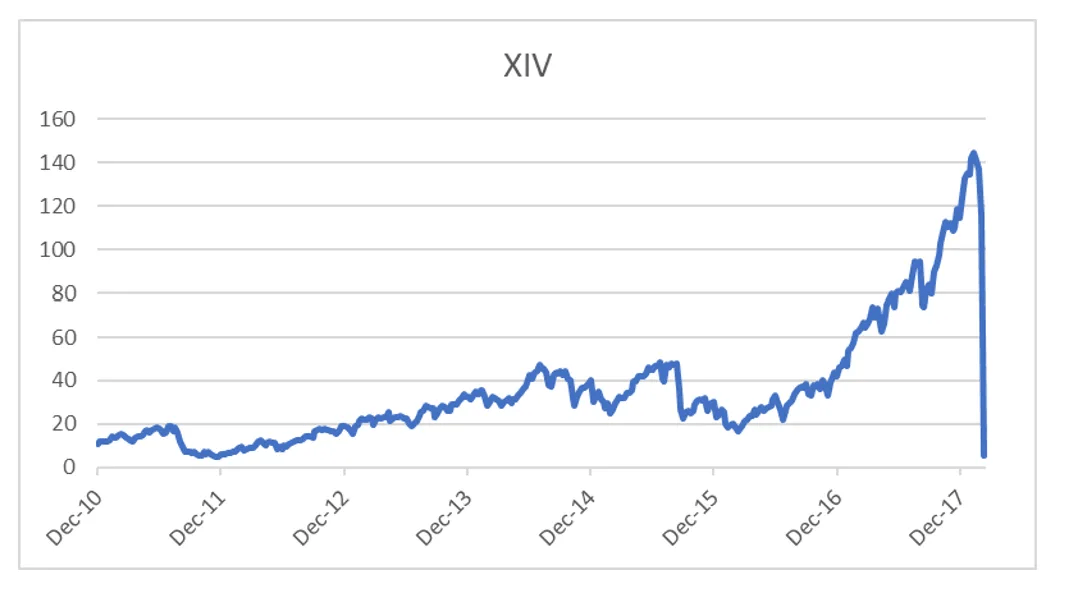
Products that sell volatility to generate yield (or converting the premium you receive from selling volatility into a form of fixed income) – autocallables – have been an interest for me for years. Over the years we have seen various blow-ups in the volatlity markets – HSCEI in 2015/6, KOSPI in 2019. Back in GFC, Japanese autocallable products, particularly in currency markets proved to be totally disastrous. Most investors should remember the overnight implosion of XIV, a short VIX ETF, in 2018.

One of the things that I started to look at was trying to work out when volatility is “mispriced”.

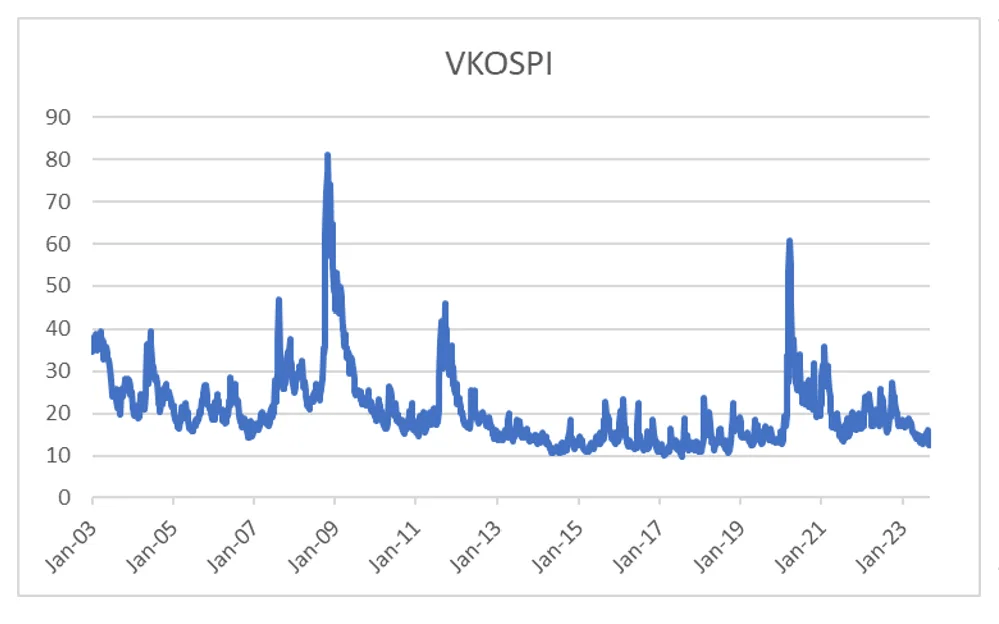
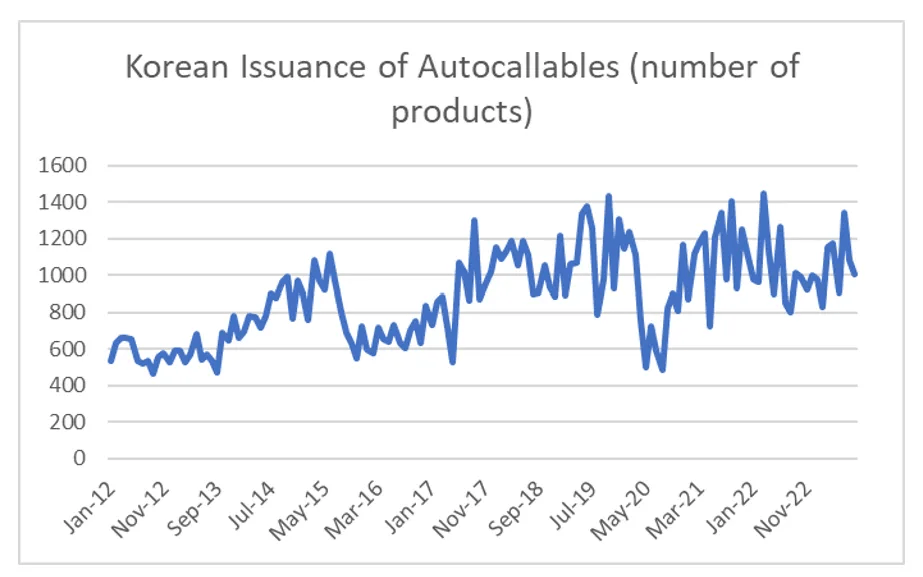
That is when in my view that volatility selling products had pushed volatility to unsustainable low levels. One of my favorite examples of this was Korea, which in recent years has become the single biggest market for equity autocallable products. From 2003 to 2012, VKOPSI (VIX for KOSPI 200) rarely traded below 20. From 2012 onwards it rarely traded above 20, until we hit Covid and 2022 tech sell off – but here today we are trading back at close to record lows.

I noted that the collapse in Kospi volatility coincided with the sharp increase in Korean issuance of autocallables.

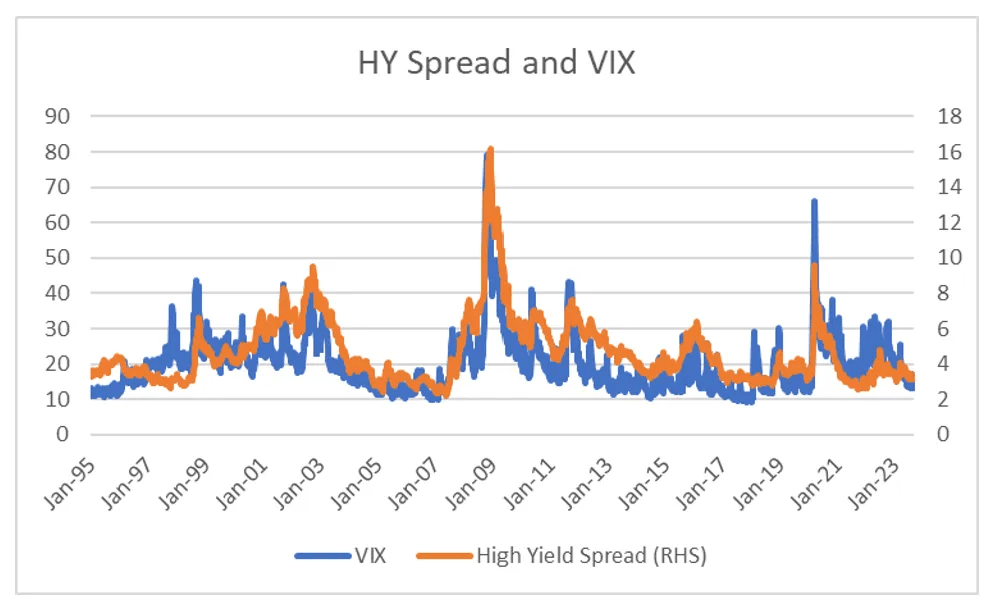
I started to think that the tail was wagging the dog. Looking at the way clearinghouses prices risk, I could see a world where momentum strategies would drive volatility lower and markets higher, and then cause a massive unwind. In many ways, what we saw in the GFC. The problem with the view was that governments now take a very dim view of financial instability. When I look at VIX, and compare it to high yield spreads, another measure of financial risk, the correlation is very high, and with no real change in the relationship since 1995, despite the rise of volatility selling.

The big difference to the 1990s, or even the 2000s, is that governments are extremely pro-active in stabilising markets. The Federal Reserve guaranteed high yield bonds during Covid, and governments have a “spend what it takes” attitude to economic growth. US and China are taking divergent view on markets. The US seems more comfortable with doing whatever it takes to keep markets growing, while China wants lower property prices, and is happy to see property developers go bankrupt to achieve that end. Due to this political divergence, see that the correlations between VHSCEI (China) and VIX (US) is weakening. In 2015, the move higher in VHSCEI was driven my currency devaluation fears, but the recent move higher is more politically driven in my view.

So post GFC, volatility markets, as they are tied to credit markets which represent the willingness of governments to backstop those markets. From that perspective, Europe has much more closely followed the US.

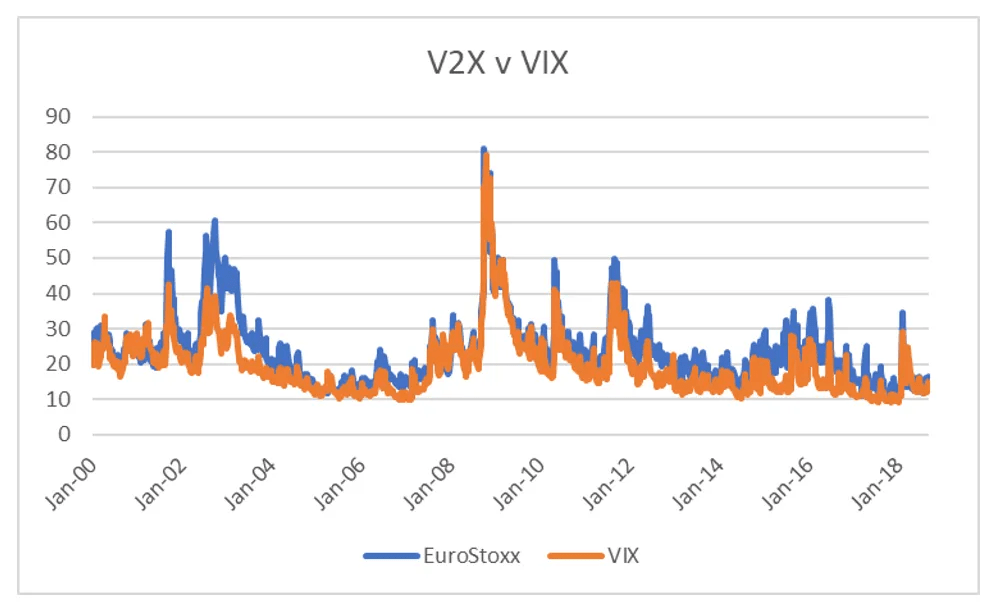
The relative volatility of EuroStoxx 50 also matches up with the political changes in Europe. From 2011 onwards, there was more political risk in European markets than in the US. Even though the ECB acted to stabilise markets, there was no political agreement. With Covid, and more united approach to Europe by European governments has appeared, the premium of European vol to US vol has collapsed. From an economic point of view, the war in Ukraine should lead to Eurostoxx Vol trading at a premium, but politically, the collapsing vol premium makes sense.

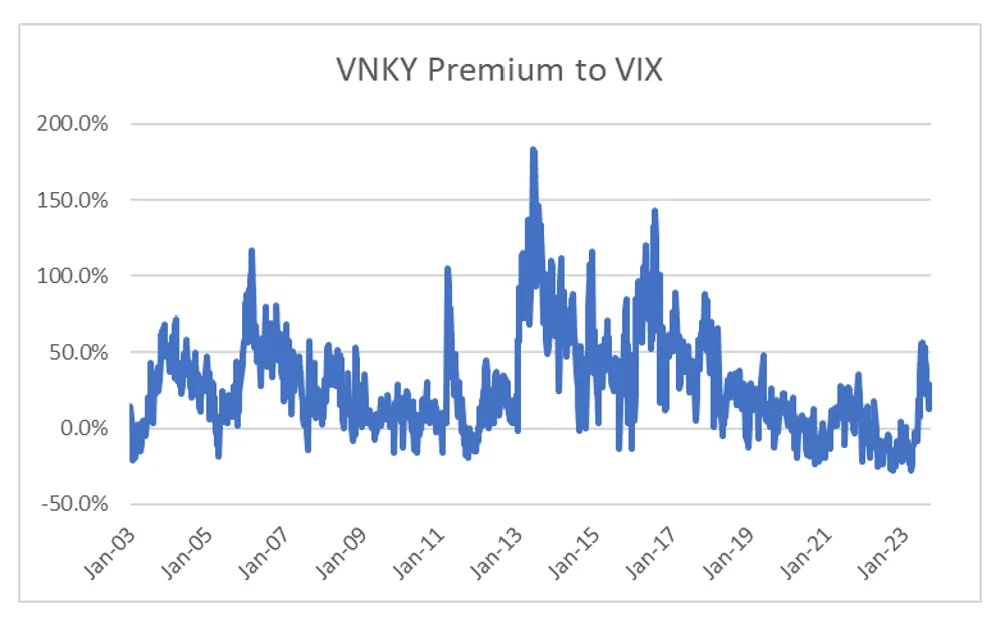
So for volatility traders, what does this analysis mean? Well the low levels in the US, Korea and Europe accurately reflect government attitudes towards markets. While Biden talks up taking on big corporates, with an election year coming up, strong stock markets are probably better for him. One market where problems of income inequality and over powerful corporates is not an issue is Japan. Here both government and central bank policy is still pro-capital. From this perspective, I could almost argue that VNKY should trade inside VIX, which in recent years it has started to do, this in sharp contrast to the trend from 2003 to 2019.

Recently VNKY has spiked over VIX, so for volatility traders, a short VNKY perhaps hedged with a long VIX looks interesting.

Politics trumps economics is the lesson I have learnt the hard way. Politically it feels there is less political risk in Japan, so this premium in VNKY look like an opportunity. However, this view is based on a political judgement, which means it could change quickly if politics changes.

Tyler Durden
Thu, 09/14/2023 – 09:25

Caesars Reportedly Paid Millions To Hackers, While MGM Paralyzed In Cyberattack

0
Caesars Reportedly Paid Millions To Hackers, While MGM Paralyzed In Cyberattack

We asked this question on Wednesday: Sin-City Cyber-Siege?

MGM Resorts International isn’t the only Vegas casino dealing with cyberattacks. People familiar with the matter told Bloomberg that Caesars Entertainment Inc. is about to reveal in a regulatory filing it was the victim of a cyberattack on Aug. 27. 

The disclosure of the alleged Caesars breach comes four days after MGM Resorts International has been plagued with a cyberattack since Sunday, shutting down critical computer systems responsible for operations at more than a dozen properties.

According to the people, Caesars and MGM were hit by the same hacking group, known as Scattered Spider or UNC 3944. 

Here’s more from Bloomberg: 

MGM was still working to resolve the turmoil caused by the hackers, known as Scattered Spider, four days into the cyberattack that has disrupted the company’s websites, reservation system and some slot machines at its casinos across the country, according to two of the people.

Caesars was also hacked by the same group in a cyberattack a few weeks earlier, and ended up paying tens of million of dollars to the hackers, according to the people, who asked not to be identified because the information is private. The hackers first breached an outside IT vendor before gaining access to the company’s network, two of the people said.

As of Thursday morning, MGM websites remain inaccessible.

Ransoms are usually paid in cryptocurrency. Around the Ceasers hack, there was an 8% spike in Bitcoin. Since the MGM cyber issue, BTC jumped 6%. 

The people said the hacking group comprises of young adults (“some as young as 19 years old”) across the US and the UK. 

We would’ve thought by now corporate media and the Biden administration would’ve blamed Moscow hackers. 

Tyler Durden
Thu, 09/14/2023 – 09:05

Initial Jobless Claims Plunge Near 12-Month Lows (Thanks To Ohio’s Fraud Fix)

0
Initial Jobless Claims Plunge Near 12-Month Lows (Thanks To Ohio’s Fraud Fix)

After the prior week’s tumble to the lowest levels since 2022 – thanks to Ohio fixing its fraud situation – expectations were for a pickup in initial claims last week and the headline print did rise very modestly (from 215k to 220k). But on an NSA basis, jobless claims dropped to their lowest since September 2022…

Source: Bloomberg

Once again, we think it is important to remember that two distortions that likely boosted initial claims over the last few months – potentially fraudulent filings in Ohio and expanded eligibility for unemployment insurance in Minnesota – and that has now been erased.

And just to make it very clear, Ohio has been the state with the biggest decline initial claims for the last four weeks…

Continuing claims rose very modestly the prior week – but remains below the key 1.7MM level…

Source: Bloomberg

As a reminder, the unemployment rate is now at its highest since Feb 2022…

WTF!

Tyler Durden
Thu, 09/14/2023 – 09:01