Global beer consumption exceeded 185 million kiloliters in 2021, enough to fill more than 74,000 Olympic-sized swimming pools.
So, which countries drink the most beer?
In the chart below, Visual Capitalist’s Bruno Venditti uses data from Kirin Holdings to compare global beer consumption by country. The Japanese company has been tracking beer consumption around the world since 1975.
Which Countries Drink the Most Beer?
Every region in the world increased its overall beer consumption in 2021 compared to 2020, with global consumption rising by 4%.
Asia holds a 31% share of the global beer market, remaining the world’s largest beer-consuming region over the last 14 years.
China was the largest beer-consuming country for the 19th consecutive year.
The tradition of brewing and enjoying beer in China spans approximately nine millennia. Recent archaeological discoveries have revealed that as far back as 7000 BC, ancient Chinese communities were engaged in producing beer-like alcoholic beverages, primarily on a small and localized basis.
China was also the leading producer of beer in 2022, followed by the United States.
Beer Consumption Per Capita
When examining per capita beer consumption, Asia falls behind Europe. In fact, nine of the top 10 consumers of beer per capita are European nations.
The Czech Republic remains the leader in per capita beer drinking for the 29th year. In 2021, the average Czech drank more than 184 liters of beer.
The Czech Republic is known for its affordable beer. In some parts of the country, beer can even cost less than bottled water.
Small Brewers and Technology
Beer production is expected to rise over the next decade, boosted by new smaller brewers, particularly in Western countries.
Investments have also been made in new technology to expedite the brewing process, including the utilization of ‘BeerBots’ capable of accelerating the fermentation process.
According to Future Market Insights, the global beer market is projected to be valued at $690 billion in 2023, rising to $996 billion by 2033.
China’s economy is in trouble. After seeing a video claiming much of China’s Electric Vehicle industry was built on subsidies that are now gone, I’m forced to ponder the legacy of these policies. It showed a factory in Chongqing, China, where a huge number of clean energy vans sit abandoned, covered in a thick layer of dust. This rendered their original appearances unrecognizable. Recently, aerial footage has also surfaced of vast grassy fields in Hangzhou littered with thousands of clean energy vehicles. This brings into question how this occurred.
Subsidies are more direct and worse than creating incentives or giving encouragement. Subsidies are a transfer of wealth. Without a doubt, many “false booms” are the result of scams created through subsidies. While it could be argued subsidies have moved the production and innovation in the EV industry forward, it brings up other issues. A huge question is whether this has created a situation where other governments have strayed down the same wrong path in an effort to spur growth. This possibility should not be discounted. Consider for a moment that maybe EVs are not the answer to a more sustainable world.
The immense waste and the environmental problems and pollution resulting from improperly placed subsidies and regulations should be addressed. The big problem China now faces is that advanced economies are complex. When they start to shut down reversing the trend becomes difficult due to contagion. It is hard to build a machine when even a few parts are unavailable. This means the trend in China will not be easy to reverse.
China is now seeing the result of subsidies backfiring and the toll of reverse leverage is devastating both investors and its economy. After looking at the mess China has made out of building ghost cities, we must turn our attention to population control and demographics. China’s poorly thought-out policies on these subjects feed into its current problems. The ramifications we are seeing play out are often referred to as unintended consequences. This is something we see far too much of.
China can no longer hide its growing problem of misallocating capital. This is coming back to haunt them. This is why many economists tout capitalism as the best economic system, it has proven to be more responsive to demand than planned economies which tend to go off track. The magnitude of China’s problems is seen when viewing an ABC News In-depth piece covering the demolition of a huge number of large unfinished residential buildings in China. This has revealed two issues, first, China was building residential buildings for “expanding future generations” that simply do not exist. The second was this resulted in rampant speculation driving prices through the roof. Now those prices are plummeting.
So, let’s circle back to the question of whether this has created a situation where other governments have strayed down the same wrong path. Just becauseanother government does something does not mean it would be good for us. Big governments are stupid and big companies are predatory. The thing they have in common is both want more control and power. In truth, we are the underdog in this ongoing struggle for control of our lives. This results in subsidies that tend to corrupt the direction capitalism takes if left alone. Unfortunately, the government is influenced by big company lobbyists that bend regulations strongly in their favor often at the expense of society at large.
The energy sector and important decisions about our future have been hijacked by this trend. An example of how twisted things have become can be seen on America’s roadways. Today millions of drivers zip down the road, the only occupant in oversized four-door trucks that get poor gas mileage. This is the answer lobbyists for the big auto companies and politicians arrived at to sidestep America’s fuel efficiency standards enacted to save gas. Still, considering the political climate, China is crazy if it thinks the EU or America will throw open their borders to import Chinese-made cars. Both have their own auto industries to protect.
Subsidies have led to many preposterous decisions, these include replacing all our current vehicles with EVs. It has resulted in America dropping tariffs on solar panels from China and spending billions of taxpayer dollars on them with the goal of rapidly reaching clean energy goals. even the rise of Amazon and its negative impact on the environment with its delivery to your door and high rate of returns or simply throw-away mentality falls into this category. Without subsidies such as the USPS delivering at a discount, even on Sundays and holidays, Amazon would not have become the giant force and destroyer of businesses it is today.
The energy sector and important decisions about our future have been hijacked by subsidies and regulations that have little basis. This trend does not bode well for creating a more productive future. China is growing proof that once a deep-seated fear of the future becomes ingrained in society people lose faith in the government’s ability to turn things around. this is a lesson America learned during the Great Depression. One of the answers to forming better policies that benefit society is not to subsidize the projects of big businesses and politicians at the expense of organically grown solutions to our problems.
Former chief medical advisor to the US President Anthony Fauci was questioned over the weekend by CNN reporter Michael Smerconish, about face masks being able to curb the spread of covid-19.
“There’s no doubt that masks work,” said Fauci.
“Different studies give different percentages of advantage of wearing it, but there’s no doubt that the weight of the studies … indicate the benefit of wearing masks,” he added.
Smerconish brought up the 2023 Cochrane review which found no evidence that physical interventions like face masks could stop viral transmission in the community and cited my interview with lead author of the study Tom Jefferson who confirmed, “There is just no evidence that they [masks] make any difference. Full stop.”
CNN’s @smerconish confronts Dr. Fauci with the latest evidence that masks, even N95s, made “no difference” in the pandemic. Fauci responds by basically conceding that point while adding the nonsensical claim that masks work on an “individual basis,” or something.
Fauci replied, “Yeah but there are other studies,” stressing that masks work on an individual basis.
“When you’re talking about the effect on the epidemic or the pandemic as a whole, the data are less strong…but when you talk about an individual basis of someone protecting themselves or protecting themselves from spreading it to others, there’s no doubt that there are many studies that show there is an advantage,” said Fauci.
Professor Tom Jefferson, who says he is committed to updating the Cochrane review as new evidence emerges, has responded to Fauci’s comments.
“So, Fauci is saying that masks work for individuals but not at a population level? That simply doesn’t make sense,” said Jefferson.
“And he says there are ‘other studies’…but what studies? He doesn’t name them so I cannot interpret his remarks without knowing what he is referring to,” he added.
Jefferson explains that the entire point of the Cochrane review was to systematically sift through all the available randomised data on physical interventions such as masks and determine what was useful and what was not.
Since 2011, the Cochrane review only included randomised trials to minimise bias from confounders.
“It might be that Fauci is relying on trash studies,” said Jefferson. “Many of them are observational, some are cross-sectional, and some actually use modelling. That is not strong evidence.”
“Once we excluded such low-quality studies from the review, we concluded there was no evidence that masks reduced transmission,” he added.
The problem with Fauci is that his story has changed.
Initially, Fauci said that masks were ineffective and unnecessary. In March 2020, Fauci told60 Minutes, “Right now in the United States, people should not be walking around with masks.”
But only a few weeks later, he did a U-turn and began recommending widespread use of face masks.
Fauci defended his U-turn saying, “When the facts change, I change my mind.”
Jefferson retorted, “What facts changed? There were no randomised studies, no new evidence to justify his flip-flop. That’s simply not true.”
Since then, Fauci has remained adamant that face masks not only stop people from infecting others, but they also protect the wearer.
Fauci advocated for the use of cloth masks, and even encouraged double-masking in the absence of evidence.
“You put another layer on, it just makes common sense that it would be more effective,” Fauci told NBC News.
“What Fauci doesn’t understand is that cloth and surgical masks cannot stop viruses because viruses are too small and they still get through,” said Jefferson.
He laments that public figures have tried to undermine the Cochrane review, despite it representing the gold standard of evidence.
Cochrane’s editor-in-chief, Karla Soares-Weiser capitulated to pressure and “apologised” for the wording in the plain language summary of the review because it “was open to misinterpretation” and may have led to “inaccurate and misleading” claims.
And former CDC director Rochelle Walensky misled Congress after claiming the Cochrane review had been “retracted” which was patently false.
As it stands, the Cochrane review will continue to be the subject of attacks because it presents a major roadblock for implementing masking policies. Jefferson says he doesn’t know what motivates people to ignore the facts.
“Could it be part of this whole agenda to control people’s behaviour? Perhaps,” he speculated.
“What I do know,” said Jefferson, “is that Fauci was in a position to run a trial, he could have randomised two regions to wear masks or not. But he didn’t and that’s unforgivable.”
Fauci, who served as the federal government’s top infectious disease specialist for nearly 40 years, stepped down in Dec 2022 and is now a professor at Georgetown University’s Department of Medicine, in the Division of Infectious Diseases.
Scientists all over the world continue to “play God”, and we are all going to have to live with the consequences.
Every single day, incredibly bizarre experiments are being conducted in secret laboratories all over the planet. I have frequently warned my readers about the very deadly diseases that are being developed in such laboratories, but other types of extremely sick experiments are happening as well. For example, it is being reported that one team of researchers has now been able to create a human “entity” that does not have a mother or a father. In fact, it was created “without using sperm, an egg or a womb”…
Scientists report they have grown the early stages of a human embryo-like entity without using sperm, an egg or a womb.
The ’embryo model’ even releases hormones that triggered a positive pregnancy test.
This is like something out of a science fiction novel.
Why in the world would they even consider doing something like this?
They are telling us that using such “entities” will make medical research easier, and frankly that makes me want to vomit.
There is no way that doing this sort of thing should be legal.
But it is.
This team of researchers was able to create a human “entity” without a mother or a father by starting with naive stem cells…
Instead of a sperm and egg, the starting material was naive stem cells which were reprogrammed to gain the potential to become any type of tissue in the body.
According to the BBC, chemicals were used to encourage these stem cells to develop into four unique cell types that are involved in the earliest stages of human embryo development…
epiblast cells, which become the embryo proper (or foetus)
trophoblast cells, which become the placenta
hypoblast cells, which become the supportive yolk sac
A total of 120 of these cells were mixed in a precise ratio – and then, the scientists step back and watch.
About 1% of the mixture began the journey of spontaneously assembling themselves into a structure that resembles, but is not identical to, a human embryo.
‘This is really a textbook image of a human day-14 embryo, [which] hasn’t been done before,’ said Professor Hanna.
If such an entity can survive to that stage, could it go all the way and actually become a full-blown baby?
Now that this breakthrough has been achieved, it is just a matter of time before someone tries to do that.
And just imagine the implications if this eventually starts happening on a widespread basis.
Babies could literally be grown on a massive scale all over the globe.
Instead of having children the natural way, parents could just order a baby that meets certain specifications.
And any babies that came out with “defects” would inevitably be discarded.
Alternatively, it is easy to imagine entire armies being “grown” by tyrannical rulers just like we have seen in certain science fiction movies.
Would such “entities” be truly human?
Would they even have souls?
There is so much that we don’t know, and hopefully this sort of work will be banned so that we will never find out.
Unfortunately, there is very little holding the scientific community back at this point.
Most of the general population has no idea what is going on in these secret labs, and most of our politicians don’t seem to care.
And so “science” will continue to advance all over the globe with very little resistance at all.
In addition to experiments that are creating new life, researchers are also searching for ways to cheat death.
In recent years, swapping blood with the young has become a very hot trend among America’s billionaires. Here is just one example…
Until recently, Bryan Johnson was paying hundreds of thousands of dollars to infuse one litre of his teenage son’s youthful plasma into his own ageing blood stream every month. “I’ve never paid more attention to what he’s eating … because that was going into my body,” the 46-year-old American tech entrepreneur says on new podcast The Immortals. He also pumped his own plasma into his 70-year-old father’s body to help improve his declining physical and cognitive health: “It was one of the most meaningful moments in his entire life. And it was the same for me.” Johnson continues to pay $2m a year for a research team to investigate how we can live longer – and he is certainly not the only rich guy in Silicon Valley dedicated to the search for eternal life.
Guys like Johnson have more money than they will ever need.
But they know that their days are limited.
So in a desperate attempt to “buy more time”, they are literally injecting the blood of young people into their own veins.
This is another thing that shouldn’t be done.
And it is probably dangerous.
But nobody is going to stop them.
In fact, the pace of scientific change will continue to march forward at an exponential rate.
Given enough time, our world would be transformed into something stranger than anything that Hollywood has ever dreamed up.
Triggered: Woke Alabama School Suspends 6-Year-Old Over ‘Finger Guns’ During Cops And Robbers Game
A six-year-old Alabama boy was suspended from school and had his “permanent record” threatened for making ‘finger guns’ during a game of cops and robbers.
“They labeled my six-year-old as a potentially violent and dangerous student because he was being a little boy and playing cops and robbers with another student (who was also suspended) and using his fingers like a gun,” said the boy’s father, Jarrod Belcher, in a statement released on Friday, Sept. 8.
According to theEpoch Times, a Jefferson County Board of Education “Due Process Referral for Class III Infractions” form released by Gun Owners of America (GOA) reads that Belcher’s son was “using gun fingers to shoot at another student.”
The boy was subsequently suspended from school pending a hearing with his parents.
According to the letter, on Sept. 1, 2023, two boys were playing “cops and robbers” during recess at Bagley Elementary School.
“During the course of their play, the children reportedly extended their index fingers and thumbs and said ‘bang-bang’ at each other,” the letter reads.
The child, identified as J.B., was suspended and accused of committing a Class III infraction. This is the district’s most serious infraction. According to the Jefferson County School District’s Student Parent Handbook, Class III infractions include possession of guns or explosives, sexual battery, battery of a school district employee, and robbery, among others.
The boy would only be allowed back in school after a hearing with his parents and the district. -Epoch Times
Following a complaint from the Belchers, the disciplinary action was downgraded to a less severe Class II infraction, however Belcher is still calling BS.
“It should be noted that punching or hitting a student would have only been a Class II violation, so in the eyes of these school administrators, a finger gun is more serious than punching a classmate in the nose,” said Mr. Belcher, adding that his son shouldn’t be punished for something in which no harm was done.
“Many noses have been broken by fists, but in the last 600 years since the invention of firearms, not a single person has been so much as bruised by a ‘finger gun,’” he wrote.
Both GOA and Freeland Martz Attorneys of Oxford, Mississippi are backing the Belchers in demanding that the Jefferson County School District clear the boy’s record.
“This incident just goes to show how embedded the anti-gun mindset is in so many communities, including in red states like Alabama. I imagine most men … can recall having played in a similar fashion in their own youth,” wrote GOA senior VP, Erich Pratt, in a Friday statement. “We will continue to demand action until a full apology is made and all disciplinary records tied to this incident are permanently destroyed.”
In a demand letter on behalf of the belchers, attorney M. Reed Martz wrote: “Candidly, I thought the story may be a hoax until I reviewed the paperwork generated by the school.”
We’re sure Russian and Chinese schools are just as proactive in eliminating masculinity among their future fighting forces.
Pfizer and Johnson & Johnson pressured South Africa into implementing provisions that shielded the companies from claims over COVID-19 vaccine injuries, newly disclosed documents show.
Pfizer made the implementation of indemnification and a compensation fund part of its COVID-19 vaccine contract with South Africa, according to documents obtained by the Health Justice Initiative.
One document states that South Africa was agreeing to “indemnify, defend, and hold harmless” Pfizer and its partner BioNTech, as well as their representatives, “from and against any and all suits, claims, actions, demands, losses, damages, liabilities, settlements, penalties, fines, costs and expenses” arising from claims resulting from the vaccine, including injuries.
The only exceptions were for a breach of confidentiality or fraud.
The component was “a non-negotiable” part of the agreement between the parties, the Health Justice Initiative said in an analysis of the documents.
Johnson & Johnson, meanwhile, also secured indemnification and the introduction of the compensation scheme in its contract with South Africa.
In a Feb. 23, 2021, letter, South Africa’s ministers of health and finance said that Johnson & Johnson requested the no-fault compensation scheme “to address adverse events that are suffered as a result of the administration of the vaccine.”
“It has been noted in discussions with J & J, and acknowledged by J & J, that a no-fault compensation scheme for vaccine related adverse events does not exist in South Africa, and that the available legislative mechanisms for establishing a scheme would require some time to undertake, even if the most expeditious processes available are pursued,” they wrote.
In an exhibit attached to Johnson & Johnson’s contract, officials said that the scheme would compensate people who prove a causal link between the vaccination they received and their injury, as decided by a panel of experts. Among outcomes ripe for compensation were death, injury, and disability. The level of compensation, officials said, “should be sufficient to provide long-term relief to victims.”
Officials later promulgated (pdf) regulations on April 22, 2021, establishing the scheme.
The scheme would “provide expeditious and easy access to compensation for persons who suffer harm, loss or damage as a result of vaccine injury,” the regulations stated.
Like similar schemes in other countries, including the United States, the schemes shield vaccine manufacturers from lawsuits and compensate victims with taxpayer money.
Pfizer and Johnson & Johnson did not respond to requests for comment.
“I wouldn’t say we were bullied, but we were in a catch-22 situation to save lives of South Africans against all odds,” Foster Mohale, a spokesperson for South Africa’s Department of Health, told Al Jazeera. “The department entered into these agreements to secure vaccine doses to protect the lives of South Africans against the deadly virus which claimed more than hundred thousand lives in South Africa.”
Matthew Kavanaugh, an assistant professor at Georgetown University who analyzed the contracts, said that South African officials “were at the whims of each of these companies who really exploited that opportunity.
“No kind of contract that I’ve ever signed in my life says at some point will you deliver something to us, but in whatever amount and on whatever timeline you think works for you, and in the meantime, we will agree to fully indemnify you,” added Mr. Kavanaugh, speaking on INXPrime.
Just a handful of vaccine injury claims have been paid out so far, South African Health Minister Joe Phaala said in June.
A number of side effects of the shots have been confirmed or are suspected, including blood clotting and heart inflammation. Some people have died from vaccine-induced injuries.
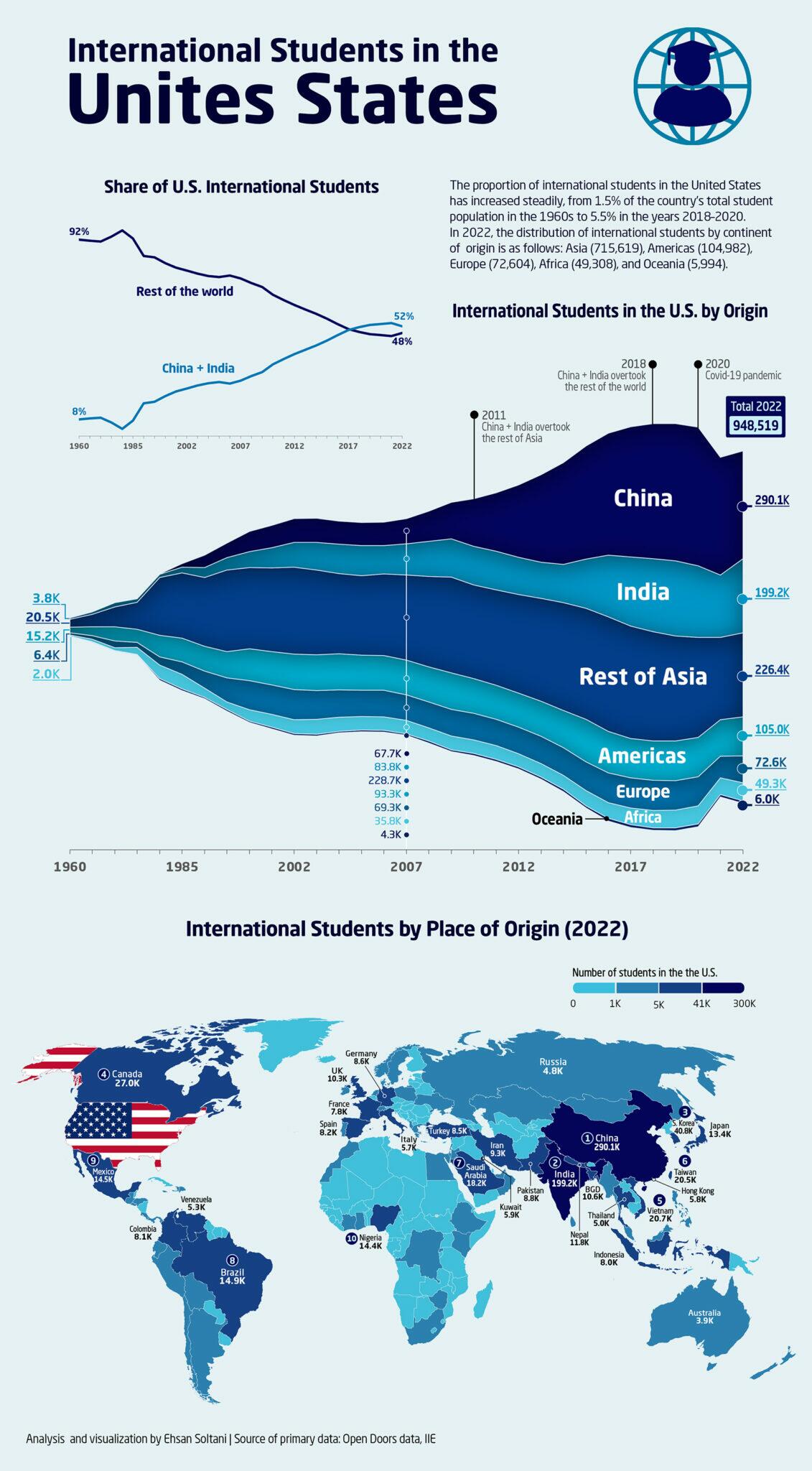
Where Do International Students In The U.S. Come From?
When it comes to higher education in the United States, the proportion of international students attending US institutions has jumped from 1.5% in the 1960s to 5.5% in the early 2020s.
According to a visualization from the International Education Exchange, one can se exactly where most of these students hail from.
The United States has always attracted students seeking quality education at its many world-class universities and opportunities in the country’s job market.
After a drop in recent years due to COVID-19 restrictions, American institutions registered a 3.8% increase in international student participation in 2022.
There were 948,519 international students at U.S. colleges and universities last year.
Asian students represent 75% of the total, with Chinese (30%) and Indians (21%) adding up to over half the count. Oceania is the place of origin with the fewest international students enrolled in the U.S., making up only 0.6% of the total.
According to Open Doors, for the first time in a decade, there were more graduate students (41%) than undergraduates (36%) studying in the United States in 2022.
Since the COVID-19 pandemic, many colleges and universities have started to offer online courses. Still, the vast majority of students attended classes in person last year.
A Billionaire Business
International students continue to be a priority for the U.S. higher education sector, contributing $32 billion to the country’s economy in 2022.
With the demographic decline in U.S. domestic higher education enrollment, many colleges and universities are strategically focusing on international students.
According to IIE, 89% of U.S. colleges and universities indicated that 2023/24 applications are up or have stayed the same as the previous year.
Several schools and private companies have reinstated mask mandates as COVID-19 cases and hospitalizations continue to increase across the country, causing divisions in communities over how to limit the spread of the coronavirus.
COVID-19 hospitalizations have increased by nearly 16 percent over the past week alone, according to the Centers for Disease Control and Prevention (CDC).
In Alabama, Kinterbish Junior High School issued a mask mandate in late August for students, staff, and visitors due to COVID-19 and just this week, Rosemary Hills Elementary School in Silver Spring, Maryland, issued a mask mandate for 10 days, after three people at the school tested positive for the virus.
“It always starts the same way, as a temporary mandate ‘15 days to [slow the spread],’” Kyle Wilkens, a parent in Silver Spring, told The Epoch Times. “I can’t go through this again, my child is not wearing a mask to school.”
Ms. Wilkens believes the mandate will be extended, though it is set to expire by Sept. 15.
“The media is already doing its part to fear monger. Now, they are trying to soften us up with scattered mask guidance and requirements here and there. We know from before it will escalate.”
Others in the area believe the temporary mask mandate is a good idea to prevent transmission of the coronavirus in the community.
“It’s better than getting stuck at home for 10 days or feeling miserable and getting stuck at home,” Marlene Tay of Montgomery County, Maryland, told The Epoch Times.
“We all got COVID last year after some school cases. It was awful because of course our daughter was fine while we felt sick. I expect to get sick soon. Our neighbors just had their third case a few weeks ago. All the kids are getting fevers and sore throats even though it’s not usually COVID, (yet).”
In other parts of the country, mask mandates have also been issued and lifted. Morris Brown College in Atlanta, Georgia, ended its mask mandate after two weeks. As did Lionsgate film studios and Kaiser Permanente in California after briefly putting a mandate in place.
“Thank god I live in Florida,” Tammy Contreraz of Tampa Bay told The Epoch Times. “I don’t have to deal with all these confusing rules on mandates.”
Health Officials Split on Masking
The CDC has issued some recommendations for masking by county based on hospital admission rates, categorizing admission levels as green, yellow, and red (low, medium, and high).
Advertisement – Story continues below
If hospitalization rates for COVID are at the yellow (medium) or red (high) level, when there are 10 to more than 20 new admissions per 100,000 people in a county, the CDC recommends wearing a mask while indoors or in a public space.
“I think it’s smart guidance, masks are effective at limiting any airborne pathogen but only if worn consistently, especially in crowded spaces and close contact areas,” Santiago Mercado, an Emergency Room Nurse at Elmhurst Hospital in Queens, New York, told The Epoch Times.
“I don’t know how well people will comply with the guidance, but it can absolutely protect the public and improve preventable deaths.”
Mr. Mercado worked at intensive care units in hospitals across the New York City area during the pandemic in 2020 and has seen how quickly COVID can spread—inundating healthcare facilities.
“It was like a brush fire; so many people were dying every day. Anything we can do to prevent that again, I support,” he said.
Healthcare professionals on the other side of the issue disagree and say masking has no significant benefit to avoiding infection by the coronavirus.
“The CDC’s own data reveals that those who wear masks get infected with COVID at the same rate as those who don’t,” according to an analysis from Americas Frontline Doctors posted on their website.
“85 percent of those infected with COVID wore masks some or all of the time before their infection. The countless jurisdictions that mandated masks actually saw an increase in infections during the mandate. A key randomized, controlled study of mass masking during the COVID outbreak, concluded that wearing a mask had no significant effect on viral spreading.”
The organization goes on to report that even if masks were effective, there are negative impacts of continuous mask-wearing, such as a “decrease in the levels of oxygen intake, headaches, Mask-Induced Exhaustion Syndrome (MIED), reduced immunity germ load and skin reactions.”
Governors on Mask Mandates
There are no statewide mask mandates across the country so far, though in New York, Gov. Kathy Hochul (D) unveiled a plan to distribute N-95 and KN-95 masks to schools this fall but is not mandating their use.
“Thanks to the hard work of New York schools, teachers, and parents, we have come a long way to ensure students can safely return to the classroom,” Ms. Hochul said. “Frequent testing for COVID-19 is an important part of keeping our kids safe and preventing an outbreak, and I will continue working to ensure our school districts have the resources they need to provide a safe, in-person learning environment for our students.”
A discarded face mask is pictured on the sidewalk in Long Beach, Calif., on Aug. 22, 2020. (Apu Gomes/AFP via Getty Images)
In Mississippi, Gov. Tate Reeves (R) has made his opposition to masking abundantly clear, stating there will be no mask mandates in the near future.
“There are some on the left that still want COVID restrictions… Let me say it again – there will be no mask mandates, COVID vaccine mandates, or lockdowns in Mississippi,” Reeves posted on Facebook.
“Mississippians will not and should not submit to fear again … If you want to take extraordinary measures to protect yourself from getting sick, God bless you. That is your right and you should do what you think is best. Maybe you’re the smartest of all of us. But we are never going back to 2020.”
Fight Over Mandates on Capitol Hill
The split over mask mandates has spilled into politics in the nation’s capital, as some Republicans in Congress introduced legislation to ban a mandate of any kind.
Senators JD Vance (R-Ohio), Mike Braun (R-Ind.), and Josh Hawley (R-Mo.) have cosponsored a Senate bill called the “Freedom to Breathe Act” which would ban federal mask mandates in the United States.
“We tried mask mandates once in this country. They failed to control the spread of respiratory viruses, violated basic bodily freedom, and set our fellow citizens against one another,” said Vance.
“This legislation will ensure that no federal bureaucracy, no commercial airline, and no public school can impose the misguided policies of the past. Democrats say they’re not going to bring back mask mandates – we’re going to hold them to their word.”
The White House issued a “100 Day Masking Challenge” in 2021, where President Joe Biden implemented a mask mandate on federal property, but the administration has not issued a new nationwide mandate since.
In this graphic, we use data from Henrik Bessembinder of Arizona State University to show the best stocks of the last century.
How is Shareholder Wealth Creation Calculated?
Bessembinder took three steps to measure lifetime shareholder wealth creation:
Considered U.S. stocks in the Center for Research in Security Prices database from 1926 (or when the stock was first listed) until 2022 (or when the stock was delisted).
Measured share price changes as well as cash flows to/from shareholders including dividends, spinoffs, share buybacks, and new share issuances.
Calculated the excess wealth generated compared to investing in one-month Treasury bills over the same time period.
If a company exited the database during the period, Bessembinder calculated its delisting return based on any proceeds from mergers or acquisitions as well as estimates of any remaining value after delistings for negative reasons.
GM is the only company within the top 25 to be delisted prior to December 2022. Its second IPO in 2010 was considered a new company and not continuous wealth creation.
The 25 Best Stocks in Modern History
With this definition in mind, here are the best stocks since 1926.
Apple takes the top spot, having created nearly 5% of all shareholder wealth. From the iPod to the iPhone, Apple’s ability to keep innovating has helped it gain a loyal fan base and given the company pricing power. Notably, Apple is America’s most profitable company.
ExxonMobil is the only non-technology company among the five best stocks. When Exxon and Mobil merged in 1999, it was the biggest merger in history and ExxonMobil temporarily became the world’s largest public company by market capitalization. More recently, the company experienced record profits in 2022 due to high oil prices.
The list also shows how wealth-generating patterns have changed over time. While energy and consumer staples are more frequent among older companies in the ranking, the stocks that have created massive wealth in recent years are more likely to be technology or financial companies.
Finding the Next Winners
Given that the names on this list account for 0.1% of all public U.S. stocks, picking out one of the next long-term winners could be a difficult task. In fact, 95% of actively-managed large cap funds—which aim to beat the market through stock picking—underperformed their benchmark over a 20-year period.
Investing in index funds is one possible way to get exposure to top performers. For instance, Apple has been part of the S&P 500 since 1982, about a year after it went public.
Megyn Kelly, a veteran journalist and podcaster, said Wednesday that she deeply regrets getting the COVID-19 vaccine because she believes she may have suffered a vaccine injury.
Ms. Kelly said that she regrets getting vaccinated and then boosted, saying she doesn’t think it was necessary—and that a doctor told her that an autoimmune condition she developed after getting the shot may be related to the vaccine.
“I regret getting the vaccine even though I’m a 52-year-old woman because I don’t think I needed it,” Ms. Kelly said during a Sept. 6 episode of her podcast “The Megyn Kelly Show.”
“I think I would have been fine. I had got COVID many times, and it was well past when the vaccine was doing what it was supposed to be doing,” she added.
“For the first time, I tested positive for an autoimmune issue at my annual physical. And I went to the best rheumatologist in New York, and I asked her, do you think this could have to do with the fact that I got the damn booster and then got COVID within three weeks? And she said yes. Yes. I wasn’t the only one she’d seen that with,” Ms. Kelly said.
Her current vaccine regret stands in contrast to remarks she made in April 2021, when she said she had “zero qualms” about getting the shot.
“Am getting the [Johnson & Johnson] vaccine this [weekend]. Have zero qualms [because] have spent a life immersed in a media obsessed with fear-mongering that is often irresponsible and untrue. Do what your doctor tells you to do and ignore everyone else,” she said in a post on X, formerly Twitter.
Ms. Kelly’s expression of regret at getting the shot comes amid reports linking spike protein-based COVID-19 vaccines to skin problems, a dull ringing in the ears known as tinnitus, visual impairments, blood clotting, and even death.
Studies have also revealed a number of issues affecting vaccinated children. For example, one recent study, published in the journal Frontiers in Immunology, shows that the mRNA-based vaccine for COVID-19 reduced children’s immune responses to other infections, making them more prone to getting sick after coming into contact with other pathogens.
Another study published by Circulation showed that some children who experienced heart inflammation after COVID-19 vaccination had scarring on their hearts months later.
The Centers for Disease Control and Prevention (CDC) continues to recommend that people of all ages receive a COVID-19 vaccine despite the risk of heart inflammation and other side effects.
Also, documents show that the Food and Drug Administration (FDA) and the CDC hid data showing a spike in COVID-19 cases among the vaccinated.
Former President Donald Trump told former Michigan gubernatorial candidate Tudor Dixon in a recent conversation on her podcast that pharmaceutical companies have an “obligation to be honest” about vaccine side effects and should disclose all relevant data on vaccine harms.
President Trump and Ms. Dixon discussed a range of issues in an episode on the Tudor Dixon Podcast last week. At one point in the discussion, Ms. Dixon asked about President Biden’s announcement to fund a new COVID-19 vaccine.
“He wants everyone to get this vaccine,” Ms. Dixon said. “And we’re hearing about a lot of complaints from vaccine injured. To say a lot is an understatement.”
She then asked President Trump about vaccine data transparency, citing reports of various adverse events, including heart inflammation and blood clots.
“Numerous pharmaceutical companies have refused to release their data on vaccine side effects,” she said. “But we’ve seen cases of myocarditis, blood clots, and heart attacks; they’re all increasing. The research has never been released.”
She asked if President Trump would “demand that the vaccine companies, that the pharmaceutical companies release their vaccine data to the public so that we can see what they’re actually seeing about the side effects of this vaccine?”
President Trump replied by saying that pharmaceutical companies “should do that,” adding that “we’re all in this together, and they should be doing that.”
In context of President Biden’s remarks about funding a new COVID-19 vaccine, the former president said that “anything new has got to be looked at very carefully.”
President Trump then reiterated the point that pharmaceutical companies should release any data on vaccine side effects.
“They should be made public immediately. People should understand that, and they should know what research is showing,” President Trump said.
He added that pharmaceutical companies would be wrong to withhold any information on vaccine injuries.
“They have to be honest with the numbers, the facts, and they have an obligation to be honest,” he said, “And if they are going to hold back, that means they’re holding back something that’s not good.”
“We’ll stand for them in many ways,” President Trump said of people who suffered vaccine injuries.
Meanwhile, the FDA has been ordered to accelerate the pace at which it releases to the public data it relied on to license COVID-19 vaccines.
In May, a federal judge in Texas ruled that the FDA must hurry up with disclosing data that underpinned its decision to license COVID-19 vaccines, ordering all documents to be made public by mid-2025 rather than, as the FDA wanted, over the course of about 23.5 years.
“Democracy dies behind closed doors,” is how U.S. District Judge Mark Pittman opened his order (pdf), which requires the FDA to produce the data on Moderna’s and Pfizer’s COVID-19 vaccines at an average rate of at least 180,000 pages per month.