77.2 F
Chicago
Tuesday, September 1, 2026
Home Blog Page 3364

Bank of Canada Holds Rate At 5%, As Expected, Sees Excess Demand Easing But Prepared To Hike More If Needed

0
Bank of Canada Holds Rate At 5%, As Expected, Sees Excess Demand Easing But Prepared To Hike More If Needed

In a day when we have seen some unexpected monetary policy decisions, including a surprise outburst from Erdogan who flip-flopped on Erdoganomics and said that Turkey may “reduce inflation with tight monetary policy” something he refuse toa accept for much of the past decade, as well as a surprise rate cut from Poland, which slashed rates by 75bps to 6.00%, much more than the 25bps expected, which was odd considering Poland still has 10% inflation, moments ago the Bank of Canada did not surprise markets when it kept policy rate unchanged at 5%, the highest level in 22 years (and up 475bps since March 2022) as expected.

“With recent evidence that excess demand in the economy is easing, and given the lagged effects of monetary policy, governing council decided to hold,” the bank said. Officials, however, remain “concerned about the persistence of underlying inflationary pressures” and are “prepared to increase the policy rate further if needed.”

While the rate pause and the accompanying statement suggested policymakers are comfortable waiting to assess whether the deteriorating economy will restore price stability, officials remainedd worried about persistent momentum in inflation and the statement sounded hawkish enough by keeping the language saying the Governing Council remains concerned about the persistence of underlying inflationary pressures, and is “prepared to increase the policy interest rate further if needed.”

Keeping that hawkish bias may allow Macklem to avoid a repeat of January’s explicit pause signal, which led markets to quickly price in future rate cuts and rekindled Canada’s housing market.

Regarding inflation, the central bank said there has been little recent downward momentum in underlying inflation. The longer high inflation persists, the greater the risk that elevated inflation becomes entrenched, making it more difficult to restore price stability. Canada 2y yield is higher by 2bp after the decision.

Some other commentary from the BOC decision, first on the economy:

  • Remains concerned about the persistence of underlying inflationary pressures.
  • There has been little recent downward momentum in underlying inflation.
  • The Canadian economy has entered a period of weaker growth, which is needed to relieve price pressures.
  • The tightness in the labour market has continued to ease gradually.

And on policy:

  • Decided to stand pat on rates due to recent evidence that excess demand in the economy is easing, and given the lagged effects of monetary policy
  • The Bank is also continuing its policy of quantitative tightening.
  • Prepared to increase the policy interest rate further if needed.

According to Bloomberg, with many central banks globally nearing or at their terminal point for rates, Wednesday’s decision suggests Canada’s six-member panel may soon transition the debate to how long they need to hold, instead of how restrictive policy should be.

Earlier on Tuesday, the Reserve Bank of Australia also kept its key interest rate unchanged and maintained a tightening bias. Consecutive pauses in that country imply a higher hurdle for any further hikes and suggest a surprise shift in economic data will be needed to prompt additional tightening.

After its January declaration, the Bank of Canada moved to the sidelines for five months, but resumed hiking in June and July after surprisingly strong economic growth. Still, there’s ample evidence the central bank has now done enough to cool excess demand.

Canada’s economy contracted in the second quarter, far below the bank’s estimate for a 1.5% annualized expansion. The labor market is loosening — job vacancies are falling and the unemployment rate continues to tick up — and the housing market has slowed.

“The Canadian economy has entered a period of weaker growth, which is needed to relieve price pressures,” the bank said. “This reflected a marked weakening in consumption growth and a decline in housing activity, as well as the impact of wildfires in many regions of the country.”

That said, with wage growth stuck around 4% or 5%, and inflationary pressures remaining broad-based, policymakers are seeing difficulty in the “last mile” of returning inflation to the 2% target. “The longer high inflation persists, the greater the risk that elevated inflation becomes entrenched, making it more difficult to restore price stability.”

The bank also kept the last three sentences of the rate statement the same, laying out key metrics policymakers will be monitoring, including the evolution of excess demand, inflation expectations, wage growth and corporate pricing behavior.

Macklem will shed more light on his team’s thinking and its outlook for the Canadian economy in a speech to the Calgary Chamber of Commerce on Thursday. The governor is scheduled to speak to reporters afterward.

The central bank’s next decision is due Oct. 25, after double releases of jobs, inflation and retail data, as well as gross domestic product numbers for July and an August estimate.

In response to the BOC hood, the Canadian dollar fell, reversing gains seen earlier in the session (which however may have also been driven by the stronger than expected Services ISM which sparked a surge in the Dollar index). USDCAD gained as much as 0.3% to 1.3676 before paring the advance, leaving the loonie near its March lows. Swaps market prices in roughly 29% chance of a rate increase at BOC’s October meeting, compared to 25% Tuesday prior to the decision.

Tyler Durden
Wed, 09/06/2023 – 10:23

Services Surveys Signal Soaring Stagflation Risks

0
Services Surveys Signal Soaring Stagflation Risks

With manufacturing surveys still in contraction, and underlying components screaming stagflation as orders drop and prices pop, all eyes are on the ‘bigger’ Services sector surveys this morning which are expected to slip lower in August (but remain in expansion – above 50).

The S&P Global US Services PMI disappointed, declining from 52.3 (July) to 50.5 (final August), and below the 51.0 preliminary August print – weakest since January

BUT

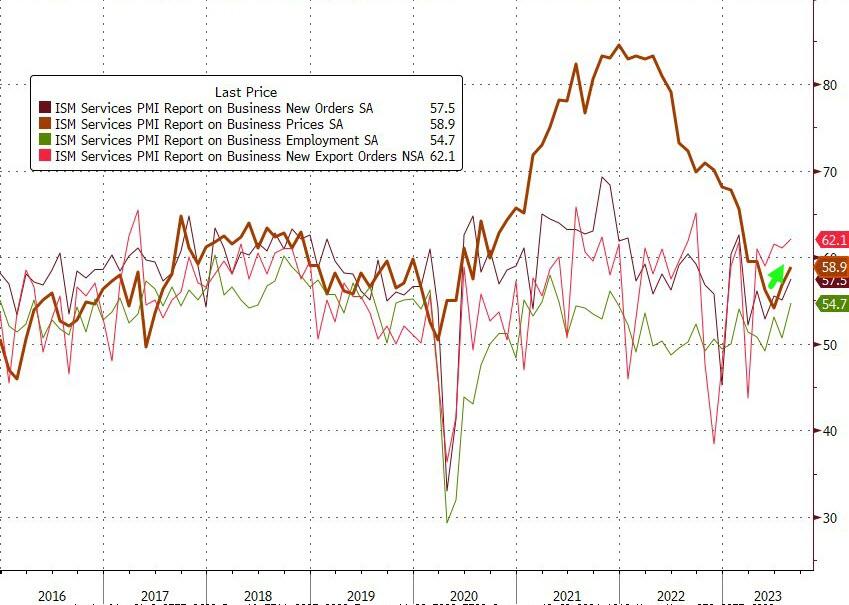
The US ISM Services soared from 52.7 to 54.5 (well above the 52.5 exp) – strongest since February

Source: Bloomberg

In case you wonder why these surveys can be so completely opposed, it is survey responses like this…

A Real Estate worker said that:

Overall conditions seem quite good, although there is definite slowdown in residential construction driven by rapidly increasing interest rates.”

A Government worker said that:

“Prices have settled. Warnings of a possible recession in 2024 are not being taken very seriously by top management. The same experts warned that the country would be in a recession by now. Our general feeling is that the (Federal Reserve’s) strategy for taming inflation and building a soft landing for the economy is working better than expected. The city has proposed reducing its municipal tax for the fiscal year beginning October 1.”

So a total joke with surveys pointing in completely different directions, but the message was similar under the hood with prices soaring

Source: Bloomberg

The final S&P Global US Composite PMI Output Index posted 50.2 in August, down from 52.0 in July, to signal only a fractional increase in business activity at US private sector firms. The slowdown in growth stemmed from a weaker service sector expansion and a renewed decrease in manufacturing output.

“The survey data send a hint of rising stagflation risks, as stubborn price pressures are accompanied by a near-stalling of business activity.

“The PMI numbers for the third quarter so far point to a faltering of economic growth after a robust second quarter, as a renewed manufacturing downturn is accompanied by a deteriorating picture in the service sector. “

Not a pretty picture:

Chris Williamson, Chief Business Economist at S&P Global Market Intelligence, said:

“While a post-pandemic revival of travel, recreation and hospitality spend contributed to an improved economic performance in the spring and early summer, this tailwind is losing momentum. Companies increasingly report customers to have become reticent to spend amid gloomier prospects as higher interest rates and the increased cost of living take their toll. However, financial services and business services providers are also increasingly feeling the pinch from weakening demand.

Persistent wage growth is meanwhile being accompanied by renewed upward pressure on energy, fuel and transport costs, as well as some broader firming of materials prices, driving cost growth higher. Competitive forces have kept a lid on selling price inflation, but the rate of increase of service sector charges remains elevated to the extent that consumer price inflation is likely to remain stubbornly above the Fed’s target in the coming months.

“The key data to watch in the coming months will be the degree to which any further waning of demand for services translates into lower pricing power and reduced inflation.

It looks like we’re gonna need more ‘Bidenomics’.

Tyler Durden
Wed, 09/06/2023 – 10:06

Prolonged US Manufacturing Slowdown Barely Dents Energy Use

0
Prolonged US Manufacturing Slowdown Barely Dents Energy Use

By John Kemp, senior market analyst

U.S. manufacturers reported that business activity declined for the 10th month running in August, though declines are becoming less widespread implying the trough in the cycle may be approaching.

The Institute for Supply Management’s purchasing managers index increased slightly to 47.6 (16th percentile for all months since 1980) in August up from 46.4 (13th percentile) in July and 46.0 (11th percentile) in June.

Despite the improvement, the manufacturing index has been below the 50-point threshold dividing expanding activity from a contraction for ten months since November 2022.

The length of the downturn has more in common with a cycle-ending recession (which have generally lasted 11 months or more) than a mid-cycle slowdown (generally lasting eight months or fewer).

If the slowdown proves to be a “soft landing”, it will be the longest since the Second World War, matched in duration only by the slowdown in 1995/96, which also lasted 10 months.

The forward-looking new orders component remained weak which indicates the downturn is likely to persist for at least several more months, which would make it the longest mid-cycle slowdown on record.

The new orders index was just 46.8 (12th percentile) in August down from 47.3 (14th percentile) in July and down from 51.3 (26th percentile) a year ago.

Industrial electricity use and distillate fuel oil consumption are both correlated with the manufacturing and freight cycle and therefore with the purchasing managers index.

Both have fallen a bit less than expected given the length and apparent depth of the downturn in industrial activity, especially in the case of diesel and other distillate fuel oils.

Based on the most recent data available, industrial electricity consumption was down by 1.7% in the three months from March to May compared with the same period a year earlier.

The change in electricity use was in the 16th percentile for all overlapping three-month periods since 1980, according to data from the U.S. Energy Information Administration (“Monthly energy review”, EIA August 31, 2023).

Distillate fuel oil consumption fell by 1.0% in the three months from April through June compared with the same period a year earlier.

The change in distillate consumption was in the 31st percentile for all three-month periods since 1980, which suggests that any downturn in industrial activity has been long but shallow.

Confirming the unexpected resilience in distillate consumption, the EIA has revised its estimate for distillate supplied up by a total of 23 million barrels (+1.6%) or roughly 63,000 barrels per day over the course of 2022.

The strength of domestic distillate consumption helps explain why fuel oil inventories have remained well below the prior ten-year seasonal average.

Resilient electricity and diesel consumption, and the correspondingly low levels of spare generating capacity and distillate inventories, imply the energy system is operating close to its maximum capacity.

In the event of a soft landing followed by a re-acceleration of the business cycle, capacity constraints will re-emerge quickly and likely lead to an early resurgence of inflation.

Tyler Durden
Wed, 09/06/2023 – 09:45

France Negotiating With Junta For Withdrawal Of Its Troops From Niger

0
France Negotiating With Junta For Withdrawal Of Its Troops From Niger

France is mulling a military withdrawal from Niger in the wake of the July 26 coup, and as a stand-off unfolds over the demand to withdraw its ambassador from the country.

France has some 1,500 troops in Niger, along with other Western allied troops – including Americans – but their presence has been unwelcome given Paris has supported threats from the Economic Community of West African States (ECOWAS) to intervene militarily to reinstate ousted president Mohamed Bazoum.

Image: Anadolu Agency

France has sought to stress that any formal talks with the junta led by Gen. Abdourahamane Tchiani should not be taken as recognition of the coup government.

According to new details in Al Jazeera:

France is reported to be in talks with Niger’s military about possible withdrawal of French troops from the West African nation in the wake of the fraying of ties following a coup in July, according to French media reports.

Confirming the news, former French ambassador to Mali and Senegal Nicolas Normand told Al Jazeera that according to his sources, talks were ongoing between the French and Niger militaries to “partially” withdraw troops.

The ECOWAS are still threatening military intervention, but this has been on the table for weeks and they appear to be waffling, given Niger’s military has reportedly bolstered its border defenses.

Any potential intervention by the West African nations would likely happen along Nigeria’s some 1,000-mile border with Niger.

Niger’s military-appointed prime minister said Monday that the junta is hoping to reach a deal with ECOWAS to de-escalate tension and avoid war. “We have not stopped contacts with ECOWAS, we are continuing contacts. We have good hopes of reaching an agreement in the coming days,” Ali Mahaman Lamine Zeine stated.

“We are bracing to be attacked at any time. Every preparation has been taken. It would be an unjust war. We are determined to defend ourselves if there is an attack,” he said.

Europe fears that previously cheap but vital resources from Niger may skyrocket in price…

Negotiations are centered on a reported plan to commit to a timeline for potential transition to civilian government, possibly nine months or up to three years.

Meanwhile, after a near month of closure, the junta has reopened airspace for commercial flights across the entire country, in a sign of potential de-escalation of regional tensions.

Tyler Durden
Wed, 09/06/2023 – 09:25

European Commission Grapples With Influx Of Ukraine Grain

0
European Commission Grapples With Influx Of Ukraine Grain

Authored by RFE/RL staff via OilPrice.com,

  • September 15 ends temporary measures allowing certain Ukrainian agricultural products to pass through five EU countries, which was instated due to border closures and oversaturation concerns.

  • Russian interference with Ukraine’s Black Sea trade has shifted a bulk of the agricultural trade routes toward the European Union, affecting local markets.

  • Options for easing trade pressures include improving the EU-Ukrainian border facilities, utilizing Baltic ports for exports, and a potential €600 million compensation for Kyiv.

The European Commission is facing tricky decisions in the coming weeks over the influx of Ukrainian agricultural products into the European Union. September 15 marks the end of the so-called temporary preventive measures that have allowed wheat, maize, rapeseed, and sunflower seed from Ukraine to transit through Bulgaria, Hungary, Poland, Romania, and Slovakia. All four of those commodities must remain “unsealed” until they reach other EU member states — ideally to EU ports to be shipped on to developing nations around the world. These measures came about in early May after Poland, then Hungary, Slovakia, and Bulgaria unilaterally shut their borders to all Ukrainian exports a month earlier, complaining that a glut of Ukrainian agricultural goods was filling up local storage and depressing prices for local farmers.

The European Commission scrambled for a solution that would satisfy the five frontline states (the above-mentioned four plus Romania) while being acceptable for Kyiv. There was also a need to ensure that Ukrainian agriproducts reached third countries, notably in Africa and Asia, that have reported food shortages.

Moreover, there was evident interest in safeguarding against major distortions on the EU’s internal market — something that the European Commission is officially in charge of. That’s a lot of circles to square, and Brussels’ solution in early May was to agree to preventive measures regarding the four products for the five frontline countries for one month, plus financial compensation for their farmers.

In June, the measures were prolonged with the understanding that they would be phased out on September 15 and, in a separate decision, the EU approved the extension by another year of a tariff-free regime with Ukraine covering all Ukrainian products entering the bloc.

Deep Background

Now the five frontline EU member states are pushing for an extension until the end of the year.

You have crucial parliamentary elections in Slovakia on September 30 and in Poland on October 15, and farmers are an important and influential constituency in both countries.

The European Commission does have some understanding for the five, and numbers back up their worries.

Before 2022, EU agricultural imports from Ukraine totaled 7 billion euros, and 90 percent came via the Black Sea route.

By 2022, that figure had risen to 13 billion euros and 5 billion of the additional 6 billion euros of goods ended up on the markets of the frontline EU states.

The big culprit here is, of course, Russia, which has severely hampered Ukraine’s lucrative Black Sea trade.

Since the outbreak of the war, 40 percent of Ukrainian grain has been exported via the Black Sea Grain Initiative that expired in July after Russia opted not to renew it.

Drilling Down:

  • Ukraine obviously wants the temporary measures removed on September 15 but finds itself in a difficult situation when it comes to its agricultural products. Only 3 percent of the products that are currently transported via the EU’s solidarity lanes instead of the Black Sea route are being shipped from the EU to third countries. There simply aren’t many global buyers for such expensive goods. Italy, the Netherlands, and Spain have instead increased Ukrainian imports, especially of maize, which is vital to feeding livestock and boosting meat production.

  • The EU is also investing to the tune of 1 billion euros to improve the Solidarity lanes — and to reduce the costs for Ukrainian traders. The most obvious remedies include removing bottlenecks on various EU-Ukrainian border crossings by streamlining customs services, improving roads leading to the crossing, and increasing personnel there. But such measures take time to implement.

  • The Baltic states have suggested easing the administrative burden on the EU-Ukrainian borders by shifting customs, veterinary, and phytosanitary controls to five Baltic ports (Tallinn, Riga, Ventspils, Liepaja, and Klaipeda), which have a combined annual capacity of 25 million tons. Croatia has also suggested using its Adriatic ports in a similar way.

  • Currently, the most likely scenario is a prolongation of the preventive measures, judging by indications I’ve gotten from EU officials. And not only that. The frontline five want more products, including eggs and poultry, added to the four types of goods already listed.

  • The European Commission has so far indicated there is no great influx from Ukraine of eggs or poultry. Raspberries, however, might be added after what one European Commission official described to me as a “drastic increase” in the EU market.

  • The European Commissioner for agriculture, Janusz Wojciechowski, recently floated the idea of compensating Kyiv along with any extension. Noting that EU transit costs around 30 euros per ton and Ukraine needs to export around 20 million tons of food produce in the coming months, the European Commission would offer 600 million euros to Kyiv.

  • This would act as a sort of economic subsidy to Ukrainian traders to enable the transport of grain all the way to EU ports. Ukraine would reportedly consider such an option, but it’s unclear whether the entire European Commission would agree to the compensation.

  • Expect that some sort of solution will be forthcoming as early as this week, especially given that a working platform set up in May to tackle the issue comprising relevant officials from the five frontline states, Ukraine, and the European Commission will discuss the issue in Brussels on September 5 as the bloc’s agricultural ministers are meeting in the Spanish city of Cordoba on September 4-5.

Turkey, which was key to the 2022 initiative that was struck to alleviate the global food shortage by opening trade from a handful of Ukrainian ports, has been working hard to resuscitate the deal. President Erdogan was expected to push for its renewal during a planned meeting with Russian President Vladimir Putin in Sochi on September 4.

There’s a question, however, as to whether Russia is interested in a renewal. By strangling the Ukrainian Black Sea option, which normally allows for larger and cheaper worldwide exports with huge cargo ships compared to transporting overland in the EU, Russia has seemingly outmaneuvered an important trade competitor and made its own grain cheaper and more lucrative worldwide.

Tyler Durden
Wed, 09/06/2023 – 07:20

Americans’ Support For, Belief In Unions Strengthens

0
Americans’ Support For, Belief In Unions Strengthens

More Americans support unions today than in the entire 1970s, 80s, 90s and 2000s.

As Statista’s Katharina Buchholz reports, in 2023, 67 percent of U.S. respondents said they approved of unions, up from only 54 percent ten years ago and comparable to levels in the 1960s. Last year support had reached 71 percent, still short of a high of 75 percent in the Gallup survey in 1953 and 1957.

Belief that unions will become stronger in the future grew even more – to 34 percent of respondents this August, up from just 19 percent in 2018 when the detailed part of the survey was last carried out. 43 percent of people said they wanted unions to have more influence, also significantly up from 39 percent in 2018 and a low of 25 percent in 2009.

Infographic: Americans' Support for, Belief in Unions Strengthens | Statista

You will find more infographics at Statista

The desire for more union power was divided along party lines – 61 percent of Democrats and 21 percent of Republican are for it – and has not changed much in the past five years, as it was mainly Independents that pivoted to championing stronger unions.

When it comes to people’s outlook on unions, however, Republicans have started to agree that unions are strengthening. 14 percent of Republicans thought so in 2018, compared with 20 percent in 2023.

Tyler Durden
Wed, 09/06/2023 – 06:55

Investors Aren’t Seeing Any Recovery In Autos

0
Investors Aren’t Seeing Any Recovery In Autos

By Michael Msika, Bloomberg Markets Live reporter and strateigst

European carmakers are so cheap that investors are pricing them to fail, seeing long-term growth and pricing power faltering as global competition intensifies. Except for their deep value, it’s hard to find a positive among the mounting headwinds.

Carmakers have been extremely cheap for nearly two years. The Stoxx 600 autos and parts forward price-to-earnings ratio is hovering around 5.3 times, near the bottom of a 17-year range and about a 60% discount to the broader market. Slowing demand, lower growth in China, fierce competition in electric vehicles and eroding pricing power are building a wall of worries for the sector.

“The sector is priced to lose substantial market share in upcoming years and, if correct, this would ultimately signal the end of the road for one of Europe’s most important industrial sectors,” say Bernstein analysts including Daniel Roeska. “Market valuations imply a free-cash-flow mean-reversion of -22% and long-term growth of 1.5%.”

The analysts believe the market is “too pessimistic,” assuming operational improvements achieved in the past year will erode, while long-term growth will be subdued. While carmakers face numerous challenges, they see some value, with outperform ratings on Mercedes and Renault, and a market-perform view on BMW, Stellantis and Volkswagen. While the latter is “overvalued,” both Stellantis and Renault are “essentially priced to go out of business,” they say.

On average, sell-side analysts are holding a positive view. The Stoxx 600 autos and parts is the subindex with the most upside seen over the next 12 months at 30%. Earnings forecasts have been on the rise this year, reaching a record high in August, but have stalled since, with cracks in the bull case finally showing in estimates.

Last week, UBS downgraded Volkswagen and Renault to sell on intensifying competition from Tesla and Chinese rivals. Earlier this month, Tesla announced a revamp of its Model 3, while again slashing prices on several variants, increasing fears of an EV price war. Meanwhile, new-model announcements at the IAA Mobility car show in Munich haven’t been a strong catalyst so far.

The sector is up 14% this year, outperforming the broader market, but most gains were achieved at the beginning of the year. Since then, it’s been a volatile ride, and the past month has been a struggle, with the SXAP falling 5.6%, the worst-performing subgroup of the Stoxx 600 over that period. European PMI data hasn’t shown any sign of recovery, which could weigh further on the sector, while slowing growth in China is seen as a major issue for exposed carmakers like BMW and Porsche, according to Citi analysts.

“China represents about 30% of global car demand, and about 70% of global BEV demand,” say analysts including Harald Hendrikse, who see yuan weakness as an additional risk to EPS. They estimate that 33% of BMW, 30% of Porsche, 26% of Volkswagen, and 23% of Mercedes Ebit come from China, while Stellantis and Renault have little exposure. “European auto OEMs tend to be highly correlated with China growth sentiment,” they say. 

Overall, confidence is low among equity strategists and asset allocators, with many, including those at JPMorgan, Barclays and Bank of America, keeping a bearish view on the sector on likely waning pricing power, slowing economic growth and softening car demand.

“Autos look cheap on a range of valuation measures, such as price-to-book, as well as on EV/Ebitda,” says JPMorgan strategist Mislav Matejka. “However, the sector is strongly correlated to activity momentum, and could be hurt as PMIs stay subdued.”

Tyler Durden
Wed, 09/06/2023 – 06:30

British Challenger 2 Tank Destroyed In Combat For First Time, Ukraine Footage Shows

0
British Challenger 2 Tank Destroyed In Combat For First Time, Ukraine Footage Shows

War monitors and several media outlets are reporting that for the first time since the Ukraine war began, a British Challenger 2 main battle tank has been confirmed destroyed

“A battlefield video circulating on social media overnight appears to show the destruction of a British Challenger 2 in Ukraine, which would be the first time one of the tanks has been destroyed in combat,” premier UK newspaper The Guardian writes.

“At the beginning of the video, filmed from a car trying to flee the fighting, the Challenger 2 with its distinctive gun barrel is seen shrouded in thick, grey smoke,” the publication details. “It is unclear what has caused the blaze.”

But given these foreign-supplied tanks are currently in front-line positions amid Ukraine’s faltering counteroffensive, very likely the tank suffered a direct hit from Russian munitions or possibly a powerful drone.

Interestingly, UK media has made clear that up to this point no Challenger 2 tank has ever been lost in battle due to enemy forces since it entered production and was first deployed in 1994 (the exception was a friendly fire incident in Iraq in 2003).

As for the Challenger newly blown up on the Ukrainian battlefield, British military sources have confirmed the loss:

British defence sources said that despite the impact, the Ukrainian crew is believed to have survived. A typical crew is made up of four members, and unlike Russian equivalents, its ammunition is stored in separate compartments to try to prevent it from exploding if the tank takes a direct hit.

Experts confirmed the identity of the tank from the video. It is unclear exactly when and where it was filmed, though people are heard speaking in Ukrainian when they see a second immobilised tank.

Watch the rare close-up video below:

The Challenger as well as Germany’s Leopard tanks were among the first Western-supplied main battle tanks to appear in action against Russia, with M1 Abrams still on their way from the US and not believed to be deployed yet, also given Ukrainian operators and crews must undergo extensive training.

Very controversially, the UK has been sending depleted uranium armor-piercing rounds to Kiev, in order to fire them from the Challenger II tanks. The UK Defense Ministry last spring admitted that it “does not monitor the locations from where DU rounds are fired by the AFU in Ukraine.”

The Kremlin has since warned such a weapon will be treated as tantamount to using a nuclear dirty bomb, and that Russia reserves the right to respond accordingly. President Putin’s decision to send tactical nukes to be hosted on Belarusian territory was reportedly related to the UK depleted uranium munitions.

Tyler Durden
Wed, 09/06/2023 – 04:15

Watch: Cultural Diversity On Display Again In Sweden

0
Watch: Cultural Diversity On Display Again In Sweden

Authored by Steve Watson via Summit News,

Displays of cultural diversity have yet again broken out in the multiethnic utopia of Sweden.

Otherwise known as migrant riots, the latest violence has erupted in Malmo following a Quran burning by an ‘Anti-Islam activist’ according to the BBC.

“A group of angry protesters tried to stop the burning, which resulted in a showdown between them and police,” the report states.

Take a look at the “angry protesters” in action:

That’s not a protest. It’s a riot.

This exact same thing happened last year in the same areas too:

Over the last 20 years, Sweden has taken in more refugees per capita that any other western country, a process which has seen Sweden go from being one of the safest countries in Europe to the second most dangerous.

Related:

*  *  *

Brand new merch now available! Get it at https://www.pjwshop.com/

In the age of mass Silicon Valley censorship It is crucial that we stay in touch. We need you to sign up for our free newsletter here. Support my sponsor – Summit Vitamins – super charge your health and well being.

Also, we urgently need your financial support here.

Tyler Durden
Wed, 09/06/2023 – 03:30

Greece Floods As Potential “Medicane” Wreaks Havoc

0
Greece Floods As Potential “Medicane” Wreaks Havoc

A powerful storm churning over the southeast Mediterranean has already dumped more than 20 inches of rain on central Greece and sparked widespread flooding. The upper-level low-pressure system, named “Daniel,” has characteristics of a “medicane” or Mediterranean tropical-like cyclone. 

“This is an extreme weather phenomenon,” said Prime Minister Kyriakos Mitsotakis during a meeting on Tuesday with Greek President Katerina Sakellaropoulou. 

The Hellenic National Meteorological Service, the Greek government weather agency, issued red warnings, the highest warning category, due to dangerous flash floods after more than 20 inches of rain had fallen across the central region. 

“Heavy rain will continue in Greece into Thursday thanks to an Omega block keeping Storm Daniel nearby for a couple of additional days,”  AccuWeather Senior Meteorologist Jason Nicholls wrote in a note. 

The Greek village of Portaria has been the most severely hit by the torrential rain. It reported 23.65 inches at the start of Tuesday, while nearby areas, such as Volos and Agia provinces, registered nearly 8 inches. 

Videos on social media show flash floods ripping through Greece and islands, expected to continue for the next 24 to 48 hours. 

AccuWeather meteorologists caution Daniel could strengthen into a “medicane” when it moves across the warm waters of the Mediterranean Sea. 

Daniel comes as Greece has been battering wildfires nationwide this summer. Civil Protection Minister Vassilis Kikilias recently said nearly 100 people have been arrested for starting fires. He called them “arsonist scum.” 

Tyler Durden
Wed, 09/06/2023 – 02:45