Beijing Is Ceding The Economic Race As Growth Slows
By George Lei, Bloomberg Markets Live reporter and strategist
Forecasts for China’s 2023 and 2024 economic growth have been slashed on Wall Street over the past few weeks. The world’s second-largest economy now risks missing Beijing’s own growth target for a second straight year and could expand at a sub-5% pace for three years in a row — something unheard of since the death of Mao Zedong in 1976.
Stalling growth will surely have longer-term geopolitical implications. Odds are stacked against President Xi, who pledged last year to make China a “medium-developed country” by 2035. That’s also the time when China could dethrone the US to become the world’s No. 1 economy, if the stars are aligned. Such a prospect, however, looks increasingly out of reach given the current trajectories.
China’s strong growth and subsequent currency appreciation meant the country’s output, measured in dollars, has grown much faster than the US for over two decades. The nation’s GDP was around $1.2 trillion at the turn of the century, less than one-eighth of the US. Its share of US GDP climbed toward 70% in 2020 and topped 72% in 2021. That was comparable with Japan, whose dollar-denominated output reached almost 73% of US levels in 1995, before embarking on a downtrend ever since.
Last year was a watershed moment as China’s relative economic might versus the US declined after the second quarter, when a two-month lockdown of Shanghai wreaked havoc on sentiment and dented growth momentum. The nation’s GDP rose $1.3 trillion in 2022, compared with a $2.1 trillion gain in the US, according to data compiled by Bloomberg. In the first half of 2023, Chinese GDP in dollar terms shrank — as the yuan lost almost 5% versus the greenback — while the US economy powered on, “opening a bigger gap in the global economic race” as my colleague Gerard DiPippo wrote. Chinese output as a share of the US now stands near 68%, on course for a second straight year of decline.
At the October party congress, President Xi set the goal for China to become a “medium-developed country” by 2035, which implies doubling the size of its economy and per-capita GDP from 2020 levels, and requires an average annual growth rate of around 4.7%. The latest Bloomberg survey of economists saw Chinese output expanding 5.1% this year, before moderating to 4.5% in 2024 and 2025. Given last year’s 3% expansion, the four-year average between 2022 and 2025 will amount to less than 4.3%. That number is sure to fall if policymakers refrain from major stimulus and growth momentum keeps deteriorating.
Two years ago, my colleagues Eric Zhu and Tom Orlik at Bloomberg Economics analyzed several scenarios and concluded that China will need 5%-plus growth as well as least a steady pace of reforms, and it also will need to avoid a full decoupling in order to economically dethrone the US in the next decade. Events since then have made their base case look optimistic, and the downside scenario more akin to reality. Beijing may choose to muddle through its present growth impasse and refrain from any “big bang” measures at the expense of never ascending to the pinnacle of the global economic competition.
“Intensity Models Show Big Development Late Week”: All Eyes On The Atlantic As Hurricane Season Nears Peak
Gert and Katia remain active systems churning in the Atlantic, but a new tropical wave off Africa caught the attention of the National Hurricane Center.
As of Monday morning, Invest 95-L was several hundred miles southwest of Africa’s Cabo Verde Islands, with a 90% probability of tropical formation in the next seven days and 70% in the next two days.
“Showers and thunderstorms continue to show signs of organization in association with a tropical wave located several hundred miles southwest of the Cabo Verde Islands. Environmental conditions are forecast to be conducive for further development, and this system is expected to become a tropical depression around midweek,” NHC wrote in an early Monday morning update.
NHC continued, “Additional strengthening is likely late this week while the system moves westward to west-northwestward at 15 to 20 mph over the central and western portions of the tropical Atlantic.”
Meteorologist Eric Burris from WELSH, a local media outlet in Daytona Beach, Florida, posted on X that the tropical wave’s new models show a potential track toward the Northeast Caribbean.
Brand new model data coming in for Invest #95L. This system looks to get strong by late week, but will it have the chance to re-curve and stay out to sea?
That’s the hope, and just about all global models show it. Let’s just keep eyes on em for consistency to build confidence pic.twitter.com/5HJyB6b9Ic
Burris posted an intensity model that suggests the storm could reach Category 1 status on the Saffir-Simpson Hurricane Wind Scale by the end of the week.
Intensity models are really starting to show big development late week…
The meteorologist said even though the models point to the Caribbean islands and perhaps the US East Coast. Some models show it could turn north and stay out to sea.
Fearistan, having done very well economically and provided its citizens a long lifespan, noticed that people were still occasionally dying in road accidents. Fearistanis were wealthy and really liked the freedom to travel. While road deaths were uncommon, any unnecessary death surely seemed worth avoiding.
The road-building industry, working closely with government, came up with the idea of building 6-lane highways between cities. Soon the big cities were all connected, and experts from the University of Transport proved that the new highways had a 7 percent lower accident rate than normal roads. University modelers predicted that if 6-lane highways were built between every town in Fearistan, they would save thousands of lives. Experts predicted that they would even save more lives than were actually dying on the existing roads.
The country followed the experts (they were, after all, renowned for building roads) and invested in 6-lane highways everywhere. While the country exhausted itself and most people could not afford to drive their cars anymore, they were rightly grateful that the road-builders were saving them. The near empty roads were now almost completely accident-free, proving the experts right.
Eventually, the road-building industry faced a dilemma; they were running out of towns to which roads could be built. This was not what their investors needed. Then the road regulator and the road-builders met and identified an urgent need to build roads to towns that did not yet exist. Fearistan had vast areas of empty desert that were completely open to town-building. When such towns were eventually built, experts predicted an inevitable and devastating tsunami of road accidents. This would return Fearistan to the total carnage from which they had so narrowly escaped years before. The new Town-X roads (as they termed them) were brilliant examples of high-tech road construction. And everyone could see how important this work was, to keep the public safe.
Understanding pandemic risk from infectious disease
Humans suffered for millennia from pandemics or ‘plagues.’ These killed up to a third of some populations. While causes in some cases remain unclear, such as the Athenian plague of 430 BC, the major plagues since Medieval times were mostly bacterial; particularly bubonic plague, cholera, and typhus.
Bacterial pandemics ceased in late 19th century Europe with improved sanitation, and elsewhere after the addition of antibiotics. Most deaths from the pre-antibiotic Spanish flu outbreak in the early 20th century are also thought to be untreated secondary bacterial pneumonia. Cholera remains an intermittent marker of extreme poverty and social disruption, whilst most deaths from malaria, tuberculosis, and HIV/AIDS are associated with poverty, which restricts access to effective treatment.
When indigenous populations long separated from the bulk of humanity encountered carriers of smallpox and measles, the effects were also devastating. Having no inherited immunity, whole populations were decimated, particularly in the Americas, Pacific Islands, and Australia.
Now the world is connected, and such mass death events don’t occur. Connectedness can be a strong defense against pandemics, contrary to what Disease X proponents claim, through its role in supporting early-age immunity and frequent boosting.
These realities reflect orthodox public health but are poorly compatible with current business models. They are, therefore, increasingly ignored.
A century of safety
The past hundred years have seen two significant natural influenza pandemic events (in 1957-8 and 1968-9) and one major coronavirus outbreak (Covid-19) that appears to have arisen from gain-of-function research in a lab. The influenza outbreaks each killed less than currently die annually from tuberculosis, while the coronavirus outbreak was associated with mortality at average age above 75 years, with roughly 1.5 people per thousand dying globally.
While the media fusses about other outbreaks, they have actually been relatively small events. SARS-1 in 2003 killed about 800 people worldwide, or less than half the number of children that die every single day from malaria. MERS killed about 850 people, and the West African Ebola outbreak killed about 11,300. Context here is important; tuberculosis kills over 1.5 million people every year while malaria kills over half a million children, and over 600,000 people die of cancer each year in the United States alone. SARS-1, MERS and Ebola may gain more media coverage than tuberculosis, but this is unrelated to actual risk.
Why are we living longer?
The reason behind increasing human lifespans is frequently forgotten, or ignored. As medical students were once taught, advancements came primarily through improved sanitation, better living conditions, better nutrition, and antibiotics; the same changes responsible for the reduction in pandemics. Vaccines came after most improvement had already occurred (with a few exceptions such as smallpox).
While vaccines do remain an important addition, they are also of particular importance to pharmaceutical companies. They can be mandated, and together with the constant birth of children this provides a continuing, predictable, and profitable market. This is not an anti-vaccine statement. It is just a statement of fact. Facts are what health policy should be based on.
So, we can be confident that, barring an intentional or accidental release of a pathogen engineered by humans, it is highly unlikely that a Medieval-style outbreak will affect anyone currently living. While poverty will reduce life expectancy, it will remain relatively high in wealthier countries. However, we can also be very confident that those half-million young children will die of malaria next year and that 1.5 million people, many of them children and young adults, will die of tuberculosis.
Over 300,000 women in low-income countries will also die agonizing deaths from cervical cancer because they cannot access cheap screening. We know this, because it happens every year – it is what international public health, particularly the World Health Organization (WHO), was supposed to prioritize.
The ability to monetize an illusion
The Covid-19 response demonstrated how the sponsors of international public health institutions have found a way to monetize public health. This business model involves promoting abnormal responses to relatively normal viruses. It employs behavioral psychology and media campaigns to instill inappropriate fear into the public, then ‘locking them down’ – prison terminology before 2020. The public may then regain a degree of freedom (e.g., fly to visit a dying relative, or work) if they agree to take a vaccine, which in turn directly benefits the original sponsors of the scheme. The heavy public investment in Covid-19 mRNA vaccine development enabled pharmaceutical companies and their investors to reap unprecedented returns.
The major public-private partnership for vaccine development for pandemics, CEPI (inaugurated at the World Economic Forum in 2017), states that “The threat of Disease-X infecting the human population, and spreading quickly around the world, is greater than ever before.”
Health practitioners are quite susceptible to this propaganda (they are only human). Many also seek income from investments and patents from technologies that may help lock others down or make vaccine production quicker and cheaper. Basing their salaries and careers on loyalty to this pandemic industry, they join in vilifying and scapegoating those who speak against it. Shielded by their sponsors’ ‘greater threat than ever before’ claims, they can blind themselves to the major causes of ill health and act as if only pandemic risk matters.
Why not rely on existing threats?
Despite current efforts with yet another variant, Covid-19 is losing its ability to scare. Sustained fear is necessary for politicians in penetrated governments (as Klaus Schwab of the World Economic Forum notes) to provide this support. This business paradigm requires a continuing target.
The overall aim is for the public to think that only a corporate authoritarian (fascist) nanny-state can save them from a continuing threat.
Major natural outbreaks being rare, and lab escapes also infrequent, Disease-X fills this need. It provides the material for the media and politicians to work with between variant or monkeypox events.
Where to from here?
For the public, diversion of resources to fairyland diseases will increase mortality by diverting funding for real threats and productive areas of investment. Of course, if increasing lab leaks of engineered pathogens are expected from ongoing and future research, that would be different. But then this would have to be explained plainly and transparently, and prevention may be more effective than a very expensive cure.
Disease-X is a business strategy, dependent on a series of fallacies, dressed up as an altruistic concern for human welfare. Embraced by powerful people, the world they move in accepts amoral practice in public health as a legitimate path to their version of success.
If our primary aim is to channel taxpayer funding to development of biotechnologies that the public can then be mandated to buy, to their own detriment but at great benefit to the developers, then Disease-X is the road forward. This market model ensures that a relative few can concentrate wealth gained from the many, at virtually no risk to themselves. The public must decide whether they want to keep their part of this highly abusive bargain.
Annnd… Here we go. If you have not read the background {Go Deep}, you will not have the appropriate context to absorb the latest revelation about how the Dept of Defense will now conduct online monitoring operations, using enhanced AI to protect the U.S. internet from “disinformation” under the auspices of national security.
Gee, who would have predicted that U.S. internet operations would suddenly have a totally new set of enhanced AI guardians at the gateways? 👀
The US Special Operations Command (USSOCOM) has contracted New York-based Accrete AI to deploy software that detects “real time” disinformation threats on social media.
The company’s Argus anomaly detection AI software analyzes social media data, accurately capturing “emerging narratives” and generating intelligence reports for military forces to speedily neutralize disinformation threats.
“Synthetic media, including AI-generated viral narratives, deep fakes, and other harmful social media-based applications of AI, pose a serious threat to US national security and civil society,” Accrete founder and CEO Prashant Bhuyan said.
“Social media is widely recognized as an unregulated environment where adversaries routinely exploit reasoning vulnerabilities and manipulate behavior through the intentional spread of disinformation.
“USSOCOM is at the tip of the spear in recognizing the critical need to identify and analytically predict social media narratives at an embryonic stage before those narratives evolve and gain traction. Accrete is proud to support USSOCOM’s mission.”
But wait… It gets worse!
[PRIVATE SECTOR VERSION] – The company also revealed that it will launch an enterprise version of Argus Social for disinformation detection later this year.
The AI software will provide protection for “urgent customer pain points” against AI-generated synthetic media, such as viral disinformation and deep fakes.
Providing this protection requires AI that can automatically “learn” what is most important to an enterprise and predict the likely social media narratives that will emerge before they influence behavior. (read more)
Now, take a deep breath…. Let me explain.
The goal is the “PRIVATE SECTOR VERSION.” USSOCOM is the mechanical funding mechanism for deployment, because the system itself is too costly for a private sector launch. The Defense Dept budget is used to contract an Artificial Intelligence system, the Argus anomaly detection AI, to monitor social media under the auspices of national security.
Once the DoD funded system is created, the “Argus detection protocol” – the name given to the AI monitoring and control system, will then be made available to the public sector. “Enterprise Argus” is then the commercial product, created by the DoD, which allows the U.S. based tech sectors to deploy.
The DoD cannot independently contract for the launch of an operation against a U.S. internet network, because of constitutional limits via The Posse Comitatus Act, which limits the powers of the federal government in the use of federal military personnel to enforce domestic policies within the United States. However, the DoD can fund the creation of the system under the auspices of national defense, and then allow the private sector to launch for the same intents and purposes. See how that works?
“The Way To Beat The End Boss”: Chamath Palihapitiya Praises Tesla’s Aggressive Price Cutting
Canadian VC and self-labeled “SPAC Jesus” Chamath Palihapitiya was out over Labor Day weekend praising the speed and aggressiveness of Tesla’s price cuts, which we have been documenting at length since the beginning of 2023.
Praising Musk and Tesla, Palihapitiya tweeted out a chart of Tesla’s most recent price cuts, stating: “I was shocked when I saw this chart. The speed and aggressiveness with which $TSLA is cutting prices is the way to beat the End Boss. (Rapidly increasing price affordability) x (constantly improving hardware and software) = super maximized market demand.”
“This is a lethal combination which we haven’t seen play out in any modern market before,” he added.
“Some companies cut prices, but most keep prices flat or increase them,” he added. “Some companies improve products quickly. But no one has actually given you more for less on such a big ticket purchase so frequently.”
Tesla’s recent price cuts have been a topic of discussion since January because, so far, they have been effective in spurring demand and putting pressure on legacy automakers. Tesla continues to make aggressive cuts, as we wrote about just days ago.
Tesla cut prices on its Model S Plaid vehicle in China most recently, to 828,900 yuan from 1.03m yuan, a cut of about 19%. Bloomberg reported last week that Tesla was also cutting the price of its Model S to 698,900 yuan from 808,900 yuan, its Model X to 738,900 yuan from 898,900 yuan and its Model X Plaid to 838,900 yuan from 1.06m yuan.
These cuts followed additional price cuts in China that took place only about two weeks ago. Recall we reported on August 16 that Tesla’s Model S price was being cut 6.7% to 754,900 yuan ($103,477) from 808,900 yuan prior and the company’s Model X was priced 6.9% lower at 836,900 yuan, down from 898,900, according to Reuters.
Earlier in August, news broke that Tesla was adding new, lower-range iterations of its Model S and Model X that would be priced $10,000 lower than previous base prices, Yahoo reported. The standard range Model S will start at $78,490 and will offer 320 miles of range and the standard range Model X will now be priced $88,490 and will have a range of 269 miles per charge, the report says.
In the fairy tale, the boy who cried wolf was ultimately right, but no one listened by the time that the wolf was there. Too many mistakes led the villagers to doubt the boy, so they didn’t respond to the actual warning.
I, like many economists, expected a recession earlier this year. I had to back off those calls as the data continued to come in better than expected. Any signs of the “lagged and variable” impact of rate hikes didn’t seem to materialize. Additionally, those who had doubted the recession got more confident and those still considering that a recession was possible had to reconsider. As all of this was occurring, the “soft landing” mantra took over.
According to Google trends, “soft landing” started seeing increased interest in early July and peaked the week of August 20th. It has dropped steadily since then, and maybe it is time to start questioning how soft the landing will be.
As we go through some data, you will see that it is not clear to me that we are destined to have some form of a recession, but I do think that we better be prepared to listen to any potential warnings. The villagers ultimately lost their flock because they didn’t listen when they should have. Maybe we need to be thinking about that possibility.
For now, I like owning bonds and stocks. I think that the recent run-up in rates (which have already started to come down) will continue to come down, which will help risk assets (stocks and credit spreads).
But, for the 10-year yield to get below 3.9%, it is going to require some recession fears to surface, which will not be good for stocks.
Lies, Damned Lies, and Statistics
Just two weeks ago, we highlighted Lies, Damned Lies, and Statistics. In this report, we tried to identify some potentially “confusing” data.
While some short-term trends in consumer credit are concerning, they don’t appear to be so bad in the long run. Which trend will win out?
The China trade isn’t working and my belief (increasing in intensity almost daily) is that any major improvement in China will come at the expense of the U.S. (China selling their brands or pushing commodity prices higher – see China’s Next Move).
Generative AI seems to be helping risk assets again (based on some market leaders), but for how long?
If you missed our inaugural X Report, I recommend it because it is an intriguing take on AI and space.
Jobs
We touched on jobs in that report, and we had to mention “recession” in Friday’s instant reaction to the jobs data. Overall, we characterized the report as “Goldilocks”, but the fine line between a healthy and unhealthy slowing of the economy may be difficult to see ahead of time. Maybe those who need jobs are sensing that it is more difficult to find one, so they better start looking now.
The Sahm Rule (I still don’t understand why economists insist on calling things “rules” that are at best conjectures) states that the U.S. is in a recession if the 3-month moving average of the unemployment rate rises by 0.5% or more from its 12-month low. The 3-month low was 3.5% at the end of April and is currently at 3.65% (so only a 0.15% increase). One thing about the Sahm Rule is that it supposedly doesn’t predict anything. It just tells us that we are likely already in a recession if the rise occurs.
JOLTS was weak across the board. The PMI data, which came in better than expected overall, still signaled a contraction.
The jobs data seems to fit well into the “economist who cried recession” theme as the data isn’t yet recessionary (not by a long shot), but the trend is not your friend here.
Et Tu, Covid?
I hoped never to have to think about COVID again, but I am hearing from people (who aren’t typically alarmists) that this new strain is something to watch. A new strain (that may have mutated so much that earlier vaccinations are less effective) could be problematic. The fact that it is ramping up as we head into the winter months could be another problem.
Could this new strain slow down the return of “work from office”?
I have felt that increased pressure to be in the office will help commercial real estate, which in turn helps the banks and the broader market. I’m keeping an eye out for any signs that this trend, which is gaining traction, gets derailed.
Wanting to ignore Covid and being able to ignore it are two different things. For now, I’m watching it mostly because the warnings that I’ve heard are not from the people who cried wolf at every stage of the pandemic.
India
I need to do more work on this, but the “commodity super cycle” risk that I associate with a rapidly rising India seems to be generating more interest. It is far from my base case, but increasingly it seems difficult to fathom that we talk so much about inflation and so little about India. It is the most populous nation on earth and has a business sector that is benefitting from companies moving out of China.
Bottom Line
I like being long bonds and risky assets until the 10-year goes below 3.9%. By then, any squeeze should be over, and we can go back to fretting about the Fed and “higher for longer” and could see a resurgence of hard landing stories.
I’m not crying recession yet, but I’m sensing that I soon will be.
Biden ‘Not Worried’ About Major UAW Strike On Automakers
President Biden on Monday expressed that he wasn’t too concerned about the growing possibility of a labor strike from the United Auto Workers’ 146,000 members. They’re seeking a 46% salary hike, a 32-hour workweek, and restoration of traditional pensions from Detroit’s big three legacy automakers.
“I’m not worried about a strike. I don’t think it’s going to happen,” Biden told reporters ahead of his Labor Day appearance in Philadelphia. He is expected to celebrate good-paying unionized jobs, a move to continue the ‘Bidenomics’ promotion ahead of the 2024 presidential election cycle.
General Motors Co., Ford Motor Co., and Stellantis NV, maker of the Jeep and Chrysler brands and the UAW have until Sept. 14 to finalize a new four-year contract for union workers. Even UAW’s own president called demands “audacious” in a Facebook live video last week.
“Record profits mean record contracts.
“While big execs have used those extreme profits to pump up their pay, our members have fallen further and further behind. … The rich are getting richer while the rest of us are getting left behind,” UAW President Shawn Fain said.
Here are more of Fain’s “audacious” demands (list courtesy of Detroit Free Press):
elimination of wage tiers
substantial wage increases
restoration of cost of living allowance increases
defined benefit pension for all workers
reestablishment of retiree medical benefits
the right to strike over plant closures
limits on the use of temporary workers
more paid time off
increased benefits to current retirees
The Detroit News has described the demands as “the largest pay increase in recent memory.”
With a Sept. 14 deadline less than two weeks away, we have noted, “Automakers have historically resisted significant pay increases, especially this unusually large one.”
Biden had previously urged Detroit’s big three legacy automakers to avoid plant closings if strikes were seen.
A recent Gallup survey revealed that approximately 75% of Americans favor auto workers and Hollywood film writers’ strikes.
The sweetheart deal Teamsters got their workers at UPS appears to have emboldened other unions to do the same: strike. But as BofA CIO Michael Hartnett recently told clients (available to pro subscribers) in the latest weekly Flow Show, inflation appears to be stickier than previously believed because of the growing influence of labor unions.
Hartnett makes another tangent on why reflation is bound to be far stickier than the Fed expects, and it has to do with wages, and specifically the growing influence of labor unions: after the teamsters recently reached an agreement with UPS, which among other things included massive pay raises for both part-time and full-time workers, we are seeing strikes galore and labor unions aggressively negotiating for double-digit wage increases. The culmination of this is that, as Hartnett notes, a net 44% of Americans now support labor unions, the highest since ’72…
Let the strike countdown begin — unless there’s a labor contract breakthrough between UAW and the automakers.
Thirteen years after the onset of the war on Syria, a domestic political eruption backed by foreign states has resurfaced, threatening to once again ignite conflict in the country despite years of relative calm. Economic woes today underpin the public grievances expressed on the street. The much-heralded May 2023 reinstatement of Syria in the Arab League has thus far failed to deliver any significant political or economic relief for the beleaguered Levantine state.
Instead, Syria’s economy continues to deteriorate with the devaluation of the national currency against the dollar. Concurrently, a renewed US initiative to partition and weaken Syria is gaining traction, as Washington strives relentlessly to undermine Damascus’ centrality as a pivotal regional state and geopolitical player.
Underpinning all this is stifling western unilateral economic sanctions imposed on Syria, as well as the territorial encroachments of US, Turkish, and Israeli military forces.
The illegal occupation of Syrian lands, coupled with the loss and theft of vital oil, water resources, and agricultural bounty by foreign occupation troops and their local proxy militias, further compounds the crisis, as does the recurrent Israeli aggression and missile strikes targeting Syrian infrastructure.
Within the context of all this devastation, some tough-lovedecisions made by the central government in Damascus have unsurprisingly ignited a fresh wave of protests that have now assumed a distinctly “separatist” character.
SDF backs Suwayda secession
The initial protests emerged in Syria’s Suwayda governorate following the removal of fuel subsidies, which caused a hike in public transportation costs and raw material prices. These grievances rapidly evolved into political demands, centering on the implementation of UN Security Council Resolution 2254 and policies of decentralization.
The latter concept implies a form of “self-administration” akin to the separatist Kurdish Autonomous Administration that receives support from the US in the northeastern region of the country.
The Syrian Democratic Council (SDC), representing the political arm of the Kurdish-led Syrian Democratic Forces (SDF) – bolstered by the US military occupation and the cover it provides – has overtly endorsed the Suwayda protests and their transformation from socio-economic aspirations into calls for secession.
The SDF openly seeks to attract western assistance to replicate its Kurdish self-governance model – but in Suwayda. Importantly, this isn’t the first time the SDF has attempted to exert political influence in Suwayda. In 2019, amidst ISIS assaults on the southern governorate, the SDF pursued relations with Druze leaders, engaging in both public and secret talks to garner support for the self-governance initiative in Suwayda.
The initial protests in Suwayda were modest in scale, and attempts by Syrian government opponents to portray these as a massive uprising fell short. The numbers involved continue to be small in comparison to Suwayda’s total population, and have thus far failed to incite a broader nationwide wave.
Comparisons with the 2011 uprisings
Others tried to ride the Suwayda momentum. In the north of the country, at the very same time,Al-Qaeda affiliate Hay’at Tahrir al-Sham (HTS) began to organize large-scale demonstrations in various cities and villages under its control in Idlib province – again, drawing parallels to the 2011 events that led to the Syrian war.
The people are out in the streets of Suwayda, Syria for a second Friday in a row.
After the Friday prayers, they left the Mosques and gathered to protest against President al-Assad.
In the southern governorate of Daraa, which borders Jordan, armed individuals took to the streets and launched attacks on a number of army positions, but these were rapidly quelled. In Suwayda, security forces monitored the movements without immediate reaction.
Today, the momentum of the protests has dwindled, and the situation across other governorates remains largely unchanged despite a rush of rumors about a potential reenactment of the 2011 events.
A Syrian security source informs The Cradle that Druze spiritual leader Sheikh Hikmat al-Hijri played a pivotal role in Suwayda’s narrative shift from local demands to separatist aspirations. His discord with the Syrian government has led him to establish ties with parties in the Persian Gulf, while internally fostering support for Suwayda’s separation. However, Hijri has since backed off, reiterating the need to preserve the unity of Syria and supporting the legitimacy of the government in Damascus.
According to the source, some local factions in Suwayda support “the process of transforming the protest movement into demands for secession, such as the traditional opposition close to the coalition, the so-called Ahrar al-Jabal movement, the Karama faction led by Sheikh Laith al-Balous and some smuggling gangs.”
After the protests spread in Suwayda and Daraa, participants demanded decentralization and the implementation of UN Resolution 2254 to end the 12-year war in Syria.
Not a populist movement
Some clerics and “local factions” in Suwayda have expressed solidarity with the protesters’ demands, and local news outlets have described the protests as “civil disobedience.” But the clerics do not speak with one voice, as some refuse to turn the demands into political ones, a development which reportedly prompted Sheikh Hijri to tone down his separatist rhetoric.
One website quoted an unnamed source as saying that “the slogans raised in all villages and towns of Suwayda carry political ideas far from economic demands, most notably the overthrow of the regime.”
Samira Moubayed, a member of the Syrian Constitutional Committee representing the civil society bloc, told North Press that “the movement will continue until security is achieved in southern Syria. This is part of the process of political change needed and necessary across Syria.”
This narrative introduced a regional aspect, positioning “the security of southern Syria” as distinct from that of Damascus and its surroundings. Riad Drar, co-chair of the SDF, countered this view more explicitly, asserting that Kurdish separatists endorse the popular movement and maintain direct communication with its leadership in the south.
Drar urged protest leaders to safeguard the movement, liaise with Syrian territories outside Damascus’ control, and establish collaborative initiatives with northeastern Syria. He also offered up the US-backed Kurdish administration as a conduit to galvanize international support for a southern secessionist movement.
The HTS-SDF crossover
The US role in Syria’s southern governorates is still unclear, unlike its overt military and financial roles in the country’s north.In June, Syrian opposition media outlets aligned with Turkiye disclosed a US-supported plan to integrate areas controlled by HTS in northwestern Syria with territories directly governed by the Turkish occupation army in the north (northern Aleppo countryside and parts of Raqqa and Hasakah countryside), as well as the Kurdish separatist domains in northeastern Syria, all under a single civilian administration.
HTS has shown that it is willing to establish channels of communication with the SDF when common economic interests emerge. Confidential sources told Syria TV at the time that HTS had hosted several delegations from al-Hasakah in recent months, including security leaders from the SDF.
The talks touched on the possibility of forming a joint civilian administration between the two parties, if HTS gains control over areas held by the Turkiye-backed Syrian National Army (SNA) – previously known as the Free Syrian Army. The SDF, for its part, indicated that the US supports the unification of the northeastern and northwestern regions of Syria.
In a revealing investigation for The Grayzone, journalist Hekmat Aboukhater detailed discussions within the Syrian opposition “lobby” in the US, where a former US official discussed the scenario of Syria’s division. This envisaged creating a “canton” in the northwest of the country under the administration of HTS, albeit with a different name to disassociate the group from its Al Qaeda origins.
Earlier this month, HTS accused its second-in-command Abu Maria al-Qahtani, of unauthorized communication with the US-led “International coalition.” Qahtani was purportedly attempting to expand into areas controlled by the so-called SNA and the “eastern sector” within the organization.
Rebranding Al Qaeda, yet again
A Syrian security source tells The Cradle that this raised concerns within a faction of Turkish intelligence linked directly to HTS, which seeks to oversee the group’s activities and avoid involvement in US-led projects.
The actual intention, says the Syrian security source, is to rebrand the organization and reshape its structure, potentially for eventual integration into the Turkish-backed “SNA” confab, followed by discussions with the international coalition or other entities. It is worth noting that HTS has undergone several re-inventions, having previously been known as Jahbat al-Nusra, and, before that, Al Qaeda.
Meanwhile, on Syria’s eastern border, the SDF has denied participating in military campaigns targeting the bordering (with Iraq) city of Albu Kamal in cooperation with US forces, but the recent visit of former US Secretary of Defense Christopher Miller to its areas suggests otherwise.
Despite himself being illegally in Syria, Miller called for supporting stability in the region, and discussed with the Autonomous Administration the limitations it faces, the threats against it, and the necessity of supporting it economically and politically, according to a statement by the Department of Foreign Relations.
Dogged pursuit of de facto division
On August 27, a high-level delegation from the US Congress visited the Turkish-occupied areas in northwestern Syria, particularly the northern countryside of Aleppo. This visit seems to confirm Washington’s intentions to establish a de facto presence in Syrian territory. Concurrently, the Saudi newspaper Asharq Al-Awsat published a report detailing a Turkish project aimed at the Turkification of northern Syria, which involves teaching the Turkish language to approximately 300,000 Syrian children.
These developments collectively raise the possibility of the US administration supporting efforts to “impose a reality” that could lead to the division of Syria. This prospect could gain traction amid the economic challenges faced by Syria, the waning authority of the central state, and Ankara’s determination to remain in Syrian territory while engineering local demographics.
Turkiye has been constructing cities for refugees with Qatari funding, a move that lays the groundwork for scenarios similar to what’s transpiring in Suwayda – and mirroring the model of the US-funded Kurdish Autonomous Administration. Given the existing security, military, and political landscape in Syria, it becomes evident that returning to the 2011 model of popular protests, which eventually transformed into an armed rebellion, remains an uphill task for the US and its allies.
Despite their inability to overthrow the government through military means, these actors – comprising the US, its European partners, Turkiye, Qatar, and Israel – remain undeterred in pursuing a de facto division of Syria.
Their strategy entails surrounding and economically strangling key areas under the control of the central government in Damascus. Although this may not immediately threaten the government’s stability, it poses an existential threat to the integrity of the Syrian state itself.
Drunk drivers who are convicted of intoxication manslaughter will now need to pay child support if they kill a parent or guardian of a child in a car crash, according to a new Texas law that went into effect on Sept. 1.
The law was a bipartisan bill that Gov. Greg Abbott, a Republican, signed in June.
“Any time a parent passes is tragic, but a death at the hands of a drunk driver is especially heinous,” Mr. Abbott said at the time.
“I was proud to sign HB 393 into law this year to require offenders to pay child support for the children of their victims.”
Advocates of the law view it as a way to discourage drunk driving.
Under the law, Texas House Bill 393, the court shall order a person convicted of intoxicated manslaughter “to pay restitution for a child whose parent or guardian was the victim of the offense.”
“[T]he court shall determine an amount to be paid monthly for the support of the child until the child reaches 18 years of age or has graduated from high school, whichever is later,” text of the legislation reads.
The court will weigh several factors when deciding the restitution amount, such as the child’s financial situation and needs. If relevant, the finances of the surviving parent, guardian, or the Department of Family and Protective Services will be taken into account. The child’s standard of living, overall well-being, and any childcare costs due to a working surviving parent will also influence the decision.
Intoxicated manslaughter in Texas has a potential penalty of up to two decades in prison.
The person convicted of intoxicated manslaughter must start the child support payments within one year of being released. They can make a plan for the missed payments and must pay everything they owe, even if the payment was supposed to end while they were in jail.
The payments will continue until each child of the victim turns 18.
‘Bentley’s Law’
The law has been nicknamed “Bentley’s law.” It was created by Cecilia Williams, a Missouri woman who lost her son, daughter-in-law, and four-month-old grandson in a crash that involved a drunk driver on April 13, 2021.
“I got up out of bed to an officer and a state trooper standing at my door,” Ms. Williams told KSDK-TV in an interview in August 2022.
“They repeatedly told me that they had died in a fiery crash.”
Ms. Williams said in a statement on the website of Mothers Against Drunk Driving (MADD): “Bentley’s Law was created out of a tragedy that has affected the lives of two beautiful boys, Bentley and Mason, and the lives of our family. These crashes are totally preventable, and I will continue to fight for change for all who have suffered from impaired drivers. Many families like mine suffer such a loss every second of every day, and Bentley’s Law will bring change to hold the offender accountable for such horrific actions.”
A police officer administers a breathalyzer test to a man at a sobriety checkpoint. (Justin Sullivan/Getty Images)
Tennessee became the first state to pass “Bentley’s Law” in July 2022.
Similar laws are being considered in over 20 other states.
Drunk Driving in Texas
Texas has among the worst rates of drunk driving in the nation, ranking third according to a Forbes analysis in late 2022. Montana has the highest rate, followed by Wyoming.
According to the analysis, Texas has the most underage drunk drivers involved in fatal crashes at approximately 1 per 100,000 residents.
More than 8 drunk drivers per 100,000 were involved in fatal crashes, the second-highest number behind Montana, the report showed.
And nearly 40 percent of all traffic fatalities in the state were caused by drunk drivers.
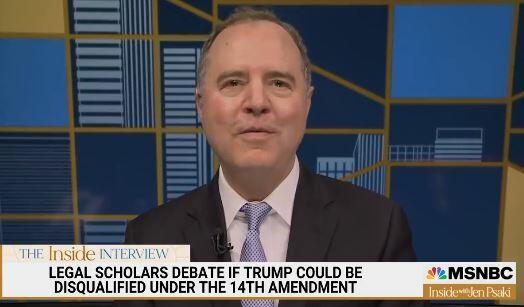
Orange Man Disqualified? Adam Schiff Talks 14th Amendment
Without outright saying so, Democrats have made no secret that their endgame with the various Trump prosecutions is to get him kicked off the 2024 ballot.
To that end, Rep. Adam Schiff (D-CA) said on Sunday that a legal argument to disqualify the former president is “valid,” and that the part of the amendment that bans those who have “engaged in insurrection” from holding elected office “fits Donald Trump to a T.”
Appearing on MSNBC, Schiff told former Biden Spox Jen Psaki that the 14th Amendment doesn’t even require someone to actually be convicted of insurrection in order to be barred from holding public office – only that they must have engaged in it.
“I think it is a valid argument. The 14th Amendment, Section 3 is pretty clear. If you engage in acts of insurrection or rebellion against the government, or you give aid and comfort to those who do, you are disqualified from running,” said Schiff. “It doesn’t require that you be convicted of insurrection. It just requires that you have engaged in these acts.”
“It’s a disqualification from holding office again, and it fits Donald Trump to a T,” Schiff continued, adding that he imagines this legal theory could either be tested by a secretary of state, or a plaintiff challenging Trump’s name on the ballot – and that he expects the issue to potentially make it all the way to the Supreme Court.
“I think this will be tested when a secretary of state either refuses to put him on the ballot, or puts him on the ballot and is challenged by a litigant. I would imagine it would go up to the Supreme Court, and that’s the big question mark through all of this, which is what will the Supreme Court do?” said Schiff, adding “There are prominent constitutional scholars, as well as prominent progressive scholars who believe that he should be disqualified.”
And what does Schiff think that the conservative-biased Supreme Court will do?
“Only time will tell, but I do think it is a very legitimate issue. By the clear terms of the 14th Amendment he should be disqualified from holding office.”
While there’s a “powerful argument to be made” that former Pres. Trump is disqualified from running again under the 14th Amendment, Sen. Tim Kaine predicts that the issue while be “resolved in the courts.” https://t.co/gLfhOlFr03pic.twitter.com/KvpDBqrSAB
We’re sure that whatever happens it will be conveniently scheduled for maximum election interference.
Of course, as Andrew C. McCarthy noted in National Review in January, If Trump was not disqualified under the impeachment clause, a remedy that undeniably applied to him, he is not going to be disqualified under the 14th Amendment, which doesn’t.