74.8 F
Chicago
Monday, August 31, 2026
Home Blog Page 3396

Two Women Shot In Bleachers At Chicago White Sox Game

0
Two Women Shot In Bleachers At Chicago White Sox Game

Chicago’s reputation for violent mayhem was elevated on Friday night, as two women were shot at a White Sox game. 

The Sox were hosting the Oakland Athletics in front of an announced crowd of 21,906 when gunfire erupted in the left field bleachers. A 42-year-old woman was shot in the leg, and a 26-year-old woman was grazed in the abdomen, according to Chicago police. The 42-year-old was listed in fair condition at the University of Chicago Medical Center, while the 26-year-old declined treatment. There was no immediate indication if the resilient 26-year-old rubbed dirt on it.

“It happened just two rows in front of me, and there was no one in front of us. All of a sudden this lady just starts bleeding from the leg,” witness Tom Miller told Chicago’s ABC7. “There were at least two of ’em in a row that got hit…and all of a sudden security was there and they kicked us out.”

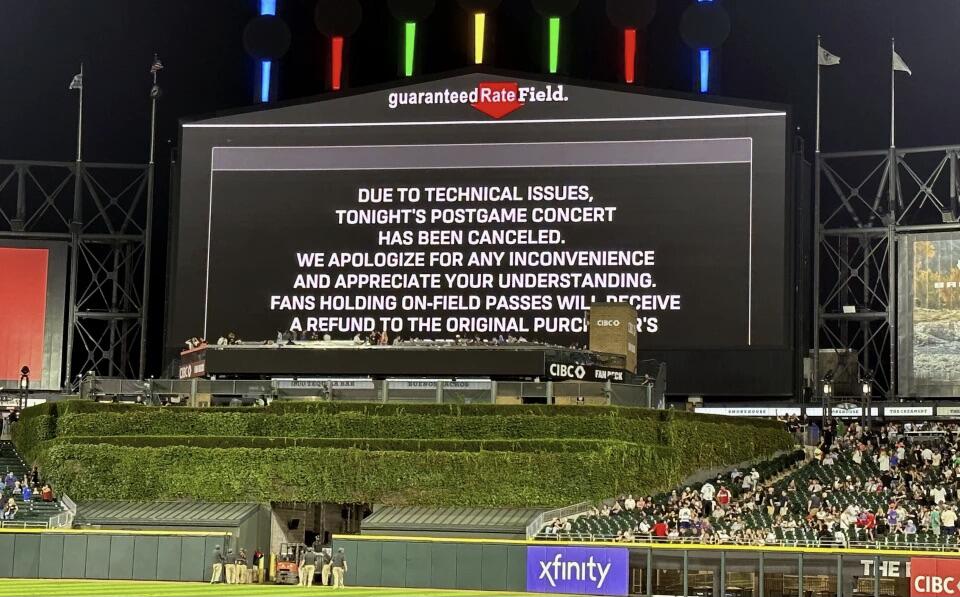
The White Sox announced a postgame concert was canceled due to “technical issues”

Some spectators told ABC7 that the gunfire seemed to result from an argument between two men. However, in a statement issued after the game, the host team said “White Sox security confirms that this incident did not involve an altercation of any kind” and also said “it is unclear…whether the shots were fired from outside or inside the ballpark.” The statement conjures possibilities that the women were hit by a stray round from the mean streets or an accidental discharge from inside the stadium. 

According to the crime-focused website CWB Chicago, the two fans were struck by a bullet fired from a mile away. 

“That’s the current line of thinking among Chicago cops tasked with investigating the incident, which unfolded a little before 7:30 p.m. as the Sox were blistered by the Oakland Athletics,” CWB said. 

The White Sox released a statement early Saturday that indicated the incident did not involve an altercation of any kind. 

CWB Chicago said around the time of the incident at Guaranteed Rate Field Stadium, a “gunfire detector alerted to nine rounds fired in a back yard in the 300 block of West 42nd Place … or about mile due south of the ballpark.” 

The incident happened occurred around the third inning. Perhaps because shootings are business-as-usual in Chicago, the game went on without any notice to attendees.

The same can’t be said for a postgame concert that was to feature Vanilla Ice, Tone Loc and Rob Base as part of an “I Love the 90s Tour.” Video displays at the stadium announced the concert was canceled “due to technical issues.” It wasn’t immediately clear if there were really production problems, or if the Sox were using poetic license to refer to the bloody crime scene in the bleachers.    

Either way, the cancellation sparked hearty, enduring boos and chants of “SELL THE TEAM” from White Sox fans who’d endured a lopsided 12-4 loss by the 50-79 Sox and were hanging on for the music to at least end their evening on a positive note. The cancellation wasn’t announced until the game was over — and the shooting wasn’t announced at all.

Tyler Durden
Sat, 08/26/2023 – 12:00

The Fed Is A Sh*tfaced Drunk On Its 21st Birthday

0
The Fed Is A Sh*tfaced Drunk On Its 21st Birthday

Submitted by QTR’s Fringe Finance

Ahead of Friday’s Jackson Hole commentary by Fed Chair Jerome Powell, Thursday morning Federal Reserve Bank of Boston President Susan Collins was out with comments basically reiterating that rate hikes could continue for the near future. Federal Reserve Bank of Philadelphia President Patrick Harker followed suit with additional, less-than-dovish comments.

“Nice view, eh Fred? By the way did I mention everything is completely f*cked with the dollar, the market and the economy? Oh, look, a bald eagle!”

“We may be near, we could even be at a place where we would hold…but certainly additional increments are possible, and we need to look holistically and be really patient right now and not try to get ahead of what the data will tell us as it unfolds,” she told Yahoo Finance on Thursday morning. Here’s how her comments looked to hedge fund algorithms worldwide as they hit the tape on the Bloomberg terminal:

  • COLLINS: MORE FED RATE HIKES ARE POSSIBLE

  • COLLINS: EXTREMELY LIKELY FED HAS TO HOLD FOR SOME TIME

  • COLLINS: FED HAS MORE WORK TO DO; MUST BE PATIENT, RESOLUTE

  • COLLINS: PREMATURE TO SEND CLEAR SIGNAL ABOUT TIMING OF RATE CUTS

“We are in a restrictive stance, do we have to keep going even more and more restrictive? I’m in the camp of let the restrictive stance work for a while, let’s just let this play out for a while, and that should bring inflation down,” Harker added Thursday morning. Here’s how his comments looked when they hit the tape:

  • HARKER: CAN’T PREDICT WHEN FED WILL CUT RATES

  • HARKER: NEED TO SEE INFLATION FALLING BEFORE WOULD BE WILLING TO CUT RATES

  • HARKER: I SEE US KEEPING RATES WHERE THEY ARE ALL THIS YEAR; IF INFLATION COMES DOWN NEXT YEAR COULD CUT RATES

But it wasn’t just these comments and the overhang of today’s Jackson Hole comments that made Thursday an ugly day. There’s more to the picture and, in my opinion, the sh*tshow is only getting started.

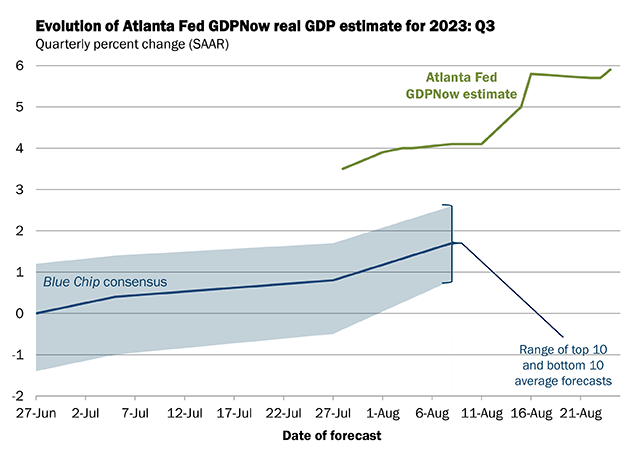
Collins’ and Harker’s statements hit the tape around the same time that the Atlanta Fed raised its GDPNow model estimate (yes, again) to 5.9%, indicating that despite the Fed’s best efforts, the goddamn economy just won’t stop growing.

As I said on my recent interview with Palisades Gold Radio, the Fed likens a robust economy with it not doing its job of curbing inflation, because it believes that it must crash the economy to win the inflation battle. Ergo, great economic news remains terrible news for the stock market.

Imagine if we didn’t need to introduce full on ridiculous Central Banking game theory into the market every time we got data and good news could just be fucking good news. But we could never have no Central Bank, right? Could you imagine a world without them? It reminds me of this Simpsons clip.

“Could you imagine a world without lawyers?”

On top of Collins’ and Harker’s comments was a prevailing sentiment on Thursday that saw Nvidia, which has basically become a proxy for the entire market and the entire market’s sentiment, sell off aggressively from its highs, despite reporting earnings and guidance on Wednesday night that blew the doors off of even Wall Street’s loftiest expectations.

While still “rangebound” and all that other technical bullsh*t, it was a pretty ugly red candle for Thursday, given that the company “issued current quarter revenue guidance of $16 billion, plus or minus 2%, far outpacing Wall Street’s already lofty expectations for $12.5 billion in revenue” and “reported revenue of $13.51 billion, a 101% jump from last year, while adjusted earnings came in at $2.70 per share, up 429% from last year,” Yahoo reported.


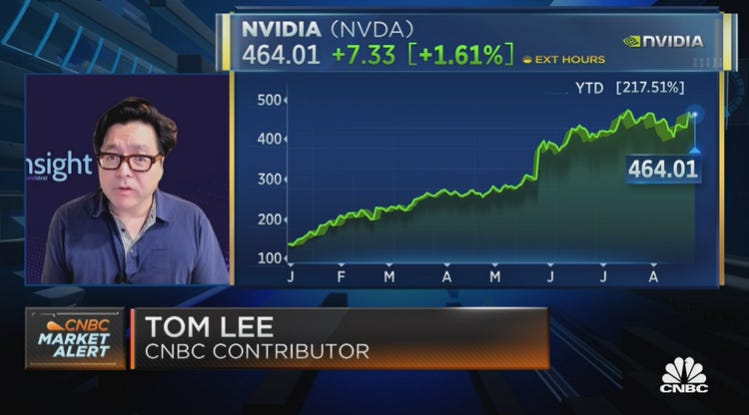
To me, Nvidia’s selloff yesterday truly feels like the market making a statement. If there were any one event that could have us retest the late July/early August market peaks, you would have thought it would have been Nvidia, the most talked about name in the market by every tiresome and perfunctory “analyst” on financial media (Exhibit A below), posting incredible earnings and guidance.

Behold Tom Lee telling investors to “add risk” with rates at 5%, ahead of Nvidia’s earnings, on Wednesday. The NASDAQ fell 2% the very next session (Thursday).

And so heading into this morning, Nvidia likely isn’t doing the market any psychological favors. As I asked yesterday, what would prevailing sentiment wind up being like heading into today’s Jackson Hole event if the national anthem of technology stocks wound up red for the day after what can only be described as an unthinkable earnings blowout?

Macro Intelligence said Thursday morning that the Fed would be expected to aim for “higher for longer” during today’s Jackson Hole speech:

Fed Chair Powell’s Jackson Hole speech is unlikely to bring new elements to the US monetary policy outlook, says Julian Brigden, from Macro Intelligence 2. “They will keep holding out their powder because they don’t want to ease financial conditions,” Brigden says.

“They will keep holding out this sort of sword of Damocles in the shape of possibly another 25 basis points of rate hikes, while emphasizing they are not going to cut any time soon.” Brigden expects inflation to remain above target, leaving no room for dovishness. He says investors are yet to realize that higher-for-longer means “much, much longer than the markets concept of longer.”

But regardless of what the Fed says today, its course of actions is already predetermined: it is already a decided outcome that the market is going to have a major meltdown by virtue of the Fed’s policy path, the only question is when. After that happens, it’ll be too late, but the Fed will “ride to the rescue” by doing more unlimited QE and slashing rates at alarming speed.

I know, you’re incredibly surprised, right?

The best way I can think about the Fed and the stock market is to compare them to a college student on their 21st birthday. At least where I went to college, it was mandatory to make the trek out to the bar and at least feign an attempt at putting down 21 drinks. You anticipated the best night of your life, and then made the worst successive decisions possible, ensuring you landed nowhere near your goal.


🔥 50% OFF ALL SUBSCRIPTIONS: Subscribe and get 50% off and no price hikes for as long as you wish to be a subscriber.


On your 21st birthday, you usually spend the afternoon or evening getting dressed up and preparing for what you believe will be a great night ahead. You’re bright eyed and looking forward to the future.

This is the Fed sitting around and planning how they believe they are going to bring the economy in the stock market in for a soft landing.

On your 21st birthday, you have a couple of drinks before you even head out to the bar because “what’s a night out without pregaming?” Sure, you’ll still be urged to do 21 shots when you get to the bar, but a couple Miller Lites before you head out couldn’t possibly hurt you, right?

This is the Fed preparing the market for coming hikes in order to try and combat inflation, as well as the first several quarter point hikes to get things started.

On your 21st birthday, when you get to the bar, it’s all business. Your friends have informed you that your mission for the evening is 21 drinks while consuming any and all beverages any asshole stranger may also buy you in the process. From there, you will hold your shit together and waltz home without a problem or care in the world, only to wake up the next morning and talk about what a resounding success your birthday party was and what a fine all around citizen and human being you are. Your friends cheer you on from the sidelines.

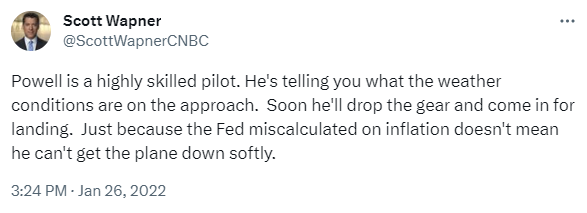
This is the Fed getting into the thick of a long series of rate hikes over 18 months. Scott Wapner cheers Jerome Powell on from CNBC.

On your 21st birthday, you know you will do short term damage to your equilibrium and long-term damage to your body, but as long as those signs don’t show up in a debilitating way, you keep pushing forward.

This is the Fed, doing damage to the economy with its rate hikes, but forging forward in the absence of a market crash.

On your 21st birthday, later in the evening, you’ll make it to your 21st drink. Despite being slightly intoxicated and wobbly, your legs dance on as the music continues to play. For all intents and purposes, despite being hammered drunk, you can still see a path where the night ends in a resounding success. You carry forward.

This is the Fed getting rates all the way above 5% without the economy or the stock market having an obvious catastrophic incident. Somehow, someway, the band has continued to play, and Jerome Powell continues to dance like Nick Beam with his feet on fire in Nothing to Lose.

On your 21st birthday, things eventually go horrifically wrong. You take that one molecule of confidence that you have a 3AM and decide that you are completely indestructible. Despite downing 30 drinks over the course of six hours, you have made a conscious decision that you are a God amongst gods, for whom the rules of basic human biology do not apply. At 3AM, you leave the bar and continue to rip shots despite the majority of your senses telling you not to. “Who cares,” you think to yourself. “I am indestructible.”

This is the Fed right now. Collins and Harker suggesting more rate hikes could be coming. Powell set to do the same today (likely). Hikes will continue and the economy hasn’t even had a chance to catch up with the ones that took place months ago. It’s impossible to say that it will make the consequences worse than they already are because consequences haven’t yet caught up to us. But they will, and now with every inch that we decide we want to push this pipe bomb deeper into the economy, we will suffer a mileslong worth of consequences.

On your 21st birthday, you wind up vomiting in a friend’s washing machine before stripping completely naked and running through a 24 hour Burger King. You are eventually found unconscious and naked on the front steps of the English Department building, holding an essay that was due 4 months ago that you hoped to turn in at 4:30AM. Police arrest you and bring you to a holding cell where you continue vomiting into a stainless steel toilet last used by your indigent cellmate who appears to have terrible aim with his bodily functions. The next day when you are released, the burden of consequences starts to become clear: thousands of dollars in fines and property damage, court appearances and humiliation that will take years to overcome.

The Fed hasn’t had this moment yet, but rest assured it’s coming.

The stock market, July 2023: “We’re going streaking!”

QTR’s Disclaimer: I am not a guru or an expert. I am an idiot writing a blog and often get things wrong and lose money. I do not fact check contributor material that I aggregate from other sources. I may own or transact in any names mentioned in this piece at any time without warning and generally trade like a degenerate psychopath. This is not a recommendation to buy or sell any stocks or securities or any asset class – just my opinions of me and my guests. I often lose money on positions I trade/invest in and I’m sure have lost more than I’ve made in my time in markets. I may add any name mentioned in this article and sell any name mentioned in this piece at any time, without further warning. Positions can change immediately as soon as I publish this, with or without notice. You are on your own. Do not make decisions based on my blog. I exist on the fringe. The publisher does not guarantee the accuracy or completeness of the information provided in this page. These are not the opinions of any of my employers, partners, or associates. I did my best to be honest about my disclosures but can’t guarantee I am right; I write these posts after a couple beers sometimes. Also, I just straight up get shit wrong a lot. I mention it three times because it’s that important.

Tyler Durden
Sat, 08/26/2023 – 11:30

Ukraine Declares Philip Morris An ‘International Sponsor Of War’

0
Ukraine Declares Philip Morris An ‘International Sponsor Of War’

The Ukrainian government has labelled two tobacco giants “international sponsors of war,” condemning Philip Morris and Japan Tobacco for continuing to conduct business in Russia and paying taxes to the country’s government.

Thursday’s declaration from the National Corruption Prevention Agency (NCPA) adds the two companies and Bermuda-based Bacardi Limited to a list of Ukraine’s corporate enemies that already includes Procter & Gamble alongside many other companies headquartered in Europe, Asia and elsewhere. 

There appear to be few real-world implications of Ukraine’s declaration. According to Ukrainska Pravda, a Ukrainian online outlet, “The NACP has sent letters to the heads of international companies from the list of war sponsors, inviting them to visit Ukraine and see the aftermath of Russian aggression with their own eyes.

Philip Morris International’s factory in Izhora, Leningrad Oblast (Kovalev Peter/Zuma Press via Wall Street Journal)

In a statement that oddly sounds like an testimonial to Western sanctions’ failure to damage the Russian economy, the NCPA said, “Having confidence in the economic potential of Russia, [Philip Morris] is implementing a large-scale long-term investment program.” Philip Morris enjoyed an 8% jump in Russian revenue in the first year of Putin’s so-called “special military operation” in Ukraine. 

As of 2019, Philip Morris brands accounted for 30.1% of the Russian tobacco market, while Japan Tobacco has a nearly 35% market share.  Philip Morris operates two factories in Russia, one near Leningrad and another in Krasnodar, a region east of the Crimean Peninsula.

“Notably, at the beginning of Russia’s full-scale invasion of Ukraine, Philip Morris announced its intention to dispose of its Russian business in order to preserve its reputation,said NCPA (sometimes amusingly abbreviated as NAZK). “However, all ‘attempts’ to sell the Russian operation seem to have been failures, and the corporation still remains one of the largest taxpayers to the Russian treasury.”

“I’d rather keep this whole thing”: Philip Morris International CEO Jacek Olczak says divesting would contravene his duty to shareholders

In February, Philip Morris CEO Jacek Olczak, citing a duty to shareholders to recover his firm’s $2.5 billion in Russia-situated assets, told the Financial Times a sale was proving impractical in the face of Russian rules. “I cannot just lose the patience and I leave it. It’s their money. It’s not my money, I’m managing this for them. If I had a buyer who could execute the transactions, yes we would do it — but it doesn’t exist…there is no hope…so then I’d rather keep this whole thing.” 

Philip Morris International shares barely budged on the news, edging down 24 cents to $94.08 at Thursday’s close, but then rising nearly a dollar in after-hours trading. Behind powerful brands like Marlboro, Parliament, Chesterfield and L&M, the company sells tobacco and other products in more than 180 countries, and currently yields north of 5%.  

In a country that has ranked 122nd-worst in a global corruption ranking, you’d think Ukraine’s “National Corruption Prevention Agency” might want keep an internal focus rather than propagandizing against foreign companies engaged in honest international commerce.

Tyler Durden
Sat, 08/26/2023 – 11:00

Hedging The End Of Fiat

0
Hedging The End Of Fiat

Authored by Alasdair Macleod via SchiffGold.com,

It is slowly coming clear that the fiat dollar’s hegemony is drawing to a close. That’s what the BRICS summit in Johannesburg is all about — rats, if you like, deserting the dollar’s ship. With the dollar’s backing being no more than a precarious faith in it, it is bound to be sold down by foreign holders. Being only fiat, it could even become valueless, threatening to take down the other western alliance fiat currencies as well.

How do you protect your paper wealth from this outcome? Some swear by bitcoin and others by gold.

This article looks at what is likely to emerge as a replacement currency system, and concludes that from practical and legal aspects, bitcoin and the entire cryptocurrency industry will fail with fiat, while mankind will return to gold, as it has always done in the past when state control over currency fails

Introduction

It is gradually dawning on market participants that the era of fiat currencies is drawing to a close. Monetarists, who first warned us of the inflationary consequences of the expansion of money and credit were also the first to warn us that the slowdown in monetary expansion would lead to recession, and since then we have seen broad money statistics flatline, with bank lending beginning to contract. This is interpreted by macroeconomists as the end of inflation, and the return to lower interest rates to stave off recession.

Unfortunately, this black-and-white interpretation of either inflation or recession but never both has been challenged by bond yields around the world which are rising to new highs. And the charts tell us that they are likely to go considerably higher. Consequently, conviction that inflation of producer and consumer prices will prove to be a temporary phenomenon is infected with doubt.

For those of us steeped in free market economics and with experience of the monetary and economic scene in the 1970s, the possibility of both inflation and recession occurring at the same time is less of a surprise. They called it stagflation, though the Keynesians never managed to reconcile the existence of the two conditions being present at the same time. The error, surely, is in Keynes’s denial of Say’s law, which postulates that we produce to consume. The Keynesian error was to ignore the plain fact that rising unemployment is the consequence of falling production first, so there can never be a general glut of goods in a slump which is the basis of Keynesian assumptions.

Consequently, we should concede that a return to stagflation, or worse, is eminently possible. And that rising bond yields from here are also possible, indeed even likely as the charts so clearly indicate. In the coming weeks and months as bond yields continue to rise dragging interest rates up behind them, the debate as to how to hedge this unexpected condition is bound to intensify. In one corner, we have gold, and in the other cryptocurrencies, headed by bitcoin. Both have their vocal enthusiasts.

But enthusiasm is not a sensible basis for an investment or trading strategy. It misleads investors and those seeking to protect their wealth from the debasement of currencies, which is what continuing and rising inflation of prices represents.

Sentiment driven investment tends to overlook important facts. In this article, I compare the relevant facts from very basic legal and monetary standpoints, first for cryptocurrencies represented by bitcoin and then for gold.

Bitcoin as practical money

Bitcoin and crypto currency fans argue that they are the future money. Bitcoin in particular is seen as incorruptible, secured, and self-audited on a blockchain. It is strictly limited to its hard cap of 21 million coins. It is this limitation which has led to estimates of its future value in fiat currency, depending on how much more fiat currency debasement a forecaster expects. And it can be convincingly argued that the fiat currency debasement rate is likely to accelerate further as stagflation returns, leading to ever greater government deficits and escalating increases in government debt. This might be expected to lead to a resurgence in interest in bitcoin, taking it to new highs.

Enthusiasts argue that bitcoin will increasingly replace fiat as the general public begins to realise that fiat currencies are losing purchasing power, which is why the general level of prices is rising. But we must make a distinction between using a currency, crypto or otherwise for day-to-day transactions and as a store of value. In the former case, the possession of currency resulting from the sale of something is temporary, so its changing value in terms of goods over time is of little interest to the seller of goods who receives it in payment. But it does matter to the saver with a longer time horizon.

Saving, or more correctly hoarding in the case of bitcoin, is the issue which we must address. To a saver an increasing purchasing power for currency units in which his savings are denominated is desirable. Therefore, it is likely that savers will hoard their bitcoin instead of letting them circulate because the hard stop on their quantity would be expected to continually increase its value. So powerful is this deflationary tendency likely to be that other than for bare essentials, all commerce, currently depending on credit, would grind to a halt. Taken to its logical conclusion, the world would simply regress to a feudal state with mass poverty.

The solution can only be for holders of bitcoin to lend their bitcoin to borrowers so that commercial activities could take place. This is credit and is the basis of all banking and all economic progress. The need for credit will not go away with the end of fiat currencies, nor will its counterpart, debt. Indeed, the possession of debt obligations is wealth and makes up the majority of it. I shall go into this topic later in this article. But for now, let us consider the difference between bitcoin and bitcoin credit.

In order to produce anything, capital is required. It is a simple fact that production precedes consumption. It can take years for factories to be built, and people with the relevant skills trained and employed. Most if not all of this funding requires credit. It entails a business plan to take all cost factors including the cost of funding into account in order to estimate a project’s viability.

When assembling a business plan, not only does an entrepreneur have to estimate all the input costs and the product’s final sales value, but he has to estimate the cost of repaying borrowed capital. But presumably, a hard stop of 21 million bitcoins will lead to higher bitcoin costs of future capital repayments. Uncertainty as to what bitcoin’s future value would be will likely scupper most projects, even before the difficulty of predicting future demand for goods priced in rising and volatile bitcoin. Bitcoin’s limitations would almost certainly lead to an intensely deflationary outlook, because it is simply not suited as a basis for valuing credit.

In this respect, bitcoin is fundamentally different from gold, the extraction of which in the long term has grown roughly in step with the world’s population. Furthermore, there are substantial reserves of above ground gold in the form of jewellery, which can be reallocated to monetary functions if markets demand its change of use. The flaw in the bitcoin as money argument is gold’s strength: its unsuitability to act as backing for credit, and its total inflexibility of supply.

I am not aware that anyone in the bitcoin camp has properly addressed these issues or is even aware of them. It appears that hodlers do not understand how dependent humanity is on credit. Instead, they tend to dismiss credit as being the problem. Nor is there any understanding of the relationship between money and credit in a functioning, stable economy. The very conditions which are supposed to give bitcoin its value as incorruptible currency are enough to render it entirely unsuited to act in that capacity.

The dismissal of credit is even before we are asked to swallow the fact that it is wholly inappropriate for the vast majority of users who are not tech savvy enough to even understand it. A currency must be simple enough to be understood by its users. The promotion of bitcoin and other cryptocurrencies is the dream of an elite of technological literates and speculators hitching a ride on its concepts.

Then there is the legal position. In the absence of specific legislation passed to give bitcoin or any other cryptocurrency the legal status enjoyed by gold it does not have the legal status required. Hodlers do not appreciate that legally only certain things can act as money.

In order to understand the distinction between what can pass as money and what cannot, we must define the difference between the right of possession and the right of property. If I lend a book to a friend, I allow him to have a right of possession for a period of time, but it still remains my property. The property in the book has not been transferred to him. If I went to his house to collect the book, and he was not at home, I would be free to recover the book if I saw it (though out of politeness I should let him know that I’ve recovered my property). This in Roman law was referred to as a commodatum, which is defined as “a gratuitous loan of movable property to be used and returned by the borrower”.

Money and credit are treated differently, along with consumable items, such as food and drink. When these are loaned, the property in them transfers absolutely, in return for which an obligation by the receiver is created to restore the equivalent of similar quality and quantity. To continue on from the example of the commodatum, if instead of a book I had loaned my friend $100, and going to his home to recover his obligation to me I found he was away but saw his wallet left behind, and I took $100 from it, I would be guilty of theft.

In Roman law, the loan of money, credit, and items to be consumed is a mutuum, which is defined as “a loan of a fungible thing to be restored by a similar thing of the same kind, quality and quantity”.

While in the English language the use of the terms lend and loan are ambiguous, the difference between commodatum and mutuum is still clearly recognised by us all to this day, as the examples of the different treatment of a loaned book and $100 illustrate. The same conditions apply with respect to criminal theft. If a thief steals your car and sells it on to an unsuspecting buyer, it remains your property and you are fully entitled to recover it without compensating the hapless buyer. But if a thief steals your wallet, or empties your bank account, you only have recourse against the thief and your property in the money or credit is lost.

In this legal context, the question arising is in the treatment of fully identifiable bitcoins, whose possession is recorded on a blockchain. Clearly, if someone sells you a bitcoin in return for currency you receive it as entering into your possession. But if the bitcoin had previously been stolen, say from a crypto wallet, it was nobody’s to sell and it almost certainly remains the possession of the person it was stolen from. The point is that while each bitcoin, or fraction of a bitcoin has the same value as another, the blockchain means that each bitcoin or part of it has a specific identity. Therefore, it is not fungible like banknotes or credit, nor is it consumed and so it almost certainly cannot be a mutuum. The precedents in law therefore point to the property in it having not been transferred if in the past it was the proceeds of crime, so it must be regarded as a commodatum.

This is a significant problem for bitcoin, which has become the money laundering medium of choice for criminals and tax evaders. While in Roman times, criminality was more basic, today governments have extended it to include mere suspicion as grounds for property confiscation. Software allows investigators to link bitcoin wallets with real world identities, which are easily available to the authorities from crypto exchanges. Companies such as Chainalysis have been working with the FBI successfully to identify wallets linked with criminal activity. The trail from these wallets clearly leads to those who subsequently bought bitcoin and are under the impression they are now their property.

Therefore, you cannot be sure that the bitcoin you have bought through an exchange will not be seized by the authorities on the grounds that a previous owner acquired it through the proceeds of crime. You cannot be certain you have clear title. On legal grounds alone, without the certainty of ownership bitcoin cannot act as a general medium of exchange.

Why credit matters

In discussing the practicality of bitcoin as money, its unsuitability as a medium from which credit takes its value has been mentioned, and that enthusiasts appear to have overlooked this vital function. Indeed, the creation of bank credit is seen by many in both gold and bitcoin camps as evil and therefore they say that one of the key benefits of bitcoin is it does away with the creators of credit. Those following this line of reasoning fail to understand that all money and obligations to pay are in fact credit, representing the temporary storage of unspent production. Because all of our consumption has its origin in production, the medium of exchange is a matter of intermediation.

There are two distinct forms of this credit, one in which there is no counterparty, and it is only in the form of gold, silver, or copper coined for convenience. It cannot be anything else if we rule out barter. The proper term for coin is money, to distinguish it from promises to pay in money at a future date, which is credit.

As a right to future payment, credit is always matched by an obligation on the part of the debtor. Ultimately, that right and corresponding obligation are to be settled in money — though in practice, today they are novated by way of settlement into other credit. It is not the transfer of money, but nevertheless credit is a form of property. That credit is property and has value in terms of goods and services arises from its transferability. This is apparent in valuations of financial assets, which together with the possession of the property in physical objects make up a person’s wealth.

In any economy which has progressed beyond a feudal state, it is credit which makes up the vast bulk, if not all of the circulating medium. And the more perfected the economic system becomes the less money circulates. It is simply more convenient to use credit, whether it be bank notes, bank deposits, or individual credit agreements, such as exist between families and friends.

Legally, money has a general and permanent value, while credit has a particular and precarious value. The problem we have today is that these distinctions between money and credit are poorly understood. Those who profess to support “sound money” rarely appreciate this vital distinction, routinely stating that sound money is a policy and not a definition. Accordingly, they incorrectly assume that bank notes issued by a central bank is money when it is in fact credit with counterparty risk, whose value in terms of goods and services can become subverted.

This leads us into the topic of how credit is valued. All credit, including bank notes issued by government authority, must take its value from something. But without being a credible substitute for what the Romans originally defined as money the value of credit obligations becomes inherently unstable. Furthermore, abandonment of credit’s attachment to money encourages a government to spend beyond its tax revenues by debasing the currency, and that is what is happening today at an increasing rate. It is not credit, which is the evil, but its detachment from money.

The legal position and history of gold as money

As a medium of exchange, the function of money is to adjust the ratios of goods and services one to another. Thus, the price expressed is always for the goods, money being entirely neutral. It is therefore an error to think of money as having a price. This should be borne in mind in the relationship between legal money whether it be gold or silver, which is habitually given a price nowadays in fiat currencies, and the fiat currencies themselves which, given the status of legal tender, are erroneously assumed to have the status of money. The relationship between money and credit has become stood on its head. The magnitude of this error becomes clear with understanding what legally is money, and what is credit. Again, this understanding starts with Roman law.

Roman law became the basis for legal systems throughout Europe, and by extension those of European settled regions, from North America, Latin America through Spanish and Portuguese influence, the Dutch in the Far East, and the entire British Empire. In common with the Athenians, Rome held that laws were the means whereby individuals would protect themselves from each other and the state. But it was particularly Rome which codified law into a practical and accessible body of reference generally.

The first records of Roman statutes and the case law which followed were the Twelve Tables of 449BC. These became the basis upon which individual jurors subsequently expounded, developed, and evolved their rulings over the next thousand years. The whole legal system was then consolidated into the Emperor Justinian’s Corpus Juris Civilis, otherwise known as the Pandects. When the empire relocated to Constantinople, the Corpus was translated into Greek and eventually reissued in the Basilica, at the time of the Basilian dynasty in the tenth century. It was that version which became the foundation for European law in the Middle Ages, except for England. As an eminent nineteenth century lawyer specialising in banking put it, the reason common law differed in England was that:

“The Romans abandoned Britain at the end of the fifth century and the common law of England on the subject of credit was exactly as it stood in Gaius which was the textbook of Roman law throughout the empire at the time when the Romans gave up Britain.  But on the 1st of November 1875, the common law of England relating to credit was superseded by equity which is simply the law of the Pandects of Justinian.”[i]

In all, two thousand years of legal development had elapsed between the Twelve Tables and the reaffirmation of Justinian’s Pandects in Dionysius Gottfried’s version in Geneva of the Corpus Juris Civilis, translated back into Latin in 1583AD from the Greek Basilica.

It is the Digest section of the Corpus which is relevant to our subject. The Digest is an encyclopaedia of over nine thousand references of eminent jurors collected over time. Prominent in these references are those of Ulpian, who died in 228AD and was the juror who did much to cement the legal position and distinction between money and credit. The Digest defined property, contracts, and crimes. Our interest in money and credit is covered by rulings on property and contracts.

The regular deposit contract is defined by Ulpian in a section entitled Deposita vel contra (on depositing and withdrawing). He defined a regular deposit as follows:

“A deposit is something given another for safekeeping. It is so called because a good is posited (or placed). The preposition de intensifies the meaning, which reflects that all obligations corresponding to the custody of the good belongs to that person.”[ii]

Another jurist commonly cited in the Digest, Paul of Alfenus Varus, differentiated between the regular deposit contract defined by Ulpian above and an irregular deposit or mutuum. In this latter case, Paul held that:

“If a person deposits a certain amount of loose money, which he counts and does not hand over sealed or enclosed in something, then the only duty of the person receiving it is to return the same amount.”[iii]

So, a mutuum is taken into the possession of the person receiving it. In return for a right of action in favour of the depositor to be exercised by him at any time, the receiver has a matching duty to return the same amount until which it becomes the receiver’s property to do with as he wishes. This is the legal foundation of modern banking.

Clearly, the precedent in the Digest is that money is always metallic. While anything can be deposited into another’s custody, it is the treatment of fungible goods, particularly money, which is the subject of these legal rulings. It is only through an irregular deposit (or mutuum) that the depositor becomes a creditor. By laying down the difference between a regular and irregular deposit, the distinction is made between what has always been regarded as money from ancient times and a promise to repay the same amount, which we know today as credit and a matching obligation to pay.

There is still one issue to clarify, and that is to do with credit rather than money. As noted above, Justinian’s Pandects were compiled a century after the Romans had abandoned Britain. From what was subsequently unified as England and Wales out of diverse kingdoms, common law differed in that debts were not freely transferable. The transferee of a debt could only sue as attorney for the transferor. This placed debt as property in a different position from other forms of transferable property. Justinian took away this anomaly as a relic of old Roman law (the laws of Gaius, referred to above), allowing the transferee to sue the debtor in his own name. Without this amendment, the status of a particular and precarious debt as an asset would be in doubt.

This anomaly in English law was only regularised when the Court of Chancery merged with common law by Act of Parliament in November 1875. Since then, the status of money and credit in English law has conformed in every respect with Justinian’s Pandects.

While the legal position of money is clear, the economic position is technically different. Jean-Baptiste Say pointed out that money facilitates the division of labour. Technically, money is unspent labour, and is therefore a credit yet to be used. Various other classical economists made the same point. Adam Smith wrote that a guinea might be considered as a bill for a certain quantity of necessaries and conveniences upon all the tradesmen in the neighbourhood. Henry Thornton said that money of every kind [including credit] is an order for goods. Bastiat and Mill opined similarly.[iv] The similarity of function between money and credit has undoubtedly led to confusion over the true meaning of terms.

But it is the legal difference which is of overriding importance because it was founded on the principal that there is a clear distinction between metallic money and a duty to pay. Money is permanent while credit is not. Money has no counterparty risk, whereas credit does.

The modern belief that money can be done away with and substituted with banknotes is therefore incorrect. And it is common ignorance of the established relationship between money and credit both in law and in practice which has led to the error of thinking that bitcoin can be the new money for modern times. Accordingly, we must put any such thoughts out of our minds.

The future of cryptocurrencies

It has been easy to point to the benefits of the cryptocurrency revolution. The blockchain concept promises a transformation in the recording of property ownership. And the popularity of bitcoin has alerted a wider public to the debasement of fiat currencies by governments — that surely is a public good. But it appears to have done nothing to enhance anyone’s understanding of money and credit.

The crypto revolution has created a potential evil in the form of central bank digital currencies, originally conceived by central bankers, seemingly ignorant of their own craft as a response to the threat from private sector money to their fiat monopolies. Their ignorance is of the legal position described above: after all, to detach a national fiat currency from legal money requires a denial of the true, legal position on the part of the perpetrator.

Central banks further demonstrated their denial of the laws of money by appointing a committee of the Bank for International Settlements, which coordinates central bank policies, to examine the benefits of a CBDC to a central bank and its government. Pursuing statist interests, the BIS committee’s conclusion is that CBDCs could give governments totalitarian control over economic activity. Nowhere has the legal position established millennia ago been respected, or even mentioned in their deliberations.

The reason the legal position of gold as money has persisted as authoritarian governments have come and gone is that the Romans defined an entirely natural relationship between money, what it is, and credit. Originally, money was and still is determined by people who are its users. And they create credit based upon money’s value. The practice evolved from the creation of credit based on goods that could be bartered. Credit must have been the way the Phoenicians financed their trade long before their city-states took to the convenience of coining metals, thought to be at about the same time as Rome’s Twelve Tables.

While the Romans paid close attention to the practicalities of trade and the natural evolution of payment in gold, silver, copper, or bronze coin and embodied it in their law, the state theory of money has always failed. The introduction of CBDCs is just another state theory of money. And while it promises to further the objectives of authoritarianism, it is bound to fail as well.

The sheer impracticalities involved have already caused the Bank of England in its White Paper to reject the BIS’s central proposition, that a sterling CBDC will bypass the commercial banking system and be totally under a central bank’s control. The reasons for the Bank’s approach are entirely sensible: the bureaucracy involved in setting up a CBDC, with everyone and every business required to open an account at the Bank of England would take years in the planning, testing, and implementation. And in the US, where the large majority of lawmakers depend on contributions from the banks to fund their election expenses, we can be certain that if any CBDC proposition was to be put forward by the Federal administration, it would be heavily watered down so as to not undermine existing banking interests.

The fate of the entire CBDC saga is likely to turn out to be a red herring. And in this article, I hope I have demonstrated convincingly the impossibility that bitcoin or any other cryptocurrency can fulfill the role of a currency. There only remains the question over their future if this role is denied to them.

It is now 52 years since the dollar and all other currencies with it became entirely fiat. While it is beyond the scope of this article to describe the factors involved, there is growing evidence that the current dollar-based fiat currency episode, like all others before it, is coming to an end. That being so, we can expect a new monetary system to replace it. But with bitcoin not suited to the task, we can be sure that the reason for bitcoin’s existence will turn out to have been purely speculative.

Therefore, when fiat dies, we can expect the whole cryptocurrency and the CBDC phenomenon to die with it. Mark it down as a modern Mississippi venture, or South Sea Bubble, both of which owed their existence to speculative excesses financed by credit — just like bitcoin.


Tyler Durden
Sat, 08/26/2023 – 10:30

Bidenomics Is Working… Against The Interests Of Everyday Americans

0
Bidenomics Is Working… Against The Interests Of Everyday Americans

Authored by Jack Hellner via The Mises Institute,

Joe Biden, along with most of the media and other Democrats believe in bigger government, higher taxes, and massive regulations.

As soon as Biden took office, he set out to destroy industries that produce reasonably priced energy. He focused tremendous effort on deficit spending and borrowing to hand out “government goodies” to buy votes; recipients of this government largesse, in large part, included debt-saddled students, the green mafia, and leftist activists.

When Biden took office, inflation was under 2%, despite COVID and supply chain disruptions; shortly after, it skyrocketed to over 9%. Now inflation increases are “down” but prices remain exceptionally high compared to pre-Biden.

For example, crude oil prices, which affect almost everything and are used in over 6,000 products, are roughly double what they were when Biden took over.

President Trump focused on reduced regulations and energy independence, and implemented lower tax rates, all moves that greatly helped the American people. In contrast, Biden focuses on ensuring bureaucrats rapidly increase regulations which raises costs for everyday Americans; he’s waging economic war against us. Very few of Biden’s regulations go through Congress. From the White House archives:

Between FY 2017 and FY 2019, the Trump Administration has cut nearly eight regulations for every new, significant regulation….

The Council of Economic Advisers (CEA) estimates that this pro-growth approach to Federal regulation will raise real incomes by upwards of $3,100 per household per year.

Here are some recent reports of how well Biden policies are working:

Leading economic indicators have fallen for sixteen straight months. Maybe that is why people think the economy is moving in the wrong direction?

The current cost-of-living crisis is a manufactured one. As inflation rose, the Federal Reserve was forced to raise interest rates, which saw fewer people move. The cycle is very understandable, as simply explained in this one headline, “Housing Crunch: Home Sales Fall To Six Month Low…But Prices Rise Anyway”.

Parcel volumes are dropping by so much, freight pilots are “worried” about job security.

People are running up credit card debt and defaulting on car loans because of high inflation, and because their real wages haven’t been able to sustain them. Now, even more are falling behind on their payments. From CNN:

More Americans are failing to make payments on their credit cards and auto loans, another sign of rising financial pressure on consumers.

New credit card and auto loan delinquencies have now surpassed pre-Covid levels, according to a Wednesday report issued by Moody’s Investors Service.

After years of promoting and subsidizing electric cars, they represent around 6% of total sales, and demand is clearly slowing. It wasn’t that long ago that well-to-do people were buying these electric toys so quickly that they were placed on waiting lists; now, inventories are building because they are too impractical and expensive:

Auto News understands that there is currently a 103-day supply of unsold EVs in the United States. While it did not specify how many units are sitting on dealership lots, it says there is a higher supply of unsold EVs than any other automotive segment, except those in the ultra-luxury and high-end luxury segments with supplies also reaching over 100 days.

So what is Biden’s solution? Force people to buy them.

Here are some simple economics questions for the media and other Democrats:

Does flooding the U.S with illegals help or hurt housing availability and affordability?

Will the intentional destruction of oil and coal companies help or hurt the middle class and the poor?

Yet, the media and other Democrats brag that Biden’s economic policies are great, and when the public gives Biden poor marks, they say that we just don’t understand, and we’re not willing to get behind a candidate if they fail to make us feel “warm and fuzzy.”

Are journalists really that unaware?

Of course, they always sought to destroy Trump as his policies, even as poverty sank to record lows amongst minorities, because they don’t really care about anything but big government. According to Census data:

In 2019, the poverty rate for the United States was 10.5%, the lowest since estimates were first released for 1959.

Poverty rates declined between 2018 and 2019 for all major race and Hispanic origin groups.

Two of these groups, Blacks and Hispanics, reached historic lows in their poverty rates in 2019.

Results and facts haven’t mattered to the complicit leftist media for a long time.

Tyler Durden
Sat, 08/26/2023 – 09:20

Visualizing The BRICS Expansion In 4 Charts

0
Visualizing The BRICS Expansion In 4 Charts

BRICS is an association of five major countries including BrazilRussiaIndiaChina, and South Africa. Distinguished by their emerging economies, the group has sought to improve diplomatic coordination, reform global financial institutions, and ultimately serve as a counterbalance to Western hegemony.

On Aug. 24, 2023, BRICS announced that it would formally accept six new members at the start of 2024: Saudi ArabiaIranEthiopiaEgyptArgentina, and the United Arab Emirates (UAE).

In this graphic, Visual Capitalist’s Marcus Lu and Bhabna Banerjee provide a data-driven overview of how the BRICS expansion will grow the group’s influence and reach.

Share of Global GDP

Because most of the new BRICS members are considered to be developing economies, their addition to the group will not have a major impact on its overall share of GDP.

The following table includes GDP projections for 2023, courtesy of the IMF.

The original six BRICS members are expected to have a combined GDP of $27.6 trillion in 2023, representing 26.3% of the global total. With the new members included, expected GDP climbs slightly to $30.8 trillion, enough for a 29.3% global share.

Share of Global Population

BRICS has always represented a major chunk of global population thanks to China and India, which are the only countries with over 1 billion people.

The two biggest populations being added to BRICS are Ethiopia (126.5 million) and Egypt (112.7 million). See the following table for population data from World Population Review, which is dated as of 2023.

It’s possible that BRICS could eventually surpass 50% of global population, as many more countries have expressed their desire to join.

Share of Oil Production

Although the world is trying to move away from fossil fuels, the global oil market is still incredibly large—and BRICS is set to play a much bigger role in it. This is mostly due to the admission of Saudi Arabia, which alone accounts for 12.9% of global oil production.

Based on 2022 figures from the Energy Institute Statistical Review of World Energy, BRICS’ share of oil production will grow from 20.4% to 43.1%.

It’s worth noting that China has been pushing for oil trade to be denominated in yuan, and that Saudi Arabia’s acceptance into BRICS could bolster this ambition, potentially shifting the dynamics of global oil trade.

Share of Global Exports

The last metric included in our graphic is global exports, which is based on 2022 data from the World Trade Organization. We can see that the BRICS expansion will grow the group’s share of global exports (merchandise trade) to 25.1%, up from 20.2%.

Unsurprisingly, China is the world’s largest exporter. Major exporters that are not a part of BRICS include the U.S. (8.3%), Germany (6.6%), the Netherlands (3.9%), and Japan (3.0%).

Who Else Wants to Join?

According to Reuters, there are over 40 countries that have expressed interest in joining BRICS. A smaller group of 16 countries have actually applied for membership, though, and this list includes Algeria, Cuba, Indonesia, Palestine, and Vietnam.

As the group grows in size, differing opinions and priorities among its members could create tensions in the future. For example, India and China have had numerous border disputes in recent years, while Brazil’s newly elected President has sought to “kickstart a new era of relations” with the U.S.

One thing that is certain, however, is that a new acronym for the group will be needed very soon.

Tyler Durden
Sat, 08/26/2023 – 08:45

Pfizer Documents Show COVID-19 Vaccines Contain Potentially Harmful ‘Modified’ RNA, Not mRNA

0
Pfizer Documents Show COVID-19 Vaccines Contain Potentially Harmful ‘Modified’ RNA, Not mRNA

Authored by Megan Redshaw, JD via The Epoch Times (emphasis ours)

Although we’ve been told Pfizer’s COVID-19 vaccine is manufactured with harmless messenger RNA (mRNA), the U.S. Food and Drug Administration’s (FDA) product label shows it contains artificially modified RNA—a key ingredient that is not naturally occurring and poses a substantial risk to human health.

According to Pfizer and BioNTech’s COVID-19 vaccine label in the FDA’s Fact Sheet for Healthcare Providers, each Pfizer vaccine dose for children ages 5 through 11 contains 10 micrograms (mcg) of modRNA, while fully-approved Comirnaty authorized for use in individuals 12 years of age and older contains 30 mcg of modRNA.

Pfizer, on its website, confirms its COVID-19 vaccine contains modRNA: “ModRNA stands for nucleoside-modified messenger RNA and in the synthesis of the RNA used in this vaccine platform, some nucleosides, which are important biological molecules that constitute DNA and RNA, are replaced by modified nucleosides to help enhance immune evasion and protein production.” The company says modRNA instructs the cells to produce desired proteins.

Yet the Centers for Disease Control and Prevention (CDC) states on its website (pdf) that mRNA COVID-19 vaccines are “made of mRNA,” or “messenger RNA.”

According to the agency, the mRNA in COVID-19 vaccines such as Pfizer and Moderna is created in a laboratory and teaches cells how to make harmless pieces of spike protein that trigger an immune response inside the body. The mRNA from mRNA-based vaccines is broken down within days after vaccination and eliminated from the body. In its description of mRNA and how COVID-19 vaccines work, the CDC makes no reference to modRNA or indicates that the RNA used in COVID-19 vaccines has been modified.

Messenger RNA occurs naturally and lives in our cells, and it does not last long enough to initiate an immune response before being destroyed by the immune system—it is modRNA that is synthetically created, according to Klaus Steger, a molecular biologist who headed several gene technology laboratories, regularly applying RNA-based technologies.

Unlike mRNA, modRNA modifies one of four compounds in RNA that make it last longer in the body, less immunogenic (reduced stimulation of the innate immune system), and more efficient at producing a protein—in this case, the spike protein, Mr. Steger stated. Since modRNA cannot target specific cells to make viral protein, it can attack perfectly healthy cells and bypass protective barriers in the body, like the blood-brain barrier.

Injecting modRNA into the body may lead to adverse events like strokes, cardiovascular complications, pulmonary embolism, and the formation of blood clots—many of which were disclosed in Pfizer’s documents (pdf) but were not attributed to its product.

“It is my opinion that, at a minimum, the intentional use of mRNA—an acronym well-known to stand for messenger RNA along with the endless statements about the vaccines being based on naturally occurring messenger RNA constitute misbranding in violation of a number of laws,” Ohio-based attorney Thomas Renz told The Epoch Times in an email.

“There is a legal and moral duty to provide informed consent, and to misrepresent a drug that was intended to be a gene therapy as a vaccine containing “natural messenger RNA” is an apparent violation of both of those duties.”

David Wiseman, a research bioscientist with a doctorate in experimental pathology and a background in pharmacy, pharmacology, and immunology told The Epoch Times in an email the FDA uses the term “modRNA” throughout its regulatory documents. Yet the FDA, when it gave emergency use authorization to the Pfizer-BioNTech vaccine, said the vaccine contains messenger RNA, which it described as “genetic material” that contains a “small piece of the SARS-CoV-2 virus’s mRNA that instructs cells in the body to make the virus’s distinctive ‘spike’ protein.”

The FDA’s description is problematic because the SARS-CoV-2 virus doesn’t contain mRNA, Mr. Wiseman said. “mRNA is the kind of RNA produced in the copying of instructions from DNA in a process called transcription, so to say this is viral mRNA is inaccurate.”

“Understand that, at core, mRNA, modRNA, saRNA, etc.—these are all gene therapies and all about genetic manipulation,” Mr. Renz wrote in a recent Substack article. “To suggest that this is high risk is an understatement. We have no idea what we are doing and yet we continue forward trying to control these genes.”

Pfizer Is Using Modified RNA Gene Therapy to Develop Other Vaccines

Mr. Renz told The Epoch Times that Pfizer is not only using modRNA for COVID-19 injections but also leveraging gene therapy technology to produce self-amplifying mRNA (saRNA) vaccines and treatments.

“Along with modRNA, Pfizer’s website also mentions saRNA (self-amplifying RNA) and numerous other lab-made RNA technologies,” he said. “We have discovered that various RNA technologies are in development for various uses, and these technologies, along with new adjuvant technologies, can allow for the introduction of gene therapy products into foods, the air (aerosolized vaccines), and even topical products.”

According to Pfizer, saRNA is a platform that uses a much larger molecule that encodes the antigen of interest and four additional proteins, allowing the cell to make more copies of the mRNA, resulting in more protein being expressed from a smaller dose. Pfizer states that it is currently using this gene therapy technology to develop influenza, shingles, and respiratory combination vaccines.

“It will be curious to know if this is going to be disclosed as well,” Mr. Renz added.

Tyler Durden
Sat, 08/26/2023 – 08:10

Putin To Skip G20 Summit In India As Ukraine Boasts Of ICC Arrest Warrant Impact

0
Putin To Skip G20 Summit In India As Ukraine Boasts Of ICC Arrest Warrant Impact

The International Criminal Court’s arrest warrant for Russian President Vladimir Putin continues to impact his travel ability and plans, though the Kremlin has framed it as him wanting to stay in Moscow to focus on the special military operation in Ukraine. He addressed the BRICS summit in South Africa this week via remote feed.

The Kremlin confirmed on Friday that he will not be in attendance at the G20 summit in India next month, citing his “busy schedule”.  

Reuters in its report has recalled that the ICC “issued an arrest warrant for Putin accusing him of war crimes in Ukraine, something the Kremlin strongly denies. This means he risks arrest when travelling abroad.”

But in South Africa’s case the question of whether Putin would attend in person or not seemed more a matter of relieving the internal and international pressure being placed on the normally sympathetic (to Moscow) Ramaphosa government, which is a signatory to the Rome statute.

But in India’s case, it’s government is not a signatory to the Rome statute which would require action based on the ICC ruling. Still, the pressure remains and has impacted where he goes internationally.

Ukrainian officials have been hailing this as a ‘victory’

Heads of the world’s 20 largest economies will gather in New Delhi on September 9 and 10. This will reportedly include President Joe Biden.

Even if Putin were to go in person, it would likely create a deeply awkward atmosphere for the Russian leader given it would trigger other world leaders to snub him and other anti-Russia demonstrations, which would surely also be on display from the media.

In December of 2022 Indian Prime Minister Narendra Modi canceled a planned meeting Putin, with an Indian spokesman at the time saying the current circumstances would likely only harm Modi’s image. Modi had previous to that stressed that “today’s era is not an era of war.”

Tyler Durden
Sat, 08/26/2023 – 07:35

Denmark Caves, Restores Blasphemy Prosecutions

0
Denmark Caves, Restores Blasphemy Prosecutions

Authored by Jonathan Turley,

In 2017, Denmark took a historic step in favor of free speech by rescinding its blasphemy law as 334 years.

For those of us in the free speech community, it was an important moment in Europe where free speech is being rapidly reduced.

Now, however, the liberal government is moving to reinstate the blasphemy crime with a new law barring the burning of the Qur’an, the Bible, and other religous texts.

The country already has an abusive law criminalizing offenses against foreign nations by publicly insulting them, including flag burnings. That law will be extended to religious books.

Minister of Justice Peter Hummelgaard adopted the same thread-worn rationalizations to curtail free speech. He simply dismissed that burning such books is free speech, dismissing such protests as “meaningless insults which have no other purpose than to create discord and hatred.”  Speech crimes are often pushed by those who disagree with the content of opposing speech as “meaningless.”

Despite the growing anti-free speech movement in the United States, the Constitution still protects such protests, including the burning of the American flag.

In Texas v. Johnson, 491 U.S. 397 (1989), the Supreme Court voted 5-4 that flag burning was protected speech under the First Amendment to the United States Constitution. It is considered one of the core cases defining free speech in the United States. Brennan was joined by Marshall, Blackmun, Scalia, and Kennedy (Kennedy wrote a concurrence). I agree with the decision as did conservatives like Scalia. Justice Anthony Kennedy wrote a powerful concurrence where he famously stated:

Justice Kennedy

“For we are presented with a clear and simple statute to be judged against a pure command of the Constitution. The outcome can be laid at no door but ours. The hard fact is that sometimes we must make decisions we do not like. We make them because they are right, right in the sense that the law and the Constitution, as we see them, compel the result. And so great is our commitment to the process that, except in the rare case, we do not pause to express distaste for the result, perhaps for fear of undermining a valued principle that dictates the decision. This is one of those rare cases.

Though symbols often are what we ourselves make of them, the flag is constant in expressing beliefs Americans share, beliefs in law and peace and that freedom which sustains the human spirit. The case here today forces recognition of the costs to which those beliefs commit us. It is poignant but fundamental that the flag protects those who hold it in contempt.”

The same is true with the burning of religious or culture symbols. 

I find such acts reprehensible, but they are clearly conveying a political or religious viewpoint.

Nevertheless, the left in Denmark are now embracing on a new age of censorship and speech criminalization.  The country will now create an amorphous crime for those who show “improper treatment of objects with religious significance.” The vagueness is by design. Citizens will not know what may be considered such improper treatment and thus a chilling effect will curtail future political speech.

The reversal in Denmark illustrates the dire situation for free speech in Europe and the growing danger here in the United States.

Tyler Durden
Sat, 08/26/2023 – 07:00

The Road To Totalitarianism, Part 3: CJ Hopkins’ Trial (& Sentencing) For ‘Thoughtcrimes’

0
The Road To Totalitarianism, Part 3: CJ Hopkins’ Trial (& Sentencing) For ‘Thoughtcrimes’

Authored by CJ Hopkins via The Consent Factory,

So, the Germans are putting me on trial for my thoughtcrimes, and, apparently, I’ve already been found guilty and sentenced. Bear with me and I’ll try to explain.

The Berlin District Court has issued a so-called “penalty order” or “order of punishment,” in which I am advised that I am now officially a criminal in Germany, for tweeting two Tweets. According to my attorney, a trial will now be scheduled, at which my attorney will argue the case before the judge that just issued the “order of punishment.” At this trial, the judge will listen attentively to the arguments my attorney has already made in writing, consider them carefully, and find me guilty, again. Then the judge will reaffirm the “order of punishment.”

Go ahead, read that paragraph again.

After my Kafkaesque trial has concluded, my attorney will file a series of appeals, which will fail, at which point I will have to decide whether to pay a fine of 3,600 Euros or go to German prison for 60 days.

This process will take months, if not years, and will cost me God knows how much money in attorney’s fees, court costs, and then the €3,600 fine. Yes, I’m going to pay the fine. I am not going to German prison for 60 days. Life is too short, and I am getting older, and it wouldn’t really accomplish anything except making a narcissistic spectacle of myself.

However, what will accomplish something (I don’t know how much, but something) is if I see the whole process through to the end, and shine as much light on it as I possibly can, because my case is just one of many such cases, and the real story here is not about me, it is about the crackdown on political dissent that is being carried out, not just here in Germany, but also in other countries all throughout the West.

There are not many outlets reporting this story, not outlets with any significant reach. If you are reading this column, you’re probably aware of various alternative media outlets that are, but most of these outlets are quarantined off where “normal” people never have to see them, and are delegitimized as “unreliable sources” and purveyors of “misinformation,” and so on.

There are a few bigger sources covering the story, which are also increasingly being branded “illegitimate,” Matt Taibbi’s Racket News, Michael Shellenberger’s Public, Glenn Greenwald’s Locals operations, and I’m sure I’m forgetting a few more, forgive me.

The point is, unless you’re a charter member of the “science-denying, conspiracy-theorizing, hate-speech-speaking, anti-vaxxing, misinforming left-or-right extremist” club — i.e., people who read weird “malinformationist” publications like The GrayzoneOffGuardianZeroHedgeDissident Voice, and Unlimited Hangout, and who are planning to vote for Bobby Kennedy, or, God help them, Donald Trump — you probably have no idea what I mean when I refer to “the crackdown on dissent” … or you do, and you think it’s just hunky-dory.

I won’t mince words. The folks who think it’s hunky-dory are totalitarians. They’re fascists. They applaud the crackdown on dissent. They applaud the criminalization of dissent. They applaud the censorship of political speech, of any speech they do not agree with. They want their political opponents in prison. They want everyone who disagrees with them punished. They want people who offend them cancelled. They want anyone who refuses to conform to their official ideology erased.

I have been calling these people “totalitarians” and “fascists” for a number of years now. I do not enjoy doing that. I’m not doing it gratuitously. Some of these people were my friends. I’m doing that, calling these people “fascists,” and comparing the nascent totalitarianism that is erupting all throughout the West to other, earlier totalitarian systems, like Stalinism (sorry, Marxist friends), and, yes, to fucking Nazi Germany, because, despite the fact that there are numerous differences, a lot of it is textbook totalitarianism. Naked textbook totalitarianism. There isn’t another, nicer word for it … or for those who are enthusiastically embracing it.

I’m not going to present the evidence for that assertion again. I have done that ad nauseam, much of it in my latest book, which is banned by Amazon in several countries, and which bears a warning on other Amazon sites to “visit the WHO, the CDC,” or your local national health authority, “for the latest information on Covid-19 and vaccines” before you consider buying it, and the cover art of which is about to make me an official “hate criminal,” with a criminal record.

That’s right, as I explained at greater length in a previous column, the pretext for this so-called “hate crime” prosecution is two Tweets I tweeted almost exactly one year ago of the cover art of that very same book, which just happens to document the rollout of the “New Normal” (i.e., the new totalitarianism) in 2020 and 2021.

Here are the two Tweets that constitute my “hate crimes.”

The one on the left reads, “The masks are ideological-conformity symbols. That is all they are. That is all they have ever been. Stop acting like they have ever been anything else, or get used to wearing them.” The one on the right is a quote by Karl Lauterbach, the Minister of Health of Germany. It reads “The masks always send out a signal.” The image is the cover art of my book.

Say what you want about me and my writing. I can be “provocative,” and some of my political satire is bombastically over-the-top, but, as Matt Taibbi put it in a recent Racket News piece …

“No amount of drugs exist that if consumed would allow a rational person to conclude that the writing of C.J. Hopkins furthers ‘the aims of a former National Socialist Organization.’ Agree with him or not, and I increasingly do, he used his imagery to compare the sweeping declarations of emergency power that were common around the world during the pandemic (and were particularly authoritarian in Germany) to Nazi tactics.”

And that is what I am being accused of, and “punished” for doing, by the German authorities, i.e., “furthering the aims of a National Socialist Organization” … basically, promoting Nazism, for tweeting those two Tweets above.

There is no complex legal issue here. Yes, swastikas are banned in Germany if you’re a Nazi or promoting Nazism or Fascism, but they are permitted for the purposes of “civic education, countering anti-constitutional activities, art, science, research and education, coverage of historic and current events,” and similar purposes, according to German law. Do you seriously believe that the German hate-crime police and the prosecutor and the judge do not understand that? Of course they understand that. They’re not complete imbeciles. They know the charges are just a pretext. And they know we know the charges are just a pretext. They do not care. They do not have to. They don’t even have to pretend to be following the rule of law. Not anymore. Because they know the majority of the masses are with them.

The point of prosecutions like this (and much more serious and significant prosecutions, like that of Julian Assange, for example) is to send a message. The naked disregard for the rule of law, the blatant absurdity of the charges, the open contempt for democratic principles, is all part of the message. It’s not a message about the law. It’s a message about power. Who has it, and who doesn’t. And what happens to those who refuse to bow down to it.

The message is not intended for me, or for more important figures like Julian Assange, or the many other less well-known dissidents that are being made examples of currently. We’re just the medium that conveys the message. We’re the delivery service. The message is for you.

I’m pretty sure you’re getting the message. The question is … how are you going to respond?

I do not mean by “storming” your capitol. Please do not go out and get yourself shot. I mean, are you going to help shine a light on where we are headed? Because it’s pretty fucking dark. Folks are offering to send me money to help with my legal costs, and I’m extremely grateful, because I’m going to need it (and here’s how to do that), but what I think we need to do is a little harder, and costs more, and is much more important.

We need to talk to the totalitarians … yes, the ones who wanted to put us in camps. If we can’t get through to them, we’re probably screwed. And there is a window of opportunity to do that now. It’s not 2020 or 2021. The mass hysteria has worn off for a lot of people. I know, not all of them, but for some of them, a lot of them. Some of them are finally reachable.

Take a chance, talk to them, the ones you know, or used to know. Try to get through to them. Not the bug-eyed, fanatical, foaming-at-the-mouth types who can’t wait for the return of the “emergency measures.” The other ones … you know the ones I mean. The ones who want out. You can see it in their eyes. Take a chance. Talk to these people. Totalitarianism, fascism, it is not an identity. It’s a mindset. No one is born a fascist. People can be deprogrammed. Some of them can. And, at this point, we need all the help we can get.

So, if you’re one of the kind and generous folks who have been asking what you can do to help and offering to send me money, sure, go ahead and send me the money — thank you, I’ve been overwhelmed by your messages, and I’m sorry that I can’t personally respond to all of them — but also consider what I’m suggesting, if you can possibly bring yourself to do it. If you can’t, I completely understand. Trust me, I am still just as angry as you are. I am hurt. I feel betrayed and abandoned. I have a feeling that some of you feel that way too. So I know what I’m asking when I ask you to talk to the New Normal totalitarians, the ones who might be reachable.

If you can’t yet, don’t. But if you’re able to, try.

Don’t try to convince them that you were right and they were wrong. Just shine a light on the road we’re on. Try to get them to recognize where we’re headed. Regardless of who was right and who was wrong about whatever, we are all going down this road together.

Personally, I’d rather not ride it all the way to the end and face what is down there this time.

Tyler Durden
Sat, 08/26/2023 – 00:00