New York Governor Kathy Hochul is urging President Joe Biden to direct the federal government and help provide the sanctuary state with housing, support, and work authorization for illegal immigrants.
In an Aug. 24 letter (pdf) to President Biden, Ms. Hochul, a Democrat, laid out a number of specific requests, including expedited work authorizations for illegal immigrants to allow them to “resettle in communities more quickly,” financial assistance for New York City and New York State, and the use of federal land and facilities for temporary shelter sites.
She also requested Title 32 designation to grant funding for the roughly 2,000 New York National Guard members who have been providing logistical and operational support to shelter the illegal immigrants across the state.
The letter comes as New York is struggling with an unprecedented influx of illegal immigrants—roughly 100,000 have arrived in New York City over the past year.
Ms. Hochul’s administration had already allocated $1.5 billion in state aid to address the influx of illegal immigrants and earlier this week announced a $20 million investment to help expedite the casework filing process for more than 30,000 asylum seekers.
However, in her letter to the president, Ms. Hochul said that the increase in illegal immigrants has stretched the city’s and state’s resources, “created tremendous operational and management challenges,” and “imposed overwhelming demands on the City’s homeless shelters.”
The result is a “humanitarian crisis” the governor wrote.
‘More Vigorous Federal Response’
“I wrote to you earlier this year to ask for the use of certain federal properties to provide temporary shelter,” she continued. “While I appreciate you taking initial steps to assist the State in this regard and your longstanding commitment to an equitable approach to immigration at the Southwest border, the challenges we face demand a much more vigorous federal response.”
The governor asked for millions of dollars in federal funding to reimburse the $22 million per month the state is spending on deploying National Guard members to shelters, as well as funding for the free Metropolitan Transportation Authority (MTA) program provided to illegal immigrants.
“To date, the MTA has spent over $2.3 million for these services and the costs will continue to rise,” she wrote.
The Democrat also asked the administration to provide financial assistance to cover the cost of testing immigrants for illnesses that might pose a threat to public health, education aid for school districts seeing dramatic increases in their student population as a direct result of the immigration crisis, and housing vouchers, and to cover the costs of the Department of Housing and Urban Development’s housing subsidy programs.
This includes Section 8 housing vouchers, which provide eligible homeless families and individuals help with moving into permanent housing, thus relieving the pressure on the city’s shelters, and decreasing the city’s significant costs to shelter elsewhere.
“No challenge is too great, and we are stepping up to handle this mission,” the governor wrote. “However, the flow of asylum seekers and migrants into New York is continuing at a high and unabated level. It is the federal government’s direct responsibility to manage and control of the nation’s borders.”
“Without any capacity or responsibility to address the cause of the migrant influx, New Yorkers cannot then shoulder these costs,” she continued. “I cannot ask New Yorkers to pay for what is fundamentally a federal responsibility and I urge the federal government to take prompt and significant action today to meet its obligation to New York State.”
Separately on Thursday, Ms. Hochul announced she has directed the state’s Department of Labor to connect illegal immigrants to employers with job openings throughout New York state.
The governor said this will allow illegal immigrants to begin working immediately after obtaining federal work authorization.
“What we’ve said all along is just let them work and help us out financially,” Ms. Hochul said. “Not only will the ability to give them employment allow them to get through this crisis, it helps solve another crisis that we are experiencing in every corner of the state.“
In a statement to Politico responding to Ms. Hochul’s request, White House spokesperson Angelo Fernández Hernández said the Biden administration continues to work with New York, noting a recent visit by senior adviser Tom Perez.
“We will continue to partner with communities across the country to ensure they can receive the support they need. Only Congress can provide additional funding for these efforts, which this administration has already requested, and only Congress can fix the broken immigration system,” Mr. Fernández Hernández said.
Watch: Fleeing Motorcyclist Killed When NYPD Cop Throws Picnic Cooler
A New York City police sergeant has been suspended without pay after throwing a picnic cooler filled with sodas and water at a motorcyclist fleeing a drug bust on Wednesday, causing a crash that killed the suspect. The NYPD has warned its officers to prepare for possible unrest in the wake of the death.
The action began around 5:30pm, as undercover cops conducted a buy-and-bust operation near 192nd Street and Aqueduct Avenue. After a man named Eric Duprey allegedly sold drugs to the cops, they attempted to arrest him. However, an unidentified man brought a “limited-use motorcycle” (or moped) with a top speed of 30 mpg to Duprey, who took off down Aqueduct Avenue.
Near the intersection with 190th Street, Duprey drove onto the sidewalk and toward a group of nearly a dozen people sitting around a table. NYPD Sergeant Erik Duran seized a picnic cooler from the table and hurled it at Duprey at point-blank range. “The cop…took my cooler, which was filled with soda cans, water bottles, and hit him,” said a 42-year-old witness, who asked the New York Daily News not to use his name.
Duprey immediately lost control of the motorcycle and hit a tree. In a video of the crash, Duprey can be seen tumbling off the bike and down the street. EMS arrived quickly, but pronounced Duprey dead just four minutes later.
“Suspect Fatally Crashes While Fleeing Drug Bust on Scooter: NYPD Undercover Officer Throws Cooler” pic.twitter.com/Jvdl8xX3Qr
A 30-year-old Bronx resident, Duprey has been arrested at least twice before. One was a drug charge. In an eerie parallel to the strange circumstances of his death,he’s also the subject of an open felony assault case for allegedly throwing a two-liter soda bottle through the driver-side window of vehicle, sources told the New York Post.
A memorial to Duprey promptly sprang up at the scene of his death, complete with some 200 candles and bouquets of carnations. The New York Times reports that he was married and had two children, ages 5 and 3. “Officers are supposed to be protecting people, not killing people for no reason,” said his wife, Orlyanis Velez. “I want justice for my husband.”
Duprey’s mother told Associated Press the police account was “all lies,” claiming she was in the midst of a video chat with Duprey when he was killed. “He wasn’t fleeing. He wasn’t fleeing. He was just on the motorcycle talking to me on the video chat. And he passed by that place when all of a sudden the call cut out,” she said. She said Duprey was also father to a 9-year-old, in addition to the two children reported by the Times.
Thirty-five-year-old Duran has served on the NYPD for 13 years, and is approaching one year on the Narcotics Bureau Bronx, the New York Times reports. The investigation of Duran’s actions will be led by the office of New York State Attorney General Letitia James. He was the subject of a 2022 complaint that he abused his authority during a traffic stop; the complaint was determined to be “substantiated.” He also has 38 citations for excellent or meritorious service.
The suspension without pay will surely cause discontent among NYPD cops. However, some top brass were quick to throw Duran under the moped bus. “The use of force here is not consistent with our guidelines,” an anonymous NYPD official told the Daily News. “We don’t train officers to pick up something and throw it at a suspect.”
Really? If it’s true that he was speeding on a motorcycle down an occupied sidewalk, Duprey presented a risk of death or great bodily harm to the public. Whatever your feelings about the morality of the drug-law enforcement that precipitated the wild episode, an intervention that posed the same risk of death or great bodily harm to Duprey seems warranted.
“A Long Way To Go” – Fed Chair Powell Delivers Hawkish J-Hole Speech
Powell’s full speech is below but to summarize – “we ain’t done yet.”
Key points:
Economic uncertainty calls for agile monetary policy making.
Fed will decide next rate moves based on data.
Attentive to signs economy not cooling as expected.
Inflation remains too high.
Process of bringing inflation down still has a long way to go. even with more favorable recent readings.
Two months of good data are only the beginning of what we need to build confidence on inflation path.
Substantial further ground to cover to get back to price stability.
Need sustained progress on goods inflation.
Slowing rents points to slowdown in housing inflation.
Need some further progress on non-housing services inflation.
Policy is restrictive, but Fed cannot be certain what neutral rate level is.
Fed is mindful monetary policy faces risks on both sides.
Above trend growth could warrant more Fed rate rises.
Getting inflation back to 2% likely requires below trend growth.
Lowering inflation also likely to require softer labor markets.
Signs job market is not cooling could also require more Fed action.
Sees evidence inflation becoming more responsive to labor markets.
Sees July PCE at 3.3%. core at 4.3%..
Chair Powell said The Fed is prepared to raise interest rates further if needed and intends to keep borrowing costs high until inflation is on a convincing path toward the Fed’s 2% target.
“Although inflation has moved down from its peak – a welcome development – it remains too high,” Powell said in the text of a speech Friday at the US central bank’s annual conference in Jackson Hole, Wyoming.
“We are prepared to raise rates further if appropriate, and intend to hold policy at a restrictive level until we are confident that inflation is moving sustainably down toward our objective.”
Powell further cautioned that the process “still has a long way to go, even with the more favorable recent readings.”
The Fed Chair explicitly noted the economy may not be cooling as fast as expected, saying recent readings on economic output and consumer spending have been strong.
“Additional evidence of persistently above-trend growth could put further progress on inflation at risk and could warrant further tightening of monetary policy,” Powell said.
Finally, Powell pushed back on speculation that the central bank could raise its inflation target, an idea that has been hotly debated mostly by academics in recent months.
“Two percent is and will remain our inflation target,” he said.
Powell’s conclusion was a carbon copy of FOMC presser uncertainty:
“As is often the case, we are navigating by the stars under cloudy skies. In such circumstances, risk-management considerations are critical. At upcoming meetings, we will assess our progress based on the totality of the data and the evolving outlook and risks. Based on this assessment, we will proceed carefully as we decide whether to tighten further or, instead, to hold the policy rate constant and await further data. Restoring price stability is essential to achieving both sides of our dual mandate. We will need price stability to achieve a sustained period of strong labor market conditions that benefit all.”
A hawkish address – but admittedly not as hawkish as last year – and the result: kneejerk lower rate-hike expectations which then reverted back higher after humans actually read and listened to his speech…
And 2Y yields are back to July highs…
* * *
After last year’s brief (8 minutes) uber-hawkish speech, all eyes and ears are on Jackson Hole this morning as Fed Chair Powell delivers his between-FOMC-meetings speech.
Goldman sees a 55-70% chance that he is ‘hawkish’ – the Volcker scenario – reiterate a “job not done” message, indicating the need for an extended period of tighter monetary policy to achieve a decisive win against inflation, whatever it takes.
And a 30-45% chance of a dovish delivery – with Powell questioning the necessity of maintaining a 4% front-end real interest rate at the present time, and whether there is room to align with market expectations for 2024 by reducing front-end real rates by half.
One thing is for sure, markets will react one way or the other.
Watch Powell’s speech below (due to start at 10am ET)…
Read Powell’s full address below:
Good morning. At last year’s Jackson Hole symposium, I delivered a brief, direct message. My remarks this year will be a bit longer, but the message is the same: It is the Fed’s job to bring inflation down to our 2 percent goal, and we will do so. We have tightened policy significantly over the past year. Although inflation has moved down from its peak—a welcome development—it remains too high. We are prepared to raise rates further if appropriate, and intend to hold policy at a restrictive level until we are confident that inflation is moving sustainably down toward our objective.
Today I will review our progress so far and discuss the outlook and the uncertainties we face as we pursue our dual mandate goals. I will conclude with a summary of what this means for policy. Given how far we have come, at upcoming meetings we are in a position to proceed carefully as we assess the incoming data and the evolving outlook and risks.
The Decline in Inflation So Far
The ongoing episode of high inflation initially emerged from a collision between very strong demand and pandemic-constrained supply. By the time the Federal Open Market Committee raised the policy rate in March 2022, it was clear that bringing down inflation would depend on both the unwinding of the unprecedented pandemic-related demand and supply distortions and on our tightening of monetary policy, which would slow the growth of aggregate demand, allowing supply time to catch up. While these two forces are now working together to bring down inflation, the process still has a long way to go, even with the more favorable recent readings.
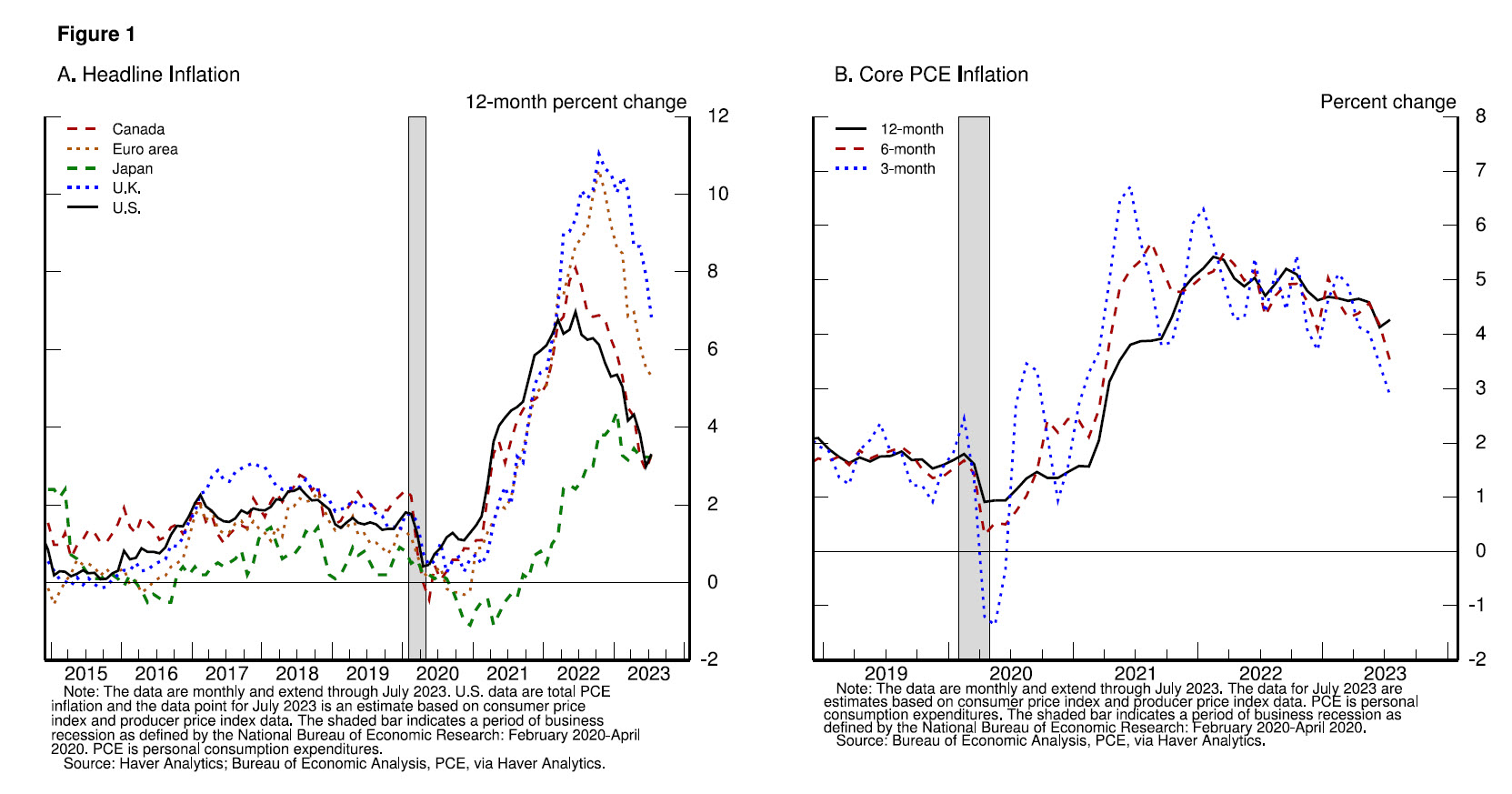
On a 12-month basis, U.S. total, or “headline,” PCE (personal consumption expenditures) inflation peaked at 7 percent in June 2022 and declined to 3.3 percent as of July, following a trajectory roughly in line with global trends (figure 1, panel A).1 The effects of Russia’s war against Ukraine have been a primary driver of the changes in headline inflation around the world since early 2022. Headline inflation is what households and businesses experience most directly, so this decline is very good news. But food and energy prices are influenced by global factors that remain volatile, and can provide a misleading signal of where inflation is headed. In my remaining comments, I will focus on core PCE inflation, which omits the food and energy components.
On a 12-month basis, core PCE inflation peaked at 5.4 percent in February 2022 and declined gradually to 4.3 percent in July (figure 1, panel B). The lower monthly readings for core inflation in June and July were welcome, but two months of good data are only the beginning of what it will take to build confidence that inflation is moving down sustainably toward our goal. We can’t yet know the extent to which these lower readings will continue or where underlying inflation will settle over coming quarters. Twelve-month core inflation is still elevated, and there is substantial further ground to cover to get back to price stability.
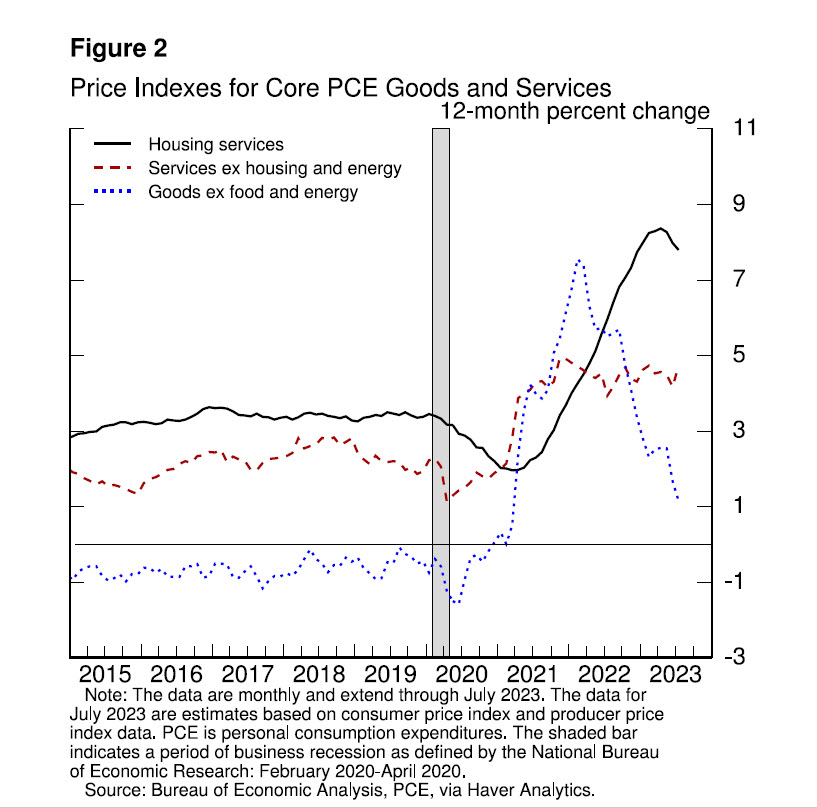
To understand the factors that will likely drive further progress, it is useful to separately examine the three broad components of core PCE inflation—inflation for goods, for housing services, and for all other services, sometimes referred to as nonhousing services (figure 2).
Core goods inflation has fallen sharply, particularly for durable goods, as both tighter monetary policy and the slow unwinding of supply and demand dislocations are bringing it down. The motor vehicle sector provides a good illustration. Earlier in the pandemic, demand for vehicles rose sharply, supported by low interest rates, fiscal transfers, curtailed spending on in-person services, and shifts in preference away from using public transportation and from living in cities. But because of a shortage of semiconductors, vehicle supply actually fell. Vehicle prices spiked, and a large pool of pent-up demand emerged. As the pandemic and its effects have waned, production and inventories have grown, and supply has improved. At the same time, higher interest rates have weighed on demand. Interest rates on auto loans have nearly doubled since early last year, and customers report feeling the effect of higher rates on affordability.2 On net, motor vehicle inflation has declined sharply because of the combined effects of these supply and demand factors.
Similar dynamics are playing out for core goods inflation overall. As they do, the effects of monetary restraint should show through more fully over time. Core goods prices fell the past two months, but on a 12-month basis, core goods inflation remains well above its pre-pandemic level. Sustained progress is needed, and restrictive monetary policy is called for to achieve that progress.
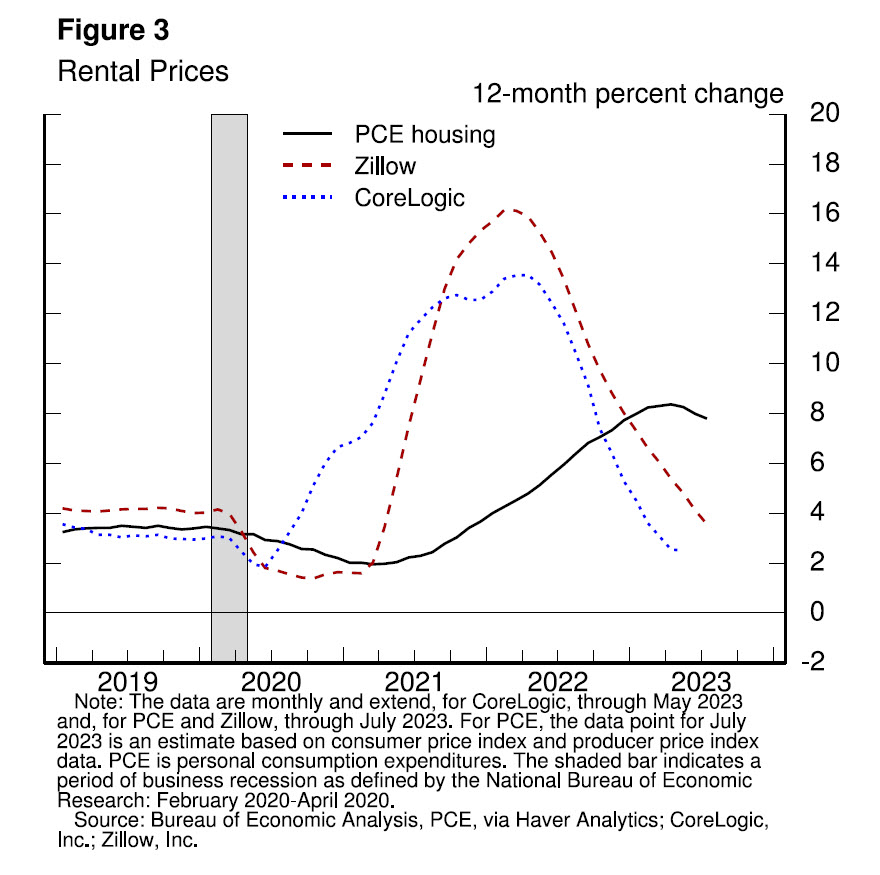
In the highly interest-sensitive housing sector, the effects of monetary policy became apparent soon after liftoff. Mortgage rates doubled over the course of 2022, causing housing starts and sales to fall and house price growth to plummet. Growth in market rents soon peaked and then steadily declined (figure 3).3
Measured housing services inflation lagged these changes, as is typical, but has recently begun to fall. This inflation metric reflects rents paid by all tenants, as well as estimates of the equivalent rents that could be earned from homes that are owner occupied.4 Because leases turn over slowly, it takes time for a decline in market rent growth to work its way into the overall inflation measure. The market rent slowdown has only recently begun to show through to that measure. The slowing growth in rents for new leases over roughly the past year can be thought of as “in the pipeline” and will affect measured housing services inflation over the coming year. Going forward, if market rent growth settles near pre-pandemic levels, housing services inflation should decline toward its pre-pandemic level as well. We will continue to watch the market rent data closely for a signal of the upside and downside risks to housing services inflation.
The final category, nonhousing services, accounts for over half of the core PCE index and includes a broad range of services, such as health care, food services, transportation, and accommodations. Twelve-month inflation in this sector has moved sideways since liftoff. Inflation measured over the past three and six months has declined, however, which is encouraging. Part of the reason for the modest decline of nonhousing services inflation so far is that many of these services were less affected by global supply chain bottlenecks and are generally thought to be less interest sensitive than other sectors such as housing or durable goods. Production of these services is also relatively labor intensive, and the labor market remains tight. Given the size of this sector, some further progress here will be essential to restoring price stability. Over time, restrictive monetary policy will help bring aggregate supply and demand back into better balance, reducing inflationary pressures in this key sector.
The Outlook
Turning to the outlook, although further unwinding of pandemic-related distortions should continue to put some downward pressure on inflation, restrictive monetary policy will likely play an increasingly important role. Getting inflation sustainably back down to 2 percent is expected to require a period of below-trend economic growth as well as some softening in labor market conditions.
Economic growth
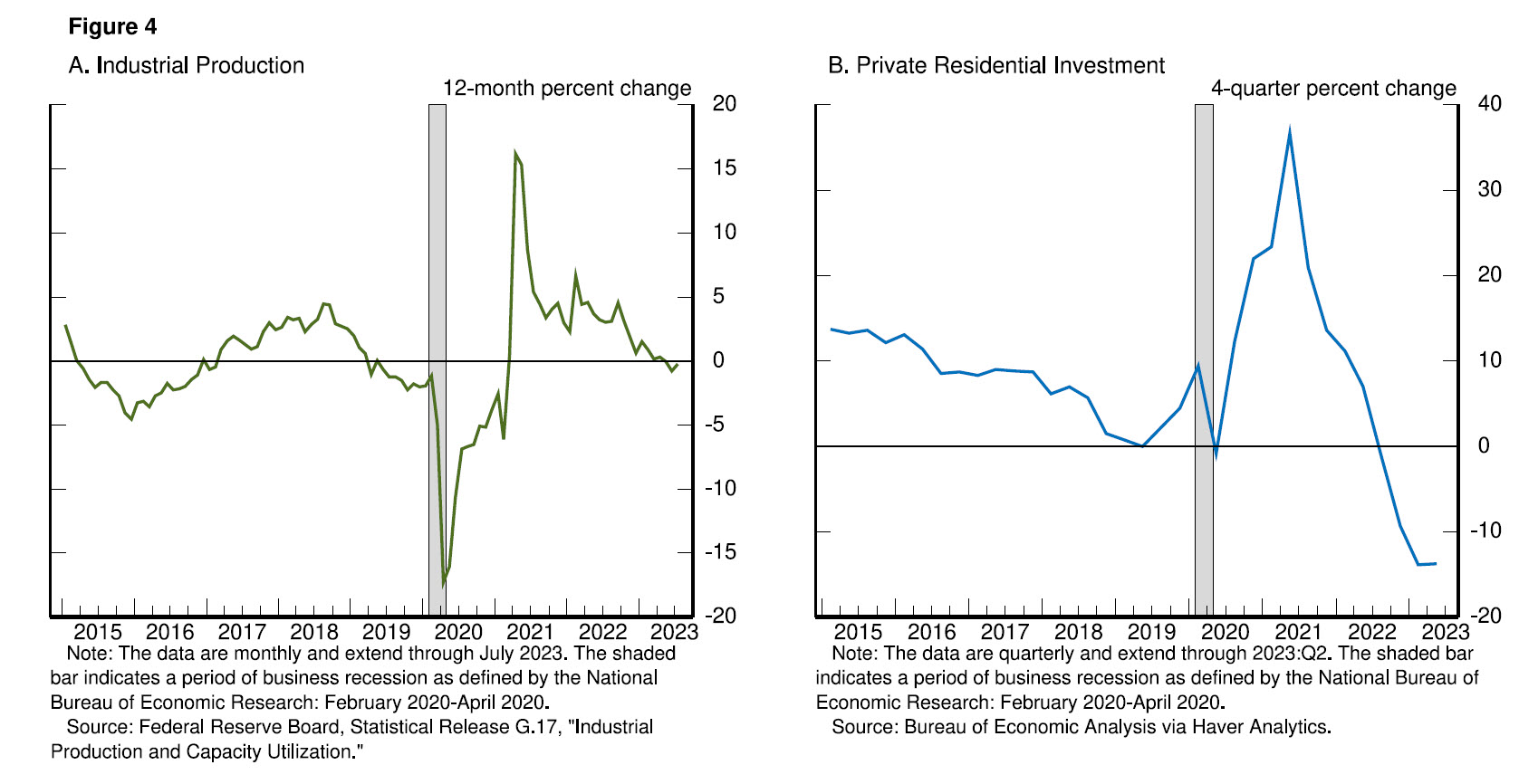
Restrictive monetary policy has tightened financial conditions, supporting the expectation of below-trend growth.5 Since last year’s symposium, the two-year real yield is up about 250 basis points, and longer-term real yields are higher as well—by nearly 150 basis points.6 Beyond changes in interest rates, bank lending standards have tightened, and loan growth has slowed sharply.7 Such a tightening of broad financial conditions typically contributes to a slowing in the growth of economic activity, and there is evidence of that in this cycle as well. For example, growth in industrial production has slowed, and the amount spent on residential investment has declined in each of the past five quarters (figure 4).
But we are attentive to signs that the economy may not be cooling as expected. So far this year, GDP (gross domestic product) growth has come in above expectations and above its longer-run trend, and recent readings on consumer spending have been especially robust. In addition, after decelerating sharply over the past 18 months, the housing sector is showing signs of picking back up. Additional evidence of persistently above-trend growth could put further progress on inflation at risk and could warrant further tightening of monetary policy.
The labor market
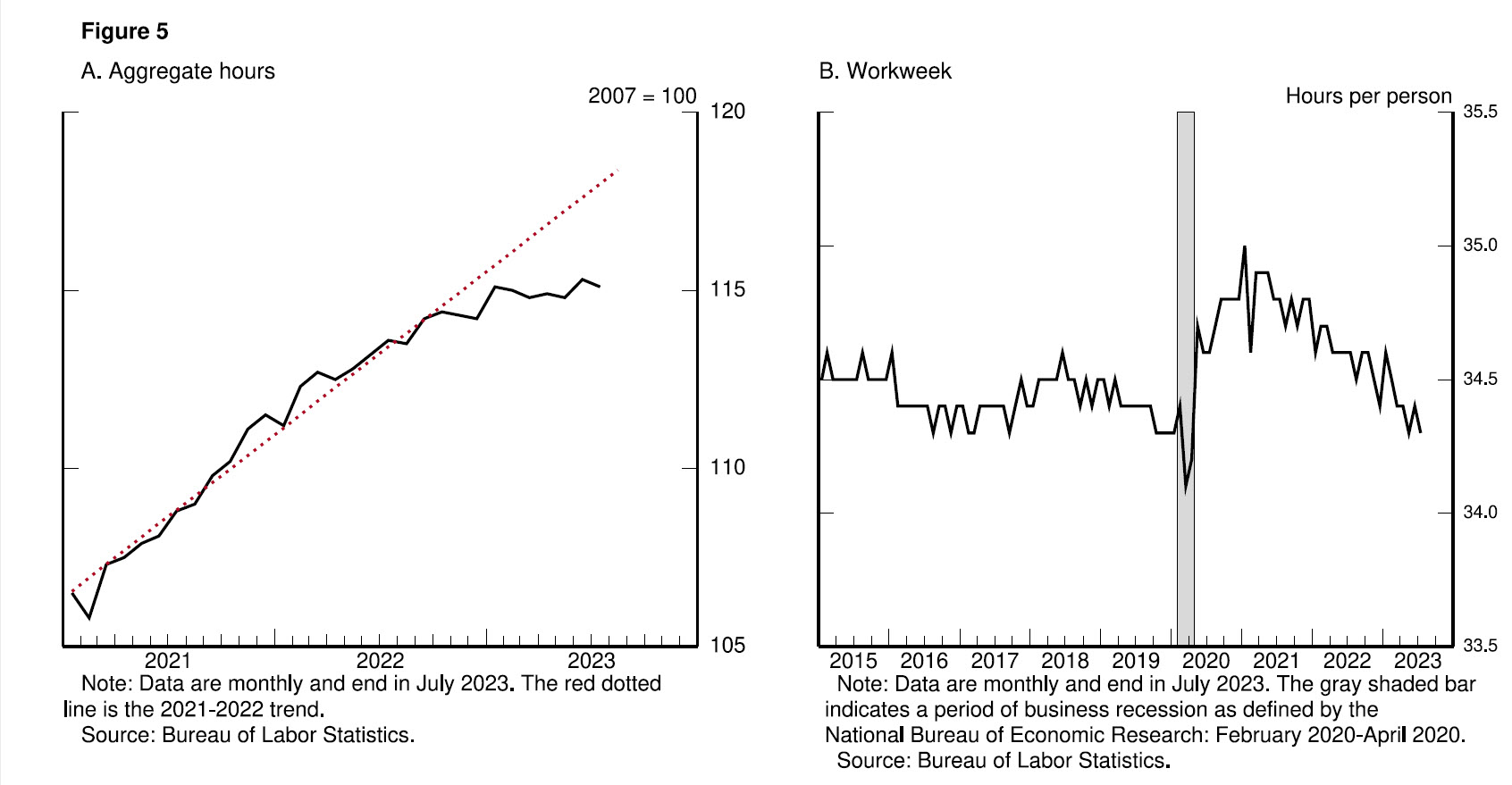
The rebalancing of the labor market has continued over the past year but remains incomplete. Labor supply has improved, driven by stronger participation among workers aged 25 to 54 and by an increase in immigration back toward pre-pandemic levels. Indeed, the labor force participation rate of women in their prime working years reached an all-time high in June. Demand for labor has moderated as well. Job openings remain high but are trending lower. Payroll job growth has slowed significantly. Total hours worked has been flat over the past six months, and the average workweek has declined to the lower end of its pre-pandemic range, reflecting a gradual normalization in labor market conditions (figure 5).
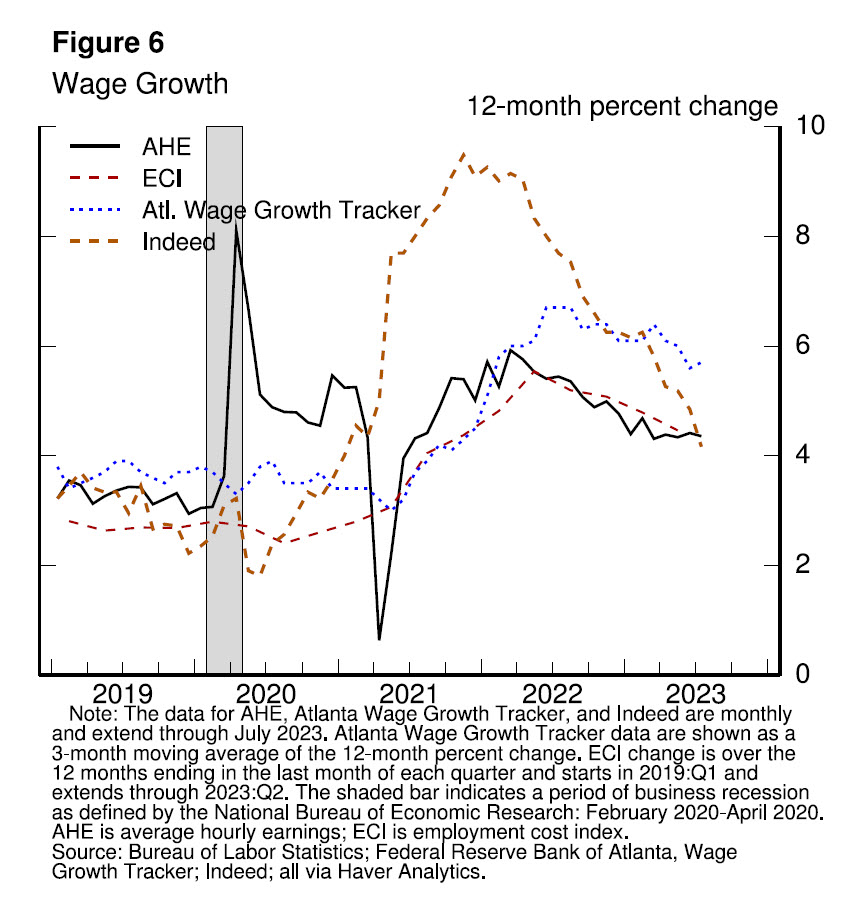
This rebalancing has eased wage pressures. Wage growth across a range of measures continues to slow, albeit gradually (figure 6). While nominal wage growth must ultimately slow to a rate that is consistent with 2 percent inflation, what matters for households is real wage growth. Even as nominal wage growth has slowed, real wage growth has been increasing as inflation has fallen.
We expect this labor market rebalancing to continue. Evidence that the tightness in the labor market is no longer easing could also call for a monetary policy response.
Uncertainty and Risk Management along the Path Forward
Two percent is and will remain our inflation target. We are committed to achieving and sustaining a stance of monetary policy that is sufficiently restrictive to bring inflation down to that level over time. It is challenging, of course, to know in real time when such a stance has been achieved. There are some challenges that are common to all tightening cycles. For example, real interest rates are now positive and well above mainstream estimates of the neutral policy rate. We see the current stance of policy as restrictive, putting downward pressure on economic activity, hiring, and inflation. But we cannot identify with certainty the neutral rate of interest, and thus there is always uncertainty about the precise level of monetary policy restraint.
That assessment is further complicated by uncertainty about the duration of the lags with which monetary tightening affects economic activity and especially inflation. Since the symposium a year ago, the Committee has raised the policy rate by 300 basis points, including 100 basis points over the past seven months. And we have substantially reduced the size of our securities holdings. The wide range of estimates of these lags suggests that there may be significant further drag in the pipeline.
Beyond these traditional sources of policy uncertainty, the supply and demand dislocations unique to this cycle raise further complications through their effects on inflation and labor market dynamics. For example, so far, job openings have declined substantially without increasing unemployment—a highly welcome but historically unusual result that appears to reflect large excess demand for labor. In addition, there is evidence that inflation has become more responsive to labor market tightness than was the case in recent decades.8 These changing dynamics may or may not persist, and this uncertainty underscores the need for agile policymaking.
These uncertainties, both old and new, complicate our task of balancing the risk of tightening monetary policy too much against the risk of tightening too little. Doing too little could allow above-target inflation to become entrenched and ultimately require monetary policy to wring more persistent inflation from the economy at a high cost to employment. Doing too much could also do unnecessary harm to the economy.
Conclusion
As is often the case, we are navigating by the stars under cloudy skies. In such circumstances, risk-management considerations are critical. At upcoming meetings, we will assess our progress based on the totality of the data and the evolving outlook and risks. Based on this assessment, we will proceed carefully as we decide whether to tighten further or, instead, to hold the policy rate constant and await further data. Restoring price stability is essential to achieving both sides of our dual mandate. We will need price stability to achieve a sustained period of strong labor market conditions that benefit all.
UMich Inflation Expectations Jumped In August, Sentiment Slipped
The final print for August’s University of Michigan sentiment survey was expected to confirm the preliminary data’s rise in confidence driven by a decline in inflation expectations.
However, instead the final print saw inflation expectations increasing intra-month and sentiment declining.
Year-ahead inflation expectations edged up from 3.4% last month to 3.5% this month (up signifcantly from the 3.3% preliminary print). Long-run inflation expectations came in at 3.0% for the third consecutive month, but up from the 2.9% preliminary print.
Source: Bloomberg
After rising sharply for the past several months, the final print for August’s UMich headline sentiment data declined…
Source: Bloomberg
While buying conditions for durables and expectations over living conditions both improved, the long-run economic outlook fell back about 12% this month but remains higher than just two months ago.
Finally, UMich notes that consumers perceive that the rapid improvements in the economy from the past three months have moderated, particularly with inflation, and they are tentative about the outlook ahead.
Watch Live: “A Long Way To Go” – Fed Chair Powell Delivers Hawkish J-Hole Speech
Update: Powell’s full speech is below but to summarize – “we ain’t done yet.”
Chair Powell said The Fed is prepared to raise interest rates further if needed and intends to keep borrowing costs high until inflation is on a convincing path toward the Fed’s 2% target.
“Although inflation has moved down from its peak – a welcome development – it remains too high,” Powell said in the text of a speech Friday at the US central bank’s annual conference in Jackson Hole, Wyoming.
“We are prepared to raise rates further if appropriate, and intend to hold policy at a restrictive level until we are confident that inflation is moving sustainably down toward our objective.”
Powell further cautioned that the process “still has a long way to go, even with the more favorable recent readings.”
The Fed Chair explicitly noted the economy may not be cooling as fast as expected, saying recent readings on economic output and consumer spending have been strong.
“Additional evidence of persistently above-trend growth could put further progress on inflation at risk and could warrant further tightening of monetary policy,” Powell said.
Finally, Powell pushed back on speculation that the central bank could raise its inflation target, an idea that has been hotly debated mostly by academics in recent months.
“Two percent is and will remain our inflation target,” he said.
A hawkish address – but admittedly not as hawkish as last year.
* * *
After last year’s brief (8 minutes) uber-hawkish speech, all eyes and ears are on Jackson Hole this morning as Fed Chair Powell delivers his between-FOMC-meetings speech.
Goldman sees a 55-70% chance that he is ‘hawkish’ – the Volcker scenario – reiterate a “job not done” message, indicating the need for an extended period of tighter monetary policy to achieve a decisive win against inflation, whatever it takes.
And a 30-45% chance of a dovish delivery – with Powell questioning the necessity of maintaining a 4% front-end real interest rate at the present time, and whether there is room to align with market expectations for 2024 by reducing front-end real rates by half.
One thing is for sure, markets will react one way or the other.
Watch Powell’s speech below (due to start at 10am ET)…
Read Powell’s full address below:
Good morning. At last year’s Jackson Hole symposium, I delivered a brief, direct message. My remarks this year will be a bit longer, but the message is the same: It is the Fed’s job to bring inflation down to our 2 percent goal, and we will do so. We have tightened policy significantly over the past year. Although inflation has moved down from its peak—a welcome development—it remains too high. We are prepared to raise rates further if appropriate, and intend to hold policy at a restrictive level until we are confident that inflation is moving sustainably down toward our objective.
Today I will review our progress so far and discuss the outlook and the uncertainties we face as we pursue our dual mandate goals. I will conclude with a summary of what this means for policy. Given how far we have come, at upcoming meetings we are in a position to proceed carefully as we assess the incoming data and the evolving outlook and risks.
The Decline in Inflation So Far
The ongoing episode of high inflation initially emerged from a collision between very strong demand and pandemic-constrained supply. By the time the Federal Open Market Committee raised the policy rate in March 2022, it was clear that bringing down inflation would depend on both the unwinding of the unprecedented pandemic-related demand and supply distortions and on our tightening of monetary policy, which would slow the growth of aggregate demand, allowing supply time to catch up. While these two forces are now working together to bring down inflation, the process still has a long way to go, even with the more favorable recent readings.
On a 12-month basis, U.S. total, or “headline,” PCE (personal consumption expenditures) inflation peaked at 7 percent in June 2022 and declined to 3.3 percent as of July, following a trajectory roughly in line with global trends (figure 1, panel A).1 The effects of Russia’s war against Ukraine have been a primary driver of the changes in headline inflation around the world since early 2022. Headline inflation is what households and businesses experience most directly, so this decline is very good news. But food and energy prices are influenced by global factors that remain volatile, and can provide a misleading signal of where inflation is headed. In my remaining comments, I will focus on core PCE inflation, which omits the food and energy components.
On a 12-month basis, core PCE inflation peaked at 5.4 percent in February 2022 and declined gradually to 4.3 percent in July (figure 1, panel B). The lower monthly readings for core inflation in June and July were welcome, but two months of good data are only the beginning of what it will take to build confidence that inflation is moving down sustainably toward our goal. We can’t yet know the extent to which these lower readings will continue or where underlying inflation will settle over coming quarters. Twelve-month core inflation is still elevated, and there is substantial further ground to cover to get back to price stability.
To understand the factors that will likely drive further progress, it is useful to separately examine the three broad components of core PCE inflation—inflation for goods, for housing services, and for all other services, sometimes referred to as nonhousing services (figure 2).
Core goods inflation has fallen sharply, particularly for durable goods, as both tighter monetary policy and the slow unwinding of supply and demand dislocations are bringing it down. The motor vehicle sector provides a good illustration. Earlier in the pandemic, demand for vehicles rose sharply, supported by low interest rates, fiscal transfers, curtailed spending on in-person services, and shifts in preference away from using public transportation and from living in cities. But because of a shortage of semiconductors, vehicle supply actually fell. Vehicle prices spiked, and a large pool of pent-up demand emerged. As the pandemic and its effects have waned, production and inventories have grown, and supply has improved. At the same time, higher interest rates have weighed on demand. Interest rates on auto loans have nearly doubled since early last year, and customers report feeling the effect of higher rates on affordability.2 On net, motor vehicle inflation has declined sharply because of the combined effects of these supply and demand factors.
Similar dynamics are playing out for core goods inflation overall. As they do, the effects of monetary restraint should show through more fully over time. Core goods prices fell the past two months, but on a 12-month basis, core goods inflation remains well above its pre-pandemic level. Sustained progress is needed, and restrictive monetary policy is called for to achieve that progress.
In the highly interest-sensitive housing sector, the effects of monetary policy became apparent soon after liftoff. Mortgage rates doubled over the course of 2022, causing housing starts and sales to fall and house price growth to plummet. Growth in market rents soon peaked and then steadily declined (figure 3).3
Measured housing services inflation lagged these changes, as is typical, but has recently begun to fall. This inflation metric reflects rents paid by all tenants, as well as estimates of the equivalent rents that could be earned from homes that are owner occupied.4 Because leases turn over slowly, it takes time for a decline in market rent growth to work its way into the overall inflation measure. The market rent slowdown has only recently begun to show through to that measure. The slowing growth in rents for new leases over roughly the past year can be thought of as “in the pipeline” and will affect measured housing services inflation over the coming year. Going forward, if market rent growth settles near pre-pandemic levels, housing services inflation should decline toward its pre-pandemic level as well. We will continue to watch the market rent data closely for a signal of the upside and downside risks to housing services inflation.
The final category, nonhousing services, accounts for over half of the core PCE index and includes a broad range of services, such as health care, food services, transportation, and accommodations. Twelve-month inflation in this sector has moved sideways since liftoff. Inflation measured over the past three and six months has declined, however, which is encouraging. Part of the reason for the modest decline of nonhousing services inflation so far is that many of these services were less affected by global supply chain bottlenecks and are generally thought to be less interest sensitive than other sectors such as housing or durable goods. Production of these services is also relatively labor intensive, and the labor market remains tight. Given the size of this sector, some further progress here will be essential to restoring price stability. Over time, restrictive monetary policy will help bring aggregate supply and demand back into better balance, reducing inflationary pressures in this key sector.
The Outlook
Turning to the outlook, although further unwinding of pandemic-related distortions should continue to put some downward pressure on inflation, restrictive monetary policy will likely play an increasingly important role. Getting inflation sustainably back down to 2 percent is expected to require a period of below-trend economic growth as well as some softening in labor market conditions.
Economic growth
Restrictive monetary policy has tightened financial conditions, supporting the expectation of below-trend growth.5 Since last year’s symposium, the two-year real yield is up about 250 basis points, and longer-term real yields are higher as well—by nearly 150 basis points.6 Beyond changes in interest rates, bank lending standards have tightened, and loan growth has slowed sharply.7 Such a tightening of broad financial conditions typically contributes to a slowing in the growth of economic activity, and there is evidence of that in this cycle as well. For example, growth in industrial production has slowed, and the amount spent on residential investment has declined in each of the past five quarters (figure 4).
But we are attentive to signs that the economy may not be cooling as expected. So far this year, GDP (gross domestic product) growth has come in above expectations and above its longer-run trend, and recent readings on consumer spending have been especially robust. In addition, after decelerating sharply over the past 18 months, the housing sector is showing signs of picking back up. Additional evidence of persistently above-trend growth could put further progress on inflation at risk and could warrant further tightening of monetary policy.
The labor market
The rebalancing of the labor market has continued over the past year but remains incomplete. Labor supply has improved, driven by stronger participation among workers aged 25 to 54 and by an increase in immigration back toward pre-pandemic levels. Indeed, the labor force participation rate of women in their prime working years reached an all-time high in June. Demand for labor has moderated as well. Job openings remain high but are trending lower. Payroll job growth has slowed significantly. Total hours worked has been flat over the past six months, and the average workweek has declined to the lower end of its pre-pandemic range, reflecting a gradual normalization in labor market conditions (figure 5).
This rebalancing has eased wage pressures. Wage growth across a range of measures continues to slow, albeit gradually (figure 6). While nominal wage growth must ultimately slow to a rate that is consistent with 2 percent inflation, what matters for households is real wage growth. Even as nominal wage growth has slowed, real wage growth has been increasing as inflation has fallen.
We expect this labor market rebalancing to continue. Evidence that the tightness in the labor market is no longer easing could also call for a monetary policy response.
Uncertainty and Risk Management along the Path Forward
Two percent is and will remain our inflation target. We are committed to achieving and sustaining a stance of monetary policy that is sufficiently restrictive to bring inflation down to that level over time. It is challenging, of course, to know in real time when such a stance has been achieved. There are some challenges that are common to all tightening cycles. For example, real interest rates are now positive and well above mainstream estimates of the neutral policy rate. We see the current stance of policy as restrictive, putting downward pressure on economic activity, hiring, and inflation. But we cannot identify with certainty the neutral rate of interest, and thus there is always uncertainty about the precise level of monetary policy restraint.
That assessment is further complicated by uncertainty about the duration of the lags with which monetary tightening affects economic activity and especially inflation. Since the symposium a year ago, the Committee has raised the policy rate by 300 basis points, including 100 basis points over the past seven months. And we have substantially reduced the size of our securities holdings. The wide range of estimates of these lags suggests that there may be significant further drag in the pipeline.
Beyond these traditional sources of policy uncertainty, the supply and demand dislocations unique to this cycle raise further complications through their effects on inflation and labor market dynamics. For example, so far, job openings have declined substantially without increasing unemployment—a highly welcome but historically unusual result that appears to reflect large excess demand for labor. In addition, there is evidence that inflation has become more responsive to labor market tightness than was the case in recent decades.8 These changing dynamics may or may not persist, and this uncertainty underscores the need for agile policymaking.
These uncertainties, both old and new, complicate our task of balancing the risk of tightening monetary policy too much against the risk of tightening too little. Doing too little could allow above-target inflation to become entrenched and ultimately require monetary policy to wring more persistent inflation from the economy at a high cost to employment. Doing too much could also do unnecessary harm to the economy.
Conclusion
As is often the case, we are navigating by the stars under cloudy skies. In such circumstances, risk-management considerations are critical. At upcoming meetings, we will assess our progress based on the totality of the data and the evolving outlook and risks. Based on this assessment, we will proceed carefully as we decide whether to tighten further or, instead, to hold the policy rate constant and await further data. Restoring price stability is essential to achieving both sides of our dual mandate. We will need price stability to achieve a sustained period of strong labor market conditions that benefit all.
By Maartje Wijffelaars, Senior Economist at Rabobank
Stock and bond markets have had quite a busy week in the run up to central bankers’ speeches later today at the Fed’s annual symposium. They’ve both moved up and down, weighing incoming economic data and monetary policy makers’ statements. Currently, the S&P500 is almost back at last week’s close, after it gained 1.5% by the midst of this week. Meanwhile, 10-year treasury yields are almost back at last week’s close of 4.25%, after having reached a 16-year high earlier in the week and dipping upon weak incoming PMI data.
This afternoon, markets and analyst will be searching for any hints regarding the future monetary policy path when Fed chair Jerome Powell takes the stage at 10:05 ET/ 16:05 CET – to be streamed at the Kansas City Fed’s YouTube channel. Later in the day/ evening, at 15:00 ET/ 21:00 CET, ECB president Christine Lagarde will take the floor. Yet don’t hold your breath, as both might well be unwilling to give much guidance into their respective September meetings.
This far into the hiking cycle and with the sticky core inflation still high, it becomes ever more difficult to balance the risk of doing too much or doing too little. Given the rather mixed signals provided by recent data coming in, it seems likely both the Fed and ECB will prefer to gather as much data as possible to make a decision on the best way forward.
Indeed, while recent data quite convincingly suggest economic growth is slowing in Europe, core inflation gave no sign of retreat in July as it stayed put at June’s 5.5% y/y. Next week we will get the first figures for August and it could help the ECB a lot they down as expected by analysts (core is expected to drop to 5.2% y/y and headline to 5.1% y/y).
With respect to the economic data, German GDP figures this morning confirmed the eurozone’s largest economy stagnated in the second quarter of the year. And this morning’s IFO survey for August confirmed the ongoing weakness that was already laid bare by last Wednesday’s PMI data. The IFO Business Climate came in below consensus at 85.7, down from July’s 87.3. In fact, all sectors saw their diffusion index declining, which is further proof that weakness is spreading more broadly into the economy. Remember, that the composite PMI dived deeper into negative territory as well, as activity in the services sector is weakening. At 44.7, Germany’s composite PMI convincingly showed that the tide is worsening rather than improving.
Germany is not alone, however, as the composite PMI for the Eurozone came in at a 33-month low in August, falling starkly into contractionary territory. It dropped from 48.6 in July to 47 in August, also convincingly below the consensus of 48.5. Most worrying is the fact that weakness is more visibly spreading to services. If anything, the risk of a near-term recession has clearly increased. All in all, these figures have let us to revise down our growth projections for the euro area from stagnation in the second half of this years to a minor contraction in the current and final quarter of the year. Minor because, for one, we don’t expect major labour shedding as companies will try to hold on to their workforce in the currently very tight labour market. That being said, risks are clearly tilted to the downside. We will explore our projections in more detail in forthcoming publications.
At the other side of the Atlantic, yesterday’s durable goods orders joined the recent PMI figures in suggesting that the US economy is slowing down. The former came in at -5.2% m/m in July compared to -4% m/m consensus and after 4.6% in June. Remember, the composite PMI fell from 52 in July to 50.4 in August. Yet whilst slowing down, the PMI figure for the US still points to growing rather than contracting activity, driven by the services sector.
This is underscored by the Nowcast forecast by the Atlanta Fed. Its updated figure on 24 August, shows the US economy grew by a still staggering 5.9% annualised rate in the third quarter. Clearly, only so much data has come in for the third quarter so far, yet at least it suggests the US is not as close to entering a recession as the EU – although the US still has a recession approaching further down the road, according to our US watcher Philip Marey. Meanwhile, albeit on a downward trend, core CPI still stood at 4.4% in July, down from its peak of 5.6% in March.
Importantly, while board members of both the ECB and Fed publicly disagree – or at least express doubts – about whether another rate hike is warranted in September, none of them hints at a pivot coming soon. On the contrary, all reiterate yields will need to stay higher for longer. And the latter thinking seems to have been gaining ground in the markets, especially in the US where a pivot was already priced in earlier than in Europe. That said, the weak data in the euro area so far has left a bigger mark on 10-year bond yields than in the US. And, we would also argue that the ‘China factor’ may have had a bigger impact than on the other side of the Atlantic.
US outperformance with respect to the Eurozone and a growing belief that yields will stay higher for longer have supported the dollar recently. The EURUSD cross has dropped from 1.12 last week to 1.08 yesterday, and the euro’s decline is continuing this morning. Our FX strategist Jane Foley believes the dollar is up for some more gains in the coming months, reaching 1.06 on a three-to six-month horizon, before it loses some strength as the gap in economic performance tightens and Fed rate cuts move into view.
As mentioned, bond yields in the euro area have come down from last week’s peak. While non-negligible, they will give governments little respite, however, in terms of rising interest costs. Indeed, while debt ratios, are set to fall in the short term, helped by high nominal GDP growth, in a recent publication we show that projected interest costs are to rise substantially over the coming few years, especially in high-debt countries.
While interest payments will require a larger portion of all countries’ revenues, Italy and Spain are expected to face the greatest debt affordability challenges. In the former, interest-to-revenue ratios are expected to exceed the threshold above which countries tend to enter speculative grade rating territory. On the bright side, there is still time to avoid such a situation and we don’t forecast a new eurozone debt crisis – not the least because of all the EU safety nets set up over the past few years -, but we do point out several vulnerability risks and argue there is no time for complacency in a number of countries. For more insights please read the report or reach out.
Day ahead
The most interesting event of the day will certainly be the Fed’s symposium titled “Structural Shifts in the Global Economy”. Apart from Jerome Powell’s view towards the economic outlook and any possible hints with regards to monetary policy going forward, it will also be interesting if and what he has to say about de-risking, decoupling, and de-dollarization. Will he reiterate parts of Lagarde’s speech earlier this year on the structural impact on consumer price indices of decoupling? Will he share his views on the BRICS extension announced yesterday?
Yesterday the BRICS asked six out of twenty-two applicants to join the bloc: Saudi Arabia, Iran, Egypt, Argentina, Ethiopia and the UAE. Looking at all the vowels it does not seem to make for a nice new acronym. Yet given its increased heft and the inclusion of several heavy weights in commodities (and hence with extensive financial powers), it certainly warrants attention. Will the group be able to agree on a future economic and political course? Will it lead to faster de-dollarization – towards perhaps yuanization? – and a stronger front against Western hegemony in global institutions? As we have already covered in several Dailies this week, in spite of all the heft, it remains to be seen if and how the enlarged group will be able to move forward, given the many different voices, aspirations, dependencies and economic sizes and structures of the countries within the group. Yet it certainly is not a development to neglect by analysts and policy makers.
This afternoon the University of Michigan will also publish its consumer survey outcome for August and the Kansas City Fed will present its services survey activity index for August.
Fitch’s recent downgrade of the U.S. debt rating alarmed investors as the deficit and debt steadily increased. The downgrade sent 10-year Treasury bond yields above 4%, causing concern about America’s deteriorating financial condition. The problem is that if radical steps aren’t taken to curb spending, such will cause interest rates to rise. To wit:
“The U.S. borrows in its own currency and will never actually default involuntarily as long as it has a printing press. As rising rates push that financing need higher, though, the ability of the U.S. government to change the fiscal path without politically disastrous measures like cutting entitlements or by overtly printing money is becoming more limited.
If no such radical steps are taken then it almost certainly means paying more to borrow. That rising risk-free-rate will crowd out private investment and dent the value of stocks, all else being equal.”– WSJ
Such certainly seems like a logical conclusion. However, the key to the statement is in the last sentence. Many “bond bears” suggest that rates must rise as deficits increase and more debt is issued. The theory is that at some point, buyers will require a higher yield to buy more debt from the U.S. Such is perfectly logical in a normally functioning bond market where the only players are the individual and institutional bond market players.
In other words, as long as “all else is equal,” rates should rise in such an environment.
However, all else is not equal in a global economy where government debt yields are controlled by Central Banks colluding with Governments to maintain economic growth, control inflation, and avoid financial crises. Such is evident in the chart below. Since 2008, Central Banks globally have been buyers of global debt.
Why have Central Banks engaged in such a massive bond-buying program? To provide liquidity to combat the deflationary forces of debt and keep global economies out of recession. As shown, since 1980, each time the economy was dealt a recessionary blow, the Government responded by increasing debt. However, more debt resulted in a continued decline in inflation, wages, economic growth, and interest rates.
The analysis becomes clearer when viewing the economic composite against the deficit.
The expectation is that “this time is different.” More debt and more significant deficits will lead to higher interest rates. However, since 1980, such has not been the case. (The exception was in 2020, when sending checks to households and shuttering the economy, creating an inflation spike.) More importantly, the Federal Reserve and the global Central Banks remain trapped.
The Fed Remains Trapped
Before 2020, the Federal Reserve wanted higher inflation. However, after the failed experiment of shuttering the economy and sending checks to households, the Fed now wants lower inflation. Ultimately, the Federal Reserve will get its wish as rising debt levels foster slower economic growth rates and disinflation.
Since 1980, increasing debt levels have been required to create $1 of economic activity. At nearly $5 of debt to create $1 of economic activity, the ability to foster more robust economic growth and inflation is unlikely.
Even if the “bond bears” are correct, and increasing debt levels and deficits do cause higher rates, Central Banks will take actions to push rates artificially lower.
At 4% on 10-year Treasury bonds, borrowing costs remain relatively low from a historical perspective. However, we still see signs of economic deterioration and negative consumer impacts even at that rate. When the leverage ratio is nearly 5:1 in the economy, 5% to 6% rates are an entirely different matter.
Interest payments on the Government debt increase, requiring further deficit spending.
The housing market will decline. People buy payments, not houses, and rising rates mean higher payments.
Higher interest rates will increase borrowing costs, which leads to lower profit margins for corporations.
There is a negative impact on the massive derivatives market, leading to another potential credit crisis as interest rate spread derivatives go bust.
As rates increase, so do the variable interest payments on credit cards. Such will lead to a contraction in disposable income and rising defaults.
There is a negative impact on banks as rising defaults on large debt levels erode capitalization.
Rising interest rates will negatively impact already underfunded pension plans, leading to insecurity about meeting future obligations.
I could go on, but you get the idea.
The Fed Will Intervene
The issue of rising borrowing costs spreads through the entire financial ecosystem like a virus. Such is why the Federal Reserve and the Government will force rates lower through both monetary and fiscal policies. Such is particularly true when the interest on the existing debt absorbs nearly 1/5th of your collected tax revenues.
The biggest problem with the “rates must go higher” thesis is the inability of the economy to sustain higher rates due to mounting debt issuance and rising deficits. The Congressional Budget Office recently updated its debt trajectory over the next 30 years. The chart below models that analysis using the growth trend of debt but also factors in the need for the Federal Reserve to monetize nearly 30% of that issuance.
At the current growth rate, the Federal debt load will climb from $32 trillion to roughly $140 trillion by 2050. Concurrently, assuming the Fed continues monetizing 30% of debt issuance, its balance sheet will swell to more than $40 trillion.
Let that sink in for a minute.
What should not surprise you is that non-productive debt does not create economic growth. Since 1977, the 10-year average GDP growth rate has steadily declined as debt increased. Thus, using the historical growth trend of GDP, the increase in debt will lead to slower economic growth rates in the future.
Conclusion
Therefore, as debt and deficits increase, Central Banks will be forced to suppress interest rates to keep borrowing costs down to sustain weak economic growth rates. The problem with the assumption that rates MUST go higher is three-fold:
All interest rates are relative. The assumption that rates in the U.S. are about to spike higher is likely wrong. Higher yields in U.S. debt attract flows of capital from countries with low to negative yields, which pushes rates lower in the U.S. Given the current push by Central Banks globally to suppress interest rates to keep nascent economic growth going, an eventual zero-yield on U.S. debt is not unrealistic.
The coming budget deficit balloon. Given Washington’s lack of fiscal policy controls and promises of continued largesse, the budget deficit is set to swell above $2 Trillion in coming years. This will require more government bond issuance to fund future expenditures, which will be magnified during the next recessionary spat as tax revenue falls.
Central Banks will continue to buy bonds to maintain the current status quo but will become more aggressive buyers during the next recession. The next QE program by the Fed to offset the next economic downturn will likely be $4 Trillion or more, pushing the 10-year yield toward zero.
If you need a road map of how this ends with lower rates, look at Japan.
Policy analyst Michele Wucker described this sort of problem in her 2016 book “The Gray Rhino,” which was an English-language bestseller in China. Unlike an out-of-the-blue crisis dubbed a “black swan,”a gray rhino is a probable event with plenty of warnings and evidence that is ignored until it is too late.
Zillow Extends Lifeline: New Down Payment Aid Targets Struggling Homebuyers
On Thursday, Freddie Mac’s average rate on a 30-year fixed mortgage topped 7.09%, the highest since 2002, in yet another blow to homebuyers and a sign the housing affordability crisis worsens. On the same day, Zillow Home Loans published a press release about its new “1% Down Payment program to allow eligible home buyers to pay as little as 1% down on their next home purchase.”
“This program can reduce the time needed to save for a down payment and provide another option for those who are otherwise ready to take on a mortgage payment,” Zillow said, adding the new program will first be available for Arizona properties, with nationwide expansions sooner after:
With the 1% Down Payment program, borrowers who qualify can now save just 1% to cover their portion of the down payment and Zillow Home Loans will contribute an additional 2% at closing. The 1% Down Payment program can reduce the time eligible home buyers need to save and open homeownership to those who are otherwise ready to take on a mortgage.
Zillow aims to lower the downpayment barrier and increase activity in the frozen housing market. The highest 30-year fixed mortgage rate since 2002 has sent mortgage applications to the lowest levels since 1995
“For those who can afford higher rent payments but have been held back by the upfront costs associated with homeownership, down payment assistance can help to lower the barrier to entry and make the dream of owning a home a reality,” said Zillow Home Loans’ senior macroeconomist Orphe Divounguy.
Divounguy continued, “The rapid rise in rents and home values means many renters who are already paying high monthly housing costs may not have enough saved up for a large down payment, and these types of programs are welcome innovations in lowering the potential barriers to homeownership for those who qualify.”
If mortgage rates increase, more buyers will be sidelined — and Zillow appears to be getting ahead of this by offering the new program. The inventory issue has yet to abate and is a structural problem that has kept home prices at lofty levels — making this moment in time the least affordable since 1984.
Chief economist at Moody’s Analytics, Mark Zandi, told Bloomberg, “When you get to 7% plus, the market goes dark. Affordability is too far out of reach.”
Perhaps this Zillow venture will fare better than its home flipping several years ago that led to steep losses.
An increasing number of parents have expressed concern over their children’s digital habits as their kids return to the classroom, findings from a new poll show.
Two-thirds of parents surveyed say overall screen time, followed by social media overuse and internet safety, are major concerns, according to the University of Michigan C.S. Mott Children’s Hospital National Poll on Children’s Health.
“Children are using digital devices and social media at younger ages, and parents may struggle with how to appropriately monitor use to prevent negative impacts on safety, self-esteem, social connections, and habits that may interfere with sleep and other areas of health,” said Mott Poll co-director and Mott pediatrician Dr. Susan Woolford in a news release.
Harmful Effects of Social Media
Findings from the poll, based on a nationally representative sample of over 2,000 respondents, also reveal that 50 percent of parents are concerned about mental health problems such as depression, suicide, stress, and anxiety associated with excessive screen use.
Social media platforms include Instagram, TikTok, Snapchat, and Facebook.
Findings from a 2019 study published in JAMA Psychiatry showed preteens and teens who spent more than three hours per day on social media had a 60 percent higher risk of developing mental health problems. Separate research shows unhealthy scrolling is a significant source of distraction that can lead to addiction, which then adversely impacts academic performance and fuels unrealistic expectations when kids compare themselves to popular, self-declared influencers.
According to an official blog by the National Eating Disorder Association, social media platforms are linked to a fixation on appearance, pressure to be muscular, and reduced body satisfaction. Social media also sets students up for cyberbullying. Fifty-nine percent of teens in the United States say they’ve been bullied or harassed online.
What to Do
The back-to-school months are an excellent time to reinstate expectations and set limits that may have been lifted during the summer months.
“It is typical for parents to relax those rules during the summer, but once school starts, parents and children need to have a conversation about limits on social media and screen time by setting up agreed-upon rules,” Dr. Michelle Escovedo, an adolescent medicine specialist at Cedars-Sinai Guerin Children’s in Los Angeles, said in a recent virtual community conversation about the back-to-school season.
Limit social media by utilizing available screen time settings so kids and teens learn self-control. Lack of self-control can lead to addiction. Brain specialists have shown that acquiring likes, engaging with people, and temporarily escaping reality trigger the brain’s reward system by releasing dopamine, the same neurotransmitter released with other addictions like eating and gambling.
2019 data from the research firm Statista show that 40 percent of U.S. online users aged 18 to 22 reported feeling addicted to social media, with 5 percent of respondents describing themselves as being “completely” addicted.
2. Ensure Kids Get Enough Sleep
Prohibit screen time that interferes with at least eight hours of sleep.
According to the National Institutes of Health (NIH), a lack of z’s impairs a child’s neurodevelopment, increases impulsivity, and leads to aggressive behavior and thinking problems. Insufficient sleep is also associated with an increased risk for chronic conditions such as diabetes and obesity.
3. Watch for Concerning Behavior
Be on the lookout for behaviors that escalate to the point where:
They interfere with the child’s daily routines and commitments, such as school, work, friendships, and extracurricular activities.
The child often chooses social media over in-person social interactions.
The child cannot get at least eight hours of quality sleep each night.
The child is prevented from engaging in regular physical activity.
The child uses social media even when they express a desire to stop.
The child experiences strong cravings to check social media.
The child lies or uses deceptive behavior to spend time online.
Visualizing The Impact Of The G20’s Corporate Subsidies: How Govts Impede Trade
Corporate subsidies refer to financial incentives provided by governments to domestic businesses.
These incentives aim to promote economic growth within a specific industry, and can take various forms such as direct crash grants, tax breaks, low-interest loans, or favorable regulations. While corporate subsidies can have positive effects on a country’s economy, they can also create an uneven playing field in the global market.
Number of Subsidy Distortions by Implementing Country
The following table includes all of the data we used to create the first chart in this graphic, which was sourced from Global Trade Alert’s Corporate Subsidy Inventory.
A key point to understand is that this data does not represent the number of subsidies implemented by each country. Rather, it shows the number of market distortions that resulted as a consequence of those subsidies.
As we can see, China and the U.S. account for a massive chunk of the G20’s subsidy-related market distortions between 2008 and Q1 2023. According to CSIS, China spent more on corporate subsidies than it did on defense in 2019. Of the country’s 176,479 market distortions, approximately 95% have stemmed from the use of financial grants.
China has a long history of providing substantial financial aid to its major companies. This includes Huawei, which became a global leader in 5G networks despite being founded just 35 years ago in 1987. A 2019 story from The Wall Street Journal found that Huawei had benefited from as much as $75 billion in government aid.
Turning focus to the U.S., the largest sources of its market distortions were financial grants (16%), state loans (15%), and production subsidies (14%).
A recent example of American subsidies is the Biden administration’s CHIPS and Science Act, which provides $39 billion in aid to boost domestic chip making, as well as billions more to support the semiconductor industry as a whole.
Tracking Subsidy Distortions Over Time
The second chart in this graphic visualizes the annual number of subsidy-related market distortions recorded between 2012 and 2022. It highlights a massive spike in activity during the onset of the COVID-19 pandemic in 2020.
China was the largest player during this time, with over 30,000 market distortions recorded throughout the year. Companies from all industries, including pharmaceuticals, technology, and manufacturing received financial grants.