75.4 F
Chicago
Monday, August 31, 2026
Home Blog Page 3402

Despite Weak Global Data, We Have Stagflation… We Also Have Leninist Policy Shocks

0
Despite Weak Global Data, We Have Stagflation… We Also Have Leninist Policy Shocks

By Michael Every of Rabobank

“Just One Damned Thing After Another”

History, some say, is “Just one damned thing after another.” So is most financial markets coverage, just with post hoc ergo propter hoc.

Yet serious historians look for patterns; Marxists see it as pre-written; and Leninists want to speed it up with bullets. In markets there are also serious thinkers looking for patterns; and Marxists; and even Leninists.

Take the death of Wagner mercenary leader Prigozhin, whose plane just ‘crashed’ in Russia. Even market analysts see the Leninist pattern there.

If only they could apply the same analytical rigour more broadly though.

In “just one damned thing after another” terms, yesterday saw appalling PMI data. UK manufacturing printed 42.5 and services 48.7, Europe 43.7 and 48.3 (with Germany worse), and the US 47.0 and 51.0. Yet the surveys also showed signs of inflation picking up again – so stagflation. The result: US 2-year yields -8bp to 4.97% and 10s -13bp to 4.20%, UK 2s -17bp to 4.97% and 10s -18bp to 4.47%, and German 2s -13bp to 2.96% and 10s -12bp to 2.51%; stocks closed up; the dollar DXY index spiked then slipped; oil dropped, then bounced; and gold and bitcoin rose. In market ‘ergo-ing’, the single worst take I saw was ‘people bought bonds because stagflation fears are rising’. But in stagflation bonds are the last place you want to be! Either the central bank raises rates, yet it does nothing; or they don’t raise rates and you get financial repression.

Those data were just what central banks didn’t want to see ahead of Jackson Hole, where the message is still likely to be ‘Higher For Longer’ under the umbrella of “Structural change”.

They will need to show new thinking that grasps economic history.

Relatedly, the BRICS just met in South Africa, as Prigozhin was taken out in the ‘R’, the ‘I’ landed a moon rover for a budget less than a bad Hollywood movie about the same, and President Biden cancelled an upcoming trip to BRICS applicant Indonesia, once again abandoning ASEAN as a foreign policy priority. Indeed, the BRICS meeting was frustrated with the US and G7, as those obsessed with microaggressions are blind to their macro transgressions.

Xi Jinping’s speech noted:

“Changes in the world, in our times and in history are unfolding in ways like never before, bringing human society to a critical juncture. Should we pursue cooperation and integration, or just succumb to division and confrontation? Should we work together to maintain peace and stability, or just sleepwalk into the abyss of a new Cold War? Should we embrace prosperity, openness and inclusiveness, or allow hegemonic and bullying acts to throw us into depression? Should we deepen mutual trust through exchanges and mutual learning, or allow hubris and prejudice to blind conscience? The course of history will be shaped by the choices we make.”

And I was told it was all about when we get rate cuts!

A lot of states now want to join BRICS: Algeria, Bangladesh, Bahrain, Belarus, Bolivia, Cuba, Egypt, Ethiopia, Honduras, Indonesia, Iran, Kazakhstan, Kuwait, Morocco, Nigeria, Palestine, Saudi Arabia, Senegal, Thailand, UAE, Venezuela, and Vietnam. That runs like the Welsh village with the longest place name in the world. This unpronounceable group has a GDP larger than the G7. However, as I warned 18 months ago, just looking at the world map and adding up populations and GDPs does not make a functioning ‘New World Order’.

As a parallel, if you ‘add’ a gorilla to a great white shark, you don’t get the king of the sea AND the jungle without a lot of evolution – you just get digestion.

In BRICS+, China is larger than all other members combined, and it exports ever-more value-added goods to them while only importing raw commodities from them.

Yet the BRICS+ want to industrialize, not just sell raw materials to rich countries, as to the G7. Something doesn’t add up.

Also note there was no BRICS+ launch of a promised common currency backed by gold or crypto, just the sensible goal of more development lending in their own currencies.

Which, by the way, the G7 should also be embracing at Jackson Hole if they have a brain, even if it’s bad for inflation near term.

Yet if it’s hard to create a new global system, it’s easier to destroy one. If BRICS+ trade invoicing shifts from the dollar to local FX bilateral barter, and then goods flows shift too, it will mean a gradual global 1930’s-style fragmentation of supply chains and capital flows, exacerbated by tech and clearing systems schisms.

One key way the West can push back against this trend is via higher rates offering a decent rate of return on the US dollar, or Euro, etc. Capital can be hoovered out of rival political blocks with higher rates. Commodity prices can be pushed lower, or at least capped. We don’t talk about this, focusing instead on data now apparently screaming for rate cuts despite stagflation, but it’s true, and it’s clearly working.

Of course, Wall Street hates it. Then again, it also hates dedollarization and being shut out of the BRICS+. Zoltan Pozsar thinks the US fears dedollarisation because, as quoted in the Financial Times, “The West dreamed of the BRICS as a lapdog, that they would accumulate dollars and recycle them into Treasuries, but instead of that they are renegotiating how things are done.” What he means is Wall Street, not the West. After all, post a serious economic bump, the US economy would do fine in a more fragmented world because it has all it needs – Wall Street wouldn’t.

Zoltan’s new ‘Ex Uno Plures’ –Latin for ‘Exit Through the Gift Shop’– offers 50% Fed liquidity and 50% on new ‘dollar-rival’ views. Yet the only Fed plumbing we need to know about is which acronym will be used to fund the Pentagon while rates stay high – again let’s see what Jackson Hole might say; and on the ‘gorilla-shark’ side, Hand-of-Godley Michael Pettis just pointed out that Zoltan misunderstands how the global balance of payments works, saving me doing it again.

Frankly, Zoltan could just have listened to both Donald Trump and the Republican Party presidential debate, where there was universal agreement that the US doesn’t want to keep receiving recycled dollars via larger trade deficits, and wants mercantilism and/or industrial policy instead. (Alongside rather too much talk about washing machines and shower head pressure.)

In short, despite weak global data, we have stagflation, which rate cuts would make worse. Moreover, we also have Leninist policy shocks for markets to deal with.

In response, former Goldman CEO Hank Paulson just wrote an open letter to Xi and Biden (‘A deep crisis in China would pose a choice for two leading powers’) that basically begs for a policy U-turn to him bail out:

“The decisions that Chinese and US leaders make in the months ahead could have enormous implications – for the global economy, global security, business and the future of the US-China competition.

First, China… Whether we are witnessing a short-term blip or the beginning of the country’s long-term stagnation will ultimately depend on choices Beijing’s leadership makes…. It could continue on the path of greater Communist Party involvement in business and the allocation of economic resources, limiting access to economic data and arbitrarily enforcing vague legislation such as the national security law. Or it could pivot, making necessary changes to place more reliance on markets and the private sector, competition, and openness.

The choice it makes matters greatly for the security of the world. A failed or low-growth economy has the potential to heighten geopolitical tensions if China opts to stoke nationalism and blames outside forces for its domestic challenges. If nationalist fervour results, the US-China relationship could further spiral toward conflict.

The test for US policymakers will be whether we lose confidence in our own system by continuing to attempt to beat China at its own game – or whether we trust in the economic principles that have made our economy and our companies leaders in the world… Once and for all, China’s economic challenges should put to rest the belief that to compete, Washington should adopt more statist economic and industrial policies. Instead, US policymakers need to do more to reduce our national debt and address our looming fiscal crisis, which is the primary threat to our economic and national security. And we need to resist the impulse to adopt more top-down, bureaucracy-implemented approaches and avoid populist bullying of private businesses.

For the sake of global growth, geopolitical security and our continued prosperity, we should hope China pivots toward policies that encourage competition and openness.

And, here at home, we should remember that our national security depends upon our economic strength and stay focused on what has made our country strong.”

To summarise, “A Greenspan Put for the Greenspan Putz, puh-lease” as Paulson expects China and the US to both cut taxes, cut state spending, cut rates, and cut regulation.

Do you think this is what we are going to hear from Beijing? Rate cuts aside, as George Magnus just put it, “Such moves do not sit comfortably with the Leninist hew of Xi’s China, which is now crossing a river where the stones are too deep to feel.

Do you think this is what we are going to hear from Jackson Hole either? Will we really see a U-turn from the speech Lagarde gave earlier this year about the fusion of fiscal and monetary policy, of national security with economic security, and of the importance of the supply side in terms of PRODUCTION, just because of a weak set of PMI data? Will Powell throw everyone a big juicy bone?

Maybe, because as Paulson shows, the ‘smartest guys in the room’ are staggeringly ignorant of how the world actually works. However, that he had to write the op-ed at all shows the pattern of history has now changed, and so will that of central banks, and then markets.

In short, the odds of a rates policy pivot are very low – even if the PMI readings are too.

Tyler Durden
Thu, 08/24/2023 – 11:40

T-Mobile Plans To Cut 5,000 Jobs: A Grim Omen For Economy?

0
T-Mobile Plans To Cut 5,000 Jobs: A Grim Omen For Economy?

In the latest sign of economic uncertainty, T-Mobile announced Thursday morning that it plans to slash its workforce by 7%, or about 5,000 jobs.

T-Mobile wrote in a filing that it will incur a pre-tax charge of approximately $450 million in the third quarter of 2023 related to the workforce reduction. The company said its fiscal year 2023 guidance remains intact. 

Bloomberg obtained a letter from CEO Mike Sievert to employees that explained the cost of attracting and maintaining customers is “materially more expensive than it was just a few quarters ago.” He said expanding the company’s high-speed internet business and efforts in other areas “is not enough to deliver on these changing customer expectations going forward,” adding he doesn’t see any additional layoffs in the quarters ahead. 

At the end of the fourth quarter in 2022, T-Mobile had a workforce of around 71,000. 

In 2019, T-Mobile’s then-CEO John Legere touted the T-Mobile/Sprint merger would create “new, high-quality, high-paying jobs” for years to come. As for the upcoming job cuts, well, it’s a sign the company could be preparing for a slowdown in the economy. 

Its competitor AT&T recently announced job cuts, eliminating 74,130 employees, or about 32% of its total staff, since early 2021. 

As for tech industry layoffs this year, 965 companies have fired 231,450 employees, according to data from Layoffs.fyi

This year, most of the tech layoffs have focused on retail, consumer, hardware, healthcare, and transportation industries. 

Job cuts are hardly a sign that the economy is flourishing. Yet the White House continues to tout ‘Bidenomics’ as some economic revival. 

Tyler Durden
Thu, 08/24/2023 – 10:00

Xi, Putin Hail First BRICS Expansion In Over A Decade As Gulf Oil Powers Join

0
Xi, Putin Hail First BRICS Expansion In Over A Decade As Gulf Oil Powers Join

At a moment China and Russia have envisioned the future of BRICS as fundamentally an anti-Western bloc of developing nations, the Gulf oil powers Saudi Arabia and the United Arab Emirates have been formally invited to become members, which marks the bloc’s first expansion in over a decade. 

“The membership will take effect from the first of January, 2024,” South African President Cyril Ramaphosa said, adding that additionally Argentina, Egypt, Ethiopia and Iran will be added to the fold next year. 

Brics pool photo, via NY Times

China’s President Xi Jinping hailed the rare expansion, beyond the current large economies of China, Russia, Brazil India, China and South Africa as “historic”. He said it will “inject new impetus into the BRICS cooperation mechanism and further strengthen the power of world peace and development.”

President Putin too congratulated the soon to be newest members, saying in a video message, “I would like to congratulate the new members who will work in a full-scale format next year.”

“And I would like to assure all our colleagues that we will continue the work that we started today on expanding the influence of BRICS in the world,” the Russian leader added. Indian Prime Minister Narendra Modi also hailed the expansion which he said will strengthen the bloc.

Saudi Foreign Minister Prince Faisal bin Farhan’s statement said, “the special, strategic relations with the BRICS nations promotes common principles, most importantly the firm belief in the principle of respect for sovereignty, independence and non-interference in internal affairs.”

He vowed in words before the BRICS conference on Thursday that the kingdom will be a “secure and reliable energy provider,” and noted that total bilateral trade between Riyadh and BRICS countries exceeded $160 billion in 2022, the Saudi foreign minister said.

Set up in 2009, the BRICS nations represent some 40% of the world’s population and significantly over a quarter of the world’s GDP. And now with Saudi Arabia, the UAE and Iran set to enter the fold, it will have three of the world’s biggest oil producers

As for Iran’s statement on it’s upcoming entry into the bloc:

Mohammad Jamshidi, the political deputy of Iran’s President Ebrahim Raisi, called the decision to add his country “a historic move.”

“A strategic victory for Iran’s foreign policy,” Jamshidi wrote on X, the website formerly known as Twitter. “Felicitations to the Supreme Leader of Islamic Revolution and great nation of Iran.”

In Putin’s virtual address the day prior, he emphasized that de-dollarization is “gaining momentum”. He said the dollar’s receding global centrality is an “objective and irreversible” process

* * *

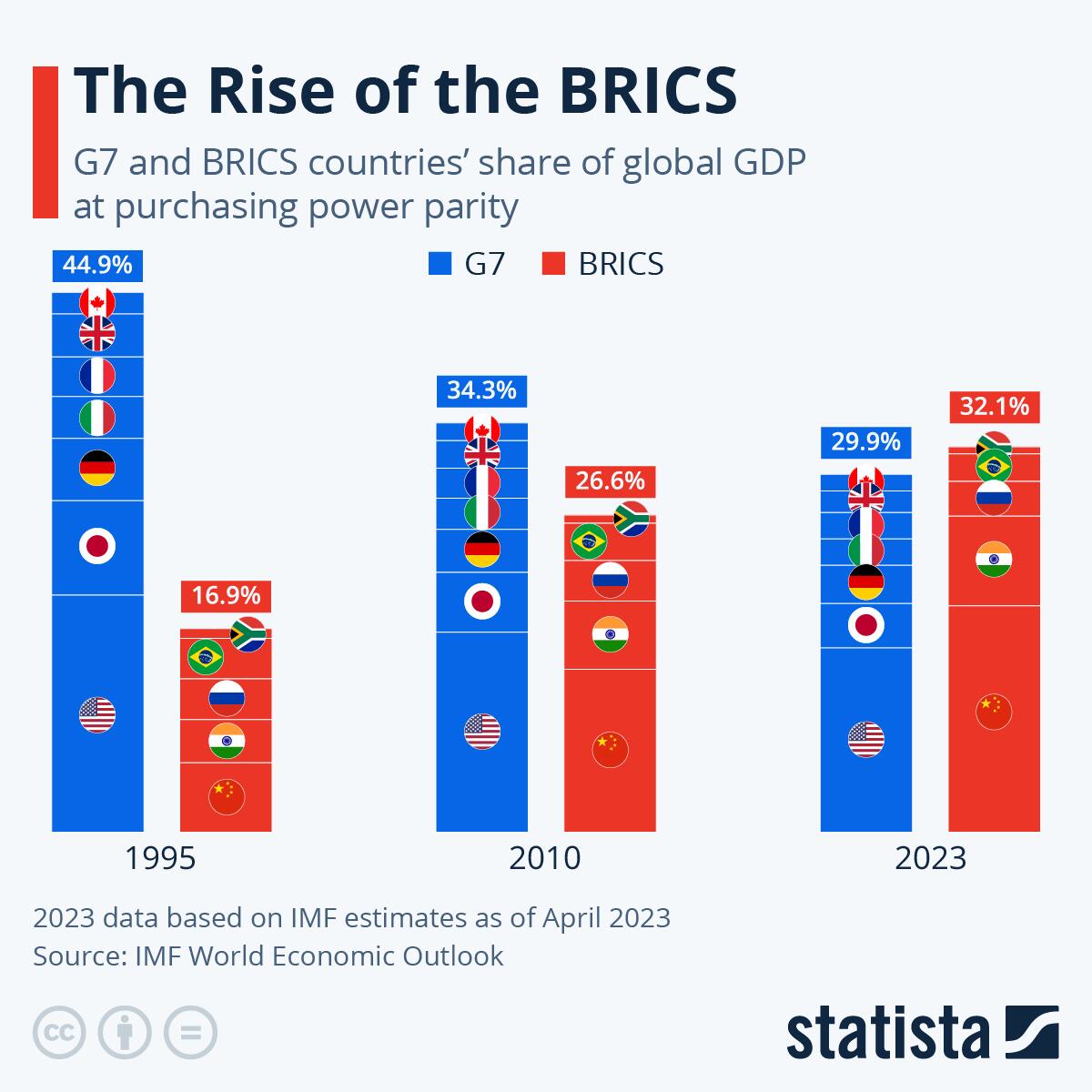
As Statista observes it fresh recent analysis, Despite the aforementioned three failing to pull their expected weight, the five BRICS nations surpassed the G7 in terms of their combined GDP in 2020. That is when measured at purchasing power parity, i.e. adjusted for differences in buying power. According to the IMF, the bloc will collectively account for 32.1 percent of global GDP this year. That’s up from just 16.9 percent in 1995 and more than the G7’s share of 29.9 percent.

You will find more infographics at Statista

The rise of the BRICS nations, while not without challenges and disparities within the group, has led to increased calls for more inclusive and representative global governance, adding more weight to voices that deviate from the policies shaped by the Western-led G7. Nowhere has that deviation been more apparent than in the response to Russia’s invasion of Ukraine. While the G7 condemned the attack and imposed strict sanctions on Russia, none of the BRICS members have denounced Russia’s actions or joined in on the sanctions.

Tyler Durden
Thu, 08/24/2023 – 09:40

Shocked!? CDC Says New COVID-19 Variant Could Cause Infections In Vaccinated People

0
Shocked!? CDC Says New COVID-19 Variant Could Cause Infections In Vaccinated People

Authored by Jack Phillips via The Epoch Times,

The U.S. Centers for Disease Control and Prevention (CDC) stated Wednesday the new BA.2.86 COVID-19 lineage may cause infection in people who received vaccines or previously had the virus.

The CDC said it is too soon to know whether this might cause more severe illness compared with previous variants. But due to the high number of mutations detected in this lineage, there were concerns about its impact on immunity from vaccines and previous infections, the agency said.

“The large number of mutations in this variant raises concerns of greater escape from existing immunity from vaccines and previous infections compared with other recent variants,” the CDC stated in its assessment.

“For example, one analysis of mutations suggests the difference may be as large as or greater than that between BA.2 and XBB.1.5, which circulated nearly a year apart.”

But it said that “virus samples are not yet broadly available for more reliable laboratory testing of antibodies, and it is too soon to know the real-world impacts on immunity.”

The agency added that it detected at least two cases with the BA.2.86 variant in the United States, although few other details were provided. It was also found in Israel, the United Kingdom, South Africa, and Denmark, the agency said.

One of the BA.2.86 cases was found in a person detected via the CDC’s traveler surveillance system, while it added that cases being found in several countries is evidence of international transmission.

“Notably, the amount of genomic sequencing of SARS-CoV-2 globally has declined substantially from previous years, meaning more variants may emerge and spread undetected for longer periods of time,” according to the assessment.

“It is also important to note that the current increase in hospitalizations in the United States is not likely driven by the BA.2.86 variant. This assessment may change as additional data become available.”

The CDC noted that most of the U.S. population has COVID-19 antibodies from a previous infection, vaccination, or both. It’s likely that the antibodies will provide some protection against the variant, said the CDC.

The CDC said on Wednesday the slight recent increase in hospitalizations in the United States is not likely driven by the BA.2.86 lineage.

Based on an analysis of the mutations to the new virus, the CDC stated that COVID-19 tests and antiviral drugs are likely still going to work against it. “At this time, we don’t know how well this variant spreads, but we know that it spreads in the same way as other variants,” the CDC said.

A top official with the World Health Organization, meanwhile, has designated the BA.2.86 as a “variant under monitoring,” noting that there is “limited” information about the variant.

A medical worker prepares the COVID-19 vaccination after the thawing stage outside of UCI Medical Center, in Orange, Calif., on Dec. 16, 2020. (John Fredricks/The Epoch Times)

But some scientists warned that people shouldn’t jump to conclusions about the variant.

“Intrinsic severity of a virus is a byproduct of many traits, a product of selection on other features. Any attempt to guess the intrinsic severity of BA.2.86 (within reasonable parameters) is just that—a guess,” Aris Katzourakis, a biologist with the University of Oxford, wrote on social media.

“It is far, far too early to evaluate the potential of this variant.”

Michael Osterholm, the head of the University of Minnesota’s Center for Infectious Disease Research and Policy, told Stat News that the new subvariant should be monitored closely but he noted that a large number of subvariants and variants of COVID-19 didn’t take off.

“I assume that all are innocent until proven guilty,” he said,

And based on the evidence so far, the threat of BA.2.86 isn’t clear, said a CDC spokesperson. “We do not yet know what risks, if any, this may pose to the public’s health beyond what has been seen with other currently circulating lineages,” the spokesperson told EveryDay Health.

The CDC statement comes as Moderna, Pfizer, and Novavax are slated to release updated COVID-19 vaccines this fall, again possibly making them available for all ages. There is anticipation that the U.S. Food and Drug Administration will authorize the booster shots in the coming weeks.

It also comes as a small number businesses, schools, offices, and hospitals in recent days opted to re-implement mask mandates. A college in Atlanta, Hollywood studio Lionsgate, several hospitals, and others recently made masks mandatory, sparking concerns among some social media users that a broader attempt to re-instate mandates might be coming to the United States in the fall or winter.

“Employees must wear a medical grade face covering (surgical mask, KN95 or N95) when indoors except when alone in an office with the door closed, actively eating, actively drinking at their desk or workstation, or if they are the only individual present in a large open workspace,” a Lionsgate manager wrote in a memo, according to Deadline Hollywood.

The mandate was implemented even as the local Los Angeles County Department of Public Health reported that for COVID-19, “overall metrics remain at a low level of concern.”

Tyler Durden
Thu, 08/24/2023 – 09:20

Lira Soars 6% After Turkey Unexpectedly Hikes Much More Than Expected

0
Lira Soars 6% After Turkey Unexpectedly Hikes Much More Than Expected

The economic freakshow that is Erdoganomics is dead, if only for a few months…

The Turkish lira, which until today was the worst performing currency of 2023, exploded higher amid a massive short squeeze, after the Turkish central bank unexpectedly raised its benchmark interest rate much more than expected, in the first sign that a new lineup of monetary officials favors more aggressive moves to curb inflation running near 50%, and a stern rebuke to Erdogan’s long-running bizarro conviction that Turkey will keep rates lower in a bid to contain inflation (also known as Erdoganomics).

The Monetary Policy Committee, under new Governor Hafize Gaye Erkan, who previously was a co-CEO of the failed First Republic bank, raised the rate to 25%, up from 17.5% and far above survey expectations of a 20% hike. It was the MPC’s first decision since three new deputy governors were appointed late last month. They included a former adviser to the Federal Reserve Bank of New York and the ex-chief economist at one of Turkey’s biggest private lenders.

Erkan, appointed in June, has begun to end Turkey’s era of ultra-low borrowing costs previously favored by Erdogan (and to be favored again after the economy craters as a result of the sharply higher rates which will crush growth again).

While the rate remains well below the level of (hyper)inflation in Turkey, it’s the third straight hike since President Recep Tayyip Erdogan won reelection in May and pledged more orthodox policies for an economy foreign investors have fled in recent years.

Even with the recent hikes, many investors still think the central bank is still being too timid. They cite the fact inflation-adjusted interest rates remain well in negative territory as evidence of that. Turkey’s real rates are among the lowest in the world.

“The pace of policy tightening over recent months has disappointed market expectations,” ING Bank NV said ahead of Thursday’s decision, although today’s move may suggest the central bank is finally trying to catch up to real rates.

According to Bloomberg, Erkan’s approach poses significant risks for the credibility of the central bank, especially after it sharply raised its own inflation forecasts last month. The governor said price growth won’t peak until the second quarter of next year, but showed little willingness to raise policy rates much faster.

While Turkish rates should be much higher, the central bank’s latest regulation took aim at a government-backed savings program that protects account holders from any weakening of the lira. Officials now want them to convert to normal lira accounts. The new rules amount to a “stealth rate hike” and follow an earlier decision to raise banks’ reserve requirements that could in effect mean an additional 40 basis points of tightening, according to Bloomberg Economics.

On Sunday, the central bank began rolling the growing and costly scheme that protects lira deposits from FX depreciation, marking another move toward more orthodox policies following a shift toward interest rate hikes. The central bank said in the early hours on Sunday that it lifted targets applied to banks for certain levels of conversions of foreign-exchange deposits to the lira-protection scheme, known as KKM.

“The new measures will likely lead to higher rates on lira deposits,” Goldman Sachs Group Inc. analysts Clemens Grafe and Basak Edizgil said in a report. But “with the gap between deposit rates and the policy rate widening again, there is a risk of renewed dollarization or funds being withdrawn.”

In a reversal, the central bank now wants lenders to set a new goal of transitioning KKM accounts into regular lira accounts, in part by dissuading companies and individuals from renewing the KKM accounts.

According to a separate decree in the Official Gazette, the central bank also raised lenders’ reserve requirement ratios for FX deposits, further nudging customers into regular lira accounts.

Ahead of the rate decision, Citigroup cut the lira in its model portfolio after the government’s steps to reduce the size of foreign currency protected deposits. Citi said to go long USDTRY at 27.16 (via 3m forwards), with a target 32, stop 25.

“In light of the macro prudential measures taken by the CBT over the weekend to reduce the size of currency protected deposits, we think the timing is now suitable for re-entering this trade,” strategists Bhumika Gupta and Luis E Costa wrote in a note.

“MPC is also scheduled this week, and the consensus expectation is for a hike to 20% policy rate, from the current 17.5%. We see some risk that markets may be disappointed again, given the new Governor’s track record so far with respect to the magnitude of rate increases” Citi added.

In the end, she did indeed surprise, but on the other side, with a rate hike that was bigger than expected. The problem, of course, is that this has been tried before in Turkey, and every time there is a sharp rate hike, the economy eventually grinds to a halt, culminating with Erdogan firing the central bank head and appointing another puppet. To be sure, this time will be no different, but for now at least, the Lira is enjoying a huge short squeeze, with the USDTRY tumbling as much as 6%…

… the currency’s second largest squeeze in history, second only to the Dec 20, 2021 short massacre, when Erdogan fired a bazooka at lira shorts.

The move lasted a few months before the currency tumbled to new all time lows.

As for today’s historic surge in the lira, enjoy it while it lasts, because it won’t: with rates once again soaring Erdogan will keep his mouth shut for a few months (weeks) until the wheels fall off the economy again, at which point he will once again terminate all the central bankers and appoint a new set of puppets who resume easing because rinse, repeat, and yet somehow the market is surprised every single time we get a rerun of this exact same script.

Tyler Durden
Thu, 08/24/2023 – 09:06

Stocks Will Have One Last Hurrah After Jackson Hole

0
Stocks Will Have One Last Hurrah After Jackson Hole

Authored by Simon White, Bloomberg macro strategist,

Federal Reserve Chair Jay Powell’s speech at Jackson Hole this week promises to give stocks a boost. But it’s likely to be short lived as the liquidity outlook soon worsens.

After months of rising almost uninterruptedly, stocks finally hit resistance as longer-term real yields rose to a 15-year high. The main driver though – a belief that the Fed will up its estimate of the neutral rate at Jackson Hole – is likely to come unstuck, prompting a relief rally in stocks.

But this is a trade rather than an investment, as real-yield curve dynamics point to less supportive liquidity conditions on their way soon, turning what was a tailwind for stocks and other risk assets into a headwind.

What is the US? Or Russia? Or the dollar, or Christianity, or Apple? These are not glib questions. They are what the historian Yuval Noah Harari refers to as “intra-subjective beliefs,” concepts that have meaning and utility because many people believe in them.

To the list we could add the neutral rate of interest. Normally such an abstraction would not have a real market impact. But given the market’s recent focus on it, it appears to have had just that.

Longer-term real yields began to rise in late July. It’s not a fait accompli, however, that this was driven by the neutral rate. The yield on a TIPS bond is the “actual” real yield + the TIPS liquidity premium. Often a rise in the real yield is driven by a rise in the liquidity premium as TIPS are sold.

But in these situations, breakevens typically fall too. The fact that they have remained steady shows that the rise in real yields was principally driven by the “actual” long-term real yield, i.e. by the neutral rate.

But that leaves the real yield open to disappointment. Powell is expected to up the Fed’s estimate of neutral at his Jackson Hole speech on Friday. Even if he does (although it’s unlikely he would want to unnecessarily tie the Fed down), there is a lot already in the real yield’s level, leaving it prone to reversing (after peaking at 2%, 10y real rates are now at 1.84%, still about 36 bps above where they were a few weeks ago).

The initial reaction would likely be a boost for stocks and other risk assets. Stocks started to sell off when 10y real yields began to rise in late July; a fall is likely to bring some relief to the equity market.

But the real information content comes from looking at the real-yield curve and its relationship with excess liquidity and the dollar. I discussed the mechanics fully here, but the TikTok version is that a flatter real-yield curve has led to a weaker dollar, and that has been the main driver of this year’s boost to global excess liquidity: the difference between real global money growth and economic growth, denominated in USD.

The flattening real-yield curve has thus signaled positive conditions for real assets through rising excess liquidity.

We saw this in reverse over the last few weeks: 10y real yields rose, the real-yield curve steepened, the dollar rallied and stocks sold off.

We now have a clearer idea of exactly why a fall in longer-term reals should trigger a rally in stocks. But it also tells us that any rally is fated not to last long. That’s because it is very unusual for the real-yield curve to flatten as 10-year real yields drop, i.e. a bull-flattening.

The chart below shows the 2s10s real-yield curve color-coded for different curve moves (over rolling six-month periods). Bull-flattenings only occur about 7% of the time (going back to 2004).

Much more common are bear-flattenings (brown color in the chart above), when two-year real yields rise more than 10-year reals. But two-year reals are already nudging 20-year highs (excepting their GFC spike). It will be difficult for them to push much higher, especially with the Fed near-done or done raising rates, and the likelihood inflation starts rising again.

Also a negative influence for short-term real yields would be the Fed raising its inflation target. Whether it eventually happens or not (and there is a lot to discuss on the topic), it is something we are likely to hear increasingly more about.

Either way, the real-yield curve is poised to soon begin steepening again (chiming with expectations the nominal curve also continues to steepen), meaning what is currently a tailwind for risk assets in buoyant excess liquidity is soon set to turn.

To recap, a rise in expectations of the neutral rate likely drove the real yield higher. Stocks are poised for a relief rally as these expectations are disappointed, but it’s likely to be short-lived as the real-yield curve starts to re-steepen, pointing to a fall in excess liquidity.

This might seem a lot of convolution when one could simply point to the rise in nominal yields over the last month being the culprit for the stock selloff. But well over half of the time (59%, going back to 1962) when yields are up over the previous month, stocks are up too.

Such a rule-of-thumb is thus very misleading. The truth, as Oscar Wilde said, is rarely pure and never simple.

Tyler Durden
Thu, 08/24/2023 – 08:50

UK Fines Morgan Stanley For Energy Traders Using Private WhatsApp Messages

0
UK Fines Morgan Stanley For Energy Traders Using Private WhatsApp Messages

By Charles Kennedy of OilPrice.com

The UK regulator Ofgem said on Wednesday it had fined Morgan Stanley & Co. International plc (MSIP) for failure to record and retain electronic trading communications in energy trades after wholesale energy traders were found to have used WhatsApp on privately owned phones to discuss energy market transactions.

The failure to comply with the requirement to record and retain electronic trading communications was for the period between January 2018 and March 2020.   

Ofgem has levied a fine of $6.8 million (£5.41 million) on Morgan Stanley for the use of WhatsApp on privately owned phones in the first-ever fine issued in the UK under legal requirements to record and retain electronic communications relating to trading wholesale energy products.

The rules have been designed to protect consumers and ensure market transparency and integrity by providing Ofgem the powers to investigate and sanction against market manipulation and insider trading, the UK regulator said in a statement.

The breach emerged following Morgan Stanley’s responses to information requests made using the information collection powers Ofgem has under these regulations.

Morgan Stanley has admitted the breaches between January 2018 and March 2020, and “has taken steps to ensure the breaches do not happen again, including enhanced staff training and the strengthening of its internal systems and controls,” Ofgem said.

The bank has fully co-operated with Ofgem’s investigation and has agreed to settle the case. The fine includes a 30% penalty discount for settling.

“This fine sends a strong message to market participants that they must comply with all REMIT rules or face enforcement action,” said Cathryn Scott, Regulatory Director of Enforcement and Emerging Issues at Ofgem.

“It is unacceptable that MSIP failed to prevent electronic communications which could not be recorded or retained. It risks a significant compromise of the integrity and transparency of wholesale energy markets.”

Tyler Durden
Thu, 08/24/2023 – 06:30

US Corporate Bankruptcies Are On The Rise

0
US Corporate Bankruptcies Are On The Rise

In March, Silicon Valley Bank collapsed, plunging its parent company SVB Financial Group into bankruptcy a week later.

While many expected a wave of bank failures to follow, much of this has since been averted – but cracks have begun to emerge with Moody’s recent downgrading of 10 small and mid-sized banks.

Across the wider corporate landscape, bankruptcies have begun to tick higher. Overstretched balance sheets coupled with 11 interest rate hikes since last year have added to mounting challenges for companies across many sectors.

As Visual Capitalist’s Dorothy Neufeld and Sabrina Fortin show in the graphic below, based on data from S&P Global, corporate bankruptcies in 2023 are surging…

U.S. Corporate Bankruptcies Grow

So far in 2023, over 400 corporations have gone under. Corporate bankruptcies are rising at the fastest pace since 2010 (barring the pandemic), and are double the level seen this time last year.

Below, we show trends in corporate casualties with data as of July 31, 2023:

Represents public or private companies with public debt where either assets or liabilities are greater than or equal to $2 million, or private companies where assets or liabilities are greater than or equal to $10 million at time of bankruptcy.

Firms in the consumer discretionary and industrial sectors have seen the most bankruptcies, based on available data. Historically, both sectors carry significant debt on their balance sheets compared to other sectors, putting them at higher risk in a rising rate environment.

Overall, U.S. corporate interest costs have increased 22% annually compared to the first quarter of 2021. These additional costs, combined with higher wages, energy, and materials, among others, mean that companies may be under greater pressure to cut costs, restructure their debt, or in the worst case, fold.

Billion-Dollar Bankruptcies

This year, 16 companies with over $1 billion in liabilities have filed for bankruptcy. Among the most notable are retail chain Bed Bath & Beyond and the parent company of Silicon Valley Bank.

Mattress giant Serta Simmons filed for bankruptcy early this year. It once made up nearly 20% of bedding sales in America. With a vast share of debt coming due this year, the company was unable to make payments due to higher borrowing costs.

What Comes Next?

In many ways, U.S. corporations have been resilient despite the sharp rise in borrowing costs and economic uncertainty.

This can be explained in part by stronger than anticipated profits seen in 2022. While some companies have cut costs, others have hiked prices in an inflationary environment, creating buffers for rising interest payments. Still, S&P 500 earnings have begun to slow this year, falling over 5% in the second quarter compared to last year.

Secondly, the structure of corporate debt is much different than before the global financial crash. Many companies locked in fixed-rate debt over longer periods after the crisis. Today, roughly 72% of rated U.S. corporate debt has fixed rates.

At the same time, banks are getting more creative with their lending structures when companies get into trouble. There has been a record “extend and amend” activity for certain types of corporate bonds. This debt restructuring is enabling companies to keep operating.

The bad news is that corporate debt swelled during the pandemic, and eventually this debt will come due likely at much higher costs and with more severe consequences.

Tyler Durden
Thu, 08/24/2023 – 05:45

Biden Admin Approves Massive Helicopter Sale To Poland

0
Biden Admin Approves Massive Helicopter Sale To Poland

Authored by Kyle Anzalone via The Libertarian Institute, 

Warsaw plans to buy nearly 100 Apache attack helicopters manufactured by Boeing for $12 billion. Until Poland receives the helicopters, the US will provide Apaches to its NATO ally. 

The Defense Security Cooperation Agency (DSCA) announced the State Department greenlit the massive arms sale on Monday. The deal is for 96 AH-64E Apache Attack Helicopters, spare parts, thousands of missiles, other munitions, as well as maintenance and training for the helicopters.

The State Department claims the sale will further the security of the US. “This proposed sale will support the foreign policy goals and national security objectives of the United States by improving the security of a North Atlantic Treaty Organization (NATO) Ally that is a force for political stability and economic progress in Europe,” the DSCA press release stated.

“The proposed sale will improve Poland’s capability to meet current and future threats by providing a credible force that is capable of deterring adversaries and participating in NATO operations.”

The statement further sought to assure, “There will be no adverse impact on U.S. defense readiness as a result of this proposed sale.”

Poland is amid a military buildup with its neighbor, Belarus. Minsk has increasingly sought closer ties to Moscow and now hosts Russian tactical nuclear weapons.

Any conflict between Poland and Belarus would likely cause a nuclear holocaust perpetrated by the White House and Kremlin. 

Warsaw says until it is ready to field its own Apaches, Washington will deploy American attack helicopters to Poland. Polish Defense Minister Mariusz Blaszczak said, “until the procedures are completed and the purchased helicopters are delivered to Poland, the US Army will provide us with Apache helicopters from its own resources.”

Tyler Durden
Thu, 08/24/2023 – 05:00

UK Set To Become World’s Biggest Gaming Nation By 2027

0
UK Set To Become World’s Biggest Gaming Nation By 2027

Taking place from August 23 to August 27, this year’s Gamescom is bound to again become the biggest video game trade fair in the world with upwards of 300,000 visitors and 1,200 exhibitors.

As Statista’s Florian Zandt shows in the chart below, while Germany is a crucial video gaming market, generating roughly ten billion euros with the sales of games, hardware and online services in 2022, the top 5 in terms of the highest user penetration in the gaming sector is populated by other countries.

Three out of these five come as no surprise, though.

Infographic: The World's Biggest Gaming Nations | Statista

You will find more infographics at Statista

According to estimates from our Statista Digital Market Outlook, Japan has consistently placed first or second in terms of the percentage of the population being considered gamers.

A penetration rate of 53 percent in 2017 and 58 percent in 2022 earned Japan the top spot in both years.

South Korea, home to many elite e-sports players and organizations, also snags a top 5 spot and even comes in third in 2022.

In the future, the United Kingdom will most likely overtake Japan in terms of user penetration.

By 2027, 70 percent of UK residents are expected to qualify as gamers, reflecting the importance of the market.

In a Newzoo ranking, the country places sixth with estimated revenue of $5.7 billion in 2022.

Overall, video games have become the most lucrative media segment concerning revenue over the last few years. Still, 2022 saw the market contract to around $182 billion, according to Newzoo estimates, with $92 billion generated with mobile gaming alone. In comparison, revenues from the music and film industries reached $25.9 billion and $21.3 billion in 2021, while video streaming providers like Netflix and Disney+ generated an estimated $62 billion in 2020.

Tyler Durden
Thu, 08/24/2023 – 04:15