80 F
Chicago
Sunday, August 30, 2026
Home Blog Page 3422

Clock Is Ticking Down On Stimulus Bazooka In China

0
Clock Is Ticking Down On Stimulus Bazooka In China

Authored by Simon White, Bloomberg macro strategist,

The likelihood of significant fiscal and monetary stimulus in China has risen sharply as the country strives to avoid a Japan-like debt-deflation trap.

Beaten-up equities are poised to benefit disproportionately from a substantial boost to excess liquidity.

It is often darkest before dawn. After a slew of dismal economic data, China’s room for maneuver is narrowing. Decisive stimulus is increasingly likely to prevent the economy from protracted stagnation or a deep recession.

Stimulus is required on three fronts:

1) to salvage the property market and thus avert a debt-deflation;

2) to boost consumption; and

3) to increase investment.

A combination of both monetary and fiscal stimulus is likely, with the emphasis on the latter.

As is often the case when China goes through a rocky patch, there is a growing chorus of those who believe a bust is imminent. While that may be the ultimate outcome, China still has a few stimulus hands to play to keep the game alive.

Equities are poised to benefit as rock-bottom sentiment combines with buoyant excess liquidity, likely to be boosted yet further by stimulus of increased intensity.

No country wants to experience the fate of Japan. Its property bust in the 1990s triggered a debt-deflation: an unenviable situation when the value of assets and the income from those assets fall in relation to the value of liabilities. Debt becomes increasingly difficult to service and pay back, leading to lower consumption and investment, entrenched deflation and derisory growth.

Source: knowen.org

Policy makers in China do not want to repeat Japan’s mistakes.

Local governments are indebted to the tune of almost $8 trillion, or ~45% of GDP, according to JP Morgan, much of it collateralized by land values. This was similar to the dynamic faced by Japan, where land values – which had been the focus of rampant speculation – collapsed, forcing corporates and banks to retrench and focus on repairing their balance sheets, causing demand and investment to crater.

The property market in China remains on its knees. House prices overall are barely rising on an annual basis, while prices in tier-1 cities are contracting. Growth in real estate transactions has slumped from 20% year-on-year to 12% and continues to fall; mortgage demand is very weak; while floor-space-started of new houses is falling at a 26% annual rate.

On top of that, property developers remain in dire straits, with Country Garden the latest that may have to default on its debt. High-yield real estate debt in China is back near its lows, at about 20 cents in the dollar.

China has introduced a raft of property-easing measures in recent months, to little avail so far.

But the specter of Japan ensures that even more potent property stimulus is on the way as policy makers determinedly head off a debt-deflation.

It won’t be enough, though, to restore China’s economic fortunes.

Further stimulus will be needed to boost consumption and investment.

Here we are likely to see fiscal as well as monetary measures.

First, the central government in China still has plenty of scope to borrow. Its debt-to-GDP ratio sits at 51%, low by international standards. Local governments and their financing vehicles account for another ~45% of GDP but, as mentioned above, averting a debt-deflation will go a long way to stabilizing the dynamics here.

Rising fiscal stimulus could be used for infrastructure investment – much of which is now unproductive, but would nonetheless give a medium-term fillip to growth.

Fiscal spending could also be used to boost consumption. It was badly hobbled in the pandemic. Policies in China during lockdowns were aimed at supporting the export-orientated SOE sector at the expense of the household sector. As a result, the latter’s share of income fell from already low levels, capping domestic demand and condemning the economy to increasingly anemic growth.

Low consumption also means private investment slows as demand falls, adding to the growth impairment. Reinvigorate consumption, then, and China is more than on its way to restoring higher, better-quality growth (expect announcements like today’s to be increasingly backed up by action).

One way to do that is through increasing the household sector’s share of income. As the economist Michael Pettis has explained, this can be achieved through measures such as reduced taxes, better pensions and subsidized rents, supported by fiscal spending.

The other way is to encourage more consumer borrowing. China has professed a reluctance to allow this after the rapid rise in household debt in the previous decade. But China’s household debt, like its central government’s debt, is also not high relative to its global peers.

A rise in consumer borrowing relies on there being demand for new lending, but China has a history of bank-mandated lending to the corporate sector, so it is not an impossibility the same outcome could be engineered in the household sector too.

Sentiment on the Chinese economy and equities is terrible, but we are seeing some contrarian bottoming signs, such as the Chinese authorities’ request that some funds refrain from net selling stocks. We saw something similar in early 2020, which along with other measures preceded a +60% rally in the market over the next year.

Despite the gloom, China’s day of reckoning is likely not here yet. In which case stocks are poised for explosive moves higher, as the sweet spot of rising stimulus meets an unloved market with cheap valuations.

Tyler Durden
Thu, 08/17/2023 – 12:25

Hurricane Hilary Could ‘Rapidly Intensify’ Into Major Hurricane With Crosshairs On Southern California

0
Hurricane Hilary Could ‘Rapidly Intensify’ Into Major Hurricane With Crosshairs On Southern California

Update (1215ET):

Tropical Storm Hilary was upgraded to hurricane status off Mexico’s Pacific coast, according to the National Hurricane Center. 

When NHC published the advisory early Thursday, Hurricane Hilary was churning several hundred miles southeast of Cabo San Lucas, Mexico, and was moving west-northwest. Winds are sustained over 75 miles per hour, with higher gusts. 

“Hilary rapidly intensified from a tropical storm to hurricane Wednesday into Thursday, and could top out at Category 4 intensity by Friday or Saturday,” The Weather Channel said. 

Forecast models show Hilary could begin to impact parts of Mexico’s Baja Peninsula on Friday or Saturday, with Southern California in the crosshairs on Sunday or Monday. 

Stefanie Sullivan, a forecaster with the National Weather Service in San Diego, told NYTimes: 

The worst-case scenario for Southern California would be if the track shifted farther west and made landfall in California, which could produce much stronger winds and larger surf. The only tropical cyclone to truly make landfall in Southern California was an unnamed storm in 1939 that made landfall in Long Beach.

Latest rainfall forecast via The Weather Channel:

Meanwhile, the tropics are awakening in the Atlantic. 

All eyes are on Hilary this weekend. 

*   *   * 

Tropical Storm Hilary formed earlier Wednesday off Mexico’s coast in the Eastern Pacific Ocean. It’s forecasted to bring heavy rainfall and strong winds to parts of Southern California and the US Southwest at the end of the weekend or early next week. 

Hillary has sustained winds of 40 miles per hour, with higher gusts, according to the National Hurricane Center. The storm is moving west-northwest toward Baja California — and is 470 miles from Manzanillo, Mexico, around 1100 ET. 

Here’s the five-day forecast track for the storm:

“It appears that a corridor will open up between a sharp dip in the jet stream along the West Coast and the super-strong heat dome over the central US,” FOX Weather hurricane specialist Bryan Norcross said.

Norcross continued, “Tropical moisture from likely-Hilary has a good chance of spreading north in that river of air into the highly populated areas west of the Southern California mountains and the desert areas to the east.”

According to Fox Weather, Southern California is expected to receive between 2-3 inches of rain, with some areas getting 3-5 inches.

While the Eastern Pacific hurricane season has been active, over in the Atlantic, it’s been quiet: “Historical Lull”: Global Major Hurricane Activity Hits Four Decade Low.


Tyler Durden
Thu, 08/17/2023 – 12:15

Hunter Biden CC’d On Call Between Then-VP Joe And Former Ukraine President

0
Hunter Biden CC’d On Call Between Then-VP Joe And Former Ukraine President

House Republican investigators have asked the National Archives to hand over any unredacted records in which then-VP Joe Biden used a pseudonym.

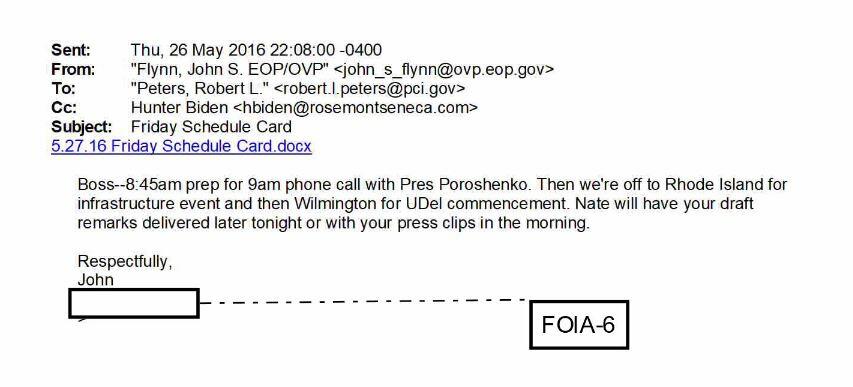
Previously released emails retrieved from Hunter’s abandoned laptop reveal that Biden used a “Robert.L.Peters@pci.gov” email address while he was serving as Vice President of the United States. What’s more, that Biden aide John Flynn cc’d Hunter on 10 emails which contained Joe’s daily schedule between May 19 and June 15, 2016.

One of the emails details plans for a phone call with Ukraine’s former president, Petro Poroshenko. Flynn copied Hunter at his email address at Rosemont Seneca Partners – while Hunter was serving on the board of Ukrainian energy giant, Burisma, which was deemed to be corrupt by the Obama-Biden State Department.

“Boss–8:45am prep for 9am phone call with Pres Poroshenko. Then we’re off to Rhode Island for infrastructure event and then Wilmington for UDel commencement,” Flynn wrote. “Nate will have your draft remarks delivered later tonight or with your press clips in the morning.”

The House Oversight Committee request primarily is focused on Hunter’s $1 million per year position on the board of Ukrainian gas company Burisma, which hired the then-second son in early 2014 as his dad assumed control of the Obama administration’s Ukraine policy.

But the broad request for records involving the president’s pseudonyms could turn up a variety of content, including about other Biden family ventures in countries such as China. –NY Post

According to a letter from House Oversight Committee Chairman James Comer, “The Committee’s need for these Vice-Presidential records is specific and well- documented,” adding “The Committee seeks to craft legislative solutions aimed at deficiencies it has identified in the current legal framework regarding ethics laws and disclosure of financial interests related to the immediate family members of Vice Presidents and Presidents— deficiencies that may place American national security and interests at risk.”

The Committee seeks unrestricted special access/ … These records have been redacted for public release pursuant to the PRA and FOIA. For example, an email bearing the subject “Friday Schedule Card,” is withheld in part under a “P6” and “b(6)” restrictions, denoting personal information regarding the subject under the PRA and FOIA respectively,” Comer wrote.

“Attached to this email, and made available on the NARA website, is a document that indicates at 9:00 a.m. on May 27, 2016, Vice President Biden took a call with the president of Ukraine, Petro Poroshenko,” he added. “It is concerning to the Committee, however, that this document was sent to “Robert L. Peters”—a pseudonym the Committee has identified as then Vice- President Biden. Additionally, the Committee questions why the then-Vice President’s son, Hunter Biden—and only Hunter Biden—was copied on this email to then-Vice President Biden.”

As Just the News further notes, The letter requested special access to specific documents, including any:

  • “Document or communication in which a pseudonym for Vice President Joe Biden was included either as a sender, recipient, copied or was included in the contents of the document or communication, including but not limited to Robert Peters, Robin Ware, and JRB Ware;
  • “Document or communication in which Hunter Biden, Eric Schwerin, or Devon Archer was included either as a sender, recipient, copied, or was included in the contents of the document or communication; and
  • “Drafts from November 1, 2015 to December 9, 2015 of then-Vice President Biden’s speech delivered to the Ukrainian Rada on December 9, 2015.”

Democrats probably need another Trump indictment at this point. 

Tyler Durden
Thu, 08/17/2023 – 10:35

OK, Since You Asked: Conservatives Provide Biden With List Of Failures He Asked For

0
OK, Since You Asked: Conservatives Provide Biden With List Of Failures He Asked For

Authored by Steve Watson via Summit News,

During a speech about the so called ‘Inflation Reduction Act’ ironically, Joe Biden challenged anyone to “Name me a single objective we’ve ever set out to accomplish that we failed on,” prompting critics to provide entire lists.

“Name me one in all of our history. Not one!” Biden screamed during the speech, which also incidentally came on the second anniversary of the botched withdrawal from Afghanistan, which saw the deaths of 13 American military personnel in a Kabul.

It’s not much of a challenge:

The rest of the speech was full of the usual outright lies about the economy:

Elsewhere during the speech when he wasn’t angrily yelling or creepy whispering, Biden tried to entice children to join him for ice cream:

Afterwards he snaked out of a side door to avoid the press again:

*  *  *

Brand new merch now available! Get it at https://www.pjwshop.com/

In the age of mass Silicon Valley censorship It is crucial that we stay in touch. We need you to sign up for our free newsletter here. Support our sponsor – Turbo Force – a supercharged boost of clean energy without the comedown.

Also, we urgently need your financial support here.

Tyler Durden
Thu, 08/17/2023 – 10:15

“Miserable” 20Y JGB Auction Tails Most Since 1987, Adding To Bond Gloom

0
“Miserable” 20Y JGB Auction Tails Most Since 1987, Adding To Bond Gloom

This morning global bond yields hitting a 15 year high, a move that was catalyzed by what Bloomberg dubbed a “miserable” 20 year auction, which priced with the longest tail – or the difference between average and cut-off prices – since 1987, while the bid-to-cover ratio fell to the lowest since September.

The Ministry of Finance sold about 992.5 billion yen ($6.78 billion) of the bond at an average yield of 1.322%, with the yield at 1.385% for the lowest accepted price. The dismal reception promptly sent yields to the highest level since January.

Traders pointed to huge tail as well as the low 2.8 bid-to-cover ratio for this bond, compared with the strong 3.5 ratio at last week’s 30-year auction as the reason for the rise in yields.

The results of the auction came as a “surprise,” said Shoki Omori, chief desk strategist at Mizuho Securities, with demand coming in extremely weak. Omori said the 20-year bond was an outlier because of the absence of a defined buyer profile and that most people with short positions in JGBs had bought before the auction.

“The buyers for the 30-year bonds were mainly life insurers, which had been steadily buying 30-year bonds (before the auction,” said Kaoru Shoji, Japan rates strategist at SMBC Nikko Securities.

“On the other hand, banks and pension funds were the main players in the 20-year bond auction. For them, the current level might not be cheap enough as yields may rise further as U.S Treasury yields are rising, and there is speculation that the BOJ may end its negative-rate policy.”

Yields on other tenors inched up too. The five-year yield rose 2 bps to 0.225%. While still far from the defacto upper bound of 1% that the Bank of Japan has set, the 10-year JGB yield hit 0.655%, up from a low of 0.565% last week.

Since the BOJ’s monetary policy meeting at the end of July, when the central bank tweaked its YCC to allow the 10Y to rise as high as 1%, investors have been carefully testing to see how much the BOJ will allow yields to rise. The last time the 10-year yield hit 0.655 the central bank stepped in with an emergency bond-buying operation.

As Bloomberg’s Tommi Utoslahti writes, the “miserable” auction  may well reflect mounting bets the Bank of Japan’s YCC will soon be loosened. But it’s also a significant warning sign for global government debt at a time when yields are already at 15-year highs. Soaring JGB yields would put further upward pressure on the rest of the world, and also mean tougher fiscal budget challenges.

Commenting on the auction, Saxo’s Althea Spinozzi wrote that “rising JGB yields threaten bonds worldwide, so we see EU and US sovereign yields accelerating their rise this morning.”

As noted earlier, global government bond yields extended their climb to the highest levels since the financial crisis after hawkish FOMC comments and resilient economic data challenges the view that central banks rates are peaking.

The 10-year TSY yield approached 4.31%, within a few basis points of its 2022 peak. The equivalent UK yield jumped to a 15-year high, while its German counterpart approached the highest since 2011.

Tyler Durden
Thu, 08/17/2023 – 10:05

Woke Hawaiian Official Stalled Release Of ‘Revered Water’ Until It Was Too Late To Save Maui

0
Woke Hawaiian Official Stalled Release Of ‘Revered Water’ Until It Was Too Late To Save Maui

How detrimental is it to allow far-left ideologues into bureaucratic public works positions?  The state of Hawaii just found out this week with a blaze that engulfed the Island of Maui and killed at least 110 people.  A series of management blunders are being blamed for the deadly wildfire, but one incident in particular has frightening implications.  

With wildfires ripping across West Maui on Aug. 8, a state water official delayed the release of water that landowners requested to help protect their property from damage and stop the spread. The water standoff played out over much of the day and the water didn’t come until too late.  The dispute involved the Department of Land and Natural Resources’ water resource management division and West Maui Land Co., which manages agricultural and residential subdivisions in West Maui.

According to accounts of four people with knowledge of the situation, M. Kaleo Manuel, a Native Hawaiian cultural practitioner and DLNR’s deputy director for water resource management, initially refused West Maui Land Co.’s requests for additional water to help prevent fires from spreading to properties managed by the company. Manuel eventually released water but not until after the fire had run its course.

His office has not yet commented on the delay of water resources. 

How much damage could have been prevented with the extra water is not yet known.  However, the question of “Why?” needs to be addressed in the wake of one of the worst natural disasters in Hawaii’s history.  Though bureaucratic red tape might be the most obvious suggestion, a recent interview with M. Kaleo Manual offers some interesting and disturbing insight.  Manuel waxes philosophical on “water equity” (“equity” being a pervasive woke buzzword) and an ancient “reverence” of water as god-like.  He uses these beliefs to support his rationale for keeping tight controls over Hawaiian water supplies; not as a resource to be used, but as a holistic privilege offered by the government. 

His sentiments represent a now familiar far-left cultism and propensity to place Earth worship and climate ideology over the the lives of average people.  It is also a rather common trope of the far-left to depict indigenous peoples as environmental sages “one with the planet,” leaving it unaltered for thousands of years – This is not historically accurate but it certainly serves the purposes of the progressive narrative.  Upon arrival on the islands, Polynesians introduced their own transported landscapes and alien species of animals. The population grew, cleared vegetation, and established an intricate agricultural system by the 1300s. Hawaii was indelibly altered by the Polynesians long before the Europeans ever arrived.

Republican presidential candidate Vivek Ramaswamy summed up the disgusting farce in a tweet:

There’s a dark but hard TRUTH to the Maui catastrophe that has led to over 110 tragic deaths.

As wildfires raged, desperate residents petitioned state officials to send more water for firefighting & to help protect their properties from fire.

That request went unanswered for hours, withholding critical aid to islanders. Now we’re learning that the official who delayed the approval is an Obama Foundation “Asia Pacific Leader” & a climate activist who believes water should be “revered” first and foremost.

The DEI agenda is literally costing people their lives.

Hawaii’s Democrat governor, Josh Green, says there are people “fighting against the release of water to fight fires” & that it needs to be explored further. The No. 1 responsibility of government is to protect its citizens. The victims and their families deserve the TRUTH.

One might argue that fresh water in an island state requires more careful planning in terms of day-to-day applications.  One cannot argue, though, that water should be withheld in emergencies due to one’s personal and meaningless belief in tribal superstition, nor can a person argue that properties and people should burn because of “water equity,” whatever that means.     

Tyler Durden
Thu, 08/17/2023 – 09:45

Soft Landing? Not So Fast!

0
Soft Landing? Not So Fast!

Via SchiffGold.com,

Good news! The recession is off!

For months, economists predicted the Federal Reserve’s rate hikes to fight price inflation would spin the US economy into a recession. But there is a growing consensus that the central bank can slay price inflation while guiding the economy to a “soft landing.”

Economists Bob Murphy and Jonathan Newman say, “Not so fast!”

In a recent episode of the Human Action Podcast,  Murphy and Newman explain why a soft landing isn’t likely and point out that this is eerily similar to the calm before the storm in 2008.

Economist at the Federal Reserve recently changed their forecast and canceled the impending recession. Fed Chair Jerome Powell mentioned this during his press conference after the last FOMC meeting.

The staff now has a noticeable slowdown in growth starting later this year in the forecast, but given the resilience of the economy recently, they are no longer forecasting a recession.”

Other economists have also become much more sanguine. As one analyst put it, the economy is “chugging along.”

Newman said it doesn’t appear that they are looking to the future.

They’re jumping the gun on this. They don’t really have a good reason why they have this view that there’s going to be a soft landing except they haven’t seen a hard landing yet. Therefore, we must be having a soft landing.”

The mainstream operates under an economic theory known as the Phillips Curve. Simply explained, under this theory, price inflation is inversely correlated with the labor market. If the labor market is tight, price inflation will necessarily rise. If unemployment is rising, price inflation will fall. Based on the Phillips Curve, the remedy for price inflation is to push interest rates up and tamp down aggregate demand. This will lower prices, but it will also necessarily cause unemployment. As Murphy put it, the mainstream generally believes that “the only way monetary policy can affect prices is going through the labor market.”

As an Austrian [school economist], I would challenge that and say, no, you can have full employment and stable, or even falling prices. There’s nothing contradictory about that. And on the other hand, you could have massive price hikes with high unemployment.”

For example, Zimbabwe had high unemployment even as its currency collapsed.

Murphy goes on to explain that it’s not just his mindset as an Austrian School economist that makes him skeptical of the “soft landing” narrative. There is plenty of empirical evidence pointing to a recession.

Murphy and Newman also point out that there are a lot of similarities between the run-up to the Great Recession and today. For instance, the Fed stopped hiking rates in 2006 at 5.25%. But unemployment continued to fall after that peak rate hike for nearly a year.

In other words, all the reasons that right now they’re saying, ‘OK, we’re out of the woods. We got a soft landing,’ that was true back then as well. It wasn’t that unemployment started rising rapidly. No, they said, ‘OK, we raised rates steadily over the course of a while here. We raised them from 1% all the way up to 5.25%. We’re starting to get CPI under control. This housing bubble is starting to get a little under control. Everything seems great.’ So, my question is would it be fair to say as of late 2006 that the Fed had achieved a soft landing and gotten the housing bubble under control? Most people would say, no. They had sown the seeds for the worst crisis since the 1930s. And likewise, right now, the data are eerily similar to that, and yet everyone is running around talking about a soft landing.”

Newman rolled out some news headlines from 2007.

  • IMF Survey; Soft Landing Ahead for US Economy

  • Fed Chairman Projects Soft Landing for US Economy

  • US Economy on Track for Soft Landing According to the Dallas Fed

  • US Inflation Pressures Are Easing and the Economy Should Manage a Soft Landing

What’s funny is you could see these exact headlines today, including some of the taglines, some of the data about interest rates and the unemployment rate. … Of course, in hindsight, we can look at 2008 and 2009 and see there was a major crisis after. So, it seems like people maybe haven’t learned their lesson.”

During the podcast, Murphy brought up a video compilation titled “Peter Schiff Was Right.”

What’s great about it is like in 2006, he’s saying stuff that’s totally spot-on as to what’s going to happen in the next 18 months. And it’s not that the people on the other side are saying, ‘Well Mr. Schiff, I respectfully disagree with your perspective.’ No, they’re literally laughing in his face. That’s how stupid they think he is.”

During the conversation, Murphy and Newman also talk about how the pandemic pushed the recession down the road, the dishonesty of Federal Reserve economists, the mechanics of the 2008 crash and how that informs us today, and current recession warning signs.

Tyler Durden
Thu, 08/17/2023 – 09:25

Fed Warns Consumers Will Deplete Excess Savings By End Q3

0
Fed Warns Consumers Will Deplete Excess Savings By End Q3

San Francisco Fed researchers penned a note on Wednesday that explained excessive savings of US households would be depleted by the end of the third quarter, or in about 44 days (as of Thursday). Couple this with both revolving credit (i.e., credit card debt) and interest charged on credit cards at a record high, plus the restart of student loan repayments in weeks — all could be a perfect storm brewing that might suggest the outlook for consumers is grim in the era of ‘Bidenomic.’ 

“Our updated estimates suggest that households held less than $190 billion of aggregate excess savings by June. There is considerable uncertainty in the outlook, but we estimate that these excess savings are likely to be depleted during the third quarter of 2023,” San Francisco Fed researchers Hamza Abdelrahman and Luiz Oliveira wrote. 

The chart below shows accumulated excess savings, in nominal terms, totaled $2.1 trillion in August 2021, thanks to government stimulus checks and other fiscal measures during the pandemic. Since then, aggregate personal savings had plunged below pre-pandemic levels, signaling an overall drawdown of pandemic-related excess savings when inflation was outpacing wages, forcing households to pull from savings to make ends meet. The drawdown on savings was slow, then ramped to $100 billion per month in 2022. 

The estimated drawdowns as of June have been $1.9 trillion, and estimates show there’s less than $190 billion of excess savings remaining. If drawdowns continue at average rates from the past 3, 6, or 12 months, researchers said, “aggregate excess savings would likely be depleted in the third quarter of 2023.” 

“The rapid accumulation and subsequent drawdown of excess savings following the onset of the pandemic recession contrasts starkly with prior recessions. This contrast holds true when the data are adjusted for inflation, as well as when we define excess savings as a share of trend savings or as a percent change from pre-recession periods,” researchers said. 

This comes as both revolving credit (i.e., credit card debt) and interest charged on credit cards hit a record high. We said this trajectory was unsustainable, and it was only a matter of time before the debt-funded US consumer hit a brick wall. That moment has likely arrived: Consumers Finally Crack: Shocking Drop In June Credit Card Debt Marks End Of Spending Binge

Nothing to see here. 

Meanwhile, with average credit card interest rates rising above 22% to a new record high…

Heavily indebted consumers with dwindling savings will also be met with the restart of student debt repayments in the next few weeks. We asked: Student Loan Repayments – Will It Start The Recession? And told readers this could be a potential aggregate $15.8 billion monthly headwind – or $190 billion per year – to consumer spending. 

This underscores the concern that consumers might face significant challenges ahead. Such challenges could be precisely what the Fed needs to spark a slowdown and guide inflation back to its 2% target. 

Tyler Durden
Thu, 08/17/2023 – 07:45

Minneapolis Arts Center Slammed For Encouraging “Family Friendly” Demon-Summoning

0
Minneapolis Arts Center Slammed For Encouraging “Family Friendly” Demon-Summoning

Authored by Steve Watson via Summit News,

An arts and culture center in Minneapolis has received backlash after it promoted an event encouraging families to attend a “ceremony to summon and befriend” a demon of their choosing.

Yes, really.

Alpha News reports that the Walker Art Center held a pagan ritual geared toward families last weekend, with a performance called “Lilit the Empathic Demon.”

The event description on the organisations website reads “Demons have a bad reputation, but maybe we’re just not very good at getting to know them.”

The event featured an ‘artist’ called Tamar Ettun who claims to create “demon traps.”

“Families are invited to create a vessel to trap the demon that knows them best — perhaps the ‘demon of overthinking’ — and then participate in a playful ceremony to summon and befriend their demon,” the description further reads.

“After designing your trap, Lilit the Empathic Demon will come from the dark side of the moon to lead you in locating your feelings using ancient Babylonian techniques,” the description further claims, adding “This collective and playful demon summoning session will conclude with a somatic movement meditation, designed to help you befriend your shadows.”

The report notes that the Art Center “received millions of dollars in taxpayer funds through Minnesota’s Arts and Cultural Heritage Fund, which routinely funds projects with a left-wing agenda.”

File this one next to the After School Satan Clubs that are no doubt doing the same kind of thing all over the country.

*  *  *

Brand new merch now available! Get it at https://www.pjwshop.com/

In the age of mass Silicon Valley censorship It is crucial that we stay in touch. We need you to sign up for our free newsletter here. Support our sponsor – Turbo Force – a supercharged boost of clean energy without the comedown.

Also, we urgently need your financial support here.

Tyler Durden
Thu, 08/17/2023 – 07:20

These Cities Have The Most “Trapped” Homeowners By Their Low-Rate Mortgages

0
These Cities Have The Most “Trapped” Homeowners By Their Low-Rate Mortgages

A recent Redfin analysis revealed that 92% of homeowners with mortgages have rates significantly lower than the current weekly 30-year fixed mortgage rate of 7.16%. Specifically, 92% have rates under 6%, 82% are beneath 5%, 62% are under 4%, and 24% are below 3%. This has led to many homeowners feeling trapped by their mortgage rates nationwide. 

The reluctance of many homeowners to sell their homes has exacerbated the inventory shortage, which has only propped up home prices. No homeowner in their right mind would give up a sub 3% 30-year fixed mortgage rate for the current market rate. People just don’t want to pay more interest after an inflation storm wrecked household finances for the last two years under ‘Bidenomics.’ 

Millions of Americans are sitting on very cheap mortgages, trapped in their homes in this high-rate environment. For them, moving is no longer an option. 

A new study from MoneyGeek found homeowners in the southern part of the US feel the most trapped. In four cities, Gainesville, Georgia; Atlanta-Sandy Springs-Alpharetta, Georgia; Ocean City, New Jersey; and San Diego-Chula Vista-Carlsbad, California, homeowners were the most trapped. 

MoneyGeek researchers analyzed data for 312 metro areas across home values, historic mortgage rates, and housing supply and demand trends. To determine cities with the most trapped homeowners, average mortgage spending had to increase while the housing supply deceased. 

Most trapped homeowners were in the southern part of the country:

  • Gainesville and Atlanta, Georgia, rank as the No. 1 and No. 2 metro areas where homeowners are most trapped in their mortgages. Homeowners looking to buy would face increases of more than 82% in annual mortgage spending. Further south, in the Naples-Marco Island area of Florida, mortgage costs have more than doubled since 2021.

In the Northeast, the report found Ocean City, New Jersey, had the most:

  • National housing trends reveal a tightening grip on supply and demand. In the Northeast, Ocean City, New Jersey, is seeing a 31.7% plunge in housing supply, while Austin, Texas, grapples with a 56.5% surge in listing-to-close time, signaling a dip in demand.

Southern California also made the top of the list:

  • San Jose, California, has the highest average mortgage payment, which surged by 67% to $8,110 per month between 2021 and 2023, posing a challenge for budget-conscious homeowners. To manage this cost without exceeding 28% of income, prospective homebuyers would need an annual income exceeding $420,000.

Best and Worst Areas for Homeowners Trapped in Mortgages

Here are the top 20 cities where homeowners feel the most trapped:

In April, we outlined this powerful dynamic in a note titled “Owners Trapped By Low-Rate Mortgages, Buyers Thwarted By High-Rate Mortgages.” 

Dampened affordability means homebuyers and homeowners are paralyzed. Jacob Channel, senior economist at LendingTree, recently called this environment: “In many ways, we’re in uncharted territory right now.” 

Tyler Durden
Thu, 08/17/2023 – 06:55