72.7 F
Chicago
Friday, August 28, 2026
Home Blog Page 3446

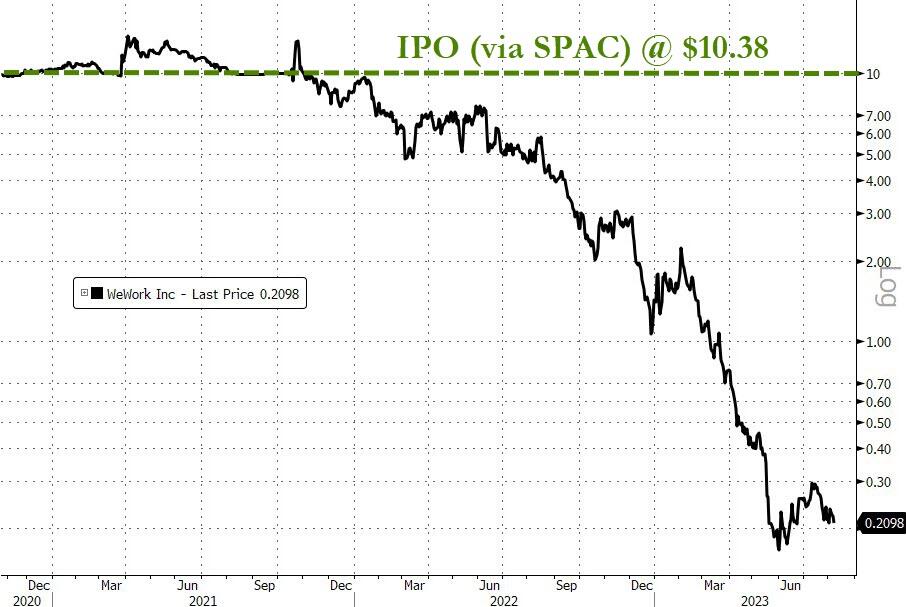
WeWork Shares Collapse After Company Warns “Substantial Doubt” Exists About Staying In Business

WeWork Shares Collapse After Company Warns “Substantial Doubt” Exists About Staying In Business

It all started off positively as WeWork reported revenue for the second quarter that almost met the average analyst estimate (Revenue $844 million, +3.6% YoY, estimate $851 million).

“In a difficult operating environment, we have delivered solid year-over-year revenue growth and dramatic profitability improvements,” David Tolley, Interim Chief Executive Officer, commented.

“Excess supply in commercial real estate, increasing competition in flexible space and macroeconomic volatility drove higher member churn and softer demand than we anticipated, resulting in a slight decline in memberships.

But then things started to go downhill…

Against expectations of a $2.68mm profit, the co-working company suffered an adjusted-EBITDA loss of $36mm.

The net loss was $397mm and cash levels are at $205mm (down 67% YoY).

And then it went off the cliff…

Later in the filing, the company added,

as a result of the Company’s losses and projected cash needs, combined with increased member churn and current liquidity levels, substantial doubt exists about the Company’s ability to continue as a going concern.

The Company’s ability to continue as a going concern is contingent upon successful execution of management’s plan to improve liquidity and profitability over the next 12 months, which includes, without limitation:

  • Reducing rent and tenancy costs via restructuring actions and negotiation of more favorable lease terms;

  • Increasing revenue by reducing member churn and increasing new sales;

  • Controlling expenses and limiting capital expenditures; and

  • Seeking additional capital via issuance of debt or equity securities or asset sales.

“We are confident in our ability to meet the evolving workplace needs of businesses of all sizes across sectors and geographies, and our long term company vision remains unchanged,” continued Tolley.

“Although we have more work to do, the talent and energy of the WeWork team is extraordinary and we are resolutely focused on delivering for our members for the long term. The company’s transformation continues at pace, with a laser focus on member retention and growth, doubling down on our real estate portfolio optimization efforts, and maintaining a disciplined approach to reducing operating costs.”

Well, the market is not “confident” as WeWork plunged another 25% after hours…

Do you believe in miracles?

Meme-stock mania time?

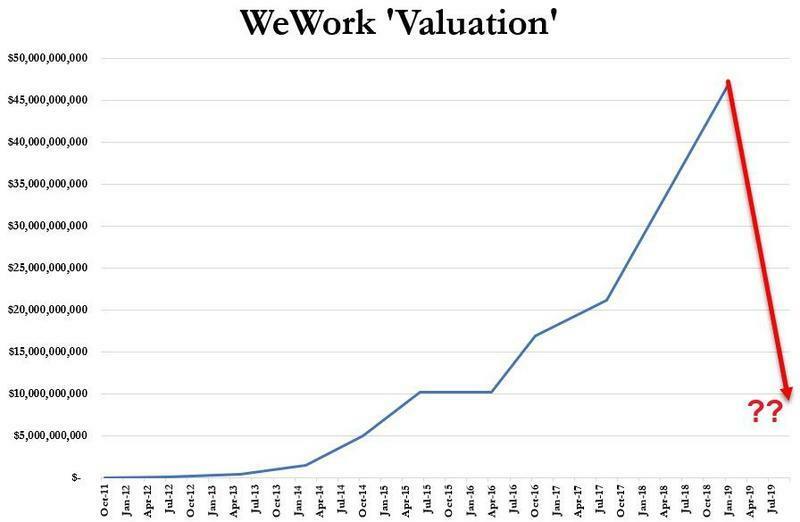
As a reminder, WeWork was ‘valued’ at $47 billion at its peak (when still private before the first failed IPO effort).

After tonight’s 35% loss, WeWork is now valued at around $290 million (with an ‘m’).

Tyler Durden
Tue, 08/08/2023 – 17:45

WTI Holds Day’s Gains After API Reports Bigger Than Expected Crude Build

WTI Holds Day’s Gains After API Reports Bigger Than Expected Crude Build

After some early weakness – after China’s dismal trade data – oil prices surged back higher after Ukrainian President Zelensky said his country would retaliate if Russia continues to block Ukrainian ports.

Oil trading centered on a “heavyweight battle playing out in global energy markets today between China demand destruction versus Saudi supply cuts,” said Robert Yawger, executive director for energy futures at Mizuho Securities, in a note.

After the largest crude inventory decline ever last week, analysts expect a very modest build this week

API

  • Crude +4.067mm (+1.3mm exp)

  • Cushing -112k

  • Gasoline -413k (-300k exp)

  • Distillates -2.093mm (+200k exp)

API reports a bigger than expected crude build (after last week’s collapse). Stocks at the Cushing hib fell for the sixth straight week. Distillates saw a much larger than expected inventory draw…

Source: Bloomberg

WTI was hovering just below $83 ahead of the API print and drifted modestly lower after…

“Amid a steady rally dating back to late June, fundamentals continue to skew supportive,” said Robbie Fraser, manager of global research and analytics at Schneider Electric, in a note.

Despite the rally, a weakening demand outlook is limiting the gains. The US Energy Information Administration on Tuesday lowered its forecast for US consumption. Reports from OPEC and the International Energy Agency coming later this week will offer further updates on the health of the market.

Tyler Durden
Tue, 08/08/2023 – 16:37

Fooled By What We Measure, Enlightened By What We Don’t

Fooled By What We Measure, Enlightened By What We Don’t

Authored by Charles Hugh Smith via OfTwoMinds blog,

Economists and pundits steer well clear of the eventual social and political consequences of America’s entrenched neofeudal wealth-income inequality.

Economists and pundits are falling all over themselves to declare the US is chugging along splendidly, and to express their frustration with the public for their curmudgeonly lack of enthusiasm. For example: If this is a bad economy, please tell me what a good economy would look like We should acknowledge that things are going well, even as we continue to look for problems to solve and How the Recession Doomers Got the U.S. Economy So Wrong.

My intention is not to slam Noah Smith or Derek Thompson. I follow their work and gain value from their analysis.

The point I want to make is we only manage what we measure, and the reliance on statistics that are overly broad and easily distorted/gamed leads to generalizations that ignore consequential cause and effect: we are fooled by overly broad and easily distorted/gamed statistics and enlightened by looking at what is not measured or measured inadequately.

The consensus holds that inflation is declining rapidly and unemployment remains low, so the economy is doing great. Please glance at Chart #1 below to see what enthuses the mainstream: the unemployment rate is near historic lows.

But this measure leaves out a great deal of consequential factors. It’s well-known that the unemployment rate is distorted / gamed by leaving out everyone who is in the workforce but not “actively seeking work.” So what does this official unemployment rate actually measure? Not the percentage of the workforce that has a job.

Nor does it measure underemployment–those working far below their potential–or job insecurity or the percentage of workers being pushed into burnout–all consequential reflections of the real economy. All of these are potentially causal factors in why US productivity has fallen so dramatically.

And speaking of productivity, that’s the ultimate source of prosperity–not speculative bubbles or debt-binging. If productivity is tanking, eventually there are negative economic consequences that will be distributed to some segments of the populace, very likely asymmetrically.

Such a broad-brush measure also ignores the consequences of demographics. Please glance at chart #2 below, of the 55 and over population and workforce. Note that virtually all the 20+ million jobs the US economy added in the past two decades are in this older workforce, which is of course steaming steadily into retirement, even as the percentage of this cohort who continues working has soared.

In other words, virtually all the job growth is the result of older workers working longer. Yes, 70 is the new 50, but try doing the same work at 70 that you did when you were 50. Sure, some people forego retirement because they love their work so much, but we don’t measure how many are still working because they have to for pressing financial reasons.

Have you observed the age of service workers and skilled workers recently? Do you reckon they really love working at Burger King so much that they’re doing it for enjoyment?

What if we measured financial pressures and job insecurity rather than risibly bogus “unemployment”? Would the economy still look so wonderful and resilient?

Chart #3 shows that virtually all the population growth ahead is in the cohort of older workers 65+ years old heading into retirement. So the workforce is rapidly aging and the unspoken / unexamined assumption is tens of millions of new workers will enter the workforce with the same skills, motivation, dedication and values as the tens of millions retiring.

But the demographics simply don’t support this breezy assumption.

Now glance at chart #4 which depicts the extraordinary rise in the number of workers who are now disabled. The causes of this are being debated (the pandemic obviously plays a role), but 2.5 million workers leaving the workforce in a few years is something that could be consequential if the trend continues. An assumption that this is a one-off is baseless until proven otherwise.

Once again, demographics, productivity and factors such as disability and burnout are not part of the unemployment, GDP and inflation measures currently being touted as proof of economic nirvana.

Item #1 of what’s not even measured is the crapification of goods and services. I addressed this in The “Crapification” of the U.S. Economy Is Now Complete (February 9, 2022) and Stainless Steal (February 26, 2023).

How do we measure the “inflation”–i.e. a loss of purchasing power–when appliances that lasted 20 years a generation ago now break down in 5 years? Where does that 75% decline in utility and durability show up in the official inflation data? How about the tools that once lasted a lifetime now breaking after a few years?

It’s been estimated that America’s food has lost 30% of its nutritive value in the past few decades. Protein per gram has dropped, trace nutrients have dropped, and so on. Rather than pursue sustainably nutrient-rich soil, Big Ag has maximized profits by dumping natural-gas-derived chemical fertilizers on depleted soil to boost production of nutrient-poor, tasteless “product.” A product deemed “organic” offers no guarantee that the soil isn’t depleted of nutrients.

Could this decline have anything to do with the American populace’s increasingly poor health? Nobody knows because these massive declines in quality and value aren’t measured and are certainly not part of the risibly bogus measures of unemployment, GDP and inflation.

The official inflation rate ignores the multi-decade decline in the purchasing power of wages. Rents have soared 25% in a few years, and economists are looking at 5% increases in wages and worrying about the potential inflationary impact of workers’ wages not keeping up with real-world inflation.

Cheerleading economists and pundits never mention the $50 trillion siphoned from labor by capital over the past 45 years. They also don’t mention the rising trend of loading more work on employees rather than hire more employees, or as a response to not being able to find qualified new hires.

Funny how rosy the picture can be tinted when all the consequential forces are ignored. But this studied ignorance characterizes the American elite, who delight in whining about airfares and travel delays, and finding someone to fix their pool pump. I address our Terminally Stratified Society here:

The Wealthy Are Not Like You and Me–Our Terminally Stratified Society (August 3, 2023)

This protected elite don’t have to put up with the crapified goods and services which generate their capital gains and income. Their wealth and income enable their detachment from the crapified economy the bottom 90% experience. Their experience of the bottom 90% is as service workers, delivery people, etc. who serve their entitled tastes.

Correspondent Tomasz G. provided a telling excerpt from Houellebecq’s The Possibility of an Island:

“… the rich certainly like the company of the rich, no doubt it calms them, it’s nice for them to meet beings subject to the same torments as they are, and who seem to form a relationship with them that is not totally about money; it’s nice for them to convince themselves that the human species is not uniquely made up of predators and parasites… “

As correspondent Ryan R. observed, America’s privileged elites “were born on third, stole home (via asset inflation) and still think they hit that home run.”

We know who the parasites are, but economists and pundits are safely blind to America’s neofeudal aristocracy. After all, who butters the bread of economists and pundits?

Is it unsurprising there are no measures of neofeudalism or elite privilege? As for the incredible concentration of wealth in the top tiers and the resulting decline in the bottom 90%’s share of the nation’s wealth–nothing to see here, just globalization and financialization doing their thing. What matters is booking my next flight to yet another conference of economists and pundits where we nod our heads and dare not admit all the conferences are nothing but echo chambers of the privileged elites.

Cheerleading economists and pundits completely ignore the consequences of the system being rigged to favor capital and the already-wealthy who were given the means to buy assets back when they were cheap and affordable to the middle-class. Now that the system generates speculative credit-asset bubbles to create “the wealth effect,” assets such as homes in desirable regions are out of reach of the bottom 90%.

Please study the six charts below of wealth inequality. 

Try not to laugh out loud when you see that the top 1% reckon that “coming from a wealthy family” has near-zero impact on “getting ahead in America.”

Also note the steady decline in the middle class percentage of national wealth, and how the middle class’s share only rises when the credit-asset bubbles that have enriched the top 10% deflate, a bubble-pop that never lasts longer than a few months thanks to the policies that favor the already-rich at the expense of those who don’t own stocks, rental properties, municipal bonds, etc.

Economists and pundits steer well clear of the eventual social and political consequences of America’s entrenched neofeudal wealth-income inequality. That this neofeudal configuration is inherently destabilizing–never mind, we don’t measure that, look at the wunnerful unemployment and inflation charts!

Lastly, consider the skyrocketing federal debt in terms of how many jobs are created in the era of soaring federal spending and debt. (Charts courtesy of CH / Economica) Debt doesn’t matter to economists and pundits, and neither does its diminishing effect on GDP and employment.

The same can be said of total debt (public and private), which is skyrocketing (last chart): diminishing returns writ large as higher interest rates are embedded in the policy excesses and neofeudal structure of the past 45 years.

In essence, nothing that is consequential is properly quantified, so the pundit class keeps insisting everything is wunnerful and is mystified why people are so foolishly dissatisfied with our wunnerful economy. The reason why people are not buying the fantasyland story is they have to live and work in the crapified real economy, as serfs serving the economist-punditry-elite aristocracy.

If we want to avoid being led astray by misleading measures, we must seek enlightenment in what isn’t being measured or is cast aside as inconvenient to the “economy is wunnerful” party line.

*  *  *

My new book is now available at a 10% discount ($8.95 ebook, $18 print): Self-Reliance in the 21st Century. Read the first chapter for free (PDF)

Become a $1/month patron of my work via patreon.com.

Subscribe to my Substack for free

Tyler Durden
Tue, 08/08/2023 – 16:20

Quartet Of Carnage Crushes Stocks; Bonds, Bitcoin, & Black Gold Bid

Quartet Of Carnage Crushes Stocks; Bonds, Bitcoin, & Black Gold Bid

Futures suffered a quartet of carnage into today’s US open included a disappointing night of economically-sensitive EPS prints (UPS, CBT, CE, IFF); Chinese trade data bombed, with exports showing the worst decline (-14.5% YoY in July) since Feb 2020, while imports too were crunched (-12.4%) – reflecting weak domestic demand, and iterating ongoing issues with lack of consumption and investment growth in China; Italy’s surprise windfall profits tax on banks has spooked EUR banks and broad index; and Moody’s cuts 10 US banks (including “super regionals” Capital One, PNC Financial Services Group and Fifth Third Bancorp) on the increased cost of funding and office exposure.

But apart from that, everything is awesome in Bidenomics-land… as ‘hope’ leads (‘soft’ survey data rising as ‘hard’ economic data slides)…

Source: Bloomberg

FedSpeak was ‘on message’ – high(er) for long(er)

0820ET *HARKER: FED MAY BE AT THE POINT WHERE IT CAN HOLD RATES STEADY, FED WILL NEED TO HOLD RATES STEADY FOR A WHILE

0855ET *FED’S BARKIN SAYS INFLATION REMAINS TOO HIGH

The result – all the US majors were in the red today. The equity indices were dumped at the US cash open then staged a recovery after Europe closed…Nasdaq was the biggest loser on the day…

After the gap-down open, a short-squeeze was engineered once again…

Source: Bloomberg

AAPL managed to bounce back into the green today, ending the 5-day losing streak. We note that AAPL found support tosay at its 100DMA (having broken below its 50-DMA last week)…

0-DTE traders faded the afternoon bounce in the market again…

Source: SpotGamma

Italian banks were clubbed like baby seals…

Source: Bloomberg

In the US, Regional banks puked on the downgrades but bounced back after a weak open…

VIX (and VVIX) pumped-and-dumped today, following a similar pattern to the last few days. VIX topped 18 intraday and VVIX remains “stressed” in the 90-100 range…

Source: Bloomberg

Treasury bonds were bid across the curve but the long-end outperformed (as the curve bull-flattened)…

Source: Bloomberg

10Y yields fell back below 4.00% intraday

Source: Bloomberg

The dollar rallied hard overnight – back up to June and July’s Payroll print levels – before fading back.

Source: Bloomberg

Bitcoin ramped up towards $30,000 (again) today, after sitting around $29,000 for a week…

Source: Bloomberg

Another crazy day for crude with WTI dumping and pumping (back up to $83)…

Gold fell back to Friday’s spike lows…

Finally, it does have the feeling that we are close to a ‘sell the news’ moment in the AI-bubble…

Can history really repeat?

Tyler Durden
Tue, 08/08/2023 – 16:00

Kids Almost Never Transmitted COVID In Schools; Major New Study Finds

Kids Almost Never Transmitted COVID In Schools; Major New Study Finds

Authored by Alex Berenson via ‘Unreported Truths’ Substack,

The research should end what’s left of the pathetic rear-guard effort to defend school closures – or any mitigation measures like making kids wear masks…

Children almost never passed Covid infections in school, a study published Friday reveals.

In fall 2021, in four Massachusetts school districts with 18,000 children, researchers found 44 potential cases of in-school transmission.

You read that right.

18,000 students. 34 schools. Four months. And 44 Covid infections – including no infections of teachers or other staff members.

Throughout 2020 and 2021, as parents pressed with increasing urgency to reopen classrooms, teachers unions and Democratic politicians warned in-school Covid transmission would lead to waves of death. “Teachers are so worried about returning to school that they’re preparing wills,” CNN infamously wrote on July 16, 2020.

In reality, schools were among the safest possible places for students and teachers during Covid, this study suggests.

The study, which ran in the peer-reviewed journal JAMA Health Forumis both nearly useless and vital.

It’s nearly useless in advancing our actual knowledge about Covid- because serious researchers have known since 2020 that children spread Covid much less frequently than adults and that schools and camps were likely to be major sources of new Covid cases.

As early as April 11, 2020, French researchers published a paper showing that an infected nine-year-old child had not transmitted the disease “despite close interactions within schools.” By August 2020, researchers in Spain and Sweden had confirmed that finding on a much larger scale.

The reason is obvious too, since it is the same reason kids get much less sick than adults. They have lower viral loads and clear the infection more quickly. For many healthy children, Covid is barely even a cold.

(Just another good reason to hate CNN)

Yet the new paper is also vital.

Why? Because it covers American schools and was published in an American journal. And the American Covid-political-medical complex has had the habit for three-plus years of simply ignoring any research from outside the United States, especially if it includes inconvenient data and facts.

And so having concrete American evidence that schools were not in any way meaningful vectors for Covid transmission can only help to make sure the colossal mistake of mass school closures never happens again.

Too bad it comes far too late to matter to the kids in blue states who in some cases were denied over a year of in-person education.

*  *  *

Subscribe to Unreported Truths

Tyler Durden
Tue, 08/08/2023 – 15:45

Peter Thiel And Rebekah Mercer May Invest in Tucker Carlson’s New Media Empire

Peter Thiel And Rebekah Mercer May Invest in Tucker Carlson’s New Media Empire

Tucker Carlson recently told journalist and author Chadwick Moore: “I really do think the cable news business has a limited future.” 

Since leaving Fox News in April, Carlson’s widely popular Twitter show has attracted tens of millions of views, if not more, underscoring his point that legacy cable news is dying. 

A new report from CNBC details two GOP megadonors, Peter Thiel and Rebekah Mercer, are considering investing in Carlson’s new media empire with Twitter as its backbone

People familiar with the matter said Mercer has spoken with Carlson about investing in the unnamed media company. They added that Theil is very interested after hearing new details about the venture. 

“It was unclear Monday whether Thiel or Mercer had officially moved ahead with a financing plan,” the people said. 

Carlson and his team’s funding efforts to attract GOP megadonors are a great sign that the ex-Fox News anchor’s new media empire could be set to liftoff. 

In mid-July, The Wall Street Journal said Tucker and former White House adviser Neil Patel are preparing to raise hundreds of millions of dollars to fund the new media company with Twitter as its backbone. 

WSJ noted that Carlson plans to offer episodes for free while charging a subscription for shorter versions of his show, interviews, and documentaries. The new media organization could expand with other shows from additional hosts. 

CNBC said, “Any business between Carlson and Mercer could be part of a larger financing effort led by 1789 Capital, which is already planning an eight-figure investment into the former Fox News host’s media venture.” 

Revisiting Carlson’s initial comment at the top of the article suggests that traditional media is dying, and a new era of journalism is imminent (here’s Carlson’s latest show: watch).  

Tyler Durden
Tue, 08/08/2023 – 15:25

Ukrainian Refugees Fill Positions In North Dakota Oil Industry

Ukrainian Refugees Fill Positions In North Dakota Oil Industry

Authored by Charles Kennedy via OilPrice.com,

Ukrainian refugees are filling open job positions in the shale patch of North Dakota, thanks to a humanitarian program, the AP reports, noting 16 Ukrainians have already started work in the shale patch and another 12 are due to arrive later this month.

There are some 2,500 job vacancies in the Bakken shale play in North Dakota, which currently produces some 1.1 million barrels of oil daily.

The output in the play peaked in 2019 at 1.5 million barrels daily and has been in decline since then.

As of June, there were 38 drilling rigs in the Bakken but North Dakota’s mineral resources director Lynn Helms said at the time that these should bounce back to the mid-40s when the first batch of Ukrainian workers under the humanitarian program arrived.

“If this workforce program works as well as we hope, we’re going to see that rig count bounce back, and that adds a lot of dollars to North Dakota’s economy,” Helms said in June, as quoted by the Bismarck Tribune.

The program, dubbed Bakken Global Recruitment of Oilfield Workers, or GROW, was launched earlier this year with the aim of filling job vacancies in the Bakken through immigration with the initial focus on Ukrainians.

The Bakken shale play is still one of the biggest producing oil regions in the U.S. shale patch. The biggest player there is Harold Hamm’s Continental Resources, the company that revealed the true potential of the place back in the early 2000s.

Since then, however, natural depletion has reduced the output of crude oil while increasing the production of natural gas, Bloomberg reported earlier this year. At the time, the Energy Information Administration cited this decline in Bakken oil output as the reason for a revision of 2024 oil production figures.

Those were revised down to a total of 12.65 million barrels daily, from an earlier projection of 12.8 million bpd.

[ZH: we do note that jobs in oil & gas extraction industry could well be set to decline as rig counts have declined sharply…

Will these newly-employed Ukrainians soon be jobless once again?]

Tyler Durden
Tue, 08/08/2023 – 12:25

Nuland In Niger, Warns Coup Leaders Against Forging Ties With Russia’s Wagner

Nuland In Niger, Warns Coup Leaders Against Forging Ties With Russia’s Wagner

Acting Deputy Secretary of State Victoria Nuland made a surprise visit to Niger’s capital Niamey on Monday, where she had “difficult” talks with Niger’s junta leadership after it ousted President Mohamed Bazoum on July 26.

“Traveled to Niamey to express grave concern at the undemocratic attempts to seize power and urged a return to constitutional order,” Nuland announced of the risky visit, given the country has just undergone a coup. It should be noted that US officials have yet to use the term “coup” to describe the situation.

Nuland, now as the State Department number two under Secretary of State Antony Blinken briefed reporters after meeting the military leadership, describing that “conversations were extremely frank and at times quite difficult because, again, we were pushing for a negotiated solution.”

She noted that the military leaders were “quite firm in their view on how they want to proceed, and it does not comport with the constitution of Niger.” The junta has indeed not budged amid external pressure, even as the neighboring and West-friendly bloc, the Economic Community of West African States (ECOWAS), threatens full military intervention.

Nuland reportedly asked to see Bazoum, who has remained in detention—a request which was denied. “It was difficult today, and I will be straight up about that,” she admitted, confirming that Washington is unlikely to get its way in Niger.

Niger’s new self-declared defense chief, General Moussa Salaou Barmou, was among the junta officials Nuland met with. Interestingly, Nuland confirmed he had previously received military training from elite American operatives—yet another irony and failure of US foreign policy.

“General Barmou, former Colonel Barmou, is somebody who has worked very closely with US Special Forces over many, many years,” she said. “So we were able to go through in considerable detail the risks to aspects of our cooperation that he has historically cared about a lot. So we are hopeful that that will sink in.” The Intercept had also previously confirmed this in its reporting.

She said, “We were left to have to depend on Mr. Barmou to make clear, again, what is at stake.” Among her chief messages conveyed to the junta leaders included a warning not to cooperate with Russia’s Wagner group.

While Wagner is active in Mali and other West and Central African states, there are fears it is seeking inroads into post-coup Niger, and also after Wagner chief Yevgeny Prigozhin earlier praised the coup as being a blow to Western and US-backed imperialism. But Nuland appeared to be left uncertain on the question of Wagner

I raised Wagner and its threat to those countries where it is present, reminding them that security gets worse, that human rights get worse when Wagner enters. I would not say that we learned much more about their thinking on that front,” she said.

Days ago the State Department made clear that it saw no evidence of Russia being in any way behind President Bazoum’s ouster. Some in the West have still alleged it, however.

But clearly, Russia is watching and maneuvering on at least the diplomatic front (Burkina Faso has sided with the coup in Niger)…

If Niger comes under attack from the ECOWAS nations, it is likely that an official pact with Wagner would be reached in that scenario. Over the weekend, Al Jazeera reported, “Niger’s coup generals have asked for help from the Russian mercenary group Wagner as the deadline nears for it to release the country’s removed president or face possible military intervention by the West African regional bloc, a news report says.” Of course, ECOWAS has yet to intervene but could make the decision at a Thursday meeting.

“The request came during a visit by a coup leader – General Salifou Mody – to neighboring Mali, where he made contact with someone from Wagner, Wassim Nasr, a journalist and senior research fellow at the Soufan Center, told The Associated Press,” AJ detailed. 

All of this sets the stage for a possible Cold War 2.0 in Africa, where the US and its allies vie for influence against against Moscow. Russia will in turn continue presenting itself as ‘anti-imperialist’ while highlighting historic Western greed and encroachment on the continent. This also as Niger’s junta has severed ties with France amid rumors it is supporting a military intervention to restore constitutional government.

Tyler Durden
Tue, 08/08/2023 – 12:05

PayPal Revisited

PayPal Revisited

Authored by Omid Malekan via Medium.com,

PayPal issuing its own stablecoin is big, marking a major milestone in the continuing evolution of crypto. It legitimizes the notion of payments moving on chain more than any blog or book (however well-written) ever could and is another step towards mass adoption.

For years, skeptics of the very idea of tokenized fiat money have homed in on the immaturity of the stablecoin industry to form their critique. Tether — they told us repeatedly — was a fraud that would collapse imminentlyand Facebook’s Libra/Diem project was dangerous. Those who couldn’t be bothered to learn the difference between a badly designed Terra UST and a fully reserved USDC told us that dollars on the blockchain were a solution looking for a problem. Just recently, SEC chairman Gary Gensler told us that we don’t need any more digital currencies because the dollar is already digital. Presumably he meant mobile services like Venmo, owned by PayPal.

But now we know: PayPal disagrees.

I first wrote about the collision of PayPal and stablecoins five years ago and got a lot wrong, some of it embarrassingly so. I was too optimistic on the speed of stablecoin adoption, and not optimistic enough about the role non-crypto FinTechs could play. Instead of staying away from crypto rails and protecting their turf, many embraced crypto for trading, and now one is issuing its own coin

The boldness of this decision cannot be understated. PayPal makes a chunk of its revenues from transaction fees charged to merchants, but is now issuing a product that can be used as a cheaper alternative. The downward pressure stablecoins will eventually put on transaction fees was the main reason I originally assumed that companies like PayPal would stay away. Specifically:

How cheap? A $1000 payment to a merchant using PayPal costs over $29. The same payment using a tokenized dollar riding the Ethereum platform today costs less than 20 cents. Not quite free, but a savings of over 99%. How’s that for disruption? Or an existential crisis for the $100b Wall Street darling that makes 90% of its revenues from transaction fees?

Ethereum fees have gone up since I wrote that blog post, but we now have rollups, and cheaper blockchains like Tron have been popular for stablecoins for years. I still believe — now more than ever — that permissionless blockchain networks will eventually make all fiat payments effectively free, in the same way that the internet made communication free.

So what does PayPal see today that even I didn’t four years ago? What is it about crypto in general and stablecoins specifically that is so appealing to an established public company that it would wade into America’s toxic regulatory environment? Here are some ideas:

  • If they don’t do it, someone else will: the Innovator’s Dilemma is in play, but PayPal’s leadership is not making the classic mistake of ignoring the threat until it’s too late.

  • Volume: Cheaper (and easier) payments will result in higher volumes. Consider how many more emails are sent today vs snail mail 20 years ago. Higher volumes at lower fees will enable new business models. Email might be free, but Gmail and Mailchimp are extremely valuable businesses.

  • On and off Ramps: We are still years removed from stablecoins taking over (at which point we’ll just call them dollars). Until then, there will be lots of money made by those who bridge them to legacy payment rails.

  • Wallets: Crypto allows users to custody their own assets, but many prefer the aid of a trusted brand, and enterprise users often have no choice. PayPal’s acquisition of Curv, combined with its decades of experience in building digital wallets, will make it a major contender in the coming land grab for both consumer and enterprise wallets.

  • Omni-asset custody: Blockchain rails are superior to traditional ones because they can handle an infinite variety of assets using the same network. Your bank account will never store your art collection and Visa will never handle stock trades, but Ethereum can do both, while also handling dollar payments. Having a strong foothold in stablecoin ramps and digital wallets will set PayPal up to become a go-to custodian for all sorts of other things — from bitcoins to CBDCs.

  • A hedge against CBDCs: Central bank digital currencies are more threatening to the payments industry than private stablecoins. Issuing their own will allow the company to build the proper muscle, while possibly making a ton of money off the float.

  • Float: With overnight interest rates sitting north of 5%, holding money for others is a highly profitable business. Securities laws forbid stablecoin issuers from paying interest to their users, so existing issuers like Tether and Circle are now making over $5B a year. In time, a popular stablecoin could significantly increase PayPal’s interest income.

  • Related services: Effectively free payments enable other high-margin products and services. The video game industry has already proven the profitability of free to play, and stablecoins open the door for free to pay. Data & analytics, compliance, rewards programs, streaming money, microlending, and IoT payments are just a few examples of new sources of revenues.

  • Expansion: PayPal’s existing P2P and merchant services may be popular, but are limited in scope. Issuing a stablecoin will allow PayPal to enter new payment categories such as:

    • B2B payments, where one company pays another

    • Correspondent banking, where banks move money for other financial institutions

    • Capital markets, where money is moved for trade settlement, dividends or interest

    • Remittance corridors, where money is sent cross-border by migrant workers

    • Payroll & government disbursement, where one payer pays many recipients periodically

    • DeFi: where decentralized protocols slowly replace financial intermediaries

A regulated stablecoin issued by a trusted provider with a recognizable brand will eventually take over all these activities, and PayPal is vying for market share.

Last but certainly not least is the unimaginable. One of the exercises I give my students when teaching them stablecoins is to invent new economic activities that become possible thanks to effectively free micropayments. Think: streaming money to pay for streaming video, paying for electricity by the second, interest that compounds continuously and workers who get paid by the hour, or even the second.

Just as a simple idea like free data exchange (AKA the internet) unleashed new services like Zoom and social media, free money exchange will enable currently unimaginable economic activities. PayPal and other forward companies will benefit from this evolution, while the legacy banks and payment providers who do nothing will fade away.

Tyler Durden
Tue, 08/08/2023 – 11:45

DeSantis Fires Campaign Manager In ‘Reload’

DeSantis Fires Campaign Manager In ‘Reload’

Days after Ron Desantis’ largest individual donor warned he’d cut off funding if DeSantis doesn’t start appealing to moderates, the Florida governor has replaced his embattled campaign manager with his Florida Chief of Staff, James Uthmeier, The Messenger reports.

Outgoing campaign manager Generra Peck will stay on board as chief strategist as part of the shakeup – the Desantis’ campaign’s third in less than a month.

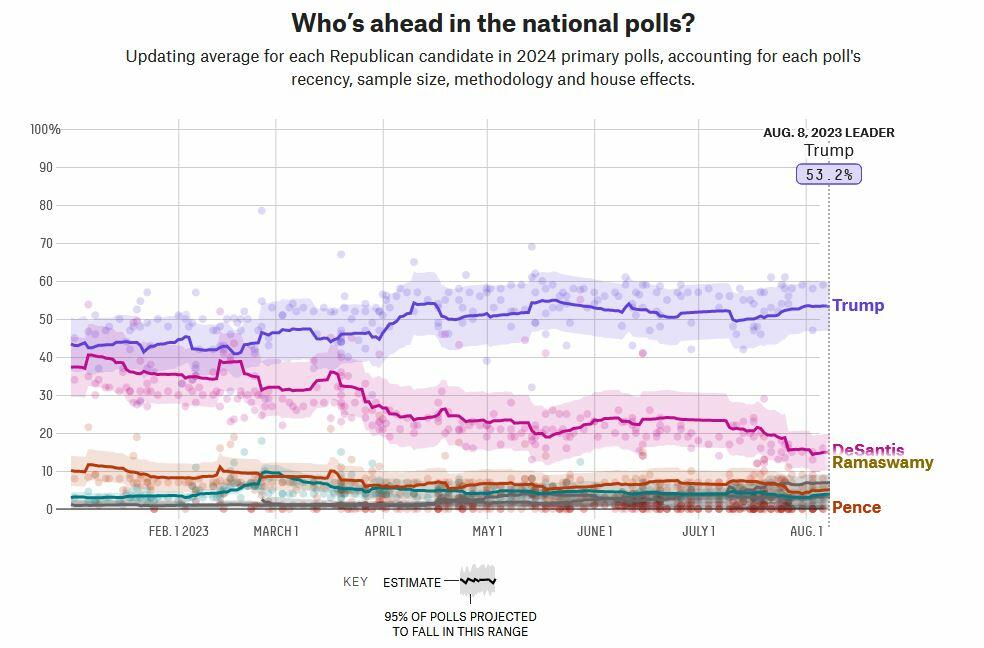
While Peck made headlines for guiding DeSantis to a blowout reelection last year, she came under scrutiny last month as the 2024 campaign stalled out, money dried up, and polling showed DeSantis losing to Trump at an accelerated rate.

Via Five Thirty Eight

The campaign then twice cut staff and expenses and retooled DeSantis’s press strategy to make him more available to the mainstream media.

But donors and some outside advisers weren’t satisfied, leading DeSantis last week to ask Uthmeier to diagnose problems with the campaign and see if he could fix them. Ultimately, it led the governor to ask Uthmeier to take the job.

Uthmeier shies away from calling the reshuffling a “reboot.” It’s a despised word in the campaign, where advisers prefer to call this the last campaign “reload” — and say they’re going to win, despite the naysayers and early polling. -The Messenger

People have written Governor DeSantis’s obituary many times,” Uthmeier told the outlet. “From his race against establishment primary candidate Adam Putnam, to his victory over legacy media-favored candidate Andrew Gillum [in 2018], to his twenty point win over Charlie Crist [in 2022], Governor DeSantis has proven that he knows how to win. He’s breaking records on fundraising and has a supporting super PAC with $100 million in the bank and an incredible ground game. Get ready.”

Uthmeier will be joined by deputy campaign manager David Polyansky, a politically savvy Iowa operative who says he’s never lost a Republican primary in the first-in-the-nation caucus state.

Uthmeier has an impressive track record — from challenging mask mandates to rapid school reopenings to redrawing Florida’s congressional maps. His appointment is clearly designed to calm fears from his donors, such as billionaire Robert Bigelow – who says he isn’t happy with the Florida governor’s strict conservative stances. By bringing in Uthmeier, known for his alignment with First Lady Casey DeSantis’s initiatives, the governor may be seeking a more balanced approach, satisfying both the conservative base and influential donors.

That said, Uthmeier has quite the challenge on his hands – with the campaign finances having suffered due to a high burn rate, and several PR disasters, including inappropriate ads created campaign staff. One ad was described by The Messenger as “homophobic (yet strangely homoerotic)” – while another ad used Nazi imagery. The campaign initially lied and denied that the videos came from staffers.

Meanwhile, former Vice President Mike Pence has just met the RNC’s requirements to participate in the first debate on Aug. 23, according to a Tuesday campaign press release. Notably, Pence recently threw Trump under the bus over January 6th, while DeSantis recently told NBC NewsOf course‘ Trump lost the 2020 US election.

Maybe these guys should stop shooting themselves in the dick when it comes to winning over Trump supporters?

Tyler Durden
Tue, 08/08/2023 – 11:25