70.7 F
Chicago
Friday, August 28, 2026
Home Blog Page 3451

German Central Bank: Gold Revaluation Account Underlines Soundness Of Balance Sheet

German Central Bank: Gold Revaluation Account Underlines Soundness Of Balance Sheet

By Jan Nieuwenhuijs of Gainesville Coins

At a press conference early 2023, member of the Executive Board of the German central bank Joachim Wuermeling made clear that the soundness of the central bank’s balance sheet, in light of general losses, is guaranteed by the bank’s gold revaluation account. Wuermeling’s testimony implies the bank is willing to use its gold revaluation account to cover losses.

The President of the Dutch central bank made a similar remark in November 2022. These statements accentuate gold’s role as a remedy regarding financial challenges created by boundless money printing.

Image: Bundesbank via Flickr

Introduction

Like many central banks nowadays, the German central bank (Bundesbank, or “Buba” in short) is performing at a loss. Many years of unconventional monetary policy made Buba buy large amounts of German government bonds, carried on the asset side of its balance sheet, with freshly created bank reserves on the liability side. Now interest rates are rising, the interest paid by Buba on its bank reserves liabilities exceeds interest income on its bond portfolio, resulting in a loss that eats into the bank’s capital buffers.

A gold revaluation account (GRA) is an accounting item on the liability side of a balance sheet, part of net equity*, that records unrealized gains of gold assets. Simplified, when the gold price appreciates a GRA swells, and when the price depreciates it contracts.

GRA = Present Gold Value – Historic Gold Purchasing Cost

Example balance sheet of a central bank. Net equity equals the difference between assets and labilities. Capital, reserves, and provisions included in net equity are simply referred to as “capital” in this article.

Because gold is the only international currency that can’t be printed, the gold price denominated in fiat currencies substantially increases in the long run, creating hefty unrealized gains when metal is held for an extended period.

In theory, GRAs can be used by central banks to absorb general losses. Accounting rules, though, determine only capital buffers can be utilized for this purpose, not GRAs. First of all because GRAs are unrealized gains and capital consists of realized gains. Furthermore, suppose a central bank operates at a loss and uses its GRA fully to compensate said losses. Then, the next year the price of gold decreases. With its GRA is emptied, the decline in value of gold assets will be recognized as a loss and can wipe out the bank’s capital buffers. Hence, accounting rules stipulate that GRAs are meant to cushion retracements of the gold price (page 26).

Think of GRAs as part of net equity but shielded from functioning as capital. In the world of accounting, though, nothing is written in stone. Rules can be changed or circumvented, as the central bank of Curaçao and Saint Martin did for using its GRA in 2021.

One could argue that using GRAs to absorb losses is only imprudent if there is a probability that the price of gold can fall below the historic purchasing price. Many European central banks, like the Bundesbank, bought their gold during Bretton Woods for $35 dollars per fine troy ounce and their GRAs are enormous. To the extent the price of gold will never again reach $35 dollars per ounce, it wouldn’t be a sin for Buba to use its GRA. To give you an idea on the Bundesbank’s gold financials:

GRA €176 bn = Present Gold Value €184 bn – Historic Gold Purchasing Cost €8 bn

It can be calculated how much of a GRA can be sapped by estimating a plausible floor for the price of gold in the free market. If the Bundesbank assesses that the price of gold won’t fall below, for example, €400 euros per ounce, it can tap 20% of its GRA (€35 billion). At a floor of €700 euros per ounce, it can use 40% of its GRA (€70 billion), etc.

With this rationale in mind, and more financial stress on the horizon, the German central bank is now publicly taking in consideration to use its GRA for offsetting losses.

Buba’s Press Conference Discussing its Gold Revaluation Account

An article by the Financial Times (FT), published in June 2023, discusses future outcomes if the Bundesbank continues to make losses. Germany’s federal audit office judges (based on EU directives) that if Buba’s losses consume its capital buffers—a situation that may affect the credibility of the Eurosystem’s monetary policythe German government has to recapitalize its central bank. While the finance ministry believes it’s highly unlikely that losses from the Bundesbank would put a strain on the federal budget.

The article made me research if the FT wasn’t subtly concealing the elephant in the room: the Bundesbank’s gold revaluation account worth €176 billion euros, which, theoretically, can keep the German taxpayer out of the equation.

Eventually I found a recording of Buba’s press conference for the presentation of its Annual Report 2022, held in March 2023. President Joachim Nagel explains in the introduction that the bank is making losses and that “in subsequent years the burdens will probably exceed [the capital] buffers.” Though, he adds: “the Bundesbank’s balance sheet is sound.” Member of the Executive Board Joachim Wuermeling leaves no room for doubt on what guards the soundness of the Bundesbank’s balance sheet: the gold revaluation account. From the horse’s mouth (25:40):

Joachim Wuermeling (member of the Executive Board): What is also of interest is the revaluation accounts. … The most important revaluation item of course is the reserve for the 3,355 tonnes of gold. In fact, the value is about €180 billion euros above the cost of purchasing it, so this is a reserve for us, and it’s part of the considerable own funds of Bundesbank, underlining the soundness which the President mentioned. So, in fact, it’s on firm ground, the balance sheet of Deutsche Bundesbank, and this certainly makes it easier for us to bare losses over a certain period of time.

Why the FT didn’t spell this out is beyond me. Wuermeling literally states, after Nagel noted capital buffers will likely be depleted in coming years, that Buba’s GRA is part of its own funds (capital), which makes it easier to bare losses.

The Bundesbank is two steps ahead by promoting its GRA from part of net equity to own funds. Whatever they may be, Wuermeling is insensitive to the obstacles preventing Buba’s GRA to neutralize losses and guarantee the soundness of its balance sheet.

As can be seen in the table above, the lion share of Buba’s total revaluation accounts consists of its gold revaluation account. Additionally, in Buba’s Annual Report 2022, it shows its revaluation accounts are an order of magnitude larger than any other component of net equity.

The Bundesbank’s net equity according to the ECB’s definition amounted to €206.5 billion and includes … €19.2 billion contained in liability item 12 “Provisions”, liability item 13 “Revaluation accounts” of €181.7 billion and the capital and reserves of €5.5 billion in total.

No wonder the Bundesbank is willing to use its GRA when confronted with losses.

Conclusion

In February 2022 I asked several central banks in Europe if they considered to write off government bonds to alleviate the debt overhang by using their respective GRAs. The Bundesbank didn’t rule out this possibility. “At this stage, we prefer not to speculate about any potential decisions … that might or might not be taken in the future,” an employee replied. A year later the door to Buba’s GRA has been opened even further.

The barrier for central banks to use their GRAs can, apparently, be overcome. Why else would Buba bring up its GRA regarding losses? And how is the finance ministry so confident it doesn’t have to recapitalize its central bank? All it takes is to change the accounting rules, which central banks do in every crisis, or to find a loophole.

There are important implications to contemplate if major central banks choose this path, though.

  • One, using GRAs emphasizes that fiat currencies devalue against gold through time, stimulating more central banks, corporations, and households to buy gold and reap revaluation benefits in the future as well.
  • Two, suppose in an extreme scenario Buba uses its entire GRA to cover losses. To avoid its net equity from turning negative, the Bundesbank (/European Central Bank) will need to put a floor under the price of gold, with all due consequences—a gold standard light.
  • Last but not least, if central banks truly screw up and losses explode, they will need to raise the price of gold to expand their GRAs and mop up all losses. In this scenario a floor under the (new higher) price of gold is required too, for the aforementioned reason. Bear in mind, there is no upper limit to a GRA, as fiat currencies can be printed unrestricted, as opposed to gold.

Using GRAs isn’t a bad thing for the simple reason that it increases gold’s role in the monetary system and has an uplifting effect on the gold price. A higher price deleverages and stabilizes the international monetary system, as it creates a larger base of money without counterparty risk (gold) to support the tower of credit. From an historic perspective that base is relatively small at the time of writing. If additional revaluation advantages can clear more debris from reckless monetary policy in the past, that’s a good thing. This view, coincidentally, rhymes with a quote of the former President of the Bundesbank Jens Weidmann (2018):

Germany’s [gold] reserve assets … are a major anchor underpinning confidence in the intrinsic value of the Bundesbank’s balance sheet. Gold has grown in importance over the course of history, first as medium of payment, later as the bedrock of stability for the international monetary system.

Further Reading:

Tyler Durden
Mon, 08/07/2023 – 06:55

UK’s NHS Raises Age For Government-Funded Transgender Treatments To Seven

UK’s NHS Raises Age For Government-Funded Transgender Treatments To Seven

The UK’s National Health Service (NHS) will allow children as young as seven to receive transgender care, according to plans seen by The Telegraph. The plans, which are part of a broader overhaul of the transgender treatment system, have sparked concerns over the potential consequences of early medical intervention on young minds.

Children covered by the services will be offered psychological support and therapy to focus on issues that may have led to feelings concerning their gender, however health experts warn that the new rule could still put children with mental health struggles on a “pathway to medical transition.”

The concerns are amplified by the potential consequences of labeling a child’s difficulties as gender-related, potentially pushing them towards a predetermined path of treatment.

The decision to implement these changes stems from the NHS’ decision to shutter the Tavistock transgender clinic. Dr. Hilary Cass’ review deemed the clinic as unsafe, raising concerns that young individuals were being rapidly pushed into a medical framework without adequate consideration of alternative factors such as autism and mental health.

The clinic is being replaced by a set of regional centres that will be led by medical doctors, rather than therapists, and consider the impact of other conditions such as autism and mental health issues.

The move came amid growing concern about the impact of gender ideology on children, including in schools where some were being socially transitioned without their parents’ consent.

NHS England said that a new service was needed because there was “scarce and inconclusive evidence to support clinical decision-making” at the Tavistock clinic. -Telegraph

The shift in approach reflects the growing unease around the impact of gender ideology on children. Reports of children undergoing social transitions without parental consent in schools have fueled concerns over the potential consequences of premature interventions.

Navigating the Uncharted Waters of Early Intervention

While the move toward evidence-based decision-making is welcomed by many, questions linger about the potential long-term effects of early intervention. Critics argue that more research is needed to fully understand the ramifications of puberty blockers, especially for young patients whose bodies and minds are still developing.

Under the new plans, “Children under seven years of age may not be expected to have sufficiently developed their intellectual understanding of, and comprehension of, sex and gender to be able to understand the reasons for, and potential consequences of, a referral to a specialist gender incongruence service.””

But, according to the UK, by the age of seven, children will “be more established within school, and education professionals and school nurses will be able to contribute to a general observational view as to the appropriateness of a referral.”

Right.

Previously, children as young as three were being treated by Tavistock, with an average of three children under the age of seven having been referred each month.

Former Tavistock governor-turned-whistleblower Dr. David Bell, told the Telegraph: “For me, there is a structural problem which needs particular caution: referring a child to a gender service, even if they are seen in the context of a multidisciplinary team, in that the mere fact of referral is consequential. 

“It risks the child’s difficulties being viewed by themselves and their family as primarily to do with gender. Labelling the problem as a gender problem can easily be the first step on a pathway to medical transition.

“My view is that certainly for the younger ages, children should be managed within the context of the ordinary Child and Adolescent Mental Health Services (CAMHS). 

Their difficulties should not be designated as a gender problem, it is much more appropriate that they be seen as individuals who are distressed and this is one way in which that distress is expressed.

Tyler Durden
Mon, 08/07/2023 – 06:30

Controversial Eyeball-Scanning Worldcoin To Allow Governments To Use Its Digital ID System

Controversial Eyeball-Scanning Worldcoin To Allow Governments To Use Its Digital ID System

Authored by Christina Maas via ReclaimTheNet.org,

Allowing state actors to use the dystopian technology…

OpenAI CEO Sam Altman’s Worldcoin is a good example of private companies doing their bit to push and introduce digital ID schemes to as many people as possible – although this effort is usually done by governments, and supported by various lobbies.

And now, Worldcoin has announced that it will be even more helpful to governments, by allowing them to use the system of biometric scanning it employs to sign users up. Other companies will be given the same privilege.

The intention is clearly to get as many people as possible on board, hence the “generosity” with sharing the iris scanning tech, as well as that designed to verify people’s identity.

And it’s no secret: “We are on this mission of building the biggest financial and identity community that we can,” is how Tools for Humanity (a company behind Worldcoin) executive Ricardo Macieira put it.

The mission marches on despite concerns not only from privacy focused non-profits and advocates, but also institutions in various countries that are tasked with protecting data privacy.

People – and the number mentioned in reports these days is 2.2 million so far – sign up to Worldcoin by giving up biometric data contained in their eyes, i.e., irises.

What they get in return is a digital ID, and citizens of some countries are incentivized to do this by being given some free crypto, too.

And, this last point seems to play a major role in why anyone would sign up for this – Reuters said that a majority of those the agency spoke to in the UK, India and Japan said they were doing it to get the free tokens.

But if you listen to what Macieira has to say, Worldcoin is clearly eager to build an image for itself of much loftier goals – not to mention ones that can turn controversial, and fast.

These are some ways Worldcoin can be used, as mentioned on its website: providing a way to tell human from artificial intelligence, possibly paving the way for universal basic income – but also, “enabling global democratic processes.”

Worldcoin currently targets countries in Africa, Latin America and Europe for growing adoption, and doesn’t seem to have much problem in raising capital, either, with a $115 million round in May alone.

*  *  *

If you’re tired of censorship and dystopian threats against civil liberties, subscribe to Reclaim The Net.

Tyler Durden
Mon, 08/07/2023 – 03:30

Scottish Govt Axes 16 Million Trees To Clear Way For ‘Greener’ Solutions

Scottish Govt Axes 16 Million Trees To Clear Way For ‘Greener’ Solutions

Authored by Olivia Murray via AmericanThinker.com,

Stupidity is increasingly state-sanctioned…

Since 2000, the Scottish government has felled around 1,700 trees on a daily basis, all to make way for “green” initiatives. Leave it to the government and their leftist abettors to harp on the “destruction of the environment” then chop down literal trees to create barren wastelands—all to make room for obtrusive, industrial, inanimate behemoths that obliterate all sorts of animal populations, and create massive amounts of environmental pollution (in production, maintenance, and disposal).

According to an article by Frank Bergman and posted to Slay News yesterday, the Scottish government’s scheme of systematic deforestation was implemented to “meet the goals” of the climate agenda. Is that not one of the most ludicrous and asinine things you’ve ever heard? Or perhaps, the move is right in line with the climate agenda, because the goal isn’t environmentalism… but rather communistic destruction?

From Bergman:

A Scottish government official has admitted that almost 16 million trees have been cut down in Scotland to make way for ‘green energy’ farms.

The trees were growing on public land and were chopped down so the land could be used for wind turbines.

The admission was made by Scotland’s Rural Affairs Secretary Mairi Gougeon, a member of the ruling left-wing Scottish National Party (SNP).

She estimated that 15.7 million trees had been cut down since 2000 on land currently managed by Forestry and Land Scotland (FLS).

Bergman also reported that Gougeon said:

‘Where woodland is removed in association with development, developers will generally be expected to provide compensatory planting in order to avoid a net loss of woodland.’

“Generally”? Seems rather vague and subjective; unsurprisingly, “No information has yet been provided regarding any trees that were ‘replanted,’ however.”

Whenever I read stories like this, a particular Office episode in which Stanley Hudson unleashes on Michael Scott comes to mind; the tirade begins like this:

You are out of your d—, little pea-sized, mind. What is wrong with you? Do you have any sense? At all?

Every day you do something stupider than you did the day before.

Stanley concludes his outburst by calling Michael a “professional idiot,” and that right there, once again, is why the scene sticks out when I read about certain government initiatives and actions, and its enforcers. These people are truly professional idiots, sanctioned by the State, and there’s no end in sight.

They squeal about “carbon pollution” then level green (literally and figuratively) CO2 consumers, and replace once-thriving forests with technological, ecological, and fiscal abominations. Every day, they “do something stupider” than the day before. Low-brow Greenies are the quintessential “useful idiots” and it certainly shows.

Tyler Durden
Mon, 08/07/2023 – 02:45

4 In 5 Germans Unhappy With Federal Govt That Prioritizes Refugees & The Rich

4 In 5 Germans Unhappy With Federal Govt That Prioritizes Refugees & The Rich

Authored by Thomas Brooke via Remix News,

A major political backlash against the traditional mainstream parties is brewing in Germany after recent polling showed that four in five Germans are dissatisfied with the government, and a majority of respondents believe the interests of ordinary people are ignored in favor of refugees and the rich.

German Chancellor Olaf Scholz is flanked by Commissioner for Migration, Refugees and Integration Reem Alabali-Radovan, left, and German Interior Minister Nancy Faeser, right, during an immigration meeting “Germany, Immigration Country, Dialogue for Participation and Respect” in Berlin, Monday, Nov. 28, 2022. (John MacDougall/Pool Photo via AP)

According to the ARD-DeutschlandTrend poll, 78 percent of respondents are unhappy with the direction in which the country is headed under the current coalition government of the socialists, liberals, and greens.

A total of 41 percent are dissatisfied with Chancellor Olaf Scholz’s administration, while 37 percent are very dissatisfied. In contrast, just 20 percent of respondents are somewhat satisfied with the government, and just 1 percent are very satisfied.

Unsurprisingly, supporters of the opposition CDU/CSU and the right-wing Alternative for Germany (AfD) are the least supportive of the current administration, with 85 percent and 97 percent against, respectively. However, voters of the liberal Free Democratic Party (FDP) are also overwhelmingly unhappy with the federal government, despite their party being a member of the coalition. Just 17 percent support the government currently.

Even a majority of the SPD, which spearheads the government and holds the most influential positions of chancellor and interior minister, do not currently support it, while only a slim majority of Green party voters are happy with the status quo — 51 percent in favor versus 48 percent against.

The polling revealed that many German citizens believe the government no longer represents their interests and instead panders to the rich and refugees.

A total of 73 percent of respondents stated that the federal government cares too little for the German people, while 71 percent believe that low earners are not a priority for the current administration.

In contrast, 62 percent believe the government caters too much to the wealthy, compared with just 10 percent who think the opposite. Similarly, 48 percent think that too much focus is placed on helping refugees compared to working-class Germans, compared with 14 percent who think the government isn’t doing enough to assist new arrivals.

The political landscape is ripe for an insurgent populist party to take advantage of the national mood which is one of disillusionment, and the right-wing Alternative for Germany (AfD) has picked up the mantle in that regard and is surging in polls across the country.

An exponential rise in support over the past 12 months sees the party now backed by almost one in four Germans, hitting a record high of 23 percent in an INSA survey for Germany’s Bild newspaper published on Sunday.

This support has translated into recent electoral gains, with the party winning its first mayoral election last month, a trend now giving the leaders of mainstream parties a headache as they contemplate whether or not to work with the anti-immigration, anti-globalist party at a local level.

German voters appear to back their parties working with the AfD on a case-by-case basis, with the ARD poll showing majorities among supporters of FDP (81 percent), CDU/CSU (74 percent), and the SPD (57 percent) in favor of cooperation. Only the Green party remains against working with the right-wing party, although the numbers here are in fact 51 percent against and 46 percent in favor.

The higher the AfD soars, however, the greater the reality of necessary cooperation with the party becomes.

Tyler Durden
Mon, 08/07/2023 – 02:00

Developed Nations With Packed Infant Vax Schedule Linked To Higher Childhood Mortality Rates: Study

Developed Nations With Packed Infant Vax Schedule Linked To Higher Childhood Mortality Rates: Study

Authored by Megan Redshaw via The Epoch Times (emphasis ours),

Highly developed nations requiring the most neonatal vaccine doses tend to have the worst mortality rates in children under age 5, according to a peer-reviewed study published July 20 in Cureus.

Researchers Neil Miller, director of the Institute of Medical and Scientific Inquiry in New Mexico, and Gary Goldman, who has a doctorate in computer science, performed several analyses based on 2019 and 2021 data to explore potential relationships between the number of early childhood vaccinations required by developed nations and their neonatal, infant, and under age 5 mortality rates.

According to global health experts, few measures in public health can compare with the impact of vaccines, which are credited with having reduced disease, disability, and death from a variety of infectious diseases. Yet the study found that developed nations requiring more neonatal vaccinations may have unintended consequences that increase childhood mortality, challenging the idea that more vaccines administered always results in fewer deaths.

“Our paper investigated potential associations between the number of early childhood vaccine doses that developed nations require and their early childhood mortality rates,” Mr. Miller told The Epoch Times in an email. “For example, some nations administer hepatitis B and tuberculosis (BCG) vaccines to their infants shortly after birth. We found that nations that require both vaccines had significantly worse infant mortality rates when compared to nations that require neither vaccine.”

Miller and Goldman’s research initially began in 2011 when they published a paper using 2009 data showing less favorable infant mortality rates among highly developed nations requiring the most infant vaccinations.

The recent study replicated their original study using 2019 and 2021 data from the top 50 nations where childhood vaccine doses range from 12 to 26.  Results showed the infant mortality rate increased by 0.167 deaths per 1,000 live births for each additional vaccine dose added to the vaccination schedule, supporting the earlier study’s findings.

Twenty-nine nations in 2009 had better infant mortality rates than the United States, but by 2019, the United States had declined to 44th in infant mortality rankings, and in 2021, ranked 50th—despite requiring the highest number of infant vaccines.

Hepatitis B and Tuberculosis Vaccination May Increase Mortality

In their latest study, Miller and Goldman broadened their research to assess the impact of hepatitis and tuberculosis vaccines on mortality rates of neonatal infants (babies under 28 days old), infants up to age 1, and children under 5. Mortality data and vaccination schedules were compiled from UNICEF, the World Health Organization, the European Centre for Disease Prevention and Control, and national governments.

Nations were then grouped based on whether they required zero, one, or two vaccine doses given to newborns to determine their statistical significance to mortality rates of the three age groups. The association demonstrated by the analysis showed neonatal vaccines for hepatitis B and tuberculosis may not contribute to an overall reduction in mortality in nations where infants are at low risk of mortality from diseases the vaccines are targeting. In these nations, infants may actually experience greater risks from vaccination.

Reduction in Infant Vaccine Doses Decreased Mortality

Using 2021 data, the researchers found a statistically significant difference of 1.28 deaths per 1000 live births between the mean infant mortality rates among nations that did not vaccinate their neonates at all and those that required two vaccine doses. For each reduction of six vaccine doses administered during infancy, the infant mortality rate improved by approximately one death per 1,000 live births.

Additionally, vaccines administered during the first year of life had a greater effect on under age 5 mortality rates compared with vaccines administered in the second through fifth years of life, suggesting younger infants who generally weigh less and receive more vaccines in a shorter period are significantly more likely to experience an adverse reaction resulting in hospitalization or death.

“Hepatitis B and tuberculosis vaccines given shortly after birth when the immune system is immature and the neonate has low weight, may increase vulnerability to serious adverse reactions and deaths that ultimately contribute to higher neonatal, infant, and under age five mortality rates,” Mr. Miller told The Epoch Times.

Vaccination Sequence and Combination Can Impact Mortality

In most nations, more than half of infant deaths occur during the neonatal period, with about 75 percent of neonatal deaths occurring during the first week of life when neonatal vaccines are administered, according to Mr. Miller. Deaths that occur during this period have a large impact on neonatal, infant, and under age 5 mortality rates.

The study states the U.S. neonatal mortality rate comprises 61 percent of its infant mortality rate and 52 percent of the mortality rate in children under age 5.

Read more here…

Tyler Durden
Sun, 08/06/2023 – 23:30

Why Is America’s ‘Woke Left’ Silent Over Blockbuster Child Sex-Trafficking Film?

Why Is America’s ‘Woke Left’ Silent Over Blockbuster Child Sex-Trafficking Film?

Authored by Robert Bridge,

A new American film that reveals the brutal reality of child sex-trafficking has been greeted with muted enthusiasm from the political left, which begs the question: does the silence equal complicity in the unspeakable crime?

Tim Ballard is an American anti-human trafficking activist, author and founder of the non-profit organization Operation Underground Railroad, an anti-sex trafficking organization. A former special agent at the Department of Homeland Security who now works independently, Ballard’s life’s work is being immortalized in a Hollywood film, entitled Sound of Freedom.

The film, which stars Jim Caviezel in the role of Ballard, leads audiences through the harrowing twists and turns of Ballard’s true life experiences where he works to rescue children from the nightmare of sex slavery. Despite receiving mixed reviews from critics, the film has grossed over $140 million in the United States against a $14.5 million budget, while audience reception has been highly positive, scoring 99% on the Rotten Tomatoes film review site, and for apparently good reason.

According to estimates by the International Labour Organization, there were 24.9 million victims of human trafficking around the world in 2016. Yet for reasons known only to them, the left-leaning media and other institutions appear to be strangely anxious to draw the curtain on the Angel Studios production.

Writing in Variety magazine, Owen Gleiberman observed, “Let’s assume that, like me, you’re not a right-wing fundamentalist conspiracy theorist looking for a dark, faith-based suspense film to see over the holiday weekend. Even then, you needn’t hold extreme beliefs to experience ‘Sound of Freedom’ as a compelling movie that shines an authentic light on one of the crucial criminal horrors of our time, one that Hollywood has mostly shied away from.”

At a time when the question of sexual misconduct inside of the entertainment industry continues to grab headlines, as witnessed by the #MeToo movement, Hollywood’s indifference and even aversion to the subject of pedophilia and child sex-trafficking is strange to say the least. After all, as this cinematic biopsy rightly reveals, there are more people enslaved now, by sex trafficking, than there were when slavery was legal. And while allegations of sexual abuse committed by Hollywood bigwigs (amongst consenting adults) is highly disturbing, even the hint that America’s leading industry could be defending or even participating in child sex-trafficking seriously challenges the limits of moral acceptability.

It goes without saying that there is practically no limit to the number of conspiracy theories involving the inner sanctum of Hollywood – from Kubrick-style Illuminati control to unbridled sexual misconduct – the industry has witnessed every sordid accusation under the California sun. Adding to its stained reputation, an increasing number of people, many of them employed by the movie industry, are speaking out about pedophilia within the Hollywood ranks, and the fact that their efforts are not being taken seriously by the overlords of media and entertainment only adds to the aura of suspicion.

So why the silence from the progressive left on the Sound of Freedom, which Netflix, Hulu and Amazon streaming services have avoided like the plague?

First, the villain here is ‘human nature’ itself, an admission that flies in the face of liberal philosophy, which takes it for granted that all human behavior, and not least of all that of a sexual nature, deserves a fair hearing, complete with a court loaded with progressive activists.

In fact, there have even been calls to legitimize pedophilia and pardon those who are guilty of it.

Dr. Stephen Kershnar, a philosophy professor at SUNY Fredonia, is just one of many left-wing academics – are there any other? – who argues on behalf of sexual relationships between children and adults.

“Imagine that an adult male wants to have sex with a 12-year-old girl. Imagine that she’s a willing participant,” Kershnar argued.

“A very standard, very widely held view is that there’s something deeply wrong about this. It’s wrong independent of it being criminalized,” he said. “It’s not obvious to me that it’s in fact wrong. I think this is a mistake. And I think exploring that why it’s a mistake will tell us not only things about adult/child sex and statutory rape and also fundamental principles of morality.”

Kershnar went so far as to suggest that there might be “evolutionary advantages” to adult/child sex, while concluding with this shocking remark: “The notion that it’s wrong even with a one-year-old is not quite obvious to me.”

Not to be outdone in academia’s woke Olympiad, Allyn Walker, an Assistant Professor at Old Dominion University, has coined the term “minor-attracted person” in order to destigmatize the word ‘pedophile.’ Walker does not consider an adult’s physical attraction to a young child, even a toddler, to be a form of mental derangement, but rather a case of individuals not being able to control who they love, which is a very sick way of justifying child rape.

With such utter insanity in the air is it any surprise that California Governor Gavin Newsom signed Senate Bill 145, which lowers the penalties for adults who have sex with same-sex minors?

Finally, we must not forget the radical cultural milieu that the film Sound of Freedom is attempting to crash: LGBTQ parades, Drag Queen Story Hour and discussions at the elementary school level about transgender and alternative sexual lifestyles have all come to dominate the national conversation in the United States, and this makes a film that takes aim at child predators actually seem like a menacing thing to a large part of the population.

It’s hard to imagine things getting any more upside down in the land of the free, but it looks like that the madness has only just begun.

Tyler Durden
Sun, 08/06/2023 – 23:00

China’s Inward Foreign Direct Investment Falls To The Lowest Level On Record

China’s Inward Foreign Direct Investment Falls To The Lowest Level On Record

Three quick highlights from China, courtesy of Goldman’s Hui Shan

A wave of policy announcements: Following the July Politburo meeting on July 24th, various ministries and local governments have put out numerous policy announcements over the past two weeks. While the supportive tone is unmistakable, many of these announcements appear short on details and small in scale. One notable exception is the requirement for local governments to finish issuing all of this year’s special bond quota by the end of September, according to a recent media report, and to finish using the proceeds by the end of October. This is consistent with our view of accelerated fiscal spending and higher sequential growth in Q3. Goldman’s client conversations in recent days suggest most investors are still waiting for more concrete policy measures and clearer signs of such policies could meaningfully boost activity.

Inward FDI fell further in Q2: The preliminary Q2 Balance of Payments (BOP) data released last week showed China’s current account still enjoys a healthy surplus, but the financial account continues to see notable net outflows. In particular, inward Foreign Direct Investment (FDI) fell to the lowest level since the series started in 1998. With elevated US-China interest rate differentials and weak economic growth, the PBOC leaning against CNY depreciation by fixing CNY on the stronger side, and the market anticipating further policy easing measures, Goldman thinks USDCNY is likely to stay range-bound and maintains its 3-month forecast of 7.20.

China’s inward FDI fell to a record low in Q2

July trade, inflation and credit data this week: Chinese exports are expected to decline 14% yoy in July. Much of the weakness is presumably due to price effects: in June, exports value (in USD terms) dropped 12.4% yoy but exports volume only fell 1.8% yoy. Goldman expects headline CPI inflation to soften further from 0% yoy in June to -0.4% yoy in July, partly due to the high base in food prices last year. Finally, the bank also expects RMB 1Tn Total Social Financing (TSF) new flows in July, as bank loan growth likely slowed and corporate and government bond issuance was tepid in July.

Tyler Durden
Sun, 08/06/2023 – 22:30

Biden Admin Reduces Savings Estimate For Americans Switching Away From Gas Stoves: Industry Group

Biden Admin Reduces Savings Estimate For Americans Switching Away From Gas Stoves: Industry Group

Authored by Naveen Athrapully via The Epoch Times (emphasis ours),

The U.S. Department of Energy (DOE) is receiving criticism for its updated data analysis regarding the agency’s proposed regulations on gas stoves, which now projects even lower savings for consumers than the already meager numbers.

The new data shows that “savings are even less than DOE originally projected and are almost negligible,” the industry group Association of Home Appliance Manufacturers (AHAM) said about the changes in an Aug. 3 press release. “DOE’s original proposal was to save consumers 13 cents per month in utility costs over the life of gas cooking products. The revised data reduces consumer savings to just 9 cents per month,” it pointed out.

The changes in energy savings projected by DOE primarily result from DOE recognizing that the currently available cooking products are more efficient than its earlier analysis assumed.”

Blue flames rise from the burner of a natural gas stove in Orange, Calif., June 11, 2003. (David McNew/Getty Images)

At 9 cents a month, the projected savings will come to just $1.08 per year. Over a decade, that amounts to $10.80 in savings.

The department proposed new energy efficiency standards for gas stoves back in February. In a March 14 opinion piece at Washington Examiner, Rep. Debbie Lesko (R-Ariz.) warned that stringent energy performance standards would mean that 96 percent of conventional gas stoves could potentially be eliminated from the market.

“In fact, it is essentially an outright ban on gas stoves,” she said.

Ms. Lesko also highlighted the meager savings resulting from the new standards, arguing that people will not be willing to trade “such substantially decreased functionality and features for minuscule savings.”

In its comments submitted to the energy department, AHAM pointed out that many consumer features on gas stoves, like simmer burners and high-input rate burners, must be protected if the department was to implement its energy efficiency proposal.

However, the DOE has “still has not made any changes” to the proposed standards, it said, according to the release.

“This means consumers could still lose access to features and many currently available gas cooking appliance models—in exchange for saving only pennies each month.”

Countering Through Legislation

In order to counter the Biden admin’s push to restrict gas stoves, a bipartisan group of lawmakers introduced the “Save Our Gas Stoves” Act in the Senate in June

The Act explicitly prohibits the DOE from implementing the energy efficiency standards for gas stoves proposed in February or any similar rule.

“This bill places limits on energy conservation standards for kitchen ranges or ovens under the Energy Policy and Conservation Act. The Department of Energy (DOE) may not prescribe or amend energy conservation standards for kitchen ranges or ovens if they would result in the unavailability of a product on account of the type of fuel the range or oven uses,” according to the bill summary.

The legislation was introduced in the Senate by Senator Joe Manchin (D-W.Va.), Chairman of the U.S. Senate Energy and Natural Resources Committee. In the House, Rep. Lesko introduced the companion legislation. It passed the House by a vote of 249-181.

“The federal government has no business telling Americans how to cook their dinner,” said Mr. Manchin, according to a June 14 press release.

“I am proud to support this legislation that would help ensure this Administration doesn’t eliminate consumer choice and make life even more expensive for the hard-working men and women of this country.

AHAM has backed the Save Our Gas Stoves Act. “Americans, 40 percent of whom live in homes that cook with gas, do not want to give up multiple large burners or spend a full day per year just waiting for water to boil, both of which would be a reality for gas cooking appliances if the DOE’s proposal were to take effect,” it said in a June 14 press release.

“The DOE’s proposal is a major setback for innovation and offers only negligible energy savings in return.”

The Epoch Times has reached out to the DOE for comment.

Expensive Transition

During a July 18 hearing of the Subcommittee on Economic Growth, Energy Policy, and Regulatory Affairs, several Republicans argued that DOE proposed rules on gas stove efficiency standards would be burdensome and costly for American citizens, especially low-income groups.

In a May 24 testimony (pdf) to the House Committee on Oversight and Accountability, Matthew J. Agen from the American Gas Association (AGA) highlighted the cost efficiency of gas to everyday Americans.

Households that use natural gas for heating, cooking, and clothes drying save an average of $1,068 per year compared to homes using electricity for those applications. In fact, the low cost of natural gas has saved families a total of $147 billion over 10 years.”

Gas stoves aren’t the only fossil-fuel-powered appliance that the Biden administration is targeting. In June, the DOE proposed regulations on gas-powered home furnaces to make them more energy efficient, a decision that could potentially limit consumer choice.

In July, the U.S. Consumer Product Safety Commission (CPSC) proposed a policy that would remove almost all existing portable gas generators from the market.

The new rule restricts the amount of carbon monoxide that generators can emit by forcing these generators to switch off when they reach a certain level of emissions.

Smaller gas generators would have to cut carbon monoxide emissions by 50 percent, and larger generators would have to cut emissions by up to 95 percent. Nearly all models currently available are expected to not be in compliance with the new standard.

Tyler Durden
Sun, 08/06/2023 – 22:00

Goldman: Rates Don’t Matter Until They Do

Goldman: Rates Don’t Matter Until They Do

By Matthieu Martal, Goldman FICC trader and director

Sharp rates moves triggered violent equity sell off, as short squeeze dynamics fade and selling pressure intensifies on long duration and credit sensitive assets.

Fading the chase: Bears are pressing shorts again. The short covering dynamics appear to have come to its natural end after two months of aggressive risk unwind. HF Net exposure has reset back to 5y median from 10th %ile in May, with Gross still at highs, speaking of the magnitude of bear capitulation. Equities entered the week with over 90% of SPX constituents trading above 50d moving average, the 2m return spread between HF VIP GSTHHVIP stocks and most shorted names GSXUMSAL at 5y highs, and our beta factor pair GSPUBETA rallied +25% since May (99th %ile) – all pointing at downside asymmetry. This week’s reversal was sharp, with CTA thresholds getting hit and forecasted $32bn for sale on a flat tape in the next week and gamma positioning adding pressures on down moves.

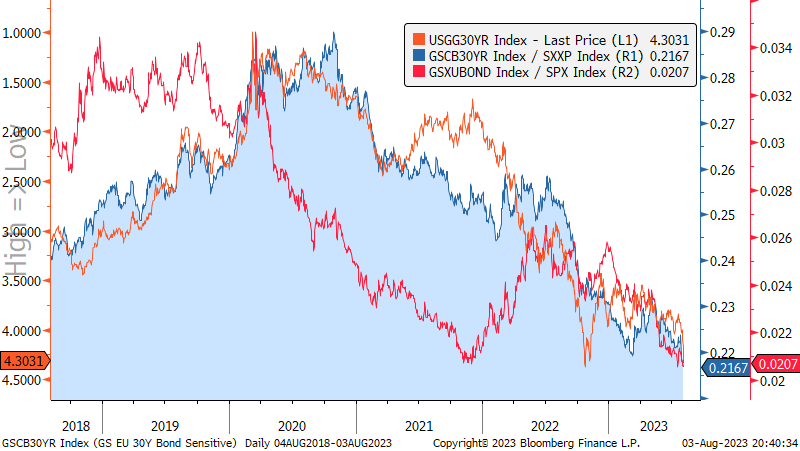
Snapping rates: The sharp increase in US rates sparked a duration sell off as equities re-calibrate expensive valuations. Equity bond proxies GSXUBOND & GSXEBOND sold off aggressively alongside expensive software GSCBSF8X and renewables GSXURNEW. Rates vs equity dislocation has been well flagged but seemed not to matter until it does. The equity sensitivity to rising rates has picked up significantly over the past month as a result, with SPX vs US 10y yield 1m correlation close 20y lows. Also interesting to see the Cleveland Fed inflation pointing at an acceleration in August which could signal more room to go. Worth noting however that European equities are trading at an all-time 12m PE discount vs US equities in a sector adjusted basis and could be more resilient in a backdrop of duration recalibration.

Credit vs Consumer: Fitch unexpectedly cutting US credit grade accentuated the risk off move, adding pressure on low quality pockets of equities such as levered stocks GSXUDEBT & GSXEDEBT and weak balance sheet ones GSXUWBAL, GSXEWBAL. Not all pockets of equities are reflecting worsening consumer credit thought, with Big Ticket Items GSXUBIGT de-coupled from Lending Sensitive Stocks GSXULEND despite worsening consumer data. See charts below for more.

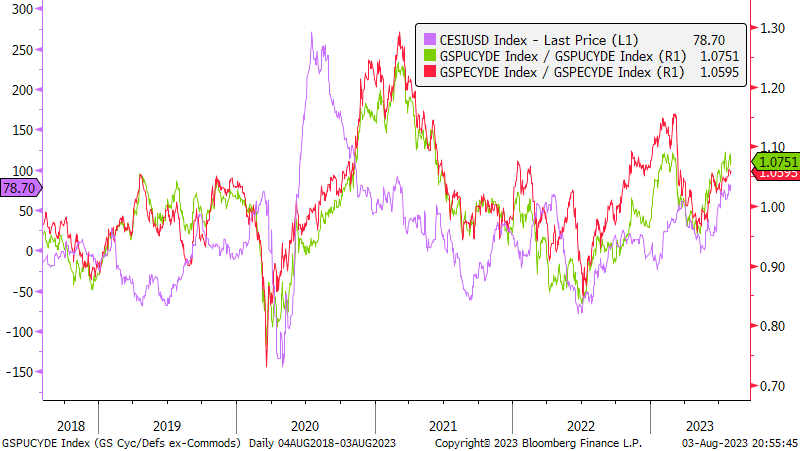
Cyclicals priced for perfection: Employment numbers continue to normalize slowly to more sustainable levels, supporting the soft landing trade. However, the soft landing narrative seems mostly priced in cyclical equities GSPUCYDE & GSPECYDE, with equities trading the normalization of costs from supply chain and strong pricing pent up demand despite fading tailwinds into 2H. Short covering have been a tailwind for cyclicals, especially in Europe where optimistic equity implied sentiment is most disconnected from PMIs. Timing the downturn remains difficult however, and the desk has seen investors favor expressions in most crowded long industries such as Autos GSXEAUTO, with EU Auto long short ratio reaching 2y highs and BMW earnings pointing at margin compression in the space.

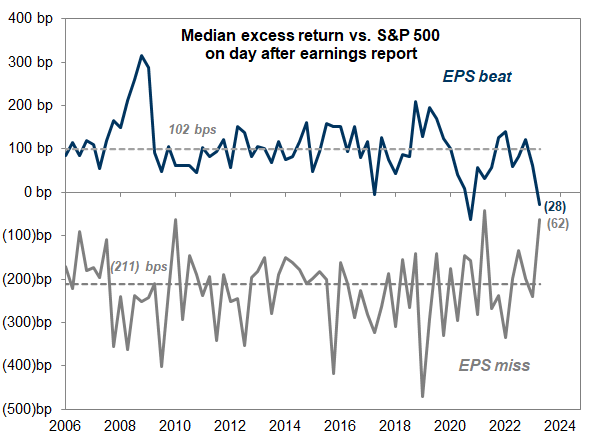
Earnings jigsaw: European earnings have been underwhelming vs US beating more, however the reaction function has been poor. For instance, companies that beat tend to outperform SPX by 100bps, but in this reporting season, names beating consensus by >1std dev outperformed  by only 22bps. On the other hand earnings miss are lagging by 62bps vs historically underperforming -211bps. This echoes the terrible  performance of our sentiment Barra pair GSXUBFSL/ GSXUBFSS, with stocks with positive sentiment lagging the ones with negative sentiment the most in 10 years on a 3m window.

The 2m return spread between HF VIP stocks and Most Shorted stocks has reached some of the worst levels in the last five years.

Stocks with the positive sentiment 3m performance vs negative sentiment name has been the worst in 10 years

Earnings confusion, beats not rewarded, miss not punished

US Economic surprises remain very strong, supporting the pro-cyclical momentum in US and European equities

Bond Proxies sold off as US rates make new highs GSXUBOND & GSCB30YR

Big Ticket Items GSXUBIGT de-coupled from Lending Sensitive Stocks GSXULEND despite worsening consumer credit data

Momentum Net Sector Changes (US LHS, EU RHS)

Tyler Durden
Sun, 08/06/2023 – 21:30