80.8 F
Chicago
Wednesday, August 26, 2026
Home Blog Page 3475

Shaky Earnings Outlook Can’t Stop Rally For Now

Shaky Earnings Outlook Can’t Stop Rally For Now

By Sagarika Jaisinghani and Farah Elbahrawy, Bloomberg markets live reporters and strategists

Shaky Earnings Outlook Can’t Stop Rally For Now

Europe’s earnings outlook seems increasingly shaky. So, it’s a good thing that it might all be priced in already.
While prospects for Corporate America appear brighter as recession worries ease, a host of challenges are spoiling things across the Atlantic, including a wobbling economy and unhelpful gains in the euro. Still, that hasn’t stopped the Stoxx 600 from grinding about 3% higher since the start of the season.

About halfway through this term’s report card, earnings for the MSCI Europe are down by almost 12% on a year earlier, according to data compiled by Bloomberg Intelligence. That’s the first drop since 2020. Over in the US, companies are presenting the most earnings beats in two years.

European investors spoiled by this year’s stock rally have been quick to show their disapproval of underwhelming numbers, as the post-earnings slumps in luxury-goods giant LVMH, software company SAP and UK lender Barclays illustrate. On average, companies that missed profit estimates so far have underperformed the index by 2 percentage points on the day — the harshest punishment in almost six years, data from Bank of America shows.

That said, there are some hints that investors have started to price in the bad season. For example, while many firms in the chemicals sector issued profit warnings in June, share-price reaction has moderated with each new announcement. Croda International fell sharply on the day of its warning, but Clariant, BASF and Wacker Chemie all rose after theirs.

Worryingly, Europe’s fortunes are only set to diverge further from the US in the second half, as business activity weakens and sticky price pressures test the resilience of the region’s consumers, market participants say.

European conditions continue to look challenging,” says Stephanie Niven, a London-based portfolio manager at investment firm Ninety One. “There’s still a lot of inflationary pressures and we need to see the impact of the ECB’s monetary policy begin to feed through. Europe could feel more pain in the coming nine months.”

Star billing in next week’s earnings line-up goes to Anheuser-Busch InBev, BP and BMW, who will face investor scrutiny of how they are navigating stubbornly high costs at a time of slowing spending power in households across the region. Meanwhile, a weakening dollar threatens to be a headache for exporters such as distiller Diageo and health-care group Fresenius. Beverages group Davide Campari has already lamented the negative currency effects it fears it will have to manage.

There are early indicators of bad news ahead for European earnings in the rest of the year. Analysis by BofA shows that Europe’s earnings revision ratio — the measure of profit upgrades against downgrades — is at its lowest since January for the past four weeks. UBS strategists say the region’s CEOs are sounding the most gloomy on earnings calls since the Covid pandemic.

The team at Sanford C. Bernstein is more optimistic. While strategists Sarah McCarthy and Mark Diver acknowledge the darker economic outlook, they argue regional equities are already priced for a slowdown. Cheaper valuations compared with the US also make Europe more attractive in the event of a slowdown, they said.

Grace Peters, EMEA head of investment strategy at JPMorgan Private Bank, also sees scope for European equities to rally after underperforming the US since April. “We believe that there is a catch-up trade here, particularly if European earnings hold up versus consensus expectations this earnings season, as they have so far,” Peters says.

Tyler Durden
Sat, 07/29/2023 – 11:30

Watch: SpaceX Falcon Heavy Launches World’s Largest Commercial Communications Satellite

Watch: SpaceX Falcon Heavy Launches World’s Largest Commercial Communications Satellite

The world’s largest commercial communications satellite was catapulted into space Friday night by SpaceX’s most powerful operational rocket from the Kennedy Space Center Launch Pad 39A in Florida. 

The Jupiter 3 communication satellite, developed by Hughes Network Systems, was launched on a Falcon Heavy rocket at 2304 ET.

Around 0232 ET Saturday, three hours and twenty-eight minutes after lift-off, Jupiter 3 separated from the launch vehicle. “The satellite began sending and receiving its first signals, and engineers deployed the JUPITER 3 solar arrays, which unfolded in space to their full ten-story span,” according to Hughes Network Systems, a unit of satellite communications company EchoStar Corp. 

“JUPITER 3 is the highest capacity, highest performing satellite we’ve ever launched. As the leading provider and inventor of satellite internet, we’re proud to herald the start of a new era of connectivity and serve more customers where cable and fiber cannot,” said EchoStar CEO Hamid Akhavan.

Akhavan continued, “This purpose-built satellite is engineered uniquely to meet our customers’ needs and target capacity where it’s needed most, such as the most rural regions of the Americas, so they can stay connected to the applications and services they depend on every day.”

JUPITER 3 will travel into a geosynchronous orbit 22,236 miles above Earth over the next several weeks “before entering service and augmenting the Hughes JUPITER fleet with more than 500 Gbps of additional capacity,” Hughes network said. 

“Whether helping a student in Mexico expand her horizons with access to technology, connecting a farmer in Idaho with the tools to monitor his crops, or connecting a senior in Montana to her doctor via a telehealth appointment, JUPITER 3 will connect our customers to what matters most,” added Akhavan.

JUPITER 3 will allow “HughesNet” to offer more broadband capacity and higher speed plans with download speeds up to 100 Mbps across the US and Latin America. The satellite internet technology is similar to SpaceX’s Starlink, which is far superior to HughesNet in terms of offering higher up and down speeds as well as some plans have no data caps. 

HughesNet, Starlink, and other space internet providers are spearheading the future of connectivity by constructing vast networks of satellites in orbit. Their actions signify that the next frontier of internet service will be space-based.

Tyler Durden
Sat, 07/29/2023 – 09:55

Subclinical Heart Damage More Prevalent Than Thought After Moderna Vaccination: Study

Subclinical Heart Damage More Prevalent Than Thought After Moderna Vaccination: Study

Authored by Zachary Steiber via The Epoch Times (emphasis ours),

Damage to the heart is more common than thought after receipt of Moderna’s COVID-19 booster, a new study indicates.

A Swiss soldier fills up a syringe with Moderna Covid-19 vaccine in Delemont, northern Switzerland, on December 14, 2021. – Switzerland hit by a new wave of infections, like much of Europe, has called army in to speed up vaccination. (Photo by Fabrice COFFRINI / AFP) (Photo by FABRICE COFFRINI/AFP via Getty Images)

One in 35 health care workers at a Swiss hospital had signs of heart injury associated with the vaccine, mRNA-1273, researchers found.

“mRNA-1273 booster vaccination-associated elevation of markers of myocardial injury occurred in about one out of 35 persons (2.8%), a greater incidence than estimated in meta-analyses of hospitalized cases with myocarditis (estimated incidence 0.0035%) after the second vaccination,” the researchers wrote in the paper, published by the European Journal of Heart Failure.

In a generally healthy population, the level would be about 1 percent, the researchers said.

The group experiencing the adverse effects was followed for only 30 days, and half still had unusually high levels of high-sensitivity cardiac troponin T, an indicator of subclinical heart damage, at follow-up.

The long-term implications of the study remain unclear as little research has tracked people over time with heart injury after messenger RNA vaccination, which is known to cause myocarditis and other forms of heart damage.

According to current knowledge, the cardiac muscle can’t regenerate, or only to a very limited degree at best. So it’s possible that repeated booster vaccinations every year could cause moderate damage to the heart muscle cells,” University Hospital Basel professor Christian Muller, a cardiologist and the lead researcher, said in a statement.

Moderna did not respond to a request for comment.

None of the patients experienced a major adverse cardiac event, such as heart failure, within 30 days of booster vaccination, and none had electrocardiogram changes.

The people with elevated levels were advised to avoid strenuous exercise, which may have mitigated more serious problems, the researchers said.

No imaging was done to examine the participants’ hearts, despite imaging being recommended by many cardiologists in cases of suspected vaccine-induced myocarditis.

It’s possible that imaging would have revealed inflammation, which could cause scarring or irregular heartbeat, Dr. Andrew Bostom, a heart expert in the United States who was not involved in the research, told The Epoch Times.

Dr. Anish Koka, an American cardiologist, said that the findings were “super useful to see how ‘cardioactive’ the booster is” but that it was hard to say how significant the elevated troponin levels were, particularly without a comparison to baseline levels. “There is really nothing clinically concerning at 30 days to report,” he said on Twitter.

Study Methods

Researchers posited that the incidence of vaccine-associated heart injury was more prevalent than previously thought following messenger RNA booster vaccination because of a lack of symptoms or mild symptoms.

They defined injury as a sharp increase in high-sensitivity cardiac troponin T on the third day after vaccination without evidence of an alternative cause. The levels of cardiac troponin had to hit the upper limit of normal, 8.9 nanograms per liter in women and 15.5 nanograms per liter in men.

All workers at the University Hospital Basel scheduled to receive a Moderna booster for the first time were offered a chance to participate in the study, unless they experienced a cardiac event or underwent heart surgery within 30 days of vaccination. The workers received a booster, which is half the dosage level of the primary series shots, from Dec. 10, 2021, to Feb. 10, 2022. The cohort ended up being 777 workers, including 540 females. The median age was 37 years.

Among the participants, 40 had elevated levels of cardiac troponin. Alternative causes were identified in 18. For the other 22, the researchers determined they had “vaccine-associated myocardial injury.” The median age of the 22 was 46. All but two were women, making the percentage of women with elevated levels higher than the percentage of men (3.7 percent versus 0.8 percent), which contrasts with most of the previous literature on vaccine-induced myocarditis.  That could stem from women receiving a higher vaccine dose per body weight, the researchers said.

Baseline levels were not recorded because the hospital’s COVID-19 task force and the researchers decided that the study “should interfere as little as possible with the motivation of the hospital staff to obtain the mRNA-1273 first booster vaccination and the logistics of booster vaccination itself.”

None of the people with elevated markers had a history of heart disease. While half experienced symptoms, most symptoms were nonspecific like fever. Two participants suffered from chest pain. And two, according to the Brighton Collaboration case definition, likely suffered myocarditis.

Testing was done for high-sensitivity cardiac troponin T because of its sensitivity.

“This marker is extremely sensitive—with other methods such as MRI we wouldn’t have been able to detect any damage to the cardiac muscle, as it only becomes visible once the damage there is about three to five times greater,” Dr. Muller said.

The researchers were not able to figure out the mechanism for the vaccine hurting the heart muscle.

The authors reported some conflicts of interest, including Dr. Muller reporting grants from drugmakers such as Novartis and Roche. The study was funded by the University of Basel and the University Hospital Basel.

Limitations include the lack of baseline levels and lack of imaging.

Previous Findings, and Pending Study

Several other prospective studies examine myocarditis following Pfizer vaccination.

In Thailand, researchers found that 29 percent of 301 adolescents developed cardiovascular effects, including chest pain, after a second Pfizer dose. Seven were diagnosed with heart inflammation.

Read more here…

Tyler Durden
Sat, 07/29/2023 – 09:20

Terror Attack Outside Syrian Capital Leaves Over Two Dozen Casualties

Terror Attack Outside Syrian Capital Leaves Over Two Dozen Casualties

Via The Cradle,

At least six were killed and over 20 wounded Thursday evening after a massive explosion near the Shia Muslim shrine of Sayyida Zaynab on the outskirts of the Syrian capital Damascus, coming just one day ahead of Ashura. 

According to Syria’s Interior Ministry, the blast happened after a motorcycle exploded near a car.  Earlier reports by state media suggested that a bomb was placed in a taxi cab by unknown assailants. 

Women and children were reportedly among the casualties, a Syrian official said. 

“A woman was killed, and her three children were injured by the explosion of a bobby-trapped car which hit a site in front of Sayedat Al-Sham hotel in Sayeda Zeinab city in Rif Dimashq,” the opposition-linked war monitor, the Syrian Observatory for Human Rights (SOHR), cited an official as saying. 

Photos and videos on social media showed chaos on the streets as people carried the wounded.

The explosion came just a day ahead of the tenth day of Ashura commemorations, where Shia Muslims remember the death of the Islamic prophet’s grandson Husayn ibn Ali and the captivity of his granddaughter Sayyida Zaynab in Damascus. 

The days leading up to Ashura are a time of mourning, and people make daily visits for prayer at the Sayyida Zaynab shrine. 

The brutal attack also comes in the aftermath of regional normalization with the Syrian government, which has stood in the way of Washington’s ambitions in Syria.

Throughout the war on Syria, which began in 2011, western-backed, sectarian-driven extremist groups carried out various bombings and suicide attacks at Sayyida Zaynab shrine. 

In 2016, two bombings at the shrine took place within one month of each other, one in January and the other in February. The death toll of both combined attacks was not less than 200. 

Tyler Durden
Sat, 07/29/2023 – 08:45

Feverish BBC Reporting On European ‘Heatwaves’ Debunked By Actual Temperature Readings

Feverish BBC Reporting On European ‘Heatwaves’ Debunked By Actual Temperature Readings

Authored by Chris Morrison via The Daily Sceptic,

Last week’s heatwaves in southern Europe would have been “virtually impossible” without humans altering the climate, reports the BBC, quoting model-produced work rushed to press by World Weather Attribution (WWA). Humans caused the spell of Mediterranean summer heat to be 2.5°C higher, it was said. This latest study confirms what we knew before, says frequent BBC contributor and WWA founder Dr. Friederike Otto. More to the point, last week’s coverage of these heatwaves confirmed what we knew before – the BBC will pull out all the stops to promote weather fear in the cause of the collectivist Net Zero project.

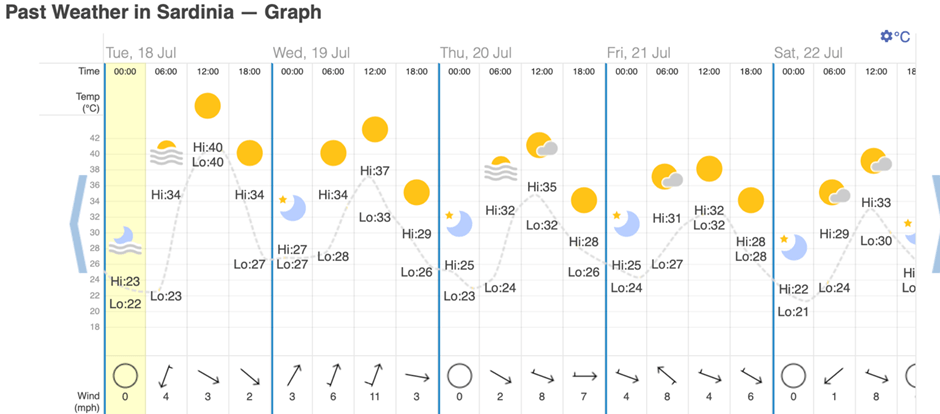
On Tuesday July 18th the BBC reported on its rolling news feed that the island of Sardinia was expected to see a high of 46°C in the afternoon “and there are warnings that extreme heat could continue for a further 10 days”.

Time and Date compiles comprehensive records of past temperatures, an increasingly useful tool for checking up on ‘World on Fire’ fantasists. The graph above shows the temperature in Sardinia peaking at 40°C on July 18th and then steadily falling during the week to the lower 30s.

Also on July 18th the BBC reported that the temperature in Rome could reach 40°C and remain above that level for 15 days. Over to Time and Date again.

Here we see the temperature did briefly touch 40°C in the midday sun, but then, like Sardinia, promptly fell away for the rest of the week.

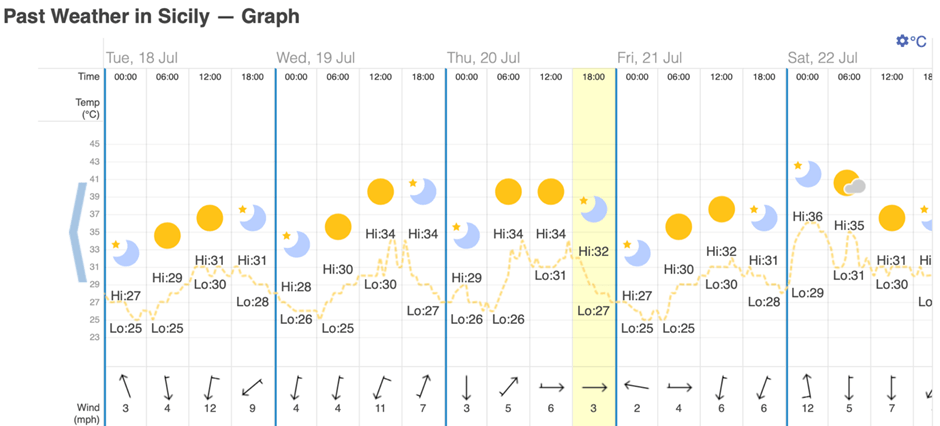
At this point, the European Space Agency entered the scare-fest and the BBC duly reported its view that Sardinia and Sicily were expected to hit a high of 48°C. As I noted on Tuesday, this fanciful prediction came from a press release issued by the European Space Agency, where it started using measurements from the ground rather than the conventional air temperature.

No comment is required, although at this point the arrival of the Monty Python Colonel marching onto the set declaring, “stop it, this sketch is getting silly. Badly written and too silly”, might be necessary.

But before the Colonel shuts us down, let us consider the plight of Justin Rowlatt, the BBC’s green activist-in-chief who was airlifted last week into heat-torn Alicante. On the southern Spanish frontline, he reported on July 18th that the heat has been “relentless” and continued day and night. It helps explain why these periods of extreme heat “can impose such a burden on people’s health”, he observed. Rising at 6:30am to do his first broadcast, he reported it was 27°C.

Alas, for our intrepid William Boot, it only briefly touched 33°C that day, and by the weekend the temperature in Alicante was struggling to stay in the 30s.

But for the BBC, it’s job well done. The mainstream media headlines screamed on cue about imminent Thermogeddon. Writing in the Daily Telegraph this Tuesday, Suzanne Moore said the “world is on fire – and we can’t ignore it any longer”. Arsonists took the opportunity to light fires on the Greek island of Rhodes, but to Moore, observing a hasty retreat by holiday makers, “this is what climate refugees look like”. BBC Dragon’s Den celeb Deborah Meaden noted that arson ”might” have been responsible, but then took the opportunity to widen the debate by claiming – without a shred of proof – “we are about to see the first countries abandoned due to rising sea levels”.

Meanwhile, the World Weather Attribution operation, partly funded by green billionaire investor Jeremy Grantham, adds to the mix with its modelled guesses based on imaginary climates with and without human-produced carbon dioxide. As we have noted in past articles, attribution studies is a growing branch of climate alarmism, but it fails the bedrock science falsification principle outlined by the science philosopher Karl Popper. Former IPCC author and economics professor Roger Pielke Jr. is a fierce critic, noting that he can think of no other area of research “where the relaxing of rigour and standards has been encouraged by research in order to generate claims more friendly to headlines, political advocacy and even lawsuits”.

Pielke suggests that the rise of individual event attribution studies coincides with frustration that the IPCC has not “definitively concluded” that many types of extreme weather have become commonplace. In his view, they offer “comfort and support” to those focused on climate advocacy.

Undoubtedly WWA leads the way in providing simple, press-ready, clickbait material. Its latest press release on the European heatwaves notes that it uses “published peer-reviewed” methods, and backing this up there is a link to Philip et al. But it might be more accurate to describe this 2020 paper as ‘mates’ helpful suggestions’. One of the named authors, for instance is none other than Friederike Otto. Another author was Julie Arrighi from the Red Cross Red Crescent Climate Centre, a person identified by the BBC as one of the authors of the latest WWA report. Helpful suggestions include the advice that communicating only a lower bound, because it is mathematically better defined in many cases, “is not advisable”. Furthermore, “quoting only the lower bound de-emphasises the most likely result and therefore communicates too conservative an estimate”. We can’t be having well-defined, conservative estimates now, can we.

Chris Morrison is the Daily Sceptic’s Environment Editor.

Tyler Durden
Sat, 07/29/2023 – 08:10

The Cities With The Most Vegan Options Worldwide

The Cities With The Most Vegan Options Worldwide

Authored by Anna Fleck via Statista,

Increasing awareness levels regarding issues such as climate change and animal welfare, along with other factors such as personal health, are continuing to drive people to embrace veganism. Once a fringe movement, it is now firmly mainstream, something that is being reflected by increasing vegan options in restaurants and supermarkets. Some cities are more vegan-friendly than others and a recent report shows the places that have the most options for people on a plant-based diet.

The Vegan Word conducted an analysis of vegan listings website Happycow and came up with a list of the cities with the most vegan restaurants per 100,000 inhabitants as of December 2022. Asian tourist hotspots ranked highest, with Phuket and Chiang Mai in Thailand and Ubud on the Indonesian island of Bali making up the top 3. One U.S. city – Portland, Oregon – and three European cities – including the Portuguese capital Lisbon, Dutch capital of Amsterdam as well as English seaside resort Brighton – also rank among the top 8.

The makers of the study acknowledge that theirs isn’t the only way to measure how vegan-friendly food options are in a given city, as the methodology doesn’t capture vegetarian and vegan-friendly restaurants as well as the general suitedness of different local cuisines for vegans.

Tyler Durden
Sat, 07/29/2023 – 07:35

An America First Approach To End The War In Ukraine

An America First Approach To End The War In Ukraine

Authored by Fred Fleitz via American Greatness,

Editor’s note: this article is an update of a lecture the author recently gave to a Council for National Policy conference. 

Good morning. Today, I am going to talk about a difficult and controversial topic that is dividing the American people and the conservative movement: what American policy should be concerning the war in Ukraine.

This is a difficult topic to discuss because if you say the wrong thing about this conflict – if you stray from the approved Washington establishment/mainstream media narrative – you are immediately accused of being pro-Russia or pro-Putin or anti-Ukraine.

We saw this in May during a CNN town hall when President Donald Trump was asked whether he wanted Ukraine to win this conflict, and Trump said, “I want everybody to stop dying. They’re dying. Russians and Ukrainians. I want them to stop dying.” Trump added, “I don’t think in terms of winning and losing; I think in terms of getting it settled so we can stop killing all those people.”

When the former president was asked if he thinks Putin is a war criminal, he replied, “This should be discussed later, and if you say he’s a war criminal, it’s going to be a lot harder to make a deal later to get this thing stopped.”

This was followed by the usual attacks on President Trump by Democrats and the press, accusing him of favoring Putin and ignoring the plight of the Ukrainian people.

By contrast, Joe Biden has called Putin a killer and a war criminal.  Biden also has stated his support for an International Criminal Court warrant to arrest Putin.

So who is being more presidential here? The reality is that unless the U.S. is willing to risk nuclear war to depose Putin and remove him from office, President Trump is right that we need to find a way to work with him. The U.S. needs to find a way to live with Putin. This is not an ideal situation, but we have lived with the leaders of adversary states throughout the history of our country.

I also agree with Trump that the focus of American policy for Ukraine should be a cease-fire and starting peace talks. Talking about this does not mean you’re siding with Russia or Putin. It means you are putting the interests and security of our country first.

I want to discuss where we are in this conflict before I talk about what U.S. policy should be.

Although Ukraine racked up political and military support from the United States and Europe in the run-up to its current counteroffensive, this campaign has fallen well short of its goal of reclaiming large amounts of Ukrainian territory because Russia had plenty of time to prepare for the offensive by laying mines, creating tank traps and digging in their troops. Russia also has the advantage of air power.

Ukrainian leaders claim the counteroffensive’s success has been limited because they have not received the arms they need from the West and lack air power. Ukraine also is running out of 155mm artillery shells. Although the U.S. agreed last spring to send F-16s to Ukraine, they won’t appear on the battlefield before early next year.

To bolster the counteroffensive, the Biden Administration agreed last month to provide Ukraine with cluster munitions – artillery shells that explode in the air and release dozens to hundreds of smaller bomblets across a wide expanse of land as large as a football field. This was a controversial decision because these weapons are banned in 123 countries under the 2008 Convention on Cluster Munitions. The UK, Germany, France, and Canada are parties to the accord and have objected to the U.S. providing Ukraine with these weapons.

There are other troubling developments in this war.

In addition to the spring offensive, Ukraine has begun to attack targets in Crimea which Russia seized in 2014 and could launch a campaign to retake this territory. As part of this effort, Ukraine launched a drone attack on July 17 against the Kerch Bridge, which links Russia to Crimea, killing two civilians. Russia retaliated by withdrawing from a UN-brokered agreement allowing Ukraine to export grain through the Black Sea and began a massive missile and drone attack against Odesa, the main port that Ukraine uses to ship millions of tons of grain to the world.

There also are reports that Ukraine may be planning to occupy Russian villages to gain leverage over Moscow; bombing a pipeline that transfers Russian oil to Hungary; and possibly firing long-range missiles deep inside Russia to try to pressure the Russians to come to a peace agreement.

We’ve heard claims over the past year that this conflict has become a proxy U.S. war against Russia and that if we push Russia too far, we could approach a red line where Russia decides to use nuclear weapons. I don’t know where that red line is, but I believe these reports, if they are accurate, are getting pretty close to this red line.

In a famous 1879 speech, General William T. Sherman said, “war is hell” and lamented the horrors of war, including cities and homes in ashes and thousands of men lying on the ground, their dead faces looking up at the skies. I could accept continuing to support the hell of the war in Ukraine despite its high human cost, Ukraine using cluster munitions, and the threat to American security if I thought the Ukrainian military had any chance of expelling the Russians and establishing a lasting peace.

But that’s not in the cards. Foreign policy experts increasingly believe this conflict will likely be a long and inconclusive war of attrition. Richard Haass, president of the Council on Foreign Relations, said in an April 2023 article, “the most likely outcome of the conflict is not a complete Ukrainian victory but a bloody stalemate.”

It’s not getting much coverage, but this also is the position of European leaders, who have privately told Ukrainian President Zelensky that they expect him to start peace talks. They’ve told him that they do not expect Ukraine will take back most of the territory Russia has seized. They have informed Zelensky that large amounts of military aid to Ukraine from their countries will not continue indefinitely because their people do not want to support and arm an endless war in Ukraine.

Many in the United States on the right and the left share this view.

Zelensky and the Ukrainian people obviously don’t see it that way. They want their country back. You have to admire the determination and skill of the Ukrainian army and how they bravely fought back against a much larger and more powerful foe. They want everything back, including Crimea. The Biden Administration has been supportive of this and has been hostile to peace talks and a cease-fire. Biden officials continue to argue that any peace settlement before a “complete” Ukrainian victory would reward Putin’s aggression.

Biden’s strategy for Ukraine is to provide military aid “for as long as it takes.” This is not a viable strategy.

Americans are a compassionate people and want Ukraine to win this war. We would like to see Russian forces expelled. We want to help. We want to do the right thing.

But Ukraine is not a vital U.S. interest. Therefore, our involvement in this conflict must be limited and not open-ended. We know from experience that America is not the world’s policeman. We have our own problems at home. We’re using up our weapon arsenals, especially advanced missiles, that we may need elsewhere, such as if China attacks Taiwan. Although it is good news that Germany, the U.K. and France are providing additional weapons to Ukraine, they are still far from doing their share in providing military aid to Ukraine. The U.S. still carries the lion’s share of providing this aid.

Ukrainian officials and some of their Western supporters argue that we must stop Russia in Ukraine because after Putin wins this war, he will invade Eastern Europe. This is nonsense. Putin has never shown interest in invading Eastern Europe after Ukraine. If you read his writings, Putin’s invasion of Ukraine was because of his perverse reading of history: Ukraine is not a separate country and Ukrainians are not a separate people.

Even if it was the original intention of Putin to invade Eastern Europe after he conquered Ukraine, this is no longer feasible because his army has been devastated. It isn’t going to invade Poland after a Russian victory or peace settlement in Ukraine.

Sadly, if the Biden Administration had understood Putin’s writings on Ukraine, maybe this invasion wouldn’t have occurred. Although I believe the main factor that caused Putin to invade Ukraine was his perception of U.S. weakness under President Biden, I also think it’s very likely that Biden goaded the Russians into invading by holding out the prospect of NATO membership when he didn’t have to.

President Biden repeated this mistake at the recent NATO summit in Lithuania when he assured Ukraine that it will join NATO after the war ends. Because of Putin’s adamant opposition to Ukraine joining NATO, this promise probably will discourage him from agreeing to peace talks or a cease-fire.

Even more worrisome, if a settlement could be agreed, Putin likely will invade Ukraine again if it is a NATO member. Washington would then be required under Article 5 of the North Atlantic Treaty to use U.S. military power to defend Ukraine, possibly including sending U.S. troops to engage Russian troops.

We would then be faced with the real possibility of World War III.

This is why I believe Trump had it right when he said the U.S. must prioritize ending the war now.

And then there’s Chinese President Xi Jinping, who is trying to wriggle out a role for himself in this conflict by playing the peacemaker. Xi’s intention is to find an outcome that is beneficial to China and Russia at America’s expense. This is not in our interest.

So what should the U.S. do? President Biden should begin to lead in this conflict with his own peace plan. American officials must start being tough with Zelensky and be clear that we’re not going to continue our current level of military support indefinitely. The U.S. also must tell Zelensky that it will not tolerate Ukraine expanding the war with a campaign to retake Crimea or doing other things that would risk a nuclear confrontation with Russia.

President Biden also must retract his offer of NATO membership for Ukraine and instead state that this is off the table for an extended period, maybe 25 years. Instead, Ukraine would be provided with the weapons it needs to defend itself over the long term to prevent Russia from exploiting a pause in the fighting to rearm and resume the war.

Ukraine would not give up its demands to reclaim its territory, but would agree to negotiations to resolve these demands with the understanding that they probably will not be resolved until some future date when Putin is out of power.

Getting Putin to negotiate in good faith and honor an agreement will be difficult. Richard Haass has proposed shoring up a cease-fire agreement to assure Russian cooperation by creating a demilitarized zone and deploying peacekeepers to verify compliance with a cease-fire. This has worked for decades in “frozen conflicts” in Cyprus and Korea and may be the best option for a lasting peace between Russia and Ukraine.

The U.S. and its NATO allies could start peace talks right now with empty chairs for the Russians and the Ukrainians. We should start discussions immediately with European states about confidence-building measures and how to rebuild Ukraine. Ukraine and Russia could join these talks when they’re ready.

A settlement will not be perfect. It will likely be a fragile cease-fire for a frozen conflict. Ukraine is not going to get most of its territory back. Borders will be where each side’s troops end up. There won’t be war crimes trials, and President Biden should stop saying there will be. Hopefully, there will be some agreement for reparations from Russia, perhaps a levy on Russian oil sales.

The Ukrainian government and the Ukrainian people will have trouble accepting this. Their supporters will also. But as Donald Trump said at the CNN town hall last May, “I want everyone to stop dying.” That’s my view, too.

Fred Fleitz is vice-chair of the America First Policy Institute Center for American Security. He previously served as National Security Council chief of staff, CIA analyst, and a House Intelligence Committee staff member.


Tyler Durden
Sat, 07/29/2023 – 07:00

Escobar: The Russia-Global South Connection – Africa As Strategic Partner

Escobar: The Russia-Global South Connection – Africa As Strategic Partner

Authored by Pepe Escobar,

The second Russia-Africa summit, this week in St. Petersburg, should be seen as a milestone in terms of Global South integration and the concerted drive by the Global Majority towards a more equal and fair multipolar order.

The summit welcomes no less than 49 African delegations. President Putin previously announced that a comprehensive declaration and a Russia-Africa Partnership Forum Action Plan all the way to 2026 will be adopted.

Madaraka Nyerere, the son of Tanzania’s legendary anti-colonial activist and first President, Julius Nyerere, set the context, telling RT that the only “realistic” way for Africa to develop is to unite and stop being an agent for foreign exploitative powers.

And the path towards cooperation goes through BRICS – starting with the crucial upcoming summit in South Africa, and the incorporation of more African nations into BRICS+.

Nyerere’s father was a very important force behind the Organization of African Unity, which later became the African Union.

South Africa’s Julius Malema succinctly expanded the geoeconomic concept of a united Africa: “They [neocolonial powers] thrive on the division of the African continent. Can you imagine the minerals of the DRC combined with the minerals of South Africa, and with a new currency based on the minerals? What can we do to the dollar? If we become a United States of Africa, with our minerals alone, we can defeat the dollar.”

No humanitarian nature, no deal

The Russian-African Conference of the Valdai Club functioned like a sort of final expert watch synchronization in the run-up to St. Petersburg. The first session was particularly relevant.

That came after the publication of a comprehensive analysis by President Putin of Russia-Africa relations, with a special emphasis on the recently collapsed grain deal involving the UN, Turkey, Russia and Ukraine.

Valentina Matviyenko, speaker of the Russian Federation Council, has stressed how “Ukraine, Washington and NATO were interested in the grain corridor for sabotage”.

In his Op-Ed, Putin explained how, “for almost a year, a total of 32.8 million tons of cargo were exported from Ukraine under the ‘deal’, of which more than 70% went to high-and above-middle-income countries, including the European Union, while countries such as Ethiopia, Sudan and Somalia, as well as Yemen and Afghanistan accounted for less than 3% of the total volume – less than one million tons.”

So that was one of the key reasons for Russia to leave the grain deal. Moscow published a list of requirements which would need to be fulfilled for Russia to reinstate it.

Among them: a real, practical end to sanctions on Russian grain and fertilizers shipped to world markets; no more obstacles for banks and financial institutions; no more restrictions on charter of ships and insurance – that means clean logistics for all food supplies; restoration of the Togliatti-Odessa ammonia pipeline.

And a particularly crucial item: the restoration of “the original humanitarian nature of the grain deal.”

There’s no way the collective West subjected to the Straussian neocon psychos who control US foreign policy will fulfill all or even some of these conditions.

So Russia, by itself, will offer grain and fertilizers free of charge for the poorest nations and contracts for grain supply at normal commercial terms for the others. Supply is guaranteed: Moscow had the biggest grain harvest ever during this season.

This is all about solidarity. At the Valdai session, a key discussion was around the importance of solidarity in the struggle against neo-colonialism and for global equality and justice.

Oleg Ozerov, Ambassador-at-Large of the Russian Foreign Ministry, and Head of the Secretariat of the Russia-Africa Partnership Forum, stressed how European “former” partners persist on the one-way track of shifting blame to Russia as Africa is “acquiring agency” and “denying neo-colonialism.”

Ozerov mentioned how “France-Afrique is collapsing – and Russia is not behind it. Russia is ensuring that Africa acts as one of the powers of the multipolar world”, as “a member of the G20 and present in the UN Security Council.” Moreover, Moscow is interested to expand Eurasia Economic Union (EAEU) free trade deals towards Africa.

Welcome to Global South “multi-vector” cooperation

This all spells out a common theme in the Russia-Africa summit: “multi-vector cooperation”. The South African perspective, especially in the light of the raging controversy over Putin’s non-physical presence in the BRICS summit, is that “Africans are not taking sides. They want peace.”

What matters is what Africa brings to BRICS: “Markets, and a young, educated population.”

On the Russian bridge to Africa, what is needed, for instance, is “railways along coastlines”: connectivity, which can be developed with Russian assistance, much as China has been investing widely across Africa under BRI projects. Russia, after all, “trained many professionals across Africa.”

There’s a wide consensus, to be reflected in the summit, that Africa is becoming an economic growth pole in the Global South – and African experts know it. State institutions are becoming more stable. The abysmal crisis in Russia-Western relations ended up boosting interest in Africa. No wonder that’s now a national priority for Russia.

So what can Russia offer? Essentially an investment portfolio, and crucially the idea of sovereignty – without requesting anything in return.

Mali is a fascinating case. It goes back to investments by the USSR training the workforce; at least 10,000 Malians, who were offered first-class education, including 80% of their professors.

That intersects with the terrorism threat of the Salafi-jihadi variety, “encouraged” by the usual suspects even before 9/11. Mali holds at least 350,000 refugees, all of them unemployed. France’s “initiatives” have been deemed “totally inefficient”.

Mali needs “broader measures” – including the launch of a new trading system. Russia after all taught how to set up infrastructure to create new jobs; time to fully profit from the knowledge of those trained in the USSR. Moreover, in 2023 over 100 students from Mali are coming to Russia on state-sponsored scholarships.

As Russia makes inroads in French-speaking Africa, former “partners”, predictably, demonize Mali’s cooperation with Russia. With no avail. Mali has just dropped French as its official language (that has been the case since 1960).

Under the new constitution, passed overwhelmingly with 96.9% in a June 15 referendum, French will be only a working language, while 13 national languages will also receive official language status.

Essentially, this is about sovereignty. Coupled with the fact that the West, as recognized from Mali to Ethiopia – the only African nation never colonized by Europeans – is losing moral authority across Africa at astonishing speed.

Multitudes in Africa now understand that Russia actively encourages freedom from neocolonialism. When it comes to geopolitical capital, Moscow now seems to enjoy all it takes to build a fruitful, Global Majority-centered strategic partnership.

Tyler Durden
Fri, 07/28/2023 – 23:30

Forget California. Texas Is “King Of Clean Energy”

Forget California. Texas Is “King Of Clean Energy”

California likes to pretend it leads the nation in decarbonizing its power grid but has been out ‘greened’ by an unlikely state: Texas. 

Texas is the reddest state in the country (for now). It leads California and all other states in terms of total electricity generation from renewable sources. 

The latest U.S. Energy Information Administration data shows Texas versus California’s power generation mix. And the clear winner in decarbonizing the grid so far is… 

Since 2018, Texas has surpassed California and the national average in integrating renewable energy sources like solar and wind, thus becoming a frontrunner in the efforts to decarbonize the grid. This contradicts the popular narrative that California, with its progressive leadership, is the champion in this field.

Bloomberg explained why Texas is now the “king of clean energy”: 

In Texas, solar permitting is uncomplicated. Connecting projects to the electric grid is straightforward. Then there’s cheap labor, homegrown energy expertise, plenty of sunshine and an anything-goes ethos. “There’s no ‘Mother, may I?’ here,” says Doug Lewin, who worked in the Texas Legislature on energy policy and now advises power companies. “In Texas, it’s just easier to get things done.”

Texas’ leadership in adding renewables to its power generation mix is at odds with its status as the top-producing state of crude oil, natural gas, refined products, and petrochemicals. 

But in terms of decarbonizing power grids, Texas trumps virtue signaling California. After all, America’s largest EV carmaker, Tesla, is now based in Austin, Texas. 

Tyler Durden
Fri, 07/28/2023 – 23:00

Biden’s DOJ Illegally Bribing States To Pass Gun Confiscation Laws: Lawmakers

Biden’s DOJ Illegally Bribing States To Pass Gun Confiscation Laws: Lawmakers

Submitted by Gun Owners of America,

Last summer, weak Republicans teamed up with Anti-Gun Democrats to pass the Bipartisan Safer Communities Act.  

Part of that law included funding for ‘red flag laws’ nationwide. The reason for this is that the Anti-Gun lobby knows that a national red flag law is totally unconstitutional and would immediately be struck down by federal courts. So instead, they chose to bribe states with federal funds into passing their own ‘red flag’ laws at the state level, where challenges to the laws could get stuck in court proceedings for years to come.  

According to the letter penned by Senator Roger Marshall of Kentucky and Representative Alex Mooney from West Virginia, the Biden Department of Justice has weaponized Bipartisan Safer Communities Act to Illegally bribe states into passing red flag laws. 

In the letter, the lawmakers state that the Justice Department gave Federal funding to States that did not meet the criteria for due process.  

“The Department of Justice appears to have weaponized the Bipartisan Safer Communities Act to illegally fund ineligible red flag laws and bribe pro-gun states into passing gun confiscation laws.”  

Interestingly, Minnesota passed a red flag law within 100 days of receiving $3.7 Million from this program.  

These Federal grants were supposed to only be given to states whose ‘red flag’ laws met “due process requirements,” a term specifically set by one of the bill’s Republican authors, Senator John Cornyn of Texas.  

When Gun Owners of America pointed out that this provision would be abused and ignored by the government, Republicans who supported the legislation accused GOA of lying. 

But now it seems that states that don’t have red flag laws at all, — such as West Virginia, Alaska, Kansas, and Arkansas – got millions of dollars towards implementing these sorts of laws in their respective states.  

This letter, — along with Representative Lauren Boebert’s Shall Not Be Infringed Act, which would repeal all the gun control passed by the 117th Congress — are just a few of the battles that GOA is fighting for your 2A rights every day on Capitol Hill. 

Read the letter here: 

So, pick up the phone and call your Senators and Representative and demand to know what they’re doing to hold the Biden administration accountable for this misuse of federal funds. 

*   *   *

We’ll hold the line for you in Washington. We are No Compromise. Join the Fight Now. 

Tyler Durden
Fri, 07/28/2023 – 22:30