74.2 F
Chicago
Monday, August 24, 2026
Home Blog Page 3492

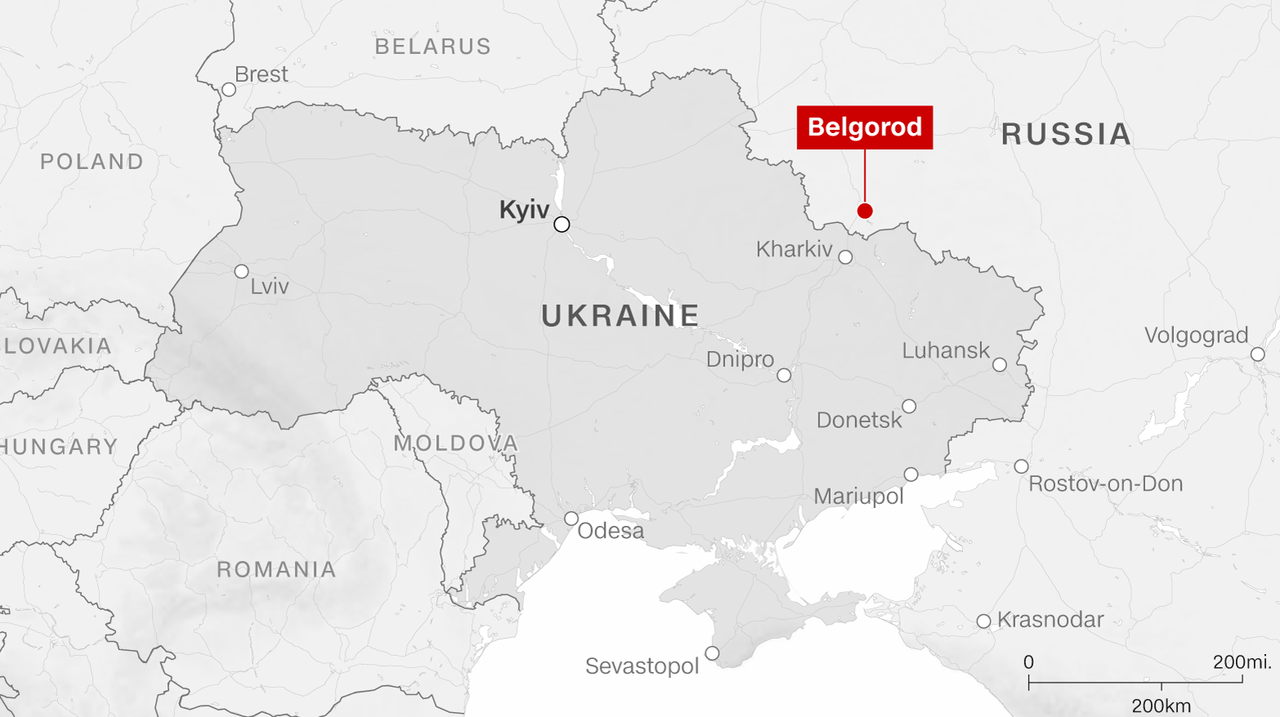
Belgorod Governor Says Cluster Bombs Used Against Village In Russian Territory

Belgorod Governor Says Cluster Bombs Used Against Village In Russian Territory

Russia is alleging that Ukraine has attacked its territory using internationally-banned cluster munitions, shortly after Kiev received its first wave of externally-supplied cluster bombs from the United States.

The governor of Russia’s Belgorod region, Vyacheslav Gladkov, said that Ukrainian forces attacked a village near the border on Friday, but no casualties resulted. Gladkov’s Saturday statement revealing the episode wasn’t accompanied by evidence nor resulted in any statements by Ukrainian authorities. 

“In Belgorod district, 21 artillery shells and three cluster munitions from a multiple-launch rocket system were fired at the village of Zhuravlevka,” Gov. Vyacheslav Gladkov said.

Via AP

It was only within this past week that both Kiev and the Biden administration confirmed initial deliveries of the munition which is banned in over 120 countries, given that it kills indiscriminately and its bomblets sometimes remain in the ground unexploded, leaving them a deadly hazard for years.

Belgorod, a southern Russian region along the Ukrainian border, has been subject of cross-border Ukrainian attacks for over the past year throughout the conflict. This has most often come in the form of drone attacks or cross-border shelling, most often targeting energy or other civilian infrastructure. 

Ukraine’s defense ministry has pledge to only use cluster munitions to dislodge enemy Russian positions, and not against civilians, Reuters had noted earlier this week.

In a separate Saturday incident, the Russian defense ministry is saying four Russian state media war correspondents were struck in a Ukrainian cluster attack in Zaporozhye region. One journalist is said to have died, and the others wounded

Four Izvestiya and RIA Novosti reporters were injured in a Ukrainian cluster munitions strike at the Zaporozhye Region, the Russian Defense Ministry said Saturday, adding that RIA Novosti reporter Rostislav Zhuravlyov died during evacuation.

“At about 12:00 on July 22, 2023, Ukrainian forces carried out an artillery strike at a group of Izvestia and RIA Novosti reporters preparing their reports about Ukrainian cluster munition shellings of Zaporozhye Region settlements. A cluster munitions strike caused various injuries to four reporters,” the Ministry said.

…”Other reporters’ condition is medium, stable. Their lives are not in danger. They are being provided with all necessary medical aid,” the Ministry added.

National security spokesman John Kirby had confirmed on Thursday that “U.S.-supplied cluster munitions are in Ukrainian hands and being deployed in the field as part of Kyiv’s battle against Russia.” Kirby cited that the controversial munitions are already having a positive impact in Ukraine’s war effort.

“We have gotten some initial feedback from the Ukrainians, and they’re using them quite effectively,” Kirby told a briefing. But if these latest attacks on Russian civilians are accurate, Putin could use it to escalate, possibly with large-scale attacks on decision-making centers across Ukraine, as the Kremlin has threatened before. 

Tyler Durden
Sat, 07/22/2023 – 11:00

It’s Mourning In America

It’s Mourning In America

Authored by Charles Hugh Smith via OfTwoMinds blog,

Now that America has been transformed from a high-trust social order into a low-trust social order, there’s no going back.

The birth of financialization in the early 1980s was morning in America because finance– the collateralization of previously low-risk assets and the resulting explosion of credit and leverage–gooses demand and asset valuations.

Now that we’ve at long last reached the demise of financialization, it’s mourning in America as the hyper-stimulation has reached its zenith and is beginning its inevitable end-game of uncontrolled implosion. The hyper-financialization of American life has fatally distorted the nation’s production, politics, values and social order.

Regardless of our political persuasion, we’re all mourning for what’s been lost to either decay or erosion, both of which are so gradual that we cannot discern the full extent of the damage. We sense it, though, and this fuels the nation’s distemper.

The decay, erosion and distemper remind me of a quote from French author Michel Houellebecq:

“I have the impression of being caught up in a network of complicated, minute, stupid rules, and I have the impression of being herded towards a uniform kind of happiness, toward a kind of happiness that doesn’t really make me happy.”

Substitute con for happiness and we have an insight into the source of mourning in America: we’re being conned 24/7, on every level and in every nook and cranny of the economy and society.

The key to any good con is to persuade the mark (victim) that it’s not a con. The most direct approach is to claim the con is true, factual, etc. Once this claim starts unraveling, then the con switches to an alternative reality that has enough shreds of credibility to be plausible.

This is why so many confuse the con and propaganda. Both are self-serving, of course, as the goal of propaganda is to generate compliance and conformity in the populace by constructing an emotionally compelling context that is both appealing and plausible. Those spewing the propaganda do so to secure their power and further their own self-serving agenda.

For example, that we’re all enjoying unprecedented prosperity in the best of all possible worlds. Look at all the low-quality rusting junk we can buy from manufacturers in totalitarian nations at low, low prices–wow! It doesn’t get any better than this. Stainless Steal (February 26, 2023).

The difference is that those spewing propaganda can be true believers in whatever cause is being pushed. In most cases, propaganda is issued by cynical, manipulative sociopaths who are merely hired guns for whomever seeks all the advantages of persuading people that enriching and empowering the few at the expense of the many is not only allowable, it’s the right thing, the only option, etc. But propaganda works best when it converts the previously uncommitted or apathetic into true believers, much like a religious conversion.

A con, on the other hand, is a swindle, a fraud, a bezzle, that takes advantage of the mark’s naive trust. This trust might be in a blood relative, a friend, an enterprise, an organization or an institution. The con exploits this trust to defraud or break the mark into an unknowing patsy.

The fundamentals of the con are:

1. The gains are guaranteed, i.e. low risk.

2. The benefits are exaggerated while the costs and consequences are left unsaid.

Here’s the metaphor the con presents: I’m leading you to a glorious fruit tree loaded with ripe fruit. All you have to do is harvest as much as you want.

Since we’re all still hunter-gatherers in Wetware 1.0, this greatly appeals to us. We’re inherently risk-averse and greedy to exploit windfalls, and the con promises us near-zero risk and one windfall to stripmine after another. It’s irresistible.

The con always has an end date, when the mark discovers they’ve been fleeced. Trust is destroyed, and the mark, bitterly enlightened to their own credulity, laziness and greed, vows to never fall for such a con again.

The higher-order con never lets trust be completely destroyed. Instead, the con-man either rushes to console the mark and apologize for the unexpected loss, (Jeez, this never happened before–it must have been a glitch in the Matrix), or the con-man brazenly blames the victim for misjudging the situation and failing to take advantage of the unbeatable deal.

You blew it, pal, I can’t help you with that. But hey, since I’m such a nice guy, and you’re deserving of a second chance, I’m gonna let you in on another deal, not quite as good as the one you blew, but still a gem.

This is America in a nutshell: a continuous cacophony of cons. This is why trust in institutions such as the media, corporations, political interest groups, government and education are in free-fall, along with social trust in our fellow Americans. Every node of power is dominated by people out to maximize their personal gains at the expense of the public, customers, voters, members, students, etc.

Listen, kid, you’re gonna be on Easy Street if you go borrow $120,000 and give it to us for a college diploma. You’ll be set for life, it’s like shooting fish in a barrel once you pony up the dough and we give you the paper. Don’t be a chump, kid, you gotta look out for yourself, and we’re trying to help you here.

This medication is safe and non-addictive, you’re gonna feel a lot better as soon as you start taking it. Here’s ten pages of side-effects, but don’t worry about all that, it’s just boiler-plate. We’re here to help you, pal, and the $27,000 a month cost is mostly on the government, so it’s a slam-dunk win for you.

Gee, I’d like to answer your questions about the district budget, employee salaries and overtime, it must be in this 293-page annual statement somewhere. You can buy a copy for only $25.

And so on, in an endless profusion of self-serving cons. Ernest academics ponder this decay and propose all sorts of scholarly possibilities, while never mentioning the obvious source: every node of power in America is hopelessly corrupt, covering its cons with tsunamis of propaganda aimed at “trust-building” among “stakeholders,” whipping up the conned faithful, cherry-picking evidence to string along the marks just a little longer, and pointing to the long history of the institution as trustworthy–a reputation that is being pillaged to benefit the few at the expense of the many.

The most successful cons divert attention from the con-men to some other group of marks / victims. You got fleeced because of them. The fact that everyone outside the nodes of power has been fleeced is left unsaid, as this realization might generate a common cause of the marks against those benefiting so richly from the cons.

It was fun while it lasted, exploiting the supercharged-cons of hyper-financialization and hyper-globalization, but those cons have been tapped out and there are no replacements.

It’s tough recognizing that we’ve been credulous, naively trusting, and greedy for low-risk riches. Every one of the countless skims, scams and cons has exploited our willingness to trust and our self-interest in easy wealth.

Now that America has been transformed from a high-trust social order into a low-trust social order, there’s no going back. 

This is why it’s mourning in America. Trust can only be rebuilt slowly, first by opting out of all the self-serving cons and then re-establishing trust at the local level.

*  *  *

My new book is now available at a 10% discount ($8.95 ebook, $18 print): Self-Reliance in the 21st Century. Read the first chapter for free (PDF)

Become a $1/month patron of my work via patreon.com.

Subscribe to my Substack for free

Tyler Durden
Sat, 07/22/2023 – 10:30

Against SecDef’s Wish, Diversity-Obsessed Biden Picks Woman To Lead Navy

Against SecDef’s Wish, Diversity-Obsessed Biden Picks Woman To Lead Navy

Casting aside the recommendation of his defense secretary, President Biden on Friday nominated Admiral Lisa Franchetti to command the US Navy. If confirmed, she would be the first woman to command a military branch and the first on the Joint Chiefs of Staff. 

Biden’s move took many observers by surprise, as Defense Secretary Lloyd Austin had recommended Admiral Samuel Paparo for the position. Paparo is TOPGUN graduate with more than 6,000 hours in F-14s, F-15s and F/A-18s, 1,100 carrier landings and experience commanding forces in war zones. 

However, with the Biden administration obsessed with diversity hires, Paparo’s bid was likely doomed by the fact that he’s a white man.  

As Commander of the US Pacific Fleet, Admiral Samuel Paparo visits the forward-deployed aircraft carrier USS Ronald Reagan in June 2021 (Oswald Felix/US Navy

“Throughout her career, Adm. Franchetti has demonstrated extensive expertise in both the operational and policy arenas,” said Biden in a statement. He of course couldn’t help but emphasize her gender: “She is the second woman ever to achieve the rank of four-star admiral in the United States Navy.” 

Though his recommendation wasn’t heeded, Austin praised Franchetti, saying “She will continue to inspire all of us.” Biden’s choice of a woman to lead the Navy comes 15 months after he picked a woman to command the Coast Guard.

With 38 years of service that began with service on and command of destroyers, Franchetti is currently the vice chief of naval operations, the Navy’s second-highest position. As then-commander of the Sixth Fleet, she was an instrument of President Trump’s unconstitutional warfare on Syria in response to an alleged use of chemical weapons by President Assad that likely never happened.  

Admiral Lisa Franchetti previously commanded the USA Navy’s Sixth Fleet

A Northwestern University Navy ROTC product, Franchetti must be confirmed by the Senate. That may not happen quickly.

Alabama Senator Tommy Tuberville has been putting holds on military confirmations to protest the Pentagon’s policy of paying for service members to travel for abortions, a policy he says is illegal. “An unprecedented change to the military’s abortion policy ought to go before the people’s elected representatives in Congress,” he wrote in a Wall Street Journal op-ed.  

As he announced his pick of Franchetti, Biden blasted Tuberville, saying, “It has long been an article of faith in this country that supporting our service members and their families, and providing for the strength of our national defense, transcends politics. What Sen. Tuberville is doing is not only wrong, it is dangerous.”

As for Paparo, Biden nominated him on Friday to lead Indo-Pacific Command, which has an area of responsibility spanning about 52% of the the Earth’s surface.

That’s all well and good, but, if he wants a shot at the Navy’s top job the next time it comes open, he might consider coming out as trans. 

Tyler Durden
Sat, 07/22/2023 – 09:55

Deflation While Food Prices Are Going Up? You Cannot Be Serious

Deflation While Food Prices Are Going Up? You Cannot Be Serious

By Russell Clark, author of the Capital Flows and Asset Markets substack, formerly CIO of Horseman Global ,

I was ordering my Pimms at Wimbledon, which I discovered would cost me £11 – and was extremely tempted to rant “You cannot be serious!”. But I sucked it up and paid.

The next day I was drinking a £7 pint at my local, I looked at my phone and was assailed by financial commentators and substack writers with news that inflation was cured, and even deflation and rate cuts were looming on the horizon. Deflation you say? No one had told the drinking establishments I frequent. UK inflation index might be saying slowing inflation. But prices have not actually fallen.

I suspect the deflation camp is looking at the period in 2013 to 2020, when food CPI stagnated after the steep rise from 2006 to 2012, and thinking that we are headed for a similar period of falling prices. UK food inflation has an upward bias, but periods of accelerated inflation occur when underlying commodity prices rise, and deflation when commodity prices are falling. We can look at the CRB Food Index to get an idea of trends there. I am struggling to see deflation.

For me there are three drivers to food inflation. One is low unemployment in the west. Given the fiscal impulse we see from both the UK and US government, I don’t see any reason for unemployment to rise. The US is also seeing Federal Government expenditure turn higher.

The second is that the ongoing Russian – Ukrainian war threatens the supply of huge amounts of grain. For wheat, Russia and Ukraine at largest and seventh largest exporters respectively. While there has been an agreement in place to allow Ukrainian exports to reach the market, it is subject to Russian whims. Ukraine is also a large supplier of coarse grain (corn) and vegetable oil (sunflower).

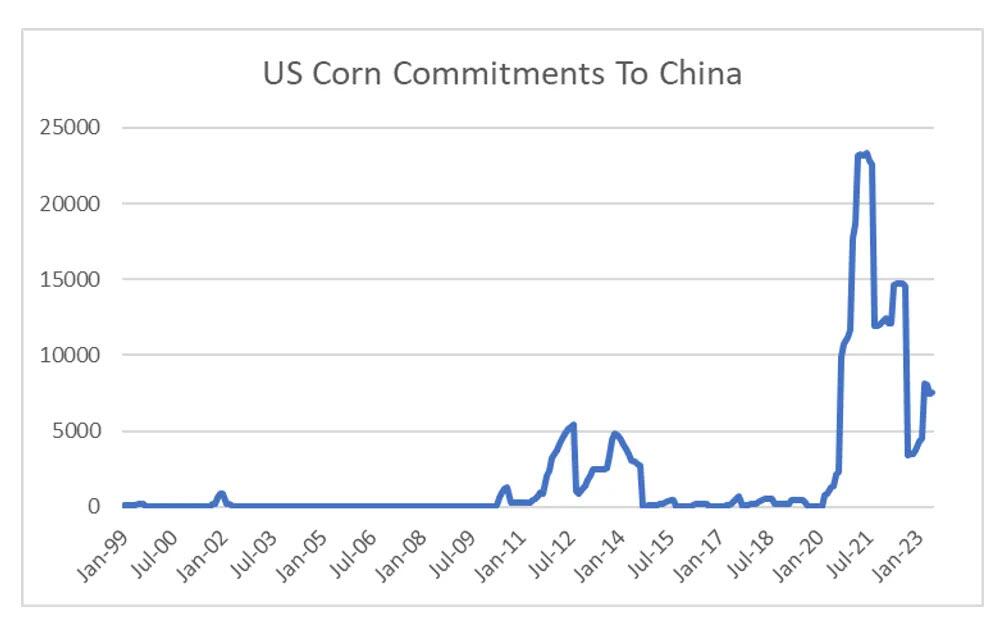
The final and most important reason was that China is turning into a net importer of food. China turned into a corn importer after the problems with African Swine Flu – but despite that being largely under control, and huge efforts by the Chinese government to reduce reliance on the US, China remains one of the largest markets for US Corn exports.

One other implication of China turning to a net importer of food is that it has also become an importer of rice. The world rice market has become increasingly reliant on India and Thailand as suppliers. Note, even though China is listed as exporting 2m tonnes of rice, it now imports 5m tonnes, making it a net importer.

India is the low cost producer of rice.

With India placing restrictions on rice exports, Thai rice prices have been rising again, and are back to levels seen during in 2021. During the spike in corn prices caused by the Russian invasion of Ukraine, many farmers used rice as feed as it was cheaper. Higher rice prices are likely to feed back into higher grain prices.

This could cause a negative feedback loop. China has been very successful in getting domestic pork prices back to pre-African Swine Flu levels, even if that still means Chinese pork prices are twice US prices.

Typically we look at pork to corn price ratios to determine the profitability of pork farming. In China we have seen farmers are record low profitability as corn prices have stayed high and pork prices low. I suspect this was due to rice being used as a substitute feed. This would also explain why China has become a net importer of rice in recent years.

India ban on rice exports is likely to cause food inflation to return to Chinese pork prices – which will likely put upward pressure on other grains. To me, it looks more like we are coming to the end of a lull in food inflation.

Deflation while food prices are going up? You cannot be serious!

Tyler Durden
Sat, 07/22/2023 – 09:20

Poland Wouldn’t Hesitate To Occupy Parts Of Western Ukraine, Putin Claims

Poland Wouldn’t Hesitate To Occupy Parts Of Western Ukraine, Putin Claims

It appears Russian President Vladimir Putin is seeking to sow distrust among allies, in a speech Friday bringing up historical aggression that in the 20th century fractured eastern Europe, namely tit-for-tat massacres between Ukrainian and Polish nationalists during the period of the world wars.

In a new video address before his national security council, Putin said increasing cooperation between Ukraine, Poland, and Lithuania could eventually provide opportunity for Warsaw to settle past grievances by demanding and taking historically disputed territory which is now part of Ukraine.

Putin explained that Poland could in the name of the “military union” and citing the threat from Russia send troops to occupy Western Ukraine.

The Russian leader said “if we’re being blunt” Poland would just take Ukraine’s territory for good. “The possibility is obvious,” Putin said. “If Polish troops enter, for example, Lviv or other Ukrainian territories, they will stay there, and they will stay there forever.”

According to his full remarks as translated in state media

“I cannot but comment on what has just been said [by Russian Foreign Intelligence Service (SVR) Director Sergey Naryshkin] and on the press reports that have appeared about plans to create a so-called Polish-Lithuanian-Ukrainian unit. We’re not talking here about some motley crew of mercenaries – there are enough of them there [in Ukraine] already, and they are being destroyed – but rather about a regular, well-oiled, well-equipped military formation that is planned to be used for operations on the territory of Ukraine,” Putin said.

“In particular [this is being done] purportedly for ensuring the security of contemporary western Ukraine, but in fact – if you call things by their proper names – for the subsequent occupation of these territories. After all, the future outlook is obvious; if Polish units enter Lvov, for example, or some other territories in Ukraine, then they will be staying put there. And they will remain there for good,” he added.

Putin proceeded in the speech to give a history lesson on Poland’s alleged angle of seeking Ukrainian territory but under the guise of “helping Kiev”…

Goaded by the West, Poland took advantage of the tragedy of Russia’s Civil War to annex certain historically Russian provinces. Our country, which was then going through a difficult period, was forced to sign the Treaty of Riga in 1921 and de facto recognize the alienation of its own territories,” Putin explained.

And more according to TASS:

Moreover, even before 1920, Poland seized part of Lithuania – the Vilna region, which includes modern-day Vilnius.

“Together with the Lithuanians, they [the Poles] were supposedly battling against so-called Russian imperialism, but as soon as the opportunity arose, they immediately ‘carved out’ a chunk of land from their neighbor,” the Russian president noted. He further recited how, “Poland also took part in the carve-up of Czechoslovakia resulting from the Munich agreement with Hitler in 1938,” completely occupying Cieszyn Silesia.

“In the 1920s and 1930s, the so-called Kresy Wschodnie of Poland [‘Eastern Borderlands’ in Polish – TASS] – and this includes the territory of western Ukraine, western Belarus and part of Lithuania – were subjected to a harsh policy of Polonization and forced assimilation of local residents, [including the] suppression of ethnic cultures and Orthodox Christianity,” Putin noted.

Putin also in the same speech warned any opposing powers that threats against Belarus would be taken as threats against Russia itself, and Moscow will respond accordingly.

He said that Polish elites were “dreaming of Belarusian lands” – but he would defend Belarus, given it is part of the ‘union state’. Currently Wagner mercenaries are training Belarusian troops, and Poland has in response moved to bolster its border defense units.

Tyler Durden
Sat, 07/22/2023 – 08:45

China’s PBoC Manipulates The Shanghai Exchange Gold Price

China’s PBoC Manipulates The Shanghai Exchange Gold Price

By Jan Nieuwenhuijs of Gainesville Coins

By obstructing gold import and export the People’s Bank of China (PBoC) greatly amplifies the gold premium or discount on the Shanghai Gold Exchange (SGE) relative to metal traded in London. In the past 12 months the PBoC has restricted gold import to curb capital flight and defend the renminbi, resulting in exaggerated SGE premiums. With these interventions the Chinese central bank risks the gold market it supervises from functioning properly, and stagnates internationalization.

Introduction

The core responsibilities of the PBoC are to “maintain financial stability … and to maintain the stability of the value of the currency and thereby promote economic growth.” To this end it wants to strengthen China’s economic security by letting the population accumulate gold (source: page 27). Additionally, the Chinese central bank uses capital controls to manage the renminbi’s exchange rate. A dilemma arises, for example, when Chinese people rush to buy gold as a form of capital flight, which undesirably weakens the renminbi.

Since 2016, there have been several periods in which the PBoC restricted gold imports into the Chinese domestic market to stem capital flight, lifting SGE premiums over the international benchmark (London spot). Remarkably, when there is no capital flight, and China is a net gold importer, the PBoC seems to aim at a 0.5% floor for SGE premiums.

Gold export from the domestic market is more or less prohibited by the PBoC. As a consequence, when the Chinese turn into net sellers, as happened in 2020, gold on the SGE trades at a steep discount versus London.

How to Measure PBoC Interference

Tracking if the PBoC is manipulating the SGE gold price by curtailing imports or exports is fairly easy: if the gold price on the SGE in the Chinese domestic market differs from the gold price on the Shanghai International Gold Exchange (SGEI) in the Shanghai Free Trade Zone (SFTZ), the PBoC is interfering. Gold traded at both the SGE and SGEI is located in Shanghai and should not differ in price, lest the PBoC creates a discrepancy.

As I have explained in my primer on the Chinese gold market, gold trading on the SGEI in the SFTZ is separated from trading on the SGE in the Chinese domestic market. Gold enterprises can freely import and export gold in and out of the SFTZ, while the PBoC controls import and export into and out of the domestic market. Fifteen or so banks are eligible to request the PBoC for a License (every batch needs a new License) to import into the domestic market. Export from the domestic market is prohibited, save for Panda coins and a few other items I’m probably not aware of.

Simplified, the SGEI gold price is the “uncensored version” of the gold price in Shanghai. The difference between the gold price on the SGE and SGEI reveals if there is any obstruction going on.

A Short History of PBoC Interference

My methodology allows us to observe interference since 2014 when the SGEI was launched. To get a sense of the PBoC’s antics let’s first examine a chart showing SGE and SGEI premiums against the US dollar price of gold in London.

Chart 1, based on end of day data. Averages are used for gold price premiums in Shanghai; “10 DMA” stands for 10-day moving average.

In the first years after the SGEI was erected, SGE and SGEI premiums coincided. Then, in 2016, the SGE premium started to drift higher than the SGEI premium because the PBoC was battling capital flight.

When in 2017 the capital flight storm was over, however, SGE and SGEI premiums didn’t realign. The PBoC kept stalling imports to set the SGE premium lower bound at 0.5%, as demonstrated in the next chart that shows the spread between the SGE and SGEI gold price in 2016 and 2017, based on granular intraday data I was able to obtain from that period.

Chart 2, based on granular intraday data. In 2017 it became apparent the PBoC set a floor for SGE premiums at 0.5%.

Possibly, the 0.5% base conceived by the PBoC is to make Chinese demand appear stronger (national pride) or create extra profit for importing banks.

In 2019 there was another stage of capital flight that made the PBoC step up blocking imports into the domestic market, pushing the SGE premium above 0.5%.

Around 2020, the Chinese became net sellers as the price went up, though the PBoC wouldn’t allow exports from the domestic market, causing gold on the SGE to trade at a steep discount to the price in the SFTZ and London. (For an explanation on why the gold price is set in the West, and the East tends to sell into bull markets, please read my article, “The West–East Ebb and Flood of Gold Revisited.”)

When the gold price stabilized in 2021 the SGE premium reverted to positive territory.

Capital Flight Since 2022

A useful approach to measure if the PBoC is interfering and why, is charting the spread between the SGE and SGEI gold price, and the renminbi’s exchange rate versus the US dollar. It’s mainly the gold price that influences Chinese supply and demand trends, but the renminbi’s exchange rate can affirm if said trends are countered by the PBoC.

Chart 3, based on end of day data. A positive spread between the SGE and SGEI implies the PBoC is interfering with imports, a negative spread implies the PBoC is blocking exports. “USDRMB” is the exchange rate between the renminbi and US dollar.

The chart above illustrates that often when the renminbi weakens (green line goes up) the PBoC is allured to restrict gold imports, which drives up the SGE premium (purple line goes up). As happened in late 2022 and February 2023. Recently, Reuters confirmed that the PBoC is limiting import Licenses on the back of a weak renminbi. From Reuters (July 7, 2023):

“Currently, no new import quotas [Licenses] have been issued, and there have been no gold imports into China from previous issued,” said Bernard Sin, regional director, Greater China at MKS PAMP.

Although the PBoC has restricted imports and exports almost continuously since 2016, it’s hard to say how much metal has actually been blocked from entering or leaving the domestic market. On average China has imported 1,000 tonnes per annum since 2016.

Conclusion

At some point in the future the PBoC will need to cease interference for its gold market to continue functioning properly. The blocking of exports, for example, is a major problem.

China as a whole can buy gold in amounts tolerated by the PBoC but can’t sell. What if the Chinese citizenry starts to fully grasp they can’t sell at the international price at all times? Put differently, what’s the point of owning gold if you can’t sell?

All sorts of unintended consequences can be thought of. Perhaps, when the international price spikes drastically, people will sell to smugglers that arbitrage between the domestic market and abroad, dislodging the Chinese gold market as it was carefully designed by the PBoC. Or the Chinese people will lose interest in owning an asset that has limited upside.

Another issue is the Shanghai Gold Benchmark Price (SHAU), initiated in 2016, that should compete with the LBMA Gold Price auction held twice a day in London. SHUA is also set twice a day and the price discovered through its auctions serves as an international benchmark denominated in renminbi. At the opening ceremony of SHAU it was said to be a milestone for the internationalization of China’s gold market.

But the underlying contract of SHAU is listed on the SGE, not SGEI. How successful can the Shanghai Gold Benchmark Price become if it’s subjected to the PBoC’s price manipulation in the Chinese domestic market? Which foreigners are going to use a benchmark that is detached from the international reality? The PBoC would be wise to eliminate confusion regarding these matters for the Chinese gold market to play a key role internationally.

Tyler Durden
Sat, 07/22/2023 – 08:10

Mental Health Round-Ups: The Next Phase Of The Government’s War On Thought-Crimes

Mental Health Round-Ups: The Next Phase Of The Government’s War On Thought-Crimes

Authored by John & Nisha Whitehead via The Rutherford Institute,

“There are no dangerous thoughts; thinking itself is a dangerous activity.”

– Hannah Arendt

Get ready for the next phase of the government’s war on thought crimes: mental health round-ups and involuntary detentions.

Under the guise of public health and safety, the government could use mental health care as a pretext for targeting and locking up dissidents, activists and anyone unfortunate enough to be placed on a government watch list.

If we don’t nip this in the bud, and soon, this will become yet another pretext by which government officials can violate the First and Fourth Amendments at will.

This is how it begins.

In communities across the nation, police are being empowered to forcibly detain individuals they believe might be mentally ill, based solely on their own judgment, even if those individuals pose no danger to others.

In New York City, for example, you could find yourself forcibly hospitalized for suspected mental illness if you carry “firmly held beliefs not congruent with cultural ideas,” exhibit a “willingness to engage in meaningful discussion,” have “excessive fears of specific stimuli,” or refuse “voluntary treatment recommendations.”

While these programs are ostensibly aimed at getting the homeless off the streets, when combined with advances in mass surveillance technologies, artificial intelligence-powered programs that can track people by their biometrics and behavior, mental health sensor data (tracked by wearable data and monitored by government agencies such as HARPA), threat assessments, behavioral sensing warnings, precrime initiatives, red flag gun laws, and mental health first-aid programs aimed at training gatekeepers to identify who might pose a threat to public safety, they could well signal a tipping point in the government’s efforts to penalize those engaging in so-called “thought crimes.”

As the AP reports, federal officials are already looking into how to add “‘identifiable patient data,’ such as mental health, substance use and behavioral health information from group homes, shelters, jails, detox facilities and schools,” to its surveillance toolkit.

Make no mistake: these are the building blocks for an American gulag no less sinister than that of the gulags of the Cold War-era Soviet Union.

The word “gulag” refers to a labor or concentration camp where prisoners (oftentimes political prisoners or so-called “enemies of the state,” real or imagined) were imprisoned as punishment for their crimes against the state.

The gulag, according to historian Anne Applebaum, used as a form of “administrative exile—which required no trial and no sentencing procedure—was an ideal punishment not only for troublemakers as such, but also for political opponents of the regime.”

Totalitarian regimes such as the Soviet Union also declared dissidents mentally ill and consigned political prisoners to prisons disguised as psychiatric hospitals, where they could be isolated from the rest of society, their ideas discredited, and subjected to electric shocks, drugs and various medical procedures to break them physically and mentally.

In addition to declaring political dissidents mentally unsound, government officials in the Cold War-era Soviet Union also made use of an administrative process for dealing with individuals who were considered a bad influence on others or troublemakers. Author George Kennan describes a process in which:

The obnoxious person may not be guilty of any crime . . . but if, in the opinion of the local authorities, his presence in a particular place is “prejudicial to public order” or “incompatible with public tranquility,” he may be arrested without warrant, may be held from two weeks to two years in prison, and may then be removed by force to any other place within the limits of the empire and there be put under police surveillance for a period of from one to ten years.

Warrantless seizures, surveillance, indefinite detention, isolation, exile… sound familiar?

It should.

The age-old practice by which despotic regimes eliminate their critics or potential adversaries by making them disappear—or forcing them to flee—or exiling them literally or figuratively or virtually from their fellow citizens—is happening with increasing frequency in America.

Now, through the use of red flag lawsbehavioral threat assessments, and pre-crime policing prevention programs, the groundwork is being laid that would allow the government to weaponize the label of mental illness as a means of exiling those whistleblowers, dissidents and freedom fighters who refuse to march in lockstep with its dictates.

That the government is using the charge of mental illness as the means by which to immobilize (and disarm) its critics is diabolical. With one stroke of a magistrate’s pen, these individuals are declared mentally ill, locked away against their will, and stripped of their constitutional rights.

These developments are merely the realization of various U.S. government initiatives dating back to 2009, including one dubbed Operation Vigilant Eagle which calls for surveillance of military veterans returning from Iraq and Afghanistan, characterizing them as extremists and potential domestic terrorist threats because they may be “disgruntled, disillusioned or suffering from the psychological effects of war.”

Coupled with the report on “Rightwing Extremism: Current Economic and Political Climate Fueling Resurgence in Radicalization and Recruitment” issued by the Department of Homeland Security (curiously enough, a Soviet term), which broadly defines rightwing extremists as individuals and groups “that are mainly antigovernment, rejecting federal authority in favor of state or local authority, or rejecting government authority entirely,” these tactics bode ill for anyone seen as opposing the government.

Thus, what began as a blueprint under the Bush administration has since become an operation manual for exiling those who challenge the government’s authority.

An important point to consider, however, is that the government is not merely targeting individuals who are voicing their discontent so much as it is locking up individuals trained in military warfare who are voicing feelings of discontent.

Under the guise of mental health treatment and with the complicity of government psychiatrists and law enforcement officials, these veterans are increasingly being portrayed as ticking time bombs in need of intervention.

For instance, the Justice Department launched a pilot program aimed at training SWAT teams to deal with confrontations involving highly trained and often heavily armed combat veterans.

One tactic being used to deal with so-called “mentally ill suspects who also happen to be trained in modern warfare” is through the use of civil commitment laws, found in all states and employed throughout American history to not only silence but cause dissidents to disappear.

For example, NSA officials attempted to label former employee Russ Tice, who was willing to testify in Congress about the NSA’s warrantless wiretapping program, as “mentally unbalanced” based upon two psychiatric evaluations ordered by his superiors.

NYPD Officer Adrian Schoolcraft had his home raided, and he was handcuffed to a gurney and taken into emergency custody for an alleged psychiatric episode. It was later discovered by way of an internal investigation that his superiors were retaliating against him for reporting police misconduct. Schoolcraft spent six days in the mental facility, and as a further indignity, was presented with a bill for $7,185 upon his release.

Marine Brandon Raub—a 9/11 truther—was arrested and detained in a psychiatric ward under Virginia’s civil commitment law based on posts he had made on his Facebook page that were critical of the government.

Each state has its own set of civil, or involuntary, commitment laws. These laws are extensions of two legal principlesparens patriae Parens patriae (Latin for “parent of the country”), which allows the government to intervene on behalf of citizens who cannot act in their own best interest, and police power, which requires a state to protect the interests of its citizens.

The fusion of these two principles, coupled with a shift towards a dangerousness standard, has resulted in a Nanny State mindset carried out with the militant force of the Police State.

The problem, of course, is that the diagnosis of mental illness, while a legitimate concern for some Americans, has over time become a convenient means by which the government and its corporate partners can penalize certain “unacceptable” social behaviors.

In fact, in recent years, we have witnessed the pathologizing of individuals who resist authority as suffering from oppositional defiant disorder (ODD), defined as “a pattern of disobedient, hostile, and defiant behavior toward authority figures.” Under such a definition, every activist of note throughout our history—from Mahatma Gandhi to Martin Luther King Jr.—could be classified as suffering from an ODD mental disorder.

Of course, this is all part of a larger trend in American governance whereby dissent is criminalized and pathologized, and dissenters are censored, silenced, declared unfit for society, labelled dangerous or extremist, or turned into outcasts and exiled.

Red flag gun laws (which authorize government officials to seize guns from individuals viewed as a danger to themselves or others), are a perfect example of this mindset at work and the ramifications of where this could lead.

As The Washington Post reports, these red flag gun laws “allow a family member, roommate, beau, law enforcement officer or any type of medical professional to file a petition [with a court] asking that a person’s home be temporarily cleared of firearms. It doesn’t require a mental-health diagnosis or an arrest.

With these red flag gun laws, the stated intention is to disarm individuals who are potential threats.

While in theory it appears perfectly reasonable to want to disarm individuals who are clearly suicidal and/or pose an “immediate danger” to themselves or others, where the problem arises is when you put the power to determine who is a potential danger in the hands of government agencies, the courts and the police.

Remember, this is the same government that uses the words “anti-government,” “extremist” and “terrorist” interchangeably.

This is the same government whose agents are spinning a sticky spider-web of threat assessments, behavioral sensing warnings, flagged “words,” and “suspicious” activity reports using automated eyes and ears, social media, behavior sensing software, and citizen spies to identify potential threats.

This is the same government that keeps re-upping the National Defense Authorization Act (NDAA), which allows the military to detain American citizens with no access to friends, family or the courts if the government believes them to be a threat.

This is the same government that has a growing list—shared with fusion centers and law enforcement agencies—of ideologies, behaviors, affiliations and other characteristics that could flag someone as suspicious and result in their being labeled potential enemies of the state.

For instance, if you believe in and exercise your rights under the Constitution (namely, your right to speak freely, worship freely, associate with like-minded individuals who share your political views, criticize the government, own a weapon, demand a warrant before being questioned or searched, or any other activity viewed as potentially anti-government, racist, bigoted, anarchic or sovereign), you could be at the top of the government’s terrorism watch list.

Moreover, as a New York Times editorial warns, you may be an anti-government extremist (a.k.a. domestic terrorist) in the eyes of the police if you are afraid that the government is plotting to confiscate your firearms, if you believe the economy is about to collapse and the government will soon declare martial law, or if you display an unusual number of political and/or ideological bumper stickers on your car.

Let that sink in a moment.

Now consider the ramifications of giving police that kind of authority in order to preemptively neutralize a potential threat, and you’ll understand why some might view these mental health round-ups with trepidation.

No matter how well-meaning the politicians make these encroachments on our rights appear, in the right (or wrong) hands, benevolent plans can easily be put to malevolent purposes.

Even the most well-intentioned government law or program can be—and has been—perverted, corrupted and used to advance illegitimate purposes once profit and power are added to the equation.

The war on terror, the war on drugs, the war on illegal immigration, the war on COVID-19: all of these programs started out as legitimate responses to pressing concerns and have since become weapons of compliance and control in the government’s hands. For instance, the very same mass surveillance technologies that were supposedly so necessary to fight the spread of COVID-19 are now being used to stifle dissent, persecute activists, harass marginalized communities, and link people’s health information to other surveillance and law enforcement tools.

As I make clear in my book Battlefield America: The War on the American People and in its fictional counterpart The Erik Blair Diaries, we are moving fast down that slippery slope to an authoritarian society in which the only opinions, ideas and speech expressed are the ones permitted by the government and its corporate cohorts.

We stand at a crossroads.

As author Erich Fromm warned, “At this point in history, the capacity to doubt, to criticize and to disobey may be all that stands between a future for mankind and the end of civilization.”


Tyler Durden
Fri, 07/21/2023 – 23:40

Does “Made In America” Still Matter To Consumers?

Does “Made In America” Still Matter To Consumers?

Do American citizens care where their products come from? Well, it depends on who you ask.

Over the past few decades, the importance of “Made in America” – labels on products indicating production was done in the U.S. – has ebbed and flowed.

As China has grown into the United States’ economic rival and geopolitical adversary, the distinction between American-made and Chinese-made has resurfaced, even as some products have been mislabeled or locally produced but Chinese-owned.

How do people currently feel? This chart, via Visual Capitalist’s Avery Koop, uses survey responses from May 2023 out of Morning Consult, in which a representative sample of 1,000 U.S. adults were questioned on whether they had favorable views of products from U.S. companies using American or Chinese labor and parts.

Who Prefers American-Made?

According to the report, companies that choose to move production state-side will experience reputational gains with American consumers.

In fact, around two-thirds of survey respondents said they regularly sought out products that were “Made in America” during the last year. But there were slight divides in gender (men favored American-made products more) and noticeable divides in generational responses.

Here’s a look at the data on how different demographic groups valued national goods:

Overall, thee older generations like baby boomers tend to be more patriotic in their purchasing opinions, with Gen Z being the least concerned with Chinese products.

On the political spectrum, both Democrats and Republicans had the exact same share of respondents who favor American-made products at 76%. Comparatively, only 57% of independents favored American-made products, though they also responded least favorably to Chinese-made products at 22%.

One other interesting point to come out of the survey: close to 50% of consumers said they would actually be willing to pay more for American-made products.

The American Goods Market

Looking at responses from U.S. adults overall, large shares of consumers are leaning towards domestic-made goods. Here are some additional insights worth considering:

  • 65% of U.S. adult consumers claimed to sometimes or always buy “Made in America” products intentionally

  • 43% prioritize purchasing American-made products rather than prioritizing other options like quality, sustainability, or affordability

  • 48% are willing to pay higher amounts for U.S.-based products. 39% responded they would pay between 6%-10% more for said products

Overall, it appears that “in-house” goods are more desirable to Americans in the current environment. This also explains why regionalization is becoming more important for companies, whether in terms of reshoring (or onshoring) production back to America, or “nearshoring” to Mexico and closer neighbors.

Tyler Durden
Fri, 07/21/2023 – 23:20

The Navy And Diversity, Equity & Inclusion (DEI)

The Navy And Diversity, Equity & Inclusion (DEI)

Authored by Brett Ramsey via RealClearDefense.com,

The Navy is all in for DEI.

At the Navy website if one clicks on “who we are,” one of the first things that shows up is “diversity and equity.”  

It must be important to show up so prominently.

The Navy Diversity and Equity website page says: “I AM A SAILOR. WE ARE A TEAM. THIS IS OUR NAVY.” 

“When Sailors feel included, respected and empowered, they will be more ready to win wars, deter aggression and maintain freedom of the seas.”

– ADM Mike Gilday, Chief of Naval Operations.

The Navy offers no evidence to support the CNO’s statement. It is not clear how the statement actually relates to diversity or equity.

It does mention feeling “included” a form of “inclusion” but in a vague sort of way. In my 34 years in uniform, I don’t recall at any time being asked my feelings.

Must be a new thing.

I doubt the People’s Republic of China military leaders ask how their people are feeling?

The Navy I served in stressed toughness, stamina, perseverance, physical fitness, strength, courage, honor, and commitment. 

My feelings were secondary and that was well understood by me and my shipmates. I have been literally eyeball to eyeball with the Soviets in the North Atlantic tracking a Yankee class submarine.  Rest assured that former enemy had our full attention and our crew devoted no time to feelings. I have no doubt our current adversaries are just as potentially dangerous to our way of life as was the former Soviet Union.

The Navy ought to focus on our real threats instead of touchy-feelie nonsense like sailors’ feelings.

The Navy is a combat force whose job it is to break things and kill people when and where called upon to do so. Those whose personality or psyche demand constant attention to “feelings” probably ought to find something else to do.

Let’s look at diversity

How diverse should the Navy be? It doesn’t say. The fact is, the Navy is already about as diverse as any institution anywhere. The 2021 DOD report on demographics for Navy shows:

Improved Race, Ethnicity Measures Show U.S. is More Multiracial (census.gov)

DOD’s 2021 demographics shows the Navy has 114,100 enlisted personnel and 13,361 officers that identify as a minority. The Navy is already diverse. 37% of the Navy is from a measured racial demographic group leaving 63% that identify as white which matches the percent reported nationally in the 2020 Census. That is more diversity than the national average. An anomaly hidden from view is the Hispanic segment of the military. You will note that there is no category for Hispanic in the table above. Actually, 17.7% of the active DOD force is Hispanic but you would never know that from the figures above because it is not reported. The US census does not count Hispanics as a minority. Instead, they are considered a different ethnic group. According to Pew Research Center data published in 2021, 58% of

Hispanics consider themselves to be white with the remainder identifying as some other color.  This unique accounting obfuscates the fact that the US military is even more diverse than appears to the naked eye when viewing DOD’s reports of racial groups. In fact, over 350,000 Hispanics serve in the military and add considerably to the diversity of the total force.

Other than a slight underrepresentation of black officers, the Navy is at or exceeds the national demographic of racial diversity. This begs the question, what is all the fuss about diversity? The Navy is diverse! There is no need to become even more diverse than the Navy already is. Millions of dollars and precious time are being devoted to a problem that is outside of the Navy’s ability to control. Nay, you say…. what about the shortfall in black officers? What about it? The Navy is devoting a lot of time and effort into trying to recruit blacks to join the Navy to become officers, but the gap remains. One must ask the question, “Why?”  It is not because of discrimination because there are already thousands of black officers so there is obviously no barrier to blacks becoming officers. What is lacking is blacks who want to become naval officers. No amount of incentives or handwringing over a slight under-representation of blacks in the naval officer ranks is going to change a situation that obviously has other causes. Even the small shortfall is actually not the Navy’s fault as is brilliantly and eloquently analyzed and explained in detail by CDR Phil Keuhlen in Task Force One Navy Final Report:  “The Emperor’s New Clothes” Redux.  According to government graduation data there are more than 200,000 black college graduates each year. The problem is that very few of these qualified people have an interest in serving in the Navy. We ought to be curious about why. It is not because of discrimination as DOD’s own internal reports document that fewer than 2% of the 3.4 million that serve in DOD consider racism to be a problem.

Let’s look at equity

The Navy DEI webpage goes on to say “Putting on a uniform doesn’t mean sacrificing who you are. America’s Navy values diversity, equality, and inclusivity — striving to build a community of service members who accurately reflect the rich makeup of our country. Our belief is that with hard work and determination, anyone, from anywhere, has the power to be successful in the Navy.”  The Navy uses the word “equity” earlier twice and then in the next paragraph, the word “equality” is used. Which is it? These two things are not the same. Equity means equal outcomes regardless of merit. Equity is a term associated with social justice advocates who want equal outcomes for everyone regardless of merit. Is the Navy really advocating equal outcomes? How does that even work in a military organization with rigid technical requirements that dictate practices for safety reasons and for warfighting effectiveness? Military organizations are rigid, structured top-down organizations whose fixed chains of commands and methods demand uniformity, strict discipline, and consistency in order to function with any kind of efficiency. Adopting equity in a military chain of command is deadly and dangerous and will get people killed. Equality is equal opportunity based on merit, which is and has been the law of the land for a long time. Equality should be the Navy’s mantra, not equity. The Navy’s use of both terms may confuse those who visit their website? Is the Navy using both terms to conflate the two words into meaning the same thing in order to stimulate interest in the Navy?

Let’s look at inclusion

What does that even mean? In one section “putting on a uniform” is the first thing said. The word “uniform” is telling! It absolutely proves the Navy strives for uniformity…that’s why you wear a uniform. Everything top to bottom in the Navy is about uniformity. Ships and aircraft are built to uniform specifications. The way things are done is based on time-tested uniform best practices. Individuality is not allowed because that leads to bad outcomes and people dying. Putting on the uniform is absolutely about giving up your individuality while that uniform is on. You absolutely must sacrifice who you are to join the Navy most of the time. On duty you must conform to the Navy’s uniform standards for dress, behavior, operational excellence and a thousand other things. When you are off duty, then you have time to be yourself. While on duty, you belong to the Navy, you are included by wearing a common uniform, the same one at the same time as everyone else does. When you get up in the morning, you look at the Plan of the Day and it tells you what the uniform of the day is. How inclusive is that? We are all exactly on the same page and the uniform reminds you every day that you are part of something bigger, something important. What does the use of the word “inclusion” imply? Are there some fields in the Navy that only white people have? Of course not. The Navy’s use of the word is purely political, and politics should have no place in the Navy. It is used to show that the Navy has gotten with the program and is using the same language as the larger society and as desired or even dictated by the political left. But, how does that make for a better Navy….using politically charged terminology? It doesn’t! It has no place in the Navy and only serves to introduce doubt and dissension and make the Navy a less effective force. A cursory search reveals the popular origin of the use of the word in today’s parlance. Where you find the term used is in colleges and universities where the political philosophies of the left are preached, including in Critical Theory, Critical Legal Theory, and Critical Race Theory.

Conclusion

There is no place in the Navy for the politics of DEI.

The Navy is already diverse. The data is not in doubt.

Equity has no place in the Navy. The Navy’s moral and practical foundation is a merit- based organization focused on being able to fight and win the nation’s wars at sea and projecting power ashore. Equity undermines merit. Dilution of merit in favor of equity will get people killed. Anyone telling you anything different is mistaken and should be ignored.

Inclusion is a phantom and is word play from the political left. When you join the Navy, you are included by the very uniform you wear which is the same for everyone. The UCMJ guides your conduct and demands fair and equal treatment of all. The oath you swear to uphold has as its foundation the Constitution. Equal protection is guaranteed in the 14th Amendment and has been upheld by the Supreme Court many times including recently in the Harvard and UNC cases on college admissions. Nothing more is required.

DEI adds nothing of value to our Navy. If just wastes resources and causes division within the ranks.

*  *  *

Brent Ramsey is a retired Navy CAPT. He was a military advisor to Congressman Mark Meadows 2016-2020. He is the author of dozens of published articles on national defense.

Tyler Durden
Fri, 07/21/2023 – 23:00

Twitter Roasts ATF For Posting Image Of Agent Loading Nazi Gun Pointed At Testicles 

Twitter Roasts ATF For Posting Image Of Agent Loading Nazi Gun Pointed At Testicles 

Twitter users are roasting the Bureau of Alcohol, Tobacco, Firearms, and Explosives (ATF) for an image tweeted by the Houston field office this week of an agent improperly following the basic rules of firearms safety: Always treat every firearm as if it is loaded and always keep your firearm pointed in a safe direction

The ATF agent appears to be at an indoor range in Austin. The agent is on the wrong side of a loading table while he loads a magazine for a Nazi MP 40 submachine gun. You will notice that the sub-gun is pointed at the agent’s testicles. 

Here’s the tweet:

The core firearm safety rules at any gun range are: 

• Always treat every firearm as if it is loaded. 

• Always keep your firearm pointed in a safe direction. 

• Always keep your finger straight and off the trigger until you are ready to fire. 

• Always keep your firearm on safe until you intend to fire.

This could be interpreted as visual evidence that some ATF agents under Biden’s administration have no idea about basic firearm safety. Notably, even the agent responsible for social media, who took the photograph, failed to recognize the lapse in gun safety. 

Twitter users mocked the photo, as some said, “Photographic proof the ATF shouldn’t be allowed anywhere near firearms.” 

“I’m no highfalutin ATF bureaucrat, but I did receive training many years ago that you NEVER stand in front of the muzzle of any firearm, not even one that you are “certain” is unloaded,” someone else said. 

Gun blog Truth About Gun said, “Standing in front of the loading table with firearms pointed at your junk is Gun Safety 101 for the distinguished agents of @ATFHQ and @ATFHou in particular. But if an FFL makes even a single typo, he gets his ticket pulled. Your tax dollars at work.” 

“Reminder ATF is in charge of “policing” things pertaining to firearms. ATF agents don’t even follow one of the most important rules of firearm safety, Treat Every Gun As If It Is Loaded. That includes ones sitting on tables, like the one pointed at that idiot’s dick,” another person explained. 

Here’s what the Federal Affairs Director of Gun Owners of America had to say about this: 

The fact that the Houston branch of the ATF not only took, but posted, a photo of an alleged agent blatantly ignoring—or not knowing—basic firearm safety is a reflection of the agency’s ineptness. While ATF may be tasked with enforcing federal gun control, their staff obviously have no understanding or respect for even the basic rules of firearm safety. Gun owners have always known the anti-gun movement knows nothing about the firearms they want to ban—but to post it on Twitter is a new level of stupidity.

Not the best look for Biden’s ATF. 

Tyler Durden
Fri, 07/21/2023 – 22:40