70.3 F
Chicago
Monday, August 24, 2026
Home Blog Page 3503

United Pilots Agree To Labor Deal That Could See Salaries Cumulatively Rise 40%

United Pilots Agree To Labor Deal That Could See Salaries Cumulatively Rise 40%

United Airlines has joined the chorus of companies all but guaranteeing wage growth at the same time the Fed continues its fight against inflation. The airline is also a prime example of how, in today’s workforce, workers have most of the leverage. 

United’s union is on the verge of solidifying a new labor agreement for its pilots that will no doubt set the standard for the industry. The agreement is being called “the richest ever at a US carrier” by Bloomberg, and it ends more than 4 years of negotiations. 

The contract will be valued at about $10 billion through the course of its life, the report says, and will provide pilots – the unsung heroes of Covid who endured forced vaccinations and layoffs, among other hellish work conditions – with a raise of 13.8% to 18.7% upon signing the deal. Salaries could cumulatively rise up to 40.2% over the course of the agreement. 

Quality of work-life, job security, work rules, retirement and benefits were also addressed in the new contract, Bloomberg writes:

United and pilot union negotiators will work to complete the final language in the coming weeks. The union’s Master Executive Council will vote to determine if it becomes a tentative agreement that the group will then put up for ratification, according to the statement.

United says that the deal “will deliver a meaningful pay raise and quality of life improvements for our pilots while putting the airline on track to achieve the incredible potential of our United Next strategy.”

And getting the deal signed will offer meaningful relief for the airline’s C-suite. United, like many other airlines, has been constantly under criticism for delays and cancellations, as well as generally chaotic service coming out of the Covid pandemic. Despite the service concerns, Chief Executive Officer Scott Kirby said recently that demand continues to be strong. 

As the report notes, United isn’t the only airline seeing rising costs. American Airlines will also be adding $8 billion in additional costs and will see their pilots vote on a contract later this month. 

Tyler Durden
Tue, 07/18/2023 – 12:25

Peter Schiff: Dollar Decline Means Lower Inflation Is Transitory

Peter Schiff: Dollar Decline Means Lower Inflation Is Transitory

Via SchiffGold.com,

With the June CPI report coming in even cooler than expected, the mainstream perspective seems to be that the Federal Reserve is winning the inflation fight. But in his podcast, Peter Schiff explains why the dollar is telling a different story.

The dollar index fell below 100 last week for the first time and hit its lowest level since April 2022 last Thursday. Through last week, the DXY fell by 2.3%. Peter said what is happening is somewhat counterintuitive.

It’s ironic that the dollar losing less purchasing power than anticipated means that the dollar loses its purchasing power on international markets. You would think it’d be the opposite.”

The dollar started rallying in January 2021 and ran through September 2022. The rally strengthened the dollar by nearly 30%. Since that peak, the dollar is down by about 13%.

It’s still up a lot, but not nearly as much as it was.”

Peter said the significance of this is that the big drop in the CPI has primarily been driven by the strength of the dollar.

That acted as a tightening all by itself. Yes, you had the Fed raising rates. You had the Fed shrinking its balance sheet. But you also had the dollar going up. That helped the Fed. … Monetary conditions tighten when the dollar goes up. That helped bring down prices.”

You can see the impact clearly on commodity prices. When the dollar gets stronger, it raises commodity prices for other countries. The rising prices lead to a drop in demand.

That benefits the US because we have dollars. We create dollars. So, we don’t see a price increase in commodities when the dollar goes up. We actually get a benefit because more of our international competitors who are bidding for those same resources get priced out. Their demand goes down because they’re looking at these higher prices. And so then we get the benefit of lower prices. So, the dollar, the foreign exchange market was doing a lot of the Fed’s work. It was tightening without the Fed having to hike rates more.

The Fed was able to manufacture a lot of dollar strength with rhetoric. All of the tough, hawkish talk supported the dollar.

In fact, the dollar started to rally before the Fed started hiking. It was because the Fed started to indicate that it was going to hike. The foreign currency markets got in front of that and started to discount those rate hikes and that tighter policy and the dollar started going up.”

Now the dollar is falling because the forward-looking currency markets know the Fed is either finished hiking or at least close enough to the peak that the next significant move the markets anticipate is easing.

The fact that the dollar is already falling — that counts as an ease. So, even if the Fed continues to hike, if the dollar keeps falling, that effect will be larger than the rate hikes. So, even though the Fed would be hiking rates, the weakness in the dollar will actually be negating those hikes and will have the effect of a cut because it will be a loosening of monetary conditions.”

A loosening of monetary conditions means a revival of price inflation. That’s why it’s likely that the current cooling in CPI is likely transitory.

Tyler Durden
Tue, 07/18/2023 – 12:05

Russia Pummels Southern Ukraine In ‘Retribution Strikes’ For Crimea Bridge Explosion

Russia Pummels Southern Ukraine In ‘Retribution Strikes’ For Crimea Bridge Explosion

Moscow had vowed revenge for the Kerch Bridge ‘terror attack’ which happened Monday, and killed two Russian civilians and temporarily shut down traffic.

It now appears to be carrying out that retaliation campaign in what the defense ministry (MoD) called a “strike of retribution” against facilities in southern Ukraine. 

Image purportedly shows the aftermath of a strike on July 17, 2023, on the Kerch Bridge. via Newsweek

The bridge attack was reportedly conducted by sea drones, and so the Russian MoD said Tuesday it launched aerial drones and missiles against maritime drone factories “as well as a ship repair plant that was manufacturing the drones,” according to a statement. 

The strikes including destroying fuel storage facilities near Odesa and Mykolaiv, per internatinoal reports. Ukraine has confirmed multiple waves of attack drones as well as six Kalibr cruise missiles which were fired at Odesa. 

The latest Kerch Bridge attack destroyed a Russian family’s vehicle as it was crossing the bridge. Two parents were killed, and their daughter wounded, according to official Russian statements.

Meanwhile, Ukrainian officials have claimed responsibility for the attack, per CNN

A Ukrainian security official has claimed Kyiv’s responsibility for an attack on the bridge linking the annexed Crimean peninsula to the Russian mainland – a vital supply line for Russia’s war effort in Ukraine and a personal project for President Vladimir Putin.

The nearly 12-mile crossing, also known as the Kerch Bridge, is the longest in Europe and holds huge strategic and symbolic importance for Moscow. Monday’s attack on the bridge was the second since Russia launched its invasion of Ukraine, after a fuel tanker exploded while crossing it in October.

The report confirms that “A source in Ukraine’s Security Service (SBU) told CNN this attack was a joint operation of the SBU and Ukraine’s naval forces.”

“The source spoke on condition of anonymity because they had not received authorization to speak on the record,” the report added.

With Kiev’s counteroffensive largely stalled, there will likely be an uptick in attacks on both Crimea and within Russian territory. Moscow has seen these increasingly brazen operations, including an assassination campaign targeting influential Russians, as acts of desperation while the counteroffensive gets beaten back.

Tyler Durden
Tue, 07/18/2023 – 11:45

The Two Causes Of The Coming Great Depression

The Two Causes Of The Coming Great Depression

Authored by Charles Hugh Smith via OfTwoMinds blog,

But the status quo has much to unlearn, and it seems the only pathway to a new understanding is a Great Depression.

There are two approaches to analyzing a situation:

1. Choose the desired outcome–generally the one that doesn’t require any major changes, sacrifices or downward mobility

2. Identify the initial conditions and systemic dynamics and then follow these to a conclusion back-tested by comparisons with historical outcomes.

Our default setting as humans is 1: select the outcome we want and then find whatever bits and pieces supports that conclusion. Cherry-pick data, draw false analogies–the field is wide open.

This is why we get so upset when our “analysis” is challenged: we’re forced to ask what happens to us if our desired outcome doesn’t transpire, and since the answer might be something less than optimal, we violently reject any data or analogies that conflict with our carefully curated “analysis.”

A great deal of what passes for analysis today is cherry-picked bits and pieces that support a happy story of endlessly expanding prosperity–AI, fusion, etc.–with no mention of limits, constraints, costs or worst-case outcomes rather than best-case outcomes.

Let’s start with an historical analogy most reject: the Great Depression of 1929 to 1942. The conventional account claims that the Depression was the result of a “Federal Reserve policy error”: the Fed tightened credit when it should have loosened it.

This is nonsense. What actually happened was credit expanded rapidly in the Roaring 1920s, which is why they were Roaring. Farmers could borrow money to buy prairie land to put under the plow, speculators could borrow $9 on margin to play the stock market with $1 in cash, and so on.

In other words, what happened was a gigantic credit bubble inflated that pushed stocks and other assets to unsustainable heights of over-valuation, valuations based on the Roaring 20s expansion of credit and consumption continuing forever.

But all bubbles pop, and so the weather changed for the worse and newly plowed prairie turned into a Dust Bowl, wiping out heavily leveraged farmers. Since there was no federal bank deposit guarantee (no FDIC), the bankruptcies of overleveraged borrowers wiped out thousands of small banks, wiping out the savings of prudent depositors.

So even prudent savers got wiped out in the crash of the credit bubble.

Stock speculators gambling on margin (i.e. borrowed money) were quickly wiped out, and the selling became self-reinforcing, accelerating the cascading crash.

The real policy error was protecting the wealthy who owned the debt from a debt-clearing write-down. The wealthy own debt, the non-wealthy owe debt. When the debt is defaulted on, the lender / owner of the debt has to absorb the loss. The debtor is freed of the burden. In a debt-clearing event driven by defaults, insolvencies and bankruptcies, the wealthy are the losers and the debtors are freed of the burden of debt.

Various programs were implemented to stave off the consequences of default, as if pushing losses into the future would somehow enable the credit bubble to reinflate. That’s not how it works: the financial system is like a forest, and if the dead wood of bad debt piles up and isn’t allowed to burn, then the forest cannot foster new growth.

Economies that refuse to accept the wealth destruction that results from credit bubbles popping stagnate. This is the story of Japan from 1990 to the present: the status quo in Japan refused to accept the losses, hiding bad debt (i.e. non-performing loans) behind artifices such as new loans that covered the interest due, listing the non-performing loans in “zombie” categories, i.e. as assets that were still on the books at full value even though they were essentially worthless, and so on.

The net result was 33 years of stagnation and social decay as young people gave up on owning homes and having families.

Now the US has inflated another “debt super-cycle” credit bubble that has pushed assets into over-valuation. Once again the goal is to avoid handing the wealthy owners of all this debt the enormous losses that must be accepted to clear the dead wood of bad debt, money lent to borrowers and projects that were not creditworthy except in a bubble.

The lesson the status quo took from the Great Depression is to cover up private-sector over-valuations and bad debts with vast expansions of credit via the Federal Reserve and the federal government. Please look at these charts below:

1. total credit (TCMDO)

2. the Federal Reserve balance sheet

All are in visibly unsustainable parabolic ascents.

Predictably, the status quo will refuse to accept the necessity of clearing the dead wood and accepting the trillions of dollars in losses that will accrue to those who own the unpayable debts.

Consider CRE, commercial real estate. Office towers are now worth one-third of their pre-pandemic valuations, the valuations on which their mortgages were based. There is no way these properties can be magically restored to their previous over-valuation. Massive losses must be accepted by the owners of the debt. If those losses make them insolvent, so be it. That is unacceptable in a system geared to protect the wealthy at all costs.

But bubbles pop anyway, regardless of policy tweaks. Consider these stock market charts of the Roaring 20s and the Great Depression and the present (below). The similarity is remarkable–possibly even eerie.

The big difference between the Great Depression of the 1930s and the Depression we’re entering is the world still had enormous reserves of resources to tap and a (by today’s standards) modest population in the resource-consuming developed nations.

Recall that a developed-world consumer uses up to 100 times more energy and resources than a poor person in a rural undeveloped nation. Recycling a few bottles doesn’t change this.

This means the planet’s “savings account” of abundant, cheap-to-access resources has been depleted. Yes, there is still oil and copper, etc., but it’s of far lower quality and much harder to get now. The rich ores have been mined and the shallow super-giant oil fields have all been tapped long ago. Now the Saudis must pump stupendous quantities of seawater into their oil wells to maintain production. All these technologies consume vast quantities of energy.

The inevitable result is the energy efficiency–how much energy is required to access, process and transport the energy–has plummeted even as consumption has soared.

The outcome many hope for is some new miraculously cheap and abundant sources of energy such as fusion. But fusion is far more complicated and tricky than pumping oil, and oil is a high-energy-density fuel that can be stored rather easily. All the electricity generated by various technologies can’t be stored easily or cheaply, and so the happy story is that a new miraculous battery technology is just around the corner.

But batteries are also complicated and resource-dense, so they’ll always be as expensive as the materials needed to fabricate them. There will never be “low-cost” batteries if the materials needed to make them are scarce and expensive to dig out of the ground, process and transport.

So the policy choices are simple: either protect the wealthy from write-downs of bad debt and the collapse of asset bubbles and usher in decades of stagnation, or force the wealthy to take the losses and clear away the dead wood.

But either choice will be constrained by the reality that humanity has already drained the easy-to-get “savings account” of global resources.

I get emails from readers who say things like “mining techniques are far more efficient now.” That’s fine, but most of these new mines are often thousands of kilometers away from railways or seaports, and thousands of kilometers away from the processing plants that turn the ore into useful metals.

Recall the enormity of the cost and effort required to build a single two-lane highway thousands of kilometers to a new mine, and the oceans of diesel fuel needed to power the mining equipment and trucks hauling the ore to railways or seaports. Recall the immense amounts of energy required to smelt / process these ores, and the near-zero percentage of lithium-ion batteries that are currently being recycled.

Batteries are difficult to recycle because they’re not manufactured to be recycled, and they’re not manufactured to be recycled because that would raise costs considerably, reducing profits.

So on the present course, the idea is to manufacture billions of batteries, throw them all in the landfill in 10 years, and then mine enough minerals to build another couple billion batteries and then repeat the cycle of throwing them away in 10 years forever.

That isn’t realistic, so the status quo will have to adjust to this unwelcome reality.

This is why I keep writing books about relocalizing, degrowth, using less rather than more to yield a higher level of well-being. The resource “savings account” won’t support fantasies of endlessly expanding consumption of hard-to-get resources.

But the status quo has much to unlearn, and it seems the only pathway to a new understanding is a Great Depression that won’t end with a new expansion of credit because the resources required for that new expansion simply won’t be available or affordable.

Reducing our exposure to avoidable risks is a key strategy of Self-Reliance.

*  *  *

This essay was drawn from my Weekly Musings Reports sent exclusively to subscriberspatrons and Substack subscribers. Thank you very much for supporting my work.

My new book is now available at a 10% discount ($8.95 ebook, $18 print): Self-Reliance in the 21st Century. Read the first chapter for free (PDF)

Become a $1/month patron of my work via patreon.com.

Subscribe to my Substack for free

Tyler Durden
Tue, 07/18/2023 – 10:10

Trump Expects ‘Arrest And Indictment’ Over January 6th

Trump Expects ‘Arrest And Indictment’ Over January 6th

Former President Donald Trump said on Tuesday that he expects to be arrested and indicted by special counsel Jack Smith in connection with the January 6th Grand Jury investigation.

“Deranged Jack Smith, the prosecutor with Joe Biden’s DOJ, sent a letter (again, it was Sunday night!) stating that I am a TARGET of the January 6th Grand Jury investigation, and giving me a very short 4 days to report to the Grand Jury, which almost always means an Arrest and Indictment,” Trump wrote on Truth Social.

President Biden’s DOJ have cast a wide net in their investigation into President Trump, Biden’s chief rival in the 2024 US election. Trump is expected to travel to Iowa on Tuesday, where he will tape a town hall with Fox News host Sean Hannity.

Prosecutors in Georgia are conducting a separate investigation into efforts by Trump to reverse his election law in that state, with the top prosecutor in Fulton County signaling that she expects to announce charging decisions in the first several weeks since Sunday. –AP

While the charges Smith is considering are unknown, several lawyers – ranging from the House committee that investigated the Jan. 6 riot to outsiders writing “model prosecution memos” (per the NYT) have focused on the ‘the attempted corrupt obstruction of an official proceeding’ under Section 1512(c) of Title 18, and conspiracy to defraud the government under Section 371 of Title 18.

Charges of obstructing an official proceeding (Congress’s session to count electoral college votes and certify Biden’s victory) have been brought against some Jan. 6 rioters. Charges of defrauding the government could get into broader actions before Jan. 6, like the scheme to have Trump supporters pretend to be alternative slates of official electors from contested states. –NYT

Read Trump’s entire message below (emphasis ours):

WOW! On Sunday night, while I was with my family, having just arrived from the Turning Point event in Florida, where I won the Straw Poll against all other Republican candidates with 85.7%, with all polls showing me leading in the Republican Primary by very substantial numbers, almost everyone predicting that I will be the Republican Nominee for President, and as I am leading Democrat Joe Biden in the polls by a lot, HORRIFYING NEWS for our Country was given to me by my attorneys.

Deranged Jack Smith, the prosecutor with Joe Biden’s DOJ, sent a letter (again, it was Sunday night!) stating that I am a TARGET of the January 6th Grand Jury investigation, and giving me a very short 4 days to report to the Grand Jury, which almost always means an Arrest and Indictment.

So now, Joe Biden’s Attorney General, Merrick Garland, who I turned down for the United States Supreme Court (in retrospect, based on his corrupt and unethical actions, a very wise decision!), together with Joe Biden’s Department of Injustice, have effectively issued a third Indictment and Arrest of Joe Biden’s NUMBER ONE POLITICAL OPPONENT, who is largely dominating him in the race for the Presidency. Nothing like this has ever happened in our Country before, or even close. They illegally spied on my Campaign, attacked me with a totally Fake “Dossier” that was funded by Hillary Clinton’s Campaign and the DNC, Impeached me twice (I won!), they failed on the Mueller Witch Hunt (No Collusion!), they failed on the Russia, Russia, Russia Hoax, the 51 “Intelligence” Agents fraud, the FBI/Twitter files, the DOJ/Facebook censorship, and every other scam imaginable. But on top of all of that, they have now effectively indicted me three times (the DOJ staffed and runs the D.A.’s Office in Manhattan), with a probable fourth coming from Atlanta, where the DOJ are in strict, and possibly illegal, coordination with the District Attorney, whose record on murder and other violent crime is abysmal. THIS WITCH HUNT IS ALL ABOUT ELECTION INTERFERENCE AND A COMPLETE AND TOTAL POLITICAL WEAPONIZATION OF LAW ENFORCEMENT! It is a very sad and dark period for our Nation!

Under the United States Constitution, I have the right to protest an Election that I am fully convinced was Rigged and Stolen, just as the Democrats have done against me in 2016. and many others have done over the ages. But the Democrats have gone much further than has ever happened before – they cheated on the elections. Rather than looking at the CHEATERS, the WEAPONI2ED DOJ AND FBI target and harass those who complain about the cheaters, and the massive fraud that took place. The prosecutor involved in this case, and likewise the Boxes Hoax, the Manhattan and Atlanta District Attorneys, the New York A.G., etc., has been overturned unanimously in the Supreme Court, headed and caused the Lois Lerner IRS scandal, and failed miserably in his prosecution of John Edwards, where the case was forced to be dropped, along with numerous other catastrophes. He has had a vicious but disastrous career, and is a known biased and obsessed Trump Hater (as is his family). Whether it’s their failure to mention the Presidential Records Act (Prosecutorial Misconduct), their dominance of the Manhattan D.A., including the fact that a Hillary Clinton lawyer, Mark Pomerantz, left a top Democrat law firm (run by Chuck Schumer’s brother) to join the D.A.’s Office and become a prosecutor against me, and then quit, against all rules, regulations, and laws when the Office would not prosecute (he wrongfully wrote a book while working at the Office and is now under scrutiny!), or a perfect phone call made to many lawyers and a Secretary of State, without any protestation of my call, because nothing that was said was wrong, (it was clearly a complaint about an election), these are all Hoaxes and Scams made up to stop me from fighting for the American People – BUT I WILL NEVER STOP!

This has been a neverending fight from the day I came down the escalator in Trump Tower, many years ago. So interesting that in this case the information was delivered to me on a Sunday night, less than 24 hours after I suggested during a major speech that the Federal Government ASSUME CONTROL of a filthy, unsanitary, neglected, and crimendden Washington. D.C., where murder and violent crime are rampant and people no longer want to go to our Nation’s Capital… and yet. that is where Biden’s DOJ actually wants my trial to take place, all because they think, especially after my strong words of a Federal takeover at the speech, a D.C jury will do whatever they want. VERY UNFAIR!

As journalist Julie Kelly notes:

Smith knows this case is small potatoes compared to what he’s about to inflict on Trump and several associates for January 6. It’s very likely Smith will use the “classified docs” prosecution as leverage to seek pretrial detention for Trump when the special counsel indicts Trump for several J6-related offenses, which could include seditious conspiracy.

Tyler Durden
Tue, 07/18/2023 – 09:56

G20 Meeting In India Ends Without Communiqué, Division On Ukraine, Despite Yellen Pleading Redoubled Support

G20 Meeting In India Ends Without Communiqué, Division On Ukraine, Despite Yellen Pleading Redoubled Support

US Treasury Secretary Janet Yellen has urged the West and global allies to redouble support for war-ravaged Ukraine on the same weekend that The New York Times ran a headline which indicated, “After Suffering Heavy Losses, Ukrainians Paused To Rethink Strategy”.

“Ending this war is first and foremost a moral imperative,” she told reporters on sidelines of the G20 Finance Ministers’ Summit in India. “But it’s also the single best thing we can do for the global economy.”

She began by listing her priorities for the G20 in a press conference given in Gandhinagar by saying, “Today, I want to speak about four priorities we will focus on this week: debt distress in emerging markets and developing countries, multilateral development bank evolution, support for Ukraine, and the global tax deal.”

“As you know, I have pushed hard – both in public and in private – for timely debt treatments for countries in need of relief. Over the past few years, we have seen debt vulnerabilities mount for many countries as a result of the pandemic and Russia’s illegal war against Ukraine,” Yellen continued. “Today, over half of all low-income countries are near or in debt distress.”

Under the Biden administration, the US has pumped over $75 billion in assistance to Ukraine, including massive and unprecedented amounts of military support.

And yet even top Pentagon officials have increasingly come out in public to lament the ‘stalemated’ nature of the conflict at this point, as well as highlighted the risks of stumbling into a nuclear-armed WW3 scenario with Russia. 

“Certainly we are at a bit of a stalemate,” DIA Chief of Staff John Kirchhofer said at a conference last Thursday, according to Bloomberg. “One of the things that the Russian leadership believes is that they can outlast the support of the West.”

Treasury Secretary Yellen had elsewhere affirmed here position that it is “premature” to talk of lifting tariffs on China, among other notable talking points.

AFP/Getty Images

But at the G20 meeting, Ukraine seems to have been the great divide, as Reuters is reporting Tuesday that there won’t be a final communique issued given the deep and obvious divisions on policy

Two days of talks between economic and finance policymakers from the Group of 20 nations will wrap up on Tuesday without a joint statement due to differences between major powers over the war in Ukraine, according to Indian officials hosting the meeting.

During its presidency of the G20, India is hoping to forge a consensus on reforms for multilateral banks, a global guiding principle on cryptocurrencies and accelerate the debt resolution of vulnerable countries, but the Russia-Ukraine conflict has cast a long shadow over global diplomacy.

“Most western countries including the U.S., United Kingdom, Germany and France had pushed for a firm condemnation of Russia and the war in Ukraine, whereas Russia and its friend China had opposed any such move, the official added,” Reuters notes further.

According to more details:

And, India, as host nation, has been unable to draft a final communique acceptable to all members, the official said, as some countries insisted on calling the conflict a war, while Russia refers to its campaign, now in its sixteenth month, as a “special military operation”.

India has adopted a largely neutral stance, declining to blame Russia for the invasion and urging a diplomatic solution, while also increasing purchases of discounted oil from Russia.

So Yellen’s attempt to rally the summit firmly behind the Ukraine cause has failed, as skepticism of Washington and NATO’s motives grow among global partners, particularly BRICS countries.

* * *

Below is the full section of her Sunday press remarks on Ukraine:

“Another key priority this week is to redouble our support for Ukraine as it continues to defend itself against Russia’s illegal and unprovoked attack. My visit to Kyiv earlier this year still deeply moves me to this day. Seeing the bravery and resilience of the Ukrainian people up close impacted me personally. During the trip, I also saw the massive difference that foreign assistance is making to the lives of Ukrainian civilians and the Ukrainian military’s front lines. As I’ve said, ending this war is first and foremost a moral imperative. But it’s also the single best thing we can do for the global economy.”

“Let me be clear: our coalition’s support for Ukraine is unequivocal. The United States will stand with Ukraine for as long as it takes. And I know the allies and partners in our coalition will do so as well. Budgetary support is critical to Ukraine’s resistance. And the United States is proud to be part of a broad coalition that has provided such support to Ukraine. By helping keep the economy and the government running, we are giving Ukraine the support it needs so it can fight for freedom and its sovereignty. We will also continue to cut off Russia’s access to the military equipment and technologies that it needs to wage war against Ukraine. One of our core goals this year is to combat Russia’s efforts to evade our sanctions. Our coalition is building on the actions we’ve taken in recent months to crack down on these efforts.”

Tyler Durden
Tue, 07/18/2023 – 09:50

The Single Biggest Risk Facing The Equity Rally

The Single Biggest Risk Facing The Equity Rally

Authored by Simon White, Bloomberg macro strategist,

A re-acceleration in inflation is the primary endogenous risk for the stock market.

Stein’s Law states that:

“If something cannot go on forever, it will stop.”

What might stop equities in their tracks? The most compelling candidate – and therefore the one which investors should be most vigilant for – is inflation.

That, superficially, might be no great surprise in an environment where inflation has leaped to heights not seen in decades. But when we dig into it, we can see just how influential the fall in price growth has been for the rally, and therefore the acute risk a re-acceleration would pose.

As the Federal Reserve removed monetary accommodation, liquidity conditions have nominally tightened. Yet excess liquidity – the difference between real money growth and economic growth – has been notably rising since March, providing equities with the strong tailwind they have enjoyed for most of this year.

Rising money growth turning up from very depressed levels and economic growth that has been falling have both supported excess liquidity. But much more important has been the influence of slowing inflation.

Inflation around the world has been easing, freeing up liquidity able to support risk assets. The flip side is that a volte-face in inflation would, all other things equal, mechanically lead to a fall in excess liquidity.

It’s not just inflation, though; the decline in the dollar has been very supportive of excess liquidity. Money growth for each currency in excess liquidity is measured in dollars, meaning that as it weakens, money growth in dollar terms rises. When foreign currencies are stronger, dollar-denominated assets are cheaper.

The dollar is in a strong down trend at the moment.

The real yield curve is one of the best (and one of the very few) indicators that actually leads the ups and downs of the dollar. It foreshadowed the peak of the dollar in September last year, and remains in a strong flattening trend now.

At the margin, the dollar is driven by the real return for a foreign buyer of US assets. The extreme flattening of the US real yield curve means that the real cost of borrowing dollars now exceeds the real return on longer-term US bonds, reducing demand for the US currency.

And here inflation rears its head again. The flattening in the real yield curve is now primarily being driven by the fall in US CPI, causing short-term real yields to rise faster than their long-term counterparts. A re-acceleration in inflation would reverse this, and signal the dollar is prone to strengthening, fanning a formidable headwind for excess liquidity.

In fact, a stronger dollar would be the cause of another headache for equities through the vector of earnings. EPS growth has been steadily declining, but the +13% drop seen in the dollar since its high last year soon promises to re-animate earnings; on the other hand, a stronger dollar would eventually depress them further.

We are in the thick of a disinflationary trend now, but my base case is inflation boomerangs higher late this year, or in the early part of next year.

  • Firstly, labor capacity remains very tight.

  • Secondly, elevated profit margins show increasing signs of remaining sticky (which, given the dynamics, is likely to continue fueling year-on-year effects).

  • And thirdly, China.

A worsening economic backdrop only increases the risk that easing there becomes less restrained. The bulk of the fall in global inflation has been driven by weakness in China, but easing will at some point break through, causing inflation to begin rising again.

Any inflation renaissance promises to be more troublesome than the debut. The vox populii is that inflation will go down and stay down. Not only would a re-acceleration in inflation pose a risk to assets from a re-pricing of Fed rate-hike expectations, but it would likely catalyze a significant reappraisal of asset pricing so as to incorporate inflation that has become embedded.

Term premium, which has remained remarkably becalmed in this inflationary episode, would likely rise, as bond holders demand higher compensation for lending money. But equities cannot adjust so easily.

The return on equity is essentially what corporations in the aggregate offer, and not all companies can adapt such that their bottom line remains steady when inflation is elevated. Thus bonds, which periodically offer an opportunity to renegotiate the coupon, begin to look more attractive. This is what we saw in the 1970s, with equity allocations falling all through the decade, while bond allocations rose. Stocks face the same repudiation in the current cycle.

Enjoy the party while it lasts (although inflation-hedged portfolios are a more prudent option). But when the specter of price growth returns, the sweet spot equities currently find themselves in promises to turn more bitter.

Tyler Durden
Tue, 07/18/2023 – 09:30

US Industrial Production Posts First Annual Decline In 28 Months

US Industrial Production Posts First Annual Decline In 28 Months

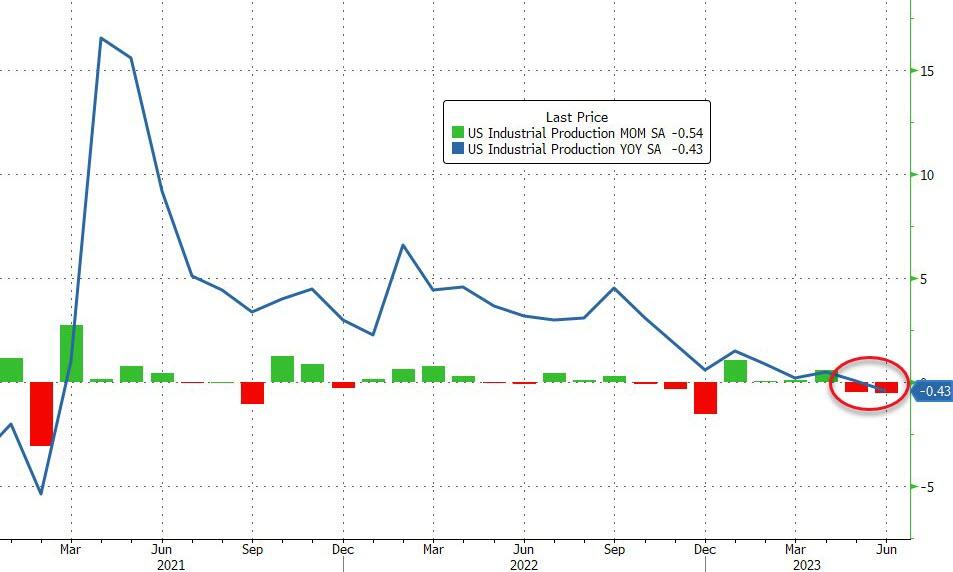
After an unexpected decline in May, US Industrial Production was expected to show no change in June as ‘hard’ manufacturing data begins to match the ‘soft’ survey collapse. However, things were considerably worse than expected with a 0.5% MoM decline – the biggest drop since Dec ’22

Source: Bloomberg

The consecutive declines pushed Industrial Production down 0.4% YoY – its first annual decline since Feb 2021.

Utilities saw a large decline (-2.6% MoM) but the index for consumer durables also fell 2.7%, led by notable decreases in the output of appliances, furniture, and carpeting (3.8  percent) and of automotive products (3.6 percent).  The decrease of 0.9  percent in the index for consumer nondurables reflected declines in  clothing (2.1 percent), energy (1.8 percent), and food and tobacco (1.3  percent).

Capacity Utilization declined to its lowest since 2021…

Source: Bloomberg

The Manufacturing sector also saw a decline, down 0.3% MoM vs unch expected.

Source: Bloomberg

That is the fourth straight month of YoY declines in Manufacturing output.

So much for the ‘soft landing’ narrative.

Tyler Durden
Tue, 07/18/2023 – 09:21

A 5% Pay-Cut Is Coming For 37 Million Student Loan Borrowers

A 5% Pay-Cut Is Coming For 37 Million Student Loan Borrowers

Authored by Mike Shedlock via MishTalk.com,

About 37 million borrowers will have to start paying back their student loans after a 3 year hiatus. Let’s discuss what that means…

Millions of student-loan borrowers will soon restart paying back their loans. This is equivalent to a Four or Five Percent Pay Cut according to Wells Fargo.

The typical monthly loan payment will be between $210 and $314, Wells Fargo estimated using data collected in 2019.

The return of loan payments will take more of a bite out of many borrowers’ budgets than a single year of dramatic rises in inflation did. From December 2021 to December 2022, the income of a typical U.S. household decreased on average by 1% when adjusting for inflation, according to estimates from the economists Thomas Blanchet, Emmanuel Saez and Gabriel Zucman.

Supreme Court Strikes Down Student Debt Cancellation, Cites Nancy Pelosi

The US Supreme Court wisely struck down President Biden’s executive power garb that usurps powers granted by the Constitution to the legislative branch of government. The 77-Page Supreme Court Decision was 6-3.

A paragraph on page 23 (PDF page 28) caught my eye.

… (quoting Gonzales v. Oregon, 546 U. S. 243, 267–268 (2006)). As then-Speaker of the House Nancy Pelosi explained: “People think that the President of the United States has the power for debt forgiveness. He does not. He can postpone. He can delay. But he does not have that power. That has to be an act of Congress.” Press Conference, Office of the Speaker of the House (July 28, 2021).

If you thought Nancy Pelosi never made any sense, you stand corrected.

On June 30, I commented Supreme Court Strikes Down Student Debt Cancellation, Cites Nancy Pelosi

Hoot of the Day

Despite being warned in advance, by Nancy Pelosi, President Biden called the decision “unthinkable”.

Precisely because he could not think, Biden kept upping the ante with more and more delays culminating in debt forgiveness.

Biden doesn’t think. Instead he lets Elizabeth Warren do his thinking for him. Warren’s handwriting is all over the unthinking president’s handling of student debt. And her signature is all over Biden’s Marxist nominees to the Fed.

Elizabeth Warren May as Well Be President, She Makes All Biden’s Calls

On December 28, 2021 I made the case Elizabeth Warren May as Well Be President, She Makes All Biden’s Calls

Joe Biden’s nominee for the Comptroller of the Currency Saule Omarova on oil, coal and gas industries: “We want them to go bankrupt if we want to tackle climate change.”

No one should be surprised by this even though Biden is not bright enough to find these Marxist nut cases on his own.

See the above link for details on who is making Biden’s calls.

And check out this Tweet by Saule Omarova praising Russia.

Say what you will about old USSR, there was no gender pay gap there.

Mercy!

Student Debt Repayment is Highly Disinflationary

Yesterday, I commented, “Nothing is more inflationary than paying people to do nothing.”

The opposite is true here. Nothing is more disinflationary than making people pay for something that used to be “free”.

Student debt cancellation wasn’t really free, of course, it was just spread out to make it a big deal for some and a very tiny deal to the rest.

Real Disposable Personal Income and Real PCE

Real Personal Income Chart Notes

  • Real means inflation adjusted by the PCE price index.

  • PCE stands for Personal Consumption Expenditures.

  • Transfer payments are free money handouts such as Social Security, Medicare, Medicaid, and the three huge rounds of fiscal stimulus.

Excluding transfer payments, real income has gone nowhere. But the huge handouts led to equally huge jumps in income and spending.

The Fed has been struggling with inflation ever since. Demographics adds to the problem.

Student Debt Repayment Magnitude

The impact of the cancellation will have nowhere near the impact of three rounds of inflation causing fiscal stimulus.

Free money went nearly everywhere. Student debt forgiveness was targeted at a much smaller audience.

Do Rising Wages Tend to Increase Inflation?

The above discussion ties in with my post yesterday, Do Rising Wages Tend to Increase Inflation?

Think of three rounds of fiscal stimulus as paying people to do nothing. After a three year hiatus to students, repayment mandates will feel like making people pay for something that was once free.

Student debt repayment will impact spending but it’s nothing compared to fiscal stimulus handouts.

*  *  *

Subscribe to MishTalk Email Alerts.

Tyler Durden
Tue, 07/18/2023 – 07:20

Baltimore Considers ‘Investing’ Billions To Address 14,000 Vacant Homes

Baltimore Considers ‘Investing’ Billions To Address 14,000 Vacant Homes

Over 14,000 vacant houses are scattered across Democrat-controlled Baltimore City, an issue we’ve been reporting on for years — refer to our 2018 article “One Baltimore Neighborhood Has The Highest Vacancy Rate In America.” 

Six decades of Democrats in City Hall have transformed the once-thriving metro area just above Washington, DC, into a ‘rat-infested hellhole.’ Now the city leadership (even more progressive than before) has a cunning plan to reverse the rot. 

Local media outlet WJZ reports Baltimore Mayor Brandon Scott has proposed a plan to throw billions of dollars at the more than 14,332 vacant homes to rebuild them, such as the ones featured below… 

Scott partnered with The Greater Baltimore Committee, a non-profit focused on improving the region’s business climate, and BUILD, an inter-faith development group, to rid the city of vacant homes through a proposed multi-billion dollar plan. 

“One person can’t do it. One entity can’t do it. One organization can’t do it,” said Pastor Brent Brown from BUILD, which stands for Baltimoreans United in Leadership Development.

Brown said, “One politician can’t do it. It’s going to take community.”

BUILD published a study that indicated at least $7.5 billion is needed to address the vacancy problem in the city. There are entire neighborhoods with vacant row homes. 

“Having vacant after vacant after vacant, it can put you, really, in a depressed state,” Baltimore resident Edith Gilliard told WJZ. 

Gilliard said she dreams of a future where homes will be occupied and neighborhoods thriving like decades ago.

The past that Gilliard refers to was one from a half-century ago when the city had a total population of nearly a million — figures now show that number has been halved. People are fleeing the area because of failed progressive policies sparking out-of-control crime

Instead of rebuilding vacant row homes for a population that doesn’t exist anymore, here is a novel idea: “The mayor should concentrate on straightforward, impactful strategies such as reducing the property tax rate, which is among the highest in the state and the country, to stimulate economic growth,” said Chadwick Chilcot, senior wealth advisor at Wilmington Trust in Baltimore. 

Tyler Durden
Tue, 07/18/2023 – 06:55