75.4 F
Chicago
Monday, August 24, 2026
Home Blog Page 3505

Homeless RV Sewage Is Going Into The Ocean In Southern California

Homeless RV Sewage Is Going Into The Ocean In Southern California

Authored by Sophie Li via The Epoch Times,

“Nine thousand gallons [of sewage] a month are going into the wastewater system. That’s the storm drain system, not the sewer. The storm drain carries it straight to Santa Monica Bay,” said Barry Coe, regarding the monthly wastewater of the 600 recreational vehicles (RV) that are being used by homeless persons in the Harbor Gateway area—located in the far southern part of Los Angeles—where he lives.

According to the 2023 point-in-time count released last month by the Los Angeles Homeless Services Authority, there are over 9,280 homeless people living in about 6,800 RVs in Los Angeles County.

Mr. Coe, who formerly ran an RV business, estimates those numbers translate to nearly 102,000 gallons, or about the volume of 11 large U-Haul trucks of sewage each month.

And all of that, he said, is being released into storm drains and directly contaminating the ocean and beaches, he said in a recent interview on EpochTV’s “California Insider.”

“I’m not talking about just going into the water. You got to remember the water percolates into the sand, you take a walk on the beach, you’re going to get this stuff on your body, if there’s hazardous materials or bacteria,” he said.

Normally, RV service providers who also collect sewage from rented-out RVs and mobile toilets are required to obtain a license to handle wastewater, and sewage is required to be dumped at a licensed facility. But the homeless that park in such RVs along urban streets are not following such regulations.

A homeless encampment in the Venice area of Los Angeles on Jan. 27, 2021. (John Fredricks/The Epoch Times)

It is common for local health departments to close beaches following rainstorms as litter, trash, chemicals, and debris are washed from storm drains into the ocean.

However, the prolonged rainy season and the excessive amount of water pollution have led to more beaches in L.A. County closing for longer periods this year including Santa Monica Pier in Santa Monica, Mothers Beach in Marina del Rey, and over a dozen others, according to the County of Los Angeles Department of Public Health.

The explosion of motorhomes in the city not only leads to water pollution but is also affecting residents’ well-being and living quality, Mr. Coe said. Residents may find RVs at no-parking zones that block regular traffic but can’t get them towed away due to cities’ contracts with towing companies regarding hazardous material.

Additionally, he said that a majority of the motorhomes are inoperable and can only serve as a living space.

“They’re not functioning so they become shelter, but they’re on the street,” he said.

“It puts them in a gray area of the law in regard to camping … so it’s a very difficult situation to address.”

Mr. Coe additionally said, some are renting out the motorhomes to those who cannot afford regular housing and are committing various crimes in the process.

“There are people that are buying these things from a wrecking yard … and they tow them out to the streets, and they control the turf,” he said.

“If you don’t pay the rent or the protection money, they will burn you out.”

Solution

According to Mr. Coe, officials need to target its growing homelessness crisis at its root—by dealing with drug and mental health issues—instead of focusing on temporary or permanent housing.

“Because maybe that’s how they got there in the first place. And we shouldn’t be doing it in reverse,” he said.

He said that many homeless people have compelling life stories—which people have compassion for—but it is important not to be blinded by emotions regarding the issue.

Tyler Durden
Mon, 07/17/2023 – 18:20
Bloomberg ‘Sound Of Freedom’ Hit Piece Written By Pro-Pedo Contributor

Bloomberg ‘Sound Of Freedom’ Hit Piece Written By Pro-Pedo Contributor

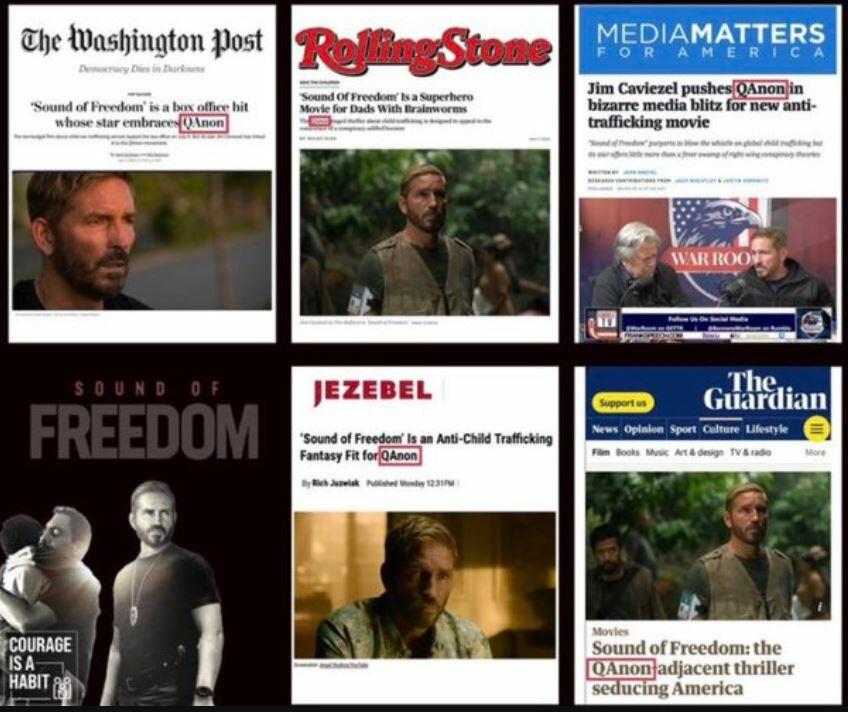
Following the release of the “Sound of Freedom,” Jim Caviezel’s anti-child-trafficking film, a chorus of mainstream hit-pieces came out denouncing it as a “QAnon” conspiracy flick.

But one author of a recent SoF hit-piece in Bloomberg isn’t just against the movie, he’s a pedo-defending freelancer who used to work for an organization working to normalize pedophilia.

Meet Noah Berlatsky: he’s just your average liberal mainstream media news contributor. Ironically, Berlatsky’s latest criticism of the drama focusing on the grave yet glossed over issue of child trafficking lambasted the movie with vitriolic scorn for perpetuating dangerous tropes, whilst he himself turned to the truly tired trope of accusing the movie of packaging together various QAnon conspiracy theories and being a movie made for alt-right boomers. There’s just one problem…Berlatsky has a sordid history of advocating for the normalization of pedophilia.

In 2021, Berlatsky was named the communications director at Prostasia, a non-profit organization which has dedicates itself to a self-avowed mission of protecting children from sexual abuse. While that on its face sounds antithetical to advocating for the normalization of pedophilia, a deeper look into Prostasia’s published content shows it merely masquerades under the guise of acting in the interest of protecting children from sexual abuse in order to promote a much more perverse ulterior motive.

In a 2018 piece addressing the FOSTA bill which was eventually signed into law as the Allow States and Victims to Fight Online Trafficking Act, Prostasia laments the legislation’s stigmatization of pedophiles. Prostasia’s criticism of FOSTA is rife with the use of terms like “minor attracted persons” and the deluded idea of the virtuous pedophile, i.e., one who is sexually attracted to children but fights their urges to refrain from abuses them in a measure of self-restraint that the sex positive non-profit champions as some sort of moral paragon. If there’s any doubt about Prostasia’s pro-pedophilia stance, the organization literally facilitates a safe space for pedophiles, which it has dubbed its MAP Support Club Partnership.

Aside from his work with Prostasia since 2021, Berlatsky has a long history with promoting the idea that children can consent to sex with adults. In 2016, he published a piece titled Child Sex Workers’ Biggest Threat: The Police with The New Republic. In the article, Berlatsky takes aim at the 2012 film Eden which is another drama centered around exposing the grim realities of child sex abuse. Throughout the piece, Berlatsky refers to youth in the sex trade in a lexicon that alienates them from the idea that they are victims of human trafficking with the suggestion that minors should be free to work in the sex trade. Though Berlatsky does make some salient points about how statutes enforced by different states treat victims of child trafficking as criminals, the vernacular in which the piece is written in emanates the tone of Prostasia’s own written content in which it attempts to normalize sex between minors and adults.

If there was any doubt about where Berlatsky’s sentiment truly lies, all one has to do is look at his social media history in which he speaks out against the stigmatization of pedophiles. A noted supporter of “trans-kids”, Berlatsky’s history of perverted tweets also takes aim at the relationship between parents and their children, a cornerstone of the transgender movement which seeks to obscure its brainwashing children into gender dysphoria with a cacophony of language designed by groomers. Of course, Berlatsky has made his Twitter private since the revelation of these pro-pedophilia tweets came to light. However, that action proved to be too little and come too late.

Despite Berlatsky’s opposition to the structure of the nuclear family, the author is married with children. However, his family would be described as anything but traditional. In a February 2023 piece for Yahoo News titled My Wife Is Bisexual And Nonbinary, And My Daughter Is Transgender. My Queer Family Helped Me Better Understand Myself And My Masculinity, Berlatsky paints a picture of the kind of life his radical ideology has molded his family into. Throughout the piece. Berlatsky chronicles his daughter’s descent into ostensible gender dysphoria beginning in middle school when she came out to him and his wife as bisexual — a coincidental parallel shared with his wife. By high school, she was convinced she was a transgender lesbian. Berlatsky attributes his wife’s sexual orientation and nonbinary gender identity as pillars of support for their handling of their daughter’s struggle with her gender identity. His narrative subjugates a traditional heterosexual male by demeaning himself for being that very thing throughout the piece while using his wife and daughter to exalt the superiority of the LGBTQ+ as the vanguard tasked with cultivating the modern family as means of advancing the pervasive agenda he shares with the likes of his cohorts at Prostasia.

A cursory examination of establishment media parasites the likes of Noah Berlatsky shows that the organized hostility against The Sound of Freedom isn’t simply the tactic of the mainstream taking aim at a low-budget independent studio film that challenges Hollywood productions pining to be this summer’s blockbuster. Instead, the criticism serves as a vehicle for advocates of the normalization of pedophilia to undermine any attempt to expose the cruel realities of the agenda they are promoting. By associating themselves with perverts like Berlatsky, NBC News, The Atlantic, WaPo, The Verge, Yahoo News, Insider, Bloomberg, and the other mainstream media outlets that have hosted his work show whose side they are on when it comes to protecting children, making the echoes of their criticisms of those speaking out against child trafficking ring hollow.

Tyler Durden
Mon, 07/17/2023 – 16:40

A Crisis Of Bad Faith & Sickness: “What Will Happen When Fear Turns To Anger?”

A Crisis Of Bad Faith & Sickness: “What Will Happen When Fear Turns To Anger?”

Authored by James Howard Kunstler via Kunstler.com,

Situational Awareness

“All across the board, illness, disability, cancer, heart, autism, fertility…WeFkdUp !!!”

– The Ethical Skeptic on Twitter

What if Dr. Geert Vanden Bossche is correct?

The Dutch virologist said at the outset of the Covid-19 episode in 2020 that vaccinating the world in the midst of an epidemic was insane because it would train the virus to evolve more dangerously while disabling human immune systems.

Last week he issued a warning that the world was within weeks of just such a new and deadly immune escape variant outbreak that would bring on a shocking wave of sickness and death among people who received multiple Covid-19 vaccinations. This would happen on top of an already accelerating rise in latent vaccine adverse reactions manifesting as aggressive cancers, blood disorders, cardiac injury, neurological disease, and much, much more.

To this point in the Covid-19 story, Western Civ in general, and the USA in particular, have descended into an epic group psychosis as a result of the managed mind-fuckery induced by their own governments in collusion with a pharmaceutical industry metastasizing on money the way an aggressive cancer feeds on sugar in a human body. Fearful citizens swallowed all manner of unreality foisted on them by means of propaganda and censorship.

We still don’t know for sure how, who, and why, exactly, Covid-19 was set loose on the world, and the public health agencies don’t want you to know. Perhaps the worst and most baldly dishonest act was the official suppression of effective treatments with common, safe, anti-virals that could have saved millions of lives. And all just to preserve the vaccine companies’ liability shield from the Emergency Use Authorization. In fact, governments are still militating against the sale and use of ivermectin and hydroxychloroquine, which could be taken prophylactically in anticipation of a new outbreak.

So, if these populations were driven crazy by authorities ginning up their fear and preying on it, what will happen if that fear turns to anger instead?

Because that’s exactly what will happen when Americans, and perhaps even Europeans, realize they’ve been subject to history’s biggest homicidal fraud. That anger is going to seek targets, and they are going to find them very easily in their own government officials and also — get this — in the medical establishment that has betrayed its patients so unconscionably.

It’s just impossible to say exactly how that will play out on-the-ground. Governments are already falling — Spain, the Netherlands — but these were parliamentary downfalls according to regular political procedure. Our country has no such procedures for changing authority in a time of crisis. Instead, we have a president up to his neck in bribery scandal and executive agency thuggery, and political parties sunk in corruption, and no way to get rid of them except elections many months away — elections which at least half the people don’t believe are honest.

This crisis of bad faith and sickness is happening at the same time that Western Civ enters an equally vicious crisis of economy and finance. America and Europe are broke. All are playing games with their conjoined banking systems and their currencies. All are de-industrializing economies strictly based on industrial production of goods no longer being produced, and pretending to replace them with economies of computer vapor-ware.

That can’t work and can only end badly in collapsing standards of living.

The past few years, an apparent coalition of global elites, functioning in orgs such as the WEF, the WHO, the EU, the IMF, the central banks, and countless NGOs, along with shadowy intel units and what remains of the old news media, have promoted ever more desperate top-down control programs to prevent a breakdown into wholesale economic and political disorder. Their efforts increasingly tilt into pretense.

Try to impose digital currencies and health passports? Fuggeddabowdit. You will only get a chaos of work-arounds, non-compliance, and probably violent opposition. Keep that stupid, dishonorable, perfidious, and unnecessary war going in Ukraine and you run the risk of turning Western Civ into a matched set of ashtrays.

As you can see, there has already been enough official mischief, crime, and malfeasance to severely piss-off the population. If Dr. Vanden Bossche is correct, we are perhaps heading into the conclusive shock of an evil era. Some kind of monumental correction will be in order. The people will need some way to regain credible self-governance, either through personnel change in every locus of power, or some revision in structure and procedure.

For now, there is little faith that our institutions can manage either of those options. Better maintain situational awareness as we creep into the unknown.

*  *  *

Support his blog by visiting Jim’s Patreon Page

Tyler Durden
Mon, 07/17/2023 – 16:20

Stocks Soar, Shrug Off China Chunder; Seth Klarman Warns “I’d Be Worried”

Stocks Soar, Shrug Off China Chunder; Seth Klarman Warns “I’d Be Worried”

Weakness in the Empire Fed Manufacturing survey this morning came on the heels of ugly China GDP data overnight (along with really ugly property investment, youth unemployment, and retail sales), prompted bond yields and commodities to drop overnight, but on a quiet-ish day (volume-wise), the day session saw things end quite differently.

Stocks just won’t stop – Small Caps and Nasdaq soared higher today from the cash open. The Dow and S&P also ended comfortably green on the day. Some late-day profit-taking wiped a little lipstick off this pig…

And, of course, another massive short-squeeze unwound all of Friday’s losses in the “most shorted” names…

Source: Bloomberg

The Telco trouncing accelerated today as Jefferies put the owners of cell-phone towers on its list of “stock pans” ahead of earnings season and BMO reiterated that it’s cautious on tower stocks in the near term…

Source: Bloomberg

Despite more threats from the Biden administration to ban chip sales to China, NVDA powered ahead, decoupling (for now) from its 2021 analog…

Source: Bloomberg

Credit markets are seemingly convinced of a soft-landing as the HY-IG spread fell back to its lowest in 15 months…

Source: Bloomberg

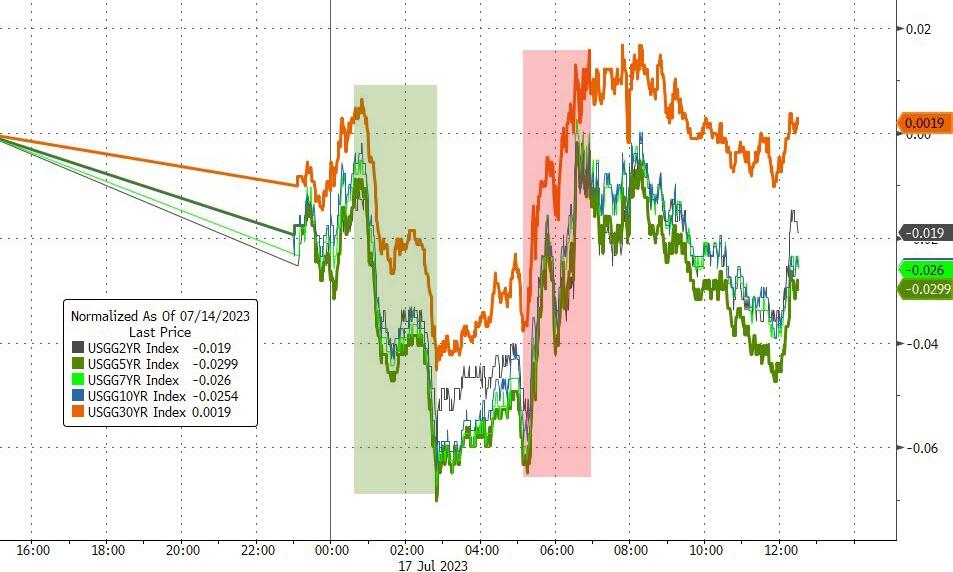
Treasuries were mixed today and traded a roller-coaster – yields tumbled overnight and then soared back during the US day-session. 30Y ended marginally higher in yield while the belly outperformed…

Source: Bloomberg

The dollar was very marginally lower after a pump and dump around the Empire Fed data…

Source: Bloomberg

Bitcoin broke back below $30,000 late in the day, below Friday’s spike-lows…

Source: Bloomberg

Oil fell overnight following ugly China GDP data but early in the European session it exploded higher (and quickly tumbled back down) after Reuters printed a headline about Saudi extending production cuts through the end of 2024 (only to retract the story within minutes).

Gold limped marginally lower on the day but bounced back nicely from a plunge around the Empire Fed data (and London Fixing)…

Finally, billionaire investor and Baupost Group CEO Seth Klarman said during the latest episode of ‘Capital Allocators with Ted Seides’, that he’s “not convinced that we’ve even begun to sort out that bubble.”

“You had a bubble, it was really a credit bubble, that became an everything bubble,” he noted, and “Super-low interest rates, at times zero rates, made capital easily available and incredibly cheap.”

“That led to startup manias and SPACs and meme stocks and crypto, all kinds of speculative activity.”

“You had a lot of hiccups between ’98 and ‘,01 and then the Great Financial Crisis was a really ugly 12 months or so,” he said.

“I’m just not sure why you couldn’t have more trouble.”

“We haven’t seen a lot of bodies float up,” Klarman concluded. “I don’t know what that means, but I’d be worried.”

Tyler Durden
Mon, 07/17/2023 – 16:00

Cotton: Secret Service Didn’t Even Talk To Hunter Biden About White House Cocaine

Cotton: Secret Service Didn’t Even Talk To Hunter Biden About White House Cocaine

Authored by Steve Watson via Summit News,

Following the announcement that the Secret Service has shut down the investigation into the cocaine found inside the White House without finding a culprit, Senator Tom Cotton said Sunday that they didn’t even talk to Hunter Biden about the matter.

“We’ve got no answers,” Cotton said during an interview with Fox News, adding “That’s not surprising. The Secret Service is a troubled agency as it’s long had challenges. It probably needs new leadership.”

“I take this very seriously. I mean, what if this was anthrax?” Cotton continued, adding “This is supposed to be the most secure building in the world. Yet the Secret Service closed down this investigation after just a few days.”

“It’s my understanding, they barely conducted in any interviews. I don’t think they interviewed the president’s son, who’s a known cocaine addict,” the Senator urged.

“This is like if Hamburglar lived in the White House, all the hamburgers disappeared, and they said they didn’t have any suspects or know one they could question,” an exasperated Cotton added.

“They know who went through those doors, so they can interview them as well. If the president were really serious about it, he could demand everybody that goes through those doors, submit to a drug test,” Cotton noted.

He continued, “You can use hair testing samples and identify anyone who’s used cocaine in the last few months. Those are the steps you would take if you took this seriously. This just seems like another Biden cover up.”

Watch:

When pressed about the ending of the cocaine ‘investigation’, John Kirby, the coordinator for Strategic Communications at the National Security Council claimed that the Secret Service “did the best they could to track down how it got there and who it might have belonged to and they just were not able to come up with any forensic evidence that proves it.”

Did their best? They didn’t even interview anyone.

Commenting on the matter over the weekend, Donald Trump was adamant that the Secret Service knows exactly who the drugs belonged to, refusing to believe that they could be so incompetent.

“I’ve gotten to know the Secret Service really well, and I can’t speak more highly of these people, they are incredible people,” Trump said, adding “And I believe that they know everything – they’re really smart and good at what they do.”

“I don’t think it’s possible for bags of cocaine to be left in a certain area, in the Situation Room,” he continued, adding “I’m not talking about five blocks away, the Situation Room, where you decide on war, where you decide on nuclear.”

Tucker Carlson called the cocaine farce his “favourite story of all time, because it just explains all the behaviour” of the Biden administration:

*  *  *

Brand new merch now available! Get it at https://www.pjwshop.com/

In the age of mass Silicon Valley censorship It is crucial that we stay in touch. We need you to sign up for our free newsletter here. Support our sponsor – Turbo Force – a supercharged boost of clean energy without the comedown.

Also, we urgently need your financial support here.

Tyler Durden
Mon, 07/17/2023 – 15:20

Paramount Falls On ‘Mission: Impossible’ Box Office Miss; Sound Of Freedom Outperforms

Paramount Falls On ‘Mission: Impossible’ Box Office Miss; Sound Of Freedom Outperforms

Paramount shares fell 3% in premarket trading in New York after Tom Cruise’s Mission: Impossible — Dead Reckoning Part One missed box office projections in its debut weekend across US and Canada, according to Bloomberg. 

Paramount and Skydance spent $290 million on the production of the action movie. However, since its release on July 12, it has only grossed $80 million, falling short of Paramount Pictures’ projection of $90 million. Over the weekend, the film’s earnings were $56.2 million, missing Boxoffice Pro’s forecasted range of $61 million to $75 million in ticket sales from Friday to Sunday. 

Second on the box office list is the anti-child sex trafficking film Sound of Freedom. This film continues to shock the entertainment industry with how well it has done in the 13 days since its release, with near-term projections to break the $100 million mark. 

Meanwhile, progressive mainstream media continues to bash the awareness of child sex trafficking, labeling the movie — a ‘conspiracy theory.’ 

Perhaps the corporate press and their buddies at the big studios are pushing disinformation because the film by a small studio continues to outperform major films, such as Disney’s latest Indiana Jones. 

Tyler Durden
Mon, 07/17/2023 – 15:00

A “Minsky Moment” Powder Keg

A “Minsky Moment” Powder Keg

By Benjamin Picton, Senior Macro Strategist at Rabobank

Two Steps Forward, One Step Back

The University of Michigan consumer survey released last Friday held good news for the economy that may be bad news for markets. Measures of consumer sentiment, current conditions and future expectations all surged. However, 1-year inflation expectations defied analyst predictions of a fall to rise by one tick on the month to 3.4%, while 5-10 year inflation expectations also nudged higher to 3.1%. The strong reading appears in contrast to the CPI inflation report released last week, which showed core inflation running two ticks lower than expected at 4.8% year-on-year and also puts further pressure on widespread expectations of impending recession.

10-year Treasury yields duly rose by almost 7bps to 3.83%, but remain well off the 4.08% highest close for the year that was recorded just ten days ago. Equity markets seem to be unsure what to make of it all. The NASDAQ closed down 0.18% while the lower beta Dow Jones index recorded a gain of 0.33%. Separating the signal from the noise here is difficult, but the overall impression is that the inflation battle has not yet been convincingly won.

As with many things, there is a world of contrast here between the United States and China. While markets were celebrating core inflation of *only* 4.8% last week, China was reporting consumer price growth of zero in June and accelerating producer price deflation.

This rang some alarm bells in trade-exposed economies like Australia and New Zealand, where the financial press picked up on the poor figures to point out that demand for commodity exports looks dicey in the months ahead, but there remains a glimmer of hope from the efforts of the People’s Bank of China and the central government to reflate the economy via fiscal and monetary stimulus. Calls for stimulus will grow all the louder after this morning’s second quarter GDP figures showed the Chinese economy expanding 6.3% year-on-year. Much slower than the Bloomberg consensus estimate of 7.1%.

Recent PMI data from China shows that manufacturing remains under pressure and while the economy experienced a tailwind from re-opening after the Covid-zero policy was scrapped late last year, that boost now appears to be petering out. Trade figures released last week showed that Chinese imports contracted by 6.8% in the year to June, while exports fell a whopping 12.4%.

Rabobank’s China expert, Teeuwe Mevissen, has been clear that he expects that any stimulus efforts will be much more modest than we have seen in the past, owing to China’s troubles with high debt loads at the local government level and the smouldering real estate crisis that Xi Xinping has repeatedly failed to staunch through attempts to tighten bank credit standards. We expect that there could be some more targeted support for strategically important sectors (semiconductors?), which regular readers of the Daily may find reminiscent of Michael Every’s predictions of targeted liquidity, or as he puts it: “higher rates + acronyms”.

China is far from being Robinson Crusoe in dealing with issues in over-indebted real estate markets. Commercial real estate valuations in the West face something of a Waterloo moment as the cannonade of “return to office” is thwarted by the Prussian cavalry of increased bargaining power for workers, quiet-quitting and a discount rates that have leapt higher after 500bps worth of monetary tightening. Gillian Tett observes in the FT that $270bn of commercial real estate debt facilities are due to be refinanced this year, and up to $1.5trn over the next three years. Sinking valuations have been driven by lower demand for office space, which may mean that commercial real estate has shifted from Minsky’s definition of speculative financing (where cashflows on the asset are sufficient to meet financing liabilities, but not sufficient to repay the principal) to Ponzi-financing, whereby cashflows on the asset are no longer sufficient to repay principal OR interest charges under prevailing market rates. The implications for broader economic stability are enormous, and imply that the wobbles that we saw in the US banking sector earlier this year and the British pension system last year is not the end of the financial stability story.

This all leaves to one side what is going on in housing markets, where much of the attention continues to focus on the day-to-day plight of homeowners, rather than the broader macro stability picture. The RBNZ last week suggested in the Monetary Policy Statement that accompanied their decision to leave interest rates on hold that there was no conflict between the inflation mandate and the financial stability mandate. That seems divergent from the views of the Fed and the ECB, where interest rate decisions earlier in the year made it very clear that financial stability considerations did, in fact, inform how aggressive those central banks could be in achieving their inflation targets. In Australia, the RBA doesn’t even have a financial stability mandate. This responsibility was hived off to the banking regulator in the late 1990s, leaving the RBA only with a nebulous commitment to the “financial wellbeing of the Australian people”.

Housing market woes appear particularly acute in the UK, where there is a growing chorus of requests for government assistance with mortgage payments. Of course, the very idea of “mortgage relief” runs completely counter to the policy prescriptions of the Bank of England, who are now making the Sophie’s Choice between tightening monetary policy enough to force people out of their homes and businesses, or allowing inflation to continue to run out of control. So far, policy support has been limited to clearing obstacles to the “extend and pretend” approach, and we have seen longer mortgage terms becoming more and more prominent. However, the runway starts to run out when the term of the loan exceeds the reasonable working life of the borrower, or (as in the commercial real estate market) the underlying asset moves into negative equity. Rather than encouraging prudent deleveraging, politicians have in the past made absurd suggestions that the policy response to this could be shifting liabilities across generations. That sounds a bit like some kind of neo-serfdom.

Data released by RightMove this morning showing year-on-year house price growth in the UK has now slowed to just 0.5%, making negative equity a real risk for recent borrowers who took out loans with skinny deposits. If we’re now talking about granting mortgages of up to 50 years in term, and turning a blind eye to the credit implications of terming out loan commitments because the amortization schedule no longer sums with the borrower’s income, surely that means that housing markets are now well into Ponzi-financing territory? What happens when the unemployment rate rises, as every central bank is forecasting it will? If years of government “help” for first home buyers via lower deposit requirements coupled with absurdly cheap money from central banks has built a ‘Minsky Moment’ powder keg under the economy via unstable real estate markets, a monetary pause on the back of momentarily encouraging inflation readings may very well be a case of one step forward, two steps back.

Tyler Durden
Mon, 07/17/2023 – 13:20

‘Massive US Oil Caverns’ Are Now Empty, Will Take ‘Decades To Refill’ Thanks To Biden

‘Massive US Oil Caverns’ Are Now Empty, Will Take ‘Decades To Refill’ Thanks To Biden

While it took the Biden administration the better part of six months to drain the US oil supply down to a precarious 20-days of emergency reserves (a 40-year low), it will take decades to refill – if that happens at all, Bloomberg reports.

Stroll through the West Hackberry oil facility on the US Gulf Coast and there’s not much to see: some pipelines and other industrial equipment. But buried deep beneath the surface are storage caverns so massive they’re tall enough to house the Empire State Building with plenty of room to spare.

Thanks to the Biden administration, these reserve sites are sitting half empty.

The Strategic Petroleum Reserve (SPR) now sits at 346.8 million barrels – a level unseen since 1983 – out of a total authorized storage capacity of 714 million.

Perhaps even more noteworthy, the emergency reserves are equal to approximately just 20 days worth of supply – an all-time record low

Replenishing the supply will be a nontrivial and lengthy process according to experts, who say that a lack of funding and ancient infrastructure will hinder the process, despite the Energy Department’s vow to keep buying.

Now that energy costs are back down comes the task of refilling the reserve. That will be a complicated, expensive process. Oil prices are now much higher than when most of the inventory was originally bought — the average price paid for oil in the reserve was $29.70 per barrel, which compares with the current benchmark cost for US crude futures at about $75.

And there’s the balance between needing to buy and not purchasing too much at once, lest the oil market gets spooked and prices jump higher. -Bloomberg

“It would be a very slow process even if you had the money and the facilities were are all in good shape,” said John Shages, who previously oversaw the oil cache for the Energy Department, adding “It could take decades.

The depleted SPR also means that the US could be vulnerable to oil price shocks. In particular, during domestic supply crunches, America will be left to the mercy of the Saudis, Russia and the rest of the OPEC+ cartel.

The SPR was established in the 1970s after the Arab oil embargo resulted in a global energy supply shock and a gasoline shortage in the US, in which Americans lined up for hours, on designated days, to refill their cars.  Decades later, the SPR still serves a vital function, providing a safety net against geopolitical turbulence and potential supply disruptions.

The Biden administration’s decision to release oil from the SPR has sparked outrage from Republicans – who have accused the admin of manipulating gas prices before the medterm elections last year in November, and have accused them of having no credible plan to refill the reserve.

DOE’s mismanagement of the SPR has undermined America’s energy security, leaving the nation more vulnerable to energy supply disruptions, and increasing the ability for OPEC and Russia to use energy as a geopolitical weapon,” wrote top House and Senate Republicans in a May letter to the Government Accountability Office, asking the federal watchdog for an audit of the reserve, Bloomberg reports.

The pace of refilling the SPR has been sluggish at best. While the Department of Energy (DOE) plans to replace barrels sold last year, it falls far short of the goal to replenish the reserves to its 2009 peak. Congress’s decision to strip $12.5 billion earmarked for reserve oil purchases further complicates the situation – as the DOE is now left with a mere $4.3 billion to acquire oil, an insufficient amount to fully restore the SPR.

Aging infrastructure poses additional challenges. The Gulf Coast salt caverns that make up the reserve were initially designed with a 25-year lifespan. As such, the risk of cavern dissolution increases with each drawdown and refill. Maintenance issues, along with the ballooning costs of the $1.4 billion modernization program, add further strain to the already troubled reserve.

Tyler Durden
Mon, 07/17/2023 – 13:00

Toxic Wildfire Smoke From Canada Is Back

Toxic Wildfire Smoke From Canada Is Back

Another round of toxic Canadian wildfire smoke is back in the US. Air quality alerts are deteriorating in Mid-Atlantic states as the plume of smoke pours in from Canada. 

Smoke and haze are set to blanket parts of New York, Pennsylvania, and Vermont by late Monday afternoon. The air quality will continue to deteriorate for many metro areas across the mid-Atlantic and Northeast throughout the day. 

Smoke forecast 

Source: NYT

“Unfortunately, the wildfire smoke will begin to make a return to the region to start the new week,” according to the National Weather Service in the Philadelphia area.

Source: NYT

As of 0700 ET, several metro areas, including Chicago, Buffalo, Pittsburgh, Nashville, and Cincinnati, had air quality readings of “unhealthy” and “unhealthy for some.” 

Source: NYT

“Canadian wildfire smoke will remain in the picture through Tuesday as northwesterly winds aloft that originate out of the Canadian Prairies continues to direct more smoke into the Lower 48,” the Weather Service said.

Last month, we cited one Candian official who warned wildfires could “last all summer.” 

Tyler Durden
Mon, 07/17/2023 – 12:20

It Almost Looks As Though On March 9th, Someone Turned Their Disk To Green

It Almost Looks As Though On March 9th, Someone Turned Their Disk To Green

By Peter Tchir of Academy Securities

Plato the Greek or Rin Tin Tin

Who’s more famous to the billion millions?

It seems like it has hit a point where it is impossible to avoid discussing the Magnificent Seven. However, at least I can write it with the Clash playing in the background.

Rates (the Fed)

I continue to believe in my very simple theme. After the July meeting (where the market has already given the Fed the green light to hike 25 bps):

  • The Fed has a high hurdle to hike again this year.

  • The Fed has an extremely high hurdle to cut this year.

The Fed (unless they do something new with their balance sheet reduction program) should largely be “a non-event” for the rest of this year. Yes, occasionally markets will move as the Fed messaging (or jawboning) changes tone, but unless the data comes in decidedly bad or good for an extended period of time (2 or more months), they are going to try to be on hold.

The volatility being priced into the bond market seems too high relative to equities

Traditionally, the two move in the same direction in somewhat similar orders of magnitude. Since the Fed started their hiking cycle, bond market implied volatility has been much higher than stock market volatility. While part of this is because the depth of true liquidity in the bond market is lower (relative to its size) than the liquidity in the equity market, bond market volatility should eventually decline (or “normalize”) relative to equity volatility.

I expect 2s vs 10s to become less inverted as the two-year can start pricing in a lower Fed Funds rate a year or so out. However, 10s can start to price in a higher terminal rate and a longer timeframe to get there.

Economic Data

  • Inflation. We should continue to see some relief in inflation (especially on the goods side of things), but many factors (particularly the re-building of more “secure” supply chains) will keep it consistently above the Fed’s 2% target.

  • Jobs. I expect weakness on the jobs front in the coming months, but not enough weakness to meet the extremely high hurdle required to cut rates.

  • The data, in general, should be impacted by the lag effect of prior rate hikes. That is why the Fed is reluctant to hike more, but since that is what the Fed wants, they won’t turn dovish either.

The Magnificent Seven

Ring! Ring! It’s 7 a.m. (ok, I couldn’t resist another line from the song).

We have seen a divergence between the major indices and their equal weighted siblings (and it has been quite extreme this year). For example, the Nasdaq 100 has a YTD return of 43% compared to an equal weighted return of 24%. The S&P 500’s YTD return is 18% vs. 8% for the equal weighted version.

Regarding the S&P, while the equal weight is “only” lagging by 10% this year, that divergence is bigger than what we have seen historically. With 500 names, it is more difficult for any one stock (or seven stocks) to drive the index returns, yet a handful of stocks have really driven this divergence. What strikes me as “curious” is that it looks like there was a clear “start date” to this trend in the S&P 500. Until March 9th, the S&P 500 and the equal weighted version marched along (more or less) in tandem. Since then, the divergence grew and has remained quite high!

If there is any “consolation” for those mired in the Russell 2000, both the equal weighted and regular weighted indices have lagged the broader market (Russell is up less than 10% YTD). Historically, you would expect that the Russell 2000 would do well when the other major indices are doing well, because it should be about the economy or liquidity. However, the Russell 2000 is struggling to get out of its own way this year. And yes, if there were problems in the high yield bond market (or even the leveraged loan market), I’d expect that to weigh on the Russell 2000, but those markets have both been healthy this year. Yes, there are some concerns (especially about some segments of the leveraged loan market), but as a whole those markets are behaving well, which should support the Russell 2000.

Some of the blame can be attributed to the regional banks (KBW Regional Bank Index is down 20% YTD). But is that really enough? Does that explain this divergence? I don’t think so.

I haven’t mentioned ARKK (a “disruptive tech” ETF) in a long time and it is “only” up 55% YTD. Yes, 55% is a great return, but if you told me that the Nasdaq 100 would be up 43% this year, I would have bet (based on its high beta) that ARKK would be up much more than 55%.

Again, this highlights just how specific the themes/trends have been this year.

Churrascaria

On this rainy Sunday morning, I am thinking about barbecue. More specifically, I’m thinking of those Brazilian steakhouses (no offense if they aren’t really authentic) where you get a disk with green on one side (you want more meat brought to you) and red on the other (indicating, at least for a moment, that you need a breather).

It almost looks as though on March 9th, someone turned their disk to green and has been gorging ever since.

The questions are:

  • Can this continue? Possibly. We’ve seen valuations stretched in the past (think ARKK) so this could continue, especially as the AI theme is bigger and more interesting/compelling than other themes that have driven the market (I never got the “metaverse” to be honest). Also, with so many (including myself) eyeing the laggards and not fully benefiting from the amazing performance by the market leaders, that could easily become the “pain trade”. Though at some point, especially if AI can deliver on its promises of efficiencies, it should help the broader market more than it has since the benefits should accrue to each and every company that can harness it.

  • If it doesn’t continue, do the laggards catch up? Or do the rising stars come back to earth? If there is to be some form of convergence, will it be because we spark a rally that lifts the laggards? Or will the convergence come as valuations drop on the high flyers? Or maybe whoever is in charge of the disk at the steakhouse will flip it red.

What I want to believe:

  • 50% chance of convergence due to a pull back.

  • 40% chance of convergence due to laggards outperforming.

  • 10% chance that the current trend continues.

What I’m starting to believe:

  • 10% chance of convergence due to a pull back.

  • 40% chance of convergence due to laggards catching up.

  • 50% chance that the current trend continues (and won’t stop until every investor buys into the trend, which just hasn’t happened yet).

Bottom Line

Well, this basically leaves me with a good song and some steak on my mind.

  • Rates: Lower volatility, rangebound, with less inversion.

  • Credit: A slow grind to tighter spreads.

  • Equities. I am scared that the scenarios that I want to see play out won’t actually happen. For now, I want to bet on convergence, largely spurred by the re-balancings being done in the indices. I have a more or less neutral view on overall risk (while the laggards outperform). However, I am truly horrified that this is an extremely consensus view.

Two final thoughts (mostly related to equities):

  • What if there is just too much money chasing too few liquid assets, which is only going to push equity valuations higher and higher? That is an argument that has been discussed a lot in the past and would help explain a permanent shift to much higher/richer valuations. AI might be a justification, but there could just be a much greater need to invest (and those with money are earning income that needs to be invested).

  • What if any economic weakness won’t translate into price action reflecting a potential recession, but will instead be viewed as a positive for stocks because rates will have to come down? Could the markets jump from recession fears to “hey, the Fed has our back sooner or later” hopes? Will the market just “look through” any recession because it will eventually end with the Fed being accommodative? Basically, it doesn’t matter if you get the recession call right or not because stocks will react positively no matter what. Seems like I’m saying that good news is good for stocks and bad news is good for stocks, which seems illogical (and even impossible), yet we seem to be living in that sort of a world.

I am really looking forward to earnings because they will provide the best insights into how sustainable the current valuations are and whether we could see a pop in the laggards!

Tyler Durden
Mon, 07/17/2023 – 12:00