80.1 F
Chicago
Sunday, August 23, 2026
Home Blog Page 3533

Biden Whistleblower Gal Luft: ‘I May Have To Live On The Run For the Rest of My Life’

Biden Whistleblower Gal Luft: ‘I May Have To Live On The Run For the Rest of My Life’

Authored by Debra Heine via American Greatness,

Dr. Gal Luft, the Israeli whistleblower who has been on the run since April, detailed his bribery allegations against the Biden family in an extraordinary new video obtained by the New York Post. 

As American Greatness previously reported, Luft was arrested on weapon trafficking and other charges in Cyprus last February and disappeared after he was let out on bail. After his arrest, the former Israeli army officer tweeted that the Biden administration was out to “bury” him.

The Biden Department of Justice had Luft, the founder and executive director of the Washington-based Institute for the Analysis of Global Security (IAGS),  arrested on on suspicion of arms trafficking to China and Libya, lying to the FBI and violating the Foreign Agent Registration Act (FARA), according to his arrest warrant. He’s facing up to 96 years in prison if convicted of the charges.

From an undisclosed location, the fugitive claimed in the 14-minute video that he was arrested to stop him from testifying to the Republican-controlled House Oversight Committee about the Biden family’s shady business exploits in China.

Let it sink in. I, who volunteered to inform the U.S. government about a potential security breach and about compromising information about a man vying to be the next president, am now being hunted by the very same people who I informed and may have to live on the run for the rest of my life,” the whistleblower lamented.

Luft said he was forced to skip bail in Cyprus while awaiting extradition “because I did not have faith I would receive a fair trial in a New York court.”

The whistleblower reportedly worked with CEFC-USA—the nonprofit arm of the Chinese energy conglomerate CEFC China—between 2015 and 2018, the same period CEFC-China began its influence operations with the Biden family.

Despite Luft’s fugitive status, House Oversight chairman, Republican James Comer said the Israeli remains a “potential witness” in the Biden family probe, the Post reported.

The whistleblower explained that his legal woes started after he made the “fatal decision” to present incriminating evidence about the Bidens to six officials from the FBI and the Department of Justice in a secret two day meeting at the U.S. Embassy in Brussels in March 2019. The DOJ delegation, he said, was made up of two prosecutors from the Southern District of New York and four FBI agents. Luft said he believed the reason why the Justice Dept. dispatched so many officials was because they knew he was a “credible witness” and had “insider knowledge” about the Biden family’s financial transactions with the Chinese energy conglomerate CEFC, “including specific dollar figures.”

He said he also told the feds about Biden family associate Rob Walker, whom he referred to as “Hunter Biden’s bagman.”

Luft says he told the DOJ and the FBI in Brussels that Joe Biden, soon after his vice presidential term ended, had attended a meeting at the Four Seasons Hotel in Washington, DC, with his son Hunter and officials from CEFC.

Luft’s account of the former VP’s presence at that meeting was corroborated 21 months later when the FBI interviewed another attendee, Biden family associate Rob Walker, according to recent testimony before Congress.

Luft disclosed during the Brussels interview that CEFC was paying $100,000 a month to Hunter and $65,000 to his uncle Jim Biden, in exchange for their FBI connections and use of the Biden name to promote China’s Belt and Road Initiative around the world — and that the money was being funneled through Walker.

The Oversight Committee has written to Walker demanding he submit to questioning about his role in distributing more than $1 million from China to at least three of President Biden’s relatives.

The most “alarming” information he shared in Brussels, according to Luft, pertained to the one-eyed mole in the DOJ who shared classified information with Hunter Biden and his Chinese partners.

“I told the DOJ that Hunter was associated with a very senior retired FBI official who had a distinct physical characteristic—he had one eye,” Luft said.

That FBI official is widely believed to be former FBI Director Louis Freeh, who gave $100,000 to a trust for two of then-Vice President Joe Biden’s grandchildren in 2016 shortly before telling Hunter, “I would be delighted to do future work with you.

According to Luft, “One Eye” tipped off Hunter’s CEFC associates, Dr. Patrick Ho and Chairman Ye Jianming, that they were under investigation.

The whistleblower stressed that he felt it was his “civic duty to alert the government” about the Biden family’s corruption far ahead of the 2020 election to give the feds plenty of time to investigate the matter.

I’m not a Republican. I’m not a Democrat. I have no political motive or agenda,” he added.  “I did it out of deep concern that if the Bidens were to come to power, the country would be facing the same traumatic Russia collusion scandal—only this time with China. Sadly, because of the DOJ’s cover-up, this is exactly what happened.”

Luft said his evidence  was corroborated nine months later by “the emails and receipts” contained in Hunter Biden’s laptop. Incredibly, according to the whistleblower, the agent who seized the laptop from the Delaware computer repair shop in December 2019, Special Agent Joshua Wilson, was one of the FBI agents who interviewed him in Brussels that spring.

The whistleblower noted that although he had provided federal law enforcement with plenty of evidence to investigate before the election, they did nothing with it, and instead made him “public enemy number one.”

Over the past four years, they followed me, my family, my friends, my associates. We were all harassed, intimidated, and finally, I was prosecuted,” Luft said.

Luft said that despite the harassment, he sent his attorney, Robert Henoch, to meet with then-acting Deputy Attorney General Richard Donahue on the eve of the 2020 elections “to ensure he was informed about the information I had given his department in Brussels nineteen months earlier, and also to warn him that there might still be a mole within the DOJ.”

In February 2020, Attorney General Bill Barr assigned Donoghue to “coordinate federal investigations into all Ukraine-related corruption allegations against Joe Biden,” according to the Post.

Donoghue reportedly agreed to meet Henoch at a Starbucks near DOJ headquarters and corresponded with him on his private email.

The story is about corruption at the very highest levels of government/politics and I think it can all be corroborated,” Henoch wrote in an email obtained by the Post. 

Unbeknownst to Luft, on Sept. 4, Donoghue had ordered the Delaware US attorney to pause the criminal investigation into Hunter to avoid leaks in the two months before the election, according to testimony before Congress.

Needless to say, nothing came of the meeting.

Yet on November 2, 2022, on the eve of the midterm elections, Luft was indicted on seven counts, including a violation of the Arms Export Control Act.

If convicted I could face up to 100 years in prison,” the whistleblower said.

He said while in jail, he was portrayed in the international media as an arms dealer “even though I have never traded a bullet in my entire life.”

Luft added that “nowhere in my indictment does the DOJ claim or present evidence that I bought, sold, shipped, or financed any weapon.”

He also contested the charge that he had committed a FARA [Foreign Agents Registration Act] violation by charging former CIA Director James Woolsey $6,000 a month for putting his name on an article he had ghost written for him in a Chinese paper.

“Nowhere in the indictment does the DOJ mention the well-known fact that Woolsey had been an advisor to my think tank since 2002 and that there was nothing in the article that represented Chinese interests—to the contrary.”

“The notion that I, Gal Luft, spoon-fed a CIA director policy proposals on China, treating him like a useful idiot, is not only an insult to the Intelligence Community, it is an insult to the intelligence of every American,” he said.

Luft also scoffed at the charge that he made a false statement to the FBI during his voluntary meeting in Brussels which he said came about as a result of his “good citizenship.”

Why was I in Brussels to begin with? Was I there to eat Belgian waffles?!” he exclaimed.

He challenged the Justice Department to make his indictment public.

“Make my day,” Luft added. “Put it on your website so every American can see the nature of the allegations against me, the quality of the evidence and the lengths the government is willing to go to weaponize the Justice system to punish whistleblowers like me.”

Luft also challenged the FBI to submit to Congress the minutes from the March 2019 meeting in Brussels.

“Let everyone see what happened in Brussels,” the whistleblower proposed. “Why not? Are you trying to protect anything? Are you trying to protect anybody?”

Luft suggested that his arrest in November 2022 was an attempt to discredit him on Trumped up charges as Republicans were about to take control of Congress and start investigations into the DOJ’s cover-up of the Biden scandal.

“Why am I being indicted for FARA for ghostwriting an innocuous article—for which I received no payment, let alone from a foreign government—when the MOTHER OF ALL FARA cases, the Biden systemic influence peddling on behalf of foreign governments for which they raked MILLIONS—goes unpunished?” he asked.

Luft said he had no faith that he would receive a fail trial in New York because he had seen how Patrick Ho had been treated after his 2017 arrest on bribery charges. According to Luft, during his trial in New York, prosecutors blocked Ho from mentioning the Bidens.

Ho “paid Hunter Biden a million dollars for God-knows-what [but] was not allowed to mention the word Biden before the jury,” Luft explained.

“The very same prosecutor who is now after me, Daniel Richenthal, told the judge at the time that mentioning the name Biden would ‘add a political dimension’ to the case, and the judge agreed,” the whistleblower added. “Which means if I was brought before a New York court, I would not be allowed to utter the word Brussels or Biden.”

He argued that in effect, “the real context” of his arrest: “me being patient zero of the Biden family investigation, would be hidden from the jury.”

The whistleblower lamented that he now faces the rest of his life on the run, or in prison for doing his civic duty.

“I warned the government about potential risk to the integrity of the 2020 election,” Luft said. “Ask yourself, who is the real criminal in this story?

Tyler Durden
Fri, 07/07/2023 – 13:00

Yellen Warns Against “Winner Take All” Fight With China

Yellen Warns Against “Winner Take All” Fight With China

During her first full day of meetings in Beijing on her 3-day trip, US Treasury Secretary Janet Yellen on Friday condemned China’s recent “punitive” actions against US companies as well as the newly announced export controls on two rare metals commonly used in computer chips and solar cells, gallium and germanium.

Following “substantive” talks with former Chinese economy czar Liu He, she told a meeting of the American Chamber of Commerce in China (AmCham) that the world’s second-largest economy should implement market reforms, and further vowed the US and its allies will fight back against China’s “unfair economic practices”. 

But crucially elsewhere, her statements given directly before Chinese officials reflected that she’s trying to smooth things over with China’s leadership after the controversial Biden remarks of last month wherein he referred to President Xi Jinping as “a dictator”. 

Yellen with Chinese Premier Li Qiang on Friday, via AP

She emphasized that Washington doesn’t want to go down the path of a “winner take all” fight with China, but desires fair economic competition which will result in benefits for both countries. 

According to her Friday remarks as cited in The Wall Street Journal

U.S. Treasury Secretary Janet Yellen pledged to Chinese Premier Li Qiang that the U.S. doesn’t seek economic estrangement from China, as she sought to curb a steep slide in relations between the world’s two biggest economies during a closely watched visit to Beijing. 

In China’s Great Hall of the People on Friday, Yellen defended the Biden administration’s position that the U.S. isn’t pursuing a “winner take all” fight with China, but rather wants to engage in economic competition that would benefit both countries over time. 

Yellen played down efforts by the U.S. to limit China’s access to sensitive technology—a particular irritant for Beijing, which has begun retaliating more forcefully—as narrowly targeted. She said such measures aren’t a reason to allow relations to deteriorate further. 

She emphasized, “The United States will, in certain circumstances, need to pursue targeted actions to protect its national security. And we may disagree in these instances.” Yellen added: “However, we should not allow any disagreement to lead to misunderstandings that unnecessarily worsen our bilateral economic and financial relationship.”

The Chinese side has so far struck a tone of optimism:

Chinese Premier Li Qiang told US Treasury Secretary Janet Yellen in Beijing that he believes the bilateral ties will see “more rainbow” after “wind and rain,” according to Bloomberg. 

Notably, the more conciliatory tone of not wanting a “winner take all” fight came later in the day, following the initial remarks criticizing Beijing over recent punitive actions. 

* * *

On the above point, Marketplace’s Kai Ryssdal, who is traveling in the Treasury Secretary’s press pool, had this to say on his day one impressions [emphasis ZH]…

“And look, she has been hearing from American executives about some of the things that have happened, right. And Chinese employees of American companies have been arrested and detained. There are laws here — a new espionage law has been passed that is giving American executives some pause. And let’s remember, she was speaking to the American Chamber of Commerce in Beijing. So she knew her audience.”

“That said, this remark is, I don’t believe what Yellen would want to be highlighted because she really, really wants the American relationship to be steady. She wants it to be calmed a little bit, the American relationship with China, and at the same time knows that she has to look out for American companies.”

Tyler Durden
Fri, 07/07/2023 – 12:40

Judge Says Trump Can Be Deposed In Former FBI Agent Peter Strzok Lawsuit

Judge Says Trump Can Be Deposed In Former FBI Agent Peter Strzok Lawsuit

Authored by Caden Pearson via The Epoch Times (emphasis ours),

Former President Donald Trump can be deposed in a lawsuit filed by former FBI agent Peter Strzok against the Department of Justice (DOJ), a federal judge ordered on Friday.

FBI Deputy Assistant Director Peter Strzok testifies at the Committee on the Judiciary and Committee on “Oversight and Government Reform Joint Hearing on Oversight of FBI and DOJ Actions Surrounding the 2016 Election” in Washington on July 12, 2018. (Samira Bouaou/The Epoch Times)

Mr. Strzok’s lawsuit alleges wrongful termination following the debunked Russia collusion investigation and claims that he was fired at Mr. Trump’s direction.

U.S. District Judge Amy Berman Jackson, an appointee of former President Barack Obama, agreed with the request to depose Mr. Trump in a brief order on July 6. This comes one day after the DOJ asked a final time to block Mr. Trump from being deposed.

“Given the limited nature of the deposition that has been ordered, and the fact that the former President’s schedule appears to be able to accommodate other civil litigation that he has initiated, the outcome of the balancing required by the apex doctrine remains the same for all of the reasons previously stated,” Ms. Jackson wrote in her brief order.

Under the “apex doctrine” in U.S. law, high-ranking government officials, such as the president, enjoy a degree of immunity from being compelled to provide testimony or evidence in legal proceedings.

In May, Ms. Jackson ordered a stay on the deposition of Mr. Trump until FBI Director Christopher Wray was deposed in the lawsuit. DOJ lawyers previously argued that Mr. Wray, a lower-ranked official, should be deposed first as any evidence that he provided could mean that Mr. Trump would not have to testify.

Mr. Strzok and former FBI lawyer Lisa Page, who is also suing the DOJ and FBI, played key roles in the FBI Crossfire Hurricane investigation into alleged collusion between the Trump campaign and Russia.

Mr. Strzok also played a role in the investigation of former Secretary of State Hillary Clinton’s use of a private email server to send classified information. Mr. Strzok reportedly changed key language in the conclusion of the Clinton email investigation from “grossly negligent,” which would have been a crime, to “extremely careless,” which may have exonerated Ms. Clinton.

Text Messages

Special counsel Robert Mueller fired Mr. Strzok in 2018 after around 10,000 text messages between Mr. Strzok and Ms. Page were discovered. The messages sent between 2015 and 2016 revealed the pair expressed strong anti-Trump bias in critical comments about Mr. Trump and his supporters as the two were working on the Crossfire Hurricane investigation. The messages also exposed an alleged affair between the two.

The FBI special counsel probe ultimately concluded that the Trump campaign did not collude with the Russian government to get elected. However, corporate media outlets aired several unfounded claims about Mr. Trump that came from what appeared to be anonymous sources within the FBI and DOJ.

The DOJ had argued that there was no evidence Mr. Strzok was fired at Mr. Trump’s direction, contending that his deposition “is not appropriate.” The DOJ claimed that Mr. Trump’s public remarks, which might have indicated his desire for Mr. Strzok to be terminated, were not the reason for the firing.

Lisa Page on Capitol Hill on July 13, 2018, and Peter Strzok on Capitol Hill on July 12, 2018. (Andrew Caballero-Reynolds/AFP/Getty Images; Samira Bouaou/The Epoch Times)

In a bid to distance the decision from Mr. Trump, the government contended that testimony from Mr. Wray, former White House chief of staff John Kelly, and others had already addressed the decision to terminate Mr. Strzok.

The DOJ recently argued in court that Mr. Trump’s testimony is irrelevant since it was former FBI Deputy Director David Bowdich who independently made the decision to remove Mr. Strzok.

According to the DOJ, Mr. Bowdich has said that he does not recall Mr. Wray ever informing him about any meeting in which the president pressured him regarding Mr. Strzok. Despite these assertions, Mr. Strzok’s lawyers have expressed their intention to question Mr. Trump about potential pressure exerted on FBI and DOJ officials to terminate Mr. Strzok.

“These circumstances do not rise to the ‘extraordinary circumstances’ necessary to authorize the deposition of a current or former high-ranking government official, much less a former President,” the DOJ wrote in a court filing.

Testimony Doesn’t Support Strzok’s Theory: Judge

However, Ms. Jackson noted in her ruling that while the testimony of Mr. Wray and other individuals did not support Mr. Strzok’s theory that Mr. Trump “was involved in the decision making at issue in this case, the fact remains that the former President himself has publicly boasted of his involvement.”

In February, Ms. Jackson ruled that Mr. Trump and Mr. Wray could be deposed for two hours, and she limited questions to a “narrow set of topics” in connection to the lawsuits.

According to court documents, she wrote in her earlier ruling that it “was appropriate in light of all of the facts, including the former President’s own public statements concerning his role in the firing of the [Strzok].”

Mr. Strzok filed the lawsuit in 2019, which is one of several ongoing legal actions against Mr. Trump, the leading contender for the GOP 2024 presidential nomination.

In his lawsuit, Mr. Strzok has claimed that “the FBI fired [him] because of his protected political speech in violation of his rights under the First Amendment to the Constitution of the United States” over the private text messages with Ms. Page.

Ms. Page alleges in her own lawsuit that her privacy was violated by the release of the text messages, which led her to be the subject of “frequent attacks by the President of the United States, as well as his allies and supporters.”

Mr. Trump has repeatedly complained about being treated unfairly by Mr. Strzok and Ms. Page during the FBI investigation, often pointing to negative comments the pair said about him.

Mr. Trump has also long criticized the “deep state,” the bureaucracy of permanent and unelected officials in government branches, for opposing him and his presidency. After declaring his candidacy for 2024, Mr. Trump made a campaign promise to clean out the “deep state.”

The Epoch Times contacted Mr. Trump for comment.

Jack Phillips contributed to this report.

Tyler Durden
Fri, 07/07/2023 – 12:20

Despite IAEA ‘Green Light’, China Maintains Ban On Japanese Seafood Imports Over Fukushima Water Release

Despite IAEA ‘Green Light’, China Maintains Ban On Japanese Seafood Imports Over Fukushima Water Release

Chinese customs said on Friday that it would continue import bans on food from about 20% of Japanese prefectures, citing food safety concerns following Tokyo’s decision to discharge nuclear-contaminated water from the crippled Fukushima plant into the ocean, reported Nikkei

On Tuesday, the International Atomic Energy Agency (IAEA) concluded that Japan’s plans to release radioactive water from Fukushima into the Pacific Ocean are consistent with international safety standards. However, that didn’t sit well with Chinese authorities. 

China, the largest buyer of Japan’s seafood exports, said it would increase monitoring of edible products from Japan and continue bans on seafood imports from 10 prefectures. The General Administration of Customs said this is a move to prevent contaminated food from hitting Chinese supermarkets. 

China customs said it would “strengthen supervision” and “rigorously examine” certificates for food imports, particularly seafood products, from the other non-banned prefectures. 

“Since the Fukushima nuclear disaster in 2011, China’s customs have attached great importance to the issue of radioactive contamination of Japanese food imported to China. It has closely monitored the relevant measures taken by the Japanese government, continued to assess the risk and responded promptly,” the agency continued.

“For weeks China had publicly voiced strong opposition to Japan’s move to discharge treated radioactive water from its crippled Fukushima nuclear plant into the sea,” Nikkei Asia said. 

On Thursday, China’s foreign ministry said the IAEA report could not be used as a “green light” to discharge more than a million tons of water from Fukushima because of unknown risks to human health. 

China customs said IAEA’s report “failed to fully reflect expert opinions” and that it will take “all necessary measures” to ensure the safety of Chinese consumers. 

IAEA chief Rafael Grossi told Reuters that a few teams of international experts behind the report had concerns about radioactive water release but didn’t raise concerns directly with him. 

Seafood, such as scallops, shrimp, tuna, and Japanese rice wine sake, are very popular in Chinese markets. Let’s hope radioactive seafood from Japan doesn’t end up Stateside. 

Tyler Durden
Fri, 07/07/2023 – 12:00

NATO ‘OK’ With Cluster Bombs After Biden Approves For Ukraine: Stoltenberg

NATO ‘OK’ With Cluster Bombs After Biden Approves For Ukraine: Stoltenberg

NATO Secretary General Jens Stoltenberg doesn’t see a problem with internationally banned cluster munitions… only when the US or its allies deploy them, apparently.

Without doubt if cluster bombs were being deployed by Russia or official US enemies, NATO would condemn it (and has in the past). But with the Biden administration now reportedly moving forward with sending cluster munitions to Ukraine, Stoltenberg has said that “Nato does not have a position on them” as some allies have signed up to prohibit their use and some haven’t.

Via Reuters

He was specifically asked by a reporter about the wisdom of allowing them to be sent to the Ukrainians. He had further added in response, “This will be for governments to decide, not for Nato to decide.”

“We are facing a brutal war, and we have to remember this brutality is reflected, that every day we see casualties, and that cluster munitions are used by both sides,” he sought to justify and explain.  “And Russia used cluster munitions to invade another country. Ukraine is using cluster munitions to defend itself.”

The Associated Press first reported Thursday that the White House has decided to arm Ukraine with cluster bombs after many weeks of intense internal discussion and debate over the controversial munitions. The cluster bombs are expected to be announced as part of the next $800 million arms package. 

On the very same day it was widely reported the US administration is ready to pull the trigger on sending the bombs, Human Rights Watch (HRW) issued a scathing report. It concluded: 

  • Ukrainian forces have used cluster munitions that caused deaths and serious injuries to civilians. Russian forces have extensively used cluster munitions, causing many civilian deaths and serious injuries. 
  • Cluster munitions used by Russia and Ukraine are harming civilians now and will leave bomblets behind that will continue to do so for many years.
  • Both sides should immediately stop using cluster munitions and not seek to obtain more of these indiscriminate weapons. The US should not transfer cluster munitions to Ukraine.

Other groups and activists have warned it marks an escalation which is to provide greater dangers to civilians now and in the future. 

Below is one of many examples of US state-funded media (RFERL) and organizations like the UNHR condemning Russia’s deployment of cluster bombs earlier in the conflict:

Prior Washington hesitation on sending cluster bombs stems from the fact that some 120 countries have banned cluster munitions as they have long been understood to be more indiscriminate than conventional weapons, given they randomly disperse small bombs over large areas.

For example, the MK-20, which is one of the weapons on Ukraine’s wish list, disperses 240 dart-like submunitions or bomblets after being deployed. “The US had been producing and selling cluster bombs to its allies until a few years ago,” Antiwar.com recently pointed out. “In 2016, Textron Systems Corporation stopped producing MK-20s when the US stopped selling them to Saudi Arabia. But there’s still an estimated one million of the bombs Pentagon stockpiles.”

Tyler Durden
Fri, 07/07/2023 – 09:20

A Cure Worse Than The Disease

A Cure Worse Than The Disease

By Bas van Geffen, Senior Macro Strategist at Rabobank

Yesterday’s data releases gave markets little reason to revisit the narrative from Wednesday’s FOMC minutes. Recall that these revealed about as hawkish of a hold as possible, given that some FOMC members had actually wanted to raise rates, before participants judged it “appropriate or acceptable” to hold. Particularly the latter does not sound like a ringing endorsement and is quite possibly the weakest support for the decision without actually casting a dissenting vote.

That hawkish read-across had already set the tone for the day before the ADP employment report counted 497,000 new jobs in June. Even after subtracting a -11k revision to last month’s estimate, that’s more than double the expected increase of 225,000. This was further corroborated by a strong ISM report for the services sector. Companies in the sector reported a rebound in hiring, on the back of a solid increase in current activity as well as new order inflows.

This resulted in sharp moves in both the rates and equities space. The US Treasuries curve bear steepened, with some 4bp increase in the 2-year segment versus 10bp for the 10-year note. European swings were even bigger: the 10y Bund closed 15bp up from the previous close. The steepening of both curves is particularly interesting as it suggests that markets may be reconsidering how long central banks will have to keep rates at peak, or how much room there will be for cuts afterwards, rather than simply revising up the estimate of peak policy rates.

And central banks may have to go further or hold rates at high levels for longer as long as the effects of rate hikes remain hard to see. In the US, credit conditions have been easing since the mini banking crisis. In Europe, financial conditions have tightened already, but the knock-on effects on the real economy remain limited so far. We have argued in the past that this may partly be the result of a decade of low rates, which has invited households and businesses to take on loans with longer fixed rate periods than before.

What’s more, the ECB is –to some extent– actively being undermined by European governments. The (often overly) generous compensation for high energy bills has been a thorn in the side of the central bank for months now, as it supported consumption demand, requiring further hikes to dampen activity. What’s more, several governments are now implementing policies that could limit the impact of additional monetary tightening.

The Italian government has made no secret of their opinion regarding the ECB’s rate hikes. Prime Minister Meloni acknowledged that “inflation is a hateful hidden tax” and that the ECB is right to fight it decisively. However, Meloni has openly questioned the ECB’s methods: “The simplistic recipe for rate increases undertaken by the ECB does not appear to be the most correct path … One cannot fail to consider the risk that the constant increase in interest rates is a more harmful cure than the disease.” Deputy Prime Minister Salvini went as far as calling the hikes “nonsense and harmful”, asking: “Does Lagarde have a variable rate mortgage? Do you know how much the instalments are increasing? Who benefits from these absurd decisions?”

Yet, the ECB flagged that it does not intend to stop here. So the Italian government is now looking at ways to ease the pressure on households with variable rate mortgages. Salvini told Rai radio on Tuesday that “we are working with the economy ministry to increase the number of instalments for people with a variable-rate mortgage,” and banks have expressed willingness to heed the government’s call. The president of the Italian Banking Association said it would be possible to extend the maturity of mortgages for those households who meet certain criteria, such as being current with mortgage payments.

The Italians are not the first to shield households from higher mortgage costs. In Spain, the government introduced various support measures for low income households. These range from grace periods to options to extend the maturity of the mortgage or to swap from a variable to a fixed rate, depending on the borrower’s situation. The Spanish relief comes with relatively high hurdles and strict conditions, so it certainly doesn’t eliminate all impact of rate hikes to date. Still, it does weaken the policy transmission somewhat. To what extent the Italian plans would hinder the ECB’s policy passthrough is unknown, as the exact details have yet to be worked out.

Nonetheless, it is a potential setback for the ECB. No measure will fully negate the impact of the hikes to date – households may still have to refinance to a higher, longer-term rate and maturity extension only lowers the monthly redemptions somewhat to compensate for the higher variable rates. That said, particularly the option to shift into longer-dated maturities could limit the impact of future rate increases. That, in turn, could force the ECB to do more than they would otherwise have to do, with potentially more devastating effects on the economy as a result. Doesn’t that make mortgage relief a cure that is worse than the disease?

At least measures are currently only being taken in countries like Spain and Italy, where inflation is relatively low compared to the bloc and where labor market tightness and, hence, wage pressures are less of an issue than in Germany and the Netherlands, for example. So while it impairs policy passthrough, it doesn’t hinder transmission in those parts of the Eurozone where it is most badly needed. Plus, at least governments aren’t taking out their check books – which would probably have been much more detrimental for price stability, and could have put government budgets under further scrutiny. Case in point are the plans announced by German Finance Minister Lindner earlier this week, which foresee a resumption of the debt brake in 2024, only €16.6 billion of additional debt, financed by significant spending cuts (nearly €32 billion) in many areas, but in particular with the health and family ministries.

Tyler Durden
Fri, 07/07/2023 – 09:00

June Payrolls Tumble To 209K, Lowest Since 2020 And First Miss In 13 Months, But Wages Come In Hot

June Payrolls Tumble To 209K, Lowest Since 2020 And First Miss In 13 Months, But Wages Come In Hot

After yesterday’s blowout ADP report, according to which almost half a million Americans magically found jobs, moments ago the BLS poured cold water on expectations for a confirmation of the surge in the latest jobs report, when the June payrolls number came in at a measly 209K, a big drop from last month’s blowout 339K print which, of course, was revised down to 306K, and the lowest print since Dec 2020.

The number missed the median economist expectation of 230K, which was the first time the series has missed since April 2022, and followed 13 consecutive beats.

It wasn’t just May that was revised – of course- lower: the change in total nonfarm payroll employment for April was revised down by 77,000, from +294,000 to +217,000, and the change for May was revised down by 33,000, from +339,000 to +306,000. With these revisions, employment in April and May combined is 110,000 lower than previously reported. In fact, every single month in 2023 has now been revised lower.

Of note, after last month’s plunge in the Household Survey employment, in June we saw a bounce back as the index rose by 273,000 in June, reversing much of the 310,000 plunge that contradicted the big gain in payrolls — which are derived from the Establishment survey.

That said, the unemployment rate was unchanged at 3.6%, stronger than expectations of an increase to 3.7%. Among the major worker groups, the unemployment rate for Whites declined to 3.1% in June. Black unemployment rate rose to the highest since Aug 2022; The jobless rates for adult men (3.4 percent), adult women (3.1 percent), teenagers (11.0 percent), Blacks (6.0 percent), Asians (3.2 percent), and Hispanics (4.3 percent) showed little change over the month.

There were no changes in the underemployment rate, which came in at 62.6%, as expected.

And with the unemployment rate stubbornly hot, hourly earnings also came in hotter than expected, with average hourly earnings rising 0.4% in June, more than the 0.3% expected, and unchanged from last month’s upward revised print. On an annual basis, hourly earnings were also flat, at 4.4%, and also came in hotter than the 4.2% exp.

Specifically, average hourly earnings for all employees on private nonfarm payrolls rose by 12 cents, or 0.4 percent, to $33.58. Over the past 12 months, average hourly earnings have increased by 4.4 percent. In June, average hourly earnings of private-sector production and nonsupervisory employees rose by 11 cents, or 0.4 percent, to $28.83.

There was a welcome change in the average weekly hours, which rose fractionally from 34.3 to 34.4, just above the expected 34.3 print. In manufacturing, the average workweek was unchanged at 40.1 hours, and overtime was unchanged at 3.0 hours. The average workweek for production and nonsupervisory employees on private nonfarm payrolls remained at 33.8 hours.

Looking at the composition, we find something bizarre: the biggest contributor to the 209K print was government.

  • Employment in government increased by 60,000 in June. Employment continued to trend up in state government (+27,000) and local government (+32,000). Overall, government has added an average of 63,000 jobs per month thus far in 2023, more than twice the average of 23,000 per month in 2022.

  • Health care added 41,000 jobs in June. Job growth occurred in hospitals (+15,000), nursing and residential care facilities (+12,000), and home health care services (+9,000). Offices of dentists lost 7,000 jobs.
  • Social assistance added 24,000 jobs in June, mostly in individual and family services (+18,000). Job growth in social assistance has averaged 22,000 per month thus far in 2023, in line with the average of 19,000 per month in 2022.
  • Employment in construction continued to trend up in June (+23,000). Employment in the industry has increased by an average of 15,000 per month thus far this year, compared with an average of 22,000 per month in 2022. In June, employment in residential specialty trade contractors continued to trend up (+10,000).
  • Employment in professional and business services changed little in June (+21,000). Monthly job growth in the industry has averaged 40,000 thus far in 2023, down from 62,000 per month in 2022. Employment in professional, scientific, and technical services continued to trend up over the month (+23,000).
  • In June, employment in leisure and hospitality was little changed (+21,000). This marks the third consecutive month of little employment change for this industry.
  • Retail trade employment changed little in June (-11,000). Employment continued to decline in building material and garden equipment and supplies dealers (-10,000) and in furniture, home furnishings, electronics, and appliance retailers (-5,000). Motor vehicle and parts dealers added 6,000 jobs.
  • Employment in transportation and warehousing changed little in June (-7,000) and has shown no clear trend in recent months. Over the month, employment edged down in couriers and messengers (-7,000) and in warehousing and storage (-7,000), while air transportation added 3,000 jobs.   
  • Employment showed little or no change over the month in other major industries, including mining, quarrying, and oil and gas extraction; manufacturing; wholesale trade; information; financial activities; and other services.

Overall, while headline payrolls came in weaker than expected, the low unemployment rate and the continued overheating in hourly earnings suggest that the Fed is still on course for a July rate hike. Peter Tchir of Academy Securities agrees:

Weaker than expected jobs data on the headline front, wasn’t supported by some other data in the report:

  • Unemployment ticked down to 3.6% as it is based on the Household survey (though, weirdly, the underemployment rate ticked up to 6.9%).
  • Hourly earnings came in at 0.4% this month and were revised up to 0.4% last month, keeping the annual rate at 4.4%. Not alarming, but not the direction the Fed would like to see.
  • Hours worked ticked up a fraction, to 34.4, which is normally viewed as a positive for the labor market but doesn’t seem to match other parts of these job reports.
  • The JOLTS data (which I believe Yellen really looked at closely) declined and is back below 10 million jobs. I highly suspect that this data series is more flawed than most as how jobs are advertised has changed dramatically.
  • The BLS Survey Response Rates likely remain low, which creates problems for those trying to interpret the data.

Bottom Line: “A mixed enough report that the Fed can probably go 25 at the next meeting, but we don’t need to price in much more than that.”

Tyler Durden
Fri, 07/07/2023 – 08:52

DoD Invokes Defense Production Act To Boost Metals Mining After China Export Controls

DoD Invokes Defense Production Act To Boost Metals Mining After China Export Controls

According to a Pentagon spokesperson cited by Reuters, the US Defense Department announced on Friday it is invoking the Defense Production Act to boost the domestic mining and processing capacity of two rare earth metals, gallium and germanium, critical for high-tech chip-making for the US defense industry. 

Reuters said the Pentagon has a strategic germanium stockpile but no gallium stockpiles. The move to invoke the Defense Production Act comes after China announced Monday that it will impose export controls on the two metals, citing “safeguard national security and interests.” 

“The (Defense) Department is proactively taking steps using Defense Production Act Title III authorities to increase domestic mining and processing of critical materials for the microelectronics and space supply chain, including gallium and germanium,” the DoD spokesperson said.

As a refresher to our early reporting, gallium is most common in semiconductors, transistors, and small electronic devices. It’s also used to make LEDs. As for military-grade Gallium Nitride, it’s found in cutting-edge weapon technology that US defense companies produce. Three of the most common uses for germanium are rectifiers, transistors, and weapons-sighting systems.

What’s most alarming is China controls the world’s processing and refining of rare earth metals.

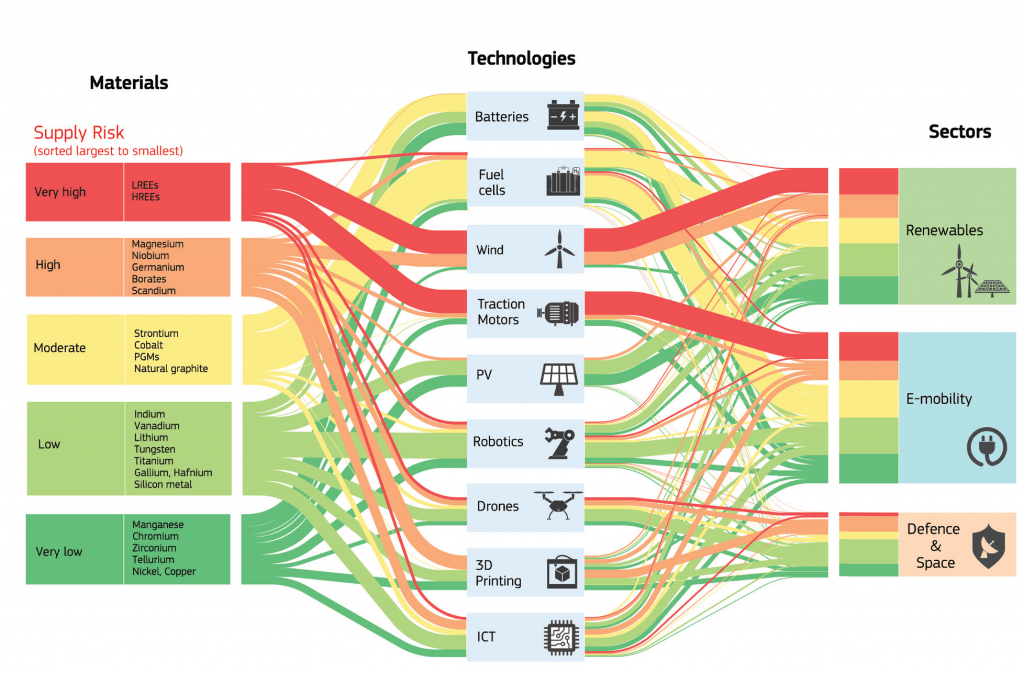
These metals aren’t just critical to the military-industrial complex but also the ‘green’ energy transition. 

Here’s a breakdown of rare earth metals used in US defense weapons. 

On Wednesday, former vice-minister of commerce Wei Jianguo spoke to state media China Daily and said Beijing has plenty of tools for countermeasures if the Biden administration continues to ramp up technology restrictions. He said the decision to restrict the export of gallium and germanium would “cause panic in certain countries, but also exert heavy pain in them.” 

Wei said: “This is just the beginning of China’s countermeasures, and China’s toolbox has many more types of measures available. If the high-tech restrictions on China become tougher in the future, China’s countermeasures will also escalate.”

The Pentagon and the military-industrial complex should secure rare earth metal supply chains before trying to start the next world war. 

Tyler Durden
Fri, 07/07/2023 – 08:20

Rising Liquidity Points To Yield-Curve Trend Change

Rising Liquidity Points To Yield-Curve Trend Change

Authored by Simon White, Bloomberg macro strategist,

Increasing excess liquidity indicates that the nascent steepening in the 3-month vs 10-year yield curve will continue.

The yield curve in this cycle has wrong-footed many in the depth and persistence of its inversion.

We have to go back to the early 1980s to see a curve this inverted.

The 3m-10y yield curve has shown tentative signs of bottoming in the last two months – with today’s ADP jobs data adding to steepening pressure – and the rise in excess liquidity posits it should keep steepening.

There have been a few false starts, where it looked like the curve was durably steepening, only for the Fed to renew its hawkish credentials. However, this time we have seen a pronounced upturn in excess liquidity which has often preceded yield-curve steepenings.

How might the curve steepen? Rate cuts (or their expectation) are usually the way, but they are becoming less likely.

The jobs market so far (at least based on the surface data, subject to revision) has held up well enough to keep the Fed in play. Not enough economic weakness could be seen before inflation re-accelerates again which I think it will do, as soon as in six months.

If that is the case, and price growth starts rising again once the current disinflation impulse peters out, term premium looks exposed to re-pricing higher, as bond holders demand extra compensation for inflation that – contrary to expectations – is not over.

Term premium has been surprisingly subdued despite the highest inflation in decades, as the market believes (for now) the Fed will ultimately rein it in.

Yet implied term premium from forecasters is already considerably higher than term premium itself.

If it were to match implied values, the 3m-10y yield curve would be at least 100 bps steeper, all other things equal, corroborating the message from excess liquidity that the curve’s trend has changed.

Tyler Durden
Fri, 07/07/2023 – 08:00

The Supreme Court Could Stop The SEC’s War On Crypto

The Supreme Court Could Stop The SEC’s War On Crypto

Authored by J.W. Verret via CoinTelegraph.com,

Neil Gorsuch, Brett Kavanaugh and Amy Coney Barrett are among a group on the Supreme Court who may not smile upon the SEC’s interpretation of the law…

When the leaders of the American Revolution signed the Declaration of Independence on July 4, 1776, they had no guarantee of victory. The battle for independence was underway, and their prospects were uncertain. Despite occasional victories, these audacious freedom fighters were grossly outnumbered and had difficulty retaining volunteer soldiers. Their commitment to the cause of freedom was their only fighting chance.

Cryptocurrency as an open-source software industry is in a similar predicament. The United States Securities and Exchange Commission and banking regulators are trying to dismantle this budding industry, brandishing lawsuits and an intimidating array of regulatory measures designed to make compliance impossible.

Crypto’s fighting chance is embedded within the very words and legal principles put forth by America’s founders in the Constitution.

They designed the Constitution on the principle of the separation of powers inspired by the Enlightenment.

Their vision was of a system with three separate but coequal branches of government, each acting as a safeguard against the potential abuse of power by the others.

Coinbase stands at the vanguard in the modern battlefield of cryptocurrency as it stares down a lawsuit brought by the SEC. In June, the company delivered a declaration in response to the lawsuit that leans on the “major questions doctrine.” This essential legal principle holds agencies like the SEC accountable when they circumvent Congress’ role in our constitutional structure and manipulate vague and antiquated statutes for their own ends.

In recent landmark cases that curbed executive overreach in both the Obama and Biden administrations, the Supreme Court has underscored the importance of the major questions doctrine.

This doctrine underlines the crucial point that when agencies attempt to regulate questions of significant national or political importance, they must have explicit authorization from Congress.

This doctrine is not new nor untested.

When the Food and Drug Administration (FDA) attempted to regulate cigarettes, justifying action by defining them under the FDA’s authority over drugs, the Supreme Court struck down the agency’s overreach. The court pointed out that nicotine, while technically a drug, did not fall under the palliative class of drugs Congress had intended when creating the FDA.

A similar verdict was reached regarding the Environmental Protection Agency’s (EPA) attempt to regulate carbon emissions. The EPA was prevented from broadening its mandate over power plant pollution to set a national policy on carbon emissions, which was beyond its remit and would usurp the role of the legislature.

The Supreme Court’s decision striking down Biden’s student loan forgiveness program is the most recent invocation of the major questions doctrine. Coinbase general counsel Paul Grewal astutely observed that one could substitute crypto for student loans in the court’s ruling and envision a similar outcome.

SEC Chairman Gary Gensler’s apologists argue that the securities laws from the 1930s have successfully adapted to the internet era, hence they can adapt to crypto as well. This argument would carry weight if the SEC made similar adaptations to crypto as they did to the internet.

Over the years, the SEC has proven its capacity to evolve, allowing prospectus delivery over the internet and sanctioning executive communications through social media. But when it comes to crypto, the SEC stubbornly insists that developers must comply with laws that, without nuanced adaptation, are impossible to adhere to.

This grudging approach of “just come in and register” while blatantly ignoring the numerous questions raised in Coinbase’s 2022 request for rulemaking is exactly why the major questions doctrine — as interpreted by Justices Neil Gorsuch, Brett Kavanaugh and Amy Coney Barrett — is so relevant to the SEC’s approach to crypto regulation. The doctrine acts as a constitutional compass, guiding the direction of authority, and restraining overreach by various agencies.

The framers of the Constitution left us an arsenal of tools to wage a revolution for freedom within the design of the U.S. Constitution. Legal scholars and constitutionalists, including Gorsuch, are reviving the founders’ vision of a delicate balance of power among the three branches with the major questions doctrine.

Crypto defendants, such as Coinbase, Ripple and Binance, are pioneering a revolution of their own. They are at the forefront of a movement aiming to decentralize power, shifting it from centralized institutions to the hands of individuals. In their struggle, they are armed with the very same tools our founders used to shape this nation.

There’s a striking parallel between our founders’ fight for political freedom and the current struggle for financial freedom in the digital realm. The underpinnings of both these movements are deeply rooted in a quest for autonomy and liberty.

Tyler Durden
Fri, 07/07/2023 – 06:30