

73.1 F
Chicago
Saturday, August 22, 2026
Home Blog Page 3553

“Angry” Biden To Use Higher Education Act To Circumvent Supreme Court Student Debt Ruling

“Angry” Biden To Use Higher Education Act To Circumvent Supreme Court Student Debt Ruling

President Joe Biden on Friday announced that he would be using a ‘new path’ to ease the burden of student loans through the Higher Education Act, after the Supreme Court found his original debt forgiveness plan unconstitutional.

Watch the entire speech below:

*  *  *

Update (1305ET): Reacting to today’s Supreme Court decision striking down his illegal student loan vote-buying scheme, President Biden(‘s team) tweeted: “Unthinkable. This fight isn’t over. I’ll have more to announce when I address the nation this afternoon.”

Except…

*  *  *

In a largely anticipated decision, the Supreme Court on Friday ruled in two separate cases that the Biden administration exceeded its authority with its $400 billion student loan forgiveness plan. The court ruled 6-3 along ideological lines.

The first case, Department of Education v. Brown, was brought by two student loan borrowers who didn’t qualify for relief sued to vacate the program on the basis that Biden’s invocation of the post-9/11 HEROES Act constitutes executive overreach. The Court ruled unanimously that the borrowers did not have standing to sue – but that the Biden administration also doesn’t have the authority to forgive the debt.

“The HEROES Act allows the Secretary to ‘waive or modify’ existing statutory or regulatory provisions applicable to financial assistance programs under the Education Act, but does not allow the Secretary to rewrite that statute to the extent of canceling $430 billion of student loan principal,” reads the opinion.

Proponents of cancellation have warned of dire consequences, such as Persis Yu – deputy executive director of the Student Borrower Protection Center.

“If payments are to resume without cancelation, we can expect a tremendous increase in defaults and forbearance,” said Yu, adding “There absolutely must be a plan to avoid the economic devastation.”

Writing the dissent was Justice Elena Kagan, who said the court was making national policy in place of Congress and the executive branch.

“Congress authorized the forgiveness plan (among many other actions); the Secretary put it in place; and the President would have been accountable for its success or failure,” she wrote. “But this Court today decides that some 40 million Americans will not receive the benefits the plan provides, because (so says the Court) that assistance is too ‘significant.’”

The challenge to the student loan program was brought by Republican-led states in one case, and two individuals from Texas in another. In both cases, the Justice Department questioned whether the plaintiffs had legal standing to file their suits.

To qualify to challenge the loan-forgiveness effort, the plaintiffs must show they have suffered a specific, rather than generalized, injury that can be remedied by relief from a federal court. It is not enough just to object to the size of the program or even to allege that the president has exceeded his authority.

A panel of the U.S. Court of Appeals for the 8th Circuit gave the states a toehold to continue their litigation, finding that the Missouri Higher Education Loan Authority, a quasi-independent entity, could suffer losses from the program change that would hurt Missouri, one of the challenger states. A different court said the two borrowers, Myra Brown and Alexander Taylor, have standing to proceed because Taylor doesn’t qualify for $20,000 of forgiveness, while Brown is ineligible altogether. –WaPo

Who will be most affected?

According to the Wall Street Journal, citing a Wells Fargo report, typical student loan payments will be between $210 and $314 per month once payments resume.

Overall, more than 40 million borrowers would have qualified for loan forgiveness through a required application. Before legal challenges halted the plan, borrowers in every state were approved for loan cancellation. Big states such as California, Texas, Florida and New York had the most approvals overall. The District of Columbia had the most approvals in proportion to its adult population, followed by Georgia and Ohio.

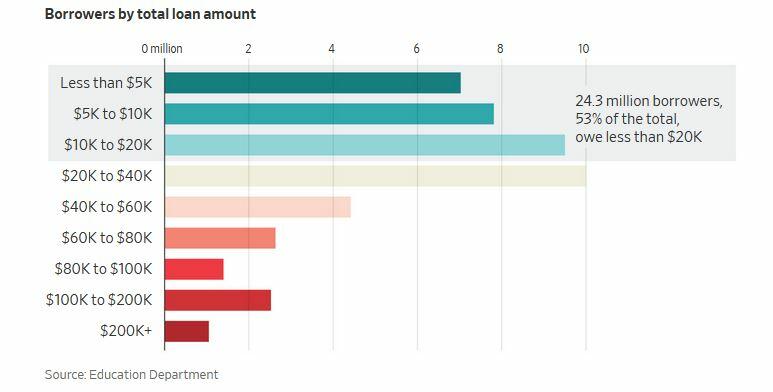
According to the Department of Education, over 43 million people collectively owe $1.6 trillion in student-loan debt. These loans include Direct Loans, Federal Family Education Loans and Perkins Loans. Around half of these borrowers owe less than $20,000.
When broken down by age, borrowers 24 and younger owe $103.4 billion in federal student-loan debt. Less than 4% owe over $40,000. The largest cohort of borrowers is those aged 25-34, of which nearly a quarter owe more than $40,000. Of those aged 35-49, more than 1/3 owe more than $40,000.

By race, around 30% of black households had student-loan debt in 2019, vs. around 20% of white households and 14% of hispanic households.

By household net worth, of those who are in the bottom 25%, more than 1/3 hold student debt, vs. 6% of those in the top 10%, per the Federal Reserve.

As noted last week at Real Clear Education, the administration’s plan to transfer up to $20,000 in student loan debt per borrower – from individuals who voluntarily took out loans to finance their college education to unsuspecting taxpayers – was one of the most audacious examples of executive overreach in American history.

Despite its $400 billion price tag, the action is only a small piece of the administration’s strategy to create a massive new public subsidy for higher education. A cynic might wonder whether the headline-grabbing but legally dubious bailout now before the Court was conceived as a decoy to distract public attention from the real centerpiece of the debt-transfer agenda.

With public attention focused on the blanket forgiveness plan (and the pleas of those demanding more), the Department of Education was busy crafting an ambitious plan to bail out future borrowers in perpetuity by changing the rules governing income-driven repayment.

Currently, multiple income-based repayment programs exist. All would cap the payments of enrollees at a percentage of their current income and then wipe away debt that remains after many years of repayment. When income-based repayment plans are designed properly, they align the timing of repayment with career earnings trajectory, such that borrowers pay the loans back faster as their incomes increase. (It is reasonable for doctors with very large loans to have smaller payments in their residency years when salaries are modest).

*  *  *

As we also noted last week, the restart of student loan payments is expected to slash household spending by $15.8 billion each month.

According to Barclays economist Adrienne Yih, the bank estimates a potential aggregate $15.8bn monthly headwind – or $190 billion per year – to US spending as the average student debt holder sees an incremental monthly payment of ~$390 beginning this fall. This represents an ~8% headwind to monthly personal income, affecting 16% of the US population, and adding pressure to not just consumer discretionary and apparel, but all retail spending.

The analysis is based on federal student loan data for the aggregate $1.4 trillion balance across the 40.5mn borrowers by age cohort. Utilizing a 10-year payment period and a 5.8% interest rate, the bank calculates an approximate $390/month payment across cohorts.

Compared to a median pre-tax personal annual income of ~$57k, this payment represents an approximate 8% headwind to monthly income. In aggregate, this amounts to an “additional” (or rather, original, as the payments were there and then three years ago, they just stopped) $15.8bn in monthly payment for federal student loans affecting approximately 15.5% of the U.S. adult population (and 32% of the 25- to 34-year-old cohort).

As an aside, Barclays’ monthly estimate of $15.8bn in incremental payments is conservative as the analysis only takes into account federal student debt (Direct Loans), which is 87.2% of total student debt.

Estimated spending impact to consumer discretionary

  • Based on our analysis, the Barclays economists estimate the total impact from the resumption of federal student loans to consumer discretionary spend to be ~$15.8bn (monthly), derived by aggregating the total cost among all Federal loan holders and the Federal loan repayments.

Next, the economists calculated the total percentage of the adult U.S. population that will be impacted by the resuming of Student Loan Repayment (using U.S. Census estimates as of 2022 to calculate the total population size vs. the total amount of recipients of Federal Student Loans, and then further disaggregated that by age group). Based on calculations, 15.5% of the adult (18+) US population will be effected and will need to resume paying their student loans, with an outsized impact among the 25-34 year old cohort (32%)

In short, expect Biden’s 2024 platform – should he make it through Huntergate – to rely on blaming the ‘MAGA Supreme Court’ for going against his vote-buying scheme.

Tyler Durden
Fri, 06/30/2023 – 16:17

Nasdaq Soars To Best H1 In 40 Years; Yield Curve Crashes To ‘Most Inverted’ Ever

Nasdaq Soars To Best H1 In 40 Years; Yield Curve Crashes To ‘Most Inverted’ Ever

The last month has seen a massive divergence between macro data reported in US and Europe (the latter collapsing as the former accelerates). The Global Macro surprise index, however, fell back into negative territory…

Source: Bloomberg

In fact, Q2 saw the biggest collapse in Europe’s macro data on record…

Source: Bloomberg

The gap between US and European macro is dramatic, but we note this has tended not to be a ‘decoupling’ but a lead-lag series (so either US is about to serially disappoint, or Europe is set to soar versus expectations)…

Source: Bloomberg

Just one thing though – while the macro surprise index is ‘relative to expectations’, the Leading Economic Indicators signal has been contracting for a year and screaming recession

Source: Bloomberg

Amid those macro moves, rate-change expectations are shockingly close to unchanged on the year – despite the massive dovish shift after the SVB collapse (and on the May FOMC 25bps hike). Since then the hawks are back in control, pricing in no rate-cuts to year-end…

Source: Bloomberg

However, none of that macro malarkey matters to the equity markets where Nasdaq (led by the magnificent seven… or just AAPL) surged in H1. The Dow was H1’s laggard, up a mere 3.9%…

Source: Bloomberg

The Nasdaq Composite rose around 31% in the first half of 2023 – its biggest H1 gain since 1983 (outpaced only by the even more concentrated Nasdaq 100 which rose 37% – its best H1 ever). Last year was the second worst H1 in history and this year is the 3rd best ever for the composite…

The median US stock rose 6% in H1 (based on the ValueLine Geometric Index)…

Source: Bloomberg

Nasdaq 100 has been green in July for 15 consecutive years with an avg return of +4.64%…

Source: Bloomberg

The first 15 days of July have been the best two-week trading period of the year since 1928. Since 1928, July 3rd has the highest hit rate for the S&P of positive returns (72.41%), followed July 1st (72.06%)

Tech and Discretionary stocks outperformed dramatically in H1 while Energy and Utilities tumbled…

Source: Bloomberg

H1 2023 saw the biggest outperformance of Growth over Value since H1 2020, completely decoupling from the yield curve…

Source: Bloomberg

Before we leave equity-land, we would be remiss to not note the fact that Apple is once again a $3 trillion market cap company… to the f**king moon , Alice!!

Source: Bloomberg

But there is one thing…

Source: Bloomberg

Equities decoupled from the credit market in Q2…

Source: Bloomberg

Valuations are getting stretched…

Source: Bloomberg

US Treasuries are very mixed in H1 with the short-end monkey-hammered over 40bps higher in yield while the 30Y yield is down over 10bps…

Source: Bloomberg

The yield curve crashed lower in Q2, flattening to its most inverted quarterly close ever

Source: Bloomberg

The dollar ended the month lower, and quarter flat, and down modestly year-to-date. Bloomberg’s Dollar Index has basically traded sideways in a small range since Q4’s big drop…

Source: Bloomberg

Bitcoin rallied to its best H1 since 2019, up over 80% to $31,000; with Ethereum up over 60%…

Source: Bloomberg

Commodities are down for the 4th quarter of the last 5…

Source: Bloomberg

Oil fell for the 2nd quarter in a row while gold managed gains in H1. NatGas was clubbed like a baby seal in H1…

Source: Bloomberg

Gold has fallen for the last two months, after tagging near record highs over $2000 (and was down 2.5% in Q1), but for now is holding above $1900

Source: Bloomberg

The bulk of Nattie’s decline was early in the year and in fact it has been rising recently – though for context, well off post-Putin highs…

Source: Bloomberg

We also note that the EU-US arb is back within its long-run historical range as European NG collapsed even more than US NG in H1…

Source: Bloomberg

Finally, H1 2023 rings a very loud bell with H2 2021 for tech…

Source: Bloomberg

What happens next with the AI-boom?

Perhaps the oldest adage on Wall Street is not to fight the Fed, but as Warren Buffett is fond of saying, “What we learn from history is that people don’t learn from history.”

Tyler Durden
Fri, 06/30/2023 – 16:00

France Deploys ‘Armored Military Vehicles’ To Combat Nationwide Riots

France Deploys ‘Armored Military Vehicles’ To Combat Nationwide Riots

Update (1545ET):

There are reports of “Tactical units driving through the streets of Marseille.” 

What the Twitter user is saying above lines up with France 24’s report:

Maybe this is why France needs military vehicles on the streets of Paris. 

Is France a third-world country? 

*   *   * 

Update (1235ET):

President Emmanuel Macron’s government struggles to contain social unrest across the country. 

French interior minister, Gérald Darmanin, said overnight chaos has resulted in 2,000 cars burned, 500 buildings damaged, hundreds of businesses looted, and violent clashes with police. He said over 800 people were arrested, with nearly 250 officers injured. 

Earlier, Macron blamed social media for fueling ‘copycat violence,’ and said state agencies would ask Twitter, Snapchat, and Tiktok to ban the most “sensitive content.” 

Riots and vandalism continued throughout the day Friday. Darmanin said buses and trams would be shut down by 9 pm local time nationwide to suppress the overnight unrest. 

Here are more scenes of the chaos:

*   *   * 

The police killing of a 17-year-old during a traffic stop on Tuesday has unleashed three consecutive days of social unrest across France. 

Bloomberg reports more than 600 people were arrested Thursday night into Friday, with a majority of them between the ages of 14 and 18. 

Rioters targeted municipal buildings, town halls, and libraries in various major cities, stores were looted, and all hell broke out nationwide as the government deployed 40,000 police officers yesterday afternoon to quell the violence. About 200 officers were injured overnight in the Paris suburb of Nanterre, where the teen was killed. 

The unrest is so bad that President Emmanuel Macron left an EU summit in Brussels, where he will hold another emergency security meeting Friday, AFP reported, citing his office. 

Video and pictures on social media of the rioting are absolutely shocking. 

If Macron wants to get a grip on the violence, he might have to declare an emergency. Fox News said the president has been close to announcing one but has stopped short. 

“Nothing justifies the violence that’s occurred,” said Prime Minister Élisabeth Borne. 

Borne is correct. Looting stores and burning buildings isn’t a typical response for those grieving over the death of a young man killed by police. France is supposedly a first-world country with a law and judicial system that will ensure justice will be served. 

We must ask critical questions, perhaps some that will trigger mainstream journos, of who exactly is sparking these riots. If it’s organized crime gangs, migrants, or just teenagers. 

Tyler Durden
Fri, 06/30/2023 – 15:45

Watch: Biden Wanders Off Set Of Softball Interview After Claiming There Was A Civil War In 1960

Watch: Biden Wanders Off Set Of Softball Interview After Claiming There Was A Civil War In 1960

Authored by Steve Watson via Summit News,

Joe Biden slurred his way through train wreck of an interview Thursday, claiming there was a civil war in the U.S. in 1960 and mixing up the Constitution and the Declaration Of Independence before wandering off the set like a lost Alzheimer’s sufferer.

During the 20 minute MSNBC interview, Biden essentially repeated everything host Nicolle Wallace said.

Unsurprisingly Wallace failed to ask a single question about the massive bribery scandal Biden is alleged to have overseen, including being present when his own son shook down a Chinese Communist Party businessman.

At one point Biden told that completely made up story he always uses about becoming a lecturer at the University of Pennsylvania.

He then declared that the Constitution says ‘We hold these truths to be self-evident, that all men are created equal…’ and claimed there had been a civil war in 1960.

Biden then doddered off the set before they went to commercial:

Maybe he needed to get back to the respiratory device that’s keeping him alive.

White House Admits Biden Uses A Respiratory Device After Indentations Seen On His Face

How is this guy in any shape to be President now, let alone for another five years?

Poll: More Than Two Thirds Of Voters, 43% Of Democrats Say Biden Not Physically Or Mentally Fit Enough

*  *  *

Brand new merch now available! Get it at https://www.pjwshop.com/

In the age of mass Silicon Valley censorship It is crucial that we stay in touch. We need you to sign up for our free newsletter here. Support our sponsor – Turbo Force – a supercharged boost of clean energy without the comedown.

Also, we urgently need your financial support here.

Tyler Durden
Fri, 06/30/2023 – 15:40

University Creates Language Guide That Erases ‘Man’ And ‘Mother’ From Existence

University Creates Language Guide That Erases ‘Man’ And ‘Mother’ From Existence

Authored by Steve Watson via Summit News,

The University of North Carolina (UNC) has shared an ‘inclusive’ language guide, laying out guidelines for what students and staff are and are not allowed to say.

The guide essentially wipes the word ‘man’ out of existence, and discourages the use of the words ‘mother’ and ‘father’.

A statement from the university claims “Carolina is committed to creating an inclusive and equitable learning environment for every Tar Heel. To fully represent the diversity of our students, faculty, staff and everyone in our community, it is important to use language that supports these values.”

It continues, “This inclusive language guide can act as a starting point for communicating in a way that supports a diverse and welcoming community.”

Here’s what’s not allowed:

Any word with ‘man’ in it is consigned to the dustbin.

Furthermore… Don’t say ‘mom’, say ‘guardian’.

And don’t say ‘poor’, say “people whose incomes are below the federal poverty threshold.”

There are a lot of rules here…

Remember that there is also romantic orientation as well, except is you’re ‘aromantic’:

This lunacy is gong on all over the country and it’s spilling out of woke education into the real world.

Video: Stanford University Wants The Word ‘American’ Added To A ‘Harmful Language’ List

Report: Biden Admin Funds AI To Police Online Language

Woke Tech Company Seeks To “Replace” ‘Violent’ Language

Report: Google Rolls Out Feature That Corrects You With Woke ‘Inclusive’ Language

“Harmful Language” Trigger Warning Added to US Constitution on National Archives Website

University Bans The Phrase “Trigger Warning” Because It Might Be… Triggering

*  *  *

Brand new merch now available! Get it at https://www.pjwshop.com/

In the age of mass Silicon Valley censorship It is crucial that we stay in touch. We need you to sign up for our free newsletter here. Support our sponsor – Turbo Force – a supercharged boost of clean energy without the comedown.

Also, we urgently need your financial support here.

Tyler Durden
Fri, 06/30/2023 – 13:40

Outrage As Planned Parenthood Declares Virginity “A Social Construct”

Outrage As Planned Parenthood Declares Virginity “A Social Construct”

Authored by Steve Watson via Summit News,

Planned Parenthood has received backlash after posting a tweet declaring that virginity is “outdated” and “hurts everyone.”

The post featured a billboard with a further declaration “Virginity is a social construct,” and claiming that the concept of virginity is a “patriarchal’ way of thinking:

The organisation has pushed this idea for a while now…

Twitter, do your thing…

Same people

*  *  *

Brand new merch now available! Get it at https://www.pjwshop.com/

In the age of mass Silicon Valley censorship It is crucial that we stay in touch. We need you to sign up for our free newsletter here. Support our sponsor – Turbo Force – a supercharged boost of clean energy without the comedown.

Also, we urgently need your financial support here.

Tyler Durden
Fri, 06/30/2023 – 13:00

Toxic Wildfire Smoke Blankets Ten States As Independence Day Weekend Begins

Toxic Wildfire Smoke Blankets Ten States As Independence Day Weekend Begins

As the Fourth of July weekend approaches, tens of millions of Americans are heading off today to either sandy beaches or resort communities in the mountains. Some folks are staying home or traveling short distances because ‘Bidenomics’ has miserably failed and bankrupted mid/low-tier households who can no longer afford an Airbnb or hotel in a resort area. But the one thing in common that millions across the Mid-Atlantic and up and down the Northeast regions are all experiencing into the holiday weekend is the lingering wildfire smoke from Canada. 

The National Weather Service issued air quality alerts over parts of the Midwest, Great Lakes, central Appalachians, Northeast, and Mid-Atlantic through the weekend. 

“Canadian wildfire smoke is expected to continue impacting portions of the northeastern quadrant of the U.S. over the next few days,” NWS wrote in a Friday morning update

NWS had some good news: “However, air quality is expected to slowly improve due to a combination of thunderstorm activity and dispersion of the smoke as we head into the weekend.” 

Still, toxic air quality alerts stretch from Michigan to Ohio, West Virginia to Pennsvyina to Maryland, Washington, DC, Virginia, Delaware, New Jersey, New York, and into the lower New England area. 

The unhealthy air is terrible for people with heart or lung disease, older adults, children, and teens. Pittsburgh had the worst air quality this morning. 

Instead of blaming ‘climate change’ for everything… Maybe Canada’s 500 raging wildfires have resulted from bad fire management over the last few decades. Plus, it’s an El Nino year… 

Tyler Durden
Fri, 06/30/2023 – 12:40

Europe’s Large Caps Are Outperforming the S&P 500

Europe’s Large Caps Are Outperforming the S&P 500

By Ksenia Galouchko, Bloomberg Markets Live reporter

European equities are broadly falling behind this year’s powerful rally in the US market, but a deeper dive shows that the region’s blue-chip stocks can help investors outperform the S&P 500.

With mounting recession fears and still hawkish central banks, some European stocks may be better positioned than others for a bumpy ride in the second half of the year. Among investor favorites are defensives, as well as companies with strong fundamentals.

The Euro Stoxx 50 gauge of large caps has climbed 14.8% this year, beating both the Stoxx 600 and the S&P 500. While sector gains in the broader European gauge have been led by travel and retail, corporate heavyweights like LVMH, ASML and SAP have contributed the most to its advance, signaling favor for safer bets.

Betting on quality and high-growth companies with strong pricing power in Europe has helped Comgest Growth Europe gain a 17% total return so far in 2023 including reinvested dividends, according to Alistair Wittet, one of the fund’s managers. The fund, whose top holdings include ASML, Novo Nordisk and LVMH, has beaten 97% of peers this year, according to data compiled by Bloomberg.

Luxury companies like LVMH, L’Oreal and Ferrari are among the top gainers in Europe this year. While Chinese demand — a key driver — has been uneven, Wittet says their high margins, strong pricing power and wealthy consumers’ resilience to downturns will allow them to maintain market leadership. The stocks are also less rate-sensitive, given low debt and high free cash flow levels.

A factor in Europe’s favor is that gains are distributed more broadly than in the US, making the broader market less vulnerable to selloffs in a particular sector or group. While 15 of the biggest companies have driven 86% of the returns in the US stock market, the same number of stocks in Europe have accounted for just 39%, according to Goldman Sachs strategists.

The more diverse sectoral exposure protects the European stock market from a sudden selloff in case tech shares fall out of favor, says Lode Devlaminck, managing director for equities at DuPont Capital. He has a preference for European equities over the US due to cheaper valuations and lower market expectations.

The question investors are asking is whether the gains in bigger companies can expand to the rest of the market or if large caps will succumb to recession fears that have been pressuring smaller peers. According to Goldman strategists, when European stocks rally with narrow leadership, the subsequent 12-month returns for the aggregate index are positive in more than two-thirds of the instances.

For the broader European market, headwinds remain. Weakening activity data and a technical recession in Germany have fueled an unwinding of bullish positions in European stocks and there may be more redemptions to come, says Barclays strategist Emmanuel Cau. The bank notes that Europe was the only major equity region to see fund outflows in June.

“If the second half of the year proves to me more challenging than the first half of the year because inflation stays stubbornly high or because interest rates continue to rise, or because the economy weakens, we think these businesses will prove resilient in that environment,” Comgest’s Wittet said, highlighting quality stocks.

Tyler Durden
Fri, 06/30/2023 – 12:20

$15BN US Arms Sale To Poland Amid Continued NATO ‘Eastern Flank’ Build-Up

$15BN US Arms Sale To Poland Amid Continued NATO ‘Eastern Flank’ Build-Up

Authored by Kyle Anzalone via The Libertarian Institute, 

The State Department announced it authorized selling $15 billion in advanced air defense systems to Poland. The deal comes as Washington wants to increase NATO’s military presence in Eastern Europe. 

A press release distributed by the State Department on Wednesday says, “This proposed sale will support the foreign policy goals and national security objectives of the United States by improving the security of a NATO Ally that is a force for political stability and economic progress in Europe.”

US and NATO leaders argue the alliance must build up its military presence in countries that border Russia to deter President Vladimir Putin’s desire to expand his nation’s border.

The US press release stated further, “Poland will use the IBCS-enabled Patriot missile system to improve its missile defense capability, defend its territorial integrity, and deter regional threats.”

“The proposed sale will increase the defensive capabilities of the Polish Military to guard against hostile aggression and shield the NATO allies who often train and operate within Poland’s borders,” the readout continued. “Poland will have no difficulty absorbing this system into its armed forces.”

However, Moscow has not indicated it plans to expand its border beyond eastern Ukraine, where the Russian military has struggled to secure territory annexed by the Kremlin.   

The sale is for an estimated $15 billion in Patriot air defense systems, radars, and communications equipment.

The primary contractors are Raytheon and Lockheed Martin. Raytheon has been accused of price gouging the Pentagon for Patriot intercepts. Secretary of Defense Lloyd Austin was a board member at the arms manufacturer before becoming the Pentagon chief. 

After Russia invaded Ukraine last year, Washington and Brussels demanded NATO members increase military spending. The increase in defense budgets has been a boon to the weapons industry in the US.

Tyler Durden
Fri, 06/30/2023 – 12:00

Supreme Court Strikes Down Student Loan Relief — Here’s Who’s Most Affected

Supreme Court Strikes Down Student Loan Relief — Here’s Who’s Most Affected

In a largely anticipated decision, the Supreme Court on Friday ruled in two separate cases that the Biden administration exceeded its authority with its $400 billion student loan forgiveness plan. The court ruled 6-3 along ideological lines.

The first case, Department of Education v. Brown, was brought by two student loan borrowers who didn’t qualify for relief sued to vacate the program on the basis that Biden’s invocation of the post-9/11 HEROES Act constitutes executive overreach. The Court ruled unanimously that the borrowers did not have standing to sue – but that the Biden administration also doesn’t have the authority to forgive the debt.

“The HEROES Act allows the Secretary to ‘waive or modify’ existing statutory or regulatory provisions applicable to financial assistance programs under the Education Act, but does not allow the Secretary to rewrite that statute to the extent of canceling $430 billion of student loan principal,” reads the opinion.

Proponents of cancellation have warned of dire consequences, such as Persis Yu – deputy executive director of the Student Borrower Protection Center.

“If payments are to resume without cancelation, we can expect a tremendous increase in defaults and forbearance,” said Yu, adding “There absolutely must be a plan to avoid the economic devastation.”

Who will be most affected?

According to the Wall Street Journal, citing a Wells Fargo report, typical student loan payments will be between $210 and $314 per month once payments resume.

Overall, more than 40 million borrowers would have qualified for loan forgiveness through a required application. Before legal challenges halted the plan, borrowers in every state were approved for loan cancellation. Big states such as California, Texas, Florida and New York had the most approvals overall. The District of Columbia had the most approvals in proportion to its adult population, followed by Georgia and Ohio.

According to the Department of Education, over 43 million people collectively owe $1.6 trillion in student-loan debt. These loans include Direct Loans, Federal Family Education Loans and Perkins Loans. Around half of these borrowers owe less than $20,000.

When broken down by age, borrowers 24 and younger owe $103.4 billion in federal student-loan debt. Less than 4% owe over $40,000. The largest cohort of borrowers is those aged 25-34, of which nearly a quarter owe more than $40,000. Of those aged 35-49, more than 1/3 owe more than $40,000.

By race, around 30% of black households had student-loan debt in 2019, vs. around 20% of white households and 14% of hispanic households.

By household net worth, of those who are in the bottom 25%, more than 1/3 hold student debt, vs. 6% of those in the top 10%, per the Federal Reserve.

As noted last week at Real Clear Education, the administration’s plan to transfer up to $20,000 in student loan debt per borrower – from individuals who voluntarily took out loans to finance their college education to unsuspecting taxpayers – was one of the most audacious examples of executive overreach in American history.

Despite its $400 billion price tag, the action is only a small piece of the administration’s strategy to create a massive new public subsidy for higher education. A cynic might wonder whether the headline-grabbing but legally dubious bailout now before the Court was conceived as a decoy to distract public attention from the real centerpiece of the debt-transfer agenda.

With public attention focused on the blanket forgiveness plan (and the pleas of those demanding more), the Department of Education was busy crafting an ambitious plan to bail out future borrowers in perpetuity by changing the rules governing income-driven repayment.

Currently, multiple income-based repayment programs exist. All would cap the payments of enrollees at a percentage of their current income and then wipe away debt that remains after many years of repayment. When income-based repayment plans are designed properly, they align the timing of repayment with career earnings trajectory, such that borrowers pay the loans back faster as their incomes increase. (It is reasonable for doctors with very large loans to have smaller payments in their residency years when salaries are modest).

But the design principle should be that most loans are eventually paid off, including interest, except in cases of manifest hardship.

With its proposal to phase out several existing income-based repayment programs in favor of a much more generous version of a specific program called REPAYE (Revised Pay as You Earn), the Department of Education is abandoning this expectation to create an ongoing bailout.

REPAYE’s extravagant new terms are a bad deal for taxpayers. Undergraduate borrowers will be required to pay only 5% of their disposable income toward their student loan debt, with disposable income defined as income above 225% of the federal poverty line ($32,805 for an individual or $67,500 for a family of four). Balances will not grow when a borrower’s monthly payment is smaller than the interest accrued. (To accomplish this benefit, the Secretary of Education claims the power to cease charging interest owed to the U.S. Treasury.)

Tyler Durden
Fri, 06/30/2023 – 10:40
