More and more countries have aspired to belong to BRICS since 2009, but none from the West.
The BRICS countries represent 40% of the world population and 25% of the global GDP.
Thanks to BRICS, China can impose its vision of international cooperation and Russia can show that it will not be isolated on the stage of global players.
The group is a thorn in the side of the Americans all the more so that a dozen other developing countries (marked in orange on the map below) want to join the current five countries of the alliance (red).
Source: Silkroadbriefing
What America certainly doesn’t like is the fact that French President Macron communicated the other day his interest in attending meetings of the alliance. France in BRICS would be a trigger for profound changes in the geopolitical landscape. We bet that Turkey can also join soon, which, like the case of France, will weaken the importance of the UN as a purely Anglo-Saxon project and that of NATO. Indeed, the BRICS countries are against the UN’s attempts to link the issues of climate with the issues of security, and France in BRICS can return to the de Gaullean concepts of foreign policy outside NATO.
A challenge to cohesion in BRICS is the large disparity in countries’ capacities (in favor of China) and the members’ focus on cooperation with the PRC, which results in a smaller number of relationships among the other partners. However, the main factor that has weakened the BRICS in recent years is the deterioration of relations between the largest member states, China and India, since 2017. Border and trade disputes culminated in the clashes on the Ladakh border in June 2020, which almost led to the cancellation of the BRICS summit in the same year and prompted India to deepen cooperation with the United States and the EU.
Now, the West’s involvement in the war in Ukraine is reviving anti-Western sentiments, not only in the BRICS countries.
Indeed, it is clear to more and more countries that the war was provoked by NATO’s excessive expansion.
The BRICS politicians also want to fight inflation whose cause they perceive not in the Russian attack but in the Western sanctions.
Whether you are pro-Western, pro-Russian, or in favor of the New Silk Road, it is better for all of us to live in a multi-polar world rather than to have all the strings pulled on the Potomac.
Sens. Josh Hawley (R-Mo.) and Mark Braun (R-Ind.) are demanding that President Joe Biden’s administration provide more details about the origins of COVID-19 after releasing a 10-page report describing potential links between the origins of the virus and work at a Chinese virology laboratory in 2019.
In March, Congress passed, and Biden signed a law known as the COVID-19 Origin Act of 2023 that required the Biden administration to release “any and all information” relating to potential links between the Wuhan Institute of Virology (WIV) in Wuhan, China, and the origin of COVID-19. The law set a June 18 deadline to declassify and “make available to the public as much information as possible.”
Hawley and Braun sent a reminder letter to Biden on June 14, but his administration still missed the June 18 deadline to declassify and publicly release the COVID-19 origins documents. The Office of the Director of National Intelligence (ODNI) instead published a 10-page document (pdf) five days late on the evening of June 23.
The 10-page document included a one-page coversheet, a one-page table of contents, and a three-page appendix of terms used throughout the report. The five remaining pages of the report stated that the WIV worked “with several viruses, including coronaviruses, but no known viruses that could plausibly be a progenitor of SARS-CoV-2.”
The report also described how several WIV researchers fell ill in the fall of 2019 and said these researchers possessed some symptoms consistent with COVID-19 and some symptoms considered “not consistent” with COVID-19.
“The COVID-19 Origin Act calls for a full declassification, not Cliffs Notes to cover for [Dr. Anthony Fauci] and protect China,” Braun wrote in a Monday press statement.
“The report released today by the DNI is totally insufficient. The bill Senator Hawley and I passed was to ‘declassify *any and all* information relating to potential links between the Wuhan Institute of Virology and the origin of COVID-19’ including several specific requests related to researchers’ names and their activities at the Wuhan lab. Our bill was passed unanimously by a Democrat Senate and a Republican House and signed by President Biden.
“This 9 page DNI report is 5 pages of titles and dictionary definitions, with only 4 pages of actual information, most of which is vague or already reported. The report contains no actual documents. The American people deserve the facts, not more half truths and politics,” Braun added.
Braun and Hawley reiterated their disappointment in a letter to Avril Haines, who is Biden’s director of national intelligence.
“[The COVID-19 Origins Act] required the Director of National Intelligence to ‘declassify any and all information’ relating to links between the Wuhan Institute of Virology and the origin of COVID-19,” the senators wrote in a letter they first shared with Fox News.
“You failed to comply with both requirements. The deadline was June 18, 2023. Well past the statutory deadline, your office published a declassified report after business hours on June 23.”
Braun and Hawley concluded that ODNI “obviously” has more information about the origins of COVID-19 and the WIV than the five-page summary would suggest. They also accused the Biden administration of showing deference toward China.
“You—and the rest of the Administration—appear to be refusing to provide information about China’s role in and responsibility for the COVID-19 pandemic in order to avoid upsetting Beijing,” they wrote.
“We invite you to try again,” the senators added. “Within 7 business days, provide to Congress documentation that fully complies with the letter of the law to disclose ‘any and all information’ related to the origins of COVID-19 and a lab leak with minimal redactions.”
NTD News reached out to ODNI and the Biden White House for comment about Braun and Hawley’s letter, but neither office responded by the time this article was published.
Growing GOP Backlash to ODNI Report
House Intelligence Committee Chair Mike Turner (R-Ohio) and House Coronavirus Subcommittee Chair Brad Wenstrup (R-Ohio) called the June 23 ODNI report “a promising step toward full transparency.”
Following the release of the report, Turner and Wenstrup also concluded that “the Chinese Communist Party and the Chinese People’s Liberation Army have some serious explaining to do” regarding the research that had occurred at the WIV.
“This Friday night ‘news’ dump of a mere 10-page summary is a slap in the face of Americans who deserve full transparency about what information the government possesses regarding the origins of COVID-19,” said Rep. Cathy McMorris Rodgers (R-Wash.).
Rep. Mike Gallagher (R-Wis.), who sits on the House Intelligence Committee, said that the ODNI should have released details on the WIV researchers who fell ill in the Autumn of 2019. In fact, the COVID-19 Origin Act asks for the names of WIV researchers who fell ill in 2019, their symptoms, and their specific involvement in coronavirus-related work at the WIV.
“This DNI release does none of that and, in many ways, obscures more than it illuminates,” Gallagher said.
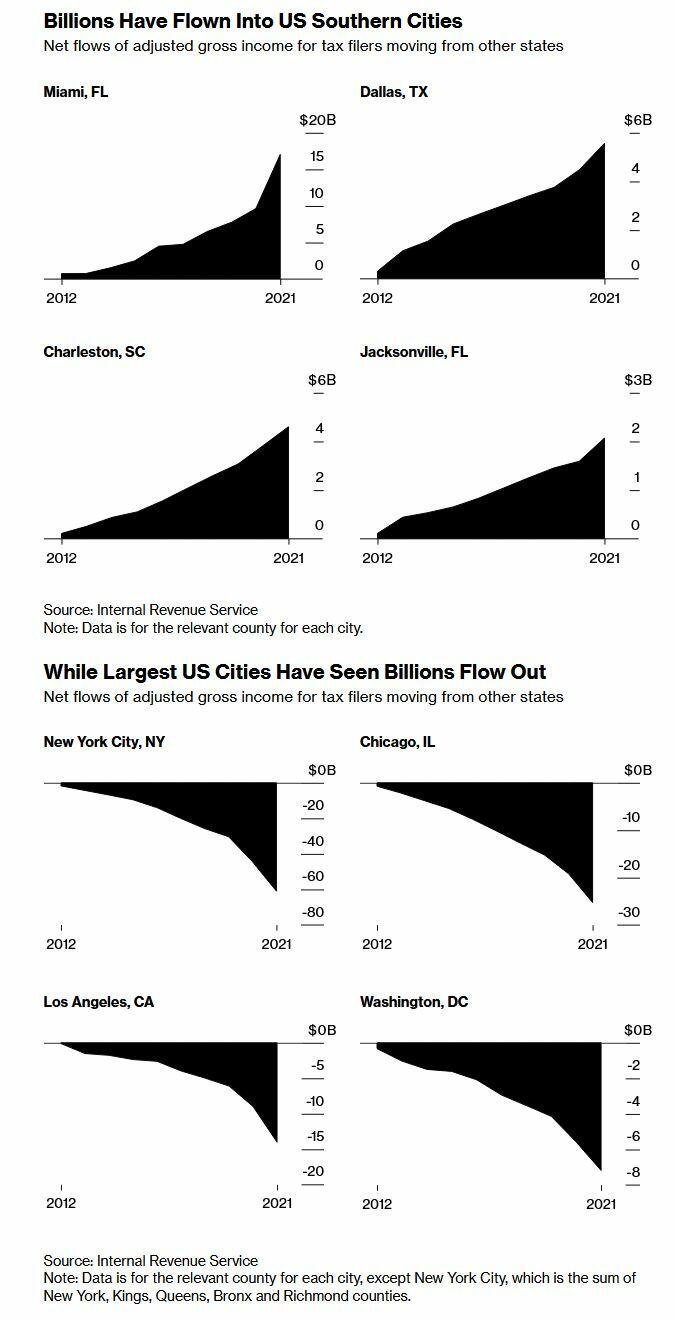
$100 Billion “Profound Economic Shift” Has Reshaped Southern US
Thanks to a flood of transplants during the pandemic, six southern states have been growing at breakneck speed – as approximately $100 billion in new income in 2020 and 2021 have begun to reshape the southern US.
To wit, Florida, Texas, Georgia, the Carolinas and Tennessee are now contributing more to the national GDP than the Northeast – which bled out about $60 billion during the same period, according to Bloomberg, citing government figures going back to thew 1990s.
“The switch happened during the pandemic and shows no signs of reverting,” write Bloomberg‘s Michael Sasso and Alexandre Tanzi.
Since early 2020, the Southeast has accounted for more than 2/3 of all job growth in the US, nearly doubling its pre-pandemic share, and making it home to 10 of the 15 fastest-growing large cities in America.
And as regular readers already know, corporations have also been flocking to the southern US, which (for now) enjoys a lower cost of living and a higher quality of life.
For example, Dun & Broadstreet, founded 182 years ago and up until recently headquartered in Short Hills, New Jersey, moved to Jacksonville, Florida in 2021 – in order to take advantage of a $100 million package of cash and tax incentives. D&B CFO Bryan Hipsher told Bloomberg that the company would have gladly stayed in the New York area, but the Florida offer was too good to refuse.
“You feel very wanted, right?” Hipsher told the outlet. “You feel very welcomed, clearly.”
The average employee here has an annual salary of $77,000, 25% above the national level, and well outstripping most local salaries. Still, many roles pay roughly 15% below the average at the former New Jersey headquarters.
Jacksonville grew so fast that it surpassed San Jose in population last year. Good schools, including University of Florida an hour and a half away, help provide a high-quality employee base, Hipsher said. Today the firm is still busy hiring — it’s a little less than halfway to its goal of 500 workers. -Bloomberg
Meanwhile, the Mayo Clinic’s Jacksonville branch is growing along with the city – with a new oncology building under construction, and the addition of 2,400 employees to bring the total in the area to 9,000 – part of the 2.2 million people who have migrated to Florida and across the Southeast over the past two years.
“You could throw a dart anywhere at a map of the South and hit somewhere booming,” said Mark Vitner, a retired longtime economist for Wells Fargo who now heads his own economic consultancy, Piedmont Crescent Capital, in Charlotte, North Carolina.
JPMorgan Chase CEO Jamie Dimon says the company now has more employees in Texas than New York state, telling Bloomberg TV “it shouldn’t have been that way.”
As far as the South Atlantic coast is concerned – including Charleston, SC, signs of explosive growth continue.
According to 47-year-old Beth Woods, who moved from Mount Olive NJ to the Charleston suburb of Mount Pleasant during the pandemic, life is much betternow.
“You could get your hair done, your nails done, you could basically live your life. And it has lower property taxes here, too,” she said.
59-year-old Rosemary Taibi concurred. She had her husband dropped their property taxes by $14,000 per year moving from Randolph, New Jersey.
“It’s a big difference,” she said.
The move has big political impacts as well.
For now, more people translate into more congressional seats and more political power on the national scene. Over the past five decades, 12 states in the Southeast including Texas collectively added 33 more congressional seats, roughly the same number that the Northeast and Midwest each lost over the same period.
And Southerners now chair 11 of the 21 most important committees in the US House, according to an analysis by Bloomberg Government.
At the 2022 midterm elections, Republican governors handily defeated nationally known Democratic opponents in Florida, Georgia and Texas, a blow to Democrats hoping that a more diverse mix of people moving south would turn the region purple, if not blue. That may still happen over the long term because shifting politics in states as big as Florida and Texas can take 10 or 20 years, said James Gimpel, government professor at the University of Maryland. -Bloomberg
According to Gimpel, it’s no surprise that so many top GOP candidates are based in the South – including Donald Trump, Ron DeSantis, Nikki Haley and Tim Scott.
Steven Hertzberg, a tech entrepreneur from Sonoma County, California, is in heaven in St. Johns County, Florida.
“Just drive around the neighborhoods here. It feels like you’re in Disneyland,” he said. “You see teenagers winging around in golf carts, electric scooters.”
This paper examines the likely trajectory of the Ukraine war moving forward.
I will address two main questions.
First, is a meaningful peace agreement possible?
My answer is no. We are now in a war where both sides – Ukraine and the West on one side and Russia on the other – see each other as an existential threat that must be defeated. Given maximalist objectives all around, it is almost impossible to reach a workable peace treaty. Moreover, the two sides have irreconcilable differences regarding territory and Ukraine’s relationship with the West. The best possible outcome is a frozen conflict that could easily turn back into a hot war. The worst possible outcome is a nuclear war, which is unlikely but cannot be ruled out.
Second, which side is likely to win the war?
Russia will ultimately win the war, although it will not decisively defeat Ukraine. In other words, it is not going to conquer all of Ukraine, which is necessary to achieve three of Moscow’s goals: overthrowing the regime, demilitarizing the country, and severing Kyiv’s security ties with the West. But it will end up annexing a large swath of Ukrainian territory, while turning Ukraine into a dysfunctional rump state. In other words, Russia will win an ugly victory.
Before I directly address these issues, three preliminary points are in order. For starters, I am attempting to predict the future, which is not easy to do, given that we live in an uncertain world. Thus, I am not arguing that I have the truth; in fact, some of my claims may be proved wrong. Furthermore, I am not saying what I would like to see happen. I am not rooting for one side or the other. I am simply telling you what I think will happen as the war moves forward. Finally, I am not justifying Russian behavior or the actions of any of the states involved in the conflict. I am just explaining their actions.
Now, let me turn to substance.
Where We Are Today
To understand where the Ukraine war is headed, it is necessary to first assess the present situation. It is important to know how the three main actors – Russia, Ukraine, and the West – think about their threat environment and conceive their goals. When we talk about the West, however, we are talking mainly about the United States, since its European allies take their marching orders from Washington when it comes to Ukraine. It is also essential to understand the present situation on the battlefield. Let me start with Russia’s threat environment and its goals.
Russia’s Threat Environment
It has been clear since April 2008 that Russian leaders across the board view the West’s efforts to bring Ukraine into NATO and make it a Western bulwark on Russia’s borders as an existential threat. Indeed, President Putin and his lieutenants repeatedly made this point in the months before the Russian invasion, when it was becoming clear to them that Ukraine was almost a de facto member of NATO.
Since the war began on 24 February 2022, the West has added another layer to that existential threat by adopting a new set of goals that Russian leaders cannot help but view as extremely threatening. I will say more about Western goals below but suffice it to say here that the West is determined to defeat Russia and knock it out of the ranks of the great powers, if not cause regime change or even trigger Russia to break apart like the Soviet Union did in 1991.
In a major address Putin delivered this past February (2023), he stressed that the West is a mortal threat to Russia. “During the years that followed the breakup of the Soviet Union,” he said, “the West never stopped trying to set the post-Soviet states on fire and, most importantly, finish off Russia as the largest surviving portion of the historical reaches of our state. They encouraged international terrorists to assault us, provoked regional conflicts along the perimeter of our borders, ignored our interests and tried to contain and suppress our economy.” He further emphasized that, “The Western elite make no secret of their goal, which is, I quote, ‘Russia’s strategic defeat.’ What does this mean to us? This means they plan to finish us once and for all.” Putin went on to say: “this represents an existential threat to our country.”
Russian leaders also see the regime in Kyiv as a threat to Russia, not just because it is closely allied with the West, but also because they see it as the offspring of the fascist Ukrainian forces that fought alongside Nazi Germany against the Soviet Union in World War II.
Russia’s Goals
Russia must win this war, given that it believes that it is facing a threat to its survival. But what does victory look like? The ideal outcome before the war began in February 2022 was to turn Ukraine into a neutral state and settle the civil war in the Donbass that pitted the Ukrainian government against ethnic Russians and Russian speakers who wanted greater autonomy if not independence for their region. It appears that those goals were still realistic during the first month of the war and were in fact the basis of the negotiations in Istanbul between Kyiv and Moscow in March 2022.
If the Russians had achieved those goals back then, the present war would either have been prevented or ended quickly.
But a deal that satisfies Russia’s goals is no longer in the cards. Ukraine and NATO are joined at the hip for the foreseeable future, and neither is willing to accept Ukrainian neutrality. Furthermore, the regime in Kyiv is anathema to Russian leaders, who want it gone. They not only talk about “de-Nazifying” Ukraine, but also “demilitarizing” it, two goals that would presumably call for conquering all of Ukraine, compelling its military forces to surrender, and installing a friendly regime in Kyiv.
A decisive victory of that sort is not likely to happen for a variety of reasons. The Russian army is not large enough for such a task, which would probably require at least two million men.
Indeed, the existing Russian army is having difficulty conquering all the Donbass. Moreover, the West would go to enormous lengths to prevent Russia from overrunning all of Ukraine. Finally, the Russians would end up occupying huge amounts of territory that is heavily populated with ethnic Ukrainians who loathe the Russians and would fiercely resist the occupation. Trying to conquer all of Ukraine and bend it to Moscow’s will, would surely end in disaster.
Rhetoric about de-Nazifying and demilitarizing Ukraine aside, Russia’s concrete goals involve conquering and annexing a large portion of Ukrainian territory, while simultaneously turning Ukraine into a dysfunctional rump state. As such, Ukraine’s ability to wage war against Russia would be greatly reduced and it would be unlikely to qualify for membership in either the EU or NATO. Moreover, a broken Ukraine, would be especially vulnerable to Russian interference in its domestic politics. In short, Ukraine would not be a Western bastion on Russia’s border.
What would that dysfunctional rump state look like? Moscow has officially annexed Crimea and four other Ukrainian oblasts – Donetsk, Kherson, Luhansk, and Zaporozhe – which together represent about 23 percent of Ukraine’s total territory before the crisis broke out in February 2014. Russian leaders have emphasized that they have no intention of surrendering that territory, some of which Russia does not yet control. In fact, there is reason to think Russia will annex additional Ukrainian territory if it has the military capability to do so at a reasonable cost. It is difficult, however, to say how much additional Ukrainian territory Moscow will seek to annex, as Putin himself makes clear.
Russian thinking is likely to be influenced by three calculations. Moscow has a powerful incentive to conquer and permanently annex Ukrainian territory that is heavily populated with ethnic Russians and Russian speakers. It will want to protect them from the Ukrainian government – which has become hostile to all things Russian – and make sure there is no civil war anywhere in Ukraine like the one that took place in the Donbass between February 2014 and February 2022. At the same time, Russia will want to avoid controlling territory largely populated by hostile ethnic Ukrainians, which places significant limits on further Russian expansion. Finally, turning Ukraine into a dysfunctional rump state will require Moscow to take substantial amounts of Ukrainian territory so it is well-positioned to do significant damage to its economy. Controlling all of Ukraine’s coastline along the Black Sea, for example, would give Moscow significant economic leverage over Kyiv.
Those three calculations suggest that Russia is likely to attempt to annex the four oblasts – Dnipropetrovsk, Kharkiv, Mykolaiv, and Odessa – that are immediately to the west of the four oblasts it has already annexed – Donetsk, Kherson, Luhansk, and Zaporozhe. If that were to happen, Russia would control approximately 43 percent of Ukraine’s pre-2014 territory.
Dmitri Trenin, a leading Russian strategist estimates that Russian leaders would seek to take even more Ukrainian territory – pushing westward in northern Ukraine to the Dnieper River and taking the part of Kyiv that sits on the east bank of that river. He writes that “A logical next step” after taking all of Ukraine from Kharkiv to Odessa “would be to expand Russian control to all of Ukraine east of the Dnieper River, including the part of Kyiv that lies on the that river’s eastern bank. If that were to happen, the Ukrainian state would shrink to include only the central and western regions of the country.”
The West’sThreat Environment
It might seem hard to believe now, but before the Ukraine crisis broke out in February 2014, Western leaders did not view Russia as a security threat. NATO leaders, for example, were talking with Russia’s president about “a new stage of cooperation towards a true strategic partnership” at the alliance’s 2010 Summit in Lisbon.
Unsurprisingly, NATO expansion before 2014 was not justified in terms of containing a dangerous Russia. In fact, it was Russian weakness that allowed the West to shove the first two tranches of NATO expansion in 1999 and 2004 down Moscow’s throat and then allowed the George W. Bush administration to think in 2008 that Russia could be forced to accept Georgia and Ukraine joining the alliance. But that assumption proved wrong and when the Ukraine crisis broke out in 2014, the West suddenly began portraying Russia as a dangerous foe that had to be contained if not weakened.
Since the war started in February 2022, the West’s perception of Russia has steadily escalated to the point where Moscow now appears to be seen as an existential threat. The United States and its NATO allies are deeply involved in Ukraine’s war against Russia. Indeed, they are doing everything but pulling the triggers and pushing the buttons.
Moreover, they have made clear their unequivocal commitment to winning the war and maintaining Ukraine’s sovereignty. Thus, losing the war would have hugely negative consequences for Washington and for NATO. America’s reputation for competence and reliability would be badly damaged, which would affect how its allies as well as its adversaries – especially China – deal with the United States. Furthermore, virtually every European country in NATO believes that the alliance is an irreplaceable security umbrella. Thus, the possibility that NATO might be badly damaged – maybe even wrecked – if Russia wins in Ukraine is cause for profound concern among its members.
In addition, Western leaders frequently portray the Ukraine war as an integral part of a larger global struggle between autocracy and democracy that is Manichean at its core. On top of that, the future of the sacrosanct rules-based international order is said to depend on prevailing against Russia. As King Charles said this past March (2023), “The security of Europe as well as our democratic values are under threat.”
Similarly, a resolution introduced in the U.S. Congress in April declares: “United States interests, European security, and the cause of international peace depend on … Ukrainian victory.”
A recent article in The Washington Post, captures how the West treats Russia as an existential threat: “Leaders of the more than 50 other countries backing Ukraine have couched their support as part of an apocalyptic battle for the future of democracy and the international rule of law against autocracy and aggression that the West cannot afford to lose.”
The West’s Goals
As should be clear, the West is staunchly committed to defeating Russia. President Biden has repeatedly said that the United States is in this war to win. “Ukraine will never be a victory for Russia.” It must end in “strategic failure.” Washington, he emphasizes, will stay in the fight “for as long as it takes.”
Specifically, the aim is to defeat Russia’s army in Ukraine – erasing its territorial gains – and cripple its economy with lethal sanctions. If successful, Russia would be knocked out of the ranks of the great powers, weakening it to the point where it could not threaten to invade Ukraine again.
Western leaders have additional goals, which include regime change in Moscow, putting Putin on trial as a war criminal, and possibly breaking up Russia into smaller states.
At the same time, the West remains committed to bringing Ukraine into NATO, although there is disagreement within the alliance about when and how that will happen.
Jens Stoltenberg, the alliance’s secretary general told a news conference in Kyiv in April (2023) that “NATO’s position remains unchanged and that Ukraine will become a member of the alliance.” At the same time, he emphasized that “The first step toward any membership of Ukraine to NATO is to ensure that Ukraine prevails, and that is why the U.S. and its partners have provided unprecedented support for Ukraine.”
Given these goals, it is clear why Russia views the West as an existential threat.
Ukraine’s Threat Environment and Goals
There is no doubt that Ukraine faces an existential threat, given that Russia is bent on dismembering it and making sure that the surviving rump state is not only economically weak, but is neither a de facto nor a de jure member of NATO. There is also no question that Kyiv shares the West’s goal of defeating and seriously weakening Russia, so that it can regain its lost territory and keep it under Ukrainian control forever. As President Zelensky recently told President Xi Jinping, “There can be no peace that is based on territorial compromises.”
Ukrainian leaders naturally remain steadfastly committed to joining the EU and NATO and making Ukraine an integral part of the West.
In sum, the three key actors in the Ukraine war all believe they face an existential threat, which means each of them thinks it must win the war or else suffer terrible consequences.
The Battlefield Today
Turning to events on the battlefield, the war has evolved into war of attrition where each side is principally concerned with bleeding the other side white, causing it to surrender. Of course, both sides are also concerned with capturing territory, but that goal is of secondary importance to wearing down the other side.
The Ukrainian military had the upper hand in the latter half of 2022, which allowed it to take back territory from Russia in the Kharkiv and Kherson regions. But Russia responded to those defeats by mobilizing 300,000 additional troops, reorganizing it army, shortening its front lines, and learning from its mistakes.
The locus of the fighting in 2023 has been in eastern Ukraine, mainly in the Donetsk and Zaporozhe regions. The Russians have had the upper hand this year, mainly because they have a substantial advantage in artillery, which is the most important weapon in attrition warfare.
Moscow’s advantage was evident in the battle for Bakhmut, which ended when the Russians captured that city in late May (2023). Although it took Russian forces ten months to take control of Bakhmut they inflicted huge casualties on Ukrainian forces with their artillery.
Shortly thereafter on 4 June, Ukraine launched its long-awaited counter-offensive at different locations in the Donetsk and Zaporozhe regions. The aim is to penetrate Russia’s front lines of defense, deliver a staggering blow to Russian forces, and take back a substantial amount of Ukrainian territory that is now under Russian control. In essence, the aim is to duplicate Ukraine’s successes in Kharkiv and Kherson in 2022.
Ukraine’s army has made little progress so far in achieving those goals and instead is bogged down in deadly attrition battles with Russian forces. In 2022, Ukraine was successful in the Kharkiv and Kherson campaigns because its army was fighting against outnumbered and overextended Russian forces. That is not the case today: Ukraine is attacking into the face of well-prepared lines of Russian defense. But even if Ukrainian forces break through those defensive lines, Russian troops will quickly stabilize the front and the attrition battles will continue.
The Ukrainians are at a disadvantage in these encounters because the Russians have a significant firepower advantage.
Where We Are Headed
Let me switch gears and move away from the present and talk about the future, starting with how events on the battlefield are likely to play out moving forward. As noted, I believe Russia will win the war, which means it will end up conquering and annexing substantial Ukrainian territory, leaving Ukraine as a dysfunctional rump state. If I am correct, this will be a grievous defeat for Ukraine and the West.
There is a silver lining in this outcome, however: a Russian victory markedly reduces the threat of nuclear war, as nuclear escalation is most likely to occur if Ukrainian forces are winning victories on the battlefield and threatening to take back all or most of the territories Kyiv has lost to Moscow. Russian leaders would surely think seriously about using nuclear weapons to rescue the situation. Of course, if I am wrong about where the war is headed and the Ukrainian military gains the upper hand and begins pushing Russian forces eastward, the likelihood of nuclear use would increase significantly, which is not to say it would be a certainty.
What is the basis of my claim that the Russians are likely to win the war?
The Ukraine war, as emphasized, is a war of attrition in which capturing and holding territory is of secondary importance. The aim in attrition warfare is to wear down the other side’s forces to the point where it either quits the fight or is so weakened that it can no longer defend contested territory.
Who wins an attrition war is largely a function of three factors: the balance of resolve between the two sides; the population balance between them; and the casualty-exchange ratio. The Russians have a decisive advantage in population size and a marked advantage in the casualty-exchange ratio; the two sides are evenly matched in terms of resolve.
Consider the balance of resolve. As noted, both Russia and Ukraine believe they are facing an existential threat, and naturally, both sides are fully committed to winning the war. Thus, it is hard to see any meaningful difference in their resolve. Regarding population size, Russia had approximately a 3.5:1 advantage before the war began in February 2022. Since then, the ratio has shifted noticeably in Russia’s favor. About eight million Ukrainians have fled the country, subtracting from Ukraine’s population. Roughly three million of those emigrants have gone to Russia, adding to its population. In addition, there are probably about four million other Ukrainian citizens living in the territories that Russia now controls, further shifting the population imbalance in Russia’s favor. Putting those numbers together gives Russia approximately a 5:1 advantage in population size.
Finally, there is the casualty-exchange ratio, which has been a controversial issue since the war started in February 2022. The conventional wisdom in Ukraine and the West is that the casualty levels on both sides are either roughly equal or that the Russians have suffered greater casualties than the Ukrainians. The head of Ukraine’s National Security and Defense Council, Oleksiy Danilov, goes so far as to argue that the Russian lost 7.5 soldiers for every one Ukrainian soldier in the battle for Bakhmut.
These claims are wrong. Ukrainian forces have surely suffered much greater casualties than their Russian opponents for one reason: Russia has much more artillery than Ukraine.
In attrition warfare, artillery is the most important weapon on the battlefield. In the U.S. Army, artillery is widely known as the “king of battle,” because it is principally responsible for killing and wounding the soldiers doing the fighting.
Thus, the balance of artillery matters enormously in a war of attrition. By almost every account, the Russians have somewhere between a 5:1 and a 10:1 advantage in artillery, which puts the Ukrainian army at a significant disadvantage on the battlefield.
Ceteris paribus, one would expect the casualty-exchange ratio to approximate the balance of artillery. Ergo, a casualty-exchange ratio on the order of 2:1 in Russia’s favor is a conservative estimate.
One possible challenge to my analysis is to argue that Russia is the aggressor in this war, and the offender invariably suffers much higher casualty levels than the defender, especially if the attacking forces are engaged in broad frontal assaults, which is often said to be the Russian military’s modus operandi.
After all, the offender is out in the open and on the move, while the defender is mainly fighting from fixed positions that provide substantial cover. This logic underpins the famous 3:1 rule of thumb, which says that an attacking force needs at least three times as many soldiers as the defender to win a battle.
But there are problems with this line of argument when it is applied to the Ukraine war.
First, it is not just the Russians who have initiated offensive campaigns over the course of the war.
Indeed, the Ukrainians launched two major offensives last year that led to widely heralded victories: the Kharkiv offensive in September 2022 and the Kherson offensive between August and November 2022. Although the Ukrainians made substantial territorial gains in both campaigns, Russian artillery inflicted heavy casualties on the attacking forces. The Ukrainians just began another major offensive on 4 June against Russian forces that are more numerous and far better prepared than those the Ukrainians fought against in Kharkiv and Kherson.
Second, the distinction between offenders and defenders in a major battle is usually not black and white. When one army attacks another army, the defender invariably launches counterattacks. In other words, the defender transitions to the offense and the offender transitions to the defense. Over the course of a protracted battle, each side is likely to end up doing much attacking and counterattacking as well as defending fixed positions. This back and forth explains why the casualty-exchange ratios in US Civil War battles and WWI battles are often roughly equal, not favorable to the army that started out on the defensive. In fact, the army that strikes the first blow occasionally suffers less casualties than the target army.
In short, defense usually involves a lot of offense.
It is clear from Ukrainian and Western news accounts that Ukrainian forces frequently launch counterattacks against Russian forces. Consider this account in The Washington Post of the fighting earlier this year in Bakhmut: “‘There is this fluid motion going on.’ said a Ukrainian first lieutenant … Russian attacks along the front allow their forces to advance a few hundred meters before being pushed back hours later. ‘It’s hard to distinguish exactly where the front line is because it moves like Jell-O,’ he said.”
Given Russia’s massive artillery advantage, it seems reasonable to assume that the casualty-exchange ratio in these Ukrainian counterattacks favors the Russians – probably in a lopsided way.
Third, the Russians are not employing – at least not often – large-scale frontal assaults that aim to rapidly move forward and capture territory, but which would expose the attacking forces to withering fire from Ukrainian defenders. As General Sergey Surovikin explained in October 2022, when he was commanding the Russian forces in Ukraine, “We have a different strategy… We spare each soldier and are persistently grinding down the advancing enemy.”
In effect, Russian troops have adopted clever tactics that reduce their casualty levels.
Their favored tactic is to launch probing attacks against fixed Ukrainian positions with small infantry units, which causes Ukrainian forces to attack them with mortars and artillery.
That response allows the Russians to determine where the Ukrainian defenders and their artillery are located. The Russians then use their great advantage in artillery to pound their adversaries. Afterwards, packets of Russian infantry move forward again; and when they meet serious Ukrainian resistance, they repeat the process. These tactics help explain why Russia is making slow progress in capturing Ukrainian held territory.
One might think the West can go a long way toward evening out the casualty-exchange ratio by supplying Ukraine with many more artillery tubes and shells, thus eliminating Russia’s significant advantage with this critically important weapon. That is not going to happen anytime soon, however, simply because neither the United States nor its allies have the industrial capacity necessary to mass produce artillery tubes and shells for Ukraine. Nor can they rapidly build that capacity.
The best the West can do – at least for the next year or so – is maintain the existing imbalance of artillery between Russia and Ukraine, but even that will be a difficult task.
Ukraine can do little to help remedy the problem, because its ability to manufacture weapons is limited. It is almost completely dependent on the West, not only for artillery, but for every type of major weapons system. Russia, on the other hand, had a formidable capability to manufacture weaponry going into the war, which has been ramped up since the fighting started. Putin recently said: “Our defense industry is gaining momentum every day. We have increased military production by 2.7 times during the last year. Our production of the most critical weapons has gone up ten times and keeps increasing. Plants are working in two or three shifts, and some are busy around the clock.”
In short, given the sad state of Ukraine’s industrial base, it is in no position to wage a war of attrition by itself. It can only do so with Western backing. But even then, it is doomed to lose.
There has been a recent development that further increases Russia’s firepower advantage over Ukraine. For the first year of the war, Russian airpower had little influence on what happened in the ground war, mainly because Ukraine’s air defenses were effective enough to keep Russian aircraft far away from most battlefields. But the Russians have seriously weakened Ukraine’s air defenses, which now allows the Russian air force to strike Ukrainian ground forces on or directly behind the front lines.
In addition, Russia has developed the capability to equip its huge arsenal of 500 kg iron bombs with guidance kits that make them especially lethal.
In sum, the casualty-exchange ratio will continue to favor the Russians for the foreseeable future, which matters enormously in a war of attrition. In addition, Russia is much better positioned to wage attrition warfare because its population is far larger than Ukraine’s. Kyiv’s only hope for winning the war is for Moscow’s resolve to collapse, but that is unlikely given that Russian leaders view the West as an existential danger.
Prospects for A Negotiated Peace Agreement
There is a growing chorus of voices around the world calling for all sides in the Ukrainian war to embrace diplomacy and negotiate a lasting peace agreement. This is not going to happen, however. There are too many formidable obstacles to ending the war anytime soon, much less fashioning a deal that produces a durable peace. The best possible outcome is a frozen conflict, where both sides continue looking for opportunities to weaken the other side and where there is an ever-present danger of renewed fighting.
At the most general level, peace is not possible because each side views the other as a mortal threat that must be defeated on the battlefield. There is hardly any room for compromise with the other side in these circumstances. There are also two specific points of dispute between the warring parties that are unsolvable. One involves territory while the other concerns Ukrainian neutrality.
Almost all Ukrainians are deeply committed to getting back all their lost territory – including Crimea.
Who can blame them? But Russia has officially annexed Crimea, Donetsk, Kherson, Luhansk, and Zaporozhe, and is firmly committed to keeping that territory. In fact, there is reason to think Moscow will annex more Ukrainian territory if it can.
The other Gordian knot concerns Ukraine’s relationship with the West. For understandable reasons, Ukraine wants a security guarantee once the war ends, which only the West can provide. That means either de facto or de jure membership in NATO, since no other countries can protect Ukraine. Virtually all Russian leaders, however, demand a neutral Ukraine, which means no military ties with the West and thus no security umbrella for Kyiv. There is no way to square this circle.
There are two other obstacles to peace: nationalism, which has now morphed into hypernationalism, and the complete lack of trust on the Russian side.
Nationalism has been a powerful force in Ukraine for well over a century, and antagonism toward Russia has long been one of its core elements. The outbreak of the present conflict on 22 February 2014 fueled that hostility, prompting the Ukrainian parliament to pass a bill the following day that restricted the use of Russian and other minority languages, a move that helped precipitate the civil war in the Donbass.
Russia’s annexation of Crimea shortly thereafter made a bad situation worse. Contrary to the conventional wisdom in the West, Putin understood that Ukraine was a separate nation from Russia and that the conflict between the ethnic Russians and Russian-speakers living in the Donbass and the Ukrainian government was all about “the national question.”
The Russian invasion of Ukraine, which directly pits the two countries against each other in a protracted and bloody war has turned that nationalism into hypernationalism on both sides. Contempt and hatred of “the other” suffuses Russian and Ukrainian society, which creates powerful incentives to eliminate that threat – with violence if necessary. Examples abound. A prominent Kyiv weekly maintains that famous Russian authors like Mikhail Lermontov, Fyodor Dostoyevsky, Leo Tolstoy, and Boris Pasternak are “killers, looters, ignoramuses.”
Russian culture, says a prominent Ukrainian writer, represents “barbarism, murder, and destruction …. Such is the fate of the culture of the enemy.”
Predictably, the Ukrainian government is engaged in “de-Russification” or “decolonization,” which involves purging libraries of books by Russian authors, renaming streets that have names with links to Russia, pulling down statues of figures like Catherine the Great, banning Russian music produced after 1991, breaking ties between the Ukrainian Orthodox Church and the Russian Orthodox Church, and minimizing use of the Russian language. Perhaps Ukraine’s attitude toward Russia is best summed up by Zelensky’s terse comment: “We will not forgive. We will not forget.”
Turning to the Russian side of the hill, Anatol Lieven reports that “every day on Russian TV you can see hate-filled ethnic insults directed at Ukrainians.”
Unsurprisingly, the Russians are working to Russify and erase Ukrainian culture in the areas that Moscow has annexed. These measures include issuing Russian passports, changing the curricula in schools, replacing the Ukrainian hryvnia with the Russian ruble, targeting libraries and museums, and renaming towns and cities.
Bakhmut, for example, is now Artemovsk and the Ukrainian language is no longer taught in schools in the Donetsk region.
Apparently, the Russians too will neither forgive nor forget.
The rise of hypernationalism is predictable in wartime, not only because governments rely heavily on nationalism to motivate their people to back their country to the hilt, but also because the death and destruction that come with war – especially protracted wars – pushes each side to dehumanize and hate the other. In the Ukraine case, the bitter conflict over national identity adds fuel to the fire.
Hypernationalism naturally makes it harder for each side to cooperate with the other and gives Russia reason to seize territory that is filled with ethnic Russians and Russian speakers. Presumably, many of them would prefer living under Russian control, given the animosity of the Ukrainian government toward all things Russian. In the process of annexing these lands, the Russians are likely to expel large numbers of ethnic Ukrainians, mainly because of fear that they will rebel against Russian rule if they remain. These developments will further fuel hatred between Russians and Ukrainians, making compromise over territory practically impossible.
There is a final reason why a lasting peace agreement is not doable. Russian leaders do not trust either Ukraine or the West to negotiate in good faith, which is not to imply that Ukrainian and Western leaders trust their Russian counterparts. Lack of trust is evident on all sides, but it is especially acute on Moscow’s part because of a recent set of revelations.
The source of the problem is what happened in the negotiations over the 2015 Minsk II Agreement, which was a framework for shutting down the conflict in the Donbass. French President Francois Hollande and German Chancellor Angela Merkel played the central role is designing that framework, although they consulted extensively with both Putin and Ukrainian President Petro Poroshenko. Those four individuals were also the key players in the subsequent negotiations. There is little doubt that Putin was committed to making Minsk work. But Hollande, Merkel, and Poroshenko – as well as Zelensky – have all made it clear that they were not interested in implementing Minsk, but instead saw it as an opportunity to buy time for Ukraine to build up its military so that it could deal with the insurrection in the Donbass. As Merkel told Die Zeit, it was “an attempt to give Ukraine time … to become stronger.”
Similarly, Poroshenko said, “Our goal was to, first, stop the threat, or at least to delay the war — to secure eight years to restore economic growth and create powerful armed forces.”
Shortly after Merkel’s Die Zeit interview in December 2022, Putin told a press conference: “I thought the other participants of this agreement were at least honest, but no, it turns out they were also lying to us and only wanted to pump Ukraine with weapons and get it prepared for a military conflict.” He went on to say that getting bamboozled by the West had caused him to pass up an opportunity to solve the Ukraine problem in more favorable circumstances for Russia: “Apparently, we got our bearings too late, to be honest. Maybe we should have started all this [the military operation] earlier, but we just hoped that we would be able to solve it within the framework of the Minsk agreements.” He then made it clear that the West’s duplicity would complicate future negotiations: “Trust is already almost at zero, but after such statements, how can we possibly negotiate? About what? Can we make any agreements with anybody and where are the guarantees?”
In sum, there is hardly any chance the Ukraine war will end with a meaningful peace settlement. The war is instead likely to drag on for at least another year and eventually turn into a frozen conflict that might turn back into a shooting war.
Consequences
The absence of a viable peace agreement will have a variety of terrible consequences. Relations between Russia and the West, for example, are likely to remain profoundly hostile and dangerous for the foreseeable future. Each side will continue demonizing the other while working hard to maximize the amount of pain and trouble it causes its rival. This situation will certainly prevail if the fighting continues; but even if the war turns into a frozen conflict, the level of hostility between the two sides is unlikely to change much.
Moscow will seek to exploit existing fissures between European countries, while also working to weaken the trans-Atlantic relationship as well as key European institutions like the EU and NATO. Given the damage the war has done to Europe’s economy and continues to do, given the growing disenchantment in Europe with the prospect of a never-ending war in Ukraine, and given the differences between Europe and the United States regarding trade with China, Russian leaders should find fertile ground for causing trouble in the West.
This meddling will naturally reinforce Russophobia in Europe and the United States, making a bad situation worse.
The West, for its part, will maintain sanctions on Moscow and keep economic intercourse between the two sides to a minimum, all for the purpose of harming Russia’s economy. Moreover, it will surely work with Ukraine to help generate insurgencies in the territories Russia took from Ukraine. At the same time, the United States and its allies will continue pursuing a hard-nosed containment policy toward Russia, which many believe will be enhanced by Finland and Sweden joining NATO and the deployment of significant NATO forces in eastern Europe.
Of course, the West will remain committed to bringing Georgia and Ukraine into NATO, even if that is unlikely to happen. Finally, U.S. and European elites are sure to retain their enthusiasm for fostering regime change in Moscow and putting Putin on trial for Russia’s actions in Ukraine.
Not only will relations between Russia and the West remain poisonous moving forward, but they will also be dangerous, as there will be the ever-present possibility of nuclear escalation or a great-power war between Russia and the United States.
The Destruction of Ukraine
Ukraine was in severe economic and demographic trouble before the war began last year.
The devastation inflicted on Ukraine since the Russian invasion is horrific. Surveying events during the war’s first year, the World Bank declares that the invasion “has dealt an unimaginable toll on the people of Ukraine and the country’s economy, with activity contracting by a staggering 29.2 percent in 2022.” Unsurprisingly, Kyiv needs massive injections of foreign aid just to keep the government running, not to mention fighting the war. Furthermore, the World Bank estimates that damages exceed $135 billion and that roughly $411 billion will be needed to rebuild Ukraine. Poverty, it reports, “increased from 5.5 percent in 2021 to 24.1 percent in 2022, pushing 7.1 million more people into poverty and retracting 15 years of progress.”
Cities have been destroyed, roughly 8 million Ukrainians have fled the country, and about 7 million are internally displaced. The United Nations has confirmed 8,490 civilian deaths, although it believes that the actual number is “considerably higher.”
And surely Ukraine has suffered well over 100,000 battlefield casualties.
Ukraine’s future looks bleak in the extreme. The war shows no signs of ending anytime soon, which means more destruction of infrastructure and housing, more destruction of towns and cities, more civilian and military deaths, and more damage to the economy. And not only is Ukraine likely to lose even more territory to Russia, but according to the European Commission, “the war has set Ukraine on a path of irreversible demographic decline.”
To make matters worse, the Russians will work overtime to keep rump Ukraine economically weak and politically unstable. The ongoing conflict is also likely to fuel corruption, which has long been an acute problem, and further strengthen extremist groups in Ukraine. It is hard to imagine Kyiv ever meeting the criteria necessary for joining either the EU or NATO.
US Policy toward China
The Ukraine war is hindering the U.S. effort to contain China, which is of paramount importance for American security since China is a peer competitor while Russia is not.
Indeed, balance-of-power logic says that the United States should be allied with Russia against China and pivoting full force to East Asia. Instead, the war in Ukraine has pushed Beijing and Moscow close together, while providing China with a powerful incentive to make sure that Russia is not defeated and the United States remains tied down in Europe, impeding its efforts to pivot to East Asia.
Conclusion
It should be apparent by now that the Ukraine war is an enormous disaster that is unlikely to end anytime soon and when it does, the result will not be a lasting peace. A few words are in order about how the West ended up in this dreadful situation.
The conventional wisdom about the war’s origins is that Putin launched an unprovoked attack on 24 February 2022, which was motivated by his grand plan to create a greater Russia. Ukraine, it is said, was the first country he intended to conquer and annex, but not the last. As I have said on numerous occasions, there is no evidence to support this line of argument, and indeed there is considerable evidence that directly contradicts it.
While there is no question Russia invaded Ukraine, the ultimate cause of the war was the West’s decision – and here we are talking mainly about the United States – to make Ukraine a Western bulwark on Russia’s border. The key element in that strategy was bringing Ukraine into NATO, a move that not only Putin, but the entire Russian foreign policy establishment, saw as an existential threat that had to be eliminated.
It is often forgotten that numerous American and European policymakers and strategists opposed NATO expansion from the start because they understood that the Russians would see it as a threat, and that the policy would eventually lead to disaster. The list of opponents includes George Kennan, both President Clinton’s Secretary of Defense, William Perry, and his Chairman of the Joint Chiefs of Staff, General John Shalikashvili, Paul Nitze, Robert Gates, Robert McNamara, Richard Pipes, and Jack Matlock, just to name a few.
At the NATO summit in Bucharest In April 2008, both French President Nicolas Sarkozy and German Chancellor Angela Merkel opposed President George W. Bush’s plan to bring Ukraine into the alliance. Merkel later said that her opposition was based on her belief that Putin would interpret it as a “declaration of war.”
Of course, the opponents of NATO expansion were correct, but they lost the fight and NATO marched eastward, which eventually provoked the Russians to launch a preventive war. Had the United States and its allies not moved to bring Ukraine into NATO in April 2008, or had they been willing to accommodate Moscow’s security concerns after the Ukraine crisis broke out in February 2014, there probably would be no war in Ukraine today and its borders would look like they did when it gained its independence in 1991. The West made a colossal blunder, which it and many others are not done paying for.
* * *
This paper was written to serve as the basis for public talks I have given or will give on the Ukraine conflict.
According to a recent release by the 2020 Census, demographic change has accelerated in the United States in the past 10 years. Especially the group of those aged 65 years and older has grown more quickly, the data shows.
While in the year 2010, 12.8 percent of Americans were 65 years or older,Statista’s Katharina Buchholz notes that had jumped up by 4 percentage points to 16.8 percent as of 2020.
In previous decades, the relative size of the age group had remained more stable.
At the same time, the share of Americans under the age of 25 took a bigger dip than usual, decreasing by 2.8 percentage points to 31.5 percent of the population. Previously, changes in the cohort size had stayed below 1 percentage point per decade.
Major changes to age groups are not unprecedented in the U.S. as numbers from the 1990 Census (compared to the 1980 Census) show. Between the two installments of the count, the last big cohorts of the Baby Boomer generation, which were born around the year 1960, aged out of the under-25 demographic, resulting in a major drop of of young people in the country by more than 5 percentage points. At the same time, the number of those 65 years or older increased. This was due to the larger pre-war age groups born before 1925 having hit their retirement age by 1990. However, the increase was smaller at 1.3 percentage points, even then showcasing the immense demographic power of the Baby Boomers that is now again being felt.
United States is only at the beginning of its journey towards demographic change.
Disney-owned National Geographic magazine has laid off the last of its staff writers and replaced them with freelancers, according to reports, making it the latest media outlet to slash jobs amid an uncertain economic environment.
Following job cuts earlier this year, just 19 members of the editorial department had remained at the publication, according to The Washington Post. The remaining staff members were reportedly notified of the upcoming terminations back in April.
The latest layoffs are the second within months as parent company Disney looks to cut costs. Back in September, the award-winning Washington-based magazine also reportedly laid off six top editors who specialized in an array of popular topics such as travel, science, and the environment.
A spokesperson for the publication confirmed the latest departures in a statement to TheWrap but stopped short of stating exactly how many staffers were let go.
“National Geographic will continue to publish a monthly magazine that is dedicated to exceptional multi-platform storytelling with cultural impact,” the spokesperson said.
“Staffing changes will not change our ability to do this work, but rather give us more flexibility to tell different stories and meet our audiences where they are across our many platforms. Any insinuation that the recent changes will negatively impact the magazine, or the quality of our storytelling, is simply incorrect,” they continued.
Multiple writers also confirmed their departure from the publication on Twitter, including Senior writer Craig Welch, who tweeted that National Geographic is “laying off all of its staff writers.”
Gilbert M. Grosvenor managed National Geographic magazine that offered windows to the world from explorations of space to ocean depths. (Ralf Liebhold/Shutterstock)
Staffers Confirm Departures
Welch confirmed he is among those to depart.
“I’ve been so lucky. I got to work with incredible journalists and tell important, global stories. It’s been an honor,” he wrote.
Elsewhere, former writer Nina Strochlic tweeted that it had been an “epic run,” adding that she and her colleagues had been “unbelievably lucky to be the last-ever class of staff writers.”
Douglas Main, a senior writer and editor at the publication, also took to Twitter to share about his departure from the publication.
“National Geographic is laying off its staff writers, including me. It’s been a wonderful five years—an honor and a joy. Very proud of the work that my colleagues and I have done here,” he wrote, adding “We were informed about this a while ago.”
Going forward, assignments will be contracted by freelancers or pieced together by the remaining editors, The Washington Post reports. The latest job cuts also eliminated the magazine’s small audio department, the publication said.
Additionally, National Geographic will no longer be sold on newsstands throughout the United States starting next year as part of further cost-cutting measures, according to the Washington Post.
The Epoch Times has contacted National Geographic for further comment.
National Geographic had just under 1.8 million subscribers at the end of 2022, according to the Alliance for Audited Media.
The CNN center is seen in downtown Atlanta, Ga., on Oct. 16, 2021. (Daniel Slim/AFP via Getty Images)
More Media Layoffs
The magazine is predominantly owned by Disney, which acquired a majority stake in the publication in 2019 as part of a $71 billion deal to purchase 21st Century Fox assets.
Back in November, the publication’s new editor-in-chief Nathan Lump told Axios that the company had no plans to slash its monthly print magazine publishing schedule but would be investing more in social media— sharing more short-form videos across platforms like TikTok and Instagram—in an effort to modernize.
“We feel good about our monthly cadence,” Lump said at the time. “Our incredible social reach is largely based on our strength on Instagram, which is based on our strength in photography, which is great,” he said.
“But obviously, we know that video is driving a lot of engagement in social, and that’s where a lot of growth is in terms of engagement and users and social platforms. And so we need to put a lot more emphasis there,” Lump added.
The latest job cuts at the award-winning magazine come amid a string of layoffs in the media industry.
In November, CNN launched a second round of layoffs, and a month later in December, Buzzfeed said that it planned to cut 15 percent of its workforce. Most recently, Buzzfeed revealed it is shutting down its news division entirely as part of those cost-cutting efforts.
The VICE Media Group (VMG) has also laid off more than 100 employees and canceled its flagship “Vice News Tonight” program. In May, the company filed for Chapter 11 bankruptcy protection.
A string of other publications, including Bloomberg, Gannett, Insider Inc., NPR, The Hollywood Reporter, The Washington Post, and Fox, have also announced job cuts in an effort to save costs as digital advertising revenue has plummeted and operating costs have surged.
Watch: Police Body Cam Footage Shows Takedown Of Texas Mall Shooter
In May, former security guard and mass shooter Mauricio Garcia shot and killed eight people when he opened fire at the Allen Premium Outlets, about 25 miles north of Dallas. However, he is perhaps best known for being labeled a “Hispanic white supremacist” by the mainstream media due to his apparent interest in fascism (a historically left-wing ideology) and the media’s obsession with trying to link every act of gun violence to conservatives. The shooting launched a national propaganda campaign asserting that minority shooters are a symptom of white supremacy.
Whether you believe this or not, the fact remains that it took a good guy with a gun (a police officer on the scene) to stop the man in his tracks. The officer’s body cam footage has now been released, showing the moments leading up to Mauricio Garcia’s death.
NEW — Texas police have released body camera footage of the officer who neutralized the mass shooter at the Allen Outlet Mall without waiting for backup. He goes from telling little kids to wear their seatbelts to running toward the sound of gunshots.https://t.co/op63KPh5X0
In light of events like the Allen Mall shooting it’s fair to ask – If Democrats want to disarm the American public and also defund the police, who will be left to stop mass murderers like Mauricio Garcia?
I watched a lot of X-Files as a teenager. My best friend had a big crush on David Duchovny, and we would watch episode after episode with Mulder and Scully investigating mysterious situations, usually involving aliens.
But we knew it was silly. Nobody really believed in aliens, right? It was just crazy people in the desert that thought UFOs were real. Or people giving fuzzy photos to the National Enquirer. Nobody respectable talked about aliens.
These reports with supposedly alien footage have gotten a lot of publicity.
Individuals have been reporting unusual phenomena for years, but they were always dismissed as rubes, or drunks, or conspiracy theorists. But perhaps the people involved in these more recent sightings have been taken more seriously because of the recent change in tone we’ve seen from not only legacy media outlets like the New York Times but also respected government agencies like NASA.
Sightings are no longer the realm of the “crazy.”
In 2017, the New York Times reported that the Advanced Aerospace Threat Identification Program was supposed to have ended in 2012. However, after receiving bizarre footage taken by Naval pilots of unidentifiable objects maneuvering in ways they had never seen before, the Navy admitted that the program investigating these kinds of incidents was still operating.
Over the past six years, stories have been slowly dribbling out about various unexplained phenomena. “Unidentified Anomalous Phenomena,” or UAP, is the preferred term now, rather than UFO. In late 2019 and early 2020, a series of strange drone sightings occurred across Colorado, Nebraska, and Wyoming. One of my children and I personally witnessed a bizarre string containing hundreds of lights, not airplanes, moving across the sky. I knew other people who had witnessed these, as well. These sightings were extensive and never satisfactorily explained.
Suddenly, it’s official.
While sightings such as these remain mysterious, the government has slowly been taking more interest. On May 17, 2022, the House Intelligence C3 Subcommittee hosted a hearing on UAP, the first in fifty years, some of which were open to the public and posted on YouTube.
In June 2022, NASA announced that they were commissioning a study team to investigate UAPs, and it’s filled with renowned scientists. The team is headed by astrophysicist David Spergel, former department chair for astrophysics at Princeton. They began a study on October 24, 2022 investigating the best ways to collect and then analyze data regarding UAPs, and expect to publish their study sometime this July.
The Department of Defense has been taking a closer look, too. In August 2020, the Under Secretary of Defense authorized the creation of an Unidentified Aerial Phenomena (UAP) Task Force. The DoD formed this Task Force to improve understanding of UAPs, particularly any that could affect national security.
Some of this seems pretty reasonable. We should probably know what our commercial airplanes and satellites are likely to encounter as they travel through the sky.
But wait a second…
However, some people think there might be more to this than pure research. One member of the UAP Task Force, David Grusch, began providing classified information to the Department of Defense Inspector General in 2021. He claimed that information regarding UAPs was being illegally withheld from Congress, who were unaware of where funding was going, and the level of technology that had been hidden. These leaks were reported in The Debrief on June 5.
David Grusch is no quack. He was a decorated combat officer in Afghanistan who moved through various government agencies before becoming the co-lead for UAP analysis. Likewise, the initial reporters at The Debrief, Leslie Kean and Ralph Blumenthal, have worked extensively for legacy media outlets. The Debrief is not Weekly World News.
And yet, some of what Grusch reported on in his News Nation interview sounded totally bizarre. He described the UAP being denied access to military programs that had recovered technical vehicles of “non-human origin” from crash sites. Grusch hasn’t provided photographs or documents backing up his claims, but a variety of people from the government, military, and legacy media seem to think he’s totally legitimate.
What’s really going on here?
So, what’s going on? Is the federal government about to finally reveal what they’ve been hiding since the 1940s about different crash landing sites?
I suspect not. I watched a few of Grusch’s interviews, and he did not strike me as particularly honest. Admittedly my opinion doesn’t mean much. But professional psychiatrist, body-language expert, and YouTuber Dr. G posted an interesting analysis of Grusch’s behavior during his interview here that quantified much of the distrust I sensed in watching Grusch’s interviews. Grusch may be telling the truth, and Dr. G never accuses him of lying, but he does say that Grusch exhibits many signs of extreme stress throughout the interview.
I don’t want to say that Grusch is an outright liar. But he’s not the only whistleblower. Love him or hate him, time has proven Edward Snowden’s claims about mass government surveillance correct. And he has had thoughts on UAPs, as well. After digging through government files for years, Snowden is convinced that there is no real proof that the U.S. government has been covering up evidence of UAPs.
Of course, I have no hard evidence either way, but I suspect that these news releases are an attempt to distract the general public.
Distract from what, you might ask?
There’s a whole list of things.
Daisy just wrote an article about the very real structural problems in our economy that most people seem to want to ignore.
Who destroyed Nordstream, creating one of the world’s biggest environmental catastrophes and seriously damaging the European economy? Sy Hersh says the Americans did it. The American legacy media blames the Ukrainians. At the end of the day, establishment figures just want this question to go away.
Did you know we’re about to hand over huge powers to the World Health Organization? If this new pandemic treaty gets passed in 2024, and it looks like it will, WHO bureaucrats will be able to declare lockdowns anywhere they want. Oh, and they’ll be taking 5% of our healthcare budget, too.
The efforts being made to put former President Trump behind bars have reached banana republic-levels of ridiculousness, particularly when contrasted with the Clintons’ various indiscretions or the Biden family crime syndicate. This situation gets harder to stomach the more you think about it. Mainstream media’s solution? Don’t think about it! Look, aliens!
And of course, there’s Hunter Biden’s sweetheart-no-jail-time-deal for not paying taxes on $8.3 million in income and federal gun charges. As well, did you know that articles of impeachment were filed against President Biden? (Of course it’s being played off as a far-right conspiracy.)
There are probably things out there but…
I absolutely believe that there are objects in the atmosphere, space, or in the deep ocean that we don’t really understand. But do I think the U.S. is about to reveal a bunch of 80-year-old secrets? Color me skeptical. I think it’s far more likely that this is part of the “circus” in the “bread and circuses” phase in the cultural evolution of the American public.
Russian Oil Exports Deliver A $1 Billion Per Month Windfall To “Mystery” Middlemen
One year ago, conventional wisdom was that Western nations would throttle Russian oil exports to starve Putin’s war machine, depriving the Kremlin of much needed cash, tipping the scales of global oil markets into a state of demand imbalance, and sending the price of crude high in the triple digit stratosphere.
It ended up being just the opposite, and despite the pompous rhetoric and countless “sanctions”, Western government did everything in their power to enable Putin to export as much oil as possible to willing buyers such as India and China. A few days ago, none other than Goldman Sachs explained how the virtue signaling rhetoric of western “democracies” which spent much of 2022 vowing they would cripple Russian oil exports was nothing but one big lie, and meanwhile behind the scenes oil-starved western nations were doing everything in their power to prevent Russian oil from exiting the market, an outcome which they knew would send inflation soaring even more, to wit:
[Russian] production rebounded sharply by June 2022 as alternative vessels were quickly sourced from the global ‘dark’ and ‘grey’ fleet, that were not reliant on Western financial and logistical services. Eventually, the G7’s price caps on oil permitted any vessel to facilitate Russian oil flows if the cargo was priced below the caps. The key point is that the 2022 disruption was ultimately political in nature, and Western governments had the ability to take actions to reduce disruptions, which they did.
Goldman explaining how Western governments made sure Russian oil kept flowing (and funding the Ukraine war) pic.twitter.com/J74h5thqzt
But while the end of the 2022 “political” disruption meant that Putin would gladly receive tens of billions in US Dollars in exchange for Russian oil every month, he was not the only beneficiary: it turns out the “dark” and “gray” fleet referenced by Goldman above – mostly various Greek tanker and shipowners – has also greatly rewarded.
As Bloomberg writes, while Russia’s main crude grade is still selling well below international benchmarks as a result of the G7-imposed price cap which is a tacit blessing for China and India to buy as much Russian oil as they want, and at a lower price than all other oil purchases around the world, a huge amount of money for delivering it continues to go into the hands of mystery middlemen.
The country’s flagship Urals grade averaged about $52 a barrel so far this month at the Baltic Sea port of Primorsk, according to data from Argus Media, a discount of about $20 compared to Dated Brent (a discount which was as wide as $40 at the start of the year). The G-7 only allows firms to provide key services such as insurance and tankers for Russian oil exports if the barrels cost $60 or less.
However, what Bloomberg noticed is that the gap between the export price and the import price in India stood at about $12 a barrel so far in June. The size of that spread matters because, multiplied by export volumes, it implies about about $900 million a month is going into the hands of a web of the abovementioned “dark” and “gray”intermediary firms — traders, shipbrokers and tanker owners — whose affiliations are unclear and who are willing to anger the US state department while transporting millions of Russian barrels of oil. The gap has nevertheless whittled down, having averaged $13 in May and $15 in April.
Even so, Urals is still trading at hefty discounts to international prices. Large amounts of oil trades relative to Dated Brent, a physical price benchmark anchored in the North Sea. Urals averaged about $23 less than the marker so far this month, about the same as in May, but a slightly smaller discount than in April, according to Argus data.
The mystery “commission” delta means that more than half of this Urals to Brent spread is going to enterprising middlemen and “gray” oil merchants who facilitate the sale of Russian oil to India and China.
The European Union banned seaborne imports of Russian crude back in December, the same time as the price cap was introduced. The prohibition forced Russian barrels to discount to compete for buyers in Asia; however it has done nothing to actually halt Russian oil exports, and not only is “Russia Set to Overtake Saudi Arabia in Battle for China’s Oil Market“, but Russian oil continues to flood global markets. In the process, those “mystery middlemen” are becoming extremely rich at the expense of ordinary European citizens who are being crushed by runaway inflation and who could be buying oil at a much lower price if only Russian crude was allowed to enter every market instead of just India and China, but thanks to their clueless politicians, Putin is keeping energy inflation in the two largest Asian nations subdued while Christine Lagarde continues to hike rates into what is now officially a technical European recession.
An Arizona county elections director resigned from her position on Tuesdayafter accusing officials of politicizing elections and creating a harmful work environment.
The Pinal County government announced the resignation of Elections Director Geraldine Roll, who stepped into the position to oversee the recount process after the 2022 midterm election.
In a scathing email sent on Tuesday, Roll announced her resignation, expressing her dissatisfaction with County Manager Leo Lew and the toxic work environment she claimed to experience.
“With no regrets, I quit,” Roll wrote, highlighting her decision as a result of losing respect for her superiors and their failure to support her during times of attack and criticism.
“When you no longer respect those you work for, it is time to leave. I have watched as you idly stood by when I was attacked,” Roll wrote in the email obtained by AZCentral. “I cannot work for an individual who does not support me. The environment fostered by your team and the Board of Supervisors is toxic.”
Roll emphasized her belief that the Elections Department “should not be politicized.” She further accused the county manager and the Board of Supervisors of prioritizing “irrational, extremist political party views and rhetoric” over “impartiality, common sense, and dedicated work.”
“It is a far reach to see how you will deliver clean elections when you bend to a faction of the Republican party,” Roll wrote in the email. “Clearly, politics are the value this administration desires in a place where politics have no place: elections administration.”
Throughout her career, Roll claimed she had never faced the level of ridicule, disrespect, intimidation, and “attacks on my reputation and ethics” she had endured in recent months, since starting her role less than a year ago.
County Manager Responds
Roll’s resignation comes amid ongoing scrutiny and partisan tension surrounding election administration in several counties across Arizona.
Roll signed her email, “Really, not respectfully.” In further comments to Pincal Central, she claimed she did nothing wrong and clarified that she didn’t resign, she quit. “I think there’s a very big difference,” she said.
After news of her resignation, Lew, the county manager, issued a statement thanking Roll for her service.
“I want to thank Geri for her service during very challenging times and for the improvements that she identified and began to implement in the Elections Department,” he said in a statement. “Although I disagree with her assessment, she has been an impactful public servant, and I wish her the best and know that she will continue to do great things in her career.”
Roll, who had been a part of Pinal County since 2013 and previously served as a deputy county attorney, had not yet overseen any elections in her role after being appointed as the elections director in Pinal County in late 2022.
During her tenure as a deputy county attorney, she provided legal counsel and guidance to various departments within the county, including the Recorder’s Office and Elections Department. Additionally, Roll had also worked in the Public Fiduciary Office.
Elections Scrutiny
Roll took over as Pinal County’s elections director, replacing Virginia Ross, who was transferred to the role in August after a problematic primary election. The primary saw ballot errors and ballot shortages in two dozen polling sites, resulting in the firing of the former director.
Officials in Pinal County said there was a shortage of ballots at more than 20 voting sites during the primary election in August 2022, which left some voters without the ability to cast votes. County officials attributed the problem to an “unprecedented demand for in-person ballots.” The county’s election agency suggested that people use an “express vote device” instead.
Pinal County Attorney Kent Volkmer and Jeffrey McClure, chair of the Board of Supervisors, issued a joint statement to FOX10 saying it was a “major screw-up,” but McClure claimed he has “not seen evidence of a nefarious act.” Instead, he attributed it to “mistakes made on a grand scale.”
The incident drew the scrutiny of major Republican organizations, the Republican National Committee (RNC), and its chairwoman, Ronna McDaniel.
McDaniel said at the time that the RNC and Republican Party of Arizona’s poll observer program had documented and reported several “failures” by Pinal County’s elections administrator. This included “63,000 mail-in ballots delivered to the wrong voters and multiple Republican-heavy precinct locations running out of ballots.”
“This is a comprehensive failure that disenfranchises Arizonans and exemplifies why Republican-led efforts for transparency at the ballot box are so important. Pinal County Elections Director David Frisk should resign immediately,” McDaniel said.
However, during a general election recount, more errors were discovered under Ross’s oversight, but she had already left the position after receiving a bonus for a seemingly smooth election.
Roll, who previously worked as a deputy county attorney in Maricopa and Graham counties, and as an assistant attorney general for Arizona, became the county’s elections director.
Every member of the Board of Supervisors in Pinal County, including County Attorney Kent Volkmer, who was also included in Roll’s email, belongs to the Republican Party.
Roll was a registered Republican until recently. In a phone interview with PinalCentral, Roll expressed her changed sentiments toward her Republican colleagues, saying, “I can’t be associated with these people.”