US Leading Economic Indicators Tumble For 14th Straight Month, Signals “Weaker Activity Ahead”
The Conference Board’s Leading Economic Indicators (LEI) continued its decline in May, dropping 0.7% MoM (slightly better than the 0.8% decline expected).
The biggest positive contributor to the leading index was building permits at 0.15
The biggest negative contributor was average consumer expectations at -0.29
This is the 14th straight monthly decline in the LEI (and 15th month of 17) – the longest streak of declines since ‘Lehman’ (22 straight months of declines from June 2007 to April 2008)
“The US LEI continued to fall in May as a result of deterioration in the gauges of consumer expectations for business conditions, ISM® New Orders Index, a negative yield spread, and worsening credit conditions,” said Justyna Zabinska-La Monica, Senior Manager, Business Cycle Indicators, at The Conference Board.
“The US Leading Index has declined in each of the last fourteen months and continues to point to weaker economic activity ahead.
Rising interest rates paired with persistent inflation will continue to further dampen economic activity. While we revised our Q2 GDP forecast from negative to slight growth, we project that the US economy will contract over the Q3 2023 to Q1 2024 period.
The recession likely will be due to continued tightness in monetary policy and lower government spending.”
Despite ‘soft landing’ hype, the LEI is showing no signs at all of ‘recovering’, hitting its lowest since Dec 2017 (outside of COVID)
And on a year-over-year basis, the LEI is down 7.9% – close to its biggest YoY drop since 2008 (Lehman) outside of the COVID lockdown-enforced collapse…
Not a good sign for Real GDP…
The trajectory of the US LEI continues to signal a recession over the next 12 months
Is this the cleanest view of The Fed’s tightening impact on the US economy?
By Stefan Koopman, Senior Macro Strategist at Rabobank
Earlier this month, Fed Chair Powell was spotted at a Dead and Company show in Virginia. The fact that someone as powerful as Fed Chair Jerome Powell is sometimes just “Jay Powell – fan of guitar music”, created a buzz on social media. Yesterday, while testifying before congressional lawmakers, the elephant in the room was finally addressed. Answering Representative Nickel’s question on whether he liked the show, he answered that he has been a ‘deadhead’ for 50 years.
The setlist in Virginia included Jerry Garcia’s “Deal”, a tune that eventually became a staple in the Grateful Dead’s, and eventually Dead and Company’s, repertoire. If he listened carefully, Jay Powell may have taken his cue from the song’s opening verse:
Since it costs a lot to win and even more to lose You and me bound to spend some time wonderin’ what to choose Goes to show, you don’t ever know Watch each card you play and play it slow
That pretty much sums up the Fed’s predicament. It could cost a lot to win and get inflation back down to 2%. The risk of recession and rising unemployment is real. But the political and social costs of inflation entrenchment well in excess of 2%, which arbitrarily leads to winners (with pricing power) and losers (without pricing power), are potentially even higher. This late in the hiking cycle, neither markets nor policymakers know the ‘right’ course of action. The future is inherently uncertain, yet we all spend hours and hours wondering what’s the best strategy going forward. So, as deadheads know, it may be best to just play your cards slowly, and figure out the best way forward as you go along.
As our FOMC-watcher Philip Marey notes in his commentary, Chair Powell’s visit to the House Committee on Financial Services took place only a week after the FOMC meeting, and there hadn’t been any major data releases or market events in between. It was therefore never likely to be a major market moving event – and it didn’t turn into one either. His message on monetary policy remained vague, as he is playing his cards slow. On the one hand, he said that more rate hikes are needed to get inflation under control, but on the other hand, there was time for a break. That ambiguity helped Powell navigate the Committee, as he had something for both sides of the aisle: a pause for the Democrats and the projection of additional hikes for the Republicans.
Getting inflation back down to 2% has “a long way to go” and, as such, the longest day of the year wasn’t one for the bulls. Both the S&P 500 and the Stoxx Europe 600 fell by 0.5%, even as the VIX continued its decline to near 13. Sentiment looks to remain subdued in today’s trading as well, with new, steeper declines at the opening. The 2-year Treasury yield ticked slightly higher at 4.73%, exactly 100bp above the 10-year’s yield.
The euro rose to as high as 1.0997, its highest level since May 11, following comments from the ECB’s Schnabel and Nagel. Both emphasized the risk of stubborn eurozone inflation, with Nagel comparing inflation to a “stubborn greedy beast” and Schnabel emphasizing the risk of a wage-price spiral due to an “incredibly strong” labor market. This contrasted sharply with the Fed’s Goolsbee’s comments, who said that last week’s decision was a close call for him.
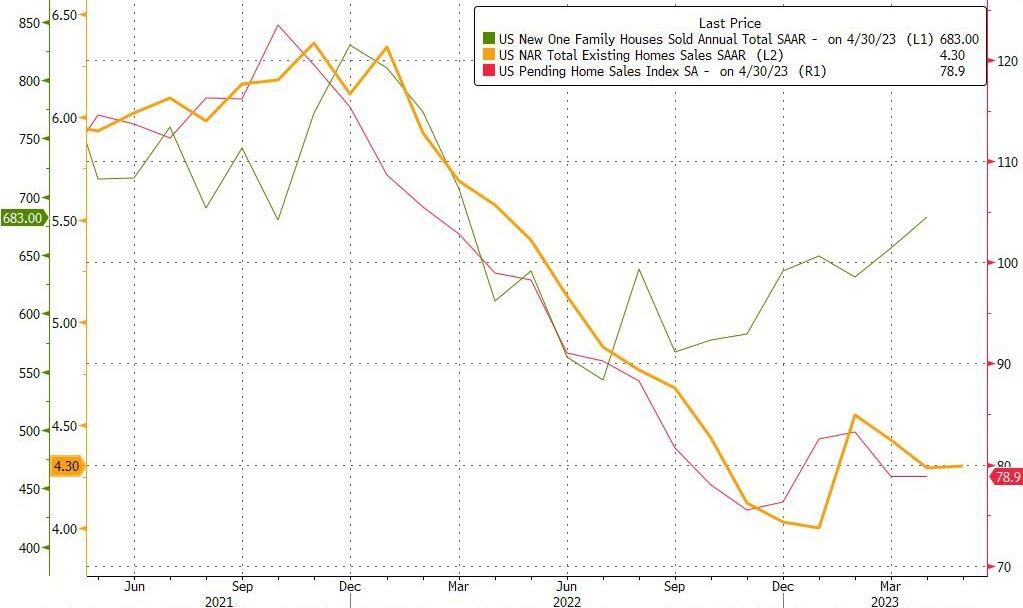
Existing Home Sales Unexpectedly Rose In May As Prices Tumble Most Since 2011
Existing home sales unexpectedly rose in May (+0.2% MoM vs -0.7% MoM) with a small upward revision for April’s tumble (from -3.4% MoM to -3.2%). That is only the second positive month for existing home sales since Jan ’22…
Source: Bloomberg
Total sales are basically flat, refusing to follow new home sale higher for now…
Sales advanced in two of four regions, led by the West and South.
“Relatively steady rates have led to several consecutive months of consistent home sales,” Lawrence Yun, NAR’s chief economist, said in a statement.
“However, existing-home sales activity is down sizably due to the current supply being roughly half the level of 2019.”
The median selling price declined 3.1% from a year earlier, the most since 2011, to $396,100. That’s still historically elevated for the month and reflective of limited supply.
Source: Bloomberg
The number of homes for sale fell 6.1% from a year earlier to 1.08 million units. That’s the lowest inventory level for any May in data back to 1999.
The folks at Snopes, whose whore mongering (and allegedly rapey) co-founder was fired for mass plagiarism, have once again illustrated why the world of ‘fact checkers’ are nothing more than otherwise-unemployable partisan hacks.
On Tuesday, Snopes took a shot at Elon Musk in a hit-piece titled “Was the Missing Titanic Submersible Using Satellites from Elon Musk’s Company?“
The article is of course meant to imply that the OceanGate Titanic exploration submersible, which lost contact with its surface support vessel on Sunday, went missing due to a Starlink failure.
After Snopes’ account tweeted the article, a scorching Twitter community note tore the article to shreds – noting that while OceanGate has used StarLink services, they’re used for their surface vessels, not their submersibles. Idiots. The note also clarifies that radio frequencies such as StarLink’s do not work underwater.
“Starlink operates in the 10.7 to 12.7 GHz band. [radionavlab.ae.utexas.edu/wp-content/upl…] Penetration depth of 2.45GHz in water is <8cm and falls off with increasing frequency. [cober.com/wp-content/upl…] Therefore, Starlink cannot be used to communicate with an underwater submarine,” the note states.
Snopes then scrambled to edit their article, adding an update at the bottom which reads: “This fact check was amended to address the legitimacy of claims that the submersible itself used Starlink during the exhibition, not whether its company did. While it was true that Oceangate and Starlink worked together during the expedition, it was unknown if, or to what extent, the submersible itself relied on Starlink’s technology.”
The article was then amended to “Unproven.”
Now, Snopes rates their own claim as “False,” and have added yet another Editor’s Note which reads: “Since the original publication of this fact check on June 20, 2023, Snopes clarified its rating and text to make clear that — while OceanGate, the company overseeing the submersible’s expedition, said it was using Starlink satellites for the trip — the submersible itself was not using the technology to communicate. How, or to what extent, the vessel’s mothership was using Starlink to communicate remained unknown.”
The OceanGate submersible Titan has been out of contact with its surface support vessel since Sunday. The submersible’s disappearance has sparked an extensive search effort with cooperation between the U.S. and Canadian Coast Guard services.
The ongoing search effort is a race against time, as officials have estimated the Titan submersible only had about 96 hours worth of life support for the five people on board when it submerged on Sunday.
Crews searching for the submersible reported hearing “underwater noises” and even “banging” sounds on Tuesday evening.
Plagiarism
Snopes founder David Mikkelson was fired from the company he co-founded, after BuzzFeed uncovered massive plagiarism – including instructing other Snopes writers to ‘cut-and-paste’ mainstream breaking news stories without attribution, and then alter them after the fact.
In total, Mikkelson ‘wrote and published 54 articles with plagiarized material,’ under his own name as well as a pseudonym, and the Snopes byline. In addition, an internal review by the ‘fact-checking’ company identified 140 articles with possible problems. Meanwhile, Snopes raised $1.7 million in 2021 to fight a series of lawsuits from a former tech vendor.
The Indian Prime Minister, Narendra Modi, is visiting the USA. In India, this event is being heralded as the event of the century.
Gina Raimondo, the US Secretary of Commerce, recently gave a speech in India about who she considers the most admired person in the world. Perhaps knowing that if the US audience watched it, they would smell a rat, she did tweet it:
She is the commerce secretary, @SecRaimondo. She has no grasp of reality and perhaps no honor. If you want a cringe-fest, watch this. pic.twitter.com/8KX7aVCHtc
A few weeks earlier, Frederic Neumann, Chief Asia Economist of HSBC, expressed his euphoria about India. So euphoric is he that he cannot find words for the magic that he sees happening:
Something big is taking place in India 🇮🇳
HSBC’s Fred Neumann has been covering Asia for decades. What’s happening in India is one of the most exciting things he’s seen.
Fareed Zakaria calls India the fastest-growing large economy. He finds its national ID system revolutionary. He credits Mukesh Ambani, one of the Indian business leaders, for taking the internet to a vast section of the population. “Today, India uses more data than China and the USA combined,” says he. He found infrastructure projects—airports, train stations, road networks, seaport capacities, and metros—to have exploded.
Der Spiegel, a German magazine, published a factual, albeit degrading, cartoon about India exceeding China in population. The German Ambassador to India, Dr. Philipp Ackermann, unctuously claimed that some Indian metro systems are better than German ones:
Apple just opened its first shop in India. Then CNN started fawning over India. Not to be left behind, Bill Gates congratulated Modi for his 100th monologue—Modi does not give interviews or take questions from journalists.
At the recently held Quad meeting, Biden asked (in my view, condescendingly) for Modi’s autograph and said, “You are causing me a real problem. Next month we have a dinner (during PM Modi’s visit to the US in June) for you in Washington. Everyone in the whole country wants to come. I have run out of tickets. You (sic) think I am kidding? Ask my team. I am getting phone calls from people I have never heard of before. Everyone from movie actors to relatives. You are too popular.”
Modi has just landed in the US. Among others, he met Elon Musk, who finds India the most exciting country on the planet but has no time to visit it until next year:
#WATCH | Tesla and SpaceX CEO Elon Musk, says “I’m incredibly excited about the future of India. India has more promise than any large country in the world. He (PM Modi) really cares about India as he’s pushing us to make significant investments in India. I am a fan of Modi. It… pic.twitter.com/lfRNoUQy3R
The Indian state of Manipur is burning. Hundreds of people have died in what is an ongoing genocide. During Modi’s rule, there has been a massive increase in religious and anti-minority violence and a resulting polarization across the country. Lawlessness is increasing everywhere.
A train accident recently killed hundreds, although a couple of people were found alive in the morgue. For those who know India better—outside the five-star hotels and business class flights—it is faltering.
Poverty and unemployment are getting rapidly worse. You hardly meet an Indian for who the quality of infrastructure has improved. He might even complain about the burden and chaos that has been created by mafia-run unscrupulous construction companies, which are the easiest ways for politicians to collect bribes in bulk. After years the roads that get constructed get washed away after a single rain.
India ranks lower than Pakistan and Afghanistan for press freedom. These days one finds oneself in prison and charged with treason for tweeting against Modi.
A vast swath of the so-called educated Indian middle class has come to believe that the US wouldn’t last for a day without the Indian CEOs and high-tech workers, ignoring that with its GDP per capita of $2,256, it is among the poorest countries and has the world’s most hungry people, most stunted kids and with half the population with no access to toilets. But then, it is not uncommon for an Indian middle-class person to claim that India has a better quality of life than the US, while he is unaware of the existence of his fleet of servants and maids, each of who earns $50 a month and gets no vacations or medical benefits.
For a decade, Modi was banned from entering the US for an anti-Muslim pogrom during his rule in Gujarat. Those days, taking a higher moral ground, the US didn’t want him. But times have changed. Now, being expedient and woke, the US is welcoming him.
One might wonder if there is a connection between this sudden increase in cringe-worthy fawning over India by the Western governments, the Western media, and big corporations.
It is perhaps easier to understand the motivations of Apple and Gates. India is one of the poorest nations. Among the minority that can afford iPhones, no Indian auntie worth her salt will want to buy in India and indirectly confess that she does not go to London for her weekend shopping. Maybe, Apple wants to show Wall Street analysts that there is still growth in Apple stock. The situation with Tesla, which has no operations in India, is likely similar. Gates loves India for the reverence that he gets from the NGOs that get his money.
Among the ruling class, there is likely a two-fold sinister ploy.
Despite Indians being only 1% of the US population, in closely contested states—like, New Jersey and California—they have a decisive swing vote. Given that they are the best-earning community in the US, they and their lobbies have an outsized social and economic clout.
While Indians in America tend to vote for the Democrats, Trump tried his best to swing them to his side. Biden will find endearing them easier. These Indians are also pro-Modi and pro-Hindu-fanaticism. While their vote will be important for who wins in the US elections, they will be voting thinking about India, not the US.
The second sinister ploy is of the warmongers in the West who want to position India against China by inviting it to join NATO Plus. This would be disastrous for both the US and India. Modi has a petty ego. He can be easily swayed. But Indians are not warriors. They have hardly any experience of fighting in wars. In the 1962 war, China was able to enter what was under Indian control without much resistance.
Over the last few years, China has humiliated India several times, infringing on its controlled areas and even setting up villages there. Apart from making courageous talks, Modi does nothing. He knows he cannot. In 1962, China’s economy was worse than India’s. It was going through a horrendous Cultural Revolution. Today, the Chinese economy is 550% that of India. In a war with China, India will do worse than in 1962.
Not only a war with China will be suicidal for India, but India desperately needs China. India should be inviting China to be its back office and to move low-value-added manufacturing.
Modi has developed an image of “Viswaguru,” the global teacher, on the back of propaganda and the extraordinary gullibility and inferiority complex of Indians. Indians have been convinced that Putin, Biden, and Sunak cannot pass a day without taking advice and help from Modi.
Modi is up for elections within a year. Indians look up to the US for validation. After a recent loss in the elections in the state of Karnataka, Modi desperately wants to spruce up his image.
The above is hardly a conspiracy, but a coinciding of interests of the Democrats who want the votes of Indians, the naïve anti-China war-mongers who want to develop India as another Ukraine, American companies desperate to show future growth to Wall Street analysts, and Modi’s building up of his Viswaguru image for the forthcoming elections.
The collateral damage is the unseen, unrecognized desperately poor of India and a country that might soon become another Pakistan.
By Michael Msika, Bloomberg markets live reporter and strategist
Warnings from the chemical sector on the outlook for earnings are piling up — just as worrying signs about global demand and economic growth begin to multiply across the board.
June has proved a bad month for chemical producers, with four European companies warning about their profit outlook for the rest of the year. This week, Lanxess joined Croda, K+S and Victrex in preparing investors for the impact of weak demand, tougher pricing, or destocking by customers. In the US, Cabot blamed softer global demand as it ditched its full-year forecast.
Whether the worsening outlook for chemicals is a warning for the broader industrial or cyclical complex isn’t yet clear. But without substantial stimulus in China or signs that demand is picking up, caution could be warranted — especially at a time when optimistic investors have pushed their positioning in stocks back to elevated levels.
Industrial shares are usually closely correlated with chemicals and account for nearly 14% of the Stoxx 600, the largest sector weight in the European benchmark after health care. More broadly, economically driven cyclicals are about two-thirds of the market. Their earnings prospects are heavily linked to global growth, which has been driven by China for the past few years. But the Asian giant’s revival is faltering. In the past week, economists at Goldman Sachs, HSBC, Citi and Nomura are among those to have revised their China GDP growth forecasts lower for 2023, doubting that stimulus from Beijing could turn the tide.
“Expectations have been too high about what China will be able to do on stimulus, as the Chinese government is more constrained compared to previous cycles relative to kick-starting the economy through just cutting interest rates or lowering reserve requirements for banks,” says Peter Garnry, head of equity strategy at Saxo Bank A/S.
Valuations remain a concern. The latest drop in chemical stocks has taken the premium on the sector’s price-to-earnings ratio over the broader European market back to its 10-year average of about 19%, after peaking at 40% last year. Industrials are still trading near a similar record premium of 40%, double the 10-year average.
In another worrying sign, troubles are expanding into the packaging sector, with Mayr-Melnhof Karton becoming the latest European company from the sector to issue a profit warning. This follows other paper and pulp sector warnings from companies including Billerud AB, UPM-Kymmene, and Stora Enso.
European cyclicals have brushed off weak macro-economic forecasts and surveys, thanks to hard data like GDP figures, which have held up well so far this year. Hopes of a soft landing and a peak in yields have supported stocks, while receding inflation has also helped.
Still, other overall macro-economic readings give a less positive picture. Manufacturing PMIs remain in the doldrums, in sharp contrast with the expansion in services data this year. A debate rages over how this gap will close, with UBS strategists Gerry Fowler and Sutanya Chedda contending that services activity will be dragged lower.
“European services new orders PMIs reversed quite sharply in May,” the UBS strategist say. “If this is a sign of emerging weakness in services demand, it could lead to more sector correlation and equity downside.”
“The main disconnect that the market will need to grapple with revolves around the hopes of a soft landing, without much pain to profits, labor or credit, but at the same time the expectation that inflation will come down quickly,” says Vincent Rennella, Silex Investment Managers’ head of equity strategy, who is keeping his defensive stock allocation. “How can the consensus think that the worst of pressures is behind us, when the impact of monetary tightening historically worked with a lag, especially with a Fed that has not even stopped hiking?”
Stocks are having a tough time this morning after central banks extended their recent hawkish spree. Switzerland and Norway raised rates – the latter by more than expected – and the BOE looks set to hike even more than consensus, as Britain’s red-hot inflation sours the outlook. Turkey is expected to raise aggressively as policymakers move to shore up confidence. Meanwhile, Jerome Powell – whose semiannual testimony on the Hill continues today, this time before the Senate – suggested yesterday the Fed’s on course for two more hikes this year.
A closer look at what happened earlier in the session:
The Swiss National Bank (SNB) hiked the policy rate by 25bp to 1.75% today, in line with consensus expectations. The SNB revised down its 2023 conditional inflation forecast markedly, but revised up the 2024 and 2025 inflation rates on the back of second-round effects, imported inflation, and rent and electricity prices. Goldman keeps its expectation for one more 25bp hike in September, but lower its terminal rate expectation to 2% from 2.25% previously.
Norges Bank’s Monetary Policy Committee voted unanimously to raise the policy rate by 50bp to 3.75%, above consensus and market expectations, stepping up the hiking pace again compared with their prior hikes this year. The Committee guided that “if developments turn out as we now expect, the policy rate will be raised further in August”. Norges Bank’s policy rate forecast has been revised up and now indicates a terminal rate around 4.2% in the autumn (compared with 3.6% previously). Given today’s guidance, Goldman retains its expectation for two further 25bp hikes in August and September, taking the forecast of the peak policy rate to 4.25%, compared with 4% previously.
Main points:
1. The Swiss National Bank (SNB) raised the policy rate by 25bp to 1.75%, in line with consensus expectations. The Monetary Policy Assessment (MPA) kept the statement that additional rate hikes “cannot be ruled out”. The press release also left the language around FX interventions unchanged, continuing to highlight that the SNB remains “willing to be active in the foreign exchange market as necessary”. In the press conference, Chairman Jordan suggested once more that further monetary tightening is needed, but given the SNB’s progress in tackling inflation a step down in pace could be justified, especially in light of FX interventions helping to keep inflation subdued, too.
2. Exhibit 1 shows the new conditional inflation forecast, which was revised down in 2023, but upwards in 2024 and 2025 on the back of second-round effects, imported inflation, and rent and electricity prices (-0.4pp to 2.2% in 2023, +0.2pp at 2.2% in 2024, +0.1pp to 2.1% in 2025). The SNB expects Swiss GDP to grow around 1.0% this year, unchanged from March, noting that the services sector gained momentum and the labor market remains robust. Looking ahead, the SNB expects that the loss of purchasing power due to inflation and restrictive financial conditions will dampen growth in the second half of the year.
3. Given the SNB’s willingness to intervene in FX markets, and today’s MPA noting that some of the 2023 inflation weakness was caused by the strength in the Franc, Goldman expects the SNB to continue to lean more on FX interventions to control inflation, especially given today’s step-down in the hiking pace. In light of this and Chairman Jordan’s comments suggesting that, prior to today’s hike, there were at most two further hikes planned, the bank expects a final 25bp hike in September, but lowers its terminal rate estimate to 2% from 2.25% previously.
* * *
4. Norges Bank’s Monetary Policy Committee voted unanimously to raise the policy rate by 50bp to 3.75%, above consensus and market expectations, stepping up the hiking pace compared with their previous 25bp hikes. The Committee guided that “if developments turn out as we now expect, the policy rate will be raised further in August”. Norges Bank’s policy rate forecast has been revised up and now indicates a terminal rate of around 4.2% in the autumn (+ 0.6pp since March, Exhibit 2). The Committee sees two-sided risks around the policy outlook: a weaker Krone or persisting economic pressures might require a higher policy rate, while a faster decline in inflation or a more pronounced slowdown in the Norwegian economy might require a lower rate.
5. The updated economic projections in the Monetary Policy Report (MPR), also published today, show meaningful upward revisions to inflation and, to a lesser extent, to growth. The MPR noted that mainland GDP growth has been a little lower than projected in March, and Norges Bank now expects mainland GDP to grow by 1.2% in 2023 (+0.1pp vs. the March MPR). Equally, higher wage growth and a weaker Krone pushed up inflation projections; Norges Bank now expects headline CPI inflation of 6.0% for 2023 (+1.1pp vs. March) and 3.9% for 2024 (+0.6pp vs. March). CPI-ATE is now expected to reach 6.3% in 2023 (+0.7pp vs. March) and 4.6% in 2024 (+0.8pp vs. March). Wage growth was revised up 0.4pp to 5.5% in 2023 and by 0.3pp to 4.7% in 2024, with the MPR noting that underlying inflation “is likely to remain elevated longer than envisaged earlier”.
West Bank Settlers Rampage In Palestinian Villages, Killing 1 And Injuring Dozens
One Palestinian is dead and dozens injured after Jewish settlers went on fiery rampages in several West Bank villages, with Israeli security forces reportedly siding with the assailants and thwarting Palestinian attempts to defend themselves and their property.
The attacks were said to be acts of vengeance for the killing of four settlers by Palestinian gunmen. However, those gunman had already been shot to death shortly after they carried out their attack at a roadside restaurant near the Eli settlement.
Israeli settlers are rampaging through the Turmus Aya village.
Fires can be seen from miles. People are locked inside their homes. Multiple vehicles & farms burned down…
That incident, in turn, followed major Israeli military attacks on the Jenin refugee camp that have killed at least seven including two children. In an escalation not seen in the occupied West Bank since 2006, Israel used helicopter gunships, followed by a drone strike that killed three on Wednesday.
Lafi Adeeb, mayor of Turmusaya, told Middle East Eye that hundreds of Jews descended upon her town in a midday onslaught, setting fire to some 30 houses and 60 vehicles as well as agricultural land.
“This is genocide, this is a war against us,” said Adeeb. “Settlers carrying weapons and canisters full of fuel attack our small villageand set fire to houses over the heads of their inhabitants.”
Turmassyah Pogrom |
“They tried to burn my children alive, while their were in the house. This is our first visit to Palestine in years.”
A dual Palestinian-American citizen describing what happened during the Israeli settler pogrom. pic.twitter.com/a86GbXtS7U
“They attacked our town by surprise, sneaking in at noon because they know that the citizens are busy and most of them are outside the town,” said Adeeb. “The attack was large and organized, with full protection and coordination with the Israeli army, which is working against us and protecting them.”
On social media, users circulated video said to show the destruction in Turmusaya and other Palestinian villages. This tweet says Israeli soldiers fired “bullets, stun grenades and gas bombs at youths as they confronted a settler attack on the outskirts of the village of Urif”:
عاجل| قوات الاحتلال تطلق الرصاص وقنابل الصوت والغاز بكثافة تجاه الشبان أثناء تصديهم لهجوم مستوطنين على أطراف قرية عوريف جنوب نابلس. pic.twitter.com/GAxRTeUThT
According to Middle East Eye,soldiers also closed the entrances to Turmusaya, leaving it to the Palestinians to transport their own wounded people, since ambulances couldn’t find their way in.
“We finished the noon prayer, then we heard screams on the northern side of the town. We rushed there and found the vehicles burning and everything on fire, which devoured the agricultural crops and trees,” said Turmusaya resident Ahmed Jabara.
In an analogue for the glorified bottle rockets that Gaza militants periodically fire at Israel, Palestinians in the West Bank town of Urif tried repelling Jewish attackers with fireworks:
“Terrorist gangs alongside the regular forces are an integral part of Zionist ideology,” Palestinian analyst Ameer Makhoul told Middle East Eye. “Terrorist settler gangs are an integral part of the occupying state, and their job is to commit acts of genocide and intimidation of the Palestinians so that their state escapes responsibility and legal accountability.”
Responsibility for deadly West Bank pogrom wave lies with Israel, which arms settler gangs and encourages them to attack Palestinians. > pic.twitter.com/3YEadT4g0K
On Sunday, Prime Minister Benjamin Netanyahu’s cabinet, which is dominated to an unprecedented extent by religious and ultra-nationalist extremists, announced it will enable the construction of an additional 4,560 settlement units in the occupied West Bank — further obliterating long-running, Western-embraced propaganda about all this violence and injustice someday ending with a supposed “two-state solution.”
Artificial intelligence will soon make its appearance in one of Europe’s best-selling tabloid newspapers, but only to support journalistic work, not replace it.
German tabloid company Bild has denied reports it is laying off parts of its editorial team and replacing staffers with artificial intelligence and “automated processes” writes Felix Ng of Cointelegraph.
The Guardian and other media outlets reported on June 21 that Bild’s parent publishing firm, Axel Springer SE, was planning to replace a range of editorial jobs with AI, citing an internal email.
However, Bild Group’s director of communications, Christian Senft, told Cointelegraph that the “reports are false” and that “with our current measures, we have no intention of replacing journalism with AI.”
Instead, Senft said the announcement was regarding a restructuring program for regional newspaper editions, which involves reducing from 18 regional editions to 12 by the end of the year, and the closing of 10 out of 15 regional offices, with many functions moving centrally to Berlin.
“Therefore, these tasks such as secretariats and photo production are no longer necessary in the regions,” he said, reiterating that the associated job reductions have nothing to do with AI.
Senft confirmed that the moves will affect employees in the “low three-digit number.” He also clarified that the announcement states that the company will “increasingly use AI to support journalistic work.”
“To this end, we are approaching the topic with an open mind and currently have many initiatives with which we are exploring areas of application for AI for our journalistic brands, both in the production processes of the editorial offices and in relation to the reader experience,” he added.
“The use of AI creates more time and space for journalistic creativity for editors and reporters. Wherever AI supports, a journalist always has to check and double-check the result at Axel Springer.”
Of course, if you really have to convince your own readers that you are not using AI to write your articles, or if someone can even question if articles are written by algos or humans (as unqualified as they may be at a giant tabloid), you probably should be.
The daily tabloid was founded in June 1952. In the 1980s, Bild reportedly sold more than five million copies per day. By 2010, Bild’s circulation had fallen to 3.55 million, according to Mondo Times. As of 2022, the print newspaper only had a circulation of just over 1 million, according to Media Impact.
In May, IBM CEO Arvind Krishna told Bloomberg that 7,800 jobs at the firm could be replaced by AI and automation over the next five years, representing approximately 30% of its workforce.
IBM expects to pause hiring for roles as roughly 7,800 jobs could be replaced by #AI.
Back-office functions such as human resources will be suspended or slowed.
30% of non-customer-facing roles could be replaced by AI and automations in 5 years.
In a June 14 report, management consulting firm McKinsey & Co. predicted that generative AI may be able to fully automate as much as 50% of all work activity conducted in workplaces today, including tasks related to decision-making, management, and interfacing with stakeholders.
* * *
ZH: …if you really have to convince your own readers that you are not using AI to write your articles, you probably should be.
Durham Goes Off On FBI, CIA, Schiff During Wednesday Testimony
Update (1351ET): More bombshells from Durham on Wednesday, where he told the House Judiciary Committee that the CIA knew that Hillary Clinton approved a plan to smear then-candidate Donald Trump with Russia allegations in order to distract from her classified email scandal, and that the FBI did not “sufficiently scrutinize information it received,” nor “apply the same standards to allegations it received about the Clinton and Trump campaigns.”
“The FBI was too willing to accept and use politically funded and uncorroborated opposition research, such as the Steele dossier,” said Durham, adding “The FBI relied on the dossier and FISA applications, knowing there was likely material originating from a political campaign or political opponent.”
🚨BREAKING: John Durham testifies before House Judiciary Committee: “The FBI was too willing to accept and use politically funded and uncorroborated opposition research such as the Steele Dossier.” pic.twitter.com/bi4mHvQPoN
Durham said that it’s “going to take time to rebuild the public’s confidence in the institution,” referring to the FBI following its mishandling of the Russia collusion probe.
Under questioning from House Judiciary Committee Chairman Jim Jordan, Durham said former FBI Director Jim Comey withheld a referral memorandum from the agents working the Crossfire Hurricane case.
The memo contained intelligence from a high-level briefing with Director of the Central Intelligence Agency John Brennan related to then-Democratic presidential candidate Hillary Clinton’s attempts to tie Trump to Russia.
“They kept key intelligence from the investigators. This is how bad this investigation was but here’s the scary part: I don’t think anything has changed,” Jordan said. –Just the News
A few highlights:
John Durham SNAPS at Adam Schiff after trying to justify Russiagate Hoax by asking if leaked emails were stolen: “In your mind!” pic.twitter.com/WD6VQNZazK
In comments to the House Judiciary Committee, Durham reiterated the report’s findings that there was “not a legitimate basis” for the Crossfire Hurricane investigation – before shooting down several barbs from Democrats;
Special Counsel Durham says that, at the time, there was “not a legitimate basis” to launch the Crossfire Hurricane investigation into Trump. pic.twitter.com/0wO1hIEs3u
— The Post Millennial (@TPostMillennial) June 21, 2023
COHEN: “Your reputation will be damaged!”
DURHAM: “My concern about my reputation is with the people who I respect, and my family, and my Lord, and I’m perfectly comfortable with my reputation with them, sir!” pic.twitter.com/zughWAoN2l
Durham said that several FBI agents apologized to him for how the Trump investigation was run.
DURHAM: “I have had any number of FBI agents…who have come to me and apologize for the manner in which that investigation was undertaken. I take that seriously!” pic.twitter.com/3vqE08nrl0
“The FBI was too willing to accept and use politically funded and uncorroborated opposition research such as the Steele Dossier,” said Durham, who also confirmed that there was no collusion found between the Trump campaign and the Russian government.
🚨BREAKING: John Durham testifies before House Judiciary Committee: “The FBI was too willing to accept and use politically funded and uncorroborated opposition research such as the Steele Dossier.” pic.twitter.com/bi4mHvQPoN
“Our findings were sobering. I can tell you, having spent 40 years plus as a federal prosecutor, they were particularly sobering to me.” — Special counsel John Durham
1. Why were former FBI Director James Comey and former Deputy Director Andrew McCabe, along with FBI officials Bill Priestap, Peter Strzok, and Kevin Clinesmith, and others allowed to refuse cooperation?
2. Where is Mifsud?
3. Why were “omissions” or “misstatements” by FBI officials and/or their sources treated as such, and not as criminal lying, as would likely have happened in Robert Mueller’s investigation?
4. Why was Halper’s name kept out of the report? What other “informant” activity was obscured?
5. Why did you punt on the hack?
It’s a great read which subscribers to Racket News can check out here.