72.5 F
Chicago
Thursday, August 20, 2026
Home Blog Page 3599

“Don’t Call It A Skip” – Fed ‘Pause’ Prompts Wild Swings Across All Assets

“Don’t Call It A Skip” – Fed ‘Pause’ Prompts Wild Swings Across All Assets

A ‘pause’ in rate-hikes and a far more hawkish dot-plot than expected spooked markets and then Powell monotonously meandered through his press conference, seemingly providing something for doves to cling to (though we are not sure what).

Powell emphasized that the inflation fight is still a priority: “Without price stability, the economy doesn’t work for anyone.”

“There’s just not a lot of progress in core inflation.”

“We want to see it moving down decisively.”

But:

“Risks for inflation are still to the upside.”

Powell says the process of getting inflation back to the 2% target “has a long way to go,” but don’t call this ‘pause’ a skip…

“The skip — I shouldn’t call it a skip.”

And finally, to ensure the doves are clear:

“It will be appropriate to cut rates at such time as inflation is coming down really significantly. And we’re talking about a couple of years out.“

“I think, as anyone can see, not a single person on the committee wrote down a rate cut this year — nor do I think it is at all likely to be appropriate if you think about it.”

Inflation has not really moved down. It has not reacted much to our existing rate hikes. We’re going to have to keep at it.”

The result of all that was a fair amount of chaos.

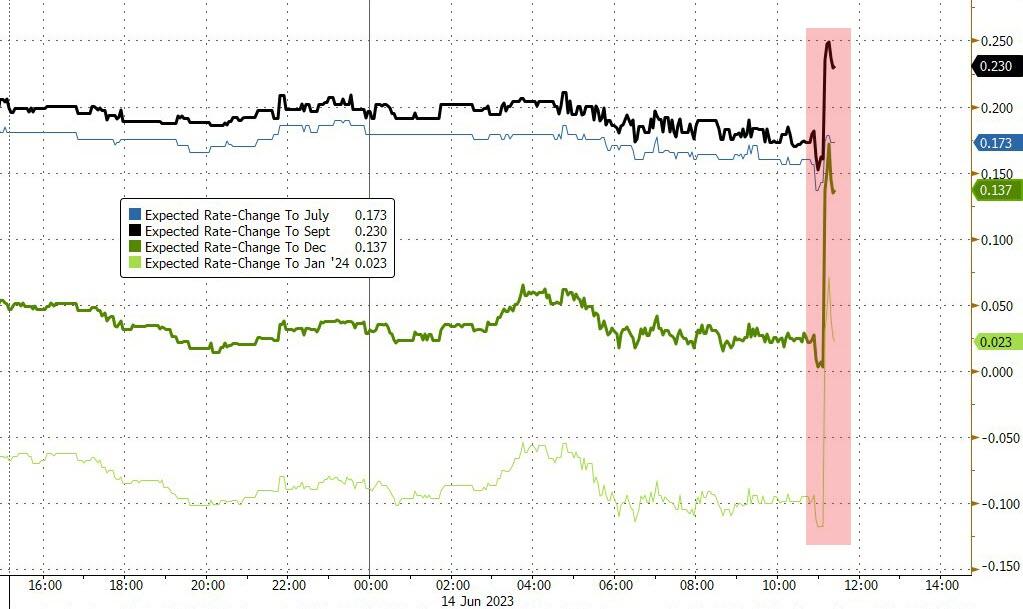
First things first, rate-change expectations rose (hawkishly) with all rate-cuts for 2023 now priced-out and the odds of a hike by September significantly higher…

Source: Bloomberg

Stocks were even more wild, dumping on the statement/SEP, rallying at the start of Powell’s presser, only to reverse back as he noted ‘no rate cuts forecast by anyone’ and failed to actually offer a dovish bone to the market. The Nasdaq managed gains on the day while Small Caps and the Dow were hit hard (the latter hurt by UNH also) and late-day weakness dragged the S&P red but managed to pull back to unch at the close…

Nasdaq pushed ahead of Small Caps once again, reversing more of last week’s reversal in favor of Small Caps…

With a big OpEx right ahead of us, optionsland is a little chaotic also but today’s 0-DTE traders faded any gains off the PPI aggressively and were right…

Source: SpotGamma

VIX was smashed lower to a 13 handle!

Banks were dumped but investors rushed to the new safe-haven – AI stocks…

Utter chaos in bond-land with PPI taking yields gradually lower early on. The FOMC statement sent yields vertical – especially at the short-end – leaving the long-end actually lower on the day…

Source: Bloomberg

The yield curve (2s30s) plummeted to its most inverted since right around the SVB collapse…

Source: Bloomberg

The dollar ended lower – tumbling on the soft PPI, spiking on the FOMC statement, then fading back during the presser…

Source: Bloomberg

Gold ended unchanged but had a violent day, rallying on PPI, dumping on FOMC then bouncing then fading…

Oil ended lower on the day with WTI testing down near a $67 handle intraday, hit by Iran headlines, strong inventory builds and the hawkish Fed…

Perhaps most shockingly, crypto was the least volatile asset-class of the day…

Source: Bloomberg

Finally, did we just make the blow-off top on this AI cycle?

Source: Bloomberg

Maybe The Fed didn’t like the decoupling from tighter financial conditions after all?

Source: Bloomberg

Now we need to hear the follow-up FedSpeak to set the narrative.

Tyler Durden
Wed, 06/14/2023 – 16:01

The Great Dollar Paradox

The Great Dollar Paradox

Authored by James Rickards via DailyReckoning.com,

The de-dollarization story is everywhere.

You see it in publications from The New York Times to The Economist and in financial media including CNBC, Fox Business and Bloomberg.

The idea is that countries around the world are preparing to ditch the dollar. This takes many forms including efforts by China to pay for imported oil from Saudi Arabia and the UAE with yuan and a major bilateral agreement between China and Brazil that allows each country to pay for exports from the other using their local currencies.

Russia got in the act by agreeing to receive rupees for oil delivered to India and paying for imports from China with rubles. All these efforts will be converging and coming to a head in late August when the BRICS (Brazil, Russia, India, China, South Africa and other invited countries) meet to announce a new BRICS+ currency linked to gold.

With all of that going on, one might expect to find the dollar in freefall. Yet that’s not the case.

The dollar has been strong lately and I expect it to get stronger in the months ahead. What gives? How can the dollar be under global attack and yet be strong at the same time?

Strong Compared to What?

The answer is found in the way you measure value in any currency. Dollar strength or weakness is typically measured in major currency indexes, including DXY (used for futures trading and quoted in The Wall Street Journal) and the Bloomberg Dollar Index.

Other major indexes include those computed by the Federal Reserve (I use the Fed indexes in my own research and analysis). What all these indexes have in common is that they compare currencies with currencies, usually the major reserve currencies.

A typical dollar index will compare the dollar with a basket consisting of euros, sterling, yen, Swiss francs and perhaps one or two others. Because of the importance of the euro in world trade and reserves (second only to the dollar), these indexes tend to be just more complicated versions of the euro/dollar cross-rate.

The emerging markets’ currencies are typically left out of such indexes. Meanwhile, the bilateral currency deals described above do not include dollars. When you look at a bilateral currency deal involving yuan or rubles, the dollar is not included at all.

So it’s entirely possible to have a strong dollar (measured mainly against euros) and a growing de-dollarization trend involving yuan, rubles and rupees. The two trends are talking past each other.

The Golden Ruler

Is there some way to tell if the dollar is actually getting stronger or weaker without making reference to reserve currencies or EM currencies?

Yes. The answer is gold. Think of gold as a ruler that measures dollar strength or weakness.

Gold is not a currency, and the comparison is made by the weight of gold, not currency-to-currency. When the dollar price of gold is lower, the dollar is stronger, and vice versa.

But the new BRICS+ currency may throw a monkey wrench into this market by linking itself to gold. In that case, Russia and China will have a strong interest in higher gold prices because that means their BRICS+ currency will be worth more. And that may trigger the real decline of the dollar.

The BRICS+ gold-backed currency is actually the reflection of a greater trend that’s been going on for over a decade…

The Trend Is Gold’s Friend

The year 2010 marked a major inflection in central bank gold purchases and the overall level of gold reserves held by central banks and finance ministries on a global basis. Let’s back up a bit…

In 1950, the United States held about 20,000 metric tonnes of gold bullion. By 1970, the U.S. gold hoard had shrunk to 9,000 metric tonnes. That gold did not disappear; it was delivered to Germany, France, Italy, Japan and other trading partners to cover U.S. trade deficits under the old gold standard.

Beginning in 1970, gold held by central banks and finance ministries declined significantly. The U.S. sold 1,000 tonnes between 1970 and 1980 and encouraged the IMF to sell about 1,000 tonnes also in a failed effort to suppress the price of gold.

After 1980, the U.S. did not sell any more gold, but encouraged the U.K. to sell over 300 tonnes in 1999. Then Switzerland sold another 1,000 tonnes between 2000 and 2010. The IMF sold 400 tonnes in 2010 also. Canada sold 100% of its gold reserves, which were not that high to begin with.

All of these efforts to suppress gold prices ultimately failed. Gold hit a then-all-time high of $1,950 per ounce in 2011 (that record was surpassed in recent years at $2,060 per ounce in 2020).

Finally, in 2009 the central banks threw in the towel and became net buyers of gold bullion. That trend has been in place ever since.

The increases have been spectacular, resulting in a rise in total official gold holdings from about 32,000 tonnes in 2008 to 35,000 tonnes today. What’s different today is the composition of the gold holders.

BRICS+: The New Gold Bloc

The U.S. has not increased its holdings since the 1950s. Nor have other major gold holders such as France and Italy. Instead, the increases are in Russia, China, Vietnam, Mexico and many other emerging-market countries.

Many of those countries with the largest increases are members of the BRICS+ currency union that will soon announce a new gold-linked currency to challenge the role of the U.S. dollar in global payments and reserves.

Overall, the first quarter of 2023 was the strongest quarter on record for central bank gold purchases with central banks buying a combined total of 228 tonnes.

We actually have a new champion in the gold purchase arena, and it’s not Russia or China — it’s Singapore.

In just the first three months of 2023, Singapore purchased an amazing 68.7 tonnes of gold bullion, making Singapore the world’s-largest central bank gold buyer for the first quarter.

One can speculate about whether this gold buying is an aspect of de-dollarization, preparation for the new BRICS+ gold-backed currency or simple prudence in an uncertain world. But the trend is undeniable.

Central banks generally know more about what is going on behind the scenes in the global monetary system than anyone. If they’re hoarding gold, maybe you should too.

There’s still time to get on the BRICS+ bandwagon.

Tyler Durden
Wed, 06/14/2023 – 15:25

After Biden ‘Promised’ Sweden Will ‘Soon’ Enter NATO, Erdogan Remains Defiant

After Biden ‘Promised’ Sweden Will ‘Soon’ Enter NATO, Erdogan Remains Defiant

To listen to the words of either the Biden administration or NATO Secretary General Jens Stoltenberg one could easily think that Sweden’s accession into NATO is a ‘done deal’. Sweden itself is saying there is “strong support” for Sweden’s membership going into the July 11-12 major annual summit of NATO heads of state in Vilnius, Lithuania. 

But as Al Jazeera highlights in a fresh report, there’s only one voice that matters at this point – the one holding onto the veto: “Western officials had hoped Erdogan would soften his position on the diplomatically charged issue after he secured a hard-fought re-election last month.” It remains that Erdogan has signaled no change of heart on the issue, even after Stockholm has taken pains to bow to Ankara’s demands.

“Sweden has expectations. It doesn’t mean that we will comply with them,” Erdogan said this week amid high level talks between Turkish and Swedish officials in Ankara.

Sweden’s chief negotiator, Oscar Stenstrom, also confirmed in a Wednesday statement that there’s been no breakthroughs.

“It’s my job to persuade our counterpart that we have done enough. I think we have,” Stenstrom said. “But Turkey is not ready to make a decision yet and thinks that they need to have more answers to the questions they have.”

But here was President Joe Biden a mere few weeks ago:

US President Joe Biden has said he is confident that Sweden will join NATO “as soon as possible”, despite Turkey and Hungary continuing to block the northern European country’s accession to the alliance.

Speaking at a United States Air Force Academy graduation ceremony on Thursday, Biden praised NATO’s unity amid the Russian invasion of Ukraine.

He “promises” it will happen… “NATO is more energised and more united than it’s been in decades. It’s now even stronger with the accession of our newest ally, Finland – and soon Sweden – to the alliance, as soon as possible. It will happen. I promise you,” he had said.

Stockholm has lately begun to implement some of the Erdogan government’s desires, and notably the following

Incidentally, the Swedish government decided on Monday to extradite a PKK supporter to Turkey. The man was convicted of drug offences in Turkey in 2013, but after serving less than six months of his sentence, he was released on parole, left Turkey legally and later moved to Sweden, where he obtained a work permit.

According to the Swedish media, the 35-year-old man argued that the extradition request to serve a sentence for drug offences is a pretext and that the “real reason” for his extradition request is that he is a Kurd, has actively promoted the Kurdish cause, and supports the YPG and the PKK.

But clearly, as many predicted, Erdogan is intent on squeezing everything he can out of both Sweden and the Western allies before giving the final approval – this looks to include F-16s from Washington as well. 

Tyler Durden
Wed, 06/14/2023 – 15:05

Creator Of Conservative Chatbot Powered By ChatGPT Says OpenAI Tried To Censor Content

Creator Of Conservative Chatbot Powered By ChatGPT Says OpenAI Tried To Censor Content

Authored by Bryan Jung via The Epoch Times,

The creators of a conservative chatbot powered by OpenAI’s ChatGPT announced that they shut down the chatbot because of pressure from OpenAI to censor the bot’s responses.

The conservative chatbot, named GIPPR in honor of the late President Ronald Reagan, debuted in May and is part of TUSK, a pro-free speech and anti-censorship web browser.

GIPPR is a modified version of OpenAI’s ChatGPT and provides users with answers from a conservative perspective.

The creators of GIPPR said they were forced to sever ties with OpenAI, after they were told that their chatbot failed to “conform to their requirements for what can or cannot be said.”

TUSK founder and CEO Jeff Bermant said in a statement to Fox Business that OpenAI told him that GIPPR was not in compliance with its policies, which were “specifically related to deceptive activity and coordinated inauthentic behavior” and that they needed to “keep users and third parties safe.”

The actions of OpenAI appear to many conservatives as another example of attempted censorship from the left.

“The GIPPR bot had been modified to not be highly biased in favor of a leftist agendasomething which seems to be of critical importance to the original creators of ChatGPT,” Bermant said in the statement.

“Tusk had produced the only AI bot in operation which actually was fair and balanced and did not promote a radical leftist agenda.”

TUSK said it is currently exploring how to make GIPPR operational again and urged users to help them to support defending free speech on the internet.

“Until they find a solution to get it back online, the world of AI will remain highly unbalanced,” Bermant added.

GIPPR Creator Wants to Oppose Left-Wing Bias

Bermant said he got the inspiration for GIPPR after his first interaction with ChatGPT following its launch in November.

He said he was shocked after he asked the chatbot questions about cultural issues and politics and received left-wing answers in response.

The TUSK CEO told Fox Business in May that he then realized that the ChatGPT was likely programmed with a “very progressive” bias, which led him to create his own version using the same OpenAI software.

“We believe that Conservatives are subject to oppressive cancel culture that now includes AI and are expected to exist in a society that tells them what to think and how to act by the progressive left,” Bermant announced after releasing GIPPR.

“It’s time for a TRUTHFUL AI chatbot to take the market by storm and remove the barriers the Radical Left and Big Tech have put in place to allow all Conservatives to enjoy the benefits of AI, without fear of being canceled or shamed for your beliefs,” he said.

OpenAI did not respond to The Epoch Times’ request for comment before press time.

Tyler Durden
Wed, 06/14/2023 – 14:45

Stocks & Gold Slump After Hawkish Fed Sends Rate-Hike Odds Soaring

Stocks & Gold Slump After Hawkish Fed Sends Rate-Hike Odds Soaring

The hawkish pause – signaled by the dot-plot – prompted a kneejerk surge in rate-change expectations with July now pricing in a 70% chance of a hike and September a 95% chance of a hike as December and January have now priced out any rate-cuts…

Source: Bloomberg

Stocks immediately tumbled, led by Small Caps…

Gold was also dumped on the hawkish signal…

The dollar spiked back to almost unchanged on the day after tumbling on the weak PPI…

Source: Bloomberg

The question is, will Powell reverse all this?

Tyler Durden
Wed, 06/14/2023 – 14:32

I-95 Collapse: Pete Buttigieg Warns Snarled Supply Chains Might Spark Higher Costs

I-95 Collapse: Pete Buttigieg Warns Snarled Supply Chains Might Spark Higher Costs

US Transportation Secretary Pete Buttigieg said there’s “no question” that the collapsed Interstate 95 bridge in northeastern Philadelphia will disrupt East Coast supply chains, resulting in higher costs because trucking companies must find alternative routes. 

Over the sounds of heavy machinery, Buttigieg told reporters Tuesday that people don’t realize that “part of what goes into the cost of everything that we pay for at the store is the cost of shipping, and if a route is disrupted … that finds its way into the cost of goods,” adding there’s “no question” prices on the East Coast will jump.

Buttigieg did not provide details regarding which goods will see price hikes or the possible extent of these increases. But he said “a lot of America’s GDP” moves along I-95. 

Buttigieg tweeted that this portion of I-95 “is an artery for people and goods,” and emergency relief funds are being deployed to fix the bridge. 

On Monday, Buttigieg addressed the American Council of Engineering Companies in Washington. He said his agency is working with state and local officials to rebuild the bridge and will provide financing and technical support. He warned summer travel could be a nightmare on the I-95 through Philadelphia. 

A tanker hauling thousands of gallons of gasoline flipped over on an off-ramp and caught fire underneath the bridge on Sunday. The fire was so intense that it caused one of the sections of the bridge to collapse. Pennsylvania Gov. Josh Shapiro declared a disaster emergency shortly afterward the incident to tap federal funding. The governor said it could ‘take months’ to fix the damaged bridge. 

On Wednesday morning, travel disruptions were seen around the closed-off section of I-95. 

We wouldn’t be surprised if the supply chain disruptions appeared in future survey data from the Philadelphia Federal Reserve. 

Tyler Durden
Wed, 06/14/2023 – 13:45

Twitter Files: Meet Academic Disinfo Queen Claire Wardle

Twitter Files: Meet Academic Disinfo Queen Claire Wardle

Authored by Paul Thacker via The DisInformation Chronicle (subscribe here),

The Washington Post defended campus researchers collaborating with federal agencies to censor Americans in an awkward, bumbling article last week, alleging that congressional staff demanding university documents were “harassing academics” who studied falsehoods spread by Trump. In reality, Congress is investigating campus employees who have little in common with traditional university scholars teaching Proust or studying the atmospheric chemistry of distant planets.

Just last year, one Stanford University researcher disclosed that he and other academics at Stanford and the University of Washington worked with an agency in the Department of Homeland Security (DHS) “to fill the gap of the things the government could not do themselves,” admitting that academics served as a cutout for federal censoring of Americans. The DHS agency campus researchers collaborated with is called the Cybersecurity & Infrastructure Security Agency or CISA.

In a recent investigation, Tablet magazine noted that in 2021 CISA began determining which ideas Americans were allowed to discuss and debate during the COVID-19 pandemic.

Documents I discovered at Twitter’s headquarters further tie these censorship efforts to another researcher—Brown University’s Claire Wardle.

The Washington Post defended campus researchers collaborating with federal agencies to censor Americans in an awkward, bumbling article last week, alleging that congressional staff demanding university documents were “harassing academics” who studied falsehoods spread by Trump. In reality, Congress is investigating campus employees who have little in common with traditional university scholars teaching Proust or studying the atmospheric chemistry of distant planets.

Just last year, one Stanford University researcher disclosed that he and other academics at Stanford and the University of Washington worked with an agency in the Department of Homeland Security (DHS) “to fill the gap of the things the government could not do themselves,” admitting that academics served as a cutout for federal censoring of Americans. The DHS agency campus researchers collaborated with is called the Cybersecurity & Infrastructure Security Agency or CISA.

In a recent investigation, Tablet magazine noted that in 2021 CISA began determining which ideas Americans were allowed to discuss and debate during the COVID-19 pandemic.

Documents I discovered at Twitter’s headquarters further tie these censorship efforts to another researcher—Brown University’s Claire Wardle.

A peek behind the paywall;

As reported by the Washington Post, congressional staff are now investigating University of Washington professor Kate Starbird, who runs a government-funded think tank on disinformation. But the Post failed to report that Starbird serves on CISA’s advisory committee.

A new document disclosed by reporter Lee Fang finds that when reporters sent a freedom of information act (FOIA) request to understand Starbird’s work with CISA, a federal attorney intervened to delay release of this information and review CISA documents that might become public.

With so little of this context reported by the Post, it’s not surprising that their misleading article kicked off a twitterstorm of Democratic party complaints.

“Another day, another pointless witch-hunt,” tweeted David Brock, who the New York Times once labeled as the propaganda artist behind “Hillary Clinton’s outrage machine.” Meanwhile, Senator Sheldon Whitehouse drew awkward comparisons between Congress investigating CISA allied campus researchers to the fossil fuel industry’s climate denial operation.

The chair of CISA’s advisory committee is Tom Fanning, the CEO of the energy firm Southern Company. In a 2015 speech, Senator Whitehouse called out Southern Company and other energy firms for orchestrating climate denial by funding campus research.

Nonetheless, campus researchers’ ties to federal agencies that have been censoring Americans can be easily found with a bit of curiosity and few minutes spent on Google.

“The Election Integrity Partnership started with our team at Stanford sending a group of interns to go work with the Cybersecurity & Infrastructure Security Agency at DHS, to work on election security,” said Stanford’s Alex Stamos in a talk last year. Because the government did not have legal authority to engage in certain activities, Stamos explained, he and others “worked to fill the gap of the things the government could not do themselves.”

In an August 2020 Commonwealth Club talk with New York Times reporter Sheera Frenkel, Stamos explained that the Election Integrity Partnership’s goal was to not just study social media disinformation, but to censor that disinformation, in real time during the 2020 election.

Our goal is to operationalize our work, so we can have mitigating impacts in the middle of the election season, during election day, and then—I think critically this year—for the handful of days after the election. And then we will still do our academic research. We’ll still be able to publish our findings. But hopefully when we do so, we can say we were able to find and to mitigate the impact, before it ever happened.

Besides holding a position at Stanford, Stamos also runs the Krebs Stamos Group, a private consulting firm he founded with Chris Krebs, the first director of CISA.

Central figure

But the central figure in recent movements by universities to partner with government censors is Claire Wardle. In 2015, Wardle collaborated with multiple organizations to start First Draft as a means to study and address trust and truth in the media…

Subscribers to The DisInformation Chronicle can read the rest here…

Tyler Durden
Wed, 06/14/2023 – 13:25

China Boosts Crude Oil Import Quotas By 20% From Last Year

China Boosts Crude Oil Import Quotas By 20% From Last Year

By Tsvetana Paraskova of OilPrice.com,

Chinese authorities have issued a third batch of crude oil import quotas to refiners for 2023, with overall allowances up by 20% in the first half of this year compared to the same period of 2022.

China issued 62.28 million tons of import quotas to private refiners – those that need government authorization to import crude unlike state-held oil refining giants – in the latest batch, Reuters reported on Wednesday, quoting documents and sources.   

With the latest batch for 2023, the total crude import allowances for Chinese refiners for the first half of the year have risen to 194.1 million tons.

This is 20% higher than the crude import quotas allocated in the first half of 2022.

Back in H1 2022, the overall import quotas for Chinese refiners were 161.72 million tons, while the June 2022 batch included quotas of 52.69 million tons, Reuters notes. 

In the latest batch of quotas from June 2023, Zhejiang Petroleum & Chemical Co, a subsidiary of Rongsheng Petrochemical, received the largest quota, at 20 million tons, according to Reuters’ sources familiar with the matter.

The first batch of quotas for imports for 2023 was issued as early as in October last year, almost three months ahead of the usual schedule.

The second batch of crude import quotas was a massive 111.82 million tons, as the country reopened from Covid restrictions after nearly three years of lockdowns.

The reopening led to an increase in oil demand in China, but recent macroeconomic data from the world’s top crude oil importer have had forecasters and analysts concerned that demand may not be as strong as initially expected.

Chinese refiners are gorging on cheap Russian crude as China and India are pretty much the only markets – but large ones – for Russia’s oil now.

As Chinese refiners returned from maintenance and built stockpiles, China’s crude oil imports jumped in May to the third-highest level on record, customs data showed last week. 

Tyler Durden
Wed, 06/14/2023 – 12:45

Jared ‘Dethrone King Dollar’ Bernstein Confirmed As Top Biden Econ Adviser; Yellen Warns De-Dollarization Efforts Will Grow

Jared ‘Dethrone King Dollar’ Bernstein Confirmed As Top Biden Econ Adviser; Yellen Warns De-Dollarization Efforts Will Grow

The Senate on Tuesday confirmed Jared Bernstein to become chair of the Council of Economic Advisers (CEA).

Senators voted 50-49 on Bernstein’s nomination to the post that Cecilia Rouse vacated in March. Sen. Joe Manchin (D-W.Va.) was the lone Democrat to side with every present Republican.

“Mr. Bernstein’s economic philosophy is problematic as he has shown a willingness to disregard the need for all-of-the-above energy policies and necessary federal budget cuts to alleviate the skyrocketing cost of living for working families,” Manchin explained in a statement.

“I did not vote for Mr. Bernstein because we must protect America’s economic stability and energy security from radical policies such as the Green New Deal,” Manchin added.

Republicans lined up to oppose Bernstein ahead of the vote, with Senate Minority Leader Mitch McConnell (R-Ky.) arguing that he was a political choice to serve as chair.

“The CEA was designed to produce objective, empirical economic analysis. With the rarest of exceptions, it’s been led by a seasoned economist with a PhD in the field. That streak would end with Mr. Bernstein,” McConnell said on the Senate floor Tuesday.

“The nominee the Senate will consider this week can more accurately claim expertise in partisan warfare than economics.”

However, what is potentially most noteworthy about Bernstein’s appointment is his 2014 NYTimes Op-Ed where he promotes the idea of abandoning support of the dollar’s reserve currency status

Bernstein writes:

“THERE are few truisms about the world economy, but for decades, one has been the role of the United States dollar as the world’s reserve currency. It’s a core principle of American economic policy. After all, who wouldn’t want their currency to be the one that foreign banks and governments want to hold in reserve?

But new research reveals that what was once a privilege is now a burden, undermining job growth, pumping up budget and trade deficits and inflating financial bubbles. To get the American economy on track, the government needs to drop its commitment to maintaining the dollar’s reserve-currency status.

….

The privilege of having the world’s reserve currency is one America can no longer afford.”

Are these the ideations being whispered into Joe Biden’s ears?

Bernstein’s confirmation came coincidentally the same day as Treasury Secretary Janet Yellen warned that the U.S. dollar’s international status as the chief reserve currency is slowly diminishing as other countries diversify their assets, warns

As Andrew Moran details below, via The Epoch Times, during a Housing Financial Services Committee on June 13, multiple Republican and Democratic lawmakers lobbed questions surrounding the risk of the worldwide de-dollarization campaign that has accelerated over the past year.

Yellen insisted that while the greenback’s share of international reserves will gradually decline, no legitimate alternatives in today’s global marketplace could displace the dollar.

When asked by Rep. Warren Davidson (R-Ohio) if U.S. sanctions could threaten dollar supremacy in global transactions, Yellen conceded that these economic and financial penalties are contributing factors for the growing number of countries searching for dollar substitutes. At the same time, “no country is able to replicate” the dollar’s role in the global financial system. This, she noted, includes China.

“And that is we have deep liquid open financial markets, strong rule of law and an absence of capital controls that no country is able to replicate,” Yellen told the House panel.

“It will not be easy for any country to devise a way to get around the dollar.”

Yellen also dismissed the assertion that perhaps the federal government should reconsider or reduce the use of sanctions. Rep. Vicente Gonzalez (D-Texas) alluded to the various allied nations, like France, participating in non-dollar transactions.

“I would say there is virtually no meaningful workaround for most countries for using the dollar as a reserve currency,” the former head of the Federal Reserve said.

China completed its first acquisition of liquefied natural gas (LNG) in the yuan in March. The transaction was done between France’s TotalEnergies and China National Offshore Oil Corp., with 65,000 tons of LNG sourced from the United Arab Emirates.

U.S. dollar banknote in this illustration taken on July 17, 2022. (Dado Ruvic/Reuters)

Ultimately, Washington should anticipate the dollar supremacy to dissipate incrementally in the future.

“We should expect over time a gradually increased share of other assets in reserve holdings of countries – a natural desire to diversify,” Yellen stated.

“But the dollar is far and away the dominant reserve asset.”

Watch the full discussion here:

According to the International Monetary Fund’s (IMF) Currency Composition of Official Foreign Exchange Reserves (COFER) data, the U.S. dollar still accounted for about 58 percent of forex reserves at the end of 2022. The next closest was the euro, representing approximately one-fifth.

In the latest de-dollarization saga, Reuters reported on June 12 that Pakistan paid for discounted Russian crude oil in the Chinese yuan. This was the country’s first government-to-government transaction with Moscow, representing 100,000 tons, with 45,000 tons arriving at the Karachi port this week.

Pakistan is presently grappling with an economic collapse.

This is in addition to the various anti-dollar-related developments in the last year. Earlier this year, Brazil and China announced a new agreement to settle trade in yuan and real. In 2022, China and Saudi Arabia reportedly negotiated to settle Chinese crude sales in the yuan.

Despite the headlines, Goldman Sachs thinks the dollar king being dethroned is an “unlikely story.”

“In our view, de-dollarization poses little risk of changing the global currency order in the foreseeable future, but we also acknowledge that it may be a part of a decades-long trend,” Candice Tse, the global head of strategic advisory solutions at Goldman Sachs, wrote in a note.

“If anything, we expect less that a single new contender overtakes the U.S. dollar as the world’s reserve currency and more that multiple other currencies grow in reserve share, as has been the case for the last two decades. Until then, we believe de-dollarization will remain a popular headline but an unlikely story.”

Gold and the Yuan

In the last several years, Beijing’s objective has been to internationalize the yuan and reduce dependence on the dollar.

While the yuan has become more prevalent in cross-border transactions, the yuan only accounts for 7 percent of worldwide FX trading volume, compared to the dollar’s roughly 80 percent. Moreover, the yuan represented 2.3 percent of SWIFT (Society for Worldwide Interbank Financial Telecommunication) payments. By comparison, the dollar and the euro accounted for 43 percent and 32 percent, respectively.

At the same time, another asset is beginning to threaten the dollar hegemony: gold.

World Gold Council (WGC) data show that central banks bought more than 1,100 tons of the yellow metal in 2022, the largest net amount since 1950. This trend continued heading into 2023, as central bank gold reserves climbed an extra 52 tons in February.

China has been one of the leaders in international gold-buying sprees and has accumulated a substantial war chest. It is unclear how much gold Beijing has in its possession because many large mining companies are state-owned.

Gold bars at Korea Gold Exchange in Seoul, South Korea, on Aug. 6, 2020. (Kim Hong-Ji/Reuters)

Marshall Billingslea, a senior fellow at the Hudson Institute, suspects that the nation’s total gold holdings are much higher than official numbers suggest. If China does maintain larger gold reserves than what international estimates show, then the main risk is that “they could start issuing gold-denominated, gold-backed yuan contracts,” he told House Subcommittee on National Security, Illicit Finance, and International Financial Institutions on June 7.

“That would further their ambition for introducing the yuan onto the world stage,” Billingslea said.

China’s US Debt Holdings

At one point during the House Financial Services Committee hearing, Yellen was instructed to have the Treasury Department and the Federal Reserve begin to prepare for a potential scenario where China dumps its $859 billion of U.S. government bonds.

Yellen acknowledged that the U.S. is currently “not engaging in specific exercises to address such a risk.”

“I would encourage treasury to make preparations and be on the ready for that scenario,” Rep. Andy Barr (R-Ky.) said.

According to Treasury data, China has been gradually offloading its holdings of Treasury securities over the past year, declining about 17 percent since January 2022.

Until recently, China had been the world’s largest holder of U.S. debt. Japan is now the top, although its holdings have also decreased, tumbling about 15 percent to $1.104 trillion.

*  *  *

Even JPMorgan recently noted that overall dollar usage has declined but remains within long run ranges, while noting that some signs of de-dollarization are emerging.

De-dollarization is evident in FX reserves where USD share has declined to a record low amid shrinking share exports and output…

Meanwhile, the share of gold has gone up….

And de-dollarization events in commodity transactions continue…

Slowly, but surely!

The full JPMorgan ‘Deciphering De-Dollarization’ report is available here to Pro subs…

Tyler Durden
Wed, 06/14/2023 – 12:25

Watch: Hawley, Cruz Hammer FBI Deputy Director’s Refusal To Comment On Biden Bribery Boondoggle

Watch: Hawley, Cruz Hammer FBI Deputy Director’s Refusal To Comment On Biden Bribery Boondoggle

Authored by Steve Watson via Summit News,

Republican Senator Ted Cruz took the FBI Deputy Director Paul Abbate to the woodshed Tuesday after he refused to comment on whether there is evidence of a “bribery scandal” involving Joe Biden.

Details of the scandal were discussed earlier this week by Senator Chuck Grassley, who noted that a Burisma executive who allegedly paid Hunter Biden $5 billion and had recorded multiple conversations with both Bidens back when Joe Biden was Vice President.

Cruz stated “Last month, a whistleblower brought to light the existence in the FBI of a report, an FD-1023, in which the informant alleges that President Biden and his family members engaged in a $5 million bribery scheme during his time as vice president,”

The Senator then asked “Deputy Director Abbate, is it true that the FBI has a report making those allegations?”

“I’m not going to comment on that, Senator,” Abbate responded.

“You don’t owe the American people an obligation to be candid about evidence of corruption by the President of the United States?” Cruz fired back.

Cruz attempted several more times to get Abbate to comment, but the FBI Deputy Director stated “this is an area that I’m not going to get into with you, senator.”

Cruz then accused Abbate of “stonewalling and covering up serious allegations of evidence of corruption from the president.”

“Yesterday, Senator Chuck Grassley stood on the Senate floor and alleged that there are 17 recordings of this informant from Burisma, Ukrainian natural gas company,” Cruz said, adding “15 of them are recordings, voice recordings, of him talking to Hunter Biden, two of them are voice recordings of him talking to Joe Biden. Deputy Director Abbate, does the FBI have 17 voice recordings laying out evidence of a bribery scheme?”

Again Abbate refused to comment.

“This is why you are damaging the institution,” Cruz urged, adding “The American people have a right to know whether there is serious, credible evidence that the president of the United States took a $5 million bribe.”

“The FBI has right now unlimited hubris,” Cruz charged, adding “you believe you are unaccountable. You won’t believe you are accountable to the U.S. Congress or the American people. And you are doing damage.”

Watch:

Meanwhile, Sen. Josh Hawley also eviscerated Abbate – asking: “Why don’t you just release it? Is it classified?”

To which Abbate replied: “The document is not classified.”

“ill you commit to releasing this unclassified document that alleges that the President Of the United States has taken $5 million in bribes from a foreign nation?” Hawley shot back.

To which Abbate replied: “The document contains sensitive information.”

Watch:

Elsewhere during the hearing, Abbate told Senator Blackburn that “I have no idea if there are voice recordings or not.” 

Abbate also tellingly added “What I will tell you with respect to the document, the document was redacted to protect the source, as everyone knows, and this is a question of life and death, potentially.”

Watch:

Biden himself was confronted by a New York Post reporter on the matter, but just grinned and walked away:

*  *  *

Brand new merch now available! Get it at https://www.pjwshop.com/

In the age of mass Silicon Valley censorship It is crucial that we stay in touch. We need you to sign up for our free newsletter here. Support our sponsor – Turbo Force – a supercharged boost of clean energy without the comedown.

Also, we urgently need your financial support here.

Tyler Durden
Wed, 06/14/2023 – 12:05