66 F
Chicago
Wednesday, August 19, 2026
Home Blog Page 3613

Tesla Can Expect $3 Billion Tailwind From Charging Deals With Other EV Brands: Piper Sandler

Tesla Can Expect $3 Billion Tailwind From Charging Deals With Other EV Brands: Piper Sandler

Tesla can expect a considerable $3 billion tailwind from its new deals with Ford and General Motors, which will allow the legacy automakers’ EVs to plug into and utilize Tesla’s charging infrastructure. 

That estimate was provided by Piper Sandler & Co. and reported by Bloomberg on Friday morning, following the news on Thursday that GM would be joining Ford, who already had a deal in place with Tesla, in sharing the EV leader’s network.

The deals make Tesla’s charging infrastructure the standard for electric vehicles in the U.S., and will put pressure on competitors to drop other standards in favor of adopting one format. 

Piper Sandler analyst Alex Potter wrote on Friday morning: “Other brands will be forced to join this consortium, effectively establishing Tesla’s ‘North American Charging Standard’ as the preferred approach for EV charging — at least in the United States.”

According to Bloomberg, he predicted “$3 billion in charging revenue from non-Tesla owners alone by 2030 and $5.4 billion by 2032”. 

Recall yesterday we detailed GM’s decision to use Tesla’s infrastructure. As we said then, the decision follows a similar move by Ford, and will allow GM vehicles to access 12,000 of Tesla’s chargers using a special adapter and the Detroit automaker’s EV charging app, beginning in 2024.

The partnership was heralded by CNBC as a ‘major win’ for Tesla and its charging technology – and it’s expected to add pressure on other automakers (and the US government) to adopt Tesla’s technology.

The deal is expected to be announced by GM CEO Mary Barra and Tesla CEO Elon Musk during a live audio discussion Thursday on Twitter Spaces. GM is ramping up production of its fully electric vehicles in pursuit of Tesla-level sales volumes in the segment.

It also marks a stark reversal in strategy for GM. Weeks ago, when Ford announced its own partnership with Tesla, GM was working with engineering organization SAE International to develop and refine an open connector standard for CCS. -CNBC

“This collaboration is a key part of our strategy and an important next step in quickly expanding access to fast chargers for our customers,” Barra said in a statement. “Not only will it help make the transition to electric vehicles more seamless for our customers, but it could help move the industry toward a single North American charging standard.”

The deal between GM and Tesla will likely benefit both companies – more than doubling access to fast charging stations of which Tesla says there are roughly 4,947 worldwide. The company has not disclosed how many are located in the United States.

Tyler Durden
Fri, 06/09/2023 – 12:45

Venezuela’s Secret Weapon: A “Dark Fleet” Of Oil Tankers

Venezuela’s Secret Weapon: A “Dark Fleet” Of Oil Tankers

Authored by Matthew Smith via OilPrice.com,

  • The rise of the “dark fleet,” vessels that hide their locations to transport illegal oil cargoes, has enabled Venezuela to continue exporting oil in defiance of U.S. sanctions, contributing to its economic recovery.

  • PDVSA, Venezuela’s national oil company, has leased numerous tankers, many in poor condition, to facilitate the clandestine shipment of oil, with Iran providing critical aid to rebuild Venezuela’s oil infrastructure.

  • The expansion of the “dark fleet” enables PDVSA to export increasing amounts of oil undetected, which is crucial for the growth of Venezuela’s economy; as a result, the IMF predicts a 5% expansion in Venezuela’s GDP for 2023.

Dark fleet is a term used to describe the assortment of tanker vessels which conceal their locations so as to enable the transportation of illicit cargoes of crude oil and derivative products. This is done using a variety of deceptive techniques to prevent the tanker from being identified or tracked. These include turning off the vessel’s ID system, spoofing its location and using multiple flags of convenience over short periods. While this has been a long-running practice that emerged to cloak the transportation and sale of U.S.-sanctioned oil from Venezuela and Iraq it exploded after Russia’s invasion of Ukraine. To penalize Moscow for the attack on Ukraine, the U.S. and its allies sanctioned Russia’s economically crucial petroleum exports. This caused the volume of vessels evading identification to surge. A substantially larger dark fleet is extremely beneficial for Nicolas Maduro’s Venezuela, which only two years ago was a near-failed state on the verge of collapse but has since seen its economy return to growth.

The dark fleet first emerged as U.S. sanctions against Iran and Venezuela were ratcheted up to prevent those pariah states from exporting their crude oil to key markets without incurring hefty penalties. The volume of tankers clandestinely shipping petroleum to Iran and Venezuela has surged over the last three years. According to a Reuters investigation, there was a fleet of 300 vessels clandestinely shipping Iranian crude oil by March 2023 compared to 70 in November 2020. The news agency also stated earlier this year that Venezuela’s national oil company PDVSA had leased 41 tankers in 2022 to ship Venezuela crude oil, paying roughly double the market rate. In an earlier Reuters article, it was estimated that there were more than 200 tankers, including over 80 supertankers, shipping Iranian and Venezuelan crude oil.

Latest estimates from a variety of sources put the number of vessels in the dark fleet at a far higher number. According to maritime AI company Windward there are 1,100 vessels in the dark fleet, with around 32% crude oil tankers, another 20% being oil product vessels, and the remainder comprised of chemical as well as other types of tankers. Analysts from other data broker firms put the number of vessels at around 700, but given the fleet’s opaque nature, it is difficult to determine the correct number. While PDVSA has its own fleet of 22 tankers, a recent internal report claimed that at least half of them are in such poor condition, they are unfit to ship crude oil. It is for that reason, along with growing oil production, that a larger dark fleet will be beneficial for Venezuela.

A combination of endemic corruption and malfeasance, sharply weaker oil prices, a lack of skilled labor and strict U.S. sanctions saw Venezuela’s economic backbone, its petroleum industry, almost collapse. Against all odds, with the assistance of Russia, China and Iran, the national oil company PDVSA was able to rebuild some corroded energy infrastructure and bolster oil production. According to data supplied by Caracas to OPEC, Venezuela pumped an average of 810,000 barrels per day during April 2023, which was not only 7% higher than a month prior but 4.5% greater year over year. This is nearly triple the record low of 390,000 barrels per day during July 2020, when petroleum production plunged because of sharply weaker prices and the COVID-19 pandemic.

The reconstruction of Venezuela’s heavily corroded oil industry is crucial to returning the economy to growth. Every year from 2014 until 2021, Venezuela’s gross domestic product contracted, plunging by 80% or $171 billion. This has been labeled as the modern world’s worst economic collapse to occur outside of war which saw over seven million Venezuelans flee the country, which was once the wealthiest in Latin America. Surprisingly, for 2021 Venezuela’s economy had returned to growth, expanding by 0.5% that year and then by a notable 8% in 2022. Key to this remarkable development was Venezuela restoring oil production and securing access to crucial energy export markets, which is where access to the dark fleet is pivotal. While U.S. sanctions had constrained Venezuela’s economy for some time, it wasn’t until President Donald Trump enacted his policy of maximum pressure that cut Caracas off from global energy and capital markets that it crashed.

It was Teheran that provided the skilled technicians, critical parts and crucial condensate that were essential to rebuilding heavily corroded oil infrastructure and thereby boosting petroleum production. Ongoing reliable supplies of condensate are especially important to PDVSA, particularly since U.S. supplies ended with Trump’s January 2019 sanctions. The very-light high API hydrocarbon is a vital ingredient for processing and upgrading Venezuela’s heavy and ultra-heavy crude oil to exportable grades. It was the provision of a reliable supply from Iran that was key to PDVA growing oil production.

While Iran’s condensate is still crucial to PDVSA’s operations, energy supermajor Chevron, which was permitted by the U.S. Treasury to recommence lifting petroleum in Venezuela in November 2022, is sourcing U.S.-supplied naphtha for heavy oil upgrading. Chevron is required to do this because of U.S. sanctions on Iranian crude oil and related products because U.S. sanctions block Chevron from making any payments to Caracas. As a result, all petroleum lifted by the U.S. energy supermajor will be utilized in an oil-for debt swap, with Chevron seeking to recover $3 billion in outstanding debt with PDVSA by the end of 2025.

This emphasizes just how important the dark fleet, including Iranian tankers, is to PDVSA to ship oil to global energy markets in order to receive urgently required cash payments. Asia is the main destination for Venezuelan crude oil, with China believed to be receiving the bulk of those exports. A larger dark fleet makes it easier for PDVSA to not only ship oil to buyers undetected, in contravention of U.S. sanctions but also to ramp up export volumes which are vital for boosting income and sustaining Venezuela’s economy’s return to growth. In fact, higher oil production and exports saw the IMF predict that Venezuela’s GDP will expand by 5% in 2023.

Tyler Durden
Fri, 06/09/2023 – 12:25

30 San Francisco Hotels Face Incoming Debt Maturity Wall As Default Dominos Begin

30 San Francisco Hotels Face Incoming Debt Maturity Wall As Default Dominos Begin

Park Hotels & Resorts stopped making payments on a $725 million loan secured by two San Francisco hotels this week. The loan is due in November, and dozens of other hotels in the crime-ridden metro area could experience a similar fate. 

Emmy Hise, senior director of hospitality analytics at CoStar, provided San Francisco Chronicle with a reality check that San Francisco hotels, at least 30, are facing loans due in the next two years. 

A debt maturity wall for the hotel industry is ahead as the Marxist shit (covered) city implodes under progressive leadership whose social justice policies have royally backfired, sparking a crime wave that has forced businesses to shutter doors and people to exit the city. 

Here’s Park Hotels’ explanation of why it reduced exposure to the San Francisco market:

Now more than ever, we believe San Francisco’s path to recovery remains clouded and elongated by major challenges – both old and new: record high office vacancy; concerns over street conditions; lower return to office than peer cities; and a weaker than expected citywide convention calendar through 2027 that will negatively impact business and leisure demand and will likely significantly reduce compression in the city for the foreseeable future.”

Hise warned San Francisco is experiencing the slowest recovery of any large metro area in the country. She explained that daily room rates of $234 this past year are below 2019 levels and are a margin crusher for hotel operators because of high inflation. 

Also, occupancy rates have yet to recover from pre-Covid times as those on holiday or business refuse to visit the crime-ridden city.

As the hotel debt maturity wall quickly approaches, high-interest rates and credit tightening make it challenging for operators to refinance and could spark a wave of defaults.

And maybe the dominos have already fallen. Park Hotels is one of many. As the Chronicle detailed:

Other San Francisco hotels such as the Huntington on Nob Hill and Yotel on Market Street were recently sold in foreclosure auctions.

Is Hilton near Chinatown the next domino to fall? 

So it’s clear a perfect storm of terrible liberal policies transforming San Fran into a ‘hellhole’ that has crippled its recovery plus tightening credit conditions via the Federal Reserve has likely doomed a whole bunch of hotel operators across the metro area that might have no other choice but to default in the coming quarters, if not sooner. 

What’s next for these empty skyscrapers? Office conversions are off the table since that side of the CRE space is imploding. So maybe apartments, but even then, who wants to live in a city where Democrats have turned it into Grand Theft Auto-esque conditions?

One last thing, just days before ParkHotels‘ announcement, San Francisco’s Mayor, London Breed, made a significant U-Turn to re-fund police after pushing for years to defund it. What a nightmare Democrats have created for everyone. 

Tyler Durden
Fri, 06/09/2023 – 12:05

Confirmed: Russians Just Destroyed Their First Leopard 2 Tank, Bradley Fighting Vehicles

Confirmed: Russians Just Destroyed Their First Leopard 2 Tank, Bradley Fighting Vehicles

Heavy armored vehicles including tanks supplied by the West have begun showing up on the frontlines in Ukraine, as Ukrainian forces have this week launched their counteroffensive. 

Multiple war analysts are now confirming that Russian forces have just destroyed their first German-made Leopard II tank, which happened Wednesday in the south of the country. Videos and photographs which have emerged also appear to show destroyed Bradley fighting vehicles provided by the United States. Drone footage captured a Leopard II tank being destroyed at is was traveling in a column of other vehicles…

A war analyst and weapons tracker at Forbes confirms that the Russians have bagged their first Leopard.

According to a detailed analysis of the video:

A Russian artillery strike on a Ukrainian vehicle column during a daytime assault on or around the town of Novopokrovka—35 miles southeast of Zaporizhzhia city in southern Ukraine—apparently knocked out at least one Leopard 2 tank on Wednesday.

A Russian drone orbited overheard as the shells rained down, its crew presumably helping to direct the strike and assess the resulting damage. The Russians posted the drone’s video on social media, finally achieving what Russian propagandists earlier had tried and failed to do: posit the destruction of a Ukrainian Leopard 2.

The Leopard 2 and other armored vehicles were traveling in an uncomfortably tight column along an unpaved road outside Novopokrovka or nearby Mala Tokmachka—both occupied by Russian troops—when the artillery struck.

The below photograph is also widely circulating, showing multiple destroyed West-supplied armored vehicles closely together in a heap of mangled metal:

Currently NATO allies have pledged 85 Leopard II tanks to Kiev, but there are more on the way, including the UK Challenger 2 tanks.

According to Forbes, “Many of Ukraine’s heaviest brigades have yet to join the attack.” The report notes that “The 47th Assault Brigade with its American-made M-2 infantry fighting vehicles reportedly is fighting along the southern front. But the 82nd Air Assault Brigade with its ex-British Challenger 2 tanks and ex-American Stryker IFVs has yet to appear.”

At least 31 M-1 Abrams have been pledged from the United States, but it’s expected the Ukrainian operators will take more time undergoing the necessary training on the sophisticated US-designed tanks. Kiev has previously touted Western main battle tanks as a “game-changer” and are now eagerly seeking F-16s.

Tyler Durden
Fri, 06/09/2023 – 10:45

Rising Excess Liquidity Resolves Risk Asset-Recession Paradox

Rising Excess Liquidity Resolves Risk Asset-Recession Paradox

Authored by Simon White, Bloomberg macro strategist,

The seeming paradox between an increasingly recessionary economy and a resilient stock market can be explained by rising excess liquidity.

Jobless claims data on Thursday continued to point in a recessionary direction. Yet, as always with this data, more information is gleaned by looking at it on a state level.

On that basis, claims data continues to worsen. Recessions are pervasive deteriorations in activity at a sectoral and geographical level. When a rising number of states sees claims rising at a high rate, it is often a sign a recession is very close.

The percentage of states with continuing claims that are rising rapidly on an annual basis keeps climbing. On an unsmoothed basis, the percentage rose to 39% from 30% last week.

As the chart below shows, when this percentage rises above 15-20% it tends to spike much higher, and this has always previously coincided with an NBER-defined recession.

Initial claims behave similarly to continuing claims, and we are seeing the same picture there.

About a quarter of states are seeing their initial claims rising rapidly – above the threshold that has typically preceded a recession.

But the market continues to seem blissfully indifferent.

This might not make sense, until you look at excess liquidity. As a reminder, excess liquidity is the difference between real money growth and economic growth, and one of the best medium-term leading indicators for stocks.

Global excess liquidity has started to rise from depressed levels as inflation and growth are falling, “freeing up” asset-supporting liquidity.

The market is being driven by a very narrow band of stocks.

Intuitively this may seem like a source of weakness rather than strength, but on previous occasions where the largest five stocks were outperforming the main index as much as they are today, it has led to further index outperformance.

The largest stocks are overbought on an individual basis using traditional measures such as RSIs, stochastics or Bollinger bands.

But the Top 5 stocks as a market-cap weighted index is in the process of rebounding from extremely oversold levels, meaning it can keep rising before it looks overbought.

If excess liquidity keeps rising – as it should do as growth and inflation continue to slow as we near the end of the cycle – it is quite conceivable a recession does not cause as much damage to equities as would normally be expected.

Tyler Durden
Fri, 06/09/2023 – 10:25

“It’s Become Dangerously Big”: Two NatGas ETFs Own 30% Of Front-Month Futures Contracts

“It’s Become Dangerously Big”: Two NatGas ETFs Own 30% Of Front-Month Futures Contracts

Over the past six months, investors have plowed billions of dollars into BOIL and UNG, two exchange-traded funds that follow natural gas futures. This surge in interest has resulted in a doubling of combined net assets for these funds in a very short period. However, the buying spree in the funds has raised alarms about potential destabilization in the underlying NatGas market, Bloomberg reported. 

BOIL and UNG have combined net assets of $2.1 billion, more than double the level just six months ago. The funds own about 30% of the front-month futures contracts for NatGas, which is extraordinarily high compared to other ETFs in other commodity markets. 

With such a significant position, these funds could induce volatility in NatGas futures if there was any forced selling or an explosion of buying by ETFs. 

Gary Cunningham, a director at Tradition Energy, an independent energy risk management and procurement adviser, told Bloomberg: “It’s become dangerously big.” He warned, “If something significant were to happen to it, its positions are so large that they can literally move the market.” 

Bloomberg pointed out, “ETFs aren’t supposed to move the market, just trade in line with the underlying asset. They’re designed to be highly liquid securities similar to stocks, ideal for giving investors exposure to commodities like natural gas that usually are traded by industry professionals using more complex futures and options contracts.” 

However, when these ETFs are too big, they can push the underlying market and drive higher volatility. Bloomberg noted this is what happened in 2009 and 2020:

 In fact, that’s what happened with natural gas in 2009 when speculators trying to profit from UNG’s need to roll over contracts helped boost volatility to a three-year high as prices surged. The fund was temporarily forced to stop creating new shares because it could no longer expand its holdings in futures markets. A similar occurrence came in 2020 when oil prices briefly went negative. The United States Oil Fund, a major ETF in the sector, was accused of contributing to market mayhem as it tried to roll over futures contracts amid volatile prices. Regulators eventually ordered the fund to change strategy in the wake of the turmoil.

The explosion of interest in the two funds comes as NatGas futures have tumbled more than 76% to around the $2 mark since last August on a warmer Northern Hemisphere winter, an abundance of supply in the US and Europe, and high production in the US. 

Tyler Durden
Fri, 06/09/2023 – 10:05

Spying, Trying And Frying

Spying, Trying And Frying

By Elwin de Groot, Head of Macro Strategy and Philip Marey, Senior US Strategist at Rabobank

Apart from the “Eurozone-recession-after-all” news, it is geopolitics that are in the limelight again. First of all, more and more commentators are now saying the Ukrainian counter-offensive has begun in earnest, as Western-supplied tanks have been spotted on the battlefield.

Secondly, as the Wall Street Journal reports, in a move reminiscent of the Cold War, Cuba and China struck a deal allowing the Chinese to set up an electronic surveillance facility on the island, which is located close to the Florida coast. Between 1962 and 2002, the Soviet Union operated a similar facility at the Lourdes base, close to Havana. In 2014, there were reports that Russia would reopen the eavesdropping facility. China has been expanding its economic activities in Latin America, focusing on trade and investment in Brazil, Argentina and Chile. This has given China increased access to commodities crucial to its economy. Cuba has been of less interest economically, but its troublesome public finances, close proximity to the US and communist history have made the country more likely to accept money for Chinese military access. After an initial improvement of relations under the Obama administration, President Trump tightened financial restrictions and sanctions against Cuba. The Biden administration has only loosened some of the restrictions, restricting Cuba’s capacity to grow. Venezuela, a nearby communist ally, facing problems of its own, has reduced its supply of cheap fuel to Cuba. While the US is bolstering its alliances in the Indo-Pacific, the Chinese have come to America’s doorstep.

Meanwhile, President Biden wrote an op-ed in the Wall Street Journal, claiming 13 million new jobs since he took office and a below 4% unemployment rate for 16 months. As his major legislative accomplishments he touted the Inflation Reduction Act’s reduction in health care costs (and suggested the IRA also brought down gasoline prices and inflation), the public investments in infrastructure, semiconductor industry and clean energy industry (the bipartisan Infrastructure Investment and Jobs Act, the CHIPS and Science Act, and again the Inflation Reduction Act), and the recent debt limit deal. So these are the accomplishments he will be selling in the next election campaign. He conveniently forgot to mention the American Rescue Plan’s contribution to inflation (which was supposed to be transitory). He also did not mention that initially he did not want to negotiate about the debt limit at all, until the House Republicans surprised him with the Limit, Save, Grow Act. Going forward, he stressed the importance of making US markets and industries more competitive and resilient and that he will push for closing tax loopholes and raising revenue from wealthy Americans and the large corporations. Good luck with that now that Republicans have taken over the House of Representatives. Still, his accomplishments show his ability to reach across the isle. This suggests that we could expect additional bipartisan legislation, which would also improve his standing among centrist voters.

Turning to Europe, yesterday’s data from Eurostat confirmed that -with hindsight- the Eurozone economy had slipped into a mild (technical) recession, as Q1 growth was revised to -0.1% q/q, marking the second consecutive quarter of decline in economic activity. That said, energy saving measures, government support, tight labor markets and more resilient investment in the face of those tight labor markets (helped also by EU-programs-led investment spending) all made that this was not more than a technical recession. Although stagnation for the remainder of the year remains our base case as monetary and credit tightening will increasingly weigh on spending, in particular private fixed investment, we actually project a slight pickup in activity in Q2 as consumption is increasingly supported by rising wages and falling energy inflation, whilst investment (notably in the South of Europe) keeps being supported by European funding.

On that note, the European Commission yesterday approved a tranche of EUR8.1 billion in state aid, covering 68 projects undertaken by 56 companies, to stimulate innovation in the European semiconductor sector. This is still small beer when you consider the huge investments that are required in this area, but at least Europe’s trying. The incentives are also expected to unlock an additional EUR13.7bn in private investments. Developments in equity markets at least suggest that there is no lack in investor appetite on this front. Technology stocks have been a key driver of recent gains. The Eurostoxx 600 technology index has advanced nearly 8% since the end of April, the S&P500 information technology index is up more than 10% over that similar timeframe.

Back to the Eurozone recession-after-all: this is unlikely to change the ECB’s minds. The debate is already evolving from pinpointing the amount of hiking that is still needed to the amount of time that the ECB needs to keep its policy rates at that peak. A 25bp hike has been well telegraphed, and the GDP data probably won’t materially change the Council’s assessment, considering that it was such a small decline and mostly driven by the energy shock that is now starting to fade, rather than the impact of the ECB’s tighter policy stance – which will only run into the GDP data in coming quarters.

With the Council’s focus shifting to the ‘pause’, their communication will probably do so too. The new staff projections may play an important role in that communication strategy. The forecasts are based on technical assumptions derived from financial markets. So the ECB can leverage its staff projections to indicate how much it (dis)agrees with market pricing. A small improvement in the inflation projections may be used as a signal that the ECB does not dislike the market’s current pricing of a 3.75% terminal rate. That said, keeping the 2025 inflation forecast a smidge above 2% would support a more hawkish narrative that traders are pricing a reversal to cuts too early.

Turning to China, policy makers there have entirely different fish to fry. While the consumer price index rose slightly from 0.1% y/y in April to 0.2% y/y in May, the PPI y/y rate fell to its lowest point since the first quarter of 2016. Producer prices have been affected by lower commodity prices but also have come down due to weakening domestic and foreign demand. China’s post zero-covid recovery already seems to have run out of steam. Consumer demand is weaker than expected, the real estate sector is still struggling and weak demand from the West is also putting a lot of pressure on China’s exports. With producer prices falling even further, deflation seems to become a real risk for the economy since it would increase default risks for the already highly indebted real estate sector and some local governments. No surprise, therefore, that calls for the People’s Bank of China to cut interest rates are growing. And this is exactly what the president of Shanghai University of Finance & Economics and former advisor to both Xi-Jinping and Li Keqiang, Liu Yuanchun has advocated. Growing expectations of a rate cut/rate cuts are feeding into the market and some expect a rate cut as soon as on June 15. We predict one rate cut at the start of the third quarter and one at the start in the final quarter of this year although the upside risk is that indeed the PBOC will already decide to lower the interest rate in June. Rate cut expectations have contributed to yuan weakness vis-á-vis the dollar and the current USD/CNH Rate stands at 7.133. We see USD/CNH at 7.15 at the end of the next quarter and expect further weakness bringing the pair to 7.20 at the end of this year.

Tyler Durden
Fri, 06/09/2023 – 09:45

It Worked: Netflix Subscriptions Explode After Crackdown On Password-Sharing

It Worked: Netflix Subscriptions Explode After Crackdown On Password-Sharing

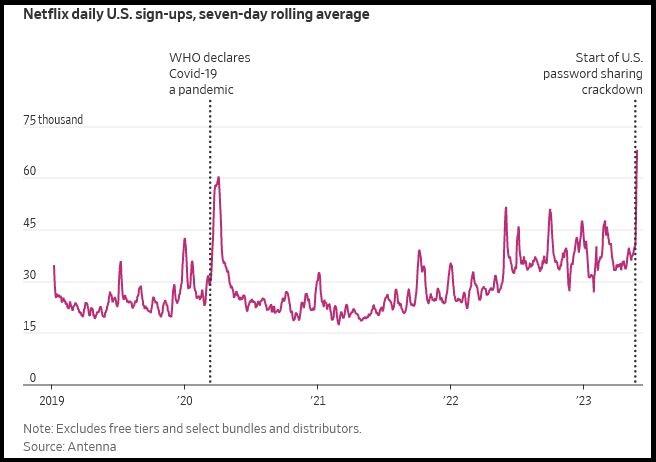
Netflix’s password-sharing crackdown appears to have been a home run, as subscriptions completely exploded over a three-day period following the announcement that the company would be taking action against some 100 million people around the world using borrowed passwords. This, after the company suffered two consecutive quarters of subscriber losses for the first time in its history – spooking the likes of Bill Ackman out of $430 million.

Between May 25 and May 28, the streaming giant amassed more users than any other four-day period since analytics company Antenna began compiling such data in 2019. The company’s move forced users sharing accounts to pay an additional $7.99 per month to watch, while the company also limited the number of extra members customers could add to their accounts, depending on the tier of service they’re subscribed to, the Wall Street Journal reports.

The cost of sharing with an extra person comes out to $2 less per month than a basic subscription, and $1 more than the ad-supported plan introduced late last year.

According to the report, Antenna uses third-party opt-in services to analyze consumer information – including online purchase receipts, bills and banking records. What’s more, the data doesn’t include subscriptions offered via bundles, meaning the explosion in new subscribers could have vastly undercounted the actual number of new subs.

Since the password-sharing crackdown went into effect May 23, shares of Netflix have risen around 13%.

As the Journal notes;

Netflix last year had two consecutive quarters of subscriber losses for the first time in its history. Its subscriber base started growing again over the past few quarters, but at a much slower pace than during the early days of the pandemic. The company has delayed its initiative to crack down on password sharing for years, though Netflix’s internal researchers had identified it has a major problem in 2019, The Wall Street Journal previously reported. 

In its first-quarter shareholder letter, the company said that account sharing “undermines our ability to invest in and improve Netflix for our paying members, as well as build our business.”

The company has also cracked down on password-sharing outside the US, including in Canada, Spain, Portugal and New Zealand.

Maybe next time, Bill. 

Tyler Durden
Fri, 06/09/2023 – 09:25

The End Of Easy Money: Bankruptcy Filings Pile Up At Fastest Rate Since 2010

The End Of Easy Money: Bankruptcy Filings Pile Up At Fastest Rate Since 2010

Authored by Wolf Richter via WolfStreet.com,

A cleansing process, long overdue, to whittle down the corporate debt overhang and clear out deadwood, at the expense of investors…

It’s turning into a banner year for corporate bankruptcy filings, after years of Easy Money that caused all kinds of excesses, fueled by yield-chasing investors, in an environment where the Fed had repressed yields with all its might. Those yield-chasing investors kept even the most over-indebted zombies supplied with ever-more fresh money. But that era has ended. Interest rates are much higher, and investors are getting a little more prudent, and Easy Money is gone.

At the peak of the Fed’s yield repression in mid-2021, “BB”-rated companies – so these companies are “junk” rated – could borrow at around 3% (my cheat sheet for corporate credit rating scales by ratings agency). Companies are junk rated because they have too much debt and inadequate cash flow to service that debt. In other words, investors risked life and limb to earn 3%, and now these investors are asked to surrender life and limb, so to speak. But that’s how it goes with yield-chasing.

These “BB” junk bond yields have risen to nearly 7%. This means these companies that had trouble producing enough cash flow to service their 3% or 5% debt, have to refinance this debt when it comes due, or add new debt, at 7%. That 7% may still be low, considering inflation running around near that neighborhood, but it puts a lot more strain on those companies.

So lots of overindebted junk-rated companies will restructure their debts in bankruptcy court at the expense of stockholders, bondholders, and holders of their leveraged loans. That’s how it’s supposed to work. That’s how the corporate-debt burden gets lifted off the economy. And it’s starting to work that way.

S&P Global has released its May bankruptcy statistics for companies that are publicly traded with at least $2 million in assets or liabilities listed in their bankruptcy filings, and private companies with publicly traded debt (such as bonds) with at least $10 million in assets or liabilities listed in their bankruptcy filings.

In May, 54 of these types of companies filed for bankruptcy, including notably, among the big ones:

  • Envision Healthcare

  • Vice Holdings and its affiliate Vice Media (a creditor group plans to acquire Vice Media out of bankruptcy)

  • Kiddie-Fernwal

  • Monitronics International

The May filings brought the five-month total to 286 bankruptcy filings, the most since 2010, more than double the filings for the same period in 2022 (138). And it even outran the 262 filings in the same period in 2020 when some companies faced enormous stress.

When the oil bust exacted its pound of flesh in 2016, and oil and gas drillers collapsed one after the other, S&P Global recorded 265 filings, but concentrated in oil and gas. To get a higher number of filings than in the first five months of 2023, we have to go back to 2010, when 402 companies filed for bankruptcy during the first five months.

Among the biggest bankruptcies included in this illustrious list so far this year that made it into my pantheon of Imploded Stocks were:

The problem today is not a collapse in prices – such as the price of oil during the Oil Bust of 2016 when crude oil grade WTI collapsed below $20 a barrel that took dozens of frackers down; WTI is at $72 a barrel today!

And the problem today is not a collapse in demand such as it hit some industries in 2020 or during the Great Recession. This economy is marked by rising prices and resilient demand.

The problem now is that the debt got a lot more expensive, and that investors thinking of buying this debt have gotten a little more prudent. The problem is the End of Easy Money. Once companies get hooked on Easy Money by having piles of debt, it’s tough to get by without Easy Money.

In a way, the economy is normalizing with rates that were fairly typical before the era of QE. But companies that only made it this far thanks to Easy Money are now getting hung out to dry.

Bankruptcy filings will whittle down the corporate debt overhang. Many companies will emerge from bankruptcy with less debt, and they’ll be nimbler and more able to thrive. Others will be sold off in bits and pieces, making room for appropriately managed companies not encumbered by these issues.

There is a cleansing aspect to this part of the credit cycle that needs to be allowed to do its job to get rid of the excesses and the deadwood at the expense of investors. This cleansing process that has now just started is long overdue.

Hilariously, the end of Easy Money is now called credit crunch. Which should be the name of a candy bar (Credit Crunch®) offered to the crybabies on Wall Street as consolation when they start clamoring for rate cuts.

*  *  *

Enjoy reading WOLF STREET and want to support it? You can donate. I appreciate it immensely. 

Tyler Durden
Fri, 06/09/2023 – 07:20

Sequoia Capital’s China Business To Split Entirely From Its U.S. Business

Sequoia Capital’s China Business To Split Entirely From Its U.S. Business

As tensions between the U.S. and China continue to ratchet higher, Sequoia Capital isn’t waiting for sanctions or interruptions to its business. Instead, it’s taking the proactive step of splitting its China business out on its own. 

The firm is going to run its China business as a “completely independent” entity from its US operation, a new report from FT revealed this week. 

In addition to splitting from the main firm, the China business will spot a new name called “HongShan”, which is a version of its previous Chinese name, which meant redwood. 

Similarly, Sequoia will reportedly be splitting off its Indian and south-east Asian businesses into another entity, the report says. 

“It really was a very complicated decision. Over the years, we have reassessed the cost-benefit trade-off of this arrangement and whether it was the right structure for the firm. We realised it was time for this,” Roelof Botha, managing partner of Sequoia Capital told FT

Shen/SCMP

“There’s much less in common now,” Neil Shen, who founded Sequoia China said. He indicated that talks about splitting the businesses “have been evolving over the last two to three years”.

The article notes that Shen has walked a thin line as founder, investing in both semiconductors and artificial intelligence in China while at the same time staying on the good side of Washington D.C., who has slapped sanctions and controls on China over the last half decade. The firm has been seeking the advice of outside policy consultants before investing in such sensitive businesses and will continue to do so going forward. 

Sequoia Capital China has raised $9 billion across numerous funds last year, including from CALPERS, the Massachusetts Pension Reserves Investment Trust and Canada’s CDPQ and CPP Investments, the report says. 

Shen concluded: “It has become increasingly complex to run a decentralised global investment business. We will move to completely independent partnerships and become distinct firms with separate brands no later than March 31 2024.” Shen said: “We shared a brand — and now we are saying no brand sharing and no centralized back office.”

Tyler Durden
Fri, 06/09/2023 – 04:15