66.9 F
Chicago
Wednesday, August 19, 2026
Home Blog Page 3615

Man Convicted Of Nonviolent Crime Cannot Be Stripped Of Gun Rights: Appeals Court

Man Convicted Of Nonviolent Crime Cannot Be Stripped Of Gun Rights: Appeals Court

A Philadelphia federal appeals court has ruled that a Pennsylvania man convicted of a nonviolent crime cannot be stripped of his 2nd Amendment right to bear arms.

A rifle at a gun shop in Richmond, Va., on Jan. 13, 2020. (Samira Bouaou/The Epoch Times)

Bryan Range was convicted in 1995 of one count of making a false statement to obtain food stamps amid a dire financial situation. He completed a three-year probation, made $2,500 in restitution, and has committed no crimes aside from minor traffic offenses and fishing without a license since then.

After he pleaded guilty in 1995, it was classified as a misdemeanor punishable by up to five years in jail – a conviction which technically made him ineligible to possess a firearm under federal law, which states that it is “unlawful for any person … who has been convicted in any court, of a crime punishable by imprisonment for a term exceeding one year” to own guns or ammunition.

In 2021, a federal judge ruled against Range’s challenge. While his case was pending appeal, the US Supreme Court decided a landmark Second Amendment case which settled on a two-step test for the constitutionality of restrictions on firearms.

The two-step process, set forth by Supreme Court Justice Thomas Clarence, first requires the court to determine whether the Second Amendment’s “plain text” covers an individual’s conduct. If so, then that conduct is presumptively protected, and the government must prove that its law is “consistent with this Nation’s historical tradition of firearm regulation.” –Epoch Times

In applying the test to Range’s case, a majority of the judges agreed in an 11-4 ruling (pdf) delivered on June 6th that despite his criminal record, he remains one of “the people” protected by the 2nd Amendment, and therefore the burden fell on the US government to prove that disarming Range would conform to “historical tradition” dating to the nation’s founding.

Yet the Government’s attempts to analogize those early laws to Range’s situation fall short,” wrote Circuit Judge Thomas Hardiman in the majority opinion.

The fact that people during the Early Republic era sometimes got executed for committing nonviolent crimes, according to Hardiman, doesn’t mean that the state, then or now, could constitutionally strip a felon of his Second Amendment rights if he was not executed, because “the greater does not necessarily include the lesser.”

“Because the Government has not shown that our Republic has a longstanding history and tradition of depriving people like Range of their firearms, [the federal law] cannot constitutionally strip him of his Second Amendment rights,” Hardiman wrote.

The judges did note that the June 6 decision is limited to Range’s individual circumstances: he was banned from owning guns because the nonviolent crime he committed decades ago carried a relatively lengthy maximum prison sentence. -Epoch Times

“Our decision today is a narrow one,” read the majority opinion. “Bryan Range challenged the constitutionality of [the federal law] only as applied to him given his violation of [the Pennsylvania law].”

As the Epoch Times notes further;

Other Opinions

Circuit Judge Thomas Ambro, a Bill Clinton appointee, wrote a concurring opinion, saying that even though the government failed to carry its burden in this case, the federal felon-in-possession ban still stands lawful.

“This is so because it fits within our Nation’s history and tradition of disarming those persons who legislatures believed would, if armed, pose a threat to the orderly functioning of society. That Range does not conceivably pose such a threat says nothing about those who do,” Ambro wrote. “And I join the majority opinion with the understanding that it speaks only to his situation, and not to those of murderers, thieves, sex offenders, domestic abusers, and the like.”

Ambro was joined by Judges Joseph Greenaway and Tamika Montgomery-Reeves, who were appointed by Barack Obama and Joe Biden, respectively.

In one of the three dissenting opinions, Circuit Judge Patty Shwartz pointed to now-unconstitutional firearm bans on groups such as Native Americans, African Americans, Catholics, Quakers, and Loyalists. She argued that these restrictions, no matter how repugnant and unlawful they are today, serve as an analogy good enough to justify disarming people such as Range.

The founders [of the United States] categorically disarmed the members of these groups because the founders viewed them as disloyal to the sovereign. The felon designation similarly serves as a proxy for disloyalty and disrespect for the sovereign and its laws,” the Obama appointee wrote. “Such categorization is especially applicable here, where Range’s felony involved stealing from the government, a crime that directly undermines the sovereign.”

Shwartz also warned that even though her colleagues have clarified that their opinion is “narrow,” the analytical framework they have applied to reach the conclusion could render most, if not all, felon firearm bans unconstitutional.

The ruling is not cabined in any way and, in fact, rejects all historical support for disarming any felon,” she wroted. “As a result, the Majority’s analytical framework leads to only one conclusion: there will be no, or virtually no, felony or felony-equivalent crime that will bar an individual from possessing a firearm.

“This is a broad ruling and, to me, is contrary to both the sentiments of the Supreme Court and our history.”

Tyler Durden
Thu, 06/08/2023 – 20:45

Jaw Dropping Stats – Reports Of Bud Light Memorial Day Sales Dropping -60% As Brand Boycott Continues

Jaw Dropping Stats – Reports Of Bud Light Memorial Day Sales Dropping -60% As Brand Boycott Continues

Authored by Sundance via The Last Refuge,

Memorial Day customarily kicks off summer and the beer beverage industry generally looks forward to the enhanced sales that come from summer.  However, if the recently published reports of Anheuser-Busch sales are accurate, which includes a stunning 60% sales drop during the holiday, the brand position of Bud Light is in freefall.

While the impacts do have a regional trend based on consumer boycotts and patterns, when the Daily Mail reports, “numbers are suffering primarily due to a decline in Bud Light sales that reached as high as a 60 percent drop off over the week that ended on Memorial Day,” we can be certain the executive offices of A/B are watching closely. The feedback from wholesalers and distributors to the parent company must be something beyond alarm.

Worse still, the forward-looking data trend doesn’t offer any hope.  Things are getting worse for the parent company.

(Daily Mail) – […] For the week ending May 20, Bud Light sales across the US fell nearly 26 percent compared to the same period last year. For the week ending May 6, in-store sales plummeted 23.6 percent. And the week before that, ending April 29, sales dropped by 23.3 percent.

This follows declines in sales for the week ending April 22, which saw a 21.4 percent decline. Seven days earlier, the dip has been 17 percent, according to NielsenIQ data provided to Dailymail.com by Bump Williams Consultancy.

The data – showing that US sales of Bud Light are dropping by as much as 20 percent each week – is being uniformly viewed by industry experts as a negative trend that may not reverse itself anytime soon.

Beer Business Daily editor Harry Schuhmacher told Fox News Digital that the ‘whole industry is in shock’. (read more)

It is safe to say the Bud Light brand is now firmly connected to the image of transgender ideology. As a result, it would appear that anyone who holds a Bud Light beverage is essentially identifying themselves as a transvestite pickle-puffer, and that could potentially draw considerable side-eyes from anyone in a public place outside the region of San Francisco, California.

As further noted by the New York Post, “Demand for Bud Light over the crucial Memorial Day weekend — the official kickoff of the summer beer buying season — was lukewarm with many store shelves still holding cases of the once mighty beer, Williams said after a spot check of local stores.  At least one store was trying to unload a 24-pack of Bud Light for just $3.49, according to Beer Business Daily.”

Anheuser-Busch InBev CEO Michel Doukeris reportedly addressed the ongoing boycott’s impact on delivery drivers, salespeople, and wholesalers on a recent earnings call. It is a little bit odd to see A/B positioning themselves as victims of their customers.

“This situation has impacted our people and especially our frontline workers: The delivery drivers, sales representatives, our wholesalers, Bud owners and servers,” Doukeris said, according to ABC News. “These people are the fabric of our business. They are our neighbors, family members, and friends. They are in every community in America. We’ve been doing everything we can to support our teams.”

It would appear that Anheuser-Busch the corporation, are refusing to accept or acknowledge their responsibility in creating this crisis for their brand.  The brand image issue was not forced upon them.  These were decisions made by the marketing division of the company, and now they place blame for the consequences on their customers.

Every time, in every story, in every print and broadcast update, as the ongoing events are told or written – every visual aide that accompanies the news includes that weird guy with the Bud Light beer in his hand.  This is now a bizarre marketing self-fulfilling prophecy. The articles and news telling updates to the story are now optically affirming the Bud Light brand as a beverage exclusively for transgenders.

This level of ongoing public relations failure is something for the record books.  I wonder if Target Inc is paying attention.

Tyler Durden
Thu, 06/08/2023 – 20:25

Revealed: Bombshell FBI Document Alleges $5 Million Bribe Paid To Joe Biden By Burisma Exec

Revealed: Bombshell FBI Document Alleges $5 Million Bribe Paid To Joe Biden By Burisma Exec

Someone has leaked the contents of the stonewalled FBI document, form FD-1023, which alleges that President Joe Biden was paid $5 million by an executive of Ukrainian natural gas firm Burisma Holdings, where his son Hunter sat on the board.

This, according to a confidential human source, who told this to the FBI during a June 2020 interview, according to Fox News.

The form, dated June 30, 2020, is from a “highly credible” confidential human source who had detailed multiple meetings and conversations they had with a top Burisma executive over the course of several years, beginning in 2015. The CHS had been working with the FBI as a regular, reliable source of information since 2010, and has been paid approximately $200,000 by the bureau.

The Burisma executive sought the advice of the confidential source, a business professional, on gaining U.S. oil rights and getting involved with a U.S. oil company, the sources familiar with the documdnt said. The Burisma executive was speaking with the confidential source to “get advice on the best way to go forward” in 2015 and 2016.

According to the FD-1023 form, the confidential human source said the Burisma executive discussed Hunter’s role on the board. The confidential human source questioned why the Burisma executive needed his or her advice in acquiring access to U.S. oil if he had Hunter Biden on the board. The Burisma executive answered by referring to Hunter Biden as “dumb.” -Fox News

According to the Burisma executive, the company had to “pay the Bidens” because Ukraine’s lead prosecutor, Victor Shokin, was investigating Burisma.

According to the CHS, he suggested that the Burisma executive “pay the Bidens $50,000 each,” to which the Burisma executive replied “not $50,000,” it is “$5 million.”

“$5 million for one Biden, $5 million for the other Biden,” the executive reportedly said.

The $5 million payments appeared to reference some sort of “retainer” Burisma intended to pay the Bidens in order to ‘clean up’ several issues – including the investigation led by Shokin. Another source told Fox it was a “pay-to-play” scheme.

The CHS believes that the $5 million payment to Joe Biden and $5 million to Hunter happened, as the Burisma executive said he “paid” the Bidens is a way “through so many different bank accounts” that investigators would not be able to “unravel this for at least 10 years.”

The document also makes reference to ‘the Big Guy,’ thought (and as seen on Hunter’s laptop) to be a reference to Joe Biden.

According to the Burisma executive, they “didn’t pay the Big Guy directly.” Meanwhile, sources tell Fox that the Burisma executive appears to be at a “very, very high level” of the company, with one source suggesting it could be the president, Mykola Zlochevsky – though the executive’s name is redacted in the document.

Biden notably bragged on camera about a quid-pro-quo arrangement to have Shokin fired.

“I said, ‘You’re not getting the billion. I’m going to be leaving here in,’ I think it was about six hours. I looked at them and said: ‘I’m leaving in six hours. If the prosecutor is not fired, you’re not getting the money,” Biden said in 2018 at a Council for Foreign Relations event, recalling a conversation with former Ukrainian President Petro Poroshenko.

“Well, son of a bitch, he got fired,” he continued. “And they put in place someone who was solid at the time.”

Of course we would be remiss if we didn’t note that this is exactly what Trump was impeached for asking about, after a 2019 phone call with Ukrainian President Volodomyr Zelenskyy – who Trump asked to launch investigations into the Biden family, particularly Hunter’s dealings with Burisma, and Joe Biden’s involvement in Shokin’s ouster.

The confidential source, according to the sources familiar with the FD-1023 form, told the Burisma executive he should “get away” from the Bidens and said the executive should “not want to be involved” with them.

A source familiar with the document told Fox News Digital that the confidential human source goes on to detail a later conversation with the Burisma executive following the 2016 presidential election. The confidential source asked the Burisma executive if he was “upset” that Donald Trump won.

The source said the Burisma executive told the confidential source that he was “an oracle,” referring to his or her advice to “get away” from the Bidens due to fears of potential investigations into their dealings. -Fox News

The revelations came to pass after a whistleblower approached GOP Sen. Chuck Grassley (R-IA) and House Oversight Committee Chairman James Comer (R-KY) to let them know that the FBI was in possession of the FD-1023.

Tyler Durden
Thu, 06/08/2023 – 20:05

Rickards: The Coming Shock To The Global Monetary System

Rickards: The Coming Shock To The Global Monetary System

Authored by James Rickards via DailyReckoning.com,

On Aug. 22, about 2½ months from today, the most significant development in international finance since 1971 will be unveiled.

It involves the rollout of a major new currency that could weaken the role of the dollar in global payments and ultimately displace the U.S. dollar as the leading payment currency and reserve currency.

It could happen in just a few years.

The process by which this will happen is unprecedented, and the world is unprepared for this geopolitical shock wave.

This monetary shock will be delivered by a group called the BRICS.

The acronym BRICS stands for Brazil, Russia, India, China and South Africa.

This play for global reserve currency status by the BRICS will affect world trade, direct foreign investment and investor portfolios in dramatic and unforeseen ways.

The most important development in the BRICS system concerns the expansion of BRICS membership. This has led to the informal adoption of the name BRICS+ for the expanded organization.

There are currently eight nations that have formally applied for membership and 17 others that have expressed interest in joining. The eight formal applicants are: Algeria, Argentina, Bahrain, Egypt, Indonesia, Iran, Saudi Arabia and the United Arab Emirates.

The 17 countries that have expressed interest are: Afghanistan, Bangladesh, Belarus, Kazakhstan, Mexico, Nicaragua, Nigeria, Pakistan, Senegal, Sudan, Syria, Thailand, Tunisia, Turkey, Uruguay, Venezuela and Zimbabwe.

There’s more to this list than just increasing the headcount at future BRICS meetings.

If Saudi Arabia and Russia are both members, you have two of the three largest energy producers in the world under one tent (the U.S. is the other member of the energy Big Three).

If Russia, China, Brazil and India are all members, you have four of the seven largest countries in the world measured by landmass possessing 30% of the Earth’s dry surface and related natural resources.

Almost 50% of the world’s wheat and rice production as well as 15% of the world’s gold reserves are in the BRICS.

Meanwhile, China, India, Brazil and Russia are four of the nine highest-population countries on the planet with a combined population of 3.2 billion people or 40% of the Earth’s population.

China, India, Brazil, Russia and Saudi Arabia have a combined GDP of $29 trillion or 28% of nominal global GDP. If one uses purchasing power parity to measure GDP, then the BRICS share is over 54%. Russia and China have two of the three largest nuclear arsenals in the world (the other leader is the United States).

By every measure — population, landmass, energy output, GDP, food output and nuclear weapons — BRICS is not just another multilateral debating society. They are a substantial and credible alternative to Western hegemony.

BRICS acting together is one pole of a new multipolar or even bipolar world.

When the new currency launch is announced in August, the currency will not fall on an empty field. It will fall into a sophisticated network of capital and communications. This network will greatly enhance its chances of success.

The BRICS are also developing an optical fiber submarine telecommunications system that would connect its members. It is being developed under the name BRICS Cable. Part of the motivation for BRICS Cable is to foil spying by the U.S. National Security Agency on message traffic carried through existing cable networks.

What’s behind this quest to ditch the dollar? In no small part the answer is U.S. weaponization of the dollar through the use of sanctions.

On numerous occasions from 2007–2014, I warned U.S. officials from the Treasury, Pentagon and intelligence community that overuse or abuse of dollar sanctions would lead adversaries to abandon the dollar to avoid the impact of sanctions.

Such abandonment would lead to the diluted potency of sanctions, unforeseen costs imposed on the U.S. and eventually to the collapse of confidence in the dollar itself. These warnings were mostly ignored.

We have now reached the first and second stages of this forecast and are dangerously close to the third.

For years, the U.S. has used sanctions to punish nations like Iran. But the sanctions the U.S. and its allies imposed on Russia after it invaded Ukraine last year went far beyond previous sanctions regimes. They were unprecedented.

Many other nations began to conclude that they could be next if they run afoul of the U.S. on certain issues. And that fear has greatly accelerated the push to opt out of the dollar system entirely.

This desire is not limited to current targets such as Russia but is shared by potential targets including China, Iran, Turkey, Saudi Arabia, Argentina and many others.

The BRICS+ present a realistic effort to de-dollarize global payments and eventually global reserves.

For years, I’ve argued that the dollar would remain the world’s leading reserve currency for longer than most people think.

But below, I show you why a new BRICS+ currency could greatly accelerate the demise of the dollar as the world’s leading reserve currency.

How could it happen so much faster than I previously thought? Read on.

The Coming Shock to the Global Monetary System

The global desire to move away from the dollar as a medium of exchange for international trade in goods and services is hardly new. The difference today is that it’s gone from a discussion point to a novelty to a looming reality in a remarkably short period of time.

Dubai and China have recently concluded an arrangement whereby Dubai will accept Chinese yuan in payment for oil exports from Dubai. In turn, Dubai can use the yuan to buy semiconductors or manufactured goods from China.

Saudi Arabia and China have been discussing similar oil-for-yuan arrangements but nothing definitive has yet been put in place. These discussions are made complicated by Saudi Arabia’s long-standing petrodollar deal with the U.S. Still, some progress along these lines is widely expected.

China and Brazil have recently reached a broad-based bilateral currency deal where each country accepts the currency of the other in trade. Meanwhile, there’s a growing strategic relationship between China and Russia as the two superpowers jointly confront the United States. In the trading relationship between the two nations, Russia can pay in rubles for Chinese manufactured goods and other exports while China pays in yuan for Russian energy, strategic metals and weapons systems.

Yet all these arrangements may soon be superseded by a new BRICS+ currency, which will be announced in Durban, South Africa, at the annual BRICS Leaders’ Summit Conference on Aug. 22–24.

The currency will be pegged to a basket of commodities for use in trade among members. Initially, the BRICS+ commodity basket would include oil, wheat, copper and other essential goods traded globally in specified quantities.

In all likelihood, the new BRICS+ currency would not be available in the form of paper notes for use in everyday transactions. It would be a digital currency on a permissioned ledger maintained by a new BRICS+ financial institution with encrypted message traffic to record payments due or owing by participating parties. (This is not a cryptocurrency because it is not decentralized, not maintained on a blockchain and not open to all parties without approval.)

The latest information from the BRICS working groups is that this basket valuation methodology is encountering the same problems that John Maynard Keynes encountered at the Bretton Woods meetings in 1944.

Keynes initially suggested a basket of commodities approach for a world currency he called the bancor. The difficulty is that global commodities included in any basket are not entirely fungible (there are over 70 grades of crude oil distinguished by viscosity and sulfur content among other attributes).

In the end, Keynes saw that a basket of commodities is not necessary and that a single commodity — gold — would better serve the purpose of anchoring a currency for reasons of convenience and uniformity.

Based on the impracticality of commodity baskets as uniform stores of value, it appears likely that the new BRICS+ currency will be linked to a weight of gold.

This plays to the strengths of BRICS members Russia and China, who are the two largest gold producers in the world and are ranked sixth and seventh respectively among the 100 nations with gold reserves.

These and related developments are frequently touted as the “end of the dollar as a reserve currency.” Such comments reveal a lack of understanding as to how the international monetary and currency systems actually work.

The key mistake in almost all such analyses is a failure to distinguish between the respective roles of a payment currency and a reserve currency. Payment currencies are used in trade for goods and services. Nations can trade in whatever payment currency they want — it doesn’t have to be dollars.

Reserve currencies (so-called) are different. They’re essentially the savings accounts of sovereign nations that have earned them through trade surpluses. These balances are not held in currency form but in the form of securities.

When analysts say the dollar is the leading reserve currency, what they actually mean is that countries hold their reserves in securities denominated in a specific currency. For 60% of global reserves, those holdings are U.S. Treasury securities denominated in dollars. The reserves are not actually in dollars; they’re in securities.

As a result, you cannot be a reserve currency without a large, well-developed sovereign bond market. No country in the world comes close to the U.S. Treasury market in terms of size, variety of maturities, liquidity, settlement, derivatives and other necessary features.

So the real impediment to another currency as a reserve currency is the absence of a bond market where reserves are actually invested. That’s why it’s so difficult to displace Treasuries as reserve assets even if you wanted. Again, no country in the world can come close to the U.S. in that regard.

But here’s where it gets interesting, and why the dollar could lose its leading reserve status much faster than previously thought.

That’s because the BRICS+ currency offers the opportunity to leapfrog the Treasury market and create a deep, liquid bond market that could challenge Treasuries on the world stage almost from thin air.

The key is to create a BRICS+ currency bond market in 20 or more countries at once, relying on retail investors in each country to buy the bonds.

The BRICS+ bonds would be offered through banks and postal offices and other retail outlets. They would be denominated in BRICS+ currency but investors could purchase them in local currency at market-based exchange rates.

Since the currency is gold backed it would offer an attractive store of value compared with inflation- or default-prone local instruments in countries like Brazil or Argentina. The Chinese in particular would find such investments attractive since they are largely banned from foreign markets and are overinvested in real estate and domestic stocks.

It will take time for such a market to appeal to institutional investors, but the sheer volume of retail investing in BRICS+-denominated instruments in India, China, Brazil and Russia and other countries at the same time could absorb surpluses generated through world trade in the BRICS+ currency.

In short, the way to create an instant reserve currency is to create an instant bond market using your own citizens as willing buyers.

The U.S. did something similar in 1917. From 1790–1917, the U.S. bond market was for professionals only. There was no retail market. That changed during World War I when Woodrow Wilson authorized Liberty Bonds to help finance the war.

There were bond rallies and Liberty Bond parades in every major city. It became a patriotic duty to buy Liberty Bonds. The effort worked, and it also transformed finance. It was the beginning of a world where everyday Americans began to buy stocks, bonds and securities as retail investors.

If the BRICS+ use a kind of Liberty Bond patriotic model, they may well be able to create international reserve assets denominated in the BRICS+ currency even in the absence of developed market support.

This entire turn of events — introduction of a new gold-backed currency, rapid adoption as a payment currency and gradual use as a reserve asset currency — will begin on Aug. 22, 2023, after years of development.

Except for direct participants, the world has mostly ignored this prospect. The result will be an upheaval of the international monetary system coming in a matter of weeks.


Tyler Durden
Thu, 06/08/2023 – 19:45

Trump: “I Have Been Indicted”

Trump: “I Have Been Indicted”

Former President Donald Trump on Thursday posted on Truth Social that he’s been indicted, “seemingly over the Boxes Hoax,” and that he’s been summoned to appear at the Federal Courthouse in Miami on Tuesday at 3pm.

Donald Trump via Truth Social:

The corrupt Biden Administration has informed my attorneys that I have been Indicted, seemingly over the Boxes Hoax, even though Joe Biden has 1850 Boxes at the University of Delaware, additional Boxes in Chinatown, D.C., with even more Boxes at the University of Pennsylvania, and documents strewn all over his garage floor where he parks his Corvette, and which is “secured” by only a garage door that is paper thin, and open much of the time.

I have been summoned to appear at the Federal Courthouse in Miami on Tuesday, at 3 PM. I never thought it possible that such a thing could happen to a former President of the United States, who received far more votes than any sitting President in the History of our Country, and is currently leading, by far, all Candidates, both Democrat and Republican, in Polls of the 2024 Presidential Election. I AM AN INNOCENT MAN!

This is indeed a DARK DAY for the United States of America. We are a Country in serious and rapid Decline, but together we will Make America Great Again!

Developing…

Tyler Durden
Thu, 06/08/2023 – 19:38

Tucker Talks Taboos After MSM Ignores Instagram Kiddie-Porn Bombshell

Tucker Talks Taboos After MSM Ignores Instagram Kiddie-Porn Bombshell

After his first episode topped 100 million views, Tucker Carlson is back with Episode 2, exploring how we, as a population, are controlled (or coerced) directly (through laws) or indirectly (through taboos).

Carlson observes the changing societal taboos in America, suggesting that they are being dictated from above rather than evolving organically, focusing explicitly on the shift in attitudes towards race-based attacks, adultery in politics, and child molestation.

“Let’s say you wanted to control a country,” the former Fox News man begins rather joltingly.

“Well,” he explains “you’d want to make sure you had the complete obedience of everybody within your borders who was authorized to use deadly force… you’d start with the military… [and other agencies] like the IRS.”

“Controlling the guns would be a top priority for you if ever wanted to go dictatorial.”

But, Carlson, asks, what if you wanted more, not simply to control people’s behavior, “but to control how they think.”

“In that case,” he remarks, “you’d need to take charge of its taboos.”

A taboo is something that by popular consensus is not allowed, it is not illegal, but it doesn’t need to be.

“Over time, social prohibitions are more powerful and more enduring than laws.”

Until fairly recently, Tucker points out that it was taboo in this country to attack people on the basis of their race, but he notes “apparently we no longer believe that – punishing people on the basis of their skin color is not only permitted in modern America, it is mandatory… as long as the victims are white.”

He questions the definition and scope of white supremacy as described by President Joe Biden and expresses concerns about the blurred lines of crime, the erosion of defined legal codes, and the need to protect societal taboos as guiding moral principles.

Which brings Carlson to this week’s horrific WSJ expose of Instagram’s kiddie-porn rings which he notes has resulted in exactly nothing as “one of the largest circulation newspapers in the world reported that one of the world’s most influential companies was promoting pedophilia and nobody in power did anything about it.”

As Carlson notes, “The people who run this country no longer see child molesters as the worst among us”

In fact, he continues, “what we are allowed to dislike is being dictated to us from above, sometimes by force.”

The trick, that has happened slowly and then all at one, is that “when a crime has no definition, anyone can be guilty of it”

“Don’t let them rationalize away your intuitive moral sense.”

“Cling to your taboos like you life depends on them… because it does.”

Watch the full Tucker On Twitter episode below:

Tyler Durden
Thu, 06/08/2023 – 19:34

“Family Man” Lionel Messi Snubs Saudis In Favor Of Miami To Usher In Twilight Of Legendary Career

“Family Man” Lionel Messi Snubs Saudis In Favor Of Miami To Usher In Twilight Of Legendary Career

While the Saudis may have notched a win this week with their tie-up between LIV Golf and the PGA Tour, legendary soccer star Lionel Messi quickly handed Riyadh a comeuppance when he chose to spend the twilight of his career in Miami instead of in Saudi Arabia. 

It was rumored that Messi was going to be offered $1 billion to play in Saudi Arabia, a country where he has reportedly already worked as a tourist ambassador, Bloomberg wrote this week. 

But the star turned down the payday to head to Major League Soccer’s Inter Miami, where details of his agreement have not yet been made public, though there are rumors of profit sharing agreements with Apple Inc. and Adidas AG, the report notes. 

“I made the decision that I am going to Miami. I still haven’t closed it one hundred percent. I’m missing some things but we decided to continue my journey there,” Messi said earlier this week, as was reported by CNN

Major League Soccer stated: “We are pleased that Lionel Messi has stated that he intends to join Inter Miami and Major League Soccer this summer. Although work remains to finalize a formal agreement, we look forward to welcoming one of the greatest soccer players of all time to our League.”

Simon Chadwick, a professor of sport and geopolitical economy at Skema Business School in Paris told Bloomberg that Messi is “a family man, very stable in his personal life, so as a brand he is very different than Ronaldo’s.”

He said that in Miami, Messi will be “enjoying much more the day to day.”

Messi’s foil, Cristiano Ronaldo, famously went on to play for Saudi Professional League club Al Nassr to end his career, reportedly reaping an ungodly €200 million per year in salary. Ronaldo reportedly turned down a move to Major League Soccer for the deal. Messi, naturally, has done the opposite. 

Soccer mega-star David Beckham is part of Inter Miami’s ownership team, which may have helped in Messi’s decision making, multiple reports stated. 

Barcelona club president Joan Laporta “understood and respected Messi’s decision to want to compete in a league with fewer demands, further away from the spotlight and the pressure he has been subject to in recent years,” a statement said. 

Laporta and Messi’s father have committed to working on a “tribute from Barça fans to honor a footballer who has been, is, and always will be beloved by Barça,” CNN concluded. 

Tyler Durden
Thu, 06/08/2023 – 19:25

Inflation & Biden Regulations Are Making Life Hard; Small Business Owners Say

Inflation & Biden Regulations Are Making Life Hard; Small Business Owners Say

Authored by Michael Clements via The Epoch Times,

Small business owners are calling on Congress to address inflation by easing business regulations and taxes. They say Biden administration policies show disdain for small businesses.

Silvia Lee, executive vice president, and Chief Lending Officer for First Community Bank in Corpus Christi, Texas, said a commercial customer told her he felt targeted.

“He mentioned that he feels our government doesn’t want small businesses to succeed and only wants large companies in business,” she told the House Committee on Small Business at a June 7 hearing.

David Zittel, a vegetable farmer from New York, called on Congress to protect small businesses.

“The Zittels hope that vegetables will always be grown on our land for generations to come, and we look forward to carrying on the farming tradition but also look to Congress to ensure that laws and regulations do not put us out of business,” Zittel said.

Zittel and the other witnesses said regulation is raising the cost of doing business to the point that they are in danger of pricing their products out of the market.

Members of small business owners take part in a “Save Small Business” protest in Los Angeles, Calif., on Dec. 12, 2020. (Ringo Chiu/AFP via Getty Images)

Lee said that raising interest rates to control inflation forces many of her bank’s customers, home builders, to scale back their operations.

She told the committee that two builders in her area were forced to close with unfinished homes. This left their customers scrambling to find a builder to finish the jobs. She said she sees every day the impact government has on a business’s bottom line.

Lee said that all of her bank’s employees bear some responsibility for compliance; at least 30 workers are responsible for ensuring compliance with banking regulations. She pointed out that ensuring compliance doesn’t increase a business’s profit margin. Committee member Rep. Blaine Luetkemeyer (R-Mo.) agreed that something should be done.

“That’s a dead investment,” he told Lee.

A letter signed by 66 business owners and submitted to the committee called on Congress to mitigate the Tax Cuts and Jobs Act of 2017.

A worker sits in an empty gift shop in New York City’s Chinatown on Feb. 13, 2020. (Spencer Platt/Getty Images)

That policy requires businesses to carry research and development costs on their books and depreciate them as an asset. The letter reads that in the past, business was allowed to expense research and development, which reduces the business’s tax burden and frees up money for more research, payroll, or other needs.

According to the letter, the tax regulation is tough on new businesses.

“Research, development, and experimentation costs can quickly eat away at a growing startup’s budget,” the letter reads.

“But immediate expensing for R&E expenditures helps to offset these costs, allowing startups to propel the U.S. as a leader in global innovation.”

But, at least one economist blames business for inflation.

Josh Bivens is Chief Economist and Research Director for the Economic Policy Institute in Washington. He said inflation is a complex issue, in this case, driven by businesses trying to deal with disruptions from the pandemic and the Russian invasion of Ukraine. He said that inflation is a global issue and that the United States is faring better than other countries in its recovery.

‘Shocks and Ripples’

Bivens said the inflationary cycle began with “shocks and ripples” during the pandemic.

“These shocks were the pandemic and the Russian invasion of Ukraine, and the ripples were mostly about jockeying by different economic actors—corporations, workers, and suppliers—to protect their real incomes from these shocks,” Bivens’ written testimony reads.

According to Bivens, the solution is more regulation. He said wealthier businesses could raise their prices while refusing to meet the increase in their suppliers’ prices. Some companies were forced to shut down. Others consolidated to survive. All this further disrupted the already tangled supply chain.

According to Bivens, whether those transactions were good or bad depends on which side of the deal you are on.

“One person’s income is another person’s cost,” he said.

Not Happening Fast Enough

Bivens said enacting and enforcing strong antitrust policies would “level the playing field.” This would hasten the reduction of inflation, which he said is already underway, although it is trending very slowly.

“It’s not happening fast enough for most of us,” he said.

Zittel pointed out that, as a farmer, he has practically no control over market prices, the weather, and other forces that impact his business. In addition, he said that the state and federal labor regulations, including minimum wage laws, control 50 percent of his business costs.

“Farmers are price takers, not price makers,” Zittel said.

Lee and Zittel disagreed with Bivens’ solution. They said a better plan is to reduce regulation and allow businesses to expand. Gordon Gray, of the American Action Forum agreed. He told the committee that the solution to inflation is basic.

“Increase the supply,” Gray said.

Tyler Durden
Thu, 06/08/2023 – 19:05

VIX Dumps, Gold Pumps, Jobless Jump As Trillion-Dollar Bill-Bomb Looms

VIX Dumps, Gold Pumps, Jobless Jump As Trillion-Dollar Bill-Bomb Looms

The morning started with two ugly data points as jobless claims jumped dramatically (this is the biggest rise in initial claims year-to-date – ex-COVID – since 2009…

Source: Bloomberg

…and Wholesale Sales totals tumbling into the red YoY (a strong recession signal)…

Source: Bloomberg

…pulling Treasury yields and the dollar lower and sending gold higher as the market’s expectations for The Fed dropped dovishly lower

Source: Bloomberg

And bear in mind that, as Deutsche Bank strategist Steven Zeng said in a recent research note, net bill issuance of $400 billion is expected in June, followed by $500 billion between July and September. In total, Zeng estimated $1.3 trillion in net bill issuance by the end of the year… all of which could well drain significantly liquidity from the system.

But hey, keep selling vol (down 9 of the last 11 days) – VIX hit a 13 handle today, the lowest since Jan 2020

Source: Bloomberg

Today saw a reversal of yesterday’s chaos in equity land with Nasdaq surging at the cash open while Russell 2000 was dumped (but the latter made a strong comeback after Europe closed). S&P and Dow rallied around 0.5%…

Nasdaq was supported by the 0-DTE traders all day today who bought calls with both hands and feet…

Source: SpotGamma

Interestingly, the ‘soft landing’ reversal stalled today as Nasdaq outperformed Small Caps (but only modestly and even that reversed back lower in the afternoon…

Source: Bloomberg

TSLA rallied for the 10th consecutive day (it has only rallied for a longer period once before, in Jan 2021)…

Oh, and then there’s CVNA…!

Treasuries were bid across the curve with the belly outperforming (5Y -9bps, 2Y -3bps, 30Y -6bps). The 30Y yield is back to unchanged on the week…

Source: Bloomberg

The dollar tumbled again today (its biggest daily drop since March) – the second big drop in a week – to 3-week lows…

Source: Bloomberg

Bitcoin went nowhere today…

Source: Bloomberg

Oil prices plunged today with WTI back below $70 and well below pre-Saudi-cut levels after headlines about possible Iran nuke deal talks… which was denied about an hour later…

Gold surged today, erasing yesterday’s plunge as markets are all acting like penny stocks…

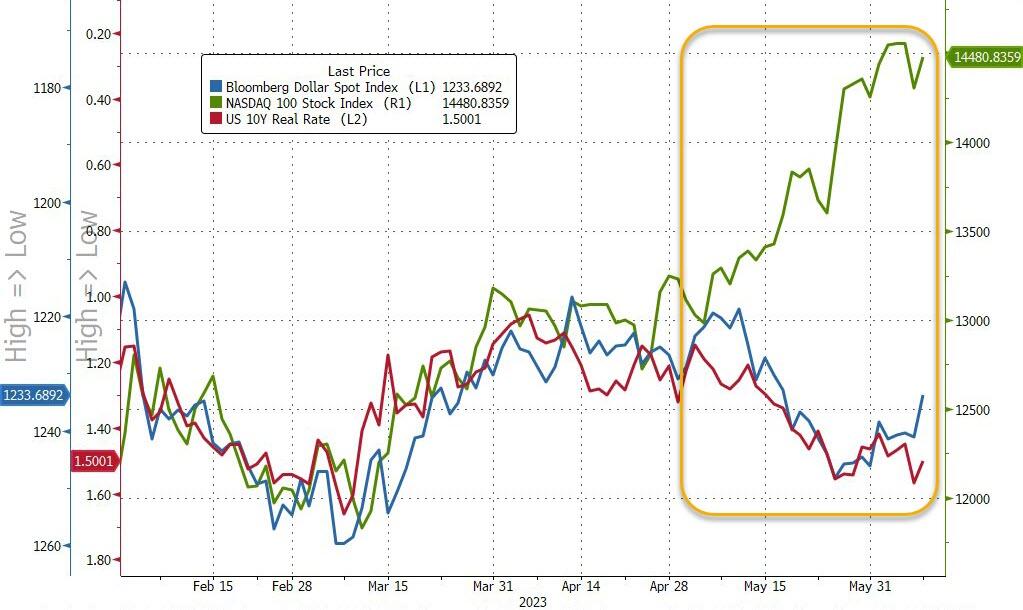
Finally, the “trilemma” continues to confuse

The dollar, tech stocks and real rates are not supposed to act like this into a recession.

The dollar rallies (fact) on higher real rates (check) OR rising risk aversion (not present), tech rallies (fact) on lower real rates (not present) OR higher risk appetite due to US exceptionalism (check).

Goldman believes that the dollar is right and equities aren’t.

Tyler Durden
Thu, 06/08/2023 – 16:00

SEC’s Gensler Offered To Serve As An Adviser To Binance In 2019: Lawyers Claim

SEC’s Gensler Offered To Serve As An Adviser To Binance In 2019: Lawyers Claim

By Tom Mitchelhill of Cointelegraph.

Years before serving as head of the Securities and Exchange Commission, Gary Gensler offered up his advisory services to Binance, the exchange’s lawyers allege.

United States Securities and Commission Chair Gary Gensler once offered to serve as an adviser to Binance, lawyers representing the crypto exchange and its founder Changpeng Zhao have alleged.

According to a June 7 CNBC report, documents filed by the SEC on June 7 indicated attorneys from Gibson & Dunn and Latham & Watkins alleged Gensler offered to serve as an adviser to the exchange in March 2019.

However, a previous report from The Wall Street Journal in March indicated that Binance had actually approached Gensler first in 2018 for the adviser role.

According to the WSJ, which cited messages and documents from 2018 to 2020, Ella Zhang, who was then the head of Binance’s venture investing arm, and Harry Zhou, co-founder of Binance-invested firm Koi Trading, first met with Gensler in October 2018 to offer him an advisory position. Gensler later declined the offer. 

Additionally, the report claims multiple private companies approached Gensler to serve as an advisor while teaching at MIT, but he declined all the offers.

United States President Joe Biden nominated Gensler to chair the SEC in February 2021, and he was sworn into office on April 17, 2021. 

Prior to joining the SEC, he was a professor of the practice of global economics and management at the MIT Sloan School of Management. From 2017 to 2019, he served as chair of the Maryland Financial Consumer Protection Commission.

The SEC sued Binance on June 5 for failing to register as a securities exchange and for allegedly operating illegally in the U.S. The financial regulator pressed a total of 13 charges against the crypto exchange, including unregistered offers and sales of the BNB

On June 7, Binance sent out a message through its Chinese social media channels declaring that it was “different” from other crypto exchanges amid the heightened regulatory actions against it.

In the statement, Binance said its wallet addresses are transparent and the exchange never “siphoned consumers’ funds.” Additionally, Binance said it never gave “large donations” to political candidates nor made “large sponsorships” to entertainment and media entities — a not-so-subtle nod to the practices harnessed by the now-defunct crypto exchange FTX. 

On the same day, Zhao sparked debate on Twitter when he pointed out that the SEC never sued FTX, despite Gensler claiming there were many “parallels” between the two companies in an interview.

Cointelegraph contacted the SEC for comment but did not receive an immediate response.

Tyler Durden
Thu, 06/08/2023 – 15:45