77.6 F
Chicago
Tuesday, August 18, 2026
Home Blog Page 3624

800 Years Of History In One Paragraph

800 Years Of History In One Paragraph

Authored by Jeffrey Tucker via DailyReckoning.com,

Perhaps you recall the immensely popular series Downton Abbey, depicting British aristocratic life in a mighty estate, robust at first but fading as the seasons progress.

At one point, the dowager countess Violet Crawley summarizes 800 years of British history in a paragraph. It’s the kind of history that is routinely denied to students and has been for decades.

But it’s a good lesson in political science. She says:

For years I’ve watched governments take control of our lives, and their argument is always the same: fewer costs and greater efficiency. But the result is the same too: less control by the people and more control by the state, until the individual’s own wishes count for nothing. That is what I consider my duty to resist.

“By wielding your unelected power?” asks Lady Rosamund Painswick.

Ignoring the swipe, the dowager answers:

“See, the point of a so-called great family is to protect our freedoms. That is why the barons made King John sign the Magna Carta.”

Surprised, her distant cousin Isobel responds:

“I do see that your argument was more honorable than I’d appreciated.”

And her daughter-in-law Cora, an American who doesn’t understand what’s at stake, answers too: “Mama, we’re not living in 1215. The strengths of great families like ours is going. That’s just a fact.”

The dowager continues:

“Your great-grandchildren won’t thank you when the state is all-powerful because we didn’t fight.”

Now we know why she cares so much about this one seemingly small issue.

For her entire life, she has seen the state on the march, most especially during the Great War, and then the pressure of the state mounted against all the old estates, as they fall in status and wealth year after year, as if by some inexorable force of history.

The dowager, on the other hand, sees not some invisible hand at work but a very visible hand, that of the state itself. In other words, she sees what nearly everyone else has missed.

And whether she is right or wrong on the particular matter of this one hospital (and later history proves her correct), the larger point is precisely right.

As the great fortunes of the nobility declined — the very structures that had not only carved out the rights of the people against the rulers and protected them for 800 years — the state was on the rise, threatening not only the nobles but the people too.

What does all this have to do with the U.S. and the American Revolution? Read on.

Corruption of the Great Families and the Future of Freedom

New history likes to point out with great ire that the prime movers of rebels against the crown in 1776 were larger landowners and businessmen along with their families.

They were the Founding families and the main influencers behind the Revolution, which Edmund Burke famously defended on grounds that it was not a real revolution but a revolt with a conservative intent. By this he meant that the Colonies were merely asserting rights forged in British political experience.

And there is a point to that. The rights-based fervor that birthed the War of Independence gradually mutated into a Constitutional Convention 13 years later. The Articles of Confederation had no central government but the Constitution did. And the main controlling factions of the new government were indeed the landed families of the New World.

The Bill of Rights, a thoroughly radical codification of the rights of the people and lower governments, was tacked on by the “Anti-Federalists” — again, a landed aristocracy — as a condition of ratification.

The issue of slavery in the Colonies massively complicated the picture, of course, and became the main line of attack on the American system of federalism itself. The landed gentry of the South in particular always had grave doubts about Jefferson’s claims of universal and inviolable rights, fearing that eventually their ownership claims over human persons would be challenged, which indeed they were and less than a century after the Constitution was ratified.

That aside, it remains true that the birth of American liberty rested with the U.S. version of the nobles, but also backed by the people at large. So the dowager’s history of British rights is not entirely inconsistent with the American story at least until recently.

This has also been the prism with which to understand the broad outlines of the terms “left” and “right” in both the U.K. and the U.S. The “right” in a popular sense has represented mostly the established business interests (including the good parts and bad parts such as the munitions manufacturers) and tended to be the faction that defended the rights of commerce.

The “left” has pushed the interests of labor unions, social welfare and minority populations, all of which happened also to be aligned with the interests of the state.

Those categories seemed mostly settled as we entered the 21st century.

But it was at this point that a titanic shift began to take place, especially after 9/11. The interests of the “great families” and the state began to align across the board (and not just on matters of war and peace). These family fortunes were no longer attached to Old World ideals but to technologies of control.

The paradigmatic case is the Gates Foundation but the same holds true of Rockefeller, Koch, Johnson, Ford and Bezos. As the main funders of the World Health Organization and “scientific” research grants, they are the main forces behind the newest and largest threats to the freedom of the individual.

These foundations built from capitalist wealth, and now fully controlled by bureaucrats loyal to statist causes, are on the wrong side of the crucial debates of our time. They fight not for the emancipation of the people but rather more control.

With many sectors of the “left” naively signing up with the biomedical state and the interests of the pharmaceutical giants, and the “right” triangulated into going along, where is the party to defend the freedom of the individual? It is being squeezed out in an attack from both ends of the mainstream political spectrum.

If the “great families” have fundamentally shifted their loyalties and interests, in both the U.S. and the U.K., and the mainline churches can no longer be relied upon to defend basic freedoms, we can and should expect a major realignment to take place.

Marginalized groups drawn from the older versions of both right and left will need to mount a major and effective effort to reassert all the rights forged and earned over many centuries.

These are completely new times and the COVID wars signal that turning point.

Essentially, we need to revisit the Magna Carta itself to make it clear: Government has definite limits to its power. And by “government,” we cannot just mean the state but also its aligned interests, which are many but include the largest players in media, tech and corporate life.

The groups that want to normalize the lockdowns and mandates — thinking of the COVID Crisis Group — can count on the financial support of the “great” families, and freely admit it. This is a problem completely unlike what freedom fighters have faced over the long course of modern history. It’s also why political alliances these days seem so fluid.

This is ultimately what is behind the great political debates of our time. We are trying to make sense of who stands for what in times when nothing is as it seems.

And there are some strange anomalies extant too. Elon Musk, for example, is among the richest Americans but seems to be a backer of free speech that the establishment hates. His social platform is the only one among the high-impact products that permit speech that contradicts regime priorities.

Meanwhile his competitor in riches Jeff Bezos does not join him in this crusade.

So too when Robert F. Kennedy Jr. — a scion of a “great family” — has broken with his clan to support the rights of the individual and a restoration of the freedoms we took for granted in the 20th century. His entry into the race for the Democratic nomination has disrupted our whole sense of where the “great families” stand on fundamental questions.

The confusion even impacts political leaders like Donald Trump and Ron DeSantis. Is Trump really a populist who is willing to stand up to the administrative state or is his appointed role to absorb the energies of the pro-freedom movement and once again turn them toward authoritarian ends, as he did with the lockdowns of 2020?

And is Ron DeSantis a genuine champion of freedom who will fight lockdowns or is his appointed role to divide and weaken the Republican Party in advance of the nomination fight?

This is the current fight within the GOP. It is a fight over who is telling the truth.

The reason conspiracy theory has been unleashed as never before in our lifetimes is because nothing truly is what it seems to be. This traces to the reversal of alliances that have characterized the struggle for liberty over 800 years.

We no longer have the barons and lords and we no longer have the great fortunes: They have thrown their lots in with the technocrats. Meanwhile, the supposed champions of the little guy are now fully aligned with the most powerful sectors of society, yielding a fake version of the left.

Where does this leave us? We only have the intelligent bourgeoisie — products of the middle class that is currently under assault — that is well-read, clear-thinking, attached to alternative sources of news and only now in our post-lockdown world aware of the existential nature of the struggle we face.

And their rallying cry is the same which has inspired the freedom movements of the past: the rights of individuals and families over the hegemon.

If the dowager countess were around today, let there be no doubt as to where she would stand. She would stand with the freedom of the people against the controls of the state and its managers.

Tyler Durden
Mon, 06/05/2023 – 19:00

Park Hotels Makes “Difficult” Decision To Stop Paying San Fran CMBS Loan, Citing “Concerns Over Street Conditions”

Park Hotels Makes “Difficult” Decision To Stop Paying San Fran CMBS Loan, Citing “Concerns Over Street Conditions”

Park Hotels & Resorts Inc. announced Monday that it ceased making payments on a $725 million CMBS loan which is scheduled to mature in November 2023. The loan is secured by two of its San Francisco hotels that it plans to remove from its portfolio.

The hotels in focus are the 1,921-room Hilton San Francisco Union Square and the 1,024-room Parc 55 San Francisco. 

“The Company intends to work in good faith with the loan’s servicers to determine the most effective path forward, which is expected to result in ultimate removal of these hotels from its portfolio,” Park wrote in a statement. 

You won’t be shocked by Park CEO Thomas Baltimore’s statement on why it’s a “necessary decision to stop debt service payments on our San Francisco CMBS loan”: 

“After much thought and consideration, we believe it is in the best interest for Park’s stockholders to materially reduce our current exposure to the San Francisco market. Now more than ever, we believe San Francisco’s path to recovery remains clouded and elongated by major challenges – both old and new: record high office vacancy; concerns over street conditions; lower return to office than peer cities; and a weaker than expected citywide convention calendar through 2027 that will negatively impact business and leisure demand and will likely significantly reduce compression in the city for the foreseeable future.”

Baltimore said removing the two hotels will “substantially improve our balance sheet and operating metrics.” 

And there it is, a large real estate investment trust focused on hotel properties, with over 29,000 rooms in prime U.S. markets, abandoning San Francisco.

Park’s announcement comes days after San Francisco’s Mayor, London Breed, makes major U-Turn to fund police after an explosion in crime has forced companies to leave the crime-ridden town.  

Well done, Democrats. You’ve effectively transformed a once-thriving city into a hellhole. 


Tyler Durden
Mon, 06/05/2023 – 18:40

The US Desperately Needs A Political Brain Transplant

The US Desperately Needs A Political Brain Transplant

Authored by Mike Shedlock via MishTalk.com,

Euointelligence has an interesting take on why Biden Inflation Reduction Act will fail in its goal to re-industrialize the US.

Don’t Re-Industrialize. Forge Alliances.

Please consider Don’t Re-Industrialize. Forge Alliances, emphasis mine.

There is an old saying in the world of manufacturing: once an industry leaves, it won’t come back. It’s the Humpty Dumpty of economics. This is why the Germans, who know a thing or two about industry, have been fighting deindustrialization so hard. The US and the UK gave up on industry decades ago, but the Biden administration wants it to return. The instrument of choice is last year’s Inflation Reduction Act, with its $370bn program of green subsidies. I fear the US underestimates the scale of the task.

The intellectual force behind that strategy is Jake Sullivan, Joe Biden’s national security adviser. It is a sign of the times that foreign policy dictates the most important strategic economic policy shift in decades. Sullivan has cited the hollowing out of the US’s industrial base as one of the reasons behind the strategy. The other, of course, is China.

The White House says the goal of the Inflation Reduction Act is to make “the nation more resilient to growing threats… and driving critical economic investments to historically underserved communities”. This describes the mélange of foreign and domestic policy goals quite well. It is rare in politics that one policy instrument achieves two policy goals. More often than not, it achieves neither.

The scale of the problem is illustrated by the diminished role of industry. In the UK and the US, industry accounts for 17-18 per cent of the value added in the economy, according to the World Bank. In Germany and Japan, it is 27-29 per cent. In China it is almost 40 per cent.

It takes years for an industrial company to build a production line and supply chains. This is why China is so good at it. Industry time-horizons correspond more closely to five-year plans than quarterly profit targets. Herein lies the first obstacle. The term of a US president, and their national security adviser, is short. Would an industrial firm be so reckless as to place a strategic bet on Donald Trump not getting back into office? Or that, if he did, he would continue Biden’s industrial policies? Or that even a future Democratic administration would?

Sullivan is, of course, right in his diagnosis: the US industrial base has been hollowed out. Re-industrialization may be a laudable goal, but Sullivan’s strategy would require a political brain transplant. It would be a very long-term program. The way to start would be to build a bipartisan consensus. A subsidy program is not enough. And it should not be the start.

I also fail to see how the US will achieve the second stated goal of the Inflation Reduction Act – to become more resilient and independent from China. China’s near monopoly in some rare earths and other raw materials remains. All the new US investment will do is reshuffle the higher nodes or points in the supply chains.

A smarter policy response for the US would be to build strategic supply-chain and industrial partnerships in Africa and Latin America. This is what China has done, for example by taking a strategic stake in a Chilean lithium mine. Chile is the world’s second largest producer of lithium – a critical raw material in the production of electric batteries. China is also now Chile’s largest trading partner. As the US lost interest in Latin America, Chile has become increasingly dependent on China. 

China is also diplomatically more active in Africa than the Europeans and the Americans. In building new strategic relationships for the benefit of Western economies, this is where I would start.

What Sullivan’s comments tell me is that the US has lost more than just industry. It has lost its instinct for understanding what industry is all about.

Trade Wars Fail

Trump failed with Tariffs. Biden will fail with subsidies. Both are trade war tactics. 

Biden may have better near-term results, but what will the next administration do? And the EU is hopping mad over Biden’s subsidies that are illegal under WTO.

There is little long-term strategic thinking in the US with corporations looking only at beating the street on the next quarter, and politicians looking no further than the next election. 

And whereas Biden weaponized the dollar, the rest of the world, including the EU, is not only resentful, but looking for ways of avoiding the long arm of US sanctions and mandates. 

Dollar Weaponization In the Spotlight Again

President Biden and the Fed crossed a line with dollar weaponization.

For discussion, please see Dollar Weaponization Expands – FDIC Message to Foreign Depositors Is Don’t Trust the US

Also see Central Banks Are Buying Gold at Record Pace, What Does That Mean for Inflation?

Let’s return to a point that Eurointelligence made. “It is rare in politics that one policy instrument achieves two policy goals. More often than not, it achieves neither.”

The Inflation Reduction Act is unlikely to make “the nation more resilient to growing threats” or “drive critical economic investments to historically underserved communities”.

The IRA certainly failed to reduce inflation. If anything, it will increase inflation.

Expect three policy failures because what we really need is a “political brain transplant.”

Although the above is true, despite China’ ability to think long term. it still has not solved its dependence on massive property bubbles.

There is a common denominator to all of these global woes: The fundamental problem everywhere is an unsound currency system that promotes bubbles as a means of growth. 

For discussion, please see What’s the Fundamental Problem in China, the US, and the EU?

*  *  *

Please Subscribe to MishTalk Email Alerts.

Tyler Durden
Mon, 06/05/2023 – 18:20

Scheme By California Woman Costs USPS $60 Million In Revenue

Scheme By California Woman Costs USPS $60 Million In Revenue

A California woman faces up to 10 years in prison over a counterfeit postage scheme that cost the USPS an estimated $60 million.

Lijuan “Angela” Chen was arrested on May 24 after postal inspectors say she shipped nine million parcels over the course of six months using shipping labels belonging to a meter number which had been phased out in 2020, despite indicating that it had been purchased in 2023.

Chen faces one count of conspiracy to defraud the United States, and one count of use or possession of counterfeit postage per the filing, Insider reports.

According to an inspector’s affidavit, the USPS would have lost $60 million in revenue due to the apparent scheme.

He also carried out surveillance on a warehouse, watching a delivery truck travel to a USPS facility “where it unloaded twelve large cardboard boxes full of parcels containing counterfeit postage,” per the affidavit.

Other inspectors saw one truck, which had been turned away from a distribution center for trying to ship mail with counterfeit postage, parked outside Chen’s house a day later, according to the court document. -Insider

“The evidence obtained in the investigation shows that Chen is operating a business which provides shipping and postage services to businesses, including e-commerce vendors operating out of China, that seek discounted USPS rates for mailing their products within the United States,” reads the filing.

“Multiple examinations conducted by USPS and USPIS staff have revealed that the vast majority of the postage used by Chen and her business to ship goods within the United States is counterfeit.”

According to prosecutors, Chen’s husband first ran the scheme before traveling to China in 2019, after which she is believed to have continued it up to August 2022.

Tyler Durden
Mon, 06/05/2023 – 18:00

Stocks Sink As ‘Appulus’ Fails To Impress; Gold Up, Crypto Down, Oil Flat

Stocks Sink As ‘Appulus’ Fails To Impress; Gold Up, Crypto Down, Oil Flat

Eurozone PPI plunged overnight, but ugly US Services PMI data and slumping factory orders sent yields dramatically lower. For context, this was the worst day for the US macro surprise index since the first week of January…

Source: Bloomberg

The overnight extension of Friday’s yield surge (pushing yields up by 6-8bps before the data hit) was cut short by the weakness in US macro data, plunging yields 10-14bps lower, leaving yield lower on the day by 1-2bps…

Source: Bloomberg

But the big story going into today was Apple’s WWDC event. Apple Surged up to an all-time high in the morning session but as they released the VR/AR headset, the price plunged into the red for the day. ‘Appulus’ starts at $3499 and won’t be released until 2024..

And that weighed on the broader market. Small Caps had been lagging all day, not helped by chatter of much higher capital requirements for ‘mid’-sized banks. Nasdaq was leading the day until AAPL shit the bed. The S&P and Dow ended red…

S&P pushed into a ‘bull market’, up 20% off the October lows intraday, finding resistance at a key level though…

Source: Bloomberg

It is worth noting that the Nasdaq/Russell2000 ratio rebounded today but was unable to recover its record highs from March 2000…

Source: Bloomberg

Bank stocks tumbled on the Basel III Endgame headlines…

Additionally, early in the day, the SEC sued Binance – the world’s largest crypto exchange – and that sent all cryptocurrencies lower with Bitcoin back down to $25,500…

Source: Bloomberg

The dollar ended basically flat on the day, erasing overnight gains as the weak US data hit…

Source: Bloomberg

2Y yields broke back below 4.50%…

Source: Bloomberg

Oil prices surged higher on Sunday night after Saudi’s production cuts, with WTI topping $75. But as the day wore on WTI slipped lower to end basically unchanged…

Get back to work MbS!

Gold rallied on the bad econ news, ripping all the way up to pre-payrolls levels…

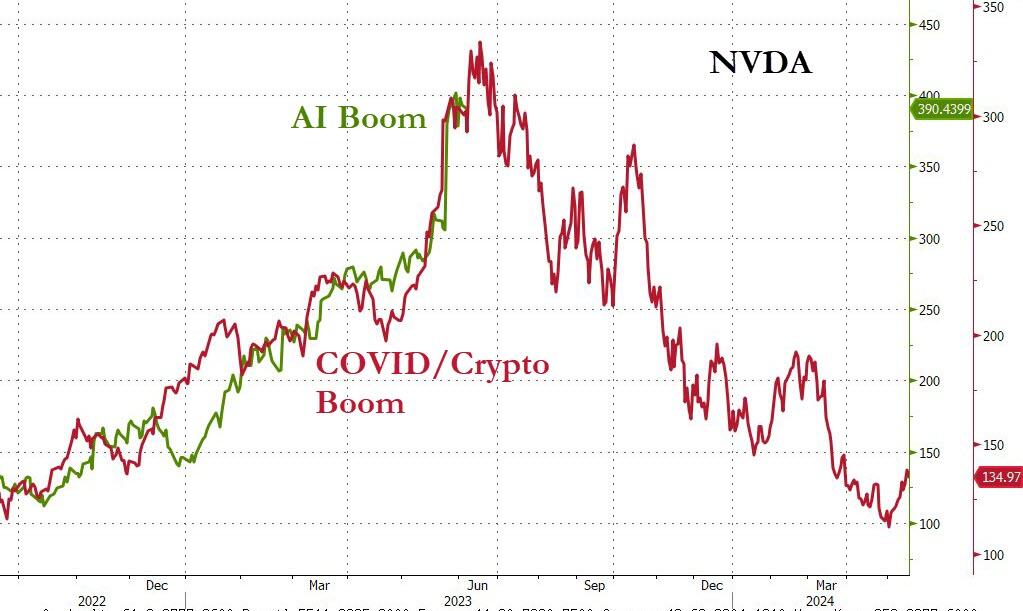
Finally, tick tock on the latest bubble-fest?

Source: Bloomberg

Did ‘Appulus’ just distract the world from AI long enough for some rational thought to return?

Tyler Durden
Mon, 06/05/2023 – 16:00

Junk Firms Face Steepest Debt Costs In Decade As Economic Reckoning Arrives

Junk Firms Face Steepest Debt Costs In Decade As Economic Reckoning Arrives

For corporations with junk credit ratings, the cost of debt servicing has skyrocketed, reaching levels not seen in over a decade. This surge can be attributed to the Federal Reserve’s rate-raising campaign. And it might force some companies to reevaluate capital structures. 

Bloomberg cited an S&P Global Ratings report that outlined junk-rated firms are paying an effective rate of 6.1% on debt, up from 5.1% last year. The 6.1% rate is the highest interest on debt since 2010.

Surging interest rate costs will likely force companies with heavy debt loads to rethink their capital structures:

“If funding costs remain higher for the long term, this may force a rethink of capital structures and bring more focus on protecting cashflows.”

 “We could see greater efforts to reduce net debt, more use of equity in M&A, and more caution over capital expenditure,” said Gareth Williams, head of corporate credit research at S&P.

Junk-rated firms will have to reconsider their business plans developed during a low-rate environment while the era of cheap money has been over for 14 months and will likely be over for some time as the Fed wrestles with inflation. Bloomberg pointed out a perfect storm forming:

“High-yield firms in particular are having to deal with the dual impact of costly payments from floating-rate debt and lower earnings.”

Some of the highest rises in interest paid versus total debt are in developers and housebuilders, healthcare, aerospace, and technology firms. 

The decade of a debt-fueled expansion has come to an abrupt end. And this means pain for zombie companies:

“The transition may be the hardest part. More vulnerable credits with capital structures built for a world of near-zero rates are more likely to default,” Williams said.

These junk-rated firms will need to eliminate debt and scale back growth as the cost of servicing debt and interest rates on the line of credit are sky-high. 

S&P warned late last year a corporate default wave would erupt in even a mild recession. 

Tyler Durden
Mon, 06/05/2023 – 15:40

If You Stand In The Way Of Their Agenda, You Will Pay A Price

If You Stand In The Way Of Their Agenda, You Will Pay A Price

Authored by Michael Snyder via The End of The American Dream blog,

The cultural environment that we live in has become insanely oppressive, and I am about to share an example with you that perfectly demonstrates this.

A few days ago, a high school student in a rural area of Idaho told his fellow students that “guys are guys and girls are girls”, and the fallout from that statement proceeded to create a firestorm of controversy that is making headlines all over the nation.  Sadly, the truth is that we now live in a society where anyone that tries to resist the new culture that is being imposed on all of us must be severely punished. 

Dissent is simply not allowed, and Kellogg High School senior Travis Lohr found that out the hard way

On Thursday, Kellogg High School senior Travis Lohr took part in an activity where seniors share advice for lowerclassmen. In a departure from his preapproved remarks, Lohr spoke from his heart, saying, “Guys are guys and girls are girls. There is no in-between.”

Despite the fact that this simple statement has been a truism for all of human history, the leadership of Kellogg High School seemed to think it was unacceptable. Principal Dan Davidian informed Lohr that he would not be allowed to walk in his graduation ceremony on Saturday.

This didn’t take place in California.

Kellogg High School is located in one of the most conservative areas of one of the most conservative states in the entire nation.

If this can happen in Idaho, it can happen anywhere.

When the community learned what had happened, a peaceful protest was quickly organized, and that is when things started getting really crazy.

The following is how a member of the Idaho legislature named Heather Scott summarized what we have witnessed so far

UNACCEPTABLE! The Shoshone County Kellogg High school graduation is canceled for all students! So how I am understanding this is:

1. A student speaks scientific truth at a school assembly (“Guys are guys and girls are girls. There is no in-between.”)
2. Science denier “adult” teachers were offended.
3. The student was punished and is now forbidden to participate in graduation.
4. Parents, students, and community members voiced their concerns in a peaceful protest.
5. The school then fired an off-duty bus driver for joining the peaceful protest!
6. The Shoshone County Sheriff’s Office informed the school of concerns about “safety”
7. The school will now punish the entire student body and community by postponing graduation for all students.

Why in the world would a bus driver be fired on the spot for simply joining a peaceful protest?

Unfortunately, all of those that showed public support for Travis Lohr are being framed as the bad guys.

And it turns out that the sheriff that raised “safety concerns” about the graduation ceremony also happens to be married to an art teacher at the high school

Shoshone County Sheriff Holly Lindsey cited “Safety Concerns.”

Sheriff Lindsey is “married” to Kellogg HS Art Teacher Rachel Krusemark, one of the 3 teachers offended by Travis Lohr’s statements.

If those teachers had not made such a fuss, this controversy never would have erupted.

Why can’t they just let people say things that they disagree with?

People say things that deeply offend me all the time, but I am not trying to shut down their right to say those things.

Sadly, it isn’t just the school that has taken action.  According to Travis Lohr, he has also just had a job offer rescinded

A student barred from his high school graduation ceremony after stating there are only two genders said in a Sunday interview on “Fox & Friends” that a firefighting job offer has now been rescinded.

He was supposed to work on Sunday, but when he showed up to complete his paperwork he was given the bad news

Lohr told Campos-Duffy he was slated to start work Sunday, but when he went in to complete the final paperwork, his boss informed him he was rescinding the offer. He described the job as “fighting wildland forest fires.”

“That’s part of life, as I am learning, and I am going to continue to grow from here. I’m not going to dwell on it.”

Yes, this has actually happened in the deep-red state of Idaho.

This just shows how far our society has fallen.

In other areas of the country, radical activists have been making bomb threats against Target just because the retailer removed “some of its Pride Month merchandise after significant backlash”

LGBTQ radicals reportedly deluged Target with bomb threats in retaliation to the retail giant pulling back on some of its Pride Month merchandise after significant backlash.

The bomb threats were allegedly made against several Target stores in at least three states: Utah, Pennsylvania, and Ohio.

Our nation is being ripped in two, and there are no quick fixes on the horizon.

Of course a similar revolution is currently underway in Europe.  This week, we learned that a “topless pregnant transgender man” is on the cover of Glamour U.K.’s June issue…

A topless pregnant transgender man featured on the cover of Glamour U.K.’s June issue ignited a fierce reaction from online critics Thursday.

Author Logan Brown, a 27-year-old who was born female but now identifies as a transgender man, posed as the cover star of British Glamour Magazine’s digital issue celebrating Pride Month in a painted-on suit, showcasing a large baby bump. Brown unexpectedly became pregnant with partner Bailey J Mills, a non-binary drag performer in the U.K., while taking a break from testosterone treatments due to health reasons, the fashion magazine said.

Everywhere around us, we are being bombarded by propaganda that has been carefully designed to promote the new culture that is relentlessly being imposed upon us.

If you dare to stand in the way of this agenda, you will be punished.

If things are this bad now, just imagine what our culture would look like if we were given another 40 or 50 years…

*  *  *

Michael’s new book entitled “End Times” is now available in paperback and for the Kindle on Amazon.com, and you can check out his new Substack newsletter right here.

Tyler Durden
Mon, 06/05/2023 – 15:20

“Bad For America” – Mid- & Big-Banks May Face 20% Jump In Capital Requirements

“Bad For America” – Mid- & Big-Banks May Face 20% Jump In Capital Requirements

U.S. regulators are preparing to force large banks to shore up their financial footing, moves they say will help boost the resilience of the system after a spate of midsize bank failures this year.

The Wall Street Journal reports, citing people familiar with the plans, the changes, which regulators are on track to propose as early as this month, could raise overall capital requirements by roughly 20% at larger banks on average.

Banks with at least $100 billion in assets may have to adhere to new requirements, lower than the existing $250 billion threshold, for which regulators have reserved their most stringent rules, according to the Journal.

Banks that are heavily dependent on fee income – such as that from investment banking or wealth management – could also face large capital increases.

Fed Vice Chair for Supervision Michael Barr signaled to House lawmakers in May that he believes capital requirements should be higher.

The banking system might need additional capital to be more resilient precisely because we don’t know the nature of the kinds of ways we might experience shocks to the system, as has happened with these recent bank failures.”

Barr has previously said that US officials are reviewing bank capital requirements and committed to putting in place strictures that align with Basel III.

Bloomberg reports that the biggest banks have argued that their steadiness in the recent turmoil showed their strength and that they already have more than enough capital. The six biggest US firms have added more than $200 billion to their capital reserves in the last decade, and JPMorgan said last month that its total loss-absorbing capacity now exceeds the loan losses that all US banks had during the financial crisis.

“Higher capital requirements are unwarranted,” said Kevin Fromer, the chief executive of the Financial Services Forum, which represents the largest U.S. banks.

“Additional requirements would mainly serve to burden businesses and borrowers, hampering the economy at the wrong time.”

JPMorgan CEO Jamie Dimon has been among critics blasting more cumbersome capital requirements, calling the upcoming increase “bad for America” last year ahead of a pair of congressional hearings.

The coming proposal is the last piece of capital rules that global policy makers agreed to implement after the 2007-09 financial crisis. The overhaul forced banks around the world to boost their capital cushions in hopes of making them better prepared to weather downturns without taxpayer bailouts.

Nathan Dean, Bloomberg’s senior government analyst noted that:

“The last remaining piece of Basel III, known informally as the Basel III endgame, would alter capital levels for US banks as regulators recalibrate risk-weighting of assets and restrict internal models used to calculate both credit and operational risk.”

All three agencies (The Fed, OCC, and FDIC) are expected to seek comment on the proposed capital rules.

They would have to vote again to complete the changes, likely implementing them over the coming years.

However, JPMorgan said at its investor day that while the final pieces of Basel III capital rules – which some investors have referred to as Basel IV because they could be so extensive – may be proposed soon, they’re unlikely to be implemented before early 2025.

Tyler Durden
Mon, 06/05/2023 – 15:00

Ron Paul Ravages Republicans’ Fiscally Irresponsible Act

Ron Paul Ravages Republicans’ Fiscally Irresponsible Act

Authored by Ron Paul via The Ron Paul Institute for Peace & Prosperity,

The political and financial class breathed a sigh of relief when Congress passed the Fiscal Responsibility Act of 2023. The bill suspends the debt ceiling for two years, thus avoiding the establishment’s nightmare of a government default on its debt. Rather, it allows the government to continue adding trillions of dollars of debt that will be monetized by the Federal Reserve.

Of course, this default will be felt by the people in the form of an inflation tax. This inflation tax may be the worst of all taxes, because it is both hidden and regressive. Politicians love to point the finger at greedy corporations, labor unions, and even consumers for increasing prices instead of taking responsibility for the legislation they pass that incentivizes the Federal Reserve to create more inflation.

Republican supporters of the bill claim it begins to roll back the excessive spending of the Biden years. While the bill does rescind $28 billion of unspent COVID funds, it  just recycles that money into the Fiscal Year 2024 budget. Thus it does not save taxpayers a dime. The bill does cap domestic discretionary spending for Fiscal Year 2024 at $704  billion and spending for Fiscal Year 2025 at $711 billion. However, these caps come from a budget whose baseline includes the increased COVID spending. The bill only cuts spending by 0.1 to 0.2 percent of gross domestic product over the next two years  – assuming Congress does not reverse the cuts. Of course, it makes no attempt to actually cut spending, much less eradicate any illegitimate and unconstitutional government agencies, cabinet departments, or programs.

Even though “defense” is the third largest item in the budget (behind social security, Medicare, and interest in the national debt), our annual military budget alone is more than the combined  budgets of the next ten biggest spending countries. The Fiscal Responsibility Act doesn’t take a penny away from the military budget; instead it matches President Biden’s request for a 3.2 percent increase.  This increase comes despite the fact that the Pentagon has never complied with the law requiring it to pass an audit. 

Biden’s military budget is the largest in United States history and probably world history. Deep  State Republicans like South Carolina Senator Lindsay Graham never met a war he didn’t love.  Graham and his allies threatened to block passage of the bill unless the military spending was increased and more taxpayer money—and Ukraine and Russian lives — wasted in the Ukraine Russian conflict.

Hawks alienate current and potential allies with their hyper-interventionist policies. This along with the increasing national debt is leading to increased challenges to the US dollar’s status as the world’s reserve currency. The dollar’s status is the only reason Congress has been able to run up such a huge deficit without causing a major economic crisis.

The Fiscal Responsibility Act will result in increased government spending, debt, and deficits. It will also further erode the value of the United States Dollar, thus making it more likely that the US dollar will lose its world reserve currency status sooner rather than later. The Fiscal Responsibility Act is to fiscal responsibility as the Affordable Care Act is to affordable health care and as the Patriot Act is to true Patriotism. Perhaps a future Congress will introduce legislation that actually begins to cut back on the size and scope of government called the Fiscal Irresponsibility Act!

Tyler Durden
Mon, 06/05/2023 – 14:40

Goldman Sachs Warns ESG Investors Against Rushing To Divest From Oil And Gas

Goldman Sachs Warns ESG Investors Against Rushing To Divest From Oil And Gas

Authored by Tsvetana Paraskova via OilPrice.com,

Investors focused on the ESG rush to divest from oil and gas should focus instead on investment in renewables and other forms of low-carbon energy supply, Michele Della Vigna, Goldman Sachs’s head of natural resources research, told Bloomberg on Monday.

“The focus on decarbonization is correct, but I think it needs to be driven by more investment, not divestment,” Della Vigna told Bloomberg in an interview.

“The key is to move away from divesting oil and gas towards more investment in renewables and in low carbon.”

The ESG investors need to quickly ramp up investment in renewables to prevent a collapse in the overall energy supply, according to Goldman’s Della Vigna.

The investment bank sees capex on energy increasing by 15% in 2023, or by as much as 30%, considering inflation.

“What needs to happen is an acceleration of renewable spending on one side, but also normalization of the spending in hydrocarbons on the other,” Della Vigna told Bloomberg.

Earlier this year, the chief executive of the world’s largest oil firm, Saudi Aramco, said that ESG investment, if outright biased against the oil and gas industry, is a threat to energy affordability and energy security.

“In my view, an increased emphasis on ESG is a move in the right direction,” Saudi Aramco’s CEO Amin Nasser said in February.

“However, if ESG-driven policies are implemented with an automatic bias against any and all conventional energy projects, the resulting underinvestment will have serious implications. For the global economy. For energy affordability. And for energy security,” Aramco’s top executive added.

Last month, the International Energy Agency (IEA) said that investment in solar power generation is set to eclipse investment in oil production in 2023 for the first time ever. For 2023, the IEA expects total investments in energy at $2.8 trillion, of which $1.74 trillion will go to clean energy and technologies and the remaining $1.05 trillion to fossil fuels.  

“For every dollar invested in fossil fuels, about 1.7 dollars are now going into clean energy. Five years ago, this ratio was one-to-one,” IEA Executive Director Fatih Birol said.

The underinvestment in the energy sector “is very concerning,” Della Vigna said. “And although energy CapEx is rising, I don’t think it’s rising fast enough to fill in the gap of 10 years of underinvestment.” 

He also questioned ESG investors’ tendency to focus on absolute emissions as a guide for allocating capital, rather than emissions intensity, which measures an entity’s carbon footprint relative to its total revenue.

“Anything that pushes companies to produce less energy, like just focusing on absolute emissions, for them, I think, runs the risk of prolonging this energy crisis,” he said.

Tyler Durden
Mon, 06/05/2023 – 13:10