

74.8 F
Chicago
Monday, August 17, 2026
Home Blog Page 3664

Key Events This Week: FOMC Minutes, Core PCE And Durables But All Eyes On Debt Ceiling Drama

Key Events This Week: FOMC Minutes, Core PCE And Durables But All Eyes On Debt Ceiling Drama

With earnings season now mostly over (AI vanguard NVDA reports on Wednesday) and the economic data slate relatively sparse, the debt ceiling negotiations will dominate this week’s calendar. As noted earlier, the latest is that President Biden and House Speaker Kevin McCarthy will meet at the White House today to resume negotiations. There was a slightly more positive tone from both sides after a phone call between the two yesterday. This follows the GOP walking out on talks late Friday. Yellen said over the weekend that the chances that the US can pay its bills by mid-June are “quite low”.

Outside of this story, highlights for the week ahead which include the latest FOMC Minutes on Wednesday, the global flash PMIs tomorrow and the US PCE inflation release on Friday. The details of the University of Michigan Survey the same day are going to be interesting as 5-10yr inflation expectations spiked from 2.9% to 3.2% earlier this month in the prelim reading, a level that hasn’t been exceeded since 2007. This often gets revised down in the final print but if not, it could mark a firming of inflation at the consumer level. Watch for any upward revisions to Q1 US GDP on Thursday after recent better than expected data. Also on the data front we have UK inflation on Wednesday (last month shocked to the upside at 10.1% – 8.2% expected this week), various sentiment data in Europe and the Tokyo CPI in Japan on Friday.
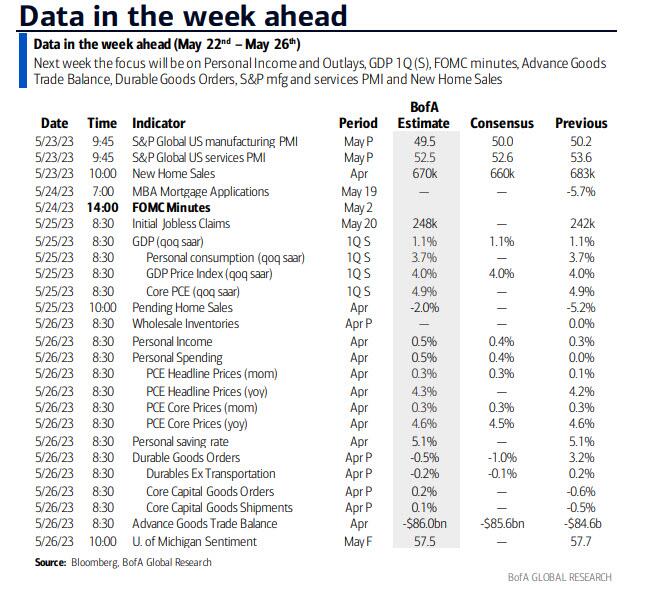
As DB’s Jim Reid notes, from central banks, as the June FOMC slowly comes into view and with an increasing possibility of a hike that was all but ruled out 1-2 weeks ago, there are lots of Fed speakers, especially early in the week (see in the calendar at the end), and also the release of the FOMC meeting minutes on Wednesday. This might help show how high the bar is for the Fed to add more hikes.

Although earnings season is drawing to a close, Nvidia on Wednesday could be worth watching. Nvidia is up +112% in 2023 and has a market cap of $773bn highlighting why AI is becoming a huge topic and one that also moves macro markets. Nvidia is trading on heroic valuations which time will tell if they are justified.

Asian equity markets have shrugged off Friday’s GOP talks walkout losses on Wall Street following comments by President Biden during the G-7 summit that he sees US-China relations improving “very shortly”. Across the region, the Hang Seng (+1.32%) is leading gains with the KOSPI (+0.83%), the CSI (+0.39%), the Shanghai Composite (+0.11%) and the Nikkei (+0.10%) also up. S&P 500 futures (-0.03%) are trading just below flat with 10yr USTs -2.3bps lower, trading at 3.65%, as we go to press.

Early morning data showed that Japanese core machinery orders unexpectedly dropped -3.9% m/m in March (v/s +0.4% expected, -4.5% in February), contracting for the second month in a row. Elsewhere, the People’s Bank of China (PBOC) kept their benchmark lending rates unchanged for a ninth straight month, keeping the one-year loan prime rate intact at 3.65% while the five-year rate, a reference for mortgages, was also held at 4.3%, as expected.

A day-by-day calendar of events, courtesy of DB:

Monday May 22

  • Data: Japan March core machine orders, Eurozone May consumer confidence, March construction output
  • Central banks: Fed’s Bullard, Bostic and Barkin speak, ECB’s Vujcic, Guindos, Villeroy, Holzmann and Lane speak
  • Earnings: Zoom, Ryanair

Tuesday May 23

  • Data: US, UK, Japan, Germany, France and Eurozone May preliminary PMIs, US May Richmond Fed manufacturing index, business conditions, Philadelphia Fed non-manufacturing activity, April new home sales, UK April public finances, Japan April nationwide department store sales, Italy March current account balance, Eurozone March ECB current account, Canada April raw materials and industrial product price
  • Central banks: Fed’s Logan speaks, ECB’s Guindos, Muller, Nagel and Villeroy speak, BoE’s Haskel speaks
  • Earnings: Lowe’s, Palo Alto Networks, Intuit, Agilent Technologies

Wednesday May 24

  • Data: UK April CPI, RPI, PPI, March house price index, Germany May ifo survey
  • Central banks: Fed’s FOMC minutes, ECB’s non-policy meeting, BoE’s Bailey speaks
  • Earnings: NVIDIA, Analog Devices, Snowflake, Kohl’s

Thursday May 25

  • Data: US Q1 GDP second reading, May Kansas City Fed manufacturing activity, April pending home sales, Chicago Fed national activity index, initial jobless claims, Germany Q1 private consumption,government spending, capital investment, June GfK consumer confidence, France May manufacturing and business confidence
  • Central banks: ECB’s Guindos, Nagel, Villeroy, Centeno and de Cos speak, BoE’s Haskel speaks
  • Earnings: Costco, Dollar Tree, Autodesk, GAP, Marvell, Workday, Royal Bank of Canada

Friday May 26

  • Data: US April personal spending, personal income, PCE, durable goods orders, advance goods trade balance, wholesale and retail inventories, May Kansas City Fed services activity, UK April retail sales, Japan May Tokyo CPI, April PPI services, Italy May manufacturing confidence, economic sentiment, consumer confidence index,
  • France May consumer confidence
  • Central banks: ECB’s Vujcic speaks

* * *

Finally, focusing on just the US, Goldman writes that the key economic data releases this week are the core PCE, durable goods, and University of Michigan reports on Friday. The minutes from the May FOMC meeting will be released on Wednesday and there are several speaking engagements from Fed officials, including governor Waller and presidents Bullard, Bostic, Daly, Logan, and Collins.

Monday, May 22

  • 08:30 AM St. Louis Fed President Bullard (FOMC non-voter) speaks: St. Louis Fed President James Bullard will participate in a fireside chat at an event hosted by the American Gas Association. Media availability and a press release are not expected. On May 18, Bullard said, “I do expect disinflation, but it’s been slower than I would have liked, and it may warrant taking out some insurance by raising rates somewhat more to make sure that we really do get inflation under control…Our main risk is that inflation doesn’t go down or even turns around and goes higher, as it did in the 1970s.”
  • 11:05 AM Atlanta Fed President Bostic (FOMC non-voter) and Richmond Fed President Barkin (FOMC non-voter) speak: Atlanta Fed President Raphael Bostic and Richmond Fed President Thomas Barkin will discuss technology-enabled disruption at an event hosted by the Richmond Fed. On May 15, Bostic said, “If I had a bias between going up and going down as our next action, I would say we might have to go up. What we’ve seen is that inflation has been persistently high. Consumers have been really resilient in terms of their spending and labor markets remain extremely tight. All of those suggest that there’s still going be upward pressure on prices. That is not my base case either.” On May 15, Barkin said, “If inflation persists, or God forbid accelerates, there’s no barrier in my mind to further increases in rates…It is not obvious to me that there is a financial stability challenge of having a higher rate path…I don’t see the urgency of making a different decision because of financial stability risks.”
  • 11:05 AM San Francisco Fed President Daly (FOMC non-voter) speaks: San Francisco Fed President Mary Daly will participate in a fireside chat at the National Association of Business Economics/Banque de France International Economic Symposium. A moderated Q&A with the audience is expected. On April 12, Daly said, “While the full impact of this policy tightening is still making its way through the system, the strength of the economy and the elevated readings on inflation suggest that there is more work to do. But how much more time and how much additional slowing is coming is unclear…We will need to carefully monitor the situation as we assess what it means for policy.”

Tuesday, May 23

  • 09:00 AM Dallas Fed President Logan (FOMC voter) speaks: Dallas Fed President Lorie Logan will deliver welcoming remarks at a conference on technology-enabled disruption hosted by the Richmond Fed. On May 18, Logan said, “The data in coming weeks could yet show that it is appropriate to skip a meeting. As of today, though, we aren’t there yet.” On May 16, she said, “Gradual policy adjustments can be helpful…financial conditions can sometimes deteriorate nonlinearly, doing damage to the broader economy, but the risk of a nonlinear reaction can be mitigated by raising interest rates in smaller, less frequent steps.”
  • 09:45 AM S&P Global US manufacturing PMI, May preliminary (consensus 50.0, last 50.2): S&P Global US services PMI, May preliminary (consensus 52.5, last 53.6)
  • 10:00 AM New home sales, April (GS -2.0%, consensus -2.9%, last +9.6%)
  • 10:00 AM Richmond Fed manufacturing index, May (consensus -8, last -10)

Wednesday, May 24

  • 12:10 PM Fed Governor Waller speaks: Fed Governor Christopher Waller will discuss the economic outlook at an event hosted by the University of California Santa Barbara. Speech text and a moderated Q&A are expected. On April 14, Waller said, “Because financial conditions have not significantly tightened, the labor market continues to be strong and quite tight, and inflation is far above target, so monetary policy needs to be tightened further. How much further will depend on incoming data on inflation, the real economy, and the extent of tightening credit conditions.”
  • 02:00 PM FOMC meeting minutes, May 2-3 meeting: The FOMC increased the federal funds rate target range by 25bp to 5-5.25% at its May meeting. We saw the May FOMC meeting as supportive of our call for a pause in June. The FOMC removed from its statement the earlier guidance that some additional policy firming may be appropriate, and while the nod toward a June pause was not quite as strong as we had expected, Chair Powell emphasized twice that this is a “meaningful change.”

Thursday, May 25

  • 08:30 AM Initial jobless claims, week ended May 20 (GS 235k, consensus 248k, last 242k); Continuing jobless claims, week ended May 13 (consensus 1,800k, last 1,799k): We estimate that initial jobless claims declined to 235k in the week ended May 20. While the number of initial claims from Massachusetts declined meaningfully last week, the level still appears elevated—likely reflecting continued issues with fraudulent filings. Our forecast assumes that some of those fraudulent filings—which we estimate could be boosting the level of nationwide initial claims by roughly 20k—are further curtailed.
    • While the annual seasonal factor revisions that took place last month appear to have resolved most of the seasonal distortions in initial claims, we believe the revisions may have intensified the distortions in continuing claims. Those distortions have likely contributed to the net decline over the last month, and we estimate they could exert a cumulative drag on the level of continuing claims of up to 400k between April and September.
  • 08:30 AM GDP, Q1 second release (GS +1.4%, consensus +1.1%, last +1.1%); Personal consumption, Q1 second release (GS +4.0%, consensus +3.7%, last +3.7%): We estimate a 0.3pp upward revision to Q1 GDP growth to +1.4% (qoq ar), reflecting upward revisions to consumer spending and inventories.
  • 10:00 AM Pending home sales, April (GS +1.5%, consensus +1.0%, last -5.2%)
  • 10:30 AM Boston Fed President Collins (FOMC non-voter) speaks: Boston Fed President Susan Collins will participate in a fireside chat at the Community College of Rhode Island. Speech text and a moderated Q&A with audience are expected. On March 30, Collins said, “Similar to the SEP median, I currently anticipate some modest additional policy tightening, and then holding through the end of this year. Of course, I’ll be carefully watching a range of indicators including data on inflation, spending, labor markets, and financial conditions.”

11:00 AM Kansas City Fed manufacturing activity, May (consensus -12, last -10)

Friday, May 26

  • 08:30 AM Personal income, April (GS +0.6%, consensus +0.4%, last +0.3%); Personal spending, April (GS +0.6%, consensus +0.4%, last flat); PCE price index, April (GS +0.27%, consensus +0.3%, last +0.1%); Core PCE price index, April (GS +0.28%, consensus +0.3%, last +0.3%): Based on details in the PPI, CPI, and import price reports, we forecast that the core PCE price index rose by 0.28% month-over-month in April, corresponding to a 4.56% increase from a year earlier. Additionally, we expect that the headline PCE price index increased by 0.27% in April, corresponding to a 4.24% increase from a year earlier. We expect that both personal income and personal spending increased by 0.6% in April.
  • 08:30 AM Wholesale inventories, April preliminary (consensus +0.1%, last flat)
  • 08:30 AM Advance goods trade balance, April (GS -$85.1bn, consensus -$85.7bn, last -$84.6bn)
  • 08:30 AM Durable goods orders, April preliminary (GS +0.2%, consensus -1.0%, last +3.2%); Durable goods orders ex-transportation, April preliminary (GS +0.5%, consensus -0.2%, last +0.2%); Core capital goods orders, April preliminary (GS +0.5%, consensus +0.2%, last -0.6%); Core capital goods shipments, April preliminary (GS +0.2%, consensus -0.1%, last -0.5%): We estimate that durable goods orders rose 0.2% in the preliminary April report, reflecting mixed commercial aircraft orders. We forecast a rebound in core capital goods orders (+0.5%) and shipments (+0.2%), reflecting a pickup in global industrial activity but a continued a drag from tighter credit.
  • 10:00 AM University of Michigan consumer sentiment, May final (GS 57.7, consensus 58.0, last 57.7):  University of Michigan 5–10-year inflation expectations, May final (GS +3.1%, consensus +3.1%, last +3.2%)

Source: DB, Goldman, BofA

Tyler Durden
Mon, 05/22/2023 – 09:55

‘Lie-bor-Gate’ 2.0 – Rate-Rigging During Lehman Crisis Was Allegedly Central-Bank-Led

‘Lie-bor-Gate’ 2.0 – Rate-Rigging During Lehman Crisis Was Allegedly Central-Bank-Led

Just when you thought it was all over (or couldn’t get any worse)…

In the last decade, 37 traders and brokers have been prosecuted by the US Department of Justice and the UK’s Serious Fraud Office for their roles in ‘rigging’ interest-rates during the Great Financial Crisis (GFC).

However, in extracts from Rigged, a book by Andy Verity on the Libor-rigging scandal (published in The Times), he explains how in 2008, it was central banks and government that pressed banks to bring down key interest rates, but none of this evidence was ever shown to jurors in nine criminal trials which resulted in multiple jail sentences for those involved (19 convicted, 9 jailed).

Backed up and supplemented by published data, The BBC reports that the suppressed evidence indicates that in October 2008, central banks intervened on a large scale in the setting of Libor and Euribor.

This was at the same time as dozens of former traders were criminally prosecuted for much less serious rate “manipulation”, it is claimed.

In October 2008 there was an international drive, involving the central banks of the UK, US and eurozone, to get Libor down and restore a sense of calm to the market, at a time when banks lending had almost ground to a halt.

Andrew Tyrie, who chaired the UK Treasury Committee of MPs when it enquired into Libor in 2012, told the BBC that he believed Parliament “appears to have been misled”.

“The evidence that Mr Verity has unearthed strongly suggests that the committee’s inquiry into the Libor scandal was not told the whole truth.

“The public rely on Parliament to get to the truth. This case illustrates why Parliament should bolster its information-gathering powers with more effective sanctions against those who provide less than the full picture. Parliament appears to have been misled and, if that’s the case, should not let it rest.”

Further suppressed evidence indicates that the UK government, including 10 Downing Street, was also involved in pressuring banks to “manipulate” Libor as defined by the criminal courts – meaning seeking to obtain movements in the benchmark rate while “disregarding the proper basis for setting Libor”.

If they allowed its setting to be influenced by other factors, such as the desire to avoid bad publicity or to help a bank’s market trades, they could be jailed for interest rate “manipulation”.

So, if Verity’s allegations are true, the politicians and policy makers threw individual traders under the bus for actions they were coerced to take action on from the top-down, while at the same time admonishing those ‘greedy bankers’.

The report alleges that the Bank of England, Banque de France, European Central Bank, Banca d’Italia, Banco de Espana and the Federal Reserve Bank of New York interfered with the London and Euro Interbank Offered Rates, or Libor and Euriobor, benchmarks on a grand scale as the financial crisis deepened in the fall of 2008.

Speaking in Parliament on Friday, Conservative MP David Davis urged lawmakers to back a probe into the covering up of “state involvement in Libor rigging, and the scapegoating of 37 low and middle-ranking bankers, some of whom spent years in jail.

“I am also greatly concerned that the Treasury Select Committee may have been misled by state agencies about the knowledge and involvement of the state in setting false rates,” Davis said.

The committee chairman also said Parliament had been misled because the new evidence showed information had been withheld from the panel’s 2012 probe into Libor.

As one would expect, regulators have pushed back against Verity’s accusations with BoE claiming it was “entirely false,” ECB saying it “strongly rebuts” the assertions, while Bloomberg reports The FBI, the Fed, Barclays and the Treasury declined to comment to the Times.

The latest extract ends with a hell of a cliffhanger…

In November 2010, investigating agencies from the US Federal Bureau of Investigation (FBI) to the UK financial regulator were directly informed of this – but they have since kept it secret from Parliament, Congress and the public.

Tyler Durden
Mon, 05/22/2023 – 09:35

Biden, McCarthy To Meet Monday After Debt-Ceiling Deal Suffers Weekend Setbacks

Biden, McCarthy To Meet Monday After Debt-Ceiling Deal Suffers Weekend Setbacks

President Biden and House Speaker Kevin McCarthy (R-CA) are scheduled to meet on Monday afternoon to attempt to get the debt ceiling negotiations back on track in the hopes of reaching a deal that could pass both the Republican-led House and Democratic-led Senate, after talks broke down over the weekend.

The two have as few as 10 days to get a deal done to raise or suspend the debt ceiling before the US Treasury runs out of cash and other options to keep the lights on – with Biden cutting his G-7 trip short by four days, while speaking with McCarthy from Air Force One as he made his way home.

“It went well,” Biden told reporters late Sunday following his arrival at the White House, adding “we’ll talk tomorrow.”

Both Biden and McCarthy have vowed to avoid defaulting on the nation’s obligations for the first time in history, despite disagreements over how to proceed The GOP has insisted that any increase in borrowing be accompanied by steep cuts in government spending – and passed a House bill in April to accomplish this, while Democrats want a ‘clean’ increase with no strings attached. For months, Democrats have refused to negotiate, and only entered into talks in the last week as the deadline approached, the Wall Street Journal reports.

The gap in the top line numbers continues to be the biggest barrier to a deal,” said Rep. Dusty Johnson (R-SD), chair of the Main Street Caucus of nearly 100 Republicans.

Biden has said he would like to work to narrow the deficit with some tax increases to wealthy Americans, but McCarthy said tax increases are off the table. Democrats have accused Republicans of seeking draconian spending cuts that they said would hurt education and healthcare research programs. 

GOP lawmakers also want to attach changes to permitting rules that would speed the process of building energy projects and to strengthen work requirements for government benefit programs, notions that the White House has signaled some openness to.

Democrats want the debt ceiling increased until after the 2024 election, while Republicans’ original bill pushed the next debt ceiling deadline to March 2024. -WSJ

The impasse has begun to translate to Wall Street jitters – with Treasury Secretary Janet Yellen twice warning that the so-called “X-date” – the day treasury reserves fall too low to cover expenses – could arrive as soon as June 1, and Fitch and Moody’s ratings agencies warning that they could place the country’s credit under review if the X-date comes too close.

In 2011, a similar standoff between the Obama-led Democrats and Republicans prompted S&P to lower its rating of US debt, sending markets reeling.

Goldman Sachs and other financial firms have projected the date to fall around June 8 or 9, which would give Congress another week to act.

“We do expect investors’ concerns to mount as the X-date approaches, particularly if there’s no solution and the sides look wide apart,” UBS managing director and chief U.S. economist, Jonathan Pingle, told The Washington Post. “As we approach, we basically see equity markets are increasingly likely to sell off, volatility indexes move higher, and there are going to be shifts and concerns in financial markets that aren’t going to be great to live through.”

“My sense is that if we get toward the end of the coming week and the rhetoric is dark, we’ll see a lot more red on the screen,” said Mark Zandi, chief economist at Moody’s Analytics , adding that “global investors are more panicked than domestic investors.”

Before talks broke down on Friday – with Republicans rejecting a White House offer to freeze, rather than reduce spending, the GOP’s top negotiator, Rep. Garret Graves (LA) offered a proposal to cut federal spending by more than $1200 billion in the coming fiscal year, and to cap most agencies’ budgets through the 2030 fiscal year, according to the Post, citing two people familiar with the offer who spoke on condition of anonymity. The GOP proposal – which was essentially their April bill which was approved by the House – also called for tougher immigration enforcement at the southern US border.

The White House responded to the offer, countering with a freeze on spending in the 2024 fiscal year to 2023 levels, arguing that it would represent a cut because budgets would not rise with inflation, according to WaPo.

Republicans outright rejected that counter, insisting that domestic spending must undergo a significant cut so that overall spending drops in the upcoming fiscal year.

On Monday, the House Freedom Caucus is expected to urge McCarthy to reject any offer from Biden unless it includes beefed up border security, cuts to the FBI, and every provision in the House-passed bill.

“The Freedom Caucus will vote next week to basically accept only what we have sent to him plus what we’re adding to it,” according to Rep. Ralph Norman (R-SC), a member of the caucus.


Tyler Durden
Mon, 05/22/2023 – 09:15

Mega Merger Monday: Chevron Buys PDC; Mubadala Buys Fortress; Mizuho Buys Greenhill

Mega Merger Monday: Chevron Buys PDC; Mubadala Buys Fortress; Mizuho Buys Greenhill

In an early summer Merger Monday for champions, no less than three major acquisitions were announced in early Monday trading.

In the first deal, US supermajor Chevron said it will buy driller PDC Energy in a $6.3 billion all-stock deal, allowing Chevron to expand its holdings in shale basins in Colorado and West Texas. Chevron will pay $72 a share, a roughly 14% premium on a 10-day average based on May 19 closing prices. Based on Chevron’s May 19 closing price, PDC shareholders will receive 0.4638 shares of Chevron for each PDC share. The deal is expected to close by year-end, pending regulatory approval and PDC shareholder approval.

The total enterprise value of the deal including debt is $7.6 billion. Chevron said it expects the tie-up to add about $1 billion in annual free cash flow at $70 per barrel Brent oil and Henry Hub natural gas at $3.50 per thousand cubic feet. Morgan Stanley and Evercore advised Chevron, while JPMorgan advised PDC.

“PDC’s attractive and complementary assets strengthen Chevron’s position in key U.S. production basins,” Chevron CEO Mike Wirth said in the statement. “This transaction is accretive to all important financial measures and enhances Chevron’s objective to safely deliver higher returns and lower carbon.

Oil and gas producers are flush with cash after raking in record profits over the past two years, leaving the US energy patch ripe for a takeover boom. Companies are looking to bulk up and consolidate, particularly in the Permian Basin of West Texas and New Mexico, the most prolific US shale play.

The second major deal will see Abu Dhabi’s sovereign wealth fund Mubadala Investment and Fortress Investment Group buying 90% of the equity held by Japanese conglomerate SoftBank Group in the US asset manager. Mubadala will own 70% of the equity in Fortress, while Fortress management will hold a 30% equity interest and a class of equity entitling it to appoint a majority of seats on the board, the firms said on Monday.

The companies didn’t disclose terms. Bloomberg News has reported that a deal that could potentially value the US asset manager at more than $2 billion. SoftBank acquired Fortress in 2017, intending to use the New York-based firm’s expertise to help manage its behemoth Vision Fund which has been a catastrophic failure.

In the third, and perhaps highest profile deal of the day, Japan’s Mizuho Financial Group expanded its reach into US investment banking through a deal to buy boutique investment bank Greenhill & Co. as it seeks to accelerate growth. The Japanese banking giant agreed to buy Greenhill for $15 a share – a whopping 121% premium to Friday’s closing price of $6.78 – in an all-cash transaction, which values the firm at $550 million including debt, the firms said Monday in a statement. The lender will retain Greenhill’s leaders, including Chief Executive Officer Scott Bok, who will be chairman of mergers, acquisitions and restructuring.

“The stock as recently as February was trading right around this price,” Jerry Rizzieri, the president and CEO of Mizuho Securities USA, said in an interview. “Regional banks are down 40%, this stock has taken a pretty big drop,” he said. “We think we’re paying a fair price for a premium brand.”

Mizuho joins its Japanese rivals to expand investment banking tie ups in the US, however it has one-upped them by going a step further in making an acquisition. Sumitomo Mitsui Financial Group last month said it will expand a tieup with Jefferies Financial Group to boost US capital markets and M&A advisory businesses. Japan’s largest bank Mitsubishi UFJ Financial Group has a more than decade-old alliance with Morgan Stanley, a deal struck in the heat of the 2008 financial crisis.

According to Bloomberg, the deal gives Mizuho another 370 employees, and Greenhill will continue to operate in 15 locations around the world. Most locations overlap with Mizuho’s existing locations except Melbourne and Stockholm, according to Rizzieri. Mizuho plans to complete the transaction by the end of the year, and the Greenhill business will be within Mizuho’s larger dealmaking division run by Michal Katz, head of banking in the Americas.

Mizuho is betting the takeover will complement its investment banking teams. “We only recently began hiring M&A bankers in the last few years,” Rizzieri said. “Mizuho offers a full complement of products ranging from debt, equity, capital markets, derivatives, fixed income and equity sales and trading, securitization. The piece that’s been missing has been M&A,” he said.

Mizuho’s takeover ends a nearly two-decade run in public markets for Greenhill, an early boutique investment bank to go public in 2004 under its iconic founder, M&A veteran Bob Greenhill. Bok was tapped to co-lead the firm three years later, and became sole CEO in 2010. The stock traded at more than $81 per share at the end of that year.

In the past decade, Greenhill faced competition from a proliferation of boutiques, with Moelis & Co., Houlihan Lokey Inc. and PJT Inc. also among those going public.

Tyler Durden
Mon, 05/22/2023 – 08:55

Price Chasing, Not Short Covering, Will Drive Market Higher

Price Chasing, Not Short Covering, Will Drive Market Higher

Authored by Simon White, Bloomberg macro strategist,

There is no big hedge fund short in US equities to boost equity prices. But investors’ large underweight could have the same effect as they chase the market higher.

It would be easy to fixate on data showing the largest net-short in S&P E-mini futures in over 10 years. But as is so often the case in finance, things are not always as they first seem. This supposed big short does not match positioning in the Nasdaq and the Dow Jones. It would be odd if speculators, i.e. hedge funds, were only short the S&P.

Instead, it is likely the data is being affected by the index-arbitrage behavior of hedge funds. Index arbitrage was once the preserve of banks, but fell victim to the Volcker Rule. This was introduced in the wake of the GFC, and limited banks’ proprietary trading activities, including specifically the realization of short-term arbitrage profits. Index arbitrage involves selling index futures to clients and buying baskets of stocks against it.

So hedge funds, classed as speculators in the CFTC positioning data and not commercials as banks are, moved in on this business, which means the data cannot be taken at face value. One way to see this is by looking at the beta of HFRX hedge fund returns and equity-market returns. Hedge funds in the aggregate – as well as macro funds, equity long-short and CTAs – are likely neutral to net long equities, not short.

But this does not mean FOMO can’t power the market higher. AI is helping to fuel sentiment. We will see whether the current burst of innovation with Large Language Models suffers from the “Amara effect,” where the short-term impact of a new technology is overestimated, but underestimated in the longer term. Either way the equity rally is being driven by AI-related stocks, with the top three year-to-date performers in the S&P being Nvidia, Meta and Advanced Micro Devices.

Throw in a large investor underweight, with BoA’s Fund Manager’s Survey showing the most negative net percent of managers who are overweight US equities than any other major asset class, then even without the mythical “hedge-fund short,” markets have the propensity to keep heading higher for the time being.

Tyler Durden
Mon, 05/22/2023 – 08:50

How Corruption Makes You Poor

How Corruption Makes You Poor

Authored by MN Gordon via EconomicPrism.com,

Are you the type of person who works hard, saves money, and invests with the intent of accumulating lasting wealth?

If so, you’ve likely noticed that things don’t quite add up between what you’re regularly told about how the economy and financial markets work and what you actually experience.  We think there’s more to this than just dollars and cents.

The central feature of economics is prices.  How they are determined and how people respond to them.  This process establishes how prices adapt to meet the supply and demand pressures of the market.

Through experience, buyers can determine what’s a good deal or not.  And they adjust their behavior accordingly.  Similarly, through testing, sellers determine the optimal price of their products; a price where profit margin is best supported by sales.

For example, when airfares are cheap, a father may spring for long distance plane tickets so his family can vacation somewhere exotic.  When plane tickets are expensive, he may opt for a road trip and tent camping at a national park.

Both experiences will create lasting family memories.  Prices, nonetheless, are a critical determinant in the decision.

In fact, prices, and how people respond to them, are factored into nearly all free exchanges for fulfilling wants and needs.  You may already have an ample supply of socks.  But a ‘buy one get one free’ sale may incentivize you to buy more.

Your old beater car may work just fine.  Still, you may want a new car that has all the latest digital integrations.

But how badly do you want it?  Bad enough to sign-up for a $1,000 per month car payment?  At that price, you’ll miss out on a lot of steak dinners.

The point is prices and incentives matter.  Moreover, changes in conditions that raise or lower prices, such as interest rates or regulations, will influence behavior.

This is an important insight.  And it is one that is not lost on government policy makers.  By influencing prices, they can influence behavior.

Corrupting Prices

To be perfectly frank, prices are corrupted by governments for the purpose of extracting capital from the economy and rearranging society in strange and unnatural ways.  In California, for instance, Assembly Bill No. 205, which was approved by Governor Newsom in 2022, requires power companies to charge customers a base fee that escalates by income bracket.

A recent proposal, would forcibly compel high income earners to pay a base fee that’s over 400 percent more than low income earners.  This is in addition to the actual use rate.

Is it fair and just to penalize people with high incomes?  Does the government know how to spend money better than the people who earned it?

Sacramento thinks so.  As does Washington through its execution of federal income tax policies.

The process of corrupting prices also accrues power to the central planners and decision makers.  This power, and the wealth it affords them, has proven to be quite intoxicating.  Too much is never enough.

What’s more, bankrupt, failing governments can only hold onto power by tightening their grip on those they dominate – including you.  Compulsory diktats over how your time is directed and how your money is spent are acts of desperation.  Yet they must go on.

Massive taxes, endless fees, tax incentive credits, and outright currency debasement and money supply inflation, all work to extract capital from private individuals and direct it back to Washington.  And right now, in the later stage of decadence, this appropriative coercion must increase.

You see, at this point, there’s no way to reverse the gross corruption that has already occurred.  Any potential means to do so are soon coopted by the central authority and turned against the population.

Tools of Control

Consider digital technology advancements.  These should be liberating.  And in many ways, they are.  But what the last 20 years of the digital age has shown is something that’s profoundly sinister.

Digital advancements, in practice, have given governments – including the U.S. government – powerful tools of control.  Edward Snowden blew the whistle a decade ago on the massive surveillance apparatus that was being erected to spy on people.  Instead of being hailed a hero, Snowden was rewarded with espionage charges and exiled to Russia.

Since then, the use of digital tools to spy on and control the political process has run completely amok.  Each innovation – from social media to cryptocurrencies to artificial intelligence – is swiftly penetrated by the FBI, CIA, IRS, Homeland Security, and the Federal Reserve.

The new digital innovations are then used to punish certain baskets of deplorables, rig elections, and stymie honest debate for the purpose of locking people down, pumping them full of bogus vaccines, and locking the doors to their churches.

A preponderance of evidence has shown that these are not merely conspiracy theories.  Rather, they’re real, genuine, bona fide conspiracies.  And they’re being perpetrated by powerful actors to destroy your freedoms, confiscate your wealth, and rule your life.

Bat to human spread of coronavirus.  Hunter Bidens laptop.  Russiagate.  These episodes were all based on lies that were perpetuated through the collusion of media with unelected bureaucrats, sitting in corrupt government agencies, to swing power in their favor.

Revelations included in the recently released Durham report confirm what everyone already knew, in spite of all the lies from Rachel Maddow and Adam Shiff.  That Russiagate was a complete fabrication by the FBI and the Clintons.

How Corruption Makes You Poor

The findings of the Durham report, for any honest observer, really aren’t all that shocking.  Political corruption in America has been normalized.

Like opaque medical billing charges, it’s merely a facet of everyday life.  You can get worked up over it.  You can complain.  But it won’t do any good.

The IRS, for example, has long proven itself to be an agency of dubious actors.  If you recall, the IRS singled out conservative groups in 2013, including the Tea Party, and subjected them to expensive and needless audits.

Lois Lerner, who was then the director of the IRS division that oversaw tax-exempt groups, ultimately apologized for making mistakes and exercising poor judgment.  President Obama also demanded the resignation of the acting IRS commissioner, Steven T. Miller, and called the agency’s actions “intolerable and inexcusable.”

Yet if there was really justice to be had the IRS would be scrapped and the agency’s workers would be sent home without pay.  The impenetrable tax code would be replaced with a simple across the board flat tax, which eliminates all deductions, loopholes, and chicanery.  But that would remove the politics, lobbying, and swindling opportunities behind it, which is the tax code’s very point.

Given these abuses by the IRS, for partisan purposes, it shouldn’t be a surprise that other government agencies are abusing their powers for political objectives.

What to make of it?

Banana republics of all stripes have several common denominators:

They have a corrupt political class, including both ‘elected’ officials and unelected agency bureaucrats, who lie, cheat, and steal to consolidate power and concentrate wealth.  

They have a corrupt debt-based currency, run massive deficits, and resort to the printing press to scam the populace.

All public restrooms are corrupted with carved graffiti and missing toilet seats.  In good time, as a nation’s corruption spreads and becomes more pervasive it bleeds all private wealth from its citizens.

Lastly, you know utopia’s been reached when the powerless majority are all equally poor.

*  *  *

Like this article?  If so, please Subscribe to the Economic Prism.

Tyler Durden
Mon, 05/22/2023 – 07:20

Greek Stocks And Bonds Jump As New Election Result Is ‘Credit Positive’

Greek Stocks And Bonds Jump As New Election Result Is ‘Credit Positive’

Greece’s government bonds and stocks gained Monday as market-friendly Prime Minister Kyriakos Mitsotakis received a strong vote from the people compared to his opposition in Sunday’s national election. 

Mitsotakis’ center-right New Democracy received 41% of the vote versus 20% for the leftist Syriza party of former premier Alexis Tsipras. However, Mitsotakis was short of achieving a majority in parliament, but political analysts expect he will secure a single-party government in the next elections in about a month, according to Bloomberg. 

Analysts and investors view the election as one of the last roadblocks standing in the country’s path to regaining its investment-grade rating that was lost 13 years ago during a debt crisis and resulting austerity measures to clamp down on debt. Last year, Greece recorded the fastest debt-to-GDP decline than any other country on the continent. 

Moody’s Investors Service said the election was a positive credit event: 

“In particular, continued focus on improving the business environment and banking sector health, together with implementation of milestones and reforms under Greece’s National Recovery Plan will support economic growth,” Moody’s Senior Vice President Steffen Dyck said in an email statement to Bloomberg. 

Dyck continued, “Combined with commitment to fiscal consolidation and rising primary surpluses this improves the prospects for a further significant reduction in Greece’s government debt burden.” 

After years of austerity measures to tackle government debt, voters feel that Mitsotakis’s plan to rebuild Greece and reclaim its investment-grade status will put the country on a successful trajectory. 

“New Democracy has the people’s approval to rule alone.

“I know how much work we have ahead of us, which requires a government that truly believes in reforms and the ability to implement them,” Mitsotakis said Sunday night. 

As a result, the benchmark Athens Stock Exchange General Index jumped nearly 7% — the highest level in almost a decade. 

Also, Greek bonds moved higher, dropping to about 3.91% on the yield for the 10-year debt. 

“The results were well beyond market expectations, with New Democracy being the clear winner,” said Alevizos Alevizakos, managing director of Axia Ventures Athens.

Eurobank Equities strategist said, “We expect a sharp re-pricing of Greek assets in the coming weeks, as investors position for the compelling Greek thesis in the next few years.” 

Greeks want an economic miracle after austerity measures that led to slow economic growth. If Mitsotakis wins the second election, planned for June or July, this will allow his party to consolidate victory and make it easier to govern with an absolute majority. 

Tyler Durden
Mon, 05/22/2023 – 06:55

From Dollar Woes To Debt Denial: The USA Is Screwed

From Dollar Woes To Debt Denial: The USA Is Screwed

Authored by Matthew Piepenburg via GoldSwitzerland.com,

De-Dollarization: Downplaying the Obvious

De-Dollarization is a real, all too real trend, though it is both fascinating and disturbing to see what is otherwise so obvious being deliberately down-played, excused or ignored from the top down.

But then again, the laundry list of ignored facts and open lies from the top down to hide hard truths in everything from inflation data to recessionary debt traps is nothing new.

Instead, such propaganda replacing blunt transparency is the new normal (and classic trick) for all historical endings to debt-soaked (and failing) nations/systems and their fork-tongued (i.e., guilty) policy makers.

Slow & Steady

De-Dollarization, of course, is a gradual rather than over-night process.

Its origins stem from 1) years of exporting USD inflation overseas (to the painful detriment of friend and foe alike) and 2) the insanely stupid decision to weaponize the world reserve currency (i.e., USD) subsequent to a border war between two local tyrants in the Ukraine.

Whether or not you buy into the Western “media’s” narrative which categorizes Putin as Hitler 2.0 and Zelensky as a modern George Washington, the weaponization of the USD (and freezing of FX reserves) has made an already dollar-tired globe even more distrusting of Uncle Sam’s currency and IOUs.

This trend is confirmed by the profound dumping of USTs throughout 2022 and the undeniable trend among the BRICS (and the 36 other nations) to deliberately seek bilateral trade agreements and settlements outside of the USD.

Furthermore, with Saudi talking to China and Iran, and with China talking to Mexico, Russia and just about everyone else, it’s fairly clear that a move away from the once sacred petrodollar (Pakistan now seeking Russian oil in Yuan) is no longer just the fantasy of conveniently eliminated folks like Saddam Hussein or Muammar Gaddafi…

As I discussed here and here, the petrodollar is under threat, which means longer-term demand for the USD is equally so.

But the USD Still Has Legs—For Now…

That said, there’s also no denying that the USD is still very strong, very important and very much in demand.

After all, and despite welching in 1971 on its 1944 promise to be gold-backed, the USD is still the world reserve currency.

With over 40% of global debt instruments denominated in Greenbacks and over 60% of the reservoir of global currencies composed of USDs, this reserve status (and hence forced demand) aint going anywhere too soon.

Furthermore, and as I have written and agreed, the so-called “milk-shake theory” is not altogether wrong.

That is, demand for USDs (and USTs) within the tangled and levered web of US derivative and Euro Dollar markets is baked into a system which will take years (not days) to unravel, monetize or replace, and this sure as heck won’t be orderly, global nor overnight.

Then Comes Change, Pain and Open Denial

But let’s get real: The days of the USD as a trusted payment system or hegemonic power broker are unwinding right before our very eyes.

And the best way to see the truth of this reality is to catalogue the ever-expanding list of lies from the big boys and their complicit, media ja-sagenders (“yes-sayers”) desperately trying to deny the same.

At first, for example, the centralized economists were blaming de-dollarization and CNY energy transactions on the Russian sanctions.

Gee. Go figure?

Thereafter, the economists said de-dollarization is just the result of Emerging Market (EM) countries momentarily running out of (in fact they’re intentionally dumping) USD reserves.

Western “experts” are trying to convince themselves and the rest of the world that EM nations will implode unless they eventually acquire more USTs and USDs to buy energy.

What these experts are failing to see (or say), however, is that many of those countries are already beginning to buy that energy outside of the USD…

Folks, de-dollarization in global commodity markets is happening already, and will accelerate rather than fade away into some fantasy image of how the “West was Won,” for as argued elsewhere, the West is already losing.

Facts Are Stubborn Things

As for the list of nations, both big and small, de-dollarizing right before our watering eyes, just consider, well…China, Russia, India, Pakistan, Ghana, Bolivia…

Even the world’s largest hardwood pulp producer, Suzano SA, is in talks with China to trade its commodity in CNY.

This transition from a weaponized USD to an expanding CNY is not just the sensationalism of fiat-haters but the hard math of real events and data, which the following chart of the Renminbi Globalization Index (up 26% in 2022) makes all too clear…

The undeniable trend and rise (which is not the same as “hegemony”) of the CNY is certainly not good news for the fiat-all-too-fiat USD, who is less and less the prettiest girl at the dance.

As trust/demand in the USD falls, so too does its purchasing power, which may explain why China, at the very same time its trade power increases, is simultaneously growing its gold reserves in anticipation for what it knows is coming but what the West still refuses to see, namely: The slow-drip neutering of Uncle Sam’s fiat currency.

See the trend folks?

We Told You So

See why picking a currency-for-energy war against Russia (the world’s biggest commodity exporter and a nuclear power in bed with China, the world’s biggest factory owner and a nuclear power) may have been a bad idea?

As we warned literally from day-1 of the sanctions, this was obviously not the same as picking a sanction fight with say, Iran or Venezuela…

Nope. This scale of this was far more dangerous, and the avoidable casualties still piling up in the West’s proxy war (on Ukrainian soil/rubble) are not just soldiers and civilians, but Greenbacks too.

This was foreseeable.

Even Obama foresaw it in 2015:

Clearly, Biden’s handlers, however, didn’t see it in 2022.

They wanted to play war rather than sound economics, and the end result will be a loss of both.

As for the USD: Volatility Before Debasement

As for the fate and price of the USD near-term and long-term, the move will be volatile rather than in a straight line north or south.

The USD can still go higher, much higher, as fewer Greenbacks overseas still face large debt payments.

Ultimately, however, Uncle Sam’s own twin deficits and schoolyard of children masquerading as House Members/”leaders” will deficit spend the USA into a debt spiral whose only “cure” is more mouse-clicked and debased dollars along side more unloved and over-issued USTs (IOUs).

Thereafter, the up and down moves of the USD will eventually just sink, Titanic-like, in one direction as ever-more USD’s collide with a growing debt iceberg.

As argued so many times, but worth repeating: The last bubble to die in a debt-soaked regime is always the currency. Even the increasingly unloved world reserve currency will be no exception to the laws of over-supply and decreasing demand.

Between now and then, all we can expect are more lies from on high and more centralized controls masquerading as efficient payment systems and national emergencies blamed on Eastern bad guys and bat-made (?) virusesrather than the bathroom mirrors of our central planners (happy idiots?).

All Good Until Things Break

We have always warned that Powell’s rate hikes (too much, too fast, too late) would be too expensive for Uncle Sam, and would thus break things here and abroad—from repo markets, gilt markets and Treasury markets to a US fiscal implosion and dying regional banks.

Next to implode are the labor markets.

Six decades of data confirm that rising rates always break things.

But when you place such rising rates into the context of the greatest debt crisis in US (as well as global) history, the “breaking” gets really ugly.

Until the Fed supplies more inflationary liquidity (fiat-fantasy money), the dual forces of a hawkish Powell and a de-dollarizing yet milk-shake world means the USD could rise and squeeze out the dollar short traders nearer term.

Anything but “Softish”

Ultimately, however, and after enough smaller banks have been murdered (more will die) and after the UST market has suffered all it can suffer, too much will break at once, and it won’t be soft, or even “softish.”

This is not fable but fact. The only “tool” the centralizers will have left is more synthetic, fiat (and inflationary) liquidity on demand.

This trend is simple: Uncle Sam is broke and his only solution is a money printer.

In short, a counterfeit answer to a real cancer.

Don’t believe me?

Just ask the US Treasury Dept.

More Ignored Math from DC

The latest TBAC (Treasury Borrowing Advisory Committee) confirms the US has already deficit spent $2.060T in fiscal 1H23, the interest expense alone of which is 101% of tax receipts.

This effectively puts the USA into a red-zone of imbalance reminiscent of the COVID crisis, only this time they don’t have COVID to blame for a debt addiction that was in play long before Fauci stained our screens or Powell printed more money post-March-of-2020 than was produced in the entire compounded history of our nation.

The TBAC report further indicated that projected US Federal deficits for 2023 to 2025 have risen by 30-50% in just the last 90 days…

And folks, the only way to pay for this embarrassing bar tab in DC is either more open QE (mouse-clicked trillions) and/or a much, much, much weaker USD to inflate away this debt as we head simultaneously into the mother of all recessions.

Such a crisis, of course, could be preceded by temporary (relative, rather than inherent) spikes in the USD until more UST supply/liquidity weakens the Greenback and sends gold higher, regardless of the USD’s relative strength and then subsequent weakness.

Meanwhile the Propaganda from On-High Continues

As I’ve said in interview after interview, you know things are getting really bad when comforting words and de-contextualized data increasingly replace simple (but scary) math.

At $95+T in public, household and corporate debt, the US has irreversibly passed the Rubicon of any easy solutions.

As Egon von Greyerz makes abundantly clear week after week, the US in general and the Fed in particular have irrevocably cornered themselves.

Stated otherwise: The USA is screwed.

DC has to chose between saving its “system” (of insider/TBTF banks, self-interested politicos–from the Maoist “woke” to the neocon “dark” and Wall Street Socialism) or destroying its currency.

Needless to say, it’s ultimately the currency that will fall on the sword for this now openly corrupt and pathetic “system.”

But again, rather than confess their own sins, the message is always “be calm and carry on.”

The Latest Fantasy Chart

Take, for example, the latest puff-tweet regarding Bloomberg’s “US Economic Surprise Index” which paints an oh-so rosy picture of the US economy rising at the fastest pace in over a year.

[ZH: we overlaid the Citi Macro Surprise Index for context]

But as far smarter folks than me (i.e., Luke Gromen) will remind, this so-called data is ignoring a few contextual elephants in the room…

Context Helps

First, the above “good news” ignores a US debt/GDP ratio of 125%, a deficits/GDP ratio of 8% and government spending at 25% of GDP.

Secondly, US Government Outlays (i.e., deficit spending) has been growing at 30% for five of the last seven months.

Spending rates like this have only occurred twice in the last four decades, namely: 1) during the height of the COVID hysteria and 2) during the height of the 2008 GFC.

So, despite the “good news” in puff-charts above, the pundits are ignoring the fact that Uncle Sam (and his mis-fit children in the House of [lobbied] “Representatives”) are spending as if the USA is already in the eye of a financial storm.

And yet we haven’t even seen the recession officially hit or labor and risk markets tank, YET.

Imagine the spending when things get officially far worse than today—and they will; it’s now mathematical.

Out of Sight, Out of (Our) Mind

Sadly, however, very few investors are seeing the bigger picture and the wandering elephants.

In the interim: 1) the military industrial complex will create more profits and jobs here and more casualties overseas; and 2) deficit spending will keep unemployment in check (for now) and GDP “stable” until 3) its deficits (and debts) cancerously metastasize within a nation frog-boiling in debt and fractured by manufactured identity politics over transgender beer ads and slavery reparations from the 1860’s.

Such “woke” trends are ironic, given the fact that middleclass Americans of all colors, sexualities, “privileges” or political bends are already unknowing slaves/serfs in a modern feudalism of fake capitalism fighting against the bogus (yet SJW) “equity” euphemism of a woke (but hidden) re-distribution of social “shares” smacking of modern yet genuine Marxism.

Slowly, Then All at Once

And amidst all this distraction, division and in-fighting, the reality of rising rates colliding into historically unprecedented debt levels will just crush all stripes of Americans in the same manner Hemingway described poverty: “Slowly, then all at once.”

As Egon has often told me: Be careful what you wish for or already know.

Gold will inevitably go higher as the rest of the nation/world slides into its foreseeable debt trap and fiat end-game.

This may be obviously good for gold; but it will be at the expense of so much else, as the disorder ahead is neither fun nor pretty.

 And it’s only just beginning…

Tyler Durden
Mon, 05/22/2023 – 06:30

Lawmakers Clash Over Regulation Of Stablecoins

Lawmakers Clash Over Regulation Of Stablecoins

Authored by Liam Cosgrove via The Epoch Times,

House lawmakers took part in a contentious debate over how stablecoins should be regulated at a hearing held by the Financial Services Committee’s digital assets panel – where there were also some hopeful signs from both sides.

At the heart of the debate on May 16 was the level of involvement of state regulators and the Federal Reserve.

Rep. French Hill (R-Ark.), who chairs the Subcommittee on Digital Assets, supports legislation that gives more power to state regulators, while Rep. Maxine Waters (D-Calif.), the ranking Democrat on the overall committee, advocates for a leading role for the Federal Reserve in the Democratic proposal. 

Hill challenged a previous notion put forth by Waters that yielding oversight to the states would be a step backwards in establishing a clear legal framework.

“We’re not starting from scratch,” Hill said.

“The similarities between the two proposals are strong, and that’s why we’re not that far apart.”

Still, Waters argued that “several critical positions” are missing from the Republican proposal, leading to a further divide between the parties.

Amid the volatile cryptocurrency markets, stablecoins are meant to be a safe haven. They also hold bipartisan appeal as an accessible and less expensive way to conduct monetary transactions outside of the traditional financial system and internationally.

Tether – the largest U.S. stablecoin – and Circle, are digital assets tied to the value of the U.S. dollar and play a significant role in the cryptocurrency market. Both Republicans and Democrats share common goals of protecting consumers and preserving the global role of the U.S. dollar. Regulating dollar-denominated stablecoins within the United States could contribute to achieving these objectives.

While the crypto industry eagerly awaits U.S. regulations, many are encouraged by the multiple congressional hearings dedicated to stablecoins and cryptocurrencies in recent weeks. A compromise on stablecoin regulation would be a significant first step toward establishing oversight of the industry in the United States.

University of Hong Kong economist Douglas Arner authored a paper for the Bank of International Settlements in 2020 calling for “an appropriate registration or licensing regime.” The paper argued that regulatory clarity is beneficial to crypto entrepreneurs who are focused on long-term prospects within the sector.

However, any legislation needs to pass through the Senate Banking Committee, chaired by Sen. Sherrod Brown (D-Ohio).

So far, Brown has not shown any inclination to move forward with a bill.

In addition to stablecoins, Hill has also weighed in on the topic of a digital dollar.

Together with Rep. Jake Auchincloss (D-Mass.), Hill introduced a bipartisan bill to prohibit the Federal Reserve from issuing a government-backed digital currency.

“Uncle Sam is going to use a central bank digital currency to surveil where they’re spending their money and how much, and ultimately block them from using the banking and payments system,” Hill said.

Recently, Florida Gov. Ron DeSantis signed a bill that bans any U.S. central bank digital currency (CBDCs) from being considered legal tender in the state, further highlighting the ongoing discussions surrounding digital currencies in various jurisdictions.

Tyler Durden
Mon, 05/22/2023 – 05:00

Seymour Hersh: ‘Something Else Is Cooking’ In Ukraine

Seymour Hersh: ‘Something Else Is Cooking’ In Ukraine

Authored by Seymour Hersh, via Scheerpost,

This story is a follow up to Seymour Hersh’s original report on the Nord Stream pipeline sabotage.

Sign up at seymourhersh.substack.com so you can support Sy Hersh’s work

Last Saturday the Washington Post published an exposé of classified American intelligence documents showing that Ukrainian President Volodymyr Zelensky, working behind the back of the Biden White House, pushed hard earlier this year for an expanded series of missile attacks inside Russia. The documents were part of a large cache of classified materials posted online by an Air Force enlisted man now in custody. A senior official of the Biden administration, asked by the Post for comment on the newly revealed intelligence, said that Zelensky has never violated his pledge never to use American weapons to strike inside Russia. In the view of the White House, Zelensky can do no wrong. 

Zelensky’s desire to take the war to Russia may not be clear to the president and senior foreign policy aides in the White House, but it is to those in the American intelligence community who have found it difficult to get their intelligence and their assessments a hearing in the Oval Office. Meanwhile, the slaughter in the city of Bakhmut continues. It is similar in idiocy, if not in numbers, to the slaughter in Verdun and the Somme during World War I. The men in charge of today’s war—in Moscow, Kiev, and Washington—have shown no interest even in temporary ceasefire talks that could serve as a prelude to something permanent. The talk now is only about the possibilities of a late spring or summer offensive by either party.

But something else is cooking, as some in the American intelligence community know and have reported in secret, at the instigation of government officials at various levels in Poland, Hungary, Lithuania, Estonia, Czechoslovakia, and Latvia. These countries are all allies of Ukraine and declared enemies of Vladimir Putin.

This group is led by Poland, whose leadership no longer fears the Russian army because its performance in Ukraine has left the glow of its success at Stalingrad during the Second World War in tatters. It has been quietly urging Zelensky to find a way to end the war—even by resigning himself, if necessary—and to allow the process of rebuilding his nation to get under way. Zelensky is not budging, according to intercepts and other data known inside the Central Intelligence Agency, but he is beginning to lose the private support of his neighbors.

One of the driving forces for the quiet European talks with Zelensky has been the more than five million Ukrainians fleeing from the war who have crossed the country’s borders and have registered with its neighbors under an EU agreement for temporary protection that includes residency rights, access to the labor market, housing, social welfare assistance, and medical care. An assessment published by the UN High Commissioner for Refugees reports that the estimate excludes roughly 3 million Ukrainian refugees who escaped from the war zone without a visa into any of the 27 European nations that have abolished border control between each other under the Schengen agreement. Ukraine, though not in the EU, now enjoys all the benefits of the Schengen pact. A few nations, exhausted by the 15-month war, have reintroduced some forms of border control, but the regional refugee crisis will not be resolved until there is a formal peace agreement.

The UNHRC reports that free travel from Ukraine into the Baltic states and EU states in Western Europe “makes it particularly difficult to determine exactly how many Ukrainians have reached the EU in the last few months, and where they are now.” The report says the “vast majority” of the Ukrainian refugees are women and children, and one third of them are under the age of eighteen. Seventy-three per cent of the refugees of working age are women, many with children.

A February analysis of the European refugee issue by the Council on Foreign Relations found that “tens of billions of dollars” in humanitarian aid were poured into Ukraine’s neighbors during the war’s first year.

“As the conflict enters its second year with no end in sight,” the report says, “experts worry that host countries are growing fatigued.”

Weeks ago I learned that the American intelligence community was aware that some officials in Western Europe and the Baltic states want the war between Ukraine and Russia to end. These officials have concluded that it is time for Zelensky to “come around” and seek a settlement. A knowledgeable American official told me that some in the leadership in Hungary and Poland were among those working together to get Ukraine involved in serious talks with Moscow. “Hungary is a big player in this and so are Poland and Germany, and they are working to get Zelensky to come around,” the American official said. The European leaders have made it clear that “Zelensky can keep what he’s got”—a villa in Italy and interests in offshore bank accounts—“if he works up a peace deal even if he’s got to be paid off, if it’s the only way to get a deal.” 

So far, the official said, Zelensky has rejected such advice and ignored offers of large sums of money to ease his retreat to an estate he owns in Italy. There is no support in the Biden Administration for any settlement that involves Zelensky’s departure, and the leadership in France and England “are too beholden” to Biden to contemplate such a scenario. There is a reality that some elements in the American intelligence community can’t ignore, the official said, even if the White House is ignoring it: “Ukraine is running out of money and it is known that the next four or months are critical. And Eastern Europeans are talking about a deal.” The issue for them, the official told me, “is how to get the United States to stop supporting Zelensky,” The White House support goes beyond the needs of the war: “We are paying all of the retirement funds—the 401k’s—for Ukraine.”

And Zelensky wants more, the official said.

“Zelensky is telling us that if you want to win the war you’ve got to give me more money and more stuff. He tells us, ‘I’ve got to pay off the generals.’ He’s telling us”—if he is forced out of office—“he’s going to the highest bidder. He’d rather go to Italy than stay and possibly get killed by his own people.” 

“All of this talk is being reported and is now flying around inside the American intelligence community, but, as usual,” the official said, “it’s not clear to the intelligence community what the president and his foreign policy aides in the White House know of the reality” of the European discussion about finding a way to end the war.

“We are still training Ukrainians how to fly our F-16s that will be shot down by Russia as soon as they get into the war zone. The mainstream press is dedicated to Biden and the war and Biden is still talking about the Great Satan in Moscow while the Russian economy is doing great. Putin can stay where he is”—in power—“despite his failure to wipe Ukraine off the map as an independent state. And he thought he would win the war with just one airborne division”—a sardonic reference to Russia’s failed effort in the first days of the war to seize a vital airport by parachuting in an attack force.

“Europe’s problem,” the official said, in terms of getting a quick settlement to the war, “is that the White House wants Zelensky to survive while there are others”—in Russia and in some European capitals—“who say Zelensky has got to go, no matter what,”

It’s not clear that this understanding has gotten to the Oval Office. I have been told that some of the better intelligence about the war does not reach the president, through no fault of those who prepare the often contrary assessments. Biden is said to rely on briefings and other materials prepared by Avril Haines, director of National Intelligence, since the Biden Administration came into office. She has spent much of her career working for Secretary of State Anthony Blinken, whose ties to Biden and agreement with him on matters pertaining to Russia and China go back decades. 

The one saving grace for some in the community, I have been told, has been CIA Director William Burns.

Burns was ambassador to Russia and deputy secretary of State and is seen as someone “who has come around” in opposition to some of the White House’s foreign policy follies. “He doesn’t want to be a rat on a sinking ship,” the official told me.

On the other hand, I have been told, it’s not clear to those in the CIA who prepare the President’s Daily Brief that Joe Biden is a regular reader of their intelligence summary. The document is usually three pages. Decades ago I was told—by someone who begged me not to write about it at the time—that Ronald Reagan rarely read the PDB until Colin Powell, then in the White House, began reading it to a video recorder. The tape would then be played for the president. It’s unclear who, if anyone, might take the initiative as Biden’s Colin Powell.

*  *  *

Sign up at seymourhersh.substack.com so you can support Sy Hersh’s work

Tyler Durden
Mon, 05/22/2023 – 04:15
