US “Plans” To Buy 3 Million Barrels For SPR Days After It Drained 2.9 Million In One Week
With oil stubbornly the only asset class that is pricing in if not a depression then certainly a deep recession – even as every other asset is already pricing in the inevitable Fed easing in response to said recession – and the price of WTI tumbling as low as $63 at the start of May, the credibility behind the Biden administration’s promise to restock the recently drained SPR has become the butt of all jokes. As a reminder, last Fall the White House said the aim was to refill the reserve when prices were at or below about $67-$72 per barrel. Since then oil prices fell far below.
But that doesn’t mean the pathological liars in the presidency will stop lying about refilling the Strategic Petroleum Reserve; in fact just the opposite and just days after the DOE moved the goalposts to a June “refill“, moments ago Bloomberg reported that the US is preparing to buy up to a whopping 3 million barrels of crude oil to begin refilling its depleted Strategic Petroleum Reserve.
After selling more than 200 million barrels from the emergency stockpile last year, in part to curb high energy prices, the Energy Department plans to solicit offers to replenish the reserve, which has fallen to the lowest level since 1983.
Of course, you will forgive us if we call more bullshit from the admin that has taken lying to an artform, and which just last week drained 2.9 million barrels of oil from the SPR, long after it was supposed to have restarted refilling it.
In addition to direct purchases, the agency has said part of its strategy for refilling the reserve includes a return of oil from previous exchanges, and avoiding “unnecessary sales unrelated to supply disruptions.” The department successfully cancelled some 140 million barrels of oil sales mandated by Congress.
Last week, Energy Secretary Jennifer Granholm said the government would repurchase crude oil for the reserve after a congressionally mandated drawdown ends in June. She also claimed that the refill the SPR as soon as maintenance work is completed… or generally just kicking the can to doing anything at all.
Case in point: an earlier attempt to refill the reserve, via another ‘gargantuan’ 3 million barrel-purchase, was canceled by the Energy Department in January, saying the offers it received were either too expensive or didn’t meet other specifications. Both explanations are the kind of pure, unadulterated bullshit one has come to expect from the most corrupt administration in US history, and explains why not only Gulf nations but US energy companies are counting the days until the senile occupant of the White House is once again voted out (only this time the fake mail in ballots won’t keep him employed).
Banks & Bond Yields Jump On Goolsbee, Gensler, Biden, Bostic, & Bad Data
Today’s terrible, horrible, no good Empire Fed Manufacturing survey pushed the US Macro Surprise Index into the red, extending an almost non-stop decline over the past 7 weeks…
Source: Bloomberg
Debt Ceiling anxiety continues to soar with USA Sovereign risk remaining at record highs…
Source: Bloomberg
And the T-Bill curve incredibly discontinuous…
Stocks started off weak after Fed’s Goolsbee warned that SVB was watching the market and bet that the market was right (so lifted its rate hedges) as opposed to The Fed’s forecast (and subsequent actions).
Biden said he will meet Congressional leaders tomorrow (Tuesday) to discuss the debt ceiling and that seemed to send stocks higher around 1300ET (even though there was nothing new in that comment at all).
1325ET SEC’s Gensler said that there was no short-selling ban currently being weighed for US stocks (and rightly so because the last time they did that it triggered a massive wave of long liquidations).
1400ET Fed’s Bostic reconfirmed his ‘high for longer’ hawkish attitude by noting that he would probably vote to hold rates for now (but does not see cuts any time soon).
1410ET McCarthy warned that debt talks “nowhere near reaching a conclusion.”
Bear in mind that CNBC did its very best to spin some marginally positive comments by Paul Tudor Jones today as being wildly bullish… they were not.
Bostic and PTJ say ‘The Fed is done’ but Bostic sees rates here for a while with no cuts soon BUT PTJ sees recession in H2 (which suggests rate-cuts may be on the table). The STIRs market inched hawkishly towards Bostic and not PTJ today.
Source: Bloomberg
“Most Shorted” stocks soared almost 5 off Friday’s lows…
Source: Bloomberg
Juiced by multiple waves of 0-DTE positive delta pulses…
VIX1D tumbled back near recent lows as extreme-local event risk disappears…
Source: Bloomberg
Regional banks were the big gainers (because Friday’s deposit data showed more outflows?? or because no banks blew up this weekend? Or just a squeeze again)…
Which helped drive Small Caps to be the day’s winners among the US Majors. The Dow lagged (but closed marginally higher after being down 10 of the last 11 days)…
Treasuries were dumped again with the long-end weakest (30Y +5bps, 2Y +1bps), but note that when the crappy Empire Fed data hit, yields plunged…
Source: Bloomberg
2Y Yields held at 4.00%…
Source: Bloomberg
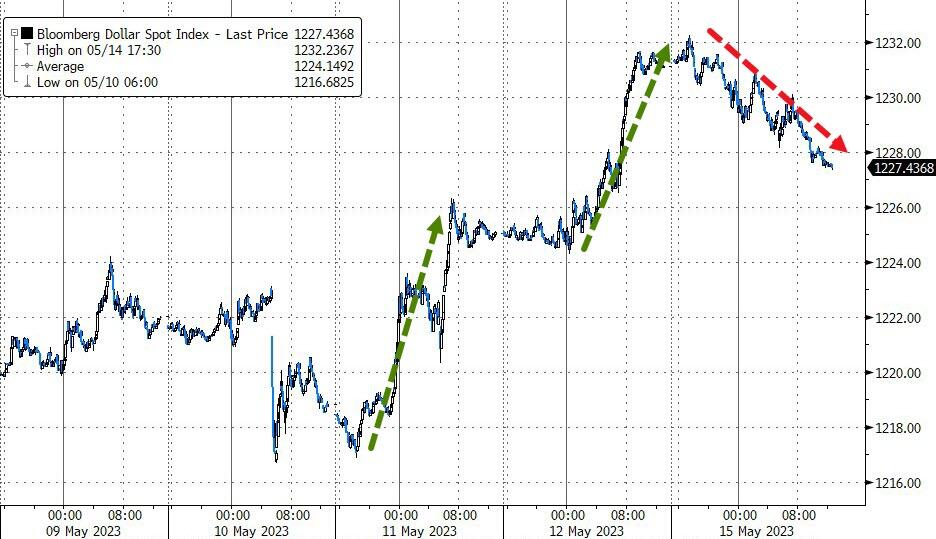
The dollar drifted lower after two strong days…
Source: Bloomberg
Bitcoin bounced modestly on the day, back above $27,000…
Source: Bloomberg
Spot Gold modestly extended its bounce off $2000 from last Friday…
Source: Bloomberg
And oil prices jumped today with WTI bouncing after tagging a $69 handle…
Finally, “you are here”…
Source: Bloomberg
Just remember, it’s different this time, right!
X-date outlook is worsening as FDIC withdrew $12bn on May 4-5 from TGA & Treasury released new estimates of extraordinary measures remaining. Looking like $20bn cash on hand at end of day on June 1 (old expectation was $38bn) https://t.co/Zf6dIaBIkQpic.twitter.com/cbF3LVdiwW
Durham Releases Final Report, Concludes FBI Opened Trump Probe Despite No Verified Intel
Special Counsel John Durham released his final report on Monday following over three years of investigation into the FBI’s handling of the Trump-Russia probe.
According to Just the News, the report concludes that the FBI had no verified intelligence or evidence when it opened up an investigation into Donald Trump and his campaign in the summer of 2016.
Durham placed blame on the FBI and DOJ for failing to follow their own standards in a probe which should have never taken place – including the agency’s surveillance of an American citizen without basis.
“Based on the review of Crossfire Hurricane and related intelligence activities, we concluded the Department and the FBI failed to uphold their important mission of strict fidelity to the law in connection with certain events and activities described in this report,” wrote Durham.
“The FBI personnel also repeatedly disregarded important requirements when they continued to seek renewals of that FISA surveillance while acknowledging — both then and in hindsight — that they did not genuinely believe there was probable cause to believe that the target was knowingly engaged in clandestine intelligence activities on behalf of foreign power.”
More via Techno Fog,
The FBI and DOJ restricted two investigations into Hillary Clinton during the 2016 election:
1) The Clinton Foundation investigation
2) Illegal foreign contributions to the Clinton Campaign
The FBI made “no effort” to investigate “the Clinton campaign’s acceptance of an illegal “campaign contribution that was made by the FBI’s own long-term CHS.”
Rep. Tony Gonzales (R-Texas) said videos he recorded at El Paso showed that the border situation is worse than it’s being portrayed, following the expiration of the pandemic-era immigration policy Title 42 at midnight on May 11.
“This is what I’m hearing on the ground from mayors, from Border Patrol agents, from embedded media, everyone is saying it’s not that bad. So on Friday, I visited El Paso and went to the Central Processing Center,” Gonzales said on CBS’ “Face the Nation” on May 14.
“In the El Paso sector, there’s over 6,000 people that are in custody in this particular facility. It’s meant to house 1,000 people, it’s housing over 3,000,” Gonzales said. “In one of these rooms … the max capacity is 90 people; there was over 400 in here, that’s a 450 percent capacity.”
He noted that another room, which was intended to hold 120 people, was holding over 700 people.
“We can’t allow ‘not that bad’ to be the normal,” Gonzales said, before adding that an unaccompanied minor had died while in the custody of the Department of Health and Human Services last week.
Title 42
The Title 42 public health provision was invoked in March 2020 by the U.S. Centers for Disease Control and Prevention (CDC). It was put in place to stop the spread of the COVID-19, as illegal immigrants could be quickly turned away at the southern U.S. border, rather than be processed at immigration detention facilities under Title 8 immigration law.
There have been concerns that ending Title 42 would lead to a significant increase in illegal immigration. Anticipating a spur in illegal crossings, several south Texas counties have issued disaster declarations.
Homeland Security Secretary Alejandro Mayorkas said U.S. Border Patrol had about 6,300 encounters with border-crossers on May 12—the first day after Title 42 expired—and another 4,200 on May 13. That’s lower than the more than 10,000 crossings per day before Title 42’s expiration.
On Sunday, Mayorkas warned “it is too early” to know whether the increased influx of immigrants has peaked.
Gonzales also called on the Biden administration to send more immigration judges to the southern border, as an alternative to releasing immigrants.
“The president should surge immigration judges to the border and that person should get their case heard in days, not years,” he explained. “Right now, in El Paso, if you apply on the one app, I was at the port of entry, if you apply on the one app, your court date is 2031. I mean, that’s eight years from now.”
He added: “The president can surge, instead of surging 1,500 troops, surge immigration judges. This is America. Get your day in court.”
The Biden administration announced the deployment of additional 1,500 military personnel for 90 days on May 2, to supplement the 2,500 already stationed along the U.S.–Mexico border.
Southern Border
Gonzales, who represents Texas’s 23rd congressional district, stretching from western San Antonio to El Paso, has been expressing concerns about the fallout of Title 42’s expiration.
Earlier this month, the Texas congressman voted in favor of the Secure the Border Act (H.R.2), an immigration bill that the House passed after a 219–213 vote mostly along party lines. The measure would restore many of the Trump administration’s policies, such as resuming construction of the border walls. It would also seek to increase the number of Border Patrol agents and strengthen the asylum process.
In a statement after the vote, Gonzales said the House bill “is a step in the right direction.”
“Unfortunately, and to my extreme concern, H.R. 2 falls short of addressing cartel activity at the southern border,” he wrote. “At the eleventh hour, my provision to begin labeling cartels as terrorist organizations was stricken from the bill. This common-sense policy would have paved the way for law enforcement to better seize their financial assets and strengthen criminal penalties on cartel operators.”
“For many of my colleagues passing H.R. 2 means ‘mission accomplished’, but the crisis at our southern border will not be resolved until a comprehensive border security bill ends up on President Biden’s desk and is signed into law,” he added. “I’ll continue to fight for the people who have had their lives upended due to Washington’s failure to protect our border and call the cartels what they truly are—terrorists.”
In January, Gonzales introduced the Security First Act (H.R.163), and a part of the legislation is aimed at designating Mexican drug cartels as terrorist organizations.
Cartels have been buying precursor chemicals from China to make fentanyl and ship finished products to the United States.
“The root cause of the fentanyl crisis in America is the Chinese Communist Party,” Gonzales wrote on Twitter in February. “The U.S. must secure our border and stand strong against China for the sake of all Americans.”
Tudor Jones Warns “Bitcoin Has A Real Problem” In The US As DeSantis Bans CBDCs
The Fed “could probably declare victory,” said legendary trader Paul Tudor Jones in an interview on CNBC this morning, pointing out that inflation has been declining for 12 straight months and “that’s never happened before in history.”
However, that ‘good news’ for The Fed is not necessarily good news for stock market investors as Jones warned the economy could enter a recession in the third or fourth quarter.
“I’m not rampantly bullish because I think it’ll be a slow grind,” he said, comparing the period to June 2006, when the Federal Reserve stopped raising rates and stocks rose for another year.
“I do think that the introduction of large language models, artificial intelligence, is going to create a productivity boost we’ve only seen a few times in the last 75 years,” he said, adding that it could add a 1.5% gain in output a year for the next five years.
Finally, however, the billionaire hedge fund manager saved his most noteworthy comments for Bitcoin.
He said while that he is still holding some of the cryptocurrency – and will always hold – it is a small portion of his total wealth, with his biggest fear the dis-inflationary environment discussed above as well as the anti-crypto sentiment from Washington:
“Bitcoin has a real problem because in the United States, you have the entire regulatory apparatus against it.”
There is at least one politician who is fighting back against the control efforts of the Biden admin with regard digital currencies.
As CoinTelegraph reports,Florida Governor Ron DeSantis signed a bill restricting the use of central bank digital currencies (CBDCs) in the state, according to local news sources.
The new law prohibits the use of a United States federal CBDC “as money within Florida’s Uniform Commercial Code (UCC).” It also bans the use of CBDCs issued by foreign governments and calls on other states to use their commercial codes to institute similar prohibitions.
At the signing ceremony for the bill, DeSantis said he was spurred into action by U.S. President Joe Biden’s administration’s studies of the new financial technology.
“I don’t think they would have done that if they don’t intend on implementing this,” he said.
Were a U.S. CBDC to be issued, it would be “a massive transfer of power from consumers to a central authority.”
DeSantis also saw the potential introduction of a CBDC as a threat to cryptocurrency:
“I think they want to crowd out and eliminate other types of digital assets like cryptocurrency because they can’t control that, so they don’t like that.”
This was the weakest quarterly debt increase in two years…
… hardly a good look for an economy that is entirely credit-driven, and may explain why the Citi US eco surprise index just dipped negative after a 4 month stretch in the green.
A detailed look at current debt balances by component:
Mortgage balances shown on consumer credit reports increased by $121 billion during the first quarter of 2023 and stood at $12.04 trillion at the end of March, a modest increase.
Balances on home equity lines of credit (HELOC) increased by $3 billion, the fourth consecutive quarterly increase following a nearly 13 year declining trend; the outstanding HELOC balance stands at $339 billion.
Credit card balances were flat in the first quarter, at $986 billion, bucking the typical trend of balance declines in first quarters.
Auto loan balances increased by $10 billion in the first quarter, continuing the upward trajectory that has been in place since 2011.
Other balances, which include retail cards and other consumer loans, increased by $5 billion.
Student loan balances now stand at $1.604 trillion, up by $9 billion from the previous quarter. In total, non-housing balances grew by $24 billion
While total debt hit another record high, the impact of soaring interest rates was felt with originations sharply lower across the board:
Mortgage originations, which include refinances, dropped sharply in the first quarter of 2023 to $324 billion, the lowest level seen since 2014, a quarter that was unusually low due to the “taper tantrum”
The median credit score for newly originated mortgages decreased slightly to 765.
What is remarkable is the collapse in mortgage originations in the highest FICO score bucket, which drove the housing market since 2020, and which has now cratered.
The volume of newly originated auto loans was $162 billion, a reduction from pandemic-era highs but still elevated compared to pre-Covid volumes.
The median credit score on newly originated auto loans ticked up 10 points, to 721, suggesting some tightening.
Aggregate limits on credit card accounts increased by $119 billion, representing a 2.7% increase from Q4 2022 levels.
Limits on home equity lines of credit were up by $9 billion in the first quarter.
Also not surprising is that in a time of near record high rates, the share of current debt becoming delinquent increased for most debt types. The delinquency transition rate for credit cards and auto loans increased by 0.6 and 0.2%, respectively approaching or surpassing their pre-pandemic levels.
With countless debt-easing measures having been implemented in recent years (mostly post-covid) soon coming to an end, the mean-reversion here will be brutal.
The New York Fed also issued an accompanying Liberty Street Economics blog post taking a closer look at housing equity and mortgage refinancing as tools for funding consumer spending. Fourteen million mortgages were refinanced during the pandemic refinancing boom, during which $430 billion of home equity was extracted through cash-out refinances. About 64% of these mortgages were “rate refinances”, resulting in an average payment reduction of $220 monthly for those borrowers.
“The mortgage refinancing boom is over, but its impact will be seen for decades to come,” said Andrew Haughwout, Director of Household and Public Policy Research at the New York Fed. “As a result of significant equity drawdowns, mortgage borrowers reduced their annual payments by tens of billions of dollars, providing additional funding for spending or paydowns in other debt categories.”
The Quarterly Report includes a summary of key takeaways and their supporting data points. Overarching trends from the Report’s summary include:
Housing Debt
There was $324 billion in newly originated mortgage debt in 2023Q1. With the pandemic-era refinance boom over and a slowdown in home sales, reported refinance and purchase mortgage originations both declined substantially in the first quarter.
Although the foreclosure moratoria have been lifted nationally, new foreclosures have stayed very low since the CARES Act moratorium was put into place. About 35,000 individuals had new foreclosure notations on their credit reports, roughly flat with the fourth quarter.
Student Loans
Outstanding student loan debt stood at $1.604 trillion in 2023 Q1.
Less than 1% of aggregate student debt was 90+ days delinquent or in default in 2023 Q1, a small decline from the previous quarter. Delinquency rates fell substantially in the previous quarter due to the implementation of the Fresh Start program, which made previously defaulted loan balances current.
Unfortunately, the party is almost over as student loan payments are set to restart (by August 30th at the latest), around the time the Supreme Court will rule that Biden’s $20K forgiveness plan is unconstitutional. In short, the student loan delinquencies are about to come back with a historic vengeance.
Putting it all together: boomers who used the covid crisis to refi their homes into a record low mortgage rate and paid down their debt are sitting pretty; meanwhile millennials and Gen Zers who are stuck renting and whose student loans are about to kick in again…
… are facing a world of pain, especially those who are already not current on their auto loans.
Peter Schiff appeared on First TV’s I’m Right with Jesse Kelly to talk about the state of the economy, inflation, and the unfolding financial crisis. Peter warned that we’re heading straight toward Great Depression 2.0.
Jesse opened the show by noting that the CPI fell to 4.9% in April. That’s an improvement, right? Peter responded, “I guess it’s not quite as bad as it was, but it’s not good.”
If you thought prices were high before, they just went up another 4.9% from where they were a year ago, and that was up a lot from where they were a year before that.”
You basically have to double the official numbers to get a better idea of what’s actually happening with prices. So, if the government says they’re up 4.9%, they’re probably up closer to 9.8%. That is a better read on what Americans are struggling with.”
Peter explained that the method for calculating the CPI was designed to produce a lower number.
The government doesn’t have to lie. The CPI does it for them.”
Jesse said the Fed is facing a “devil’s bargain.” It has to choose between high interest rates and high inflation. Peter said we’re going to get both.
Interest rates are prices. It’s the price you pay when you borrow money. The price is going up, just like the price of everything else. And in fact, interest expense is a major part of every business. … As interest goes up, well, that’s just another cost that you need to pass on to your customers through higher prices. So, it’s a self-perpetuating spiral.”
Peter said what we really need to tackle inflation is lower government spending.
Government needs to cut spending, but that’s not happening. In fact, they’re doing the opposite. Under Biden, the government is increasing spending, so they are throwing gasoline on an inflation fire.”
So, how does this end in anything other than disaster?
It doesn’t.
That’s the only way it will end because as long as there is no disaster, we’ll keep kicking the can down the road.”
Peter said the crisis is going to come in the form of a sovereign debt and currency crisis.
So, much worse than just the garden variety financial crisis we had in 2008. Because this time, it’s not just going to be subprime mortgages that are the problem. It’s going to be US Treasury debt that’s the problem. Nobody is going to want to own our sovereign debt because of how high inflation is. And that’s also going to create a dollar crisis. There is where we’re heading and it’s a big disaster.”
Peter said everybody is pretending that we’re going to have a crisis if Congress doesn’t raise the debt ceiling.
No! We’re going to have a crisis because we do raise the debt ceiling. Because we’ve continued to raise that debt ceiling instead of dealing with the real problem, which is not the ceiling, but the debt. The ceiling would be the solution to the problem if they only stopped raising it.”
Peter went on to explain how a currency crisis would impact the average American, pointing out that we enjoy a higher standard of living because of the dollar’s role as the reserve currency. As a result, US trading partners are willing to accept the dollars it prints. Then they loan those dollars back to the US by purchasing Treasuries and other American debt.
We basically get to buy stuff at lower prices and then borrow money at lower interest rates.”
If the world stops wanting US dollars because they no longer have confidence in the US currency’s future purchasing power in the exchange rate of the dollar versus their own currencies, it will cause the prices of everything Americans want to buy to go way up. Meanwhile, the cost of borrowing money will also go way up.
So, Americans see their standard of living go way down. Because if the price of everything goes up, they can’t afford to buy anymore. So now, a lot of the things we take for granted we can no longer afford. And to the extent that we need to borrow money, we can’t afford that either. So, the entire economy just collapses, and that is the disaster that we are heading for.”
Jesse said, “That sounds like a Great Depression or worse to me.” And Peter agreed.
Yeah, it’s probably going to be worse. It is a depression, but unlike the depression of the 1930s, where the people at least got the benefit of falling prices that provided some relief. During the depression, you lost your job, but at least the cost of living went down. And if you didn’t lose your job, you were actually better off because you had your paycheck and your paycheck went further because consumer prices fell during the 1930s. But this time, even the people who don’t lose their jobs are going to suffer because they’re going to lose the value of their paychecks. They’re going to lose the value of their savings. Because everything that you need to buy is going to be a lot more expensive. And that’s going to compound the burden for the unemployed. Because not only are they going to be without jobs, but their savings are going to be destroyed. And even if they get checks from the government, it’s not going to be enough to afford the basic necessities.”
Why can’t the powers that be see this coming? Peter said they never do. Or if they do, they lie about it.
Why couldn’t they see 2008 coming? That was obvious. Why couldn’t they see this inflation problem? I mean, they were claiming it was transitory when it was obvious that it wasn’t. It’s all about spin when it comes to the government. They’re never going to be honest. They’re either going to lie about what’s going to happen, or maybe they’re just so ignorant that they really can’t see what is clearly apparent to anybody who objectively looks at the facts. So, you’ve got to think for yourself and recognize that the government is never going to tell you about a crisis. You just need to prepare for it yourself.”
Beginning Of Liquidation Wave? Tiger Global Prepares To Dump A Segment Of Its Startup Portfolio
After a tumultuous 2022, Tiger Global Management has decided to dump hundreds of millions of dollars worth of private startups into the secondary markets, according to the Financial Times, citing people familiar with the upcoming move.
Chase Coleman’s $51 billion hedge fund has hired an adviser to explore options to sell some of its privately held companies in the secondary markets. The people said this was the best way for Coleman to return a portion of the money to shareholders.
“Talks are at an early stage, and potential buyers have said that any deal would probably be complicated by difficulties valuing Tiger’s private holdings, which include stakes in companies such as payments business Stripe, US software group Databricks, and China’s ByteDance,” the people said.
This comes as New York-based Tiger tumbled 56%, and the long-only fund plunged 67% in 2022, cementing its worst annual performance ever. FT’s source doesn’t specify if the selling is due to Tiger facing increasing redemptions, though it’s apparent liquidity is needed.
For Tiger and many of its peers, buying startups and then dumping them on public markets was an easy business model when the Federal Reserve pinned interest rates at the zero lower bound for a near a decade. However, with slumping mergers and acquisitions activity and a deep freeze in IPOs and SPACs, fewer companies are going public, indicating that Tiger is holding a bag of startups that it bought at lofty valuations.
As long as the Fed’s crusade to fight inflation remains in play, turmoil in capital markets will persist, which spells bad news for Tiger’s ability to offload startups at high valuations.
Financial Times pointed out a majority of Tiger’s assets are tied up in private companies. And this higher interest rate environment depresses valuations and makes it harder for cash-burning startups to raise additional money.
And so the great liquidation might have just kicked off as Tiger allegedly needs cash. Its exposure to illiquid venture capital bets that were made at high valuations has been its downfall. The music might have just stopped.
“The staff is very engaged. I would characterize the engagement as serious, as constructive,” Brainard told CBS’s Face The Nation on Sunday, warning that a default would be “catastrophic” for the economy.
Once again we are told the banking system is sound. Lovely.
And just how engaged is everyone?
The leaders were supposed to meet again Friday but delayed that session to allow talks to play out, and cast that development as a sign of progress, not a setback.
I am pleased to report we are making progress by canceling meetings and cancelling meetings will allow talks to play out.
Dealing With Repeat Liars
The amusing thing is Biden says he recognizes a need to cut the budget.
But one thing we have repeatedly learned is that his words are meaningless. He pledged to be a moderate Democrat, he pledged to be a consensus builder, he pledged to not carry on the divisive tactics of President Trump.
And just ask Joe Biden what happened to his energy agreement once he signed off on the absurdly-named Inflation Reduction Act.
In an op-ed to the Wall Street Journal, Joe Manchin says he was betrayed by President Biden.
One of Senator Manchin’s main concerns was the cost of the program. That cost went up over 2.5 times and Manchin did not even get what was pledged on pipelines.
So when president Biden says he is willing to negotiate on debt but only after the ceiling is raised, rest assured it’s a lie.
There is still no plan on the table, but meetings are supposed to resume this week. Hmm, what happened to the idea we were making progress by cancelling meetings?
McCarthy’s Key Demands
Claw back unspent Covid-19 funds.
Impose tougher work requirements for recipients of food stamps and other government aid.
Halt Biden’s plans to forgive up to $20,000 in student loans.
End many of the landmark renewable energy tax breaks Biden signed into law last year. It would tack on a sweeping Republican bill to boost oil, gas and coal production.
The first three points should not be the least bit controversial. Point 3 will happen via the Supreme Court, anyway.
I have been arguing for tougher rules on government aid for a long time.
Limit Save Grow Act
The CBO estimates a 10-year savings of $4.8 trillion. It would be higher if the IRS enforcement portion is removed.
Wagner Boss Rejects WaPo Report As ‘Smear Campaign’ Planted By Political Enemies
The Washington Post has issued a new report which was immediately met with incredulity and intense skepticism among many given the enormity of the claims, alleging that Russia’s Wagner mercenary group chief Yevgeny Prigozhin offered to give the Ukrainians information on Russian troop positions.
“In late January, with his mercenary forces dying by the thousands in a fight for the ruined city of Bakhmut, Wagner Group owner Yevgeniy Prigozhin made Ukraine an extraordinary offer,” the WaPo report begins. “Prigozhin said that if Ukraine’s commanders withdrew their soldiersfrom the area around Bakhmut, he would give Kyiv information on Russian troop positions, which Ukraine could use to attack them.”
The report described further based on the alleged US intelligence: “Prigozhin conveyed the proposal to his contacts in Ukraine’s military intelligence directorate, with whom he has maintained secret communications during the course of the war, according to previously unreportedU.S. intelligence documents leaked on the group-chat platform Discord.”
While the intensifying spat between Wagner and the regular chain of command has long been out in full view, and has likely been somewhat of an embarrassment for the defense ministry and the Kremlin, the Washington Post reporting is describing outright treason.
But given the Post is one of the most visible US newspapers in the world, Prigozhin was forced to address it. According to his words translated by Moscow Times/AFP:
The founder of Russia’s Wagner mercenary group Yevgeny Prigozhin called reports that he offered information on Russian troop positions to Ukraine “laughable” and a result of a possible smear campaign.
…Prigozhin laughed off The Washington Post’s report in an audio message posted on Telegram.
“Reading this is of course nice. It means I am not only fighting for Russia but Zelensky is also fulfilling my orders,” Prigozhin said.
“This is laughable.”
He said “people from Rublyovka” — a luxurious Moscow suburb home to the Russian elite — could be behind the allegations.
“Of course they will pour as much s*** on me as they can,” he said.
While firmly rejecting the claims, it’s interesting that Prigozhin was immediately suspicious of his own political enemies inside Russia as being behind planting the “intelligence”.
We’re now on D+5 of the Ukrainian counteroffensive, which was predictably launched into the Bakhmut flanks after Prigozhin spent months losing his mind on social media.
The modest gains shown have cost multiple AFU brigades and thousands of casualties to achieve. pic.twitter.com/Z4xf3O8UPO
Another scenario could be that US intelligence itself knows this is an optimal time to sow further suspicion, confusion, and division in Russian military ranks at a moment the fate of Bakhmut hangs in the balance. By feeding US news outlets such allegations centering on Prigozhin, US intelligence can easily at this point ratchet the drama and pressure between the Russian defense ministry and Wagner.
The Kremlin in its Monday daily press briefing said it’s initial take is that it “looks fake” when asked about the Washington Post report.