77.1 F
Chicago
Sunday, August 16, 2026
Home Blog Page 3689

Our Two Deep States: One Public, One Private

Our Two Deep States: One Public, One Private

Authored by Charles Hugh Smith via OfTwoMinds blog,

One Deep State is bad enough, but a renegade, predatory private-sector Deep State is intolerable.

In 2007, well before the term Deep State entered the common lexicon, I sketched the interconnected public-private pieces of the Deep State, which I termed the elite maintaining and extending global dominance. This diagram doesn’t make all the connections or list all the consequential nodes of influence of course, but you get the idea: elected officials, i.e. “democracy,” play a modest role in the entire structure, which displays remarkable continuity regardless of which politicians and parties are currently in power.
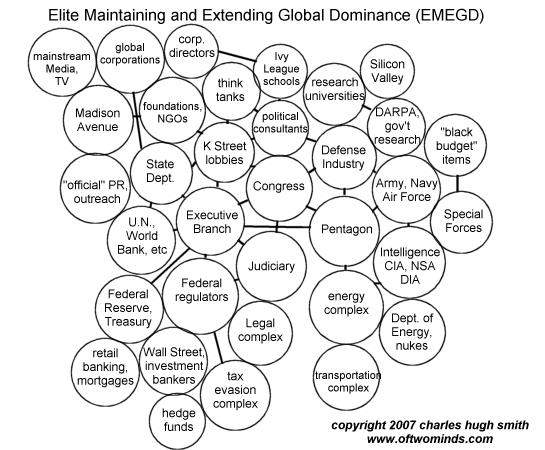
That’s the whole idea, of course: continuity that can’t be disrupted by an election.

What’s changed is the emergence of a private-sector Deep State–a.k.a. Big Tech–that has established unprecedented power outside the control of elected officials even as it continues to play ball with the traditional public-sector dominated Deep State of the alphabet federal agencies and informal public-private sector ties.

This private-sector Deep State is free to pursue its own agenda of information-gathering and selling, surveillance, influence and profit-maximizing monopolies while seeming to serve the traditional Deep State as information-collecting and censorship services.

What makes Big Tech a private-sector Deep State is that nobody outside the corporations knows precisely what’s in their databases and algorithms or the extent of their capabilities. Sure, they share information with the traditional Deep State players, and censor whomever it’s “suggested” they censor / shadow-ban, but that transfer isn’t 100% of what Big Tech has in hand. All that transfer is just enough to appear to be playing ball so Big Tech can “suggest” OK, we’ve done our part, now leave us alone.

The problem with both Deep States is there is no recourse within the system for those censored / shadow-banned, those being tracked, those whose data is being siphoned off and sold to whomever offers a hefty sum of cash, and so on. The basic idea of the US Constitution is that every citizen has some recourse via the judicial or political systems should the state (government) or private entities overstep the boundaries established by the Constitution.

Citizens have no recourse against the predations of Big Tech or the traditional Deep State. Um, hello there, Big Tech, could you please share precisely how and when I’ve been shadow-banned, who else has copies of the data you’ve collected about me and how much you “earned” selling my data to third parties? What’s actually in your AI tools? Does any public agency have any real oversight power over all the looting, pillaging and predation you’re pursuing?

So sorry (heh), you agreed to our terms of service which grant us all the rights and our algorithms and databases are protected proprietary corporate property. So blow chow, pal, you have no recourse. We’re a corporation, we have rights; you’re only a citizen, you have none. You currently have permission to post photos of puppies and kittens, so just enjoy the photos of puppies and kittens and be happy you haven’t yet been digitally erased entirely.

Um, hello there, Alphabet-Soup Agency, could I please have all the files you’ve assembled on me? Yes, there is a protocol for requesting information (the Freedom of Information Act FOIA), but there are exemptions and delays, so don’t hold your breath.

Meanwhile, the nation careens into an era of Polycrisis, defined as a cluster of related global risks with compounding effects, such that the overall impact exceeds the sum of each part. This is of course a classic description of emergent systems, which display characteristics that differ from those generated by each individual component.

I’ve sketched out a few of these dynamics in the chart below of overlapping crises.

At the same time, the global status quo, regardless of political flavor, is sliding down the backside of the S-Curve (see graph below). Everything that was considered a dependable solution is now the problem. There are no solutions within the existing status quo, and so everyone has no choice but to do more of what’s failed spectacularly.

There are no perfect, sacrifice-free fixes to the demise of the debt-funded, waste is growth / Landfill Global Economy, but a good start would be bringing the private-sector Deep State of Big Tech to heel, stripping it of its opacity and powers, relegating everything Big Tech does or attempts to a tightly regulated utility with transparent public oversight.

One Deep State is bad enough, but a renegade, predatory private-sector Deep State is intolerable. It goes almost without saying that I’ve been shadow-banned for the past 7 years (revealed by the bogus PropOrNot hit list), if not longer, but the mechanisms of this censorship are opaque, not just to me but to the elected branches of government and the shadow-realm of the traditional Deep State.

*  *  *

My new book is now available at a 10% discount ($8.95 ebook, $18 print): Self-Reliance in the 21st Century.

Read the first chapter for free (PDF)

Become a $1/month patron of my work via patreon.com.

Tyler Durden
Sat, 05/13/2023 – 15:30

Non-Binary Character In New Transformer Cartoon Goes Viral As People Call For “Another Brand Boycott”

Non-Binary Character In New Transformer Cartoon Goes Viral As People Call For “Another Brand Boycott”

Out of the ‘woke’ indoctrination ovens from studios in Hollywood is a children’s computer-animated television show called “Transformers: EarthSpark” that first aired on Paramount+ in November 2022 and has embraced the woke movement. 

Paramount+ might be digging its grave after the show for young kids appears to have recently promoted gender ideology. 

I know I’m safe when I’m with my friends or other non-binary people,” a character named Sam said to Transformer Nightshade. Sam also said her pronouns are “she/they.”

The 1-minute clip tweeted by Libs of TikTok has been viewed 8 million times within 24 hours. Commenting on the clip is Mostly Peaceful Memes, who said, “Really putting the trans in transformers ammiright?”

The cringe-woke cartoon isn’t the first. Disney has been pumping woke cartoons for a while, enraging parents. The proliferation of woke cartoons should be a wake-up call for parents and the need to vet kids shows as Hollywood and the left wages a culture war on the youngest generation. Twitter users were appalled by the woke cartoon. 

Paramount+ might be walking a fine line as some Americans have been on a roll, boycotting products from corporate America, such as woke Bud Light. 

Tyler Durden
Sat, 05/13/2023 – 15:00

Non-Profit Hospitals Made Huge Profits During Pandemic While Receiving $23 Billion In Federal COVID-19 Aid: Report

Non-Profit Hospitals Made Huge Profits During Pandemic While Receiving $23 Billion In Federal COVID-19 Aid: Report

Authored by Mark Tapscott via The Epoch Times (emphasis ours),

Federal officials gave more than $23 billion COVID-19 aid to the nation’s top 20 nonprofit hospitals even as a 62 percent increase in their collective net assets led parallel surges in the institutions’ total profits and revenues during the 2018-2021 time period spanning the Coronavirus pandemic, according to a new report.

The Mayo Clinic in Rochester, Minn., on Sept. 29, 2020. (Kerem Yucel/AFP via Getty Images)

Only two of the 20 institutions have repaid the government for the COVID-19 aid they received.  

The 20 largest nonprofit hospitals in the country continued making massive profits while their cumulative net assets soared to $324.3 billion in 2021, up from $200.6 billion in 2018. The year 2021 is the latest year available for cross-comparison purposes.

“Those hospital systems received congressional COVID bailouts of $23 billion and only two providers partially paid their COVID bailout back,” said the report compiled by Open The Books, an Illinois-based research nonprofit that compiles and posts spending by all levels of government in America. The two institutions that have partially repaid the government were not identified.

The biggest jump among the top 20 was 92 percent by the Mayo Clinic, based in Rochester, Minnesota, whose assets went from $9.2 billion in 2018 to $17.7 billion in 2021. The Mayo Clinic received $350,000 in federal COVID-19 aid, the lowest amount received among the top 20 institutions.

The Cleveland Clinic Health System, based in Independence, Ohio, saw its assets go up 60 percent, from $9.8 billion to $15.7 billion, while receiving $118 million in federal COVID-19 aid. Intermountain Healthcare, based in Salt Lake City,  Utah, the 12th largest of the top 20, enjoyed a 63 percent growth in net assets from $7.1 billion to $11.6 billion. Intermountain received $518 million in aid.

The Cleveland Clinic in Cleveland, Ohio. (Courtesy of Cleveland Clinic)

Seeing a 43 percent jump in net assets between 2018 and 2021 was the Northwestern Medicine system, moving from $8.3 billion to $11.9 billion, and receiving $419 million in COVID-19 aid from federal officials. The Indiana University Health System went from $7 billion in 2018 to $10.3 billion in 2021, a 47 percent increase. The Indiana facility received $726 million in COVID-19 assistance from the government.

And as the revenues poured in for the 20 hospitals, compensation for their top executives soared, often beyond $10 million annually, according to the report.

For example, the chief executive officer (CEO) of Ascension Healthcare, which is based in St. Louis and is the nation’s second-largest such system, received $13 million in 2021 and a total in excess of $22 million for the period covered by the study.

The recipient among the top 20 of the most COVID-19 aid was San Francisco-based CommonSpirit Health with $3.6 billion, followed by Providence St. Joseph Center with $3 billion, Ascension Healthcare with $2.7 billion, Livonia, Michigan-based Livonia Health with $2.3 billion and Sutter Health, based in Sacramento, California, with $1.7 billion.

But the overall health of Americans headed downward between 2018 and 2021.

American life expectancy during this period sharply declined by a staggering 2.5 years from 2019 through 2022. While ‘comparable country averages’ rebounded from a COVID-related drop in 2021, the United States continued declining in life expectancy,” the report found.

“Yet, the cost of health care is still astronomically high, as the average family paid $22,463 in health insurance premiums in 2022. That does not include out-of-pocket costs like co-pays and deductibles, which can be thousands more. This has led to medical debt for about 100 million Americans,” the report continued.

Read more here…

Tyler Durden
Sat, 05/13/2023 – 14:30

Watch: Texas Governor Buses More Illegal Migrants To Kamala Harris’ House

Watch: Texas Governor Buses More Illegal Migrants To Kamala Harris’ House

For decades, Democrats have ignored or applauded the mass movements of illegal immigrants across the US southern border as a grand signal of cosmopolitan virtue.  However, as soon as border states began to fight back against open border policies and started sending those same migrants to leftist cities, suddenly their tone changed and their enthusiasm disappeared. 

The moment blue sanctuary cities were forced to deal with the direct repercussions of an invasion of low skill, welfare seeking illegal migrants, leftists became enraged. Instead of blaming their own failed ideals, they started blaming the conservative governors that are bussing the illegals to their doorstep.  Unphased by the indignant whining of Democrats, the governors of Florida and Texas have continued their effort to make a point – If leftist controlled cities can’t even handle a few thousand migrants, why should border towns be expected to handle millions?  

With the continuance of Title 42 now in question, the ability of border patrol agents to ship migrants directly back to Mexico is about to disappear.  And, if red states aren’t allowed by the Biden Administration to send them back, they might as well send them to Biden. 

Texas Governor Greg Abbot has sent another group of buses carrying illegals to already overwhelmed Washington DC, straight to the residence of Vice President Kamala Harris: 

As the saying goes, the beatings will continue until morale improves.  Perhaps Democrat constituents will finally start questioning the immigration policies of their leadership? 

Tyler Durden
Sat, 05/13/2023 – 14:00

Zillow Warns Of “Deep Freeze” In Housing Market If US Defaults

Zillow Warns Of “Deep Freeze” In Housing Market If US Defaults

Lawmakers on Capitol Hill left this week with no deal on how to avert a default on the national debt. The US has never defaulted on its debt, and the probability remains low. But, if Congress fails to pass legislation raising the statutory debt ceiling on the “X-date” – the date on which the Treasury can no longer meet its obligations (June 1) without raising debt in excess of the ceiling – then it would undoubtedly unleash economic turmoil and, more importantly, send the housing market into “a deep freeze,” warned Zillow

While a debt default seems unlikely, new scenario projections from Zillow show housing sales would crater and mortgage costs would soar in the worst-case scenario.

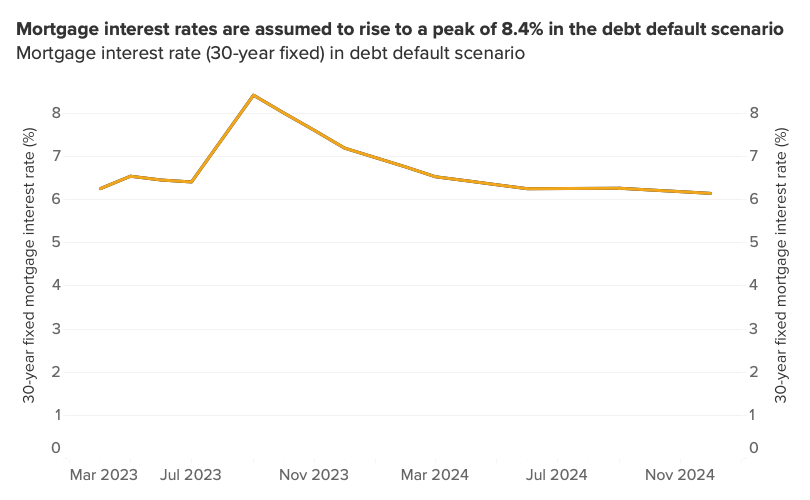
Housing costs would jump by 22%, with the rate for 30-year, fixed-rate mortgages peaking around 8.4% in September. Securing a loan of $500,000 at an interest rate of 8.4% would result in a monthly payment of over $3,800, a significant increase from around $3,100 with rates at 6.3%. 

Zillow explains the economic scenario below: 

A sharp increase in the unemployment rate starting this summer — jumping from the current level of 3.4% to a peak of 8.3% in October before gradually declining — and an increase in 30-year mortgage interest rates to a peak of 8.4% in September, before declining, as well. Those are in contrast to our baseline scenarios, in which we expect unemployment to only gradually increase very slightly from its present generational-low level of 3.4% over the next year and a half, and we expect mortgage rates to gradually fall somewhat over the same timeframe.

Jeff Tucker, a senior economist at Zillow, warned: 

“Home buyers and sellers finally have been adjusting to mortgage rates over 6% this spring, but a debt default could potentially raise borrowing costs even higher and send the market into a deep freeze.”

In another scenario, Zillow said 30-year mortgage interest rates above 8% would wipe out nearly a quarter of expected sales in the months ahead. 

We ran our forecast models for sales volume and price appreciation using the debt default scenario charted above, while holding other key input variables, such as demographics, the same as in our baseline forecasting scenario. [4] In the event of a debt default, existing home sales volume would fall from a projected seasonally adjusted annualized rate (SAAR) of 4.3 million this April to 3.3 million in September – a decline of 23% in housing market activity, both from the current pace of sales and the pace that we predict would prevail in the absence of a debt default crisis. Cumulatively, in the 18 months from July 2023 to December 2024, the decline in sales volume would be just over 700,000 existing homes sold – that is almost 12% of the 6 million sales in that 18-month span we would expect without a default.

Zillow pointed out, “It appears that home prices remain somewhat insulated from deeper declines due to today’s very low inventory and the especially low flow of new listings so far this year.” 

It added, “Higher mortgage rates would likely further discourage homeowners from listing their homes, as they seek to avoid selling in an unfavorable market environment, much like the increase of mortgage rates in 2022 helped to depress new listings.” 

Zillow said it’s only “if unemployment really rises by as much as assumed here, that could force many homeowners, unable to pay their mortgages, to sell, putting more downward pressure on home values than predicted here.” 

Even though Tucker acknowledges that default is “unlikely,” the scenario he mapped out would be added downward pressure on shelter costs that have already peaked, as per the latest CPI report. We pointed this out in early April

A real estate bear’s dream would be for the US to default on its debt. 

Tyler Durden
Sat, 05/13/2023 – 13:00

Bad To Worse For Russia: Multiple Aircraft Downed In 24 Hours – Ukraine Gains In Bakhmut

Bad To Worse For Russia: Multiple Aircraft Downed In 24 Hours – Ukraine Gains In Bakhmut

Shortly after a Russian military helicopter crash was reported early Saturday in a region near the Ukrainian border, a second crash of an aircraft has been reported, at a moment of continuing general bad news for Moscow related to the Ukraine war. Possibly a third aircraft downing has also been reported – all within a matter of hours.

An Su-34 fighter jet crashed in Bryansk Region, Russia near the Ukrainian border, minutes after reports that an unidentified helicopter also went down in the area, TASS news agency reported on Saturday, citing sources,” state media is reporting.

Details on casualties weren’t initially revealed, but images and video circulating on social media show what appears to be a crash site, including the jet’s tail and engine on fire. 

The jet crash reportedly happened near the village of Istrovka north of the Ukrainian border, and unofficial military channels online are saying the pilot and navigator were killed. 

Just hours before news of the jet crash emerged, a Russian Mi-8 helicopter separately caught fire and crashed. It may have been shot down. Newsweek is meanwhile suggesting that a total of two helicopters crashed within the same time frame, reporting that— 

A Su-34 combat jet and a Mi-8 helicopter came down on Saturday, according to Russia’s state-owned Tass news agency.

Russian online news channel Mash posted on Telegram that another Mi-8 helicopter and a Su-35 warplane crashed in the same area on Saturday.

There’s also growing speculation that given multiple aircraft came down in the same region, it may have been from a Ukrainian attack on the aircraft, but this is unconfirmed

This was also reported by Russian media outlet Readovka, who said: “Two helicopters and fighter-bombers were shot down by the Armed Forces of Ukraine. Our pilots were ambushed and we are talking about a carefully planned operation.” Newsweek has been unable to independently verify reports of the additional crashes.

A Reuters national security correspondent is counting four total downed aircraft on Saturday, citing Russian state sources:

The day prior, on Friday, a Mi-28 military helicopter had crashed during a training flight in Crimea, after which the defense ministry confirmed that two pilots were killed. 

TASS cited defense officials who described, “At 3:42 p.m. (Moscow time) on May 12, 2023, a Mi-28 helicopter crashed during its scheduled training flight in the Dzhankoi district of the Republic of Crimea. The helicopter performed its flight without an ammunition load. There is no destruction on the ground. Both pilots died.”

The military statement said the crash in Crimea was due to a “technical failure” of the attack helicopter but said a further investigation is ongoing. 

Overall this has been a bad past week and even month so far for Russia and its war efforts.

There’s not only been a spate of these deadly aerial incidents in the past 24 hours, but Russian territory is coming under increased drone attack from Ukraine, and oil facilities in particular have been targeted and significantly damaged. In addition the defense ministry acknowledged that Russian military positions have pulled back in some areas of northern Bakhmut, following prior months of steady gains.

Yevgeny Prigozhin, head of the Wagner forces, has called it a “rout” – as the open feud between himself and the top military command has also been a likely cause of ‘low morale’ and is somewhat embarrassing on an international stage.

At this point it remains unconfirmed and uncertain whether these Saturday jet and helicopter crashes were the result of cross-border shootdowns. If so it would mark a huge escalation and leap in Ukraine’s capabilities, including the possibility of Western advanced offensive weapons being used:

Reuters summarized of the battlefield developments by Friday:

Moscow acknowledged on Friday that its forces had fallen back north of Ukraine’s battlefield city of Bakhmut after a new Ukrainian offensive, in a retreat that the head of Russia’s Wagner private army called a rout.

The setback for Russia, which follows similar reports of Ukrainian advances south of the city, suggests a coordinated push by Kyiv to encircle Russian forces in Bakhmut, Moscow’s main objective for months during the war’s bloodiest fighting.

“In three days of counter-offensive activity, the Ukrainian Armed Forces in the Bakhmut sector have liberated 17.3 sq. km (6.6 sq. miles) of territory,” Serhiy Cherevatyi, spokesman for the “east” group of Ukrainian forces, said on the Telegram messaging app.

Both sides are now reporting the biggest Ukrainian gains in six months, although Ukraine has given few details and played down suggestions a huge, long-planned counteroffensive has officially begun.

Additionally days ago Moscow’s big Victory Day parade was widely reported as “muted” and lacking in tanks and other military hardware that is typically on display.

Ukrainian officials have mocked all of this as showing weakness, also while Kiev’s spring counteroffensive may be imminent, or is perhaps already begun. All the while, Ukraine’s cross-border attacks are only growing bolder, and it doesn’t seem the Kremlin can do anything about it.

Yet, despite what appear to be significant Russian military setbacks, Ukraine frontlines in many places are still getting pounded. For example, the below video is purportedly of a Russian strike in Western Ukraine on Saturday:

As for the much-touted spring counteroffensive by Ukraine forces, it’s as yet unclear whether this is in full swing or not. While there have been moves on the ground, Zelensky has so far denied that it’s begun, saying his forces must “wait”. 

Tyler Durden
Sat, 05/13/2023 – 12:30

Record-Setting 83,000 Migrants Illegally Crossed US Border This Week

Record-Setting 83,000 Migrants Illegally Crossed US Border This Week

Tens of thousands of migrants rushed across the US-Mexico border this week as the pandemic-related asylum restrictions were lifted at midnight Thursday. 

“A record-setting 83,000 migrants crossed our border illegally this week — equivalent to a full capacity Dallas Cowboys football stadium,” said Fox News’ Bill Melugin.

Melugin fact-checked White House press secretary Karine Jean-Pierre, calling her statement about masses releases aren’t happening at the southern border “categorically false.” He said that is “not the reality of what’s happening on the ground here.” 

The Biden administration has said there’s a plan that includes strengthening Title 8 penalties, an asylum rule that makes those entering the US illegally ineligible for asylum. But we question just how strong those rules are considering footage has emerged on Twitter of migrants being loaded on busses and allegedly headed inland. 

But don’t worry, in case you don’t trust your lying eyes, here’s WaPo explaining in the same story that there is “no surge” and yet at the same time “unlawful crossings were the highest ever this week”…

Hmm…

Clown world. 

Tyler Durden
Sat, 05/13/2023 – 12:00

US Blocks China’s Attempt To Condemn Israeli Attacks On Gaza At UN

US Blocks China’s Attempt To Condemn Israeli Attacks On Gaza At UN

Via The Cradle, 

US officials blocked an effort led by China at the UN Security Council (UNSC) this week to condemn Israel’s latest onslaught on the besieged Gaza Strip, according to senior Israeli officials that spoke with the Times of Israel.

Washington’s interference reportedly came at the request of Tel Aviv, who feared the motion at Tuesday’s emergency meeting “would draw an equivalence” between the Israeli army and the Palestinian Islamic Jihad (PIJ) group.

Getty Images

Over the decades, the US has consistently stepped in to protect Israel from facing the consequences of rampant human rights abuses, the military occupation of Palestinian land, and the imposition of an apartheid system targeting Palestinians.

The only exception to this rule came earlier this year, when Washington allowed a statement to pass at the UNSC blasting Israel’s expansion of illegal settlements in the occupied West Bank. Nonetheless, the US went on to block a binding resolution against Israel.

Former US President Harry Truman was the first world leader to recognize Israel when it was created in 1948 following the ‘Nakba,’ or catastrophe, during which at least 700,000 Palestinians were violently evicted from their lands by Jewish settlers.

Israel is also the largest cumulative recipient of US foreign aid in the post-World War II era and enjoys unequivocal political and diplomatic cover from both the Democratic and Republican parties as well as from US corporate media. However, US influence in the region has started to wane in recent months, pushing Israel further into isolation.

Last month, Beijing offered to help facilitate peace talks between Israel and Palestine as part of a larger effort to mediate historic conflicts in West Asia.

In December, Chinese President Xi Jinping expressed support for an end to the Israeli occupation of Palestine and voiced frustration over the “historical injustice” suffered by Palestinians.

He also called for granting Palestine “full membership in the United Nations” and said Beijing “supports the two-state solution and the establishment of a Palestinian state on the 1967 borders, with East Jerusalem as its capital.”

The Asian giant has slammed recent comments by a Jewish supremacist government minister, who in March said, “there is no such thing as a Palestinian people.”

“The Israeli senior official is wrong and irresponsible to deny Palestinian people’s existence and to display an ‘Israel map’ including Jordan and Palestinian places occupied by Israel at an event in Paris,” said Wang Wenbin, a spokesman for China’s Foreign Ministry.

Tyler Durden
Sat, 05/13/2023 – 11:30

New York, San Francisco Office Buildings Are Absolute Ghost Towns

New York, San Francisco Office Buildings Are Absolute Ghost Towns

It’s no secret that commercial real estate is in bad shape across the globe…

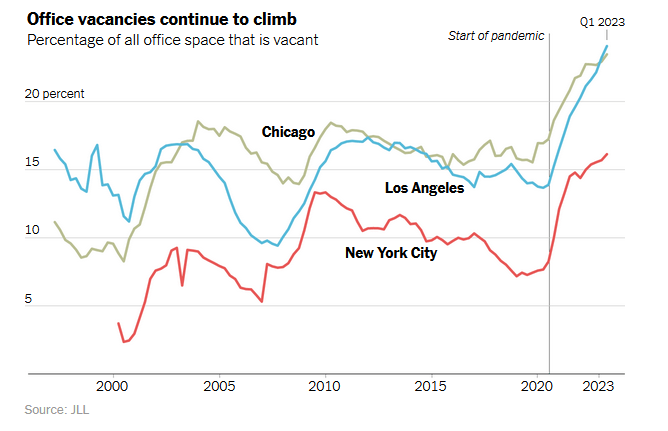
Things are so bad, in fact, that 26 Empire State Buildings could fit into New York City’s empty office space, as occupancy in the city is hovering around 50% of prepandemic levels, according to the chair of Harvard Economics Department, Edward Glaeser and MIT’s Carlo Ratti.

The cause? Thanks to the pandemic, working from home has become the norm in many industries – a phenomenon which has also heavily impacted mass transit systems in America’s largest cities.

In downtowns from Chicago to Los Angeles, the physical layout of the 20th-century city is clashing with the new economy. Since the 1920s, single-use zoning has divided our cities into separate neighborhoods for home, work and play. Work-from-home and Netflix have made these distinctions irrelevant, but our partitioned urban fabric has yet to catch up.

To create a city vibrant enough to compete with the convenience of the internet, we need to end the era of single-use zoning and create mixed-use, mixed-income neighborhoods that bring libraries, offices, movie theaters, grocery stores, schools, parks, restaurants and bars closer together. We must reconfigure the city into an experience worth leaving the house for. Streets once filled by commuting crowds can be reinvigorated by those who really want to be there. NYT

In Los Angeles, the vacant office space is equivalent to 30.7 US Bank Towers.

Glaeser and Ratti note that in 1980, futurist Alvin Toffler argued that information technology would render urban office environments more or less obsolete, as workers would instead use residential “electronic cottages.”

This sudden shift was a body blow to New York. Many offices remain empty, and the city lost more than 300,000 inhabitants from 2020 to 2021. No other American city experienced such a large numerical decline. Over the same period, Houston lost only 12,000 people, although the global commercial real estate services company JLL reports that Houston’s office vacancy rates are now even higher than New York’s. -NYT

In San Francisco, the downtown area is experiencing its worst office vacancy crisis on record – with 31% of space available for lease or sublease, the SF Chronicle reports.

In the heart of the city, an astounding 18.4 million square feet of real estate is available — enough space to house 92,000 employees and the equivalent of 13 Salesforce Towers.

The Chronicle mapped and charted every major downtown office building’s vacancy, using data provided by real estate brokerage Lee & Associates.

According to the report, some of the emptiest buildings are those vacated amid layoffs by tech giants Salesforce and Meta – the former of which embraced remote work, and has listed office for lease at 50 Fremont, where 90% of the space is vacant.

Slack, a subsidiary of Salesforce, left its former headquarters at 500 Howard street 95.4% vacant. It’s also listed space at 45 Fremont St. for sublease, which is currently 60% vacant.

Meta, meanwhile, has listed all 435,000 sqft of their 181 Fremont St. location for rent, as the city’s 3rd largest tower currently sits 100% vacant.

According to Cody Kollmann, founding principal at Lee & Associates, “This is the first time in over a decade where office tenants in San Francisco have had any leverage or negotiating power against landlords. This is an incredible opportunity for tenants to exploit a commercial real estate market that is experiencing a historically high vacancy rate.”

Landlords, meanwhile, need to offer more than just space according to some.

The more an office building acts like a hotel, the more office tenants are attracted to it and the more likely they will stay,” said David Klein, managing principal at Lee & Associates.

“I strongly believe the office experience should be at the same level as luxury residential and hospitality,” said Michael Shivo, owner of the Transamerica Pyramid – who’s investing $250 million in a renovation of the landmark that’s currently sitting 36.7% vacant.

“In the last two years, we’ve made our homes into our offices, now it’s time to make our offices feel like our homes.”

Tyler Durden
Sat, 05/13/2023 – 11:00

Fewer Than 60% Of Baby Boomers Have Retirement Accounts

Fewer Than 60% Of Baby Boomers Have Retirement Accounts

Authored by Katabella Roberts via The Epoch Times (emphasis ours),

Millions of working-age Americans aged between 56 and 64 are edging closer to retirement without having savings stashed away.

As you’re looking at the fast-approaching years of your retirement, you may be thinking about how to stretch your retirement savings. (Cozine/ShutterStock)

Census data for 2020 shows that less than 60 percent (approximately 58.1 percent) of American “baby boomers”—generally defined as those born between 1946 to 1964—owned a retirement account three years ago, at a time when the COVID-19 pandemic upended jobs and the global economy.

That means over two-fifths of baby boomers nearing retirement had no retirement savings stored in financial institutions.

The U.S. Census Bureau defined retirement accounts as 401(k), 403(b), 503(b), Thrift Savings Plans, Individual Retirement Accounts (IRA), Keogh accounts, and defined-benefit and cash balance plans.

The Census data also revealed that just 56.1 percent of “Generation X” members, or those aged between 40 and 55 had a retirement account in 2020, while roughly half of “millennials” ages 24 to 39 had one.

Meanwhile, just 7.7 percent of Americans who fall under the “Generation Z” category, meaning those aged 15 to 23, owned retirement accounts in 2020. However, given their ages, they also have more time to accumulate additional retirement savings.

A separate report (pdf) from the TransAmerica Center for Retirement Studies found a similar trend, noting that baby boomers have been “susceptible to employment risks, volatility in the financial markets, and increasing inflation—all of which could disrupt their retirement plans” in the wake of the COVID-19 pandemic.

Baby Boomers’ Confidence in ‘Comfortable’ Retirement Waning

That report is based on an online survey conducted between October 28 and December 10, 2021, among a nationally representative sample of 5,493 workers aged 18 or over in a for-profit company employing one or more employees.

It found that just 23 percent of Baby Boomers feel “very confident” that they can fully retire with a comfortable lifestyle, while 48 percent are “somewhat confident.” Approximately 16 percent are “not too confident,” and 14 percent are “not at all confident” that they will be able to enjoy what they consider to be a comfortable lifestyle after retiring from the workforce.

Just 22 percent said they believe they are currently building a “large enough retirement nest egg,” while 34 percent said they “somewhat disagree” or “strongly disagree” that this is the case.

Overall the TransAmerica Center for Retirement Studies found that 85 percent of Baby Boomers expect Social Security income to be one of their sources of income after they retire, while 78 percent plan to use self-funded savings.

When it comes to their primary source of income in retirement, though, approximately 40 percent cited Social Security, the report found.

The average monthly Social Security check to a retired worker in February 2023 was about $1,782, or about $21,384 annually, according to the Center on Budget and Policy Priorities.

However, statistics from the U.S. Bureau of Labor Statistics (BLS) show that an American household headed by someone aged 65 and up spent an average of $48,791 per year, or $4,065.95 per month, between 2016 and 2020.

Cost of Living Crisis

Meanwhile, households headed by someone between the ages of 65 and 74 spent $53,916 annually during that same time period, while spending declined to $41,637 annually for people aged 75 and older.

Those nearing retirement, aged between 55 to 64, spent $65,392 annually between 2016 and 2020, the data shows, far more than the $21,384 they are set to receive annually in Social Security.

Read more here…

Tyler Durden
Sat, 05/13/2023 – 10:30