73.8 F
Chicago
Saturday, August 15, 2026
Home Blog Page 3704

What Is The Success Rate Of Actively Managed Funds?

What Is The Success Rate Of Actively Managed Funds?

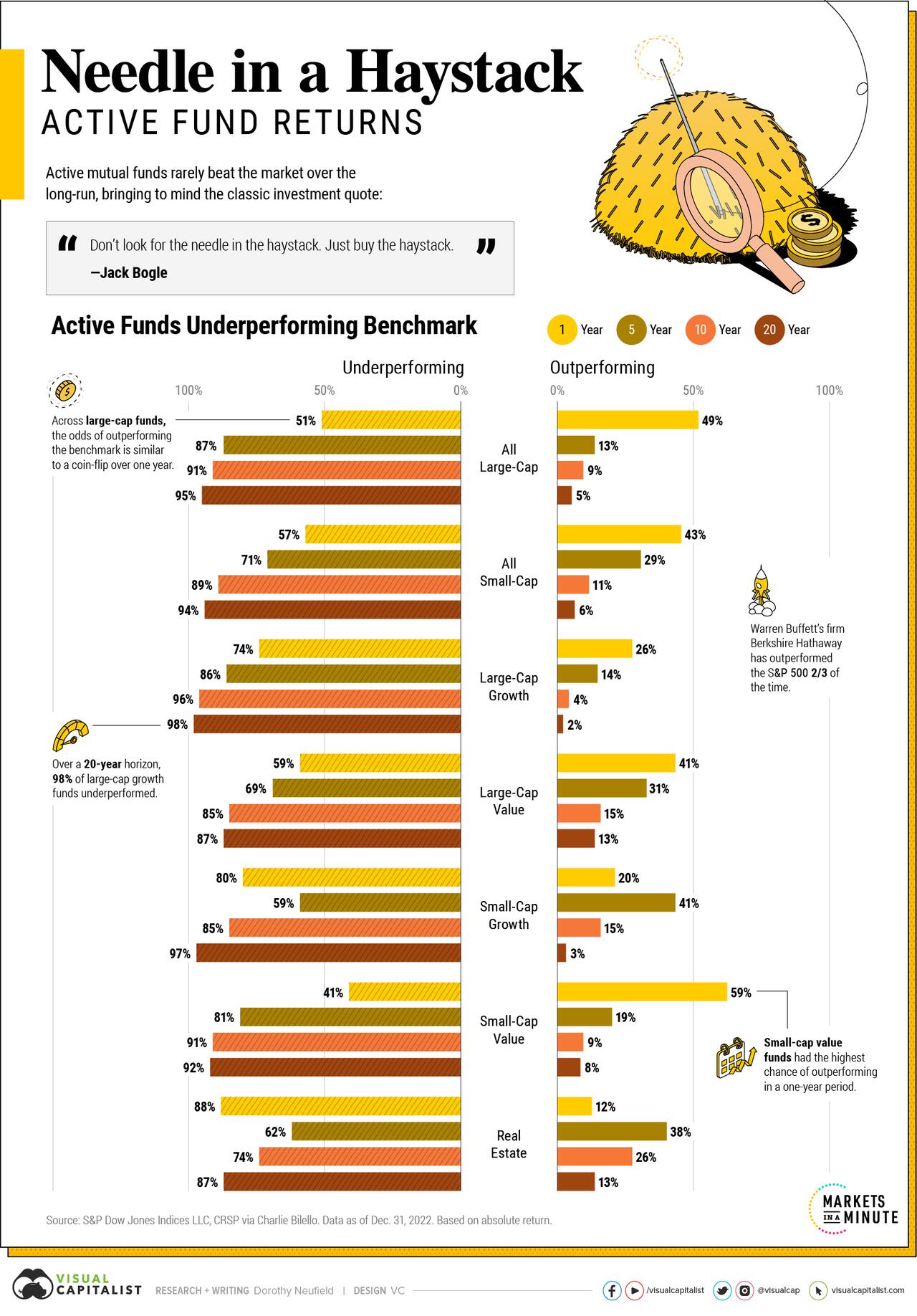
Over a 20-year period, 95% of large-cap actively managed funds have underperformed their benchmark.

As Visual Capitalist’s Dorothy Neufeld shows in the graphic below, the performance of actively managed funds varies widely across a range of fund types( using data from S&P Global via Charlie Bilello).

Missing the Mark: Actively Managed Funds

Several factors present headwinds to actively managed funds.

  • Trading costs: First, fund managers will trade more often than passive funds. These in turn incur costs, impacting returns.
  • Cash holdings: Additionally, many of these funds hold a cash allocation of about 5% or more to capture market opportunities. Unlike active funds, their passive counterparts are often fully invested. Cash holdings can have the opposite effect than intended—dragging on overall returns.
  • Fees: Active funds can charge up to 1-2% in investment manager fees while funds that tracked an index passively charged just 0.12% on average in 2022. These additional costs add up over time.

Below, we show how active funds increasingly underperform against their benchmark over each time period.

As we can see, 51% of all large-cap active mutual funds underperformed in a one-year period. That compares to 41% of small-cap value funds, which had the best chance of outperforming the benchmark annually. Also, an eye-opening 88% of real estate funds underperformed.

For context, Warren Buffett’s firm Berkshire Hathaway has beat the S&P 500 two-thirds of the time. Even the world’s top stock pickers have a hard time beating the market’s returns.

2020 Market Crash: A Case Study

How about active funds’ performance during a crisis?

While the case for actively managed funds is often stronger during a market downturn, a 2020 study shows how they continued to underperform the index.

Overall, 74% of over 3,600 active funds with $4.9 trillion in assets did worse than the S&P 500 during the 2020 market plunge.

Source: NBER

In better news, roughly half underperformed through the recovery, the best out of any market condition that was studied.

The Bigger Impact

Of course, some actively managed funds outperform.

Still, choosing the top funds year after year can be challenging. Also note that active fund managers typically only run a portfolio for four and a half years on average before someone new takes over, making it difficult to stick with a star manager for very long.

As lower returns accumulate over time, the impact of investing in active mutual funds can be striking. If an investor had a $100,000 portfolio and paid 2% in costs every year for 25 years, they would lose about $170,000 to fees if it earned 6% annually.

Tyler Durden
Mon, 05/08/2023 – 06:55

Gold, Oil, & Global Currencies Entering A Watershed Moment

Gold, Oil, & Global Currencies Entering A Watershed Moment

Authored by Matthew Piepenburg via GoldSwitzerland.com,

Below we look at the math, history and current oil environment in the backdrop of a global debt crisis to better predict currency and gold market direction without the need of tarot cards.

Seeing the Future: Math vs. Crystal Balls

Those looking forward only need to look at current and backward math to make relatively clear forecasts without risking the mug’s game of deriving crystal ball predictions.

Not surprisingly, the theme and math of simple (as well as appalling) US debt levels makes such forward-thinking almost too simple.

The Oil Issue: Is Anti-Shale Anti-American?

Although not as fluent as others in the oil trade or the green politics of the extreme US left, I’ve argued in prior reports that the current administration’s anti-shale policies make for some good (debatable?) environmental chest-puffing while ignoring the math, history and science of sound national as well as well as global thinking.

(But then again, the entire woke fiasco of current US policy seems to be on a crusade to cancel such things as math, history and science; so, thinking contextually or globally is beyond their sound-bite-driven stump-speeches.)

Oil, however, still matters.

And when understood in the broader context of the macro-economic themes we’ve tracked for years–namely debt, currencies, inflation, gold, a cornered Fed and a weaponized USD–the current and future trends are already in motion.

And as for the endless debate as to global warming, butterfly-friendly energy policies and the simple reality of fossil fuels as a part of, rather than threat to, our planet, I’m certainly not here to answer or solve the same.

Certainly the Germans (and their solar powered ideas in a part of Europe with very little sun) are not getting it… In fact, they are getting much of their (nuclear) energy from France and are now forced to burn coal to get through the winter.

I am here, however, to lay down some objective facts and ask some blunt questions.

Oil Politics

Biden, it seems fairly clear to all, is not in charge of US policy.

That’s a scary fact. Even more scary, however, is determining who is in charge?

Again, not something I can answer.

But if he were in charge, we’d all be amused to ask how he expected Saudi Arabia to welcome him and his embarrassing pleas for Saudi production increases (to ostensibly ease inflated US fuel costs) after previously telling the world he considered Saudi Arabia a pariah state…

We all remember that embarrassing fist-pump with the Crown Prince.

Meanwhile, Saudi is now spending far more time with the Chinese and Iran…

We’d also love to hear the White House explain how it expects increased US shale production to reduce energy inflation when it has been simultaneously seeking to legislate oil off the American page.

Furthermore, it would be worth reminding Americans and politicians tired of inflated fuel prices that the vast majority of those inflated pump costs are due to US taxes per gallon, not Saudi production cuts.

But I digress.

Oil Math

At the current levels of US oil production and exploration, the US (according to its own Dallas Fed) will have to engage in annual energy price inflation levels of 8-10% just to keep the oil industry’s lights on at a breakeven price level.

Such conservative inflation figures for oil/fuel pricing, when seen in the context of over $31T in US Federal debt, basically means that Uncle Sam’s ability to cover his ever-increasing public debt burden will weaken by at least 8-10% per year at a moment in US history where Uncle Sam needs all the help, rather than weakness, he can get.

Fighting Inflation with Inflation, and Debt with Debt?

Needless to say, the only “solution” to these inflated debt burdens will be the monetary mouse-clicker at the Eccles Building, whose doom-loop (yet now ossified) “solution” to addressing inflated oil prices is the even more inflationary policy of printing more fake money to “fakely” cure an inflation crisis.

You really can’t make this stuff up.

Fed monetary policy, ever since patient-zero Greenspan sold his soul (and sound-money, gold-backed academic thesis) to Wall Street and Washington, boils down to this: We can solve a debt crisis with more debt, and an inflation crisis with more, well…inflation.

Does this seem like “sound monetary policy” to you?

Or, Just Export Your Inflation to the Rest of the World?

But as I’ve warned for years, Uncle Sam’s first instinct (as holder of the world reserve currency) whenever handed a hot-potato of self-inflicted inflation, is to hand it off to the rest of the world—i.e., to export his inflation to friends and foes alike.

Global energy importers in Europe, emerging markets, India, China, and Japan, for example, are facing what accountants call a balance of payments crisis, but what I’ll bluntly call by its real name: A currency crisis.

That is, under the current, but potentially dying petrodollar system, these countries will need more USDs to buy oil.

But that’s where the problem lies.

Why?

Simple: Those USDs are drying up (unless more are printed).

How Long Will Global Currencies (& Leaders) Remain Prisoner to the USD?

Regardless of whether you believe in the perpetual hegemony of the USD as a payment system or not, we can all agree that USD liquidity is drying up (whether it be from the milk-shake theory absorption in euro-dollar and derivative markets or from post-sanction de-dollarization).

Nations facing the double whammy of needing more USDs to pay for inflated oil prices and inflated USD-denominated debts around the globe are going to being crying “uncle!” rather than just “Uncle Sam.”

What can these nations do in the face of that bullying hot potato known as the USD? How can they service these increased USD payment (oil and debt) burdens?

How the US Creates a Global Currency Crisis

Well, short of turning their backs on the USD (not yet), the only current option other nations have is to devalue (i.e., inflate and debase) their own currencies at home, which is how Uncle Sam makes his problem just about everybody else’s problem…

As I often say, with friends like the US, who needs enemies?

Something, however, has to give.

How Physical Gold Offers Better Pricing than Fiat Dollars

This clearly broken system of the US exporting its inflation upon a world forced since the 1970’s to import oil under a broken and inflationary Greenback has a genuine potential to implode.

Already, countries like Ghana have realized that it’s better to trade oil in real gold rather than fake fiat dollars.

Long before the petrodollar became the mad king, for example, history recognized that physical gold was a far better instrument of payment to settle stable oil pricing.

See for yourself.

As more and more of the world recognizes the currency crisis slowly in play now, and then steadily in greater pain tomorrow, this “Balance of Payments” (i.e., currency) crisis can easily evolve into a “change of payments” reality in which gold re-emerges as a superior payment system for oil.

Think about that.

More Tailwinds for Gold

As of this writing, the physical oil markets are greater than 15X the size of the physical gold markets on an annualized (USD) production basis.

If the world turns slowly (then all at once?) toward settling oil in gold (partially or fully) to avoid a global currency crisis, gold will have to be repriced at levels significantly higher than current pricing.

Hmmm.

Something worth tracking, no?

Well, the Zeitgeist suggests that we are not the only ones tracking these trends…

The Central Banks Are Catching On to (and Stacking) Gold

A recent pole of over 80 central banks holding greater than $7T in FX reserves indicated that 2 out of 3 polled strongly believe that central banks will be making more, not less, purchases of physical gold in 2023.

Again: Are you seeing a trend? Are you seeing the context? Are you seeing why?

As I’ve said countless times and will say countless times more: Debt matters.

Debt matters because debt, once it crosses the Rubicon of insanity and unsustainability, impacts everything we market jocks were supposed to have been taught in school and in the office—namely bonds, currencies, inflation and recessionary cycles follow debt cycles.

In short: It’s all tied together.

Once you understand debt, the policies, reactions, weaknesses, truths, lies, and cycles are far easier to see rather than just “predict.”

The increasing loss of faith in the world reserve currency and its embarrassing IOUs (i.e., USTs) is not merely the domain of “gold bugs” but the simple and historical consequence of the blunt math which always follows broken regimes, of which the US is and will be no exception.

The graph below, is thus worth repeating, as the world is clearly turning away from Uncle Sam’s drunken bar tabof debased dollars and IOUs toward something more finite in supply yet more infinite in duration.

Again: See the trend?


Tyler Durden
Mon, 05/08/2023 – 06:30

These Are The Best US States For Retirement

These Are The Best US States For Retirement

What is the most important aspect of retirement planning?

If you said finances, you’re probably right. But have you ever thought about where the best place is to retire? Being strategic about location can make a big impact on your quality of life, and perhaps help your savings go just a bit further.

To help break it down, Visual Capitalist’s Marcus Lu visualized data from personal finance platform, WalletHub, which ranked the best U.S. states for retirement as of 2023.

Data and Methodology

WalletHub ranked each state using 47 metrics across three dimensions.

  • Affordability (7 metrics worth 40 points)

  • Quality of Life (22 metrics worth 30 points)

  • Health Care (18 metrics worth 30 points)

Here are some examples of what each dimension measures:

  • Affordability: Cost of living and taxation

  • Quality of Life: Quality of elder-abuse protections and crime rates

  • Health Care: Number of health professionals per capita and life expectancy

Visit the source for the full list of metrics.

The final scores (visualized as the bars in the infographic above) represent each state’s weighted average across all metrics. See below for more comprehensive results.

Rank State Score Affordability
(rank)
Quality of Life
(rank)
Health Care
(rank)
1 Virginia 57.6 16 11 11
2T Florida 57.4 9 4 28
2T Colorado 57.4 14 27 5
4 Wyoming 55.6 5 9 38
5 Delaware 55.5 6 33 18
6 New Hampshire 55.0 31 5 7
7 South Dakota 53.6 25 30 9
8 Minnesota 53.5 40 2 1
9 Idaho 53.2 15 17 31
10 North Dakota 53.0 22 25 20
11 Utah 52.7 20 24 26
12 North Carolina 52.6 12 23 35
13 Missouri 52.4 17 28 32
14 Pennsylvania 52.3 36 3 12
15T Montana 52.1 24 15 29
15T South Carolina 52.1 4 38 39
17 Massachusetts 51.9 47 1 2
18 California 51.6 32 19 10
19 Alaska 51.3 26 36 8
20 Arizona 51.1 18 35 25
21 Wisconsin 50.9 34 14 17
22 Alabama 50.7 1 44 50
23 Ohio 49.8 27 8 37
24 Hawaii 49.7 38 29 4
25 Nebraska 49.3 37 16 15
26 Iowa 48.9 35 12 24
27 Georgia 48.6 7 40 42
28 Michigan 48.0 29 18 36
29T Maine 47.5 43 6 13
29T New Mexico 47.5 21 46 30
31 Indiana 47.3 23 31 40
32T Nevada 47.2 11 42 41
32T Tennessee 47.2 2 48 45
34T Vermont 47.1 48 7 6
34T Connecticut 47.1 44 26 3
36 Kansas 46.8 30 32 33
37 West Virginia 46.4 3 43 49
38 Oregon 46.1 41 21 21
39 Texas 45.9 28 37 34
40 Rhode Island 45.0 39 39 14
41 Arkansas 44.7 8 49 44
42 Maryland 44.6 46 20 19
43 Washington 44.5 45 13 23
44 Illinois 44.3 42 22 27
45 Louisiana 43.9 13 45 47
46 New York 43.7 50 10 16
47 Oklahoma 43.6 19 47 43
48 Mississippi 40.8 10 50 48
49 New Jersey 40.2 49 34 22
50 Kentucky 38.8 33 41 46

According to this methodology, Virginia is currently the best state for retirement. Although the Southeastern state does not excel in any one dimension, it scores consistently well across all three to create a very balanced retirement profile.

This gives it a slight advantage over second place Florida, which excels in quality of life and affordability, but falls further behind in terms of health care. Third-placed Colorado is a mirror of Florida, offering excellent health care but a lower quality of life in comparison.

How to Interpret These Results

It’s important to remember that this ranking is purely based on data and the methodology above, and may not be tailored to your individual preferences.

For example, if you believe that health services will be very important during retirement, you may rank Minnesota (#1 in terms of health care) much higher than eighth place.

You may notice that prioritizing one dimension will often come at a trade-off in others. Looking at Minnesota once more, we can see that the state is also one of America’s most expensive.

Looking to retire outside of the U.S.? Check out this graphic on the top 25 countries to retire in.

Tyler Durden
Mon, 05/08/2023 – 05:45

FDA Issues Emergency Bacteria Warning For 500,000 COVID-19 Tests

FDA Issues Emergency Bacteria Warning For 500,000 COVID-19 Tests

The FDA issued a warning to consumers on Thursday over potential bacteria contamination affecting certain Covid-19 at-home tests.

Consumers and health care workers are advised “to stop using and toss out certain lots of recalled SD Biosensor, Inc. Pilot COVID-19 At-Home Tests, distributed by Roche Diagnostics.”

According to the FDA, the agency has “significant concerns of bacterial contamination” in the liquid solution component of the kits. “Direct contact with the contaminated liquid solution may pose safety concerns and the bacterial contamination could impact the performance of the test,” said the agency, issuing a “do not use” warning to consumers.

The contamination could have come from raw materials from a supplier, according to SD Biosensor.

Specifically, the tests could be contaminated with Enterococcus, Enterobacter, Klebsiella, and Serratia bacterial species – the infection of which could cause illness in individuals with weakened immune systems, or those who have direct exposure to the contaminated liquid test solution via misuse, accidental spills, or “standard handling” of the product, the Epoch Times reports.

Aside from developing an infection, the contaminated products may also produce “false-negative” or “false-positive” antigen test results, the FDA said, which could lead to a variety of problems. For example, according to the FDA, a false-negative test could result in an individual seeking treatment for COVID-19.

SD Biosensor has initiated the recall for the at-home tests to certain retailers across the United States, according to the FDA announcement.

Some 500,000 tests were distributed through CVS Pharmacy as well as about 16,000 tests that were sent via Amazon. It’s not clear how many were sold to consumers, the FDA said, adding that it is “working with Roche” to determine the number. -Epoch Times

“Importantly, none of the impacted lots were distributed through COVID.gov/tests – Free at-home COVID-19 tests or as part of other federal testing programs,” said the FDA. “If you received your tests through the COVID.gov/tests distribution or as part of other federal testing programs, they are not subject to this safety communication or product recall.”

In a statement responding to the warning, Roche said that the recalled test kits can be identified by the lot number on the outer packaging and compared to a list of affected lot numbers.

“Dispose of the entire test kit in the household trash,” reads an advisory. “Do not pour the liquid down the drain.”

The statement continues to warn that “direct exposure to the liquid in the tube through misuse or spillage could potentially lead to serious illness.”

“If the liquid in the tube contacts your skin and eyes, flush with large amounts of water and if irritation persists, seek medical attention,” the company added. “Individuals performing the self-test may run the risk of direct contact with the contaminated liquid in the tube.”

“The liquid is contained in an individual, ready-to-use, pre-filled and sealed tube, but a user may inadvertently come in direct contact with the contaminated liquid during opening the tube or handling of the open tube or while performing the test.”

Tyler Durden
Mon, 05/08/2023 – 05:00

Arab League Agrees To Reinstate Syria After 12 Years

Arab League Agrees To Reinstate Syria After 12 Years

The Middle East political alignment continues its “reset” away from US influence at a rapid pace, as on Sunday Al Jazeera reported the huge development that the foreign ministers from Arab League member states have agreed to accept Syrian membership after a suspension that’s lasted 12 years.

“The ministers voted for Syria’s return into the fold at the Arab League’s headquarters in Cairo on Sunday,” AJ details. “The decision was made in advance of the Arab League Summit in Saudi Arabia on May 19 and amid a flurry of regional normalization of ties with Damascus in recent weeks.”

Assad received a delegation of various Arab parliaments in Damascus in February, SANA/AP image.

In March Saudi Arabia and Syria agreed to begin the process of reopening their mutual embassies, which followed on the heels of the China-brokered Saudi-Iranian rapprochement.

One analyst was quoted in regional media at the time as saying:

“The prevailing attitude can be defined as, ‘times have changed, the Arab Spring is history and the region is transitioning towards a new future, with new geopolitical characteristics,'” the official, who himself recently reconciled with Damascus after defecting to the Syrian opposition in the summer of 2011, added.

The Arab League and many regional countries officially cut ties with Damascus in 2011 as the conflict there erupted. Saudi Arabia and allies like Qatar and the UAE had helped the US spearhead regime change efforts in Damascus. Russia and Iran came to the aid of Syria, however, in a war that took hundreds of thousands of lives and left much of the country in rubble.

President Assad survived and now these same countries are forced to ‘play nice’ given the centrality of Syria in the regional order. The US and Israel are worried over these developments to say the least.

The restoration of ties between Assad and Arab powers has also been hastened due to the tragic earthquake of February 6th which rocked the region. Despite far-reaching US sanctions, countries poured in support in order to aid rescue and relief efforts of the Syrian people.

Tyler Durden
Mon, 05/08/2023 – 04:15

Germany And The EU Are Hopelessly Behind On EVs & Artificial Intelligence

Germany And The EU Are Hopelessly Behind On EVs & Artificial Intelligence

Authored by Mike Shedlock via MishTalk.com,

The EU is hopelessly behind the US and China on technology that will lead the future. It will stay that way…

Lead image from Horizon Europe.

Sleepwalking Into Oblivion

Eurointelligence has an interesting article on how Germany is Sleepwalking Into Oblivion.

Current policy debates are rightly focused on the consequences of global bifurcation. But perhaps an even bigger danger for the EU is its failure to keep with the US and China on high tech. This is an area that is not on the radar screens of policy makers and the media. We noted a commentary in Germany outlining a scare scenario in which Germany would lose its leadership in the global car industry. The journalist concluded that this is possible but not likely. For us, this is the baseline scenario.

And so it seems for Federico Fubini, who has taken a deep-dive into the market for electric batteries in Corriere della Sera. Fubini notes that the European trade surplus in cars derives exclusively from the shrinking segment of fuel-driven cars. They are hopeless in the fast growing electric car business. The Chinese sold almost nothing to Europeans until recently, but they have become competitive in e-cars now (despite the protectionist EU car tariff). Fubini notes that the EU runs a trade deficit in this sector. Of the ten largest manufacturers of electric batteries, which is one of the core value-added components of electric cars, six are Chinese, three are South Korean, and one is Japanese. 

The decline of the European car industry is a cautionary tale. It’s not just e-cars, but a whole array of 21st century technologies. Europe has no representative in the world’s top ten digital companies any longer. SAP now ranks number 11, and there is not much after that. Artificial intelligence is largely a duopoly between the US and China. The only European country with a foot in this sector is Brexit-Britain. The UK government has identified AI as the best bet for regulatory divergence from an EU that is hampered by data-protection laws with a one-sided focus on consumers.

It does not matter a great deal where the electric batteries are produced, but who owns them. The European car industry is dying, while the EU keeps on congratulating itself on the successes of its science and research programme, Horizon Europe.

Wave of the Future

EVs are the wave of the future whether anyone likes it or not. Eventually battery technology will be good enough and costs drop enough for widespread adoption. 

Regarding artificial intelligence, Microsoft invested tens of billions of dollars and Google wants to catch up. 

Meanwhile, the EU wants to bust up Google and Microsoft, and has little interest in AI other than wanting to regulate it to death. 

The US leads in technology because the EU would bust up any company before it got big enough to lead on anything. 

Proposed AI Pause

In the US, Elon Musk, the WSJ, and a group of signatories seek a 6-month pause in AI Development.

On April 1, I commented On the Proposed 6 Month AI Pause? Why Not 23? Forever? Better Yet, None at All

But a pause won’t happen, nor should it. Technology will not stop because some people worry that it will kill everyone.  

The EU is behind with no intention of even competing. Germany still wants to protect diesel.

*  *  *

Please Subscribe to MishTalk Email Alerts.

Tyler Durden
Mon, 05/08/2023 – 03:30

Growing Pushback Over BlackRock In Ukraine: “Taxpayers Pay The War Bills, Private Firms Get The Profits”

Growing Pushback Over BlackRock In Ukraine: “Taxpayers Pay The War Bills, Private Firms Get The Profits”

Blackrock, the world’s largest manager of assets, starting in September has been sending teams of executives to Kiev to meet with Ukrainian President Volodymyr Zelensky and his officials. In December BlackRock CEO Larry Fink in a phone call reached a tentative agreement with Zelensky to coordinate major reconstruction investment in the war-ravaged country.

A call readout at that time confirmed that the two would “focus in the near term on coordinating the efforts of all potential investors and participants in the reconstruction of our country, channelling investment into the most relevant and impactful sectors of the Ukrainian economy.”

Now multiple meetings later, amid growing visibility, the initiative is being met with a degree of controversy and pushback from some sectors of the Ukrainian public as well as international commentators. This as another high-level meeting took place Friday in Kiev, which included Blackrock’s vice chairman and member of the asset management firm’s global executive committee Philipp Hildebrand.

Early December video conference meeting with Larry Fink, via Ukrainian presidency’s office

Details of the reconstruction fund are being hammered out, but simultaneously attracting more scrutiny and criticism.

Bloomberg described the latest meeting as follows:

BlackRock Financial Market Advisory will provide services for the fund, according to an emailed statement from Zelenskiy’s office. The fund will seek private and public capital for projects in Ukraine after active hostilities end.

“We can offer interesting projects for investments in energy, agriculture, logistics, infrastructure, IT and many other sectors,” Zelenskiy said. “We want global partners, who can provide us with large investments to come.”

One international online financial publication took note of a selection of the negative reactions among pundits, including social media statements which said: “Taxpayers pay the war bills, private firms get the profits,” and “Ukraine [is] being privatized and sold off to companies like Blackrock.”

RT as well as other pro-Kremlin media have leveled similar criticisms…

“Ukraine being privatized and sold off to companies like Blackrock, while being enslaved to the IMF, the US and EU through crippling debt?” RT’s “Going Underground” show tweeted out over the weekend.

And not long before Tucker Carlson was pushed out at Fox, he weighed in on the cozying relationship as follows…

The timing of these remarks from Hillary Clinton and friends is certainly interesting…

Meanwhile, it’s becoming more evident by the day that the much-hyped Ukrainian spring offensive has stalled, or may not ever completely get off the ground at all in terms of momentum, given also Russia has escalated its nationwide aerial attacks and generally ratcheted the pressure against Ukraine’s frontline positions.

The World Bank starting in December began trying to put a number to Ukraine’s post-war reconstruction costs, citing at that time a figure of upwards of 600 billion euros. All the way back in October the Ukrainian government offered its own estimate at nearly $750 billion.

Zelensky’s office and state-linked media have simultaneously been informing citizens that BlackRock is firmly in its corner while touting that BlackRock manages $8 trillion worth of client assets. 

Tyler Durden
Mon, 05/08/2023 – 02:45

Israeli Whistleblower With Info On Biden Corruption Disappears In Cyprus After Saying Biden Regime Wants To ‘Bury Him’

Israeli Whistleblower With Info On Biden Corruption Disappears In Cyprus After Saying Biden Regime Wants To ‘Bury Him’

Authored by Debra Heine via American Greatness,

An alleged Israeli whistleblower who is an expert on energy security has gone missing in Cyprus after claiming in a tweet that the Biden administration was out to “bury” him.

In February, Dr. Gal Luft, the founder and executive director of the Washington-based Institute for the Analysis of Global Security (IAGS), was preparing to reveal damning information about the Biden family’s international business exploits to Congress when the Biden Department of Justice had him arrested on weapon trafficking charges.

Luft reportedly told the FBI in 2019 that the Bidens informed a Chinese energy executive that he was the target of a federal investigation, allowing him to flee the country before he could be arrested.

According to Luft’s lawyer, the Justice Department is retaliating against his client “with trumped-up and false charges.”

Luft was arrested at the Larnaca International airport on February 16, after Interpol issued an arrest warrant against him on suspicion of arms trafficking to China and Libya. According to the Cyprus Mail, the whistleblower was boarding a plane for Israel when local authorities arrested him. Luft was also accused of lying to the FBI and violating the Foreign Agent Registration Act (FARA), according to his arrest warrant. He’s facing up to 96 years in prison if convicted of the charges.

Luft, a former lieutenant colonel in the Israel Defense Forces, confirmed his arrest in a tweet two days later.

“I’ve been arrested in Cyprus on a politically motivated extradition request by the U.S.,” he wrote on February 18. “The US, claiming I’m an arms dealer. It would be funny if it weren’t tragic. I’ve never been an arms dealer,” Luft continued. “DOJ is trying to bury me to protect Joe, Jim & Hunter Biden,” the 56-year-old added, threatening to “name names.”

Dr. Luft is a whistleblower,” Luft’s American attorney Robert Henoch told the Washington Free Beacon back in February. Henoch said prosecutors ignored Luft’s information “and are instead targeting him with trumped-up and false charges.” The attorney added: “This unfortunately appears to be part of an attempt to discredit a witness with critical information about an ongoing congressional and DOJ investigation.”

Luft disappeared some time in March after the Larnaca court ordered a conditional discharge for him. The whistleblower posted bail for €150,000 ($165,409.50) and was required to report to the Paphos central police station at regular intervals, according to the Cyprus Mail.

Larnaca police said he failed to report to the police station on March 28, and has been missing ever since. In April, Larnaca police spokesperson Haris Hadjiyiasemi told reporters that another European and international arrest warrant had been issued against him.

According to the Cyprus Mail, “police seized €250,000 from a guarantor Luft named before the Larnaca court ordered his release.”

Luft had reportedly worked with CEFC-USA—the nonprofit arm of the Chinese energy conglomerate CEFC China—between 2015 and 2018, the same period CEFC-China began its influence operations with the Biden family.

The whistleblower reportedly organized conferences in the United States, Hong Kong and China and developed close personal ties with several CEFC-USA senior officials, including the chairman of CEFC, Ye Jianming and his deputy Patrick Ho. Jianming and Ho reportedly began their outreach to the Bidens in 2015, while Joe Biden was serving as vice president.

Luft alleged through Henoch that four years ago, he tried to inform the DOJ that CEFC had paid $100,000 a month to Hunter Biden and $65,000 to Joe Biden’s brother Jim, “in exchange for their FBI connections and use of the Biden name to promote China’s Belt and Road Initiative around the world,” the New York Post reported in March.

Henoch, a former U.S. assistant attorney, said Ye confided to Luft that Hunter had an FBI informant called “One-Eye” who was “extremely well placed, who they paid lots of money to [provide] sealed law enforcement information.”

“One-Eye” allegedly tipped off  Ye Jianming that the Southern District of New York was investigating him, according to the Post. According to the Post, Luft learned about the scheme through his own relationship with Patrick Ho and Ye Jianming.

Soon after that tipoff, Ye offered Hunter $1 million to be his “private counsel” and flew to China, leaving his wife, daughter, son, mother, and nanny in his $50 million penthouse at 15 Central Park West. Ye was detained in Shanghai three months later and disappeared. Before he left New York, Ye told Ho that the coast was clear for him to come back to the US.

On Nov. 18, 2017, Ho flew into JFK Airport, where he was arrested by FBI agents on bribery and money laundering charges. Hunter was paid $1 million by CEFC to represent Ho, which entailed contacting his FBI sources on Ho’s behalf and engaging another attorney to do the legal work, according to emails on his laptop. CEFC paid a further $4.9 million to Hunter and Jim Biden in monthly installments for 14 months from August 2017, government records show.

Luft claims he contacted the DOJ after Ho was jailed, and federal investigators flew to Brussels to interview him for more than 18 hours on March 28 and 29, 2019. However, he never heard from them again, and less than four weeks later, Joe Biden announced he was running for president. The House Oversight Committee has released bank statements showing an additional $1,065,000 was funneled from a Chinese company affiliated with CEFC to Hunter, Jim, and Hallie Biden, Hunter’s former lover and widow of his late brother, Beau. The payments were made in increments over three months through Biden associate Rob Walker, whose wife, Betsy, had been personal assistant to then-second lady Jill Biden.

According to the Free Beacon, Henoch, told the Justice Department in a filing under penalty of perjury that he had accompanied Luft during his 2019 meeting with FBI and Justice Department officials.

“The DOJ had this information in March 2019 and did nothing,” Henoch said.

The attorney said in March that he planned to submit letters to Congress with details of Luft’s case and of his 2019 meeting with federal investigators.

Luft’s fate remains to be seen. His attorneys have called on Israeli authorities to intervene in Cyprus to block his extradition to the United States. Rep. James Comer (R., Ky.), the chairman of the House Oversight Committee, said this month that he is investigating Luft’s claims and has been in contacts with his lawyers.

After Luft’s arrest in February, Jeremy Carl, a senior fellow at the Claremont Institute, wrote on Twitter that he had spent many years as an energy and environmental policy analyst, and had gotten to know Luft fairly well through this work.

“Gal was *very* connected to the energy policy and security establishments, in the U.S., China, and elsewhere,” Carl wrote.

But he certainly didn’t behave like an international arms dealer. He didn’t splash money around, personally or professionally. He just seemed like a politically-connected think tank guy. And you meet lots of those in my line of work.

In all the time I knew him, Gal never asked me to do anything or say anything that I felt was remotely inappropriate. And here is where things get interesting: Gal Luft struck me as absolutely connected enough (particularly in China) that he could know some information about corrupt Biden family business dealings there. But he did not remotely strike me as an arms dealer.

Now I want to be careful here. I have no idea what information the Biden administration and FBI claim to have on Luft. He may be guilty as charged. He wouldn’t be the first politically-connected DC policy guy to have a double life.

But given what we’ve seen from the FBI and Biden Family, I see no reason to given them the benefit of the doubt. Did a corrupt FBI and Biden family have Luft arrested on bogus charges to try to silence him? Or did they make a mountain out of a molehill for the same reason?

The House Oversight Committee is attempting to obtain Luft’s testimony. It is not clear if he will be allowed to testify, but we should all be very interested in what he has to say.

Two national security experts who had worked with Luft in the past, told American Greatness that it was a “really weird situation” and that Luft did not strike them as someone who could be an international arms dealer. “F—k no,” said one of the experts, when asked. “That said, these guys rarely look like that,” he added.

The other source said, “He was a nerd obsessed with getting the US off of Arab oil.”

In response to American Greatness’ inquiries about the status of their investigation, Comer’s office said it had no comment at this time, but would let us know if that changes.

Tyler Durden
Mon, 05/08/2023 – 02:00

Biden Admin Backs Down In Standoff With Catholic Hospital Over Chapel Candle

Biden Admin Backs Down In Standoff With Catholic Hospital Over Chapel Candle

Authored by Ross Muscato via The Epoch Times (emphasis ours),

The Biden administration announced on May 5 that it is stepping back from a previous decision demanding that a Catholic hospital in Oklahoma remove a lit candle from its chapel—a practice and observance sacred to Catholics—or lose its ability to accept Medicare, Medicaid, or Children’s Health (CHIP) patients.

A lit candle in the chapel of Saint Francis Hospital South is at the center of a matter of religious liberty. (Saint Francis Health System.)

Centers for Medicare & Medicaid Services (CMS), a division of the Department of Health and Human Services (HHS), had ruled in April that the candle, which has burned continuously for 15 years at Saint Francis Hospital South in Tulsa, was a safety hazard—even though a local fire marshal cleared the candle and CMS permitted other flames, including pilot lights, in the hospital.

CMS said its decision was based on the findings of an independent group, The Joint Commission, which reviews hospitals to determine if they meet the standards necessary to be accredited to receive Medicare, Medicaid, and CHIP patients.

The 12th largest U.S. health care network, Saint Francis Health System is the Catholic owner and operator of Saint Francis Hospital South, eight other hospitals, and 110 clinics in Oklahoma. Saint Francis appealed the CMS decree and sought a reasonable accommodation.

CMS denied Saint Francis’ request in a letter dated April 20.

Yet, following widespread protest, media attention, and a pre-litigation letter a leading religious liberty legal group, Becket Law, along with Yetter Coleman LLP, sent to CMS on behalf of Saint Francis, alleging that prohibiting the candle was a violation of the First Amendment free exercise of religion clause, the agency said it is now open to working with Saint Francis to find an arrangement that permits the burning candle to stay.

Lori Windham, vice president and senior counsel for Becket Law, said that CMS’ adjusting its position is a win for religious freedom.

“The decision of CMS shows that religious liberty protections extend to practicing your faith, and that includes providing health care and worship in a chapel,” Windham told The Epoch Times. “These protections apply to everyone. Today it’s a candle. Tomorrow it could be something else.

“And so, a good decision today for Saint Francis is a good decision for religious believers across the country.

In a statement that CMS shared with The Epoch Times, the agency said: “CMS is aware of a safety finding involving a fire risk, made by an independent accrediting organization, issued to a hospital in Oklahoma. CMS met with the hospital and accreditation organization, and issued a waiver to allow the hospital to mitigate the potential fire risk and correct the safety finding. The hospital will work with the accrediting organization on next steps.”

Windham said Saint Francis has put up a sign to let people know there is a flame in the chapel and plans to put a rail or other barrier in place to prevent people from getting too close.

Saint Francis Health System, with its stated mission to “extend the presence and healing ministry of Christ to all who seek its services,” treats approximately 400,000 people annually and has delivered more than $650 million in free care to people in need over the past five years.

The organization employs more than 10,000 and has a volunteer force of 700.

Infringing on Religious Freedom

A lit candle in a chapel is a fundamental component of the Catholic canon law, of the rules and ways the church governs itself.

As was the case before the CMS judgment, the candle is set within two layers of glass, on a metal base with a metal top, and affixed to the wall.

When CMS said the candle had to go, it struck at the spiritual and cultural heart and foundation of the purpose of the Saint Francis Health System.

We’re being asked to choose between serving those in need and worshiping God in the chapel, but they go hand in hand,” said Barry Steichen, executive vice president and chief operating officer of Saint Francis Health System, in a May 3 statement.

Our work depends upon our faith in the living God, and the sanctuary candle represents this to us.

The 13-page pre-litigation letter sent to CMS asserted that prohibiting the candle was an example of consistently applying rules and regulations and violating religious freedom.

“You have threatened to deny accreditation because Saint Francis keeps a candle—an eternal flame—in its hospital sanctuary,” wrote Windham. “For 15 years, that flame has burned without problem or concern in Saint Francis Hospital South in Tulsa; and for 63 years, the eternal flame has burned at Saint Francis Hospital Yale Campus, the largest hospital in the state of Oklahoma, without problem or concern.”

“From the moment Saint Francis opened its doors in 1960, this flame has been maintained without interruption. In requiring Saint Francis to extinguish its flame, you are trying to extinguish not just a candle, but the First Amendment rights of Saint Francis Health System, as well as vital healthcare for the elderly, poor, and disabled in Oklahoma.”

Tyler Durden
Sun, 05/07/2023 – 23:30

Liberal Utopia: Two-Mile-Long Vehicle Encampment Spotted In California

Liberal Utopia: Two-Mile-Long Vehicle Encampment Spotted In California

The growing number of homeless encampments has spread like wildfire throughout the San Francisco Bay Area. For years, lawmakers in the state have implemented progressive policies that have backfired, sparking a multitude of crises, including soaring crime, rising homelessness, out-of-control drug overdoses, and population and business exodus.

One of the latest examples of implementing failed progressive policies is the inability to effectively address the homelessness and drug crisis on a two-mile stretch of road in Marin County, California, overrun by cars, tents, RVs, and trailers parked on the side of the road. 

Just north of San Francisco along Binford Road, the Daily Mail counted at least 135 vehicles. This is one of the largest encampment sites in the state. 

Police in Marin County have found some individuals dealing fentanyl and other drugs from their vehicles or tents. In one bust, agents seized a ‘ghost gun’ and large amounts of fentanyl, methamphetamine, and marijuana. 

Photos taken by Daily Mail show a large number of vehicles. 

Many of the residents living in their vehicles are said to be from the surrounding area — many of which were kicked out of their homes because the coast of shelter and food spiked in recent years. 

So why do California leaders deliberately choose to leave the homeless unsheltered and allow open-air drug markets that have transformed some parts of the state, such as the 2-mile strip on Binford Road, into what appears to be a ‘third world’-like country? 

Is it the mess they created is too large to solve? 

Tyler Durden
Sun, 05/07/2023 – 23:00