79 F
Chicago
Friday, August 14, 2026
Home Blog Page 3718

NYC’s Novel Idea To Solve Rampant Car Theft Is Hand Out Free Apple AirTags

NYC’s Novel Idea To Solve Rampant Car Theft Is Hand Out Free Apple AirTags

Mayor Eric Adams announced that New York City would distribute hundreds of Apple AirTags to residents as part of a cunning plan to combat a spike in car thefts across the five boroughs.

“The aggravated number of grand larceny autos continues to drive up crime in our city,” said Adams. These GPS-tracking devices are a “really amazing piece of ingenuity” and will allow police to track stolen vehicles. 

He said the 500 AirTags will be distributed to residents in the coming days. The Association for a Better New York donated the devices amid a spike in crime. The latest data shows car thefts jumped 19.4% in the Bronx from this time last year. Citywide, the number of stolen vehicles has risen from 3,756 to 4,184, up 11.4%, over that same period. 

NYPD Chief of Patrol John Chell had this to say about the AirTags: 

“It allows our officers to be more strategic while mitigating pursuits, keeping us safe and keeping the community safe.

“Hopefully we recover your car undamaged, we take a bad guy off the streets, and you get a car back to conduct your business and it doesn’t impose on your life.”

While the mayor urged New Yorkers to use the AirTags, the internet laughed at the new plan… 

“Democrats will do anything but enforce the laws,” a Twitter user said while replying to the story published by ABC News. 

Someone questioned: “How is this going to help? The judges let the thieves go through their no bail program.” 

People seem fed up with progressive city leadership… 

“And then what? You track down the car with the thief still behind the wheel, what do you do? Arrest him for the 10th time and then let him out in 48 hours? I hope you’re buying a lot of air tags.” 

This is all just for optics, as Adams fails to confront a wave of car thefts. 

Tyler Durden
Wed, 05/03/2023 – 18:30

Supreme Court Intervenes After Gun Rights Advocates Challenge “Assault Weapons” Bans In Illinois City

Supreme Court Intervenes After Gun Rights Advocates Challenge “Assault Weapons” Bans In Illinois City

Authored by Jonathan Turley,

We recently discussed a federal judge enjoining the new Illinois law banning “assault weapons.”

Now a gun shop in Naperville, Illinois has made it to the Supreme Court in seeking injunctive relief and Justice Amy Coney Barrett has given the proponents of the law until Monday to respond to the request.

On Tuesday afternoon, Barrett issued the order to the city of Naperville in Illinois after Robert Bevis, owner of Law Weapons & Supply, challenged two bans.

First, he is challenging the Protect Illinois Communities Act (PICA) that was the subject of the earlier injunction.

“This is an exceedingly simple case.

The Second Amendment protects arms that are commonly possessed by law-abiding citizens for lawful purposes, especially self-defense in the home,” the plaintiffs wrote in their emergency application.

“The arms banned by Respondents are possessed by millions of law-abiding citizens for lawful purposes, including self-defense in the home.”

The petitioners went on to argue that the recently passed local and state laws violate the 2008 and 2022 precedents.

“Under this Court’s precedents, ‘that is all that is needed for citizens to have a right under the Second Amendment to keep such weapons’” the plaintiffs continued. “There cannot be the slightest question, therefore, that the challenged laws are unconstitutional.”

“The challenged laws are unconstitutional because ‘[w]hen the Second Amendment’s plain text covers an individual’s conduct, the Constitution presumptively protects that conduct.’ Plaintiffs desire to keep and bear for lawful purposes (including defense of their homes) the semi-automatic firearms and firearm magazines banned by the challenged laws,” they wrote.

Second, he is challenging a separate Naperville city ban that he says is destroying his business.

“Mr. Bevis has extended his personal credit, missed personal payments like home and car payments, maxed his credit limits, and taken out loans to pay the monthly bills,” the plaintiffs wrote, adding that his company will be unable to abide by the terms of its 15-year commercial lease for its business property or pay equipment leases and purchase inventory “if these bans remain in effect any longer.”

Here is the key question in Bevis v. Naperville and the State of Illinois, No. 22A948:

Can the government ban the sale, purchase, and possession of certain semi-automatic firearms and firearm magazines tens of millions of which are possessed by law-abiding American for lawful purposes when there is no analogous historical ban as required in D.C. v. Heller (2008)…and New York State Rifle & Pistol Association v. Bruen (2022).

When Barrett was up for confirmation, I noted that the Second Amendment could prove one of her most interesting legacy areas of jurisprudence. Her dissent in Kanter v. Barr as an appellate judge was a powerful defense of Second Amendment rights. Rickey Kanter was convicted of one count of felony mail fraud for defrauding Medicare in connection with therapeutic shoe inserts.  Focusing on the “history and tradition” of such restrictions, Barrett also took on the voting rights and jury service point with a key distinction:

“The problem with this argument is that virtue exclusions are associated with civic rights—individual rights that “require[ ] citizens to act in a collective manner for distinctly public purposes.” See Saul Cornell, A New Paradigm for the Second Amendment , 22 LAW & HIST. REV. 161, 165 (2004). For example, the right to vote is held by individuals, but they do not exercise it solely for their own sake; rather, they cast votes as part of the collective enterprise of self-governance. Similarly, individuals do not serve on juries for their own sake, but as part of the collective enterprise of administering justice…

Heller , however, expressly rejects the argument that the Second Amendment protects a purely civic right. Moore v. Madigan , 702 F.3d 933, 935 (7th Cir. 2012). It squarely holds that “the Second Amendment confer[s] an individual right to keep and bear arms,” Heller , 554 U.S. at 595, 128 S.Ct. 2783 (emphasis added), and it emphasizes that the Second Amendment is rooted in the individual’s right to defend himself—not in his right to serve in a well-regulated militia, id. at 582–86, 128 S.Ct. 2783.”

In this case, we are dealing with a direct ban on certain weapons that are loosely characterized as “assault weapons.”

I have previously raised doubts over some of these laws, which are based on questionable factual claims and distinctions between weapons. Indeed, President Biden has made dubious constitutional and historical claims about the Second Amendment and AR-15s.

Illinois and New York have previously supplied gun rights advocates with huge victories by drafting facially unconstitutional laws. Moderate efforts at gun control are often ramped up in the legislative process to become more and more sweeping.

This is a standard response to such an emergency filing. Yet, these cases are now bubbling up to the Court from various states and it seems increasingly likely that the Court may be inching toward a new review of Second Amendment claims. However, the Court often prefers to wait for a conflict in the circuits to allow lower courts to be heard on such laws.

Tyler Durden
Wed, 05/03/2023 – 18:10

Gov. Newsom Activates National Guard And Highway Patrol To Combat San Francisco’s Drug Crisis

Gov. Newsom Activates National Guard And Highway Patrol To Combat San Francisco’s Drug Crisis

Gov. Gavin Newsom has called up the California Highway Patrol and the California National Guard to combat San Francisco’s out-of-control open-air drug market as parts of the progressive-run city descend into chaos. 

According to ABC7 News, CHP officers will be deployed across Tenderloin and South of Market neighborhoods, while guardsmen will run intelligence analysis operations behind the scenes. The governor brought the two agencies together as the drug-related deaths in the city jumped 41% in the first quarter. 

Newsom’s announcement last Friday did not specify the number of personnel on the ground or which units of the Natural Gaurd will be providing intelligence analysis. Supervisor Matt Dorsey said:

“As we hopefully wind down the drug market, we also have to make sure that we are winding up support for the people who are going to have a harder time finding drugs.” 

San Francisco recorded 200 drug-related overdose deaths in the first three months of the year compared with 142 in the same period last year. Homelessness doubled as junkies littered the streets in tent cities while crime soared. 

“It’s a crying shame that a city as wealthy as San Francisco can’t get its act together to deal with overdose deaths,” Dr. Daniel Ciccarone, a professor of addiction medicine at the University of California San Francisco, recently told The Guardian. He said the city’s approach to addressing the drug crisis has only worsened things. 

“We’re a politically divided city between the people who have a lot of money and want the streets swept and those who think a compassionate, science-based, health approach is appropriate,” Ciccarone said.

Last year, residents had enough of the Soros-backed district attorney, Chesa Boudin. They recalled Boudin and forced Mayor London Breed to appoint a new district attorney, Brooke Jenkins, who vowed to take a new path of law and order. 

Years of failed progressive policies are to blame for transforming some neighborhoods into third-world-like environments. 

Newsom’s call to deploy CHP and National Guard forces is an admittance that liberal policy is bad policy. And residents are waking up to this by booting out these reckless lawmakers. 

Tyler Durden
Wed, 05/03/2023 – 17:50

Stocks & Bond Yields Tumble On ‘Hawkish Pause’; Gold Gains As Crude Collapses

Stocks & Bond Yields Tumble On ‘Hawkish Pause’; Gold Gains As Crude Collapses

‘Good’ headline macro news (strong ADP and ISM Services beat) was somewhat trumped by ‘bad’ macro news (inflationary pressures re-accelerating under the hood)… all of which do nothing at all to support The Fed’s ‘easing’ anytime soon (strong jobs and resurgent inflation).

Of course, today was all about Powell and his pals who signaled a ‘hawkish pause’ (despite the market’s very dovish beliefs). June rate-hike odds rose…

Source: Bloomberg

Now it gets interesting…

Source: Bloomberg

With Real Rates positive for the first time since 2019…

Source: Bloomberg

Powell’s comments did nothing at all to help (unusually):

  • POWELL: SENIOR LOAN SURVEY CONSISTENT WITH OTHER DATA

  • POWELL: POSSIBLY AT SUFFICIENTLY RESTRICTIVE LEVEL, MAY NOT BE FAR OFF

A recession is coming but don’t expect rate-cuts…

  • POWELL: POSSIBLE WE’LL HAVE WHAT WOULD BE A MILD RECESSION

Yield curve gives 94% odds of a recession within 12 months…

Don’t believe the market’s dovish hype!

  • POWELL: FOMC’S INFLATION OUTLOOK DOESN’T SUPPORT RATE CUTS (the ‘inflation is transitory’ outlook?)

And that spooked stocks lower (not helped by Powell’s hints at how bad next week’s SLOOS data will be). Small Caps managed to hold on to gains but the S&P, Dow, and Nasdaq tumbled…

0DTE traders were betting on the downside in a big way today and took profits after the post-Powell puke…

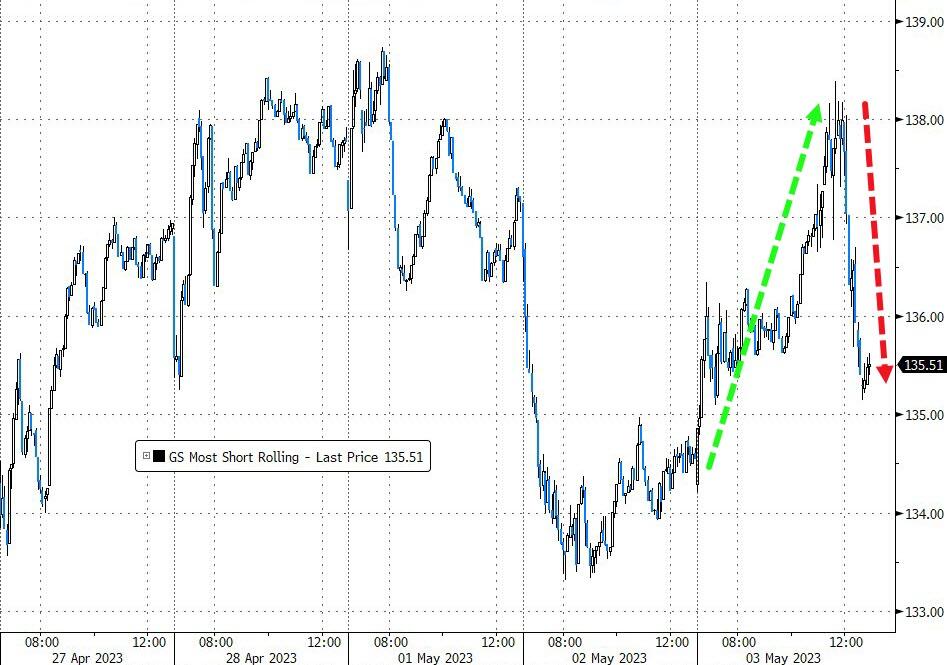
Big reversal in “most shorted” stocks today (which helps explain the early gains in Small Caps)…

Source: Bloomberg

Regional banks puked after Powell said the banking system was sound and resilient…

VIX1D remains notably higher than VIX…

Source: Bloomberg

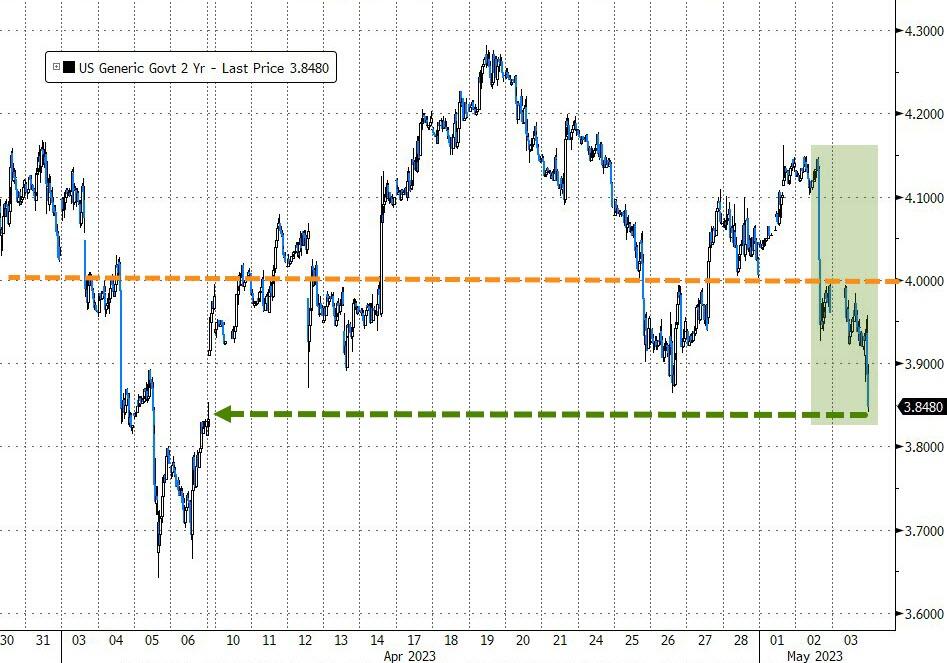
Treasury yields tumbled once again today with the belly of the curve outperforming (5Y -11bps, 30Y -2bps). It’s been quite a week in bonds already…

Source: Bloomberg

The 2Y extended below 4.00%

Source: Bloomberg

The STIRs curve adjusted (small) hawkishly in the shortest end but notably more dovish next year on…

Source: Bloomberg

The Dollar dived on the day to two-week lows…

Source: Bloomberg

Bitcoin chopped around but ended marginally lower…

Source: Bloomberg

Gold rallied on the day (marginally)…

But crude was clubbed like a baby seal with WTI tumbling to a $67 handle intraday, dramatically below the pre-OPEC+ level…

Finally, the market remains dramatically more dovish than The Fed and Powell throughly rejected that view today…

And WTF is Powell talking about claiming that the banking system is sound and resilient and is stabilizing…

2023 bank failures are now larger than 2008 and 2009 combined…

And deposit outflows continue from large and small banks…

Sorry Joe ol’ pal, jawboning’s not gonna out enough lipstick on this pig to fix this shitshow…

It’s on you mate! The market is demanding cuts (and pricing them in) and you just made it worse.

Jeff Gundlach gets the last word: “…markets for risk assets are too complacent.”

Tyler Durden
Wed, 05/03/2023 – 16:01

One And Done-ish?

One And Done-ish?

By Peter Tchir of Academy Securities

One and Done-ish

One and Done seems to have been priced in, and we “kind of” got that, though I’ll call it “Donish”. They will decide what to do in June for the June meeting (seems like what they should do at every meeting). So, we are stuck with divining what data they pay more or less attention to, and waiting for that data to roll in.

Powell seems to downplay the risk of financial conditions tightening as result of ongoing pressure on bank valuations. Negative for risk.

Given where inflation is, and the messaging from today, it seems that for now markets will have to go between pricing in 0 and 25 bps. With WIRP pricing in about a 10% chance of a hike at next meeting (3 pm EST), that seems about right. A tiny negative for risk.

Markets are still pricing in multiple cuts by year-end. I agree that should be the path, but “donish” is far from “dovish” and that is all we got today. Look for a battle between the Fed and markets in the coming days as they try to jawbone away cuts later this year. Maybe that is why he is so adamant that 2% is their target, not some 3% “soft” target.

Quantitative tightening remains in play, as it should, but I continue to believe that QT has more of an impact on risk asset prices, than rate hikes or cuts (at least in the near term). Negative for risk.

My takeaway is that so long as jobs are strong, 2% is their inflation target and they will push on the economy. I’m okay with that so long as we strength in all segments of the job market (I’m concerned about the state of higher income jobs in this economy).

The topics from this week’s Smooth Sailing T-Report, remain relevant.

  • Inventories, the Consumer, Inflation, Not a Short Squeeze, M2, the Fed, Jobs, the Debt Ceiling and China and other Geopolitical Risks.

The biggest change from this weekend, to the negative, is the broad pressure on banks again after the FRC deal.

So far, not seeing inordinate buying pressure in markets and even 0DTE options seem reasonably well behaved.

The bad news for bears (of which I remain one) is Powell did a very solid job on this press conference. No “gotcha” type of moments and “donish” is better than being hawkish, which was a plausible (unlikely, but plausible) stance for the Fed to take.

The good news for bears is that despite all sorts of recent stories about record short positions in stock futures, the market isn’t trading at all like there is a short squeeze, which makes me wonder if there are some very lager long positions (potentially concentrated in a small number of stocks), using the broad market as a hedge. I’m starting to believe that is the positioning, which to me makes me want to start any long positions with the laggards, while avoiding the highest fliers of recent weeks and months.

Tyler Durden
Wed, 05/03/2023 – 15:51

Wall Street Reacts To Powell’s Hawkish Pause

Wall Street Reacts To Powell’s Hawkish Pause

While opinions differed on the margin, the broad consensus is that the Fed just paused its rate hike campaign – pulling a line, literally, from its 2006 FOMC statement when it also was dragged, kicking and screaming, into a Fed pause (before all hell eventually broke loose – after the 10th consecutive rate hike, lifting rates by 25bps to 5.25%.  And while the market now sees the Fed as now done and starting to cut as soon as September…

… here is a smattering of Wall Street hot takes on the topic, most of which are largely in agreement.

Jeff Gundlach, Doubleline:

“I suspect the Fed won’t raise rates again”

Bloomberg Economics’ Chief US Economist Anna Wong

“The Fed has marked 5.25% as the terminal rate in this tightening cycle, raising rates by another 25 basis points at the May FOMC meeting — and, more importantly, signaling in the policy statement that this will be the last hike for a while. “Bloomberg Economics expects the Fed to pause at its June meeting, at which point the labor market will be showing clearer signs of softening. We expect the Fed to hold rates at this peak level through 1Q24 as inflation comes down only very gradually.”

Bloomberg Intelligence Chief Rates Strategist Ira Jersey

“The belly of the yield curve is outperforming given the relatively dovish statement from the FOMC, and that may continue beyond today. The removal of the Fed’s ‘firming’ language is telling. It allows the Fed to hike if needed without pre-committing as they basically have during recent meetings. We think they are likely to pause in June, but that’s not a given.”

Bloomberg Economics’ Stuart Paul:

“In his press conference, Powell noted that the balance between labor supply and demand is coming into better balance, with prime participation increasing and job vacancies declining. However, he was clear that the Fed views the labor market as still very tight.”

* *  *

“In one of the few answers that he didn’t have well-scripted in the presser, Powell was slow to specify just how tight monetary policy would remain if headline inflation stayed around 3% on a year-over-year basis for a prolonged period of time. At 3% inflation, he acknowledged, the employment and price stability mandates would carry equal weight.”

George Goncalves, head of US macro strategy at MUFG,

“The statement chimes with the Fed’s take back in 2006, when it pushed the funds rate to a peak of 5.25%. They never flat-out come out with ‘we are done’ but this was as close as they could have done so in my book. It’s codified in the statement — like 2006.”

Jan Hatzius, Goldman Sachs chief economist

“As we expected, the FOMC balanced the hint toward a June pause with a clear message that it retains a hawkish bias, noting that it would take into account “the cumulative tightening of monetary policy, the lags with which monetary policy affects economic activity and inflation, and economic and financial developments” in “determining the extent to which additional policy firming may be appropriate”.

Ellen Zentner, Morgan Stanley

The May statement held little surprise vs our expectation. The Fed delivered a 25bp hike, setting the range of the federal funds rate at 5.00% to 5.25%, and has moved into a conditional pause… We also expected the Fed to memorialize how long rates would remain elevated and it chose not to. That can be interpreted as more dovish than we expected, particularly when compared to Governor Waller’s recent – more hawkish – warning that policy would remain tight for “longer than markets anticipate”.

Ian Lyngen of BMO:

“Powell will strike a dovish tone and stress the heightened uncertainty as the cumulative tightening works its way through the real economy.”

BE’s Anna Wong:

“It’s notable that Powell openly admits he disagrees with Fed staff’s forecasts. Even though Fed governors and presidents don’t always agree with staff forecasts, staff views are often the benchmark that guide members’ forecasts. For the Fed chair to admit he disagrees with staff forecasts is a vote of no-confidence in their reliability.”

Renaissance Macro:

“At this point, the Fed call is a call on the evolution of the economic data. If we are right, the Fed may well be revising up their growth estimates in the June SEP. Events might allow the Fed to skip that meeting, but ultimately, we expect another hike (or two) this year.”

Viraj Patel, Vanda Research

“Given the amount that Powell is talking about credit tightening… SLOOS clearly tightened quite significantly (from already high levels). Now is a case of how persistent that credit tightening is – and how quickly it feeds through to real economy”

Tyler Durden
Wed, 05/03/2023 – 15:40

FTC Says “Facebook Repeatedly Violated Its Privacy Promises,” Puts “Young Users At Risk”

FTC Says “Facebook Repeatedly Violated Its Privacy Promises,” Puts “Young Users At Risk”

Meta, the parent company of the Facebook platform, has failed to comply with the Federal Trade Commission’s 2020 privacy order that bars the social media company from profiting off data it collects from young users. Shares of Meta slid as much as 2% on the news. 

Facebook has repeatedly violated its privacy promises,” said Samuel Levine, Director of the FTC’s Bureau of Consumer Protection. He said Meta’s “recklessness has put young users at risk, and Facebook needs to answer for its failures.”

As part of the proposed changes, Meta, which changed its name from Facebook in 2021, would be prohibited from profiting from data it collects, including through its virtual reality products, from users under the age of 18. It would also be subject to other expanded limitations, including in its use of facial recognition technology, and required to provide additional protections for users.

Wednesday’s action by the FTC signifies an unwelcome reemergence of controversy for Meta and its platforms, Facebook and Instagram. Following previous FTC investigations into its privacy practices, the company paid a $5 billion civil penalty in 2019. 

This marks the third time the FTC has pursued action against Meta for allegedly failing to protect users’ privacy. The agency explains the timeline of events:

The Commission first filed a complaint against Facebook in 2011, and secured an order in 2012 barring the company from misrepresenting its privacy practices. But according to a subsequent complaint filed by the Commission, Facebook violated the first FTC order within months of it being finalized – engaging in misrepresentations that helped fuel the Cambridge Analytica scandal. In 2019, Facebook agreed to a second order—which took effect in 2020—resolving claims that it violated the FTC’s first order. Today’s action alleges that Facebook has violated the 2020 order, as well as the Children’s Online Privacy Protection Act Rule (COPPA Rule).

Shares of Meta slid 2% on the news but have rebounded since… 

The FTC requested that Meta respond to its proposed findings within 30 days

Meta’s spokesperson responds… 

… and calls FTC’s move a “political stunt.”  

Tyler Durden
Wed, 05/03/2023 – 15:25

Fed Hikes 25bps As Expected, Signals ‘Hawkish Pause’; Warns Of ‘Tighter Credit Standards’

Fed Hikes 25bps As Expected, Signals ‘Hawkish Pause’; Warns Of ‘Tighter Credit Standards’

Tl:dr; Fed raises rates by 25 bps as expected.

Policy statement softens the rate guidance in a way consistent with past pauses and The Fed deletes reference to “some additional policy firming may be appropriate.”

A clear hat-tip to the banking crisis:

“Recent development are likely to result in tighter credit conditions” removed and replaced with “Tighter credit conditions”

The decision was unanimous.

As WSJ Fed Whisperer Nick Timiraos notes: “The FOMC statement used language broadly similar to how officials concluded their interest-rate increases in 2006, with no explicit promise of a pause by retaining a bias to tighten.”

This is clearly more of a hawkish pause since it doesn’t suggest whether ‘policy easing’ may be appropriate…

…but then again, if Powell had gone that far, markets would have panicked over “what does he know”?

What happens next?

*  *  *

Since March 22 (the last FOMC statement, which included the dot-plot and economic projections), markets have been ‘just a little bit turbo’ but amid all that vol, bonds and stocks are modestly higher while the dollar has tumbled and alternative currencies (bitcoin and gold) have outperformed…

Source: Bloomberg

However, The Fed’s preferred recession rate-spread indicator (3-month/18-month forward) is now flashing red implying a 94% probability of a recession within the next year

Interestingly, the market’s expected rate trajectory of The Fed has shifted somewhat hawkishly, mainly due to the plunge in rate-hike odds that occurred on the day of the FOMC meeting…

Source: Bloomberg

Rate-hike expectations have drifted higher since the last FOMC…

Source: Bloomberg

Today’s 25bp hike is a lock from the market’s perspective, but what is really the focus today is any hints that The Fed is done (and the market for now, is convinced they will be with just 5% odds of a 25bp hike in June).

But, the market remains massively dovishly divergent from The Fed‘s dotplot rate expectations for this year and next…

As we noted earlier, a single sentence in the FOMC statement will change everything everything today and all eyes will also be on whether there are any dissents.

  • Federal Open Market Committee raises benchmark rate by 25 basis points, as forecast, to target range of 5%-5.25%

This hike moves Real Rates positive for the first time since 2019…

  • FOMC omits prior language saying “some additional policy firming” may be warranted, suggesting Fed could pause at the next meeting

  • FOMC will take into account various factors “in determining the extent to which additional policy firming may be appropriate”

And the vote was unanimous.

Additionally, The Fed highlights the impact of the banking crisis:

FOMC says tighter credit standards likely to weigh on inflation, economy

QT continues:

The Fed maintains plan to shrink balance sheet each month by as much as $60 billion for Treasuries and $35 billion for mortgage-backed securities.

As WSJ Fed Whisperer Nick Timiraos notes: “The FOMC statement used language broadly similar to how officials concluded their interest-rate increases in 2006, with no explicit promise of a pause by retaining a bias to tighten.”

This is clearly more of a hawkish pause since it doesn’t suggest whether ‘policy easing’ may be appropriate… but then again, if Powell had gone that far, markets would have panicked over “what does he know”?

Finally, read the full red-line below:

Tyler Durden
Wed, 05/03/2023 – 15:20

Divide And Control: Central Bankers Blame The Victims

Divide And Control: Central Bankers Blame The Victims

Authored by Peter St.Onge via Substack,

The Elite playbook: blame the people. So they fight…

The Central bankers of the world, apparently losing confidence that they can fix the inflation they created, are turning to Plan B: blame the people. So we fight each other.

Last week the chief economist of the Bank of England, one Huw Pill, said the quiet part out loud, that “British households and businesses need to accept they are poorer and stop seeking pay increases and pushing prices higher.”

Note inflation in the UK is currently running double-digits, with grocery prices up 19% year-on-year. So not getting a raise may mean cutting a meal.

Meanwhile, a poll from a major British insurer found 57% of small businesses in Britain are at risk of closure from rising prices.

So you plebes need to drop a meal and close your family business so we can keep stealing from you.

Central Bank Divide-and-Control

According to the Guardian, central bankers actually have a name for this scapegoating the masses: “Greedflation.”

As in, double-digit inflation had nothing to do with central bankers printing up trillions and handing it to governments, bankers, and — surely by accident — to the rich at the fastest pace in 50 years.

To the point that, as of last year, one in 4 pounds in existence, and almost one in 3 dollars, had been printed in the previous 3 years.

Naturally, the bankers say: Ah, but that was all sheer coincidence. What’s really happening is the people, for some odd reason, suddenly got greedy. They weren’t greedy before, you see, but now they are and it must stop.

The beauty of the “Greedflation” narrative is not only does it dodge blame for central banks’ institutionalized pillaging, it sets the masses against one another while the elite used central banks to thieve away.

They’re quite open about this: A couple weeks ago the European Central Bank put out a tweet asking “What really drives inflation? Profits or wages?”

Get it, voter? Is it the greedy right-wing capitalists or is it the greedy left-wing unions?

They do this because *if* they can get half the country to blame the other half, the bankers and bureaucrats who actually caused the problem are off the hook. They can get back to siphoning away our life savings and future prospects while we fight.

It’s enough to make you wonder if maybe Americans, or Britons, or Europeans aren’t actually at each others throats. That perhaps we actually agree the system is broken, but our elite does everything they can to set us against one another.

This divide the masses has been going on for a long time, certainly since the founding of the Federal Reserve, indeed since Western governments took on an activist role that converted them from responsible custodians of the common good — fixing potholes, dredging ports, the “night watchman” state — and turned them into existential political footballs in service to the elite to be weaponized against the masses.

They ran this playbook perfectly last financial crisis, setting the right-populist Tea Party and left-populist Occupy Movement away from the bankers who’d just pillaged the country and turned them against each other. They will, no doubt, try again.

And your part in all this? Make do with less, take one for the team, and fight against your neighbor so the elite can go on robbing all of us, and all of our children, blind.

The Mother of All Greed: Government

So what is driving inflation? It’s greed alright: government greed. In the form of trillions printed up to buy votes and bribe voters into accepting authoritarian lockdowns.

Then, when the resulting inflation tore into the people, central bankers around the world responded by hiking rates to crush the private economy. Keeping the way open for historic deficits by clearing out the rest of us.

We lose our jobs so governments can go on spending, buying votes, and rewarding their friends and sponsors.

The solution is easy. In fact, so easy it will never happen: shrink the government. Cut deficits to zero, use the savings to fire the bureaucrats and regulators who are holding down job creation, innovation, and the small businesses that are increasingly an endangered species.

Central banks could accomplish this literally tomorrow. By simply standing up and telling their governments: “No More.” No more central bank financing of trillion-dollar deficits, no more central bank making ends meet by crushing the people.

Of course, there’s no chance in this happening. Not until voters actually demand it, either because they’re angry or because they’re desperate.

One might hope voters do get angry. Before they have nothing left to lose.

Tyler Durden
Wed, 05/03/2023 – 12:40

Oil Plunges To Most Oversold In Two Years Amid CTA Shorting Frenzy

Oil Plunges To Most Oversold In Two Years Amid CTA Shorting Frenzy

One of the most popular mainstream explanations behind the recent plunge in oil, is that the price is dumping on expectations of a US – and global – recession (the slow rebound in China isn’t helping) which will throttle oil demand and has turned investors even more bearish and caused refining margins to slump. There is just one problem with this “explanation”: oil, as a spot commodity, doesn’t trade based on discounting the future, but on supply and demand dynamics in the here and now, and unless one claims that the BEA has manipulated a deeply negative real GDP print into the latest +1.1% print (which translates into 5.1% nominal growth), there is no way that oil is currently seeing such a sharp drop in demand.

Which leaves financial speculation as the other explanation.

In a note from Goldman’s commodities desk today, we read that “crude oil is taking the brunt of the ‘macro’ pain again to start the London session and while people point to the slightly softer ytd fundamentals out of the US / China inventories scanning quite high.” The bank then goes on to note that we that similar to the selloff in the middle of march most of this move is the result of positioning set up. Specifically, the US producer community was quite active following the OPEC ‘surprise’ cut.. and we are moving through producer strike levels in both WTI and Brent. Add to the mix 1) a top trade on the year has been short crude vol.. and 2) CTAs flipped from max short to nearly max long… and the reversal back down has been swift.

And speaking of positioning, the Goldman desk also notes that RSI has been a good indicator of entry points on the previous sell-offs, and “we are getting closer” to where the CTAs get squeeze again: after all, as shown below, the 7-day RSI in oil as now approaching record lows!

Going back to the influence of momentum on the price of oil, here is a note from Marex commodity strategist Ryan Fitzmaurice, who looks at the recent outsized impact of momentum trading on the price of oil. We excerpt from the full note below (available to pro subs in the usual place).

Momentum trading systems are prevalent across almost all liquid futures markets and their price influence can be obvious at times. That certainly is the case with oil futures recently, as is clear from the wild swings in the CFTC market positioning data. As many are aware, the Commitment of Traders report disaggregates positions into four distinct categories: Money Managers, Other Reportables, Producer/Merchant, and Swap Dealers. Many systematic momentum funds are considered money managers, and this is clear when analyzing the trading behavior of this group with respect to price changes. There are also other factors that influence their trading behavior beyond price, such as changes in volatility and correlations, but in general, money managers buy when prices are going up and sell when prices are going down in classic momentum chasing fashion.

This can work well when markets are trending strongly, but oil markets have been quite choppy lately. As a result, many momentum systems have gotten whipsawed by the volatile price action. In March, the US regional banking troubles sent oil prices tumbling and with that many systematic funds got “short” on bearish momentum signals. In fact, the combined gross “short” held by money managers for ICE Brent and Nymex WTI rose by 96k contracts during the first three weeks of March. Then came the OPEC+ surprise cut which sent oil prices gapping higher, triggering “short” covering with the gross “short” dropping by -126k contracts in the three weeks following the news. This aggressive buying and selling in such a short period of time has undoubtedly exacerbated the oil price action recently, a dynamic we expect to continue this year.

Thinking Ahead

As noted, we expect momentum funds to continue to exert influence on oil prices this year. In fact, oil prices weakened right after the buying from managed money “short” covering faded. Importantly, oil momentum signals are now bearish again on most key timeframes, and already we are seeing some fresh “shorts” being added back by this influential group. On Tuesday, oil prices fell sharply in what felt like aggressive systematic selling. In addition to that, US regional bank failures, debt ceiling concerns and recession fears continue to weigh on oil prices, while a weak April Chinese PMI print has also hurt sentiment despite record crude processing in March. Interestingly, these newly established “shorts” come just ahead of Wednesday’s key FOMC rate decision.

The market is currently pricing in a +25bp hike, which would take the upper bound to 5.25%. If market expectations are met, this would leave the Fed Funds rate at the highest level since 2007, just before the global financial crisis. More importantly, this would put the Fed Funds rate above the latest US CPI print which showed y/y consumer inflation of 5% in March and with current expectations for that level to hold in April. That would take real interest rates into positive territory for the first time since 2019. In theory, that should take some pressure off the Fed in the near term, potentially allowing for a pause to assess the economic impact of the fastest hiking cycle in decades. As for oil prices, a Fed pause could shift the focus away from the macro concerns and towards more traditional supply and demand factors

If the US Fed hikes interest rates by +25bp as expected on Wednesday, real rates would be in positive territory for the first time since 2019…

More in the full note available to pro subs in the usual place.

Tyler Durden
Wed, 05/03/2023 – 12:19