Bonds & Bullion Burst Higher, Banks Battered As JOLTs Plunge Ahead Of Jay Powell
A surprise RBA rate-hike, hotter than expected headline EU inflation, weak JOLTS, poor US factory orders, a sudden realization of the urgency and seriousness of the debt ceiling debacle, Europe back from vacation, and/or just pre-FOMC jitters?
…or was it this?
As a reminder, the Fed NOW has next week’s dire SLOOS report in hand
Bank stocks were a bloodbath as the world and his pet rabbit realized JPM hadn’t saved the universe. Regionals were smashed lower as whack-a-mole resumes…
Source: Bloomberg
And even the big boys suffered…
Source: Bloomberg
Overall, all the majors were lower today with Small Caps hardest hit…
‘Most Shorted’ Stocks puked hard…
Source: Bloomberg
0-DTE fought hard against the initial down-thrust in stocks from the cash-open. Stocks stalled around 4100 then rebounded and then around 1400ET, 0-DTE call-buyers took profits…
VIX1D soared today, breaking back above VIX for the first time since April 11th (ahead of CPI) and April 6th (ahead of payrolls)…
Source: Bloomberg
And as we noted earlier, equity markets remain somewhat more sanguine about the debt ceiling threat that other markets
Source: Bloomberg
And then there was Chegg, down 50%… AI’s first victim…
Source: Bloomberg
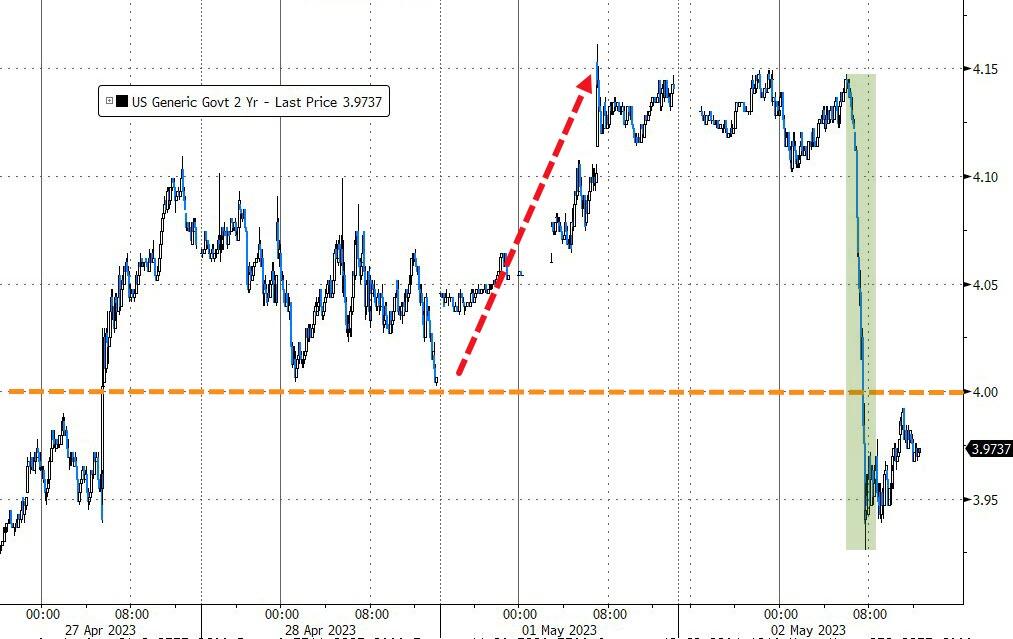
Treasuries were aggressively bid as Europe’s liquidity returned and the heavy corporate calendar eased up. The long-end underperformed but the entire curve plunged (30Y -10bps, 5Y -18bps, 2Y -16bps)…
Source: Bloomberg
2Y Yields fell back below 4.00%…
Source: Bloomberg
Rate-hike odds plunged today ahead of tomorrow’s FOMC statement. The market adjusted down to an 85% chance of a 25bps hike tomorrow…
Source: Bloomberg
…but most notably, June went from a 35% chance of 25bps hike to a 15% chance of a 25bps rate-cut today…
Source: Bloomberg
The dollar dipped lower on the day, erasing European session gains…
Source: Bloomberg
Bitcoin bounced off $28,000…
Source: Bloomberg
Gold surged back above $2000, with futs at 3-week highs…
Oil plunged with WTI back to a $71 handle – well below the pre-OPEC+ lows – suffering its biggest drop since Jan 4th…
Finally, circling back to the beginning, how do you think the global economy is going to cope with the massive tightening of lending standards…
Source: Bloomberg
Especially when inflation remains far stickier than anyone expected it would be by this time in the tightening cycle.
Why The Long-Awaited Ukrainian Counteroffensive Is Delayed
The much-touted and anticipated spring counteroffensive by the Ukrainian army is still on hold, and according to both Ukraine military and Western officials, it’s all due to mud. And yet, the White House has still offered an upbeat assessment of how Ukraine is fairing militarily. US National Security Council spokesman John Kirby only yesterday declared of Russia’s offensives against key holdout towns in Donetsk and Luhansk, “Most of these efforts have stalled and failed.” He asserted that “Russia has been unable to seize any real strategically significant territory.”
So Kirby paints a picture of a teetering Russian army, and still there’s no counteroffensive on the horizon. “But for the moment, they are barely moving forward, stalled not by ferocious Russian attacks, but by an enemy no less tenacious: the viscous central Ukrainian mud,” The New York Times wrote Monday. A Ukrainian officer interviewed by the Times acknowledged that “Until the weather improves, there will be no counteroffensive.” This is because: “the vehicles will get stuck and then what will we do if the shooting starts?”
The report further describes why Ukraine is holding off in saying, “Deep and black, with a consistency similar to a mixture of cookie dough and wet cement, the spring mud is one obstacle that the Ukrainian military, for all its ingenuity, finds difficult to overcome.” Further “It jams weapons and steals the boots from soldiers’ feet. Wheels and treads spin and spin, only digging military vehicles deeper into the mire.”
Echoing the same, Kiev’s ambassador to the UK, Vadim Pristayko, told Sky News on Tuesday, “Obviously, the weather is not allowing so far the heavy tanks to move in the Ukrainian usual spring mud.” Ukraine’s Defense Minister Aleksey Reznikov has also recently stated the weather has played a key role in determining the timing of a counteroffensive. Also, Russia has lately ramped up its strikes across the country. Is it really just mud and less than ideal weather stalling the counteroffensive? Or is there something more?
The month of May has arrived but without the long-awaited Ukrainian “counteroffensive”. The western media is speculating that it may come by late May. There is also the spin that Kiev is judicious to “buy time.” The chances of Ukraine making some sort of “breakthrough” in the 950-km long Russian frontline cannot be ruled out but a Russian counteroffensive is all but certain to follow. An open-ended war will not suit Western powers.
Last week, NATO’s top commander, US Army General Christopher Cavoli stated that the Russian army operating in Ukraine is larger than when the Kremlin launched its special military operation and the Ukrainians “have to be better than the Russian force they will face” and decide when and where they will strike.
Cavoli said Russia has strategic depth in manpower and has only lost one warship and about 80 fighters and tactical bombers in an air fleet numbering about 1,000 so far. The general gently contradicted Defence Secretary Lloyd Austin and Chief of General Staff Gen. Mark Milley who have been propagating that Russia is on the brink of defeat.
Speaking at the House panel on Wednesday, Gen. Cavoli said, “This war is far from over.” On Thursday, he went further to tell the Senate, “I think [the Russians] can fight another year.” At the House hearing, Cavoli also said Russian submarine activity has only picked up in the North Atlantic since the beginning of the war and none of the Kremlin’s strategic nuclear forces have been affected by operations in Ukraine.
He said at one point in his written testimony, “Russian air, maritime, space, cyber, and strategic forces have not suffered significant degradation in the current war. Moreover, Russia will likely rebuild its future Army into a sizeable and more capable land force… Russia retains a vast stockpile of deployed and non-deployed nuclear weapons, which present an existential threat to the US.”
Clearly, the entire narrative of lies and obfuscation created by the neocons in the Biden Administration through the past year has unraveled. The balance sheet shows there is nothing to justify the massive amount of aid to Ukraine through the past one-year period — in excess of $100 billion dollars, which is pro rata vastly more than what the US had spent in the twenty years of war in Afghanistan.
Gen. Cavoli’s testimony came soon after the leaked Pentagon documents recently, which has presented a grim picture of the state of Kiev’s military preparedness and the Biden Administration’s lack of confidence in the Zelensky regime.
Endless war…I guess not.
‼️🇺🇦🏴☠️ Ukraine may need another counteroffensive, and getting the F-16 will depend on the results of the first one, – Foreign Minister Kuleba
▪️”The decisive battle will be the one that will lead to the complete liberation of Ukrainian territories”… pic.twitter.com/Whchn8c9v7
The Pentagon documents echoed, in effect, a January study titled Avoiding a Long War by the RAND Corporation, which recommended that “the paramount US interest in minimizing escalation risks should increase the US interest in avoiding a long war (in Ukraine). In short, the consequences of a long war — ranging from persistent elevated risks to economic damage — far outweigh the possible benefits.”
Indeed, it appears that there is a significant stream of dissenting opinion within the US security and defence establishment, which estimates that President Biden has taken the US on a disastrous policy trajectory that is fated to have a calamitous outcome — a humiliating defeat in Ukraine that may damage the NATO alliance, weaken the transatlantic system and erode the US’ credibility as a global power.
Well-informed veterans of the US intelligence community regard the leaking of Pentagon documents itself as a mini-mutiny. The former CIA analyst Ray McGovern told China’s CGTN, “I believe it could be that some senior policymakers in the Pentagon at the highest reaches of the Department of Defense have decided, ‘You know, it’s a fool’s errand in Ukraine. Maybe, we got to get out the truth. Maybe, we got to expose people like Joint Chief of Staff Milley and Secretary Austin for the lies they have told about Ukrainian progress and Russians being just pulverised. And, maybe, that will stop this widening of the war.’ ”
The well-known former CIA analyst Larry Johnson shares the same view. He wrote: “This looks like a controlled, directed leak… the leaked material is not random intelligence material. It is designed to tell several stories. The most prominent is the deterioration of Ukrainian capabilities and the major obstacles confronting the United States and the rest of NATO in supplying badly needed air defence, artillery shells, artillery pieces and tanks. In other words, Ukraine is going to crash and burn.”
Johnson added, “Let me suggest one possibility for this leak — create a predicate for forcing Joe Biden from office. The revelations in the classified documents are not fabrications designed to deceive the Russians. Nor are they the kind of material to rally more US support for pouring more resources into the black hole of Ukraine. These leaks feed the meme that the Biden team is incompetent and endangering American interests overseas.”
Make no mistake, such coup attempts by the Deep State are nothing new in US presidential history — Eisenhower was undercut when he sought détente the Soviet Union; a whole corpus of materials available today suggests that CIA framed Nixon in the Watergate affair. Today, all this is happening against the backdrop of President Biden seeking a second term in the 2024 election.
As for Zelensky himself, he is acutely conscious that success or failure of his “counteroffensive” will be critical for continued western support. All things taken into account, a messy diplomatic scenario is looming ahead, one that would also open up divisions between western countries, and in which China could play a more important role.
There is no guarantee that public support for Biden’s proxy war would hold through the 2024 election. Suffice to say, it is increasingly doubtful whether Biden will sacrifice his presidency over the Ukraine war. These are of course early days. A large ship needs a big arc for turnaround.
The Russians are taking their decisions on the basis of own assessments. There has been a perceptible scaling up of Russian strikes against Ukrainian military facilities. Massive strikes deep into Ukrainian military’s rear areas have been reported.
An attack on Sunday on railroad infrastructure and depots for ammunition and fuel in Pavlograd, a major communication hub near Ukraine’s fourth-largest city of Dnepropetrovsk, was particularly devastating. The Ukrainian troops had been accumulating in Pavlograd for an offensive toward Zaporozhye. Two S-300 missile divisions were destroyed.
In the weekend, former president Dmitry Medvedev wrote in Telegram channel that Russia should seek “mass destruction” of Ukrainian personnel and military equipment”; deal a “maximum military defeat” on the Armed Forces of Ukraine; strive for “the complete defeat of the enemy and the final overthrow of the Nazi regime in Kiev with the complete demilitarization of the entire territory of the former Ukraine”; and press ahead with reprisals against key figures of the Zelensky government, regardless of their location, and without limits.”
Medvedev added, “Otherwise, they will not calm down… and the war will drag on for a long time. Our country doesn’t need that.” The mood has turned ugly and the conflict is set to take a vicious turn, as diplomacy has run aground completely.
Towards the end of a financial bubble, the people who benefit from the bubble’s continuation — politicians hoping to be reelected, bankers hoping to complete the next deal, money managers talking their books — start touting “record household net worth” as a sign of societal health.
But they’re wrong, for the following reasons:
Deceptive leverage.
Pretend that you borrow $1 million to buy some JPMorgan Chase shares and that this transaction pushes the value of the stock higher. Without realizing it, you’ve just raised the net worth of millions of other JPMorgan Chase stockholders. Total household net worth — that is, assets minus liabilities —increases by vastly more than the money you borrowed. Society gets “richer” and the economy gets more robust and “safer” because of its growing net worth cushion.
So far so good. But since leverage works both ways, as soon as you turn around and sell your stock, thus pushing down the price, that incremental net worth vanishes, because it never really existed.
False comparison.
Most adults understand that their stocks, bonds, and houses fluctuate in price, rising in good times and falling in bad, while their mortgages, credit card debts, and auto loans only fall as they’re paid off. Which is to say instead of falling, these obligations mostly just rise as new debts are incurred and old debts are rolled over. A statistic derived by combining things that can evaporate (asset prices) and things that generally can’t (debt balances) does not measure what they say it does.
The takeaway: In a society of borrowers and speculators, asset values increase because of borrowing and speculation, which makes rising household net worth both a negative indicator of future growth and a sign of fragility rather than strength. But until people figure this out, it remains a great tool for convincing consumers that everything is fine when it’s actually not.
The following chart (courtesy of European money manager Gavekal Research) shows household net worth peaking just before the onset of recessions and/or brutal bear markets.
Notice how as the economy becomes more and more addicted to leverage, the volatility around the trend line increases, indicating that the next downturn — which we’ve already entered — will lop around 40% from household net worth via plunging asset prices.
And that’s assuming that the trendline itself is a real thing.
If the credit supercycle that began in the 1970s is now ending, we’re facing a generational, not a cyclical, mean reversion in which the other edge of the leverage sword cuts financial assets even more deeply.
Here’s how CNBC covered the subject last year, noting the increase in debt without exploring the link between debt and net worth:
Household wealth tops $150 trillion for the first time despite surge in debt
Americans got considerably richer as 2021 came to a close, thanks to a nice boost from their stock market holdings and an increase in real estate values, the Federal Reserve reported Thursday.
Household net worth in the fourth quarter eclipsed $150 trillion for the first time, rising at a healthy 8.2% pace from the previous quarter for the fastest growth period since the first quarter of 2020. The increase came thanks to a combined $4 trillion rise in holdings from corporate equities and housing.
The total level — $150.29 trillion, to be exact — represented a 14.4% increase from a year ago. The boost came with U.S. economic growth running at its fastest pace since 1984 and the stock market enjoying another robust year.
The move came despite a rapid increase in debt at all levels.
Total nonfinancial debt came to $65.1 trillion, including $17.9 trillion at the household level, $18.5 trillion in the business world and $28.6 trillion from government. Each category saw substantial rises.
Household debt jumped at an 8% annual rate, owing to a 6.9% rise in consumer credit and an 8% surge in mortgages. Nonfinancial business debt increased at a 6.7% clip, while federal government debt leaped by 10.8% after declining 1.3% in the third quarter.
The key sentence: “The move came despite a rapid increase in debt at all levels.”
The CNBC writer is apparently bemused that net worth would rise along with debt as if the two are unrelated, when if fact rising debt is the source of rising net worth.
Americans did not get “considerably richer in 2021.” They got considerably more leveraged and fragile, and one step closer to the mother of all mean reversions.
On May 1, new Federal Housing Finance Agency (FHFA) rules went into effect that will allow borrowers with lower credit ratings to qualify for better mortgage rates than they otherwise would have. Meanwhile, borrowers with better credit ratings will pay higher fees to subsidize the program. Peter Schiff recently appeared on Real America with Dan Ball to talk about the new rules.
Experts say a person with a credit score over 680 could pay an extra $40 to $70 per month.
When the news came out, Peter Schiff tweeted, “Just when you thought the Joe Biden administration couldn’t get any dumber, it does this. It’s a perfect example of why government shouldn’t have any involvement in the housing market and why the FHA, Fannie Mae and Freddie Mack should all be abolished.”
Dan said he’s about ready to buy a home and he’ll be punished if this plan goes through. Peter told Dan he didn’t have to get punished.
Just miss a few payments. Screw up your credit score. That will help your mortgage rate.”
Peter also noted that the plan will encourage homebuyers to make smaller down payments.
Normally, if you make a big downpayment, you get a better rate. But now, Biden wants the better rates to go to people that don’t make a big down payment. The worst part about this is that it’s going to further undermine the solvency of our banking system because banks are going to be encouraged and actually required to make more loans to riskier borrowers, which means more mortgages are going to end up in default.”
As Dan pointed out, this isn’t unlike the policies that helped blow up the subprime mortgage bubble leading up to the 2008 financial crisis.
During the Clinton and GW Bush administration, the government was pressuring banks to make loans to marginalized communities. But as Peter pointed out, banks are supposed to be colorblind.
They’re making loans based on the ability to repay. If somebody can repay the mortgage, they’re going to make it. So, if they’re denying mortgages, it’s not because they’re racist or sexist or homophobic or whatever. They’re denying the mortgage because the borrower probably can’t pay the money back.”
Peter said programs like this are really doing a disservice.
When the government encourages people who can’t afford houses to buy them anyway, they actually end up in over their heads, and they lose money because houses are very expensive. Take it from me; I own several. And you know, they’re money pits. You need money to afford to own a home. You can’t own a home when you’re broke.”
Looking at the broader Biden economy, Peter called it “a disaster” and said you can fit all of Biden’s economic accomplishments “on a chewing gum wrapper.”
In fact, you probably don’t even need all that paper, because I don’t even think he has any accomplishments to list. He’s just stumbled his way through the first couple of years in the White House and the economy is getting worse. Inflation is getting worse. All he’s done is worsen the problems that he inherited — not like everything was great when he stepped into office. But he’s made it worse.”
Tesla Bumps Prices Of Model 3 And Model Y Higher In U.S. And China
The ebb and flow of Tesla vehicle prices continued this week, with the automaker raising the prices of its main models – the Model 3 and the Model Y – for the second time since the company’s earnings report.
Bloomberg reported Tuesday morning that Tesla’s main models are marked up $250 each, stating that the model prices are being raised both in the United States and China. The Model 3 is now priced at $40,240 in the US and 231,900 yuan in China, while the Model Y is now priced at $47,240 in the US and 263,900 yuan in China.
The hikes are small compared to the cuts the company has put in place since the beginning of the year. We had just noted days ago that, due to aggressive price cuts, the Model Y was cheaper than the average new vehicle in the U.S. by $759. That’ll likely still be the case, despite the $250 hike.
Tesla is continuing what seems to be a completely schizophrenic pricing strategy, with reports out two weeks ago that the automaker had raised the price of its Model X and Model S vehicles just hours after missing margin estimates on its earnings report.
The Model S Plaid and Model X Plaid now cost $107,490 from $104,990 earlier, Reuters reported last month. They also said the regular Model X is at $97,940, which marks about a 2.6% rise, and the Model S is at $87,490, marking a rise of about 2.9%.
Recall, the EV maker plunged last month after reporting earnings that disappointed Wall Street. Among the topics of discussions were the company’s poor margins, occurring as a result of Tesla slashing prices consistently since the beginning of 2023. Total GAAP margin for the quarter was 19.3%, missing estimates of 21.2% and down 977 bps from 29.1% just one year ago.
Tesla closed its first quarter with record deliveries hitting over 423,000 units worldwide, but that’s still less than what the automaker produced. Tesla has used price cuts throughout the quarter, aiming to reach more of the mass market, and as Bloomberg calculated last week, the latest price cut makes the Tesla Model Y nearly a third cheaper than it was at the start of the year, in part due to the introduction of a new lowest level trim.
The most recent cuts to Model X and Model S prices came on March 6, a little more than a month ago, when the company reduced the starting prices for the S and X in the US by 5.3% and 9.1%, respectively, to $89,990 and $99,990. Additionally, the higher-performance Plaid version of the Model S and X had been lowered by 4.3% and 8.3%.
Just hours before it reported earnings, the company made its sixth price cuts of the year. Model Y prices were cut by $3,000 and the base Model 3 was cut by 4.7% to less than $40,000 at the time. It was literally only days prior that we wrote about a fifth set of price cuts Tesla had put into place this year.
Why Market Says Fed’s Higher-For-Longer Is Fantasy
Authored by Simon White, Bloomberg macro strategist,
The Federal Reserve will be unable to keep rates at their peak for long, according to the clear message coming from the front part of the yield curve. Nonetheless, the end of Fed tightening cycles tend to be positive for both stocks and bonds, with stocks outperforming.
This week the Fed is likely to raise rates to their highest level, 5.25%, in more than 15 years. This is a significant milestone as it is the highest cycle-peak in rates the Fed has been able to maintain for the longest time – 14 months in 2006-2007. The burning question is: will it be able to repeat this feat, or even come close to it?
The market’s answer is a resounding no. But before we see why, note that the 2006-2007 period was very much the exception, not the rule. The Fed is rarely able to keep rates at their peak for long, looking at tightening cycles going back to 1972. In the cycles after 1990, though, the average period on hold is longer — about four to five months — than cycles pre-1990, when it averaged less than a month.
But we are not in that post-1990 world any more.
These were the NICE (non-inflationary continuous expansion) decades of long and smooth business cycles and less frequent recessions which allowed the Fed to keep rates at a higher level for a longer period.
The yield curve is making it plain we won’t see that this time. The three-month versus two-year segment is signaling the regime has changed. The chart below shows that this curve hits a low as the Fed rate is peaking, but the more negative it becomes – as we saw in the 1970s and early 1980s – the less time the Fed is able to hold rates at their peak.
In the post-1990 tightening cycles, when the Fed was able to keep rates higher for longer, the curve never became as negative, i.e. the pressure from the market for cuts was not as intense. But today the curve is as inverted as it has been since the inflation of 50 years ago, at a time where the Fed was unable to keep rates at their cycle highs for more than two months.
The depth of the yield curve inversion is one reason why the market always ends up forcing the Fed’s hand. Take the 2s10s yield curve. It’s also heavily inverted along with the three-month versus two-year curve.
The 10-year yield can be seen as a proxy for demand and supply of credit and therefore for the underlying health of the economy. As the economy slows from higher interest rates, longer-term yields fall as demand for credit declines, and the curve flattens and inverts. Credit availability also falls as especially smaller banks’ margins are squeezed.
The cumulative impact from a persistently and deeply inverted yield curve mounts through time, until something goes awry and the Fed feels it has no choice but to cut rates.
Secondly, the more inverted the yield curve, the less effective rate hikes become. The curve is the Fed’s transmission mechanism from its base in Washington to the rest of the economy. Raising rates when the curve is heavily inverted is like using rubber to conduct electricity – by the time the rate hike travels down the wire to the real economy, its inflation-combating effect is much diminished. This changes the Fed’s risk-reward calculus in deciding when to cut.
The end of Fed tightening cycles is often unequivocally good for financial assets. Both stocks and bonds typically rally after the last Fed hike, with bonds outperforming stocks.
This is the case even if we only look at tightening cycles before 1990, i.e. those including the high-inflation periods in the 70s and 80s. But in post-1990 cycles, stocks outperformed bonds.
Either way the historical picture is clear that over the last five decades both stocks and bonds rallied after the last Fed hike.
(The Fed may of course hike again after this week’s anticipated rate rise, but it is clear we are much closer to the end than the start of this hiking cycle).
The positive backdrop for financial assets comes when speculators, according to COT data, have a near-record net short in financial assets. Thus if stocks are not derailed in the short term by falling reserve growth or the debt ceiling, their outlook over the next three to six months is constructive.
If the Fed defies the historical odds and keeps rates at peak for an extended period, financial assets might suffer. But the three-month versus two-year curve inversion is telling us the market’s inflation “mindset” is different from the Fed’s. While inflation is likely to remain sticky, it’s unlikely to accelerate enough in the near term for the market to see what the Fed seems to fear.
While that’s the case, it’s more likely something goes wrong and the Fed capitulates. And if past is a prologue then that will happen sooner rather than later.
House Speaker Kevin McCarthy (R-CA) offered strong support to Israeli Prime Minister Benjamin Netanyahu during a visit to Israel, saying he’ll invite the Israeli leader to address Congress if President Biden doesn’t invite him to the White House.
McCarthy told the newspaper Israel Hayom when he arrived in Israel on Sunday that Biden has waited “too long now” to invite Netanyahu to Washington. “If it doesn’t happen, I’ll invite the prime minister to come meet with the House. He’s a dear friend, as a prime minister of a country that we have our closest ties with,” he said.
In March, President Biden saidhe would not invite Netanyahu in the “near term” and criticized the Israeli leader’s judicial overhaul plans, which would give the Knesset the power to override Israel’s top court with a simple majority. Netanyahu’s plans are currently on pause as he faced major opposition to the policy.
Besides the mild criticism of the judicial overhaul, Biden has not signaled he will make any changes to the US-Israeli relationship and has repeatedly reaffirmed his support for the country.
On Monday, McCarthy delivered a speech to Israel’s Knesset and reaffirmed that there is strong bipartisan support for Israel in Congress. “I choose to come here today to celebrate the bond between our two countries and to reaffirm the bipartisan support for Israel in Congress,” he said.
Reflecting the bipartisan support for Israel, the top Democrat in the House, Minority Leader Hakeem Jeffries (D-NY), just led a delegation to the country to show support. In comments to Jewish Insider, Jeffries dismissed the notion that the US could leverage aid to Israel due to the judicial overhaul or other policies, calling the idea a “nonstarter.”
Rep. Josh Gottheimer (D-NJ), who joined Jeffries in Israel, said the delegation emphasized that “regardless of any issues in Israel, the relationship transcends [domestic Israeli politics] and remains special and ironclad.”
The congressional visits to Israel come amid a spike in violence against Palestinians as Netanyahu’s government has stepped up raids in the West Bank. The governing coalition includes extremist settlers who want to significantly expand settlements with the ultimate goal of annexing the West Bank. The plans have not impacted US support for Israel.
Having reached the debt-limit three months ago, the real vinegar strokes (don’t Google it) of this political polava is just getting started as TSY Sec. Yellen launched a fearmongering missive to Congress yesterday warning that Treasury will exhaust its resources under the debt limit “by early June, and potentially as early as June 1”.
‘Be afraid, very afraid’ was the message as the House and Senate are in session for only two weeks before early June and so negotiations need to start now!
The market bought the fear with the Treasury Bill curve ‘kink’ going all the way to ’11’ after Yellen’s note…
And USA sovereign risk soaring to yet another new record high (rather dramatically higher than the prior debt-ceiling debacle periods)…
However, implied equity volatility shows little debt limit effect…
This may change once the Treasury announces a specific deadline for Congress to raise the debt limit.
However, Goldman believes that while there is a good chance that the Treasury’s cash balance will dip as low as $25-30bn for a few days in June (in the past, the debt limit deadline Treasury has given to Congress has assumed a minimum cash balance around this level), Hatzius and his pals expect Treasury to be able to pay obligations until late July…
More recently, the cash balance has rebounded sharply following the mid-April tax deadline. The large amount of April receipts and their year-to-year volatility can swing the overall deficit more than other parts of the budget. And without any meaningful trend to examine in the weeks prior to the tax deadline, there is a greater potential for surprise.
This year, we had expected April tax filing-related receipts to be down 28%, which we thought would put the deadline in early August. Over the last few weeks, April cumulative non-withheld receipts fluctuated between roughly 30% and 40% under last year’s level. Seeing this weakness, we revised our projected deadline to late July and highlighted that an early June deadline looked nearly as likely as late July. Last week, we became more confident of a July deadline when month-to-date non-withheld receipts rebounded to a decline of only 30% from last year. However, collections since then have started to lag more substantially once again.
But, the bottom-line is – blame California…
A separate issue that is harder to quantify is the impact of the delayed tax payments for most California residents. In February the IRS delayed the deadline to file and pay remaining 2022 tax liabilities from April 18 to October 16 for residents of areas affected by weather-related disasters, which includes most of California; tax payments due June 15 and September 15 are also delayed until October.
The effect is evident in daily California state tax receipts.
Even with lower taxes, the cash balance building up—along with some “extraordinary measures”—should be just enough to allow the Treasury to meet all of its obligations until early June.
At that point—late in the week of June 5, we think—the Treasury looks likely to come close to exhausting its resources, with only $25-30bn of headroom left.
By June 13, another round of non-withheld receipts should arrive ahead of the June 15 quarterly tax deadline.
If the Treasury has not run out of cash by then, these taxes should be sufficient to finance obligations until June 30, at which point the Treasury expects to get another $145bn in headroom from a set of one-time “extraordinary measures”.
The Treasury is likely to use up that additional room under the limit by late July, we think.
Goldman’s Hatzius warns that Yellen’s potentially overly-conservative projection has downsides.
Ahead of every debt limit deadline, there are some lawmakers skeptical of the deadline that the Treasury projects, presumably because they believe the estimates are overly cautious.
A June deadline might run the risk of reinforcing this perception since, as described above, there are likely only to be a few days in June where the Treasury appears to run a high risk of running short of funds.
Normally, this would not be as important a consideration since Congress would raise the limit by the announced deadline and it would never become clear whether the projected deadline was accurate or not. However, while not our base case, there is clearly a higher than usual risk that Congress fails to raise the debt limit by the projected deadline.
The risk in this scenario would be that, even if the Treasury misses a few days of scheduled payments, the cash balance would likely begin to grow just before the June 15 tax deadline and the Treasury would get more headroom June 30, as described earlier.
The risk this poses is that some lawmakers might doubt the next deadline that Treasury announced (in that scenario, probably mid/late July) since the prior deadline would appear to have taken care of itself without Congressional intervention. But missing the next deadline in July would have far more severe negative consequences. At that point, the Treasury would run a deeper deficit for a much longer period (the next round of tax payments would not be until September 15).
Finally, we note that amid all the gamesmanship in Washington over who will get the ‘blame’ should we shut down the government or actually technically default, Goldman found that historically, Republican net favorability has declined somewhat following prior debt-limit debacles…
However, it seems likely that neither party will want to take this political risk this time.
So, Goldman still believes that while it is hard to completely rule out worst-case scenarios, a prolonged stalemate seems very unlikely.
Global Bank Lending Standards Tighten To GFC Levels
Authored by Simon White, Bloomberg macro strategist,
A composite measure of DM banks’ lending standards shows they are the tightest since 2009. Tighter credit conditions will be an impediment to central banks’ preference to keep rates “higher for longer.”
The ECB’s bank lending survey was released this morning, with banks further tightening their credit standards.
This has pushed an aggregate measure of bank-loan credit standards to levels not seen since the Lehman crisis.
This has been driven primarily by US and European banks; loan standards for Japan and UK banks are close to unchanged over the last year.
For Europe, the data released today showed a further rise in tighter credit standards for loans. Typically when banks make it harder to take loans out, this leads to lower demand for them. In turn, lower demand for loans is consistent with less supply.
This should keep pressure on money growth in Europe, but it is important to focus on the correct type of money. M3 was also released today, and showed a slowdown, but M3 is counter-cyclical. M1 is a more reliable leading indicator of economic activity and risk-asset performance.
Real M1 has fallen sharply over the past months, and the expected decline in bank loans will keep the pressure on real M1 even as inflation moderates. This points to weaker growth in Europe through the rest of the year.
Some have posited that M1’s significance is diminished as a rising-rate environment means more borrowers are terming out overnight deposits. But this is nothing new. M1 is a better measure because it is driven by demand deposits, i.e. money that is available to spend. It is therefore a pro-cyclical measure of future activity. If people are terming out deposits this is not a sign of confidence in the economy.
Credit tightening and weakening economic growth in Europe and the US will soon bring the pipe dream of “higher-for-longer” into contact with reality, with one part of the yield curve already making this plain.
Chegg Shares Crash As CEO Admits Threat From OpenAI’s ChatGPT
Chegg shares crashed in premarket trading on Tuesday as executives acknowledged that OpenAI’s ChatGPT was threatening the growth of its homework-help services. This marks one of the first notable market reactions to AI chatbots upending an industry.
On Monday, California-based Chegg reported a 7% year-over-year decline to $187.6 million in the first quarter. It saw a 5% drop in the number of subscribers to 5.1 million. Most of its revenue streams come from homework-help subscriptions, which start at $15.95 per month.
“In the first part of the year, we saw no noticeable impact from ChatGPT on our new account growth and we were meeting expectations on new sign-ups,” Chief Executive Officer Dan Rosensweig said in prepared remarks during the company’s first-quarter earnings Monday.
“However, since March we saw a significant spike in student interest in ChatGPT. We now believe it’s having an impact on our new customer growth rate,” Rosensweig said.
Chegg withdrew its full-year guidance because of the surge in the popularity of ChatGPT. Shares tumbled as much as 43% in premarket trading. If premarket losses hold, this will be the most significant decline since Nov. 2, 2021.
Wall Street analysts currently have three buys, 12 holds, and one sell. Bloomberg data shows the average price target is around $17.82.
Here’s what analysts are saying about ChatGPT threatening Chegg’s business model (list courtesy of Bloomberg):
Jefferies (cut to hold from buy, PT to $11 from $25)
AI headwinds are starting to impact Chegg’s “fundamental story”
“While retention rates of CHGG’s existing customers remain strong now, we fear that student usage of AI tools like ChatGPT could cause a viral sensation around campus, which could increase churn in the coming quarters”
PT set to $11, implies a 38% decrease from last price
Morgan Stanley (equal-weight, PT cut to $12 from $18)
Chegg’s solid 1Q results “completely overshadowed by threat and impacts from generative AI”
“Expect substitute AI tools to capture ~20% of Chegg’s subscriber base”
KeyBanc (sector weight)
Chegg admitted to seeing incremental headwinds from ChatGPT, the warning offset the company’s “alright 1Q results”
These new headwinds led Chegg to lower 2Q guidance
Piper Sandler (Neutral, PT cut to $11 from $17)
The company needs to “make significant changes in a rapidly changing environment”
“Commend management for recognizing the tectonic shift and their desire to make changes across their business model and operations”
This news had a ripple effect on education stocks, with London-based Pearson experiencing a decline of over 8%.
The challenge posed by AI chatbots extends beyond Chegg and other educational companies, affecting industries across the entire economy. To remain competitive, companies must embrace AI integration, which will lead to substantial job loss due to the automation of various tasks. Recall what IBM said yesterday…