74.2 F
Chicago
Friday, August 14, 2026
Home Blog Page 3724

America’s Empire Is Bankrupt

America’s Empire Is Bankrupt

Authored by John Michael Greer via UnHerd.com, (emphasis ours)

The dollar is finally being dethroned…

Let’s start with the basics. Roughly 5% of the human race currently live in the United States of America. That very small fraction of humanity, until quite recently, enjoyed about a third of the world’s energy resources and manufactured products and about a quarter of its raw materials. This didn’t happen because nobody else wanted these things, or because the US manufactured and sold something so enticing that the rest of the world eagerly handed over its wealth in exchange. It happened because, as the dominant nation, the US imposed unbalanced patterns of exchange on the rest of the world, and these funnelled a disproportionate share of the planet’s wealth to itself.

There’s nothing new about this sort of arrangement. In its day, the British Empire controlled an even larger share of the planet’s wealth, and the Spanish Empire played a comparable role further back. Before then, there were other empires, though limits to transport technologies meant that their reach wasn’t as large. Nor, by the way, was any of this an invention of people with light-coloured skin. Mighty empires flourished in Asia and Africa when the peoples of Europe lived in thatched-roofed mud huts. Empires rise whenever a nation becomes powerful enough to dominate other nations and drain them of wealth. They’ve thrived as far back as records go and they’ll doubtless thrive for as long as human civilisations exist.

America’s empire came into being in the wake of the collapse of the British Empire, during the fratricidal European wars of the early 20th century. Throughout those bitter years, the role of global hegemon was up for grabs, and by 1930 or so it was pretty clear that Germany, the Soviet Union or the US would end up taking the prize. In the usual way, two contenders joined forces to squeeze out the third, and then the victors went at each other, carving out competing spheres of influence until one collapsed. When the Soviet Union imploded in 1991, the US emerged as the last empire standing.

Francis Fukuyama insisted in a 1989 essay that having won the top slot, the US was destined to stay there forever. He was, of course, wrong, but then he was a Hegelian and couldn’t help it. (If a follower of Hegel tells you the sky is blue, go look.) The ascendancy of one empire guarantees that other aspirants for the same status will begin sharpening their knives. They’ll get to use them, too, because empires invariably wreck themselves: over time, the economic and social consequences of empire destroy the conditions that make empire possible. That can happen quickly or slowly, depending on the mechanism that each empire uses to extract wealth from its subject nations.

The mechanism the US used for this latter purpose was ingenious but even more short-term than most. In simple terms, the US imposed a series of arrangements on most other nations that guaranteed the lion’s share of international trade would use US dollars as the medium of exchange, and saw to it that an ever-expanding share of world economic activity required international trade. (That’s what all that gabble about “globalisation” meant in practice.) This allowed the US government to manufacture dollars out of thin air by way of gargantuan budget deficits, so that US interests could use those dollars to buy up vast amounts of the world’s wealth. Since the excess dollars got scooped up by overseas central banks and business firms, which needed them for their own foreign trade, inflation stayed under control while the wealthy classes in the US profited mightily.

The problem with this scheme is the same difficulty faced by all Ponzi schemes, which is that, sooner or later, you run out of suckers to draw in. This happened not long after the turn of the millennium, and along with other factors — notably the peaking of global conventional petroleum production — it led to the financial crisis of 2008-2010. Since 2010 the US has been lurching from one crisis to another. This is not accidental. The wealth pump that kept the US at the top of the global pyramid has been sputtering as a growing number of nations have found ways to keep a larger share of their own wealth by expanding their domestic markets and raising the kind of trade barriers the US used before 1945 to build its own economy.

The one question left is how soon the pump will start to fail altogether.

When Russia launched its invasion of Ukraine in February 2022, the US and its allies responded not with military force but with punitive economic sanctions, which were expected to cripple the Russian economy and force Russia to its knees. Apparently, nobody in Washington considered the possibility that other nations with an interest in undercutting the US empire might have something to say about that. Of course, that’s what happened. China, which has the largest economy on Earth in purchasing-power terms, extended a middle finger in the direction of Washington and upped its imports of Russian oil, gas, grain and other products. So did India, currently the third-largest economy on Earth in the same terms; as did more than 100 other countries.

Then there’s Iran, which most Americans are impressively stupid about. Iran is the 17th largest nation in the world, more than twice the size of Texas and even more richly stocked with oil and natural gas. It’s also a booming industrial power. It has a thriving automobile industry, for example, and builds and launches its own orbital satellites. It’s been dealing with severe US sanctions since not long after the Shah fell in 1978, so it’s a safe bet that the Iranian government and industrial sector know every imaginable trick for getting around those sanctions.

Right after the start of the Ukraine war, Russia and Iran suddenly started inking trade deals to Iran’s great benefit. Clearly, one part of the quid pro quo was that the Iranians passed on their hard-earned knowledge about how to dodge sanctions to an attentive audience of Russian officials. With a little help from China, India and most of the rest of humanity, the total failure of the sanctions followed in short order. Today, the sanctions are hurting the US and Europe, not Russia, but the US leadership has wedged itself into a position from which it can’t back down. This may go a long way towards explaining why the Russian campaign in Ukraine has been so leisurely. The Russians have no reason to hurry. They know that time is not on the side of the US.

For many decades now, the threat of being cut out of international trade by US sanctions was the big stick Washington used to threaten unruly nations that weren’t small enough for a US invasion or fragile enough for a CIA-backed regime-change operation. Over the last year, that big stick turned out to be made of balsa wood and snapped off in Joe Biden’s hand. As a result, all over the world, nations that thought they had no choice but to use dollars in their foreign trade are switching over to their own currencies, or to the currencies of rising powers. The US dollar’s day as the global medium of exchange is thus ending.

It’s been interesting to watch economic pundits reacting to this. As you might expect, quite a few of them simply deny that it’s happening — after all, economic statistics from previous years don’t show it yet, Some others have pointed out that no other currency is ready to take on the dollar’s role; this is true, but irrelevant. When the British pound lost a similar role in the early years of the Great Depression, no other currency was ready to take on its role either. It wasn’t until 1970 or so that the US dollar finished settling into place as the currency of global trade. In the interval, international trade lurched along awkwardly using whatever currencies or commodity swaps the trading partners could settle on: that is to say, the same situation that’s taking shape around us in the free-for-all of global trade that will define the post-dollar era.

One of the interesting consequences of the shift now under way is a reversion to the mean of global wealth distribution. Until the era of European global empire, the economic heart of the world was in east and south Asia. India and China were the richest countries on the planet, and a glittering necklace of other wealthy states from Iran to Japan filled in the picture. To this day, most of the human population is found in the same part of the world. The great age of European conquest temporarily diverted much of that wealth to Europe, impoverishing Asia in the process. That condition began to break down with the collapse of European colonial empires in the decade following the Second World War, but some of the same arrangements were propped up by the US thereafter. Now those are coming apart, and Asia is rising. By next year, four of the five largest economies on the planet in terms of purchasing power parity will be Asian. The fifth is the US, and it may not be in that list for much longer.

In short, America is bankrupt. Our governments from the federal level down, our big corporations and a very large number of our well-off citizens have run up gargantuan debts, which can only be serviced given direct or indirect access to the flows of unearned wealth the US extracted from the rest of the planet. Those debts cannot be paid off, and many of them can’t even be serviced for much longer. The only options are defaulting on them or inflating them out of existence, and in either case, arrangements based on familiar levels of expenditure will no longer be possible. Since the arrangements in question include most of what counts as an ordinary lifestyle in today’s US, the impact of their dissolution will be severe.

In effect, the 5% of us in this country are going to have to go back to living the way we did before 1945. If we still had the factories, the trained workforce, the abundant natural resources and the thrifty habits we had back then, that would have been a wrenching transition but not a debacle. The difficulty, of course, is that we don’t have those things anymore. The factories were shut down in the offshoring craze of the Seventies and Eighties, when the imperial economy slammed into overdrive, and the trained workforce was handed over to malign neglect.

We’ve still got some of the natural resources, but nothing like what we once had. The thrifty habits? Those went whistling down the wind a long time ago. In the late stages of an empire, exploiting flows of unearned wealth from abroad is far more profitable than trying to produce wealth at home, and most people direct their efforts accordingly. That’s how you end up with the typical late-imperial economy, with a governing class that flaunts fantastic levels of paper wealth, a parasite class of hangers-on that thrive by catering to the very rich or staffing the baroque bureaucratic systems that permeate public and private life, and the vast majority of the population impoverished, sullen, and unwilling to lift a finger to save their soi-disant betters from the consequences of their own actions.

The good news is that there’s a solution to all this. The bad news is that it’s going to take a couple of decades of serious turmoil to get there. The solution is that the US economy will retool itself to produce earned wealth in the form of real goods and non-financial services. That’ll happen inevitably as the flows of unearned wealth falter, foreign goods become unaffordable to most Americans, and it becomes profitable to produce things here in the US again. The difficulty, of course, is that most of a century of economic and political choices meant to support our former imperial project are going to have to be undone.

The most obvious example? The metastatic bloat of government, corporate and non-profit managerial jobs in American life. That’s a sensible move in an age of empire, as it funnels money into the consumer economy, which provides what jobs exist for the impoverished classes. Public and private offices alike teem with legions of office workers whose labour contributes nothing to national prosperity but whose pay cheques prop up the consumer sector. That bubble is already losing air. It’s indicative that Elon Musk, after his takeover of Twitter, fired some 80% of that company’s staff; other huge internet combines are pruning their workforce in the same way, though not yet to the same degree.

The recent hullaballoo about artificial intelligence is helping to amplify the same trend. Behind the chatbots are programs called large language models (LLMs), which are very good at imitating the more predictable uses of human language. A very large number of office jobs these days spend most of their time producing texts that fall into that category: contracts, legal briefs, press releases, media stories and so on. Those jobs are going away. Computer coding is even more amenable to LLM production, so you can kiss a great many software jobs goodbye as well. Any other form of economic activity that involves assembling predictable sequences of symbols is facing the same crunch. A recent paper by Goldman Sachs estimates that something like 300 million jobs across the industrial world will be wholly or partly replaced by LLMs in the years immediately ahead.

Another technology with similar results is CGI image creation. Levi’s announced not long ago that all its future catalogues and advertising will use CGI images instead of highly-paid models and photographers. Expect the same thing to spread generally. Oh, and Hollywood’s next. We’re not too far from the point at which a program can harvest all the footage of Marilyn Monroe from her films, and use that to generate new Marilyn Monroe movies for a tiny fraction of what it costs to hire living actors, camera crews and the rest. The result will be a drastic decrease in high-paying jobs across a broad swathe of the economy.

The outcome of all this? Well, one lot of pundits will insist at the top of their lungs that nothing will change in any way that matters, and another lot will start shrieking that the apocalypse is upon us.

Those are the only two options our collective imagination can process these days. Of course, neither of those things will actually happen.

What will happen instead is that the middle and upper-middle classes in the US, and in many other countries, will face the same kind of slow demolition that swept over the working classes of those same countries in the late 20th century. Layoffs, corporate bankruptcies, declining salaries and benefits, and the latest high-tech version of NO HELP WANTED signs will follow one another at irregular intervals. All the businesses that make money catering to these same classes will lose their incomes as well, a piece at a time. Communities will hollow out the way the factory towns of America’s Rust Belt and the English Midlands did half a century ago, but this time it will be the turn of upscale suburbs and fashionable urban neighbourhoods to collapse as the income streams that supported them disappear.

This is not going to be a fast process. The US dollar is losing its place as the universal medium of foreign trade, but it will still be used by some countries for years to come. The unravelling of the arrangements that direct unearned wealth to the US will go a little faster, but that will still take time. The collapse of the cubicle class and the gutting of the suburbs will unfold over decades. That’s the way changes of this kind play out.

As for what people can do in response this late in the game, I refer to a post I made on The Archdruid Report in 2012 titled “Collapse Now and Avoid the Rush”. In that post I pointed out that the unravelling of the American economy, and the broader project of industrial civilisation, was picking up speed around us, and those who wanted to get ready for it needed to start preparing soon by cutting their expenses, getting out of debt, and picking up the skills needed to produce goods and services for people rather than the corporate machine. I’m glad to say that some people did these things, but a great many others rolled their eyes, or made earnest resolutions to do something as soon as things were more convenient, which they never were.

Over the years that followed I repeated that warning and then moved on to other themes, since there really wasn’t much point to harping on about the approaching mess when the time to act had slipped away. Those who made preparations in time will weather the approaching mess as well as anyone can. Those who didn’t? The rush is here. I’m sorry to say that whatever you try, it’s likely that there’ll be plenty of other frantic people trying to do the same thing. You might still get lucky, but it’s going to be a hard row to hoe.

Mind you, I expect some people to take a different tack. In the months before a prediction of mine comes true, I reliably field a flurry of comments insisting that I’m too rigid and dogmatic in my views about the future, that I need to be more open-minded about alternative possibilities, that wonderful futures are still in reach, and so on. I got that in 2008 just before the real estate bubble started to go bust, as I’d predicted, and I also got it in 2010 just before the price of oil peaked and started to slide, as I’d also predicted, taking the peak oil movement with it. I’ve started to field the same sort of criticism once again.

We are dancing on the brink of a long slippery slope into an unwelcome new reality. I’d encourage readers in America and its close allies to brace themselves for a couple of decades of wrenching economic, social, and political turmoil. Those elsewhere will have an easier time of it, but it’s still going to be a wild ride before the rubble stops bouncing, and new social, economic, and political arrangements get patched together out of the wreckage.

*  *  *

Like what you’re reading? Get the free UnHerd daily email Sign up, for free

Tyler Durden
Mon, 05/01/2023 – 22:00

IBM To Stop Hiring For Roles That Can Be Replaced By AI; Nearly 8,000 Workers To Be Replaced By Automation

IBM To Stop Hiring For Roles That Can Be Replaced By AI; Nearly 8,000 Workers To Be Replaced By Automation

One month ago, to much dismay and widespread denial, Goldman predicted that AI could lead to some 300 million layoffs among highly paid, non-menial workers in the US and Europe. As Goldman chief economist Jan Hatzius put it, “using data on occupational tasks in both the US and Europe, we find that roughly two-thirds of current jobs are exposed to some degree of AI automation, and that generative AI could substitute up to one-fourth of current work. Extrapolating our estimates globally suggests that generative AI could expose the equivalent of 300 million full-time jobs to automation” as up to “two thirds of occupations could be partially automated by AI.”

Yet while Goldman’s forecast was met with a emotions ranging from incredulity to outright mockery, it may not have been too far off the mark.

Consider that just last week, Dropbox said it would lay off 16% of the company, some 500 employees as the company sought to build out its AI division.  In a memo to employees, Dropbox CEO Drew Houston said that “in an ideal world, we’d simply shift people from one team to another. And we’ve done that wherever possible. However, our next stage of growth requires a different mix of skill sets, particularly in AI and early-stage product development. We’ve been bringing in great talent in these areas over the last couple years and we’ll need even more.”

The changes we’re announcing today, while painful, are necessary for our future,” Houston notes. “I’m determined to ensure that Dropbox is at the forefront of the AI era, just as we were at the forefront of the shift to mobile and the cloud. We’ll need all hands on deck as machine intelligence gives us the tools to reimagine our existing businesses and invent new ones.”

But while Dropbox’s layoffs were lateral, and meant to open up space for more AI linked hires, in the case of IBM, it is AI itself that is making workers redundant.

As Bloomberg reports, IBM CEO Arvind Krishna said the company expects to pause hiring for roles it thinks could be replaced with artificial intelligence in the coming years. As a result, hiring in back-office functions — such as human resources — will be suspended or slowed, Krishna said in an interview. These non-customer-facing roles amount to roughly 26,000 workers, Krishna said. “I could easily see 30% of that getting replaced by AI and automation over a five-year period.” That would mean roughly 7,800 jobs lost.

Part of any reduction would include not replacing roles vacated by attrition, an IBM spokesperson said.

Krishna’s plan marks one of the largest workforce strategies announced in response to the rapidly advancing technology; it certainly won’t be the last as virtually all companies follow in IBM’s footsteps and layoffs tens if not hundreds of millions of workers in the coming years.

Mundane tasks such as providing employment verification letters or moving employees between departments will likely be fully automated, Krishna said. And while some HR functions, such as evaluating workforce composition and productivity, probably won’t be replaced over the next decade, it is only a matter of time before these roles are also replaced by AI.

IBM currently employs about 260,000 workers and continues to hire for software development and customer-facing roles. Finding talent is easier today than a year ago, Krishna said. The company announced job cuts earlier this year, which may amount to about 5,000 workers once completed. Still, Krishna said IBM has added to its workforce overall, bringing on about 7,000 people in the first quarter.

The Armonk, New York-based IBM beat profit estimates in its most recent quarter due to expense management, including the earlier-announced job cuts. In the past IBM had managed to manipulate its stock higher thanks to billions in stock buybacks (at much higher prices). But once its debt load grew too big, the buyback game ended, Warren Buffett sold his shares, and the stock price has languished for over half a decade. And since the company’s revenue is stagnant at best, its only hope is to drastically cut overhead.

Enter AI: new “productivity and efficiency” steps – read replacing workers with algos – are expected to drive $2 billion a year in savings by the end of 2024, Chief Financial Officer James Kavanaugh said on the day of earnings.

Helping the company’s imminent transition to an AI-staffed corporation will be the coming recession. Until late 2022, Krishna said he believed the US could avoid a recession. Now, he sees the potential for a “shallow and short” recession toward the end of this year, although it remains unclear just how once can determine that a recession will be “shallow and short”.

Tyler Durden
Mon, 05/01/2023 – 21:40

Colorado: 27 Democrats Vote Against Making Flashing Kids A Felony

Colorado: 27 Democrats Vote Against Making Flashing Kids A Felony

Authored by Steve Watson via Summit News,

More than two dozen Democrats in the state of Colorado have voted against legislation that would make it a felony for anyone to indecently expose themselves to children, reasoning that it could lead to the banning of drag shows.

Currently, in Colorado it is only considered a class 1 misdemeanor if a person indecently exposes themselves in the view of a child, if it is the first offence.

Speaking about the legislation to make it a class 6 felony, one of the Democratic Representatives, Leslie Herod said, “These types of laws have been used to ban drag shows, to target individuals who use the restroom of the sex that they identify with—a public restroom—to charge them with felony charges.”

“I am very concerned about the attacks against the transgender community that are happening across the country,” she added.

First of all, what attacks?

Secondly, this has nothing to do with transgenders, it’s a bill to make flashing at kids a felony.

Despite the Democratic opposition, the bill reportedly did pass on Saturday, but with amendments to not apply the law if the exposure is in a public place with other adults present.

It’s still ok for drag queens to get their junk out in front of kids then.

Drag Queen Flashes Children During Story Hour

*  *  *

Brand new merch now available! Get it at https://www.pjwshop.com/

ALERT! In the age of mass Silicon Valley censorship It is crucial that we stay in touch.

We need you to sign up for our free newsletter here.

Support our sponsor – Turbo Force – a supercharged boost of clean energy without the comedown.

Also, we urgently need your financial support here.

Tyler Durden
Mon, 05/01/2023 – 21:20

US Says It Will Defend Philippine Boats Against Chinese Threats

US Says It Will Defend Philippine Boats Against Chinese Threats

Authored by Dave DeCamp via AntiWar.com,

The State Department has reaffirmed that an attack on a Philippine vessel in the South China Sea will invoke the US-Philippine Mutual Defense Treaty following a near miss between Chinese and Philippine coast guard vessels in the disputed waters.

The stand-off took place on April 23 when Manila says a larger Chinese ship blocked a Philippine patrol vessel after warning it to leave the area near Second Thomas Shoal, a Philippine-controlled reef in the Spratly Islands also claimed by China, Taiwan, and Vietnam.

Image via Philippine Coast Guard/AP

The incident received a lot of publicity as the Philippine coast guard had journalists onboard during the patrol, including reporters from The Associated Press. According to AP, the Chinese ship came within 120 to 150 feet of the Philippine vessel, which had to reverse its engines to avoid a collision.

For their part, Beijing blamed the Philippine vessel for the incident and said Manila staged the near collision for the press. “

“It needs to be stressed that the Philippine vessels intruded into the waters with press staff on board. This makes it clear that it was a premeditated provocation designed to initiate friction, blame it on China and hype up the incident,” Chinese Foreign Ministry spokeswoman Mao Ning said.

The State Department issued a statement that said the US “stands with The Philippines in the face of the People’s Republic of China (PRC) Coast Guard’s continued infringement upon freedom of navigation in the South China Sea.”

The statement went on to vow that the US was willing to go to war with China if a Philippine vessel came under attack.

“The United States stands with our Philippine allies in upholding the rules-based international maritime order and reaffirms that an armed attack in the Pacific, which includes the South China Sea, on Philippine armed forces, public vessels, or aircraft, including those of the Coast Guard, would invoke US mutual defense commitments under Article IV of the 1951 US Philippines Mutual Defense Treaty,” the statement said.

Tyler Durden
Mon, 05/01/2023 – 19:20

Woke Bar Loses Customers Defending Bud Light Transgender Ad Campaign

Woke Bar Loses Customers Defending Bud Light Transgender Ad Campaign

A dive bar in southern Indiana is begging for more customers after defending Bud Light and booting anyone being ‘intolerant’ following Anheuser-Busch’s partnership with transgender influencer Dylan Mulvnaey.

The beer maker has received enormous backlash since the “365 Days of Girlhood” ad campaign featuring custom-made cans featuring Mulvaney’s face. In response, millions of Americans have boycotted Bud Light and other Anheuser-Busch brands.

The Fairfax Bar & Grill in Bloomington, Indiana, however, is now hurting for customers after it hypocritically declared that it supports free speech – except for anyone who criticizes Anheuser-Busch or Bud Light.

“We are tired of all of the hate. We are very open to debate and discussion and it’s truly a shame that we can’t have open conversations about this important political and cultural topic. Bars, in our opinion, exist as public spaces where ideas should be exchanged,” the establishment wrote on Facebook. “Unfortunately due to all of the bigotry and hatred that has surfaced around the Bud Light controversy any patron wanting to voice their concerns about the issue will be immediately asked to pay their bill and leave our establishment.”

The post was featured next to an image of a statement claiming the Bar & Grill welcomes “ALL people,” except those who are “intolerant.”

“We are all aware of the controversy surrounding Bud Light. We support ALL people in this establishment no matter who you are of how you identify. We will continue to sell Anheiser [sic] Busch products because we don’t care who they make special cans for,” reads the statement. “If you are intolerant of other humans of any kind, we ask that you keep your opinions to yourself. Should you feel the need to discuss this matter in public you will be asked to leave. We will not tolerate intolerance here.”

Bar owner McKinley Minniefield told WISHTV: “We were just dealing with a lot of hate speech, and people being uncomfortable. My bartenders were aggravated and we had customers that were leaving.”

“We’re a local dive bar in southern Indiana, there’s a lot of ideas that tossed around here, but I’ve never dealt with anything recently that was so overtly hateful.”

As Fox News notes, however, on Wednesday the bar’s Facebook page posted a follow-up statement to the backlash.

“While the response here has been overwhelmingly positive and supportive, it’s time to reiterate why we took a stand against hate speech. In the last two weeks since sharing a post stating that we will not tolerate intolerance, our social media has been flooded with blatantly transphobic, homophobic and racist comments,” adding “We are all inclusive and welcome all kindhearted customers. After making that post, the comments on every post since include hate speech saying that transgender people are mentally ill, biological women are being erased, and showing a plethora of disgusting memes.”

“Hate speech has no place at The Fairfax,” the statement continues, before admitting that they’re hurting for customers.

“Thank you to all of you for supporting our establishment. With the departure of some of our regulars, we have needed new clientele, and you have answered. I’m not gonna lie, we still need more of you right now,” reads the page. “Please continue to consider supporting us. It’s gonna be a great year of friendship, food, drinks and live music!”

As Jonathan Turley notes,

According to his policy, “playing nice” means not voicing an opposing view on this controversy. Yet, being tossed out of the bar is not considered censoring an opinion.

Notably, the ban is not on those who are shouting or engaging in disruptive conduct. It is anyone who “voices their concerns” about the transgender campaign.

Clearly, the bar has a free speech right to set such standards. Heck, we just discussed a bar that faced a boycott from the left over showing a Harry Potter game. It solved the problem with a cringing apology and promising to ban any Harry Potter images. This is not a denial of the right of the bar owner to impose his own views on patrons, but a criticism in how that right is being exercised.

Notably, many of the same people defended the right of players to kneel during the national anthem as an exercise of free speech. Yet, some support this bar tossing out those who express opposing views on the Bud Light controversy. What is maddening is for Minniefield and the bar to do so in the name of free speech.

All businesses and sites face tough choices in what to remove in terms of speech. Many blogs and newspapers like The Hill have now eliminated comment sections because it is too much work to monitor and make these decisions. On this blog, we use a WordPress system to remove profanity. We also remove a narrow range of threatening, doxing, or offensive content. However, we tend to allow a far greater range of speech than most sites, including speech that we find personally offensive and wrong.

The line drawing can be challenging. For example, most would agree that someone using racist or anti-Semitic attacks in reference to another patron should be asked to leave. However, it would be more problematic to toss out someone who is making a comment that is deemed inherently racist or intolerant. Such judgment can be highly subjective and biased.

In this case, the use of transgender advertising campaigns raises a host of issues for customers. I understand how many view this as an objection to the status of Mulvaney and a denial of her identity. However, there remains a major debate in society over the involvement of corporations to push such social agendas. We have to be able to discuss these issues. Indeed, I can imagine no more appropriate forum for discussing the Bud Light controversy than a bar. If a patron becomes loud and disruptive on either side of that debate, the bar has every reason to issue a warning and, if necessary, ask the patron to leave.

Tyler Durden
Mon, 05/01/2023 – 19:00

Hedge Fund CIO: “The US Will Benefit From Existential Competition With China… Provided We Don’t Destroy Each Other”

Hedge Fund CIO: “The US Will Benefit From Existential Competition With China… Provided We Don’t Destroy Each Other”

By Eric Peters, CIO of One River Asset Management

Survival Of: “Those who came before us made certain that this country rode the first waves of the industrial revolutions, the first waves of modern invention, and the first wave of nuclear power, and this generation does not intend to founder in the backwash of the coming age of space,” said the President of the United States. “We mean to be a part of it – we mean to lead it. For the eyes of the world now look into space, to the moon and to the planets beyond, and we have vowed that we shall not see it governed by a hostile flag of conquest, but by a banner of freedom and peace. We have vowed that we shall not see space filled with weapons of mass destruction, but with instruments of knowledge and understanding,” continued John F. Kennedy in 1962, the USSR’s Sputnik orbiting overhead, a 184-pound metallic ball, 22 inches in diameter.

The Fittest: “Behind me stands a wall that encircles the free sectors of this city, part of a vast system of barriers that divides the entire continent of Europe,” said the President of the United States. “Standing before the Brandenburg Gate, every man is a German, separated from his fellow men. Every man is a Berliner, forced to look upon a scar,” continued Ronald Reagan, standing before the Brandenburg Gate in 1987, eighteen years after Neil Armstrong set foot on the moon. “As long as this gate is closed, as long as this scar of a wall is permitted to stand, it is not the German question alone that remains open, but the question of freedom for all mankind. Mr. Gorbachev, open this gate! Mr. Gorbachev, tear down this wall!” Two years later, the Berlin Wall fell, ending the greatest national competition in human history.

Monopolies: “Today the House of Representatives has taken an historic step toward continued prosperity in America, reform in China and peace in the world,” said the President of the United States. “If the Senate votes as the House has just done, to extend permanent normal trade relations with China, it will open new doors of trade for America and new hope for change in China,” continued Bill Clinton in 2000, overly confident in the triumph of democracy, capitalism. “Bringing China into the WTO and normalizing trade will strengthen those who fight for the environment, for labor standards, for human rights, for the rule of law. America, of course, will continue to defend our interests, but at this stage in China’s development we will have more positive influence with an outstretched hand than with a clenched fist.”

Competitors: Nineteen years later, China landed a rover on the dark side of the moon. In 2020 it pioneered quantum-entanglement satellite communication. In 2021, Beijing released its 14th Five-Year-Plan with ambitions to achieve supremacy across exploration/research/technologies essential to national security and development. 1. Artificial Intelligence. 2. Quantum computing. 3. Semiconductors. 4. Brain Science. 5. Genomics and biotechnology. 6. Clinical medicine and health. 7. Deep space, deep earth, deep ocean, and polar research. It also included China’s vision for 2035, when the country seeks/expects to “be among the most innovative nations globally.”

Communists:At the heart of capitalism is creative destruction.” Joseph Schumpeter brought forward economic principles with piercing logic. Competition is key to progress – firms “strive to survive,” he argued. Excessive policy responses to successive financial crises have derailed that pathway by socializing financial losses, allowing incumbents to deepen competitive moats. The policy narrative is that financial losses risk economic depression, justifying the prioritization of bailouts. Yet, even at low unemployment rates, workers earn a share of the national income seen in the 1950s. Unlike previous inflations, corporate profit margins survived the most recent one due to lack of real competition. Political urgency should be squarely focused on restoring it.

Metaphors: Life expectancy in America has dropped for a nearly unprecedented second year in a row – down to 76 years. While countries all over the world saw life expectancy rebound during the second year of the pandemic after the arrival of vaccines, the US did not. American children are less likely to live to age 5 than children in other high-income countries. Even Americans who are not obese or do not smoke, appear to have higher disease rates than their peers in other countries. And in 2020, a Pentagon study revealed that 77 percent of young Americans do not qualify for military service without a waiver due to being overweight, drug use, or mental or physical problems. 44 of those 77 failed to qualify for more than one reason.

* * *

Anecdote: “You Americans generally do not understand the Chinese,” said the CIO from Asia, visiting us in Connecticut. “And we Chinese generally do not understand Americans,” she continued, a unique thinker, independent, aggressive, blunt. “And this is where I hunt for opportunities, in these kinds of misunderstandings,” she said, our teams brainstorming, looking for ways to work together more closely. “Do you think our countries will have a direct military conflict?” I asked, knowing that no one knows, but interested in how she would respond. “It is not in China’s interest, and it would be economically devastating, so only if there is a miscalculation, an accidental conflict,” she said. “China has too little food to feed 1.4bln people and the US is the world’s largest exporter, so this gives me hope we will avoid a great war,” I said. “China also needs energy, metals, nearly everything,” she added.

“So here is my base case,” I said, “The US is in desperate need of a worthy competitor, so we need China as badly as China needs us. The EU was designed simply to prevent another devastating war, and if it can accomplish that it will be a minor miracle. We should expect no more from them. Russia is a failed state. India is decades away from mattering. That leaves only China.”

I graduated college in 1989, the year the Berlin Wall fell, twenty years after Neil Armstrong set foot on the moon. With no real competitor to keep the flame alive, great cities like San Francisco are in chronic decline, our politicians are abdicating leadership to the regulators and central bankers, who in turn have short-circuited creative destruction. 77% of our youth are now unfit for military service, and the nation is needlessly divided.

“I want to see what can be accomplished by two great powers in fierce competition, using today’s technology. Imagine the incredible things we will discover, invent, produce. And perhaps, to be in true competition – the kind that awakens us from this slumber – we need to truly believe this is an existential struggle, even if it need not be. It’s probably necessary, healthy. Provided we don’t destroy each other.” 

Tyler Durden
Mon, 05/01/2023 – 18:40

Kirby Claims Whopping 100,000+ Russian Casualties In Bakhmut Alone

Kirby Claims Whopping 100,000+ Russian Casualties In Bakhmut Alone

In a Monday press briefing National Security Council spokesman John Kirby issued a surprisingly high estimate of Russian casualties which he said took place since December fighting in the contested Donetsk city of Bakhmut. 

He said Russian forces have suffered over 100,000 total casualties – including about 20,000 soldiers killed in combat and another 80,000 wounded.

Image: AP/Shutterstock

He explained that these figures were based on “information and intelligence that we were able to corroborate over a period of of some time.”

While presenting these figures he said that the Russian advance in Donetsk and Luhansk provinces had “failed” – despite most international estimates currently indicating Russia holds 80-90% of Bakhmut at this point. 

“Most of these efforts have stalled and failed,” Kirby said. “Russia has been unable to seize any real strategically significant territory. “

“The only area where Russia has made some incremental gains — and I want to focus on the word ‘incremental’ — is Bakhmut,” Kirby acknowledged. “That really holds, as we’ve said before, very little strategic value for Russia. The capture of Bakhmut would absolutely not alter the course of the war in Russia’s favor, and Ukraine’s defenses in the areas surrounding Bakhmut still remain strong.”

He also said that some half of the 20,000 Russians killed there had been fighting on behalf of Wagner.

“Folks he [Wagner Group founder Yevgeny Prigozhin] went knocking around on the doors in prison cells throughout Russia to throw human flesh at this fight,” Kirby said of a months-long recruitment drive by Wagner, controversially focused on Russian prisons.

But when pressed, the NSC spokesman refused to give casualty numbers for the Ukrainian side. “I’m not ever going to put anything out in the public domain that’s going to make their job harder,” Kirby said. “They are the victims here. Russia is the aggressor.”

While very clearly Bakhmut has for months been a tragic “meat-grinder” for both sides, the US could be offering this staggering and large Russian casualty count of 100,000 in order to establish a ‘pyrrhic victory’ narrative. Kirby admitted the Russians are winning in Bakhmut, but wants to paint a picture of it losing the overall conflict given the massive cost and sacrifice for Bakhmut. 

But to keep this figure in perspective, which to most people is going to seem an extremely high estimate (and thus dubious), the total official American casualties in Vietnam were nearly 60,000 killed in action, and over 150,000 wounded – and that was after a decade of war.

Tyler Durden
Mon, 05/01/2023 – 18:20

Luongo: Tucker, BlackRock, & The SIFI Two-Step

Luongo: Tucker, BlackRock, & The SIFI Two-Step

Authored by Tom Luongo via Gold, Goats, ‘n Guns blog,

The big news last week was Tucker Carlson’s unceremonious firing by Fox News. The reasons for Tucker’s firing are still unclear. And even Tucker’s emergence from his man cave on Tuesday for two minutes did nothing to quell the speculation.

What it did do was underscore just how much real power he amassed during his time in the prime time slot anchoring Fox’s entire evening.

I’m not the first to point out to you just how many views this thing has gotten, dwarfing his Nielsen Ratings.

This was a serious needle scratch.  Something changed behind the scenes.  Within an hour Don Lemon was dumped by CNN.  Susan Rice left the Biden Administration that morning. Nate Silver was let go from ABC News.

Both Carlson and Lemon had stories planted about them harboring ‘toxic workplace environments’ to set the scene.  

Nuts and Sluts is a time-tested method of invalidating a public figure.

It doesn’t have to be true, it just has to play. Even if only for a day or two *cough* Abby Grossman *cough*

There is every theory imaginable about what happened here and all of them have a nugget of truth to them.  Dexter White and I recorded a podcast covering what we think is the beginning of the Death of the Time Slot.

And while the court politics of this are interesting, they almost feel like discussing 9/11 or the Kennedy assassination at this point. Does it matter who was behind or why Carlson was ousted from Fox? Could we not see this coming the further he went off the reservation?

In fact, I was amazed he was still on the air after all this time. I don’t think this is a Tucker-as-Icarus proxy story no matter which way you cut it. It was always about something far bigger than Tucker Carlson.

The confluence of major media and political figures leaving their posts, including now the head of the BBC Richard Sharp, over literal ancient conflict of interest issues that looks more like something taken off the shelf for the proverbial rainy day rather than some new, disturbing thing.

It never just rains when its time to change the board state. And that’s exactly what this feels like, an attempt to completely change the direction of information flow as we get ready for the next big psy-op…

… The remaking of the First Fungal President into the Next Garden Variety Wartime President.

Because this is the best chance the DNC has at this point of retaking the presidency with any degree of credibility given their approval ratings. Even if you believe our elections aren’t corrupt (sic) you at least have to admit to yourself that this is a plausibly deniable way to convince yourself of that ‘fact.’

Of course, as I said above, do any of the other whys about these events even matter? Of course not, they are, like Wartime presidents don’t lose, statistics which are simply chum for people to feed their confirmation biases and prevent any coming together of the center of the electorate to say no more.

This was Tucker’s real crime if any of us are being honest with ourselves.

And, in fact, it is the least interesting part of the whole story. Because the given proximate cause spoon fed to the ‘smart people’ in alternative media is the entire Blackrock angle.

Of course, this isn’t true but, again, it doesn’t matter. That said, there is a Blackrock angle to this story but it isn’t what people were led to believe for a couple of days.

Blackrock increased their ownership in FOX just before these events. This is symptomatic of Blackrock’s use of proxy to get what they want.

Larry Fink, BLK CEO, is notorious for his antics in forcing heads of state and CEO’s to do his bidding while hiding behind the smokescreen of ‘I’m just a guy investing your hard-earned capital on your behalf for the good of humanity.’

Now, this is some prime Grade AA Bullshit.

Blackrock is Davos’ main arm-twisting subsidiary in the C-Suites of the S&P 500 as well as the Euro STOXXX 50 (link will need translation from German).  He may as well change his first name to Don but there are some ethnic issues with this outside of Queens. 

As I’ve discussed in previous Private Blog posts for my patrons and interviews Blackrock bet the farm on Obama/Biden getting rid of Jerome Powell. They went all in on their CARES Act power to access the Fed’s Discount window to procure zero-cost seed capital to buy US stocks and, by extension, real estate and everything else.

The company’s growth was turbocharged during COVID by this but it was already growing by more than $1 trillion annually before that.

Its AUM — Assets Under Management — fell in 2022 because the value of the underlying assets fell as Powell put the interest rate screws to a lot of Blackrock’s ‘investments.’  The headlines have been full of governors like Florida’s Ron DeSantis going on an anti-Blackrock/anti-ESG/anti-Woke tirade which has helped see some outflow from Blackrock’s funds. 

But that doesn’t do a whole lot in the face of $10 trillion in AUM.  A few billion is literally a rounding error.

No, the bigger effect came from taking the Fed Funds Rate from 0% to 5% in a year.  

In the late stages of the ZIRP years we saw really strong moves in the equity markets, especially coming out of COVID as the CARES Act money made its way into the economy.   Normie FinTwit is always going on about the Fed subsidizing the ‘wealth effect’ as their main argument for why Powell is just ‘one more meeting away from pivoting’ off his ‘higher rates for longer’ schtick.

The ‘wealth effect’ expands not only Blackrock’s AUM but also it’s political pull in the board room.  There is both coincidence and causality in my opinion, between things like Woke-a-Cola and genuflecting to every sicko with a gender fetish and the rise in Blackrock’s AUM.

So it’s no wonder that the standard FinTwit commentary on the Fed is that QE and ZIRP goose equity prices (which it does) but also that that is what the Fed wants to do all the time!

This is the part I disagree with and have been steadfast in my assessment as to why for nearly two years.

Powell was trapped by both COVID and the CARES Act to go along with extending this madness for another two years.  And in the process handed Don Fink-liosi the keys to the whole rotten candy store to ensure what we’re seeing today — maximal brand destruction that defies market logic — gets ramped up to 11.

Buying a huge stake in Fox is just one more brick in the New Media Stonewall for the upcoming war.

All they had to do to seal the deal was convince everyone the global economy was still suffering because of COVID and we needed even MOAR SPENDING!! at the zero bound to reflate the economy.

Powell was supposed to be deposed and Lael Brainard installed to ensure continuity of policy with them having moved Janet Yellen back into a position of power as Treasury Secretary under “Biden.”

That has failed.  Brainard is out at the Fed. She’s prepping to replace Yellen in Biden’s 2nd term.

Biden/Harris’s soft launch of their re-election campaign, was timed with Carlson’s ouster from Fox and warning shots fired at every major media outlet to toe the line like never before.

So, now, let’s really talk what’s going on with Blackrock in light of this failure to replace Powell.

For a few years now Janet Yellen and Elizabeth Warren have brought up the idea of expanding the definition of SIFI – Systemically Important Financial Institutions — to non-bank entities, like Blackrock.

Blackrock has argued for years that it cannot be a SIFI because:

“The British commissioner who took over from Barnier, Jonathan Hill, wanted the commission to work hand-in-hand with the financiers and every time a debate or a hearing was organised, BlackRock’s people were there,” recalls Daniela Gabor.

“Then I realised that it was no longer the banks that had the power but the asset managers. We are often told that a manager is there to invest our money for our old age. But it’s much more than that,” she says. “In my opinion, BlackRock reflects the renunciation of the welfare state. Its rise in power goes hand-in-hand with ongoing structural changes; changes in finance, but also in the nature of the social contract that unites the citizen and the state.”

Daniela Gabor explains that the European Central Bank, which commissions BlackRock to audit banks, has no power over the company. “BlackRock’s argument is simple: we do not do leverage, we do not act like banks, so we do not need to be regulated as a systemic institution.” {emphasis mine}

In fact, BlackRock slips under all radars. “They can be regulated for reasons known as micro-prudential, to protect their customers, but not as a financial institution tasked with ensuring overall financial stability,” she says.

HTTPS://WWW.INVESTIGATE-EUROPE.EU/EN/2019/BLACKROCK-THE-FINANCIAL-LEVIATHAN-THAT-BEARS-DOWN-ON-EUROPES-DECISIONS/

This ‘conversation’ has been going on since at least 2019.  It resurfaced again this week as Yellen brought this up.  Now why would she do that if, as I’ve strenuously argued, she’s Davos through and through.

After all wouldn’t she continue arguing for the opposite per Blackrock and Don Fink-liosi’s instructions?

It goes back to what I’ve been saying about Blackrock for over a year now.  All of that AUM rests on a very slim pile of shareholder equity, $38.2 billion to be precise.

As longtime Patrons know, when I do a balance sheet analysis of a company I strip out things like “Goodwill” and “Intangible Assets” from the asset side of the balance sheet.  These are simply piles of ‘value’ leftover from previous M&A activity, brand equity, etc., that may or may not have any real value.

Stripping out the $33.6 billion BLK has in these two ‘asset’ classes that leaves Fink with less than $5 billion in shareholder equity.  

I’m not saying there is no value there, but it’s reasonable to think that the actual value of Blackrock’s balance sheet is somewhere between these two numbers. I’m even willing to entertain 100% valuation for argument’s sake.

It is also staring at more than $55 billion in “Other liabilities” which, is very likely derivative exposure that the company can play very fast and loose with since it was over $90 billion in 2021, and $120 billion in both 2019 and 2020.

These are some pretty big black boxen.

So I’m asking the question no one really wants asked, “Does Blackrock actually have any equity today?” Or is this all a big psy-op based on them voting our proxy for us?

And when we look at the stock price I have to wonder if Wall St. isn’t also asking that question with growing confidence?

I note on the chart the 2022 bottom in October.  What else bottomed in October 2022?  The Euro at $0.956 while the USDX made an important high. But look at that chart.  A two-bar reversal in Oct/Nov, followed by a triple-top around $775 which turns into a one-bar reversal in February, when Powell finally turned the corner on convincing the market the Fed Put is dead.

Now we’re looking at this as a possible ‘dead cat bounce’ which needs a lot of help here to create a rally.  

So, if Blackrock is in real trouble here because of falling asset prices, ESG backlash, rising rates, and falling cash flow then that would necessitate a change in the rules to allow it to be bailed out.

Remember, last year when the UK pension crisis developed which took out Prime Minister Liz Truss and forced the Bank of England to intervene, the one holding the bag on the failing assets there was none other than Blackrock. 

They were the ones in trouble who sold these leveraged CLOs — Collateralized Loan Obligations — to the UK state pensions which ran out of money to pay pensioners.

Now, is Blackrock, which was built on the same premise as Silicon Valley Bank, using non-balance sheet activity to resist being regulated as a SIFI, is staring at a crisis if yields keep rising?

Who is protected by the big inversion of the US yield curve we keep staring at? Who is

So, in swoops Yellen to demand Blackrock should be a SIFI once the FUD surrounding it reaches a fever pitch.  Who is everyone afraid of now? Blackrock.  

Why?  Because they “own the world.” 

Why aren’t they regulated like the big banks?  Because they sit at the High Table.

Who gets screwed if they go tits up?  The little guy.

Who’s fault will it be if Blackrock went tits up?  The Fed.

You can hear Elizabeth Warren setting the political stage for this now. We have to protect US workers from the evil Wall St. fat cats.  So, we’ll bring them under the auspice of increased government regulation by labeling them as a SIFI.

Who sits on the Financial Services Oversight Council who will make this decision?

And then we have Jim Rickards’ Ice-9 scenario.  (Link to tweet with video).

In short, Blackrock as a SIFI becomes a protectorate of the Treasury department and it circumvents a bankruptcy.

Since Blackrock is just a pile of AUM on top of a relatively small balance sheet it can be carved up pretty easily. Its book of business can be bought by the rest of Wall St. licking their lips at the thought of all those asset management and consulting fees that generate the lion’s share of the company’s cash flow.

So now, does Blackrock want to be regulated as a SIFI after having built itself into the monster it is by evading that designation?  

You can see the game here, Janet Yellen can force Jerome Powell to bail them out when their balance sheet implodes for real, holding the holes in the pension funds hostage as blackmail.

Why would they do that?  Why would Fink do this?  

Well, if you want to nationalize the US pension system and end the old US dollar system then you do that during a major crisis.  

How did they tie Powell’s hands during COVID?  

The CARES Act.  

How will they tie Powell’s hands during the European Sovereign Debt Crisis?

Making Blackrock a SIFI before it happens.

What would you expect to happen between now and then?  

Snuffing out any major selloff in US Treasuries by managing credit spreads between US and European debt.  This relieves the pressure on Blackrock’s balance sheet and that of others.  

Now let’s talk about the blowout in US Credit Default Swap Rates as well as the massive plunge in the 1-month T-Bill rate last week creating an historic 1 month/2 month spread of over 160 basis points.  Yellen has been ramping up the rhetoric about the US defaulting once the Treasury General Account is empty.  

“Biden” and Davos are serious about trying to stop any kind of spending cuts, because they want to balloon the US deficit to the moon to save the EU.  Blackrock is more heavily exposed to Europe than the US pension systems, but still heavily exposed to both.

What did Lagarde at the ECB put in place last July?  The TPI – Transmission Protection Instrument — designed to protect credit spreads within the EU, nominally, but also internationally.

What’s been happening during this major rally in the euro to $1.10 and Powell convinced the markets he’s serious about not pivoting? A collapse of US/European credit spreads indicating preferential capital movement into the US and out of Europe.

In short, I think Blackrock’s deteriorating balance sheet as well as Yellen’s intention to stiff US bondholders to save pensioners is setting us up for the biggest Lucy with the Football moment in history. It is the biggest threat to Powell’s “higher for longer” rate policy and the future of the US.

And it comes down to playing hard ball over the debt ceiling without significant spending cuts. If that happens then Yellen is winning and Powell is checkmated. If McCarthy and the GOP hold the line then the US banking interests will tear Blackrock apart and take their business in bankruptcy.

Making Blackrock a SIFI short-circuits this completely and puts the onus directly on the taxpayer, per Rickards’ analysis.

I can easily see Blackrock sacrificed on the alter of the Great Reset once it’s control over corporate interests has been turned over to the Treasury and the ECB.

In fact, it is the best play for them to nationalize all the assets they have.  $9 trillion in AUM is a lot of win for the commies.

And Fink, as I said, already has his seat at The High Table.

Which is why Tucker Carlson’s firing is important but really the side show in all of this.

*  *  *

Join my Patreon if you don’t like tables

Tyler Durden
Mon, 05/01/2023 – 18:00

Bonds, Bitcoin, & Bullion Battered After Bank Bailout, Stagflation Scare

Bonds, Bitcoin, & Bullion Battered After Bank Bailout, Stagflation Scare

Weak macro data, re-accelerating inflation (prices paid), no progress on the debt-ceiling, and a bank bailout that literally does nothing to calm fears of more bank runs (or superwalks).

Macro data disappointment continues…

Source: Bloomberg

ISM Manufacturing signaled stagflation with prices paid rising but activity and new orders still in contraction…

Source: Bloomberg

“Stagflation is looming,” said Bruce Liegel, a former macro fund manager at Millennium Partners LP who’s been working in financial markets since the early 1980s. He advised buying short-duration Treasuries, such as the 2-year note. Rates are high now and will remain high at maturity — so investors can pick up new debt at that time at even higher rates. He also expects value stocks to outperform growth during this time as well.

“We are set to have higher rates, and higher inflation for at least three to five years,” said Liegel, who writes a monthly global macro report.

“The growth we had seen in the past was based on low interest rates and leverage. And now we are unwinding all that, which is going to be a headwind for growth for years.”

The debt-ceiling “game” in Washington remains stagnant and the T-Bill curve’s kink is becoming more and more cliff-like…

If everything’s so awesome, why are big- and small-bank stocks down today…

Source: Bloomberg

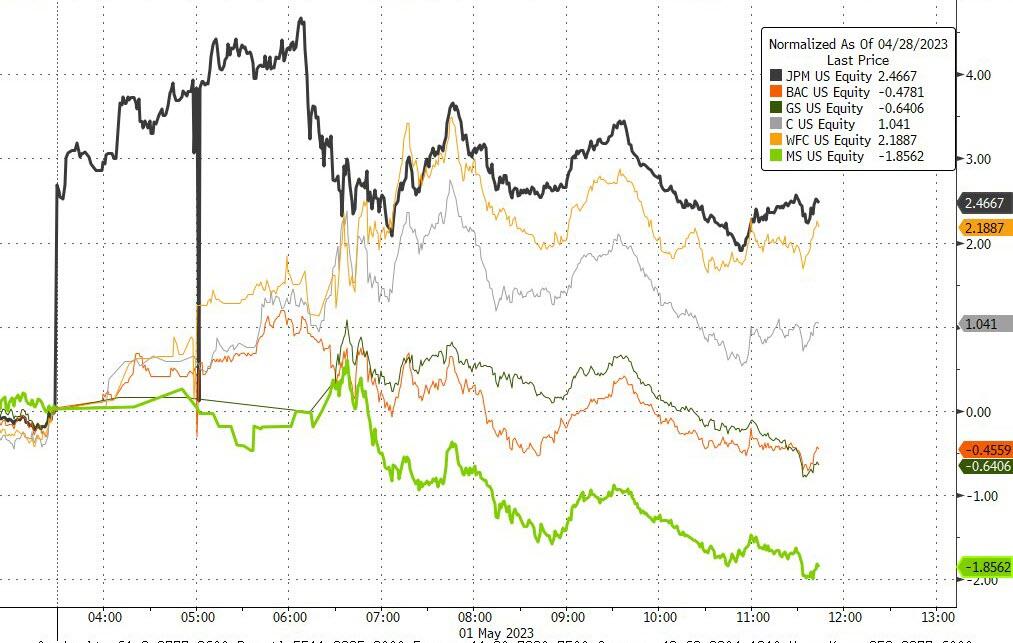
JPM, of course, outperformed as its now even too-biggest-to-fail, but BofA, Goldman, and MS were all red on the day…

Source: Bloomberg

Interestingly, with banks “fixed” and stagflation scares ascendant, we saw rate-hike expectations lift modestly hawkishly today with the terminal rate in June (but very marginally above this Wednesday – hence the 25% odds of a June hike). NOTE (off the chart because of scaling) that December is expected to be 25bps below current levels!

Source: Bloomberg

So what did all that mean for stocks? Well BTFD of course  – durr, as 0DTE vol plunged at the open once again. But, they could not hold it and stocks faded late on into the red as major negative delta flow from 0DTE hit the market starting around 1200ET…

Source: SpotGamma

On the day the pump was met with a dump leaving the majors basically unchanged (Small Caps spiked into the green in the last few mins)…

Another day, another VIX compression (VIX his 15.60 lows intraday) and VIX1D dump and pump…

Source: Bloomberg

Treasury yields soared, despite equity’s general malaise as a holiday-thinned session was dominated by heavy corporate supply (META $8.5 billion for example). The entire curve was basically up 13-15bps…

Source: Bloomberg

Also bear in mind that Europe was largely closed today for Labor Day.

We wouldn’t be betting too hard on today’s yield surge holding as the corporate calendar easing up and rate-locks lifted…

Source: Bloomberg

The dollar was higher, reversing overnight weakness, pushing back up to Friday’s highs…

Source: Bloomberg

Crypto was clubbed like a baby seal for no good reason again. Bitcoin tried to tag $30k again but was punished, puking back to the Mt.Gox ‘fake news’ spike lows…

Source: Bloomberg

Gold was crazy today – with Futs spiking up to $2105 intraday on the JPM rescue then puking it all back because we can’t have the barabrous relic hinting that systemic shit is bad…

Oil was down on the day but WTI seemed to find support at $75…

Finally, well done Jim Cramer…

Source: Bloomberg

That “CNBC Pro” sub was well worth the money.

Tyler Durden
Mon, 05/01/2023 – 16:01

Wagner Chief Threatens To Quit Bakhmut Unless His Men Get More Munitions

Wagner Chief Threatens To Quit Bakhmut Unless His Men Get More Munitions

The head of Wagner Group and Russia’s defense ministry have continued their public spat over war strategy and the mercenary firm’s role in Ukraine operations. 

On Sunday Wagner’s outspoken chief Yevgeny Prigozhin threatened to withdraw his fighters from the strategic eastern city of Bakhmut, where fighting has raged for several months, at a time Russian forces control something like eighty to ninety percent of the city.

“I am appealing to Sergei Shoigu with a request to issue ammunition immediately,” he said in reference to Russia’s defense minister. “Now if this is refused … I deem it necessary to inform the commander-in-chief about the existing problems, and to make a decision regarding the feasibility of continuing to station units in the settlement of Bakhmut, given the current shortage of ammunition,” Prigozhin warned.

By many accounts, Wagner has spearheaded successful operations in Donetsk, especially in the capture of nearby Soledar, which created the necessary momentum to control most of Bakhmut, though Ukraine has still committed to the wrecked city’s defense.

Prigozhin is now saying his supplies have dwindled to the point his forces can only sustain operations for a mere days longer. “Do we go on with our assaults or not? Do we stay or go?” he said, but still vowed to fight “until the very last round of ammunition.”

On Monday he followed with a video post to his Telegram channel, saying he needs at least 300 tonnes of artillery shells each day in order to take the city. “Three hundred tonnes a day is 10 cargo containers – not a lot at all … But we are being given no more than a third of that.” 

Prigozhin has been charging the regular military command with “betraying” his fighters by withholding ammunition, in an ongoing spat which became public with the Russian seizure of Soledar. A Wagner statement at the time declared victory over the city for itself, but controversially didn’t acknowledge the role of the regular military. The rift has increasingly been out in the open since then.

For this reason, Russian generals might actually welcome Prigozhin taking a backseat – though a full withdrawal of Wagner forces from Bakhmut could prove a devastating setback for the Russian side, if he were to actually go through with it.

Tyler Durden
Mon, 05/01/2023 – 15:20