71.4 F
Chicago
Friday, August 14, 2026
Home Blog Page 3728

200 Years Of Global Gold Production, By Country

200 Years Of Global Gold Production, By Country

Although the practice of gold mining has been around for thousands of years, it’s estimated that roughly 86% of all above-ground gold was extracted in the last 200 years.

With modern mining techniques making large-scale production possible, global gold production has grown exponentially since the 1800s.

In the infographic below, Visual Capitalists Govind Bhutada and Miranda Smith, using data from Our World in Data, visualizes global gold production by country from 1820 to 2022, showing how gold mining has evolved to become increasingly global over time.

A Brief History of Gold Mining

The best-known gold rush in modern history occurred in California in 1848, when James Marshall discovered gold in Sacramento Valley. As word spread, thousands of migrants flocked to California in search of gold, and by 1855, miners had extracted around $2 billion worth of gold.

The United States, Australia, and Russia were (interchangeably) the three largest gold producers until the 1890s. Then, South Africa took the helm thanks to the massive discovery in the Witwatersrand Basin, now regarded today as one of the world’s greatest ever goldfields.

South Africa’s annual gold production peaked in 1970 at 1,002 tonnes—by far the largest amount of gold produced by any country in a year.

With the price of gold rising since the 1980s, global gold production has become increasingly widespread. By 2007, China was the world’s largest gold-producing nation, and today a significant quantity of gold is being mined in over 40 countries.

The Top Gold-Producing Countries in 2022

Around 31% of the world’s gold production in 2022 came from three countries—China, Russia, and Australia, with each producing over 300 tonnes of the precious metal.

North American countries Canada, the U.S., and Mexico round out the top six gold producers, collectively making up 16% of the global total. The state of Nevada alone accounted for 72% of U.S. production, hosting the world’s largest gold mining complex (including six mines) owned by Nevada Gold Mines.

Meanwhile, South Africa produced 110 tonnes of gold in 2022, down by 74% relative to its output of 430 tonnes in 2000. This long-term decline is the result of mine closures, maturing assets, and industrial conflict, according to the World Gold Council.

Interestingly, two smaller gold producers on the list, Uzbekistan and Indonesia, host the second and third-largest gold mining operations in the world, respectively.

The Outlook for Global Gold Production

As of April 25, gold prices were hovering around the $2,000 per ounce mark and nearing all-time highs. For mining companies, higher gold prices can mean more profits per ounce if costs remain unaffected.

According to the World Gold Council, mined gold production is expected to increase in 2023 and could surpass the record set in 2018 (3,300 tonnes), led by the expansion of existing projects in North America. The chances of record mine output could be higher if gold prices continue to increase.

Tyler Durden
Sun, 04/30/2023 – 15:00

Cash Use Rises As Households Struggle To Cope With High Inflation

Cash Use Rises As Households Struggle To Cope With High Inflation

Authored by Bryan Jung via The Epoch Times,

Cash payments have made a comeback as households struggle to cope with high inflation, according to a new study.

After decades of falling cash use, the impact of the rapid inflation growth has been reversing the trend toward digital.

Credit Karma and The Harris Poll conducted a survey last month, which showed that 53 percent of adults in the United States and 46 percent in the United Kingdom are more likely to use cash than a year ago, reported Bloomberg.

Individuals preferring cash rose 19 and 4 percentage points, respectively, over those who did not use it more.

Roughly three in five cash users in both countries said using physical money makes them spend less.

The change in preferences towards cash over digital is also a reaction to the growing dominance of the latter, such as Apple Pay to Venmo to tappable credit cards, which some consumers say make it too easy to spend through their budget.

Over two-thirds of the 3,171 survey respondents admit that digital payment methods made them spend more than intended.

Cash Use Rises Among Young

High inflation rates have made people more self-conscious about what they spend daily, especially in the U.K., where price gains remain above 10 percent.

“As the world is getting back to normal after the pandemic and prices are going up significantly, we see cash as being one of the most enduring ways of managing money,” said Courtney Alev, an associate director of product management at Credit Karma.

“It really transcends generations and financial situations.”

The surge in cash use was especially pronounced among younger generations, such as Millennials and Gen Z, the survey found.

Younger consumers facing hard times are following the trend towards “cash-stuffing” by watching TikTok videos, that teach people how to separate their cash into different envelopes to use for different expenses, much like their grandparents or great-grandparents might have done during the Great Depression.

Consumers are also utilizing social media venues like Facebook to avoid businesses that do not accept cash.

Natalie Ceeney, chairwoman of Cash Access UK, told Bloomberg, “a lot of the theory on payments has been to remove friction,” and that “actually, a lot of people want friction back.”

Cash Access’s mission is to promote easier access to cash following legislation to stem its decline.

A woman holds British pound banknotes in this illustration taken on May 30, 2022. (Dado Ruvic/Reuters)

Ceeney said that studies found a large increase in sales when businesses in personal contact with consumers, such as the sports industry, switch to contactless payments.

“One of the reasons is people are more likely to just tap and buy things without thinking, ‘Gosh, that’s a lot of money.’”

Some fintech companies are trying to assist struggling consumers by introducing features that help with setting limits on everyday spending, reported Bloomberg.

Digital Currency Proposed

The survey findings suggest that the recovery in payments in cash after pandemic lows might not be temporary, as studies by the Federal Reserve and the Bank of England seem to confirm.

The BOE noted in October that it had seen a “sustained, if partial, recovery in cash use” post-pandemic and that banknotes in circulation have risen close to a historic high.

The U.K. bank, Nationwide Building Society, reported in January that more than 30.2 million withdrawals were made from its ATMs last year, a 19 percent jump from 2021, likely due to the rising cost of living.

The British central bank said that the use of paper currency and coins are especially useful for lower-income households that are struggling to deal with inflated costs, ranging from food to rent payments.

Meanwhile, central banks worldwide, including the BOE, are pushing ahead with plans to introduce digital versions of their currencies, which is a very unpopular move among the public.

Privacy advocates worry about a loss of privacy and the potential for government surveillance if digital currencies become mandatory.

The Fed itself published a paper outlining the benefits of a digital dollar, but officials say there will be no “Fedcoin” without any action by Congress.

The continuous rise in cash use may depend on how the central banks will manage to tame stubbornly high inflation rates in the coming months.

Tyler Durden
Sun, 04/30/2023 – 14:30

Vultures Circling: Bearish Bets Against REITs Soar As CRE Meltdown Risks Mount

Vultures Circling: Bearish Bets Against REITs Soar As CRE Meltdown Risks Mount

As storm clouds gather over the commercial real estate market, it faces ever-darker prospects by the week. Short-seller vultures are circling above CRE REITs, targeting these investment vehicles with significant exposures to office, retail, and hotel with massive bearish bets on the hope “more borrowers will default on office debt as interest costs increase and property values fall,” as reported by Bloomberg

New data compiled by S&P Global Market Intelligence shows short interest in some of the largest REITs with exposure to commercial properties, Blackstone Mortgage Trust Inc. and Starwood Property Trust Inc., have soared in recent weeks. 

Hedge funds are making bearish bets in the credit derivatives and equities spaces on the premise remote and hybrid work will continue to paralyze demand for tier 2 and 3 properties and crush landlords. Data from broker Cushman & Wakefield indicates office vacancy rates are rising at alarming rates. 

The gold-standard measure of office occupancy trends is the card-swipe data provided by Kastle Systems. The average office occupancy nationwide is around 46%, still well off the highs from pre-pandemic levels. 

The problem now is borrowers lack new tenants, which means default risk increases and negatively impacts REITs. These investment vehicles generate revenue from the spread between their capital costs and the interest rates charged to borrowers for loans. 

Gavriel Kahane, the co-founder of real estate investment firm Arkhouse, warned there’s mounting concern among top investors about “ballooning defaults on held loans” due partly to higher refinancing costs. He noted:

“Mortgage REITs in general do better when the Fed funds rate stays constant, and in this hyper-turbulent environment distress bubbles up.” 

The surge in bearish bets is an ominous sign market participants recognize the CRE space is headed for severe pain. The Mortgage Bankers Association reported a delinquency rate on office loans across all lenders climbed to 2.7% at the end of 2022, up from 1.6% in the previous quarter. We suspect that the rate will continue to rise throughout this year.  

Bloomberg noted, “Office loans are a minority of the portfolios for the mortgage REITs that are being shorted.” 

Recall last month, we pointed out that regional banking turmoil would have spillover effects in the CRE space — especially the office sector (Read: New “Big Short” Hits Record Low As Focus Turns To $400 Billion CRE Debt Maturity Wall). And since then, JPMMorgan Stanley, and Goldman Sachs have all joined the CRE gloom parade. 

We highlighted the next big short: BBB- tranches of CMBX Series 15, due to its outsized exposure to office commercial real estate…

BBB- tranches of CMBX Series 15 is sliding again. 

We also cautioned about a large maturity wall in the CRE sector, with $400 billion of debt due this year. Morgan Stanley data shows $2.5 trillion in CRE debt comes due over the next five years.

Perhaps last week’s Vornado Realty Trust announcement about delaying its dividend is a harbinger of what’s to come. The REIT just hit a 27-year low. 

Read this: 

“We expect private equity and commercial real estate to suffer as regional banks were disproportionate funders of these sectors and the crisis has shut leveraged lending primary markets for the time being,” fund managers James Hanbury and Jamie Grimston of Brook Asset Management wrote in a letter to investors seen by Bloomberg.

The latest BofA Fund Managers Survey (available to pro subs in the usual place) shows institutional players are most bearish on real estate since 2009.

Meanwhile, CRE Billionaire Sam Zell recently told New York University graduate students that remote work is a “bunch of bullshit” and that they should dismiss the idea of working from home. It might be hard for Zell to persuade folks to return to the office. These work trends seem permanent and will exert pressure on the CRE space, with mounting risks of a default wave. The dominos appear to be already falling. 

Tyler Durden
Sun, 04/30/2023 – 14:00

MIT Scientists Create New Nanoparticle Sensors To Detect Early Cancer Via Simple Paper Test

MIT Scientists Create New Nanoparticle Sensors To Detect Early Cancer Via Simple Paper Test

Authored by Bill Pan via The Epoch Times (emphasis ours),

Scientists at the Massachusetts Institute of Technology (MIT) have designed nanoparticle sensors that could diagnose early-stage cancer through a simple urine test on a strip of paper.

Approximately one-third of cancer deaths are caused by factors such as smoking, high body mass index, alcohol consumption, low intake of fruits and vegetables, and lack of physical activity. Many cancers can be cured if detected early and treated effectively. (Freepik)

The scientists said these sensors, designed to detect many cancerous proteins, could also distinguish the type of tumor, how it responds to treatment, and whether it has metastasized.

“We are trying to innovate in a context of making technology available to low- and middle-resource settings. Putting this diagnostic on paper is part of our goal of democratizing diagnostics and creating inexpensive technologies that can give you a fast answer at the point of care,” said Sangeeta Bhatia, a biomedical engineer at MIT and senior author of the study published on April 24 in Nature Nanotechnology.

Bhatia’s team had initially investigated the concept of detecting naturally occurring cancer biomarkers, such as proteins or circulating tumor cells, in the patient’s blood samples. However, these biomarkers are hard to find, especially at early stages, prompting the team to create “synthetic biomarkers” that could diagnose cancer by amplifying small-scale changes occurring within small tumors.

Nanoparticles previously created by the team can detect the activity of proteases, biological catalysts that can help tumor cells spread. However, since this equipment is not always available, the researchers developed new nanoparticle sensors that could be analyzed more easily and affordably using a technology that reads repetitive DNA sequences called CRISPR.

Specifically, the nanosensors are designed so that when they encounter a tumor, they shed short sequences of DNA that will eventually end up in the patient’s urine. The urine sample can be analyzed using a paper strip that recognizes a signal activated by a CRISPR enzyme called Cas12a. When a particular DNA “barcode” is present, Cas12a enhances the signal so it appears as a dark strip on the paper test.

In a study conducted in mice, the scientists showed that a panel of five DNA barcodes could accurately distinguish tumors that first arose in the lungs from tumors formed by colorectal cancer cells that had metastasized. The team also collaborated with other institutions to build a device to distinguish at least 46 DNA barcodes in a single sample.

The scientists said they are now working on further developing the nanoparticles, with the goal of testing them in humans.

Tyler Durden
Sun, 04/30/2023 – 13:30

Democrat Cities Have Biggest Homicide Rate Problem, Study Finds

Democrat Cities Have Biggest Homicide Rate Problem, Study Finds

The Democratic Party aggressively promoted the idea of ‘defunding the police’ after George Floyd was killed by a Minneapolis, Minnesota, police officer in 2020, which was supposed to improve public safety. A few years later, a new study found the homicide rate in Democrat cities is on the rise and a sign progressive policies are failing. 

In a study published by WalletHub, researchers found “homicide rates have risen by an average of roughly 10% in 45 of the most populated U.S. cities between Q1 2021 and Q1 2023, and are still rising.” 

The cities with the biggest homicide rate problems include Memphis, Tennesse; New Orleans, Louisana; Richmond, Virginia; Washington, DC; and Detroit, Michigan. Democrat mayors lead all five cities. 

Researchers pointed out that murders were rising faster in Democrat-led cities than Republican-led cities. 

Separately, Chidike Okeem, an assistant professor at Western New England University, told the NYPost that defunding the police movements directly correlates with the rise in violence. 

“As a response to the social unrest, some officers have embraced ‘de-policing,’ which is the idea of not engaging in proactive policing practices in order to avoid increased scrutiny and censure. Without pronounced police presence, violence proliferates,” Okeem said.

A University of Central Missouri Professor, Gregg Etter, went further and blamed no-cash bail as a significant driver in the alarming rise of homicide rates in major cities. 

“If you have a problem with police use of force in isolated instances, rather than deal with the problem or the problem officers, defund the police. This results in a less-effective police force, increased response times, lower police morale, and an increasing unwillingness by the police to engage in proactive policing,” Etter said.

And it’s not just homicide rates that are moving higher. Retail thefts and carjackings are soaring. Democrats have yet to take accountability for their failed social justice reforms. As a result, businesses and people are quickly exiting these dangerous cities for safer places. 

Tyler Durden
Sun, 04/30/2023 – 13:00

With FRC Auction Results Imminent, Handicapping The Reported Bidders For First Republic

With FRC Auction Results Imminent, Handicapping The Reported Bidders For First Republic

By Todd Baker, Senior Fellow at the Richman Center for Business, Law & Public Policy at Columbia and the Managing Principal of Broadmoor Consulting LLC; first published on Medium

According to the collective wisdom of The Wall Street Journal, Bloomberg, and Reuters, there are five banks that have been asked to submit bids to the FDIC in this weekend’s rumored receivership sale of First Republic Bank. All can “afford” the bank with sufficient FDIC assistance, although a private deal is effectively impossible outside of a collective bid by the banks that provided $30 billion in emergency deposits last month.

Unlike most bank deals, this one won’t be fueled by cost cutting and branch closings. The key for bidders is finding a way to hold on to First Republic’s rainmakers and customer service model, which are the reason it has been so successful in acquiring and retaining wealthy customers. That means hitting the ground running with retention packages and active outreach to front line employees.

JP Morgan

It’s good to be the King, as Mel Brooks once said. JP Morgan has a large wealth management business and a deep presence in First Republic’s key California and New York markets. It has high customer satisfaction ratings in California tied in part to its acquisition of Washington Mutual in 2008. It also worked hard to help First Republic when the initial run happened and tried its best to find a private solution to the bank’s problems, so there should be some employee goodwill should JP Morgan be the winner. While generally prohibited from buying more deposits due to the 10% national deposit cap, it can do a deal like this with the FDIC. Can it integrate First Republic’s quirky culture and customer focus into its disciplined private banking behemoth? We stand a good chance of finding out as it is probably the favorite going into the auction.

Bank of America

It would be deeply ironic if Bank of America turned out to be the successful bidder. It owned First Republic Bank as a result of buying Merrill Lynch and sold it in 2010 because it didn’t fit in well with the bank’s own wealth management plans. Nevertheless, times change and the attractiveness of First Republic’s customer base is real for Bank of America asset management and Merrill Lynch business lines. One problem…Bank of America’s California customer satisfaction ratings are much lower than competitors’ (other than Wells Fargo) and many First Republic California customers came to the bank initially because they were dissatisfied with Bank of America.

PNC Bank

In many ways, this is the best fit for First Republic. PNC has relatively few operations in the Western US and only a small presence in New York, where First Republic has also been successful. That means fewer layoffs in a deal. Like many of the other potential bidders, it has made wealth management a focus and punches above its weight in that field. It will be most likely to value the existing First Republic high-touch business model and keep the revenue producers and other front line staff happy. An added bonus is geographic diversification coming into a credit downturn. I’d bet on PNC to either win or place in the auction.

US Bank

It seems unlikely for US Bank to be an active bidder because it is currently integrating its own acquisition of California-based Union Bank which closed at the end of last year. It has also faced criticism about its relatively low capital levels which might make a large transaction challenging. Finally, First Republic’s huge California single family jumbo loan portfolio might be too much to handle given the size of a similar loan portfolio acquired by US Bank in the Union Bank deal.

Citizens Bank

Citizens would be a real dark horse winner, but like PNC it has no geographic overlap to speak of so it would be likely to keep all the front line staff and a significant part of the back office functions. It recently acquired Investors Bancorp to strengthen its New York to Philadelphia presence, as well as HSBC’s East Coast branches and national online deposit business. The introduction of First Republic’s customer-service model into those geographies could be a winner, as could increasing the geographic diversity of Citizens’ loan portfolio with addition of California.

Tyler Durden
Sun, 04/30/2023 – 12:30

How Long Until The US Is Put On Downgrade Watch?

How Long Until The US Is Put On Downgrade Watch?

By Peter Tchir of Academy Securities

Smooth Sailing Ahead?

The market started off rough and looked incredibly shaky on Wednesday. However, a great performance by MSFT was one of the main things that held the broad markets together and they ended the week incredibly strong.

There were some interesting reactions last week. FRC dropped from $14.24 to $3.50, but KRE (a regional bank ETF) finished virtually unchanged and seemed to be able to shrug off the issues dragging FRC stock down. That sort of resilience is encouraging as it seems like the market is in the process of sorting out the banks that have been affected (from the rest). Yes, there are still issues with what banks may have to pay on deposits to retain customers, but this was very encouraging. I’m finding myself re-reading I Like Mid Banks, I Cannot Lie because we have learned a lot since that was published. I’m more encouraged than I have been in weeks in large part due to how we traded this week.

Inventories

GDP was weaker than expected, but much of that can be attributed to inventories declining. Since the inventory overhang (or even glut) has been a major concern (Moving Beyond Banks), this was encouraging news. Seeing GDP shrink because we are draining inventories is actually a positive because it sets the stage for future growth.

Having said that, two questions still need to be answered:

  • Have inventories been reduced enough to start creating demand for increased production or are they still far too high? I’m leaning towards the latter.
  • Were companies really able to sell a lot more (close to full price) or were they just reducing shipments so fast that even “mediocre” sales helped? There is some evidence that it was the former, which would be good, but the evidence is mixed at best.

While the inventory news was encouraging, the bar has been set quite low on that front, so I wouldn’t expect smooth sailing from here.

The Consumer

Consumption data looked decent. If we look at new home sales, durable goods, and personal consumption data, all of this points to a consumer that is still spending.

This is in contrast to increasing (but still manageable) delinquency rates on auto loans and credit cards. Yes, they are higher, but they are still below pre-Covid historical levels (at least for the data series that I’ve been tracking). However, credit card debt has been building, but not to alarming levels.

We have all become used to never betting against the American consumer’s willingness to consume, and maybe we have another round of high spending to look forward to, but I struggle to see that.

I don’t believe that the consumer will be a big tailwind for markets or the economy and I expect to see weaker data as layoffs start to take effect.

Inflation

Inflation seems to be stabilizing around levels that are “too high” but not “alarmingly too high”. Right around 4% is higher than the Fed (and incumbent politicians) would like, but it is in the realm of “manageable” and heading in the right direction.
As someone who expected deflation concerns to mount in the first half of this year, I am not worried about inflation rising. Yes, we had an uptick in reported data after “disinflation” gained some traction in January. However, we will learn that we are still headed down a path to lower inflation, because we were set on that path months ago when hikes were started (see
Mistaking Hard for Soft Landing).

Not a Short Squeeze

While markets did very well on Thursday (and even on Friday), there was less of a “squeezy” feel than in some prior rallies. I’ve seen some charts indicating that in some sectors, the “most shorted” names underperformed significantly (not what you would expect in a “short squeeze”). We already discussed FRC versus KRE, but ARKK (another crowd favorite) was down while QQQ (Nasdaq 100) powered higher and beat the Dow and S&P 500 on the week. If you told me that the Nasdaq 100 was going to be up more than other indices, I’d have guessed that ARKK would outperform (it didn’t). Similarly, the Russell 2000 was down on the week, pointing to some selectivity.

This price action is encouraging to me, because it isn’t just a bunch of bears getting stopped out. It is indicative of “new risks” being added with a degree of thoughtfulness that we didn’t see in many of last year’s “ripfests”.

M2

While not something that I pay close attention to, as Tom Keene exposed on Bloomberg TV (at the 1 hour 38 minute mark), the recent decline has been noticed by many people.

The Fed balance sheet, which I do watch, has resumed its decline as banks are using less of the emergency lending facilities and quantitative tightening is taking its toll.

This will continue to be a headwind.

The Fed

We get the FOMC on Wednesday, which all seems to boil down to the messaging that will be provided during the press conference.

Consensus is for a 25 basis point hike with talk of a pause. Since I don’t think that they should have hiked at the last meeting (or at the last couple of meetings), I can’t see why they won’t raise rates 25 bps (so let’s price this in). I also think that the “pause” is so long overdue that I’d be shocked if we don’t get some indication of this.

When I pull up WIRP it shows a high of 5.09%, so basically one and done, but isn’t that priced in?

Even as someone who thinks that a recession is well on its way, I struggle to see how the market is pricing in a better than 50% chance of a cut by September.

Expect messaging to be “higher for longer”, which I’m not sure the market is on board with.

Jobs

This week will be all about jobs, starting with JOLTS on Monday. Can they continue to surprise? Can we start to trust ADP (which was revised) more than the NFP data (where response rates are abysmally low)? Will some of the headlines about layoffs translate into weaker published data?

Finally, and maybe most importantly, will we start to focus on jobs at a granular level and see a disturbing trend (from an economic standpoint) that low-paying jobs are abundant, but middle to high-end jobs are being cut?

We continue to be in the camp that the negative economic impact won’t be a function of job losses, it will be a function of which jobs are lost (i.e., # of jobs multiplied by pay for those jobs will be the real metric to identify and react to).

Debt Ceiling

Will the Republicans’ successful vote bring Biden to the table for serious negotiations or will both sides dig in their heels because they are confident that they have the support of the voters? Or at least can they get the voters to blame the other side for any failure to pay?

When I look at 1-year U.S. government CDS (which I rarely look at), I see that it indicates a small (but increasing) probability of some sort of a “failure to pay” credit event.

As discussed in recent reports, I take a very simplistic view that given where some longer-dated Treasuries trade (70 cents on the dollar), a failure to pay event will create a 30 point gain for holders of CDS. With a price of 1.75 points, that implies slightly less than a 6% chance of a failure to pay. The CDS is much more complex than that, but I think that this sums up the basic logistics here. No one is buying U.S. CDS because they think that the holders of any debt (that isn’t paid) won’t get paid in full with interest. They are buying it in hopes of a credit event occurring that opens up the “cheapest to deliver” bonds.

So, it is wonky, but important.

I expect rough seas on the debt ceiling front!

It is possible that one (or more) of the NRSRO (Nationally Recognized Statistical Ratings Organizations) will decide to put the U.S. credit rating on credit watch for a potential downgrade. However, since most mandates that I see treat U.S. Treasury risk as its own asset class (i.e., not dependent on rating, unlike what we see in mandates for credit and structured products investors), I don’t think that any potential downgrade would move markets. Any Treasury sell-off linked to a downgrade headline should be bought. However, I would be in no rush to buy any corresponding equity sell-off.

From Made in China to Made by China

We wrote about this in Locking in Some Themes and discussed it in the aforementioned Bloomberg TV interview.

On Tuesday May 2nd, at 1:00 pm ET, Academy will be hosting a webinar on China’s Recent Geopolitical Successes and Influence (please use this link to register). Rachel Washburn will lead a conversation with General Marks, General Walsh, and myself on China’s recent ventures into the global political arena. We will examine what it means for our relationship with not just China, but also other countries and regions. China is certainly improving how it wields its influence on the global stage.

I’d be shocked if questions surrounding “reserve currency” don’t come up!

Bottom Line

A bit of a broken record.

Remaining at -4 on equities on a scale of -10 to 10. Based on price action on Thursday and Friday, I’d move myself closer to neutral or even bullish, but Wednesday felt so awful that I cannot bring myself to make the change to neutral so quickly. However, I certainly cannot get more “beared up” after the past couple of days. I am concerned that I am fighting the “one last hike and done” rally, but so much of that seems to be priced in that I’m willing to take that risk.

On rates, I expect that Powell and the Fed will try to push the “higher for longer” pitch. That will be bad for the front-end (say out to 3-years), so I’d expect yields to increase there. With the 10-year already at a measly 3.4%, it is difficult to imagine it going much lower (back to the hawkish Fed being bad for the front-end, but good for the long-end). But given how much everyone seems to hate the bond market here (apparently record short positions amongst speculators), I won’t bet on much higher longer-dated yields.

I think that the 2s vs 10s yield curve will become more inverted (again).

On the credit side of things, I still like to err on the side of caution. IG over high yield and high yield over leveraged loans (viewing it as big cap vs secured, but not necessarily well secured). In addition, I favor higher credit quality versus lower credit quality tranches on the structured products side of things.

I’d keep buying banks that trade cheap here, though much (if not all) of that trade has already disappeared.

Basically, on credit, I don’t see much downside to spreads (but very little upside), which is often an okay time to give up some potential returns in hopes of a cheapening event (that would likely occur if I’m correct on stocks).

With summer fast approaching, clear sailing would be nice, but while that’s a possibility, my current forecast is for more of the same choppy (but not dangerous) seas, which we just have to make our way through.


Tyler Durden
Sun, 04/30/2023 – 11:56

When We Lose Small Businesses…

When We Lose Small Businesses…

Authored by Charles Hugh Smith via OfTwoMinds blog,

When we lose small businesses, we lose MORE than tax revenues.

Small businesses receive plenty of lip service but very little appreciation–until they’re gone. By then it’s too late to do anything but mutter, “you don’t know what you’ve got until it’s gone.”

Small businesses aren’t just sources of tax revenues, they’re sources of a wide range of jobs that can’t be replaced by Corporate America or the government. Just as importantly, small business owners and entrepreneurs are advocates for the neighborhoods, districts and cities they depend on for customers and suppliers.

The livelihoods of the owners and their employees depend on maintaining the viability of their neighborhood / district / city, which includes public safety and services such as transportation and trash collection, and a minimum density of other private-sector services and amenities which provide residents a safe, appealing atmosphere worth visiting.

59.9 million Americans work at small businesses across the nation. An estimated 47% of Americans shop at small businesses at least twice a week, generating about 45% of the nation’s economic activity. According to the most recent available numbers from the U.S. Census, approximately 47% of U.S. employees work for small businesses, compared to 54.5% in 1988.

Small business entrepreneurs are risking everything they have to open and operate a business. They have far more skin in the game than city functionaries tasked with enforcing regulations and collecting business-related fees or their employees, who have the freedom to quit and seek employment elsewhere.

Residents tend to feel powerless to stop the decay of their neighborhood safety, services and amenities. They tried contacting their elected officials or municipal functionaries and were given a meaningless feel-good reply which everyone involved knows is empty.

Small business owners are more willing to apply meaningful pressure because they know the decay follows a sobering slide in which incremental declines pile up and eventually trigger a phase change in which the character of the neighborhood / district / city goes over a cliff no one discerned: petty crime increases, paving the way for more serious crimes to proliferate; customers thin out and then become scarce, and the zeitgeist goes from friendly to wary to unpredictable or even dangerous.

The core characteristic of of neofeudal economy and society is that it’s two-tier: there are two tiers of “criminal justice,” one of wrist-slaps and vast white-collar crimes ignored for elites and the wealthy, and another far more brutal and Kafkaesque for the rest of us.

In terms of commerce, Big Tech is free to establish monopolies and Finance escapes all the supposed regulatory safeguards, while small business is throttled with endlessly multiplying petty regulations that have little or nothing to do with public safety or employee labor rights. Corporate America has the immense wealth and power to gut any regulations it finds onerous, but small business struggles to pay the soaring costs of compliance and the tripling of junk fees such as business license renewals.

City-provided services degrade but the costs for the privilege of doing business triple.

The majority of small businesses are sole proprietors. (see chart below) Many of these are online or at-home enterprises that are invisible to residents walking down the sidewalk. The 5.4 million small businesses with less than 20 employees are visibly consequential to the viability of bricks-and-mortar neighborhood commerce.

Demographics play a large role in the viability of small businesses. About 40% of all small businesses are owned by Boomers nearing retirement or already past the age of typical retirement. It won’t take much in the way of losses or stress to nudge these owners into selling or closing the business.

But if conditions are decaying, who’s going to buy a struggling business? The grim reality is “no one.” Owners are already working long hours and enduring high levels of stress. This self-exploitation can only go so far before the owners’ health and/or finances break down in burnout or losses.

Municipal bureaucracies tend to see small business tax donkeys as something they can count on much like a gushing spring. Should one tax donkey collapse and close a business, another tax donkey will magically appear to pick up the self-exploitation harness and start a new business in the same space.

Local-economy boosters love to cite the flood of new business applications as proof the spring is still gushing, but many of these new enterprises are sole proprietorships with no storefront presence and no employees. Many new businesses that thrived in the post-pandemic boom will soon encounter the headwinds of recession for the first time, and many will find their enterprises blown onto the unforgiving rocks of financial losses.

The phase-change shift in the character and zeitgeist of neighborhoods, districts and cities is difficult to reverse. Once people no longer feel safe, they won’t come back. Once the empty storefronts and homeless encampments dominate the landscape, they won’t come back. Once services deteriorate and trash accumulates, they won’t come back.

Municipal bureaucracies are largely staffed by people who have never experienced what a real recession (such as 1981-2) can do to commerce, tax revenues and small businesses struggling to survive. They’re confident that history demonstrates any downturn will be brief and the tax donkeys will appear as usual to fill the empty storefronts, lofts and offices.

But this time will be different. No new tax donkeys will appear to gamble their fortunes and lives on starting a stupidly expensive-to-operate business, pay prevailing wages and benefits and all the taxes, licenses and junk fees municipalities have piled on small business.

When we lose small businesses, we lose more than tax revenues. We lose the engines of employment and the commercial foundation of neighborhoods and districts. When these foundations crumble, those residents who see the slide down the slippery slope of decay sell their homes and get out while the getting’s good. Those who remain will regret their inaction.

Tax donkeys don’t appear by magic. There has to be an infrastructure in place that allows a real opportunity to scrape out a living despite the high costs and formidable challenges. If the infrastructure and character of a place decay, so does the opportunity, and small businesses melt into air when it’s longer worth the struggle.

New Podcast: Its a Waterfall – Risk, Collateral & Productivity (48 min)


*  *  *

My new book is now available at a 10% discount ($8.95 ebook, $18 print): Self-Reliance in the 21st CenturyRead the first chapter for free (PDF)

Become a $1/month patron of my work via patreon.com.

Tyler Durden
Sun, 04/30/2023 – 11:30

“It Was Weird”: Video Shows ‘Mysterious Lights’ Hovering Over Las Vegas

“It Was Weird”: Video Shows ‘Mysterious Lights’ Hovering Over Las Vegas

The public’s fascination with UFO sightings and potential signs of alien life has soared in recent years. The Department of Defense has played a significant role in fueling this public curiosity by sharing videos that show unidentified objects hurtling through the sky. 

According to Bloomberg data, the number of news stories across all media outlets featuring “UFO videos” has exponentially jumped since late 2019, with multiple spikes in 2020 and 2021.

The latest footage of what appears to be a UFO, not released by the Pentagon but by a civilian in Las Vegas, shows mysterious lights hovering in the night sky over the metro area last Thursday. 

“Often, the bright glow can be traced to parachute flares and perhaps aviation training of some sort. Maybe Nellis Air Force Base, Creech Air Force Base, or even Harry Reid International Airport is involved in some way,” KLAS 8 News Now reported. 

However, when the local media outlet contacted Nellis, a spokesperson told them, “No training was conducted over the valley the previous night.” A Harry Reid airport spokesperson said traffic controllers weren’t aware of any activity in the area that would produce a line of lights in the sky. 

The person who filmed the mysterious lights spoke with the local media outlet and asked not to be named. He said:

“I’ve seen tourist helicopters flying around the Strip before, but this was so much bigger and brighter.

“At the end there, it looks like a plane might be coming in to land at the (Harry Reid International) airport.

He added: 

“It was weird. The lights hung out for about five minutes or so, and then they were gone.”

The mysterious lights did appear in an area known for producing some of America’s top-secret weapons. 

Tyler Durden
Sun, 04/30/2023 – 09:55

Over 10,000 FBI Agents Can Access Data From Secretive Surveillance Program: Inspectors General

Over 10,000 FBI Agents Can Access Data From Secretive Surveillance Program: Inspectors General

Authored by Joseph Lord via The Epoch Times (emphasis ours),

More than 10,000 federal employees could have access to data revealed by a secretive government surveillance program that has come under scrutiny because of alleged abuses, lawmakers were told by U.S. inspectors general.

Michael Horowitz, chair of the Pandemic Response Accountability Committee, testifies during a House Oversight and Reform Committee hearing in the Rayburn House Office Building in Washington on Feb. 1, 2023. (Anna Moneymaker/Getty Images)

At an April 27 House Judiciary subcommittee hearing, lawmakers heard from a panel of three witnesses associated with the U.S. Office of the Inspector General (OIG) responsible for oversight of the Foreign Intelligence Surveillance Act (FISA). The legislation gives intelligence agencies broad powers to conduct surveillance on foreigners suspected of spying for a foreign power or belonging to a terrorist group.

However, bipartisan concerns have been raised because the program also has the ability to collect information about U.S. citizens.

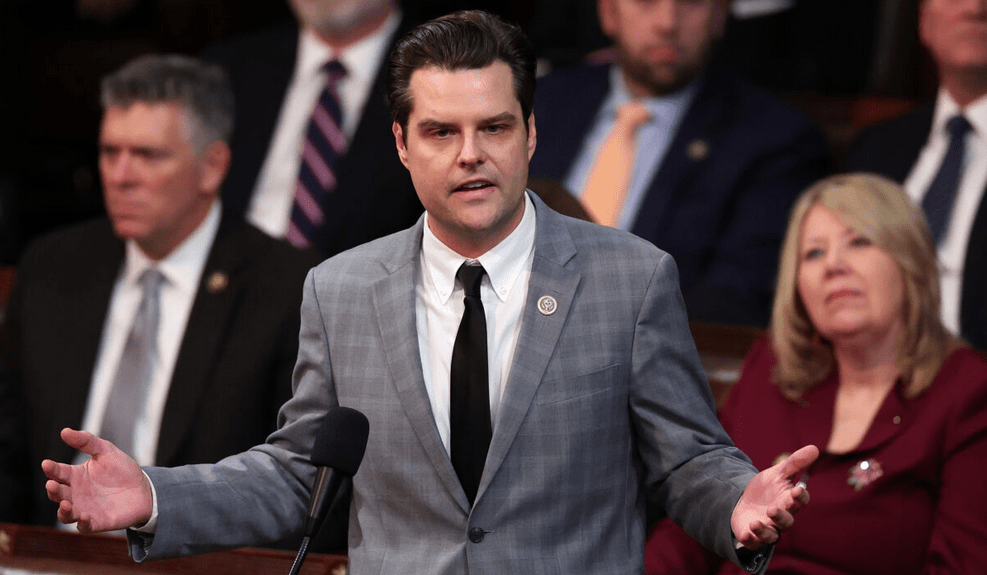
During the hearing, Rep. Matt Gaetz (R-Fla.) queried panelists about how many FBI agents could have access to FISA-acquired data.

Rep. Matt Gaetz (R-Fla.) delivers remarks at the U.S. Capitol on Jan. 6, 2023. (Win McNamee/Getty Images)

A court-ordered report released in May 2022 revealed that the FBI had made more than 3.3 million queries of Americans under FISA authority. This, in turn, prompted a crisis of confidence in the FBI’s respect for civil liberties among members of both parties.

In his questioning, Gaetz referenced that report.

Addressing each of the three panelists, Gaetz asked, “If I represent to you that we believe there may be north of 10,000 people in the federal government who can perform [FISA] queries, would anyone here have a basis to disagree with that?”

All three answered in the negative.

In a Twitter post featuring a clip of the exchange, House Judiciary Republicans said, “Upwards of 10,000 FBI personnel may have access to section 702-acquired FISA data.

“10,000! Why’s that number so big?”

Rep. Andy Biggs (R-Ariz.) speaks at a House Judiciary Committee Subcommittee hearing, “The Fentanyl Crisis in America: Inaction Is No Longer an Option,” in Washington on March 1, 2023, in a still from video footage. (House Judiciary Committee YouTube/Screenshot via NTD)

Alleged Abuses

The program in question, FISA section 702, has been scrutinized for its alleged abuses. Aside from the incidents uncovered in 2021, the intelligence community (IC) has repeatedly failed audits of its use of FISA.

In 2019, Justice Department Inspector General Michael Horowitz investigated a random sampling of 29 FISA cases by the FBI. None of the 29 cases chosen were found to be legitimate.

The FISA is overseen by the FISA court, a secretive body that grants spying authority to U.S. intelligence agents.

To make a FISA query of U.S. citizens, the FBI and other law enforcement agents are legally required to receive the approval of the closed-door FISA court.

In his investigation, Horowitz found that none of the 29 randomly chosen queries had been carried out properly or legally. Rep. Andy Biggs (R-Ariz.) said from an earlier conversation with Horowitz that in 25 of the cases, “there was unsupported, uncorroborated, or inconsistent information.” The FBI couldn’t even produce the relevant investigative files in the other four.

Read more here…

Tyler Durden
Sun, 04/30/2023 – 09:20