71.6 F
Chicago
Friday, August 14, 2026
Home Blog Page 3731

Watch: CNN Host Shockingly Blasts Teachers Union Boss Over School Closure Lies

Watch: CNN Host Shockingly Blasts Teachers Union Boss Over School Closure Lies

Randi Weingarten is the president of the American Federation of Teachers and a member of the AFL–CIO, but she’s perhaps best known as being the key advocate for shutting schools down during the onset of the Covid pandemic.

Weingarten was called to task this week on the Don Lemon-less CNN by senior political commentator Scott Jennings, who excoriated the union boss after she engaged in historical revisionism over her role in school shutdowns – insisting before the Select Subcommittee on the Coronavirus Pandemic, that she had instead advocated for reopening schools as quickly as possible.

Not so fast, Randi…

“Speaking on behalf of millions of American parents, I had to teach them at home,” Jenning said. “My wife had to teach them at home. I am stunned at what you have said this week about your claiming to have wanted to reopen schools.” 

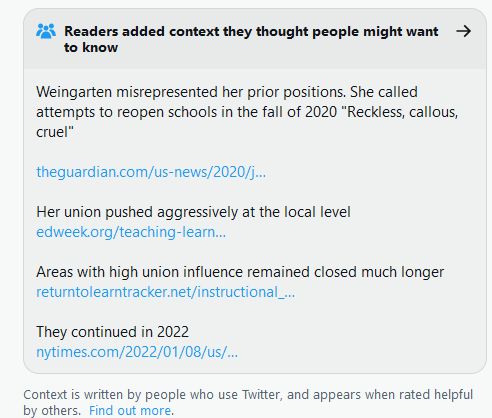
In 2020, Weingarten called attempts to reopen schools in the fall of 2020 “reckless, callous and cruel.”

What’s more, her union pushed aggressively for closures at the local level, while areas with high union influence remained closed much longer.

CNN‘s Jennings continued to shred Weingarten, stating: “I think you’ll find that most parents believe you are the tip of the spear of school closures. There are numerous statements you made over the summer of ’20 scaring people to death about the possibility of opening schools. And I hear no remorse whatsoever about the generational damage that’s been done to these kids.” 

“I have two kids with learning differences. Do you know how hard it is for them to learn at home and not in a classroom that was designed for them? And for you to sit in front of Congress and the American people and say, oh, ‘I wanted to open up them the whole time,’” I am shocked. I’m stunned. I’m stunned,” he continued. “And there are millions of parents who feel the exact same way.”

Watch:

Additionally, the NY Post reported last week that one epidemiologist claimed Weingarten even “fudged a scientific study” that showed low levels of Covid transmission in schools in order to keep schools closed during the pandemic. 

Co-author of the study, Dr. Tracy Høeg, wrote on Twitter last week: “We saw remarkably low in school transmission & no known transmission to teachers.”

She added: “The fact the [CDC] was taking the advice of the [AFT] & not the scientists publishing on this topic in their own journal and without considering the data from Europe seems to have played a role in the massive error that left millions [of] US kids out of school unnecessarily.”

Weingarten had used the study “multiple times as evidence schools needed ‘layered mitigation’ to reopen”, she said during a congressional hearing. 

“The way Ms. Weingarten mentioned me in her testimony, one might have thought I was being consulted all along but this was not the case,” Høeg said, shredding the assumptions of the union leader.

“Despite the wording in [Randi Weingarten’s] written testimony, I consistently *disagreed* w/ what she & AFT were requesting in terms of mitigation to reopen schools & I’ve said that consistently (on social media, in op-eds, on news interviews) since our study was published.”

Meanwhile, Weingarten has doubled down on Twitter – and locked down replies from the general public!

Community notes to the rescue;

Then and now;


A post shared by Defiant Ls (@defiant.ls)

Tyler Durden
Sat, 04/29/2023 – 12:00

Inflation Still Too High? Let Them Eat EVs

Inflation Still Too High? Let Them Eat EVs

Authored by Patrice Onwuka via RealClear Wire,

Inflation rose 5% last month compared with one year prior, according to the latest consumer price index. That is the lowest level of price increases since May 2021, though it’s still not down to pre-Biden and pre-pandemic levels. Inflation’s easing may provide some relief, but it will be too late to rescue many once-thriving American households.

The harsh reality is that excessive government spending, starting with the American Rescue Plan in 2021, spurred inflation and the ensuing hardship that households – especially middle-class households – are struggling with today.

President Biden has denied responsibility for the high prices. Whether Americans blame him or not, they give him no credit for helping them through it. In new Monmouth polling this week, just 10% of Americans say middle-class families benefited “a lot” from Biden’s policies, while over half (51%) say the middle class has not benefited at all. Perceptions of Biden’s support for the middle class took a nosedive from early in his term. President Donald Trump had similar low numbers early in his term, but he had turned them around by the time he left office.

In the same poll, one-quarter of the public names inflation or rising gas prices as the biggest concern facing their family right now. This proportion is down from one-third last summer, signaling that Americans are feeling a little better about the slowing of inflation.

The left is quick to credit the misleadingly named Inflation Reduction Act (IRA) for this marginal improvement, but Americans aren’t buying it. Half of adults say that the federal government’s actions over the past six months have actually hurt their families. Just 1% rank climate change as a top priority. The IRA was a climate bill dressed up as price relief, but it is not helping Americans or addressing what matters most to them.

Simply put: the left is out of touch with middle America and the middle class. In Democratic political circles, Ohio Rep. Mercy Kaptur has been circulating a stunning data visualization showing how most of the wealthiest congressional districts are represented by Democrats, and most of the poorer half of districts by Republicans. Referring to colleagues like former Speaker of the House Nancy Pelosi, she said, “There’s an elitism that pervades when you have wealth.”

The implications are clear. Politically, the terrain favors the right – at least in the House. As Cook Political Report’s Dave Wasserman told Axios, “Increasingly, districts that make up the majority of the Democratic caucus don’t really reflect the middle-income districts where the House is won and lost.”

The left’s elitism is on full display through its policies. Take President Biden’s push to force Americans to abandon gas-powered vehicles. His tougher new emissions standards could require as much as 67% of all new vehicles sold in the U.S. by 2032 to be all-electric; last year, though, electric vehicles accounted for just 5.8% of all the 13.8 million new vehicles sold in the country. The price tag of EVs is just too high, according to six in 10 Americans, which is why they wouldn’t purchase one any time soon.

Shelling out an average of more than $58,000 for a car is an afterthought for coastal elites with comfortable six-figure incomes, but it’s out of reach for many U.S. households. Furthermore, fewer EVs may qualify for the full $7,500 federal tax credit that is supposed to make them affordable under new rules proposed by the U.S. Treasury Department.

Asking a semi-retiree like “Lynne Allen” of Key West, Fla, to pay that much to purchase a car is just another “let them eat cake” policy. “Lynne” came home from a paralegal job one day to find her husband collapsed at the bottom of the stairs. She was forced to retire early to care for him, but 40-year-high inflation drove her back into the workforce. She sometimes had to clock 50 hours a week to make ends meet.

Her adult son moved back in with her and her husband. Yet all their earnings and her husband’s disability check are still not enough to afford basic necessities. Eggs are a luxury for a woman who almost bursts into tears when a customer drops a $20 bill into her tip jar. She says, “Oh, wow, that means we get chicken tonight.” She often chooses between grains and veggies, meat or no meat at all.

“We worked our whole life. We owned a charter boat. We owned a home, and we lost it all. We were still happy. We were still making it, and then [the government] just turned around and made everything harder.”

Inflation may not be rising as fast as it was two years ago, but the damage to Americans’ financial situation will be lasting.

Patrice Onwuka is director of the Center for Economic Opportunity at Independent Women’s Forum and co-host of WMAL’s O’Connor & Company.

Tyler Durden
Sat, 04/29/2023 – 11:30

Watch: ABC News Admits It Censored RFK Jr. Interview For “False Claims About Covid-19 Vaccines”

Watch: ABC News Admits It Censored RFK Jr. Interview For “False Claims About Covid-19 Vaccines”

Authored by Steve Watson via Summit News,

In a remarkable video, ABC News presented a pre-recorded interview with presidential candidate Robert F. Kennedy, telling viewers that parts of what was said had been edited out because he said something about the COVID vaccine that the news network disagrees with.

The interview was aired with clear edits made during parts where Kennedy spoke about his views on vaccines.

The interviewer Linsey Davis asked RFK Jr. about his belief that vaccination was linked to autism, which he began to explain before she jumped in and claimed that has all been debunked. The footage then skipped to a different topic entirely.

After the interview concluded, Davis told viewers “We should note that during our conversation, Kennedy made false claims about the Covid-19 vaccines.”

She claimed “Data shows that the Covid-19 vaccine has prevented millions of hospitalizations and deaths from the disease.”

“He also made misleading claims about the relationship between vaccination and autism,” Davis further asserted, adding “Research shows that vaccines and the ingredients used in the vaccines do not cause autism, including multiple studies involving more than a million children and major medical associations like the American Academy of Pediatrics and the advocacy group Autism Speaks.”

“We’ve used our editorial judgment in not including extended portions of that exchange in our interview,” Davis explained.

Remarkable.

What did Kennedy say? That the COVID vaccines don’t prevent transmission of the virus, despite government claims to the contrary? That the vaccines have caused deaths? We simply don’t know because ABC News declared itself to be the arbiter of information and openly censored him.

Here is the full interview (minus the parts you’re not allowed to hear):

*  *  *

Brand new merch now available! Get it at https://www.pjwshop.com/

In the age of mass Silicon Valley censorship It is crucial that we stay in touch. We need you to sign up for our free newsletter here. Support our sponsor – Turbo Force – a supercharged boost of clean energy without the comedown.

Also, we urgently need your financial support here.

Tyler Durden
Sat, 04/29/2023 – 09:20

Space Force, Assemble!

Space Force, Assemble!

General Chance Saltzman, Chief of Space Operations for the U.S. Space Force, warned last week that the U.S. is facing a new era of space activity:

“The threats that we face to our on-orbit capabilities from our strategic competitors [have] grown substantially”, he told CNBC’s “Manifest Space” podcast.

The Space Force has grown substantially since its 2019 inception: Both in terms of personnel and budget.

Infographic: Space Force, Assemble! | Statista

You will find more infographics at Statista

As Statista’s Martin Armstrong shows in the infographic above, end-strength personnel in 2021 was almost 10 thousand, while the budget was $15.4 billion.

In 2023. the personnel level had to over 13,500. Representing an even larger jump, Space Force’s budget leapt up to nearly $25 billion in 2023.

Tyler Durden
Sat, 04/29/2023 – 08:45

Blinken Draws Fire Over Afghanistan Blame Game, ‘Stonewalling’

Blinken Draws Fire Over Afghanistan Blame Game, ‘Stonewalling’

Authored by Susan Crabtree via RealClear Wire,

Former Ambassador Thomas Boyatt, a highly decorated foreign service officer who served in multiple senior U.S. foreign service roles in the 1970s and 80s, has a bone to pick with Secretary of State Antony Blinken.

Since the chaotic and deadly U.S. exit from Afghanistan, Blinken has refused to turn over to Congress a key internal State Department dissent document signed by 23 U.S. diplomats at the embassy in Kabul. The classified cable was sent to Blinken and top leadership at State in July 2021, one month before the evacuation descended into chaos. The classified memo reportedly urged the administration to accelerate evacuation plans because the Afghan government was on the brink of collapse as the Taliban swept the country. Its existence was leaked to the Wall Street Journal after the Taliban took control of the country and the U.S. withdrawal quickly went sideways.

What’s worse, in Boyatt’s view, is that the State Department is now using a misleading precedent surrounding a dissent cable he sent nearly 50 years ago as its rationale for withholding the Afghanistan dissent document from Congress.

When Boyatt learned about Blinken’s refusal and his reasons –  that he was trying to protect future dissent cables from a chilling effect – “It was like tearing off the scab of an old wound of mine,” Boyatt, now 90, told RealClearPolitics Tuesday.

Blinken had cited the 1975 precedent of the department’s refusal to provide Congress the dissent cable written by Boyatt before Turkey invaded Cyprus just a year before. Boyatt recently provided a statement to Rep. Mike McCaul, slamming Blinken’s stated concerns about protecting the integrity of the dissent cable system as “bullshit.”

McCaul, a Texas Republican who now chairs the House Foreign Affairs Committee, has been requesting the cable since first learning about it in late August of 2021 while events were unraveling in Kabul. Last week, a deadline passed for McCaul’s subpoena for the cable, with Blinken still resisting.

While serving as the State Department’s director for Cyprus affairs, Boyatt used the official dissent channel to warn then-Secretary of State Henry Kissinger and the Nixon administration that the Greek army was planning to overthrow the Cypriot president and install a puppet Cypriot government. If this were to occur, his cable warned, Turkey’s armed forces would invade Cyprus and establish a Turk-Cypriot mini-state on Cyprus, leading to the displacement of Cyprus’s ethnic communities and fueling Turkey’s expansionist objectives. Boyatt says he decided to utilize the dissent cable process to alert the Nixon administration about the impending invasion after exhausting normal State Department channels.

Instead of attempting to stop the invasion, however, Kissinger removed Boyatt from his position in Cyprus five days after he sent the cable. Boyatt went on to serve as counselor in the U.S. embassy in Chile while events in Cyprus unfolded just as he had warned.

Boyatt notes that his friend, Rodger Davies, who was serving as ambassador to Cyprus at the time, was shot dead during a Greek Cypriot protest outside the U.S. embassy. It was just a week after Turkey’s invasion, and roughly 300 people were protesting against the United States’ failure to prevent the Turkish invasion.

After the Nixon administration, Boyatt served as ambassador to Upper Volta in 1978 and ambassador to Colombia in 1980. Even before Kissinger punished him for airing opposition through the classified dissent cable process, Boyatt was already a hero within the agency – lauded for his bravery demonstrated during a 1969 TWA flight he was on that was hijacked by Palestinian terrorists. That year, the State Department honored him with its Meritorious Honor Award for helping injured passengers to safety and negotiating the passengers’ release with the Syrian government.  

Roughly a year after Turkey invaded Cyprus, a Democratic-controlled House committee decided to scrutinize the Nixon administration’s foreign policies in Cambodia, Chile, and Cyprus. It demanded that Kissinger hand over Boyatt’s dissent cable on Cyprus. Kissinger refused, arguing that he wanted to protect Boyatt from retaliation.

“That was a joke at the time,” Boyatt recalled, explaining that back then, “everybody in my world” was well aware of Kissinger’s penchant for punishing those who challenged his judgment and the administration’s prevailing foreign policies.

State Department officials across the agency were on edge because Kissinger had recently retaliated against another U.S. diplomat, Archer Blood, for sending what was considered one of the most strongly worded cables in the history of the U.S. foreign service while serving as U.S. consul general to Dhaka, East Pakistan (now Bangladesh). Signed by 20 members of the diplomatic staff. the “Blood Telegram” protested the atrocities being committed in the Bangladesh Liberation War.

The dissent memo angered Kissinger, who recalled Blood from the position and assigned him to the State Department personnel office, retribution for airing his views contradicting Kissinger’s and Nixon’s hopes of using the support of West Pakistan for diplomatic openings with China.

Even though the demotion severely harmed Blood’s career, his telegram became the precursor to the creation of the official State Department “dissent channel” that formed in the following years, the same system Boyatt used to air his warnings. The State Department agreed to establish the channel partly in response to concerns that contrary opinions were suppressed or ignored during the Vietnam War. In 1971, Blood received a prestigious Christian Herter Award for “extraordinary accomplishment involving initiative, integrity, intellectual courage, and creative dissent.” The Herter Award was established by the American Foreign Service Association, AFSA, the U.S. foreign service labor union, to honor senior diplomats who challenge the status quo.

“The point is that nobody in Washington or the State Department or anyone else believed that Kissinger’s concern was for the well-being of the dissenters,” Boyatt recalled. “His concern was that he did not want a series of mistakes in the public record with respect to the Cyprus crisis. I strongly suspect that that is the same motive with Blinken.” 

The State Department has vigorously defended its decision to fight McCaul’s subpoena. The agency also denied a request for the cable by Rep. Gregory Meeks, a New York Democrat who chaired the panel before Republicans won the majority last year.

Instead, State has offered to provide a closed-door briefing, proposed for later this week, for McCaul and other members of Congress about the “concerns raised and the challenges identified” by U.S. embassy staff in Kabul before and during the withdrawal, State Department spokesperson Vedant Patel told RCP.

Secretary Blinken has continued to make clear his and the State Department’s commitment to working with the House Foreign Affairs committee to provide relevant information while also upholding his responsibility to protect the integrity of the Department’s dissent channel,” Patel said in an emailed statement. “We continue to believe that our offers can satisfactorily provide the committee with the information it needs to conduct its oversight function while still protecting the dissent channel.”

McCaul has repeatedly dismissed Blinken’s justification for withholding the Afghanistan dissent cable and has pledged to pursue legal recourse if Blinken continues to ignore his subpoena. While McCaul has accepted State’s offer for a briefing, he has told the agency that it in no way satisfies the subpoena.

“I am currently discussing next steps with my staff and House legal counsels to decide on what action to take if the State Department continues to refuse to comply with the subpoena despite their legal obligation to do so,” McCaul said in a statement last week.

Boyatt also rejects the State Department’s rationale that it’s simply protecting dissenters from retaliation and trying to prevent a chilling effect on future dissent.

“The reality is that if a dissent cable or dissent memorandum for one reason or another reaches public purview, it’s good for a variety of national security reasons because it forces the bureaucracy to confront its mistakes and to concentrate on not repeating them,” Boyatt said.

The dissenters themselves are applauded by their peers, Boyatt said, and rightly so because all foreign service officers take an oath to support and defend the Constitution against all enemies, foreign and domestic, and to do their best to support U.S. foreign policy interests.

“They instantly become heroes to some 15,000 foreign service officers serving all over the world,” he added. “They become eligible for, and many do receive, awards from the American Foreign Service Association for creative dissent.”

Underscoring his point, two diplomats stationed in Kabul who signed the July 2021 dissent cable recently received AFSA’s William R. Rivkin Award for Constructive Dissent by a Mid-Level Foreign Service Officer. The union publicly recognized the pair for their “courage” in using the classified dissent channel to “speak an unpopular truth to power.”

Elisabeth Zenos and Anton Cooper, foreign service officers who served in Kabul in 2020 and 2021, embody “the best traditions of the Foreign Service and constructive dissent in a uniquely difficult moment, bringing their intellectual courage, astute analysis and willingness to speak an unpopular truth to power,” AFSA wrote about the pair on its website.

“Using the appropriate internal embassy channels, Ms. Zentos and Mr. Cooper presented their concerns and a proposed course of action,” the organization said, adding that Zentos and Cooper turned to the dissent channel when their positions differed from the “established views of decision-makers.”

AFSA also noted that the cable received the “required response from the secretary of state’s policy planning staff, and preparations reportedly sped up – but unfortunately, not quickly enough to avoid the events that transpired in Kabul.”

Despite choosing Zentos and Cooper for the award, one of several the union handed out in 2022, AFSA has defended Blinken’s decision to withhold the dissent cable from Congress. In March, Eric Rubin, the union’s president, said the dissent channel must be protected under the executive branch or risk undermining the privileged purposes the secure communication line provides.

“AFSA maintains that constructive dissent can only thrive and be successful if it remains confidential and confined to internal discussion within the executive branch,” Rubin said in the statement. 

Boyatt strongly disagrees and says he’s hardly alone among his State Department colleagues, current and retired. “I think they’re wrong, and the next time I see [Rubin], the current president, I’m going to tell him that,” Boyatt told RCP.

Republicans over the last week have hammered the Biden administration for what they characterized as more than a year of stonewalling their oversight requests for key Afghanistan documents. McCaul on Tuesday sent a separate letter to Blinken asking for the public release of key parts of its after-action review of the Afghanistan withdrawal. The Texas Republican stressed that some of the information in the report that he’s reviewed “stands directly at odds with the administration’s public narratives.”

The 87-page report was completed more than a year ago and was only provided to Congress recently after a subpoena threat from Republicans. McCaul also took issue with State’s decision to withhold parts of the after-action review from the public even though the vast majority of its contents are marked as either “sensitive but unclassified” or “unclassified.” The unclassified sections of the review, including the executive summary, findings, and recommendations, should be released “immediately,” and an unclassified version of the complete document within 60 days, McCaul argued.  

State Department spokesman Vedant Patel on Tuesday said there are “no plans” at the moment to declassify the after-action review and release it publicly.

On April 6, while Congress was out of town and two days before Easter weekend, the Biden administration released a 12-page unclassified document claiming to summarize the findings of the after-action review. John Kirby, the National Security Council spokesman, released the summary 10 minutes before appearing at a White House press conference. The move drew criticism from several reporters who publicly complained of being blind-sided by the report.

While the summary acknowledged mistakes in evaluating the risks of a Taliban takeover of the Afghan government, the Biden administration defended its decision to end the war and blamed the Trump administration for leaving them with few options and even less planning capability. 

When RealClearPolitics’ Phil Wegmann asked if the after-action review summary included information about the dissent cable, Kirby referred him to the State Department. During the briefing, reporters also repeatedly questioned Kirby for denying that the Afghanistan evacuation was chaotic despite disturbing photos and videos that emerged amid the final days of the withdrawal.

“For all this talk of chaos, I just didn’t see it,” Kirby told reporters during the White House briefing, adding, “I just don’t buy the whole argument of chaos.”

The shocking images from the final days of the Afghanistan withdrawal showed desperate Afghans clinging to the wings and wheels of U.S. military planes taking off from Kabul, including images of several Afghans falling to their deaths. On August 26, a suicide bomber killed 13 U.S. servicemen and women, injured 45 others, and killed 170 Afghans after the Taliban took control of the country and panicked Afghans, along with U.S. citizens, jammed into the Kabul airport in a desperate attempt to flee.

Last month, Sgt. Tyler Vargas-Andrews, a Marine sniper, told a House hearing convened by McCaul that his military leaders ignored his warnings about the suicide bomber’s movements. Several minutes later, the bomber detonated his vest in a blast that cost Vargas-Andrews a leg, an arm, and a kidney. Vargas-Andrews has undergone 44 surgeries over the last year and a half. 

After the Biden administration released the 12-page summary report, a former U.S. ambassador to Afghanistan called the document “shameful” and “a White House whitewash.”

Retired Ambassador Ryan Crocker, who capped a four-decade foreign service career as the top U.S. diplomat in Kabul in 2011 and 2012, said the Trump administration bears blame for adhering to a pre-determined end date for the exit of U.S. and NATO forces, but that doesn’t absolve Biden for carrying out the Trump policy without setting conditions or considering shifting dynamics on the ground.

“Frankly, it’s dishonest,” Crocker said of the Biden administration’s repeated blaming of Trump and his senior foreign policy leaders. “This administration – ably and amply assisted by the previous administration, of course – were the ones who set the stage for that incredibly swift Taliban takeover.”

Crocker also blasted the summary for touting the Biden administration’s work to ramp up the processing of special immigrant visas for Afghans who aided Americans as interpreters and in other roles that makes them Taliban targets while failing to mention that hundreds of thousands of Afghan allies are still trying to flee the country.

The absence of any mention of our broken promises to Afghan allies is “as shameful and as egregious to me as anything in that document,” Crocker said. More than 150,000 special immigrant visa applicants are still trying to escape Afghanistan, according to internal Biden administration estimates, Foreign Policy reported in March. Other advocates say the numbers could be twice as high.

Crocker says he believes Blinken should provide the dissent cable to Congress without the names of those who signed it to protect their identities and prevent any possible harm to their careers “down the line,” especially when it comes to younger foreign service officers. 

“I certainly believe that with an issue of this magnitude, Congress has an obligation to seek, and the executive has an obligation to provide, access to reports that have a direct bearing on a huge foreign-policy issue,” he told RCP. 

It was appropriate to keep the document classified in the weeks after it was first generated amid a quickly deteriorating situation in Afghanistan, Crocker said, but those reasons no longer apply.

“That’s not what you would want to have out on the street available to our adversaries in the middle of this whole thing, but my guess is now that we are way, way past that … the classification has to be re-looked in light of the current situation,” he said.

Crocker also has a personal experience of voicing dissent, although there was no time to put his views into writing or to get a cable out. In the fall of 1983, several months after the deadly bombing of the U.S. embassy in Beirut, Crocker said the Reagan White House envoy for Lebanon, Robert “Bud” McFarlane, “got himself panicked by a Lebanese brigade commander that the forces of darkness were sweeping all the forests and unless we did something, they would have seized the presidential palace complex within a matter of hours.”

Crocker said he received a call from David Mack, a former ambassador to the United Arab Emirates who was serving as the director of Syria, Lebanon, and Jordan back at the State Department at the time. Mack told him what the recommendation was and asked for his thoughts.

“I thought it was a catastrophic mistake, and then dictated to him over a secure phone my opposition to it and why – [That it was] essentially dragging us as a participant into the Lebanese civil war,” Crocker recalled. “Like most messages, it was basically ignored.”

McFarlane has been criticized for his decision to order the USS New Jersey to bombard Lebanese opposition forces, which may have led to the 1983 Beirut barracks bombing where 241 U.S. servicemen, 58 French military personnel, and six civilians were killed. After that assignment, McFarlane returned to Washington and became President Reagan’s national security adviser and a central figure in the Iran-Contra affair.

A year or so later after formally objecting, Crocker received an award by AFSA for creative dissent for choosing to voice his opposition to the prevailing foreign policy opinion.

“Again, it had no impact whatsoever, but I would have been perfectly fine if that message was released or the transcription was released and my name was attached to it,” he said. “It would not have bothered me in the slightest. I would have been happy.”

The White House also has tried to defend itself against searing criticism from Special Inspector General for Afghanistan Reconstruction John Sopko, who accused the administration last week of unprecedented obstruction of his oversight of the chaotic withdrawal from Kabul.

The morning before Sopko testified to the House Oversight Committee, the administration, in a memo to reporters, argued that it had provided “thousands of pages of documents, analyses, spreadsheets, and written responses to questions, as well as hundreds of briefings to bipartisan members and staff and public congressional testimony by senior officials, all while consistently providing updates and information to numerous inspectors general.”

White House press secretary Karine Jean-Pierre repeated the claim in tense exchanges with reporters during her daily briefing. There was no mention, however, of Blinken’s refusal to provide a copy of the dissent cable.

Susan Crabtree is RealClearPolitics’ White House/national political correspondent.

Tyler Durden
Sat, 04/29/2023 – 08:10

Russian Next-Gen T-14 Tank Makes Ukraine Debut

Russian Next-Gen T-14 Tank Makes Ukraine Debut

While Western nations are working to upgrade Ukraine’s ground game with US M-1 Abrams and German Leopard 2 tanks, Russia has now introduced its latest-generation tank into the war in Ukraine, according to Russia’s state-owned RIA. 

The new Russian tank is the T-14 Armata, which features an unmanned turret, with a three-man crew operating the vehicle from what RIA describes as an “isolated armored capsule located at the front of the hull.” The tank has a maximum highway speed of 50 miles per hour. 

A T-14 Armata on Tverskaya Street in Moscow before a Victory Day parade (TASS vis Daily Mail)

It’s equipped with a 125mm smoothbore main gun with a reported range of 8 kilometers. The gun is fed by an automated loader with a 45-round capacity, and can also fire laser-guided missiles

On defense, it has both reactive armor that explodes outward upon a projectile’s impact, and an “active protection system” (APS), which BBC has described as “essentially an anti-missile system for tanks, with radars capable of tracking the incoming anti-tank missile, and projectiles that are launched to disrupt or destroy it.” The T-14 is additionally distinguished from predecessor T-90 tanks by having higher ground clearance.  

A developer also claimed the tank would have technology to hide it from radar- and heat-seeking targeting systems: “We essentially made the tank invisible.” RIA reports the deployed T-14s have received “additional side protection from anti-tank ammunition.”

Until now, T-14 appearances have been largely limited to a series of Moscow Victory Day parades stretching all the way back to 2015, though RIA says they have been “tested in Syria.” 

T-14 Armata tanks traverse Moscow’s Red Square at the 2020 Victory Day parade (Host Photo/Evgeny Biyatov via Reuters)

Why has it taken so long for this supposed cutting-edge weapon to appear in Ukraine? Especially where military procurement is concerned, it turns out the Russians aren’t so different from the United States. 

“Eleven years in development, the [T-14 Armata] programme has been dogged with delays, reduction in planned fleet size, and reports of manufacturing problems,” the British military said in January.

The initial order called for 2,300 of them to be delivered by 2020. However, the UK claims “production is probably only in the low tens, while commanders are unlikely to trust the vehicle in combat,” and suggested its introduction in Ukraine may largely be for propaganda purposes. Of course, that jab may itself be propaganda. 

Lending some credence to the claim of commander hesitancy, RIA‘s source says Russia is proceeding gradually with using the T-14 in Ukraine: “Russian troops have begun to use the latest Armata tanks to fire on Ukrainian positions. They have not yet participated in direct assault operations.”

Meanwhile, Ukrainians are slated to begin 10 weeks of training on US M-1 tanks at Grafenwoehr Training Area in the next few weeks. That means we could see M-1 vs T-14 bouts by early fall — assuming the West continues thwarting attempts to reach a negotiated peace

Tyler Durden
Sat, 04/29/2023 – 07:35

“We Simply Don’t Have The Ammo” – Polish General Says Can No Longer Supply Ukraine, Warns Russia Has Resources To Continue War

“We Simply Don’t Have The Ammo” – Polish General Says Can No Longer Supply Ukraine, Warns Russia Has Resources To Continue War

Via Remix News,

Speaking at a strategy session of the National Security Bureau, the Polish Armed Forces chief of staff General Rajmund Andrzejczak said that when he analyzes the war in Ukraine politically, he is pessimistic.

This is, he explained, because “there is nothing that indicates that Russia will lack the resources to continue the conflict.”

He said during the session that he did not feel sanctions would stop Russia from having the funds to continue the war.

The general also offered a bleak assessment of Poland’s ability to send ammunition to Ukraine.

“We simply don’t have the ammunition. Our industry isn’t ready to send the equipment to Ukraine and to maintain our own dwindling reserves,” he said.

He noted that he was tirelessly presenting such an analysis in order to raise awareness.

He continued his remarks by saying that “war is not the business of soldiers.”

It is rather “a question of politics with economic factors involving finance, infrastructure, technology, food, and a range of other problems that you have to figure into the equation to be able to understand it.” 

Gen. Andrzejczak observed that “Ukraine is experiencing huge financial problems,” despite the huge aid packages it was receiving from the U.S., the West and Poland.

Gen. Andrzejczak told the National Security Bureau that he regarded the security situation facing Poland as highly dangerous. Asked if the leaders of the West appreciated how far Ukraine is from winning the war with Russia, he opined that “an honest assessment of the threats was still both a surprise and a shock for most of them.”

The general also said there was no indication that Ukrainians who fled their country would return home to start reconstruction, adding that he felt that the NATO summit in Vilnius will be “a summit to define our credibility, of NATO, and the whole of the West.”

If the response was “late” and lacking in determination, then Ukraine would have no chance of a secure future.

Tyler Durden
Sat, 04/29/2023 – 07:00

Escobar: De-Dollarization Kicks Into High Gear

Escobar: De-Dollarization Kicks Into High Gear

Authored by Pepe Escobar via The Cradle,

The US dollar is essential to US global power projection. But in 2022, the dollar share of reserve currencies slid 10 times faster than the average in the past two decades…

It is now established that the US dollar’s status as a global reserve currency is eroding. When corporate western media begins to attack the multipolar world’s de-dollarization narrative in earnest, you know the panic in Washington has fully set in.

The numbers: the dollar share of global reserves was 73 percent in 2001, 55 percent in 2021, and 47 percent in 2022. The key takeaway is that last year, the dollar share slid 10 times faster than the average in the past two decades.

Now it is no longer far-fetched to project a global dollar share of only 30 percent by the end of 2024, coinciding with the next US presidential election.

The defining moment – the actual trigger leading to the Fall of the Hegemon – was in February 2022, when over $300 billion in Russian foreign reserves were “frozen” by the collective west, and every other country on the planet began fearing for their own dollar stores abroad. There was some comic relief in this absurd move, though: the EU “can’t find” most of it.

Now cue to some current essential developments on the trading front.

Over 70 percent of trade deals between Russia and China now use either the ruble or the yuan, according to Russian Finance Minister Anton Siluanov.

Russia and India are trading oil in rupees. Less than four weeks ago, Banco Bocom BBM became the first Latin American bank to sign up as a direct participant of the Cross-Border Interbank Payment System (CIPS), which is the Chinese alternative to the western-led financial messaging system, SWIFT.

China’s CNOOC and France’s Total signed their first LNG trade in yuan via the Shanghai Petroleum and Natural Gas Exchange.

The deal between Russia and Bangladesh for the construction of the Rooppur nuclear plant will also bypass the US dollar. The first $300 million payment will be in yuan, but Russia will try to switch the next ones to rubles.

Russia and Bolivia’s bilateral trade now accepts settlements in Boliviano. That’s extremely pertinent, considering Rosatom’s drive to be a crucial part of the development of lithium deposits in Bolivia.

Notably, many of those trades involve BRICS countries – and beyond. At least 19 nations have already requested to join BRICS+, the extended version of the 21st century’s major multipolar institution, whose founding members are Brazil, Russia, India, and China, then South Africa. The foreign ministers of the original five will start discussing the modalities of accession for new members in an upcoming June summit in Capetown.

BRICS, as it stands, is already more relevant to the global economy than the G7. The latest IMF figures reveal that the existing five BRICS nations will contribute 32.1 percent to global growth, compared to the G7’s 29.9 percent.

With Iran, Saudi Arabia, UAE, Turkey, Indonesia, and Mexico as possible new members, it is clear that key Global South players are starting to focus on the quintessential multilateral institution capable of smashing Western hegemony.

Russian President Vladimir Putin and Saudi Crown Prince Mohammad bin Salman (MbS) are working in total sync as Moscow’s partnership with Riyadh in OPEC+ metastasizes into BRICS+, in parallel to the deepening Russia-Iran strategic partnership.

MbS has willfully steered Saudi Arabia toward Eurasia’s new power trio Russia-Iran-China (RIC), away from the US. The new game in West Asia is the incoming BRIICSS – featuring, remarkably, both Iran and Saudi Arabia, whose historic reconciliation was brokered by yet another BRICS heavyweight, China.

Importantly, the evolving Iran-Saudi rapprochement also implies a much closer relationship between the Gulf Cooperation Council (GCC) as a whole and the Russia-China strategic partnership.

This will translate into complementary roles – in terms of trade connectivity and payment systems – for the International North-South Transportation Corridor (INSTC), linking Russia-Iran-India, and the China-Central-Asia-West Asia Economic Corridor, a key plank of Beijing’s ambitious, multi-trillion-dollar Belt and Road Initiative (BRI).

Today, only Brazil, with its President Luiz Inácio Lula Da Silva caged by the Americans and an erratic foreign policy, runs the risk of being relegated by the BRICS to the status of a secondary player.

Beyond BRIICSS

The de-dollarization train has been propelled to high-speed status by the accumulated effects of Covid-linked supply chain chaos and collective western sanctions on Russia.

The essential point is this: The BRICS have the commodities, and the G7 controls finance. The latter can’t grow commodities, but the former can create currencies – especially when their value is linked to tangibles like gold, oil, minerals, and other natural resources.

Arguably the key swing factor is that pricing for oil and gold is already shifting to Russia, China, and West Asia.

In consequence, demand for dollar-denominated bonds is slowly but surely collapsing. Trillions of US dollars will inevitably start to go back home – shattering the dollar’s purchasing power and its exchange rate.

The fall of a weaponized currency will end up smashing the whole logic behind the US’ global network of 800+ military bases and their operating budgets.

Since mid-March, in Moscow, during the Economic Forum of the Commonwealth of Independent States (CSI) – one of the key inter-government organizations in Eurasia formed after the fall of the USSR – further integration is being actively discussed between the CSI, the Eurasia Economic Union (EAEU), the Shanghai Cooperation Organization (SCO) and the BRICS.

Eurasian organizations coordinating the counterpunch to the current western-led system, which tramples on international law, was not by accident one of the key themes of Russian Foreign Minister Sergey Lavrov’s speech at the UN earlier this week. It is also no accident that four member-states of the CIS – Russia and three Central Asian “stans” – founded the SCO along with China in June 2001.

The Davos/Great Reset globalist combo, for all practical purposes, declared war on oil immediately after the start of Russia’s Special Military Operation (SMO) in Ukraine. They threatened OPEC+ to isolate Russia – or else, but failed humiliatingly. OPEC+, effectively run by Moscow-Riyadh, now rules the global oil market.

Western elites are in a panic. Especially after Lula’s bombshell on Chinese soil during his visit with Xi Jinping, when he called on the whole Global South to replace the US dollar with their own currencies in international trade.

Christine Lagarde, president of the European Central Bank (ECB), recently told the New York-based Council of Foreign Relations – the heart of the US establishment matrix – that “geopolitical tensions between the US and China could raise inflation by 5 percent and threaten the dominance of the dollar and euro.”

The monolithic spin across western mainstream media is that BRICS economies trading normally with Russia “creates new problems for the rest of the world.” That’s utter nonsense: it only creates problems for the dollar and the euro.

The collective west is reaching Desperation Row – now timed with the astonishing announcement of a Biden-Harris US presidential ticket running again in 2024. This means that the US administration’s neo-con handlers will double down on their plan to unleash an industrial war against both Russia and China by 2025.

The petroyuan cometh

And that brings us back to de-dollarization and what will replace the hegemonic reserve currency of the world. Today, the GCC represents more than 25 percent of global oil exports (Saudi Arabia stands at 17 percent). More than 25 percent of China’s oil imports come from Riyadh. And China, predictably, is the GCC’s top trading partner.

The Shanghai Petroleum and Natural Gas Exchange went into business in March 2018. Any oil producer, from anywhere, can sell in Shanghai in yuan today. This means that the balance of power in the oil markets is already shifting from the US dollar to the yuan.

The catch is that most oil producers prefer not to keep large stashes of yuan; after all, everyone is still used to the petrodollar. Cue to Beijing linking crude futures in Shanghai to converting yuan into gold. And all that without touching China’s massive gold reserves.

This simple process happens via gold exchanges set up in Shanghai and Hong Kong. And not by accident, it lies at the heart of a new currency to bypass the dollar being discussed by the EAEU.

Dumping the dollar already has a mechanism: making full use of the Shanghai Energy Exchange’s future oil contracts in yuan. That’s the preferred path for the end of the petrodollar.

US global power projection is fundamentally based on controlling the global currency. Economic control underlies the Pentagon’s ‘Full Spectrum Dominance’ doctrine. Yet now, even military projection is in shambles, with Russia maintaining an unreachable advance on hypersonic missiles and Russia-China-Iran able to deploy an array of carrier-killers.

The Hegemon – clinging to a toxic cocktail of neoliberalism, sanction dementia, and widespread threats – is bleeding from within. De-dollarization is an inevitable response to system collapse. In a Sun Tzu 2.0 environment, it is no wonder the Russia-China strategic partnership exhibits no intention of interrupting the enemy when he is so busy defeating himself.

Tyler Durden
Fri, 04/28/2023 – 23:40

How Smart Is ChatGPT?

How Smart Is ChatGPT?

ChatGPT, a language model developed by OpenAI, has become incredibly popular over the past year due to its ability to generate human-like responses in a wide range of circumstances.

In fact, ChatGPT has become so competent, that students are now using it to help them with their homework. This has prompted several U.S. school districts to block devices from accessing the model while on their networks.

So, how smart is ChatGPT?

In a technical report released on March 27, 2023, OpenAI provided a comprehensive brief on its most recent model, known as GPT-4. Included in this report were a set of exam results, which Visual Capitalist’s Marcus Lu and Rosey Eason visualized in the graphic above.

GPT-4 vs. GPT-3.5

To benchmark the capabilities of ChatGPT, OpenAI simulated test runs of various professional and academic exams. This includes SATs, the bar examination, and various advanced placement (AP) finals.

Performance was measured in percentiles, which were based on the most recently available score distributions for test takers of each exam type.

Percentile scoring is a way of ranking one’s performance relative to the performance of others. For instance, if you placed in the 60th percentile on a test, this means that you scored higher than 60% of test-takers.

The following table lists the results that we visualized in the graphic.

The scores reported above are for GPT-4 with visual inputs enabled. Please see OpenAI’s technical report for more comprehensive results.

As we can see, GPT-4 (released in March 2023) is much more capable than GPT-3.5 (released March 2022) in the majority of these exams. It was, however, unable to improve in AP English and in competitive programming.

Regarding AP English (and other exams where written responses were required), ChatGPT’s submissions were graded by “1-2 qualified third-party contractors with relevant work experience grading those essays”. While ChatGPT is certainly capable of producing adequate essays, it may have struggled to comprehend the exam’s prompts.

For competitive programming, GPT attempted 10 Codeforces contests 100 times each. Codeforces hosts competitive programming contests where participants must solve complex problems. GPT-4’s average Codeforces rating is 392 (below the 5th percentile), while its highest on a single contest was around 1,300. Referencing the Codeforces ratings page, the top-scoring user is jiangly from China with a rating of 3,841.

What’s Changed With GPT-4?

Here are some areas where GPT-4 has improved the user experience over GPT-3.5.

Internet Access and Plugins

A limiting factor with GPT-3.5 was that it didn’t have access to the internet and was only trained on data up to June 2021.

With GPT-4, users will have access to various plugins that empower ChatGPT to access the internet, provide more up to date responses, and complete a wider range of tasks. This includes third-party plugins from services such as Expedia which will enable ChatGPT to book an entire vacation for you.

Visual Inputs

While GPT-3.5 could only accept text inputs, GPT-4 has the ability to also analyze images. Users will be able to ask ChatGPT to describe a photo, analyze a chart, or even explain a meme.

Greater Context Length

Lastly, GPT-4 is able to handle much larger amounts of text and keep conversations going for longer. For reference, GPT-3.5 had a max request value of 4,096 tokens, which is equivalent to roughly 3,000 words. GPT-4 has two variants, one with 8,192 tokens (6,000 words) and another with 32,768 tokens (24,000 words).

Tyler Durden
Fri, 04/28/2023 – 23:20

We Should Really Be Having More Kids

We Should Really Be Having More Kids

Submitted by Jack Raines via Young Money,

In 27 BC, Caesar Augustus was crowned the first Roman emperor. Widely considered one of Rome’s greatest leaders, Augustus’s reign marked the beginning of the 200-year Pax Romana.

One reason that the Roman Empire flourished during this time was its first-class transportation and sewage infrastructure that supported densely-populated cities, with Rome itself boasting an estimated one million residents at its peak.

However, these population centers were also susceptible to epidemics, disease, and lead poisoning (lead was commonly used in pipes, eating utensils, and even food and drinks), yielding high infant mortality rates and low life expectancies (maximum ~33 years).

Low life expectancy + expansive territories meant that the Roman Empire needed high birth rates to maintain enough soldiers to defend its borders, and Rome struggled to keep its birth rates above the population replacement rate. This issue was so important that Augustus offered tax breaks for large families and cracked down on abortion and adultery because he believed that “too many men spent their energy with prostitutes and concubines and had nothing for their wives, causing population declines.

But government efforts never succeeded in meaningfully increasing birth rates.

At the conclusion of the Pax Romana, low birth rates, combined with plague and war, wreaked havoc on Rome’s population, and the power structure of the empire shifted to the newer Constantinople. Rome never recovered, with the city’s population dwindling from a peak of 1,000,000 residents in the late second century to ~30,000 by 600 AD.

We humans draw parallels and analogies across time and space because they help us better understand the world around us, and no two Western civilizations have attracted more comparisons than the Roman Empire and the United States of America.

Both nations experienced explosions of wealth and eras of unprecedented peace, both nations were the dominant global powers of their respective eras, and today, the US faces the same issue that plagued Rome 2,000 years ago: declining birth rates.

In The Sun Also Rises, Hemingway penned this now timeless exchange:

“How did you go bankrupt?” Bill asked. “Two ways,” Mike said. “Gradually, and then suddenly.”

Ernest Hemingway: The Sun Also Rises

We worry about global warfare and pandemics because they’re big and scary and sudden and could wipe us out with a sudden BANG! But the real existential threat, declining birth rates, will progress like Mike’s bankruptcy: gradually, and then suddenly.

Allow me to demonstrate through some basic arithmetic.

~2.1 children per woman is the typical population replacement rate in a developed country, and the US currently has a total fertility rate (which measures the average number of children that would be born per woman if all women lived to the end of their childbearing years and bore children according to a given fertility rate at each age): of 1.84. This means that (assuming this rate holds constant) every 100 parents will yield 92 children and ~85 grandchildren. And keep in mind, rates have been on a steady decline for years.

It’s a bear market for babies.

This isn’t just a US problem. We’re seeing these trends of sub-replacement fertility rates occurring all over the developed world:

  • South Korea: 1.11

  • Spain: 1.29

  • Japan: 1.39

  • China: 1.45

  • Austria: 1.51

  • Canada: 1.57

  • Germany: 1.58

  • United Kingdom: 1.63

  • Sweden: 1.67

So now you might be thinking, “Okay, declining birth rates ‘sound’ scary, but who cares? Like, why does it matter?

At the individual level, it doesn’t matter. You have every right to think, “It’s no one else’s business if I don’t have kids!” But once a critical mass of individuals decides not to have kids, there are societal consequences.

In her recent piece, Everything’s a Pyramid Scheme, Katie Gatti Tassin highlighted a logical fallacy in the “retire early” movement:

I’ve long pointed out the fact that financial independence and early retirement cannot exist at scale, because our economic system would cease functioning. If every young person in their thirties or forties achieved financial independence and quit working, the workforce would be limited to those under the age of 35, effectively removing roughly 66% of the current labor force, or the equivalent of about 44 million people…

Of course, there’s a funny redundancy in the system: If 44 million working-age people retired en masse and ceased most discretionary spending…corporate profits would drop, the stock market would stutter to a halt, and the returns required to support early retirement would vanish, driving everyone back to work.

Katie Gatti Tassin

Basically, retiring early works for individuals, but it could never work at scale because our economy would collapse without enough workers to keep it functioning smoothly. The Financially Independent, Retire Early (FIRE) movement only works as long as the majority of society fails to FIRE.

Now, back to the babies.

One big reason that our advanced and wealthy societies have become so advanced and wealthy is that growing populations created a growing labor force which, coupled with technological advancements, powered growing economies and widespread wealth creation.

And now, our advanced, wealthy societies have devised systems that allow folks to retire and live their golden years in relative ease and decadence thanks to a combination of personal savings/investments and social safety nets.

These social safety nets are supported by taxes, which are funded by taxpayers, aka workers. And our number of workers has been steadily increasing since the Industrial Revolution.

But now people are having fewer kids, meaning that down the road, we’ll have fewer workers. And when life expectancies are higher than ever while birth rates are lower than ever and everyone still wants to retire on time… well, you see where I’m going with this? The math doesn’t add up.

(Katie actually made this same observation to highlight the absurdity of individualism).

So not to be a complete doomer here, but it feels a lot like we’re climbing the initial ascent on a rollercoaster, and we’re about to hit the apex.

What does the descent look like? I don’t really know, because we haven’t actually seen a large-scale population decline in the modern era, but I imagine it would go something like this:

  • Social programs that we take for granted will no longer be feasible.

  • People will have to work longer (you’re already seeing protests about this in France after the pension reform).

  • Stock and real estate markets will decline as lower populations reduce consumer demand, hurting corporate profits and property values.

So after considering why declining birth rates matter, I had another question: Why, given the risks associated with birth rate declines, are we still experiencing said declines in developed countries?

Like, this problem is pretty obvious, so why aren’t we making more babies?

I have a few hypotheses:

1) Kids are expensive (both in perception and reality).

The US Department of Health & Human Services estimates that the average family with infants would need to pay $16,000 per year to cover the true cost of childcare, and half of US households make less than $70,000 per year. That’s a big chunk of cash going to raising a kid each year.

Besides the real costs, the perceived costs of childcare scale exponentially with one’s social group. Say you’re a high earner, and you and your spouse take home $200k+ per year.

Do you want your kid to attend a private middle school to improve their chances of gaining acceptance to an elite boarding school to ensure they secure a seat in an Ivy League university which will help them land a coveted job on Wall Street?

Are they going to play travel sports and take music lessons and eat organic foods and drive a nice car?

That’s going to cost a lot more than $16,000 per year.

Even high-earners are hesitant to have children because they don’t know if they can afford their desired lifestyle for their kids.

2) Widespread contraceptives.

Thousands of years before Planned Parenthood, the ancient Greeks and Romans discovered this cool plant called Silphium. Silphium had a number of medical uses, but it was most popular for its role as a contraceptive: ingesting a chick-pea-sized dose of Silphium prevented pregnancy.

There was just one problem with Silphium: it could only be grown in a narrow strip of fertile land in present-day eastern Libya. The Romans loved Silphium so much that they overused the wonder plant, eventually driving it extinct.

After the disappearance of Silphium, the world didn’t have an effective, safe contraceptive that could be ingested until 1950, when the birth control pill hit the market.

For the first time in 2,000 years, women controlled when and if they wanted to have children. When we have a high degree of control over the childbirth process, the number of unplanned pregnancies will decline, which means the number of total pregnancies will likely decline too.

3) Everyone, regardless of their sex, is focused on their careers.

100 years ago, it was normal for husbands to go to work while their wives took care of the house and/or raised the children. But now? Everyone works. And kids really throw a wrench in climbing the corporate ladder.

Ambitious women don’t want children to derail their careers, and ambitious men don’t want to step off the fast track to partner to spend a few years as stay-at-home dads. So both sexes delay having kids until they have achieved some threshold of success in their professional lives. But the clock doesn’t stop ticking, and every year spent chasing paper is one year not spent chasing two-year-olds around the house.

4) The Bored Parent Hypothesis.

I have this half-baked idea that one’s number of children is inversely related to their availability of fun/interesting alternative activities. If you are a 20-something living on a few dollars a day in an undeveloped country, you don’t really have many things to do (excluding work) besides creating an army of your own miniature genetic replicas.

But if you live in a developed, first-world country in the Year of Our Lord 2023, you have a lot of ways to spend your time that does not involve making babies. You can enjoy a luxury previously unknown to most of our ancestors: chill with your friends. You can travel for fun, ski, engage in this weird modern phenomenon known as “hobbies,” create art, and learn a foreign language.

You have options.

Subconsciously, we know that children mark the end of this period of vast optionality by introducing a really, really big responsibility. This is the first-world problem of all first-world problems, but I do think that some young people in developed countries today are hesitant to have kids because there’s just a ton of fun stuff to do when you don’t have kids.

Of course, I’m speaking as a young dude in a developed country who thinks there’s a ton of fun stuff that doesn’t involve having kids.

5) There are literally too many potential partners.

While birth rates have been steadily declining, the average age of first marriage has been steadily increasing. These two numbers are related: if you get married later, you literally have less time to have kids.

Something, something, biological clock.

So why are people getting married later? One reason is that the internet has given us a damn-near-infinite number of potential partners.

Historically, guy likes girl, girl likes guy (or the parents arrange the marriage without consulting the kids at all), and then guy and girl get married and have kids.

But now, guy likes girl, girl likes guy, guy refuses to show how much he likes girl while girl plays hard-to-get to keep guy interested, and guy and girl enter a 4-month relationship-adjacent purgatory where they go on dates and sleep together but don’t acknowledge the relationship itself until one party inevitably stops talking to the other party to see what else is out there, and then the whole cycle repeats.

“Dating” looks the way it does today because everyone is replaceable when the dating pool has millions of options. Instead of working through a road bump in one’s relationship, you can treat every minor inconvenience as an opportunity to look for someone “better.”

This weird dating carousel can last for years as we take longer and longer to commit, giving us less and less time to have kids.


The irony of this whole thing is that it was our very economic prosperity that created the conditions that could unwind the whole thing:

  • The desire for everyone to “get ahead” has made it really expensive for your kids to get ahead

  • Medical advancements have allowed us to be tactical with our pregnancies

  • Previously unavailable career opportunities have led many folks to put off having children to pursue those opportunities

  • Our abundance of wealth has provided us with near-limitless entertainment and activities that don’t involve having kids

  • And the internet turned the whole world into a potential dating pool, making commitment next to impossible

And now we face this really weird Prisoner’s Dilemma:

Any individual person can delay having children to enjoy our abundance of everything, and their world will function just fine. But if every individual person neglects to have kids any time soon, the whole system grinds to a halt. The only way to ensure that everyone wins is by everyone having more kids.

Maybe society really is just one big pyramid scheme.

So I guess we should probably start having more kids. Or at least y’all should, anyway. I don’t really want to be part of the solution anytime soon, respectfully.

– Jack

Tyler Durden
Fri, 04/28/2023 – 23:00