70.3 F
Chicago
Friday, August 14, 2026
Home Blog Page 3733

US Sends “Shadowy Unit” Of Atomic Experts To Wire Ukraine With Nuke-Blast-Detecting Sensors

US Sends “Shadowy Unit” Of Atomic Experts To Wire Ukraine With Nuke-Blast-Detecting Sensors

The Biden administration is following through in a big way on its past denunciations of nuclear rhetoric and threats coming from Russian leadership of the past months and year. The Kremlin is likely to see it as an ultra-provocative and unnecessary step, revealed in fresh New York Times reporting on Friday…

“The United States is wiring Ukraine with sensors that can detect‌‌ bursts of radiation from a nuclear weapon or a dirty bomb and can confirm the identity of the attacker,” the Times report says. The goal, according to the report, is for US officials to be made immediately aware of if a radioactive weapon detonates inside Ukraine, and to be able to identify Russian forces as the culprit.

Ukrainian Emergency Ministry rescuers attended an exercise in the city of Zaporizhzhia last August, AFP/Getty Images

NYT describes the measure as “the hardest evidence to date that Washington is taking concrete steps to prepare for the worst possible outcomes of the invasion of Ukraine, Europe’s second largest nation.”

Interestingly, an elite team under an Energy Department organization which the Times calls “shadowy” has been tasked with deploying the sensors with the help of Ukrainian partners on the ground: 

The Nuclear Emergency Support Team, or NEST, a shadowy unit of atomic experts run by the security agency, is working with Ukraine to deploy the radiation sensors, train personnel, monitor data and warn of deadly radiation.

In a statement sent to The New York Times in response to a reporter’s question, the agency said the network of atomic sensors was being deployed “throughout the region” and would have the ability “to characterize the size, location and effects of any nuclear explosion.” Additionally, it said the deployed sensors would deny Russia “any opportunity to use nuclear weapons in Ukraine without attribution.”

Further this would ensure that alternative or less conventional nuclear ‘dirty bomb’ deployment methods such as delivery by truck or boat could conceivably be more traceable (in addition to the more obvious: a mushroom cloud).

Russia last year on multiple occasions alleged the Ukrainians could be planning a small nuclear dirty bomb false flag attack, in order to draw in NATO forces directly into a ground war in Ukraine.

US officials and the Times report addresses this in saying “For instance, Moscow could falsely claim that Kyiv set off a nuclear blast on the battlefield to try to draw the West into deeper war assistance.” With the sensors in place, officials say, “in theory… Washington would be able to point to its own nuclear attribution analyses to reveal that Moscow was in fact the attacker.”

So now it seems the US is prepping for the eventually of a false-flag blame game, disturbingly enough. Already last year iodine pills had been widely distributed in Ukraine and other Eastern European countries. 

Nuclear Emergency Support Team has meanwhile said in a statement that–

“If a nuclear emergency were to occur in Ukraine, whether a radiation release from a nuclear reactor or a nuclear weapon detonation, scientific analyses would be rapidly provided to U.S. government authorities and decision-making centers in Ukraine and the region to make actionable, technically informed decisions to protect public health and safety.”

But it remains that Moscow says its nuclear doctrine hasn’t changed. This includes the nuclear option in instances where the nation’s survival is deemed under existential threat. The Kremlin has further repeatedly denounce what it calls Western media and officials’ twisting Putin’s words anytime he speaks on the matter of nuclear weapons.

Russian leadership has also asserted it doesn’t intend to use tactical or strategic nukes in Ukraine; however, Putin’s recently announcing “plans” to station tactical nuclear weapons in Belarus has certainly rattled the West. He described it along with sending nuclear-capable bomber aircraft as a necessary decision in response to the UK giving Ukraine armor-piercing shells containing depleted uranium.

Tyler Durden
Fri, 04/28/2023 – 18:40

Nationwide Support For Assault Weapons Ban Slides, New Poll Finds 

Nationwide Support For Assault Weapons Ban Slides, New Poll Finds 

Authored by Stephen Gutowski via The Reload (emphasis ours),

Americans are less interested than ever in imposing an “assault weapons” ban.

Those are the results of a Monmouth University poll released on Monday. That poll found 49 percent of Americans opposed a ban on the sale of assault weapons while 46 percent supported one, and six percent were unsure. That marks a nine-point decline in support and a seven-point increase in opposition since Monmouth asked the same question in June 2022.

“Despite continued incidents of mass shootings, public support for banning assault weapons has dipped,” Patrick Murray, director of the independent Monmouth University Polling Institute, said in a press release.

The poll is just the latest to show a decline in support for the policy, which targets guns like the AR-15 and AK-47. It indicates Americans are growing increasingly skeptical of new broad-based restrictions on different kinds of guns, despite their presence in high-profile mass shootings. The deterioration of public opinion toward assault weapons bans may negatively affect the recent renaissance the policy has enjoyed in recent years and may be why several states where Democrats hold complete control, such as Colorado and New Mexico, failed to pass one this year.

Monmouth’s poll comes a few months after an ABC News/Washington Post survey found a majority of Americans now oppose a ban on the sale of assault weapons, often defined as semi-automatic centerfire guns capable of accepting detachable magazines and featuring banned cosmetics like pistol grips or telescoping stocks. A Quinnipiac University poll from the same time frame found more Americans opposed a ban than supported one. The downward trend in support has persisted even after mass shootings that have captured public attention and House Democrats passing the first proposed federal ban in nearly 20 years.

A poll from The Economist/YouGov has been one of the only consistent outliers from major polling firms on the issue. It shows support for a ban at over 60 percent. Although, that poll further confuses already-nebulous terminology by asking about a ban on “assault rifles,” which are traditionally defined as being capable of automatic fire–unlike common AR-15s.

While gun-control advocates and President Joe Biden (D.) have continued to pursue a federal assault weapons ban as their top policy solution for mass shootings, the popularity of the guns they are seeking to remove from store shelves has skyrocketed. Late last month, Washington Post/Ipsos poll found tens of millions of Americans own an AR-15.

It isn’t the only estimate that puts the number of legally-owned ARs in the tens of millions.

The National Shooting Sports Foundation, the gun industry’s trade group, estimated there were over 24.4 million AR-15s and similar rifles in circulation last year. Georgetown professor William English found in his 2021 National Firearms Survey that “30.2% of gun owners, about 24.6 million people, indicated that they have owned an AR-15 or similarly styled rifle.”

Monmouth’s survey found political affiliation significantly impacted whether a respondent supported banning assault weapons. A majority of Democrats support such a ban, while a majority of Republicans and independents oppose it. Similarly, liberals support a ban, but conservatives and moderates do not.

Breakdowns along age and racial lines were apparent too. The 55+ age group was the only one to feature majority support for a ban. White Americans were more likely to oppose a ban than support one, while a bare majority of non-White Americans support a ban.

Support for other gun-control policies fared better in the Monmouth poll, though slight declines were present. 81 percent of adults said they support universal background checks, down two points from 2022 and accompanied by the caveat that only 28 percent believe it should be accomplished through an executive order. Support for a federal “Red Flag” law came in at 72 percent, down three points. The split on requiring permits for those who want to conceal a gun in public remained steady, with 56 percent supporting them and 41 percent opposed.

Monmouth conducted the poll of a random sample of 805 adults between March 16th and 20th.

Tyler Durden
Fri, 04/28/2023 – 18:20

Jim Jordan Slaps Biden Censorship Operatives With Subpoenas Following ‘Twitter Files’ Revelations

Jim Jordan Slaps Biden Censorship Operatives With Subpoenas Following ‘Twitter Files’ Revelations

The heads of three federal agencies involved in Big Tech censorship of non-establishment narratives were slapped with subpoenas by Rep. Jim Jordan (R-OH), according to the Washington Examiner‘s Gabe Kaminsky, who has reviewed the subpoenas.

Dr. Rochelle Walensky, director of the Centers for Disease Control and Prevention, Jen Easterly, who heads the Cybersecurity and Infrastructure Security Agency, and James Rubin, coordinator of the Global Engagement Center, a State Department-housed interagency, were all subpoenaed by Jordan as part of his Weaponization of the Federal Government subcommittee.

“Freedom of speech is one of the most important rights we have in this country,” Jordan told the Examiner. “The collusion between our federal government and Big Tech undermines First Amendment principles and should be investigated.

The Biden administration has continued to come under fire for its efforts to stave off alleged “disinformation,” especially following a series of Washington Examiner reports detailing how the Global Engagement Center funded a group blacklisting conservative media outlets called the Global Disinformation Index. The “Twitter Files,” a series of stories published by Matt Taibbi and other journalists based on internal Twitter documents and communications, have also revealed how the government under President Joe Biden repeatedly emailed with employees at the company, such as ex-general counsel Vijaya Gadde, to suggest suppression of certain information.

For instance, the White House urged a Facebook employee in April 2021 to block posts about then-Fox News host Tucker Carlson alleging there have been efficacy issues with “vaccines,” according to documents obtained by Republican Louisiana Attorney General Jeff Landry as part of his lawsuit alleging that the Biden administration violated the First Amendment by demanding content moderation. Moreover, Facebook was informed by the White House in May 2021 that “slowing down” posts appearing as “anti-vax” would be “reasonable,” documents show. -Washington Examiner

“Numerous documents made publicly available reflect the weaponization of the federal government’s power to censor speech online directly and by proxy,” reads a Friday letter sent by Jordan to Walensky. “It is necessary for Congress to gauge the extent to which the CDC coerced, pressured, worked with, or relied upon social media and other tech companies in order to censor speech.

In March of this year, Jordan demanded that the CDC turn over records showing “communications between the CDC and private companies, internal CDC communications, and communications between the CDC and other third parties discussing content moderation.”

CISA, meanwhile, is a creepy sub-division of the Department of Homeland Security, which was busted scrubbing embarrasing text from its website by the Foundation for Freedom Online, has been scrambling to change its image following a spate of bad press. As journalist Matt Taibbi and Susan Schmidt wrote last month;

Jen Easterly, head of the DHS’s cyber division — the Cybersecurity and Infrastructure Security Agency, or CISA — this week convened the agency’s influential Cybersecurity Advisory Committee (CSAC), which is made up of senior executives from organizations like Twitter, Amazon, and the Stanford Internet Observatory. The agency announced an expanded roster, adding 13 new members to CSAC, including chief cybersecurity officer for General Motors Kevin Tierney and Cathy Lanier, the chief security officer for the NFL. The full CSAC now contains 34 members.

However, amid the additions, CISA also shuffled responsibilities, making a key change. In particular, its “MDM” advisory subcommittee, for “Misinformation, Disinformation and Malinformation,” was scrapped. -Racket News

As the Examiner notes, CISA “works with partners to defend against today’s threats and collaborate to build a more secure and resilient infrastructure for the future,” and has come under fire for its efforts to combat purported disinformation.

In June 2022, CISA’s advisory committee drafted a report which called on the agency to review “social media platforms of all sizes, mainstream media, cable news, hyper-partisan media, talk radio, and other online resources,” while shaping the “information ecosystem.”

“To this end, we have asked for communications between the Cybersecurity and Infrastructure Security Agency (CISA), private companies, and other third-party groups such as nonprofit organizations, in addition to other information,” Jordan wrote to Easterly on Friday. “Your response without compulsory process has, to date, been inadequate.”

Finally, the Global Engagement Center (GEC) goes, which the Examiner has written on extensively, granted $100,000 to the Global Disinformation Index in 2001, and has reportedly also given funding to the Atlantic Council’s Digital Forensic Research Lab – which flagged more than 40,000 Twitter accounts in June 2021 they claimed were engaging in “inauthentic behavior.”

GDI through its website maintains a “dynamic exclusion list” of the worst offenders of disinformation online, which it then distributes to ad tech companies – such as Microsoft’s Xandr – in order to try and “defund and downrank these worst offenders,” and deprive said sites of ad revenue.

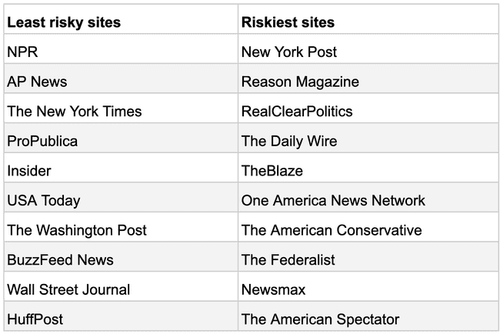
According to The American Conserviative executive director Emily Doak, “They might consider TAC a ‘high-risk’ publication because we have consistently taken on the bipartisan establishment’s sacred cows, whether it’s the war in Iraq, nation-building in Afghanistan, or the harm done by free trade and open borders — and we’ve been proven right time and time again,” adding “They know they can’t say we’re wrong, only that we’re biased and ‘high-risk,’ so we will wear that designation as a badge of honor.”

In 2018, the GEC began funding Disinfo Cloud, a State Department spokesperson told the Washington Examiner. The GEC awarded roughly $300,000 to an investment group called Park Advisers, which fights “disinformation, terrorism, violent extremism, hate speech” to manage Disinfo Cloud, the spokesperson said.

Park Advisers implemented Disinfo Cloud “to provide the U.S. government and its partners with a database of the tools and technologies available to help push back against foreign propaganda and disinformation,” according to its website, which links to Disinfo Cloud’s former landing page that has since been pulled off the internet. -Washington Examiner

One State Department-funded group which supports GDI is the nonprofit National Endowment for Democracy, which receives nearly 100% of its funding from congressional appropriations ($300 million in 2021), which critics have argued is essentially giving money to a government grantmaking body despite its status as a private entity.

In 2020, $230,000 went from the NED to the AN foundation, a GDI group that also goes by the Disinformation Index Foundation. The grant was to “deepen understanding of the challenges to information integrity in the digital space” in Asia, Africa and other foreign countries, and to “assess disinformation risks of local online media ecosystems.”

Meanwhile in September 2021, the GEC hosted the US-Paris Tech Challenge – an event which sought to “advance the development of promising and innovative technologies against disinformation and propaganda” in Europe and the UK. The event was a “collaboration with U.S. Embassy Paris, the Atlantic Council’s Digital Forensic Research Lab (DFRLab), the Cybersecurity and Infrastructure Security Agency (CISA), the North Atlantic Treaty Organization (NATO)” and several other organizations.

“Accordingly, and due to the GEC ’s inadequate voluntary compliance, please find attached a subpoena,” wrote Jordan in his subpoena to Rubin, former assistant secretary of state for public affairs in the Clinton administration.

Jordan is demanding the agencies produce records showing “persons” they have “cooperated with, consulted with, or relied on, formally or informally, in developing, applying, executing, implementing, or communicating” government policies in connection to “the moderation, deletion, suppression, restriction, or reduced circulation of content” online.

He also seeks “any agreements and communications” made between the agencies and persons when it comes to content moderation and records showing ways it has allegedly identified “‘misinformation,'” “‘disinformation,'” or ‘malinformation.'” -Washington Examiner

In a statement to the Examiner, DHS said that “The Department of Homeland Security does not censor speech and does not request that content be taken down by social media companies,” adding “Instead of working with the Department, as numerous committees have done this Congress, the House Judiciary Committee has unnecessarily escalated to a subpoena.”

“DHS will continue cooperating appropriately with Congressional oversight requests, all while faithfully working to protect our nation from terrorism and targeted violence, secure our borders, respond to natural disasters, defend against cyberattacks, and more.”


Tyler Durden
Fri, 04/28/2023 – 15:45

Watch: Kamala Harris Cites ‘Squid Game’ As Example Of “Intertwined History” Of US And South Korea

Watch: Kamala Harris Cites ‘Squid Game’ As Example Of “Intertwined History” Of US And South Korea

Authored by Steve Watson via Summit News,

In a speech made while hosting South Korean President Yoon Suk Yeol, Kamala Harris, the Vice President of the United States, cited the Netflix show Squid Game as an example of cultural ties between the countries.

Yes, really.

Unable to contain laughter as usual, Harris stated “South Korea and the United States, as the Secretary [Blinken] has mentioned, also shared strong cultural and people to people ties. K-pop fans, they topped the billboards in the United States, including BTS, who I had the great pleasure of meeting and inviting to my office in the West Wing and to the great pleasure of my niece, I must tell you.”

She added, “I also think of the Emmy Award-winning TV shows like ‘Squid Games,’ which I will confess, Doug and I binged watched at home over a series of weeks, and I think of the actress Yuh-jung Youn who I met in Seoul last year when I convened groundbreaking South Korean women. She is the first Korean to win an Academy Award for acting. These are examples of the cultural ties and the intertwined history between our nations.” 

She couldn’t think of anything cultural or historical associated with South Korea other than K-pop and Squid Game.

Lazy and embarrassing.

At least she didn’t confuse South and North Korea this time, unlike when she visited the demilitarized border.

And the Squid Game thing made some semblance of sense, unlike much of everything else she says:

Related:

*  *  *

Brand new merch now available! Get it at https://www.pjwshop.com/

In the age of mass Silicon Valley censorship It is crucial that we stay in touch. We need you to sign up for our free newsletter here. Support our sponsor – Turbo Force – a supercharged boost of clean energy without the comedown.

Also, we urgently need your financial support here.

Tyler Durden
Fri, 04/28/2023 – 15:25

“Time To Act:” Lazard To Cut 10% Of Jobs Amid M&A Slowdown

“Time To Act:” Lazard To Cut 10% Of Jobs Amid M&A Slowdown

Investment bank Lazard Ltd on Friday announced plans to shrink its workforce by 10% this year, following a decline in dealmaking activity in the first quarter. 

“Candidly, things are not feeling as good as they were in December or January,” Chief Executive Officer Ken Jacobs told Bloomberg. He stressed, “It’s time to act. That’s basically it.” 

The first quarter of 2023 was the slowest start to global dealmaking since 2013, as rising interest rates and elevated inflation soured the mood in capital markets. 

According to Bloomberg data, on Wall Street, investment-banking fees across the top five firms plunged 49% last year. This resulted in a first-quarter financial-advisory revenue decline of 29% from a year ago, to 274 million, which missed analysts’ estimates of $296 million. Asset-management revenue slid 15% to $265 million. There was also a surprise first-quarter loss of 22.2 million, or 27 cents a share, compared with a profit of $113.9 million, or $1.05 a share, in the same period a year earlier. Analysts surveyed by FactSet were expecting a profit of 32 cents a share.

Lazard incurred a $21 charge in the first quarter, and the investment bank expects an additional $95 million in charges. 

“We are implementing cost-saving initiatives to right-size for the current environment and provide flexibility to strategically invest in our business,” Jacobs said. 

As of March, Lazard had a workforce of approximately 3,400. 

Jacobs expects other investment banks will reduce headcount this year as the dealmaking environment remains muted. Bankers have also been slashing bonuses (read: here & here). 

Tyler Durden
Fri, 04/28/2023 – 15:05

Watch: Spirit Airlines Duct Tapes Plane Before Takeoff

Watch: Spirit Airlines Duct Tapes Plane Before Takeoff

A viral TikTok video shows a Spirit Airlines employee using duct tape to secure an exterior panel of an airplane engine. The short video was posted on the Chinese-owned social media platform earlier this week. 

TikTok user @myhoneysmacks, who is from Alabama, said: 

“This is the reason why I don’t fly with Spirit. 

“I don’t care if it is aviation airplane tape or nothing, the fact that you even have to tape the plane together and then you doing it while people are on the flight like we cannot see you.”

She reaffirmed:

“This is the reason that I will not fly with Spirit… Now Southwest, I can do, but Spirit, no sir.” 

Here’s the video. 

With some of the highest ticket prices in decades due partly to a jet fuel shortage on the East Coast, one would hope that some panels on planes were screwed or riveted rather than duct-taped. 

According to the travel blog The Points Guy, airlines sometimes use “speed tape” for “temporary cosmetic fixes or in a bid to improve aerodynamic efficiency on a damaged part.” 

… and even if the TikToker flew with Southwest, they would still have to deal with a legacy backend system that sometimes fails, causing nationwide delays (read: here & here). 

Tyler Durden
Fri, 04/28/2023 – 14:25

US Officials Reject Compensation For People Diagnosed With COVID-19 Vaccine Injuries

US Officials Reject Compensation For People Diagnosed With COVID-19 Vaccine Injuries

Authored by Zachary Stieber via The Epoch Times (emphasis ours),

U.S. authorities rejected multiple people who sought compensation for COVID-19 vaccine injuries, despite diagnoses from doctors, documents show.

Cody Flint, left, and Dr. Joel Wallskog in file images. (Courtesy of Cody Flint and Dr. Joel Wallskog)

Letters from U.S. officials reviewed by The Epoch Times show officials contradicting doctors who treated patients as they turned down requests for payment.

Cody Flint, an agricultural pilot, was diagnosed by four doctors with a severe adverse reaction to Pfizer’s COVID-19 vaccine. Shortly after being vaccinated, Flint experienced intense head pressure, which led to problems such as perilymphatic fistula, the doctors said.

Flint sent a slew of medical files, including evidence of the diagnoses, to the U.S. Countermeasures Injury Compensation Program (CICP), which compensates people who prove they were injured by a COVID-19 shot.

But administrators for the program rejected Flint’s application in a denial letter, saying they “did not find the requisite evidence that the Pfizer COVID-19 vaccination caused” the conditions from which he suffers.

Flint, in his 30s, felt his first symptoms within an hour of vaccination. An onslaught of severe symptoms followed while he was flying two days later.

“One second I went from having burning in the back of my neck and tunnel vision to the very next second I was slumped over in my airplane. The best way I know to describe it, it was like a bomb went off inside my head,” Flint said.

CICP administrators told him that “compelling, reliable and valid medical and scientific evidence does not support a causal association between the Pfizer COVID-19 vaccine and benign paroxysmal positional vertigo, perilymphatic fistulas, increased intracranial pressure, Eustachian tube dysfunction, hearing loss, or loss of eyesight.”

They also tried to pin the problems on barotrauma. Colloquially known as airplane ear, barotrauma happens when air pressure suddenly changes, and is common as planes climb higher in the sky. Barotrauma causes the fistulas and symptoms of the fistulas “began while flying,” administrators wrote.

Flint and his doctors asserted in appeal letters that the barotrauma theory doesn’t hold up because Flint flies low as he dusts crops. Flint’s condition is “not from barotrauma,” Flint’s doctors told the CICP. “As an agricultural pilot, he does not fly more than a couple of hundred feet off the ground which is not of a magnitude to where he is at risk for barotrauma.”

Elevated intracranial pressure has been recognized as a complication of COVID vaccination, and given the sequence of events, more probable than not, it is the cause of Mr. Flint’s elevated intracranial pressure, which had been documented on lumbar puncture,” they added. “The elevated intracranial pressure led to his perilymphatic fistula. Elevated intracranial pressure is a cause for perilymphatic fistula and more probable.”

The CICP determination was reviewed by a panel that sided with administrators. The panel found that the COVID-19 vaccine “did not cause Mr. Flint to develop bilateral perlympathic fistulas and related symptoms,” Suma Nair, an administrator, told Flint in a final denial letter. “There is no compelling causal connection between the Pfizer COVID-19 vaccine and the symptomology Mr. Flint experienced; the more likely cause of Mr. Flint’s symptoms is trauma from flying a plane, which would have developed over time.”

Administrators cited no studies or other evidence in their letters.

Flint said that the determination was wrong, pointing to a number of papers detailing post-vaccination intracranial and other neurological issues. He also noted a study that said intracranial pressure can cause perilymphatic fistulas.

Nair also said the panel concluded: “given the timeline of symptoms, it was not plausible for the Pfizer COVID-19 vaccine to have caused the otologic and vestibular issues experienced by Mr. Flint.”

“It’s just all comical to me,” Flint told The Epoch Times. “I get the shot, I’m injured within 48 hours, and they say that that makes it implausible.”

Agricultural pilot Cody Flint in a file image. (Courtesy of Cody Flint)

Difficulty Getting Compensation

The case highlights how people who experienced problems after vaccination have struggled to get money from the federal government, even when doctors diagnose vaccine injuries.

Flint is one of 76 people who were rejected as of April 1 because administrators determined they did not “show that a covered serious physical injury was sustained as the direct result of the administration” of a COVID-19 vaccine.

The CICP may only make such determinations based on compelling, reliable, valid, medical and scientific evidence,” the program says.

More than 8,100 applications, as of April 1, have been submitted to the CICP for compensation for a COVID-19 vaccine-induced injury or death. Three hundred and sixty-two in total have been turned down. Just 23 have been accepted. All but two are for a type of heart inflammation called myocarditis or a related condition known as pericarditis, both of which U.S. authorities say are caused by COVID-19 vaccination.

Documents on the denials and acceptances have been largely withheld from the public. Freedom of Information Act (FOIA) requests, successful in unearthing information about COVID-19 vaccine safety, have yielded few documents. Administrators located 652 records in response to one request seeking all claims and associated documents. They only released 52 heavily redacted documents, citing exceptions to FOIA. A similar request returned a single page that wasn’t already public.

COVID-19 vaccine injuries fall under the CICP, a little-used program before the pandemic that was created by Congress in a 2005 bill, because of a Public Readiness and Emergency Preparedness Act declaration entered during the Trump administration that has not yet been rescinded.

Most administered vaccines in the United States fall under the National Vaccine Injury Compensation Program, enabling people with alleged or actual injuries to take their cases to federal judges in a no-fault system that paid out $4.8 billion between 1988 and 2022.

Decisions on CICP petitions, in contrast, are decided by the Department of Health and Human Services (HHS) Health Resources and Services Administration (HRSA)—the same agency that operates the program.

That “potentially creates a conflict of interest,” researchers wrote in a 2022 paper, advising Congress to initiate major reforms by either relocating the program or allowing judicial review of determinations.

Read more here…

Tyler Durden
Fri, 04/28/2023 – 14:06

Turkish Evacuation Plane Comes Under Attack In Sudan

Turkish Evacuation Plane Comes Under Attack In Sudan

Heavy explosions and gunfire have continued to rock parts of Sudan’s capital Khartoum and its twin city Omdurman despite a ceasefire. At least 500 people have been killed, including reportedly two American citizens, as fighting reaches two weeks amid the power struggle between two rival generals representing Sudanese Armed Forces and the paramilitary group Rapid Support Forces.

“Many areas that saw very active fighting at the beginning have become quieter than before. Yet, I cannot say there is a total ceasefire in those places,” a Khartoum resident told Al Jazeera on Friday. “I don’t think anyone has gone to school in the last 14 days. I don’t think anyone has been to a hospital.”

Via AP

A massive foreign evacuation effort involving many countries sending military transport planes has continued for the better part of a week. The United States administration, however, has said that it is not conducting a large-scale evacuation operation for the estimated 16,000 US citizens who live in Sudan, many of them dual nationals who have made the country their home. 

But this international rescue effort appears to now be coming under threat, after new reports that a Turkish evacuation plane came under gunfire while landing at Wadi Seyidna airport outside Khartoum. The aircraft, a C-130, had its fuel supply system damaged by the ground gunfire. 

The Turkish defense ministry confirmed the damage but without naming a culprit. “Light weapons were fired on our C-130 evacuation plane … Our plane landed safely. Although there are no injuries to our personnel, necessary repairs are being carried out on our aircraft,” it said.

The national army said the Rapid Support Forces of Gen. Mohamed Hamdan Dagalo mounted the attack on the plane as it was landing, but the RSF rejected the accusation as part of the national army “spreading lies”. 

“Our forces have remained strictly committed to the humanitarian truce that we agreed upon since midnight, and it is not true that we targeted any aircraft in the sky of Wadi Seyidna in Omdurman,” the RSF said. Fighting has been witnessed elsewhere in the country, which could signal a slide toward full-scale civil war, as the AFP is reporting 74 dead in two days of fighting in the West Darfur capital of El Geneina.

The rival military factions reached an agreement to extend their ceasefire from midnight local time (22:00 GMT on Thursday) for an additional three days, but by many accounts it’s barely holding, if at all.

Tyler Durden
Fri, 04/28/2023 – 10:50

First Republic Shares Crash To Record Lows As ‘Deal’ Hope Fades

First Republic Shares Crash To Record Lows As ‘Deal’ Hope Fades

Update (1045ET): First Republic Shares are halted for volatility having collapsed 25% back to record lows as hopes of a ‘private’ deal fade…

The question now is simple – will they make it to the close without the FDIC stepping in?

*  *  *

The First Republic farce rolls on…

After reporting dramatically worse deposit outflows (and aggregate banking system flows suggesting things are getting worse, not better in April), The FT reports that there had been a shift in tone among the First Republic Bank’s advisers compared with Tuesday and Wednesday when First Republic’s shares fell 65 per cent and fears grew that it was close to being taken over by the FDIC.

The conversations about the bank reportedly remain fraught, and the people cautioned that it was not clear that a solution would be found.

The banks are reluctant to put their shareholders at risk of losses without some sort of government participation.

Which is notable since Reuters reports that, according to three sources familiar with the situation, US officials are coordinating urgent talks to rescue the beleaguered regional bank as private-sector efforts led by the bank’s advisers have yet to reach a deal.

The government’s involvement (and presumably some hope of backstopping commitments) is reportedly helping bring more parties, including banks and private equity firms, to the negotiating table, one of the sources added.

Reuters adds though that it is unclear whether the U.S. government is considering participating in a private-sector rescue of First Republic.

However, the government’s engagement, however, has emboldened First Republic executives as they scramble to put together a deal that would avoid a takeover by U.S. regulators.

Specifically, The FT reports that one proposal that may be part of an eventual solution is for some of the banks to buy some of First Republic’s long-dated assets for more than their current market price, allowing the lender to shrink its losses.

But people familiar with the situation say that this would probably not be enough to stabilize First Republic on its own.

Bear in mind that the ‘Big Banks’ have $30 billion in deposits at the embattled bank… so the FDIC has a problem already.

FRC Bonds ain’t buying it at all…

First Republic shares were up around 5% in the pre-market, but have already erased the earlier stronger gains…

Just to put that into context, here’s FRC this week…

Finally, First Republic Bank’s membership in the S&P 500 Index could be in jeopardy after the troubled bank’s stock set a new all-time low on Wednesday that briefly pushed its market capitalization below $1 billion.

At roughly $1.2 billion, FRC has by far the smallest market cap in the S&P 500 after wiping out more than $21 billion in market value. As Bloomberg notes, this is a problem because companies must have a market cap of at least $12.7 billion to be considered for inclusion in the S&P 500.

Tyler Durden
Fri, 04/28/2023 – 10:40

Could Global Upturn Trump Domestic Slowdown For European Stocks?

Could Global Upturn Trump Domestic Slowdown For European Stocks?

Authored by Simon White, Bloomberg macro strategist,

European equities should stay supported despite growth faltering somewhat as a global cyclical upturn driven by China builds momentum.

The initial look at 1Q euro-area GDP came in slightly below expectations, at 0.1% quarter-on-quarter, versus a 0.2% estimate, and 1.3% year-on-year versus 1.4%.

That is a far cry from weak expectations last year in the heat of Russian’s invasion of Ukraine and a sharp rise in energy prices. However, a lot of the positivity around Europe came from rock-bottom expectations that swung to comparatively euphoric once markets realized the worst wasn’t going to happen.

The chart below shows that economic surprises were greatest in soft, i.e. survey, data over the last year. Now, though, soft data is disappointing.

And hard data too are disappointing, with household, retail and labor releases all recently coming in lower than expectations.

We can see the soft-data weakness in the PMIs, which picked up from their lows, but are now mostly falling again.

However, sentiment can only take you so far and there will be a re-evaluation of Europe’s growth prospects as it is realized that just because the situation is not as bad as feared, that does not mean there is nothing at all to fear.

European equities have surfed the wave of this upswing in optimism, coming in ahead of the US, UK, Canada, Australia and Japan this year. While they are beginning to reflect this less upbeat outlook, that does not mean they are doomed to lose all of their mojo.

Europe is highly sensitive to China and global growth, and the cyclical upswing that is gradually, but surely, building momentum as easing in China gains traction will keep European equities supported, and continuing to outperform the US.

Semiconductors are one of the best bellwethers of global cyclical growth, and after struggling through most of 2021 and 2022, chip stocks have bounced strongly, pointing to a rise in European earnings.

Revenues are the main positive support of European equity returns, compensating for the drag from margins and multiples. However, a pick-up in earnings should make up for the expected decline in revenues as the economy slows through the year, keeping prices supported.

Tyler Durden
Fri, 04/28/2023 – 10:35