80.2 F
Chicago
Thursday, August 13, 2026
Home Blog Page 3763

The US Could Use Some Separation Of Media And State

The US Could Use Some Separation Of Media And State

Authored by Caitlin Johnsone via medium.com,

The US State Department’s spokesperson Ned Price is being replaced by a man named Matthew Miller. Like Price, Miller has had extensive prior involvement in both the US government and the mass media; Price is a former CIA officer and Obama administration National Security Council staffer who for years worked as an NBC News analyst, while Miller has previously had roles in both the Obama and Biden administrations and spent years as an analyst for MSNBC.
Like every high-level government spokesperson, Miller’s job will be to spin the nefarious things the US empire does in a positive light and deflect inconvenient questions with weasel-worded non-answers. Which also happens to be essentially the same job as the propagandists in the mainstream media.

In journalism school you are taught that there’s supposed to be a sharp line between government and the press; journalists are meant to hold the government to account, and there’s an obvious conflict of interest there if they’re also friends with government officials or are looking to the government as a potential future employer. But at the highest levels of the world’s most powerful government and the world’s most influential media platforms the line between media and state is effectively nonexistent; people flow seamlessly between roles in the media and roles in the government depending on who’s in office.

We see this indistinctness between government and media with White House press secretaries even more clearly. The current press secretary Karine Jean-Pierre is a former analyst for NBC News and MSNBC, and the last press secretary Jen Psaki now has her own show on MSNBC. Prior to her stint as White House press secretary Psaki worked as a CNN analyst, and before that she was a spokesperson for the State Department like Price and Miller.

At a recent event for the news startup Semafor, Psaki was asked if she considers herself a journalist and she said she does, adding that “to me, journalism is providing information to the public, helping make things clearer, explaining things.” Which is a bit funny considering that Psaki’s political faction has spent the last seven years furiously insisting that WikiLeaks founder Julian Assange is not a journalist. In liberal brainworms land the world’s greatest journalist is not a journalist at all, but Joe Biden’s spin doctor is because she’s got a knack for “explaining things”.

Lest you get the mistaken impression that this phenomenon is unique to Democrats and their aligned media outlets, it should here be noted that Trump’s press secretary Sarah Huckabee Sanders got a job as a Fox News contributor immediately after resigning from that position, and now she’s the governor of Arkansas. Another Trump administration press secretary, Kayleigh McEnany, is now an on-air contributor to Fox News, and previously worked for CNN. Trump’s first press secretary Sean Spicer reportedly tried to get jobs with CBS News, CNN, Fox News, ABC News and NBC News after his stint in the White House, but was turned down by all of them because nobody likes him.

Without any clear lines between the media and the state, US media are not meaningfully different from the state media the west spends so much energy decrying in “tyrannical regimes” like Russia and China. The only difference is that in Tyrannical Regimes the government controls the media, while in Free Democracies the government is the media.

On a related note, journalist Michael Tracey just observed on Twitter that all questions asked during the Pentagon press briefing today about the documents leaked online from the Department of Defense all pertained not to the information contained in those documents, but to the Pentagon’s failure to keep them from leaking to the public. Rather than trying to obtain more information and transparency from their governments as journalists should, they’re actually badgering their government to do more to prevent important information from getting into the hands of journalists.

So I suppose that’s another difference between Totalitarian Regimes and Free Democracies: in Totalitarian Regimes the government instructs the media to suppress inconvenient facts, while in Free Democracies the media instruct the government to suppress inconvenient facts.

As it happens the man who allegedly leaked the Pentagon documents, a 21 year-old National Guardsman named Jack Teixeira, was tracked down and named by The New York Times even before his arrest by the FBI. The New York Times assembled a crew of a dozen reporters to hunt down the leaker, even using contributing reporting from the empire-funded propaganda firm Bellingcat. This job typically undertaken solely by federal agents was undertaken first by reporters from the mainstream press; we’re just a click or two away from New York Times reporters kicking down the doors of people who leak classified information and shooting their dogs like proper feds.

All this while state propaganda outlet NPR continues its ongoing tantrum about Twitter accurately labeling its account “Government Funded”, an upgrade from its also-accurate previous designation as “US state-affiliated media”. NPR has now officially rage-quit Twitter in objection to the label on the basis that “the platform is taking actions that undermine our credibility by falsely implying that we are not editorially independent,” which is hilarious because NPR has no credibility to undermine.

As we discussed recently, NPR receives funding from the US government, consistently promotes the information interests of the US government, and is run by the former CEO of the US government’s foreign propaganda network US Agency for Global Media. It doesn’t even deserve the label “Government Funded”; it should have the exact same labels as Russian and Chinese state media, because it is not meaningfully different from them.

This was made even funnier by the fact that America’s literally state-owned media outlet Voice of America is now standing in very unhelpful solidarity with NPR by also objecting to the “Government Funded” label that has been placed on its own account.

Voice of America writes the following in its own “news” reporting on NPR’s plight:

VOA’s public relations department on Monday also pushed back against Twitter’s decision, saying the label gives the impression that VOA is not an independent outlet.

Twitter did not respond to VOA’s request for comment.

VOA is funded by the U.S. government through the U.S. Agency for Global Media, but its editorial independence is protected by regulations and a firewall.

Bridget Serchak, VOA’s director of public relations, said that “the label ‘government funded’ is potentially misleading and could be construed as also ‘government-controlled’ — which VOA is most certainly not.”

“Our editorial firewall, enshrined in the law, prohibits any interference from government officials at any level in its news coverage and editorial decision-making process,” Serchak said in an email. “VOA will continue to emphasize this distinction in our discussions with Twitter, as this new label on our network causes unwarranted and unjustified concern about the accuracy and objectivity of our news coverage.”

As Branko Marcetic pointed out on Twitter, these claims about VOA’s “editorial independence” have been squarely refuted by someone who worked there for 35 years. In a 2017 article with Columbia Journalism Review titled “Spare the indignation: Voice of America has never been independent,” VOA veteran Dan Robinson says such outlets are entirely different from normal news companies and are expected to facilitate US information interests to receive government funding:

I spent about 35 years with Voice of America, serving in positions ranging from chief White House correspondent to overseas bureau chief and head of a key language division, and I can tell you that for a long time, two things have been true. First, US government-funded media have been seriously mismanaged, a reality that made them ripe for bipartisan reform efforts in Congress, climaxing late in 2016 when President Obama signed the 2017 National Defense Authorization Act. Second, there is widespread agreement in Congress and elsewhere that, in exchange for continued funding, these government broadcasters must do more, as part of the national security apparatus, to assist efforts to combat Russian, ISIS, and al-Qaeda disinformation.

Everywhere you look you can find extensive entanglements between the US government and the news media outlets that westerners look to for information about the world, and that’s before you even get into the way the plutocratic class which owns and influences the US media is also not meaningfully separate from the US government. When corporations are part of the government, corporate media is state media.

It seems a safe bet that the US would be a completely different country if separation of media and state and separation of corporation and state were enshrined like the separation of church and state is.

The only reason Americans consent to the freakish status quo of their government which impoverishes and oppresses people at home while bombing and starving people abroad is because their consent has been manufactured by a media class that is not meaningfully separate from the government. Place the press in their proper place as oppositional scrutinizers of government behavior, and the dynamics underlying the nation’s problems would no longer be hidden from the public.

__________________

My work is entirely reader-supported, so if you enjoyed this piece please consider sharing it around, throwing some money into my tip jar on Patreon, Paypal, or Substack, buying an issue of my monthly zine, and following me on Facebook, Twitter, Soundcloud or YouTube. If you want to read more you can buy my books. The best way to make sure you see the stuff I publish is to subscribe to the mailing list for at my website or on Substack, which will get you an email notification for everything I publish. Everyone, racist platforms excluded, has my permission to republish, use or translate any part of this work (or anything else I’ve written) in any way they like free of charge. For more info on who I am, where I stand, and what I’m trying to do with this platform, click here. All works co-authored with my husband Tim Foley.

Tyler Durden
Tue, 04/18/2023 – 17:25

Netflix Tumbles After Top-Line & Subscriber Miss; Slashed Forward Guidance

Netflix Tumbles After Top-Line & Subscriber Miss; Slashed Forward Guidance

Netflix shares are sliding after hours following a top-line miss, sub-addition miss, and forward guidance cut.

First things first, revenues missed expectations but EPS beat…

*NETFLIX 1Q REV. $8.16B, EST. $8.18B

*NETFLIX 1Q EPS $2.88, EST. $2.86

Sub-additions rose less than expected…

*NETFLIX 1Q STREAMING PAID NET CHANGE +1.75M, EST. +2.41M

*NETFLIX 1Q STREAMING PAID MEMBERSHIPS 232.5M, EST. 233.0M

And to add to the pain, they cut guidance for Q2…

*NETFLIX SEES 2Q REV. $8.24B, EST. $8.47B

*NETFLIX SEES 2Q EPS $2.84, EST. $3.08

*NETFLIX SEES 2Q PAID NET ADDS `ROUGHLY SIMILAR’ TO 1Q

This has sent the stock plummeting 12% lower after hours…

This is the second year in a row where Netflix has gotten off to a shaky start.

Finally, right before earnings, Netflix announced that after a 25 year run, they’ve decided to wind down DVD.com later this year.

Those iconic red envelopes changed the way people watched shows and movies at home – and they paved the way for the shift to streaming.

Tyler Durden
Tue, 04/18/2023 – 16:09

Fox News And Dominion Settle Defamation Case, Averting Trial Over 2020 Election Claims

Fox News And Dominion Settle Defamation Case, Averting Trial Over 2020 Election Claims

Update (1610ET): And just like that, Fox News parent Fox Corp. and Dominion Voting Systems have agreed to settle their legal battle – thus averting a trial over Dominion’s allegations that it was defamed by the network following the 2020 US election.

Fox haters are not taking the news well.

*  *  *

Dominion Voting Systems’ lawsuit against Fox News kicks off on Tuesday, after the voting machine company accused the network of defamation following their coverage of the 2020 election, including former President Trump’s claims that voter fraud is the reason he lost the race.

“It’s potentially the most important defamation case in generations,” said RonNell Andersen Jones, a law professor at the University of Utah who specializes in media law, in a statement to The Hill. “Partially, this is because it involves very high stakes for two very important entities. That in and of itself makes it important. But beyond that, it sits at the intersection of some of the most significant constitutional, social and political debates of our time.”

After an abrupt Sunday night delay for rumored settlement talks, Delaware Superior Court Judge Eric Davis said on Monday that such postponements are “not unusual,” and that he expects the parties to show up on Tuesday to start the trial.

“I made the decision to delay the start of the trial until tomorrow,” Davis said in court, adding “it’s a six-week trial. Things happen… this is not unusual… This does not seem unusual to me.”

Dominion is seeking $1.6 billion in damages, but appears to have softened its claims, the WSJ reports. In a Sunday night filing, Fox’s legal team indicated that Dominion wouldn’t present the jury with claims for alleged lost profits – which in their original 2021 lawsuit was set at an amount not less than $600 million.

The voting machine company has accused Fox News of airing false claims by hosts and guests, who say Dominion helped rig the 2020 election in favor of Joe Biden. The company seeks damages for alleged financial harm to the company due to what they claim is a departure from journalistic norms by broadcasting claims the network knew was false.

Fox says they were just reporting allegations from former President Trump and his associates they felt were newsworthy.

A voter in Atlanta using a Dominion voting machine in the 2022 midterm election last fall.Photo: CARLOS BARRIA/REUTERS

Evidence released during litigation shows that Fox executives and hosts were skeptical over the election fraud claims, but didn’t want to alienate Trump supporters.

“In some ways, it’s just another piece of litigation for a large dollar amount, but it’s also unlike any case you’ve seen before, weighing the future of Fox News, what’s permissible for what a reporter can trust, and the future of faith in the media,” said Victoria Baranetsky, general counsel at the Center for Investigative Reporting (via WSJ). “In those ways, the stakes are high.”

Media organizations enjoy robust protections under the First Amendment, making defamation cases difficult for plaintiffs to win. Most lawsuits don’t even make it to trial, prompting some to argue that modern precedent makes it too difficult for businesses or individuals to vindicate their reputations in court. 

Legal observers say the Dominion case could prove to be a notable counterexample. The company has come to the eve of trial riding momentum: Judge Davis has already concluded that Fox News and Fox Business did in fact broadcast false claims about Dominion, voiced by both network hosts and Trump associates, including Sidney Powell and Rudy Giuliani, who appeared as guests. -WSJ

According to the Judge, Fox has a ‘credibility problem,’ and may have failed to provide required disclosures and information in the litigation.

Assuming the case proceeds, Fox will have to convince a jury that they didn’t act with “actual malice” regarding the claims, while Dominion will have to prove that Fox knowingly published false information, or had a reckless disregard for the truth.

Tyler Durden
Tue, 04/18/2023 – 16:08

US Sovereign Risk Nears Record High; Yield Curve Screams Recession As VIXtermination Continues

US Sovereign Risk Nears Record High; Yield Curve Screams Recession As VIXtermination Continues

Today was about the ‘good’ China data (GDP better than expected, helped by domestic demand), the ‘bad’ US data (building permits – implicitly forward-looking – much worse than expected), and the ugly (hawkish-ish Fed head Bostik – one more hike and hold for long time, no hint of cuts at all; and St. Louis Fed’s Bullard reiterated his call for higher U.S. interest rates to combat inflation, saying he’s not worried about a banking crisis and doesn’t see a recession taking place anytime soon).

But the big one was the sound & fury beginning to build around the debt ceiling debacle with the T-Bill curve getting a bit wild…

Source: Bloomberg

And the US Sovereign credit risk spread hovering right at record highs…

Source: Bloomberg

Given all that VIX tumbled to a 16 handle making fresh lows since Jan ’22…

Source: Bloomberg

The yield curve (2s10s) flattened dramatically…

Source: Bloomberg

And stocks pumped and dumped, Small Caps lagged on the day (but are still best from Friday. The Dow, S&P, and Nasdaq all closed unchanged-ish…

Nasdaq is lagging on the week while Small Caps lead…

Breadth remains irrelevant…

Source: Bloomberg

0DTE put and call traders battled against like yesterday, but unlike yesterday’s late-day, today’s covering left stocks unmoved…

Source: SpotGamma

Overall, US Treasuries were mixed today with the short-end underperforming (2Y +1.5bps, 30Y -2.5bps)

Source: Bloomberg

The odds of a 25bps hike in May held their post-SVB highs at around 88%…

Source: Bloomberg

The Dollar drifted lower

Source: Bloomberg

Bitcoin bounced back above $30,000 today after yesterday’s selloff…

Source: Bloomberg

Gold managed small gains today, after dipping down towards $2000…

Having found support at $80, WTI bounced back to end the day unchanged ahead of tonight’s API data…

Finally, the NY Fed recession probability model is flashing red…

…and it has never given a false signal at this level.

Tyler Durden
Tue, 04/18/2023 – 16:00

New York Mayor Goes To War Against Meat And Dairy As Climate Agenda Escalates

New York Mayor Goes To War Against Meat And Dairy As Climate Agenda Escalates

The war on food is one of the more subversive elements of the “Net Zero” climate agenda – While most mainstream discussion focuses on carbon taxation or a shift to electric vehicles, there is a legitimate public threat underway in the form of agricultural restrictions by government (specifically on nitrogen and methane emissions) and the targeted removal of animal based protein in regular western diets.

It’s no secret, the green totalitarians hate meat.  At least, they hate meat for the general populace.  The reasons why are uncertain, though it’s certainly not because cow farts cause global warming.  There is zero evidence of any causation relationship between animal farming and rising global temperatures.  In fact, there is zero evidence of any causation relationship between carbon, methane or nitrogen emissions and rising global temps. 

The issue is obscured by the methods used to calculate livestock’s impact: The UN’s climate report, Livestock’s Long Shadow, claims livestock alone are responsible for 18% of GHG emissions, but the figure calculates emissions along the entire supply chain, from land use to processing and refrigeration in supermarkets.

Meanwhile transportation figures, which are regularly reported as 28% of all GHG emissions, only factor in direct emissions from exhaust fumes, ignoring processes associated with manufacturing machinery, or moving people and produce.  The UN is deliberately overstating the scale of livestock emissions, not to mention there’s no proof of climate impact.

So why the obsession with meat and dairy?

There are multiple studies which suggest that veganism can lead to reduced cognitive function and lower intelligence, especially when such diets are forced onto children.  The human brain requires several nutrients that simply cannot be found in plants.  In most cases, vegans are required to take regular supplements to offset these missing elements that the brain needs.  Maybe the establishment’s goal in the future is to keep the average person as stupid as possible? Or perhaps they want to keep the population dependent on vital supplements that are manufactured?

One can only speculate on the true motives at this point.  However, the spread of the anti-meat ideology within governments is not a theory, it is a fact.  New York Mayor Eric Adams is the latest official among many to announce his fealty to the climate crusade by joining efforts to cut animal based carbon emissions by 2030 (exactly in line with the UN’s Agenda 2030 program). 

Reading from a speech he obviously barely understood, Adams stumbles over his words as he declares that “food is the third biggest source of city emissions” involved in climate change.  He then slurs his sentences as he asserts “We already know that a plant-powered diet is better for your physical and mental health…and I am living proof of that…”    

Much like the ongoing effort by Democrats to remove natural gas-based appliances while claiming that “no one is going to take your gas stove,” the war on meat is also presented as nothing more than a “lifestyle suggestion” which is then retooled as a health crisis as well as a climate crisis.  The intent is to eventually ban meat completely, or make it so expensive through carbon taxation and regulation that only the wealthy can afford to eat it.  The goal of a meatless world is openly admitted by the UN.

What will you be allowed to eat instead?  If veggies don’t get you excited the establishment elites at the World Economic Forum suggest protein harvested from insects to satiate the appetite of the masses along with soy-formed meat substitutes.  They are no doubt laughing about this behind closed doors over a glass of red wine and a nice medium-rare steak.

Incrementalism is the name of the game and often long term nationwide controls are achieved through the tip-toe of localized policies.  The litmus test for future authoritarianism is invariably found in the actions of far-left city and state governments that use their citizens as guinea pigs to see what trespasses people are willing to tolerate.        

Tyler Durden
Tue, 04/18/2023 – 15:30

CRE Giant Brookfield Defaults On $161 Million Debt For DC Office Buildings

CRE Giant Brookfield Defaults On $161 Million Debt For DC Office Buildings

With recent stress in the regional banking sector, sentiment in US commercial real estate (CRE) – and especially the office sector – has turned negative as investors prepare for potential spillover effects (with JPMMorgan Stanley, and Goldman Sachs all joining the gloom parade), especially as high-profile defaults continue to make headlines as borrowers face higher debt service costs and refinancing becomes much harder ahead of a $400 billion CRE debt maturities this year alone. 

The latest headline fueling concerns about a potential CRE crisis involves a fund belonging to CRE giant Brookfield defaulting on a $161.4 million mortgage for twelve office buildings in Washington, DC. 

According to Bloomberg, the loan was transferred to a special servicer working with “the borrower to execute a pre-negotiation agreement and to determine the path forward.” 

Real estate data firm Green Street said DC office space values had slid 36% through March compared with a year ago due to rising vacancies amid the rise of remote and hybrid work post-Covid.

The gold-standard measure of office occupancy trends is still the card-swipe data provided by Kastle Systems. The average office occupancy across Washington, DC, is only 43% and has yet to recover to pre-pandemic levels.

Brookfield has also defaulted on debt tied to two Los Angeles buildings, the Gas Company Tower and the 777 Tower. 

A spokesperson from the company blamed the pandemic for its CRE challenges.

“While the pandemic has posed challenges to traditional office in some parts of the US market, this represents a very small percentage of our portfolio.”

Brookfield could potentially be the first in a series of companies defaulting on their office space loans. We’ve pointed out that the state of the CRE market is in dire shape as delinquency rates across property types, particularly offices, are rising. The lending environment is getting tougher ahead of $400 billion in CRE debt maturities this year. 

Meanwhile, the collapse of Silicon Valley Bank (and other regional banks) has put a magnifying glass on regional banks, and their CRE loan books remain a significant concern. As shown below, JPM’s data as of February 2023, regional banks account for a staggering 70% of total CRE loans outstanding, excluding multifamily, farmland, and construction loans.

This will cause an acute credit crunch in secondary/tertiary CRE markets.

And then there’s Bank of America’s Michael Hartnett, who recently said, “You know what commercial real estate is, it’s a boa constrictor tightly wrapped around the economy, suffocating growth for the next 2 years.”

Bloomberg pointed out about a “dozen buildings in the Brookfield portfolio, occupancy rates averaged 52% in 2022, down from 79% in 2018 when the debt was underwritten.” 

The onset of a CRE crisis in the office sector will likely spark significant issues for regional banks and the Fed. 

Apollo chief economist Torsten Slok recently noted

In other words, with the commercial real estate bubble bursting, we are likely to enter three years with low growth, similar to what we saw after the housing bubble burst in 2008. Put differently, once the Fed starts cutting rates later this year, interest rates will likely stay low for several years, and QE is likely to come back in 2024.

Will Brookfield be the first of many to default on office building loans this year?

Tyler Durden
Tue, 04/18/2023 – 15:11

“Anything On The Table:” Coinbase CEO Mulls Moving Headquarters Outside US Amid Crypto Crackdown

“Anything On The Table:” Coinbase CEO Mulls Moving Headquarters Outside US Amid Crypto Crackdown

Cryptocurrency executives hoped for a fresh start in 2023 following a year of setbacks. However, they’ve been battered by a government crackdown, numerous exchange blowups, and crypto-related bank failures.

Several weeks ago, Sen. Elizabeth Warren (D-Mass.) tweeted she was building an “Anti-crypto Army.” So it appears an aggressive government crackdown on the crypto industry will persist through the coming election cycle. 

That may be why crypto exchange Coinbase Global Inc has mulled over shifting headquarters outside the US unless pressure from Elizabeth Warren and state and federal regulators subside. 

According to Bloomberg, Coinbase CEO Brian Armstrong said, “Anything is on the table” when asked by former UK Chancellor of the Exchequer George Osborne at a fintech conference in London on Tuesday whether the crypto exchange would move operations to the UK. “Including, you know, relocating or whatever is necessary,” Armstrong said. 

The increasing relocation risk of Coinbase comes after the Securities and Exchange Commission slapped the crypto exchange with a Wells notice, warning the company about potential securities violations. 

Meanwhile, lawmakers on Capitol Hill have a series of bills that could usher in strict regulation for the crypto space. Simultaneously, the SEC and the Commodity Futures Trading Commission are discussing which regulator will oversee the space and whether crypto assets should be labeled as securities or commodities. 

Armstrong cited mounting regulatory uncertainty in the US. 

“The US has the potential to be an important market in crypto, but right now, we are not seeing that regulatory clarity needed,” Armstrong said, adding that the UK is Coinbase’s second largest market globally by revenue. 

“I think if a number of years go by where we don’t see regulatory clarity emerge in the US, we may have to consider investing more in other regions of the world.”

With around 100 million verified users, Coinbase is set to expand across Europe. Should Elizabeth Warren’s anti-crypto army and government regulators maintain pressure on the industry, Coinbase’s relocation of its headquarters could become a reality. 

Tyler Durden
Tue, 04/18/2023 – 12:50

IRS Under Biden Taxing Americans More Than Trump

IRS Under Biden Taxing Americans More Than Trump

Authored by Tom Ozimek via The Epoch Times (emphasis ours),

The amount of taxes collected from Americans under President Joe Biden has soared compared to former President Donald Trump’s tenure, while tax enforcement has also risen, an analysis of Internal Revenue Service (IRS) data shows.

The IRS building is seen in Washington on Sept. 28, 2020. (Erin Scott/Reuters)

The IRS collected a total of $4.9 trillion in taxes for fiscal year 2022 (Oct. 1, 2021 to Sept. 30, 2022), according to the IRS’ newly released Data Book. At the same time, the IRS issued nearly $642 billion in refunds last year, putting the net amount of taxes collected at around $4.26 trillion.

By comparison, in fiscal year 2020, Trump’s final year in office, the IRS’ gross tax collections were $3.5 trillion. With nearly $736 billion in refunds, that puts the net total taxes collected at around $2.76 trillion, or around 35 percent less than during Biden’s second year in office.

For fiscal year 2021, Biden’s first year in office, the IRS’ gross tax collections amounted to $4.1 trillion. When subtracting the $1.1 trillion in refunds, that put the net total at $3 trillion, or 8 percent higher than during Trump’s final year in the White House.

Tax enforcement, too, has accelerated under Biden. Using the number of tax returns examined as a proxy for enforcement, there was a steady decline under Trump, with a recent low of around half a million in 2020. That figure jumped to around 750,000 in 2021 and, in 2022, it remained at roughly the same level.

The number of tax returns examined by the IRS for the fiscal years 2013-2022. (IRS)

IRS Commissioner Danny Werfel said in an introduction to the 2022 Data Book that the agency’s commitment to maintaining a “visible, robust tax enforcement presence” is “strong.”

“During FY 2022, we continued to develop and utilize innovative approaches to better understand, detect, and resolve potential noncompliance,” Werfel said, adding that this includes “leveraging new technology and data analytics.”

Our comprehensive and coordinated enforcement strategy has shown success,” he added, presumably referring to the rise in the amount of tax collection and the boost in enforcement.

Werfel added that the IRS’ work to transform itself into a “stronger, more modern” organization continued in 2022 and that he’s “confident this journey will pay significant dividends over time.”

The agency recently received an $80 billion funding boost, with part of the funds going to hiring more staff, including in areas of tax enforcement. This has fueled concerns about an increase in tax audit rates among lower and middle income Americans, which the IRS has said repeatedly would not be the case.

The IRS recently released its strategic operating plan (pdf), in which it identified certain transactions as being at high risk of noncompliance and vowed to ramp up enforcement in some areas.

In a press release accompanying the release of the 2022 Data Book, the IRS said it would target its enforcement efforts at high-income and high-wealth individuals, complex partnerships, and big corporations.

The IRS has no plans to increase the audit rate for households making less than $400,000,” the agency stated.

As the IRS has increased the amount of taxes it collects from Americans, however, the share of people saying that it’s “not at all acceptable” to cheat on income taxes has fallen sharply.

From 2021 to 2022, the share of Americans saying that it’s “not at all acceptable” to cheat on taxes fell from 88 percent to 84 percent, the lowest reading in six years.

Enforcement Crackdown

The IRS said in the plan that it would increase enforcement regarding digital asset transactions and certain other types of transactions.

“The IRS tracks many known, high-risk issues in noncompliance, such as digital asset transactions, listed transactions, and certain international issues. These issues arise in multiple taxpayer segments, and data analysis show a higher potential for noncompliance,” the IRS wrote.

We will prioritize resources to increase enforcement activities, including criminal investigation as appropriate.”

The tax agency stated that it will develop an information platform to support digital asset reporting and analytics tools with the aim of bolstering digital asset compliance.

Digital assets include convertible virtual currency, cryptocurrency, stablecoins, non-fungible tokens (NFTs), and other digital representations of value, according to the IRS.

Digital assets are considered property by the IRS, which requires taxpayers to report taxable gains or losses from transactions involving such assets.

‘Soft Notice’ Instead of Tax Audits

Although the IRS vowed to ramp up enforcement of certain transactions and said it’s planning to get tough on wealthier tax dodgers, it stated that it would soften its enforcement efforts for ordinary filers.

Tyler Durden
Tue, 04/18/2023 – 12:37

Tesla, GM, Ford Among The Only 10 Vehicles That Will Qualify For The New $7,500 EV Tax Credit

Tesla, GM, Ford Among The Only 10 Vehicles That Will Qualify For The New $7,500 EV Tax Credit

So much for the “we’re not trying to pick winners or losers in the EV market” thesis from the Biden administration.

The new $7,500 tax credit that comes as part and parcel with the Inflation Reduction Act (we’ll pause for the irony of subsidies included in a bill aimed at curbing inflation) only includes 10 electric and plug-in hybrid vehicles, according to new reporting from Bloomberg

The companies that will have at least one vehicle that qualifies includes Tesla, GM, Ford and Stellantis. The credits kick in on Tuesday and strict battery-sourcing rules make most other vehicles ineligible. 

The act mandates that battery components or raw materials must be sourced from the U.S. or from countries that the U.S. has free-trade agreements with. Here’s Bloomberg’s full list of vehicles that qualify: 

The guidelines cut in half the number of eligible vehicles from those that qualified earlier this year when the Treasury was still working up the criteria, the report says. Companies like Volkswagen, Hyundai and Nissan all had vehicles that were once eligible for partial credits that are no longer eligible for any credits, according to the U.S. Department of Energy. 

7 vehicles qualify for a half credit of $3,750, including vehicles made by Tesla, Ford and Stellantis:

Three vehicles eligible for the full credit won’t even be available until this summer or fall, Bloomberg writes, adding that VW is waiting for documentation to see if its ID.4 SUV will also qualify. 

As the article concludes, the shortlist of qualified vehicles is supposed to be a positive:

The stringency of the sourcing rules within the IRA are a feature, not a bug. West Virginia Senator Joe Manchin initially balked at the Biden administration’s efforts to expand the availability of EV credits, citing long waiting lists that reflected manufacturers’ inability to keep up with demand. He came around only on the condition that incentives go to companies producing EVs in North America with localized supply chains. Credits also are restricted to vehicles under certain price thresholds and limited to taxpayers below income caps.

As we wrote days ago, the auto industry has become a case of Joe Biden versus the free market. Last Friday we wrote about how, despite enormous subsidies, EV adoption in the United States was slowing. In other words, it turns out, not everybody shares the virtue signaling stance of blindly switching to a more expensive method of driving with more complex refueling demands…just because the government “said so”.

But then the Biden administration unveiled what Fox News is calling “the most aggressive tailpipe emissions ever crafted” to try and further a push into EVs.

The new rules proposed by the EPA and White House “will impact car model years 2027 through 2032”. The White House claims they will result in “carbon emission reductions of nearly 10 billion tons by 2055 and would save consumers an average of $12,000 over the lifetime of vehicles,” the report says.

Meanwhile, critics state the obvious: that new rules on emission standards (and battery sourcing) will make the cost of all vehicles rise – specifically while the nation is supposedly trying to fight inflation and look out for the middle and lower class. 

Tyler Durden
Tue, 04/18/2023 – 12:10

The Cash Hoard Of 2023 (And The Sideline Money Myth)

The Cash Hoard Of 2023 (And The Sideline Money Myth)

Authored by Lance Roberts via RealInvestmentAdvice.com,

The vast “cash hoard of 2023” has the bullish media salivating about what it means for the future of equities. That cash hoard in money market funds now exceeds $5.2 trillion.

Such has brought forth the age-old narrative that the “money on the sidelines” is set to come into the markets. However, they don’t tell you those funds have accumulated since 1974. Correctly, in the aftermath of crisis events, some of these assets rotate from “safety” to “risk,” but not the degree commentators suggest. Interestingly, such did not occur following the pandemic-related crisis.

This is the “myth of money on the sidelines.”

“There are no sidelines. Those saying this seem to envision a seller of stocks moving her money to cash and awaiting a chance to return. But they always ignore that this seller sold to somebody, who presumably moved a precisely equal amount of cash off the sidelines.” – Clifford Asness:

Every transaction in the market requires both a buyer and a seller, with the only differentiating factor being at what PRICE the transaction occurs. Since this is required for market equilibrium, there can be no “sidelines.” 

Think of this dynamic as you would a football game. Each team must field 11 players despite having over 50 players. If a player comes off the sidelines to replace a player on the field, the substituted player will join the other sidelined players’ ranks. Notably, at all times, there will only be 11 players per team on the field. Such holds equally true if teams expand to 100 or even 1,000 players.

So, while the “cash hoard” has swollen in recent years, there are two important points to consider in the current environment.

  1. The disincentive of taking risk versus “risk-free” returns; and,

  2. Who holds the majority of that “cash hoard?”

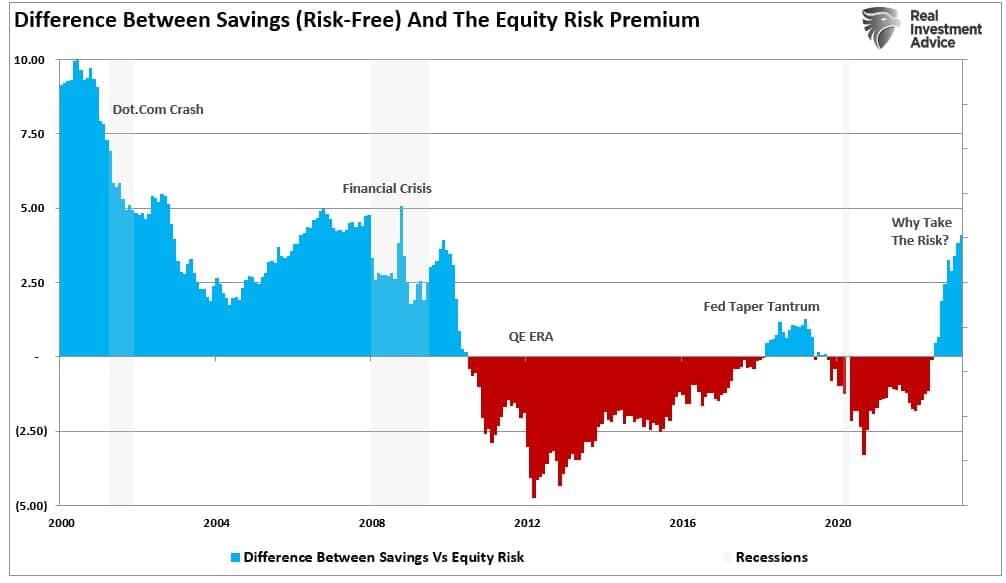
Why Take the Risk?

Following the financial crisis, Ben Bernanke dropped the Fed funds rate to zero and flooded the system with liquidity through “quantitative easing.” As he noted in 2010, those actions would boost asset prices, lifting consumer confidence and creating economic growth. By dropping rates to zero, “risk-free” rates also dropped toward zero, leaving investors little choice to obtain a return on their cash.

Today, that narrative has changed with current “risk-free” yields above 4%. Historically, there were periods when one could stick money in a “savings” account and earn enough return without taking risks. In other words, it was possible to “save” your way to retirement.

The chart below shows the savings rate on short-term deposits versus the equity-risk premium of the market.

One of the problems with the “cash hoard” in 2023 is there is currently no incentive to reverse those savings into “risk assets” unless the Fed is dropping rates and reintroducing “quantitative easing.” However, as discussed in “Banking Crisis Is How It Starts,” if the Fed reverses to a more accommodative policy, it is because they have “broken something.” Such will not be the time to take on more risk, but less.

Furthermore, despite the high money market account balances, investors have very low cash balances relative to the current equity exposure. As asset prices escalated since the Financial Crisis, supported by successive rounds of monetary policy, investors were trained to chase risk. While equity-to-cash ratios peaked in 2022, they remain at historically high levels.

Furthermore, retail investors have very little cash in money markets to invest.

Professional mutual fund managers are also holding near record-low levels of cash.

In fact, what is interesting is that historically, although higher rates attracted savings, the subsequent rate decline did not create massive outflows.

There is a reason for that.

Corporate Coffers

So, if it isn’t retail or professional investors, who is holding this $5 trillion cash hoard? The following Office of Financial Research chart breaks down money market funds by type.

Looking at the chart above, you will notice that the bulk of the money is in government money market funds. Those particular money market funds generally have much higher account minimums (from $100,000 to $1 million), suggesting the funds are not retail investors. (Those would be the smaller balances of prime institutional and retail funds.)

As noted, much of the “cash on the sidelines” is held by corporations. As we said in “A major support for assets has reversed,” that isn’t a surprise:

“CEOs make decisions on how they use their cash. If concerns of a recession persist, companies will become more conservative on the use of their cash, rather than continuing to repurchase shares.” — September 2019

Not surprisingly, as of the end of 2022, with CEO confidence near record lows, the money spent on buybacks slowed, and the cash hoard swelled as mergers and acquisitions declined.

Until the economic environment improves, those cash hoards will unlikely revert anytime soon.

Future Returns May Be Lower

As discussed in “Long-Term Returns Are Unsustainable.”

“The chart below shows the average annual inflation-adjusted total returns (dividends included) since 1928. I used the total return data from Aswath Damodaran, a Stern School of Business professor at New York University. The chart shows that from 1928 to 2021, the market returned 8.48% after inflation. However, notice that after the financial crisis in 2008, returns jumped by an average of four percentage points for the various periods.

After more than a decade, many investors have become complacent in expecting elevated rates of return from the financial markets. However, can those expectations continue to get met in the future?”

Of course, those excess returns were driven by the massive floods of liquidity from the Government and the Federal Reserve, including trillions in corporate share buybacks and zero interest rates. Since 2009, there was more than $43 Trillion in various liquidity supports. To put that into perspective, the inputs exceed underlying economic growth by more than 10-fold.

However, given an equal choice between “risk” and “risk-free” returns, such extracts buyers from the market and lowers potential price appreciation. In other words, as long as savings rates remain elevated, future stock market returns will likely be lower than over the past decade.

With net exposure to equities by professional and retail investors still near historically high levels, it suggests there is not an exceeding amount of buying power to push markets substantially higher.

It is a foregone conclusion that the Fed will eventually cut rates drastically due to a financial crisis or a recession. However, as noted above, that does not mean the $5 trillion “cash hoard” will come flooding back into the equity markets. back into the markets. That will ultimately be an issue of confidence.

So, the next time you hear someone talk about “money on the sidelines,” just remember that it really isn’t on the sidelines.

More importantly, if you expect a return to the “bull market of yesteryear,” you may be disappointed.

Tyler Durden
Tue, 04/18/2023 – 11:57