80.7 F
Chicago
Wednesday, August 12, 2026
Home Blog Page 3766

Biden EPA’s New Vehicle Emissions Standards Spark Backlash From Auto Industry, Republicans

Biden EPA’s New Vehicle Emissions Standards Spark Backlash From Auto Industry, Republicans

Authored by Nathan Worcester via The Epoch Times (emphasis ours),

An employee works on an assembly line at startup Rivian Automotive’s electric vehicle factory in Normal, Ill., on April 11, 2022. (Kamil Krzaczynski/Reuters)

The Environmental Protection Agency’s (EPA’s) proposed emissions standards for automobiles and trucks are raising eyebrows in the auto industry and Washington alike.

“EPA’s proposed emissions plan is aggressive by any measure. By that I mean it sets automotive electrification goals in the next few years that are … very high,” John Bozzella, president and CEO of the automaker trade organization Alliance for Automotive Innovation, wrote in an April 12 blog post.

The federal standards would tightly restrict emissions from new vehicles. That would effectively force automakers to boost their sales of electric vehicles (EVs).

Environmental Protection Agency Administrator Michael Regan testifies before the Senate Appropriations Committee in the Dirksen Senate Office Building on Capitol Hill on April 20, 2021. (Chip Somodevilla/Getty Images)

The agency’s proposal anticipates that under the new standards, two-thirds of new light-duty vehicles sold in the United States would be electric by the model year 2032.

It also predicts that 46 percent of new medium-duty vehicles sold in the United States would be electric by that model year.

EVs made up less than 6 percent of total new vehicle sales in 2022. That’s an increased percentage relative to past years, even as total new vehicle sales were down to 13.8 million units from 17.3 million in 2018.

The EPA claims that its standards would lower carbon dioxide emissions by 10 billion tons.

Agency administrator Michael Regan described the standards as the “strongest ever” during an April 12 press conference.

“The proposal exceeds the administration’s own 50 percent electrification target,” Bozzella wrote, noting that his industry is “fully committed to an electric and low-carbon transportation future.”

Not Enough Chargers

Less than two weeks ago, the IRS and the Treasury Department issued complex guidance on EV tax credits that could make it harder for consumers to benefit from those financial incentives.

Bozzella, who began his career working for then-New York Mayor David Dinkins, a Democrat, said the guidance would reduce the number of vehicles qualifying for tax credits. That would seem to disincentivize EV adoption even as the administration steps up other measures intended to facilitate more EV purchases.

Bozzella also said the 100,000 public, nonproprietary EV chargers in the United States are “not enough.”

An April 6 memo from the automotive alliance stated that electrification would take a “massive, 100-year change to the U.S. industrial base and the way Americans drive.”

Groups outside of the auto industry also voiced concerns.

Will Hild, executive director of Consumers’ Research, a consumer protection organization, said the standards are “the same thing BlackRock and ESG extremists like Larry Fink are doing with U.S. pensions and retirement dollars.”

The American people won’t stand for it,” he said.

Read more here…

Tyler Durden
Mon, 04/17/2023 – 17:00

New Mexico Researchers Transform Dead Birds Into Drones

New Mexico Researchers Transform Dead Birds Into Drones

Followers of the “Birds Aren’t Real” conspiracy theory, which claims the birds in the sky are government surveillance drones, may find some validation as a new research project intends to transform dead birds into drones. 

Reuters reported a team of scientists at the New Mexico Institute of Mining and Technology in Socorro are taking dead birds and converting them into drones to study flight. While the bird drones might not be spying, it provides some validity to supporters of the Birds Aren’t Real movement. 

“We came up with this idea that we can use … dead birds and make them (into) a drone,” said Dr. Mostafa Hassanalian, a mechanical engineering professor who is leading the project. 

“Taxidermy bird drones – currently being tested in a purpose-built cage at the university – can be used to understand better the formation and flight patterns of flocks. That, in turn, can be applied to the aviation industry,” said Hassanalian.

“If we learn how these birds manage … energy between themselves, we can apply (that) into the future aviation industry to save more energy and save more fuel,” he said.

The Birds Aren’t Real folks will have a blast with this picture of one of Hassanalian’s taxidermy bird drones. 

Hassanalian told Bussiness Insider that the Birds Aren’t Real movement didn’t inspire his research. 

Tyler Durden
Mon, 04/17/2023 – 16:40

Shorts Steamrolled As Late Day Squeeze Sends Stocks To Session High, VIX Plummets

Shorts Steamrolled As Late Day Squeeze Sends Stocks To Session High, VIX Plummets

First, some context from Goldman’s Prime Brokerage: “our franchise flows have shifted to local selling of tech this week and Nasdaq is only up in two of the past ten sessions (also note that it stands exactly where it stood in … the spring of 2021).

In other words, might as well have sold in May of 2021 and gone away for two years, enjoying all the hikes, golfing and trips and you’d still be right where you left off. Instead, you overtraded every market move and lost money.

Today was a micro snapshot of this entire dynamic: after some terrible results from large custody bank State Street, at a time when everyone is on edge about anything negative news out of banks, which sent State Street shares plunging by as much as 18%, the most intraday since March 2020…

… following the sharp early selloff, we say bank stocks gradually recover all losses before eventually trading near session highs by the close, as the massive hedge fund short overhang we discussed last week remains intact.

… and leads to a powerful rally every time a selling thrust is exhausted, and today was no difference. And speaking of massive short overhangs,  after we noted last week that the number of non-commercial net specs (i.e. hedge funds) shorting the S&P is at an 11 year high, we have barely budged..

… which is also why stocks took the escalator down, and the short squeeze elevator up closing at session highs and squeezing another round of shorts in the process…

… a reversal which the 0DTE crew orchestrated starting at exactly 2pm ET with a market-leading spike in delta, driven by a surge in call buying and put selling, a market inflection which was captured vividly in this chart from our SpotGamma partners

Source: Spotgamma

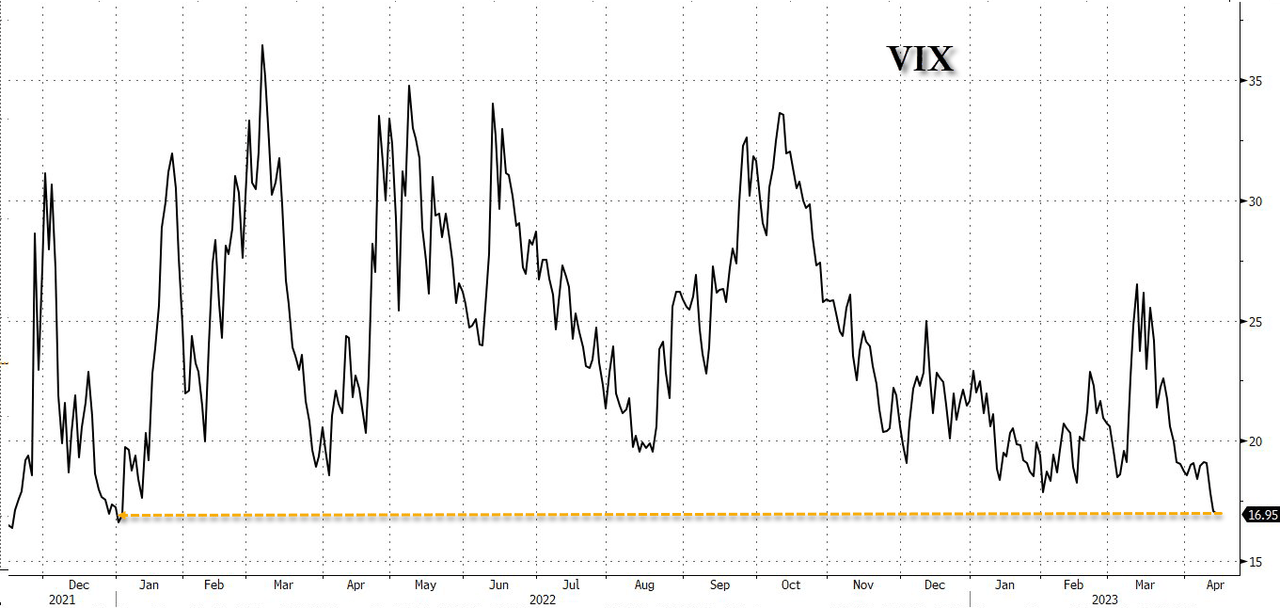
… which also is why the VIX was crushed today, as puts were unwound in a frenzy, and tumbled below 17 to the level where it was back in Jan 2022 when stocks were at all time highs!

And while banks promptly recovered and joined most other sectors in the green, the only sector that was lower was energy…

… tracking the renewed weakness in oil…

… where unlike stocks, shorts once again have zero fear of a squeeze, at least no a financial one – indeed, while all financial actors in energy are pressing their shorts having picked this asset class as the best expression of rising recession bets – bets which are encouraged by the senile occupant of the White House, because we learned today that another 1.6 million barrels in oil was drained from the Strategic Petroleum Reserve, it will be up to OPEC+ again to offset the relentless oily gloom.

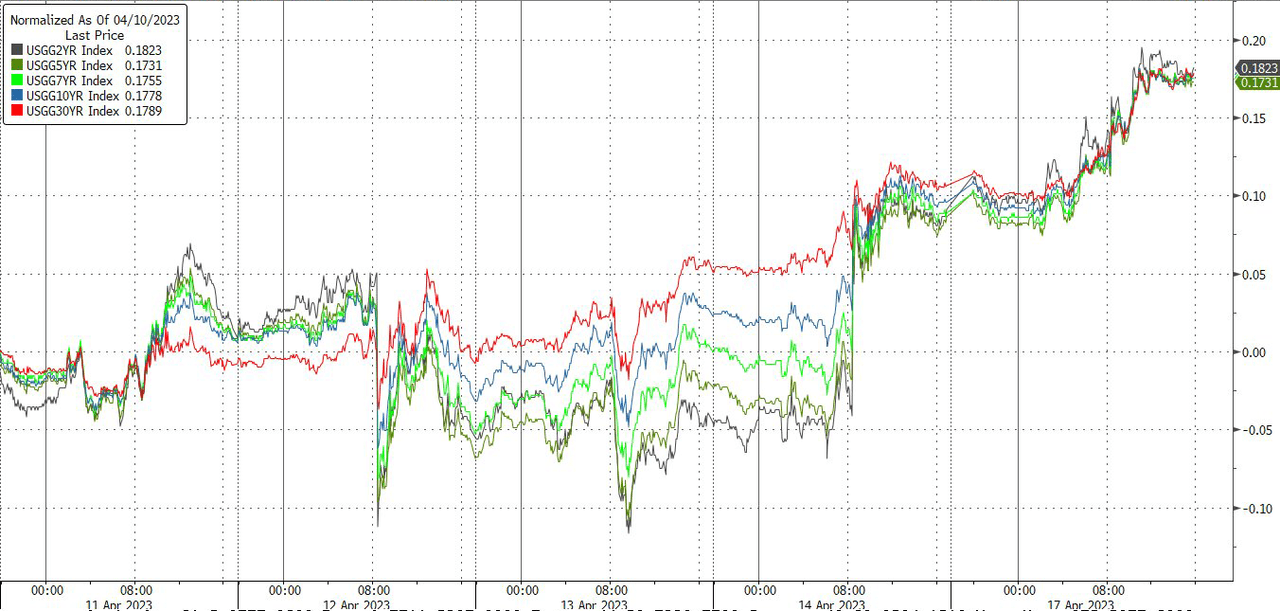
Elsewhere, there was a still bitter aftertaste in the market’s mouth from last Friday’s hawkish Fed commentary and today’s blow, near record beat in the NY Empire Fed, which pushed May rate hike odds to new cycle highs just shy of 90%…

… which helped push yields higher again and sending the 10Y back to 3.60% even if today that meant no selling in high duration tech names.

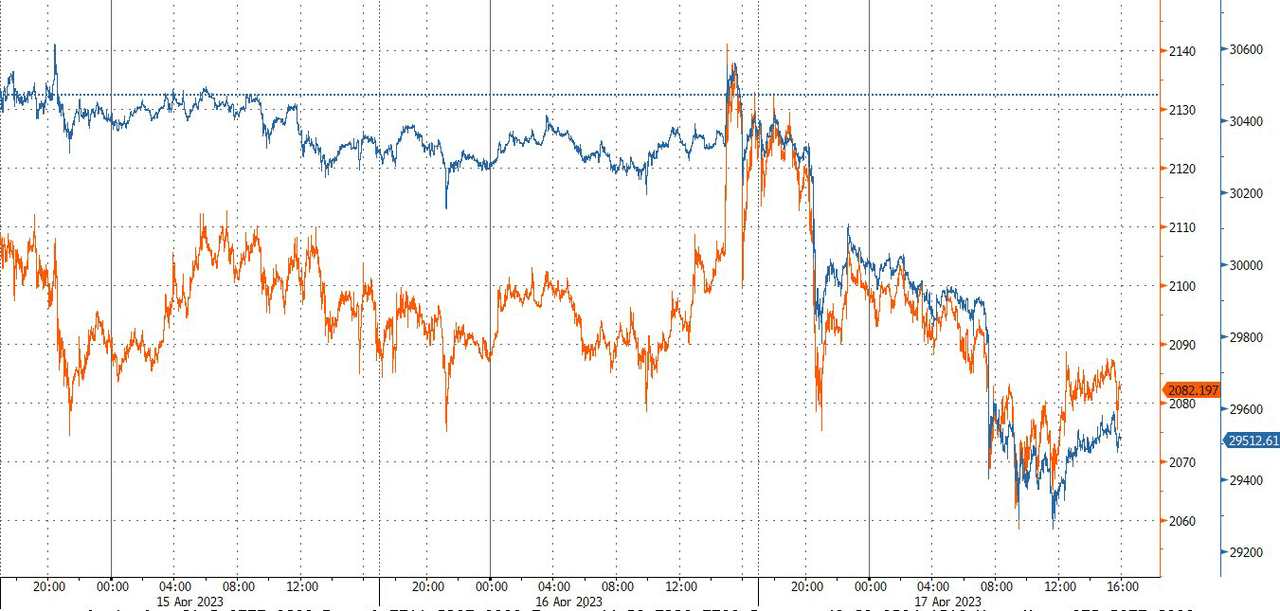
It did, however, mean that the dollar rose sharply after months of seemingly relentless declines which in turn helped smash both gold and cryptos with bitcoin dropping back under $30,000 after it was poised to rise above $31,000 just a few days earlier.

That said, with the next round of dollar-debasement just around the corner, the resumption of the fiat money alternatives rally is just a matter of time.

Tyler Durden
Mon, 04/17/2023 – 16:23

Competition And Costs Are Threatening The US LNG Boom

Competition And Costs Are Threatening The US LNG Boom

Authored by Tsvetana Paraskova via OilPrice.com,

  • More than a dozen proposed LNG export projects in the United States could stall due to cost inflation and increased competition to secure financing.

  • Demand for LNG has soared since Russia invaded Ukraine and buyers spurned Russian pipeline gas.

  • Developers could launch $100 billion worth of new LNG projects over the next five years, but securing long-term deals and financing is a major hurdle.

Cost inflation and increased competition to secure long-term buyers and financing could hold back some of the more than a dozen proposed LNG export projects in the United States.  

Demand for LNG globally is currently high, as European countries rush to build import terminals and purchase liquefied natural gas to offset the very low, or complete lack of, Russian pipeline gas supply.  

Despite the surge in LNG demand and the abundance of natural gas in the United States, America’s next LNG export boom could stall as costs have surged and financing has become more complicated with the higher interest rates.

“It’s dramatically more expensive,” Charif Souki, who founded Cheniere Energy and was the CEO of what is now the top U.S. LNG exporter until 2015, told the Financial Times.

“There are fewer and fewer construction companies that can actually handle these kinds of loads,” said Souki, who now leads Tellurian, the developer of the Driftwood project that has hit snags in its ability to raise funds and secure major long-term customers in recent years.

Apart from soaring project costs and rising interest rates, U.S. LNG export project developers face the issue with many buyers’ reluctance to commit to 20-year-long supply deals.  

Developers of U.S. LNG export facilities could launch $100 billion worth of new plants over the next five years as high prices and the need for energy security create strong momentum for long-term LNG demand and contracts, energy consultancy Wood Mackenzie said in a report earlier this year.

Yet, price volatility and the cost and financing issues could mean that fewer projects could see the start of operations this decade than previously thought.   

New U.S. and Canadian LNG export projects show signs of accelerating but volatile natural gas prices are making bets on future supply and demand difficult, industrial market intelligence provider Industrial Info Resources (IIR) said in research last month.  

Tyler Durden
Mon, 04/17/2023 – 16:20

US Banks Lost Money On Mortgages For The First Time Since The MBA Began Keeping Records

US Banks Lost Money On Mortgages For The First Time Since The MBA Began Keeping Records

US banks lost money on mortgages in 2022, according to a report from the Mortgage Bankers Association (MBA), which noted that the average loss was $301 on each loan originated that year, vs. an average profit of $2,339 per loan in 2021.

“The rapid rise in mortgage rates over a relatively short period of time, combined with extremely low housing inventory and affordability challenges, meant that both purchase and refinance volume plummeted,” said Marina Walsh, MBA’s vice president of industry analysis, as reported by USA Today. “The stellar profits of the previous two years dissipated because of the confluence of declining volume, lower revenues and higher costs per loan.”

The MBA has been tracking these statistics since 2008.

Mortgage rates more than doubled in 2022, briefly touching 7% in October. Rates have since come down slightly. 

Loan volumes in 2022 were 50% down compared with 2021. Volume was $2.6 billion (8,371 loans) per company in 2022, down from $4.9 billion (16,590 loans) per company in 2022.

Meanwhile, producing a loan got more expensive for lenders. The total costs including commissions, compensation and equipment increased to $10,624 per loan in 2022, up from $8,664 in 2021. -USA Today

“Companies could not adjust their capacity fast enough,” said Walsh. “The number of production employees declined, but not at the same pace as origination volume. As a result, productivity in 2022 fell to a low of 1.5 closed loans a month per production employee.”

The report also notes that refinancing applications were also down, as most homeowners have loans with interest rates below 4%. By dollar volume, the refinancing share of total originations dropped 20% in 2022 from 46% in 2021.

Meanwhile, the average loan balance for first mortgages reached a high of $323,780 in 2022, up from $298,324 in 2021 – the largest single-year increase in the history of the report.

Tyler Durden
Mon, 04/17/2023 – 15:40

“It’s Going To Be Ugly”: Commercial Real Estate Predictions Turn Dire

“It’s Going To Be Ugly”: Commercial Real Estate Predictions Turn Dire

Over the past several months we’ve seen a series of progressively negative headlines over commercial real estate – predictions becoming more and more dire.

Blackstone, of course, is waiting with dry powder for the “largest ever” real estate drawdown.

Now, according to one CEO of a real estate investment firm, things could get as bad as what was seen during the 2008 financial crisis.

“Unfortunately in the situation we’re in, things need to bottom out, and they haven’t bottomed out yet,” said Patrick Carroll, the CEO of the real estate investing firm Carroll, in a Thursday interview with CNBC, adding that while some areas of CRE could remain intact, such as multifamily housing, areas such as offices and hotels could be “destroyed,” as the sector grapples with tighter credit conditions and a cascade of debt maturities.

“It’s going to be ugly. It’s going to be at least as bad as ’08, ’09,” he warned.

One of the core issues is that commercial mortgage debt held by banks will need to be refinanced in much tougher conditions in the coming years – as around 80% of outstanding commercial property debt is held by small and medium-sized banks.

“Sellers are not realizing how much their properties have lost value, and they’re not willing to dump their properties yet because they haven’t felt enough pain. They’re about to start feeling pain. These lenders are screwed,” said Carroll, who noted that $1.5 trillion in commercial real estate debt will come due in the next three years – which will either need to be refinanced or renegotiated.

And with the collapse of SVB and other small banks feeling the pressure, many will be less inclined to lend without doing so at much higher interest rates than the commercial real estate market is used to.

Tyler Durden
Mon, 04/17/2023 – 13:00

Is There A Worldwide Run On The Bank Of The United States Of America?

Is There A Worldwide Run On The Bank Of The United States Of America?

Authored by Douglas MacKinnon, op-ed via The Hill,

In talking this week with a friend about the United States seemingly imploding from within across multiple sectors, my friend stressed:

It’s not just from within. There is a run on the United States from certain nations and business interests around the world. Just like there was a run on banks after the collapse of Silicon Valley Bank, many nations are either thinking about — or actually proceeding with — transferring at least a portion of their allegiance, assets and commitments from the ‘Bank of the U.S.’ to the ‘Bank of China’ or elsewhere.

This was not just some person sitting on a porch casually talking about current events while whittling a stick waiting for his Social Security or pension check to hit the mailbox. This was a former high-level U.S. government official, now a CEO, someone who sits on the boards of directors for multiple companies. He has massive real-world and business experience and believes the United State may be on the verge of collapse.

He is far from the only one to think that.

Some fear the Biden administration is losing control of our southern border; losing control of our decaying, crime-infested big cities; creating a recession; vilifying and needlessly destroying the fossil fuel industry while pushing suspect and subsidized “green” energy alternatives; leaving tens of billions of dollars in military equipment in Afghanistan while withdrawing our troops and abandoning an ally; stepping closer to a trip-wire in the Ukraine war, which could trigger a nuclear strike; turning on Israel over ideological issues as Turkey and others call on Arab and Muslim nations to unite and crush the Jewish State; weakening our military with one “woke” edict after another; focusing on “trans” issues at the expense of failing transportation infrastructure; cheerleading the social justice warrior takeover of our colleges and universities; and weakening the dollar (the currency much of the world depends upon).

Is it any wonder, then, that nations such as France, India, Saudi Arabia, Japan, Mexico, Brazil and others are suddenly hedging their bets by looking beyond the United States of America for partnerships and stability?

On top of those problems, our allies and certain foreign corporations now have the legitimate concern of wondering what between them and the United States will be kept private and secure, in light of the massive and reportedly deliberate leak of classified Pentagon documents. 

Who is an ally or foreign business partner to trust? More importantly, in the eyes of some of these nations and foreign business interests, who will prove to be the more stable and dependable partner in the coming years and decades?

In an example of a world leader hedging his bets, French President Emmanuel Macron recently traveled to Beijing to meet with China’s President Xi Jinping. Macron did not travel alone. He brought along Ursula von der Leyen, the president of the European Commission. Some saw this as Macron advertising that much of the European Union was with him in spirit as he met with Xi. 

On his way back to France after the meeting, Macron emphasized that Europeans should not be “just America’s followers” and “get caught up in crises that are not ours.” Even though the French leader seemed to be spelling it out in 100-font, one could read between the lines and assume he meant not getting dragged too deeply into the Ukraine war or defending Taiwan, should China invade. The last part was music to the ears of China’s strongman, Xi.

Next, we have Mexican President Andrés Manuel López Obrador openly criticizing — and challenging — the leadership of the United States for months, by calling the U.S. an “oligarchy, not a real democracy.” He threatened to sabotage calls for U.S. military action against Mexican cartels, and has made it clear that he is not afraid to pick a fight with what he may see as a United States in decline.

Or, last month’s news that Saudi Arabia was inching closer to joining a China-led Asian security and economic bloc, after having been granted the status of a dialogue partner in the Shanghai Cooperation Organization (SCO). Aside from China and Russia, the bloc also includes India, Pakistan and some ex-Soviet states. It’s an organization  one might view as not always having the best interests of the United States in mind.

As Ali Shihabi, a Saudi analyst and writer, made clear during an interview:

The traditional monogamous relationship with the US is now over. And we have gone into a more open relationship, strong with the U.S. but equally strong with China, India, [the] UK, France and others.”

Finally, we have Brazil — China’s most important trading partner in South America — announcing a new agreement to conduct bilateral commerce in their respective currencies, rather than the U.S. dollar. The move not only shocked many in the U.S. government but opened the eyes of others around the world to the possibility of decoupling from the dollar.

Some believe these things are happening because a growing number of political and business leaders around the world now lack confidence in the United States, believing our country truly is in disarray, decline and increasingly polarized and politicized. Will such concerns accelerate a “run on the Bank of the United States” with assets being transferred to China or even Russia? 

Only time will tell. But as with the collapse of Silicon Valley Bank, the signs are out there, should the analysts care to pay attention.  

Tyler Durden
Mon, 04/17/2023 – 12:40

Michigan State University Language Police Warn Of Offensive Words Like ‘America’, ‘Female,’ ‘Wreaths’

Michigan State University Language Police Warn Of Offensive Words Like ‘America’, ‘Female,’ ‘Wreaths’

Submitted by Mark Pellin via Headline USA (emphasis ours),

Graduates line up to receive their diplomas. / PHOTO: AP

The latest iteration of Michigan State University’s so-called inclusive language guide sparked divisive backlash for what it excluded and criticism that a woke language police had crossed the line.

The indoctrination tool was designed to curtail the use of wide-spread, commonly-used words and phrases that leftists have deemed offensive.

“The origins of seemingly innocuous idioms or words may be racist, sexist or ableist in nature,” the guide claimed, dinging phrases and words like “hold the fort,” “cake walk,” “bonkers,” “addict,” “founder” and “America” as examples of bigoted language.

America, the guide instructed, should be referred to as the “United States.”

The word “female” was excluded for inclusion in the guide’s section dealing with “Gender and Sexuality.” When used “as a noun for women,” the “pejorative term reduces women to their assumed biological anatomy,” the guide scolded.

The guide also advised to include cisgender whenever referring to transgender.

Not including cisgender implies that cisgender identities are more valid than transgender identities,” the guide warned.

Taking inclusiveness to a wild extreme, MSU language police recommended using a veritable alphabet to replace LGBT.

“LGBTQIA2S+ is often used at MSU to refer to lesbian, gay, bisexual, transgender, questioning and/or queer, intersex, asexual and two-spirit groups,” the guide noted. “The plus sign refers to the inclusion of all identities that are not specified in the acronym.”

Words deemed offensive for “Indigenous stereotyping and colonial language” included “tribe,” “low man on the totem pole,” “powwow,” “sitting Indian style,” “bury the hatchet,” “on the warpath,” “shaman,” “rain dance,” “savage,” “barbarian,” “off the reservation,” “spirit animal,” “scalped,” “peace pipe,” “hold down the fort,” “frontier.”

The term Spartan, the university’s mascot, escaped the purge.

Don’t use the shorthand ‘POC’ for people of color, ‘BIPOC’ for Black, Indigenous and people of color or ‘QTBIPOC’ for queer, transgender, Black, Indigenous and people of color unless in a direct quote; when used, explain it,” the guide instructed. “These are vague terms that may unintentionally leave out race and ethnicity groups or create hierarchy.”

The guide explained that the University “values communications practices that support belonging for all Spartans. In alignment with strategic efforts around diversity, equity and inclusion, the Inclusive Guide provides best practices for communications in gender and sexuality, race and ethnicity, global identity and disability.”

In that vein, the guide warned, “Be aware that the terms ‘obese,’ ‘obesity’ and ‘overweight’ are pathologizing stigmas in the size-diversity community. Do not use these when describing individuals outside of communicating about research. Use ‘higher weight’ or ‘larger-bodied if necessary and consider the barriers that ‘students of size’ face in marketing, events and classroom experiences.”

To prevent what the guide called “male-centric and western father-son language,” it advised using grade levels “first year” through “fourth year,” instead of “freshman,” “sophomore,” “junior” and “senior.”

Under the section for “Global Identity,” the guide chided:

Labeling a person as an “illegal immigrant” or “illegal” is not only dehumanizing but also a poor way to describe someone’s migration status. Consider using “undocumented immigrant” or “immigrant who is undocumented.”

Avoid references to religious imagery and language. Use terms like “wishing you a wonderful winter/spring break” or “best wishes for the new year.”

Avoid the contentious term “Islamist” and instead use the specific name of the group, movement or institution.

The guide’s section on “Race and Ethnicity” instructed that African American and Black are not synonymous. A person may identify as African or African American or Black from geographical regions or with a distinct cultural heritage, for instance, Afro-Caribbean, Afro-Latine/x, Afro-Indigenous or Afro-Asian.”

The inclusive guide did its best to divide, advising that “Brown” has been used for South Asian Americans, Middle Eastern Americans and Hispanic, Chicano/a and Latino/a/x Americans either as a pejorative term or as self-identification. Use specific racial identities.”

Tyler Durden
Mon, 04/17/2023 – 12:20

McCarthy Warns Biden Could ‘Bumble’ Into First Default In US History

McCarthy Warns Biden Could ‘Bumble’ Into First Default In US History

House Speaker Kevin McCarthy (R-CA) announced Monday that House Republicans are on course to pass their own debt ceiling bill which would allow the United States to meet its obligations until 2024.

Since the president continues to hide, House Republicans will take action. So here’s our plan: In the coming weeks the House will vote on a bill to lift the debt ceiling into the next year, save taxpayers trillions of dollars, make us less dependent upon China, curb our high inflation — all without touching Social Security and Medicare,” said McCarthy during a speech at the New York Stock Exchange.

And while he didn’t offer specifics, McCarthy slammed Democrats over open-checkbook policies, while refusing to negotiate policy conditions for extending the debt limit.

Let me be clear. A no-strings-attached debt limit increase will not pass,” McCarthy said, adding of the forthcoming GOP plan: “It limits, it saves and it grows,” said McCarthy, who added that “the longer President Biden waits to be sensible to find an agreement, the more likely it becomes that this administration will bumble into the first default in our nation’s history,” said McCarthy.

As we noted earlier Monday (available in full for premium subscribers), thanks to a notable spike in the US deficit (due to less tax revenue combined with far greater governmental outlays), the Treasury General Account, or the cash balance parked by the Treasury at the Fed, has dwindled rapidly and was in the double digits as of Friday – the lowest since the end of 2022 – and an amount which, sans a rapid debt ceiling solution, could lead to market chaos.

So is chaos eminent? Read more here

“Without exaggeration, American debt is a ticking time bomb that will detonate unless we take serious, responsible action. Yet how has President Biden reacted to this issue? He has done nothing,” said McCarthy, adding “Debt limit negotiations are an opportunity to examine our nation’s finances.

Any bill passed by the GOP-controlled House would of course need approval from the Democratic-led Senate, before heading to Biden’s desk for his signature.

As far as the Treasury Department is concerned, lawmakers have until June to raise the debt limit, however other experts believe it could be extended until between July and September.

According to White House spokesman Andrew Bates, “There is one responsible solution to the debt limit: addressing it promptly, without brinksmanship or hostage-taking — as Republicans did three times in the last administration and as Presidents Trump and Reagan argued for in office.”

Tyler Durden
Mon, 04/17/2023 – 12:00

Blain: Markets Still Look Daft

Blain: Markets Still Look Daft

Authored by Bill Ban via MorningPorridge.com,

“Money can’t buy happiness, but it can buy property.. and that’s a whole new can of worms.”

Markets are in wait and see mode – inflation, rates, earnings and all the rest weigh upon them. Back in the real world, the economic reality for young workers trying to find housing security in London feels more and more broken.

According to a big US bank, we are now in a Bear Market! Crashing major/minor chords.. Really.. how exciting…. yawn.. I’m expecting an interesting week’s play in prospect here in the Global Financial Markets as we watch US earnings, while wondering just how aggressively/mildly Central Banks will hike in May. I’m thinking markets still look daft: there is still much delusion, hopes, confusion, speculation and outright FOMO driving prices and trading.

Many market participants believe good times (like the 1920s and 2010’s) are just around the next corner – it’s just a matter of rates and central banks seeing the good sense of supporting markets… That is so last decade. There are a slew of complex factors making for a very muddy market picture that’s obscuring how a new reality of higher rates, more persistent inflation, changing global trade flows, but ultimately stronger growth and positive economies after some painful readjustment. Climate change, AI, and probably many things that ain’t occurred to us yet are going to drive a new investment age – as soon as we shake off the fug of this one.. SPACS might be unravelling, Tech madness is diminishing, Cryptos are back on a roll (why?), but there is still too much general FOMO and the belief markets only ever go up…

Major changes to valuations and expectations across the financial asset markets are happening as interest rates normalise. The threat of recession/stagflation is real. Many of the silly market “wisdoms” that have taken hold since 2008 are still to topple, but markets will offer some really exciting growth opportunities.

This morning I’m thinking about just one factor: housing – a critical confidence factor. Later this week, I’m hoping to find some time to focus on China, the dollar and emerging markets.  

There are lot of myths out there. Time to prick a few bubbles…

That’s what usually happens when the paradigm shifts – those still caught in the last one get tumbled up by the replacement and are loath to let it go, while the smart money is already running to chase the next set of opportunities.

Last week, my colleagues and I were talking about how to invest in a higher for longer inflation/rates environment – and came up with a series of fascinating conclusions of the Shard Litebite market podcast – you can find it here.

Broadly, we do expect selective stocks to perform well – areas like energy, some tech, etc, but acknowledge there is still a lot of dross to be exposed. The next year or so is going to see further unwinds. Beware indices, and focus on fundamentals. Much more interesting are bonds (including inflation linked if your share our view inflation will remain elevated) at positive real yields, including higher yielding cashflow based alternative investments in private debt – dull boring predicable returns from real assets, rather than speculative hype-driven hopes for stock upside.

A Moment in The London Housing Market…

One of the risks writing about markets is not actually seeing the woods for the trees. It easy to figure out what might be happening looking at prices on a screen, reading too many analyst reports, or talking with an investment manager on their trading views, but its seldom any of us get to view real economies in practice.

I did.. on Saturday in London.

My youngest dragged me to the London Home Show, a sales jamboree for the “shared-ownership” property sector. This a government sponsored initiative to help low-income workers find an affordable way to own their own homes. The idea is to buy 25-75% of the flat, and pay rent on the remainder to the “housing association” running the property.

Realistically, it’s the only way my daughter will get on the property ladder in London. She has a great job, but her rent was just hiked 30% plus (which will eat up all her savings), and she won’t spend the rest of her career being ripped blind by avaricious landlords. (Yes, I know most landlords are decent, but in her particular block every tenant just got notice to quit, and apparently, they are being replaced by Chinese students flocking back to London). Originally the block was affordable housing for key workers – not so much now…

The “home show” was packed with 20/30 somethings all caught in the same rent trap. All of them are looking for an element of housing security – if they don’t find it, London will collapse on a lack of workers. The enthusiastic marketing teams were extolling their new tower blocks around London. A one bed flat in this new block just 20 miles from the Centre of London? It turned out the minimum income threshold for such “affordable” property is £81,000 – when the average London income is £36k. (Not only do you need to persuade a bank to give you a mortgage, but the income test gives the landlord the ability to cherry-pick their tenants.)

On every stall the marketing teams were making the same pitch: “this block has sold out really fast, there are just a few left, and you would really need to reserve it now to be in with a chance..”

I wondered how the prices of these new build blocks (extolled as the best property to buy as they are energy efficient, green and full or modern appliances) are actually set? There isn’t a “grey” market in them – the price is the price the developer sets. If the marketing teams then create a hype to sell them at that price – that’s business. I asked a few of marketing folk who explained these prices were set in relation to the market.. How? Never got an answer on that.

My girl was asking great questions – if she is paying a mortgage, a rent on top of that for other 75%, plus her council tax and her “service charge” on the flat (typically £3k per annum), what’s to stop her being crushed if the “landlord” hikes the rent or the service charge? Again not much comfort except a vague undertaking that rents were market set or linked to inflation. Service charge questions usually got blanked. Instead, she was “reassured” that her share of the ownership would give here the “upside” to buy some bigger as prices rise. Really?

I like the idea of shared ownership to get on the housing ladder, and lots of very reputable firms are involved, but I can’t help thinking there is a massive element of hype around it. It feels fuelled by desperation. It will probably boom because London will remain massively short affordable property. Whenever demand massively exceeds supply – someone will exploit the opportunity. I sense that is happening.

When single bedroom “London” flats in the wilds of Essex, (closer to Amsterdam than the City), are only available to workers on incomes in excess of £60k… I can’t help but smell a rat.. and a massive element of hype where the developers and landlords controlling supply are setting the price. But I am just a suspicious guy…

I read about how difficult existing shared ownership owners find it to sell their properties – tied up in bureaucracy and valuation costs as the landlord/developers focus on selling the new stock – selling flats below that price might prick the bubble?

My kids are nowhere close to settling down, or having families of their own in the near future. How can they – living in expensive rental insecurity where they have to keep moving further out as rents are hiked to unaffordable levels? It’s no wonder population decline is the demographic reality, prompting the question…. Just who is going to buy all these expensive London flats when the number of young people coming to London inevitable crashes?

What’s the solution?

I’m not sure – but the shared ownership market, while no doubt well-intentioned, looks a tad frothy. Fortunately my girl is bright and clever enough to be going into it eyes wide open, and asking the right questions.. The Bank of Mum and Dad is…. nervous.. but trusts her.


Tyler Durden
Mon, 04/17/2023 – 11:40