Supreme Court Temporarily Pauses Restrictions On Abortion Pill
The Supreme Court has temporarily paused a suspension of the FDA’s approval on the abortion pill, mifepristone, after Justice Samuel Alito issued a five-day administrative stay in order to give the high court time to consider a longer delay.
The stay, which expires next Wednesday, April 19, comes one day after the Biden DOJ asked the Supreme Court to protect the availability of the abortion pill, after the 5th US Circuit Court of Appeals blocked doctors from prescribing the pill after the seventh week of pregnancy.
“People are worried that the money they’ve saved won’t last and are worried they’re going to have to lean more on their credit cards and other sources of debt just to get by,” said Bruce McClary, a senior vice president at the National Foundation for Credit Counseling.
Cost of Shelter Still Rising Sharply
Shelter Costs Surge Again
For 14 consecutive months, the cost of shelter has risen at least 0.5 percent from the preceding month.
Rent of primary residence is standard rent (not owner occupied), unfurnished without utilities.
Owners’ Equivalent Rent (OER), is the estimated price one would pay to rent one’s own house, unfurnished and without utilities. It is the single largest CPI component at 25.41 percent.
The shelter index increased 8.2 percent over the last year, accounting for over 60 percent of the total increase in all items less food and energy.
Consumers Are Having a Much Harder Time Getting Credit Than a Year Ago
Data from the New York Fed Survey of Consumer Expectations for March, chart by Mish
The inverted yield curve and QT act to restrict lending
Banks are fearful of a recession and credit losses
All the banks that leveraged into duration are suffering mark-to-market losses on their Treasury and MBS portfolios. The banks know this (and knew this even before Silicon Valley Bank was taken over).
Fed Minutes Now Predict a Recession This Year Along With Higher Unemployment
The Fed forecasts a recession, calls for higher unemployment and below trend growth, with risks to the downside.
The staff’s projection at the time of the March meeting included a mild recession starting later this year, with a recovery over the subsequent two years.
The unemployment rate was projected to rise above the staff’s estimate of its natural rate early next year.
The Fed has never predicted a recession in advance. Is this a first or has a recession already started?
Perhaps you think there won’t be a recession. Those 58% living paycheck to paycheck, sure hope hope there won’t be one.
Meanwhile, President Biden is doing everything humanely possible with regulations, energy mandates, and support for unions to create more inflation.
The dilemma for the Fed, and it’s a huge one, is that credit conditions are very deflationary, but the economic policies of this administration coupled with trade wars everywhere are very inflationary.
NYT Lies About Snowden To Peddle ‘Evil-Leaker’ Propaganda, Then Stealth-Edits When Caught
When the New York Times wonders why they went from ‘the paper of record’ to BuzzFeed in a suit, they can look no further than this article on whistleblowers written by ‘Diplomatic correspondent’ Michael Crowley – which for 12 hours, despite undergoing a full editorial process, contained major fabrications about whistleblower Edward Snowden, who in 2013 exposed vast domestic and international spying operations run by the NSA and other organizations.
For starters, Crowley wrote that Snowden “handed them off to the website WikiLeaks for publication,” which is a complete lie. Snowden in fact gave the documents to journalist Glenn Greenwald when he was with The Guardian, and the Washington Post – where they went through the editorial process.
Second, Crowley wrote that a disclosure that the NSA was spying on former German Chancellor Angela Merkel’s phone came from the Snowden archive – another total lie. Both of these lies could have been debunked with a 10 second look at Wikipedia. In reality, the Merkel findings were the result of a 2015 internal investigation in the Danish Defense Intelligence Service into the NSA’s role in the partnership, and broken by Reuters.
Holy shit: this NYT news article by @michaelcrowley has 2 gigantic, glaring factual errors in the first 3 paragraphs:
1) Snowden didn’t give the archive to WikiLeaks for publication, but rather to me and Laura Poitras.
As Greenwald notes, “This story was published by the NYT 12 hours ago. Numerous top editors who oversaw publication of our reporting — then-Guardian-editor-in-chief @janinegibson and Intercept’s @MargotWilliams — quickly corrected them, but the paper ignored it.”
Of course all journalists and outlets make minor errors but these are major. No journalist has any business writing about the Snowden reporting if they believe WikiLeaks published it. That’s just massive ignorance that made it through all their editors.https://t.co/H8SPQDz42E
The entire liberal corporate media just banded together to proclaim the TwitterFiles debunked based on 2 minor errors with acronyms (which, as @lhfang proved, were not, in fact, errors). These NYT errors are in a different universe.https://t.co/HgGPebaKhx
Then, without saying a word, the Times stealth edited the lies out of the article more than 12 hours later.
Just now, the NYT silently deleted its false statements from the article, without bothering to add a correction, an editor’s note or any other indication that this happened.
Just a stealth edit after these errors were up for more than 12 hours, as if it never happened: pic.twitter.com/6GMuFDCBGC
Nasdaq’s Casino-Like Returns Turns Investment Into Roulette Game
By Ven Ram, Bloomberg Markets live reporter and strategist
Sometimes, watching stocks go up, up and away to stratospheric heights, one may end up thinking they are in a casino.
The gravity-defying performance of technology stocks this year is a case in point. After Thursday’s 2% rally, the Nasdaq 100 basket has serenaded investors with a stunning 20% return. And that’s not counting the dividend yield. Given the potent rally, that yield may not be stellar at less than 1%, but every percentage point does count in the long run.
At current levels, the earnings yield available to a stockholder is around 3.26%, and you know that you can aspire to higher yields in the Treasury market without accruing any credit risk. Talking of the latter, even the option-adjusted spreads on high-yield credit in Corporate America are a lot higher — a full 130 basis points. The question to ask, of course, is whether the growth picture of technology stocks is so alluring and risen suddenly so meteorically since the start of the year that investors should forsake all sense of caution and flee to high-duration stocks.
That last bit is likely to come into sharper focus now that it’s becoming increasingly clear that the Federal Reserve is entering the last lap of tightening for the current cycle. But the end of a tightening cycle doesn’t necessarily have to give way to a loosening cycle — especially given above-target inflation — but that point is pretty much lost on the markets. “Hike and hold”, which has been the Fed’s refrain, doesn’t translate into “Hike and cut immediately” even in Swahili the last time I checked, but you could argue until the cows come home and still not get anywhere.
So if the current mood in the market continues, we may well see technology stocks climbing higher and higher for longer than you keep your sanity or solvency — or both. However, one thing is for sure: those who live by the sword must be prepared to die by it. Buying high and selling higher may be a thrilling ride while it lasts, but the point is that it doesn’t last long enough until you are burnt.
For, if you treat the markets like a casino, you should also expect the returns you would get from being inside one.
Indian banks fear an end to the country’s major intake of discounted Russian oil in the wake of OPEC+ surprise production cuts, which have helped push Urals crude close to overrunning the G7’s $60 per barrel price cap.
According to The Millennium Post, citing an unnamed refinery executive, both the State Bank of India and Bank of Baroda have informed refiners they will not handle payments for oil bought above the limit.
In the meantime, Indian banks are very closely monitoring crude prices at ports, where costs of logistics are intermingled, making for a more complicated pricing mechanism, the Millennium Post reports, adding that “banks are demanding details on so-called free-on-board prices to ensure they fall at, or below $60 a barrel”.
Anything above that would trigger European Union sanctions, which prevent Russia from selling above $60 a barrel using G7/EU services and logistics.
While Russian oil has not yet breached the $60 mark, but is trading very close to that, if Brent ends up riding higher to the mid-90s, Urals will move up in tandem.
While key Indian banks are starting to get worried, Millennium Post cited a Mumbai refining executive as suggesting that buyers might start looking to different banks with less foreign exposure who are less risk-averse to falling afoul of the G7 rules.
The biggest OPEC producers in the Middle East and several other members of the OPEC+ pact announced early this month a total of 1.16 million bpd of fresh production cuts. Saudi Arabia, OPEC’s de facto leader and top global crude exporter, will cut 500,000 bpd and said that the move was “a precautionary measure aimed at supporting the stability of the oil market.”
The voluntary production reductions include big cuts, beginning in May and lasting through the end of 2023, from the top Middle Eastern producers who typically export sour and more heavier varieties of crude.
The surprise OPEC+ cuts have also led to Asia’s biggest oil importers snapping up June-loading spot cargoes from the Middle East after Saudi Arabia moved once again to hike the price of oil to the continent.
‘Rape Is Sexy’ Trump Accuser Bankrolled By Billionaire Hoax-Funding LinkedIn Founder
A woman who claims that former President Trump sexually assaulted her in the mid-1990s at a Bergdorf Goodman department store dressing room in Manhattan has been funded by LinkedIn founder Reid Hoffman, according to newly released court documents.
While the alleged attack happened decades ago, Carroll is suing under New York’s Adult Survivors Act, which allows victims to sue for civil damages beyond the statute of limitations.
Trump, who has long-denied her allegation, accused Carroll of using false claims as a way to promote her book. “I’ll say it with great respect: Number one, she’s not my type. Number two, it never happened,” the-then president told The Hill in an interview at the White House in June 2019.
Reid Hoffman’s involvement was revealed in a filing from Trump’s legal team seeking a one-month delay in the upcoming trial, scheduled to begin April 24, claiming that Carroll tried to hide Hoffman’s funding, which they say brings her credibility into question. While a delay was not granted, Judge Lewis Kaplan allowed the inquiry from Trump’s team.
Carroll’s legal team claims that Hoffman’s support is irrelevant to her case, and that he offered it almost a year after the lawsuit was filed – while calling Trump’s attempts to delay the trial “his latest transparent effort to keep a jury from deciding Carroll’s claims.”
In 2019, Carroll stunned CNN‘s Anderson Cooper when she said “I think most people think of rape as being sexy.”
E. Jean Carroll on her allegation against Trump: “The word rape carries so many sexual connotations. This was not sexual. … I think most people think of rape as being sexy. They think of the fantasies” pic.twitter.com/idjLXIOFMp
And while Carroll couldn’t remember if Trump penetrated her “halfway – or completely,” she refuses to use the term ‘rape’ for what she says happened.
“I am filing this on behalf of every woman who has ever been harassed, assaulted, silenced, or spoken up only to be shamed, fired, ridiculed and belittled,” said Carrol, who seeks unspecified compensatory and punitive damages, according to the Washington Post.
Hoffman, a major 2016 Hillary Clinton supporter, notably apologized for bankrolling an online disinformation hoax conducted by a former Obama administration official leading up to the 2018 midterm elections.
Hoffman, who co-founded LinkedIn, admitted in late 2018 to funding American Engagement Technologies (AET) – which was embroiled in a “false flag” scandal stemming from the 2017 Alabama special election for commissioning cybersecurity firm “New Knowledge” – founded by Jonathon Morgan, who created the technology running the infamous “Hamilton 68” propaganda website which purports to track Russian bot activity.
Morgan’s firm created over 1,000 Russian language Twitter accounts which supported Republican candidate Roy Moore, then Morgan pointed to his own bots following Moore to imply that he was a Russian stooge.
Disinformation warrior @jonathonmorgan attempts to control damage by lying. He now claims the “false flag operation” never took place and the botnet he promoted as Russian-linked (based on phony Hamilton68 Russian troll tracker he developed) wasn’t Russian https://t.co/N4EEjz49mBpic.twitter.com/qfNcVIRQsD
The Internal Revenue Service (IRS) announced Wednesday that over a million Americans have unclaimed tax refunds for the tax year 2019 and face a looming deadline to claim a total of $1.5 billion before it becomes government property.
The IRS said in a press release that nearly 1.5 million people across the United States have unclaimed refunds because they haven’t filed their tax returns for the 2019 tax year.
“The 2019 tax returns came due during the pandemic, and many people may have overlooked or forgotten about these refunds,” IRS commissioner Danny Werfel said in a statement. “We want taxpayers to claim these refunds, but time is running out.”
Normally, the deadline for filing older tax returns falls around the April tax deadline. But for 2019 returns, that window has been extended to July 17 due to the pandemic.
“With the pandemic taking place when the 2019 tax returns were originally due, people faced extremely unusual situations,” Werfel said.
There’s a three-year window for taxpayers to file returns and claim refunds. If they don’t file within three years, any money they could have received becomes the property of the U.S. Treasury.
The average unclaimed amount for the 2019 tax year is $893 per filer.
In a separate press release, the IRS issued a reminder that April 18 is the deadline for first quarter estimated tax payments for the tax year 2023. These estimated quarterly tax payments are typically made by individuals like the self-employed and entities like corporations that do not have their taxes withheld.
Also, the IRS on Tuesday announced that taxpayers in nearly two dozen states should consider filing amended tax returns for 2022 because they may have needlessly reported income from special state relief payments and stand to get bigger refunds.
Some Taxpayers Eligible for Bigger Refunds
The IRS said in a press release that taxpayers who reported certain state payments related to general welfare and disaster relief as taxable income on their tax returns did so, in many cases, unnecessarily.
The tax agency earlier this year determined that taxpayers in nearly two dozen states didn’t need to report these special payments in tax year 2022 and the IRS won’t challenge their taxability.
French Court Approves Macron’s Unpopular Pension Reform As Fresh Protests Expected
France’s top constitutional body ruled in favor of President Emmanuel Macron’s unpopular plan to raise the retirement age is in line with the French Constitution, a decision that will only spark further social unrest.
Bloomberg reported the Constitutional Council in Paris, France’s equivalent of the US Supreme Court, “approved the core elements of the law, including the key contested provision to raise the minimum retirement age by two years to 64.”
The nine-member body rejected one of two opposition-backed demands for a process that would’ve allowed for a referendum on keeping the pension age cutoff at 62.
We suspect hardline unions and the opposition won’t back down this weekend and will continue protests.
France’s Constitutional Council upholds Macron’s retirement-age increase but one leader of the opposition 👇 vows to fight on. https://t.co/UeueMTCxlV
On Thursday, pension demonstrators stormed the LVMH Moet Hennessy Louis Vuitton, the world’s largest maker of luxury goods, headquarters in Paris. One union leader said:
“Apparently our government is struggling to finance our social security and pension system, so money needs to be found where it is, which is in billions in companies like LVMH,” Fabien Villedieu from the Sud-Rail unions said on local television.
Rep. Jim Jordan (R-Ohio) on April 12 subpoenaed Chair Lina Khan of the Federal Trade Commission, stepping up the conflict between that agency and House Republicans regarding its approach to Twitter in the Elon Musk era.
The Epoch Times has reviewed the subpoena.
The subpoena comes after a March 10 letter to Khan from Jordan, who chairs the House Judiciary Committee, and Sen. Ted Cruz (R-Texas), ranking member of the Senate Commerce Committee.
The two sought documents related to the FTC’s intensified scrutiny of Twitter after it was acquired by Musk.
“We reached out to Committee staff to begin discussions about this request, and we provided a letter on March 27,” said Jeanne Bumpus of the FTC in March 29 testimony before the Judiciary Committee’s oversight subcommittee regarding her agency’s responsiveness.
Bumpus testified that the FTC would keep working with the House on its many requests for information “while ensuring the FTC can continue to protect the independence, integrity, and effectiveness of the Commission’s law enforcement efforts and core agency processes.
“To date, your voluntary compliance has been woefully insufficient,” Jordan wrote in his April 12 cover letter for the subpoena, which requests documents from Khan and the FTC by April 26.
“The FTC respects the important role of Congressional oversight. We have made multiple offers to brief Chairman Jordan’s staff on our investigation into Twitter. Those are standing offers made prior to this entirely unnecessary subpoena,” FTC spokesperson Douglas Farrar said in response to the subpoena.
According to the FTC, those briefings would include nonpublic information.
Jordan and Cruz’s first request to the FTC was triggered by a 113-page report to the Judiciary Committee and its Select Subcommittee on the Weaponization of the Federal Government.
The FTC entered into a consent agreement with Twitter in 2011. The agreement was revised in May 2022, before the South African-born space magnate took the helm, after the tech giant was accused of exploiting user data under deceptive pretenses and fined $150 million.
Yet, the March 7 report accused the agency of “overreach to harass Elon Musk’s Twitter,” citing numerous demands made of the company in the wake of his purchase.
“The timing, scope, and frequency of the FTC’s demands to Twitter suggest a partisan motivation to its action. When Musk took action to reorient Twitter around free speech, the FTC regularly followed soon thereafter with a new demand letter,” the report states.
The report claims that information already gathered by the Judiciary Committee “makes clear that the FTC has inappropriately stretched its regulatory power to harass Twitter.”
“The FTC is doing so consistent with the approach that partisan actors and interest groups have urged it to do: misusing a revised consent decree between the FTC and Twitter to justify its campaign of harassment.”
In March 9 testimony to the weaponization subcommittee, journalist Michael Shellenberger said he and his fellow “Twitter Files” investigators had helped uncover a “censorship-industrial complex” involving Twitter, the government, and government-funded nonprofits.
“Our government built a cozy relationship with Big Tech,” Jordan said during that hearing.
Jordan’s latest subpoena comes just days after he subpoenaed Manhattan District Attorney Alvin Bragg, who indicted former President Donald Trump on April 4.
Bragg responded through a lawsuit of his own in a New York federal court, accusing Jordan of launching a “campaign to intimidate.”
In February, Jordan subpoenaed FBI Director Christopher Wray and Attorney General Merrick Garland, part of a long series of oversight requests by House Republicans worried about the politicization of federal law enforcement.
The congressman on April 10 announced another subpoena of Wray, this one motivated by a January FBI memo linking traditionalist Catholics to “violent extremists.”
A Record 30% Of San Francisco Office Space Is Vacant
Here come the vacancies…
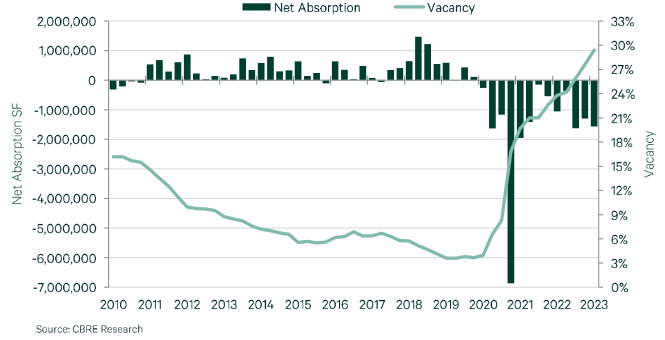
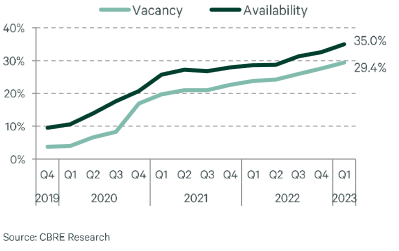
A sobering report from Coldwell Banker (available to pro subs in the usual place) reveals that San Francisco’s office vacancy rate hit a record highof 29.4%, as net absorption (total new square footage leased minus the total square footage of vacated space) registered -1.56 million sq. ft.
To wit, software giant Salesforce has put the last of its San Francisco office space up for sublease as part of its January plan to lay off approximately 7,000 employees and reduce office space, SF Gate reports.
According to the report, six floors at 350 Mission St. (Salesforce East) – the top four floors and the fifth and sixth floors – which encompass more than 104,000 square feet, are now up for sublease, according to real estate giant Cushman and Wakefield. The space comes with amenities such as a “fully functional coffee bar,” board rooms, and “high-end” presentation floors.
Salesforce’s intention to cut back on its San Francisco real estate footprint has been evident since even before the dramatic January announcement. Within the past year, the company — San Francisco’s largest private employer — has listed half of its space at Salesforce West at 350 Fremont St. for sublease and six floors at Salesforce Tower, in addition to the Slack headquarters move. In 2021, Salesforce listed half of its footprint in Salesforce East. -SF Gate
“Over the past two years, we have continued to re-imagine our real estate strategy,” said CFO Amy Weaver, adding that the company’s reassessment of their real estate footprint is ongoing. “That is not only to optimize for scale but also continue hybrid work environment and how people are working and how they’re using their space.”
The move is in-line with current industry trends, as big tech firms cut workers and office space – despite CEOs such as Salesforce’s Marc Benioff pushing post-pandemic return-to-office policies.
According to the CBRE report, “Businesses are challenged with macroeconomic headwinds, including tech industry layoffs, rising interest rates, banking industry uncertainty, and recession risk.”
Prior to the COVID-19 pandemic, San Francisco had a near 100% occupation rate throughout the city due to the latest tech boom, as the vacancy rate in 2019 grew from 5.4% in the fourth quarter of 2019 to 24.1% at the end of 2022.