74.3 F
Chicago
Tuesday, August 11, 2026
Home Blog Page 3800

Saudi Arabia Now Leading Regional Embrace Of Assad

Saudi Arabia Now Leading Regional Embrace Of Assad

It’s being widely reported that Saudi Arabia is pushing for a regional embrace of Syria’s President Bashar al-Assad, more than a decade after Syria was booted from the Arab League due to the conflict which burned starting in 2011, chiefly for Damascus’ anti-demonstration crackdown.

Reuters first reported this week that Saudi Foreign Minister Prince Faisal bin Farhan is planning to extend a formal invitation for Assad to attend an Arab League summit in Riyadh, planned for May 19. This will reportedly take place in person as bin Farhan is expected to soon travel to Damascus. Bloomberg is calling this a “win for Iran”.

Image source: AFP

After diplomatic efforts from gulf states in the wake of the devastating earthquakes which rocked Syria and Turkey in early February sped up, Middle East Eye has reported that “Maher al-Assad, the Syrian president’s brother and head of the feared Fourth Armored Division, reportedly visited Saudi Arabia last month and received the kingdom’s conditions for normalization.”

One by one, gulf nations have reembraced Assad. First the Syrian leader visited Oman in February, and the next month he went to UAE with his first lady Asma. Egypt has also sent delegations to Damascus.

Washington has been complaining about these contacts, while watching from the sidelines, as the Pentagon has continued the controversial occupation of oil and gas rich northeast Syria. Importantly, it comes against the backdrop of a China-brokered peace between Iran and Saudi Arabia. A regional analyst recently observed

Now, as China takes a more assertive economic diplomacy role in the Middle East, Syria remains key to Saudi Arabia’s desire to cool regional tensions.

Saudi Arabia presented the last obstacle to Syria’s return as a key player in the Arab world – a thaw that began with a hug between the Bahraini and Syrian foreign ministers at the United Nations in 2018. 

But still, the Biden administration has taken a softer tone to this rapprochement than hawks were hoping for. A senior US administration official was cited this week as saying Arab states should “get something in return” if they restore ties with Assad. 

As the above discussion on Syriana Analysis with regional expert Kamal Alam highlights, times have changed, and that change is coming fast.

A central irony remains, however: Saudi Arabia for years led the way alongside the US in seeking to topple Assad by any means possible. This included supporting jihadists and armed death squads which helped spawn ISIS, as even internal Pentagon memos have admitted.

Tyler Durden
Wed, 04/05/2023 – 18:40

Three GOP Reps. Introduce Gold Standard Bill To Stabilize Dollar’s Value

Three GOP Reps. Introduce Gold Standard Bill To Stabilize Dollar’s Value

Submitted by Headline USA (emphasis ours),

As America faces the twin threats of inflation and bank failures, three U.S. congressmen introduced a pivotal sound-money bill that would enable the Federal Reserve note “dollar” to regain stable footing for the first time in more than half a century.

Rep. Alex Mooney (R-WV)

Rep. Alex Mooney, R-W.Va., joined by Reps. Andy Biggs and Paul Gosar, both Arizona Republicans, introduced H.R. 2435, the Gold Standard Restoration Act, to facilitate the repegging of the volatile Federal Reserve note to a fixed weight of gold bullion.

Upon passage of H.R. 2435, the U.S. Treasury and the Federal Reserve are given 24 months to publicly disclose all gold holdings and gold transactions, after which time the Federal Reserve note “dollar” would be formally repegged to a fixed weight of gold at its then-market price.

Federal Reserve notes would become fully redeemable for and exchangeable with gold at the new price, with the U.S. Treasury and its gold reserves backstopping Federal Reserve Banks as guarantor.

Monetary experts have noted a return to a gold standard would substantially curtail the economic damage caused by inflation, runaway federal debt and monetary-system instability.

A gold standard would protect against Washington’s irresponsible spending habits and the creation of money out of thin air,” said Rep. Mooney in a statement.

“Prices would be shaped by economics rather than the instincts of bureaucrats,” he continued. “No longer would American families, businesses, and the economy as a whole be at the mercy of the Federal Reserve and reckless Washington spenders.”

The Gold Standard Restoration Act also makes several findings as to the harm the Federal Reserve System has inflicted on everyday Americans—particularly since President Richard Nixon “temporarily suspended” gold backing of America’s monetary system in 1971.

H.R. 2435 points out: “The Federal Reserve note has lost more than 40 percent of its purchasing power since 2000, and 97 percent of its purchasing power since the passage of the Federal Reserve Act in 1913.”

Historians have observed that the elimination of gold redeemability from the monetary system freed central bankers and federal government officials from accountability when they expand the money supply, fund government deficits though trillion-dollar bond purchases, or otherwise manipulate the economy.

At times, including 2021 and 2022, Federal Reserve actions helped create inflation rates of 8 percent or higher, increasing the cost of living for many Americans to untenable levels…enrich[ing] the owners of financial assets while… endanger[ing] the jobs, wages, and savings of blue-collar workers,” H.R. 2435 states.

Notably, Mooney’s bill also would require full disclosure of all central bank and U.S. government gold holdings and gold-related financial transactions over the last 6 decades—a seemingly taboo subject surrounded by mystery and deception.

“To enable the market and market participants to arrive at the fixed Federal Reserve note dollar-gold parity in an orderly fashion… the Secretary and the Federal Reserve shall each make publicly available… all holdings of gold, with a report of any purchases, sales, swaps, leases, and any other financial transactions involving gold, since the temporary suspension in August 15th, 1971, of gold redeemability obligations under the Bretton Woods Agreement of 1944,” says the bill.

In the years leading up to Nixon’s panicked “temporary suspension” of gold redeemability, abusive U.S. deficit spending and currency debasement had prompted many foreign central banks to turn in their Federal Reserve notes for gold.

However, this disgorgement of America’s gold holdings was largely conducted in secret.

That’s why H.R. 2435 also requires the Fed and the Treasury to disclose “all records pertaining to redemptions and transfers of United States gold in the 10 years preceding the temporary suspension in August 15, 1971, of gold redeemability obligations.”

U.S. sound money groups and industry leaders are cheering Mooney’s actions.

“Government cannot continue to spend and print on a massive scale without producing existential threats to the currency and our economy,” said Lawrence W. Reed, president emeritus of the Foundation for Economic Education.

“The gold standard never failed America, bad ideas and bad politicians did. If we do nothing, disaster awaits us just as it drowned earlier civilizations that spent and inflated their way to ruin,” Reed continued.

Today’s debt-based fiat-money system serves primarily to support big government and wealthy financial insiders—while the Federal Reserve’s serial policy of currency debasement punishes savers and wage earners,” explained Stefan Gleason, president of the Sound Money Defense League and Money Metals Exchange.

“A return to gold redeemability would arrest the problem of inflation, restrain the growth of wasteful and inefficient government, and kick off an exciting new era of American prosperity,” Gleason concluded.

The full text of Rep. Mooney’s gold standard bill can be found here. It was introduced on March 30, 2023, and referred to the House Committee on Financial Services.

Recently named “Best Overall” gold and silver dealer in the United States by Investopedia, Money Metals Exchange serves almost 500,000 customers nationwide. A family-owned Idaho business founded in 2010, it also operates Money Metals Depository for vaulting of gold and silver and Money Metals Capital Group, a collateral lending institution.

The Sound Money Defense League is a non-partisan public policy group working nationally to restore sound money at the state and federal level and publisher of the Sound Money Index.

Tyler Durden
Wed, 04/05/2023 – 18:20

Ukraine ‘Ready’ To Give Up Crimea, Says Zelensky Advisor

Ukraine ‘Ready’ To Give Up Crimea, Says Zelensky Advisor

There has been much talk and reporting of the coming Spring counteroffensive by Ukraine forces, but with the fight for Bakhmut not going so well for Kiev, there’s also been talk of the need for compromise, at a moment Ukrainian casualties in the east are believed to be high.

Last week we reported on President Volodymyr Zelensky’s voicing rare doubts concerning Bakhmut – as if preparing his people for news of a devastating defeat. And now, on Wednesday, the Financial Times is reporting the single most important development to come out of the conflict in a long time: Zelensky’s office says he’s ready to compromise on the future of the Crimean peninsula

The Crimean Bridge connecting Russian mainland & Crimean peninsula over the Kerch Strait, via AP.

Naturally, the Ukrainians present themselves as speaking from a position of having the upper hand, which is the general tone of the remarks that Andriy Sybiha, who is deputy head of Zelensky’s office, gave to FT. Per the publication, “Kyiv is willing to discuss the future of Crimea with Moscow if its forces reach the border of the Russian-occupied peninsula” – which marks the “most explicit statement of Ukraine’s interest in negotiations since it cut off peace talks with the Kremlin last April.”

“If we will succeed in achieving our strategic goals on the battlefield and when we will be on the administrative border with Crimea, we are ready to open [a] diplomatic page to discuss this issue,” Sybiha said, previewing his high hopes for an imminent counteroffensive.

He explained however that “It doesn’t mean that we exclude the way of liberation [of Crimea] by our army.” But given that Ukrainian forces are nearly completely surrounded in the strategic city of Bakhmut in Donetsk region, despite pouring in massive amounts of manpower and equipment, the whole notion of “liberation of Crimea” is a pipe dream.

Western officials themselves have in many cases long acknowledged the extreme unlikelihood of any Ukraine attempt to take Crimea at reaching success. The FT report hints at this in the following

Sybiha’s remarks may relieve western officials who are skeptical about Ukraine’s ability to reclaim the peninsula and worry that any attempt to do so militarily could lead President Vladimir Putin to escalate his war, possibly with nuclear weapons. To date Zelenskyy has ruled out peace talks until Russian forces leave all of Ukraine, including Crimea.

All of this represents a public reversal of sorts from Zelensky’s prior hardened stance of seeking the return of every inch of Ukrainian territory. For example, last October while feeling emboldened after billions in defense aid was pledged from the US and Western allies, he declared in a nightly address, “We will definitely liberate Crimea.”

More recently, Zelensky’s outlook & messages on the future have been mixed to say the least:

“We will return this part of our country not only to the all-Ukrainian space, but also to the all-European space,” Zelensky had said, not for the first time. He also repeated the same as recently as Sunday.

Interestingly, FT cites yet another high-ranking Western defense official who admits the near impossibility of Ukraine actually taking Crimea militarily

Rear Admiral Tim Woods, the British defense attaché in Washington, said on Wednesday that Crimea would need “a political solution because of just the concentration of force that is there and what it would mean for the Ukrainians to go in there”. He added: “I don’t think there’s going to be a very quick military solution . . . hence we need to see what are favorable conditions for Ukraine to negotiate and I think Ukraine would be up for that.”

Russia of course knows this. For Moscow the question will not be Crimea being at issue on the negotiating table, but the status of the eastern territories. Likely the Kremlin will base its willingness to strike a peace deal to end the war based on recognition of the eastern oblasts. On September 30, President Putin signed “accession treaties” declaring Luhansk, Donetsk, Zaporizhzhia and Kherson as part of the Russian Federation. 

At this point, Zelensky is unlikely to let the four territories go, but if Crimea is let go – that at least constitutes positive momentum toward the negotiating table. But still, all of these questions will likely be decided on the battlefield, until either side reaches the point of exhaustion. 

Meanwhile, while Washington has shown little interest in peaceful settlement based on ceding territory to Russia (in fact, many reports have alleged the opposite: that the US and UK have actively sabotaged the possibility of negotiations), Ukraine continues to be steadily pushed out of Bakhmut.

* * *

As for Zelensky himself, he’s been sounding more and more pessimistic of late, as we described exactly a week ago

Zelensky described that the capture of Bakhmut will mean that Putin will smell weakness. According to the Ukrainian leader’s words:

Speaking with The Associated Press, Zelenskyy said that if Bakhmut were to fall, Putin could “sell this victory to the West, to his society, to China, to Iran,” as leverage to push for a ceasefire deal that would see Ukraine agree to give up territory.

“If he will feel some blood — smell that we are weak — he will push, push, push,” Zelensky continued.

“Our society will feel tired” if the Russians gain victory in Bakhmut, he said. “Our society will push me to have compromise with them.” Implicit in these words are perhaps a first-time admission that significant sectors of the Ukrainian population are ready for compromise and peaceful negotiations to end the war.

And tellingly, CBS commentary on the AP interview included the following observation: “He appeared acutely aware of the risk that his country could see its vital support from the U.S. and Europe start to slip away as the 13-month war grinds on.” Zelensky admitted: “The loss of Bakhmut would mean a political defeat, could lead to a general defeat in conflict.”

Tyler Durden
Wed, 04/05/2023 – 18:00

Calling All Consumers: It’s Time To Recall Our Failing Energy Policies

Calling All Consumers: It’s Time To Recall Our Failing Energy Policies

Authored by David Holt via RealClear Wire,

Last year was the latest in a string of bad years for energy proposals. Before we continue down this path, it’s time to add a healthy dose of reality to the national conversation about energy and environmental policy. 

Make no mistake, we are in an exciting, evolutionary moment for energy and the environment. Wind and solar power are coming onto the grid at a breakneck pace, carbon capture and storage is taking off, emissions are continuing their rapid decline. America is helping lead the world in carbon reduction, and innovations in energy technologies are improving performance and efficiency. 

Our national issue with all this is how to properly capture these advances in a smart, consistent and reality-based way, so we can meet our economy’s growing energy demands without hurting families by making energy less affordable and reliable. This is a scientific and engineering challenge at a grand scale, something America has traditionally excelled at solving.

The great disconnect is how our energy discussion is framed.  

For too many years, the fact-free, illogical and ideological demands of extremists have played an oversized role in our energy policy dialogue. The modern form of extreme activism is rarely about the stated goal – in this case environmental protection. It is increasingly designed to block economic activity, thwart responsible solutions, and scold people into making radical changes. 

The simple fact is we can, must and are marching toward a lower carbon future, while producing more oil and natural gas than ever, and diversifying our energy economy with more wind, solar and soon, nuclear.

I’ve often wondered why the marketplace of ideas is not where extreme activist groups want to make their case. They prefer creating villains and false choices, pitting energy progress and environmental progress against each other, stoking emotions, or turning to ad hominem attacks.

Tiresome and solutionless, disaster strikes when their false furors hold too much sway: In 2022, we got a year of near-record energy prices that fueled the highest inflation in 40 years, dozens of states warning of electricity brownouts or blackouts, and declining emissions performance. 

Rather than following this false narrative, data, economic impacts and rigorous, continual testing (i.e., the scientific method) should be central tenets of our energy and environmental conversation.

If they were, no one would entertain attempts to ban natural gas, as has been proposed in New York, California and other states. Nor would anyone consider attempts to ban gas stoves and appliances based on discredited studies, as has been proposed in dozens of jurisdictions as well as by the current Administration.

Add in the labyrinth of regulatory hurdles for domestic oil and natural gas production, failure to fix energy project permitting and sudden activist opposition to removing carbon from our environment via carbon capture and storage – long seen as one of most indispensable paths to help manufacturers, steelmakers, cement producers and other energy-intensive industries cut their carbon footprint at scale and speed. 

Similar contradictions abound. A day after Energy Secretary Jennifer Granholm tooled around in an all-electric Ford pickup, the Biden Administration blocked mining on one America’s largest combined copper and nickel deposits. EVs require three times as much copper as traditional vehicles, so why not have American workers mine it under our strict environmental protections? Why not “Make It in America” as the president urged in successive State of the Union Addresses? 

The usual anti-everything gang that wants to replace internal combustion vehicles with electric also oppose U.S. development of the metals including an important EV component mineral, cobalt. It’s mainly sourced from Chinese-owned mines in Congo that use child labor. At the same time, they urge the U.S. government to take it easy on China while supporting policies that give China control of our future energy.

Where we live, how we get around, the energy we choose to use are all freedoms improving our quality of life. No one – least of all those living at or near the poverty level who feel it the most when energy prices skyrocket – should support policies that raise prices by limiting energy choice and supply. 

European nations did, enacting production bans and retiring functioning, always-on energy assets too early. These energy policies failed at a catastrophic cost to taxpayers, a familiar feeling to Californians. 

European Union nations and the UK have budgeted at least $756 billion – roughly last year’s U.S. defense budget – to offset record energy bills. Still, some elected leaders want us to accept this intentional economic self-harm in America. 

It’s time for consumers everywhere – families, farmers, truckers, organized labor, manufacturers, retailers, environmentalists – to demand a consumer recall for any idea that makes energy less affordable, available, reliable or environmentally responsible.

David Holt is president of Consumer Energy Alliance, a U.S. consumer energy and environment advocate supporting affordable, reliable energy for working families, seniors and businesses across the country. 

Tyler Durden
Wed, 04/05/2023 – 17:40

Swiss Authorities Eliminate, Cut Credit Suisse Executives’ Bonuses

Swiss Authorities Eliminate, Cut Credit Suisse Executives’ Bonuses

Prior to the $3.25 billion emergency takeover of Credit Suisse by UBS, mandated by Swiss authorities more than two weeks ago to avert a global financial crisis, the struggling Swiss bank had been contemplating for several months about slashing bonuses for its bankers

On Wednesday afternoon, the Swiss government, not Credit Suisse bank executives, moved forward with a plan to cancel or reduce bonuses. The Swiss Federal Council directed the Federal Department of Finance to eliminate or decrease top Credit Suisse bankers’ bonuses by 25% to 50%. According to the SFC statement, this action would affect bankers in the top three tiers of management.

For the bonuses already paid out, Credit Suisse has to examine whether some of those payments to employees can be recovered. The lender would have to report to FDF and the Swiss Financial Market Supervisory Authority on the matter. 

Bloomberg noted UBS is required that its “remuneration system continues to give appropriate consideration to risk awareness and includes as a criterion the successful, i.e., most profitable possible, realization of the Credit Suisse assets covered by the state loss guarantee.” 

The Swiss government’s move might lead to more Credit Suisse bankers jumping ship. Days after the state-brokered takeover of the troubled bank, there were reports of employees talking with job recruiters from competing firms

Perhaps UBS chair Colm Kelleher’s speech to shareholders on Wednesday, outlining the takeover of Credit Suisse entails “a huge amount of risk,” might be why Swiss authorities plan to cancel or reduce top banker bonuses. 

The Swiss government is penalizing top bankers and avoiding impacting lower-tier employees who weren’t responsible for causing the crisis. 


Tyler Durden
Wed, 04/05/2023 – 15:27

U.S. Dollar “Fear Mongers” Only Need To Be Right Once

U.S. Dollar “Fear Mongers” Only Need To Be Right Once

Submitted by QTR’s Fringe Finance

Optimists about the U.S. economy and the dollar’s global reserve status have had the wind at their back for half of a century, so why should anyone expect them to consider an alternative viewpoint?

Therein lies the folly that our country faces.

There’s a reason that every financial disclosure, brochure, hedge fund letter or commercial always says “past performance is not indicative of future results” on it: because it isn’t. But that boilerplate-sounding warning is printed in size zero font and, as a result, also rests in the equivalent of size zero font in the brains of U.S. dollar bulls.

The fact is that warnings about the precarious nature of the U.S. dollar – whether bombastic or not – are probably more important today than they have ever been. But these warnings can’t compete with 50 years of the “trend being the United States’ friend”, a hurricane force tailwind that includes politicians on both sides of the aisle, the nation’s central bank, the treasury secretary and the roaring concert of all financial news media.

Those who believe the dollar is always destined to be the backbone of the global economy are like players at a roulette table who have a system of betting all of the inside numbers, except for the number 13. Given a small house edge and the fact that you have to lay 35 to win 36 (excluding the 0 and 00) means that, in order to start cashing in on your system in a big way, you have to get hot and tear off a ton of wins in a row. But when the odds are in your favor – and betting 35 of 36 total outcomes definitely skews them to your advantage – it’s almost a certainty you’ll “get hot” and start winning multiple spins in row. When you start winning dozens of spins in a row, it becomes impossible to hear the skepticism of the one person betting the 13 or warning you that eventually, it’ll come out.

Well right now, at the casino of the global economy, the U.S. is on a roll. We are on fire. We have figured out how to beat the house. We are casino gods.

We’ve won 1,000 spins of the roulette wheel in a row, without hitting the number 13. We are a shooter at a craps table that has made every point, over and over, for hundreds of days in a row. We are sports bettors hitting every leg of an 8 team parlay every single night for an entire month and pressing the winnings each time. We are playing multiple blackjack hands every hand, and we split and double down on every hand, and all we do is pull 20’s and 21’s. The dealer doesn’t even need to bust every hand, but it does.

The casino has plied us with drinks. We’ve been drinking top shelf for 50 years and have no idea how drunk we’ve become. The seduction of the win has blinded us to the sobering constant of the math on the other side of our “systems”. Like a slithering, unsuspecting cobra slowly making its way to our table on the floor while we high five our allies after every additional win, the snake of reality gets closer and closer, preparing to eventually bite us when we least expect it.

And the truly fucked up thing? When you’re betting it all, every hand, it only takes that one roll, or that one spin, to give back everything we’ve spent our entire winning streak accumulating.


QTR’s Fringe Finance is a reader-supported publication, consider subscribing here and get 50% off a subscription, for life: SUBSCRIBE


Which brings me to the point of today’s post: the idea that so-called “fear mongers” about the U.S. dollar – arguing for everything from a mundane DXY crash to a full out loss of reserve currency status – literally only have to be right once.

Most people will tell you that, mathematically, they acknowledge that the dollar’s run can’t continue for the rest of eternity. And we’ve never experimented with a monetary system the way we have now, so we don’t have any basis for comparison about how long the fiat circus is going to continue. 50 years of fiat is actually a relatively short amount of time, so there are good arguments for both continuing to ride the “hot streak” for a few more generations and also for hegemony ending suddenly, when we least expect it.

However, after 10 years of trying to figure out the dastardly scheme that is macroeconomics, I can’t remember a time where the idea of the dollar losing reserve status has been in the mainstream media as much as it is now.

And in the past few hours we’ve seen headlines like:

And also courtesy of @WatcherGuru, Saudi Arabia in just the past week has done the following:

  1. Saudi Arabia to adopt economic strategy without US dependence, following decline in relations under Biden Administration, FT reports.

  2. Saudi Arabia, Russia, UAE, Iraq, Kuwait, Oman, and Algeria to cut oil production output until the end of 2023.

  3. Saudi Arabia partners with China to build a Chinese oil refinery for 83.7 billion yuan ($12.2 billion).

  4. Saudi Arabia enters trade alliance with China, Russia, India, Pakistan, and four Central Asian nations to step further away from reliance on the US dollar.

  5. Saudi Arabia partners with India to create an investment bridge emphasizing greater economic interconnectedness.

Initially, I wrote today’s article as a concession that I would stop writing about the risks facing the dollar – but then I took personal inventory and realized it’s not likely I would be able to commit to that.

Suffice it say, however, the mainstream is finally picking up the thread.


Even the mainstream media realizes what many of us have been screaming for years: that we are in uncharted waters, given the decades of low rates, Keynesian policy, current potential for serious stagflation and the global challenge that nations like Saudi Arabia, Russia and China appear to be mounting against the dollar.

Journalists that don’t even involve themselves in finance much even agree that we haven’t faced these financial conditions before, and are exercising caution.

While we had a similar inflationary crisis back in the 70’s, we had only been off the gold standard for a couple years and our debt levels were nowhere near where they are today as a percentage of GDP.

Today we’re 50 years into the fiat experiment and we’ve drawn the ire of half the world.

Look, there are a lot of smart people on the other side of this argument – Brent Johnson, who I respect a ton, comes to mind – but even he can’t escape the fact that our situation, as it stands today, has never before occurred in the history of our country.

We have never been off a gold standard for 50 years, while separating economically and militarily from China, Russia and the Saudis, all while experiencing significant inflation and an economic slowdown.

And it is this very same fact – the fact that we have never been here before – that is also what makes it clear that we have no idea how or when things will change drastically.


To go back to the roulette analogy, the trend certainly seems to be continuing as our friend. But what happens when something unprecedented takes place at the casino?

For example, what if the dealer wants to drop two roulette balls in the wheel every time it spins now. And what if the craps dealer handed you three dice instead of two, and told you it was only going to take the two that landed the closest to 3 and 4? In those cases, the game changes drastically, as do the odds. This is exactly what’s happening all around the United States on a global stage.

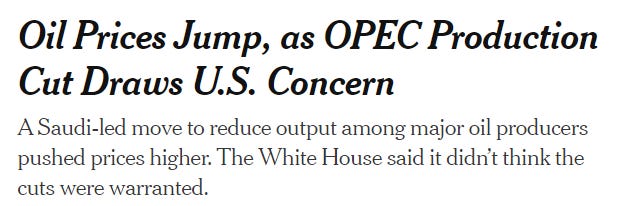
If it isn’t enough that the BRICS nations have openly stated their intent to develop a global reserve currency, and that they’re hoarding gold while ending the petrodollar, OPEC snubbed President Biden for all the world to see, just hours ago, when it announced an unplanned cut of 1 million barrels of oil per day.

There is no doubt OPEC knows that energy prices are a huge contributor to inflation in the United States, and that inflation remains the main driver of monetary policy – at least until markets crash (coming soon, in my opinion).

And so the Saudi’s and OPEC have knowingly thrown a wrench in the gears of the United States because President Biden chose not to refill the strategic petroleum reserve in the $60 range when he had the chance over the last few weeks.

Biden is multiple steps behind the 8 ball. This plundering of the reserves and then missing the chance to buy it back is like something out of my shitty trading playbook. Biden is “trading” like the ultimate bagholder – except he’s not pushing around 100 shares of AMC, he’s speculating with the oil reserves that our country keeps for a military emergency.


As far as the dollar goes, I’m happy to be called a fear monger as long as I’m wrong.

Being a skeptic of monetary policy and coming by it honestly is very paradoxical in nature. On one hand, I want to warn about the way it appears things are going.

On the other hand, for my country, and everybody in it, our critics are right in the sense that I don’t want to be right. Deep down, I hope guys like Brent Johnson are right and the dollar remains a shining beacon on a hill for the rest of the world. And hey, if I could think myself into some cognitive dissonance enough to truly believe that a bullish dollar situation is more likely than the ones I write about, I would do it in a heartbeat. And I would probably sleep a lot better at night.

But the fact is that, like many of you, I can’t ignore what appears to be the obvious.

When you’re betting it all, it only takes that one ‘13’ to come up on the roulette wheel or the one ‘7’ to come up with the button on in craps. With the dollar, our nation is betting it all on remaining reserve currency in the way we abuse it – and it only takes us “fear mongers” once to be right before we wake up and everything is completely different than it has ever been before.

Sure, I never want this day to happen – but that doesn’t mean that the likelihood of it happening isn’t significant enough to prepare for it. For how I’m positioned personally, you can read my latest on my portfolio here and here and my earlier market forecast for 2023 or my 23 Stocks To Watch In 2023 (Part 1 here, Part 2 here).

QTR’s Disclaimer: I am not a guru or an expert. I am an idiot writing a blog and often get things wrong and lose money. I may own or transact in any names mentioned in this piece at any time without warning and generally trade like a degenerate psychopath. This is not a recommendation to buy or sell any stocks or securities or any asset class – just my opinions of me and my guests. I often lose money on positions I trade/invest in and I’m sure have lost more than I’ve made in my time in markets. I may add any name mentioned in this article and sell any name mentioned in this piece at any time, without further warning. Positions can change immediately as soon as I publish this, with or without notice. You are on your own. Do not make decisions based on my blog. I exist on the fringe. The publisher does not guarantee the accuracy or completeness of the information provided in this page. These are not the opinions of any of my employers, partners, or associates. I did my best to be honest about my disclosures but can’t guarantee I am right; I write these posts after a couple beers sometimes. Also, I just straight up get shit wrong a lot. I mention it three times because it’s that important.

QTR’s Fringe Finance is a reader-supported publication, consider subscribing here and get 50% off a subscription, for life: SUBSCRIBE


Tyler Durden
Wed, 04/05/2023 – 15:05

Slowing, Slowing, Gone…

Slowing, Slowing, Gone…

By Peter Tchir of Academy Securities

Slowing, Slowing, Gone?

With baseball season coming, I couldn’t think of a better way to start this quick economic update.

Since we highlighted Excess Inventory, Increasing Delinquencies Falling Shipping last week, April has provided us with largely weak economic data.

  • Manufacturing PMI fell further to 46.3 (the 5th month in a row below 50)

  • JOLTS job openings actually fell and is back to levels last seen in the summer of 2021 (the Quit Rate at 2.6% was still higher than the historical average (2.4%), but well off its peak of 3%).

  • Factory orders and durable goods remained in decline.

  • ADP was “only” 145k, down from allegedly 261k last month.

  • While the service sector is still hanging on, the ISM Services came in at 51.2, down from 55.1 and versus expectations of 54.4, making some (or at least me) wonder if the 49.9 print back in December wasn’t an anomaly after all? The employment component reverted lower again. Finally, new order dropped substantially was well (62.2 from 62.6).

Every bit of data this month has hinted at a slowing economy.

The inflation front is not being helped by oil, with WTI surging from $69 to $80 in less than two weeks, supported by OPEC+ cutting production, rather than from solid global growth prospects (I’m assuming the world’s leading oil exporters have a sense of where demand is heading).

Maybe this is “just” catching up to some overly good data in recent months (The Citi Economic surprise index shot from -10 in early February, to above 60, and was still at 48 before today’s data). Or maybe the data recently was skewed by bad “seasonal adjustments”, “low response rates”, a “shifting economy that isn’t fully captured in current data”, etc…

[ZH: We note that this decline in the macro surprise index has been driven (until very recently) by a collapse in ‘soft’ survey data]

We get NFP on Friday, while the stock market is closed, should make for some interesting trading late on Thursday and Monday.

From a positioning standpoint, I’m updated some things since Sunday’s Fortune Favored the Bold:

  • Neutral on bonds. It felt foolish being constructive on bonds with he 10 year at 3.47%, but it fit my models. Here at 3.3% I’m neutral and would be tempted to be short, except the fact that NFP on Friday will be on a day with incredibly low liquidity (even by already low liquidity standards) and almost anything could happen. The 2-year at 3.7% holds little appeal and I am bearish on the economy!

  • Medium bearish on risk assets. I am now firmly entrenched in the medium bearish camp and will keep that as stocks (and credit spreads) seem to be trading on recession and earnings fears and less on the hope that the Fed is done hiking and the view (ill advised, in my opinion) that the Fed finishing should send stocks significantly higher.

On the bright side, in the first week of April, everyone’s team is in the running to win the World Series! (unless you are a Washington Nationals fan, in which case you can give up already).

Tyler Durden
Wed, 04/05/2023 – 14:25

Well-Known Crypto Tech Exec Murdered In San Francisco Stabbing

Well-Known Crypto Tech Exec Murdered In San Francisco Stabbing

Well-known crypto tech executive Bob Lee was stabbed to death early Tuesday morning near downtown San Francisco.

The 43-year-old Lee was perhaps best known for starting Cash App, and as former CTO of Square. He was the chief product officer of San Francisco-based crypto startup MobileCoin.

“Our dear friend and colleague, Bob Lee passed away yesterday at the age of 43, survived by a loving family and collection of close friends and collaborators,” reads a statement from MobileCoin, which described him as “a dynamo, a force of nature … the genuine article.”

“Bob would give you the shirt off his back,” his father said in a Facebook post.

“He would never look down on anyone and adhered to a strict no-judgment philosophy.”

San Francisco police responded at around 2:35 a.m. to a report of a stabbing in the city’s relatively safe Rincon Hill neighborhood, where they found Lee still alive.

He was taken to a local hospital where he succumbed to his injuries, CBS News reports.

No arrests have been made in the case, nor has any information on potential suspects been released.

Tyler Durden
Wed, 04/05/2023 – 14:05

Recession Signals Flash At California Warehouse Hub Facing Slowdown

Recession Signals Flash At California Warehouse Hub Facing Slowdown

The Inland Empire in Southern California is home to 4,000 warehouses that occupy 1 billion square feet, with ownership of some of these warehouses by mega-corporations like Amazon, Walmart, and others. These massive warehouses receive imported goods from Asia via Los Angeles and Long Beach ports and store them before distributing them through a complex logistical network to fulfill the nation’s growing obsession with ordering goods online. 

Similar to using container rates and port activity to assess economic activity, observing warehouse activity throughout the 27,000-square-mile region of the Inland Empire spanning from east Los Angeles to the Nevada and Arizona borders is also indicative of economic trends.

Bloomberg reports the massive influx of cargo that flowed from Los Angeles and Long Beach ports through the warehouses during Covid has plunged to a three-year low. Also, the number of jobs has peaked, which means either employers are laying off because of shipment declines or due to automation – perhaps it’s both. 

Source: Bloomberg

Transport and warehouse jobs in the Inland Empire peaked last April at around 215k. As of February, the total number of jobs is about 202k.

Source: Bloomberg

In what could be an ominous sign of the regional banking crisis, combined with an aggressive Federal Reserve raising interest rates to sky-high levels to cool down the hottest inflation prints in decades, numerous prominent folks in the financial industry are forecasting a recession. 

Last week, ‘Bond King’ Jeff Gundlach warned of an imminent recession – within the next few months – as the yield curve suddenly steepens…

“The economic headwinds are building, we’ve been talking about this for a while, and I think the recession is here in a few months,” Gundlach said Monday during an interview with CNBC.

“All we really need is the unemployment rate to go higher.”

We shared a recent note with professional subs from Scott Feiler, Goldman Sachs’ consumer retail trader, who “is quickly turning negative on the consumer sector.”

The downturn in warehouse activity, declining port activity, and sliding container rates are alarming indicators of increasing recession threat, given that consumers make up a significant portion, around 70%, of GDP. 

Tyler Durden
Wed, 04/05/2023 – 14:00

Fire Breaks Out At Russian Defense Ministry Building In Moscow

Fire Breaks Out At Russian Defense Ministry Building In Moscow

Russian media has reported that a fire fire broke out at a building belonging to Russia’s Defense Ministry in the center of Moscow on Wednesday evening. TASS news agency was the first to report it, citing emergency services.

Widely circulating videos appear to confirm the report, though at this point the fire looks relatively small, coming from an office or offices inside the building. There are reports that it’s an office on the fifth floor or above.

It’s as yet unclear what the cause is – whether accidental or possibly a drone or sabotage incident.

In January, amid increasingly bold drone strike operations on Russian soil launched from Ukraine, the Russian military erected surface-to-air Pantsir batteries on some Moscow buildings, including the top of the defense ministry building.

The Drive reported at that time, “The official reason for the apparent deployments is unclear, but Ukrainian forces have demonstrated their ability to conduct strikes at extended ranges using various types of drones. There could be other explanations, including this just being part of an ostensible exercise of some kind.”

While alarming given the prospects for severe escalation, it’s anything but clear what the cause of this current fire is at this early stage.

developing…

Tyler Durden
Wed, 04/05/2023 – 13:30