75.2 F
Chicago
Tuesday, August 11, 2026
Home Blog Page 3804

Credit Suisse Chairman Tells Angry Shareholders: “I Am Truly Sorry”

Credit Suisse Chairman Tells Angry Shareholders: “I Am Truly Sorry”

Credit Suisse Group AG Chairman Axel Lehmann told a room of shareholders that he was “truly sorry” the Swiss bank imploded and for the controversial takeover by UBS. 

“It is a sad day for you and for us too. I can understand the bitterness, the anger, and the shock of all those who are disappointed, overwhelmed, and affected by the developments,” Lehmann said in remarks prepared for the bank’s annual shareholder meeting in Zurich. 

“I apologize that we were no longer able to stem the loss of trust that had accumulated over the years, and for disappointing you,” he said. 

Lehmann, who has been chairman for a year, said that up until the bank failed and was forced by Swiss authorities to be taken over by rival UBS, he believed the 167-year-old bank was on a promising turnaround path after years of scandals, losses, and failures. He added the quick downward spiral of events last month indicated “the bank could not be saved.”

“Until the end, we fought hard to find a solution, but ultimately there were only two options: deal or bankruptcy,” Lehmann, who became chairman in January 2022, told shareholders. “The merger had to go through.”

Here’s a clip of Lehmann’s apology to shareholders. 

And clearly, failure wasn’t an option: On Monday, Swiss National Bank Vice President Martin Schlegel told broadcaster SRF in an interview that Credit Suisse faced imminent failure if not sold to UBS. He said, “It’s very, very likely a financial crisis in Switzerland and worldwide would have happened.” 

Despite the merger preventing what could’ve been a financial nuclear bomb, shareholders at Zurich’s hockey stadium were still infuriated with Lehmann and other Credit Suisse execs.

“I wore my red tie today to represent the fact that I and plenty of others today are seeing red,” one shareholder who addressed the board and the audience said, who was quoted by WSJ. 

Before today’s meeting, shareholders and proxy advisors said they would vote against the reelection of several board members, including Lehmann. However, it remains to be seen which of Credit Suisse’s top executives will survive the takeover. 

Tyler Durden
Tue, 04/04/2023 – 09:50

OPEC+ Shock Oil Cut May Give G-7 A New Russian Oil Problem

OPEC+ Shock Oil Cut May Give G-7 A New Russian Oil Problem

By Alaric Nightingale, Bloomberg Markets Live reporter and analyst

Sunday’s announcement of surprise production cuts by key members of OPEC+ creates a question about where that might leave the G-7’s price cap on Russian oil sales (something ZH first discussed late on Sunday in “Anti-Russia Alliance Splinters As Japan Buys Russian Oil At Price Above Cap; Others To Follow).

It’s important to remember that the cap is really there to allow Russian oil to flow, not to hinder it. That’s because the threshold was imposed as a means of allowing traders and companies to access key G-7 services, especially insurance, which are otherwise banned. So the higher global oil prices, the greater the theoretical pressure for the cap to guarantee that Russian barrels keep flowing.

The oil price is about where it was when then cap on crude was first imposed in early December. So there’s no obvious need to adjust it right now.

Also, Russia appears to be dumping more crude onto the global market than ever. That will presumably give the G-7 some comfort that its strategy is working. (Incidentally, Russia is supposed to have cut output by 500,000 barrels a day last month, but it’s not showing up in the loadings of tankers at the nation’s ports.)

A trickier issue is if oil prices were to shoot higher. Imagine they reach $100 a barrel, as some suspect is a possibility. Urals is already trading above the $60 price cap.

If that happens, the G-7 will be faced with the quandary of wanting to keep Russian oil flowing while at the same time seeking to constrain Moscow’s revenues.

In other words, it might logically see a need to raise the cap — thereby rewarding Moscow for its part in limiting the global supply of petroleum. Awkward. And any revision to the cap would need EU backing, which could be tough as some have sought lower thresholds.

Tyler Durden
Tue, 04/04/2023 – 09:37

Australia Central Bank Joins Canada In Hitting “Pause” On Rate Hikes

Australia Central Bank Joins Canada In Hitting “Pause” On Rate Hikes

First it was the Bank of Canada which in January announced it would pause its rate hike campaign; then overnight the RBA became the second bank to join the bandwagon when it put its year-long hiking campaign on pause after leaving the cash rate unchanged at 3.6% at April’s Board meeting, marking the first pause since the RBA starting raising rates in May 2022. Ahead of the meeting, 19/30 economists surveyed by Bloomberg expected a pause, while 11/30 expected a +25bp hike. Financial markets were pricing in just 4bp of hikes, so the decision was mostly priced in.

The attending statement noted the Board decided to keep rates steady to “assess the impact” of increases in rates to date. While reiterating that Australia’s labour market remained “very tight”, the statement also noted that timely data suggested CPI inflation had peaked and that a “substantial slowing” in household spending was occurring.

Looking forward, the statement noted the Board expects further tightening “may well be needed”, a somewhat softer tightening bias compared to last month (“will be needed”).

Here are the main points from the announcement:

  • The RBA left the cash rate unchanged at 3.6% at April’s Board meeting, marking the first pause since the RBA starting lifting the cash rate in May 2022. Ahead of the meeting, 19/30 economists survey by Bloomberg expected a pause, while 11/30 (including GS) expected a +25bp hike. Financial markets were pricing ~4bp of hikes. The statement noted the Board “took the decision to hold interest rates steady this month to provide additional time to assess the impact of the increase in interest rates to date and the economic outlook.”

  • The forward guidance in the final paragraph maintained a tightening bias, but with a softer tone compared to March’s statement. The statement noted the Board expects that “some” further tightening (vs “further tightening” in the March statement) of monetary policy “may well be needed” (vs “will be needed” in March) to ensure that inflation returns to target. The statement also noted the decision to hold rate steady “provides the Board with more time to assess the state of the economy”, “in an environment of considerable uncertainty”. In our view this language keeps the options fairly open for the RBA over the next few months.

  • On the global front, the RBA noted the recent banking system problems in the US and Switzerland “have resulted in volatility in financial markets and a reassessment of the outlook for global interest rates”, and “These problems are also expected to lead to tighter financial conditions, which would be an additional headwind for the global economy”. However, the RBA noted “The Australian banking system is strong, well capitalised and highly liquid. It is well placed to provide the credit that the economy needs.”

  • On the domestic economy the language was incrementally more dovish around the household sector, noting that there is further evidence that the combination of higher rates, high inflation and falling house prices is “leading to a substantial slowing in household spending”.

  • The RBA maintained the language that the labor market “remains very tight” and removed the language “although conditions have eased a little” following the strong February report. On wages, the RBA maintained that “wage growth is still consistent with the inflation target” but with the qualification that “provided that productivity growth picks up” – a hat tip to the current strong growth in nominal unit labor costs.

  • On inflation the language was a touch more dovish on net, noting that “a range of information, including the monthly CPI indicator suggests that inflation has peaked”. Interestingly the statement removed the sentence “Services price inflation remains high, with strong demand for some services over the summer” – despite little new information on services inflation over the past month – but continued to note that “rents are increasing at the fastest rate in some years” and added that “the prices of utilities are also rising quickly”.

Commenting on the decision, Goldman writes that from its perspective, “while today’s decision was always a close call, we viewed the pause as revealing a somewhat more dovish reaction function than we had anticipated, particularly given ongoing upside risks to wages growth and inflation in Australia.”

And while there is significant uncertainty around the outlook, Goldman now expects the RBA to remain on hold for several months while it ‘assesses’ the impact of prior tightening – including the roll-off of many fixed rate mortgages over the June quarter – before raising rates in July (+25bp) and August (+25bp) to a terminal rate of 4.1%. By this time the RBA will have a better read on inflation momentum over the June quarter and the Fair Work Commission’s decision on minimum and award wages growth for FY2023/24.

That said, even GS is mindful of the significant uncertainty around the macro outlook, both domestically and globally, and acknowledges that the RBA could remain on hold if downside risks to growth and/or inflation are realised. Alternatively, the RBA could restart hikes as soon as May if the 1Q2023 CPI data (26 April) surprise to the upside.

In response to the pause, Australian stocks rebounded into the green, while the Australian dollar fell 0.9% to 0.6723, below 200-DMA at 0.6750.

Finally, as Bloomberg speculates this morning, with the JOLTS data looming in the US this morning, it “feels like a lower-than-expected result would kindle more serious speculation that the Fed may also be done with its tightening campaign.”

Tyler Durden
Tue, 04/04/2023 – 09:20

Tesla Set To Rebound After Reporting 35% Increase In Chinese Sales For March

Tesla Set To Rebound After Reporting 35% Increase In Chinese Sales For March

Shares of Tesla could be due for a respite from yesterday’s selloff today, as news of the company’s deliveries in China rising 19% in March broke overnight. 

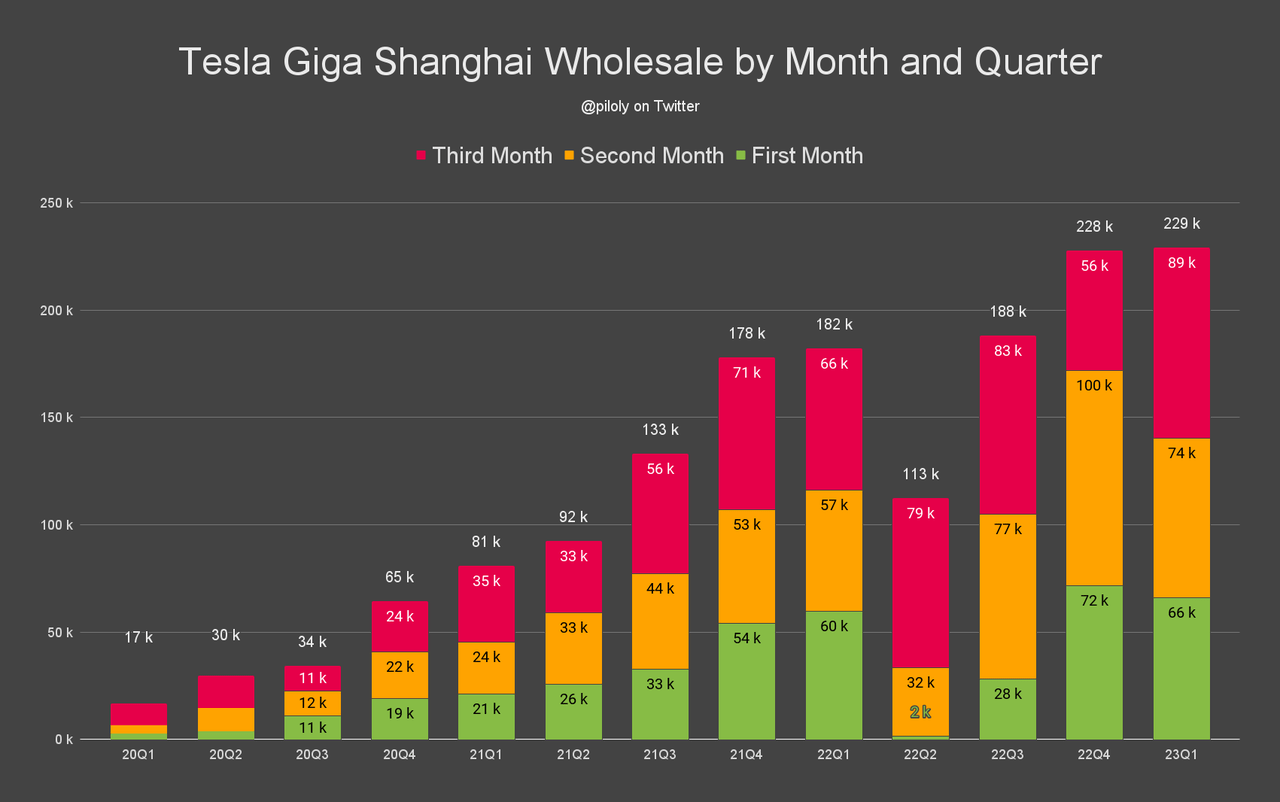
According to the China Passenger Car Association (CPCA) on Tuesday, Tesla sold 88,869 units of China-made electric vehicles for the month of March, a 35% increase from a year ago, according to Reuters. 

The figure is also up 19.4% sequentially after Tesla delivered 74,402 vehicles in February. Competitor BYD remains the name to watch in China, however, selling 206,089 vehicles last month.

It marks the “second-highest China-made vehicle sales ever for the company, just behind the 100,291 units that were sold in November of last year,” according to the Teslarati blog

Chart by @piloly on Twitter. Source

Recall we also posted Tesla’s Q1 delivery numbers for the U.S. just days ago. 

Tesla reported Q1 2023 deliveries on Sunday, posting a figure of 422,875 vehicles delivered, beating most current consensus Wall Street estimates. The company delivered 10,695 Model S/X vehicles and 412,180 Model 3/Y vehicles. 

Original analyst expectations were for 430,008 vehicles, according to Refinitiv data cited by Reuters. Multiple outlets reported the number as a miss (it was, compared to original estimates) and a beat (it was, compared to current lower-balled estimates). 

This Q1 figure was a 36% increase year over year and a 4% increase sequentially, compared to the 405,278 deliveries the company posted in Q4 2022. Bulls are likely to see the beat as good news, while bears will likely argue that the “beat” wasn’t enough given the drastic price cuts Tesla has put into place since the end of last year. 

“We continued to transition towards a more even regional mix of vehicle builds, including Model S/X vehicles in transit to EMEA and APAC,” the company’s release said. Despite this mix change, the Model S and Model X are becoming dwindling contributors to Tesla’s delivery bottom line. 

Martin Viecha, Tesla’s head of IR, said Sunday: “Sequential growth continues even in the first quarter.”

Tyler Durden
Tue, 04/04/2023 – 09:05

Fed’s Making Worst “Policy Mistake In Several Decades”, El-Erian Warns

Fed’s Making Worst “Policy Mistake In Several Decades”, El-Erian Warns

Authored by Andrew Moran via The Epoch Times,

The Federal Reserve’s year-long aggressive monetary tightening efforts could turn out to be one of the most significant policy errors in the last several decades, according to renowned economist Mohamed El-Erian.

El-Erian shared excerpts from the Peterson Institute for International Economics (PIIE) and the Financial Times that reinforced his view that the U.S. central bank is committing egregious policy missteps.

“As first mentioned almost a year ago, I fear that this may well end up being the biggest Fed policy mistake in several decades,” the chief economic adviser at Allianz tweeted on Monday.

The PIIE lamented on the Fed’s macroeconomic scenarios to determine the 2023 stress tests on large banks. The think tank noted that the measurements were not diverse enough and failed to address the potential effects of higher interest rates on financial institutions.

Silicon Valley Bank was not subjected to routine stress tests. However, experts aver that the California-based bank would have passed because it had been considered “well-capitalized” by the Fed. The tests also gauged how the company would have handled a falling GDP, rising unemployment, and tighter credit conditions. Today’s primary economic challenges are rampant price inflation and higher interest rates.

The Financial Times article contained comments from Julius Baer CEO Philipp Rickenbacher that acknowledged the possibility of “some room for policy mistakes at the highest levels when it comes to interest rates.”

‘One Mistake After Another’

El-Erian has been highly critical of the Federal Reserve for the past year.

He penned an op-ed on MarketWatch on Monday, asserting that the institution “has slipped in its analysis, forecasts, policymaking and communication” and has made “one mistake after another.”

“The Fed’s problems should worry everyone. A loss of credibility directly affects its ability to maintain financial stability and guide markets in a manner consistent with its dual mandate of maintaining price stability and supporting maximum employment,” he wrote.

In the end, Fed Chair Jerome Powell will be remembered as Paul Volcker or Arthur Burns, El-Erian purported. The former had conquered skyrocketing inflation in the 1980s. The latter kept monetary policy too loose for too long, resulting in stagflation (a blend of slow economic growth and rampant inflation).

Federal Reserve Chair Jerome Powell as he testifies before the House Committee on Financial Services on Capitol Hill in Washington on March 8, 2023. (Anna Moneymaker/Getty Images)

In October, he told CBS’ “Face the Nation” that the central bank made two crucial errors: mischaracterizing inflation as transitory and failing to respond to high inflation “in a meaningful way.”

“So yes, unfortunately, this will go down in a big policy error by the Federal Reserve,” he said.

“Even Chair Powell has gone from looking for a soft landing to soft-ish landing to now talking about pain. And that is the problem. That is the cost of a Federal Reserve being late. Not only does it have to overcome inflation, but it has to restore its credibility.”

Last month, El-Erian asserted that the Fed is facing a “trilemma”: inflation, financial stability, and economic growth.

He suggested that the Fed should hit the pause button on its tightening campaign, adding that he is concerned about how the banking turmoil could result in credit challenges throughout the national economy.

“I’m more worried about the credit issues — and that really comes back to how badly hampered the economy is because of this mishandled interest rate cycle,” El-Erian told CNBC.

At the March Federal Open Market Committee (FOMC) policy meeting, the central bank voted to raise the benchmark fed funds rate by 25 basis points to a target range of 4.75 percent and 5.00 percent.

The updated Survey of Economic Projections (SEP) (pdf) kept the 2023 median rate at 5.1 percent, suggesting monetary policymakers expect one more rate hike this year.

Powell told reporters he does not anticipate any rate cuts this year, adding that the rate-setting committee could even pull the trigger on a rate hike if necessary.

He also insisted that the American people can feel confident that their deposits are safe in the wake of the SVB and Signature Bank failures.

“We took powerful actions with Treasury and the FDIC, which demonstrate that all depositors’ savings are safe,” Powell told a post-FOMC meeting press conference. “The banking system is safe.”

Powell noted that it is too early to determine if the SVB and Signature failures will impact the U.S. economy.

Security guards and FDIC representatives open a Silicon Valley Bank (SVB) branch for customers at SVBs headquarters in Santa Clara, Calif., on March 13, 2023. (Noah Berger/AFP via Getty Images)

Some March economic data were published on Monday.

The Institute for Supply Management’s (ISM) Manufacturing Purchasing Managers’ Index (PMI) weakened to 46.3 last month, down from 47.7 in February and below the market forecast of 47.5. The S&P Global Manufacturing PMI contracted for the fifth straight month, coming in at 49.20, up from 47.3.

“Weak demand for inputs resulted in some relief for manufacturers as input cost inflation slowed again. A paucity of new orders sparked efforts to entice customers, however, as selling price inflation eased notably to the weakest since October 2020,” wrote Siân Jones, Senior Economist at S&P Global Market Intelligence, in the report. “Nonetheless, inflationary concerns weighed on business confidence once again amid pressure on margins.”

Tyler Durden
Tue, 04/04/2023 – 08:45

Victor Davis Hanson: Indict One… And All?

Victor Davis Hanson: Indict One… And All?

Authored by Victor Davis Hanson via AmGreatness.com,

Were the opposition to match tit-for-tat these Democratic means, then the republic would not survive…

As we await the publication of all the impending indictments of former President Donald Trump by Manhattan District Attorney Alvin Bragg, Americans are trying to figure out what constitutes an indictable offense for current and retired public officials.

Most legal experts, Left and Right, have noted:

1) Bragg promised in advance that he would try to find a way to indict Trump. His prior boasts are reminiscent of Stalin’s secret police enforcer Lavrentiy Beria’s quip, “Show me the man and I’ll show you the crime.” Nancy Pelosi gave the game away, when in her dotage, she muttered that Trump had a right to prove his innocence as if he is presumed guilty.

2) No former president has ever been indicted—and for good reason. Such prosecutions would be viewed as persecutions and render all former presidents veritable targets of every publicity-hungry and politically hostile local, state, or federal prosecutor. They would reduce the presidency to Third World norms. Gratuitously prosecuting former presidents would become a political tool to harm the opposing political party or to tarnish the legacy of a former president.

3) Trump is currently ahead in the polls for the Republican nomination to face Democratic incumbent Biden. And in head-to-head matchups, he outpolls Biden. For a prosecutor of the same party as the current president facing reelection to seek to destroy the viability of a likely opponent is a first in U.S. history. But again, it is now in accordance with Third World norms.

4) At least two left-leaning federal and state prosecutors previously have passed on the same evidence Bragg is now using for his indictments. They have explained that such a prosecution is infeasible because of statutes of limitations, because of a state attorney improperly appropriating the role of a federal prosecutor, and because non-disclosures agreements are a fact of life and not strictly illegal.

5) Bragg’s chief witness Michael Cohen is a felon and confessed liar, with a deep personal hatred of Donald Trump—a fact well known to all potential prosecutors.

6) The current indictment follows a long line of historic harassment of Trump, including the first incidence of two impeachments of a sitting president, the first impeachment trial of a president as a private citizen, and the first FBI armed raid of a retired president’s home, the first instance of an FBI director leaking confidential presidential conversations to the media for the purpose of appointing a special counsel to remove a president.

Such asymmetry also raises questions about the equal application of our laws as they apply to all our other officials, current and out-of-office.

Or, to put it another way: what crime did Trump not do that others did with either impunity or without being arrested?

Here is a sample of 20.

1) Trump did not violate federal law, as did Hillary Clinton, by destroying federally subpoenaed emails and devices in order to hide evidence.

2) Trump did not violate federal law, as did Hillary Clinton, by sending classified government communications on her own, through an unsecured home-brewed server.

3) Trump did not violate federal law, as did Hillary Clinton, by hiring—through three paywalls—a foreign national, who is prohibited from working on presidential campaigns, to compile a dossier to smear her presidential opponent.

4) Trump did not violate federal campaign laws, as did Hillary Clinton, by hiding her payments (as “legal services”) to Christopher Steele through bookkeeping deceptions.

5) Trump did not, as did Bill Clinton, use a crony to search out a high-paying New York job for a paramour in order to influence her testimony before a special counsel.

6) Trump did not, as did Bill Clinton, receive a $500,000 “honorarium” for speaking in Moscow while his wife, our secretary of state, approved a longstanding and lucrative desire of the Kremlin for North American uranium to be sold to a Russian consortium.

7) Trump did not, as did Barack Obama, promise Vladimir Putin that he would be “flexible” on “missile defense” if during his own reelection bid Putin in return would give him “space”. That quid pro quo arrangement led to the U.S. abandonment of key joint missile defense systems with Poland and the Czech Republic, and, reciprocally, less than two years later a Russia invasion, mostly unopposed by the United States, of eastern Ukraine and the Crimea.

8) Trump did not boast publicly, as did Joe Biden, that he used U.S. foreign aid monies as leverage to have the Ukrainian government fire a prosecutor who may have been looking into the Biden family’s efforts to sell influence to corrupt Ukrainian interests.

9) Trump did not, as the Bidens did, set up a family consortium to leverage monies from Ukraine, Russia, and China, on their shared expectations that he might soon run for and be elected president and become compromised. Trump is not mentioned, as is Joe Biden, in family business communications as a recipient of a 10 percent commission on such payoffs.

10) Trump did not, unlike Joe Biden, remove presidential papers—without any authority to declassify them—and leave them scattered and unsecured in a garage and various residences and offices.

11) Trump did not, as did the FBI, wipe clean subpoenaed mobile phone records.

12) Trump did not, as did interim FBI head Andrew McCabe, admittedly lie under oath on four occasions to federal investigators.

13) Trump did not, as did CIA Director John Brennan, admittedly lie on two occasions while under oath to the U.S. Congress.

14) Trump did not, as did Director of National Intelligence James Clapper, admittedly lie on one occasion to the U.S. Congress.

15) Trump did not, as did James Comey, claim amnesia or ignorance 245 times while under oath before the U.S. Congress.

16) Trump did not, as did FBI Director James Comey, summarize a confidential private conversation with a president and then deliberately leak that classified memo to the media for his own agenda of appointing a special counsel to investigate the president—which turned out to be his friend Robert Mueller.

17) Trump did not, as did Robert Mueller, claim ignorance while under oath when asked about the Steele dossier and Fusion GPS, the catalysts for Mueller’s own investigation.

18) Trump did not, as did private citizen and former secretary of state John Kerry, meet clandestinely while out of office with Iranian officials to help them resist  current U.S. policy toward Iran—or what the Boston Globe characterized as “unusual shadow diplomacy” to “apply pressure on the Trump administration from the outside.”

19) Trump did not, as did the FBI and CIA, pay clandestine money to Twitter to monitor and smother news stories deemed unhelpful to their agendas.

20) Trump did not, as did then-Senate Minority Leader Chuck Schumer, whip up a mob at the doors of the Supreme Court by threatening two sitting justices by name to intimidate them concerning an impending judicial ruling: “I want to tell you Gorsuch, I want to tell you Kavanaugh: You have released the whirlwind, and you will pay the price. You won’t know what hit you.” In subsequent months, mobs of protestors swarmed the private homes of these two named justices to influence their decisions, a federal crime that was ignored by Attorney General Merrick Garland, but not by a self-confessed, potential assassin of Justice Brett Kavanaugh who later turned up in the neighborhood.

What are we to make of these radical disparate applications of laws and protocols? The Left repeatedly breaks laws and long-held customs with impunity by weaponizing federal offices and bureaus, whether defined in the legal sphere by mostly exempting 120 days of mass rioting, looting, arson, mayhem, and lethal violence in the summer of 2020, or procedurally by denying the House minority leader the right to nominate his party members to committees, or ceremonially having the speaker of the House tear up the presidential State-of-the-Union Address on national television.

By any fair application of past tradition and the law, Joe Biden and Alejandro Mayorkas should be impeached for their deliberate efforts to subvert U.S. immigration law for political purposes. By any just measure, Joe Biden should be the target of a special counsel’s investigation to ascertain how and why the Biden family received hidden funds from foreign governments and whether Biden himself paid taxes on such large sums.

It is the revolutionary Left that attacks institutions deemed unhelpful for its current political agenda—one that rarely warrants 50 percent public approval—whether that effort is defined by threats of ending the filibuster, scrapping the Electoral College, adding two more states, packing the court, or radically changing balloting laws and customs to turn elections into a 70 percent no-show of voters on Election Day.

All of the above is predicated on a simple premise: Were the opposition to match tit-for-tat these Democratic means, then the republic would quickly descend into a spiral of illegality and chaos analogous to what ended the late Roman Republic. That fact is well known to the new hard-left Democratic Party. So it has assumed the role of the spoiled teen who feels he has a blank check of lawless behavior that his parents would not dare emulate, given that for adults to do so would destroy the family.

In other words, the Left is saying to America something along the following lines, “We are so morally superior to you that we can and must employ any means necessary to achieve our unpopular political ends. But you cannot respond in kind or deter us by mimicking our own tactics, because should both parties do so, the resulting disorder would undermine the republic. And that is something you won’t dare do.”


Tyler Durden
Tue, 04/04/2023 – 17:00

ECB’s Tightening Window Narrowing As Curve Becomes More Fed-Like

ECB’s Tightening Window Narrowing As Curve Becomes More Fed-Like

Authored by Simon White, Bloomberg Macro Strategist,

The ECB’s window for efficiently transmitting monetary policy is narrowing; traders should thus consider the portfolio implications of faster action to damp inflation.

The market’s determination to price in a pivot has complicated the process of tightening for central banks.

The Fed repeatedly insisted that it would hold rates higher for longer, but to no avail as the market stubbornly maintained the pricing-in of rate cuts soon after when rates were expected to peak.

We are now close to the end of the Fed’s hiking cycle (if we will not soon be seeing cuts), meaning the short-term interest rate curve in the US is almost fully inverted (see chart below).

This implies that there are rapidly diminishing returns for the Fed to hike more, as the shape of the curve means it would not be effectively transmitted across the full yield curve and to the economy.

The ECB is behind the Fed, yet, as the chart above shows, the Euribor curve is becoming a similar shape to the US’s, i.e. it is almost fully inverted.

The curve shape is less of a problem for the Fed.

They have already raised rates 475 bps, versus 350 bps for the ECB.

Further, spot real rates in the US should be positive by May, and reach over 2% soon after (assuming the Fed rate remains unchanged at 5%).

But spot real rates in Europe are not expected to be positive until October, and not get above 1% (assuming the ECB raises rates by what is currently priced, i.e. another ~60 bps expected by October/November).

The OPEC+ oil-production cut complicates the ECB’s task as CPI in Europe is highly sensitive to Brent oil prices.

However, the move so far has not really moved the dial, as Brent is still very negative on a year-on-year basis.

Nonetheless, a faster rate-hiking pace will help the important milestone of positive spot real rates to be realised sooner.

Tyler Durden
Tue, 04/04/2023 – 06:30

Where Electric Cars Are (Not) Being Considered

Where Electric Cars Are (Not) Being Considered

The adoption and openness to electric cars vary significantly between states in the United States.

As Statista’s Martin Armstrong details below, while some states appear to be embracing EVs in large numbers as the future of transportation, others states are home to large majorities seemingly still skeptical about the feasibility and practicality of electric vehicles.

Infographic: Where Electric Cars Are (Not) Being Considered | Statista

You will find more infographics at Statista

As data from the Statista Consumer Insights survey shows, California is one state that is at the forefront of the electric car revolution, with over 30 percent of respondents saying they consider the propulsion type ‘electric’ when buying a car.

New York, Maryland and New Hampshire also had over 30 percent keeping an EV in mind in 2022.

On the other end of the scale, states like North Dakota, Kentucky and Alaska showed relatively little interest in adopting electric cars as a viable transportation option.

Tyler Durden
Tue, 04/04/2023 – 05:45

CDC Warns About Deadly Marburg Virus Amid Outbreaks In Africa

CDC Warns About Deadly Marburg Virus Amid Outbreaks In Africa

Authored by Mimi Nguyen Ly via The Epoch Times (emphasis ours),

The U.S. Centers for Disease Control and Prevention (CDC) is warning travelers to take precautions and avoid nonessential travel in the African nations of Equatorial Guinea and Tanzania amid outbreaks of the deadly Marburg virus disease (MVD).

This transmission electron microscopic (TEM) image in 1975 of an undisclosed tissue sample, reveals the presence of numerous Marburg virus particles. (CDC/ Dr. Fred Murphy; Sylvia Whitfield)

The CDC also says it’s sending personnel from its National Center for Emerging and Zoonotic Infectious Diseases to respond to the outbreaks.

Equatorial Guinea declared an outbreak of MVD on Feb. 13, and Tanzania declared an outbreak on March 21, the CDC noted.

The World Health Organization (WHO) has recorded at least nine confirmed cases in Equatorial Guinea and another 20 probable cases, all of whom have died as of March 25. In Tanzania, the WHO confirmed eight cases, five of whom have died, with the remaining three people undergoing treatments as of March 22.

People are being warned to avoid nonessential travel to the regions where the outbreak is occurring. In Equatorial Guinea, the provinces are Kie-Ntem, Centro Sur, and Litoral. In Tanzania, the Kagera region had confirmed cases.

Kenya and Uganda are on high alert due to the recent cases in Tanzania.

MVD is often fatal and is caused by the Marburg virus, which is in the same family as the virus that causes Ebola. According to the CDC, (pdf) as many as 9 out of 10 people infected with the virus will die without treatment.

It causes a viral hemorrhagic fever that brings severe symptoms within seven days that include high fever, chills, severe headache, muscle pain, malaise, rash, sore throat, diarrhea, weakness, uncontrolled bleeding or bruising, and more.

CDC Recommendations

The CDC recommends that people should watch for MVD symptoms while in the outbreak areas and for 21 days after leaving the area. If they develop any of the symptoms, they must isolate themselves and seek medical care immediately, according to the CDC.

The virus, like Ebola, originates in bats and can spread from infected bats to people or between people via direct contact with blood or body fluids. It can also be transmitted by contaminated surfaces. Other nonhuman primates, such as chimpanzees and gorillas, can also be infected with the virus and therefore pose a threat.

The CDC advises that people who travel to Equatorial Guinea or Tanzania should avoid contact with sick people who have symptoms such as fever, muscle pain, and rash; avoid contact with blood and other body fluids; avoid contact with dead bodies or items that have been in contact with dead bodies, participating in funeral or burial rituals, or attending a funeral or burial; avoid visiting health care facilities in the outbreak area for nonurgent medical care or for nonmedical reasons; avoid visiting traditional healers; avoid contact with fruit bats and the caves and mines where they live; and avoid nonhuman primates (e.g., chimpanzees, gorillas).

While there are no vaccines or drugs currently authorized for MVD, infection control protocols can help prevent its transmission, and rehydration treatment to improve symptoms can improve people’s chances of survival.

Marburg outbreaks and individual cases have, in the past, been recorded in Angola, Congo, Kenya, South Africa, Uganda, and Ghana, according to the WHO.

The rare virus was first identified in 1967 after it caused simultaneous outbreaks of disease in laboratories in Marburg, Germany, and Belgrade, Serbia. Seven people died who were exposed to the virus while conducting research on monkeys.

Tyler Durden
Tue, 04/04/2023 – 05:00

The Countries With The Highest Density Of Doctors

The Countries With The Highest Density Of Doctors

As healthcare workers are being driven from Britain’s NHS due to difficult working conditions, Statista’s Anna Fleck decided to take a look at how other countries’ health systems are faring with an international comparison of doctors.

Infographic: The Countries With The Highest Density Of Doctors | Statista

You will find more infographics at Statista

According to the most recent OECD data, Austria is at the more equipped end of OECD countries with an average of 5.5 doctors per 1,000 of its population.

In the United Kingdom, there are fewer doctors at 3.2 per 1,000 inhabitants, while the United States has 2.6 per 1,000.

China and India recorded even lower numbers at 2.4 and 0.9 doctors per 1,000 people, respectively.

World Health Worker Week 2023, led by the Frontline Health Workers Coalition, kicked off yesterday, running from April 3-7.

This year, the group is calling on policymakers to invest in health workers, both in terms of allocating long-term funding programmes and implementing policies that protect and support health workers.

Tyler Durden
Tue, 04/04/2023 – 04:15