46.2 F
Chicago
Wednesday, March 11, 2026
Home Blog Page 3806

Hurricane Warning Issued For Florida’s East Coast

0
Hurricane Warning Issued For Florida’s East Coast

Subtropical Storm Nicole is expected to strengthen into a tropical storm Tuesday and could become a hurricane later this week, with landfall somewhere between Miami and Cape Canaveral, according to The Palm Beach Post

As of an early Tuesday National Hurricane Center advisory, Nicole was about 385 miles east-northeast of the northwestern Bahamas and 520 miles east of Melbourne Beach, Florida. The storm had maximum sustained winds of 50 mph and was moving west-northwest at 8 mph. 

“Nicole is expected to make a transition to a tropical storm later today and begin strengthening, and it is forecast to be near or at hurricane strength by Wednesday and Wednesday night while it is moving near the northwestern Bahamas and approaching the east coast of Florida,” forecasters said.

The NHC issued a hurricane warning for much of Florida’s east coast. 

From Palm Beach to Jacksonville, NHC also declared a storm surge warning. 

“Numerous life-threatening rip currents will continue. The strong winds and high surf will combine with ongoing high astronomical tides to bring significant storm surge and major beach erosion around the times of the next several high tide cycles from Tuesday through Thursday. 

“Coastal areas of Volusia County which suffered serious damage from Hurricane Ian remain particularly vulnerable to additional beach erosion and inundation from coastal flooding,” the National Weather Service said. 

NHC’s storm surge forecasts a 3 to 5 feet surge north of Palm Beach to Jacksonville. 

On Monday, Gov. Ron DeSantis issued a State of Emergency for 34 counties in the storm’s projected path, including Central Florida. 

We pointed out on Sunday that the end of November marks the close of the 2022 Atlantic hurricane season. Nicole could be one of the last systems of the season. 

Tyler Durden
Tue, 11/08/2022 – 11:40

“Strange Things Are Afoot In Vol World” – VIX’s NASDAQ Cousin Sends An Ominous Signal

0
“Strange Things Are Afoot In Vol World” – VIX’s NASDAQ Cousin Sends An Ominous Signal

By Simon White, Bloomberg Markets Live reporter and commentator

Sharp intra-day falls in the Nasdaq VIX, like those we’ve seen in recent days, have previously been associated with corrections in the Nasdaq 100 itself.

Strange things are afoot in vol world. S&P implied volatility as captured by the VIX has looked low relative to cross-asset volatility, at-the-money volatility and realized volatility for most of this year. This is unexpected given equities are in a protracted bear market. The relative cheapness of deep out-of-the-money puts is perhaps one explanation, as the market believes the Fed’s put is drawing nearer.

Nevertheless, we are also seeing similar patterns in the Nasdaq 100’s version of the VIX, the VXN. It is also very low compared to realized volatility, as well as being close to 15-year lows to at-the-money volatility.

On top of that, there has been some unusual price action in the VXN in recent days. There has been a cluster of lightning-fast intra-day falls, with an equally sharp rebound straight after. These types of moves are very rare, and they have never been this big, with the low hitting only 20% of the close.

This is potentially worrisome. Previous occasions where we have seen similar price action have often marked corrections in the Nasdaq.

Equity volatility across US indices looks ominously low, but this additional rare behavior in Nasdaq vol is worth paying attention to lest it indicate further equity-market instability.

Tyler Durden
Tue, 11/08/2022 – 11:21

Cryptos Spike: Binance Announces Acquisition Of Distressed FTX After “Significant Liquidity Crunch”

0
Cryptos Spike: Binance Announces Acquisition Of Distressed FTX After “Significant Liquidity Crunch”

Update (1115ET): It seems the pain this morning was enough to bring the two billionaires together as FTX’s Sam Bankman-Fried just tweeted that they have come to an agreement. The “strategic” agreement seems to be that Binance will buy FTX

SBF additionally clarified that:

2) Our teams are working on clearing out the withdrawal backlog as is. This will clear out liquidity crunches; all assets will be covered 1:1. This is one of the main reasons we’ve asked Binance to come in. It may take a bit to settle etc. — we apologize for that.

3) But the important thing is that customers are protected.

4) A *huge* thank you to CZ, Binance, and all of our supporters. This is a user-centric development that benefits the entire industry. CZ has done, and will continue to do, an incredible job of building out the global crypto ecosystem, and creating a freer economic world.

5) I know that there have been rumors in media of conflict between our two exchanges, however Binance has shown time and again that they are committed to a more decentralized global economy while working to improve industry relations with regulators. We are in the best of hands.

Binance’s ‘CZ’ has also confirmed this in a tweet:

CZ added that: 

“There is a lot to cover and will take some time. This is a highly dynamic situation, and we are assessing the situation in real time. Binance has the discretion to pull out from the deal at any time. We expect FTT to be highly volatile in the coming days as things develop

That has sent FTT higher on extremely heavy volume…


And Bitcoin is seeing a notable relief rally, back above $20k…

We have to say – that was masterfully played by Binance’s CZ…

*  *  *

The war between two of crypto’s richest men – Binance’s ‘CZ’ and FTX’s Sam Bankman-Fried (SBF) – escalated last night (as we detailed here) with the price of many major cryptocurrencies tumbling after FTX Token (FTT) broke down and anxiety over FTX’s reserves heated up.

We have previously reported on the surge in outflows from the giant exchange…

Despite Bankman-Fried reassurances that:

“FTX is fine. Assets are fine… A competitor is trying to go after us with false rumors,… FTX has enough to cover all client holdings.”

…but, this morning, it appears the situation has got a lot more serious as The Block reports that FTX seems to have stopped processing withdrawal requests, according to on-chain data.

“It appears that FTX has stopped processing on-chain withdrawals from at least their main identified wallets on Ethereum, Solana and Tron,” said Steven Zheng, a research analyst at The Block.

“This is weird as there presumably are still people queueing up waiting for their withdrawals.”

The last outgoing transaction from FTX on the Ethereum blockchain was at 0637ET (it’s reportedly a similar story on Tron and Solana blockchains)…

Source: Etherscan

There have been lots of incoming transactions, but that is the last outgoing.

For now there is not much panic-selling reactions in Bitcoin or Solana for instance (which may suggest this is not as bad as it looks).

SBF has not responded yet.

Tyler Durden
Tue, 11/08/2022 – 11:17

ABC News Says “Red Mirage” Will Look Like Big Republican Win, But Vote Count Could Take “Weeks”

0
ABC News Says “Red Mirage” Will Look Like Big Republican Win, But Vote Count Could Take “Weeks”

Authored by Paul Joseph Watson via Summit News,

In a throwback to 2020, ABC News reports that a “red mirage” could make it look like Republicans are winning big on the night, but that a full vote count could take “weeks.”

The legacy news outlet has published an article titled ‘Early election night results might not indicate final tallies (and why that’s OK)’.

The piece explains how Republicans may “appear to be leading their Democratic opponents, even by large margins” in federal and statewide races, but that their leads “will dwindle, or crumble completely” after “dumps” of mail-in and absentee ballots are counted after election day, which could take “weeks”.

Why America can’t count all the votes on the night, as is done in countless other developed countries, isn’t explained.

“This phenomenon was popularized as the “red mirage” or the “blue shift” after the 2020 presidential election, when former President Donald Trump took a deceptive lead in several competitive states on Election Day due to delays in counting of Democrats’ mail-in ballots — their preferred method of voting due to the COVID-19 pandemic — only to eventually dissipate when the entire reserve of votes was totaled,” states the report.

However, the explanation that COVID-19 caused so many Democrats to use mail-in ballots on 2020 is also not a factor now given that all restrictions have been lifted and COVID is barely even a news story at this point.

“The red wave nearly every pollster is predicting is actually just a “mirage” ready to be corrected through “election fortification” and “perceived” late night ballot dumps,” commented Chris Menahan.

White House Press Secretary Karine Jean-Pierre also said yesterday that the vote count may take “days” to be sorted out, asserting, “That’s how this is supposed to work,” despite no such narrative being in place when Democrats performed well in the 2018 mid-terms.

Delaying the election result will almost certainly lead to a repeat of the chaos of 2020, and prompt more claims by Republicans of vote fraud and stolen elections.

Polls show that around 61 per cent of Republicans think Biden didn’t win legitimately in 2020, while nearly a third of Americans in total think Biden won thanks to voter fraud.

A recent Pew survey also found that a fairly slim majority of 56 per cent of Republicans think “the midterm elections in the U.S. will be administered very or somewhat well, with just 11% saying they will be run very well.”

According to the latest Washington Post forecast, Republicans are set to easily regain control of the House and will also flip the Senate, where they only need to gain one seat to claim victory.

*  *  *

Brand new merch now available! Get it at https://www.pjwshop.com/

In the age of mass Silicon Valley censorship It is crucial that we stay in touch. I need you to sign up for my free newsletter here.Support my sponsor – Turbo Force – a supercharged boost of clean energy without the comedown. Get early access, exclusive content and behind the scenes stuff by following me on Locals.

Tyler Durden
Tue, 11/08/2022 – 08:20

Futures Rise On Expectations For A Post-Midterm Rally

0
Futures Rise On Expectations For A Post-Midterm Rally

US equity futures rose as bond yields dipped as Americans headed to the polls on Tuesday for midterm elections where Republicans are expected to gain as many as 75 seats in the House and 11 in the Senate, while traders were also bracing for a key CPI print later this week. Nasdaq 100 futures were up 0.5% by 7:30 a.m. in New York, while S&P 500 futures rose 0.2% to trade at 3,820 and above a key CTA threshold level (as Goldman notes overnight “CTA short term momentum flipped from negative to positive w/ the close north of 3804”). The US Dollar was little changed as was the yield on the 10-year Treasury after rising for the past four days.

Among notable movers in premarket trading, NVidia climbed in early New York trading as it began producing a processor for China. Bitcoin tumbled as part of a crypto selloff trigged by the growing Binance-FTX feud. Lyft plunged 20%, on track to hit their lowest level on record. The ride-sharing company’s 3Q results appear to confirm it is losing market share to rival Uber and raise questions on its outlook in 4Q and beyond, analysts say. TripAdvisor shares also cratered after the online travel agency issued a disappointing fourth-quarter forecast. Take-Two Interactive Software Inc. fell 18% and was set for its biggest drop in 13 years after the video-game developer’s results showed weakness in its mobile business, which drove a cut to its bookings guidance. Lordstown Motors, on the other hand, surged after the EV maker struck a deal to sell a $170 million stake to Foxconn and give two board seats to its manufacturing partner, boosting investor confidence over its prospects.

  • SolarEdge shares rise 9.6% in US premarket trading after third-quarter results that analysts say were strong and indicated a further improvement in margins for the solar company in the future.
  • Take-Two shares drop 18% in US premarket trading. The video-game developer’s results show weakness in its mobile business, which drove a cut to its bookings guidance, though analysts remain positive on its pipeline of future releases. Video-game stocks could be in focus on Tuesday after Take-Two reduced its full-year net bookings guidance, while Nintendo cut its forecast for sales of Switch consoles by 10%. Keep an eye on stocks like Electronic Arts (EA US), Roblox (RBLX US), AppLovin (APP US).
  • Five9’s shares decline 13% in premarket trading as reduced guidance indicates a slowdown ahead for the cloud software firm against a tough macro picture, with Jefferies saying that the outlook was “worse than feared.” Still, some analysts think there may be an opportunity to buy shares on any weakness.
  • Lyft shares drop about 18% in US premarket trading, on track to hit their lowest level on record. The ride-sharing company’s 3Q results appear to confirm it is losing market share to rival Uber and raise questions on its outlook in 4Q and beyond, analysts say.
  • TripAdvisor shares slump 19% in premarket trading after the online travel agency reported third-quarter results. While revenue for the period came in ahead of estimates, the fourth-quarter guidance disappointed, with analysts noting that increased spending on Viator was the main reason for the soft outlook.
  • Cryptocurrency- exposed stocks fall in US premarket trading as a selloff among digital currencies spreads to Bitcoin and Ether. Investors are paring risky bets ahead of US midterm elections and following a renewed slump in cryptocurrency exchange FTX’s token. Riot Blockchain declines 4.9%, Marathon Digital (MARA US) -4.8%, Coinbase (COIN US) -2.1%, Hut 8 Mining (HUT CN) -4.5%
  • Watch US semiconductor stocks after peer Nvidia began making a chip for China that the company said meets a US export ban, boosting hopes that companies impacted won’t see a sizable hit to their revenues from the curbs.
  • Keep an eye on stocks including Intel (INTC US), Qualcomm (QCOM US), Advanced Micro Devices (AMD US), Lam Research (LRCX US), Applied Materials (AMAT US), KLA (KLAC US).

Investors will be closely monitoring the outcome of the midterm vote while the CPI reading will be significant in assessing the impact of Fed hikes on inflation. President Joe Biden acknowledged that Democrats face a “tougher” challenge holding the House than the US Senate. Polls pointing to Republicans winning at least one chamber of Congress provide a potential catalyst for lower bond yields and higher equity prices, according to Morgan Stanley’s Michael Wilson, who said that a “clean sweep” by the Republicans could greatly increase the chance of fiscal spending being frozen and historically high budget deficits being reduced, fueling a rally in 10-year Treasuries that can keep the equity market rising.

“The US debt burden could stop the Democrats from putting in place many economic reforms that they would’ve otherwise, if Republicans are sufficiently crowded to block them moving forward,” Ipek Ozkardeskaya, a senior analyst at Swissquote Bank, wrote in a note. “Hence, slowing debt under GOP could slow growth.”

That said, sentiment has improved in recent days, and major equity markets aren’t likely to see “another big leg down” as a lot of the bad news seems to be priced in, according to Altaf Kassam, head of EMEA investment strategy and research at State Street Global Advisors.  The Fed is likely to shift away from rate increases after the effects of hikes start showing up, especially in the second half of next year, he said. “Equity markets have already kind of started to anticipate that, so if you are patient you might miss out on the beginning of a rally, but that’s when we think it’s going to happen,” he told Bloomberg TV.

Tuesday’s two-way moves in Treasuries, however, underscored the fragile sentiment in markets where the Federal Reserve’s monetary tightening remains the biggest headwind. Thursday’s consumer-price-index data will offer the next cue for traders even as money markets are raising their peak-rate wagers.  The inflation reading is coming after the core consumer price index rose more than forecast to a 40-year high in September. Even if prices begin to moderate, the CPI is far above the Fed’s comfort zone.

“Inflation is going up. It may be coming down periodically. But it’s going up,” Richard Harris, chief executive of Port Shelter Investment Management, said on Bloomberg Television. “The market is kind of uncertain — it’s hoping for the best but really should be preparing for the worst.”

In Europe, tech, telecoms and utilities are the strongest performing sectors while energy and miners lag. Euro Stoxx 50 is little changed. FTSE 100 lags peers, dropping 0.2%. Here are some of the biggest European movers today:

  • BE Semi shares rise as much as 6.5%, hitting the highest in three months and leading gains in the Stoxx 600 Tech index, as Morgan Stanley initiates coverage with an overweight rating
  • Pandora gains as much as 8.8%, the most since May, after 3Q net income beat estimates. The Danish jeweler said that despite macroeconomic and geopolitical uncertainty, the shopping patterns of its consumers are so far largely unchanged.
  • AB Foods jumps as much as 6.7%, the most since March 9, after the UK company announced a £500m share buyback. The amount was bigger than Citi had expected, while RBC said the repurchase program will be well received.
  • Coca-Cola HBC gains as much as 4.2%, among the top performers in the FTSE 100 Index, after the bottler reported third-quarter sales that beat estimates and said it now sees FY comparable Ebit in the range of €860m-€900m.
  • Persimmon falls as much as 9.3% after the homebuilder’s trading update flagged rising cancellations, falling sales rates and prices, increased provisions for cladding remediation and changes to the capital return policy which Morgan Stanley (underweight) says points to a “meaningful decline” in the FY23 dividend.
  • DCC drops as much as 8.7%, the most since March 2020, after 1H results that RBC says came in slightly below expectations.
  • Bayer falls as much as 5%, the most intraday since Aug. 29, after reporting results that beat estimates while reiterating guidance given in August — leaving limited room for any changes to consensus expectations, according to Morgan Stanley.
  • Direct Line drops as much as 7.8%, the most intraday since July, after the insurer’s gross written premium for the third quarter was weaker than expected due to lower motor premiums. Shares of peer Admiral Group also fall.

Asian stocks also rose amid investor optimism that the potential outcome of the US midterm elections could be good for equities. Chinese shares, meanwhile, pulled back after a two-day rally as pandemic concerns flared once again.  The MSCI Asia Pacific Index advanced as much as 0.8%, poised for a third day of gains, driven by technology stocks. Benchmarks in Japan, South Korea and Taiwan led gains, while Indian markets were closed for a holiday.

China’s Covid cases surged by the most since April, halting a recent rally in the Hong Kong and mainland markets. Chinese shares had been rising on growing hopes for an eventual reopening even as health officials reiterated a strict adherence to Covid Zero policy. The market is also wagering that a US Congress split between Democrats and Republicans could be good for stocks. A post-election rally will provide some respite for investors amid concerns over the Federal Reserve’s monetary-policy tightening. “Gridlock cross-checks each party’s ‘worst impulses,’ and less activist fiscal policy is conducive to lower market volatility,” Stephen Innes, managing partner at SPI Asset Management, wrote in a note. “That could be particularly helpful in 2022 and 2023 to the extent it calms rates volatility.”

Japanese equities climbed for a second day, following US peers higher as investors awaited the outcome of US midterm elections and further direction on Federal Reserve policy. The Topix rose 1.2% to close at 1,957.56, while the Nikkei advanced 1.3% to 27,872.11. Sony Group Corp. contributed the most to the Topix gain, increasing 3.3%. Out of 2,165 stocks in the index, 1,662 rose and 410 fell, while 93 were unchanged. “Japanese stocks followed the gain in overseas stocks,” said Naoki Fujiwara, chief fund manager at Shinkin Asset Management. “There seems to be more buybacks after the release of employment statistics that investors were originally cautious about.”

In FX, the dollar consolidates and is marginally firmer against most majors; the Bloomberg Dollar Spot Index swung between gains and losses after touching a seven-week low. The greenback advanced against all of its Group-of-10 peers apart from the yen.

  • The euro weakened to trade around parity versus the dollar. Bunds and Italian bond curves twist- flattened modestly. One trader has bought an upside strategy in Euribor calls that seeks to profit from the ECB easing policy rates significantly by the middle of 2024
  • The pound was among the worst performers, while gilts were steady. The Debt Management Office kicked off a 15-year syndication in a busy week for supply. UK retailers said sales growth slowed in October as a surge in prices pushed more consumers to focus on essentials instead of new clothing and household accessories. Bank of England Chief Economist Huw Pill said market turmoil in the UK in recent weeks led to some “de-anchoring” of inflation expectations, and the central bank is working hard to tamp down those views; Pill speaks twice today
  • The Australian dollar erased a loss. It earlier slumped after the nation’s consumer sentiment tumbled to the lowest level in 2-1/2 years and business confidence also weakened as higher interest rates and surging inflation stoke concern about the nation’s economic outlook

In rates, fixed income trading was fairly muted; Treasury yields are flip to slightly cheaper on the day, follow wider drop in bunds after Germany plans to more than double the 2023 net debt to €45 billion. US 10-year yields back up to around 4.22%, cheaper by less than 1bp on the day while bunds underperform by 2bp in the sector as bund futures test session lows

In commodities, WTI falls 1.2% to near $90.73. Spot gold falls roughly $5 to trade near $1,671/oz.  Oil futures are softer intraday as DXY picked up overnight and in early European trade, whilst China’s COVID woes remain a grey cloud for the complex, with daily new cases in China rising to a six-month high for Sunday. Spot gold moves in tandem with the Buck and oscillates on either side of its 50 DMA at USD 1,672/oz today in the run-up to the midterms. Base metals are mixed with LME copper trading with mild gains just under the USD 8,000/t mark.

To the day ahead now, and the highlight will be the US midterm elections. From central banks, we’ll hear from the ECB’s Nagel and Wunsch, as well as BoE chief economist Pill. Otherwise, data releases include Euro Area retail sales for September, and earnings releases include Disney.


Market Snapshot

  • S&P 500 futures up 0.2% to 3,821.00
  • STOXX Europe 600 up 0.2% to 419.27
  • MXAP up 0.7% to 143.54
  • MXAPJ up 0.4% to 461.67
  • Nikkei up 1.3% to 27,872.11
  • Topix up 1.2% to 1,957.56
  • Hang Seng Index down 0.2% to 16,557.31
  • Shanghai Composite down 0.4% to 3,064.49
  • Sensex up 0.4% to 61,185.15
  • Australia S&P/ASX 200 up 0.4% to 6,958.87
  • Kospi up 1.1% to 2,399.04
  • German 10Y yield down 0.1% at 2.34%
  • Euro down 0.2% to $0.9999
  • Brent Futures down 0.9% to $97.06/bbl
  • Gold spot down 0.3% to $1,670.56
  • U.S. Dollar Index up 0.20% to 110.34

Top Overnight News from Bloomberg

  • Donald Trump said on the eve of US midterm elections that he would be making a “big announcement” next week, all but confirming his widely anticipated third White House bid that he’s been teasing for weeks
  • The term structures in the major currencies remain inverted as US risk events, including midterm elections and a key inflation report, make the case for long gamma exposure in the front-end
  • The ECB will start reducing its bond holdings through so-called quantitative tightening “sooner or later, for sure in 2023,” Vice President Luis de Guindos tells Politico in an interview
  • The ECB needs to continue increasing interest rates even if that weighs on economic output, according to Bundesbank President Joachim Nagel
  • Japan’s cabinet approved a 29.1 trillion yen ($198 billion) extra budget to fund an economic stimulus package that aims to ease the impact of inflation on people and companies

A more detailed look at global markets courtesy of Newsquawk

APAC stocks were mixed as the region only partially sustained the early momentum seen following the positive handover from Wall St with Chinese stocks pressured overnight as infections continued to rise. ASX 200 traded marginally higher with the index kept afloat by strength in the top-weighted financial industry and gains in consumer-related sectors. Nikkei 225 was firmer and edged closer to the 28,000 level as participants digested earnings releases and shrugged off mixed household spending data although Average Cash Earnings accelerated. Hang Seng and Shanghai Comp were subdued despite the reopening rumours which officials pushed back against, while the number of daily new infections continued to climb from 6-month highs.

Top Asian News

  • Hong Kong Chief Executive Lee dismissed calls to drop the health code for travellers and mask-wearing rules, according to SCMP.
  • Japanese PM Kishida is to approve USD 198bln extra budget for the stimulus plan, according to Bloomberg. Furthermore, Japan’s government is to add JPY 1.4tln of fiscal loans for the second extra budget and will issue JPY 20.4tln in deficit-covering bonds, according to a draft cited by Reuters.
  • Japan’s cabinet has approved a second supplementary budget with JPY 29.1tln (in-line with prior reports) for FY to fund an economic stimulus package, according to MoF.
  • BoJ Summary of Opinions stated that Japan’s consumer inflation is likely to continue accelerating as firms pass on higher costs. Furthermore, consumer inflation is likely to slow back below 2% next fiscal year due to the impact of slowing global growth but cannot rule out chances that prices will sharply overshoot forecasts.
  • RBNZ reappointed Governor Orr as the head for another five-year term, according to Reuters.
  • Chinese interbank market regulator is to boost support by financing to private firms, will initially support around CNY 250bln of bond financing by private firms including property developers; supported by central bank refinancing.

Major bourses in Europe portray a mixed picture with no clear conviction seen heading into the US mid-term elections. Sectors are mostly firmer (vs a mostly lower open) with Tech leading the charge with additional help from declining bond yields. Energy and Basic Resources sit as the sectoral laggards amid declines in underlying commodity prices. US equity futures post mild gains but with price action contained; ES +0.1%.

Top European News

  • BoE urged lenders to do more to avoid a repeat of the pensions fund turmoil seen in September, according to FT.
  • UK PM Sunak is expected to increase pensions and benefits in line with inflation, according to The Times.
  • UK Chancellor Hunt is to announce a tax raid on inheritance in the Autumn statement, according to The Telegraph and FT.
  • UK plan to review or repeal all EU laws by end-2023 suffered another setback after 1,400 additional pieces of legislation were discovered, according to FT.
  • UK and France are reportedly in the final stage of reaching an agreement concerning illegal English Channel crossing, according to FT.
  • ECB’s de Guindos says ECB will continue raising rates to levels that ensure price stability; levels will depend on data, the evolution of inflation, economic conditions, demand, and energy prices, via Reuters.
  • ECB’s Nagel says he will do his utmost to make sure the ECB does not let up in the inflation fight, according to Reuters.
  • SNB’s Jordan says policy decisions must be based on firm commitment to price stability objective; policy decisions must not be based exclusively on inflation forecast, via Reuters.
  • BoE Chief Economist Pill says there is a danger of self-fulfilling dynamics on wage-cost nexus. Cannot declare victory against second-round effects but is entering a recession. Pill reiterated that there is more to do, and need to raise rates to tighten monetary policy. Pill is sceptical that front-loading hikes has big expectations effect, via Reuters.
  • UBS (UBSG SW) branches have been searched by German criminal investigators in relation to sanctioned Russian oligarch Usmanov, according to Der Spiegel; searches related to money laundering.

FX

  • DXY gleaned some traction across the board amidst a firmer rebound in Treasury yields, renewed weakness in the Yuan and general consolidation ahead of impending risk events.
  • Yen managed to keep afloat of 147.00 and bucked the overall trend after Japan’s Cabinet approved a second supplementary budget and the BoJ’s SOO highlighted risks of a sharp price overshoot.
  • European G10s sit as the current laggards, with EUR, GBP, and CHF towards the bottom of the bunch.

Fixed Income

  • US Treasuries were first off the block in terms of paring more losses from worst levels to turn marginally positive
  • Gilts followed suit as books closed on a well sought after 2038 syndicated offering.
  • Bunds remain depressed in wake of a somewhat mixed Schatz auction given a bigger retention and hefty concession needed to achieve a 1.2 cover ratio for the new 2 year benchmark.

Commodities

  • WTI and Brent futures are softer intraday as DXY picked up overnight and in early European trade, whilst China’s COVID woes remain a grey cloud for the complex, with daily new cases in China rising to a six-month high for Sunday.
  • Spot gold moves in tandem with the Buck and oscillates on either side of its 50 DMA at USD 1,672/oz today in the run-up to the midterms.
  • Base metals are mixed with LME copper trading with mild gains just under the USD 8,000/t mark.
  • Chile’s Codelco offers Chinese copper buyers 2023 supply at a premium USD 140/t (prev. USD 105/t; +33.3% Y/Y) according to Reuters sources.

Geopolitical

  • Ukrainian President Zelensky said it is vital to force Russia to participate in genuine peace negotiations, according to Reuters.
  • White House Press Secretary said US President Biden has no intention of meeting Russian President Putin, while State Department spokesman Price said Russia signals that it is focused on escalation, according to Bloomberg.
  • North Korea’s military denied exporting weapons to Russia in which it stated that it has never exported weapons or ammunition to Russia and has no plans to do so, according to Yonhap.
  • Chinese Foreign Ministry, on President’s Xi’s visit to Saudi Arabia, says don’t know the information referred to, according to Reuters.
  • Chinese President Xi will comprehensively strengthen military training and preparation for any war, according to state media. China’s security is increasingly unstable and uncertain.

US Event Calendar

  • 06:00: Oct. SMALL BUSINESS OPTIMISM 91.3, est. 91.4, prior 92.1

DB’s Jim Reid concludes the overnight wrap

It’s been a long two years, but today we’ve finally arrived at the US midterm elections, which is clearly the most important political milestone between the presidential elections. I have my own electoral success story to report as my 7-year old daughter Maisie was voted onto her school council on Friday. I asked her what platform she stood on. She said that she campaigned on having more homework and that the school should have a pet fish. In case you think she’s a swot, nothing can be further from the truth. Getting her to do homework is the most stressful part of every weekend and often brings floods of tears. Maisie cries too. How she got elected on that mandate is beyond me. Maybe the others stood on bringing back corporal punishment!

On to weightier matters, as a reminder for our non-US readers, today will see every seat in the US House of Representatives (the lower chamber) up for grabs, along with a third of the seats in the Senate (the upper chamber), on top of the governorships in 36 of the 50 US states. And when it comes to markets, it’s no exaggeration to say that midterm elections are one of the best historic buy signals for equities we have. In fact, in the 19 midterm elections since WWII, the S&P 500 has always been higher one year after the vote. Whether any of those cycles had to contend with the macro tsunami that’s coming in the next 12 months is a moot point but it shows the underlying technicals.

Currently the Democrats control both chambers in Congress, but by the narrowest of margins. The Senate is currently split 50-50 their way thanks to the tie-breaking vote from Vice President Harris, so the Republicans only need a net gain of one to win the majority there. Meanwhile in the House of Representatives, it was split 222-213 to the Democrats in the 2020 election, meaning the Republicans only need a net gain of five seats to take control.

In terms of what’s expected to happen, most forecasters think that the Republicans are likely to win control of the House of Representatives. For instance, FiveThirtyEight’s model gives them an 83% chance of the majority, and Politico’s forecast puts it as “Likely Republican”. In the Senate however, the Republicans are generally seen as having a weaker chance, with FiveThirtyEight’s model giving them a smaller 55% chance of the majority, and Politico’s forecast leaving it as a “Toss-Up”. Part of the reason why the Republicans have a much weaker chance in the Senate relative to the House is because only a third of the Senate is up for election, and most of the seats up for grabs are ones already held by the Republicans, which limits their scope to make net gains from the Democrats.

If the Republicans do end up retaking control of either chamber in Congress (or both), the result will likely be legislative gridlock for the next two years, and our US economists do not see any major legislation on economic policy ahead of the 2024 election in this circumstance. Remember that President Biden will still have a veto on legislation, and the Republicans will not have the two-thirds majority in both houses required to override a veto (it’s mathematically impossible in the Senate where only a third of seats are up for grabs). If there is divided government however, one area we might see more action again is the debt ceiling, since there’s a chance that a Republican-controlled Congress use the need to raise the ceiling as leverage to get some of their policy priorities through. See Henry’s piece (here) from yesterday for more on that.

When it comes to the results, it could be some time before we know the full picture. In fact, for the Georgia Senate race, state law requires the candidate to win over 50% of the vote to win, so if nobody does today then the top two will go to a runoff on December 6, meaning it could theoretically be another month before we find out who controls the Senate if it does hinge on that race like last time. Even absent any runoffs, it’s also possible that it takes some days anyway. Last time at the presidential election, it wasn’t until the Saturday after the Tuesday that we had final confirmation of Biden’s victory.

Whatever ends up happening today, there’ll be plenty of extrapolation onto the 2024 presidential election from the results. However, it’s important to remember that 2 years is also a very long time in politics and a number of presidents have come back from very bad midterm results to win re-election. Indeed, the last two Democrats in the White House (Presidents Obama and Clinton) both suffered major midterm losses before coming back to win re-election. So be cautious in saying anything is inevitable!

Ahead of the midterms there were some familiar themes in markets, with yields on 2yr US Treasuries up +6.3bps to a post-2007 high of 4.72%, whilst the 10yr yield was up +5.5bps to 4.21% (4.23% in Asia). Those moves were driven pretty much entirely by higher inflation breakevens rather than real rates, and came as Brent crude oil prices traded closer to $100/bbl than at any point since August, intraday, before falling into the close to finish the day slightly lower at -0.66%. The trend towards higher sovereign bond yields was evident in Europe too, where yields on 10yr bunds (+4.9bps), OATs (+3.3bps) and gilts (+7.6bps) all rose on the day.

Whilst there was a clear trend in rates, for equities it was a pretty choppy session, with the S&P 500 fluctuating between gains and losses to eventually post a very healthy gain of +0.97%. Cyclical stocks led the way while defensives like Utilities were stark underperformers, falling -1.94%. The Nasdaq advanced for the second straight day for the first time in November, climbing +0.85%. Meanwhile in Europe, the major indices mostly rose, with the STOXX 600 (+0.33%) hitting a 7-week high, but the FTSE 100 (-0.48%) lagged behind amidst a +1.19% rebound in sterling.

Asian stock markets are mixed this morning with the Nikkei (+1.42%) sharply higher, notching an 8-week high. The KOSPI (+0.98%) is also trading in positive territory. In China, the Shanghai Composite (-0.52%) and the CSI (-0.75%) are losing ground with the Hang Seng (-0.04%) struggling to gain traction as the speculation about China’s reopening continues to add market volatility. US stock futures tied to the S&P 500 (-0.09%) and NASDAQ 100 (-0.09%) remain rangebound at the time of writing.

We have data from Japan showing that household spending rose +2.3% y/y in September coming in slightly lower than market expectations of a +2.6% increase (v/s a +5.1% gain in August). However, household consumption faces increasing inflationary pressures because of a weaker yen with real wages (adjusted for inflation) falling -1.3% y/y in September (v/s -1.8% expected), its sixth-consecutive decline. This was less than August’s -1.7% drop.

From the Bank of Japan, the Summary of Opinions released overnight showed that policymakers debated the future exit from ultra-low interest rates and its impact on financial markets amid rising prices. According to the summary, some board members argued that the cost-driven inflationary pressures are broadening with one member stressing that a “big overshoot of inflation cannot be ruled out”.

There wasn’t much data of note yesterday, with German industrial production rising by a faster-than-expected +0.6% in September (vs. +0.1% expected). However, the previous month’s contraction was revised to show a worse performance than before.

To the day ahead now, and the highlight will be the US midterm elections. From central banks, we’ll hear from the ECB’s Nagel and Wunsch, as well as BoE chief economist Pill. Otherwise, data releases include Euro Area retail sales for September, and earnings releases include Disney.

Tyler Durden
Tue, 11/08/2022 – 08:06

PA Cities And Dem Volunteers Rush To Help Voters Replace Flawed Ballots

0
PA Cities And Dem Volunteers Rush To Help Voters Replace Flawed Ballots

With help from left-wing organizations, the largest urban cities and counties in the battleground state of Pennsylvania are going all-out to help thousands of voters replace flawed ballots submitted via mail. 

Pennsylvania law requires that voters “shall…fill out, date and sign the declaration” printed on the ballot’s outer envelope. Republicans have been litigating to ensure that election officials follow the law and invalidate ballots with improperly prepared envelopes. 

Depending on where you live, it seems any date will do just fine. “There has been evidence that at least some Pennsylvania counties have deemed any date to be acceptable, even dates in the future,” according to the Associated Press.

Last Tuesday, the Pennsylvania Supreme Court ordered state election boards “to refrain from counting any absentee and mail-in ballots received for the November 8, 2022 general election that are contained in undated or incorrectly dated outer envelopes.” 

Democrats have far more to lose: More than 1.1 million mail-in and absentee ballots have already been submitted, and roughly 70% of the ballots are from registered Democrats. The Department of State has not specified how many ballots across the state are flawed, but it’s believed to be at least 7,000 and counting — in a state where victory margins could be razor-thin with Senate control at stake. 

In 2020, Philadelphia alone had 8,300 undated ballots — and counted every one of them after the state Supreme Court ruled they should be counted across the state in 2020 but never again. More litigation on the issue ensued.  

In the wake of the Supreme Court order, some county governments started trying to notify voters who failed to properly follow the printed ballot instructions — most notably and impactfully, Philadelphia County and Allegheny County, which is home to Pittsburgh. 

The vote-repair effort is most intense in Philadelphia county, where the final 2020 tally gave Biden 81% of the vote. Over the weekend, city officials posted the names of more than 2,000 people who’d submitted invalid ballots, and encouraged them to go to City Hall to try voting again. 

County-level 2020 presidential election results (via Politico

The Democratic Party and other left-wing organizations then leapt into action. Shoshanna Israel, a member of the Working Families Party in Philadelphia, told the Washington Post that 250 volunteers signed up for a Monday-evening phone-bank session to contact errant voters.  

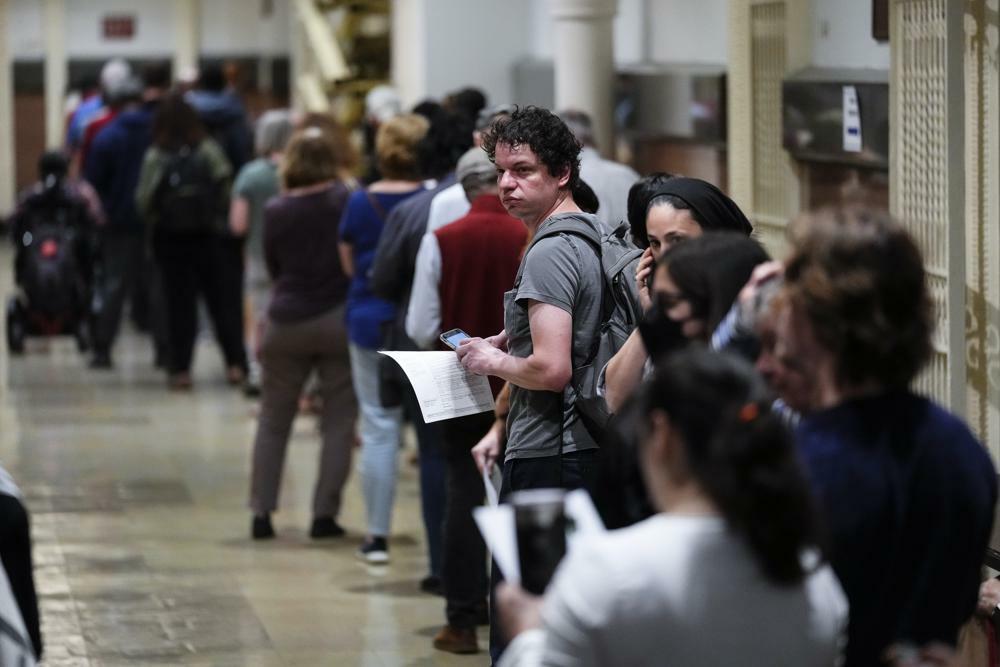
Other volunteers gave pizza, snacks and bottled water to voters waiting in line at City Hall that reportedly had people waiting for upwards of two hours. One activist told the Post that, at 3:45pm Monday, city officials notified some would-be re-voters that they wouldn’t make it to the office before it closed. Upset voters prompted the arrival of sheriff’s deputiesbut there were no reports of violence…yet — Election Day could be more boisterous. 

In Allegheny County, the AFL-CIO found that 147 of the failed votes belonged to its members. A phone bank had reached some 100 of them by 5 pm on election eve and was going to keep working into the night. 

Not all counties are trying to alert voters. “We’ve never cured ballots in Lancaster County,” county commissioner Joshua G. Parsons told the Post. “It’s a questionable procedure.” 

Monday’s “try-again” line at Philadelphia City Hall (AP Photo/Matt Rourke)

The Monroe County Republican Party asked a court to block the ballot-correcting blitz, saying it was tantamount to an illegal “pre-canvas” of mail ballots, which are required to be kept secure until counting begins at 7am on Election Day. Monroe County, in eastern Pennsylvania, is considered a swing county.

The court refused to issue an injunction, saying the GOP “has not shown a strong likelihood of success at this very early stage of litigation,” and that — since many voters had already been notified of their errors — “it would adversely affect the public interest to grant the injunction.”

According to the Philadelphia Inquirer, names on the list of flawed ballots include Comcast CEO Brian L. Roberts, 2022 mayoral candidate Derek Green and high-profile defense attorney Charles Peruto, who was last year’s GOP nominee for district attorney.   

Penina Bernstein told the Washington Post that she’d be flying home to Pennsylvania from Colorado to replace her ballot: “I will be there to fix it tomorrow, because my voice will not be silenced by voter suppression.”   

Tyler Durden
Tue, 11/08/2022 – 07:42

Russell Clark: Why I Stopped Short-Selling

0
Russell Clark: Why I Stopped Short-Selling

Authored by Russel Clark via Capital Flows and Asset Markets blog,

I gave up on short selling for mainly because I could not “time” it anymore – but I think that problem is now being resolved…

I did a lot of short selling when I was managing money. The funny thing about short selling was that most people (or at least my investors) would agree something was a short – but just could not agree on “when”. I thought I had solved this “when” problem, by closely watching movements in currency and bonds (macro assets). In previous posts, when I talk about the 3M process – the fist “M” – Macro was really all about timing moves in the market. The core idea was that asset flows would create and destroy capital markets (hence the title of this substack). The related idea to this was that Japan was the Saudi Arabia of the savings markets, and that Japanese flows into and out of markets would create and then end credit booms. This idea helped explain why the Yen and JGBs rallied during credit crises, as Japanese capital would flow back into Japanese asset markets. The implication was you needed to look at relative investment position of two different nations to see where risk was hiding. We started using net international investment position (NIIP) data to look at where capital flows had gone and could reverse creating a crisis.

This worked well with the Asian Financial Crisis, where Japan had a very positive NIIP, while Korea was very negative in 1998. Note Private sector here means that the holdings of treasuries as foreign reserve assets are stripped out.

This analysis also worked well with the Eurocrisis, where we swapped Germany for Japan. The NIIP of Spain was very negative just before the crisis began.

On the back of this analysis, I then looked for other countries with negative NIIP numbers. China data in 2014 and 2015 was highlighting the risk of asset flows out of China.

Once China risk was realised, the NIIP data has been pointing to a very negative outlook for US assets, with NIIP data extending far past the levels seen during the dot com bust.

Using the NIIP data, from 2018 onwards I tried to short assets tied to the US, while being long asset that would benefit from a weakening US dollar. This was not a very successful trade, but this was not the reason I gave up on short selling. With a bearish view on the USD driven by NIIP, I was not particularly bearish on Chinese or Emerging Market assets. But one day in early 2021 I read about the Chinese antitrust regulator calling in the 34 biggest internet operators to remind them to comply with existing antitrust laws. Most articles only referred to Alibaba and Tencent, but after 30 minutes work I was able to find the list of all 34 companies from an article dated 14 April.

As you would expect, many of these companies topped out a few months before this meeting, but many fell more than 50% post this meeting, particularly the smaller lesser-known Chinese companies.

For half an hour work I had generated a very successful short theme, that worked far better than a macro model that I have spent more than 15 years developing. What was worse, the implication was that politics trumped economics, which was something that I had explicitly rejected in my macro model. And this is why I stepped away from short selling and managing money. But over the last year, I have tried my best to develop a “political model” of markets, which is starting to pay dividends. So in my next post, I will talk about where my political model says to short.

Tyler Durden
Tue, 11/08/2022 – 07:20

Ukraine Seizes 5 Major Companies From Billionaire Oligarchs For ‘Wartime Needs’

0
Ukraine Seizes 5 Major Companies From Billionaire Oligarchs For ‘Wartime Needs’

For the first time since the Russian invasion began back in February, the Ukrainian government has invoked wartime laws to dramatically intervene into the private business sector, seizing five “strategically important” companies for state and military use. It comes a year after President Zelensky’s so-called “de-oligarchization” reforms and targets companies run by some of Ukraine’s wealthiest billionaire businessmen – at least a couple of which are facing major corruption investigations. 

Defense Minister Oleksii Reznikov announced Monday at a press briefing in Kiev, “As of today, the specified assets are managed on behalf of the state and in the interests of the entire security sector — to meet the needs of the Armed Forces and the entire defense sector.”

Influential Ukrainian billionaire Ihor Kolomoisky, via TASS.

Specific “urgent” military and national needs which were cited include maintaining fuel supply and adequate equipment repair lines, as well as accessing steady quantities of industrial lubricants. The companies were transferred directly under management of Ukraine’s defense ministry. “This is about providing fuel and lubricants, repairing military equipment and weapons,” Reznikov said. 

The National Securities and Stock Market Commission starting Sunday issued the order to secure shares in aircraft engine manufacturer Motor Sich, oil producer Ukrnafta PJSC, and oil-refining company Ukrtatnafta. These latter two oil industry companies were controlled by Igor Kolomoisky, a controversial previously pro-Zelensky oligarch under investigation for the insolvency of PrivatBank. Also seized were truck maker Avtokraz and parts supplier Zaporizhtransformator.

As for the oligarchs behind MotorSich, AvtoKraz, Zaporizhtransformator, the FT profiles them as follows:

  • Vyacheslav Boguslaev, MotorSich’s former owner and president, was arrested last month on treason charges. Local prosecutors allege he funnelled through sanctioned export operations helicopter engines that Moscow needed. Boguslaev sold his controlling stake in MotorSich to Chinese company Skyrizon many years ago, but Ukrainian trust and security authorities blocked the move by freezing the shares. Both Kolomoisky and Boguslaev have denied wrongdoing.
  • AvtoKraz, a truck manufacturer which produces vehicles for domestic military transport as well as rocket systems, was also among the groups taken under state control. It was previously owned by Ukrainian oligarch Kostyantyn Zhevago, who has lived in exile in the past years as Ukrainian authorities pursued cases against him related to the insolvency of a bank he previously owned.
  • Zaporizhtransformator, an electricity grid parts producer located in Zaporizhzhia, was also seized by the state. Previously owned by businessmen including Kostyantyn Grigorishin, its seizure is designed to secure stable supply of parts needed to repair Ukraine’s electricity infrastructure.

Ukraine government authorities vowed in the Monday statement that “After martial law is lifted, these assets may be returned to their owners or their value may be reimbursed.” And further, “These enterprises must operate 24 hours a day, seven days a week for the needs of the state’s defense.”

“In connection with military necessity, a decision was made to expropriate the assets of strategically important enterprises into state ownership,” the Secretary of Ukraine’s National Security and Defense Council, Oleksiy Danilov, explained further in a joint presser. 

Monday’s presser: Oleksii Reznikov, left, Denys Shmyhal, center, and Oleksiy Danilov, via AFP/Getty Images

The unprecedented move comes amid the backdrop of Russia’s persistent devastating aerial attacks on the country’s energy infrastructure, with some 40% of all electrical facilities having been damaged or destroyed. 

In announcing the state seizures, Ukrainian officials quickly went on defensive, given they’ve consistently cast the current crisis as Kiev leading the way in defending not only Ukrainian democracy but also “European Democratic values” more broadly. “We are defending not only Ukraine, but also European democratic values,” Kyiv Mayor Klitschko and Ukrainian Minister Chernyshov told an EU body of lawmakers last month.

Perhaps bracing for criticisms from some nervous corners of the Ukrainian private sector, Reznikov was quoted Reuters on Monday as claiming these are not “nationalizations” – but instead he argued, “This is a direct taking over of assets during wartime. These are totally different legal forms.” There were no statements coming from the five companies Monday in reaction to the state takeovers. 

Tyler Durden
Tue, 11/08/2022 – 06:55

UK To Announce A Stealth Tax Raid On Pensions

0
UK To Announce A Stealth Tax Raid On Pensions

It’s remarkable to think that it was just 6 weeks ago when the UK revealed its biggest spending spree in decades – one which sparked a bond market crisis, a political shake up and the resignation of the now former PM Liz Truss. Fast forward to today when in a dramatic reversal, we learn that the UK is sinking into Greek-style austerity: the Telegraph reports that Prime Minister Rishi Sunak and finance minister Jeremy Hunt plan to reveal a stealth tax raid on pensions later this month.

The pension lifetime allowance is set to be frozen for two more years, with a rise in line with prices delayed from 2025 to 2027, the newspaper said.

The allowance level has risen with prices in the past, but Sunak – as finance minister last year – froze the allowance until 2025. The move was forecast to bring the Treasury close to a billion pounds over the period, Telegraph said. And with the UK set to remain in a recessionary stagflation, with near-double digit CPI for the foreseeable future, UK retirees’ purchasing power will be drained faster than Biden can syphon away oil from the US SPR.

The Treasury is now planning to announce that the freeze will be extended until 2027, the end of the five-year period for which plans will be produced, the report said.

Sunak and Hunt, who need to fill a fiscal gap of nearly 50 billion pounds ($56.88 billion) during the Nov. 17 budget, have agreed to split the cost roughly equally between spending cuts and tax rises, according to the Telegraph.

The duo do not want to break the 2019 Tory election manifesto promises or raise the rates of major taxes, the Telegraph said citing Treasury sources. They are also determined to make sure the well-off carry more of the burden for the tax rises than the poorest, a move which means that another government crisis is assured in the very near term.

Separately, the Times reported that Sunak warned that people cannot expect the state to “fix every problem” and vowed to regain the trust of voters by being honest about the scale of the economic difficulties ahead.

Finally, the FT also reports that Sunak is under pressure regarding bullying claims concerning one of his closest political allies with the opposition Labor party calling for an independent investigation of allegations of bullying by Sir Gavin Williamson who was appointed as Minister of State without Portfolio last month.

In short: just the right amount of fear, loathing, chaos and confusion, that one has grown to expect from UK politics.

Tyler Durden
Tue, 11/08/2022 – 05:45

German Economist Sues OPEC, Wants $50 In Compensation

0
German Economist Sues OPEC, Wants $50 In Compensation

Authored by Charles Kennedy via OilPrice.com,

  • A German economist has filed a lawsuit against OPEC with a Berlin court.

  • Despite the paltry sum, the suit could end up costing OPEC more than it can afford.

  • The judge in a regional court in Berlin allowed the case to proceed and has ordered OPEC and several state-controlled oil firms to file a document naming their lawyers for the case.

A German economist has filed a lawsuit against OPEC with a Berlin court, accusing the cartel of pushing up the prices of the gasoline and heating oil he is buying, Bloomberg Opinion columnist Javier Blas reports—and despite the paltry sum, the suit could end up costing OPEC more than it can afford.

Armin Steinbach, Professor of law and economics, is suing OPEC for damages for $50 (50 euros), plus interest, alleging that OPEC is an illegal cartel operating to drive up oil prices. The court has allowed the case, which is a rare legal challenge against OPEC, despite decades of one-and-off debates in the United States about a bill that would allow lawsuits against OPEC producers.   

The judge in a regional court in Berlin allowed the case to proceed and has ordered OPEC and several state-controlled oil firms to file a document naming their lawyers for the case.

“I hope OPEC reacts soon to the court order. Ignoring court orders is not smart strategy in dealing with German courts,” the German plaintiff, Steinbach, tweeted on Monday.

In his claim, Steinbach had written that he was seeking damages “due to violation of antitrust law.”

“If my lawsuit is successful, it would be recognized for the first time in court that OPEC is a cartel,” Steinbach told German business daily Handelsblatt last week.

“Then every German could sue OPEC for damages,” he added.

Such a precedent could have legal consequences, although countries, including the U.S., have been wary of removing the sovereign immunity for countries to be sued, for fear of retaliatory lawsuits.  

In the United States, the Senate Judiciary Committee moved last month the bill that would allow the U.S. to sue OPEC for antitrust behavior and market manipulation to the Senate. The so-called No Oil Producing and Exporting Cartels (NOPEC) Act proposes to amend the Sherman Act to make oil-producing and exporting cartels illegal. NOPEC has been an on-and-off topic for U.S. lawmakers and Administrations for over two decades but has never moved past discussions at committees in Congress. Forms of antitrust legislation aimed at OPEC were discussed at various times under Presidents George W. Bush and Barack Obama, but they both threatened to veto such legislation.

While the NOPEC bill may be dead in the water again, a private citizen’s lawsuit against OPEC could set precedents for more court actions against the organization.

Tyler Durden
Tue, 11/08/2022 – 05:00