Rare Rebuke Of Israel By White House Riles Republicans
The political fallout continues after President Biden’s controversial and rare criticisms of Israel, which included on Tuesday his urging Prime Minister Benjamin Netanyahu to abandon his governing coalition’s judicial overhaul policy which critics say will destroy any semblance of checks and balances and thus is a threat to Israeli democracy itself. The plan is now on “pause” as deep divisions in Israel simmer.
Biden had said he hoped Netanyahu “walks away from” the plan which has brought hundreds of thousands of Israeli protesters into the streets over the last couple weeks. But he really riled Israel-supporters by emphasizing that he has no intention of welcoming Netanyahu to the White House “in the near term.” Typically newly elected Israeli prime ministers can expect to meet with the US president fairly quickly after entering office.
“Like many strong supporters of Israel, I’m very concerned, and I’m concerned that they get this straight. They cannot continue down this road,” Biden had told reporters after a speech in North Carolina. “Hopefully the prime minister will act in a way that he can try to work out some genuine compromise. But that remains to be seen.”
Again such a rebuke from an American president directed at close ally Israel, which receives over $3 billion a year in foreign and defense aid from Washington, is so rare as to be almost unheard of. But some argue that the funding and steady weapons pipeline to Tel Aviv is precisely why Washington must reign in Israel from time to time.
But pro-Israel hawks have historically treated the Jewish state like it cannot possibly do any wrong. Congressional Republicans were especially angry by Biden’s criticisms, with House Speaker Kevin McCarthy on Thursday speaking up, issuing words of support for Netanyahu:
“Prime Minister Netanyahu is an Israeli patriot, statesman, and most importantly, a great friend of the United States of America,” McCarthy said in a statement.
“Free societies have vigorous and open debate. Israel is no exception. I support Prime Minister Netanyahu, and America’s support for Israel’s strong, vibrant democracy is unwavering. Now is an important time for Americans to stand together in support of our long, mutually respectful, and important friendship with Israel.”
Interestingly, some Republicans agree that the judicial overhaul plan shouldn’t be pursued, but have expressed that Biden shouldn’t criticize Israel so out in the open.
For example, Rep. Chris Smith of New Jersey said Biden’s words should have been conveyed through quiet back-channels: “The administration if they’re going to convey a message, it ought to be doing it through secure channels and not being so public about it,” he said to The Hillon Wednesday.
New: President Biden urged Prime Minister Benjamin Netanyahu in a strong private message to halt his government’s judicial overhaul just hours before Netanyahu announced the suspension of the controversial plan. My story on @axioshttps://t.co/EUtzlFkYAj
“An ally like Israel that absolutely needs a friend like the United States as part of its deterrence, we want to, in no way convey, any, no matter who’s prime minister, diminution of support. Talk it out on a secure phone or in a meeting, don’t do it through the press,” Smith added.
Damascus Rocked By Israeli Attack On Heels Of Saudi-Iran Rapprochement
More Israeli airstrikes rocked Damascus early Thursday morning, wounding two Syrian soldiers, according to national SANA news agency and international reports.
State sources say Syrian air defenses were “confronting hostile targets” over the capital at around 1:20am, during the aerial attack which came from the direction of the Golan Heights. This marks the fourth major Israeli attack on Syria this month, which included two prior air assaults which temporarily shut down Aleppo International Airport.
“At around 01:20 am (10:20 GMT), the Israeli enemy carried out an aerial aggression from the direction of the occupied Golan Heights targeting several positions in the vicinity of Damascus,” Syria’s defense ministry said later, also noting material damage.
After a short lull following a pattern of several years that included hundreds of Israeli attacks on Syria, there’s been an uptick and return to more frequent attacks so far this year.
“A group monitoring the Syrian civil war said the Israeli missile strikes last week destroyed a suspected arms depot used by Iran-backed fighters at Aleppo airport,” Al Jazeeraobserves. “On March 7, three people were killed in the Israeli air strike on the airport that also halted flights for three days.”
Israeli officials have long claimed to be targeting Iranian military assets such as weapons shipments, but civilians and city infrastructure have long been targeted. “Along with airports, Israeli warplanes have also aimed at other critical infrastructure, including Syrian seaports,” AJ notes further.
One likely explanation for Israel’s ramped up aggression in Syria is the Saudi-Iran deal to reestablish and normalize diplomatic ties announced this month. Israel has long relied on robust US-Gulf (and GCC) efforts to counter Iran. Couple with this is that Syria’s Bashar al-Assad is being welcomed in Gulf capitals such as the UAE and Oman.
#UPDATE: Israeli strikes have reportedly hit a target in the Al-Midan neighbourhood in the Syrian capital, Damascus pic.twitter.com/cRXqzof1HZ
US state-backed VOA has observed the post-earthquake diplomacy is part of “renewed efforts to bring Damascus back into the Arab fold.” This scares Israel, which wants to see Syria perpetually isolated amid fears in Tel Aviv of deepened Iranian entrenchment in the region.
In late 2020, the policy makers of the Biden administration and its partisan supporters started crafting a new COVID stimulus package. What they wrought set off a chain of events that ultimately led to the cost of living and banking system crisis we face today.
It didn’t have to be that way. When they started their discussions, the participants had modest goals for what an additional stimulus would look like. Considering the federal government had just enacted its fourth Covid relief package on 27 December 2020, totaling $900 billion, no one at the time was advising the Biden administration to pursue for another stimulus of similar size, much less one that was $1 trillion larger.
That changed quickly after 5 January 2021, when President Biden’s political party gained control of the U.S. Senate after runoff elections in Georgia came out in their favor.
With control of the U.S. Congress in hand, the most rabidly partisan among President Biden’s supporters quickly switched gears to exercise their new political power. Instead of linking the magnitude of any new stimulus package to the actual scale of the problem the U.S. economy was facing at the time, they decided they would “go big”, putting their fringe political agenda ahead of sound fiscal policy.
But in ditching sound fiscal policy, they opened a rift among those who had been crafting the new stimulus measure. That rift took the form of an academic controversy that erupted while they were developing what would ultimately become the American Rescue Plan Act, which the Biden administration rammed through Congress and signed into law on 11 March 2021.
The controversy involved an economic concept known as potential output, or potential GDP. Here’s a quick primer:
Potential output is an estimate of what an economy could feasibly produce when it fully employs its available economic resources. The Congressional Budget Office (CBO) estimates potential output by estimating potential GDP, which it describes as “the economy’s maximum sustainable output.” The word “sustainable” is important — it doesn’t mean that the entire working-age population is working 18 hours per day or that factories are operating 24/7. Rather, it means that economic resources are fully employed — at normal levels. Potential output (estimated as real potential GDP) serves as an important benchmark level against which actual output (measured as real GDP) can be compared with at any given time.
The difference between the economy’s potential output and its actual output is called the output gap, which economic policy makers must consider when shaping major fiscal policies. If they adopt policies that undershoot the gap, they will fail to obtain the full positive results they seek at the cost of greatly adding to the nation’s debt. If they overshoot the gap, they risk creating adverse economic conditions, like inflation, that can fully undermine whatever positive results they hoped to achieve.
These scenarios were known risks at the time the Biden administration was pushing the American Rescue Plan Act forward. In fact, because the stimulus package they were considering had swelled to $1.9 trillion, the risk of creating inflation became a primary concern among the more fiscally responsible members of Biden’s policy making team. But they lost the internal argument when President Biden sided with the most extreme elements among his supporters.
That victory didn’t make the likelihood the enormous new stimulus package would almost certainly overshoot the output gap and create persistent inflation go away. By Inauguration Day, the progressive activists who hijacked the stimulus development still needed to dispell that risk to ensure they could get the massive stimulus through a still closely-divided Congress. Their chosen path to achieve their political agenda would hinge on an assumption cooked up by the Biden administration’s most rabidly partisan supporters: that the nation’s potential GDP and output gap were much larger than the CBO estimated and thus, would not create inflation. That assumption would become the focal point of the controversy for how the stimulus bill could negatively impact the economy.
On 3 February 2021, the Committee for a Responsible Federal Budget discussed how the assumptions of the size of potential GDP and the output gap being put forward affected the forecasts of how much the stimulus could overshoot the output gap:
The output gap could differ from CBO’s projections. Many forecasts and experts suggest the economy will grow faster this year than CBO estimates. A one percentage point increase in Gross Domestic Product (GDP) growth would reduce the output gap to less than $200 billion, in which case the American Rescue Plan would be large enough to close eight to ten times the output gap based on the Edelberg and Sheiner numbers. On the other hand, many haveargued that CBO is underestimating full employment and potential GDP. If potential GDP were 1 percent larger than CBO’s estimate, the output gap would total $1.3 trillion through 2023 and the America Rescue Plan would close 115 to 145 percent of the output gap.
The “Edelberg and Sheiner numbers” refer to a 28 January 2021 analysis of the Biden administration’s proposed stimulus produced by the nonpartisan Brookings Institute’s Wendy Edelberg and Louise Sheiner. Just a few weeks later, Sheiner would join with Brookings’ Tyler Powell and David Wessel to report on the controversy related to potential GDP that had erupted among those who were giving input to the Biden Administration’s first major economic policy initiative:
As President Biden and Congress negotiate the next fiscal stimulus package to aid the COVID-19 economic recovery, they will implicitly be making assumptions about the output gap. Analysis by one of us (Louise Sheiner) and our Brookings colleague Wendy Edelberg suggests that Biden’s $1.9 trillion package would result in GDP reaching its pre-pandemic path by the end of 2021 and exceeding it in 2022. In other words, some of the economic activity lost during the pandemic would be made up after the virus subsides.
Based on the CBO’s recent estimate of potential GDP, though, this would leave a large positive output gap—peaking at 2.6 percent in the first quarter of 2022. Some critics — including former Treasury Secretary Lawrence Summers — argue that pushing output this far above potential could drive up inflation.
Others, including Nobel Laureate Paul Krugman, warn against putting too much emphasis on a projected output gap in determining the riskiness of a large fiscal stimulus. They note the significant uncertainty that surrounds any estimate of potential GDP. Indeed, by CBO’s estimates, the U.S. economy was operating above potential in 2019, yet inflation remained subdued and below the Fed’s 2 percent target. Moreover, there is little historical precedent to predict how the pandemic will affect potential output or consumer and business demand once the virus recedes.
With hindsight being 20/20, we know that Larry Summers’ view was correct. President Biden’s COVID stimulus overshot the output gap and created significant inflation, which quickly became evident after its enactment. Mainstream economists using different methodologies indicate the American Recovery Plan Act played a “sizable role” in causing inflation, adding anywhere from 2.6% to 3.5% on top of the inflation rate that would have been recorded without President Biden’s $1.9 trillion stimulus.
That inflation was allowed to fester for a full year because of a commitment the Federal Reserve made to hold rates near zero percent for as long as possible. It took Americans seeing prices inflate faster than their incomes to finally force the Fed to address the inflation they allowed to gain traction with a series of interest rate hikes beginning in March 2022. Flashing forward one year later, the actions to fix the inflation unleashed by the stimulus measure has had negative impacts on large sectors of the U.S. economy, such as the housing market, and directlycontributed to the bank failures that became front page news during the last few weeks.
The Biden administration cannot say they were not warned. Here’s the prescient commentary from Larry Summers’ 4 February 2021 op-ed in the Washington Post:
… while there are enormous uncertainties, there is a chance that macroeconomic stimulus on a scale closer to World War II levels than normal recession levels will set off inflationary pressures of a kind we have not seen in a generation, with consequences for the value of the dollar and financial stability. This will be manageable if monetary and fiscal policy can be rapidly adjusted to address the problem. But given the commitments the Fed has made, administration officials’ dismissal of even the possibility of inflation, and the difficulties in mobilizing congressional support for tax increases or spending cuts, there is the risk of inflation expectations rising sharply. Stimulus measures of the magnitude contemplated are steps into the unknown.
In another op-ed just two months later, Summers provided the epitaph for the inflationary failure of the Biden administration’s first major economic initiative with just a simple, understated clause:
Excessive stimulus driven by political considerations was a consequential policy error…
The Biden administration and its extremist political supporters chose to purposefully overshoot the output gap and pretend it would not create the adverse economic conditions that are undermining whatever positive results they hoped to achieve with their $1.9 trillion stimulus. Today, they’re expending much effort trying to avoid accountability for their roles in causing the catastrophic consequences of what is becoming the biggest policy error in generations.
Then again, if they weren’t honest about it from the beginning, why would they start being honest and take responsibility for their failings now?
References
Martin Wolf. Interview with Larry Summers: ‘I’m concerned that what is being done is substantially excessive’. Financial Times. [Online Article]. 11 April 2021. Here’s a video of the full interview:
François de Soyres, Ana Maria Santacreu, and Henry Young. Demand-Supply Imbalance during the COVID-19 Pandemic: The Role of Fiscal Policy. Federal Reserve Bank of St. Louis Review. First Quarter 2023, 105(1), pp. 21-50. [PDF Document]. DOI: 10.20955/r.105.21-50. 20 January 2023.
Francesco Bianchi and Leonardo Melosi. Inflation as a Fiscal Limit. Federal Reserve Bank of Chicago Working Paper No. 2022-37. [Online Article]. DOI: 10.2139/ssrn.4205158. 21 September 2022.
Doreen Fagan. Understanding Potential GDP and the Output Gap. Federal Reserve Bank of St. Louis Open Vault Blog. [Online Article]. 4 August 2021.
Committee for a Responsible Federal Budget. How Much Would the American Rescue Plan Act Overshoot the Output Gap. [Online Article]. 3 February 2021.
Wendy Edelberg and Louise Sheiner. The macroeconomic implications of Biden’s $1.9 trillion fiscal package. Brookings Institute Up Front. [Online Article]. 28 January 2021.
Tyler Powell, Louise Sheiner, and David Wessel. What is potential GDP, and why is it so controversial right now? Brookings Institute Up Front. [Online Article]. 22 February 2021.
Block Shares Rebound After Company Issues Response Addressing Short Seller Claims
Shares of payment company Square are edging back toward territory it traded in prior to Hindenburg Research’s March 23 report on the company. Today, shares are higher by about 3% after the company issued a more detailed response to the report.
The company said in a response publicized on Thursday that its “compliance and risk teams placed just 2.4% of Cash App accounts on a watch list last year”, according to Bloomberg on Thursday.
As part of the response, the company also admitted that it had 39 million unique users by social security number, differing from the 51 million user number they have highlighted.
So $SQ just admitted that actual confirmed (unique SS #) Cash App users was 39M at 12/31, vs the 51M they keep highlighting? That seems like a material difference. pic.twitter.com/BZDhCH1wg2
The company also said “that transacting actives have conducted at least one financial transaction through the app during the specified period, unlike other companies that count any account that opens their mobile app or loads a webpage as an active account,” Seeking Alpha reported.
Addressing allegations of fraud, Block wrote:
“While it’s challenging to arrive at definitive estimates of the amount of fraud and illicit activity, we measure the number of accounts that we “denylist” (a control that prevents, among other things, sending and receiving funds, using a Cash App Card, buying stocks or bitcoin, or taking a loan).”
“We have additional controls to help prevent known bad actors from returning to the platform,” it added.
Recall on March 23, Hindenburg Research published a report called “Block: How Inflated User Metrics and “Frictionless” Fraud Facilitation Enabled Insiders To Cash Out Over $1 Billion”.
“Most analysts are excited about the post-pandemic surge of Block’s Cash App platform, with expectations that its 51 million monthly transacting active users and low customer acquisition costs will drive high margin growth and serve as a future platform to offer new products,” the short seller wrote.
The report alleged: “Our research indicates, however, that Block has wildly overstated its genuine user counts and has understated its customer acquisition costs. Former employees estimated that 40%-75% of accounts they reviewed were fake, involved in fraud, or were additional accounts tied to a single individual.”
“Even when users were caught engaging in fraud or other prohibited activity, Block blacklisted the account without banning the user,” Hindenburg writes. “Block obfuscates how many individuals are on the Cash App platform by reporting misleading “transacting active” metrics filled with fake and duplicate accounts. Block can and should clarify to investors an estimate on how many unique people actually use Cash App.”
Renowned author and journalist James Howard Kunstler (JHK) has been complaining and pointing out that the American public is told one lie after another by the Lying Legacy Media (LLM), the government and the medical community.
This kind of lying, according to JHK, is pure treason by all parties, from the 600 million CV19 bioweapon/vax injections, to the crumbling banking system, to the war in Ukraine. Let’s start with the genocide of the CV19vax. JHK says,
“They are pretending that they didn’t cause any damage, and they are ignoring their own assembled statistics, and they don’t want to paint a realistic picture for the American public to see what the consequences were for their vaccination program…
I don’t think they can suppress the reality of it that much longer. There are just too many people who know too many people who have been injured or killed by the vaccines. The basic problem is dishonesty puts you in a place of weakness, and the truth puts you in a position of strength. Eventually, if you are not being honest with yourself and the other people around you, you are going to be found out…
They have to keep doubling and tripling down on narratives that are manifestly untrue, and pretty soon I think people are going to be super pissed off about how all this went down.”
With the banking crisis, JHK says the lie that everything is under control is going to be exposed too. JHK says,
“When you are compelled to liquidate like Silicon Valley Bank, they are liquidating their assets below their supposed value and they become insolvent. I would imagine there is a great deal of damage waiting to express itself out there, and we haven’t seen much action in the derivatives racket so far, and that’s going to be a big deal when that happens because of the completely reckless contracts that are made…
It’s really a bad bet, and the people taking the bet can’t pay off the bet, and the whole thing is really a disaster waiting to happen.”
JHK says the so-called reset is going to happen, but not the way Klause Schwab wants it to happen.
All will go extremely local, and JHK says, “Social discourse will make it all much worse.”
The lies about Ukraine and the losing war started by NATO are summed up by JHK,
“In retrospect, we could see why Donald Trump would want to have a phone call with Zelensky over the Biden family activities in Ukraine…
The whole Ukraine portfolio is just a big bag of crap. . . . Because of those activities, there is a war against the people, and that includes a war against Donald Trump. They are trying every way possible to shove him off the playing field…
I think it is safe to say the U.S. government is not your friend.”
In closing, JHK says,
“This is an extremely socially and politically perverse period of history…
.I grew up in the hippie period… It was quite based compared to the baseless nuttery and lunacy that this country is involved in now. The fact that there has to be any debate about drag queen story hour for children is amazing… That’s okay? Deliberately, demonstrable male imitation of a female. That’s supposed to be good for kids and not scare them?
…There is a uniform craziness across the culture, and people are being asked to swallow increasingly absurd propositions. That’s where we are now. We are being asked to swallow absurd ideas one after another.”
There is much more in the 52-minute interview.
Join Greg Hunter as he goes One-on-One with author and journalist James Howard Kunstler.
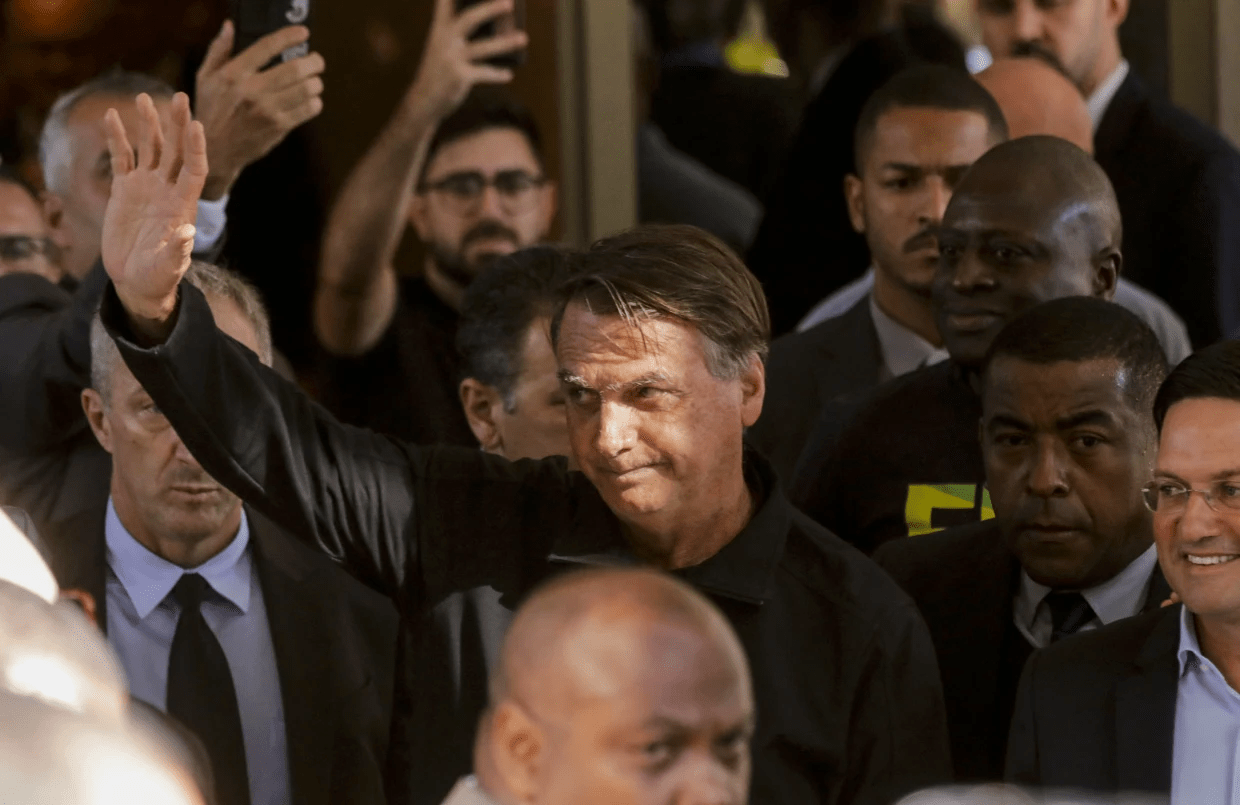
Bolsonaro Returns To Brazil From Florida, Faces Down Multiple Criminal Investigations
Former Brazilian President Jair Bolsonaro has returned to Brazil on Thursday for the first time since far-left rival Luiz Inácio Lula da Silva returned to the presidency, and at a moment no less than five Supreme Court investigations linger over his head, any one of which could send him to prison.
As AFP outlines, this includes “four for alleged crimes during his term (2019-2022), and one over accusations he incited a riot by supporters who invaded the presidential palace, Congress and the Supreme Court on January 8, protesting his election loss.”
He spent three months in Florida, quiet and keeping a low profile, as politicians in both Brazil and the US (Democrats) called for him to be booted from the US amid questions over his visa status. He had flown to Florida days prior to Lula’s Jan.1st inauguration, residing in a posh resort community residence outside Orlando provided by a friend, on an A-1 visa which is only issued to diplomats and heads of state.
Democrats as well as pro-Lula officials accused Bolsonaro of inciting riots and political violence from afar, and the White House had even multiple times been asked about extradition.
The State Department’s Ned Price denied to extradition was on the table, and explained in early January: “If an A visa holder is no longer engaged in official business on behalf of their government, it is incumbent on that visa holder to depart the US or to request a change to another immigration status within 30 days.”
And after three months of the Florida Man lifestyle, Bolsonaro is back in Brazil.
(Unrelatedly, I need to know more about who makes the music choices for his TikToks) pic.twitter.com/Nf7HvcZESq
Additionally, group of 41 Democratic members of Congress had sent a letter to the Biden White House demanding action against the former Brazilian president. “We must not allow Mr Bolsonaro or any other former Brazilian officials to take refuge in the United States to escape justice for any crimes they may have committed when in office,” the lawmakers wrote.
Bolsonaro had submitted an application for a for a six-month visitor visa, so while it at first appeared he would extend his stay in the US through legal means, that could have been called off due to the mounting political pressure both within and outside the US.
The former president was greeted by a large crowd upon return:
He never actually formally conceded defeat to Lula, and is expected to help bolster the political opposition in Brazil, but says he doesn’t plan to lead it. CNN describes of his return:
Instead, Bolsonaro said he planned to help his party “as an experienced person,” collaborating with “whatever they wish,” CNN Brasil quoted the former president as saying. He added that he will tour the country in preparation for next year’s municipal elections.
“We have turned a page, and now we will prepare for next year’s election,” he recently said to CNN Brasil. “You don’t have to oppose this government. This government is an opposition in itself.”
United States Securities and Exchange Commission Chair Gary Gensler says the regulator is spread thin and needs additional funding to keep up with the “increased complexity in the capital markets.”
United States Securities and Exchange Commission Chair Gary Gensler has thrown his support behind U.S. President Joe Biden’s request to allocate a record $2.4 billion in funding for the regulator, highlighting the ongoing need to crack down on “misconduct” in the cryptocurrency industry.
In prepared testimony for the March 29 budget hearing with the House Appropriations Committee, Gensler said the additional funding was needed to keep up the pace of innovation, adding:
“Rapid technological innovation in the financial markets has led to misconduct in emerging and new areas, not least in the crypto space. Addressing this requires new tools, expertise, and resources.”
The additional funding would allow the SEC to hire 170 additional staff, most of whom would work within its enforcement and examination divisions, said Gensler.
The SEC chair said that the prior year’s budget increase allowed it to bring staffing levels above what it was in 2016 for the first time, but said the regulatory agency was still stretched thin, adding:
“As the cop on the beat, we must be able to meet the match of bad actors. Thus, it makes sense for the SEC to grow along with the expansion and increased complexity in the capital markets.”
Gensler again described crypto as the wild west, suggesting the nascent industry is “rife with noncompliance,” and that crypto investors were putting their “hard-earned assets at risk in a highly speculative asset class.”
According to Gensler, the regulator “received more than 35,000 separate tips, complaints, and referrals from whistleblowers and others in FY 2022,” which helped it bring more than 750 enforcement actions and “resulted in orders for $6.4 billion in penalties and disgorgement.”
Thirty of these actions were related to the crypto industry, which resulted in $242 million in monetary penalties and represents a 36% increase over the 22 actions announced in 2021.
“It’s Not Rocket Science” – RH CEO Warns “This Is Not Normal, This Is Dangerous”
RH shares are down around 5% in the pre-market as the upscale home furnishings company issued weaker-than-expected full-year guidance for FY23…
According to the letter to shareholders, business conditions for RH are anticipated to remain challenging for the “next several quarters” and maybe even longer due to a rapidly weakening housing market, the uncertainty caused by the recent banking crisis, lapping of COVID-19 driven sales and backlog reductions.
“…, inflation that was thought to be “transitory” is now deemed “persistent” by the Federal Reserve, resulting in a record rise in interest rates triggering a dramatic decline of the housing market, with luxury homes sales down 45% in the most recent quarter versus a year ago. Add to that an underperforming stock market, and a banking crisis no one saw coming and the data points to business in our sector likely getting worse before it gets better,“
But, as always, it’s what RH CEO Gary Friedman had to say during the earnings call that caught most analysts’ ears…
And now, in Q1, the comfortably outspoken Friedman turns up the threat amplifier to ’11’…
As the Q&A began, a question about a lower margin outlook prompted this:
“It’s not rocket science to know this is a really bad time,” according to a transcript from Bloomberg.
“The fact is, we’ve been in a massive housing recession for the past year,” Friedman continued.
“The data points to business in our sector likely getting worse before it gets better,” Friedman said, signaling additional headwinds from bank credit contraction ahead.
“I’ve been on the planet for long enough to know this is not normal, and this is dangerous,” he said.
He worries about the consumer (which is important given the high-end nature of his company’s products might suggest some insulation from that threat)…
“…the unsettling feeling as being a person on a Saturday afternoon is watching Warriors basketball game at the news cut to align formed around your local bank while the bank was sending hourly e-mails trying to tell you that they committed to serving you. It’s very unsettling…“
And more pointedly, he exclaimed that:
“Anybody that thinks it’s not a big deal, the three banks went down… is living in a — with a euphoric view of the world.”
Finally, Friedman offered some advice to policymakers:
“Just land the plane on the other side, whether it’s hard, whether it’s bumpy,” Friedman said.
“Just don’t completely crash. A complete crash would look like the ’70s and the ’80s. That will take over a decade to recover from.”
Subtle, and scary, as ever… but hey, just keep listening to the MSM and the Biden admin about how strong the consumer is… (remember how ‘sound’ the US financial system was a month ago too?)
Senator Rand Paul has claimed that Anthony Fauci is still working for the government in order to take advantage of federal legal protection against claims that he engaged in a cover up on the origins of the coronavirus pandemic.
Appearing on Hannity, Paul stated “There is a massive coverup going on and the lead in all of the coverup has been Fauci.”
The Senator continued, “We now have information that he is still working for the government even though he says he is retired.”
“It is my belief that he is worried about being indicted and so he continues to work so he will get legal protection under the federal government,” Paul asserted.
“This is wrong on every level of it and we are going to get to the bottom of it. We are sending a letter to find out what the actual status of his employment is,” Paul added.
“Is he retired? Is he still getting a federal detail? There is a lot of stuff going on, but at the top of every sort of concern we have it is Tony Fauci,” the Senator further noted.
Watch:
Last week, Paul accused Anthony Fauci of ‘weaponising’ government to get people on board with a COVID lab leak cover up.
“This guy weaponized the NIAD. He weaponized it to get his supporters,” Paul emphasised, adding “At first, they said, ‘My goodness. It came from a lab.’ And then, all of a sudden, they changed their mind. They got more money. They got more grants.”
“He used that grant-making authority — who gets it — and he weaponized government to get what he wanted,” Paul urged, adding “and that was the cover-up.”
@RandPaul on Fauci cashing in off the Covid vaccine: $400 million in total goes to the NIH and even if it’s goes back out in grants, it’s still self-interested. Fauci was in charge of dispensing all this money while being a policy maker. pic.twitter.com/7DjXvinvHk
— Jesse Watters Primetime (@jesseprimetime) March 23, 2023
Q4 GDP Comes In Below Estimates On Sharp Slowdown In Personal Spending Ahead Of Looming Credit Crunch
In the least relevant data point on what will otherwise be a quiet day on the data front, moments ago the BEA reported its third and final Q4 GDP estimate (to be fair this number will still be revised numerous time in coming years), and it continued the trend of declines, having printed 2.9% in the first estimate in January (above the 2.6% estimate), it then dropped to 2.7% in the second estimate in February, and it is now down again to 2.6%, exactly where the original Q4 GDP estimate was primarily reflecting downward revisions to exports and consumer spending, , and a master class in how you can “buy” two quarters of “above average” growth before converging with the original estimates. And for those keeping track, the most recent consensus estimate for Q4 GDP was 2.7% so technically we missed.
According to the BEA, the Q4 compared to Q3 increase in real GDP reflected increases in inventory investment, consumer spending, business investment, federal government spending, and state and local government spending that were partly offset by decreases in housing investment and exports. Imports, which are a subtraction in the calculation of GDP, decreased.
The increase in private inventory investment was led by manufacturing (mainly petroleum and coal products) as well as mining, utilities, and construction industries (led by utilities).
The increase in consumer spending reflected an increase in services (led by health care as well as housing and utilities) that was partly offset by a decrease in goods (led by “other” durable goods, specifically jewelry).
The decrease in housing investment was led by new single-family housing construction and brokers’ commissions
Meanwhile, comparing the final Q4 GDP to the second estimate, it was revised down 0.1% “primarily reflecting downward revisions to exports and consumer spending. The price index for GDP increased 3.9 percent in the fourth quarter, unrevised from the previous estimate.”
A look at the detailed breakdown:
Personal consumption contributed just 0.70% to the bottom line GDP, down notably from 0.93% in the 2nd estimate and 1.42% in the first; it was also the lowest since the covid lockdowns
Fixed investment (capex spending) continued to detract from GDP, and the final estimate was -0.68%, a modest improvement from the -0.81% in the second estimate.
Change in private inventories was flat vs the previous estimate at 1.47%, and a solid reversal from the -1.19% drop in Q3. Still, the number was a massive 57% of the total GDP contribution.
Net exports was fractionally lower at 0.42% (exports of -0.44% offset by imports of 0.86%), compared to 0.46% in Q3.
Finally, government contributed 0.65%, up from 0.63% in the second estimate, and matching the highest government contribution since Q1 2021.
And visually:
Of the above data, two things stuck out: the outsized contribution by inventories at 57% of the bottom line number, and the sharp drop in annualized Personal Consumption, which rose just 1.0%, or the least since the covid crash in Q2 2020.
The Personal Consumption number dropped from 2.3% in Q4, and missed the estimate of 1.4% by the widest margin since Q2 2022.
As an aside, today’s release includes estimates of GDP by industry, or value added—a measure of an industry’s contribution to GDP. Private goods-producing industries increased 4.0 percent, private services-producing industries increased 2.3 percent, and government increased 2.1 percent. Overall, 17 of 22 industry groups contributed to the fourth-quarter increase in real GDP.
Within private goods-producing industries, the increase was led by durable goods manufacturing and mining. Partly offsetting these increases was a decrease in construction.
Within private services-producing industries, the leading contributors to the increase were professional, scientific, and technical services; retail trade; health care and social assistance; and information. Notable offsets include decreases in finance and insurance as well as real estate and rental and leasing.
The increase in government reflected increases in both federal government as well as state and local government.
While growth slowed down, the inflation components in the GDP report came in hotter than expected, with the Core PCE rising 4.4%, above the 2nd estimate of 4.3% which was also the median consensus. The silver lining: the headline GDP price index rose 3.9% in 4Q after rising 4.4% prior quarter; at least this number came in line with expectations.
Some more details from the BEA: “Gross domestic purchases prices, the prices of goods and services purchased by U.S. residents, increased 3.6 percent in the fourth quarter after increasing 4.8 percent in the third quarter. Excluding food and energy, prices increased 4.1 percent after increasing 5.0 percent.”
Personal consumption expenditure (PCE) prices increased 3.7 percent in the fourth quarter after increasing 4.3 percent. Excluding food and energy, the PCE “core” price index increased 4.4 percent after increasing 4.7 percent.
Putting it all together, today’s report was downright stagflationary, because while inflation remains hot and well above the Fed’s (pre-revision) 2% target, consumption continues to shrink, and as Joe Lavorgna notes, “real consumption was revised down 40 bps to 1.0%. There isn’t much momentum as a potential commercial bank credit crunch looms. Last qtr is (non-pandemic) weakest since Q1 2019 (0.4%)”
It’s notable that Q4 2022 real consumption was revised down 40 bps to 1.0%. There isn’t much momentum as a potential commercial bank credit crunch looms. Last qtr is (non-pandemic) weakest since Q1 2019 (0.4%)