82.7 F
Chicago
Monday, August 10, 2026
Home Blog Page 3821

“More Dangerous Than Ever”: Experts Warn Americans Against Going To Mexico To Buy Cheap Pharmacy Drugs

“More Dangerous Than Ever”: Experts Warn Americans Against Going To Mexico To Buy Cheap Pharmacy Drugs

Authored by J.M. Phelps via The Epoch Times (emphasis ours),

A recent study by the University of California (UCLA) concluded that many drugs from Mexican pharmacies are laced with fentanyl, heroin, and methamphetamine. U.S. tourists are often the buyers of these pills, which include counterfeit replicas of Oxycodone, Percocet, and Adderall.

U.S. Customs and Border Protection seized approximately 47,000 rainbow-colored fentanyl pills, 186,000 blue fentanyl pills, and 6.5 pounds of meth hidden in a floor compartment of a vehicle at the Nogales port of entry on the southern border with Mexico on Sept. 3, 2022. (U.S. Customs and Border Protection)

The UCLA-led study reported that two out of three (68 percent) pharmacies in four cities in northern Mexico had at least one controlled substance for sale without requiring a prescription. Prescriptions were also offered in bottles or individual pills.

Eleven pharmacies contain counterfeit pills laced with fentanyl, heroin, and/or methamphetamine. “Of 45 pill samples,” UCLA Health reported, “nine sold as Adderall contained methamphetamine, eight sold as Oxycodone had fentanyl, and three sold as Oxycodone contained heroin.”

The Epoch Times spoke to Derek Maltz, a former head of the Special Operations Division (SOD) of the Drug Enforcement Administration (DEA). As the study suggested, he said, “One of the reasons why Mexican pharmacies attract buyers from America is because you don’t need a prescription, and they’re inexpensive.”

He further explained, “Some people think they can’t afford medicine here, and others can’t afford medical procedures.” As a result, many go to Mexico to make their drug purchases or get their procedures done at a more affordable rate.

The trend of medical tourism—Americans traveling to Mexico for medical care because it’s cheaper—is now more dangerous than ever,” he said.

The UCLA study pointed out that a person could be led into thinking they’re receiving pharmaceutical-grade pills but could be receiving fake pills, Maltz said. “And this is more dangerous than I have the words to express,” he added.

What if these pills make it into the medical offices where you’re having a procedure and are seeking pain relief?

Maltz offered this warning: “You get what you pay for.” With that in mind, he said, “Rather than going to Mexico for inexpensive drugs or medical procedures, it would be smarter to spend a little extra money on this side of the border.

“Now, more than ever, dealing with a Mexican pharmacy is a terrible decision because it could kill you.”

Fentanyl is 100 times more potent than morphine and 50 times more potent than heroin.

Deadly Doses

Jaime Puerta, president of the advocacy group Victims of Illicit Drugs, is alarmed by the growing number of deaths attributed to fentanyl. Up to 67 percent of drug overdoses or drug poisonings of over 100,000 people can involve synthetic opioids like fentanyl. He then told The Epoch Times about losing his 16-year-old son, Daniel, to fentanyl in 2020.

While he agreed with Maltz, he also added that “a lot of kids are going down to Mexico for spring break, and while they are down there, they could visit the local pharmacy to buy what they think is the Mexican equivalent to a drug they’re familiar with, but they could actually be buying a poison.”

While they could be trying to self-medicate a psychological issue or even a physical injury, Puerta said, “It’s not a gamble any kid should be taking.”

Adding to the comment about psychological issues, Maltz said, “There’s a growing trend of depression and anxiety, especially in younger kids.” This is one of many reasons teens could be “turning to pills to relieve some of the stress and anxiety they’re feeling,” he said. “And before you know it, they’re addicted to the meds they’re choosing to take.” These can include Adderall, Xanax, Oxycontin, Percocet, and other opioids or pain medications.

Coconuts filled with fentanyl seized by Mexican authorities in Puerto Libertad, Mexico, on Dec. 1, 2022, in a still from a video. (Prosecutor General’s Office of Mexico via AP/Screenshot via The Epoch Times)

There’s a great demand for these pills because kids want to feel better,” Maltz said. “But what they don’t know is that many of these kinds of pills that are being made in Mexico are illicitly made in clandestine labs,” he said.

“A never-ending amount of these pills are being made with deadly fentanyl, so these kids who purchase them are essentially being deceived to death.

Tyler Durden
Wed, 03/29/2023 – 17:40

FDIC Weighs Squeezing Big Banks To Plug $23 BIllion Hole From Small Bank Failure Costs

FDIC Weighs Squeezing Big Banks To Plug $23 BIllion Hole From Small Bank Failure Costs

Yesterday, we explained that the reason why the stock price of First-Citizens Bank & Trust exploded on Monday after the FDIC revealed that it would “acquire” much of the now failed Silicon Valley Bank, is because in exchange for paying $500 million to the FDIC, the Raleigh, N.C. bank  would get $16.5 billion in clean assets, and would also get a taxpayer backstop for future losses to boot.

But while the transaction was immediately accretive to First-Citizens, which doubled its market cap moments after the news hit…

… the question is who would end up footing the bill. The logical answer, of course, is “US taxpayers”… unless of course the FDIC found someone else to front the massive costs that have emerged as a result of the ongoing bank failures.

Well, moments ago Bloomberg reported that the FDIC may have found someone to “volunteer” and pick up most of the tab: that someone are the very same large, megabanks that have directly benefited from the ongoing crisis of confidence shaking their small, regional peers.

According to Bloomberg, the Federal Deposit Insurance Corp, which is facing almost $23 billion in costs from recent bank failures, is “considering steering a larger-than-usual portion of that burden to the nation’s biggest banks.”

The agency has said it plans to propose a so-called special assessment on the industry in May to shore up a $128 billion deposit insurance fund that’s set to take major hits after the recent collapses of Silicon Valley Bank and Signature Bank, and whose purpose is to “insure” the roughly $10 trillion in guaranteed deposits (those under $250,000) yet which is a small fraction of that total amount.

The regulator — under political pressure to spare small banks now that politicians and the Fed have decimated small banks with both their actions and inactivity — has noted it has latitude in how it sets those fees. Behind the scenes, Bloomberg reports, officials are looking to limit the strain on community lenders by shifting an outsize portion of the expense toward much larger institutions, according to people with knowledge of the discussions. That would add to what already may be multibillion-dollar tabs apiece for the likes of JPMorgan Chase, Bank of America and Wells Fargo.

Talks for setting the size and timing of the assessment are in early stages. Leaning heavily on big banks is seen as the most politically palatable solution, some of the people said, asking not to be named describing private deliberations.

To be sure, the contentious question of how to spread the cost of SVB’s and Signature’s failures is already a hot topic in Washington, where lawmakers have pressed FDIC Chairman Martin Gruenberg, Treasury Secretary Janet Yellen and Federal Reserve Chair Jerome Powell over who will shoulder the burden — especially after an unusual decision to backstop all of those banks’ deposits while refusing to backstop all uninsured deposits across other banks, thus keeping the bank run dormant. The extraordinary measure saved legions of tech startups and wealthy customers whose balances far exceeded the FDIC’s typical $250,000 limit on coverage, and sparked a backlash against VC “billionaire bros” who were the latest beneficiaries of depositor bailouts.

The news initially hit the KBW Bank ETF, but as traders assessed the broader implications of the report, they may concluded that more capital from the big banks to offset the pain caused by small banks may end up boosting confidence in the broader banking sector, and with some 40 minutes to go until he close, the KBWB ETF rose to session highs amid fresh optimism that the acute phase of the bank crisis is now in the rearview mirror.


Tyler Durden
Wed, 03/29/2023 – 15:24

The Implausibility Of A Net Zero Carbon Energy Future Is Now Obvious

The Implausibility Of A Net Zero Carbon Energy Future Is Now Obvious

Authored by Mike Shedlock via MishTalk.com,

Germany has hit a brick wall on clean energy, postponing a ban on internal-combustion automobile engines. Let’s start there…

EU Drafts Plan to Allow E-Fuel Combustion Engine Cars

Reuters reports EU Drafts Plan to Allow E-Fuel Combustion Engine Cars

The European Commission has drafted a plan to allow sales of new cars with internal combustion engines after 2035 if they run only on climate neutral e-fuels, as it tries to resolve a spat with Germany over moves to phase out combustion engine cars.

The draft proposal, seen by Reuters on Tuesday, suggests creating a new type of vehicle category in the European Union for cars that can only run on carbon neutral fuels.

Such vehicles would have to use technology that would prevent them from driving if other fuels are used, the draft said.

The proposal could offer a route for carmakers to keep selling combustion engine vehicles after 2035, the date when a planned EU law is set to ban the sale of new CO2-emitting cars.

Preposterous E-Fuel Assumptions

Eurointelligence comments on E-Fuel Assumptions. 

ARD German TV reports on a study by the Potsdam institute for climate impact research, which reveals the utter lack of reality in the German debate about e-fuels. Even in the best-case scenario, Germany will struggle to get enough e-fuels to meet its indispensable demand, from shipping, air transport and the chemical industry. These will all still require liquid hydrocarbons as their energy source. In other words, there won’t be anything left for cars. The whole FDP debate about the exemption for e-fuelled power cars after 2035 is a smoke screen.

The politics of this is that the FDP is trying to arrest its political decline by appealing to rural voters, who are dependent on the motorcar for transport. A recent poll in Germany has shown that around two thirds of the population opposes the end of the fuel-driven car.

E-fuels are based on the extraction of hydrogen from water through a process called electrolysis. In a second stage the hydrogen then combines with carbon dioxide to produce hydrocarbons. The idea is to use green energy for the production of e-fuels, for use by ships and airplanes. The same goes for parts of the chemical industry. Together, they account for 40% of Germany’s total demand for liquid hydrocarbons. The institute’s simulation assumes the relatively optimistic assumption that air transport stays at current levels.

A far more likely scenario is that there won’t be enough e-fuels around even to satisfy the indispensable demand. So far, only 60 production facilities are currently in the pipeline worldwide. Of those, only a small fraction are funded. Even if they all get funded, they will only produce a tiny fraction of what Germany itself demands. The idea that there is enough left for cars is completely unrealistic.

What this is telling us, beyond the petty FDP politics, is that the Germans are fighting tooth and nail to squeeze the last hydrocarbons into their cars, rather than focus on next generation technologies. All for the sake of a couple of percentage points in the polls.

It is the classic losers’ strategy.

Europe Backtracks on Its Gas-Car Ban

The WSJ reports Europe Backtracks on Its Gas-Car Ban

The implausibility of a net-zero carbon energy future is becoming so obvious that even Europeans are starting to notice. Witness the weekend decision to step back from the ban on internal-combustion automobile engines that the European Union had intended to implement by 2035.

The eurocrats in Brussels had formulated the ban as part of their plan to reach net-zero carbon-dioxide emissions by 2050. But what regulators imagine would replace conventional engines remains a mystery. Battery technologies don’t exist to replace fossil fuels in driving distance or ease of refueling, and no one can say if or when such batteries will materialize. 

Electric vehicles also require rare-earth minerals often sourced from dirty mines in China. They’re only as green and affordable as the electricity used to charge them. In Europe that means coal-fired power for which consumers pay a huge price owing to the costs of forcing intermittent renewables such as wind and solar into the grid.

Resistance from Berlin and several other European governments has forced Brussels into all but abandoning its engine ban.

Consumers will be allowed to buy internal-combustion autos as long as those cars can run on synthetic fuels, which are fuels made from captured carbon or renewable energy. Brussels still seems to hope that these cars will run only on such “e-fuels” by that deadline. But doubts about the technological feasibility of that pledge may explain why environmental groups were aghast at the weekend decision.

No Country is Prepared

Electric cars are coming, like it or not. No one anywhere is prepared for it. 

Germany is scheming preposterous e-fuel ways to make it appear to work. Eurointelligence picks up on that point but misses the broad picture.

One cannot set a date and force it to happen if the science does not match.

In the US, Biden is forcing electric vehicles whether the infrastructure is ready or not. And it’s obvious the infrastructure is not ready and likely won’t be ready.

Nonetheless, California, Oregon and Washington state still have internal-combustion-engines bans slated for for 2035. 

A Big Green Mess in Germany With Coal a Stunning 31 Percent of Electricity

Meanwhile, please note A Big Green Mess in Germany With Coal a Stunning 31 Percent of Electricity

Germany managed to avoid a harsh winter from the reduced supply of natural gas from Russia. 

It did so by ramping up the use of coal. Ironically, the Greens backed this policy.

Hoot of the Day

In reference to California, Oregon and Washington, the WSJ conclusion is my hoot of the day: “You know your state capital has taken a wrong turn when your lawmakers would do well to learn a lesson from Brussels.

And in case you missed it, please note Biden’s Energy Policy Mandates Cause Severe Shortage of Electrical Steel and Transformers

*  *  *

Please Subscribe to MishTalk Email Alerts.

Tyler Durden
Wed, 03/29/2023 – 14:45

No, Social Media Had Nothing To Do With SVB’s Implosion

No, Social Media Had Nothing To Do With SVB’s Implosion

An odd narrative which emerged following the dramatic collapse of Silicon Valley Bank was that it was the “first Twitter-fueled bank run,” with notables such as Peter Thiel and Bill Ackman taking the blame for influencing businesses to withdraw funds from the bank.

Also promoting this absurd narrative (without a clue about the underlying causes of the collapse, such as failure to hedge against interest-rate risk) was the ‘woman-owned and operated’ Alethea Group, which circulated a dossier of sorts accusing ZeroHedge and others of potentially contributing “to increased online panic about SVB.”

Interestingly, Alethea – run by a former staffer for Sen. Angus King – cropped up in 2019, and last November received $10 million from Ballistic Ventures, whose general partner is Ted Schlein. Ted “provides counsel to the U.S. intelligence community, serves on the Board of Trustees at InQTel, and was recently named as a board member of the CISA Cybersecurity Advisory Committee.

Connecting the dots…

What did we learn recently from the latest “Twitter Files” from Matt Taibbi?

Last June, the advisory board recommended that CISA [on whose board Schlein sits] should work with and provide support to external partners “who identify emergent informational threats,” and find ways to mitigate “false and misleading narratives.”

So, the US Government is farming out ‘misinformation’ research, and a CISA board member doled out $10 million to Alethea as part of that effort.

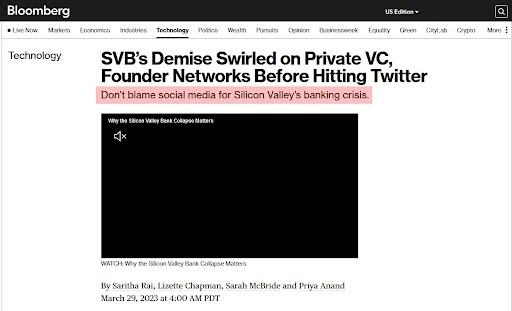
Bloomberg, (which excluded ZeroHedge from their report referencing the Alethea dossier after we told them what bullshit it is), now reports that “SVB’s demise swirled on private VC founder networks before hitting Twitter.”

“It wasn’t phone calls; it wasn’t social media,” said one Silicon Valley startup founder who wishes to remain anonymous. “It was private chat rooms and message groups.”

By the time most people figured out that a bank run was a possibility on Thursday, March 9, it was already well underway. -Bloomberg

A WhatsApp text exchange in the chaotic hours leading up to SVB’s failure.
Source: Avinash Raghava

According to the report;

Gunjit Singh, the San Francisco-based co-founder of Electric Sheep Robotics, first heard chatter about Silicon Valley Bank’s financial straits in January via WhatsApp messages. Initially he dismissed it. His company, which makes robotic lawn mowers, had a line of credit and most of its cash with the bank, but the worry at that point was mostly theoretical. “There are rumors about everything,” he said.

The rumors, of course, turned out to be true. Silicon Valley Bank had liquidity issues thanks to the combination of rising interest rates and a large portfolio of long-term, low-interest assets. When it moved to shore up its financial position in early March, many people started taking the risks more seriously. 

It was Wednesday, March 8, the day before the company’s stock tumbled 60%, when Alfred Chuang became aware of worries over Silicon Valley Bank’s health, mostly via email and phone calls. Chuang, an investor at VC firm Race Capital, said chief executive officers of public companies began warning him about the bank that evening. “I knew it meant one thing: They were withdrawing money,” Chuang said. Race Capital “exited out of SVB in record time.”

The rest of the Bloomberg report, available to BBG subscribers, lays out what happened in painstaking detail. But the bottom line is this;

This was not a “Twitter-fueled bank run,” and those accusing ZeroHedge or other financial media outlets of contributing to it for accurately reporting on what was going on can go pound sand.

Tyler Durden
Wed, 03/29/2023 – 14:25

AZ Governor’s Press Secretary Resigns Amid Outrage After Calling For Violence Against ‘Transphobes’

AZ Governor’s Press Secretary Resigns Amid Outrage After Calling For Violence Against ‘Transphobes’

Update (1325ET): Josselyn Berry, Governor Hobbs’ Press Secretary, has resigned after responding to the Nashville school shooting with a tweet that appeared to advocate violence against “transphobes.”

*  *  *

As Paul Joseph Watson of Summit News detailed earlier, there was widespread outrage after Arizona Gov. Katie Hobbs’ press secretary responded to the school shooting in Nashville by posting a tweet that appeared to advocate violence against “transphobes”.

A transgender-identified individual killed three children and three adults after a rampage at The Covenant School, a private Christian school for students aged three to 11, on Monday.

Hobbs’ spokeswoman Josselyn Berry responded to the carnage by posting an image from the 1980 movie Gloria showing a woman brandishing two handguns.

The image was captioned with the text “Us when we see transphobes.”

The sickening nature of the response to children being murdered has understandably caused massive outrage, with many calling for Berry to be immediately fired.

This is what @katiehobbs press secretary decided to tweet after a trans militant shut up a school. Any Republican would be fired for this in an instant. We’re done with the double standard. @joss_berry must be fired,” asserted commentator Matt Walsh.

“This is the contact information for the governor’s office. I’ll be giving it out again tomorrow on my show. And the next day. And the day after. We are going to start holding these people to the same standard and the same rules,” he added.

The Arizona Freedom Caucus has also called for Berry’s immediate dismissal.

Less than 12 hours after the tragic shooting in Nashville by a deranged transgender activist [Hobbs’] Press Secretary calls for shooting people Democrats disagree with,” the group tweeted.

“Calling for violence like this is un-American & never acceptable. [Berry] should be fired immediately,” the GOP group added, before noting that the “vile tweet encouraging violence” had been seen by millions.

The New York Post contacted Hobbs’ office, which has yet to respond.

Twitter appeared to take no action against Berry’s account, which is now on lockdown.

Many were reminded of the infamous Sam Hyde quote.

*  *  *

Brand new merch now available! Get it at https://www.pjwshop.com/

ALERT!

In the age of mass Silicon Valley censorship It is crucial that we stay in touch.

I need you to sign up for my free newsletter here.

Support my sponsor – Turbo Force – a supercharged boost of clean energy without the comedown.

Get early access, exclusive content and behind the scenes stuff by following me on Locals.

Tyler Durden
Wed, 03/29/2023 – 13:25

Mediocre 7Year Auction Tails For The 5th Time In The Past 6 Months

Mediocre 7Year Auction Tails For The 5th Time In The Past 6 Months

After a dismal 2Y auction and a solid 5Y, moments ago the Treasury concluded the week’s coupon issuance when it sold $35BN in 7 paper in a passable auction.

The high yield of 3.626% was down sharply from the 4.062% in February if above January’s 3.517%; it also tailed the When Issued 3.615% by 1.1 basis points; this was the 5th tailing 7Y auction in the past 6.

The bid to cover of 2.394 was the lowest since November and was on the lower end of the range from the past year; it was certainly below the six-auction average of 2.49.

The internals were likewise mediocre at best, with Indirects awarded 63.2%, down from 65.5% last month and below the 66.4% recent average; and with Directs awarded 21.4%, the highest since October, Dealers were left holding on to 15.4% of the auction, modestly above the recent average of 14.0%.

Overall, this was a passable, if mediocre auction, which however considering the bone-crushing rates volatility in the past two weeks, the fact that it wasn’t even worse is probably a victory.


Tyler Durden
Wed, 03/29/2023 – 13:16

Jefferies Sends A Warning To The Big Banks As Profit Plunges

Jefferies Sends A Warning To The Big Banks As Profit Plunges

By now everyone knows that small banks – which have little to no capital markets exposure and are almost entirely reliant on NIM and debt transformations courtesy of their balance sheets in many cases with catastrophic results – are hanging by a thread and all it takes is one (alleged) tweet for deposits to be drained from bank XYZ, sending the bank into the waiting arms of the FDIC within hours, while Jamie Dimon will be delighted to collected the deposits. But while the large banks (and money markets) have been clear beneficiaries of the deposit flight, a question ahead of earnings season which starts in two weeks with JPMorgan, is how are they doing on their non-interest income which for most banks amounts to roughly half of their total revenue.

The answer, courtesy of mid-tier investment bank Jefferies which after the financial crisis remains perhaps the only one with an “off” fiscal year end  (not Dec 31, but Nov 30) reported earnings last night one month ahead of the group, and in the process sent a flashing red alert for anyone expecting strong bank earnings this quarter. That’s because the bank reported profit for fiscal Q1 which plunged as a bump in equities and fixed income trading failed to offset a slump in investment banking.

Investment banking revenue dropped about 42% to $568 million in the period ended Feb. 28, the New York-based firm said late Tuesday in a statement. That fell well short of the $616.5 million average estimate of analysts in a Bloomberg survey. Meanwhile, sales and trading revenue grew 33% $639.4 million. Total revenue of $1.283BN dropped 24% Y/Y while EPS of 54c plunged 56% from the $1.23 a year ago.

The silver lining: while the bank was hit by the freeze in underwriting and advisory, it benefited from the turmoil in the secondary market, and fixed-income was a growth engine for Jefferies, posting a 63% gain to $330.7 million amid continued volatility across markets caused by economic uncertainty and rising interest rates. Revenue from equities trading also grew 11% from a year earlier to $308.7 million. Of note: the surge in market vol stemming from Silicon Valley Bank’s collapse happened outside Jefferies’ fiscal first quarter, but it will be captured in the Q1 period for most other banks that have a conventional March 31 quarter end.

“Despite the significant decline in M&A activity and a continued lull in the IPO and leveraged finance markets, our investment banking business continues to build on our momentum and growing market position,” Chief Executive Officer Richard Handler and President Brian Friedman said in the statement.

Capital markets will reopen, though probably not until the third or fourth quarter, Handler said after results were announced. “We saw capital formation early in the year, then the music just stopped. It won’t be a turn of the switch,” he said.

Handler said he sees pent-up demand for mergers and acquisitions, but interest rates will determine whether deals return (spoiler alert: higher rates aren’t helping). The recent banking crisis will cause even more complications for the Federal Reserve, he said.

To address the broader decline in revenue, the company’s non-interest expenses fell to $1.125 billion from $1.3 billion a year ago. Costs have been a focus for investors with persistent inflation putting pressure on spending and wage growth across the globe.

As Bloomberg notes, Jefferies’ results offer an early snapshot of how Wall Street’s biggest banks may fare as they report earnings for the first three months of 2023. Investment banking revenue plummeted last year, after corporate dealmaking and sales of new securities waned during 2022’s market swings.

The shares gained less that 1% Tuesday in regular New York trading to $30.20, and have declined about 8% this year.

Tyler Durden
Wed, 03/29/2023 – 13:04

De-Dollarization Just Got Real

De-Dollarization Just Got Real

Authored by John Rubino via Substack,

A multi-polar world is bad news for the American Empire but great news for gold…

Since the 1970s it’s been virtually impossible for a country to function without access to US dollars. And Washington maintained this highly-favorable status quo by putting various kinds of pressure — from sanctions to election theft to outright invasion — on anyone who stepped out of line.

This weaponization of the world’s reserve currency has, not surprisingly, created resentment in a lot of foreign capitals. And after a long gestation period, that resentment is now erupting into a rebellion against dollar hegemony. Among the big recent events:

The BRICS coalition has become the hottest ticket in geopolitics. Brazil, Russia, India, China, and South Africa (the BRICS) have been toying with the idea of forming a political/monetary counterweight to U.S. dominance since 2001. But beyond some aggressive gold buying by Russia and China, there was more talk than action.

Then the floodgates opened. Whether due to the pandemic’s supply chain disruptions, heavy-handed sanctions imposed by US-led NATO during the Russia-Ukraine war, or just the fact that de-dollarization was an idea whose time had finally come, the BRICS alliance has suddenly become the hottest ticket in town. In just the past year, Argentina, Indonesia, Saudi Arabia, Iran, Mexico, Turkey, the United Arab Emirates (UAE), and Egypt have either applied to join or expressed an interest in doing so. And new bilateral trade deals that bypass the dollar are being discussed all over the place.

Combine the land mass, population, and natural resources of the BRICS countries with those of the potential new members and the result is more or less half the world. And now things are getting real:

China brokers a peace deal between Saudia Arabie and Iran, two bitter historical enemies who want to join the BRICS alliance but can’t if they’re in an undeclared war. Should they stop competing and start cooperating they could dominate the Middle East and raise China’s clout in the region, at the petrodollar’s expense. An example of the press coverage:

Eurasia’s geo-economic integration took a great leap forward as a result of the IranianSaudi rapprochement, which unlocks the Gulf Cooperation Council’s (GCC) trade potential with Russia and China. Its wealthy members can now tap into two series of Iranian-transiting megaprojects in one fell swoop through this deal, with the North-South Transport Corridor (NSTC) connecting them to Russia while the China-Central Asia-West Asia Economic Corridor (CCAWAEC) will do the same vis-à-vis China…

…Only two weeks after Saudi Arabia announced an effort to establish diplomatic ties to Iran in a deal mediated by China, more news surfaced that Saudi Arabia was also planning to reopen its embassy in Syria for the first time in over a decade.  Rumors are swirling that Iran, Saudi Arabia and Syria are on the verge of geopolitical and economic agreements that sidestep the US. 

Russia and India agree to trade oil for rupees. Russia is now India’s largest oil supplier, with 35% of that massive, growing country’s imports. The U.S. is not happy about this — but India doesn’t seem to care. From a recent article:

Even the US itself seems to have finally accepted that it can’t reverse this trend, which is evidenced by former Indian Ambassador to Russia Kanwal Sibal recently telling TASS that “Lately, the discourse from Washington has changed and India is no longer being asked to stop buying oil from Russia. In a recent visit to India, the US Treasury Secretary actually said that India can buy discounted oil from Russia as much as it wants so long as western tankers and insurance companies are not used.”

African leaders travel to Moscow. Representatives of 40 African nations traveled to Rissia for the Second International Parliamentary Conference “Russia – Africa in a Multipolar World.” According to the press release, the attendees:

… discussed the potential for collaboration across a range of sectors, their contribution to the African continent’s economy and security, and their work in the realms of science and education, politics, and techno-military area.

During the conference, the African continent was invited to work together to form a new multipolar world order. This is especially important given the significant human resources of Africa, which is home to more than 1.5 billion people and has enormous mineral reserves in its soil.

Brazil and Argentina announce a common currency. In February, the two dominant Latin American economies announced plans for a common currency called the “sur” for use in bilateral trade. South America is a big, resource-rich place with numerous grudges against its intrusive northern neighbor. So a de-dollarization movement there, while not as immediately consequential as what’s happening in the Middle East or Asia, is both plausible and potentially serious for the dollar.

Lower Dollar, Higher Gold

Even in an emerging multi-polar world, there’s no obvious replacement for the deep, liquid US capital markets. So the dollar won’t disappear from global trade. However:

  • If the BRICS have the commodities and the US and its allies are left with finance, pricing power for crucial things like oil and gold will shift to Russia, China, and the Middle East.

  • Falling demand for dollar-denominated bonds as reserve assets will send trillions of dollars now outside the US back home, raising domestic prices (which is to say lowering the dollar’s purchasing power and exchange rate).

  • The loss of its weaponized reserve currency will lessen the US’ ability to impose its will on the rest of the world (witness China as Middle-East peacemaker and India buying Russian oil with rupees).

To sum up, tomorrow’s world is multi-polar, and for the US and its allies, inflationary. That means a commodities bull market — at least in dollar terms — and extreme financial instability as the US Empire is forced to live within its means. It won’t be pretty but for gold bugs and commodity bulls, it might be extremely profitable.

I’ll leave you with this:

Tyler Durden
Wed, 03/29/2023 – 12:45

US To Withhold Nuclear Weapons Data From Russia As Last Treaty Collapses

US To Withhold Nuclear Weapons Data From Russia As Last Treaty Collapses

The White House has confirmed what we can call the effective (and expected) collapse of the New START nuclear treaty between the US and Russia, announcing Tuesday it will no longer provide data on its nuclear arsenal under the treaty’s stipulated terms.

Moscow had already suspended its participation on March 1st, but still said it will remain in compliance with nuclear weapons caps under the agreement. National Security Council spokesman John Kirby said the decision was made due to Russia being in violation, but still held out hope that the US punitive measure could push Moscow to return.

“We obviously would like to see Russia back in New START in full compliance … Russia refused to share data, which we agreed in New START to share biannually … since they have refused to be in compliance with that particular modality of New START, we have decided to, likewise, not share that data,” Kirby said. “We would prefer to be able to do that, but it requires them to be willing as well.”

Image: AFP/Getty

“As a lawful countermeasure intended to encourage Russia to return to compliance with the treaty, the United States will likewise not provide its biannual data update to Russia,” Kirby said. “The United States informed Russia in advance of this step. In the interest of strategic stability, the United States will continue to promote public transparency on our nuclear force levels and posture.”

However, Russian Foreign Minister Sergey Lavrov rejected Kirby’s assertion of ongoing contact between the two sides on New START. But he did emphasize that “our readiness to adhere to the caps on strategic nuclear arms in the treaty is nothing more than a goodwill gesture” – suggesting all is not quite yet completely lost regarding the last nuclear arms reduction agreement between the nuclear-armed superpowers.

On Monday, White House press secretary Karine Jean-Pierre stated that the has not seen “any indications that Russia is preparing to use a nuclear weapon” – despite the big news this week that Putin ordered tactical nukes to be stationed in neighboring Belarus.

Starting in August last year the US accused Russia of violating the treaty in disallowing US on-site inspections under its stipulations. In response, Washington halted Russian inspectors’ ability to do the same on American soil. Russia had at the time complained that it was actually the US side which “deprive the Russian Federation of the right to conduct inspections on American territory.”

And then last month, Putin declared, “No one should be under the illusion that global strategic parity can be violated,” in reference to New START.

In March 2021 the two sides renewed New START for a period of five years, and it will expire in February 2026 if it’s not continued – now looking looking more likely given US-Russia relations have deteriorated so fast over the Ukraine war and are at a complete breaking point.

Tyler Durden
Wed, 03/29/2023 – 12:25

Musk, Wozniak Call For Pause In Developing ‘More Powerful’ AI Than GPT-4

Musk, Wozniak Call For Pause In Developing ‘More Powerful’ AI Than GPT-4

Elon Musk, Steve Wozniak, AI pioneer Yoshua Bengio and others have signed an open letter calling for a six-month pause in developing new AI tools more powerful than GPT-4, the technology released earlier this month by Microsoft-backed startup OpenAI, the Wall Street Journal reports.

Contemporary AI systems are now becoming human-competitive at general tasks, and we must ask ourselves: Should we let machines flood our information channels with propaganda and untruth? Should we automate away all the jobs, including the fulfilling ones? Should we develop nonhuman minds that might eventually outnumber, outsmart, obsolete and replace us? Should we risk loss of control of our civilization? Such decisions must not be delegated to unelected tech leaders. Powerful AI systems should be developed only once we are confident that their effects will be positive and their risks will be manageable. –futureoflife.org

We’ve reached the point where these systems are smart enough that they can be used in ways that are dangerous for society,” said Bengio, director of the University of Montreal’s Montreal Institute for Learning Algorithms, adding “And we don’t yet understand.”

Their concerns were laid out in a letter titled “Pause Giant AI Experiments: An Open Letter,” which was spearheaded by the Future of Life Institute – a nonprofit advised by Musk.

The letter doesn’t call for all AI development to halt, but urges companies to temporarily stop training systems more powerful than GPT-4, the technology released this month by Microsoft Corp.-backed startup OpenAI. That includes the next generation of OpenAI’s technology, GPT-5. 

OpenAI officials say they haven’t started training GPT-5. In an interview, OpenAI CEO Sam Altman said the company has long given priority to safety in development and spent more than six months doing safety tests on GPT-4 before its launch. -WSJ

“In some sense, this is preaching to the choir,” said Altman. “We have, I think, been talking about these issues the loudest, with the most intensity, for the longest.”

Goldman, meanwhile, says that up to 300 million jobs could be replaced with AI, as “two thirds of occupations could be partially automated by AI.”

So-called generative AI creates original content based on human prompts – a technology which has already been implemented in Microsoft’s Bing search engine and other tools. Soon after, Google deployed a rival called Bard. Other companies, including Adobe, Salesforce and Zoom have all introduced advanced AI tools.

“A race starts today,” said Microsoft CEO Satya Nadella in comments last month. “We’re going to move, and move fast.”

One of the letter’s organizers, Max Tegmark who heads up the Future of Life Institute and is a physics professor at the Massachusetts Institute of Technology, calls it a “suicide race.”

“It is unfortunate to frame this as an arms race,” he said. “It is more of a suicide race. It doesn’t matter who is going to get there first. It just means that humanity as a whole could lose control of its own destiny.”

The Future of Life Institute started working on the letter last week and initially allowed anybody to sign without identity verification. At one point, Mr. Altman’s name was added to the letter, but later removed. Mr. Altman said he never signed the letter. He said the company frequently coordinates with other AI companies on safety standards and to discuss broader concerns. 

“There is work that we don’t do because we don’t think we yet know how to make it sufficiently safe,” he said. “So yeah, I think there are ways that you can slow down on multiple axes and that’s important. And it is part of our strategy.” -WSJ

Musk – an early founder and financial backer of OpenAI, and Wozniak, have been outspoken about the dangers of AI for a while.

There are serious AI risk issues,” he tweeted.

Meta’s chief AI scientist, Yann LeCun, didn’t sign the open letter because he says he disagrees with its premise (without elaborating).

Of course, some are already speculating that the signatories may have ulterior motives.

Tyler Durden
Wed, 03/29/2023 – 09:25