75 F
Chicago
Monday, August 10, 2026
Home Blog Page 3840

Disney Begins 7000 Job Cuts After String Of Theatrical Failures

Disney Begins 7000 Job Cuts After String Of Theatrical Failures

Disney has finally hit the financial wall after a long string of money losing theatrical and streaming service failures, with the company committing last month to at least 7000 job cuts to help cover a $5.5 billion total savings target.  The move followed the abrupt replacement of former CEO Bob Chapek and the return of Bob Iger, and has been blamed on “macroeconomic headwinds.”

Those layoffs are being initiated in March, with the bulk of pink slips expected to be handed out in April as new details of the mass firings emerge.  Already, Marvel Studios VFX head and notorious woke promoter Victoria Alonzo has abruptly left the company, indicating that layoffs may extend to management.       

Disney has made little mention of the role their “diversity and inclusion” methodology might have played in plummeting audience numbers both for theatrical releases and streaming subscriptions.  Disney+ lost over 2.4 million subscribers in February, while movies like Lightyear, Strange Worlds, Pinocchio and Ant Man 3 have all flopped at the box office in the past year.  Pending releases including live action adaptations of The Little Mermaid and Peter Pan are heavily injected with identity politics and audience reactions to trailers are so far extremely negative, hinting that these films will also have a dismal showing.  

Beyond the lack of interest in woke movies and media, the company seems to be reeling from its catastrophic attempt to use economic leverage to intimidate the State of Florida as it passed the ‘Parental Rights In Education Act’, which was designed to stop sexualized lessons in public schools for children in grades K-3.  The bill was specifically motivated by the proliferation of gender identity ideology within Florida classrooms and was attacked by Democrat opponents who called it the “don’t say gay bill.”  

It has become clear that Disney backed the wrong horse in that fight.  They have now lost their special autonomy under the Reedy Creek Improvement District and the Florida government has taken over management.  The majority of major media companies in the US are scrambling to survive dwindling profits and collapsing audiences, but many would argue that Disney in particular triggered their own downfall.

Disney stock was up slightly on the news that layoffs would begin, with investors happy to see costs being reduced. 

Tyler Durden
Thu, 03/23/2023 – 13:40

Watch: Amid Banking Collapse, White House Says “We See A Strong Economy”

Watch: Amid Banking Collapse, White House Says “We See A Strong Economy”

Authored by Steve Watson via Summit News,

As inflation continues to skyrocket and amid huge banking collapses, the White House press secretary declared Wednesday that the Biden administration “sees a strong economy.”

CBC’s Caitlin Huey-Burns asked Karine Jean-Pierre about Joe Biden’s support for Federal Reserve Chairman Jerome Powell and what the Fed is doing to attempt to reduce inflation. 

“We understand what the American people are feeling, that is why we have made it a priority to do everything that we can to lower costs for Americans,” Jean-Pierre responded.

Then came the kicker.

“We do not see a recession or pre-recession. We see a strong economy and it’s because of the work that this president has done,” Jean-Pierre declared.

You don’t see it or there isn’t a recession?

Strange choice of words.

Keep saying it and it might become reality:

When asked if there will be an economic downturn owing to two giant bank collapses, KJP had no answer, other than to quote the Fed chairman saying the economy is sound:

Powell claims that rampant money printing isn’t driving inflation:

Treasury Secretary Janet Yellen claims that just growing debt forever is sustainable:

Are they willfully ignorant or just flat out lying?

*  *  *

Brand new merch now available! Get it at https://www.pjwshop.com/

In the age of mass Silicon Valley censorship It is crucial that we stay in touch. We need you to sign up for our free newsletter here. Support our sponsor – Turbo Force – a supercharged boost of clean energy without the comedown. Also, we urgently need your financial support here.

Tyler Durden
Thu, 03/23/2023 – 13:20

Crypto Fugitive Do Kwon Arrested In Montenegro

Crypto Fugitive Do Kwon Arrested In Montenegro

Famous South Korean fugitive and “crypto-entrepeneur” Do Kwon, who was behind the $40BN implosion of the terraUSD and luna digital tokens last year which sparked the initial leg of the crash sweeping the crypto space, has been arrested in Montenegro according to local authorities.

Do Kwon in his company’s office in Seoul in 2022: Bloomberg

In a statement on Twitter, Montenegro’s interior minister Filip Adzic said “the former cryptocurrency king” was detained by police at Podgorica Airport with falsified documents. “We are waiting for official confirmation of identity,” Adzic added.

As a reminder, it was the collapse of terraUSD coin in May of 2022 that unleashed an unprecedented crash in crypto markets which engulfed many of the industry’s leading players. As the FT notes, Kwon, co-founder of Terraform Labs, was charged with fraud and breaches of capital markets law in his home country and sparked an international manhunt after authorities were unable to locate him.

Last year South Korean authorities said Kown had traveled to an unknown country, believed to be Serbia, via Dubai after leaving Singapore, where Terraform was headquartered. His South Korean passport was also revoked.

The meltdown of terraUSD and luna coins affected hundreds of thousands of investors, many of whom were drawn in by a scheme in which clients could lend their terra coins for a yield of up to 20%.

Kwon and Terra have also been sued by the US Securities and Exchange Commission for allegedly arranging a cryptocurrency fraud that led to billions of dollars in losses by selling a number of digital assets not properly registered with regulators.

The SEC said the alleged fraud took place between April 2018 and May 2022.

In May last year, terraUSD’s peg collapsed in dramatic fashion, sparking an unprecedented crisis of confidence in crypto markets which plunged companies such as Celsius and Three Arrows Capital into bankruptcy.

The collapse of terraUSD fuelled concerns among international regulators that the stablecoin industry poses stability risks to established finance as crypto becomes more integrated with conventional payment systems.Shortly before the collapse (former?) billionaire Mike Novogratz tattooed Luna on his arm, saying “I’m officially a Lunatic!!!  Thanks @stablekwon” His entire investment was wiped out 5 months later.

In September last year, Interpol issued a red notice against Kwon, representing a plea to worldwide law enforcement to arrest the Terraform boss. Since his disappearance, Kwon has continued to make statements on social media without sharing his location. His last known tweet is below.

Following the news of his alleged arrest, bitcoin and crypto spiked to session highs.

Tyler Durden
Thu, 03/23/2023 – 13:00

“An Unprecedent Inquiry”: Manhattan DA Fires Off Angry Letter Blaming Trump For Arrest Rumors

“An Unprecedent Inquiry”: Manhattan DA Fires Off Angry Letter Blaming Trump For Arrest Rumors

Manhattan District Attorney Alvin Bragg – who lied about growing up poor, has fired off an angry letter to House Republicans, calling their investigation into his case against former President Trump over hush payments to Stormy Daniels “an unprecedent [sic] inquiry into a pending local prosecution,” adding “The letter only came after Donald Trump created a false expectation that he would be arrested the next day and his lawyers reportedly urged you to intervene.

See the full response below.

The response comes after a Monday letter from House Republicans on the Weaponization of the Federal Government subcommittee.

“You are reportedly about to engage in an unprecedented abuse of prosecutorial authority: the indictment of a former President of the United States and current declared candidate for that office,” read the Monday letter to Bragg from Reps. Jim Jordan (Judiciary Chairman), James Comer (Oversight Chairman) and Bryan Steil (House Admin Chairman).

The letter went on to shred the ‘untested legal theory’ underpinning Bragg’s expected indictment, and calls out former Trump Attorney Michael Cohen, Bragg’s star witness and a convicted perjurer, as having a “serious credibility problem.”

GOP investigators demanded all documents and communications related to the decision.

And now, Bragg claims the GOP is overstepping their bounds.

“The letter’s requests are an unlawful incursion into New York’s sovereignty,” the letter continues.

Earlier this week, Trump posted to Truth Social that he would likely be arrested on Tuesday – a rumor which set off a firestorm of political debate over a case which would normally be a misdemeanor, and was elevated to a felony by Bragg.

On Wednesday, a 2018 letter emerged in which an attorney for former Trump fixer Michael Cohen says that Cohen paid Stormy Daniels out of his own pocket and was not reimbursed.

“In a private transaction in 2016, before the U.S. presidential election, Mr. Cohen used his own personal funds to facilitate a payment of $130,000 to Ms. Stephanie Clifford [Stormy Daniels],” reads the 2018 letter from Cohen attorney Stephen Ryan to the Federal Election Commission, which asserts that Trump was not involved in the hush payment to the former porn star.

Cohen’s credibility has already been called into question:

See Bragg’s full letter below:

Tyler Durden
Thu, 03/23/2023 – 12:42

Watch: Biden Judicial Nominee Stumped By Basic Legal Question

Watch: Biden Judicial Nominee Stumped By Basic Legal Question

A Senate judiciary nomination hearing exposed a Biden nominee’s alarming lack of fundamental knowledge of US law. This was no “gotcha” question about some obscure aspect of jurisprudence — it related to a basic rule that’s guided criminal law for the past 60 years and is familiar to plenty of well-informed laymen.  

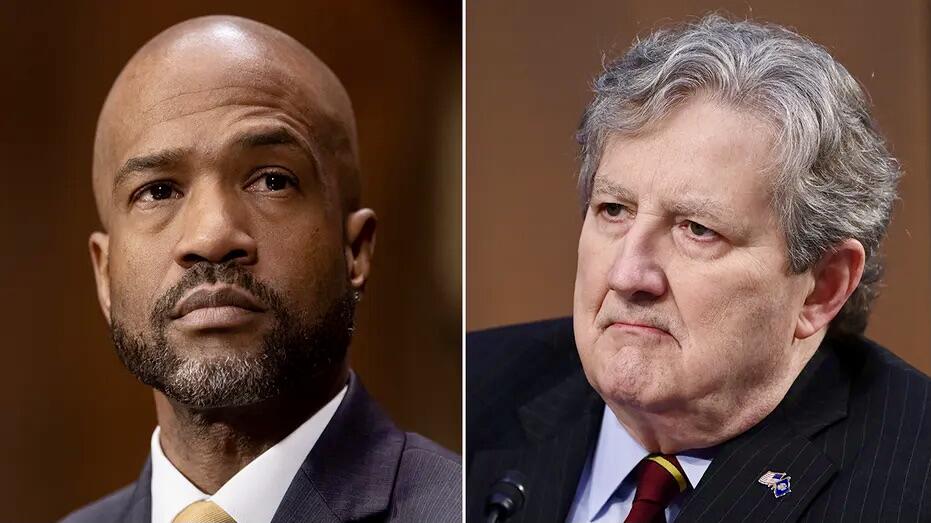
The nominee is Kato Crews, whom Biden has put forward for the US District Court for the District of Colorado. His jarring knowledge gap was exposed Wednesday when Louisiana Senator John Kennedy asked him how he would analyze a “Brady motion.” 

That’s a reference to the “Brady rule,” which sprang from the 1963 Supreme Court case, Brady v MarylandIt requires prosecutors to give defendants information the government holds and that could aid in their defense. 

Nominee Kato Crews (left) and Louisiana Senator John Kennedy (Nathan Howard / Bloomberg | Mandel Ngan / AFP / Bloomberg via Fox News)

Even your humble Tyler Durden, without any formal legal education, knew what “Brady” requires, simply from previous reading about various trials. Others have learned it from TV dramas: The Brady rule has made appearances in about a dozen episodes of Law & Order and Law & Order: SVU alone  

However, when he was asked about it, the Honorable Judge Crews paused, looked up in the air for a few seconds and said, “In my four and half years on the bench, I don’t believe I’ve had the occasion to address a Brady motion.” 

When asked, “Do you know what a Brady motion is?”, Crews sidestepped by repeating nearly verbatim what he’d already said.  

An attempt to jog Crews’ memory didn’t work. “Do you recall the US Supreme Court case Brady v Maryland?” asked Kennedy. Crews merely claimed he recalled “the name of the case.” 

Things took a darkly humorous turn when Kennedy asked what the Supreme Court held in the case. Apparently hoping to get lucky on this game show — and perhaps trying to infer what Brady was about based on the Southern country drawl of his GOP questioner — Crews said, “I believe the Brady case involved something regarding the Second Amendment.”  

Fair-minded observers can reasonably and empathetically cringe when legislators ask nominees exceedingly technical questions from the field they’re about to hold responsibility for. For example, earlier this month, Biden’s nominee to head the FAA had no answer when Senator Ted Budd asked, “Are you familiar with the difference between Part 107 and Part 44809 when it comes to unmanned aerial standards?

Kennedy’s Brady questions were nothing like that.  

Even lefty Bloomberg’s Supreme Court reporter was aghast: 

ZeroHedge readers may recall that, earlier this month, lawyers for a January 6 defendant cited Brady when moving for his case to be dismissed. That motion came after Tucker Carlson aired video footage that his lawyers called “plainly exculpatory” — and which had been withheld by the government.  

Crews has been a U.S. magistrate judge for the District of Colorado since 2018. His career started with a year at the National Labor Relations Board, where he investigated and prosecuted claims of unfair labor practices, before spending 17 years defending employers in civil suits.

He studied law — well, to some extent, anyway — at the University of Arizona. His nomination has attracted endorsements from a black bar association, the Asian Pacific Bar Association of Colorado, the Colorado Hispanic Bar Association, and a former Teamsters Union rep. 

In a letter submitted to the Senate judiciary committee, a group of civil rights lawyers explicitly touted Crews’ skin color as a qualifier: “Magistrate Judge Crews is the District’s first Black Magistrate Judge and we believe it fitting he be nominated to fill a seat vacated by a Judge of color.” 

Tyler Durden
Thu, 03/23/2023 – 12:20

Watch Live: TikTok CEO Testifies Before Congress; China Opposes Forced Sale

Watch Live: TikTok CEO Testifies Before Congress; China Opposes Forced Sale

As TikTok mulls a demand from the Biden administration that the video-app divest itself from Beijing-based parent ByteDance (a move strongly opposed by the Chinese Ministry of Commerce), CEO Shou Chew is preparing to testify before Congress for the first time on Thursday, where US lawmakers will grill him over how the app handles sensitive US user data, as well as the risks it may pose to teens and children.

The hearing will commence at 10 a.m. before the House Energy and Commerce Committee.

TikTok – one of China’s first global internet success stories which has 150 million users, has become a battleground in a technical cold war of sorts between Washington and Beijing – as the US has repeatedly demanded that it be blocked from various platforms out of security concerns.

In order to keep operating in the US under ByteDance’s ownership, TikTok has sought approval from the Committee on Foreign Investment in the United States, or CFIUS, for a plan called Project Texas – which would prevent the Chinese government from accessing US user data or manipulating content recommendations. Oversight would be provided by government-approved officials and third-party auditors.

Watch Live:

Both ByteDance and US officials struck a preliminary agreement last year which stipulated that TikTok data on US users would be hosted by Oracle Corp. TikTok, meanwhile, said it will delete the private data of US users from its own data centers in Virginia and Singapore as it transitions to fully store data with Oracle. The company has also said that access to US data by anyone outside of a newly established division to govern US data security would be limited by, and subject to, its protocols – which would be overseen by Oracle.

Last week, news emerged that the Biden administration wants ByteDance to sell the app or face a possible ban – a move which China said on Thursday that it would “firmly oppose,” according to a commerce ministry spokeswoman, who added that it would “seriously undermine the confidence of investors from various countries, including China, to invest in the United States.”

More than two dozen US states, various colleges, and Congress, have announced bans on TikTok in recent months, with the Biden administration recently backing a bipartisan Senate bill that would give the US government more power to deal with TikTok – which would include a potential ban. Scrutiny of the app includes a lawsuit from the state of Indiana, a ban in South Dakota, calls to ban TikTok ‘everywhere,’ and a major snag in negotiations with the Biden administration over national security concerns.

“TikTok’s Chinese parent company, ByteDance, is required by Chinese law to make the app’s data available to the Chinese Communist Party (CCP),” read a December statement from Sen. Marco Rubio’s office. “From the FBI Director to FCC Commissioners to cybersecurity experts, everyone has made clear the risk of TikTok being used to spy on Americans.

Rubio – who introduced the Averting the National Threat of Internet Surveillance, Oppressive Censorship and Influence, and Algorithmic Learning by the Chinese Communist Party Act (ANTI-SOCIAL CCP Act) – was joined by Reps. Mike Gallagher (R-WI) and Raja Krishnamoorthi (D-IL), who introduced companion legislation in the US House of Representatives.

TikTok is digital fentanyl that’s addicting Americans, collecting troves of their data, and censoring their news,” said Gallagher. “It’s also an increasingly powerful media company that’s owned by ByteDance, which ultimately reports to the Chinese Communist Party – America’s foremost adversary.”

Chew may also be asked about ByteDance’s surveillance of US journalists.

The hearing is expected to last up to 4.5 hours.

Tyler Durden
Thu, 03/23/2023 – 09:55

Republicans Introduce Bills To Prevent Biden Administration From Banning Gas Stoves

Republicans Introduce Bills To Prevent Biden Administration From Banning Gas Stoves

Authored by Savannah Hulsey Pointer via The Epoch Times (emphasis ours),

Two House Energy and Commerce Committee Republicans announced on March 20 they are introducing legislation to prevent the Biden administration from banning gas stoves.

A gas stove in a file photograph. (Joe Klamar /AFP via Getty Images)

The legislation was introduced by Reps. Kelly Armstrong (R-N.D.) and Debbie Lesko, (R-Ariz.) in response to the Biden administration’s two-pronged push to ban gas stoves, and might go to the House floor for a vote later this year.

Lesko introduced H.R. 1640, also known as the Save Our Gas Stoves Act, while Armstrong introduced H.R. 1615, the Gas Stove Protection and Freedom Act. Both bills are currently in committee.

The pieces of legislation would prohibit the Consumer Product Safety Commission (CPSC) from using federal funding to implement any regulation that would classify gas stoves as a prohibited dangerous product under current law.

The bills also prohibit the CPSC from enforcing any consumer product safety standards that would prohibit the use of gas stoves or impose regulations that would raise gas stove prices.

In a press release announcing the legislation, Armstrong emphasized his frustration with the administration’s attempts to ban the stoves.

“Inflation is hurting everyone. We have a crisis at our Southern Border. North Dakotans are worried about being able to provide for their families. What is the Biden administration focused on? Controlling the kind of stove Americans use,” Armstrong said.

This is further incompetence from an administration that seems more interested in dictating every aspect of our lives than solving real problems. Our bill makes it clear that Americans should decide if a gas stove is right for their families, not the federal government.”

Lesko also spoke to the proposed ban: “The Biden Administration’s extreme proposed regulation that will ban nearly every gas stove on the market is just another example of out-of-touch bureaucrats trying to control Americans’ everyday lives.”

A member of the CPSC stated in January that a ban on gas stoves was possible due to the health concerns they bring to users.

After a public uproar and derision, the CPSC backed down, but soon after, the Department of Energy proposed an energy-efficiency requirement that officials admit is so strict that 96 percent of the gas stoves currently in use would not pass muster.

However, a March 17 report indicated that the CPSC had made a formal request for information about the possible health hazards of gas-powered stoves—another signal that the United States may be moving towards a ban on those appliances under the Biden administration.

Read more here…

Tyler Durden
Thu, 03/23/2023 – 09:40

FDIC Unexpectedly Delays Bid Deadline For Silicon Valley Private Bank

FDIC Unexpectedly Delays Bid Deadline For Silicon Valley Private Bank

Over the past weekend, it was determined that the Federal Deposit Insurance Corporation (FDIC) would break up Silicon Valley Bank into two separate auctions. But now, the auction for SVB’s wealth-management unit has been delayed. 

FDIC was set to receive bids for Silicon Valley Private Bank, successor to Boston Private, which SVB acquired in 2021 at 2000 ET Wednesday. However, without any reasoning, government regulators shifted the auction until Friday, according to Bloomberg, citing people familiar with the matter.

Additionally, on Friday, the deadline for submitting bids for the so-called “bridge bank” that the FDIC set up earlier this month to take receivership of SVB’s assets and liabilities.

Last weekend, FDIC decided to break up the sale of SVB into two auctions after failing to find a buyer. We noted First Citizens BancShares Inc participated in the first round of auctions but had its bid rejected. 

It’s worth noting there were eager buyers for SVB days after the collapse, but the FDIC prevented the sale.

FDIC also tapped advisors from the investment bank Piper Sandler Companies to assist in the upcoming auctions.

It might be as late as Friday night or Saturday before potential new buyers for SVB’s wealth management and bridge bank emerge. 

Tyler Durden
Thu, 03/23/2023 – 09:20

Swiss Defend $17BN AT1 Bond Wipeout In Credit Suisse Deal As Furious Creditors Including David Tepper Vow To Sue Switzerland

Swiss Defend $17BN AT1 Bond Wipeout In Credit Suisse Deal As Furious Creditors Including David Tepper Vow To Sue Switzerland

Amid the justifiably shocked outcry from Credit Suisse junior debtors, who saw their entire AT1 debt tranche wiped out before the equity was fully impaired, violating every conventional liquidation waterfall, on Thursday Swiss financial regulator Finma has defended its decision to wipe out a huge swath of risky subordinated bonds as part of the Credit Suisse rescue deal even as an army of bondholders is preparing to sue the Swiss government.

Sunday’s shocking bail-in, which rendered $17BN of investments worthless, has become one of the most controversial elements of the shotgun marriage between Credit Suisse and its larger rival, UBS, brokered by Swiss authorities. Just hours after the deal was announced, other large market regulators began to distance themselves from the decision, fearful that it would endanger banks’ ability to raise capital in the future.

Meanwhile, enraged bondholders have pledged to sue the Swiss government and Finma over the matter the FT reported

In its first statement on the deal since the weekend, Finma said on Thursday that all the contractual and legal obligations had been met for it to act unilaterally given the urgency of the situation.

“On Sunday, a solution was found to protect clients, the financial centre and the markets,” said Finma’s chief executive Urban Angehrn. “In this context, it is important that Credit Suisse’s banking business continues to function smoothly and without interruption.”

Speaking to the press on Thursday, Swiss National Bank chair Thomas Jordan argued that the purchase by UBS had been the only option for Credit Suisse, saying that a takeover of the bank by the government and stabilization of it in a process known as resolution would have risked a systemic crisis.

“Resolution in theory is possible under normal circumstances, but we were in an extremely fragile environment with enormous nervousness in financial markets in general,” said Jordan. “Resolution in those circumstances would have triggered a bigger financial crisis, not just in Switzerland but globally.”

“[It] would not have worked to stabilize the situation but, on the contrary, created enormous uncertainty . . . It was clear that we should avoid it if there was any other possibility.”

None of that explains why the decision was taken to preserves CHF3.25BN in value for CS shareholders – who would nominally be subordinated to any bondholders in the capital structure – even as junior creditors were wiped out.

That said, the additional tier 1 (AT1) bonds in question were warned as they contained explicit contractual language that they would be “completely written down in a ‘viability event’ in particular if extraordinary government support is granted”, Finma said. This allowed the regulator to prioritise equity holders ahead of AT1 holders. Furthermore, when AT1s were created as a hybrid debt instrument after the financial crash of 2008, their whole purpose was to give banks greater capital flexibility in the event of crises, and for the bonds to be bailed in in case of need.

Meanwhile, the government’s intervention to bail out the combined UBS-CS entity – because if Credit Suisse had gone under, UBS was certainly next – is undisputable: as part of the acquisition deal by UBS, the combined bank will receive CHF9BN of government guarantees and a CHF100bn liquidity lifeline from the SNB. An additional emergency government ordinance issued by Bern on Sunday had further confirmed the power to take decisions over elements of a bank’s capital structure in Swiss law, Finma said.

“[The] instruments in Switzerland are designed in such a way that they are written down or converted into [equity] before the equity capital of the bank concerned is completely used up or written down,” it said, pointing out that the bonds were designed for the use of sophisticated institutional investors because of their risky hybrid nature.

None of that however has helped ease the anger of bondholders who over one weekend saw their entire investment wiped out. Quinn Emanuel Urquhart & Sullivan and Pallas Partners are among the law firms representing bondholders that have pledged to fight the Swiss decision. Quinn hosted a call on Wednesday joined by more than 750 participants.

Partner Richard East told the Financial Times the deal was “a resolution dressed up as a merger” and pointed to statements by the European Central Bank and the Bank of England, which distanced themselves from the Swiss approach.

“You know something has gone wrong when other regulators come and politely point out that in a resolution [they] would have respected ordinary priorities,” he said.

“If this is left to stand, how can you trust any debt security issued in Switzerland, or for that matter wider Europe, if governments can just change laws after the fact,” David Tepper, the billionaire founder of Appaloosa Management, told the Financial Times. “Contracts are made to be honored.”

Tepper is among the most successful investors in troubled financial companies, famously making billions of dollars on a 2009 wager that US banks would not be nationalised during the last financial crisis. Appaloosa had bought a range of Credit Suisse’s senior and junior debt as the bank descended into chaos.

Mark Dowding, chief investment officer at RBC BlueBay, which held Credit Suisse AT1 bonds, said Switzerland was “looking more like a banana republic”. His Financial Capital Bond fund is down 12.2 per cent this month.

No matter how the lawsuits turn out, however, one thing is certain: Swiss banking as an industry that thrived and prospered for centuries, is effectively over and nobody will voluntarily either deposit or invest in Swiss banks after this catastrophically bundled government intervention. For the sake of what’s left of the Swiss economy, we can only hope that the cheese and chocolate industries are not in need of bailouts.


Tyler Durden
Thu, 03/23/2023 – 09:03

Block Shares Fall As Hindenburg Accuses Company Of “Fraud Facilitation”, Says Shares Could Fall 65% To 75%

Block Shares Fall As Hindenburg Accuses Company Of “Fraud Facilitation”, Says Shares Could Fall 65% To 75%

Shares of Jack Dorsey’s Block fell about 10% this morning after short seller Hindenburg Research said it was short the name, accusing the company of “facilitating fraud”. 

“On a purely fundamental basis, even before factoring in the findings of our investigation, we see downside of between 65% to 75% in Block shares,” the short seller wrote.

The short seller, recently most well known for targeting Asia’s richest man Gautam Adani, is now setting its sights on another billionaire in Dorsey, who has a reported net worth near $5 billion.

The outlet, led by Nathan Anderson, published a report called “Block: How Inflated User Metrics and “Frictionless” Fraud Facilitation Enabled Insiders To Cash Out Over $1 Billion”. 

“Most analysts are excited about the post-pandemic surge of Block’s Cash App platform, with expectations that its 51 million monthly transacting active users and low customer acquisition costs will drive high margin growth and serve as a future platform to offer new products,” the short seller wrote.

In context, this is the lowest price since the end of last year…

“Our research indicates, however, that Block has wildly overstated its genuine user counts and has understated its customer acquisition costs. Former employees estimated that 40%-75% of accounts they reviewed were fake, involved in fraud, or were additional accounts tied to a single individual.”

“Even when users were caught engaging in fraud or other prohibited activity, Block blacklisted the account without banning the user,” Hindenburg writes. “Block obfuscates how many individuals are on the Cash App platform by reporting misleading “transacting active” metrics filled with fake and duplicate accounts. Block can and should clarify to investors an estimate on how many unique people actually use Cash App.”

The company said it “filed public records requests to learn more about Block’s role in facilitating pandemic relief fraud and received answers from several states,” claiming that “Massachusetts sought to claw back over 69,000 unemployment payments from Cash App accounts just four months into the pandemic. Suspect transactions at Cash App’s partner bank were disproportionate, exceeding major banks like JP Morgan and Wells Fargo, despite the latter banks having 4x-5x as many deposit accounts.”

The report continues: “CEO Jack Dorsey has publicly touted how Cash App is mentioned in hundreds of hip hop songs as evidence of its mainstream appeal. A review of those songs show that the artists are not generally rapping about Cash App’s smooth user interface—many describe using it to scam, traffic drugs or even pay for murder.”

“In an apparent effort to preserve its growth engine, Cash App ignored internal employee concerns, along with warnings from the Secret Service, the U.S. Department of Labor OIG, FinCEN, and State Regulators which all specifically flagged the issue of multiple COVID relief payments going to the same account as an obvious sign of fraud,” Hindenburg writes.

“Block reported a pandemic surge in user counts and revenue, ignoring the contribution of widespread fraudulent accounts and payments. The new business provided a sharp one-time increase to Block’s stock, which rose 639% in 18 months during the pandemic. As Block’s stock soared on the back of its facilitation of fraud, co-founders Jack Dorsey and James McKelvey collectively sold over $1 billion of stock during the pandemic. Other executives, including CFO Amrita Ahuja and the lead manager for Cash App Brian Grassadonia, also dumped millions of dollars in stock.”

The report concludes

  • In sum, we think Block has misled investors on key metrics, and embraced predatory offerings and compliance worst-practices in order to fuel growth and profit from facilitation of fraud against consumers and the government.

  • We also believe Jack Dorsey has built an empire—and amassed a $5 billion personal fortune—professing to care deeply about the demographics he is taking advantage of. With Dorsey and top executives already having sold over $1 billion in equity on Block’s meteoric pandemic run higher, they have ensured they will be fine, regardless of the outcome for everyone else.

You can read the full report here. We will add any response from Block if and when it becomes available. 

Tyler Durden
Thu, 03/23/2023 – 08:46