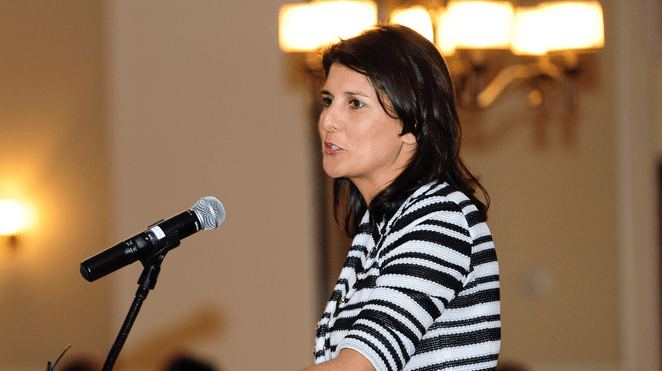
In the prospective 2024 nominating contest, some GOP wannabes are serving up straight talk about the need to fix Medicare and Social Security, even though Donald Trump banished entitlement reform from Republican doctrine in 2016. These fiscally sober, and actually conservative, Republicans aren’t likely to win the nomination, and they’re making Trump giddy. But they could also put House Republicans and Ron DeSantis in a jam.
Nikki Haley, who announced her candidacy last month, and likely contenders Mike Pence and Mike Pompeo, have all said the looming insolvency of these programs – which take up 30% of the federal budget – must be addressed.
House Republicans vowing to find $130 billion in spending cuts had initially placed entitlements squarely on the negotiating table, but removed them after Trump and President Biden united against reform. Biden taunted congressional Republicans at his State of the Union, saying it was their “dream” to cut both popular programs, which was met with boos. Trump has released a video warning congressional Republicans not to cut “one penny” from either safety net program in their negotiations over the debt ceiling. After both events, House Speaker Kevin McCarthy made it explicit: In their hunt for savings they will look elsewhere and leave both programs alone.
“Clean” increases in the debt ceiling passed during Trump’s presidency, while the debt increased by 39%. House Freedom Caucus members, who rode the Tea Party wave and sought drastic spending cuts for years, went all in on the Trump spending bender. One of those Freedom Caucus members who went on to serve as both budget director and then chief of staff to Trump – Mick Mulvaney – told The Dispatch, “The truth of the matter is that the first two years of the Trump administration, when the Republicans had the House and the Senate, we raised spending faster than the last couple of years of the Obama administration.”
Current Freedom Caucus members, who have relocated their fiscal rectitude, have insisted House Speaker Kevin McCarthy pledge not to bring up a clean debt ceiling increase for a vote because there is a dire need to curb spending now.
Since a debt crisis cannot be avoided without curbing mandatory spending, some Republicans are still willing to acknowledge the third rail, and Haley did so last week. “It’s unrealistic to say you’re not going to touch entitlements,” she said, proposing a new system for younger generations while leaving the program intact for current recipients. Pence has warned about a debt crisis coming in the next 25 years that is “driven by entitlements” and said, “The truth is we’ve got to have that conversation.” Pompeo recently told RCP that “the next Republican president has to be more serious than previous Republican presidents have ever been about getting our fiscal house in order,” and that entitlements must be put “on a sustainable trajectory.”
Trump would like nothing better than to be the only person in the primary field opposing reforms to Social Security and Medicare – to claim to be their sole defender against some establishment cabal threatening benefits to the elderly. Even though those Republicans are not recommending any near-term cuts or changes, Trump has never let facts or the truth get in his way.
What is true: We are headed for a debt crisis; Social Security and Medicare need reform; and Democrats are not interested in addressing debt reduction. Also true: The pre-Trump Republican Party used to be committed to limited government and debt reduction. Even now, Trump will not brook debate of even reasonable, modest, and interim fixes which could extend solvency.
At the Conservative Political Action Conference earlier this month, Trump said some Republicans wanted to raise the retirement age to 70, 75, or 80 and planned to “cut Medicare to a level that it will no longer be recognizable.”
And since DeSantis remains the biggest threat to Trump winning the nomination, the Florida governor’s past support for entitlement reforms is now Trump’s favorite subject. While serving in the House, DeSantis voted for several budget resolutions that would have made changes to the programs, including phasing in the eligibility age to 70.
DeSantis is trying to fend off Trump and recently said on Fox News: “We’re not going to mess with Social Security as Republicans. I think that’s pretty clear.” But Trump claims DeSantis wants to “cut” the programs and called him “a wheelchair-over-the-cliff kind of guy, just like his hero, failed politician Paul Ryan.” Trump was referring to ads Democrats ran against the former House Speaker’s plans to privatize the programs a decade ago, in which someone who resembled Ryan was seen pushing an old woman in a wheelchair off a cliff.
Sen. Mike Rounds, who is at work on such reforms as a member of the Senate working group on entitlements, said it was “very unfortunate,” that Trump attacked DeSantis over the issue.
“We need an adult as president who is going to take on the tough challenges, the tough problems, and be prepared to share with the American people how serious it is. That we use facts. And not scare tactics,” he told Politico.
Yet Rounds may not get that leader in DeSantis either. The governor may bend on entitlement reform, just like he did on support for Ukraine, abandoning policies he believes in to win the nomination.
House Republicans are already divided among themselves over their coming budget battle with the Biden administration. And there is no consensus about what to do next spring – rally behind Trump for the nomination, or follow the lead of House Freedom Caucus member Rep. Chip Roy and endorse DeSantis and his record of support for privatizing entitlement programs?
What all Republicans can count on is that Trump will distort and demagogue whatever any other candidate says anyway. And it’s more than likely granny will vote for him.
A.B. Stoddard is associate editor and columnist at RealClearPolitics and a guest host on Sirius XM’s POTUS Channel.
Stoltenberg Vows Sweden ‘Will Soon’ Join NATO Despite Turkish Rejection
NATO Secretary-General Jens Stoltenberg was quick to hail and celebrate the Friday announcement by Turkish President Tayyip Erdogan that his country will ratify Finland’s application to join NATO.
The NATO chief told Reuters that it is a “a good day for everyone that believes in NATO enlargement.” He said, “Finnish membership will strengthen NATO, it will strengthen Finnish security. It will also strengthen Swedish security.”
But despite the two Nordic countries previously pledging to enter the alliance “hand in hand”, it became clear after Erdogan’s remarks that Sweden will remained sidelined. Hungary is the only other country which has also remained a holdout, refusing thus far to take action on ratification.
But Stoltenberg said that Erdogan is still willing to continue consultations on potential Swedish membership. “I’m confident also that Sweden will join soon, and I will work hard for that,” he said.
Erdogan had announced following a meeting with his Finnish counterpart.”We have decided to start the protocol of Finland’s accession to NATO in our parliament.”
Concerning Sweden, Erdogan commented that his country submitted a list of 120 “terrorists” to Stockholm, but complained that not a single one of them has been extradited.
Sweden’s membership bid is expected to continue to stall, after deteriorating relations with Turkey in the wake of the Quran-burning incident by a far-right activist. Turkey has also demanded Swedish authorities crackdown on Kurdish political groups and operatives while alleging that Stockholm has hosted “terrorists” on its soil.
NATO member map from from 2016: Montenegro joined in 2017 and North Macedonia joined in 2020.
Finland is at the same time building a 200km fence along its border with Russia to boost security, also after reporting that Russian men fled across the border by the droves in order to escape conscription. The fence will reportedly be 10 feet high and topped with barbed wire.
Protests and strikes that have disrupted France for weeks have grown more intense after the government yesterday decided to force through a controversial reform raising the minimum standard retirement age from 62 to 64. The change has been in the making for years and has been postponed time and time again following fierce opposition among the population – for example in the form of the country’s longest-ever transport strike in early 2020.
French President Emmanuel Macron will evoke special constitutional powers to pass the law that the French Senate on Thursday signed off on, but that was expected to hit a roadblock in the lower house. French Prime Minister Elisabeth Borne, who announced the plan, called the reform necessary to prevent a major deficit in the pension system. Like many aging societies in Europe, France is looking to support a growing share of retirees among its population, but unlike many of its neighbors has not raised the retirement age so far.
The change is scheduled to be finalized by 2030. Likewise, other developed countries around the world have been in the process of raising the retirement age of their public pensions, but most have gotten a lot further than France will have come in this decade.
The Netherlands, Spain, Germany and the U.S. (through the Social Security Administration) are inching up to their joint new retirement age of 67.
The newest cohorts eligible for a standard pension as of January 1, 2023 are now between 65 years and 10 months and 66 years and 10 months of age in these countries. The new retirement age of 67 for newly eligible cohorts will be reached between 2024 and 2030. The UK, meanwhile, will start inching up to 67 between 2026 and 2028, while Belgium will raise the minimum retirement age to 66 in 2025 and 67 in 2030.
In addition to an age requirement, countries also apply minimums for the length of a person’s work life in order to retire with a standard pension. Exceptions are sometimes made for people who majorly overshoot that work life requirement ahead of minimum pension age. In most countries, it is also possible to retire from an earlier age and accept deductions. Diverging rules apply to occupational pensions, basic benefit pensions, individual pension accounts and of course, private pensions.
Countries that have been more timid in raising the retirement age include Canada, where plans to change it beyond 65 were scrapped, and Switzerland, which is still mulling a further raise. However, the retirement age will be 65 for both sexes starting in 2025 in the country. Sweden raised the retirement age to 63 this year from 62 and might increase again as life expectancy rises.
Fighting between Russia and Ukraine has been going on for a little over a year now, ending the lives of hundreds of thousands of young men and displacing millions. Ukraine’s Defense Minister, Oleksii Reznikov, invited Western arms manufacturers to test their newest weapons against Russians in 2022. And indeed, all kinds of weaponry have been flowing into Ukraine. It is truly a testing ground.
So, this begs the question, is anything else getting tested there? The Ukrainian government seems pretty willing to use its own citizens as guinea pigs, and the American government seems pretty willing to foot the bill. Are American tax dollars going to any other interesting projects?
Here’s what the US is funding in Ukraine.
Yes, actually. Volodymyr Zelensky became president of Ukraine in May 2019, and almost immediately he introduced his idea of a “country in a smartphone.”
In early September 2019, Ukraine launched its Ministry of Digital Transformation, headed by a World Economic Forum participant, Mykhailo Fedorov According to Federov, the goal of this new government department was to streamline government services, making it easier to apply for driver’s licenses, passports, and so on. Ukraine has long held the reputation as Europe’s most corrupt country, and young politicians like Federov want to take advantage of new technology to make changes.
So, in early February 2020, the Ukrainian government launched its Diia app for smartphones. Developed by volunteers from EPAM Systems, Diia has been touted as a way to streamline government services. By 2021 it had allowed Ukraine to become the first European nation to accord digital passports and one of the first to issue digital drivers’ licenses. Federov reported in 2021 that about one-fourth of the Ukrainian population was using it, and it was gaining in popularity. As of January 2023, about half the adult Ukrainian population was using it.
There is a positive side to streamlining government services. Diia has allowed Ukrainians to easily start new businesses, making all the required government paperwork easily available. I can see this being helpful for young entrepreneurs.
However, negative consequences became readily apparent, too.
Within a year of its launch, millions of Ukrainians found that their personal data, such as driver’s licenses, social media information, and banking information, were being traded online. There’s always been the risk of losing your wallet and your driver’s license, but with everything online, the risks of fraud and identity theft increase astronomically.
Early on in his presidency, Zelensky talked about streamlining the voting process via the app. Aside from the fact that experts have never agreed about the safety of online voting, by July 2022, Zelensky had banned political opposition parties and shut down media companies with alternative views. Having one central app that controls everyone’s important documents makes it far easier for any ruling party to maintain its power.
Controlling elections is only the beginning. Diia launched in February 2020, and by March 2020, Diia was helping the Ukrainian government enforce its lockdown policies, as discussed in the recent report by Redacted.
The Redacted report shows portions of various WEF summits and at 2:06 has a clip of a WEF paper saying, “This digital identity determines what products, services, and information we can access—or conversely, what is closed off to us.” Diia (and other digital identity products) have been marketed as a convenience, but don’t be fooled. Developers of this technology have seen their potential as a control mechanism from the beginning.
The Redacted report also shows clips of Federov speaking at the 2021 WEF summit, and at 5:40 he openly admits that the pandemic allowed the Ukrainian government to speed up Ukraine’s digital transformation. “The pandemic has accelerated our progress,” says Federov. “People are really now demanding digital online services. People have no choice but to trust technology.”
The Redacted report traces Diia’s transformation from a convenient service to a military tool. At 6:39, they discuss an interview in Wired with Anton Melnyk, an adviser in Ukraine’s Ministry for Digital Transformation. In March 2022, Dr. Melnyk stated, “We have restructured the Ministry of Digital Transformation into a clear military organization.”
Wartime features in an app
Shortly after the Russian invasion, Diia added all kinds of new wartime features. Ukrainians can report Russian troop movements through Diia’s chatbot, eVorog (eEnemy). Ukrainians can receive government payments even if they’re displaced. But Diia doesn’t stop there.
Diia encourages citizens to snitch on their neighbors. The wartime features allow any citizen to anonymously accuse any other citizen of being a Russian collaborator. Stalin’s rule in the Soviet Union demonstrated how wrong this can go. Ukrainians hate Stalin, and rightfully so. But using cutting-edge technology to encourage the exact same kind of community-destroying snitching is a page right out of his playbook. Between the snitching and its one official, government-approved news station, Diia is rapidly becoming Stalin in a smartphone.
Here’s why Americans should care.
In case you’re wondering why we should care about the ins and outs of Ukrainian bureaucracy, there are two big reasons worth paying attention to this. The first is that Americans have been paying for much of the technical development. The second is that the “government in a smartphone” concept is rapidly spreading around the world.
USAID has been supporting Ukraine’s digital transformation since 2016. The volunteers that developed Diia were Ukrainians working with EPAM Systems, a software engineering company based in Pennsylvania. And EPAM Systems may be a private company, but USAID isn’t. It’s taxpayer-funded.
After the Russian invasion, USAID donated another $8.5 million to Ukraine to help develop Diia’s wartime features. USAID director Samantha Power spoke at the World Economic Forum in 2023, touting Diia’s success. She and Federov both talked about the huge successes and discussed sharing Diia’s model with other countries. Incidentally, Samantha Power is married to Cass Sunstein, the author of Nudge and a number of other books that some might consider pro-social-manipulation.
Power has stated that USAID intends to look for leaders in developing nations that have been running on anti-corruption platforms and sharing Diia-like technology with them to help modernize their countries. She specifically cited Zambia, the Dominican Republic, and Ecuador. In January, Estonia announced that they would begin trial runs of their mRiik app, modeled after Ukraine’s Diia.
And, of course, all of this sounds very loving and charitable. However, it’s impossible to ignore the financial incentives.
The digital shift in America
The U.S. got a giant shove online when lockdowns were enforced in 2020 and 2021. The U.S.’s “digital transformation,” even though it was only partial, still made already-wealthy tech companies even wealthier. Even though billionaire wealth can fluctuate pretty dramatically, by the end of 2022, American billionaires were still 50% richer than pre-pandemic.
Lovers of free-market economics will point out that increased technological ability is a rising wave that lifts everyone. That can be true, but ask yourself, are most people you know 50% richer than before the pandemic? Probably not. Our lives have been getting pushed online over the past few years. Some people profited, but the quality of life of the average citizen decreased.
Combine the shift to a digital world with the reconstruction after wartime destruction, and you see huge opportunities for profit. It’s estimated that rebuilding Ukraine, so far, will cost over $1 trillion. Zelensky and BlackRock CEO Larry Fink have already come to an agreement about managing the rebuilding of Ukraine. USAID may be charitable, but BlackRock isn’t. Ukraine is in the process of being destroyed and being rebuilt. This is going to be hugely profitable for certain people, and Big Tech seems to be intent on getting their slice of the pie.
This kind of thing isn’t new. Brigadier General Smedley Butler, combat veteran and Medal of Honor recipient, wrote War Is a Racket back in the 1930s. The book is full of examples of industries generating huge wartime profits in conflicts a hundred years ago. War profiteering isn’t new. It isn’t a conspiracy. It’s human nature.
There’s no reason not to think that the same powerful Big Tech figures will not continue to push the expansion of their businesses by pushing life around the world online, with or without violent conflict.
Will we all be pushed into government-by-smartphone?
Maybe some emerging markets will be helped by Diia-like apps. But what about countries that already had reasonably safe and secure government services? Will functional governments be pushed onto a smartphone?
Americans are still, on average, relatively concerned about privacy and the concentration of power. The many concerns surrounding Centralized Bank Digital Currencies apply to digital identification, as well. The OP ran an article last month discussing the total loss of anonymity that will occur when CBDCs become implemented.
And there are other, less discussed applications. Look at geofencing. A federal district judge just issued a first-ever “geofencing” warrant for anyone in the vicinity of the Capitol on January 6. This gave police the authority to search the cell phone data of every American whose coordinates happened to be in the area, regardless of whether or not they had anything to do with the shenanigans at the Capitol.
Imagine if they could pull your driver’s license or freeze your bank account, too. Right now, that’s not possible. With all of your important documents linked to something like Diia, it could be.
Here’s how it could unfold.
I don’t think we will all be forced onto something like Diia in the space of a year, but I think we’re at the beginning of a certain chain of events. Digital IDs begin to be offered as a convenience, they become popular, they begin to be preferred by businesses and governments, and we eventually lose the option of physical IDs. And, of course, some kind of crisis (climate change, another pandemic, a hot war) could speed this up more quickly, as happened in Ukraine.
The tools to implement a CBDC linked to a digital identity are already out there. Look at China’s social credit system. It’s technically possible for us, too. It sounds crazy, but conspiracy theorists have been proven correct so consistently lately I don’t think skepticism regarding these new, profitable technologies is unreasonable.
How to retain our privacy
We need to remember that life’s about more than convenience. It’s about the freedom to try new things, some of which will fail spectacularly and some of which will lead to resounding successes. That combination of failure and success is what leads to the deeper insights that make most of us into interesting people. If we continue to trade privacy for convenience, we may find we don’t have much freedom left, either.
If we want to retain some measure of privacy and control over our own lives, if we want to avoid the techno-prison currently being constructed for us, if Americans don’t want our own “Stalin in a smartphone,” we need to avoid feeding the digital beast. Yes, it’s hard, and no, it’s not going to be realistic for 99.9% of us to live completely offline. But we can keep our friendships and purchases offline as much as possible. We can drag our feet when it comes to getting the newest smart gadgets. Perhaps most importantly, those of us with teenagers and young adults can spend time explaining our privacy concerns to the younger generation, so they try to live life offline, as well.
The digital prison is being constructed, but it’s by no means done yet. Grand plans like “government in a smartphone” always fall apart at some point. The problems with Diia are obvious to anyone paying attention. If enough of us can postpone moving everything online, hopefully, this impetus will collapse on its own.
The Foundation for Government Accountability (FGA) is launching an investigation into a recent executive order the group called an “unprecedented scheme” they believe violates the democratic process.
In a press release, FGA said they are “sounding the alarm” on the “‘woke army’ being assembled inside the federal government,” through Executive Order 14091 (EO), titled “Executive Order Further Advancing Racial Equity and Support for Underserved Communities Through The Federal Government.”
FGA announced that their investigation will include filing Freedom of Information Act (FOIA) requests targeting the 23 agencies addressed in the Equity EO, including the Departments of State, Justice, Defense, Labor, Transportation, Social Security, Education, and Health and Human Services.
The group will share the information they gather with Congress, the states, and the American people, according to their press release.
FGA asserted that the plan (pdf) was developed by a left-wing activist group, and said it was “designed to circumvent the normal, democratic process and instead force their ideology onto Americans.”
Tarren Bragdon, FGA President and CEO said of the executive order, “These equity teams are a Trojan horse planted in the heart of every federal agency to fundamentally change decision-making across the bureaucracy. Their goal is to continuously and permanently embed Left-wing ideology into every agency action.
“We cannot allow this new ‘woke army’ to force un-American philosophy into all corners of our federal government. They will degrade our nation’s capabilities and effectiveness, while undermining our liberty and security.”
“We’ve seen the economic devastation over the first two years of the Biden presidency. If radical ideology is ingrained into every policy and regulatory decision at all agencies, the impact on the American people and economy will be widespread, devastating, and impossible to reverse,” Bragdon added.
Bragdon referenced part of Section 2 of the order, which outlines the requirement that agency heads across the administration ensure they place an “Agency Equity Team” within their agencies to “coordinate the implementation of equity initiatives,” in order to deliver “equitable outcomes” to the American people.
Stewart Whitson, FGA legal director spoke to the issue, saying “The clock is ticking on President Biden’s term. And the radical forces inside his administration and their partners on the outside know they have limited time to embed their ‘leaders and practitioners’ into every federal agency before they lose power. If successful, this ‘woke army’ will outlast the Biden presidency and become a permanent fixture deeply entrenched in our government.”
“Through this investigation, FGA is fighting to expose this attempted ideological takeover of our federal agencies, and we won’t stop until we’ve uncovered the truth. We will share the information we uncover with Congress, the states, and the American people so that, together, we can help stop this unconstitutional effort before it’s too late.”
The White House did not immediately respond to The Epoch Times’s request for comment.
As Visual Capitalist’s Pallavi Rao details below, cities – settlements that are densely populated and self-administered – require many specific prerequisites to come into existence. The most crucial, especially for much of human history, is an abundance of food.
Surplus food production leads to denser populations and allows for people to specialize in other skills that are not associated with basic human survival.
But that also means that cities usually consume more primary goods than they produce. And their size requires a host of many other services – such as transport and sanitation – that are traditionally expensive to maintain. So maintaining large urban centers, and especially the world’s largest cities, was a monumental task.
Mapper and history YouTuber Ollie Bye has visualized the seven largest cities in the world since 3,000 BCE. His video covers cities with a minimum population of 10,000 and hints at historical events which led to the establishment, growth, and eventual fall of cities.
The World’s Largest City Throughout History
With any historical data, accuracy is always a concern, and urban populations were rough and infrequent estimates up until the Industrial Revolution.
Bye has used a variety of data sources—including the UN and many research papers—to create the dataset used in the video.
In some places he also had to rely on his own estimates and criteria to keep the data reasonable and consistent:
In early history, some cities didn’t have given population estimates for long periods of time, and had to be equalized or estimated through other sources. For example, Babylon had a population estimate at 1,600 BCE (60,000) and at 1,200 BCE (75,000) but none in the 400 years between.
Cities that only briefly climbed above a population of 10,000, or that would have made the largest cities ranking for only a couple of years (and based on uncertain estimates), were not included.
Here’s a look at the largest city starting from the year 3,000 BCE, with populations listed in millions during the last year of each city’s “reign.” Cities are also listed with the flags of current-day countries in the same location.
Time Period
Largest City
Population (Millions)
Country
3000-2501 BCE
Uruk
0.08
Iraq 🇮🇶
2500-2251 BCE
Lagash
0.06
Iraq 🇮🇶
2250-2001 BCE
Girsu
0.08
Iraq 🇮🇶
2000-1751 BCE
Isin
0.04
Iraq 🇮🇶
1750-1251 BCE
Babylon
0.06
Iraq 🇮🇶
1250-1001 BCE
Pi-Ramesses
0.16
Egypt 🇪🇬
1000-601 BCE
Thebes
0.12
Egypt 🇪🇬
600-301 BCE
Babylon
0.20
Iraq 🇮🇶
300-201 BCE
Carthage
0.40
Tunisia 🇹🇳
200 BCE-270 CE
Alexandria
0.60
Egypt 🇪🇬
271-350 CE
Rome
0.39
Italy 🇮🇹
351-500 CE
Constantinople
0.49
Turkey 🇹🇷
501-640 CE
Ctesiphon
0.50
Iraq 🇮🇶
641-644 CE
Constantinople
0.40
Turkey 🇹🇷
645-795 CE
Chang’an
0.59
China 🇨🇳
796-963 CE
Baghdad
1.10
Iraq 🇮🇶
964-975 CE
Constantinople
0.32
Turkey 🇹🇷
976-984 CE
Córdoba
0.33
Spain 🇪🇸
985-1144 CE
Bian
0.44
China 🇨🇳
1145-1199 CE
Constantinople
0.24
Turkey 🇹🇷
1200-1275 CE
Lin’an
0.36
China 🇨🇳
1276-1278 CE
Cairo
0.37
Egypt 🇪🇬
1279-1315 CE
Hangzhou
0.43
China 🇨🇳
1316-1348 CE
Cairo
0.50
Egypt 🇪🇬
1349-1353 CE
Hangzhou
0.43
China 🇨🇳
1344-1380 CE
Cairo
0.35
Egypt 🇪🇬
1381-1394 CE
Vijayanagara
0.36
India 🇮🇳
1395-1426 CE
Yingtian
0.50
China 🇨🇳
1427-1441 CE
Vijayanagara
0.44
India 🇮🇳
1442-1612 CE
Beijing
0.70
China 🇨🇳
1613-1678 CE
Constatinople
0.74
Turkey 🇹🇷
1679-1720 CE
Dhaka
0.78
Bangladesh 🇧🇩
1721-1826 CE
Beijing
1.30
China 🇨🇳
1827-1918 CE
London
7.40
UK 🇬🇧
1919-1954 CE
New York
13.20
U.S. 🇺🇸
1955-Present
Tokyo
37.30
Japan 🇯🇵
Ancient Cities in the Fertile Crescent
Considered the “cradle of civilization,” the Fertile Crescent in the Middle East was home to all seven of the largest cities in the world in 3,000 BCE.
The Sumerian city of Uruk (modern-day Iraq), allegedly home to the legendary king Gilgamesh, topped the list with 40,000 people. It was followed by Memphis (Egypt) with 20,000 inhabitants.
For the next 1,700 years, other Mesopotamian cities in modern-day Iraq and Syria held pole positions, growing steadily and shuffling between themselves as the largest.
2,250 BCE marked the first time a different Asian city—Mohenjo-Daro (modern-day Pakistan) from the Indus Valley Civilization—found a spot at #4 with 40,000 people.
The table below is a quick snapshot of the seven largest cities in the world for from 3,000 BCE to 200 CE. Again, populations are listed in millions.
Rank
3000 BCE
2250 BCE
1250 BCE
200 CE
1
Uruk (0.04) 🇮🇶
Girsu (0.08) 🇮🇶
Pi-Ramesses (0.16) 🇪🇬
Alexandria (0.60) 🇪🇬
2
Memphis (0.02) 🇪🇬
Mari (0.05) 🇸🇾
Yin (0.12) 🇨🇳
Pataliputra (0.35) 🇮🇳
3
Umma (0.02) 🇮🇶
Umma (0.04) 🇮🇶
Thebes (0.08) 🇪🇬
Carthage (0.20) 🇹🇳
4
Nagar (0.02) 🇸🇾
Mohenjo-daro (0.04) 🇵🇰
Sapinuwa (0.07) 🇹🇷
Luoyang (0.20) 🇨🇳
5
Lagash (0.02) 🇮🇶
Akkad (0.03) 🇮🇶
Babylon (0.07) 🇮🇶
Seleucia (0.20) 🇮🇶
6
Larak (0.01) 🇮🇶
Uruk (0.03) 🇮🇶
Hattusa (0.06) 🇹🇷
Pergamon (0.20) 🇹🇷
7
Eridu (0.01) 🇮🇶
Memphis (0.03) 🇪🇬
Uruk (0.03) 🇮🇶
Taxila (0.10) 🇮🇳
It wasn’t until 1,250 BCE that the top two spots were taken by cities in different regions: Pi-Ramesses (Egypt) and Yin (China), both with more than 100,000 residents.
Egyptian cities would continue to be the most populous for the next millennium—briefly interrupted by Carthage and Babylon—until the start of the Common Era. By 30 CE, Alexandria was the largest city in the world, but the top 10 had representatives from the Middle East, Northern Africa, and Asia.
All Roads Lead to Rome
One city in Europe meanwhile, was also beginning to see steady growth—Rome.
It took until halfway through the 3rd century C.E. for Rome to become the most populous city, followed closely still by Alexandria (Egypt). Meanwhile in Iraq, Ctesiphon, the capital of the Sasanian empire was growing rapidly.
Rank
271 CE
351 CE
501 CE
645 CE
1
Rome (0.39) 🇮🇹
Constantinople (0.29) 🇹🇷
Ctesiphon (0.41) 🇮🇶
Chang’an (0.38) 🇨🇳
2
Alexandria (0.37) 🇪🇬
Ctesiphon (0.25) 🇮🇶
Constantinople (0.40) 🇹🇷
Constantinople (0.32) 🇹🇷
3
Luoyang (0.20) 🇨🇳
Rome (0.24) 🇮🇹
Luoyang (0.20) 🇨🇳
Kanyakubja (0.24) 🇮🇳
4
Vaishali (0.17) 🇮🇳
Pataliputra (0.22) 🇮🇳
Teotihuacan (0.15) 🇲🇽
Luoyang (0.21) 🇨🇳
5
Carthage (0.16) 🇹🇳
Luoyang (0.20) 🇨🇳
Jiankang (0.15) 🇨🇳
El Pilar (0.17) 🇧🇿
6
Teotihuacan (0.14) 🇲🇽
Vaishali (0.16) 🇮🇳
Caracol (0.14) 🇧🇿
Ctesiphon (0.41) 🇮🇶
7
Antioch (0.12) 🇹🇷
Teotihuacan (0.15) 🇲🇽
Chang’an (0.10) 🇨🇳
Teotihuacan (0.15) 🇲🇽
Towards the end of the 3rd century, the Roman empire was divided into two, with Constantinople becoming the new capital for the Eastern half. Consequently, it had outgrown Rome by 353 and become the world’s most populous city, and for the next few centuries would reclaim this title time and time again.
The Largest Cities Reach 1 Million
In the 9th century, Baghdad became the first city to have 1 million residents (though historians also estimate Rome and the Chinese city of Chang’an may have achieved that figure earlier).
It would be nearly nine centuries until a city had one million inhabitants again, and Baghdad’s reign didn’t last long. By the 10th century, Bian, the capital of the Northern Song dynasty in China, had become the largest city in the world, with Baghdad suffering from relocations and shifting political power to other cities in the region.
Rank
850 CE
985 CE
1316 CE
1381 CE
1
Baghdad (1.00) 🇮🇶
Bian (0.35) 🇨🇳
Cairo (0.44) 🇪🇬
Vijayanagara (0.36) 🇮🇳
2
Chang’an (0.60) 🇨🇳
Cordoba (0.33) 🇲🇽
Hangzhou (0.43) 🇨🇳
Cairo (0.35) 🇪🇬
3
Constantinople (0.27) 🇹🇷
Constantinople (0.32) 🇹🇷
Dadu (0.40) 🇨🇳
Paris (0.29) 🇫🇷
4
Kanyakubja (0.21) 🇮🇳
Angkor (0.18) 🇰🇭
Paris (0.25) 🇫🇷
Yingtian (0.27) 🇨🇳
5
Luoyang (0.20) 🇨🇳
Baghdad (0.17) 🇮🇶
Kamakura (0.20) 🇯🇵
Hangzhou (0.23) 🇨🇳
6
Bian (0.17) 🇨🇳
Kyoto (0.15) 🇯🇵
Guangzhou (0.15) 🇨🇳
Beiping (0.15) 🇨🇳
7
Cordoba (0.16) 🇲🇽
Cairo (0.12) 🇪🇬
Fez (0.14) 🇲🇦
Tabriz (0.14) 🇮🇷
From the 12th century onwards, Mongol invasions in the Middle East and Central Asia severely limited population growth in the region. European cities too were ravaged in the 14th century, but by plagues instead of marauders.
For the next few hundred years, Cairo (Egypt), Hangzhou (China), and Vijayanagara (India) would top the list until Beijing took (and mostly held onto) the top spot through the 19th century.
Industrial Revolution and Rapid Urbanization
The start of the Industrial Revolution in the UK—spreading to the rest of Europe and later on the U.S.—led to hitherto unseen levels of urban population growth.
Factories needed labor, which caused mass emigration from the rural countryside to urban centers of growth.
In 1827, London passed Beijing to become the largest city in the world with 1.3 million residents. Over the next 100 years, its population increased nearly 7 times, remaining the most populous city until the end of World War I, by which time it was overtaken by New York.
Rank
1442
1851
1919
1955
1
Beijing (0.51) 🇨🇳
London (2.2) 🇬🇧
New York (7.6) 🇺🇸
Tokyo (13.7) 🇯🇵
2
Vijayanagara (0.44) 🇮🇳
Beijing (1.6) 🇨🇳
London (7.4) 🇬🇧
New York (13.2) 🇺🇸
3
Cairo (0.37) 🇪🇬
Paris (1.3) 🇫🇷
Paris (4.7) 🇫🇷
Osaka (8.6) 🇯🇵
4
Hangzhou (0.24) 🇨🇳
Guangzhou (0.87) 🇨🇳
Tokyo (4.3) 🇯🇵
London (8.2) 🇬🇧
5
Tabriz (0.21) 🇮🇷
Constantinople (0.71) 🇹🇷
Berlin (3.7) 🇩🇪
Paris (6.7) 🇫🇷
6
Nanjing (0.18) 🇨🇳
Edo (0.78) 🇯🇵
Chicago (2.9) 🇺🇸
Buenos Aires (5.9) 🇦🇷
7
Granada (0.15) 🇪🇸
New York (0.56) 🇺🇸
Vienna (1.9) 🇦🇹
Moscow (5.7) 🇷🇺
From 1920 to 2022, the world population quadrupled thanks to improvements in farming and healthcare, and cities saw rapid growth as well. The beginning of the 20st century saw the top 10 largest cities in the world in the U.S., Europe, and Japan.
By the 21st century however, growth shifted away to other parts of the world and by 2021, the top seven had cities only from Asia and the Americas.
Rank
1970
1990
2000
2021
1
Tokyo (23.2) 🇯🇵
Tokyo (32.7) 🇯🇵
Tokyo (34.3) 🇯🇵
Tokyo (37.3) 🇯🇵
2
New York (16.1) 🇺🇸
Osaka (18.5) 🇯🇵
Osaka (18.6) 🇯🇵
New Delhi (31.1) 🇮🇳
3
Osaka (15.2) 🇯🇵
New York (16.2) 🇺🇸
Mexico City (18.4) 🇲🇽
Shanghai (27.7) 🇨🇳
4
Mexico City (8.8) 🇲🇽
Mexico City (15.9) 🇲🇽
New York (17.8) 🇺🇸
Sao Paulo (22.2) 🇧🇷
5
Buenos Aires (8.4) 🇦🇷
Sao Paulo (15.0) 🇧🇷
Sao Paulo (17.0) 🇧🇷
Mexico City (21.9) 🇲🇽
6
Los Angeles (8.3) 🇺🇸
Bombay (12.7) 🇮🇳
Mumbai (16.1) 🇮🇳
Dhaka (21.7) 🇧🇩
7
Paris (8.2) 🇫🇷
Buenos Aires (11.2) 🇦🇷
New Delhi (15.6) 🇮🇳
Beijing (20.8) 🇨🇳
Tokyo, which took the top spot in 1954, is the largest city in the world today with a population of 37 million (including the entire metropolitan area).
It is followed by New Delhi with 31 million, but by 2028, the UN estimates that positions will switch on the leaderboard and New Delhi will overtake Tokyo.
What Does Population Growth Say About the Past (and Future)?
The rise and fall of cities through the sands of time can give us insight into the trajectory of civilization growth. As civilizations grow, become richer, and reach their zenith, so too do their cities blossom in tandem.
For example, of the modern-day seven largest cities in the world, four of them belong to countries with the 10 largest economies in the world.
Meanwhile, sudden falls in urban population point to turbulence—political instability, wars, natural disasters, or disease.
Most recently Ukraine’s cities are seeing depopulation as residents flee conflict zones, raising the specter of a demographic crisis for the country should the war continue.
Thus, tracking the size of urban population can help policymakers forecast future roadblocks to growth, especially when prioritizing sustainable growth for a country.
Dr. Anthony Fauci responded on March 15 to a newly released email that said he was among those who “prompted” work on analyzing how COVID-19 came about, which resulted in a paper that claimed the laboratory origin theory was not credible.
A special U.S. House of Representatives panel on March 5 released the email, sent by scientist Kristian Andersen in February 2020 to the journal Nature.
“There has been a lot of speculation, fear mongering, and conspiracies put forward in this space and we thought that bringing some clarity to this discussion might be of interest to Nature,” Andersen wrote at the time. “Prompted by Jeremy Farra[r], Tony Fauci, and Francis Collins, Eddie Holmes, Andrew Rambaut, Bob Garry, Ian Lipkin, and myself have been working through much of the (primarily) genetic data to provide agnostic and scientifically informed hypothesis around the origins of the virus,” Andersen added.
In another message that had previously been made public, Andersen said the work was “focused on trying to disprove any type of lab theory.”
Anderson was one of the co-authors of a paper published without peer review in February 2020. Both that version and one later published by Nature Medicine said the analysis shows that “SARS-CoV-2 is not a laboratory construct nor a purposefully manipulated virus.” SARS-CoV-2 causes COVID-19.
Fauci was asked about the emails on Wednesday during an appearance on NewsNation.
“Absolutely not,” he said when host Chris Cuomo inquired whether the paper was drafted to disprove the lab origin theory.
Fauci referenced the secret phone call involving himself, Andersen, and others that took place on Feb. 1, 2020, and involved several experts—including Andersen—saying characteristics of COVID-19 pointed to it being engineered.
“During the phone call on Feb. 1, where very competent evolutionary biologists were going back and forth, and they decided on the phone call, listen, let’s take a little time and go back and really carefully examine those sequences and see if, in fact, there’s anything to that,” Fauci said.
“They did that and they came to the conclusion that, in fact, it is more likely that it was not something that was engineered, but something that actually escaped from a wet market [in Wuhan, China]. And in order to get it peer reviewed, they wrote a paper to let the peer review system evaluate whether it was valid, and it did and that’s how the paper came about,” Fauci added. “So this idea of saying, write the paper to definitively disprove something is conspiracy at its height. It’s really ridiculous.”
Grateful for ‘Advice and Leadership’
According to other emails made public after being acquired through the Freedom of Information Act, Fauci was involved in looking over drafts of the paper before it was published. In one email, Andersen thanked Fauci and several others “for your advice and leadership as we have been working through the SARS-CoV-2 ‘origins’ paper.”
“Thanks for your note. Nice job on the paper,” Fauci responded.
Fauci’s boss, Dr. Francis Collins, was also thanked. In a later email to Fauci, he said that the lab origin theory was “very destructive” and that he had hoped the paper “would settle this” but that it “probably didn’t get much visibility.”
“I would not do anything about this right now. It is a shiny object that will go away in times,” Fauci wrote. In April 2020, Fauci cited the paper during an official White House press conference without mentioning his involvement, telling reporters that “a group of highly qualified evolutionary virologists looked at the sequences there and the sequences in bats as they evolve and the mutations that it took to get to the point where it is now is totally consistent with a jump of a species from an animal to a human.”
For the natural origin theory to be true, a host animal must have passed the virus on to humans. No such animal has been identified.
Fauci has maintained during recent interviews that he’s kept an open mind as to the origin of COVID-19.
“If that is true, why did Dr. Fauci tell the American people at a White House briefing televised on April 17, 2020, that COVID-19 was ‘totally consistent’ with a natural origin and never mentioned that half the scientists on a February 1, 2020, conference call thought it was a lab leak,” Rep. Debbie Lesko (R-Ariz.), a member of the special U.S. House panel, the Select Subcommittee on the Coronavirus Pandemic, told The Epoch Times via email.
“That doesn’t sound like someone with an open mind. That sounds like someone misleading the American public,” Lesko added.
Air pollution is the greatest environmental health hazard to humankind, leading to over six million deaths a year and an economic cost that equates to over $8 trillion dollars.
That’s according to the World Air Quality Report 2022 released Tuesday by Swiss air quality technology company IQAir.
Statista’s Anna Fleck reports that the analysis found that out of a surveyed 131 countries, regions and territories, only 13 met World Health Organization air guidelines of annual PM2.5 concentrations at or below 5 μg/m3 in 2022, many of which were in Oceania.
The following chart shows how greatly air quality varies globally, with cities such as Pakistan’s Lahore (97.4 μg of PM2.5 particles per m3) and India’s Delhi (92.6) both exceeded WHO guidelines more than 10 times. At the other end of the spectrum lie cities such as Reykjavik in Iceland (3.3) and Tallinn in Estonia (4.8) which are among the few that meet guidelines.
Air pollution impacts already vulnerable communities particularly hard, with more than 90 percent of pollution related deaths occurring in low-income and middle-income countries, according to the report. Africa, as well as Central and South Asia were overrepresented for having the highest annual average PM2.5 concentrations weighted by population. This is even including the huge disparities in data availability between countries, with only 19 out of 54 African countries having had sufficient data to be usable in the paper.
IQAir defines PM2.5 concentration as the amount of fine particulate aerosol particles up to 2.5 microns in diameter. It is one of six major air pollutants commonly used in the classification of air quality and widely considered as the most harmful, in terms of its prevalence in the environment and the impacts it has on health. The latter includes causing and aggravating health conditions such as asthma, cancer, lung illness, heart disease and premature mortality.
There’s a growing divide between the rank-and-file officers of the FBI and upper management, according to FBI agent-turned-whistleblower Steve Friend, and it’s those at the top who are pushing a political agenda.
“I spent close to nine years in the FBI, spent a good chunk of my time just keeping my head down and working the cases in front of me,” Friend noted in a March 14 interview with NTD News, The Epoch Times’ sister outlet.
“There are a lot of agents that sort of share that sentiment and just want to drive the mission forward. Unfortunately, there’s a big disconnect between the rank-and-file and the management class, and as you climb that ladder, it’s tending to become more and more political.”
The evidence, Friend said, could be seen in the bureau’s disparate treatment of pro-life activists—like Mark Houck, whose home was raided by the FBI over an altercation outside of a Planned Parenthood—and pro-abortion activists, like those who protested outside of Supreme Court justices’ homes and were never investigated.
“I think there’s an argument to be made that the FBI has now just become a weaponized apparatchik of the presidential administration,” he added, holding that public trust in the agency has diminished largely as a result of the perception of political bias.
Friend—now a senior fellow at the Center for Renewing America—previously worked as a special agent in the FBI’s Jacksonville, Florida, office, but was suspended from the agency after he came forward last September with concerns about how the bureau was handling child sexual abuse cases and allegations that cases were being inappropriately assigned.
Friend had also objected to the FBI’s use of SWAT teams to arrest individuals suspected of committing misdemeanors during the Jan. 6 Capitol breach.
According to a March 6 letter (pdf) written by whistleblower organization Empower Oversight, Friend was informed in December by the Department of Justice (DOJ) Office of the Inspector General (OIG) that, “after careful consideration,” the OIG had decided against opening an investigation into his allegations.
However, on March 16, DOJ Assistant Inspector General Sean O’Neill responded that DOJ Inspector General Michael Horowitz “still intends to schedule an interview with Mr. Friend regarding his disclosures.”
Views on Jan. 6
Prior to his suspension, Friend was involved in investigations relating to the Jan. 6 Capitol breach—an incident he said could only be fully understood through “radical transparency.”
“I’m hoping that this slow drip of surveillance footage is just eventually abandoned, and we just get the whole amount of it,” he said, alluding to the recent exposés aired by Fox News’ Tucker Carlson.
“There’s no reason why it should be leaked out slowly because that just gives cannon fodder to both sides to accuse the other of cherry-picking their information.”
As for his views on the events of that day, Friend said he thought the incident involved a “mixed bag” of people who did some “deplorable and abhorrent” things and should be held accountable and those who were just there to exercise their First Amendment rights.
… appears to have changed his mind and is urgently hoping to recreate the zeitgeist surrounding the infamous Oct 16 “Buy American” NYT op-ed by Warren Buffett.
… which ended up being memorable but only after the biggest bailout of US banks and capital markets in history and the start of the neverending QR/ZIRP->bust->QE/ZIRP cycle.
According to Bloomberg, Berkshire’s Warren Buffett has been in touch with senior officials in President Joe Biden’s administration in recent days as the regional banking crisis goes from bad to worse to Savings And Loan 2.0 (if only America had any savings left).
The buzz of private jet activity centering on Omaha was first reported by Fuzzy Panda who noted that “a large number (>20) of Private Jets landed in Omaha yesterday afternoon” with jets flying from HQs of Regional Banks, Ski Resorts & DC, and prompting the question “Did Buffett just fly all the regional bank CEOs into Omaha & offer a deal to SAVE the banks?”
The Private Jets arrived in Omaha in multiple groups. Sometimes landing at almost the same exact time.
Did Buffett schedule some meetings with different groups of CEOs every hour?
Number of Jets arriving:
5 ~10am (est)
3 ~2pm
5 ~3:30pm
5 ~5pm
6 ~6:15pm
3 ~7:30pm pic.twitter.com/68Ok6zl8cA
For now the answer is unclear, nor is it clear what role, if any, the billionaire investor may play to contain the crisis after the cascading failures of Silicon Valley Bank, Signature Bank and Silvergate.
Buffett, who will be 100 years old in 2031, has a long history of stepping in to aid banks in crisis, providing funding at daylight robbery terms (10% prefs + warrants), and leveraging his cult investing status to restore confidence in ailing firms. Bank of America won a capital injection from Buffett in 2011 after its stock plunged amid losses tied to subprime mortgages. Buffett also tossed a $5 billion lifeline to Goldman in 2008 to shore up the bank following the Lehman Brothers collapse.
Meanwhile, Biden’s team, wary of political blowback among progressives, has sought to implement bailouts that are spun as magically not being bailouts and which don’t require direct government spending from taxpayers, including the Federal Reserve’s actions (narrator: of course they require taxpayer backing). Alas, so far Biden’s plan has been a disaster: on Thursday, big US banks voluntarily deposited $30 billion to stabilize First Republic Bank this week, a move regulators described as “most welcome.” On Friday, the stock collapsed another 50%.
Any investment or intervention from Buffett or other figures would continue that playbook, looking to stem the crisis without direct bailouts…. until of course direct bailouts, rate cuts and QE are inevitable since a cascading wave of defaults among the regional banks would lead to another great depression as small/medium banks account for 50% of US commercial and industrial lending, 60% of residential real estate lending, 80% of commercial real estate lending, and 45% of consumer lending.