67.5 F
Chicago
Sunday, August 9, 2026
Home Blog Page 3860

Biden DOJ Stands Accused Of Hiding This Evidence Of Biden-China Corruption: Sperry

Biden DOJ Stands Accused Of Hiding This Evidence Of Biden-China Corruption: Sperry

Authored by Paul Sperry via RealClear Wire,

The Justice Department is not disclosing to the public or Congress links between President Biden’s son Hunter and brother James and a corrupt Chinese government agent who doled out millions of dollars in bribes. It has scrubbed the connections from court documents and is suggesting it doesn’t have evidence clearly in its possession.

 
In addition, the department appears to be trying to silence another disreputable partner from coming forward to tell what he knows about the Bidens’ Chinese connection.

In 2016, FBI counterespionage agents began collecting voluminous evidence against Chinese national Chi Ping “Patrick” Ho, who was suspected of paying off officials and their families around the world in exchange for oil rights for a China-based energy conglomerate he represented which has ties to Chinese military intelligence.  

From emails, text messages, phone calls, bank records, and other evidence gathered from wiretaps and searches of Ho’s offices in D.C. and New York, investigators discovered that Hunter Biden and his uncle James were targets of Ho and CEFC China Energy, which had struck up a business partnership with the Bidens. The deal, sealed in 2017, netted the Bidens almost $6 million for unspecified work, at least $1 million of which was paid directly by Ho.

DOJ prosecutors were able to indict and convict Ho in 2018 under the Foreign Corrupt Practices Act for his role in a bribery scheme aimed at former United Nations and African officials. Though the evidence also potentially implicated the Bidens, who failed to register as foreign agents of CEFC, prosecutors did not pursue charges against them.  

Republican congressional leaders investigating Biden influence-peddling say the DOJ is actively covering up the illicit connection. Here’s how:  

Failing to Turn Over Surveillance Evidence

Despite Senate Judiciary Committee requests, DOJ refuses to turn over Foreign Intelligence Surveillance Act materials the FBI used to spy on Ho in 2016 and 2017. DOJ claims the FISA information may not even exist.

Unfortunately, we are not in a position to confirm the existence of the information that is sought if it exists in the department’s possession,” then-Deputy Assistant Attorney General Joseph Gaeta told GOP Sen. Charles Grassley of Judiciary in a letter.

But the FISA applications and material do exist — according to a sworn acknowledgement by former U.S. Attorney Geoffrey Berman, who prosecuted the Ho case.

In Feb. 8, 2018, he notified Ho’s defense team and the court of his “intent to use Foreign Intelligence Surveillance Act information” in the case, including “information derived from electronic surveillance pursuant to FISA.” 

A former Democratic congressional staffer, Gaeta recently left DOJ to take a top job at Democracy Forward, a Democratic Party shop formed in 2016 to bring legal challenges to Donald Trump. It is chaired by former Hillary Clinton campaign lawyer Marc Elias, who commissioned the discredited Steele dossier that fabricated ties between Trump and Russia.

If Hunter Biden and his uncle were mentioned in the FISA wiretap materials, it’s a closely guarded secret.

The affidavits to “electronically monitor” Ho and his contacts remain classified and under seal, along with the FISA material collected from the wiretaps – including “foreign intelligence,” according to court documents. Ho’s defense team had access to the FISAs as part of discovery, but when they tried to introduce information from them as evidence, the court ruled it “classified” and “inadmissible.” 

Redacting Hunter Biden’s Name 

During Ho’s 2018 trial in New York, federal prosecutors strained to keep secret his partnership with the Biden family.

In at least one court exhibit, Hunter Biden’s name was redacted from an email that agents obtained from Ho. One of the prosecutors in the case asked the judge to keep jurors in the dark about Ho’s powerful American connection, because he said DOJ did not want to “introduce a political dimension to this case,” records show. 

Emails the feds seized from Ho during their investigation show one of his CEFC advisers tried to arrange a private Washington dinner in December 2015 with their boss, CEFC Chairman Ye Jianming, and someone whose name was redacted by DOJ prosecutors. (Although the name wasn’t made public during the trial, in an email to a mutual business associate found on Hunter Biden’s abandoned laptop, however, Ho’s adviser had invited “Hunter” to attend the dinner.)

Further explaining his reason for censoring the name, DOJ prosecutor Daniel Richenthal told the judge “the name of that individual could introduce a political dimension to this case that we don’t think is worth dealing with.” Ho’s lawyers argued the redaction was unnecessary.

In May 2018, federal prosecutors reached out to Hunter from the Southern District of New York, which handled the Ho case, information found on Hunter’s abandoned laptop reveals. It’s not clear what they discussed. Richenthal is a Democrat who has given money to the DNC.

DOJ also redacted sections of transcripts of audio recordings captured from Ho’s phone conversations from the New York prison where he was incarcerated.

More than a dozen filings and hearing transcripts from the Ho case remain under seal, locked in a court “vault,” according to the docket. Ho’s connection to the Bidens went unmentioned in DOJ press releases about the case.

Suppressing a Tipster’s Leads 

The Justice Department allegedly has suppressed leads provided investigators years ago on the Bidens related to CEFC by a former CEFC consultant close to both Ho and Hunter Biden.

DOJ is seeking the extradition of the tipster Gal Luft, a former senior adviser to CEFC China Energy who was arrested last month in Cyprus for charges tied to the illegal export of arms to China.

However, Luft maintains he’s “never been an arms dealer” and that the real reason the Biden administration wants to bring him into custody is to silence him from cooperation with congressional investigations into Hunter’s business dealings with CEFC and other Chinese entities.

Luft said he met with FBI and DOJ investigators in 2019 and gave them incriminating information on Hunter, but they did not pursue the leads he gave them. His lawyers recently told DOJ he plans to submit a letter to Congress detailing statements he made in that interview.

DOJ is trying to bury me to protect Joe, Jim & Hunter Biden,” Luft claimed in a Feb. 18 tweet. He threatened to “name names” of department officials whom he says are trying to cover for the Bidens.

It was also in 2019 that the FBI was given a copy of Hunter Biden’s laptop hard drive by a Delaware computer repairman several months after the younger Biden abandoned the device there. The laptop contains numerous documents featuring Ho, CEFC Energy Fund and its U.S.-based subsidiary, the China Energy Fund Committee, which Ho ran from D.C. FBI whistleblowers have told Congress that their supervisors in Washington suppressed the laptop evidence and even claimed, falsely, it was Russian “disinformation.” 

Withholding Other Non-Laptop Evidence

Congressional investigators say it’s clear from the court proceedings in the Ho case that the FBI and DOJ are sitting on more evidence related to the Bidens’ illicit ties to the Chinese government than what is contained on Hunter Biden’s laptop hard drive.

“DOJ likely possesses additional evidence related to CEFC and Hunter Biden given the seizure of Patrick Ho’s iPad and email accounts in November 2017,” House Oversight Committee Chairman James Comer said last month.

FBI agents also confiscated a Huawei cell phone from Ho when they arrested him at JFK International Airport that month, DOJ records show. 

Suppressing ‘Kevin’ Dong Evidence:

Meanwhile, in the Senate, Grassley believes DOJ may have also electronically monitored Gongwen “Kevin” Dong, another CEFC agent tied to the Bidens. Grassley has demanded DOJ also turn over any FISA materials related to Dong. However, DOJ has stonewalled this request too.

Dong is the CEFC principal who signed a joint venture contract with Hunter Biden and who initiated most of the wire payments to him via pass-through entities in 2017 and 2018. In effect, Dong was the Chinese bagman for the Bidens and the millions in cash they raked in from China.

Throughout the legal proceedings, prosecutors made it plain they believed Ho was a dangerous Chinese agent, but they never breathed a word about his $1 million in payments to Biden’s son and brother. 

Hunter Biden first engaged with CEFC in 2015, while his father was vice president. (See main article.)

Former assistant FBI director Chris Swecker points out that the CEFC-Biden deal had the hallmarks of a Chinese intelligence operation.

He notes that Hunter Biden was well aware of Ye’s and Ho’s links to Chinese intelligence. In an audio recording found on his laptop, Hunter described Ho as “the fucking spy chief of China.” Hunter’s ex-business associate Tony Bobulinski says their Chinese partners – whom he described as “intelligence” assets – weren’t looking to make a “healthy” return on investment in the CEFC deal, but rather viewed it “as a political or influence investment.” Bobulinski says he has told the FBI in interviews that Joe Biden himself was cut in on the CEFC deal.

Swecker said the FBI and DOJ no doubt suspected the Chinese were targeting the Bidens as part of an influence operation and intelligence-gathering operation. By asking the FISA spy court to authorize surveilling Ho, he said, counterintelligence agents believed the foreign national was working covertly for the Chinese government. Such warrants can only be granted for targets suspected of being an agent of a foreign power or a terrorist group, which means FBI agents were searching for evidence of espionage.

“Hunter’s and Jim’s dealing with CEFC had aroused counterintelligence concerns inside the FBI, “ said Ben Schreckinger, author of “The Bidens: Inside the First Family’s Fifty-Year Rise to Power.” “The FBI had Hunter under surveillance.” 

Neither Biden was accused of wrongdoing in Ho’s criminal bribery and money laundering scheme involving former United Nations and African officials. Hunter and his attorney did not respond to messages seeking comment. Attempts to reach James Biden were unsuccessful.

*  *  *

Paul Sperry is an investigative reporter for RealClearInvestigations. He is also a longtime media fellow at Stanford’s Hoover Institution. Sperry was previously the Washington bureau chief for Investor’s Business Daily, and his work has appeared in the New York Post, Wall Street Journal, New York Times, and Houston Chronicle, among other major publications.

Tyler Durden
Thu, 03/16/2023 – 20:25
Target Shutters Downtown Philly Location Citing “Declining Performance”

Target Shutters Downtown Philly Location Citing “Declining Performance”

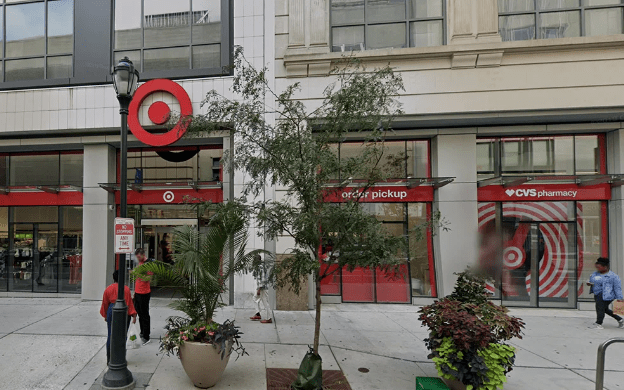
Not unlike many other corporations with retail locations in cities nationwide, Target is calling it quits on Philadelphia. They follow in the footsteps of Wawa, who we noted last year had enough of Philadelphia’s crime and also picked up and left shop at several locations in Center City.

Target, located just blocks from one Wawa that recently closed, is taking the same action, according to the Philadelphia Business Journal. Its store at 12th and Chestnut streets in Center City will be closing after 7 years of operation. 

The 19,000 sq. foot store is going to be closing “due to several years of declining performance”, the report says. The company plans on attempting to relocate its 45 part and full time employees at the store. 

Kayla Castañeda, a spokesperson for Target, commented: “The decision to close one of our stores isn’t something we take lightly. It’s an action we take only after multiple years of working to improve performance.”

Target is also going to be closing three other stores, one in its hometown of Minneapolis and two in the Washington, D.C., area, the report continued. The company is also looking to open a massive 22,000 sq. foot store near 37th and Chestnut – basically in the middle of U Penn’s campus – which will help it replace its presence lost in Center City. 

The Center City store had just opened in July 2016 as part of an apartment building, and its across the street from a brand new $762 million Jefferson Health facility that is nearing the end of construction. On the south side of the closing Target store, additional commercial and residential buildings are being erected.

But the influx of new buildings onto the block wasn’t enough for the company to want to keep its store open. In addition to Wawa stores that have closed, a Marshalls located at 10th and Market street – just blocks away from Target – also closed earlier this year.

Tyler Durden
Thu, 03/16/2023 – 20:05

Trump’s Competitors Seek To Set Themselves Apart Without Scorning MAGA

Trump’s Competitors Seek To Set Themselves Apart Without Scorning MAGA

Authored by Nathan Worcester via The Epoch Times (emphasis ours),

As more Republicans challenge Donald Trump in the race for the party’s 2024 presidential nomination, the former president’s dramatic impact on the GOP is becoming clearer.

(Left) Former President Donald Trump addresses the crowd during a 2024 election campaign event in Columbia, S.C., on Jan. 28, 2023. (Right) Florida Gov. Ron DeSantis speaks to guests at the Republican Jewish Coalition Annual Leadership Meeting in Las Vegas on Nov. 19, 2022. (Logan Cyrus, Scott Olson/Getty Images)

Everyone from Nikki Haley to Vivek Ramaswamy has sought to link themselves to “America First,” as they court Trump’s Make America Great Again (MAGA) movement.

Those Republican hopefuls face a daunting task. They have to distinguish themselves from Trump and woo many of his fans, all while mounting campaigns that can compete in the general election.

How are Trump’s competitors trying to set themselves apart from the former president—and how can they do so without alienating his fiercely loyal base?

While it’s early, some patterns are already being established.

Florida Gov. Ron DeSantis speaks to Iowa voters in Des Moines, Iowa, on March 10, 2023. (Scott Olson/Getty Images)

DeSantis’s Delicate Dance

While Florida Gov. Ron DeSantis hasn’t yet committed to a primary bid, he’s widely seen as Trump’s most formidable 2024 competitor.

The Florida governor has so far avoided responding to digs directed at him by Trump, although his online supporters, some anonymous, have gone to bat for him.

Paul Ingrassia, a Trump administration veteran and Cornell Law school graduate and lawyer, told The Epoch Times that DeSantis has relied on “digital acolytes” to fight for him because he hasn’t yet entered the race.

He wants to have these other guys do his dirty work for him while remaining above the fray,” Ingrassia, himself a prominent online Trump supporter, stated in a March 13 interview.

“People in the Trump orbit several months ago decided their best strategy would be to charge hard at former Trump supporters who’ve publicly aligned with DeSantis, in an effort to intimidate us into silence,” David Reaboi, a political consultant and well-known DeSantis advocate, said in a March 14 interview with The Epoch Times.

This is crucial to their effort because they’re terrified of more people peeling off and abandoning Trump for a far more sane option—one who’s far more likely to succeed on every issue of policy.

Both men seemed to agree that DeSantis is being pitched as a more competent version of Trump. In addition, DeSantis’s sometimes critical stance on the COVID-19 response could distinguish him from the former president.

Florida’s surgeon general has drawn attention to adverse events linked to the COVID-19 vaccines that were rolled out as a result of Trump’s “Operation Warp Speed.” That elicited a critical reaction from U.S. health authorities.

Ingrassia points out that a large majority of the population has taken at least one COVID-19 vaccine dose. He believes DeSantis’s messaging on the issue may not play well with the public at large, even if it resonates with Republican primary voters.

DeSantis, he added, “was just as much of a rule follower during the early months of COVID as anyone.”

“As more time goes on, the vaccine will be an increasing political liability—as will Trump’s outsourcing of COVID to the expert class,” Reaboi said.

“Picking a fight on COVID policy with Ron DeSantis, of all people, is inadvisable.”

Republican presidential candidate Vivek Ramaswamy, speaks during the annual Conservative Political Action Conference (CPAC) at the Gaylord National Resort Hotel and Convention Center in National Harbor, Md. on March 3, 2023. (Anna Moneymaker/Getty Images)

Ramaswamy’s ‘America First 2.0’

Ramaswamy, a venture capitalist, has explicitly pitched his campaign as the next development in Trump-inspired politics.

He calls his platform “America First 2.0.” His priorities include ending affirmative action, splitting from China, and rejecting the push for central bank digital currencies.

“I respect a lot of what President Trump did,”  Ramaswamy told The Epoch Times in a Feb. 23 interview. “He acknowledged problems in this country on both sides of the aisle that no one else had acknowledged before him. The question is where we go from here.”

Reaboi said he doesn’t have any stance on Ramaswamy.

“I understand that people do this for name recognition or to fleece some money off of gullible donors, but just about any other use of their money, focus, and time would be better spent in policy activism or building institutions to nurture and support a new cadre of policy professionals,” he said.

Ingrassia believes Ramaswamy would fall short against Trump even if his message reaches “the more educated faction of the GOP.”

I think he’s in over his head,” Ingrassia said.

Former U.S. Secretary of State Mike Pompeo speaks during the Conservative Political Action Conference (CPAC) at The Rosen Shingle Creek in Orlando, Fla. on Feb. 25, 2022. (Joe Raedle/Getty Images)

Pompeo Criticizes ‘Larger-Than-Life Personalities’

Another figure, Mike Pompeo, also is setting himself apart from Trump.

The former secretary of state and CIA director, who has said he’s considering a run, can make a strong case for himself as a longtime critic of the Chinese Communist Party (CCP). Democrats and Republicans are starting to unite against the CCP, vindicating concerns of earlier China watchers.

Yet, in a March 3 speech at the Conservative Political Action Conference (CPAC), Pompeo said America’s “greatest threats are here,” not abroad.

He made what seemed like anti-Trump comments, saying conservatives “should not look for larger-than-life personalities.”

Read more here…

Tyler Durden
Thu, 03/16/2023 – 18:25

As Bank Crisis Looms, Biden’s Aggressive Focus On Firearms Is Suspicious

As Bank Crisis Looms, Biden’s Aggressive Focus On Firearms Is Suspicious

Joe Biden has always been hostile to constitutional gun rights, but in the past week his administration has gone into an obsessive fervor, calling for more restrictions on sales, banning high capacity magazines and banning “assault weapons.”  Is there a reason for his sudden focus on taking effective firearms from Americans despite the multitude of more important issues facing the nation today? 

Much of the firearms related discussion in the corporate media has revolved around Biden’s recent executive order calling for individuals in the business of selling guns to be federally licensed and to check the backgrounds of buyers. Under the order, the Attorney General Merrick Garland will “use his discretion” to ensure gun sellers “willfully violating the law” and those unaware of background requirements become compliant.

The order makes little sense considering there are already multiple laws in place that require firearms dealers to commit to background checks before a buyer can purchase any weapon.  Of course, many people on the political left are illiterate when it comes to firearms related restrictions, and some actually do naively think that a customer can easily walk into a gun store, grab a pistol or rifle off a shelf, and walk out.  

Is Biden’s executive action just a ploy for his ignorant political base as he pretends to implement anti-gun measures while really doing nothing?  Or, is something else at play?

The order does not seem to be an effort to prevent private firearms sales or gun show sales, which are legal in some states, though there is talk of “universal background checks” in the future.  Executive orders have no constitutional standing in any case, and they certainly have no bearing on state laws, but is Biden seeking to change that?

The unilateral action also outlines steps to promote Red Flag laws, which are an attempt by gun grabbers to institute backdoor confiscation.  Red Flag laws, if enforced widely, would allow various state and federal agencies to target individuals designated as “potentially dangerous” or mentally unstable and take their firearms without due process.  It is a guilty-until-proven-innocent policy based on hearsay rather than legal evidence.


However, even Biden’s Red Flag efforts are more about lip service than tangible results that will make anti-gun proponents happy.  The real threat may be in an underlying attempt to normalize gun related executive orders as a means to sidestep checks and balances entirely, but that would require a national emergency as a rationale.

Enter the ever escalating economic crisis…

Is it merely a coincidence that Biden’s amplification of anti-gun propaganda has been timed almost exactly with the rising threat of a systemic credit collapse within the banking sector?  It’s not just SVB and Signature Bank that signal a problem today, it’s also Credit Suisse – A massive bank with over $700 billion in asset exposure.  It would appear that a credit crisis is swiftly developing, and as we all know, establishment elites “never let a good crisis go to waste.”   

The majority of the Biden Admin’s rhetoric on social media has not been about background checks, but the outright banning of semi-automatic, high capacity rifles (which are involved in less than 3% of all firearms related murders).  By extension, Biden has consistently mentioned the need to circumvent Congress to enforce more gun control, and he seems to be test-piloting the notion of executive orders to do it.    

It is no secret that establishment politicians often ignore handgun related crime in favor of far less used “military-style” rifles, but why?  One might suggest that it is the proliferation of these firearms in the hands of the citizenry that has prevented numerous attempts to undermine other constitutional protections.  Many believe that Biden’s abandonment of perpetual pandemic lockdowns and vaccine passports was directly related to red state resistance and a large number of armed Americans refusing to comply.    

Medical authoritarianism in the name of covid failed partly because of the 2nd Amendment.  With the economic crisis comes another possible window to centralize power and degrade the Bill of Rights further, but not if the populace has the capacity to rebel.

Is the establishment realizing they will have to take our guns before they can accomplish any other objectives?  And, are they preparing to use a bank crash they know is coming as a rationale or smokescreen for confiscation?  With every economic plunge comes an inevitable spike in crime, not to mention public fear.  The-powers-that-be might view this as a favorable development in their quest for American disarmament.   

Tyler Durden
Thu, 03/16/2023 – 18:05

Americans Value Truck-Parking Facilities, But Not In Their Backyards

Americans Value Truck-Parking Facilities, But Not In Their Backyards

By Mark Solomon of FreightWaves,

Americans value commercial truck drivers and the service they offer. However, they don’t want drivers parking their rigs anywhere near their homes.

That was a key finding in a 2023 survey of truck parking issues published Tuesday by CloudTrucks, an IT-based provider that supports the commercial truck driving sector. About 56% of the 1,000 American adults surveyed were unfamiliar with the issue. About 21% didn’t realize that many drivers end up sleeping in their vehicles, reflecting a lack of knowledge of the inconvenience and safety risks they encounter on a daily basis without sufficient dedicated parking capacity.

Once these aspects were explained to them, 86% recognized truck parking as an important issue, and 95% supported the building of overnight parking facilities.

However, 80% said they would only support the construction of facilities if they were at least 3 miles from their homes.

About two-thirds of respondents called for more government funding to address the parking shortage, including the building of more truck stops and rest areas. About 43% said they would support relaxed zoning and land use regulations that could pave the way for more parking. Approximately 40% supported giving tax incentives to truck stop operator chains and other private companies to create more parking.

The survey indicated that Americans understand the difficulty of a drivers’ jobs and the value they deliver. The vast majority of respondents thought drivers were overworked. About 58% said that drivers were underpaid, and about 50% said that commercial drivers are safer drivers than the public at-large.

Despite the “’not-in-my-backyard’ feedback, the survey’s findings gave CloudTrucks executives optimism that the public at least understands the problem. Tobenna Arodiogbu, co-founder and CEO of CloudTrucks, said it’s important to ensure the “resources provided to truck drivers are proportional to how much we value their service to our economy.”

The Truck Parking Safety Improvement Act was incorporated into the SHIP IT Act introduced in the House on Jan. 24. The act provides $755 million over four years (fiscal years 2023-26) in grants dedicated specifically for truck parking creation and expansion. 

Entities eligible include states, metropolitan planning organizations, local governments, which are allowed to partner with private entities. In addition to building new parking facilities, the act also opens up inspection and weigh stations and park-and-ride locations to truck parking expansion.

Tyler Durden
Thu, 03/16/2023 – 17:45

The Trump, DeSantis, Tucker Effect: New Polls Show Republicans Increasingly Done With Ukraine

The Trump, DeSantis, Tucker Effect: New Polls Show Republicans Increasingly Done With Ukraine

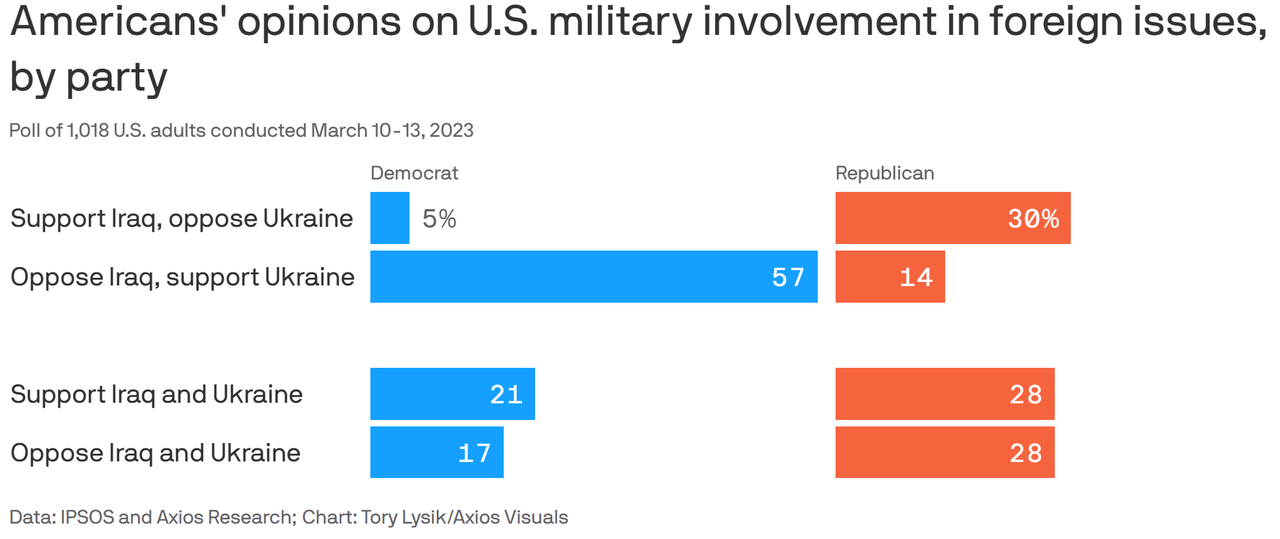
A new IPSOS-Axios poll shows a divide on Ukraine policy among conservatives, with the debate and momentum clearly shifting in favor of those who want to avoid deeper US involvement in the war.

“Four in five Republicans want the U.S. to remain the world’s leading power — but fewer than half support giving Ukraine weapons and financial support to try to save itself from Russia, according to the latest wave of the Axios-Ipsos Two Americas Index,” the research finds.

Popular Fox News host Tucker Carlson has already for months been hammering a message of US non-intervention in Ukraine, given the looming possible spiral into WW3, as also the fact that billions are being taken from struggling American taxpayers and sent abroad to a government historically known for its corruption.

Former President Trump too has been urging Washington to cut off its involvement in the conflict. But it is Florida Gov. Ron DeSantis who really came out swinging this week, and this inevitably is tilting public opinion among conservatives further into the non-intervention camp, given these will be the two GOP frontrunners for next presidential nominee. 

DeSantis went so far as to dismiss that Washington should be pouring billions into a quagmire that’s at the end of the day a “territorial dispute” – in reference to the war in Donbas that goes back to 2014. 

Other polling sources are showing the same trend of more and more Republicans getting deeply critical of America’s involvement in the grinding proxy war with Russia…

Just 42% of Republicans surveyed now say they support sending U.S. weapons and money to Ukraine — compared with 79% of Democrats and 60% of independents,” Axios observes of its new poll.

GOP leadership is nervous…

And the Biden administration bloviates meaninglessly with no indication of an end-game to their escalatory policies…

Looming significantly in the background is the fact that this week marks the 20-year anniversary of the US invasion of Iraq, now one of the most unpopular wars in American history.

Tyler Durden
Thu, 03/16/2023 – 17:25

Fed Balance Sheet Explodes By $300BN As Bank Bailouts Lead To Record Discount Window Surge

Fed Balance Sheet Explodes By $300BN As Bank Bailouts Lead To Record Discount Window Surge

Earlier today we said that with Wall Street freaking out over the latest bank crisis, everyone’s attention would be focused on today’s weekly H.4.1 update from the Fed. And they weren’t disappointed because what we found was striking.

In the week ended March 15, borrowings under the Fed’s deeply stigmatizing last-ditch liquidity facility, the Discount Window, exploded to $152.85BN, a record $148BN weekly jump to an all-time high which surpassed even the borrowings during the financial crisis!

Just as importantly, those curious what the usage of the Fed’s new BTFP facility would be, got their answer – and the Fed won’t like it: at just $11.943BN, this was a very small amount as banks clearly fear the stigma associated with the BTFP program even more than they loathe the Discount Window. This is in line with what Goldman suggested:While use of the BTFP is the most straightforward measure of the extent to which deposit outflows are putting banks under pressure, many banks say they will only use the BTFP once they have exhausted other funding sources such as FHLB advances, certificate of deposit issuance, and the wholesale debt market.” Clearly many banks are staying away.

Of course, as discussed earlier, we won’t know the names of the banks that used the two facilities – due to their deeply stigmatizing nature – for the next two years.

Taken together, the credit extended through the two backstops showed a banking system that remains broken and is dealing with over $100BN in deposit migration in the wake of the failure of Silicon Valley Bank of California and Signature Bank of New York last week. 

And then the Fed also revealed that $142.8 billion in reserves were released by “Other Credit Extensions” (this line item was $0 last week), and “includes loans that were extended to depository institutions established by the Federal Deposit Insurance Corporation (FDIC). The Federal Reserve Banks’ loans to these depository institutions are secured by collateral and the FDIC provides repayment guarantees.”

Including loans that were extended to depository institutions established by the Federal Deposit Insurance Corporation (FDIC). The Federal Reserve Banks’ loans to these depository institutions are secured by collateral and the FDIC provides repayment guarantees.

At the consolidated level, the surge in new liquidity created by the Fed meant that the Fed’s balance sheet rise by $297bn – its biggest jump since April 2020 and erasing 4 months of QT, or half of the entire program!

Separately, earlier today, we reported that JPMorgan’s Nick Panigirtzoglou estimated that the Fed’s new BTFP facility could rise as much as $2 trillion, and suggested that as a result of the massive reserves created by this facility it could serve as a Stealth QE. However, at $11BN per week, we will have to wait quite some time to get to JPM’s target.

Putting it together we said that we live in an interesting time: one when the Fed is hiking, the Fed is shrinking its balance sheet, and the Fed is also engaging in Stealth QE in hopes of injecting trillions in reserves in small banks.

Well, we can now say that for all intents and purposes, QT is over and as long as deposit flight continues, the Fed’s balance sheet will keep rising.

Tyler Durden
Thu, 03/16/2023 – 17:11

James O’Keefe Announces New Project After Project Veritas Ouster

James O’Keefe Announces New Project After Project Veritas Ouster

Authored by Zachary Stieber via The Epoch Times (emphasis ours),

Project Veritas founder James O’Keefe has announced a new media project.

James O’Keefe, founder Project Veritas, at the Values Voter Summit in Washington on Oct. 12, 2019. (Samira Bouaou/The Epoch Times)

The O’Keefe Media Group was unveiled on March 15, about three weeks after O’Keefe resigned from Project Veritas following a suspension and probe into his spending practices.

We’re going to be sending cameras into the hands of hundreds of people,” O’Keefe said on Real America’s Voice. “We’re going to be creating a citizen army of journalists.”

Project Veritas staffers and its board had maintained that O’Keefe could return to the organization, but O’Keefe is instead forging a new path.

The Project Veritas founder said that a “small, tight-knit group” of “elite journalists” has remained by his side and is joining in the new venture.

“They have awakened a sleeping giant,” O’Keefe said in a promotional video. “I’m back.”

The business model is based on donations that will directly sponsor cameras. Tiers run from $19.99 a month to $5,000 a year.

“Let’s build this army and keep every statehouse, every city council, every school board and everywhere people are conspiring to keep power, proactive favoritism or line their pockets with tax dollars!” O’Keefe said on Twitter. “Become a founding member today!”

Exit

O’Keefe exited Project Veritas, which he founded in 2010, on Feb. 20.

O’Keefe was suspended by the organization’s board of directors as it investigated allegations of financial malfeasance and abuse. A preliminary probe showed O’Keefe “has spent an excessive amount of donor funds in the last three years on personal luxuries,” the board said.

The board said it did not remove O’Keefe but he said he was forced out because he no longer had any authority.

The move divided staffers, some of whom had threated to leave if O’Keefe’s alleged conduct was not addressed. Others supported O’Keefe and have moved to the new group.

We will never replace James O’Keefe. But for now, we see it as our job to hold the torch for him while keeping the door wide open for his return,” staffers said in a statement.

Read more here…

Tyler Durden
Thu, 03/16/2023 – 15:41

Big Banks Agree To Historic $30 Billion Unsecured Deposit Injection In First Republic Bank

Big Banks Agree To Historic $30 Billion Unsecured Deposit Injection In First Republic Bank

Update (1530ET): And here is the official press release from the Big Banks, :

Bank of America, Citigroup,. JPMorgan Chase, Wells Fargo, Goldman Sachs, Morgan Stanley, BNY-Mellon, PNC Bank, State Street, Truist and U.S. Bank to make uninsured deposits totaling $30 billion into First Republic Bank

March 16, 2023

Action by the largest U.S. banks reflects their confidence in the country’s banking system and helps ensure First Republic has the liquidity to continue serving its customers.

  • Bank of America, Citigroup, JPMorgan Chase and Wells Fargo announced today they are each making a $5 billion uninsured deposit into First Republic Bank.
  • Goldman Sachs and Morgan Stanley are each making an uninsured deposit of $2.5 billion
  • BNY-Mellon, PNC Bank, State Street, Truist and U.S. Bank are each making an uninsured deposit of $1 billion, for a total deposit from the eleven banks of $30 billion. 

This action by America’s largest banks reflects their confidence in First Republic and in banks of all sizes, and it demonstrates their overall commitment to helping banks serve their customers and communities.  Regional, midsize and small banks are critical to the health and functioning of our financial system.

Following the receiverships of Silicon Valley Bank and Signature Bank, there were outflows of uninsured deposits at a small number of banks.  America’s financial system is among the best in the world, and America’s banks – large, midsize and community banks – do an extraordinary job serving the banking needs of their unique customers and communities.  The banking system has strong credit, plenty of liquidity, strong capital and strong profitability. Recent events did nothing to change this.

The actions of America’s largest banks reflect their confidence in the country’s banking system.  Together, we are deploying our financial strength and liquidity into the larger system, where it is needed the most.  Smaller- and medium-sized banks support their local customers and businesses, create millions of jobs and help uplift communities.  America’s larger banks stand united with all banks to support our economy and all of those around us.

And here is the very brief joint statement from the Fed, Treasury and FDIC:

The following statement was released by Secretary of the Treasury Janet L. Yellen, Federal Reserve Board Chair Jerome H. Powell, FDIC Chairman Martin J. Gruenberg and Acting Comptroller of the Currency Michael J. Hsu.

Today, 11 banks announced $30 billion in deposits into First Republic Bank. This show of support by a group of large banks is most welcome, and demonstrates the resilience of the banking system.

This bailout is very similar to the 1998 bailout of LTCM when fourteen banks and brokerage firms invested $3.6 billion in Long-Term Capital Management L.P. (LTCM) to prevent the firm’s imminent collapse; the bailout was orchestrated by – but did not involve – Fed funding. That said, LTCM was a hedge fund, and was not a direct competitor.

The bailout is also very different to what happened when Bear Stearns collapsed, as the Big Banks again tried, but refused to save Bear in 2008.

And now they have agreed to inject $30BN in the form of unsecured deposits in First Republic, effectively backstopping the entire capital structure and making the equity money good, because they have explicitly guaranteed that no matter how bad the deposit run is, they will keep the bank funded (using deposits that just a few days ago may have been parked at First Republic).

The next question: why did the banks agree to this? Was it guilt that banks such as SIVB and SBNY collapsed because of their actions/behind the scenes negotiations with regulators? We don’t know, but Wall Street is hardly known for being a good Samaritan, and if given the choice, banks would have opted to wait until the bankruptcy and pick choice assets for pennies on the dollar.

* * *

Update (1300ET): CNBC’s David Faber is reporting that 11 of the largest  US banks are planning – as a group – to deposit around $30 billion of their own cash with First Republic.

Faber updated his reporting with details of what size deposits will be – now around $30 billion in uninsured deposits…

  • BofA, WFC, JPM, Citi: ~$5 Billion each

  • Morgan Stanley, and Goldman Sachs: $2.5 Billion

  • Truist, PNC, US Bancorp, M&T, and Capital One: ~$1bn each

This makes some sense as the ‘big banks’ have lots of reserves relative to assets… 

As a reminder, JPM and the “Big 4” got even bigger recently thanks to small bank deposit run from past week, which they are now returning as deposits back into those troubled banks.

The Wall Street Journal reports, according to sources, that not all banks will contribute the same amount to the pool, but each one that is participating so far will likely put in at least $1 billion.

FRC shares are jumping (and halted) on the headlines…

Summing up the last few days actions: BTFP removes all the asset-side risk from bank balance sheets, while the Big Bank deposit pledges remove all liability-side risk.

*  *  *

Update (1230ET): What did they know and when?

As chatter continues to build of some bailout for First Republic Bank this week, after the company’s share price has collapsed, The Wall Street Journal reports that top execs at the bank sold millions of dollars of company stock in the last two months… but did not report the sales to SEC.

A gander at the SEC filings show only one small ‘insider sale’ recently (in November)…

However, executive have been selling for months, as unlike insider sales at most companies, those at First Republic aren’t required to be reported to the Securities and Exchange Commission.

Instead, the trades were reported to the Federal Deposit Insurance Corporation.

A handful of banks currently file these forms to the FDIC, which posts them on a website where the documents can be accessed one at a time.

As of Wednesday, First Republic is the only company listed on the S&P 500 index that doesn’t file its insider trades with the SEC, a Wall Street Journal analysis shows.

In all, insiders have sold $11.8 million worth of stock so far this year at prices averaging just below $130 a share.

Finally, we would expect a knock at the door if we were them as the DoJ is already looking at insider sales made by Silicon Valley Bank executives a week before that bank’s failure,

*  *  *

Update (1100ET): The Wall Street Journal reports that JPMorgan and Morgan Stanley are among a group in talks to bolster First Republic Bank.

According to people familiar with the matter, several large banks are discussing a potential deal with First Republic Bank that could include a sizable capital infusion to shore up the beleaguered lender.

Any deal would need the blessing of regulators and will be driven at least in part by the bank’s highly volatile stock.

FRC shares are bouncing hard off the earlier lows (halted numerous times)…

That headline sent the US Majors soaring…

*  *  *

As we detailed earlier, First Republic Bank shares have plunged this morning, extending a week-long rout, as executives consider courting a buyer to prop up the bank in the wake of the collapse of several regional peers.

Bloomberg reports that, according to people familiar with the matter, the San Francisco-based bank is said to be exploring strategic options that include a sale. The firm is also weighing options for shoring up liquidity, some of the people said.

“Normally, a headline of a potential sale would support the stock,” Christopher McGratty, an analyst at Keefe, Bruyette and Woods, wrote in a report.

“However, the potentially significant deposit outflows post-SIVB failure likely leave FRC in a tough spot.”

“Any potential sale would likely be a tough outcome for existing shareholders, given mark-to-market accounting on loans,” McGratty wrote.

FRC shares are down over 30% this morning, back at post-SVB lows…

First Republic saw its credit rating was cut to junk by S&P Global Ratings and Fitch Ratings.

First Republic’s options have narrowed following deposit outflow, a sharp share-price decline and recent downgrades from ratings agencies, while a potential sale of the bank could center on the attractive wealth-management business,” Herman Chan, an analyst at Bloomberg Intelligence, wrote in a note.

But, but, but President Biden said:

“Americans can rest assured that our banking system is safe.  Your deposits are safe.”

It’s not over.

Tyler Durden
Thu, 03/16/2023 – 15:35

The Liquidity Phase Of The Bank Crisis Is Over… But The Solvency Phase Is Getting Worse

The Liquidity Phase Of The Bank Crisis Is Over… But The Solvency Phase Is Getting Worse

The acute phase of the banking crisis appears to be over.

As was revealed late on Sunday just around the time futures opened for trading, the Fed’s new Bank Term Funding Program (BTFP which should stand for Buy The Fucking Pivot) – a facility designed to avoid banks that are facing deposit outflows from being forced to sell their bond holdings at a loss, and which as JPMorgan concluded is a stealth form of QE which can be as big as $2 trillion (and even bigger if required) – will serve to backstop small bank impaired assets for the foreseeable future.

Then, today’s “deposit consortium” plan unveiled as part of a coordinated rescue of First Republic Bank, which envisions big banks like JPM, C and BofA injecting tens of billions of (newly received) deposits into the troubled bank and which are meant to replenishing its own lost deposits (which ended up fleeing to the same big banks which are now recycling them in the form of a bailout) has created a blueprint of how to backstop the liability side of small banks. Simply said, any deposit that JPM received from regional/small bank XYZ, will be promptly recycled as a new deposit back into regional/small bank XYZ to keep it liquid.

That last word is critical, because between the asset and liability backstop, the liquidity phase of the banking crisis is now over. But what about the solvency phase?

Well, therein lies the rub, because as readers will recall, around the time the regional banks started slumping we wrote “Why Small Banks Are In Big Trouble: As Hedge Funds Pile Into The New “Big Short”, The Next ‘Credit Event’ Emerges“, which focused not on the small bank net unrealized losses on their Held to Maturity portfolios (or the bank run sparked by the sudden collapse of SIVB which was still quite solvent at the time of our article), but on the real solvency risk facing the regional bank sector: their exposure to commercial real estate in general, and office buildings in particular.

Specifically, in the article we explained why after residential real estate, malls, and hotels – all of which represented the various Big Shorts over the past 15 years – it was now offices’ turn to crumble. We won’t republished the whole article here (it can be read in its entirety here), but we will rephrase the big rhetorical question we asked then:

what happens as the troubles in the office sector – which had been isolated to the RE realm so far – start spreading to the broader banking sector? After all, both previous Big Shorts, versions 2.0 and 3.0, were mostly isolated phenomena thanks to the low rates that prevailed in 2020 and much of 2021.

That has now changed, and suddenly investors are starting to look at who among the US banks has the most exposure to crashing commercial real estate (and offices in particular). For now, investors are taking a shot gun approach, dumping the regional and small banks en masse, with the KRE ETF plunging to the lowest level in two years, the broader BKW bank index suffering its worst day since June 2020…

… little did we know just how much worse it would get int he next two days…

… while arguably the most popular office REIT, Vornado, just hit the lowest since 1997!

As we concluded, “the problem, and this is where the discussion of the coming ‘credit event’ kicks in, is that while large banks still are very well capitalized, small banks – the core constituents of the KRE index – are in big trouble because as the following chart from TS Lombard shows, their reserves (as a % of total assets) have collapsed as a source of funding for loans and are back to levels when the Fed needed to do QE to reload their reserves!

We then excerpted from TS Lombard’s Steven Blitz (full note available to pro subs) explaining why we may be this close to another banking crisis (spoiler alert: we were):

Banks – and especially small banks – are now sitting with reserves pretty much at their lowest comfort level, There is not much of a cash-to-asset cushion left for small banks as a whole, so a funding crisis can easily get rolling if large depositors decide too many loans in commercial real estate and other areas are about to go bad. The Fed will make funds available to keep these banks afloat, but that alone will get some push-back from Congress because of the increased concentration of bank deposits in an increasingly smaller number of banks.

Small banks could have slipped below the promised macro-supervision radar owing to the political direction to lighten the regulatory burden on small, community banks. The belief is that they should not be subject to the same reporting requirements as G-SIBs.

Ahead of any banking problem rooted in bad loans turning into a funding problem, banks are going to pull back on lending at an even faster pace.

… and concluded:

Translation: not only are banks once again reserve constrained, but small banks are especially desperate for reserves.

Well, we were right: as JPMorgan’s Nick Panigirtzoglou conceded today, our take was spot on, because not only were small banks reserve constrained – and imploded promptly after we wrote our preview of the “New Big Short” – but the Fed launched a new Stealth QE program in the form of the BTFP facility which may have to expand to $2 trillion or more, and which means that we now live in a time when i) the Fed is hiking, ii) the Fed is shrinking its balance sheet via QT, and iii) it is also injecting up to $2 trillion in liquidity via the BTFP facility, aka Stealth QE.

Our conclusion from Thursday was also prophetic:

In conclusion, even without the office real estate crisis, small banks were already headed for an unsettling mix of reduced funding and more underperforming loans. Throw in a cascade of bad debt in exposure to office real estate and you could see a repeat of the 2009 banking crisis for the small banks… if only in the beginning, because once the small banks go down, the big banks won’t be far behind.

Less than a week later, as noted above we have gone through a full-blown small bank crisis cycle and the acute (liquidity) phase is over. But the solvency part remains.

And after that very long preamble we finally present the core of today’s post, namely that even as regional banks are surging today on the easing in liquidity, the solvency part is getting worse.

Recall, in our Thursday post we said that readers should keep a close eye on the office sector -i.e., the “Big Short 4.0” trade, whether in the form of the CMBX S15 (BBB-) tranche, or equities and REITs. And today, while everything else is surging, one sector is having a very hard time.

You guessed it: office CRE.

As shown in the charts below, office-building landlords are some of the biggest decliners among US real estate stocks Thursday, on pace for the lowest close since August 2009.

Below we summarize the damage: the S&P Composite 1500 Office REITs Index drops as much as 4.9%..

… with the S&P Composite 1500 Real Estate Index dropping as much as 2% as the banking crisis continues to weigh on real estate stocks.

Office giants such as Vornado Realty, Hudson Pacific and SL Green are falling as much as 7% or more; other decliners include Piedmont Office Realty Trust (-4.5%), Cousins Properties Inc. (-5.9%) and Kilroy Realty Corp. (-6%).

A longer-term chart of Vornado is terrifying: the stock is back to levels last seen in November 1996.

Our preferred trade – which we highlighted last week – the CMBX S15 BBB- tranche which has outsized exposure to offices, just hit a new lifetime low.

And so on.

The bottom line: the acute phase of the bank crisis may now be over thanks to the Fed’s Stealth QE and JPMorgan’s recycling of newly acquired regional bank deposits back into the same regional banks that saw bank runs in the past week; but now the slow burning – solvency – phase is starting to accelerate and until the Fed cuts rates, expect a mood, sentiment and price rollercoaster as investor focus increasingly turns to what is the next big threat, not to mention Next Big Short, facing the financial sector.

Tyler Durden
Thu, 03/16/2023 – 15:21