75.2 F
Chicago
Saturday, August 8, 2026
Home Blog Page 3878

Fluoride Lawsuit Against EPA Prompts Pending Release Of Potentially Damaging Report

Fluoride Lawsuit Against EPA Prompts Pending Release Of Potentially Damaging Report

Authored by Christy Prais via The Epoch Times (emphasis ours),

The U.S. Environmental Protection Agency (EPA) continues to oppose and delay a lawsuit filed against them by the Fluoride Action Network (FAN) to ban the use of fluoride in public water supplies in the United States.

The case has revealed government attempts to limit available evidence and avoid having the facts of water fluoridation reviewed in court. A spokesperson with FAN told The Epoch Times in an email, “this represents a major reversal in the federal agencies’ position, and will ensure that the public has access to these critical documents that would have otherwise remained buried forever.

Fluoride exposure has been linked to an increased risk of hypothyroidism in pregnant women and brain-based disorders in their offspring. There are also findings that higher fluoride exposure is associated with reduced IQ in children.

From Petition to Lawsuit

The lawsuit began in 2017 after a petition filed in November 2016 called on the EPA to “protect the public and susceptible subpopulations from the neurotoxic risks of fluoride by banning the addition of fluoridation chemicals to water.”

The petition referenced more than 2,500 pages of scientific documentation detailing the risks of water fluoridation to human health, including more than 180 published studies showing fluoride is linked to reduced IQ and neurotoxic harm.

In its Feb. 27, 2017 response, the EPA claimed the petition had failed to “set forth a scientifically defensible basis to conclude that any persons have suffered neurotoxic harm as a result of exposure to fluoride,” and denied the claim.

The Toxic Substances Control Act passed in 2016 includes statutes that provide citizens the ability to challenge an EPA denial in federal court. Thus, in 2017, FAN, Food & Water Watch, and Organic Consumers Association filed a lawsuit against the EPA challenging the denial.

Government Agency Interference 

Internal CDC emails obtained through the Freedom of Information Act by plaintiff attorney Michael Connett showed discussion and comments related to the NTP’s unreleased Fluoride Toxicity Report.

The emails seem to indicate the NTP report was not made public due to interference from Levine and Tabak.

One email from the CDC dated June 3, 2022, specifically stated, “ASH [Assistant Secretary of Health] Levine has put the report on hold until further notice.”

In the submitted notice Connett stated, “These emails confirm that the NTP considered the May 2022 monograph to be the NTP’s final report. They also confirm that the CDC was opposed to the NTP releasing the report, and that leadership at the top levels of the Department of Health and Human Services intervened to stop the report from being released.”

Harmful Effects of Fluoride

In the past, fluoridation chemicals were obtained from the wet scrubbing systems of the phosphate fertilizer industry and added to many public water supplies in the United States to reduce tooth decay. It is now recognized by dental researchers that fluoride’s primary benefit comes from topical application and does not need to be swallowed to prevent tooth decay.

The FAN states that “in recent years, however, an increasing number of water departments have begun purchasing their fluoride chemicals from China. Based on recent incidents, it appears that the quality control of the Chinese chemicals is even more lax, and variable, than the U.S.-produced chemicals.”

The NTP’s 2019 Systematic Review of Fluoride Exposure and Neurodevelopment and Cognitive Health Effects concluded that “ … fluoride is presumed to be a cognitive neurodevelopmental hazard to humans. They state that “This conclusion is based on a consistent pattern of findings in human studies across several different populations showing that higher fluoride exposure is associated with decreased IQ or other cognitive impairments in children.” 

Read more here…

Tyler Durden
Fri, 03/10/2023 – 18:20

Putin Congratulates Xi On Securing Unprecedented 3rd Term, Hails ‘Strategic Cooperation’

Putin Congratulates Xi On Securing Unprecedented 3rd Term, Hails ‘Strategic Cooperation’

In what was widely seen as a purely ceremonial vote, Xi Jinping secured an unprecedented third term as China’s president on Friday by approval of the country’s rubber-stamp legislature in Beijing’s Great Hall of the People on Friday. It was unanimous, at 2,952 votes, and this was followed by a standing ovation. 

This makes the 69-year old the longest-serving head of state that Communist China has ever seen going back to 1949, and comes after he already broke precedent in gaining a third term as head of the Chinese Communist party last fall. He’s also head of the nation’s armed forces, and thus has unrivaled authority even compared to predecessors of past decades.

A toast after inking a major Sino-Russian Gas Deal in 2014. File image: Zuma Press

CNBC previews that a new premier will be chosen by delegates on Saturday. And “Xi is scheduled to speak at the parliamentary meeting’s closing ceremony on Monday. The new premier is set to speak with the press later that day.” It’s expected to be one of Xi’s most loyal protégés, Li Qiang.

Russian President Vladimir Putin was among the first world leaders to congratulate Xi on his third term, and hailed the two countries’ strategic partnership.

“Dear friend, please accept sincere congratulations on the occasion of your reelection,” Putin said in a statement published by the Kremlin. “Russia highly values your personal contribution toward the strengthening of ties … and strategic cooperation between our nations,” he added. 

“I am certain that working together, we will ensure the development of fruitful Russian-Chinese cooperation in all sorts of different areas,”  the letter continues. “We will continue to coordinate joint work on the most important regional and international issues.”

This comes at a moment the US intelligence community is warning of “complex” threats from both China and Russia – as their coordination grows while finding a common enemy in Washington, as well as outlier states like North Korea.

The standing ovation after Xi secured his third 5-year term as president of China…

The US administration has also repeatedly warned Beijing against arming Russia for use in the war in Ukraine. Biden officials have not said they believe this has been done yet, but have cited intelligence which shows Beijing is mulling it. Xi is also planning an upcoming trip to Russia to meet with Putin, which the West will greet as a huge provocation.

Tyler Durden
Fri, 03/10/2023 – 18:00

Kelly: A Handy January 6 Fact Sheet

Kelly: A Handy January 6 Fact Sheet

Authored by Julie Kelly via American Greatness,

In another example of Washington’s inexorable slide into banana republic territory, Senate Majority Leader Charles Schumer (D-N.Y.) took to the floor of the U.S. Senate on Tuesday to call for the removal of an American journalist. 

“I don’t think I’ve ever seen an anchor treat the American people, and American democracy, with such disdain,” Schumer said during his seven-minute authoritarian tirade.

“And he’s going to come back tonight with another segment. Fox News should tell him not to. Fox News, Rupert Murdoch—tell Mr. Carlson not to run a second segment of lies. You know it’s a lie.

Schumer later reiterated his demand to a group of journalists who, rather than denounce one of the most powerful government officials in the country attempting to silence an influential member of the media, dutifully reported Schumer’s bleating without question.

Republican senators including Senate Minority Leader Mitch McConnell (R-Ky.) and Senator Mitt Romney (R-Utah) joined the fray, echoing Schumer’s faux concerns over “national security.”

Clearly, it’s panic time. The White House, Congress, and the Democratic Party propaganda arm that is the corporate media realize their carefully engineered narrative about January 6 is imploding in real time. Which is why they’re accusing Carlson of “whitewashing” and “rewriting” the events of January 6. Anything less than total fealty to regime-approved talking points about what happened before and after that day now is considered a “threat to democracy.”

But facts are facts. And no amount of pearl-clutching by the hags on “The View” or threats made by U.S. senators can alter the reality of January 6. Between video recordings, witness testimony, court filings, and news reporting, the undeniable truth about January 6 cannot be willfully wished away even by the most skilled spinmeisters.

Here’s what we know:

  • Some people acted badly. A handful came ready for a fight while others admit they were caught up in a mob mentality that unfolded over the course of the afternoon.

  • The overwhelming majority of protesters did not act badly or violently. Not only do security footage and other video sources demonstrate that is indeed true, the Justice Department’s own data supports it. “Parading” in the Capitol, a class B misdemeanor, is by far the most common charge in the Justice Department’s sweeping investigation. According to an update published this week, 919 out of 1,000 defendants face trespassing charges. Of the 518 who accepted plea agreements, 385 pleaded guilty to misdemeanors and 133 pleaded guilty to a felony.

  • The most common felony is not “insurrection” but rather obstruction of an official proceeding. Fewer than 20 people face seditious conspiracy charges.

  • Roughly 100 defendants are accused of attacking police officers with a dangerous weapon. No one is charged with carrying or using a firearm inside the building.

  • Speaking of police, body-worn camera and independent video show outrageous misconduct by law enforcement. D.C. Metropolitan Police launched an aggressive and unnecessary offensive against the crowd assembled on the west lawn. Even though protesters were respecting police lines at the time, footage shows officers throwing stun grenades into and other devices containing rubber bullets into the crowd beginning shortly after 1:00 p.m.

  • Video and testimony by Capitol police officers at trial confirmed how that activity enraged the crowd. Other officers shoved women down stairs and shoved one man off the upper terrace balcony.

  • This conduct continued inside the building. Some officers shoved and hit individuals inside the Rotunda and other areas. A brutal scene in the lower west terrace tunnel unfolded as police used their batons to beat at least two women on the head resulting in bleeding and injuries.

  • Excessive force caused the deaths of four Trump supporters: Ashli Babbitt, Rosanne Boyland, Kevin Greeson, and Benjamin Phillips.

  • On the flip side, despite persistent claims even by Attorney General Merrick Garland and White House spokeswoman Karine Jean-Pierre as recently as this week, no police officers died as a result of injuries sustained on January 6. Officer Brian Sicknick is on video walking around after he suffered a pepper spray attack; he died of a stroke the next day. There’s no evidence the reported suicides of other officers after January 6 were related to the protest.

  • Further, the responsibility of sufficiently protecting the Capitol with enough officers fell to the Capitol Police board—staffed by the sergeant-at-arms for then House Speaker Nancy Pelosi and then Senate Majority Leader Mitch McConnell. Former Capitol Police Chief Steven Sund repeatedly testified that he requested additional help including National Guardsmen days before January 6. Even as the chaos unfolded that day, House Sergeant-at-Arms Paul Irving and Senate Sergeant-at-Arms Michael Stenger delayed pursuing the proper authorization of the National Guard.

  • Irving told House Republicans that his staff as well as members of the House Administration committee began planning for January 6 weeks before the protest. Jamie Fleet, a security staffer for both Pelosi and the committee overseeing Capitol functions, told the January 6 select committee that he started preparations for January 6 in the summer of 2020.

  • When the building was breached at around 2:15 p.m., Congress was not voting to certify the electoral college results at the time, a common misperception. Senator Ted Cruz (R-Texas) and Rep. Paul Gosar (R-Arizona) were in the process of disputing the election outcome in Gosar’s home state, a process permitted under the Electoral Count Act. The joint session of Congress technically had been adjourned an hour earlier so debate could begin.

  • For all the wasted energy spent over the past two years that democracy almost died on January 6, the chaotic protest only delayed the certification ceremony for seven hours. Joe Biden officially was declared president at 3:00 a.m. the next day.

  • The surveillance video viewed by Carlson’s team has not been made available to defense attorneys, arguably in violation of defendants’ constitutional rights.

  • A separate trove of tapes that captured activity from the hours between noon and 8:00 p.m. was turned over to the FBI in early 2021 to use in its investigation. With few exceptions, all footage remains under protective orders. Defense attorneys consistently have complained that access to the full archive is constrained by the protective orders.

Plenty of other falsehoods and misrepresentations animate the fable of January 6. But for those honestly seeking the truth, consider this a cheat sheet for future use.

Tyler Durden
Fri, 03/10/2023 – 17:40

60% Of Restaurants Struggling To Find Enough Employees

60% Of Restaurants Struggling To Find Enough Employees

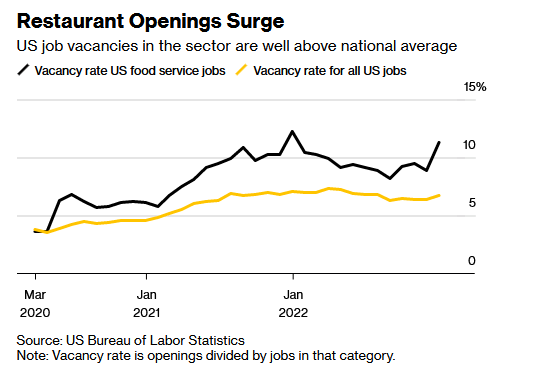
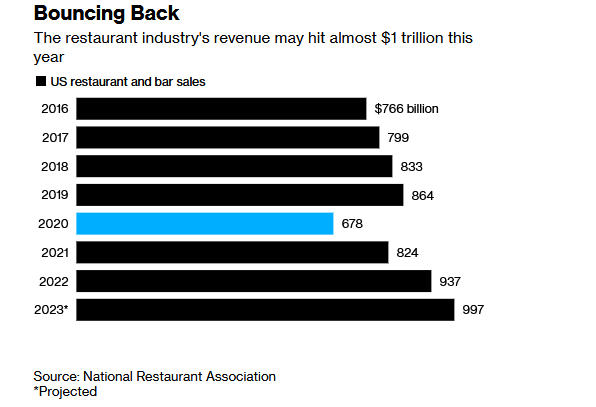
Three years after Covid led to a national shutdown of restaurants, the $900 billion US foodservice industry is struggling to find enough workers – despite boosting pay and benefits. In fact, over 60% of establishments say they’re understaffed, according to a new poll cited by Bloomberg.

Chains such as Domino’s Pizza and Jack in the Box say the labor shortage is hurting business.

Like much of the US labor market at the moment, the picture that official data paint of the restaurant industry can look contradictory. On one hand, foodservice employment levels are approaching where they were in early 2020 and the number of restaurants is still below pre-pandemic counts, implying there are plenty of workers to go round. Yet for every two job openings in foodservice, there’s only one unemployed person to potentially fill the gap, and job openings spiked to 1.7 million in December. -Bloomberg

“Despite the really strong gains in the labor market, leisure and hospitality continues to be the sector where you haven’t seen the full recovery,” said Anna Zhou, an economist at Bank of America Institute. “They continue to struggle to fill every opening.”

Of note, US restaurant and bar sales are projected to increase to the tune of 6% this year to nearly $1 trillion.


Domino’s Pizza can’t find enough delivery drivers, causing pizzas to take longer to get to customers than they did in 2019. At Jack in the Box, around 70% of locations are operating on fewer store hours despite a wage increase last year.

People don’t really want those jobs anymore,” said Lightcast senior economist Rucha Vankudre. “Given how much choice there is in the market right now, people are kind of moving away.”

Who’s still missing from the labor force? Mostly Millennials and Gen Xers, who make up a ‘significant chunk’ of the more than 2 million people who are still unemployed, according to BofA research from February. They explain that many left for childcare or eldercare reasons, or quit because of a disability or a disease, or relocated to areas with lower costs of living, Zhou told Bloomberg. These structural changes have left restaurants desperate for servers, cooks and cashiers.
 

Things were bad in the industry even before the pandemic, however. Restaurant jobs typically mean hard work and low pay, which the ‘get rich quick’ entitlement generation seems allergic to.

Now, the industry has been forced into an unprecedented growth spurt and must claw back the millions of jobs that were lost in 2020: food and beverage outlets are projected to have the largest employment jump of any industry for the decade through 2031, data from the Bureau of Labor Statistics show.

Burger King and Qdoba franchisee Matt Herridge’s staff have been quitting, too stressed and tired to work in his 11 restaurants across West Virginia and Ohio. One Burger King general manager, who’d worked there for more than a decade, left during the pandemic for a 9-to-5 office job at an auto servicing company, desperate for predictable hours and no night shifts. -Bloomberg

“The way she described it to me — in tears even — ‘My son wanted to know how often he will get to see me.’ There’s a lot of stories like hers,” said Herridge. “Just folks who went out and found other types of work that felt a little bit more stable to them.”

The average hourly wage for a fast-food cook in May of 2021 was $12.25, vs. $21.22 for the average construction worker, or $17.28 for a data entry position. The fast food industry has tried without success to boost perks to no avail.

Many restaurants, including McDonald’s Corp. and Domino’s, gave workers bonuses during the pandemic. Some smaller chains and franchisees that did the same are now struggling to wean them off.

Herridge started offering a $2-per-hour attendance bonus in late 2021, where employees get extra pay just for showing up. He’s since notched it down to $1 per hour extra, but said that competition from other industries would make it difficult to scrap entirely. -Bloomberg

I have to raise prices when I raise wages. That’s just how it works,” said Herridge, who can’t find enough staff to get his Burger Kings back to 24-hour operations. “That’s going to be the primary driver of inflation still over the next year or so.”

Tyler Durden
Fri, 03/10/2023 – 17:20

Luongo: The War For The Dollar Is Already Over, Part II: The Fly Or The Windshield?

Luongo: The War For The Dollar Is Already Over, Part II: The Fly Or The Windshield?

Authored by Tom Luongo via Gold, Goats, ‘n Guns blog,

Live images flashing by
Like windshields towards a fly
Frozen in that fatal climb
But the wheels of time, just pass you by

-RUSH, “Between the Wheels”

In part I of this series I told you the war over the US dollar was over because the bane of domestic monetary policy, Eurodollar futures, lost the battle with SOFR, the new standard for pricing dollars.

The ignominious end of the Eurodollar system is a study in the evolution of markets, as a new system replaces an old one. Old systems don’t die overnight. We don’t flip a switch and wake up in a new reality, unless we are protagonists in a Philip K. Dick novel.

More than a decade ago I looked at the responses to President Obama cutting Iran out of the SWIFT system as the beginning of the end of the petrodollar system. The goal was to take Iran out of the global oil markets by shutting Iran out from the dominant dollar payment system.

Out of necessity Iran opened up trade with its major export partners, most notably India, in something other than dollars. India and Iran started up a ‘goods for oil’ trade, or as Bloomberg called it at the time, “Junk for Oil.”

The stick of sanctions created a new market for pricing Iranian oil and a way around the monopoly of US dollar oil trading. India, struggling with massive current account deficits because of their high energy import bill, welcomed the trade as a way to lessen the pressure on the rupee.

Iran needed goods. They worked out some barter trade and the first shallow cuts into the petrodollar system were made.

Turkey eventually joined the fray, seeing the opportunity to act as a middle man by accepting gold into its banks from Iran’s customers and settling up with Iran in dollars or whatever.

Turkey was the first country to make gold a 100% reserve asset in defiance of Basel I capital rules to facilitate this trade. Turkey’s gold ‘reserves’ skyrocketed because of this.

More than 10 years later we’re now looking at the lynchpin of the petrodollar, Saudi Arabia, seriously considering taking other currencies for their oil. The petrodollar was never going to die overnight, it was always going to die as the cost of doing business in dollars rose to make using other currencies a better path to buying/selling oil.

Every time the US went to the sanctions well to coerce conformity, the more “star systems slipped through its fingers,” to quote Princess Leia. While we joke today about never ‘going full retard,’ this is just another way of saying that you should never threaten to nuke someone either.

Trump went sanctions nuclear on Iran in 2018. He failed.

“Biden” and Davos went nuclear on Russia in 2022, going further than even Trump. And they failed even harder. All they did was raise the cost of using dollars in the minds of the dollar’s best customers.

When the cost/benefit framework flips, behavior changes accordingly.

In the world of money, since we don’t have anything close to resembling real capital markets, rather politicized ones, policy is the thing that alters that cost/benefit structure the most. This means while analyzing the market reaction to day-to-day data the listening to the tea-leaf reading by commentators becomes an exercise in chasing your tail through a wilderness of rhetorical mirrors if you don’t include policy changes.

So, with that in mind we have to analyze structural changes to markets from a policy perspective to see what the future really looks like. It’s not that the markets don’t have a say in the matter, it’s that if you analyze the policy through the lens of capital flowing to where it is treated best, then the future outcome is pretty predictable if there isn’t a competing policy put in place to redirect that capital flow later.

In this sense, financial analysis in politicized markets is better described by court politics than spreadsheet output cells.

People want oil. They will buy it regardless of what Davos or “Biden” or anyone else says about this. Until you replace oil itself, no amount of policy changes will fundamentally change the market for oil unless you destroy the supply chain supporting the oil industry.

And analyzing oil supply and demand fundamentals in this case is a fool’s errand when malign actors are materially affecting the supply and demand for oil and are incentivized to ‘game the statistics.’ It’s not that these numbers are worthless, it’s more that they should be discounted heavily until policy changes are assessed.

Diminishing Returns of Socialism

In the end all markets respond predictably to the Law of Diminishing Marginal Utility. If you don’t believe that, then you are a Malthusian and publicly admitting you are a moron with the inability to accept outcomes you cannot personally perceive.

I put the “Peak Oil” folks in this category. And you know who you are.

I put Climate Change believers in this category as well. Yes, by the transitive property of rhetorical mathematics, I just called them all morons.

The Davos solution to their problems of overpromising the deliverables of socialism financed through the dollar is to default on those promises through global monetary inflation using war with Russia and China as the cover and Climate Change as the reason why it’s necessary.

This is to save themselves and secure totalitarian control for their posterity into the next cycle of history.

But history will prove them wrong. Because, in the end, you can’t fight a flowing river any more than you can alter the mass of human behavior with respect to their preferences. If they want to drive a car, eat a steak, live in a house, own a gun or have a child, they will.

You can delay it or make it more expensive but that expense is a double-edged sword, because as Margaret Thatcher famously said, “The problem with socialism is that eventually you run out of other people’s money.” (OPM)

Think of the Eurodollar system as the ultimate expression of OPM, which is a homophone for ‘hopium.’

If you really want to change their behavior, you have to give them more carrot than stick. This appraoch worked for decades to guide us towards their more perfect technocratic dystopian unions as long as money got progressively cheaper during the dollar reserve standard.

This system broke in 2008 and by 2011 forced the world, through a compliant Federal Reserve, into birthing the Coordinated Central Bank Standard, where all the major central banks would take turns inflating a deflating credit system.

But back to Diminishing Marginal Utility. The law simply states that the acquisition of the next unit of a thing, any thing (water, money, food, credit dollars, etc.), is worth less to a person than the previous unit. We act to alleviate our perceived need to hedge against future uncertainty. So, in hurricane season, we Floridians stock up on bottled water, propane, toilet paper, preserved food, etc.

Price is supposed to tell us when to stop stocking up and really assess what’s important to us.

I’ll leave my rant about ‘anti-gouging’ laws on the cutting room floor.

It is this verity about human action in the face of both scarcity and abundance that creates the Newtonian ‘opposite reaction’ to rising/falling costs.

It is what always squashes the fears of Malthusian thinking against the windshield of history.

So, while you can bully people into acting against their preferred outcomes for a while by raising the costs of disobedience to be greater than the marginal return of defiance, eventually a reversal of that cost/benefit framework takes place.

For the Fed and the domestic banking interests, the best way to get to their preferred end, a domestically-driven cost structure to the US dollar, it meant offering the market gradually a better alternative to the old system or Eurodollars.

SOFR is a collateralized rate, delivered to the market by the market for dollars. It’s a fundamentally superior interest rate product than LIBOR, which is a number picked out of thin air by 18 banks of dubious character and even more dubious motivations.

Eurodollar futures are set based on LIBOR and because of LIBOR being written previously into every old debt and debt derivative instrument out there, LIBOR was the tail wagging the monetary policy dog.

The five-year roll out of SOFR was done to introduce the better system and phase it in allowing the market to come to the ‘right’ conclusion that it is superior. If SOFR wasn’t a superior product to LIBOR no matter how much the Fed tried to force it onto the market, the market would have rejected it.

Eurodollar futures would have remained a vibrant and liquid market up to the last day and call the Fed’s bluff.

But SOFR was a superior product, gradually weaning the markets off LIBOR. Now there is still a whole lotta LIBOR-indexed debt out there and a lot of people are holding out hope this is all just a bad dream, but it’s not.

There has been an uptick in loans switching to the Federal Reserve’s recommended Secured Overnight Financing Rate (Sofr) from Libor so far this year, but “a huge volume” still needs to transition, he said.

Of the loans, many of which are held by CLOs, that still need to remediate, about 55% risk falling back to the prime rate, which is 7.75%, compared to around 4.5% for Sofr, if they do not find a transition path before the deadline, according to KKR.

That difference could hurt borrowers with lots of debt and lower credit ratings, like CCC or B-, as their chances of downgrades rise, and it also puts lenders, such as CLOs that are measured by how many CCCs and defaults are in their vehicles, in a difficult spot, said Reback.

“That is a significant risk for the loan market,” she said.

Caught between the Scylla (a 25 bps spread over LIBOR) and Charybdis of prime, 3.50% over that, the outcome is inevitable. Anyone holding out is likely hoping for a last-minute policy change to help them out. If I had to guess those holdouts are at Blackrock trying to blackmail the Fed like they blackmailed the Bank of England last summer over UK pension obligations.

I don’t know that the situation is analogous but it certainly smells that way.

The BRICS and the Golden Path

I had Vince Lanci on the podcast recently to discuss this very thing, how to replace an old system with a new one gradually.

He’d been thinking about remonetizing gold, spurred on by a Twitter Spaces we did where we discussed gold redeemable Treasuries, or as Vince put it, “throw gold out onto the yield curve.”

Listen to the podcast as we go over this idea in detail.

Like the fall of the petro- and euro- dollar, the re-monetization of gold cannot happen overnight. Instead something like that has to happen over time. Again, using more carrot than stick is the better, more sustainable path.

The markets are screaming for a solution to the current mess — wanting less debt, even less leveraged debt, fewer wars, more decentralization — but everyone also doesn’t want to be reduced to Bartertown and all that that implies.

So, the best way to achieve that is to signal to the market that this exactly what you want. It starts with policy. In the case of the Fed it starts with being wholly unapologetic of the political consequences of aggressively tight monetary policy.

FOMC Chair Jay “Baller” Powell gave us that this week testifying before the Senate Banking Committee.

Powell reiterated his ‘higher rates for longer’ mantra. But, unlike in the past, the markets are now actually listening to him. There are still holdouts, trying to undermine the Fed, but I’ll leave the ECB and BoJ out of the discussion for now. The bond markets are grudgingly accepting this but the yield curve on US Treasury debt is still stubbornly inverted.

But more significantly, Powell told Sen. Cynthia Lummis the Fed flat-out does not consider the fiscal situation on Capitol Hill in making monetary policy. (H/T Jim Bianco).

Read that passage carefully and you’ll see this FOMC Chair isn’t above telling Congress their business. You may not believe Powell but we know there are ways of getting out of this fiscal and monetary mess if we commit to doing it, rather than pouring gasoline on the socialist fire that the “Biden” Administration just did with their budget proposal.

Moreover, what’s unspoken by Powell and others in the position to support him is what’s lurking on the other side of the International North South Transport Corridor (INSTC), a growing international framework for trade wholly outside the control or threats of the western political establishment and their slap-happy sanction monkeys we call heads of state.

Powell can see the de-dollarization writing on the wall and he knows now is the time to slow down that trend and find a way to make the dollar more trustworthy. But, again, he can only deal with one side of that equation — the monetary policy side. The Fiscal and regulatory side are still firmly controlled by, frankly, shitbag commies; old, terrified colonial interests in Europe and the northeast US who see their time passing and refuse to accept it with grace.

People who would rather burn the world to the ground than let it fall into the hands of those they consider ‘the help.’

But ‘the help’ are no longer helpless in the face of a big bully US dollar. They have a plan and they are executing it.

That plan clearly involves the return of gold as the asset to balance the trade books to rebuild global trust and if the US and Europe don’t stop acting like entitled, spoiled children on the world stage, they will drop the gradualism and one day we will wake up in a different reality.

This was Powell’s real message to Congress this week. It is the clear geopolitical imperative staring us all in the face. But if we don’t start down it now voluntarily, the superior monetary system will eventually outcompete and capital will flow to where it is treated best.

This is the future policy choice we have to make our peace with. Because if we don’t I’m reminded of an old, bad joke I first heard as a teenager.

“What’s the last thing that goes through a fly’s head before it hits the windshield of your car?”

“It’s ass.”

“We can move from boom to bust
From dreams to a bowl of dust.
We can fall from rockets red glare
Down to — “Brother can you spare…”
Another war — another wasteland —
and another lost generation…”
— RUSH, “Between the Wheels”

Join my Patreon if you don’t like windshields

Tyler Durden
Fri, 03/10/2023 – 17:00

Mexican Cartel Issues ‘Unusual’ Apology For Killing Americans

Mexican Cartel Issues ‘Unusual’ Apology For Killing Americans

The Associated Press reports that alleged members of a Mexican drug cartel penned a letter apologizing for the kidnapping of four Americans and the killing of two of them last week. The letter also claimed that the five perpetrators of the violent attack had been handed over to Mexican police. 

“We have decided to turn over those who were directly involved and responsible in the events, who at all times acted under their own decision-making and lack of discipline,” the letter reads. The AP obtained the letter through a Tamaulipas state law enforcement official. It added those involved in the attack on the Americans had gone against the Gulf cartel’s rules, which include “respecting the life and well-being of the innocent.”

Images posted on Twitter show five men on the pavement with their hands tied — next to a small pickup truck, with a handwritten letter of apology on the windshield.

While letters from cartels aren’t unprecedented, the apology is very unusual, according to former CIA officer and FBI agent Tracy Walder, who spoke with the NBC 5 Dallas-Forth Worth media outlet. 

“I can’t remember the last time that I saw something where you have an actual faction saying, we did this: ‘We’re sorry. We’re the people responsible,'” said Walder.

According to Walder, the apology was issued amid turf wars between the Cyclones and the Scorpions, two subgroups of the cartel. 

Mexican authorities have theorized cartel members probably mistook the Americans for drug smugglers and abducted them while killing two. 

The ambush took place last Friday in Tamaulipas, a state in the northeast region of Mexico, and in a border town called Matamoros, across from Brownsville, Texas. 

Despite the killing of Americans, the Biden administration on Wednesday ruled out designating Mexican drug cartels as foreign terrorist organizations.

The chaos on the border highlights how the immigration policies by the administration have exacerbated the crisis along the US-Mexico border

Tyler Durden
Fri, 03/10/2023 – 15:29

A Monetary Policy ‘Cargo Cult’

A Monetary Policy ‘Cargo Cult’

Authored by Michael Every via Rabo bank,

Forget about geopolitics for once; or rather, don’t forget about it, but it isn’t the prime focus even as the Wall Steet Journal says ‘US, China plunge further into a spiral of hostility’.  

Forget about politics, despite a headline-grabbing White House budget that won’t pass Congress, and how some in Congress just argued against how we used to think journalism should be done.

Forget about the climate, as Oilprice.com argues ‘Investors Start To Realize The Energy Transition Will Take Decades’, and that: “According to analysts, there is a broader understanding among the public and governments that until a clean energy system is ready, oil and gas will continue to play a prominent role in global energy supply and, like it or not, we are stuck with fossil fuels for our current energy needs. Right now, fossil fuels account for just over 80% of global energy supply.” Which implies messier geopolitics and politics, and higher inflation.

Forget about economic data like US initial claims data spiking to 211K, the highest since….. December, when it last didn’t mean anything.

Focus instead on the sudden sell-off in the US banking sector, which has seen a massive bull steepening of its yield curve and a serious reappraisal of the odds that the Great Pivot in the Sky may bring forth the abundance of riches that it usually does when the correct correction ceremony is performed.

The problems at the individual US banks involved vary. The broader problem echoes what we saw in the UK under Truss, and what we will see in other places as rates rise. And if they don’t, as China’s local governments sell their own land to themselves to try to remain solvent. What you see is a series of investments into assets –crypto and bonds in the West, and property in China)– collapsing in value as rates rise, or under their own weight even if rates don’t. It’s not complicated, even if complex derivatives and spin, or market freezes, can pretend all is still well.

It’s ironic that this US sell-off is happening ahead of the BOJ meeting today, where governor Kuroda bows out after a decade throwing ridiculous amounts of liquidity at a system that hasn’t responded to it. The market had been whispering he might sign off with a surprise hawkish big bang to reverse yield curve control, smoothing the policy path for his successor Ueda-san. (Who would of course be in the loop, as would the Fed.) That may still happen, but you can bank on further market volatility ahead if it now does.

We will also soon find out if the Fed is worried by the Dow falling to a four-month low(!) and small banks being punished for bad investment decisions made under ultra-loose monetary policy(!) to act. Obviously, the market thinks the Fed will pivot again. That’s how our monetary policy cargo cult has worked for the past few decades: just do the correct correction ceremony, and riches rain down on you.

[ZH: The pivot is starting to get priced in…]

For those unfamiliar with the term, a cargo cult is defined as:

an indigenist millenarian belief system, in which adherents perform rituals which they believe will cause a more technologically advanced society to deliver goods.

Cargo cults are marked by a number of common characteristics, including a “myth-dream” that is a synthesis of indigenous and foreign elements, the expectation of help from the ancestors, charismatic leaders, and lastly, belief in the appearance of an abundance of goods.

There is certainly a lot of that about in markets after 40 years of ‘charismatic’ leaders providing the liquidity and other societies the goods.

Just a year ago, Fed rates were still zero and it was finally ending QE with headline CPI at 8.5%(!), while expecting cheap stuff to keep flowing domestically and internationally. Most economists still think complex physical supply chains across geopolitical fault-lines work by divine providence: “I click, cheap stuff appears.” Naturally, large parts of the market also think that if we had zero rates and QE again that all would be well. Or at least they would be well: e.g., the $2,927bn increase in US household net worth reported for Q4, more than reversing a $392bn drop in Q3 and -$1,294bn in Q2.  

However, just as the US crates falling from its planes onto remote Pacific Islands dried up after the end of WW2, leaving local cargo cults frustrated, so Fed liquidity has been disappearing as policy tightens. (Although, again ironically, to push back against China, there is a huge proposed increase in the White House budget for aid to Pacific Islands.) Bond markets should note that we have seen with crypto that the Fed is now quite prepared to smash assets to show that the Great Put in the Sky does not exist anymore. Indeed, what makes markets sure that even a small bank failing is not something the FOMC would be willing to see happen pour encourager les autres?

Of course, banking ripples could escalate, and global markets are mirroring what the US is seeing because they also had low rates for too long and bad investment decisions to match.

If the Fed stands back, the market is likely to frantically engage in a more correct correction ceremony to get the Great Pivot in the Sky to shower them with gifts again.

But that still doesn’t mean it will happen. Especially after today’s strong payrolls number and if CPI next Tuesday is too.

“What, me crypto?” may be the plaintive question some then have to ask.

Of course, if the Great Pivot happens because a bank nobody has heard of bought crypto assets nobody has heard of, then the ride on inflation ahead is likely to end up with many of us looking at empty shipping containers and praying they had goods inside them – again.

Yet if there is no more monetary cargo cult then we need new ceremonies: a dance around Austrianism? Or the esoteric exegesis of bifurcated ‘rate hikes and QE (for some)’ that prevailed before neoliberalism?

But that’s all too complex for most in markets to focus on. They keep looking down at their screens and then up at the sky.

[ZH: For the first time in decades, the Fed is confronted with the dual challenge of elevated inflation & relatively severe dislocation in the banking industry.]

Happy Friday!

Tyler Durden
Fri, 03/10/2023 – 15:10

‘Contained’ 2.0? Treasury Sec Yellen Says Banking System Is “Resilient”

‘Contained’ 2.0? Treasury Sec Yellen Says Banking System Is “Resilient”

Remember when Ben Bernanke told the world that the subprime crisis – that would eventually collapse the global financial system – was “contained”?

And don’t forget, Janet Yellen exclaimed proudly that there would never be another financial crisis “in our lifetimes” in 2017, only to see the repo crisis and the reaction to COVID lockdown policies prompt the biggest response by The Fed ever.

Having earlier commented during her appearance before Congress that Treasury was “monitoring” several banks as Silicon Valley Bank failed, the Treasury Department released this statement:

“Today, Secretary of the Treasury Janet L. Yellen convened leaders from the Federal Reserve, the Federal Deposit Insurance Corporation, and the Office of the Comptroller of the Currency to discuss developments around Silicon Valley Bank.

Secretary Yellen expressed full confidence in banking regulators to take appropriate actions in response and noted that the banking system remains resilient and regulators have effective tools to address this type of event.”

Some of them don’t look very “resilient”…

Is “resilient” the new “contained”?

Tyler Durden
Fri, 03/10/2023 – 14:54

US Intel Chief Says China Should Know US Is Willing To Defend Taiwan

US Intel Chief Says China Should Know US Is Willing To Defend Taiwan

Authored by Dave DeCamp via AntiWar.com,

Director of National Intelligence (DNI) Avril Haines said Thursday that China should know the US is willing to go to war over Taiwan, pointing to comments made by President Biden that he would defend the island in the event of a Chinese attack.

Haines made the remarks at a House Intelligence Committee hearing when asked by Rep. Chris Stewart (R-UT) if she thinks the US should change its policy of “strategic ambiguity” over the question of defending Taiwan. “I think it is clear to the Chinese what our position is, based on the president’s comments,” she said.

File image, US intel chiefs: Bloomberg

In September 2022, President Biden was asked if American men and women would be deployed to Taiwan if China attacked, and he replied, “Yes.” Unlike previous times he made the commitment, the White House did not walk it back. Kurt Campbell, Biden’s top Asia official on the National Security Council, said at the time that the president’s comments “speak for themselves.”

For decades, the US policy was not to say one way or another if it would come to Taiwan’s defense. The policy served two purposes: China wouldn’t be sure what the cost of an invasion would be, and Taiwan wouldn’t be emboldened to take any action that would provoke a Chinese attack.

Biden administration officials insist there hasn’t been an official change in US policy on the issue but have made clear, unlike in Ukraine, Biden would directly intervene with troops in a Taiwan conflict to fight China despite the risk of nuclear war.

Journalist Michael Tracey: “They keep announcing war with China is already a foregone conclusion.”

Haines also said at the hearing that “it’s not our assessment that China wants to go to war” over Taiwan. Beijing’s official stance is that it seeks “peaceful reunification” with Taiwan but doesn’t rule out the use of force.

China has been increasing military pressure on Taiwan in direct response to the US stepping up support for the island. Chinese officials have warned if the US doesn’t change its policies in the region, it will lead to “conflict and confrontation.”

Tyler Durden
Fri, 03/10/2023 – 14:46

Wells Fargo Warns Customers Of ‘Incorrect Balances Or Missing Transactions’

Wells Fargo Warns Customers Of ‘Incorrect Balances Or Missing Transactions’

Of all days…

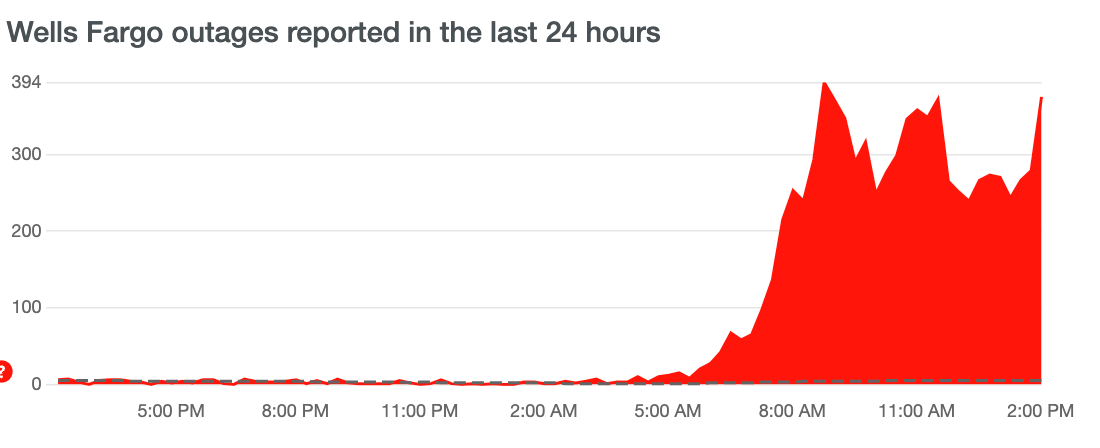
Customers of Wells Fargo, the fourth largest bank in the US by assets, are complaining of missing direct deposit payments and incorrect balances.

The bank has acknowledged the reports which are affecting “some customers,” and is chalking it up to a potential “technical issue.”

“We are working quickly on a resolution and apologize for the inconvenience. Customers’ accounts continue to be secure,” the company added.

According to Downdetector, a spike in reported Wells Fargo outages began just after 5 a.m.

A Wells Fargo customer shared this screenshot of their online banking account in the negative after a direct deposit disappeared from their account on March 10, 2023. (source WFAA)

That’s comforting…

Tyler Durden
Fri, 03/10/2023 – 14:33