82 F
Chicago
Saturday, August 8, 2026
Home Blog Page 3894

Tulsi Gabbard: Democrats Are The Party Of Division, Authoritarianism, & War

Tulsi Gabbard: Democrats Are The Party Of Division, Authoritarianism, & War

Authored by Liam Cosgrove via The Epoch Times,

Democrats are funding a dangerous war in Ukraine, stifling ideological dissent, and polarizing this country.

That was the message from former Democratic presidential candidate Tulsi Gabbard, speaking on the final day of CPAC.

The former congresswoman took shots at radical gender ideology and accused President Joe Biden of stoking racial tensions by embracing identity politics.

She accused Biden of “fanning the flames of divisiveness.”

“They reduce each of us to the color of our skin,” Gabbard said in her speech, saying the Democrats “have become the racists they claim to hate.”

Gabbard, now a registered independent, denounced her former political party for its reckless armament of Ukraine and warned that the policy of providing lethal aid is bringing the United States to the “brink of nuclear war.”

“They’ve sent now over $100 billion to fuel this proxy war,” she said.

On Friday, Secretary of State Anthony Blinken promised an additional $400 million in weaponry and utility gear to Ukraine, with tensions rising as Ukrainian President Zelenskyy has vowed to use Western arms to retake Russian-occupied Crimea.

Gabbard, a combat veteran who served two tours of duty in Iraq, has long espoused a message of ending “regime change wars” and advocating for a more restrained foreign policy. Many within the Republican Party align with Gabbard’s anti-war sentiments.

After watching Gabbard’s speech, Rep. Matt Gaetz (R-Fla.) told The Epoch Times that he supports her advocacy to end U.S. financial support for the Ukrainian military.

The congressman talked about working closely with Gabbard in the House Armed Services Committee and butting heads with the pro-war “so-called national security experts,” as he called them.

“I think we need a focused foreign policy based in realism, not fantastical dreams of turning countries like Syria into Jeffersonian democracies,” he said.

“I want a strong, well-funded, highly capable military that we rarely use.”

On the topic of gender, Gabbard called out progressives for rejecting “the fact that there is such a thing as a woman.”

“All the ladies can attest here that we are in fact real,” she said, adding that Democrats are confusing fiction with reality.

“Truth becomes whatever those in power say it is at any given time.”

After dropping out of the presidential race, Gabbard declined to seek reelection to Congress and has since focused on activism and public speaking.

Her political future remains uncertain, but Gabbard’s unique blend of progressive and non-interventionist views continues to make her a fascinating figure in American politics.

Tyler Durden
Sun, 03/05/2023 – 22:30

Bump Stocks Return To Store Shelves In These Three States

Bump Stocks Return To Store Shelves In These Three States

Following the Fifth Circuit Court of Appeals’ decision to invalidate the Bureau of Alcohol, Tobacco, Firearms and Explosives’ administrative ban on bump stocks, the Department of Justice was given until last Monday to challenge the ruling before the Supreme Court. However, since the DOJ did not take any action, the Fifth Circuit’s order became effective, which allowed three states, Texas, Louisiana, and Mississippi, to begin selling bump stocks once again. 

Michael Cargill, the owner of Austin’s Central Texas Gun Works, sued to challenge the ban in 2019 with New Civil Liberties Alliance, a litigation group that says it protects constitutional freedoms, including Second Amendment rights. 

They lost in federal court in Austin, and before a three-judge panel of the 5th Circuit, one of the country’s most conservative courts. 

Victory came after another hearing, this time before the full 5th Circuit. —The Dallas Morning News

The DOJ had until Monday to appeal the decision to the Supreme Court but let the deadline pass.

“Bump Stocks are now legal in TEXAS, LOUISIANA & MISSISSIPPI,” Cargill tweeted last week.

Cargill said his store plans to sell bump stocks soon. He said the retail price would be around $249, about 15% higher than pre-ban prices, primarily due to higher commodity, labor, and transportation costs. 

The ATF can still enforce the bump stock ban outside Texas, Louisiana, and Mississippi. 

“Essentially, the ATF is prevented from enforcing the rule for the time being in these three states,” South Texas College of Law professor Dru Stevenson said. 

As to why the DOJ didn’t ask the Supreme Court to consider the issue… Keeping the case in the Fifth Circuit’s jurisdiction would prevent the Supreme Court from agreeing with Cargill and overturning the ban nationwide. 

Tyler Durden
Sun, 03/05/2023 – 22:00

Capitol Police, FBI Failed To Share “Credible Threats” Before Jan. 6 Breach: Watchdog

Capitol Police, FBI Failed To Share “Credible Threats” Before Jan. 6 Breach: Watchdog

Authored by Zachary Stieber via The Epoch Times,

FBI agents and U.S. Capitol Police officers identified “credible threats” ahead of the Jan. 6, 2021, electoral vote certification but did not properly disseminate the intelligence, a watchdog says in a new report.

The FBI obtained information from human informants, social media, and other agencies and tracked suspected domestic terrorists traveling to Washington, according to the U.S. Government Accountability Office (GAO) report (pdf).

Capitol Police officials examined information developed from arrests and investigations, as well as open sources, and distributed a document three days before Jan. 6 that conveyed a subject of an investigation had said militia members planned to attend a Jan. 6 demonstration while armed, which would violate Washington law.

Both agencies assessed threats for credibility and reported that some of the threats were deemed credible.

But both failed to properly adhere to policies for processing or sharing information, the watchdog found.

FBI agents in San Antonio, Texas, for instance, received tips from the social media company Parler but did not develop reports based on the tips, as required.

“FBI officials noted that the FBI San Antonio Field Office did not develop any related reports on January 6 events as required by policy, such as Guardians, situational information reports, or intelligence information reports but did not indicate why not,” GAO said.

Such reports are distributed to state, local, and tribal law enforcement partners.

A U.S. Capitol Police officer monitors the crowd atop the east Rotunda steps on Jan. 6, 2021. (Bobby Powell/Special to The Epoch Times)

Rep. Ralph Norman (R-S.C.) said on “Just the News, No Noise” that the FBI “had a blueprint for what was going to happen, and they didn’t think about it and look at the consequences.”

The FBI did develop some reports, which it shared with partners, the GAO report noted.

‘Relevant Threat Information’ Omitted

Capitol Police officials, meanwhile, left out “relevant threat information” it received from other agencies in documents developed for Jan. 6, according to GAO.

“Capitol Police identified potential violence that could occur on January 6 in Washington, D.C. in advance of planned events. However, it did not consistently incorporate complete information into assessments of threats in its threat products, such as information obtained from other agencies regarding an individual traveling to Washington, D.C. to engage in violence at January 6 events,” the report said.

One example of information left out was a suspicious activity report from Washington Homeland Security officials that indicated an individual planned to travel to the nation’s capitol to engage in violence during Jan. 6 protests.

Capitol Police officials also failed to update a threat product to include important information, including information indicating violence might occur during the demonstrations, and did not consistently share relevant details across its agency, “resulting in some officers, agents and intelligence staff not having complete information,” the report stated.

Eight other agencies, including the National Park Service and the Secret Service, examined by GAO received information, but they either did not assess threats for credibility or did not identify any of the threats as credible.

The Department of Homeland Security Office of Intelligence & Analysis (DHS I&A) did not assess any reports or identify any credible threats before the department’s team charged with collecting information from open sources “did not share reports on January 6 open source threats with other DHS I&A divisions until after the Capitol attack occurred,” according to the watchdog.

Police officers set up barricades outside of the U.S. Capitol in Washington on Jan. 6, 2021. (Andrew Caballero-Reynolds/AFP via Getty Images)

DHS I&A also failed to share information with the Capitol Police “in a timely manner,” GAO said.

GAO made 10 recommendations, including advising FBI Director Christopher Wray, a Trump appointee, to assess why personnel did not adhere to policy in processing information related to Jan. 6 and, after an assessment, implement a plan for fixing what went wrong.

FBI Takes Note

Many of the agencies, including the FBI, agreed with the recommendations.

“We appreciate the GAO’s extensive fact gathering and thorough analysis in the report,” adding that “we will incorporate GAO’s conclusion that, despite collecting and sharing significant pieces of threat reporting, the FBI did not process all relevant information related to potential violence on January 6,” Larissa Knapp, an FBI official, said in a response to GAO.

“Our goal is always to disrupt and stay ahead of the threat, and we are constantly trying to learn and evaluate what we could have done better or differently, this is especially true of the attack on the Capitol,” Knapp also said.

The FBI declined to comment beyond Knapp’s letter. The Capitol Police and DHS did not respond to requests for comment.

U.S. Capitol Police Chief Thomas Manger told GAO that it is taking steps to implement the watchdog’s recommendation that the Capitol Police Board should establish policies for sharing information on possible threats across the agency.

Manger said the department is drafting policy that “will provide guidance for sharing threat-related information agency-wide.”

GAO previously concluded that DHS should have designated the Jan. 6 demonstrations as special, which would have triggered heightened security.

Another previous report found that many agencies were aware of open source, or publicly available, information on potential violence planned for Jan. 6.


Tyler Durden
Sun, 03/05/2023 – 21:30

Japan’s Population In Freefall As Twice As Many People Die As Are Born

Japan’s Population In Freefall As Twice As Many People Die As Are Born

Japan’s population is in freefall.

In 2022, the number of births registered in Japan plummeted to another record low last year according to statistics released by the Ministry of Health – the latest worrying statistic in a decades-long decline that the country’s authorities have failed to reverse despite their extensive efforts.

The country saw just 799,728 births in 2022 – the lowest number on record and the first ever dip below 800,000 – and about half of the number of deaths, which  at more than 1.58 million, was a record high. The number of births in Japan has nearly halved in the past 40 years: in 1982, Japan recorded more than 1.5 million births, a number which was then more than double the number of deaths. This ratio has since reversed.

As shown in the chart above, deaths have outpaced births in Japan for the past 15 years – a trend which is unlikely to reverse ever again – posing an existential problem for the (aged) leaders of the world’s third-largest economy. They now face a ballooning elderly population, along with a shrinking workforce to fund pensions and health care as demand from the aging population surges.

Japan’s population has been in steady decline since its economic boom of the 1980s and stood at 125.5 million in 2021, according to the most recent government figures.

According to CNN, Japan’s fertility rate of 1.3 is far below the rate of 2.1 required to maintain a stable population, in the absence of immigration.

The country also has one of the highest life expectancies in the world; in 2020, nearly one in 1,500 people in Japan were age 100 or older, according to government data.

These concerning trends prompted a warning in January from Prime Minister Fumio Kishida that Japan is “on the brink of not being able to maintain social functions.”

“In thinking of the sustainability and inclusiveness of our nation’s economy and society, we place child-rearing support as our most important policy,” he said, adding that Japan “simply cannot wait any longer” in solving the problem of its low birth rate.

A new government agency will be set up in April to focus on the issue, with PM Kishida saying in January that he wants the government to double its spending on child-related programs. But money alone might not be able to solve the multi-pronged problem, with various social factors contributing to the low birth rate.

Japan’s high cost of living, limited space and lack of child care support in cities make it difficult to raise children, meaning fewer couples are having kids. Urban couples are also often far from extended family in other regions, who could help provide support.

In 2022, Japan was ranked one of the world’s most expensive places to raise a child, according to research from financial institution Jefferies. And yet, the country’s economy has stalled since the early 1990s, meaning frustratingly low wages and little upward mobility: the average real annual household income declined from 6.59 million yen ($50,600) in 1995 to 5.64 million yen ($43,300) in 2020, according to 2021 data from the Ministry of Health, Labor and Welfare.

Attitudes toward marriage and starting families have also shifted in recent years, with more couples putting off both during the pandemic — and young people feeling increasingly pessimistic about the future.

In 2022, Japan was ranked one of the world’s most expensive places to raise a child, according to research from financial institution Jefferies. And yet, the country’s economy has stalled since the early 1990s, meaning frustratingly low wages and little upward mobility.

The average real annual household income declined from 6.59 million yen ($50,600) in 1995 to 5.64 million yen ($43,300) in 2020, according to 2021 data from the Ministry of Health, Labor and Welfare.

Attitudes toward marriage and starting families have also shifted in recent years, with more couples putting off both during the pandemic — and young people feeling increasingly pessimistic about the future. Who can blame them for not feeling frisky.

It’s a familiar story throughout East Asia, where South Korea’s fertility rate — already the world’s lowest — dropped yet again last year in the latest setback to the country’s efforts to boost its declining population.

Meanwhile, in January China just lost its title as the world’s most populous country to India after its population shrank in 2022 for the first time since the 1960s.

Tyler Durden
Sun, 03/05/2023 – 21:00

A Long Idea From One Of Wall Street’s Biggest Bears

A Long Idea From One Of Wall Street’s Biggest Bears

By Russell Clark, author of the Capital Flows and Asset Markets substack, and former CIO of the (very bearish) Horseman Global hedge fund.

In previous posts, I have tried to talk about how I used to manage money using a 3M process – Macro, Micro and Market. In essence I was looking for a macro change, that was supported by underlying industry data (micro) and confirmed by market trends, particularly technicals. The biggest macro trend I paid attention to was currency, which I had seen be the least understood factor in investing in my career. This stopped working in 2016, with Brexit, China and Trump, making politics far more important than macro. It took me a long time to accept that politics is more important than macro, but now that it has, my investing process is improving. I have had to rename it 4M – with the additional M is motivation, which is another way of saying politics. Paid subscribers will be aware of the ideas I have already pitched.

On the long side, I like Occidental for its commodity exposure and long term option on Direct Air Capture technology. I also like Japanese banks as an aggressive inflation trade. On the short side, I still like TLT, McDonalds, and residential REITS. All of this ideas are driven by the view that inflation is political, and the politics is now towards raising real wages. This means you have inflation, AND, tight financial conditions to protect those wage increase.

One of the ideas I have been toying with has been driven by politics, or the Motivation (the first M). One of the key ideas is that rising wages tends to push up the price of food. In a world of rising wages, food prices should rise.

This surge in food inflation is driven by China getting wealthy, more than anything else. The success of China in driving wages higher relative to other Asian nations that industrialized earlier is truly staggering. In a pro-capital world, China would have been expected to devalue to regain competitiveness, but China has obviously chosen to promote higher wages. When economist talk about China exporting inflation, what they mean is that Chinese policy has successfully raised wages – and in stark contrast to the experience of other Asian nations.

The combination of rising food prices makes me like food related companies, particularly companies that own or control farm land. Russia’s invasion of Ukraine also made me like the look of agricultural commodities that Ukraine has a large market share of exports – namely sunflower oil. In the traded vegetable oil market, palm oil dominates, with sunflower oil and soybean oil following.

Vegetable oil imports is one commodity that India imports more than China, making its demand outlook more robust than industrial commodities.

As it happens, supply of sunflower oil was better than expected, and inventory of crude palm oil has been larger than expected. This had lead palm oil to trade at a discount to soy.

Crude palm oil production and exports are dominated by two countries, Indonesia and Malaysia. The largest plantation owner is Singapore listed Wilmar International.

There are two things that attract me to Wilmar. Firstly, when they export palm oil to both China and India, they have built a local brand of vegetable oil as a consumer business. This has a much higher value than the plantation business, which they have attempted to monetize by listing a 10% stake in their Chinese consumer business in Shanghai. The value of their stake in Kerry Arwana has consistently been higher than Wilmar’s market cap.

The other thing that gets me very excited about Wilmar is that they have begun to expand into Africa. Still small, but this is much large than any other listed crude palm operators in Arica. Nigeria is now a a larger consumer of palm oil than the US, and has been growing rapidly. Palm oil originated in West Africa, before being introduced to Malaysia and Indonesia, so offers an attractive way to play growing African consumption.

Wilmar has a track record of building good consumer businesses, even in notoriously difficult markets like China and India.

Wilmar trades below book value with a 4% dividend yield. Why so cheap? I can give a lot of reasons, ranging from claims that palm oil cultivation destroys the environment, to the fact that other Singaporean commodity trading stocks, Noble and Olam ended up in financial trouble, and delisted. Against that, US listed trader, Archer Daniels Midland owns 25% of Wilmar. Wilmar faces the same headwinds of rising interest rates, but a cheap valuation with a long dated call option on African consumption sounds pretty good to me. Full discloser – I have a long position.

Tyler Durden
Sun, 03/05/2023 – 20:30

With Tuesday Pot Legalization Vote, OK Poised To Rake In Texans’ Money

With Tuesday Pot Legalization Vote, OK Poised To Rake In Texans’ Money

Tuesday may bring a major milestone in America’s relentless march toward marijuana legalization, as Oklahoma will likely become the most conservative state so far to approve recreational use of the plant. Trump carried the state by a 33% margin in 2020. 

Oklahomans will consider State Question 820, which offers a chance to legalize consumption by adults 21 and older — along with their possession of up to an ounce — and grant Okies the freedom to grow six mature plants and six seedlings for their own use.

A 15% tax would be imposed on sales, with proceeds flowing to student services, drug addiction programs, courts, local government and the state’s general fund. 

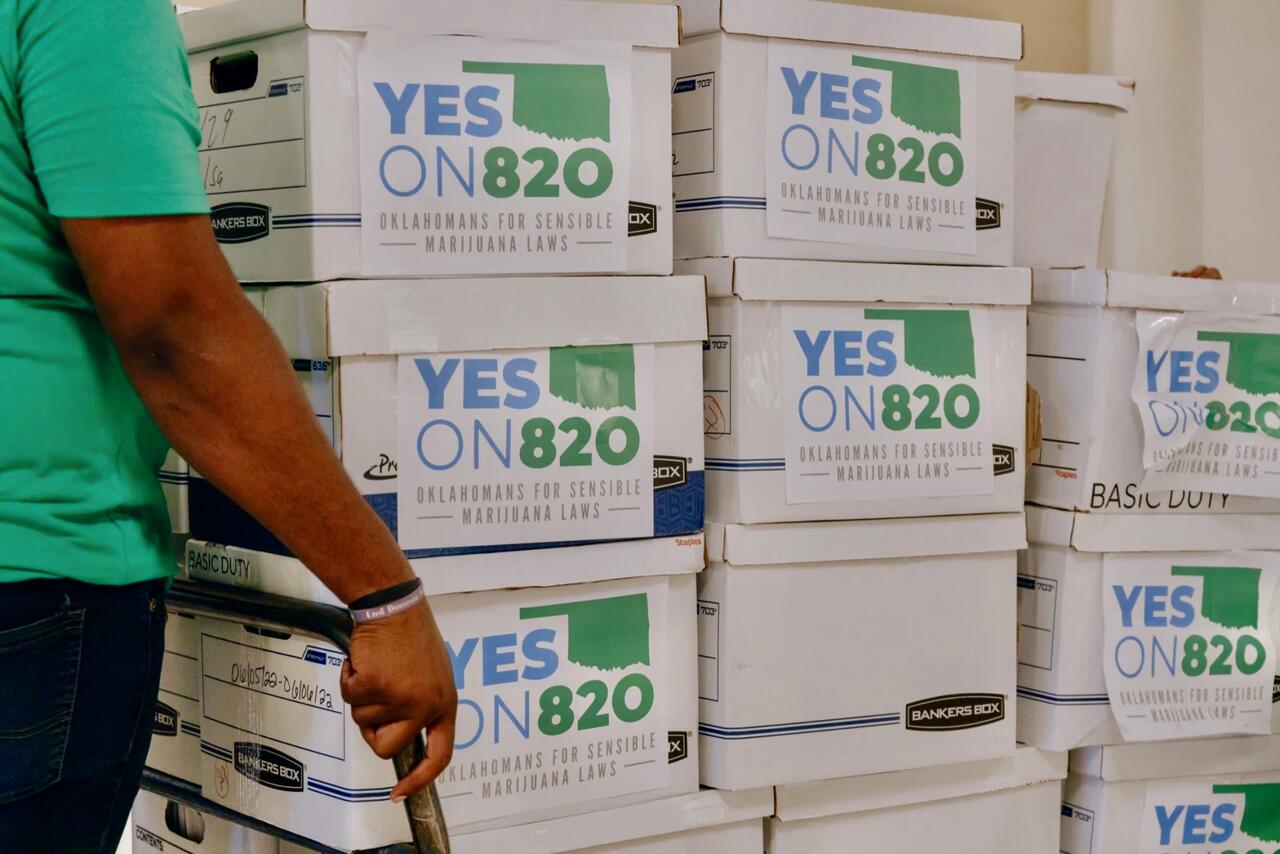
Backers of State Question 820 deliver petition signatures to Oklahoma’s Secretary of State in July (Yes on 820 Campaign)

With approval, Oklahoma stands to rake in tax revenue from Texans expected to cross the border to take a break from the Lone Star State’s stubborn nanny-state tyranny. Ryan Kiesel, a former Oklahoma state legislator and current legalization advocate told AP:  

“There are thousands and thousands of Texans who are increasingly coming to Oklahoma as a tourist destination. I want to be able to sell legal, regulated and taxed marijuana to those Texans over the age of 21, and take their tax dollars and invest them in Oklahoma schools and Oklahoma health care.”

Nearly 8 million people live in Dallas-Fort Worth, which is almost twice as many as live in all of Oklahoma.

Oklahoma is a standout with one of the country’s most relaxed medical marijuana regimes. About one in ten adults in the state holds a medical license. In contrast to most states that allow medical use, Oklahoma has no list of qualifying conditions and patients can receive a doctor’s recommendation over the internet. 

Okie cannabis growers are desperate to expand their market: The state’s medical marijuana market is so relatively free that low barriers to entry have sent prices into a nose-dive, with one retailer telling AP the price of a 1-gram cartridge of concentrate has collapsed from $60 to $70 in 2019 to just $20 today. 

The last public poll on the proposal — taken way back in October — had voters approving recreational legalization, 49% to 38%. The question was originally slated to appear on the November 2022 midterm ballot, but a delay in verifying petition signatures led to it being moved to March 7.

In 2018, the ballot measure to allow medical use was approved 56% to 43%. The wild card in Tuesday’s election is turnout, as SQ820 is the only statewide measure on the ballot.  

Yes on 820‘s Michelle Tilley told NonDoc that her team is feeling “pretty good” about their chances:

“I think what resonates with people is compassion for other human beings with the criminal justice reform, and I think the revenue piece is also something people have been excited about.”

The Oklahoma Sheriff’s Association opposes the measure, but plenty of cops are ready to stop wasting time and resources punishing adults who choose to intoxicate themselves with a plant nobody’s ever overdosed from.  

Tyler Durden
Sun, 03/05/2023 – 20:00

Russia’s Oil Revenues Plunged By 48% In February

Russia’s Oil Revenues Plunged By 48% In February

By Charles Kennedy of OilPrice.com,

Russian tax revenue from crude oil and petroleum products plummeted by 48% in February from a year earlier due to the much lower price of Russia’s flagship crude grade after the EU banned imports of Russian oil, according to Bloomberg estimates based on official Russian data.

Total tax revenues from oil and natural gas dipped by 46% year over year to $6.9 billion (521 billion Russian rubles) in February, per data from the Russian Finance Ministry published on Friday.

Russia’s revenues from crude oil and oil products alone crumbled by 48% annually to $4.8 billion (361 billion rubles), according to Bloomberg’s calculations. Oil accounted for more than two-thirds of Russia’s energy tax revenue in February.

Russian natural gas revenues also plummeted last month compared to February 2022, when Russia invaded Ukraine. Natural gas revenues slumped by 42% as Russia cut off gas supplies to a number of EU customers after the invasion. 

The plunge in the price of the flagship Russian crude grade, Urals, was the key reason for the lower revenues for the country for both January and February this year.

Russia’s budget was $23.3 billion (1.76 trillion rubles) into deficit in January, compared to a surplus for January 2022, as state revenues from oil and gas plunged by 46.4% due to the low price of Urals and lower natural gas exports, the Russian Finance Ministry said last month. Russia’s budget revenues from oil and gas plunged in January by 46% compared to the same month last year due to the sanctions on Russian oil exports, which led to a slump in the price of Russia’s flagship crude grade.

The average price of the Urals blend stood at $49.52 per barrel in January and February 2023, compared to $88.89 per barrel for the same months last year, the Russian Finance Ministry said earlier this week. The price of Urals averaged $49.56 a barrel in February 2023, or 1.86 times lower than the average price in February 2022 – $92.15 per barrel.    

Tyler Durden
Sun, 03/05/2023 – 19:30

Communities Block, Ban Dollar Stores Amid Nationwide Invasion

Communities Block, Ban Dollar Stores Amid Nationwide Invasion

Recall Dollar General, Dollar Tree, and Family Dollar stores are invading low-income communities nationwide. At the start of 2022, all three discount retailers operated 34,000 US stores, more than Mcdonald’s, Starbucks, Target, and Walmart combined. Now there’s a wave of grassroots opposition in cities and towns blocking these chains from opening new stores. 

According to a new report published by the Institute for Local Self-Reliance, a nonprofit organization and advocacy group focused on sustainable local economies, at least 75 communities blocked proposed dollar stores, with more than 50 of those denials occurring between January 2021 and the end of 2022. 

ISLR continued:

At least 54 cities and towns — including Birmingham, Ala.; Fort Worth, Texas; Kansas City, Kan.; and Plainview, Neb. — have gone further. They’ve enacted laws that sharply restrict new dollar stores, typically by barring them from opening within one to two miles of an existing dollar store

At least one town, Stonecrest, Ga., has imposed a total ban on new dollar stores. These laws are often adopted in conjunction with measures designed to support the retention and development of grocery stores.

These discounted retailers are rapidly expanding their presence across the country, targeting low-income communities with cheap Chinese-made products and unhealthy food.

A town in eastern Kentucky, with a population of 1,600, was recently overrun by a ‘dollar store mania.’ Given the low incomes and inexpensive land around Olive Hill, it makes sense why dollar stores are flooding the small town to take advantage of poor residents.

An Olive Hill resident told Daily Mail last month:

It seems like there’s a dollar store every few feet.” 

Source: Daily Mail

The proliferation of new dollar stores shows no signs of slowing down. “Communities need reinforcements to stop the encroachment of dollar stores. They need action at the federal level, where a negligent approach to antitrust has allowed Dollar General and Dollar Tree to flex their market power unfairly and overrun their less powerful competitors, especially independent grocery stores,” the report said. 

Make local grocery stores and farms thrive again as small towns need an economic revival.  

Tyler Durden
Sun, 03/05/2023 – 19:00

US Begins ‘Training Assessment’ For Ukrainian Pilots On F-16s

US Begins ‘Training Assessment’ For Ukrainian Pilots On F-16s

The White House has so far ruled out calls to provide the Ukrainian government with F-16 fighter jets, but clearly the idea is still on the table and Biden may be close to pulling the trigger amid intense administration discussions.

“Two Ukrainian pilots are currently in the United States undergoing an assessment to determine how long it could take to train them to fly attack aircraft, including F-16 fighter jets, according to two congressional officials and a senior U.S. official,” a weekend NBC report indicates.

“The Ukrainians’ skills are being evaluated on simulators at a U.S. military base in Tucson, Arizona, the officials said, and they may be joined by more of their fellow pilots soon,” the report continues.

Source: Shutterstock

The officials additionally said 10 more Ukrainian pilots are expected to join the program soon, and they may arrive in the US this month.

The officials emphasized that this does not yet constitute a fighter jet training program for Ukrainian pilots, and that actual aircraft will not be flown – only the advanced flight simulators. But clearly if F-16s are approved, this will form the basis of formal training on the jets.

One of the main reasons for the hold-up in approving jets for Ukraine, apart from the fact that Russia is vowing severe and unpredictable escalation, is the significant time investment of the training, which could take at least a year or years.

Colin Kahl, defense undersecretary for policy, recently told the House Armed Services Committee that the US has “not started training on F-16s” and that the delivery timeline is about 18 months. The training program for F-16s also happens to be about 18 months.

“So you don’t actually save yourself time by starting the training early in our assessment,” said Kahl. “And since we haven’t made the decision to provide F-16’s and neither have our allies and partners, it doesn’t make sense to start to train them on a system they may never get.”

So by all accounts, even if the Biden administration were to approve jets for Ukraine tomorrow, it could take years before they are piloted by Ukrainians in the skies of the conflict. 

Tyler Durden
Sun, 03/05/2023 – 18:00

“Most Important Discovery In 21st Century”: Archeologists Find Hidden Corridor In Great Pyramid Of Giza

“Most Important Discovery In 21st Century”: Archeologists Find Hidden Corridor In Great Pyramid Of Giza

Humans have spent centuries, if not longer, attempting to unlock the secrets of the 4,500-year-old Great Pyramids at Giza, located just outside of Cairo. But with modern cosmic ray scanning technology, archaeologists have discovered a hidden passageway, Reuters reported. 

Mostafa Waziri, head of Egypt’s Supreme Council of Antiquities, announced the discovery of the 30 feet in length and 6 feet wide corridor near the main entrance of the Pyramid of Khufu after a tiny snake camera was inserted through a crack. Speculation about the cavity behind the opening was first revealed via cosmic ray mapping in 2016.

Waziri told reporters that the unfinished corridor was constructed to distribute the pyramid’s weight around the main entrance, which is now being used by tourists about 21 feet away. There’s the belief another chamber could lie beneath it. 

“We’re going to continue our scanning so we will see what we can do … to figure out what we can find out beneath it, or just by the end of this corridor,” he said. 

Former Egyptian Antiquities Minister Zahi Hawass commented on the discovery of the secret passage:

“This discovery, in my opinion, is the most important discovery in the 21st century.”

As part of the Scan Pyramids project initiated in 2015, cosmic-ray mapping was utilized to uncover the mysteries within the seventh wonder of the ancient world. 

Tyler Durden
Sun, 03/05/2023 – 17:00