87.3 F
Chicago
Friday, August 7, 2026
Home Blog Page 3898

Russia Suspended New START Because Of Attacks On Strategic Sites

Russia Suspended New START Because Of Attacks On Strategic Sites

Authored by Dave DeCamp via AntiWar.com,

Russian Deputy Foreign Minister Sergey Ryabkov said Thursday that one of the reasons Moscow suspended its participation in the New START treaty was because the US helped Ukraine attack a facility housing Russian nuclear weapons.

New START is the last nuclear arms control treaty between the US and Russia and limits the deployment of warheads and launchers, including heavy bombers assigned to nuclear missions. Ryabkov said Ukraine launched an attack on facilities declared under New START.

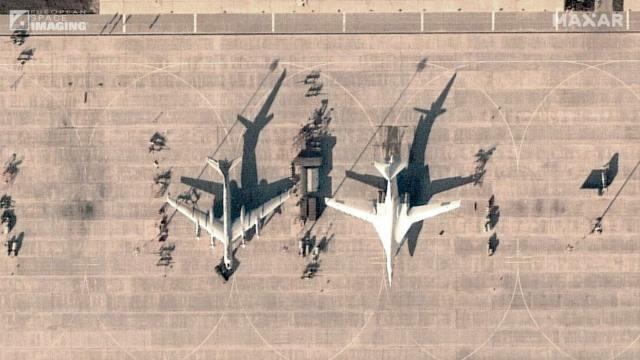
Aftermath of a Ukrainian drone attack on Russia’s Engels air base.

“The situation was further escalated by US attempts to probe the security of Russian strategic facilities declared under New START by helping the Kiev regime to carry out armed attacks on them,” he told the Conference on Disarmament in Geneva.

In December, Ukrainian drones targeted the Engels airfield, a base deep inside Russian territory that houses Russian strategic bombers that are capable of carrying nuclear warheads, although it’s not clear if they were at the time. 

NATO military sources told Asia Times that Ukraine employed drones in the attack on Engels and another airfield that used US satellite GPS data to hit their targets.

Ryabkov said Ukraine wouldn’t be able to target Russian infrastructure without help from the US. “We know that those attacks would never be possible in absence of a very deep and sophisticated assistance by the US to the Ukrainian military,” he said.

The Russian diplomat said that even though Russia suspended its participation in New START, it would still keep its nuclear deployments within the limits of the treaty.

“Under these circumstances, we were forced to announce the suspension of the New START Treaty. At the same time, as it has already been stated, we will continue to adhere to the quantitative restrictions enshrined in New START,” he said.

Ryabkov also warned that US support for Ukraine could lead to a direct clash between nuclear powers. He said the US and NATO’s “increasing involvement in the military confrontation is fraught with a direct military clash of nuclear powers with catastrophic consequences.”

Tyler Durden
Sat, 03/04/2023 – 12:30

First-Time Homebuyers Are Absolutely Screwed Right Now

First-Time Homebuyers Are Absolutely Screwed Right Now

Despite a recent softening in the US housing market, a combination of rising borrowing costs and still-high prices have put prospective first-time homebuyers in a serious bind.

How times have changed…

For the first time since records began, first-time homebuyers made up the smallest share of sales last year at 26%. And as we noted on Thursday, a surge in mortgage rates above 7% have sent homebuyer applications to a 28-year-low across all age groups.

Now, as the spring homebuying season approaches, tight inventory and uncomfortably high interest rates mean that the American dream can only be achieved by those with high-paying jobs, lots of money, or rich parents, Bloomberg reports.

The average rate for a 30-year, fixed mortgage climbed for a fourth straight week, reaching 6.65%, Freddie Mac data released Thursday show.

The difficulties for first-time buyers have been escalating for years. During the pandemic boom, they were frequently squeezed out as they competed against people with cash and investors who frequently target starter homes. The typical household income for first-time buyers soared to as much as $90,000 in 2022 from about $70,000 in 2019. -Bloomberg

We’re far from affordability for the masses,” according to Zillow senior economist, Nicole Bachaud. “The scales are shifted toward homebuyers with higher incomes and a better financial background. This will be the norm until we get more inventory in the market.”

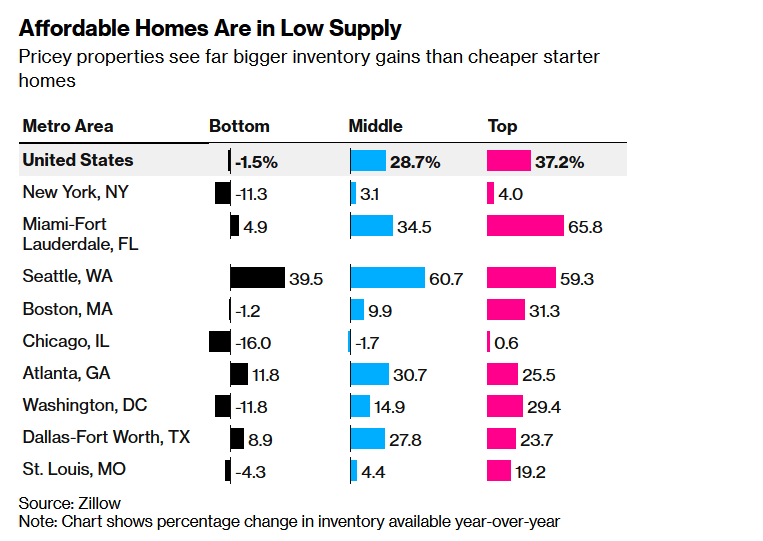
When mortgage rates hit 7% towards the end of 2022, Zillow predicted that it would take around 10 years for an individual saving 5% of the median household every month to set aside enough for a 10% down payment on a typical home (and are banks even taking 10% down?). What’s more, supply of entry-level housing remains tight, with the inventory of America’s cheapest properties down 1.5% in January vs. the same time last year, while supply for the most-expensive properties jumped 37%.

Also submitted for your consideration – 99% of outstanding mortgages have interest rates below the Primary Mortgage Market Survey. People bought and refinanced when rates were low, while new applications have essentially crashed as illustrated above.

Lowered expectations

Bloomberg highlights the plight of Rob and Kelsey Scott, a Seattle couple who have a combined income of $200,000, and were able to save $70,000 toward a down payment on a house. After the surge in mortgage rates, the Scotts had to lower their budget from $800,000. They ended up buying a two-bedroom house in a ‘quaint’ neighborhood for $700,000.

Rob and Kelsey Scott with cat child bought their first home in November

“If we compared ourselves to our parents who bought in their late 20s, we felt like we were behind. But if we look around today, we’re on track,” said 35-year-old Rob. “Where we were workwise as a couple is the only reason we’re in a house.”

Meanwhile, the median age of first-time buyers has jumped from 29 in 1981 to 36 in 2022, the oldest in the National Association of Realtors’ records – and is due to the fact that home prices have far outpaced wages, according to Zillow chief economist Skylar Olsen.

Rich kids win again

Even before the pandemic, around 1/3 of first-time homebuyers tapped rich parents or family members for a gift or loan to cover at least part of their down payment, Zillow’s Olson says. That increased to around 40% in 2021, while the percentage of young adult buyers with a co-borrower over the age of 55 has spiked since 2021, Freddic Mac reported.

Source: Freddie Mac

I don’t know how anyone could afford a home on their own at my age,” said Maddie Duleyrie, 29, who was only able to buy a condo in New York City thanks to help from her parents, despite being “fortunate to have a well-paying job.”

Kimberly Jay, the Duleyrie family’s real estate broker, said “I see some parents giving gifts for the full price of a million-dollar property.”

“This is a city with wealthy people.”

Even in Dallas, Texas, at least half of young first-time homebuyers are getting help from their families, according to real estate agent Connie Segovia, who says that most are receiving the entire minimum down payment from such sources.

Others simply have to make due with less.

Ashley Shipp-McGhee didn’t just want to buy her first house — she urgently needed more space after adopting her late aunt’s two children. The 39-year-old nurse started her search in December 2021 in the Illinois suburbs north of St. Louis, with a $260,000 budget.

Nearly one year and 30 houses viewed later, she finally landed a place for $256,000, a higher price than she had hoped.

She used an escalation clause to pay $1,000 over competing offers, waived the inspection and paid all the closing costs. She felt “uncomfortable” with her monthly mortgage payments after she was preapproved for 2.9% at the beginning of her hunt, only to close on the home at 6.4%. But she’s holding on to hope that she can refinance down the line if rates go down. -Bloomberg

Thanks to higher interest rates, a buyer purchasing a $400,000 home with 20% down on a 30-year fixed loan, the monthly payment, including principal and interest, is now roughly $230 a month more than it would have been a month ago. Compared with a year ago, when rates were in the 4% range, today’s monthly payment is about 50% higher, according to CNBC’s Diana Olick.

Good luck out there…

Tyler Durden
Sat, 03/04/2023 – 12:00

Feinstein, Fetterman Hospitalizations May Mean Trouble For Democrats

Feinstein, Fetterman Hospitalizations May Mean Trouble For Democrats

Authored by Jack Phillips via The Epoch Times (emphasis ours),

Senate Democrats have little room for error after Sen. Dianne Feinstein (D-Calif.) announced she was hospitalized with shingles on Thursday and amid Sen. John Fetterman’s (D-Penn.) ongoing treatment for clinical depression.

Sen. Dianne Feinstein (D-Calif.) is seen speaking on Capitol Hill in Washington on May 5, 2020, and Sen. John Fetterman (D-Pa.)is seen at Belmont Water Treatment Center in Philadelphia on Feb. 3, 2023. (Andrew Harnik/ AP Photo; Andrew Caballero-Reynolds/AFP via Getty Images)

On Thursday, Feinstein, 89, said she was hospitalized with the virus and won’t return until “later this month,” while Fetterman, 53, was hospitalized at Walter Reed National Military Medical Center to treat clinical depression last month. It’s not clear when Fetterman will be released.

Two other senators this week missed votes, including Sen. Jeff Merkley (D-Ore.) and Sen. Mike Crapo (R-Ind.) Merkeley said in a statement that he is in Oregon to deal with a “family matter,” while Crapo reportedly is suffering from illness.

Because of absences this week, the Senate is deadlocked at 48–48, forcing Vice President Kamala Harris to cast tie-breaking votes for Democrats. When Crapo and Merkley return, the Senate will be tied at 49–49.

With no time-table provided for either Fetterman’s or Feinstein’s respective returns to the Senate, some analysts say that Democrats could face problems when trying to confirm President Joe Biden’s nominees.

This week, the Senate voted 49–48 in favor of one of Biden’s judicial picks, Margaret Guzman, and also voted 49–48 to confirm Araceli Martinez-Olguin to serve as a federal judge in the Northern District of California.

Slim majorities are always challenging, but especially so in today’s Senate,” Sarah Binder, political science professor at George Washington University’s Columbian College of Arts and Science, told Newsweek on Thursday. “There are not many legislative measures on tap in the Senate, but Democrats will feel the pinch of a tied Senate whenever they try to confirm a controversial nominee.”

“In those cases, Democrats will need Vice President Harris back in the chair to break a tied vote to cut off debate on a confirmation vote,” Binder added. “That might slightly slow down Democrats and encourage them to focus on nominees who have some support from across the aisle.”

In an interview with Fox News, strategist Doug Heye said that “the danger of having such a small majority is that one or two illnesses can bring things to a halt,” noting the White House “has been aggressive and effective on judicial nominees, but that’s all on hold for now.”

Read more here…

Tyler Durden
Sat, 03/04/2023 – 11:30

‘Triple-Digit’ La Nina Ending As El Nino May Strike Soon

‘Triple-Digit’ La Nina Ending As El Nino May Strike Soon

On Wednesday, the World Meteorological Organization reported that a ‘triple-digit’ La Nina weather phenomenon, which caused severe droughts and floods, is finally ending. Nonetheless, the probability of an El Nino occurring is increasing and could affect global weather patterns.

Severe Weather Europe provides an in-depth forecast of one of the most important weather changes in years: 

La Nina is over, and an El Nino event is forecasted to begin this Summer. An El Nino event can completely change the weather patterns in the upcoming seasons, especially during the late Fall and Winter seasons, so this will likely be one of the biggest global events in 2023.

Ocean anomalies and especially their changes can significantly influence seasonal weather patterns. Perhaps even more so in Winter, when the pressure systems are strongest.

First, we will look at why these ocean anomalies affect global weather on a large scale. Then we will look at how and when El Nino will emerge and how it can influence the Winter season of 2023/2024 based on historical data.

OCEAN-ATMOSPHERE WEATHER RELATIONS 

El Nino and La Nina are two phases of the ENSO, which stands for “El Niño Southern Oscillation.” This is a region of the equatorial Pacific Ocean that shifts between warm and cold phases. Typically there is a phase change around every 1-3 years.

ENSO significantly influences tropical rainfall, pressure patterns, and the complex energy exchange between the ocean and the atmosphere. As a result, we can observe large-scale pressure changes in the tropics with each developing phase or during its breakdown.

The image below shows the ENSO regions across the tropical Pacific. Regions 3 and 4 expand over the east and west tropical Pacific. The main area combines regions 3 and 4, seen in the image as the Nino 3.4 region.

Each ENSO phase influences the pressure and weather in the tropics differently. This affects the overall global circulation over time, changing the weather patterns worldwide.

A new (cold/warm) phase usually develops between late Summer and early Fall. It then lasts until Spring, but some events can last up to two or three years.

The following image below from NOAA Climate shows the typical circulation during a cold ENSO phase, which is currently on its way out.

Descending air in the eastern Pacific causes high pressure and stable weather. At the same time, the air is rising in the western Pacific, causing frequent thunderstorms, low pressure, and more rainfall.

This way, ENSO strongly impacts the tropical rainfall and pressure patterns, affecting the ocean-atmosphere feedback system. Through this ocean-atmosphere system, the ENSO influences the weather globally.

ATMOSPHERIC CHANGES

The cold ENSO phase is called La Nina, and the warm phase is called El Nino. Besides the ocean temperatures, one of the main differences between the phases is the pressure patterns they develop, seen below as high (H) and low (L) pressure zones.

During an El Nino, the pressure over the tropical Pacific is lower, with more rainfall and storms in this region.

But during a La Nina, the pressure over the equatorial Pacific is higher, creating stable conditions and fewer storms. These pressure changes translate into global circulation over time, affecting seasonal weather over both Hemispheres.

We can observe a global shift in pressure patterns during the emergence of an ENSO phase. But it is usually more influential during the peak of its phase.

But how does ENSO even shift between cold and warm phases? The simplest answer is that it happens because of a complex relationship between pressure, winds, and ocean currents.

Global trade winds usually start or stop a certain ENSO phase by overturning the ocean surface layers and altering the ocean currents. Trade winds are steady and persistent winds, blowing towards (and along) the Equator in both Hemispheres.

But the key here is not just in the winds, as pressure differences drive them. Thus, the ENSO phase directly responds to an atmospheric pressure change called the Southern Oscillation Index (SOI).

The Southern Oscillation Index or SOI represents the difference in air pressure measured at Tahiti (French Polynesia) and Darwin (Australia). The image below shows the location of the two pressure zones important for ENSO.

Positive SOI values mean the pressure over the Tahiti side is higher than over Darwin in Australia. This corresponds to stronger easterly trade winds, supporting La Nina conditions.

But during an El Nino, we see lower pressure in the eastern Pacific, over Tahiti, and higher pressure over Darwin. This produces a negative SOI value and weaker trade winds, which means less ocean surface cooling.

This entire process is much better seen in the video animation below. It shows the ocean temperature anomalies from Summer to Fall and how quickly they can change in the ENSO regions.

ENSO cooling restarted in August as the trade winds intensified. As a result, cold waves developed across the equatorial Pacific as the winds pushed surface waters to the west.

WINTER SEASON 2022/2023 CLOSES

So with La Nina slowly saying goodbye, we will quickly look at its influence on the Winter season.

A strong blocking high-pressure system in the North Pacific is a typical effect of a cold ENSO phase (La Nina). That usually redirects the polar jet stream down over the northern United States. You can see the La Nina winter weather patterns in the image below by NOAA Climate.

The colder air is typically spread over the northwestern United States, the Midwest, and western Canada. Warmer than normal winter weather is found in the southeastern and eastern parts of the United States.

Looking below at the actual 22/23 Winter analysis, you can see a very similar pattern. Colder air focused on western Canada, the northwestern United States, and parts of the Midwest. The rest of the United States ended up warmer than normal. Europe is also warmer than normal, but that is not a direct La Nina-specific pattern.

This is due to the jet stream changes, which you can see reflected in the pressure anomalies below. A high-pressure anomaly extends from the North Pacific and into the polar regions. A low-pressure area was present over the western United States, bringing more unsettled Winter to the west and pumping warm weather into the eastern United States.

Over Europe, we mainly see higher-than-normal pressure anomalies and lower pressure to the southwest. Again, this is something that was indicated in the seasonal forecast models, which had a good idea about this pattern in advance.

What about snowfall? The historical data shows that the jet stream from a La Nina also changes the snowfall potential over North America as the pressure systems take a different path.

The colder air is more easily accessible to the northern United States, which increases the snowfall potential when moisture is available. The graphic below by NOAA-Climate shows the average snowfall pattern for La Nina Winters.

Besides the northwestern United States and the Midwest, we can see more snowfall potential over the northeastern United States and eastern Canada.

Looking at the actual Snowfall anomalies, we can see more snowfall across the western and northern United States. This is where we typically see more snow in a La Nina winter. But there is a large lack of snowfall in the central and eastern United States. Image by Ben Noll.

But, as you will see, La Nina is already breaking down, slowly losing its influence in the atmosphere.

LA NINA HEADS FOR THE EXIT

The latest global ocean analysis below reveals weakening cold ocean anomalies in the tropical Pacific. However, cold anomalies remain in the western regions. A relatively strong cold horseshoe pattern persists on the west coast of North America, associated with a negative PDO phase. But more on that in another article. Image by NOAA CRW.

Below, you can see the anomaly data from the past years across the ENSO region. You can see the first La Nina event in 2020. The second La Nina occurred in late 2021, lasting through the Winter. A third-year event is currently active but is already on its way out.

The current La Nina was 3rd consecutive. No cold ENSO event has gone into the 4th year in the known records. So it is expected that this is the last La Nina phase for some time, increasing the statistical likelihood of an El Nino event for the 2023/2024 season.

Looking more closely at the latest analysis of the ENSO regions below, the cold anomalies are breaking down over the east. So overall, La Nina is really hard to define at this point. But as the ocean anomalies break apart, the atmospheric influence lingers for a while.

Below we have the latest 7-day ocean temperature anomaly change. You can clearly see an active warming trend across the ENSO regions. Some of it is seasonal, but the patterns are changing, and the La Nina is looking at its last days.

But there is more going on beneath the ocean surface as well.

BELOW THE OCEAN SURFACE

The activity below the ocean surface shows a strong subsurface wave of warm anomalies, also known as a Kelvin Wave, expanding from the west. In the east, you can see the remaining cold anomalies. These cold patches are what remains of the subsurface “engine” of the La Nina, now starting to turn off slowly as warmer waters move in.

Looking at the latest July 2023 ocean forecast from CFS, we can see the warm pool taking over the subsurface waters. This signals that El Nino conditions may appear on the surface during Summer, creating completely different weather patterns by the end of the year.

But what do the forecasts show for the ocean surface layer?

EL NINO EVENT 2023 FORECAST

The ocean temperature forecast from the ECMWF model shows the eastern and central ENSO regions going warm this Spring. The image below shows the average anomaly forecast for the March-April-May season, which is the meteorological Spring season.

Below you can see the ensemble forecast for the eastern ENSO region. The La Nina conditions are forecast to dissipate rapidly. A shift into the warmer territory is forecast during Spring, with the El Nino threshold being above +0.5. So far, this looks like a moderate event in the works.

But below, you can look at the latest shorter-term seasonal forecast for the main ENSO region. Compared to the previous month, the latest update shows an even better consolidation in the El Nino territory over the Summer. Most of the ensembles reach above the El Nino threshold.

You can also see that in the extended seasonal forecast by ECMWF for the main ENSO region. It shows the cold phase going out rapidly by early Spring. A sustained shift into El Nino territory is forecast for the next Fall and Winter seasons of 2023/2024.

The ENSO forecast from the NOAA multi-model forecast is similar. First, it shows the current cold anomalies will weaken over the Winter. Then the forecast suite goes for the shift into the warm phase, but not as convincingly as the other model solutions for now.

The IRI official probabilistic ENSO forecast also shows the current La Nina quickly disappearing. But it is typical for a new phase to emerge in late summer/fall with seasonal pressure changes. Below, you can see a strong sustained probability increase of an El Nino event in 2023.

Looking at the warm season ahead, the ECMWF forecasts a strong tongue of warm anomalies across the equatorial Pacific. These conditions, as forecast, show a full El Nino event starting in Summer and would likely last till next Spring.

We can also look at the precipitation forecast, where you can see a strong area of increased precipitation over the ENSO regions. This is because an El Nino event causes lower pressure over the central and eastern tropical Pacific, increasing the number of storms and precipitation.

The North American multi-model ensemble forecast (NMME) also shows the same anomalies developing over Summer. It is somewhat weaker than the ECMWF forecast. But as the anomalies tend to strengthen over Fall, this is a healthy case for an El Nino Winter of 2023/2024 in the works.

ATMOSPHERIC PRECURSOR

Another sign of the El Nino development was pointed out by Eric Webb. He showed data from a study by Vimont et al. (2002) on how specific North Pacific pressure patterns precede El Nino events. Below is the expected pressure pattern ahead of El Nino events.

As you can see, the main pattern is a high-pressure system in the far North Pacific. Under that system is a low-pressure area, driving westerly winds across the equatorial Pacific.

The EMCWF pressure forecast for this Spring shows a very similar pattern. A strong surface high-pressure system with an underlying low-pressure area. This does raise confidence for a proper weak to moderate El Nino event developing over the year.

But how does an El Nino change the weather patterns during the cold weather season?

EL NINO WINTER WEATHER IMPACT

During the El Nino winter season, we usually have a strong and persistent low-pressure area in the North Pacific. That pushes the polar jet stream further north, bringing warmer-than-normal temperatures to the northern United States and western Canada.

But the southerly Pacific jet stream is amplified, bringing storms with lots of precipitation and cooler weather to the southern United States.

The image below shows the average winter pressure pattern for the past few El Nino winters. You can see the strong low-pressure area in the North Pacific, typical for an El Nino. A high-pressure zone is over Canada, and a low-pressure storm track with precipitation spans the southern United States.

Below are temperature anomalies in these winters. You can see the average El Nino winter having colder temperatures in the southern half of the United States and parts of the eastern United States. The northern half of the country is warmer than usual, as is southern Canada.

Precipitation-wise, an average El Nino winter can bring more precipitation to the southern half of the United States, especially in the southeast, due to the stronger subtropical jet stream. However, drier winter conditions prevail in the northwestern United States and around the Great Lakes, opposite a La Nina’s influence.

Of course, an El Nino also changes the snowfall patterns, as seen in the image below. There is usually less snowfall in the northern United States during the El Nino winter seasons. But more snow than normal is seen in the central and southern United States during an El Nino. And also over parts of the east.

This is mainly due to low-pressure systems trailing across the southern United States. With cooler air available and more moisture, the chances of snowfall increase in the southern half of the country. But a lot depends on the availability of the cold air coming from the north.

After passing Canada and the United States, the jet stream moves into the North Atlantic, where it can take different paths toward Europe.

But the ENSO effects are much less direct in Europe than North America. That is why we focus more on North America to track direct (and more predictable) weather changes.

But still, looking at the historical connections of ENSO to Europe, we produced two graphics below. First is the Winter pressure anomaly signal. It shows a high-pressure tendency over most of Europe, with the subtropical ridge expanding during an El Nino winter season.

The following temperature is, of course, warmer than normal over much of the continent. But the signal has a weak strength, as the ENSO influence loses most of any direct influence this far out. So while there is a signal in the average, it cannot be used for any direct weather pattern forecasts over Europe.

As El Nino changes the weather globally, hardly a corner of the world does not feel its effect. But the weather changes in parts further away are less predictable. That is because local weather systems play a specific role, as well as other global weather drivers.

But what does the long-range forecast data show for the upcoming Spring, still partially under the influence of the outgoing La Nina?

SPRING 2023 WEATHER OUTLOOK

The pressure pattern forecast from ECMWF below shows the typical La Nina high-pressure system in the North Pacific. The low-pressure system is indicated over western Canada, with another high-pressure area over Greenland. This helps to keep a low pressure over western Canada and southwestern/western Europe.

We also see the North Atlantic in a west-negative North Atlantic Oscillation (NAO) mode and blocking over the North Atlantic.

Looking closer at Europe, you can see that the surface temperatures are mostly above normal. This is due to the low-pressure area focused to the southwest, creating a warmer southerly flow over the continent.

Over Noth America, the ECMWF forecast hints at normal to colder-than-normal surface temperatures over the northwestern United States and upper Midwest. In addition, we see an indication or a gap in the warmer anomalies toward the Ohio Valley. This is likely caused by a cold outbreak, common during Spring, especially early in the season.

Despite being shown warmer than normal, the central parts of the United States can also get occasional colder weather and snow in early Spring during these jet stream patterns. But mostly warmer than normal temperatures are forecast over the far south and the southwestern United States.

Precipitation-wise, Europe is trending to have more precipitation over the continent. This is the expected scenario as the model is going for a lower-pressure area over western and southwestern Europe, sustaining a warm and moist southerly flow over the mainland.

The North American precipitation anomaly forecast below shows a more La Nina-type pattern over Canada and the United States. As a result, the United States has wetter conditions in the northwest and the northeast and drier conditions over the southwest.

In Canada, the forecast currently shows more precipitation over the west and southeast. In combination with colder temperatures, that also affects the snowfall potential in early Spring.

NOAA OFFICIAL SPRING 2023 FORECAST

Below is the official Spring temperature forecast for the United States by NOAA. It shows the temperature probability, with colder to equal chances in the northern United States. The southern half of the country and the northeast have a higher probability of warmer than normal weather, as seen in the models above.

The official precipitation forecast is also quite similar to the model forecast. We see an equal-to-higher probability for more precipitation in the eastern United States across the Ohio Valley and the Great Lakes area. On the other hand, the southwestern United States is forecast to have a drier-than-normal spring season.

*   *   *

We would like to remind all the climate warriors on social media: “El Nino and La Nina are naturally occurring climate patterns and humans have no direct ability to influence their onset, intensity or duration,” according to the UN Office for the Coordination of Humanitarian Affairs

Tyler Durden
Sat, 03/04/2023 – 11:00

Brace Yourself For Extreme Economic Turbulence

Brace Yourself For Extreme Economic Turbulence

Authored by Michael Snyder via TheMostImportantNews.com,

Why is the U.S. economy suddenly deteriorating so rapidly all around us? 

Well, the short answer is that this downturn is way overdue.  For years, our leaders tried to cheat the laws of economics.  The Federal Reserve pushed interest rates all the way to the floor, which is something that never would happen in a true free market economy, and they pumped trillions of fresh dollars that they literally created out of thin air into the financial system.  Meanwhile, our politicians in Washington were engaging in the greatest debt binge that the world has ever seen. 

All of this reckless manipulation seemed to work for a while, but many of us warned that it would inevitably create a major inflation crisis, and that is precisely what happened. 

So now the Fed is aggressively hiking interest rates in a desperate attempt to tame the inflation monster that they helped to create, and higher rates are absolutely crushing economic activity.

At this point, most Americans understand that something has seriously gone wrong, and this is pushing consumer confidence lower.

On Tuesday, we learned that consumer confidence has now fallen for two straight months to start 2023…

U.S. consumer confidence unexpectedly fell for the second straight month in February as Americans’ outlook on the economy tumbled further, showing how persistent inflation is weighing on shoppers amid looming recession fears.

The Conference Board’s latest Consumer Confidence Index released Tuesday declined to 102.9 for this month, slipping from 106.0 in January — which was revised lower. Economists polled by Refinitiv had expected February’s index to tick up to 108.5.

Even more troubling is the fact that Americans seem to be bracing themselves for more economic turbulence as 2023 rolls along.

The Conference Board’s senior director of economics, Ataman Ozyildirim, is warning that U.S. consumers are planning to do far less spending in the months ahead…

“Expectations for where jobs, incomes, and business conditions are headed over the next six months all fell sharply in February,” Ozyildirim reported, noting that “consumers may be showing early signs of pulling back spending in the face of high prices and rising interest rates.”

“Fewer consumers are planning to purchase homes or autos and they also appear to be scaling back plans to buy major appliances,” the economist added. “Vacation intentions also declined in February.”

So home sales could go down even more?

That is really bad news, because home sales in southern California have already fallen to the lowest level ever recorded

When Christmas lights go up, home sales typically go down as buyers and sellers take a break.

But this past Christmas, Santa delivered a giant lump of coal to Southern California’s housing market, as well as to real estate agents, lenders, escrow officers and anyone else who gets paid by the transaction.

Closed sales this past January — which reflect deals signed during the holiday season — fell to 9,938, the lowest number of transactions in records dating back 35 years, real estate data firm CoreLogic reported Tuesday, Feb. 28.

As I keep telling my readers, a new housing crash has begun.

In fact, U.S. home prices have now declined for sixth months in a row

US home prices fell for the sixth month in a row in December, as rising mortgage rates pushed prospective buyers out of the housing market, according to the latest S&P CoreLogic Case-Shiller US National Home Price Index, released Tuesday.

Sadly, home prices will likely fall quite a bit more in many areas if the Federal Reserve keeps raising rates.

Higher rates are also really hurting the auto industry, and Zero Hedge is reporting that one of the most prominent subprime auto lenders in the entire country has just collapsed…

Well, after a lengthy period in which nothing seemed to happen, suddenly the dominoes are starting to fall, and as Bloomberg reports, used car retailer and subprime auto loan lender, American Car Center, told employees the business was closing its doors, just one day after the company had hoped to pull off a funding Hail Mary by selling a $222 million bond (it failed).

According to Bloomberg, the used car retailer, which targets consumers regardless of their credit history (and thus targets almost entirely subprime borrowers who can’t get a loan elsewhere), said in an email to employees on Friday the firm was ceasing all operations, closing its headquarters in Memphis, Tennessee, and that all employees would be terminated by the end of the business day, the people said. It employed about 288 people at its headquarters.

Yes, the dominoes are certainly starting to tumble.

But at least things in the U.S. are still better than they are over in Europe.

Right now, consumers in the UK are literally fighting over cucumbers as the nationwide rationing of fruits and vegetables starts to become extremely painful…

A supermarket shopper has described ‘customers fighting over the last box of cucumbers’ on the first day that Aldi and Tesco imposed rationing on some of its fresh produce. The two retailers announced limits on purchases of certain fruit and vegetables on Thursday.

It followed similar moves from Morrisons and Asda, with four major supermarkets now limiting the number of items people can buy across items such as peppers, cucumbers and tomatoes. The temporary measures are in response to a nationwide shortage of some fruit and veg.

And food prices in the UK continue to spiral completely out of control

A measure of UK grocery price inflation soared to a record high this month — that’s more bad news for consumers already facing a shortage of fruit and vegetables that has led to rationing at major supermarkets.

Grocery prices rose 17.1% in the four weeks to February 19, compared with the same period a year ago, according to data published by Kantar Tuesday. That’s the highest rate of inflation since the data company started tracking it in 2008, and is equivalent to adding an extra £811 ($980) to a household’s average yearly grocery bill.

Unfortunately, what we are facing is a global crisis.

Economic conditions all over the planet will deteriorate in the months ahead, and so I would encourage you to brace yourself for a tremendous amount of economic turbulence.

Because it is coming, and at this point there is nothing that our leaders can do to stop it.

For such a long time, central banks and politicians all over the world tried to cheat the system.

But in the process they made our long-term problems even worse.

Now a moment of reckoning is here, and every man, woman and child on the entire planet will feel the pain.

*  *  *

It is finally here! Michael’s new book entitled “End Times” is now available in paperback and for the Kindle on Amazon.

Tyler Durden
Sat, 03/04/2023 – 10:30

“Boon For Europe”: US NatGas Flows To Freeport LNG Hit ‘Record High’

“Boon For Europe”: US NatGas Flows To Freeport LNG Hit ‘Record High’

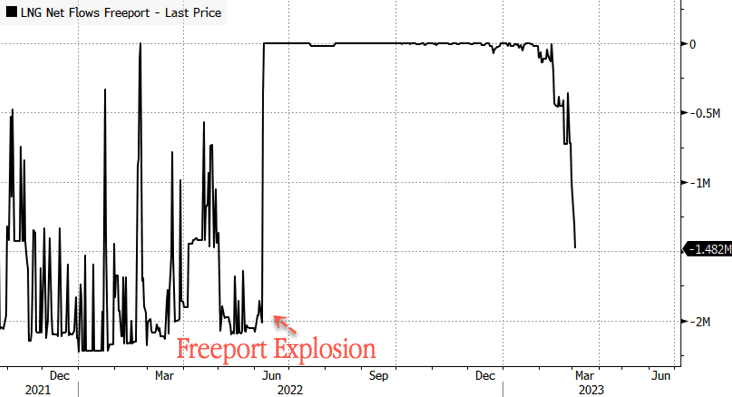
Houston-based energy firm Criterion Research told clients Friday morning that the Freeport LNG export facility in Texas has recorded a surge in natural gas flowing into the plant. Inflows hit a daily record high as the export facility partially restarts operations. 

According to Criterion Research flow data, Freeport LNG nominations have surged to nearly 1.5 Bcf/d as of this morning, which implies that the terminal now has two full LNG trains operating. The pop in Freeport volumes pushed net US LNG feed gas demand above 14 Bcf/d, which is a new all-time high

Thus far, the FERC has given full regulatory approval for the restart of Trains 2 & 3, and there is a pending request by Freeport LNG to bring liquefaction Train 1 in the near term. Criterion currently believes the terminal could reach 2 Bcf/d by the end of March if the FERC gives them clearance to activate Train 1 in a timely manner. 

… and when operating at full power, Freeport’s three LNG trains will likely increase volumes north of 2 Bcf/d. Some analysts have suggested that the plant may not resume full capacity until late March or early April.

Criterion Research noted the return of Freeport is a “boon for Europe” as the continent rejiggers NatGas sourcing away from Russia. 

While the US natural gas market is mainly concerned about high production and the after-effects of a mild winter on storage, the return of Freeport is a boon for Europe as it moves closer to the storage refill season in the coming months. The added 2 Bcf/d in exports from Freeport will go a long way in helping to offset lost Russian volumes.

Freeport accounts for 15% of all US LNG exports. The prospect of Freeport returning has sent TTF price, Europe’s NatGas benchmark, lower over the last month. Other price pressures have been unseasonably warm weather and large supplies. 

And inversely, US NatGas prices have bounced 37% since falling around the $2 handle last month. Freeport’s return would mean tighter US markets as exports to Europe and or Asia ramp up in the months ahead. 

The return of Freeport LNG is excellent news for Europe’s supply ahead of the summer season. 

Tyler Durden
Sat, 03/04/2023 – 08:45

NATO Member Says 50 Billion Euros In Aid To Ukraine “Far From” Satisfying, Urges Allies To Boost Spending

NATO Member Says 50 Billion Euros In Aid To Ukraine “Far From” Satisfying, Urges Allies To Boost Spending

Authored by Lorenz Duschamps via The Epoch Times,

Estonia has called on all NATO allies to increase defense spending in a bid to strengthen collective support for Ukraine as the conflict recently passed its one-year mark.

“Members have not done enough,” Estonian Foreign Minister Urmas Reinsalu told Fox News Digital in an exclusive interview. “This is my comprehensive assessment.”

“The Western camp has supported weapons aid, given around 50 billion euros [about $53 billion] approximately, and this is far from being satisfying,” he added.

“If we want to invest in Ukrainian victory, not only to invest to Ukraine, that they can survive and not lose, we have to change the paradigm of our support.”

The Baltic state, which joined NATO in 2004 and is also a member of the European Union, recently increased military aid for Ukraine to 370 million euros (about $392 million), slightly more than 1 percent of Estonia’s gross domestic product (GDP).

In the interview, Reinsalu asked all member states to follow Estonia’s target, noting that not only should allies contribute more to Ukraine, but they should also increase defense spending to the alliance itself, suggesting raising spending from 2 percent to 2.5 percent.

“We are making—before the Vilnius Summit—the call that all the NATO allies should contribute their fair share to defense, and the 2 percent is not enough … to raise the minimum of defense expenditure from GDP to 2.5 percent level,” Reinsalu said, adding that Estonia “passed the decision” to raise defense spending to 3 percent of GDP starting next year.

Reinsalu’s remark reiterates a stance revealed in early February by Estonian Minister of Defense Hanno Pevkur, who pled during a bilateral meeting in Estonia’s capital, Tallinn, with U.S. Secretary of Defense Lloyd Austin that all EU partners and NATO member states “must spend more than 2 percent” of their GDP, “ideally closer to 2.5 percent” on defense, according to a transcript of the meeting.

U.S. Secretary of Defense Lloyd Austin (R) and Estonian Defense Minister Hanno Pevkur stand for their national anthems during an honor cordon at the Pentagon in Arlington, Va., on Oct. 18, 2022. (Kevin Dietsch/Getty Images)

Estonia, though a small country, has been a vocal supporter of Ukraine since the start of Russia’s invasion and, as a share of its economic size, has “provided more military aid to Ukraine than any other country in the world,” Austin said at the meeting.

According to data from The World Bank reported by Fox News, Estonia invested as much as 2.4 percent of its GDP toward NATO in 2020, though that number dropped to 2.2 percent in 2021.

Spending Pledges

NATO allies agreed in 2014, after Russia annexed Ukraine’s Crimean Peninsula, to halt the spending cuts they had made after the Cold War and move toward spending 2 percent of GDP on their defense budgets by 2024. That pledge expires next year, and now, some NATO members are working toward a new target, despite some existing members not even supplying the necessary 2 percent of GDP to defense as stipulated.

NATO leaders are expected to map out the way ahead when they meet for their next summit at the Heads of State Summit in Vilnius, Lithuania, in July, although it is unclear what the new guideline will be because some member states say 2.5 percent of GDP is unrealistic.

The United States, meanwhile, spends more on its defense budget than all the other allies combined, putting 3.47 percent of GDP into its military coffers, according to NATO estimates for last year.

On the one-year mark of Russia’s invasion of Ukraine, the Biden administration also announced an additional $2 billion in new military aid, bringing the total to $32 billion in taxpayer funds provided to Kyiv in the past 12 months, or roughly five times Ukraine’s annual military budget.

Tyler Durden
Sat, 03/04/2023 – 08:10

Ford Files For Patent That Can “Remotely Shut Down” Parts Of Your Car When Your Bill Isn’t Paid

Ford Files For Patent That Can “Remotely Shut Down” Parts Of Your Car When Your Bill Isn’t Paid

Remember when getting in your car and flying down the highway with the top down used to be the perfect escape from the mire and muck of everyday life, like bills and e-mail? Now, thanks to the implementation of technology in the auto industry, that once-freeing joyride is literally becoming bills and e-mail. 

That’s because a new patent from Ford now allows the manufacturer to “remotely shut down your radio or air conditioning, lock you out of your vehicle, or prompt it to ceaselessly beep if you miss car payments”, according to a new report from Bloomberg. While the official company line is that Ford has “no plans” to use the technology, we’re certain that’ll be proven to be incorrect over time.

“We submit patents on new inventions as a normal course of business, but they aren’t necessarily an indication of new business or product plans,” Ford said.

And the patent coincidentally comes along at a time when many car owners are experiencing difficulty keeping up with rising rates, resulting in “delinquencies [that] have been steadily ticking back up from their pandemic lull”. 

John Van Alst, a senior attorney with the National Consumer Law Center, commented: “It really seems like you’re opening up a can of worms that, as a manufacturer, you don’t really need to be doing.”

“You’ve now created this device which is like the doomsday device in Dr. Strangelove,” he continued. 

The technology is called a “repossession-linked technology” in the patent and can also disable cruise control and automated windows. “Disabling such components may cause an additional level of discomfort to a driver and occupants of the vehicle,” the patent reads. 

Recall, back in September 2021, we wrote about how in-car cameras were already keeping a close eye on everything drivers were doing. Researchers at the Fraunhofer Institute have now developed a smart-car camera system that can “figure out exactly what a driver is doing,” according to a Gizmodo report from around the time. 

We noted that the “appeal” of these points is what prompted the Fraunhofer Institute of Optronics, System Technologies and Image Exploitation to come up with a camera that uses AI powered image recognition to construct a digital sketch of the driver – which then, in turn, provides enough details for the system to guess what the driver is doing. The system can determine things like when a driver is sipping a cup of coffee or looking at their phone.

The vehicle can then make a determination if the driver is paying attention, prompting a semi-autonomous system to determine how distracted they could be. 

Pretty soon the car will be taking you out for a joyride when it’s stressed…

Tyler Durden
Sat, 03/04/2023 – 07:35

More Than Half Of Global Population Overweight Or Obese By 2035: Report

More Than Half Of Global Population Overweight Or Obese By 2035: Report

Authored by Efthymis Oraiopoulos via The Epoch Times,

Fifty-one percent of the world’s people will be overweight or obese by 2035, with the most affected countries being in Asia and Africa, a new report estimates.

The World Obesity Federation report claims that overweight and obesity-related problems could cost $4.35 trillion annually by 2035 if prevention and support do not improve.

The report says its estimates will be realized if current trends continue.

Childhood obesity could more than double by 2035 from 2020 levels, the report says, adding that lower-income countries, all in Asia and Africa, will be hardest hit.

The report adds that 208 million boys and 175 million girls are expected to be obese by 2035.

One out of four people is predicted to be obese by 2035, compared with one out of seven today.

The report uses body mass index (BMI) for its assessments, a number calculated by dividing a person’s weight in kilograms by their height in meters squared. In line with the World Health Organization’s guidelines, a BMI score over 25 is overweight, and over 30 is obese.

Describing the data as a “clear warning,” Louise Baur, the federation’s president, said that policymakers needed to act now to prevent the situation from worsening.

“It is particularly worrying to see obesity rates rising fastest among children and adolescents,” she said in a statement.

“Governments and policymakers around the world need to do all they can to avoid passing health, social and economic costs on to the younger generation.”

The World Obesity Federation has a formal consultative status with the World Health Organization, according to its website.

The report’s data will be presented to United Nations policymakers and member states next week.

American Obesity

In the United States, one of the major hurdles army recruiters now face is obesity, which has become a dominant health challenge for Americans. As of 2020, the prevalence of obesity in the adult population hit nearly 42 percent.

In addition, research shows that government food subsidies are a significant contributing factor.

One 2022 study found a link between receiving food assistance and a greater chance of becoming obese by consuming unhealthy foods. That’s especially true for participants in the Supplemental Nutrition Assistance Program (SNAP).

Tyler Durden
Sat, 03/04/2023 – 07:00

One Year Later In Ukraine: Washington And NATO Got It Very Wrong

One Year Later In Ukraine: Washington And NATO Got It Very Wrong

Authored by Ryan McMaken via The Mises Institute,

It’s been a year since the Russian invasion of Ukraine.

In spite of claims from the regime and its media allies that Russia was the next Third Reich and would soon roll through half of Europe, it turns out that was never even remotely true.

In fact, things have unfolded more or less just like we predicted here at mises.org:

  • the Russians aren’t even close to occupying any place in Europe beyond eastern Ukraine.

  • It’s not Munich 1938. Economic sanctions have not crippled the Russian regime.

  • Most of the world remains ambivalent on the conflict.

  • The conflict will likely end with a negotiated settlement – contrary to what the Washington wants.

The fact is that in spite of the United States’ and North Atlantic Treaty Organization’s (NATO) efforts to turn Ukraine into World War III, the war in Ukraine remains a regional conflict. It seems most of the world is uninterested in making sacrifices to carry out US policy in Ukraine and that many see the inherent hypocrisy behind US talk about respecting national sovereignty. 

There’s also an important lesson here about listening to the war maximalists who incessantly promote full-scale war as the “solution” to every international crisis. The US clearly wants to fight the war to the last Ukrainian, in what the US is packaging as a global crusade in the style of World War II. But, it seems now that more pragmatic thinkers—i.e., the French and the Germans—recognize that negotiations are the more humane solution. 

They Wanted a “Munich Moment”

Within days of the Russian invasion, the Western global hegemonists got to work claiming the invasion was essentially a war of global conquest. For instance, Matthew Kroenig in Foreign Policy stated that Vladimir Putin had shown a clear interest in “resurrecting the former Russian Empire, and other vulnerable Eastern European countries—Poland, Romania, or the Baltic states—might be next.” Kroenig immediately concluded that the US’s military budget should be doubled.

Another writer insisted the Ukraine invasion contained “a whiff of Munich.” John Storey at the Australian Strategic Policy Institute claimed that “the forgotten lesson of Munich” had allowed “Putin is [to do] his best impression of German dictator Adolf Hitler.” Storey ominously asked, “Will the Baltic states and Eastern Europe be next?” dutifully repeating the party line that Russian tanks might soon roll into central Europe.

Yet the “lesson of Munich”—which is invoked incessantly and certainly not “forgotten”—has never been appropriate for conceptualizing the war in Ukraine. That sort of thing has even led some pundits to proclaim that global nuclear war is “worth it.” The real lesson to be learned here, however, is the lesson of 1914: that we should not allow military alliances to lead major powers into overreactions that lead to global disasters. The “Munich” crowd wanted mass mobilization against Russia in early 2022. They didn’t get it, and thank goodness.

Russia Was Never a Global Threat

It has been clear from the very beginning that Russia has never had the capability to sustain an occupation of any areas that do not already contain a sizable number of ethnic Russians or Russian sympathizers. This hardly mirrors the military capabilities of the Third Reich. Thus, it is not surprising that Russia’s occupation endures only in southeastern Ukraine and the Crimea. At this point, Russia is attempting to push the frontiers of its occupation zone as deeply as possible into areas with a sizable Russian minority. Even this has proven difficult for the Russian regime. Russia simply lacks the resources to take on anyone but its impoverished neighbors. 

What’s more, bogging down Russia has required only a tiny portion of the war-making resources available to the NATO coalition. Europe’s NATO members have mostly pledged older weapons, and precious little state-of-the art equipment. The Washington Post recently noted, for example, that the West “is still short on pledges.” Recent promises of Leopard tanks from Germany, Denmark, and the Netherlands turned out to be promises of “refurbished” tanks that are more than forty years old. Moreover, none of these tanks will even arrive before this summer. As of late November, contributions of military aid from Germany, the United Kingdom, and France combined totaled a paltry €5 billion. That’s 6.00 percent the size of Russia’s military budget, and a miniscule 0.05 percent of the combined gross domestic product (GDP) of $10 trillion that comes out of the UK, Germany, and France combined. But what of US military aid? Surely a huge amount is needed to counter the Russian juggernaut? Well, the US military aid totals no more than $50 billion as of early 2023. That’s 6.00 percent of the US military budget, and it’s 0.20 percent of the US’s GDP.  In addition to this, the US regime now admits it doesn’t even know what happens to the weapons it sends to Ukraine. How much of that $50 billion actually goes to Ukraine’s defense? Not $50 billion. 

If that’s all it takes to keep Russia slogging it out in eastern Ukraine, it’s hard to see how the Russian regime poses an existential threat to even western Ukraine, let alone any other state in Europe. This helps illustrate how unnecessary the US is to the conflict. Russia poses no threat to the US—unless the US escalates to the point of nuclear war. If the Europeans feel threatened, they can easily defend themselves given the huge size of their economic bloc, relative to Russia. The Europeans have more than enough resources to “stand with Ukraine” however they wish to define that. Yes, that might require Europeans to give up a bit of their government pensions and enormous welfare states in order to fund their own military defense. But there’s absolutely no reason why American taxpayers need be on the hook to subsidize Europeans as they’re swilling cappuccinos on month-long vacations.

The World Is Not United against Russia

Perhaps seeing that Russia presents no conventional military threat beyond its “near abroad,” most of the world has not signed off on starting a new cold war. Although NATO mouthpieces have been enthusiastic about the passage of United Nations resolutions condemning Russia, it’s notable how many countries chose to abstain from the vote. Last week, the UN general assembly voted again on a resolution condemning the Russian invasion and calling for Russia’s withdrawal. One hundred forty-one countries voted in favor, but, notably, thirty-two countries abstained from voting (seven states voted against the measure). Among those thirty-two countries were China, India, Pakistan, and South Africa. India, a US ally and the “world’s largest democracy,” was apparently uninterested in joining NATO on the resolution. South Africa, another major world economy and democracy, stayed out of the matter as well. In fact, the only member of the BRICS bloc to vote in favor of the resolution was Brazil.

This has partly been driven by practical matters. The political leadership in these countries is simply not prepared to impoverish its population in order to please Washington. But the resistance also comes from the fact that most of the world knows US pretensions toward respecting national sovereignty and international law are all an act. The US invasions and bombing campaigns against Iraq, Afghanistan, Libya, and Syria have made it clear the United States is perfectly at ease with violating national sovereignty when it suits US ambitions. The so-called rules-based international order obviously means nothing to the US when it becomes inconvenient to Washington. (It should also be noted the Ukraine regime supported invading Iraq and sent at least five thousand troops to help the US occupy that supposedly sovereign nation.)

What does this all mean for Russia? It means that some of the world’s largest economies have signaled they have no plans to cut Russia off from the global economy and that they refuse to cut themselves off from Russian oil, gas, and foodstuffs.

Sanctions Didn’t Ruin Russia

The US has been unsuccessful in securing global compliance in isolating Russia economically. Thus, the US has been forced to rely on coercive sanctions—not just against Russia, but against those who choose to keep doing business with Russia. The US must now spend time and resources enforcing “secondary sanctions” designed to coerce countries that don’t play along, and now finds itself in the position of repeatedly threatening countries other than Russia with “consequences” for violating US sanctions.

But, for all the US bluster on this, US sanctions have clearly failed to ruin Russia economically. Recent numbers show that the US oil sanctions against Russia “have done little to curb the flow of Russia’s crude.” Or as this article as CNBC suggests, the oil sanctions “failed completely.”

This isn’t to say that the sanctions have had no effect. Yet it is clear that the sanctions—the harshest sanctions used since World War II—are not a “game-changer.”

Instead, the sanctions have created additional motivation for states to find ways to get around US sanctions in the future. As Agathe Demarais notes in Foreign Policy:

Russia, Iran, China, and other countries at odds with the United States are doubling down on efforts to vaccinate their economies against sanctions. These measures have little to do with sanctions circumvention: Instead, they represent preemptive steps to render potential financial sanctions entirely ineffective. Such mechanisms include de-dollarization efforts, the development of alternatives to SWIFT (the Belgian cooperative that connects all banks across the world), and the creation of central bank digital currencies.

That reference to “other countries” is key. The more the US employs its financial power as a weapon against other regimes, the further this will push the world’s regimes to find ways to break free of the US-centered financial world. Those efforts will put downward pressure on the dollar in coming years.

“Unconditional Surrender” was Never an Option

The US has generally saved its “regime change” rhetoric for small, dirt-poor countries that are unable to fight back. Yet, following the Russian invasion, many Western commentators began calling for regime change in Russia as well. Most notably, on March 26, President Joe Biden said Putin “cannot remain in power,” although he was later forced to backtrack. Not only are the prospects for regime change in a nuclear-armed country fraught with immense danger, but many observers recognize the fact that toppling Putin is easier said than done. Nor would such a move guarantee that Putin’s regime would be replaced with a regime opposed to Russian expansionism. In fact, the new government could easily be “worse” by NATO standards.

This is a hard pill to swallow for Americans who are wed to a long-standing obsession with “unconditional surrender” in every military conflict. The model here is the Japanese surrender in the Second World War. The reality, however, is that the overwhelming majority of military conflicts are ended through negotiated settlements.

Nevertheless, throughout the first half of 2022, those who called for negotiations to end the war—for purposes of ending the bloodshed sooner—were branded Russian apologists. Only total victory, we were told, was an acceptable outcome.

Those days are swiftly coming to a close. “Total victory” for Ukraine, defined as the total withdrawal of Russia, was never likely. The reality is more along the lines of what French diplomats are privately willing to admit. As the Wall Street Journal reported last week, French and German leaders are now telling the Ukrainian regime that it needs to consider peace talks:

“We keep repeating that Russia mustn’t win, but what does that mean? If the war goes on for long enough with this intensity, Ukraine’s losses will become unbearable,” a senior French official said. “And no one believes they will be able to retrieve Crimea.”

Gen. Petr Pavel, president-elect of the Czech Republic and a former NATO commander, said at the Munich conference [last week]: “We may end up in a situation where liberating some parts of Ukrainian territory may deliver more loss of lives than will be bearable by society. . . . There might be a point when Ukrainians can start thinking about another outcome.”

The endgame is coming into view, and it’s a negotiated settlement. Unfortunately, it’s a settlement that will come only after an immense loss of life for both Ukrainians and Russians, and at the price of enormous loss of capital and infrastructure. A settlement could have likely been achieved sooner, and with the same territorial losses in Ukraine that likely would have resulted in any case. The US could have given up its obsession with making Ukraine a NATO outpost. The Ukraine regime could have given up trying to turn Ukraine into an ethno-state where Russian-speakers are second-class citizens. The US and Ukraine could have admitted they’re not getting Crimea back.  Instead, they chose to prolong the conflict, and the result has been perhaps hundreds of thousands of unnecessary deaths. The fact that the Russian regime is ultimately the aggressor here does not change this reality.  Being a small, poor country next to Russia has always been just an unfortunate reality for some. Thus, responsible foreign policy for those states lies in taking positions that limit unnecessary bloodshed while finding ways to co-exist with the Russians. Instead, the US and Ukraine have chosen to wax philosophical about moral rectitude while NATO leaders recite their bullet points on regime change, total victory, Munich, and a “rules-based order.” None of this helps save lives. 

Those who promoted a need for full-scale war and “no peace until total victory”  have been stunningly wrong, and it has proven to be very costly.

*  *  *

Read More:

Tyler Durden
Fri, 03/03/2023 – 23:40