74.3 F
Chicago
Wednesday, August 5, 2026
Home Blog Page 3932

President Biden Makes Surprise Visit To Kyiv, Pledges New Military Aid

0
President Biden Makes Surprise Visit To Kyiv, Pledges New Military Aid

President Biden departed from Joint Base Andrews in Prince George’s County, Maryland, early Sunday morning. He stopped at Ramstein Air Base in Germany before making an unannounced visit to Ukraine on Monday morning. The visit comes ahead of the first anniversary of Russia’s invasion of Ukraine. 

Biden’s visit comes as Russia prepares for a massive spring offensive. Western countries are racing to flood Ukraine with new weaponry, including main battle tanks and armored vehicles. Biden delivered remarks alongside President Volodymyr Zelenskyy at Mariinsky Palace in Kyiv and announced new military aid worth $500 million, according to AP News. The new military aid includes anti-tank missiles, air surveillance radars, howitzers, shells, ammunition, and other support but no new advanced weaponry. 

“I thought it was critical that there not be any doubt, none whatsoever, about US support for Ukraine in the war,” Biden said in joint remarks with Zelenskyy. He said, “I’m here to show our unwavering support for the nation’s independence, sovereignty, and territorial integrity.” 

Zelenskyy thanked Biden for coming to Kyiv “at a huge moment for Ukraine.” He said he and the US president would hold talks about the war and what’s happening on the frontlines and also “about the people, about Ukrainians, about Americans . . . what we have to do to stop the war, to have success in this war . . . and how to win this year”.

Biden said, “I am meeting with President Zelenskyy and his team for an extended discussion on our support for Ukraine.” He added that Russian President Vladimir Putin was “dead wrong,” believing he could instantly take Ukraine during the invasion nearly one year ago. 

“Over the last year, the United States has built a coalition of nations from the Atlantic to the Pacific to help defend Ukraine with unprecedented military, economic, and humanitarian support – and that support will endure,” he continued.

Biden also said, “We will announce additional sanctions against elites and companies that are trying to evade or backfill Russia’s war machine.” 

The president’s social media team was busy tweeting this morning. 

Biden’s long-term support for Ukraine shows the war is far from over, with both sides preparing for spring offensives. 

After Ukraine, Biden will visit Poland. He’s expected to deliver a speech on the war efforts and talk with Polish president Andrzej Duda as well as other European leaders.

Tyler Durden
Mon, 02/20/2023 – 07:30

The SECs Leap Of Faith?

0
The SECs Leap Of Faith?

By Marcel Kasumovich, deputy CIO of One River Asset Management

Forecasts were for a “digital kill switch” in the SEC’s custody proposal. The weather forecast was wrong. Instead, the SEC’s custody proposal provided a runway. Who gets to take off as the clouds part? The details, as ever, will decide.

“No honest business need fear the SEC.” The first Chair of the SEC, Joseph Kennedy, was charged with the task of bringing full disclosures to the public when companies issued securities. Of course, this was after the hands-off policy of the roaring 20s and the 1929 Crash. Kennedy observed “it was prophesied that the securities markets…would dry up within a few months,” only to see every major American stock exchange register, thrive, under the SEC.

Cryptoassets had their 1929 moment last year, and the post-crash regulatory response is uncertain. The safeguarding of client assets is at the heart of investor protection. And market concern of a severe response was palpable heading into this week’s SEC custody proposal. No honest business would argue against the spirit of the proposal: to “expand and enhance the role of qualified custodians…to help ensure that advisers don’t use, lose, or abuse investors’ assets,” as Chair Gensler said.

It’s not a kill switch. The market feared a shuttering of US activity in digital assets – the SEC eliminating a pathway to being a qualified custodian, the Treasury outlawing self-custody, and the Fed culling banking ramps to digital business. Through enforcement and proposal, clarity is emerging that centers around avoiding a repeat of 2022. The SEC’s proposal will remain open to public feedback for 60 days before going live in a year. It’s a short and bumpy runway. But there’s a route to lift off.

Details matter – a lot. “We understand, for instance, that it is decreasingly common for banks acting as custodians to do so in a fiduciary capacity. These changes in the industry have caused us to reconsider the role of a ‘qualified custodian’,” is an example of a stern assessment of custodians (our emphasis). State laws are key. Segregated customer funds in their name are likely bankruptcy remote. This opens a lane to holding cryptoassets in a “qualified custodian”. Advisors can service cryptoassets.

But details matter to regulators, too. Investor protection is the natural domain of the SEC. With a broader assessment of assets captured by the proposal – including previously exempt private assets – the issue of being a security or not doesn’t matter in the custody proposal. All cryptoassets will apply. But the SEC isn’t the regulator for custodians! What if proposed guidelines aren’t met? Regulators, including States, will need to work cooperatively. It’s not all about the SEC, after all.

These are not new issues. Last Spring, the SEC sprung SAB 121 on cryptoasset custodians. It effectively took banks out of the market with onerous capital requirements relative to the custody of traditional assets. It also required new disclosures in the industry to reflect uncertainty around bankruptcy protection. This, too, is at the heart of investor protection. Upon bankruptcy, the goal is to ensure that custodied assets are returned to clients, rather than being the property of the defunct entity.

The benefit of living through 1929-like crash is that we now have case precedent. Things to avoid in the future. Like Celsius. On January 4, 2023, the bankruptcy court ruled that a significant portion of customer assets were the property of the debtors’ estate – customers were deemed general creditors. Those assets were held in the “earn” program – not segregated. Celsius deployed those assets to generate returns in a discretionary manner, and their contractual terms were explicit. There was no protection.

Celsius customer risk is exactly what the SEC is aiming to guard against, reasonably. That’s good for the industry. The Commission can also communicate through disclosures of publicly traded companies under their supervision. That’s Coinbase. Their latest 10K observes that “we place great importance on safeguarding cryptoassets we custody and keeping them bankruptcy remote…in June 2022 we updated our Retail User Agreement to clarify the applicability of UCC Article 8 to custodied crypto assets.”

The Uniform Commercial Code – UCC – are the laws governing all US commercial transactions. It’s State law. Article 8 is used by the crypto industry to indicate their intended custodial standards are the highest of investment securities. But it’s just a bridge until digital assets are fit into UCC – Article 12. That article provides a clear definition to controllable electronic records, and it’s passing through State legislatures now. Article 12 is key to bankruptcy –custodial relationships can be clearly defined, and not as general creditors.

Make no mistake – there is a sense of urgency in regulatory policy since the crypto crash. This is the historic norm. The SEC’s proposed custody rule makes three key strides. First, it reaffirms that all cryptoassets will apply to the rule. Second, it sets the standard that a “qualified custodian” intermediary will need to ensure client assets are remote from bankruptcy beyond any doubt. And third, it advances dialogue with the industry.

Clarity is arriving in the same way that the picture of a puzzle becomes visible – piece by piece. It’s not just the SEC, or the Treasury, or the Fed. It is a broad integration – State laws play a big role, too. But don’t look to regulatory policy to mark a new, positive trend in digital asset markets. That’s not the point. Clarity clears a path for the drivers of value – innovation, use cases, and adoption.

Tyler Durden
Mon, 02/20/2023 – 06:20

Demographic Challenges Weigh On Russia’s Military Ambitions

0
Demographic Challenges Weigh On Russia’s Military Ambitions

Authored by The Jamestown Foundation via OilPrice.com,

  • Russia is looking to grow the size of its armed forces to 1.5 million by the end of 2026.

  • According to the Russian population census of 2020–2021, the number of men 18–26 years old in Russia was around 7.21 million in 2021.

  • The number of young men in Russia is inevitably decreasing, presenting a challenge that make realizing its military ambitions impossible.

In December 2022, the Russian Ministry of Defense announced its ambitious plan for increasing the size of the Russian Armed Forces to 1.5 million personnel by the end of 2026. To this, the number of contracted soldiers within the Russian Armed Forces has to be increased significantly as well: to 521,000 by the end of 2023 and 695,000 by the end of 2026, adjusted from the previous plan of increasing this number from 405,000 in 2020 to 500,000 by 2027. Besides this, the conscription system will also be adjusted, with the age range for conscription being changed from 18–27 years old (at the moment, Russian men are not conscripted once they reach age 27) to 21–30 years old (Rg.ru, March 25, 2020; Mil.ru, December 21, 2022).

Recently, this author estimated that the only hypothetical way for realizing the planned increase would be a massive campaign of coercion for military service in Russia: from forcing young drafted soldiers to sign two-year service contracts to extending the network of military training centers within the universities, among other strategies (see EDM, January 6). However, a more serious issue looks to restrain the planned increase in the Russian Armed Forces faces—namely, Russia’s mounting demographic challenges (see EDM, January 10).

According to the Russian population census of 2020–2021, the number of men 18–26 years old in Russia was around 7.21 million in 2021. Using this census data, the number of men 18–26 years old will decrease to 7.18 million in 2023 and should then slightly increase to 7.22 million in 2026. Moreover, those who will be between the ages of 18 and 26 in 2023 are the same people who will be 21–29 years old in 2026, when the new conscription rules should be functioning (Rosstat.gov.ru, accessed February 16).

Yet, in fact, these projected numbers should be lower as annual mortality rates count 1,700–1,900 for those 10–14 years old (here and further, the mortality rates include both males and females, but the share of boys always exceeds 50 percent); 4,000–4,200 for those 15–19 years old; and 6,500–8,000 for those 20–24 years old (Rosstat.gov.ru, June 21, 2022).

For comparison, according to the 2010 census, about 10.6 million men ages 18 to 26 resided in Russia and about 12 million men of the same age group, according to the 2022 population census. Considering the planned increase of the conscription age, less than 7.16 million men ages 21 to 29 will be present in Russia in 2030 (Rosstat.gov.ru, accessed February 16).

Briefly speaking, the number of young men in Russia is inevitably decreasing. In previous decades, the Russian military leadership tried to take into consideration the long-term consequences of this process. For instance, the seasonal conscription in 2002 counted around 160,000–170,000 soldiers, and the spring conscription six years later numbered 133,000 soldiers (Iz.ru, April 25, 2002; RBC, October 17, 2002; Gazeta.ru, April 1, 2008). At that time, the term for conscripted military service was two years.

However, in 2008, when the term for military service was reduced from two years to one, the Russian Ministry of Defense tried to increase the number of drafted soldiers. In this way, the 2008 fall conscription enlisted 219,000 soldiers, the 2009 spring conscription numbered 305,000 soldiers and, during the further seasonal conscription campaigns of 2009 and 2010, around 270,000–280,000 soldiers were drafted (RIA Novosti, October 2, 2008; RBC, April 1, 2009; RIA Novosti, July 16, 2010). Thus, as the demographic of young Russians within the country began to dwindle, the total number of conscripted soldiers decreased from 640,000–660,000 to 540,000–560,000 during the 2000s.

Then, from 2012 to 2022, the number of soldiers drafted during each conscription campaign decreased from 200,000 in the spring of 2011 to an average of 130,000–140,000 (RBC, April 1, 2011; Rg.ru, December 31, 2021). Meanwhile, the number of contracted soldiers (including sergeants and noncommissioned officers) increased from 150,000 in 2010 to 405,000 in 2020 (Interfax, June 9, 2010; Rg.ru, March 25, 2020)—though, during these years, the number of conscripted soldiers and the number of contracted soldiers represented overlapping sets. That means the total number of soldiers, both drafted and contracted, decreased from almost 700,000 in 2010 to between 560,000 and 600,000 at the beginning of the 2020s.

In addition, it must be mentioned here that the total labor pool in Russia, made up of those people who should feed into the armed forces, also decreased from 93.1 million in 2010 to 89.1 million in 2020. And the number of those employed decreased from 71.5 million in 2010 to 69.5 million in 2020 (Rosstat.gov.ru, accessed February 16).

Consequently, the planned increase for personnel in the Russian Armed Forces seems to be impossible within the current demographic, economic and even political circumstances. The threshold of 695,000 contracted soldiers by 2027 means that one in ten Russian men between the ages of 21 and 30 could be called up to active service at any moment. In truth, this increase would only be possible if Russia was a truly democratic federation facing an existential foreign threat. Another option would be if Russia drafted young women together with men and those women signed formal service contracts—though, given the domestic demographic problems, this option looks even more impossible in Russia. As a result, the Russian Ministry of Defense may believe that it can close the gap by recruiting young migrants from Central Asia in exchange for Russian citizenship, which adds another dimension to Russia’s growing desperation in the face of declining demographics at home and manpower shortages in Ukraine.

Tyler Durden
Mon, 02/20/2023 – 05:45

The EU’s ‘Rule Of Law’ Dispute With Poland Has Been Taken Up A Notch

0
The EU’s ‘Rule Of Law’ Dispute With Poland Has Been Taken Up A Notch

Authored by Grzegorz Adamczyk via Remix News,

The European Commission’s decision to sue Poland over its constitutional court rulings is making the European Court of Justice a de facto Supreme Court of Europe…

The European Commission has decided to challenge the Polish constitutional court over not only its assertion of the supremacy of the Polish constitution over European law, but also to question the appointment of three justices of the court as well as the election of the chief justice herself. This move escalates the rule of law dispute to a new level.

The European Commission is effectively arguing that Poland’s constitutional court has ceased to be an independent entity and is now a creature of the government. 

The commission is taking an unprecedented step. It will be the first time the European Court of Justice (ECJ) has been asked to assess the functioning of a member state’s constitutional court and its verdicts. If the European court rules in favor of the commission, its ruling will have consequences that go way beyond the dispute over the observance of the principle of the rule of law in Poland.

It will mean that the ECJ has asserted its right to review the work of member states’ constitutional courts and to challenge their verdicts. In this way, the ECJ in Luxembourg would effectively become a Supreme Court of Europe able to interpret and adjudicate the constitutional laws of the member states. 

The European Commission’s decision cannot but affect the political situation in Poland. Last Friday, President Andrzej Duda submitted the legislation passed by the Polish parliament on disciplinary procedures for judges for review by the constitutional court. The law was passed in order to change the very procedure objected to by the European Union so that the Commission would unblock Poland’s share of the EU Recovery Fund.

The Polish president’s move looks like a further delay to Poland’s access to its EU recovery fund allocation is inevitable, but the European Commission’s decision to question the credentials of the constitutional court complicates matters still further.

This is because it is more than likely that the ECJ will suspend the workings of the court, just as it did with regard to the Disciplinary Chamber of the Supreme Court. Or it may suspend the four justices whose appointments have been challenged, therefore making it impossible for the court to sit in full session until the ECJ has made a final ruling, a process that could take years. 

The latest developments have not brought Poland any closer to unlocking EU funds and threaten a political conflict between Warsaw and Brussels that could lead to a chain reaction. The constitutional court could simply refuse to suspend its working and the ruling majority could opt for a full-scale confrontation with the European Commission, with the ruling conservatives going to the electorate, blaming Brussels, and accusing it of attempting to deprive Poland of its sovereignty.

Tyler Durden
Mon, 02/20/2023 – 05:10

British Taxpayer-Funded Anti-Extremist Study Finds Shakespeare, Orwell, Tolkien “Key Texts” For “White Supremacists”

0
British Taxpayer-Funded Anti-Extremist Study Finds Shakespeare, Orwell, Tolkien “Key Texts” For “White Supremacists”

Several of the UK’s most respected TV shows, movies, and works of literature have been included in a list of works that could potentially encourage far-right sympathies, compiled by the taxpayer-funded and government-led ‘Prevent’ counter-terrorism program.

As The Daily Mail reports, works by some of the world’s greatest writers were included as examples of warning signs of potential extremism, including Shakespeare, Chaucer, Milton, Tennyson, Orwell, Huxley, Kipling and Edmund Burke.

The flagship Prevent scheme, recently the subject of a scathing audit, singled out comedies Yes Minister and The Thick Of It, the 1955 epic war film The Dam Busters, and even The Complete Works Of William Shakespeare as possible red flags of extremism.

Prevent is a key part of the UK’s counter-terrorism strategy as a means to safeguard against “vulnerable people being drawn into criminal behavior”.

In practical terms, it places public bodies, including schools and the police, under a legal duty to identify people who may turn to extremism, and intervene in their lives before it is too late.

If the local panels find someone who is at risk of becoming a terrorist, the Prevent teams use specialist mentors or other support programs to turn around their lives.

It said the works of fiction were “key texts” for “white nationalists/supremacists”.

Right-leaning writer Douglas Murray obtained the full list and discovered that one of his books had been given a red flag by Prevent.

He wrote in The Spectator:

“A number of books are singled out, the possession or reading of which could point to severe wrongthink and therefore potential radicalisation.

It seems that RICU [Prevent’s Research Information and Communications Unit ]  is so far off-track that it believes that books identifying the problem that it was itself set up to tackle are in fact a part of the problem.”

House of Cards screenwriter Andrew Davies said:

It almost seems like a joke. House Of Cards was actually a satirical view of Right-wing politics. This list includes more or less the entire classical canon of literature and some of the very best British television programs ever made.”

The list has emerged following a major review criticized the Prevent scheme by William Shawcross.

His report, published earlier this month, criticised the £49million-a-year scheme Prevent scheme, saying it applied  a ‘double standard’ to Islamist and far-Right threats, prioritizing the latter.

The BBC reports, Mr Shawcross said he had been consistently unable to determine how many community organisations receiving a slice of the Prevent budget were having any impact.

“Funding too often goes towards generic projects dealing with community cohesion and hate crime, and few [community organisations] could be seen publicly to contest extremist discourse.

“Some have promoted extremist narratives, including statements that appear sympathetic to the Taliban.

As The Mail reports, a Home Office spokesman said:

“The Home Secretary made clear that Prevent will now ensure it focuses on the key threat of Islamist terrorism, as well as remaining vigilant on emerging threats.

We’ve accepted all 34 recommendations [from the Shawcross review] and are committed to protecting our country from the threat posed by terrorism.”

Home Secretary Suella Braverman told MPs that Prevent needs major reform: “Prevent has shown cultural timidity and an institutional hesitancy to tackle Islamism for fear of the charge of Islamophobia. Prevent’s focus must be solely on security, not political correctness.”

Tyler Durden
Mon, 02/20/2023 – 04:35

Race Of Logistics: NATO’s Military-Industrial Crisis

0
Race Of Logistics: NATO’s Military-Industrial Crisis

Authored by Andrew Korybko via The Automatic Earth blog,

Speculation has been swirling over the past month about why the US-led West’s Golden Billion so decisively shifted its “official narrative” about the Ukrainian Conflict from prematurely celebrating Kiev’s supposedly “inevitable” victory to seriously warning about its potential loss in this proxy war.

This took the form of related remarks from the Polish Prime MinisterPresident, and Army Chief as well as the US’ Chairman of the Joint Chiefs of Staff, after which the New York Times admitted that the sanctions failed.

The reason why they decided to so decisively shift the “official narrative” was because NATO’s military-industrial crisis, which the New York Times warned about last November and was then touched upon by Biden’s Naval Secretary last month, finally became undeniable. Putting all prior speculation about this to rest, NATO’s Secretary-General declared a so-called “race of logistics” against Russia on Monday precisely on this pretext and thus confirmed the bloc’s crippling military-industrial crisis.

According to the transcript of Jens Stoltenberg’s pre-ministerial press conference that was shared by NATO’s official website ahead of his meeting with this anti-Russian alliance’s Defense Ministers, he said the following of relevance to this subject:

“It is clear that we are in a race of logistics. Key capabilities like ammunition, fuel, and spare parts must reach Ukraine before Russia can seize the initiative on the battlefield.


 Ministers will also focus on ways to increase our defence industrial capacity and replenish stockpiles. The war in Ukraine is consuming an enormous amount of munitions, and depleting Allied stockpiles. The current rate of Ukraine’s ammunition expenditure is many times higher than our current rate of production. This puts our defence industries under strain.


For example, the waiting time for large-calibre ammunition has increased from 12 to 28 months.

Orders placed today would only be delivered two-and-a-half years later. So we need to ramp up production. And invest in our production capacity.


 Well, this is an issue we started to address last year, because we saw that an enormous amount of support for Ukraine, the only way to deliver that was to dig into our existing stocks. But of course, in the long run, we cannot continue to do that we need to produce more, to be able to deliver sufficient ammunition to Ukraine, but at the same time, ensure that we have enough ammunition to protect and defend all NATO Allies, every inch of Allied territory.


 Of course, in the short run, the industry can increase production by having more shifts, by using existing production facilities more. But really to have a significant increase, they need to invest and build new plans. And we see a combination both of utilizing existing capacity more and also by making decisions to invest in increased capacity. This has started but we need more.

 So what I said was that the current rate of ammunition consumption is higher, bigger than the current rate of production. That’s a factual thing. But since we have been aware of that for some time, we have started to do something. We’re not just sitting there idle and watching this happening.  

 And of course the industry has the capability to increase the production also short term, sometimes this on some non-used or not utilized capability there. But even when you have a factory running, you can have more shifts. You can even work during weekends.


 So yes, we have a challenge. Yes, we have a problem. But problems are there to be solved and we are addressing that problem and we have strategies to solve it both in the short term and also longer term to as a mobilized defense industry. And if there’s anything NATO Allies, and our economies and our societies have proved over decades, is that we are dynamic, we are adaptable, we can change when needed.


 And let me also add, of course this is –the challenge of having enough ammunition is also a big challenge for Russia. So it just shows that this is a war of attrition, and the war to attrition becomes a battle of logistics and we focus on the logistical part of the defence capacity, defence industry capacity to ramp up production.”

As proven by Stoltenberg’s press conference, there should thus be no doubt that NATO is experiencing an unprecedented military-industrial crisis, which is responsible for reshaping its members’ narratives and overall strategy towards the Ukrainian Conflict.

This self-declared “race of logistics”, which he also described as a “war of attrition”, first of all proves that the bloc wasn’t prepared for waging a prolonged proxy war against Russia otherwise they’d have preemptively retooled their military-industrial complexes accordingly. The New York Times’ recent admission that the anti-Russian sanctions are a failure also suggests that NATO completely miscalculated in this respect by expecting Russia to collapse as a result of those restrictions, which didn’t happen.

These two factors add crucial context to why the Golden Billion’s “official narrative” about the conflict so decisively shifted over the past month. They simply can’t sustain the pace, scale, and scope of their armed assistance to Kiev, especially not after their much-ballyhooed sanctions failed to catalyze Russia’s economic collapse or at the very least give their proxy an edge in this “race of logistics”/”war of attrition”. As a result, they were forced to change how they present this conflict to their people.

Most tellingly, the Polish President didn’t rule out the scenario of Kiev making territorial concessions to Russia in his recent interview with Le Figaro, which he said should solely be that country’s choice to make and not anti-war Republicans’. Even Stoltenberg let slip during his latest press conference that “we must continue to provide Ukraine with what it needs to win. And to achieve a just and sustainable peace”, which also didn’t include his usual explicit condemnation of the territorial concession scenario.

That selfsame “just and sustainable peace”, according to the Jerusalem Post’s Dave Anderson, can actually be achieved by Kiev finally giving up its territorial claims. In his opinion piece about how “Ukraine can win against Russia by giving up land, not killing troops”, which was coincidentally published on the same day as Stoltenberg’s press conference, he argued that this swift resolution of Ukraine’s territorial disputes with Russia could result in its accelerated admission to NATO.

That outcome would thus sustainably ensure its security, thereby representing a victory over Russia, at least according to Anderson’s view. In the broader context of this analysis and in particular the interpretation of Stoltenberg’s remarks from his latest press conference, his article can thus be seen as the latest contribution to decisively shifting the “official narrative” about the Ukrainian Conflict in the direction of preconditioning the Western public to accept some sort of “compromise” with Russia.

All of this, the reader should be reminded, is occurring because of NATO’s military-industrial crisis hamstringing its members’ capabilities to sustain their bloc’s pace, scale, and scope of armed assistance to Kiev. Their “race of logistics”/“war of attrition” against Russia is obviously trending towards Moscow’s favor after that Eurasian Great Power proved that it truly has the wherewithal to sustain the pace, scale, and scope of its special operation in spite of the Golden Billion’s unparalleled sanctions against it.

If someone still remained in denial about the existence of NATO’s military-industrial crisis in spite of Stoltenberg’s surprisingly candid admission on Monday, then they should also be made aware of Politico’s exclusive report that was published on the same day, which reinforced his claim. Four unnamed US officials told this outlet that their country can’t send Kiev its requested “Army Tactical Missile Systems” (ATACMS) because “it doesn’t have any [of them] to spare”.

This revelation should thus serve as the proverbial “icing on the cake” proving that NATO is in the midst of such a serious military-industrial crisis right now that its US leader itself can’t even afford to spare important munitions that could give its proxies in Kiev the edge that they so desperately need right now. What’s so stunning about this strategic dynamic is that the combined military-industrial capabilities of the bloc’s two and a half dozen countries can’t compete with their single Russian adversary’s.

That insight in turn shows just how mighty Russia’s military-industrial complex is that it’s still capable of sustaining the same pace, scale, and scope of the ongoing special operation in Ukraine despite the sanctions against it while 30 Golden Billion countries can’t collectively do the same. Should its rumored full-scale offensive transpire, then it’s likely to deal a deathblow to NATO’s proxies due to Russia’s edge in this “race of logistics”/”war of attrition” and thus force them to finally cede their disputed regions.

*  *  *

Support the Automatic Earth via Patreon.

Tyler Durden
Mon, 02/20/2023 – 04:00

Escobar: The Big Picture Behind The Iran-China Strategic Partnership

0
Escobar: The Big Picture Behind The Iran-China Strategic Partnership

Authored by Pepe Escobar,

The key takeaway of President Ebrahim Raeisi’s state visit to Beijing goes way beyond the signing of 20 bilateral cooperation agreements…

This is a crucial inflection point in an absorbing, complex, decades-long, ongoing historical process: Eurasia integration.   

Little wonder that President Raeisi, welcomed by a standing ovation at Peking University before receiving an honorary academic title, stressed “a new world order is forming and taking the place of the older one”, characterized by “real multilateralism, maximum synergy, solidarity and dissociation from unilateralisms”.

And the epicenter of the new world order, he asserted, is Asia.  

It was quite heartening to see the Iranian president eulogizing the Ancient Silk Road, not only in terms of trade but also as a “cultural bond” and “connecting different societies together throughout history”.

Raeisi could have been talking about Sassanid Persia, whose empire ranged from Mesopotamia to Central Asia, and was the great intermediary Silk Road trading power for centuries between China and Europe.

It’s as if he was corroborating Chinese President Xi Jinping’s famed notion of “people to people exchanges” applied to the New Silk Roads. 

And then President Raeisi jump cut to the inescapable historical connection: he addressed the Belt and Road Initiative (BRI), of which Iran is a key partner.

All that spells out Iran’s full reconnection with Asia – after those arguably wasted years of trying an entente cordiale with the collective West. That was symbolized by the fate of the JCPOA, or Iran nuclear deal: negotiated, unilaterally buried and then, last year, all but condemned all over gain.

A case can be made that after the Islamic Revolution 44 years ago, a budding “pivot to the East” always lurked behind the official government strategy of “Neither East nor West”.

Starting in the 1990s that happened to progressively enter in full synch with China’s official “Open Door” policy.

After the start of the millennium, Beijing and Tehran have been getting even deeper in synch. BRI, the major geopolitical and geoeconomic breakthrough, was proposed in 2013, in Central Asia and Southeast Asia.

Then, in 2016, President Xi visited Iran, in West Asia, leading to the signing of several memoranda of understanding (MOU), and recently the wide-ranging 25-year comprehensive strategic agreement – consolidating Iran as a key BRI actor.  

Accelerating all key vectors

In practice, Raeisi’s visit to Beijing was framed to accelerate all manner of vectors in Iran-China economic cooperation – from crucial investments in the energy sector (oil, gas, petrochemical industry, pipelines) to banking, with Beijing engaged in advancing modernizing reforms in Iran’s banking sector and Chinese banks opening branches across Iran.

Chinese companies may be about to enter the emerging Iranian commercial and private real estate markets, and will be investing in advanced technology, robotics and AI across the industrial spectrum.

Sophisticated strategies to bypass harsh, unilateral US sanctions will be a major focus every step of the way in Iran-China relations. Barter is certainly part of the picture when it comes to trading Iranian oil/gas contracts for Chinese industrial and infrastructure deals.

It’s quite possible that Iran’s sovereign wealth fund – the National Development Fund of Iran – with holdings at estimated $90 billion, may be able to finance strategic industrial and infrastructure projects.

Other international financial partners may come in the form of the Asian Infrastructure Development Bank (AIIB) and the NDB – the BRICS bank, as soon as Iran is accepted as a member of BRICS+: that may be decided this coming August at the summit in South Africa. 

The heart of the matter of the strategic partnership is energy. The China National Petroleum Corporation (CNPC) pulled out of a deal to develop Phase 11 of Iran’s South Pars gas field, adjacent to Qatar’s section.

Yet CNPC can always come back for other projects. Phase 11 is currently being developed by the Iranian energy company Petropars.

Energy deals – oil, gas, petrochemical industry, renewables – will boom across what I dubbed Pipelineistan in the early 2000s.

Chinese companies will certainly be part of new oil and gas pipelines connecting to the existing Iranian pipeline networks and configuring new pipeline corridors.

Already established Pipelineistan includes the Central Asia-China  pipeline, which connects to China’s West-East pipeline grid, nearly  7,000 km from Turkmenistan to the eastern China seaboard; and the Tabriz-Ankara pipeline (2,577 km, from northwest Iran to the Turkish capital). 

Then there’s one of the great sagas of Pipelineistan: the IP (Iran-Pakistan) gas pipeline, previously known as the Peace Pipeline, from  South Pars to Karachi.

The Americans did everything in the book – and off the books – to stall it, delay it or even kill it. But IP refused to die; and the China-Iran strategic partnership could finally make it happen.

A new geostrategic architecture

Arguably, the central node of the China-Iran strategic partnership is the configuration of a complex geostrategic economic architecture:  connecting the China-Pakistan Economic Corridor (CPEC), the flagship of BRI, to a two-pronged Iran-centered corridor.

This will take the form of a China-Afghanistan-Iran corridor and a China-Central Asia-Iran corridor, thus forming what we may call a geostrategic China-Iran Economic Corridor.

Beijing and Tehran, now on overdrive and with no time to lose, may face all manner of challenges – and threats – from the Hegemon; but their 25-year strategic deal does honor historically powerful trading/ merchant civilizations now equipped with substantial manufacturing/ industrial bases and with a serious tradition in advanced scientific innovation.

The serious possibility of China-Iran finally configuring what will be a brand new, expanded strategic economic space, from East Asia to West Asia, central to 21st century multipolarity, is a geopolitical tour de force.

Not only that will completely nullify the US sanction obsession; it will direct Iran’s next stages of much needed economic development to the East, and it will boost the whole geoeconomic space from China to Iran and everyone in between.

This whole process – already happening – is in many aspects a direct consequence of the Empire’s “until the last Ukrainian” proxy war against Russia.  

Ukraine as cannon fodder is rooted in Mackinder’s heartland theory:  world control belongs to the nation that controls the Eurasian land mass.

This was behind World War I, where Germany knocking out Russia created fear among the Anglo-Saxons that should Germany knock out France it would control the Eurasian land mass.

WWII was conceived against Germany and Japan forming an axis to control Europe, Russia and China. 

The present, potential WWIII was conceived by the Hegemon to break a friendly alliance between Germany, Russia and China – with Iran as a privileged West Asia partner.

Everything we are witnessing at this stage spells out the US trying to break up Eurasia integration.

So it’s no wonder that the three top existential “threats” to the American oligarchy which dictates the “rules-based international order” are The Three Sovereigns: China, Russia and Iran.  

Does that matter? Not really. We have just seen that while the dogs (of war) bark, the Iran-China strategic caravan rolls on.

Tyler Durden
Sun, 02/19/2023 – 23:30

Iran Reportedly On Cusp Of Making Nukes Having Enriched Uranium To 84% Purity

0
Iran Reportedly On Cusp Of Making Nukes Having Enriched Uranium To 84% Purity

Inspectors from the UN atomic agency discovered uranium enriched to 84% purity in Iran last week, a level just below that needed for nuclear weapons, Bloomberg reported Sunday, citing two unnamed senior diplomats. Until now, Iran had been known to have enriched uranium to 60%, while a purity of 90% is needed to produce nuclear weapons.

The IAEA said in a tweet that it was “aware of recent media reports relating to uranium enrichment levels in Iran.” Director-General Rafael Grossi noted that the agency was in talks with Iran regarding the results of recent inspections, the tweet added.

The International Atomic Energy Agency is trying to clarify how Iran accumulated the uranium enriched to 84% purity — the highest level found by inspectors in the country to date. Iran had previously told the IAEA that its centrifuges were configured to enrich uranium to a 60% level of purity. The IAEA has been preparing its quarterly Iran safeguards report ahead of a March 6 Board of Governors meeting in Vienna, where the Persian Gulf nation’s nuclear work will figure prominently on the agenda.

The report did not say where the highly enriched material was found, and comes after last month’s unannounced inspection at the Fordo nuclear site, which found two advanced centrifuges connected in a way that the Iranians had not declared to inspectors. Iran said it provided “explanations” to the inspector who reported the change and that he then “realized his mistake.”

In a joint response at the time, the United States, France, the United Kingdom, and Germany dismissed Iran’s claim as “inadequate.”

Various centrifuge machines line a hall at the Natanz Uranium Enrichment Facility, on April 17, 2021

Also in January, IAEA Director-General  Grossi told European Parliament lawmakers Iran had “amassed enough nuclear material for several nuclear weapons — not one at this point.” Speaking about Iran’s recent atomic activities, including enriching uranium well beyond the limits of the landmark 2015 deal to curb its nuclear capabilities — Grossi said Tehran’s trajectory “is certainly not a good one.”

The latest development comes as Iran is increasingly isolated from the West and nuclear talks with world powers remain suspended. The country has also faced widespread condemnation for its crackdown on major protests and the US and European Union have tightened sanctions on Iran over its military support for Russia’s war on Ukraine.

As Bloomberg notes, inspectors now need to determine whether Iran intentionally produced the material, or whether the concentration was an unintended accumulation within the network of pipes connecting the hundreds of fast-spinning centrifuges used to separate the isotopes. It’s the second time this month that monitors have detected suspicious enrichment-related activities.

Iran hasn’t submitted required forms declaring its intention to raise uranium enrichment levels at two facilities near the towns of Natanz and Fordow, according to one diplomat. Even if the detected material was mistakenly accumulated because of technical difficulties in operating the centrifuge cascades — something that has happened before — it underscores the danger of Iran’s decision to produce highly enriched uranium, the other diplomat said. The IAEA has said levels even at just 60% are technically indistinguishable from the level needed for a nuclear weapon. Most nuclear power reactors use material enriched to 5% purity.

The news comes just hours after earlier in Sunday, Israel blamed Iran for a Feb. 10 attack on an oil tanker in the Arabian Sea. The incident came about a fortnight after a drone strike on a weapons depot near Iran’s city of Isfahan that Tehran blamed on Israel.

Iran’s deal with world powers, known as the JCPOA, collapsed after the United States withdrew from it in 2018 under then-president Donald Trump. The JCPOA gave Iran sanctions relief in return for the curbs and inspections of its nuclear facilities. After Washington withdrew, claiming the deal did not go far enough in preventing Iran from obtaining nuclear weapons, the Iranians dropped many of their own commitments to the pact and ramped up uranium enrichment. The deal had set a maximum enrichment threshold of 3.67%.

Negotiations that started in April 2021 to revive the agreement have since stalled. Iran said in November it had begun producing uranium enriched to 60% at Fordo, an underground facility that reopened three years ago after the breakdown of the JCPOA.

Tyler Durden
Sun, 02/19/2023 – 23:00

Four Hypotheses About The Secular-Corporatist Global Elite

0
Four Hypotheses About The Secular-Corporatist Global Elite

Authored by Dr. James Alexander via The Daily Sceptic,

Everyone has a theory about what is going on. But many are partial, or fragmentary, or too simple in explanation – attributing too much significance to ‘capitalism’ or ‘globalism’ or ‘opportunism’ or ‘unintended consequences’. We have to keep trying to make sense of the whole scenario. And I mean that while the exact and quantitative writers have to keep writing – as the Daily Sceptic regulars do – so do those of us who write about things less exact.

Let us begin with a few grand hypotheses about what is going on. Rene Guenon’s hypothesis, first sketched around 1930, was that all civilisations possess spiritual and temporal powers and so somehow incorporate a tension between the two: but that, for the first time in history, our modernity from any time after 1500 placed the temporal above the eternal, the material above the spiritual: in short, ‘state’ above ‘church’. There were a few related hypotheses offered at the same time: such as Julien Benda’s hypothesis that the clercs, or intellectuals, had shifted their concern: so the immense value they had always attributed to unworldly matters was now attributed to worldly matters. That was to say, the intellectuals were now corrupt, coming after filthy lucre.

An American friend of mine recently drew my attention to some of the recent writings of a novelist and essayist, Paul Kingsnorth. Originally an anti-capitalist, he thought he was on the Left, and now finds himself more or less on the Right. His hypothesis is that the decline of Christianity in our civilization – the decline of the eternal and spiritual – coincides and was probably ultimately caused by the rise of what he calls ‘the myth of progress’. Progress is the conviction that the world, this world, is getting better. This myth is the sort of thing we may associate with Francis Bacon or John Stuart Mill, or indeed Bayle, Mandeville, Voltaire, Smith, Hegel, Comte, Marx – more or less everyone of the 17th to 19th centuries but for the most extreme Bossuet or Maistre types, and but for Burke at the very end of his life. Kingsnorth builds a very effective vision of history on this hypothesis, which enables him to explain why leftists and corporatists are so agreed nowadays. They all, he says, want progress. They are all contributing to what he calls the Machine.

Let us accept these two hypotheses. But I have to add a third, which adds some inner complication to the second, and thus renders the whole scenario a bit more dynamic. It may even explain why there is so much confusion about what has gone on. The hypothesis is that there was never a single ‘myth of progress’: the power of the myth of progress was that it contained an inner diremption, as translators of Hegel used to call it: an inner division. There were two rival positions, which disagreed on the how even while they agreed on the what. The what was an absolute presupposition – something so fundamental it was never questioned by either side. As is ever the case, the disagreement in the foreground distracted from the deeper agreement which dominated everything in the background.

What they agreed on was that progress was happening and should happen. What they disagreed on was how this was supposed to take place. I am of course simplifying here, but to simplify an argument into two positions is a great deal less simple than simplifying it into one position.

On one side, there was the argument that progress was occurring whether we liked it or not. It was occurring through what Adam Smith called the invisible hand, what Samuel Johnson called the secret concatenation, what we now sometimes call the law of unintended consequences. This is the process by which many humans, in pursuit of their own individual interests, contributed to the emergence of a good which none had ever intended, and which none had anticipated, but which could be understood in retrospect.

On the other side, there was the argument that progress would only occur if we adopted the right rational beliefs, the correct enlightened views (liberté, égalité, fraternité, etc.), and set our minds to imposing on the world the policies or schemes suggested by the right rational beliefs and the correct enlightened views. This was to emphasise planning rather than unintended consequences: and planning could only be effective if it was carried out by those in power. So the powerful had to be subjugated by the experts in enlightenment.

The difference between these two positions is that one sees an unconscious process, the other sees a conscious impetus. These two positions have dominated political debate for two centuries: by and large, one side has favoured markets and independent private and apparently (but not actually or eventually) selfish activity, and the other side has favoured a cameralism, colbertism or comtism of scientific planning and collective public activity.

In practice, of course, the two have been mixed together, given a variety of names, and some people who began on one side have ended up on the other: consider John Stuart Mill’s or T.H. Green’s drift from liberalism to socialism; but also consider Kingsley Amis’s, Paul Johnson’s and John Osborne’s drift in the other direction. Unpicking all this is the devil of a job: and it should be left to historians who have the patience for it. But historians usually leave everything only slightly less complicated than they found it: or, let’s say, one step more complicated than previous historians left it. So all this requires some explaining: and explaining it in the abstract, as I do here, certainly makes it possible to explain why Liberals have sometimes been on one side or the other, and why Conservatives are just as quixotic: some Conservatives have favoured the plan; others favoured the invisible hand. There is no certain logic in any of this politics. No name in politics has any fixed meaning – except when we give it one.

The point of this hypothesis is to say that all of the politics of the last two centuries was dominated by arguments about whether progress would take place in the observance or in the breach, so to speak: whether it would have to be consciously theorised and then imposed by some careful policy, or whether it would have to arise without deliberate planning in such a way that only later historians would try to understand it fully. But this has come to an end. We are now at the next stage.

Part of this is because, as Kingsnorth says, the myth of progress – though not entirely dead – is having the last rites. Arguably it has been in trouble since the 1890s, and was jolted by the First World War; but has suffered its recent shocks since the 1970s, what with pollution, population, stagflation, ozone, carbon dioxide, subprime mortgages, and so on. For the moment, the globalists are unsure exactly how to square the circle of wanting ‘progress’ (or, at least, wanting to be ‘progressive’) and wanting ‘sustainability’ at the same time. If we have a myth at the moment it is surely the myth of sustainability. Perhaps the globalists and the localists like Kingsnorth will find that though they disagree on much – COVID-19, for instance – they agree on sustainability. The myth of sustainability is that by retreating to local life and luddism or by advancing to technological repurposing and rewilding and transhumanism we can settle on a mode of existence which will enable us to survive in a less frenetic, destructive, galloping manner.

But there is something to be added to this, a fourth hypothesis, and this is really the crowning hypothesis. I have said that for a few centuries there was planning versus laissez-faire, or consciousness versus unintended consequences – both trying to find out how to make the world, this world, better. But there is something else. The fourth hypothesis is that some figures in the early nineteenth century glimpsed that the two positions could be fused. Hegel was one of these figures; even Marx. There were others; and are many now. Fusion meant something like the following

Until now we have made the mistake of thinking that good can be imposed consciously – usually through religious precepts – but we have discovered, courtesy of Mandeville, Smith and the economists, that good can be achieved through unintended consequences. This, however, does not mean that we should adopt laissez-faire politics: on the contrary, now that we understand unintended consequences, we know how the whole unconscious system of the world works, and since we know how to incorporate our knowledge of this into our politics, we can finally achieve a perfect scientic-and-moral or evidential-and-justified world order.

Is this clear? The Scottish Enlightenment created the empirical expert, who was fused with the morally certain conscious progressive, to become the hope of the world. Doubtless, most of us have abandoned Hegelian and Marxist fantasies of ‘the end of history’ or of ‘emancipation’, but I think that the shadow of these fantasies survived and has come to final fruition in the recent scientific-and-moral majoritarianism seen clearly since COVID-19 arrived in the world.

If I am right about this fourth hypothesis, then it explains why we are so confused. We cannot make sense of our situation by using the old language of ‘collectivism’ versus ‘individualism’. The fact is that in our post-progressive era, the experts feel more justified than ever in imposing on everyone an ‘evidence-based’ and ‘morally-justified’ set of protocols and precepts. They feel more justified because they are combining knowledge of how things work individually (through modelling and observation of unconscious processes or of unintended consequences) with certainty about what it is right to do collectively (given that the old fantasies of progress have been modified by a puritanical and restraining ideology of sustainability and survival, plus diversity, equity and inclusion – which incidentally serves more as a restraining impetus than an anticipation of Marxist emancipation).

This is not only toxic but tangled. The levels of hypocrisy and self-deception involved in this are formidable. The globalists have an ironclad doctrine in their world-saving sustainable politics, or ‘sustainabilitics’. It is almost unassailable, since it draws on the greatest achievements of natural and moral science. It is of course powered by ancient acquisitive greed, but also by sentiment for those who require to be levelled up, or offered something in exchange for their lack of privilege; and, besides, it makes the world better, ‘saves’ the planet, and gilds the cages of the unprivileged and the palaces of the privileged in the same foolish golden moral lacquer.

Perhaps, as Guenon and Kingsnorth glimpse – also Delingpole and Hitchens – the truth is that we need to actually work our way back through the whole Age of Sustainability and Age of Progress to the Age of Faith. Certainly, someone or something needs to force these ‘elites’ to submit to a higher vision: and I think that the only way we can make sense of this at the moment is to imagine that a church or prophet or philosopher could strike down their state-corporate secularity, show them that their faith is just an ideology serving their interests, and that they should submit to a genuinely graceful doctrine that can admit fault, error, even sin. This would not be done by public apology, or hypocritical political display, but by interrogating their own souls.

I am certain not saying that this is what will happen, or even that it should happen (or that it could): but it is certainly the type of thing that needs to happen. That is, it is the type of thing we ought to imagine happening. What will happen will either be more of the same old White Swannery, or perhaps some unexpected ‘Black Swan’ event (not necessarily a good thing: we seem to be overly fond of crisis at the moment). But, either way, a reactionary sensibility seems to be the only one which is capable of exhibiting any awareness of what is going on.

For the sake of clarity, let me again state the four hypotheses about what has been going on:

1. Through all ages there has been a balance of spirituality and secularity. In our modernity, secularity is dominant. There is only this world.

2. For three or so centuries we have believed that this world is getting better and should get better. This is the ‘myth of progress’.

3. There was always disagreement about progress: some supposed it was happening as a result of accident and individual interest; others supposed it could only happen as a result of deliberate design.

4. But we should not ignore that there has been a very clever fusion of the two positions: a fusion which has not faded away with the fading of the ‘myth of progress’ but which survives to support the strange and novel politics of what we could call the ‘myth of sustainability’. This fusion is extremely condescending and sure of itself because it combines scientific certainty about what has gone on unconsciously to better the world with moral certainty about what should now be done consciously to better the world. It appears to harness the individual and the collective together in a way that is meant to make gainsaying impossible.

Tyler Durden
Sun, 02/19/2023 – 22:30

The World Wants To Be Deceived

0
The World Wants To Be Deceived

Authored by Edward Curtin via off-guardian.org,

My title comes from a 19th century author whose name does not matter nor would it mean much if I mentioned him.  It’s an old truth that has not changed a bit over the centuries.

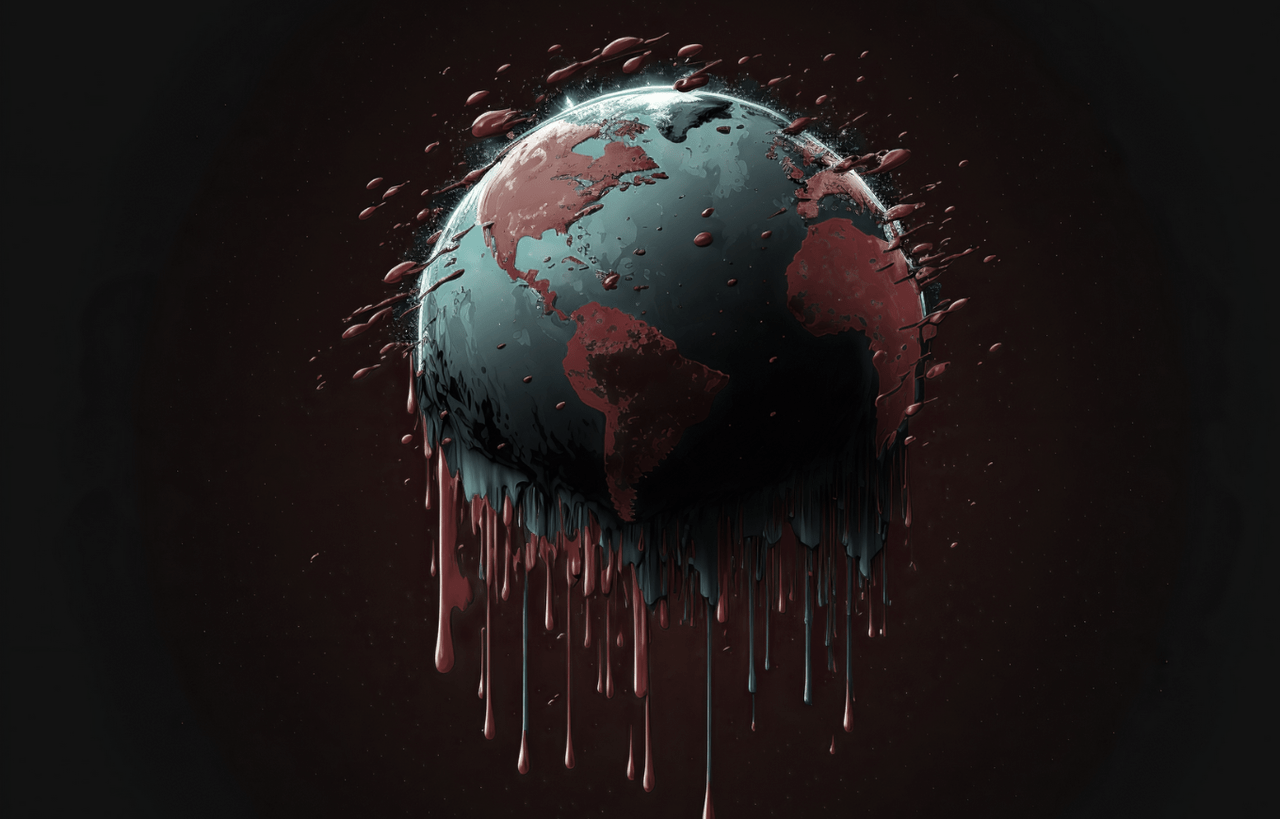
I think, however, it would be more linguistically accurate to say that most people want to be deceived, for the world, the earth doesn’t give a damn, as the French poet Jacques Prévert reminds us in “Song in the Blood”:

There are great puddles of blood on the world
where’s it all going all this spilled blood
is it the earth that drinks it and gets drunk
funny kind of drunkography then
so wise…so monotonous…
No the earth doesn’t get drunk
the earth doesn’t turn askew
it pushes its little car regularly its four seasons
rain…snow
hail…fair weather
never is it drunk
[…]
It doesn’t give a damn
The earth

But people, the thinking reeds as Pascal called us, we, who through the support of wars and violence of all sorts, care just enough to want to be deceived as to what we are doing by making so much blood that is inside people get to the outside for the earth to drink.

I could, of course, quote liberally from truth-tellers down through history who have said the same thing about self-deception with all its shades and nuances. Those quotations are endless.  Why bother?  At some very deep level in the recesses of their hearts, people know it’s true. 

I could make a pretty essay here, be erudite and eloquent, and weave a web of wisdom from all those the world says were the great thinkers because they are now dead and can no longer detect hypocrisy.

For the desire to be deceived and hypocrisy (Greek hypokrites, stage actor, a pretender) are kissing cousins.  I write this to try to say something of value about the mass idiocy of the media’s daily barrage of lies and stupidities that pass for news on the front pages and newscasts of the corporate media.  And the people who believe them.

It is not easy. No matter how obviously absurd the claims about Chinese “spy” balloons, the shooting down of unidentified flying objects, reports of how Russia is losing the war in Ukraine, all the support for presidents and prime ministers who shill for the war industries, etc. – a list that could be extended indefinitely on a daily basis – these media are relentless in presenting government propaganda juxtaposed with trivia.

When you think they must realize they have gone too far since even a moron could see through their fabrications, they double down.  And I am referring only to what they do report, not what they omit – e.g. how the US has restricted aid to the earthquake victims in Syria or Seymour Hersh’s report on the US blowing up the Nord Stream pipelines, two examples of terror by a terrorist state that must be protected at all costs.  This is the protection racket by omission and commission.

Maybe an anecdote would help.

A week ago, I ran into an old friend at a coffee shop.  Hersh’s article, aspects of which I question, had just come out and I asked him if he had seen it.  He said he hadn’t but didn’t know anything about such pipelines being blown up.

I was stunned.  A devout consumer of mainstream media, yet he somehow missed this major September 2022 event in the U.S. war against Russia that was reported widely by the media he relies upon.  Those media went on to suggest that Russia blew up its own pipelines, a claim beyond ridicule but one that was part of its war propaganda narrative.

My friend is a guy who has strong opinions about everything and finds NPR, The Guardian, The New York Times, CNN, etc. to be credible news sources.  How could he have missed one of the major stories of 2022, one that The New York Times, etcwas reporting on into December, still suggesting that Russia did the deed? 

How could he have missed the pipeline story whose reverberations spread through all aspects of the US war against Russia via Ukraine when it was referenced in so many reports of gas and oil prices, a cold winter for Europe, and so many other issues?  Its ramifications are manifold and have been reported as such, but he had never heard of it.  I was stunned.

I wanted to quote him Dylan’s facetious words from “The Ballad of the Thin Man”: “’Cause something is happening/And you don’t know what it is/Do you, Mister Jones?”  But I did not.

I have spent a week wondering how it is possible that he didn’t know anything about the pipeline explosions. I am sure he wasn’t lying to me.  So how explain it?

In the interim, as I have been trying to comprehend these matters, the Super Bowl with its mesmeric half-time spectacle replete with crotch grabbing has come and gone, and I have read an interesting article by Ethan Strauss, a sports journalist, “Why America Needs Football. Even its Brutality” that raises important questions.

Much has been written about football’s violence and the injuries it causes, the most recent example being the near fatal injury to Damar Hamlin of the NFL’s Buffalo Bills that garnered headlines for weeks (even though why he suffered cardiac arrest has been left unanswered since that would raise the COVID vaccine problem, which is also taboo).

Strauss notes the many arguments calling for the banning of football – the war game – because of its violence.  He notes that it is very true that football is very violent but that this is part of its great appeal.  He writes:

And the NFL gives Americans that war, as spectacle, week after week.

Today, at 6:30 p.m., eastern time, begins the biggest spectacle of them all: the Super Bowl, where we channel those ancient animal spirits into a highly commercialized event that ends with fireworks and a shiny trophy.

We should celebrate that.

He doesn’t argue for the celebration of war, which he opposes, but for the war-like game of football.  To Malcolm Gladwell’s statement in support of the banning of football as “a moral abomination” – “This is a sport that is living in the past that has no connection to the realities to the game right now and no connection to American society.” – he responds quite rightly that Gladwell is wrong:

In 2022, 82 of the top 100 TV shows in America were NFL games, and the top 50 most viewed sporting events were football games or events that immediately followed football games. By contrast, in 2016, only 33 of the top 50 were football-related. The country has lost interest in so much else, but football remains a huge draw and, in fact, is gaining relative market share.

Americans love violence, not just the military propaganda that precedes the Super Bowl game, but the smashing hits that players make and take in the games.  It is hard to deny.  Strauss goes on to show how over ninety percent of former NFL players who suffer from daily lifelong pain say they would do it again.  The violence is intoxicating and Americans get drunk on it.  It is the American Way.

I don’t agree with all of Strauss’s points or assumptions, especially his imperative that “we have war within us, whether or not there’s one to wage,” but he clearly is right that despite all the rhetoric about how terrible violence is, there is something about it that Americans love.  D. H. Lawrence’s point a century ago still applies: “The essential America soul is hard, isolate, stoic, and a killer.  It has never yet melted.”

But this killer soul must be hidden behind a wall of deceptions as the U.S. warfare state ceaselessly wages wars all around the world.  It must be hidden behind feel good news stories about how Americans really care about others, but only others that they are officially allowed to care about. Not Syrians, Yemenis, Russian speakers of the Donbass, Palestinians, et al.

The terrorist nature of decades upon decades of U.S. savagery and the indifference of so many Americans go hand-in-hand but escape notice in the corporate media.  The major theme of these media is that the United States government is the great defender of freedom, peace, and democracy.  Every once in a while, a scapegoat, one rotten apple in the barrel, is offered up to show that all is not perfect in paradise.  But essentially it is one massive deception.

There’s a make-believe quality to this vast spectacle of violent power and false innocence that baffles the mind.  To see and hear the corporate masked media magicians’ daily reports is to enter a world of pure illusion that deserves only sardonic laughter but sadly captivates so many adult children desperate to believe.  This is so even as the propagandists’ trial balloons are popped in the society of the comedic spectacle.

But back to my friend I mentioned earlier. He hates violence in all its forms, is strongly opposed to war, and has a most compassionate heart, yet he remains devoted to the media that have lied us – and continue to do so – into war after war, a media that clearly fronts for the warfare state.  I still can’t explain how he knew nothing about the pipeline explosions.  Nor can I explain his allegiance to the media that lie to him daily.

Even as his government, led by that very media, leads the world toward nuclear annihilation, he remains true to his media informants.

I am stunned.

In the Blood

Born in a normal time,
The periodic slaughter of millions
By the civilized nations of the earth
I grew to adulthood half-crazed
With fear and numbed wonder.

I always wished to believe otherwise,
That people were good at heart,
Wanted to live in mutual peace
And tend the green earth as if
It were a garden
As if pity vivified all living things.

Somehow the blood that was in me
Said otherwise,
Spoke truth to the power
Of my wish,
While everywhere around me lay the lie.

But my blood, this blood that became me
While millions were being butchered
And Bing Crosby crooned I’m dreaming
Of a white Christmas,
This red blood said otherwise.

Do not accept the way they say
“Good Morning”
And the way they nod as they pass,
As though they didn’t want to kill
Each other.

Do not believe their eyes
And the way they pray to the skies
To save them.
Do not believe their beliefs,
All lies woven to deceive.
For at heart they truly hate
The green earth.

Do not believe the way they say
“Good Evening”
For they wish the darkest night
To descend upon us,
The nothingness of their knowledge
To swallow all.

That is what will release them,
That is all.

Thus my blood spoke to me,
A child of a sanguine century,
Born in a normal time,
The periodic slaughter of millions
By the civilized nations of the earth.

And despite all appearances,
I have never believed them.
Never.  Not at all.

Edward Curtin is an independent writer whose work has appeared widely over many years. His website is edwardcurtin.com and his new book is Seeking Truth in a Country of Lies.

Tyler Durden
Sun, 02/19/2023 – 21:30