64.1 F
Chicago
Monday, August 3, 2026
Home Blog Page 3956

“Putin Apologists”: Former Sen. Claire McCaskill Denounces Senators Calling For Investigation Of FBI Abuses

0
“Putin Apologists”: Former Sen. Claire McCaskill Denounces Senators Calling For Investigation Of FBI Abuses

Authored by Jonathan Turley,

Even after the collapse of the Russian collusion investigation, Democrats seem to be doubling down on labeling opponents as Russian lovers and Putinites.

Yesterday, I testified at a hearing with members of Congress who want the House to investigate possible FBI abuses. One of the witnesses, former Rep. Tulsi Gabbard, testified how her anti-war positions led to her being labeled a Russian asset by Hillary Clinton. Not to be outdone, MSNBC contributor and former Senator Claire McCaskill appeared on MSNBC following the hearing to denounce Senator Chuck Grassley and Sen. Ron Johnson as “Putin apologists” and Putin lovers.

McCaskill went on MSNBC’s Deadline: White House to declare “I mean, look at this, I mean, all three of those politicians are Putin apologists. I mean, Tulsi Gabbard loves Putin.”

(For the record, she also attacked me as not being “a real lawyer.”)

McCaskill previously denounced the personal attacks used by Republicans as unacceptable in American politics.

It is an ironic follow up to a hearing where I warned Congress not to replicate the mistakes of the McCarthy period and label opponents as “fellow travelers” and Russian sympathizers. McCaskill immediately responded by denouncing these members as Putin apologists and lovers.

Democrats like McCaskill expressed disgust at the personal attacks of former President Donald Trump against opponents and witnesses. I joined in that criticism. However, they are now engaging in the same attacks to avoid addressing issues of agency bias, censorship, and investigatory abuse. On MSNBC, those seeking investigations into these allegations are now Russian lovers and traitors. Even with a supportive media, it will not work. The polls have shown that the public overwhelmingly support investigations into these matters. It will, however, succeed in adding to the hateful rhetoric that now permeates every aspect of our political discourse.

Tyler Durden
Fri, 02/10/2023 – 11:36

Moldova’s Govt Collapses After Russian Missile Salvo From Black Sea Breaches Its Airspace

0
Moldova’s Govt Collapses After Russian Missile Salvo From Black Sea Breaches Its Airspace

Ukrenergo, Ukraine’s energy operator, confirmed Friday that several high-voltage sites across the country had been hit in what Kiev authorities called the latest “massive” missile attack by Russia. Already tens of millions across the war-ravaged country are without power, and elsewhere emergency cuts persist.

Ukrainian forces claimed to have shot down the majority of inbound missiles, however. “The enemy launched a massive missile attack on the critical infrastructure of Ukraine,” Ukraine’s air force said. “Sixty-one out of 71 enemy missiles (have been) destroyed.”

The attack was focused on Kharkiv and Zaporizhzhia regions. In describing the fresh assault, Valery Zaluzhny, the commander-in-chief of Ukraine’s armed forces, said that Russia fired two Kalibr missiles from the Black Sea and which had allegedly crossed over the airspace of Romania and Moldova. The allegation is significant especially given Romania is a NATO member.

Screenshot via NBC News

Romania has formally denied the claim, but Moldova acknowledged it without initially condemning Russia directly, likely in fear it will inflame tensions with Moscow further, as the AP reports:

Romania’s defense ministry said it detected an “aerial target launched from the Black Sea from a ship of the Russian Federation” but “at no point did it intersect with Romania’s airspace”.

The Moldovan defense ministry said it detected a missile, confirming it “crossed the airspace of Moldova.” Moldova, which has already seen debris of Russian missiles during the war, said it would summon Russia’s ambassador over the incident.

But one of the missiles is still believed to have narrowly missed crossing into NATO-member Romania’s airspace. Ukraine’s President Zelensky seized on this to argue it constitutes a fresh “challenge” to NATO and its collective security.

“The enemy launched at least 70 rockets in another massive attack [on Ukraine] this morning,” Zelenskyy said in a video statement on Telegram.

“Several Russian missiles passed through the airspace of Moldova and Romania. These missiles are a challenge to NATO and collective security. This is terror that can and must be stopped,” he added. Zelensky has long tried to push NATO more directly into the conflict to drive the Russians out of Ukraine.

Source: ESRI

News of the missile flyover was accompanied by further instability in Moldova, as CNBC reports, the Moldovan government has effectively collapsed amid the ongoing pressure due to the war just across the border. “Moldova’s Prime Minister Natalia Gavrilita said Friday that her government was resigning following a volatile 18 months in power and an ongoing war at its border.”

“Gavrilita did not say whether the decision was in direct response to the war between neighboring Ukraine and Russia,” CNBC continues. Western allies have long charged Russia with seeking to destabilize Moldova, and there have long been fears that Russian forces could cross into the country.

The follows on the heels of in the past months Western countries donating hundreds of millions of dollars to shore up tiny Moldova’s resources amid renewed fears of future Russian aggression and energy supply cuts against it. 

A new prime minister has been named, the pro-EU Dorin Recean, described as someone who will keep Moldova on a pro-European Union trajectory. Recean is currently the national security adviser, and will replace Natalia Gavrilița as the new head of government,” Politico reports.

“The Moldovan parliament, where Sandu’s party holds a comfortable majority with 63 out of 101 seats, will vote to confirm the nomination next week,” details Politico.

On the ground, fighting in Bakhmut continues, with Western media reports increasingly acknowledging that time is running out for Ukrainian troops defending the city.

Russia already has it surrounded by three sides, but the Ukrainians have vowed to fight till the end, akin to what happened in Mariupol. Control of Bakhmut will strategically link large swathes of eastern and southern Ukraine currently in control of Russian forces. 

Tyler Durden
Fri, 02/10/2023 – 11:15

Investors Say They Want Companies To Save Cash, But They’re More Than Happy To Reward Those Buying Back Stock

0
Investors Say They Want Companies To Save Cash, But They’re More Than Happy To Reward Those Buying Back Stock

By Sagarika Jaisinghani and Michael Msika, Bloomberg Markets Live reporters and strategists

Meta, Big Oil Lead $160 Billion Buyback Revival

Investors may say they want companies to save cash rather than repurchase stock, but they’re more than happy to reward the increasing number doing otherwise.

Bumper buyback announcements worth more than $160 billion from the likes of Meta Platforms Inc., BNP Paribas SA and Equinor ASA have brought enthusiastic responses this earnings season. Those that suspended programs — such as Carlsberg A/S and British American Tobacco Plc — or shied away from setting out new plans have been punished. Both in the US and Europe, buyback announcers have outperformed benchmark indexes by 6 percentage points in the past year.

After slowing down last year as firms braced for a bleaker economic outlook, stock repurchase plans have roared back in 2023, led by energy firms such as Chevron Corp. and Exxon Corp. as soaring oil prices brought cash flooding in. That’s despite 53% of the participants in Bank of America Corp.’s latest fund manager survey saying they’d rather see corporates shoring up balance sheets, and less than a fifth opting for higher shareholder returns.

Not even a new US tax on buybacks or calls for further levies by President Joe Biden have acted as a deterrent, and at $132 billion in January in the US, repurchase plans notched the best ever start to a year.

Companies with still large post-pandemic cash balances are returning increasing amounts to investors as they face “relatively limited investment opportunities in light of a worsening economic backdrop and rising uncertainty,” said Marija Veitmane, senior multi-asset strategist at State Street Global Markets.

In Europe, this year is shaping up to be one of the best ever for buybacks, with announcements totaling about $30 billion so far. Along with energy firms, banks have been leading the way as higher interest rates have provided a boost to their income. Goldman Sachs Group Inc. strategist Sharon Bell said she expects repurchases to be one of the main drivers of stock demand in the UK in 2023.

With the economic climate still so uncertain, companies have cause to prefer returning cash via buybacks, given they’re much easier to suspend or reduce than dividends. Moreover, buybacks produced capital gains but no immediate tax bills until this year, when a 1% excise tax went into effect in the US. In his State of the Union address this week, Biden called for quadrupling the levy.

One argument against buybacks is that companies would be better off investing the cash into research & development, ensuring they maintain a competitive advantage over the longer term. But as interest rates remain high, “shorter-duration equities” are more attractive, “perhaps at the expense of those hoping to tie up capital for longer-time horizons,” said Ross Mayfield, investment strategy analyst at Robert W. Baird & Co.

That’s not to say companies announcing buyback plans this season have ignored R&D investments. BP Plc on Tuesday hiked its dividend and extended buybacks, but also pledged to accelerate investments in both low-carbon energy and fossil fuels. Its stock jumped 8% to the highest since November 2019.

“It’s not an either/or situation for buybacks versus capital expenditure and a majority of companies are continuing to invest as appropriate in R&D,” said Brian Ferguson, a portfolio manager at Newton Investment Management.

To be sure, not everyone is sold on the benefits of stock repurchases.

“Buybacks create incremental demand for shares, pushing them higher and enriching executives with stock options or underlying shares,” said Michael Green, portfolio manager and chief strategist at Simplify Asset Management. “Whether they are a good deal for long-term shareholders is debatable.”

BAT shares tumbled by the most in nearly two years after the firm’s decision to end a share buyback program disappointed some investors.

Tyler Durden
Fri, 02/10/2023 – 10:55

Experts Believe Chinese Satellite Fired Green Lasers Over Hawaii

0
Experts Believe Chinese Satellite Fired Green Lasers Over Hawaii

Late last month, mysterious green laser beams were spotted from Hawaii’s tallest peak. Experts initially said the burst of laser beams was emitted by a NASA spacecraft though that was proven incorrect this week — with evidence pointing to a Chinese satellite. 

Space experts at the National Astronomical Observatory of Japan (NAOJ) initially tweeted on Jan. 30 that the Subaru-Asahi Star Camera “captured green laser lights in the cloudy sky over Maunakea, Hawai’i. The lights are thought to be from a remote-sensing altimeter satellite ICESAT-2/43613.” 

But on Feb. 6, one week later, NAOJ issued a correction on YouTube that specified the laser beams weren’t from a US spacecraft but the “most likely candidate” was a “Chinese Daqi-1/AEMS satellite.” 

“According to Dr. Martino, Anthony J., a NASA scientist working on ICESat-2 ATLAS, it is not by their instrument but by others,” a correction note on the YouTube video explains. 

“His colleagues, Dr. Alvaro Ivanoff et al., did a simulation of the trajectory of satellites that have a similar instrument and found a most likely candidate as the ACDL instrument by the Chinese Daqi-1/AEMS satellite.

“We really appreciate their efforts in the identification of the light. We are sorry about our confusion related to this event and its potential impact on the ICESat-2 team.”

Here’s the video of the Chinese satellite firing bursts of lasers toward Earth. 

Even though the Daqi-1 satellite is supposedly an atmospheric environment monitoring spacecraft, there are many concerns after the spy balloon incident last week of space-base and even high-altitude surveillance equipment monitoring the US and allies. 

Tyler Durden
Fri, 02/10/2023 – 10:34

The Yield Curve Would Invert By A Record 450bps If The Fed Hikes To 8%

0
The Yield Curve Would Invert By A Record 450bps If The Fed Hikes To 8%

By Michael Every of Rabobank

Duh, Kapital

Balloons blow, and capital won’t flow. ‘US Makes Case That Chinese Balloon was Part of a Spying Program’, says Bloomberg, and “The Chinese spy balloon shot down Saturday included western components with English-language writing on them.” ‘US Aims to Curtail Financial Ties With China’, says the New York Times, with the White House preparing rules to restrict US dollars from flowing there. An inverse CFIUS would stop US investment in areas related to technologies like AI; or with dual civilian-military uses, which is a longer list; or balloons.

Markets are not going to like that because it’s anti-Marx. I don’t mean the CCP, though that is also true, but rather Karl’s quote that: “The bourgeoisie has through its exploitation of the world market given a cosmopolitan character to production and consumption in every country. To the great chagrin of Reactionists, it has drawn from under the feet of industry the national ground on which it stood. All old-established national industries have been destroyed or are daily being destroyed…. In place of the old local and national seclusion and self-sufficiency, we have intercourse in every direction, universal inter-dependence of nations.”

Talking of capital flows, yesterday US yields rose again and the 2s -10s yield curve spread widened to most since the early 1980s, at one point reaching 86bps – and that is with the 2-year yield still 100bps lower than the 5.50% terminal rate that our Fed watcher Philip Marey now has penciled in for this year. However, things can get worse. Philip sees the risk of a US wage-price spiral becoming embedded, as does Fed Chair Powell in talking about a “structural” shift in the labor market. That leads Philip to flag that Fed Funds might have to go to 6% – and today Bloomberg quotes one analyst saying 8% rates are needed to bring US inflation down to 2% again. (If 5.50% was science-fiction a year ago, 8% was *bad* science-fiction, like ‘Plan 9 From Outer Space’.)

The deepening US curve inversion shows the market refuses to see the same risks of a wage-price spiral: the long end would hypothetically by 450bps inverted if it didn’t move and the Fed did to 8%.

In doing so the market is adopting a Marxist view that capital has so much power vis-à-vis labour that wages can’t get out of control. For a long time that has been a really accurate call. However, there is building evidence of a Covid effect on OECD labour markets, and others: Thailand recently floated using prisoners in the under-staffed tourist sector, giving a whole new meaning to ‘Let me take your bag, Sir.’ Moreover, we might be seeing labor hoarding because firms realize having no labor makes their capital worthless. If sustained, that would undermine Marx’s claim that capitalists maintain a “reserve army of labor”, i.e., high unemployment to ensure wage demands never rise.

Of course, one can push back against this, as a Marxist dialectician must, to say that central banks don’t understand the political-economy or Marx, which is ironically an argument for an inverted yield curve, because they risk over-tightening.

However, the long-end view that the bourgeoise elderly are retiring, so asset prices must be high, so yields must be low, clashed with an inverted US demographic pyramid even pre-Covid. A retirement wave now means fewer workers; so wage pressures; so inflation pressures; so higher rates for longer; and so lower asset prices; unless one is focused on the bourgeoise elderly – “OK, Marxist Boomer.”

Moreover, it seems an odd dichotomy to conceive that capitalists are ruthless, short-term, amoral exploiters (so low wages), yet capital markets are thoughtful, rational, and forward-looking (so low yields). Enron, Madoff, and Bankman-Fried are obvious retorts, as is the fact that Wall Street thinks about end-quarter returns and remuneration, not Marx. On that basis, the capital market is as willing to be ruthless, short-term, amoral, and exploitative: and what it wants is lower rates, to allow a broader re-risking, end-quarter returns, and remuneration.

Just as a reserve army of labor is created by capitalists to ensure wages cannot rise much, a reserve army of liquidity flows from capital markets to the long end of the yield curve to ensure yields cannot rise much either. That forces the Fed to keep doing more on rates to compensate for the easing of financial conditions the market is creating. If that then leads to a Fed policy error, recession, and the mass mobilization of a reserve army of labour, then it’s just collateral damage to end-quarter returns; and the market will have created it, rather than having predicted it. Perhaps they are Leninists, not Marxists, willing to give history a violent push in the right direction. Yes, this again supports an inverted curve – just not for the kind of intellectual reasons one thinks.

Of course, capital markets can be forced back – the Fed’s Williams recently underlined that rates are not just moving vastly higher than capital thought a year ago, but will stay higher for longer. But such talk is cheap, as is the long-end cost of borrowing in real terms. Far more effective is the kind of blunt instrument we see the Biden administration about to use vis-à-vis China.

Importantly, all this theorizing will reach a point of praxis soon. What will tip the market scales one way or the other will be wage growth. If there really is no more reserve army of labor, we are going to see wage growth stay high. If there is a reserve army of labor, we won’t. It’s not just a case of ‘duh, Kapital’, but ‘duh, Labor’.

We will find out what the BOJ has to say about both shortly too, as next week (11am local time on February 14) will see the nomination of the next Governor. Do we get a hawk or a dove? Does that imply a market-wrenching shift in BOJ policy? Again, praxis looms.

The RBA quarterly Statement on Monetary Policy today also saw the Bank raise its forecasts for core inflation, now 6.25% y-o-y in the year to end-June, up from 5.5%, but then falling back to 4.25% by December (because reasons). Wages are expected to rise 4% y-o-y by June and peak at 4.25% too, despite a white-hot labour market, despite 1/3 of firms surveyed by the RBA hiking wages by over 5% in Q4 (because reasons). Those forecasts are based on the RBA overnight cash rate peaking at 3.75% this year then declining to 3% by mid-2025, both of which are open to question at this stage. Aussie GDP growth is now seen at 1.6% in 2023 and 1.4% in 2024, against population growth of 1.5%, which implies a lot of net immigration, and a slight decline in GDP per capita. Overall, the SoMP was taken as hawkish – but trying to decipher its inherent contradictions, as the RBA tries not to spook housing while talking tough, is a challenge even for a Marxist.

Today saw Chinese CPI and PPI too: the former was 2.1% y-o-y, up from 1.8%, but as expected, and the latter was -0.8% y-o-y, weaker than then -0.5% expected. Lots of challenges for Marxists there too, even if different ones from the West.

Meanwhile, global commodity traders Trafigura are facing losses of $577m after nickel shipments were found to be fraudulent. That’s painful for them, and for markets expecting cheap nickel as a key input for ongoing green transitions, especially as it comes after the LME’s scandal over nickel trading. That means higher inflation as part of that transition. Of course, higher US rates for longer would help push commodity prices lower for everyone, as well as asset markets in general;  and ‘nickel and dimes’ also points out the problems inherent in trying to move away from dollars to commodities as currency as a point of geopolitical praxis. You think fiat is doddy? Try non-existent nickel and copper!

Tyler Durden
Fri, 02/10/2023 – 09:20

Tesla Now Raising Price Of Its Model Y In China

0
Tesla Now Raising Price Of Its Model Y In China

Possibly emboldened by the strong demand it spurred from price cuts just a month ago, Tesla is now raising the price of its Model Y in China back to 261,900 Yuan. 

The price of the vehicle had been cut to 259,900 Yuan on January 6th from its original price of 288,900. The move not only shows that price cuts for the automaker could be over in China, but also that demand has likely firmed. 

Tesla will also be raising the price of the Model Y an unspecified amount in the United States, according to the same Bloomberg write up.

As we noted yesterday, price cuts seemed to be a plan that paid off for the automaker, which was mired in questions about slumping demand heading into the end of 2022. The worries sent the company’s stock spiraling lower to end last year, but shares have now doubled off the low they made on January 6, 2023, the day after the price cuts were announced. 

It marks a stunning move higher in a short amount of time when both Elon Musk’s financial solvency and Tesla demand were popular talking points among skeptics. 

The pop in shares has come as a result of Tesla finding success in driving more demand by cutting its prices. Heading into the company’s Q4 2022 earnings report, there were looming questions not only about whether or not the price cuts would work, but also whether or not they would drive down margins too much.

But just last weekend we noted that the company’s price cuts were helping spur demand in China that was so robust, it was bucking the national trend for EVs for the month of January. The company’s China segment shipped 66,051 vehicles in January, according to Bloomberg, citing preliminary data released by China’s Passenger Car Association. In December, that number stood at 55,800.

The figure is up 18% from December, while China’s new energy passenger vehicles, in total, are seen down 45% month over month from December to January. 

The company is now reportedly planning to increase output at its Shanghai plant – bringing its run rate back toward where it was in September 2022 – in order to continue meeting the demand from price cuts on its best selling models. 

Tesla had suspended operations at its Shanghai plant for a portion of December. The EV maker was expected to halt production – as we noted in a previous article – but continued swirling questions about demand had surfaced after the company shut down operations at the key location earlier than expected. Back on December 9th we wrote that the company was shutting down operations due to upgrades at the plant and waning consumer demand.

Meanwhile, looking at the broader scope of EV sales in China, domestic names like Nio, Xpeng and Li Auto all recorded monthly and YOY sales declines in January, per Jalopnik

Tyler Durden
Fri, 02/10/2023 – 09:00

Bullish Investors Continue To Fight The Fed

0
Bullish Investors Continue To Fight The Fed

Authored by Lance Roberts via RealInvestmentAdvice,com,

Bullish investors continue to “Fight the Fed,” hoping that a change to monetary policy will reignite the 12-year-long bull market. But, for over a decade, the “Don’t Fight The Fed” mantra was the “call to arms” for bullish investors.

“With zero interest rate policies and the most aggressive monetary campaign in history, investors elevated the financial markets to heights rarely seen in human history. Yet, despite record valuations, pandemics, warnings, and inflationary pressures, the “animal spirits” fostered by an undeniable “faith in the Federal Reserve.” 

Of course, the rise in “animal spirits” is simply the reflection of the rising delusion of investors who frantically cling to data points that somehow support the notion ‘this time is different.’” 

Not surprisingly, as a massive flood of monetary interventions detached market dynamics from economic and fundamental realities, bullish investors scrambled to find rationalizations for ever-higher asset prices. David Einhorn previously explained such:

“The bulls explain that traditional valuation metrics no longer apply to certain stocks. The longs are confident that everyone else who holds these stocks understands the dynamic and won’t sell either. With holders reluctant to sell, the stocks can only go up – seemingly to infinity and beyond. We have seen this before.

Of course, with more than $43 Trillion in bailouts and Federal Reserve interventions, it is of no surprise that bullish investors cast caution to the wind.

It is also not surprising that stocks have come under pressure as the Fed started hiking interest rates aggressively and the process of reducing its previous influx of monetary support.

Yet, instead of bullish investors sticking with their mantra of “Don’t Fight The Fed,” it is now a standoff between bullish investors and the Fed. After a tough year in the markets, the hope for 2023 is that the Fed will “pivot” in its monetary policy campaign and begin to ease by mid-year. As Tom Lee of FundStrat noted;

“Historical data shows there is a high chance that the U.S. stock market may record a return of 20% or more this year after the three major indexes closed 2022 with their worst annual losses since 2008,”

While bullish investors cling to historical statistics about market returns, the problem is the Fed remains clear that it will not back off its current inflation fight.

The Fed And Bullish Investors Are At Odds

In early January, the market got the release of the minutes from the December FOMC meeting. The minutes were unsurprising, at least to us, as they reiterated the same message the FOMC delivered in all of 2022. To wit:

“No participants anticipated that it would be appropriate to begin reducing the federal funds rate target in 2023. Participants generally observed that a restrictive policy stance would need to be maintained until the incoming data provided confidence that inflation was on a sustained downward path to 2 percent, which was likely to take some time. In view of the persistent and unacceptably high level of inflation, several participants commented that historical experience  cautioned against prematurely loosening monetary policy.”

There are a couple of important points made in that statement.

  1. The FOMC isn’t looking to have inflation at 2% before changing its policy stance. They want to see a clear and sustained pathway to 2%.
  2. The FOMC fears inflation will come down and then reaccelerate, as seen in the 70s. (See chart)

It is worth noting that the floor for inflation in the 70s was 4% versus 2% today. Such is because debt levels were dramatically lower, economic growth was more robust, and there was no Federal deficit. Today, the economy can’t sustain higher interest rates or inflation for very long without more severe economic consequences.

Nonetheless, despite the FOMC reiterating there is “no pivot” coming on monetary policy anytime soon, bullish investors expect rate cuts as soon as July of this year.

Notably, bullish investors are trying to apply some fundamental logic for a stronger market in 2023.

  • The economy will avoid a recession.

  • Employment will remain strong, and wages will see the consumer through.

  • Corporate profit margins will remain elevated, thereby supporting higher market valuations.

  • The Fed will back off its tightening campaign as inflation falls.

There is a particular problem with those arguments.

If the economy and employment remain strong, and a recession gets avoided, there is no reason for the Fed to begin cutting rates. Yes, the Fed may stop hiking rates, but if the economy is functioning normally and inflation is falling, there is no reason for rate cuts.

More importantly, bullish investors continue to work against their own interests.

The Beatings Will Continue Until Morale Improves

As we discussed, the Fed wants “tighter,” not “looser,” financial conditions.

“Higher asset prices represent looser, not tighter, monetary policy. Rising asset prices boost consumer confidence and act to ease the very financial conditions the Fed is trying to tighten. While financial conditions have tightened recently between higher interest rates and surging inflation, they remain low. Such is hardly the environment desired by the Fed to quell inflation.”

The FOMC needs substantially tighter financial conditions to slow economic demand and increase unemployment, lowering inflation toward target levels. Tighter financial conditions are a function of several items:

  • A stronger US dollar relative to other currencies (Check)
  • Wider spreads across bond markets (There is no credit stress currently)
  • Reduction in liquidity (Quantitative Tightening or QT)
  • Lower stock prices.

The more bullish market participants should be aware the Fed is ultimately pushing for lower stock prices. The Fed is removing liquidity by reducing its balance sheet twice as fast as in 2018. For those who don’t remember, the last QT ended in a 20% market plunge over three months. Today, even with weaker inflation, QT is not ending anytime soon.

We noted in November that:

It will not be surprising to see Federal Reserve speakers try and swat down asset prices with continued hawkish rhetoric. As far as a ‘pivot’ goes, that still seems quite a long way off.”

That point was repeated in the latest FOMC minutes.

“Participants noted that, because monetary policy worked importantly through financial markets, an unwarranted easing in financial conditions, especially if driven by a misperception by the public of the Committee’s reaction function, would complicate the Committee’s effort to restore price stability. Several participants commented that the medians of participants’ assessments for the appropriate path of the federal funds rate in the Summary of Economic Projections, which tracked notably above market-based measures of policy rate expectations, underscored the Committee’s strong commitment to returning inflation to its 2 percent goal.”

As noted, the FOMC wants a “controlled burn” of asset prices lower, not higher. I would suspect that at some point, market participants will realize that the FOMC is serious about its mission.

However, for now, hope remains.

Risks Of A Recession Are Elevated

As noted, heading into 2023, market participants are starting to coalesce around the idea the economy will avoid a recession. To wit:

“We believe the Fed will stop QT sometime in the Fall before they begin lowering rates. It is hard for us to see a recession of any significance occurring in 2023.” – Brett Ewing, Chief Market Strategist, First Franklin.

Maybe that happens. Anything is certainly a possibility.

However, that is essentially swimming against the stream of what the FOMC is trying to achieve. Again, if the goal is to quell inflation, then economic demand must fall. Even the FOMC is now admitting a recession is plausible.

Moreover, the sluggish growth in real private domestic spending expected over the next year, a subdued global economic outlook, and persistently tight financial conditions were seen as tilting the risks to the downside around the baseline projection for real economic activity, and the staff still viewed the possibility of a recession sometime over the next year as a plausible alternative to the baseline”

The financial markets have yet to adjust to accommodate for a substantially weaker, if not recessionary, economy.

As discussed previously, earnings estimates remain highly optimistic and deviated from their long-term growth trend despite the recent cuts.

As my friend and colleague Albert Edwards of Societe Generale recently noted:

“I keep being told this is the most widely anticipated recession ever, and it must already be priced in. But the decline in 12-month forward EPS of only 4% (from the peak) doesn’t suggest so.”

Furthermore, the rash of weak economic data also suggests that the risk of a recession has risen markedly, as noted by our broad economic activity composite index. If that data weakens further, which is the Fed’s goal, such also suggests lower earnings.

Given current valuations, as discussed in more detail here, the forecast for asset prices later in the year is not extremely bullish.

“Adding the bullish scenario to our projection chart gives us a full range of options for 2023, which run the gamut from 4500 to 2400, depending on the various outcomes.”

Here is our concern with the bullish scenario. It entirely depends on a “no recession” outcome, and the Fed must reverse its monetary tightening. The issue with that view is that IF the economy does indeed have a soft landing, there is no reason for the Federal Reserve to reverse reducing its balance sheet or lower interest rates.

More importantly, the problem with the bullish forecast is the rise in asset prices eases financial conditions, which reduces the Fed’s ability to bring down inflation. Such would also presumably mean employment remains strong along with wage growth, elevating inflationary pressures.

While the bullish scenario is possible, that outcome faces many challenges in 2023, given the market already trades at fairly lofty valuations. Even in a “soft landing” environment, earnings should weaken, which makes current valuations at 22x earnings more challenging to sustain.

While bullish investors continue trying to “Fight the Fed,” such may prove to be a more formidable challenge than many expect.

Tyler Durden
Fri, 02/10/2023 – 08:40

Adidas Shares Crash Over $1.3 Billion Pile Of Unsold Yeezy Shoes

0
Adidas Shares Crash Over $1.3 Billion Pile Of Unsold Yeezy Shoes

Adidas AG shares trading in Germany crashed after it published its financial guidance for 2023 and warned it’s sitting on a 1.2 billion euros ($1.3 billion) pile of unsold Yeezy product. 

The German sportswear company said it’s ‘reviewing’ all options for utilizing its Yeezy inventory. It said, “this guidance already accounts for the significant adverse impact from not selling the existing stock.” 

Operating profit will decline by 500 million euros if the company fails to sell the products and expects sales to decline at a high-single-digit rate this year. The company might write off its remaining products if the inventory isn’t repurposed. 

In December, we first pointed out Adidas was sitting on a half billion dollars of Yeezy products. Today’s report doubles that number to a staggering $1.3 billion. 

“The numbers speak for themselves. We are currently not performing the way we should,” CEO Bjørn Gulden wrote in a statement. 

Gulden said this “will be a year of transition to set the base to again be a growing and profitable company.” 

In October, Adidas terminated its partnership with Kanye West, who now goes by Ye, after antisemitic comments. 

Gulden added: 

“We need to put the pieces back together again, but I am convinced that over time we will make adidas shine again. But we need some time.”  

Adidas shares crashed 12% on today’s horrible 2023 outlook. 

Here’s what Wall Street analysts are saying about Adidas (courtesy of Bloomberg): 

Jefferies (cut to hold from buy, PT to €150 from €140) 

  • The confirmation of an even-deeper earnings trough for 2023, though needed for a quicker rebuild in profit, “will spook many,” analyst James Grzinic says 
  • The disconnect between the operational delivery at Adidas and the exceptional cash returns will likely see the company end 2022 with a slight net-debt position 
  • As such, assume no dividend proposal for 2022 or 2023 and cut rating given the rebound for the stock set agains a difficult medium-term profit outlook

Oddo (cuts to underperform from neutral, PT to €120 from €124) 

  • “Massive” warning on both Yeezy and other problems within the business, with market seemingly too-optimistic on inventory clearing and promotional volumes, analyst Andreas Riemann says
  • Not selling more Yeezy is not a surprise, but the magnitude is and given this cannot explain the shortfall entirely, believe there are additional problems which may take years to resolve

Morgan Stanley (underweight, PT to €110 from 115)

  • “Material reset” for Adidas in 2023, driven by the combination of losing any profit contribution from the highly-profitable Yeezy line and from weaker underlying performance, analyst Edouard Aubin says 
  • Bulls will say this is a classic “kitchen-sinking” by the new CEO, who is know to guide conservatively 
  • Yet this report confirms what the broker has been hearing in the trade, that Adidas has an unattractive profit line, it is losing market share in a number of categories and has a bigger inventory issue than peers

UBS (neutral, PT €150) 

  • Based on the tone of the press release, see a high likelihood that the Yeezy business will be “scrapped entirely” going forward, analyst Zuzanna Pusz says
  • The update may provide a “reality check” for the market given the re-rating in Adidas shares recently

Credit Suisse (underperform, PT €103) 

  • The warning underlines the weakness of the Adidas brand and damage to the margin structure of the company, analyst Simon Irwin says 
  • Assume the cut to guidance driven by weaker gross margins and operating de-leverage, which means much of the margin rebound will have to come from the cost lines

RBC (sector perform, PT to €110 from €130) 

  • Had been anticipating Adidas would book one-offs in FY23 but the lower underlying guidance has resulted in a “materially worse” outlook than expected, analyst Piral Dadhania says 
  • See much work to do for Adidas across its corporate culture, on products, on lower sell-through rates, inventory and digesting the Yeezy exit, which can all be achieved but which will take time
  • Materially cutting FY23 estimates and continue to prefer Puma and Nike

Baader (reduce, PT €133) 

  • Outlook is “horrible” and and the cut to the sales and earnings guidance is “much deeper than anybody projected,” analyst Volker Bosse says

Senior leaders at the German sportswear company have learned a valuable lesson not to concentrate large segments of the business on one relationship. 

Let’s not forget Beyoncé’s clothing line with Adidas is another flop. The Germans sure know how to pick influencers…

Tyler Durden
Fri, 02/10/2023 – 08:20

Futures Extend Slump To 3rd Day As Tech Rout Accelerates, Yields Rise, Oil Surges

0
Futures Extend Slump To 3rd Day As Tech Rout Accelerates, Yields Rise, Oil Surges

Global markets dropped, US futures extended their slump into a third day and the Nasdaq 100 was on course for its first weekly loss of 2023, while Treasuries extended a selloff as wagers for more hawkish monetary policy mounted. Oil rose after Russia said it will cut output. Nasdaq futures were down 1.1% by 730 a.m. ET after the tech-heavy index lost 0.9% during the previous session, bringing this week’s declines to 1.5%. Nasdaq futs have broken below the support level of the rising channel since the start of the year.

The tech benchmark is still up over 13% year-to-date, but expectations of interest rates staying higher for longer – at least for a few more days – after a blowout US payrolls report and concerns about inflation pressures are weighing on sentiment. Investors will be closely watching the US inflation report next Tuesday for clues on the Fed’s monetary policy outlook.

S&P futures were also down, off by 0.6% and trading near session lows, and at the lowest level since the Golden Cross earlier this week. Treasury yields held gains across the curve after investors inverted the TSY yield curve by the most since the early 1980s, a sign of flagging confidence in the economy’s ability to withstand additional Federal Reserve hikes. The dollar reversed earlier losses when the yen surged after a report that Japan’s Prime Minister Fumio Kishida had picked the hawkish Kazuo Ueda as the next head of the BOJ.

In premarket trading, Lyft tumbled as much as 35% after the ride-hailing company said it would prioritize lower prices to attract more customers, a move it expects to shrink future profits. Expedia Group was lower in premarket trading after reporting a fourth-quarter miss driven by bad weather. Here are some other notable premarket movers”

  • BuzzFeed and SoundHound AI lead fellow artificial intelligence-related stocks lower in US premarket trading. The group is poised to extend losses from Thursday. AI-related stocks falling in premarket trading: BuzzFeed -10%, SoundHound AI -6%, BigBear.ai -3.5% and C3.ai Inc. -4%
  • Expedia Group dips 2.3% after the US online travel agency reported a fourth-quarter miss, driven by bad weather. That said, a surge in January bookings sparks optimism around recovery in 2023, with some analysts raising price targets.
  • PayPal shares slip 0.4%, erasing earlier gains, as analysts weighed the payment company’s miss on fourth-quarter total payment volume against better-than-expected EPS guidance, with some looking for more evidence of growth to justify further gains in the stock.
  • Cloudflare rises 7.3% after the infrastructure software company gave a 2023 revenue forecast that beat the average analyst estimate. Analysts raised their price targets and said that the guidance will allay some investor concerns.
  • Bloom Energy shares jumped 7.4% as analysts nudged their price targets higher on the power generation equipment maker, noting the company’s fourth-quarter revenue beat estimates.
  • News Corp. shares drop 2.8% in US postmarket on Thursday after the media company reported adjusted earnings per share for the second quarter that missed the average analyst estimate and said it will cut 5% of its staff this year, or about 1,250 positions.

Stocks are heading for their first weekly decline in three after a chorus of Fed speakers reinforced the need to keep raising rates for longer, following a strong payrolls report, quashing the optimism that spurred a powerful rally in January. Next week’s inflation update from the US offers a relevant potential inflection point in the Treasury yield curve, according to Benjamin Jeffery and Ian Lyngen, strategists at BMO Capital Markets  “Our expectations are that the market takes away sufficient angst regarding the prevailing inflation trend to press the inversion trade even further,” they wrote in a note.

Investors have become increasingly jittery about a hawkish policy tilt are paying close attention to official comments and economic data for clues on the rates trajectory. In Japan, reports of a surprise nomination for Kazuo Ueda to take helm at the Bank of Japan sparked a jump in the yen. It pared gains later as Ueda said the BOJ’s stimulus should stay in place.

“The momentum this week is building towards realizing that Powell’s last speech is actually not dovish and that translates on Treasuries yield and the Nasdaq,” said John Plassard, investment specialist at Mirabaud, confirming once again that price action sets the daily narrative. Investors initially brushed off the Fed chief’s warning on Tuesday that borrowing costs may need to peak higher than previously expected, and instead focused on his outlook that 2023 will be a year of significant declines in inflation.

And speaking of deflation, next week’s CPI data will mark a turning point for the equity rally at a time when investors are swapping stocks for bonds amid the specter of a recession, according to Bank of America strategists. US equity funds saw their first redemptions in three weeks, according to BofA’s note citing EPFR Global data. Bank of America strategist Michael Hartnett said that while it was “so very tempting” to believe that last week’s blowout US jobs report for January indicated the economy could avoid a contraction, the consumer-price data on Tuesday will be “vital” for clues on when the Federal Reserve would start easing up on monetary policy. Hartnett reiterated his 4,200 “sell” level.

In Europe, stocks were also lower with the Stoxx 600 down 1.1% and on course to snap a three day winning streak. Retailers, travel and consumer products are the worst-performing sectors. Here are some of the biggest European movers.

  • Adidas shares drop as much as 12%, the most since March 2020, after the sportswear group warned that the fallout from the dispute with rapper and former partner Ye might lead to a €700 million operating loss in 2023
  • Roche voting shares fall as much as 7.9% on news that an unnamed shareholder plans to sell a 2.5% stake in the Swiss pharmaceutical company
  • HelloFresh falls as much as 8.9% as the meal-kit delivery firm is cut to underweight from neutral at JPMorgan
  • Standard Chartered declines as much as 7% after First Abu Dhabi Bank reiterates that it’s not evaluating a possible offer for the London-based lender
  • Schibsted slides as much as 5.7% after results, trimming a recent rally, after the Norwegian firm failed to offer Ebitda guidance at a group level
  • Thule falls as much as 18%, the most since September, after the Swedish outdoor and bicycle equipment maker said it would replace its CEO
  • Enel shares gain as much as 3.5%, the most since Jan. 4, after the Italian utility reported full-year revenue and adjusted Ebitda that beat estimates
  • Saab jumps as much as 11% to a record after reporting a strong full-year performance
  • Neobo Fastigheter AB rises as much as 56% on its first day of trading, bucking a trend in the real estate market that’s recently been in the limelight for its struggles
  • Nobia gains as much as 5.6% after the Swedish kitchen interiors manufacturer reported in-line numbers in its 4Q report
  • Iveco soars as much as 15%, the steepest gain on record, after the company reported 4Q results that Mediobanca (neutral) said are strong and “far above” consensus across the board

Earlier in the session, Asian stocks were poised for a second weekly decline as worries about a more hawkish Federal Reserve weighed on sentiment, while a pullback in China’s reopening rally also dragged the region’s equities.  The MSCI Asia Pacific Index fell as much as 1.1% on Friday, with losses driven by consumer discretionary and communication service shares. The Hang Seng Index declined the most among benchmarks, led by Chinese technology stocks, while gauges for South Korea and Australia also fell. Onshore Chinese shares continued to retreat from their highs as traders await fresh impetus, with a mild pick-up in inflation — seen as reflecting improving demand — doing little to support share prices.  Meanwhile, Japanese stocks edged higher as strong earnings from chipmakers providing a boost. However, Nikkei futures slipped after a report said Kazuo Ueda will be nominated as the Bank of Japan’s next governor. The Asian stock benchmark was poised to drop more than 1% this week, extending its slide from a late-January high. Global investors are starting to price in the prospect of higher interest rates, following a strong US jobs report last week and a string of hawkish comments by Fed officials. “Some investors are ramping up bets that we could see a whole lot more Fed tightening, but overnight index swaps are still pricing in easing by the end of the year,” said Edward Moya, senior market analyst at Oanda. “If inflation ends up being hotter-than-expected, the Fed will most likely go back to the hawkish playbook and signal more work needs to be done.”

Stocks in India declined for a second week in three amid rising wagers for further rate hikes by the global central banks, while an extension of a selloff in Adani Group shares weighed on investor sentiment.   The S&P BSE Sensex fell 0.2% to 60,682.70 in Mumbai on Friday, stretching its weekly decline to 0.3%, while the NSE Nifty 50 Index declined by by a similar measure. The Reserve Bank of India raised its key lending rate by 25 basis points as expected to 6.50% earlier this week. The rate-setting panel said it remains open to further hikes if the inflation accelerates. US Federal Reserve as well as the Reserve Bank of India seem to be using a “firmer tone” regarding inflation containment, and “both sounded quite determined to hike rates again if data points favor the same,” according to Joseph Thomas, head of research at Emkay Wealth Management.  Nine out of BSE Ltd.’s 20 sector-gauges fell on Friday, led by metal companies, which were also among worst performers for the week as worries over global growth and monetary tightening hurt stocks across Asia.  Reliance Industries contributed the most to the Sensex’s decline on Friday, decreasing 0.8%. Out of 30 shares in the Sensex index, 14 rose, while 16 fell. Adani Group stocks capped another week of losses as a review by MSCI Inc. spurred concern about passive outflows from shares already reeling from the rout triggered by US short seller Hindenburg Research’s scathing report.

In FX, the dollar edged higher against its Group-of-10 peers as traders awaited Tuesday’s key inflation data to assess the outlook for Federal Reserve rate hikes. The gauge is set for a 0.3% gain this week as traders lifted bets on peak Federal Reserve policy rate after a slew of officials reiterated the need to hike rates further to quash inflation. In Japan, the yen initially jumped on media reports of a surprise nomination for Kazuo Ueda to take helm at the Bank of Japan — suggesting investors saw the move as hawkish. The currency later pared gains after Ueda said it’s important to keep BOJ easing for now

In rates, US treasuries extended losses over the London session, following wider selloff in bunds and gilts as money markets ramped up expectations that the ECB will raise the deposit rate to 3.75% by September. Front-end-led selloff in core rates pushed German 2-year yield 8bps higher to 2.77%, the highest since 2008. US yields cheaper by 3bp to 4.5bp across the curve with losses led by intermediates, cheapening the 2s5s10s spread by 1.5bp on the day; 10-year yields up to around 3.70% are near cheapest levels of the day with bunds and gilts lagging by 3bp and 4.5bp in the sector. Bear-flattening move in German curves have knocked 2s10s, 5s30s spreads tighter by 1bp and 2.5bp vs Thursday’s close.

In commodities, oil prices surged after Russian Deputy Prime Minister Alexander Novak said the country will cut output in March by 500,000 barrels per day. Russia did not consult with OPEC+ on its March oil production reduction, it was an independent decision, according to a source cited by Reuters. Subsequently, Russia’s Kremlin says Russia held talks with some OPEC+ members on its decision to cut its oil output. OPEC+ will not boost supply in reaction to the Russian cut, according to delegates cited by Reuters. Brent crude futures have added 2.6% to trade around $86.70.  Spot gold is little changed around $1,864.

To the day ahead now, and data releases include UK GDP for Q4, Italian industrial production for December, and in the US there’s the University of Michigan’s preliminary consumer sentiment index for February. From central banks, we’ll hear from the Fed’s Waller and Harker, the ECB’s Schnabel and de Cos, and BoE chief economist Pill.

Market Snapshot

  • S&P 500 futures down 0.7% to 4,062.25
  • MXAP down 0.8% to 166.52
  • MXAPJ down 1.1% to 542.42
  • Nikkei up 0.3% to 27,670.98
  • Topix little changed at 1,986.96
  • Hang Seng Index down 2.0% to 21,190.42
  • Shanghai Composite down 0.3% to 3,260.67
  • Sensex down 0.2% to 60,701.20
  • Australia S&P/ASX 200 down 0.8% to 7,433.66
  • Kospi down 0.5% to 2,469.73
  • STOXX Europe 600 down 0.6% to 459.65
  • German 10Y yield little changed at 2.36%
  • Euro down 0.2% to $1.0718
  • Brent Futures up 2.8% to $86.83/bbl
  • Gold spot up 0.1% to $1,863.42
  • U.S. Dollar Index little changed at 103.29

Top Overnight News from Bloomberg

  • Japanese Prime Minister Fumio Kishida will nominate Kazuo Ueda, a professor and former Bank of Japan board member, to take the helm of the BOJ from April, according to local media reports, in a surprise move that sparked a jump in the yen
  • Russia’s partners in the OPEC+ oil coalition signaled they won’t boost output to fill in for cutbacks announced by Moscow
  • The UK avoided a recession last year by the narrowest of margins after the cost- of-living crisis and industrial action hit the economy during December
  • The UK’s trade deficit with the European Union widened to a record in the final quarter of 2022 as imports from the bloc jumped
  • Banks in the euro zone will return another €36.6 billion ($39.2 billion) in long-term funding to the European Central Bank after the terms of the programs were toughened to help the fight against inflation

A more detailed look at global markets courtesy of Newsquawk

APAC stocks were mostly negative after the losses on Wall St where the major indices wiped out initial gains and virtually spent the entire session on the back foot with sentiment hampered and recession fears stoked amid the deepest 2s/10s yield inversion since the 1980s. ASX 200 was dragged lower as underperformance in tech led the declines seen in almost all sectors and after the latest RBA Statement on Monetary Policy reaffirmed that further rate hikes will be needed. Nikkei 225 bucked the trend amid an overload of earnings releases and softer PPI data, although advances were capped as participants second-guess who will succeed BoJ Governor Kuroda. Hang Seng and Shanghai Comp. were lower with Hong Kong pressured by weakness in the property and tech industries, while frictions lingered as the US seeks to take action against Chinese entities linked to the surveillance balloon and reportedly aims to curtail technology investment in China.

Top Asian News

  • RBA Statement on Monetary Policy noted that the board’s priority is to return inflation to the target and that the board expects further increases in rates will be needed, while it is mindful that a considerable adjustment to interest rates has already been made and that monetary policy affects activity and inflation with a lag and through different channels. RBA also stated there are considerable uncertainties surrounding the outlook, and so around the level of interest rates needed to achieve the Board’s objectives.
  • Singapore Backtracks on Grab’s Lawmaker Hire After Outcry
  • Adani Stocks Decline as MSCI Action Raises Concern Over Outflows

European bourses are under pressure, Euro Stoxx 50 -1.2%, in a continuation of APAC/US trade that was exacerbated by the latest geopolitical developments re. Romanian airspace. Sectors are predominantly in the red with the exception of Energy given benchmark pricing while Retail names post marked underperformance amid heavy losses in Adidas. Stateside, futures are directionally in-fitting with Europe given broader geopolitics-induced action though with marked NQ -1.0% underperformance as yields pick up globally.

Top European News

  • UK Treasury officials are in discussions to speed up Solvency II reforms and are considering whether to pursue a two-stage implementation, according to FT.
  • ECB’s Vujcic says core inflation is too high and ECB needs to see a sustained decline in the core rate. Not the time to discuss terminal, once the peak is reached will need to hold there for some time. Even if headline inflation fell below core, policy would need to remain restrictive.
  • ECB TLTRO.III February 10th window repayment figure (EUR): 36.6bln vs exp. 60-320bln (prev. 62.75bln).
  • Russian Federation Central Bank Key Rate (Feb) 7.50% vs. Exp. 7.5% (Prev. 7.5%); if pro-inflationary risks intensify will consider the necessity of hikes.
  • Roche Foundation Buys Shares as Family Voting Stake Falls to 65%
  • Jupiter’s Mid-Cap Fund Sinks Below £1 Billion AUM After 62% Fall
  • UK Trade Deficit With EU Hits Record as Brexit Curtails Exports
  • Russia to Cut Oil Output in Retaliation for West’s Sanctions
  • Brent Oil Jumps Above $86 After Russia Says It Plans Output Cut

BOJ

  • Japanese gov’t is reportedly likely to nominate Kazuo Ueda as the new BoJ Governor, via Nikkei; to nominate Himino as the new Deputy. Japanese gov’t initially approached BoJ deputy Amamiya as a possible successor but was met with a firm refusal. Click here for more detail.
  • Touted BoJ Governor nominee Ueda said the BoJ’s monetary policy is appropriate and they need to continue easy policy, speaking on NTV; when asked if he will be nominated as the next BoJ Governor, says nothing has been decided. Adds, it is important to make decisions logically and explain them clearly.
  • Japan’s government is to present the nominees for the BoJ leadership on February 14th at 02:00GMT/21:00EST, while the ruling and opposition parties are considering holding a hearing on the nominees in the lower house on February 24th, according to officials cited by Reuters. Subsequently confirmed by PM Kishida

Geopolitics

  • “Ukrainian commander in chief Zaluzhny says 2 Russian kalibr missiles entered Moldovan and NATO-member Romanian airspace on their way to targets in Ukraine”, via The Economists’ Carroll; subsequently, Romania says it cannot confirm at this point that a Russian missile crossed its airspace though Moldova confirms it entered Moldovan airspace.
  • Most recently, Romania’s Defence Ministry says Russian missile did not reach Romanian airspace, but crossed Moldovan airspace.
  • Ukrainian Energy Minister says Russian attacks hit power facilities in six regions, emergency shutdowns reported in many regions.
  • French President Macron said he doesn’t rule out sending fighter jets to Ukraine but added that it is not a priority for now, according to Reuters.
  • Brazil reportedly bowed to US pressure and agreed to delay Iranian warships from docking in Rio de Janeiro until after President Lula meets with US President Biden, according to sources cited by Reuters.

FX

  • JPY soared on reports that Ueda will be the gov’ts nomination for BoJ Governor, with USD/JPY dropping to 129.82 from 131.55; however, Ueda announcing he is happy with easy policy saw this unwind back towards 131.00.
  • Amidst this, the DXY was pushed down to 102.89 though has since been revitalised by the above Ueda commentary and geopolitics, taking the index to a session peak of 103.50.
  • More broadly, GBP and EUR initially benefitted from the above gyrations, but have since succumbed to the USD’s strength and thus have been below 1.21 and 1.07 respectively.
  • SEK continues to extend post-Riksbank while NOK benefited from very hot CPI which adds to conviction to the calls for more policy tightening than flagged by Governor Bache at the last gathering.
  • PBoC set USD/CNY mid-point at 6.7884 vs exp. 6.7885 (prev. 6.7905)
  • Banxico hiked rates by 50bps in a unanimous decision (exp. 25bps hike) and said for the next policy meeting, the upward adjustment to the reference rate could be of a lower magnitude.

Fixed Income

  • Core benchmarks came under JGB-led pressure on the initial Ueda reports, sending Bunds, Gilts and USTs to 135.88, 104.07 and 112.29+ lows.
  • However, this pressure has since eased a touch for EGBs given risk gyrations though USTs remain at session lows as the initial JGB-induced move was less pronounced stateside.

Commodities

  • WTI and Brent are bolstered following Novak announcing that Russia is to cut oil production by 500k BPD in March.
  • Currently, the benchmarks are firmer by circa. USD 2/bbl, though they have eased slightly from best levels as the USD lifts alongside the risk tone slipping somewhat.
  • MMG (1208 HK) said the Las Bambas copper mine in Peru secured critical supplies that have enabled production to continue at a reduced rate and the property remains secure but transport disruptions continue and critical supplies remain low. Furthermore, it warned that if the situation of critical supplies persists, it would be forced to commence a period of care and maintenance.
  • Damage assessment and repairs are taking place in Turkey’s Ceyhan oil terminal and exports from BTC could begin on Sunday, according to a Turkish official and industry source cited by Reuters.
  • Spot gold is modestly firmer and seemingly torn between geopolitical-induced haven appeal, though perhaps impacted by JPY action, and the associated pick up in the USD, as such the yellow metal is at the mid-point of USD 1852-1877/oz parameters.

US Event Calendar

  • 10:00: Feb. U. of Mich. 5-10 Yr Inflation, est. 2.9%, prior 2.9%
  • 10:00: Feb. U. of Mich. 1 Yr Inflation, est. 4.0%, prior 3.9%
  • 10:00: Feb. U. of Mich. Expectations, est. 63.1, prior 62.7
  • 10:00: Feb. U. of Mich. Current Conditions, est. 68.5, prior 68.4
  • 10:00: Feb. U. of Mich. Sentiment, est. 65.0, prior 64.9
  • 14:00: Jan. Monthly Budget Statement, est. -$55b, prior $118.7b

DB’s Jim Reid concludes the overnight wrap

Although the S&P 500 is still above where it was before the FOMC last Wednesday, it does feel like more challenging markets for both risk and rates have been developing since the payrolls number two days later.

After the strong 10yr auction on Wednesday, a weak 30-yr auction last night pushed yields higher across the curve in the last few hours of the session. US 30yr UST yields were up +5.5bps on the day and around 10bps off their pre-auction lows. This pulled up 10yr Treasury yields, which prior to the auction were down slightly, to close +4.8bps higher on the day at 3.658% and slightly up (+0.76 bps) this morning in Asia. There were bigger moves at the front end, with the 2yr yield up +6.1bps to 4.482%, and came as investors modestly raised their estimates of the Fed’s terminal rate. For instance, Fed funds futures are now expecting a 5.153% rate in July, up +1.5bps from the previous day, although still -0.05bps beneath its recent closing high on Monday.

The only silver lining from the poor 30 year auction was that it prevented the 2s10s curve from closing at its most inverted for 42 years. It moved as low as -87.2bps at one point before closing at -82.8bps as the back end got dragged up by the weak auction. Regardless of the brief respite, these curve levels are very extreme and at levels where a recession has always followed within months. Long-time readers will know that the 2s10s is my favourite US recession lead indicator. Critics might argue that some cycles have taken a lot longer to roll over than others after the initial inversion which means you can’t rely on the curve for timings.

However, the lead time tightens up considerably when we only count it as a signal when the yield curve inverts for 3 months. In this cycle it first (briefly) inverted at the end of March last year but then only inverted on a sustained basis since the start of last July. After the 3 months rule has been triggered in the last 70 years, 8 out of 9 recessions have occurred between 8-19 months later. In this cycle that would take us to a range between March 2023 and February 2024.

The deeper curve inversion hurt US equities after a bright start in the first half of the session but the market didn’t recover any poise in the last few hours of trading even as we steepened back. In the end, over 77% of the S&P 500 finished lower as the index posted a -0.88% loss. The large move higher in long-term yields weighed on tech stocks, which was one of the sectors that was keeping the index afloat in the morning. It was the first back-to-back -1.0% days for the S&P 500 since mid-December. Tesla remained an outperformer (+3.0%). Its share price now stands at nearly double its intraday low back on January 6, albeit down -49.98% from its all-time peak on November 4th. On the other hand, Alphabet fell a further -4.39% yesterday, following on from its -7.68% decline on Wednesday. Outside of Tesla and BorgWarner keeping the Autos sector above water (+2.44%), defensives like Food & Beverage (+0.01%) were the only industry group higher on the day.

Whilst US markets were fairly soft, European assets had a much stronger day thanks to some good news on the inflation side. First, we had the delayed German CPI figures for January, which showed inflation unexpectedly falling to 9.2% (vs. 10.0% expected) on the EU-harmonised definition. That’s a 5-month low, and is also the third consecutive decline since its peak of 11.6% back in October. The data might need to settle down a bit after the benchmark revisions though for economists to get the best view on trends. Second, European natural gas futures fell to a fresh 17-month low yesterday of €52.77 per megawatt-hour, which is another positive story for European consumers and should help sustain the recent downturn in inflation.

Against that backdrop, Euro sovereigns outperformed their counterparts elsewhere, with yields on 10yr bunds (-5.9bps), OATs (-6.1bps) and BTPs (-11.2bps) all seeing a decent decline on the day. It was a similar story for equities too, with the STOXX 600 (+0.62%) hitting a 10-month high and Germany’s DAX (+0.72%) reaching a one-year high.

The main exception to this European outperformance came from Sweden, which followed the Riksbank’s latest policy decision. This was the first meeting with the new Governor at the helm, and although the 50bps hike was expected, they also announced that QT would be starting from April and indicated that the policy rate would “probably be raised further during the spring.” That triggered a massive reaction among Swedish assets, with the Krona strengthening +2.36% against the US Dollar, whilst yields on 10yr Swedish government bonds were up by +23.0bps on the day.

Asian equity markets are mostly trading in the red following the second consecutive overnight losses on Wall Street. Across the region, the Hang Seng (-1.79%) is the biggest underperformer with the CSI (-0.72%), the Shanghai Composite (-0.60%) and the KOSPI (-0.59%) slipping in morning trading. Meanwhile, the S&P/ASX 200 (-0.67%) is also losing ground after the Reserve Bank of Australia (RBA) released its quarterly Statement on Monetary Policy (SoMP) in which it indicated that inflation remains high and flagged further interest rate hikes ahead. Elsewhere, the Nikkei (+0.22%) is bucking the regional downward trend. Outside of Asia, US stock futures are printing fresh losses with contracts tied to the S&P 500 (-0.17%) and NASDAQ 100 (-0.26%) both slightly down.

In early morning data, consumer prices in China (+2.1% y/y) rose at the fastest pace in three months in January, in line with market expectations and up from a +1.8% increase seen in December on the back of a spending surge over the Lunar New year festival. At the same time, factory gate prices (-0.8% y/y) dropped more than the anticipated -0.5% decline while extending the -0.7% drop in the preceding month. The mixed data highlights a staggered economic recovery in the world’s second largest economy even as it relaxed its stringent Covid-19 policy earlier this year. Meanwhile, Japan’s producer prices advanced (+9.5% y/y) in January (vs +9.7% expected), lower than the upwardly revised gain of +10.5% in December 2022.

There wasn’t much other data of note yesterday, but we did get the latest weekly initial jobless claims for the US, covering the week ending February 4th. Interestingly, they marked the first time this year that the number had surprised to the upside of consensus with a 196k reading (vs. 190k expected). Even so, the 4-week moving average still fell to its lowest level since April, at just 189.25k.

To the day ahead now, and data releases include UK GDP for Q4, Italian industrial production for December, and in the US there’s the University of Michigan’s preliminary consumer sentiment index for February. From central banks, we’ll hear from the Fed’s Waller and Harker, the ECB’s Schnabel and de Cos, and BoE chief economist Pill.

Tyler Durden
Fri, 02/10/2023 – 08:04

No Matter How You Turn It, The Global System Is Already Doomed: Got Gold?

0
No Matter How You Turn It, The Global System Is Already Doomed: Got Gold?

Authored by Matthew Pipenburg via Gold Switzerland,

Below we look at the interplay of embarrassing debt, dying currencies and failed monetary fantasies masquerading as policies to confirm that no matter how one turns or spins the inflation/deflation, QT/QE or recession/no-recession narratives, the global financial system is already doomed.

Recession: The Elephant in the Room

As I’ve been arguing in report after report, my view has been that the US, with its 125% debt-to-GDP and 7% deficit-to-GDP ratios, was, and already is, in a recession heading into 2023, despite official efforts in DC to re-define the very definition of a recession.

But a recession is still a recession, and an elephant is still an elephant, and both are fairly easy to see at a distance.

As of now, however, the recession has officially been avoided.

How comforting.

As with the inflation data, it’s nice when the folks in Washington can exercise their magical powers to move the goal-posts in mid-game whenever a little “cheating” helps their odds and fictional narrative.

For me, an elephantiac recession is now in the room.

The Empire Manufacturing data in my latest report, for example, supported this recessionary outlook.

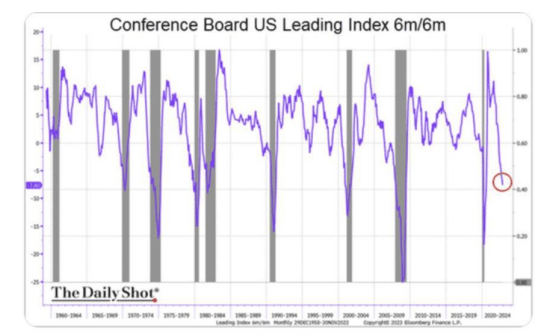
In case, however, we still need more recessionary evidence, the dramatic 6 month decline in the Conference Board’s index of leading indicators serves as yet another neon-flashing warning that the recession—if not under our bow—is certainly right off our bow.

Still Hoping for a “Softish” Landing?

Furthermore, and despite Powell’s belief that his office can manage a recession with the precision of a home thermostat, his faith in what he lately described as a “softish landing” is almost as farcical as his prior attempt to describe inflation as “transitory.”

Without wishing to appear “sensational,” as many of us blunt and math-based observers (from Burry to Middelkoop) of late are described, I will stick my tin-foil-covered head out and say candidly that I see nothing “softish” ahead.

Instead, I see either: 1) a financial crisis which will dwarf 2008 and/or, 2) an absolute tanking of the USD, whose unsustainable strength throughout 2022 was indeed “transitory,” as I argued numerous times.

The Simple Math of Liquidity

The simple math and reality of even centralized and central-bank distorted markets is quite simple: These markets rise and fall on liquidity.

Once the monetary “grease” required to maintain the MMT fantasy of mouse-click money as a debt solution “tightens” too tight or runs too dry, the entire house of cards of the post-2008 fairytale comes to a hard rather than “softish” end.

Again, we saw the first signs of this collapse in the “tightening” backdrop of 2022.

Of course, this critical “liquidity” won’t be coming from economic growth, rising tax receipts, a robust Main Street or a fairly-priced market.

Instead, and as expected, it now comes from out of thin air…

Is It a Race to the Bottom for Risk Assets?

The honest but scary numbers rather than fluffy but fictional words of our financial central planners make it all too clear that unless Powell puts his finger on the Eccles-based mouse-clicker to create more fiat money (highly inflationary), US and global credit markets will simply continue their race to the ocean floor (highly deflationary or at least dis-inflationary).

As credit markets sink and bond yields and rates rise, this also means that equity markets, who have been sickly addicted to years of central-bank repressed low rates and cheap debt, will merely join those bonds on the bottom of the dark ocean floor.

In short, bonds (and hence risk parity portfolios) won’t save you. Rather than hedge stocks, they are now correlated to the same.

More Easing Won’t Bring “Ease”

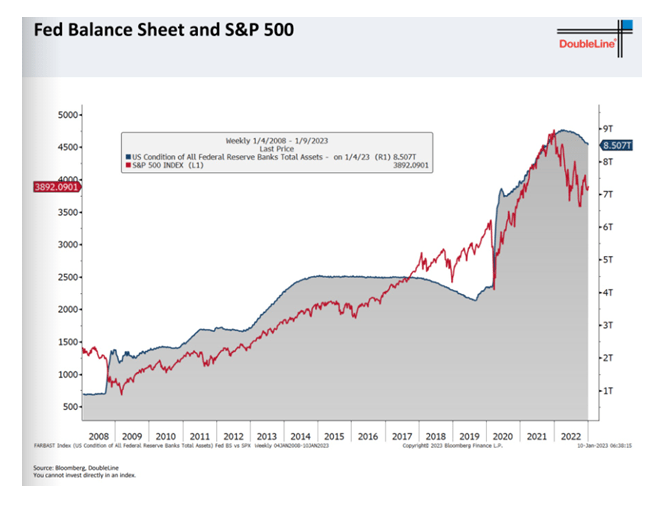
Failing outright and open bond default, it thus seems that an eventual capitulation to more magical “liquidity” and renewed QE is nothing short of inevitable, which means the USD’s fall from its 2022 highs is equally the case, as shown below.

But such “easing,” if realized, will lead to more inflationary-debased Dollars and hence more inflation dis-ease for investors.

This is hard for investors to fully grasp when the Dollar seems “strong,” but even that was an illusion, and one which hardly did any asset class any good in 2022 but for the Dollar itself.

The Damage Already Wrought by the Strong USD

In the interim, the cancerous ripple-effects of the Fed’s strong USD policies, as warned throughout 2022, continue their waves of destruction, as openly evidenced by the earnings reports from our beleaguered S&P.

Already, the early data coming from its listed companies is anything but positive.

As in the July and October earnings seasons of 2022, corporate earnings for 2023 are still drowning under the weight of the USD.

But we must also keep in mind that the DXY (which measures the relative strength of the USD) has fallen 11% (from 113.9 to 101.8) over the last quarter.

If the S&P hit an October bottom during a DXY high, what can we deduce from a now falling DXY?

Will markets rise like Lazarus?

This will be something worth tracking.

But why?

Strong Dollar or Weak Dollar, No One Wins…

Should earnings and hence stocks continue to decline despite the DXY declines, this would suggest that not even a weakening USD can save these post-08, over-stretched, Fed-addicted and debt-soaked markets.

However, should stocks rise on a weaker Dollar, the percentage gains in price will only be eaten away by the invisible tax of inflation and the increasingly debased value of the very dollars used to measure those so-called “appreciating” stocks.

In short, a no-win scenario…

For now, it seems the stock market only cares about the Fed rather than the DXY, as the Fed is the market.

That is, when QE is the meme, zombie markets rise; when QT is the meme, they fall.

Again, see for yourself:

Yellen, Squawking for a Weaker Dollar?

In fact, it was during those October market lows that the queen of toxic liquidity, former Fed-Chair-turned-Treasury-Secretary (imagine that?) Janet Yellen, was suddenly ringing the bell for more magical money—i.e., “liquidity.”

Specifically, Yellen was wondering who would be buying Uncle Sam’s IOU’s without more mouse-click money from the Eccles Building?

As my latest reports on the UST markets confirmed, the answer was simple: No one.

Instead, foreign central banks were and are selling rather than buying America’s bonds. Just ask the Japanese…

Is Yellen, contrary to Powell, silently suggesting that QT has backfired? Is Yellen, unlike Powell, realizing that there are no buyers for our increasingly issued yet unloved USTs but the Fed itself?

Perhaps these tensions within the Treasury market provide the hidden clues as to why the USD has been sliding rather than rising from the DXY’s October highs?

After all, a weaker USD means less forced need for foreign nations to dump their UST reserves to come up with the money to buy their own dying bonds and strengthen their own dying currencies as a direct response to Powell’s (and originally, Yellen’s) strong USD policy.

In short, perhaps our Treasury Secretary now wants to stop the bleeding in her Treasury market…

Weaker Dollar Ahead?

My current view is therefore this: We are seeing the slow end of the strong USD policy.

Why?

Because as warned throughout 2022, such a strong USD was a massive gut-punch to foreign currencies and hence foreign holders of USD-denominated debt.

Indirectly then, the strong USD was also a gut-punch to the UST market, which saw more sellers than buyers around a crippled globe. Hence Yellen’s backfired and back-stepping fears above…

Furthermore, and returning to the aforementioned topic of recessions, I also argued throughout 2022 that no recession in history has ever been solved with a strong currency.

Given that such a recession is, again, either directly off our bow or already under it, it is likely no coincidence that the USD/DXY is now falling rather than rising.

In short has Uncle Sam’s strong Dollar finally cried, well… “Uncle”?

Or more simply stated, has Yellen realized, in private, what we’ve been arguing in public, namely: That we are already in a recession and thus need a weaker Dollar.

Powell: Ignoring Reality & Yellen?

Meanwhile, however, you have the math-challenged but psychologically tragic Jay Powell wanting to save his legacy as a Paul Volcker rather than as an Arthur Burns.

Like a child wanting to be John Wayne rather than Daffy Duck, Powell and his rate-hiked strong USD refuses to see the $31T debt pile in front of him which makes it impossible to be a reborn Volcker, who in 1980 faced a much smaller debt pile of $900B.

In short, Powell’s America of 2023, unlike Volcker’s America of 1980, can’t stomach rising rates or a strong USD.

Or stated even more simply: Powell can’t be Volcker.

Will someone at the Eccles Building please remind him of this?

Doomed Either Way

Yellen or Powell, QT or QE, strong Dollar or weak Dollar, the global financial system is nevertheless doomed.

We either tighten the bond and hence stock markets into a free fall and economic disaster, or we loosen and ease liquidity into an inflationary nightmare.

As I’ve said so many times: Pick your poison—depression or hyperinflation.

Or perhaps both…namely stagflation.

Either way, of course, Powell, and the American economy, is now doomed. And he has only Greenspan, Bernanke, Yellen, himself and years of mouse-click fantasy to blame.

Supercore (CPI) Lies from On High

Meanwhile, the lies, twisted math and Nobel-Prize level mis-information continues…

Last week, for example, I reminded readers of DC’s latest attempt to mis-report otherwise humanly-felt inflation by tweaking an already-tweaked (i.e., bogus) CPI inflation scale.

But if that comedy wasn’t already comical enough, now welcome none other than Paul Krugman to this stage of open theatrics masquerading as economic data.

According to one of Krugman’s latest neoliberal economist tweets, “3-month ‘supercore’ CPI is below Fed’s 2% inflation target,” which naturally had those equally raggish economic playwriters at the WSJ almost galvanic with theatrical “good news.”

Hmmm.

What neither Krugman nor the WSJ seemed to recognize is that “supercore” CPI excludes food, energy, shelter and the price of used cars, so yes, absolutely, if you take away all the things that actually cost lots of money, inflation is no problem at all… Bravo!

Such shameless misuse of data and headlines, of course, is almost as shameless as the misuse of monetary policy we’ve been enjoying since the Troubled Asset Relief Program…

But as stated last week, such desperate tricks from on high will continue to mount as global financial problems do the same.

An Historical Turning Point

The astounding lack of accountability from the foxes guarding our financial hen house will one day be the stuff of history books, assuming history itself is not cancelled, as it seems the study of economics has already left the room.

The best we can hope for from the very “experts” who have brought the global economy toward a mathematically unavoidable cliff are now empty words and twisted math, as per above.

Such disloyalty from our financial generals on the eve of an unprecedented strategic and tactical economic defeat of their own making reminds me of officers sitting miles from the trenches as investors go “over-the-top” toward a row of cannons pointed straight at their trusting chests.

In short: Sickening.

Gold: A Far More Loyal Lieutenant

Gold was a far more loyal asset than stocks and bonds in the turbulent times of 2022; and given that 2023 portends to be even worse, we can expect better loyalty from this so-called “barbarous relic” of the past.

With inflation ripping and war blazing, many still argue that gold did not do enough.

Hmmm…

But gold in every currency but the USD (see above) would beg to differ.

Furthermore, and as argued so many ways and times, that USD strength will not hold, as gold’s price moves this year have already tracked.

Gold’s future strength and rise is thus easy to foresee, as gold doesn’t rise, currencies just fall.

It’s really that simple.

Got gold?

Tyler Durden
Fri, 02/10/2023 – 06:30