65.2 F
Chicago
Monday, August 3, 2026
Home Blog Page 3959

Beware: The Fed Thinks It’s Different This Time

0
Beware: The Fed Thinks It’s Different This Time

By Dhaval Joshi of BCA Research

The four deadliest words in life are ‘it’s different this time’. Anyone who utters these words usually ends up being carried away, feet first. So, it’s especially worrying that the ‘it’s different this time’ narrative is coming from none other than the world’s most important central bank, the US Federal Reserve.
Through the past 75 years, the US unemployment rate has either not gone up meaningfully, or it has gone up by a lot. The US unemployment rate has never gone up by ‘just’ 1 percent. Yet when asked at last week’s press conference if the cost of killing inflation could be kept to the unemployment rate going up by ‘just’ 1 percent, Jay Powell answered:

“Yeah, absolutely it’s possible… this is not a standard business cycle where you can look at the last ten times there was a global pandemic… it is unique”

The Sequence Of Events Leading To Recession Is Always The Same

It’s not every day that there’s a global pandemic. Then again, it’s not every day that the Bretton Woods monetary system collapses, as happened prior to the 1970s recessions. It’s not every day that the mother of all stock market bubbles bursts, as happened prior to the 2001 recession. And it’s not every day that there’s a nationwide housing bust in the US, as happened prior to the 2008 global financial crisis.

The backdrop to every business cycle is ‘different this time’. But the chain reaction that takes the economy into recession is always the same.

First, sales decline relative to wages.

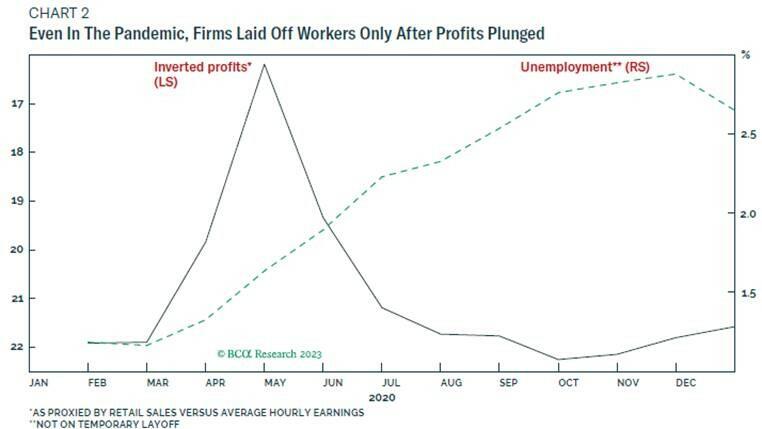
Second, firms’ profits plunge.

Third, firms lay off workers.
Fourth, at a tipping-point of a 0.5-0.6 percent rise in the unemployment rate, consumers take fright and increase their precautionary saving, and banks slow their lending.

Fifth, this further slowdown in spending is the self-reinforcement which causes the unemployment rate to go up by at least 2 percent. Meaning, a recession.

This chain reaction explains why the US unemployment rate is non-linear: it either doesn’t go up meaningfully, or it goes up a lot. If the chain reaction breaks down before stage four, then unemployment doesn’t rise meaningfully, but if the chain reaction gets to stage four, then unemployment rises a lot.

The latest employment data shows that the US jobs market remains red hot, but this should come as no surprise. To repeat, firms only lay off workers after their profits plunge. Not before. So far, the chain reaction is only at stage two. Sales are declining relative to wages, but economy-wide profits have not declined enough to trigger widespread layoffs.

Only if we get to stage four in the chain reaction will we know whether it’s different this time. But as I explained in The US Approaches Its Event Horizon, to get to stage four, the best real-time indicator for profits – retail sales versus average hourly earnings – must decline by 3-4 percent. So far, this indicator has declined by 3 percent, so it is at the cusp of unleashing stage three and four of the chain reaction. Hence, we await next data release on Feb 15th as a crucial signpost.

So Far, It’s Not Different This Time

It rarely is different this time. Yet we should keep an open mind. There is a first time for everything. The Fed is betting that it’s different this time because the self-reinforcement in stage five of the chain reaction will be much weaker this time. So, rather than rising by well over 2 percent, the unemployment rate will rise by just 1 percent. To repeat, this outcome is unprecedented. But given this outlook, says Powell, “I don’t see us cutting rates this year.”

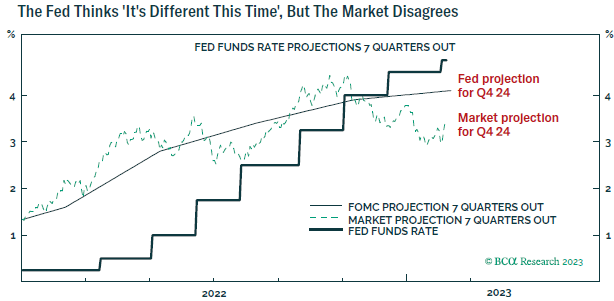
After the red hot jobs report for January, the market broadly agrees. Projections for the fourth quarter of 2023 show that both the Fed and the market expect one to two further quarter-point hikes, and then a pause, but no rate cuts.

Projections for the fourth quarter of 2024 are more interesting. Given the Fed’s outlook for the unemployment rate to rise by just an unprecedented 1 percent or so, it is projecting the policy rate to be only modestly lower than today. Meanwhile, the market is projecting 125 bps lower than today.

Therefore, if you believe the Fed is right, and it really is different this time, the investment recommendation would be to sell the less optimistically priced November 2024 Fed funds future (FFX24), or more liquid close equivalent FFZ24.

What if you believe that the Fed is wrong, and that it’s not different this time – does the less optimistic market pricing for 2024 already discount this? No, in every cycle, interest rates climb up the stairs, but fall down the elevator shaft. Meaning that once in a recession, the pace of cutting rates is always aggressive. In 2001, rates collapsed at a pace of 150 bps per quarter, in 2008 by 100 bps per quarter, and in 2020 – even starting from a very low peak of 2.5 percent – by 80 bps per quarter.

Therefore, if this time is not different, the unemployment rate will rise by well over 2 percent, killing wage inflation, and unleashing the typically aggressive rate cutting that follows a recession. In this case, the pricing of the late 2024 Fed funds futures is not pessimistic enough, and the investment recommendation would be to buy them.

So far, there is nothing to suggest that it’s different this time. To repeat, the US jobs market remains strong because economy-wide profits have not declined enough to trigger widespread layoffs. We will only discover if it’s different this time after profits plunge, and we won’t have to wait long to find out.

We must watch the data and keep an open mind. But until the data proves that this time is different, it most likely is not. Therefore, the recommendation is to buy the November 2024 Fed funds future (FFX24), or more liquid close equivalent FFZ24.

It also implies staying overweight bonds versus equities on a 6-12 month horizon.

Tyler Durden
Thu, 02/09/2023 – 15:35

Cryptos Tumble After Kraken Agrees To Shutter Crypto-Staking Ops To Settle SEC Charges

0
Cryptos Tumble After Kraken Agrees To Shutter Crypto-Staking Ops To Settle SEC Charges

Update (320pm ET): As Coindesk reported earlier, the SEC confirmed that it has indeed reached a settlement with Kraken under which the exchange will pay $30 million to settle allegations its broke securities rules, and would end its crypto staking program as it involved “unregistered securities.” It is unclear if Ethereum is among the alleged “securities”:

  • *CRYPTO EXCHANGE KRAKEN ENDS STAKING PROGRAM IN SEC SETTLEMENT
  • *SEC SAYS KRAKEN STAKING INVOLVED UNREGISTERED SECURITIES
  • *SEC ALLEGES IN COURT CASE THAT KRAKEN STAKING BROKE RULES
  • *SEC SUES KRAKEN IN FEDERAL COURT IN CALIFORNIA

“Today’s action should make clear to the marketplace that staking-as-a-service providers must register and provide full, fair, and truthful disclosure and investor protection,” SEC Chair Gary Gensler said in a statement.

*  *  *

Bitcoin and the broader crypto universe tumbled…

… and slid to three week lows, breaching support that had held since late January…

… after a report from Coindesk, which cites an “industry source briefed on the matter” that crypto exchange Kraken agreed to shut its cryptocurrency-staking operations to settle charges with the SEC; the report confirms earlier news from Bloomberg that Kraken was close to a settlement with the SEC over offering unregistered securities on Wednesday.

Kraken, like most crypto exchange, offers a number of yield services under its staking umbrella, including a crypto-lending product offering up to 24% yield. This is also expected to shut down under the settlement, the industry person said. Kraken’s staking service offered a 20% APY, promising to send customers staking rewards twice per week, according to its website.

According to the report, the SEC will discuss and vote on the settlement during a closed-door commissioner meeting on Thursday afternoon, and an announcement may around 4 p.m. ET.

The vote comes one day after Coinbase CEO Brian Armstrong tweeted that he’d heard rumors the SEC would bar retail customers from engaging in staking, the technique of pledging crypto tokens to run proo-of-stake blockchains such as Ethereum.

Since Coinbase offers its own staking services, especially for clients who are long ETH, a potential ban on staking would prove to be catastrophic for US-based exchanges, and it would force virtually all domestic users of staking securities to offshore exchanges like Binance. As Armstrong reminds us, “regulation by enforcement doesn’t work. It encourages companies to operate offshore, which is what happened with FTX.”

But to SEC Chair Gary Gensler, a lifelong Democrat who was humiliated by SBF epic fraud who had managed to worm his way into Democrats’ best graces thanks to his tens of millions in bribes, none of that matters: previously the former Goldman partner said he believes staking through intermediaries – like Kraken – may meet the requirements of the Howey Test, a decades-old U.S. Supreme Court case commonly used as one measure of whether something can be defined as a security under U.S. laws.  Staking looks similar to lending, Gensler said at the time. The SEC has brought and settled charges with lending companies before, such as now-bankrupt lender BlockFi.

Here, too, Armstrong disagrees:

A Kraken settlement would help Gensler’s mission, giving his agency a big win as it continues its efforts to police the broader crypto ecosystem. The majority of people staking on Ethereum, for example, use services, according to Dune Analytics.

Whether or not the SEC goes so far as to land a crushing blow on US-based exchanges and in the process forces virtually all cryptos offshore, remains to be seen, but judging by the swift selling int he crypto market, many are not taking chances.

Tyler Durden
Thu, 02/09/2023 – 15:13

NTSB Says Fatal 2021 Tesla Wreck Was The Result Of “Excessive Speed” And “Alcohol Intoxication”

0
NTSB Says Fatal 2021 Tesla Wreck Was The Result Of “Excessive Speed” And “Alcohol Intoxication”

A report from the U.S. National Transportation Safety Board this week has found that a 2021 fiery Tesla crash was the result of the vehicle’s driver speeding and being intoxicated. The crash killed two people. 

69-year-old engineer Everett Talbot and 59-year-old Dr. William Varner were the victims of the crash which took place on April 17, 2021. The occupants were traveling in a 2019 Tesla Model S P100D which, after slamming into a tree, burst into flames. 

NTSB’s investigation concluded that the likely cause of the crash was: “the driver’s excessive speed and failure to control his car, due to impairment from alcohol intoxication in combination with the effects of two sedating antihistamines, resulting in a roadway departure, tree impact, and post-crash fire,” according to ABC

Recall, we wrote back in May 2021 that a close friend of one of the men who died in the Houston area fatal wreck ago said he believed the driver of the vehicle climbed into the back seat while “trying to save his own life”. We noted that when the NTSB issued their preliminary report on the wreck, they noted that “all aspects” were still under investigation. 

The report noted that:

  • Footage from the vehicle’s owner’s home security system showed “the owner entering the car’s driver’s seat and the passenger entering the front passenger seat”. It has been called into question whether or not there was anyone in the driver’s seat at the time of the crash, so it appears to be too early to judge whether or not this means anything.

  • It was shortly thereafter that the “car leaves and travels about 550 feet before departing the road on a curve, driving over the curb, and hitting a drainage culvert, a raised manhole, and a tree,” the report notes. 

  • The ensuing fire destroyed the car’s onboard data storage device. Yes, despite the fact that Elon Musk went “all in” in proclaiming that data logs “recovered so far” showed Autopilot was not enabled in the car last month, the NTSB is now reporting that they didn’t have access to stored data inside the vehicle The report reads: “The crash damaged the front of the car’s high-voltage lithium-ion battery case, where a fire started. The fire destroyed the car, including the onboard storage device inside the infotainment console.”

Dr. William Varner – identified as one of two men who died in the accident – was in the vehicle after it caught fire. He was found by first responders to be in the back seat of the vehicle. The other occupant was found in the front passenger’s seat. 

Varner’s best friend, Bob Wortham, said back in 2021: “I’ve been going weeks without being able to sleep because I can’t get it out of my mind. It’s just horrible.”

“The reason he was in the back seat, he was trying to save his life. It was such a painful experience for the whole family,” he continued, telling a local NBC affiliate. Wortham said he believed that Varner could not get out of the car and was burned alive.

“There was a neighbor that saw and came over to see what was going on and he said the damage on the front of the car was minor damage,” Wortham said. “This car was burned so bad that they couldn’t identify either of the people by their dental records. That’s how bad they were burned.” 

Tyler Durden
Thu, 02/09/2023 – 14:35

El-Erian Warns About Disinflationista’s “Dangerous Complacency”

0
El-Erian Warns About Disinflationista’s “Dangerous Complacency”

Authored by Mohamed El-Erian via Project Syndicate,

There Is More Inflation Complexity Ahead

As US inflation gradually eases, the claim that today’s inflationary pressures are the result of a temporary supply shock has re-emerged. While this thesis may be comforting, it could also encourage dangerous complacency, making an already serious problem much harder to solve.

Nearly two years into the current bout of inflation, the concept of “transitory inflation” is making a comeback as the COVID-related supply shocks dissipate. This comes at a time when it is critically important to keep an open mind about the trajectory of inflation, including by avoiding an over-simplified transitory narrative that risks obfuscating the real issues facing the US economy.

“Transitory” is a comforting notion suggesting a short-lived, reversible phenomenon. Critically, the concept assumes away the need to adjust behaviors. After all, if an inflation scare is only temporary, the best way to deal with it is simply to wait it out (or, to use a policy and market term, “look through it”). That is why this narrative is particularly dangerous. By encouraging complacency and inertia, it could exacerbate an already serious problem and make it harder to solve.

The US Federal Reserve’s initial response to rising inflation is a case in point. In 2021, the world’s most powerful and influential central bank rushed to characterize higher inflation as transitory. It doubled down on this approach even after the data went against it, refusing to pivot for too long.

The Fed’s repeated mischaracterization delayed crucial policy responses at a time when the persistence of inflation was starting to influence corporate price-setting and workers’ wage demands. As a result, the Fed not only lost credibility but also inflicted unnecessary pain on millions of American households, particularly the most vulnerable segments of the population.

While a few economists have never given up on the transitory inflation thesis, the vast majority already realized last year that it was a regrettable analytical and policy error. That makes the current re-emergence of this narrative even more perplexing.

A recent article in Politico noted that “There is also at least some reason to believe that [the economists and policymakers] who assured [Americans] that inflation would be transitory, including Fed Chair Jerome Powell, might have been kind-of-sort-of right, though the transitory period was just longer and uglier than expected.”

This is unfortunate. Not only does it force a time dimension on an inherently behavioral concept, but it also ignores the fact that the Fed’s initially fumbled response forced it into one of the most aggressive, front-loaded series of interest-rate hikes ever, including four consecutive 75-basis-point increases. Moreover, while US inflation has been slowing, it is dangerous to suggest that the problem is behind us.

Looking ahead to the rest of the year and early 2024, three possibilities stand out for me.

  • The first is orderly disinflation, also known by critics as “immaculate disinflation.” In this scenario, inflation continues to come down steadily toward the Fed’s 2% target without damaging US economic growth and jobs. The dynamics involve primarily a labor market that avoids excessive wage increases while continuing to anchor strong economic activity. Given what else is going on in the economy, I would put the probability of this scenario at 25%.

  • The second scenario is one in which inflation becomes sticky. The inflation rate continues to decrease but then gets stuck at 3-4% over the second half of this year as goods prices stop declining and services inflation persists. This would force the Fed to choose between crushing the economy to get inflation down to its 2% target, adjusting the target rate to make it more consistent with changing supply conditions, or waiting to see whether the US can live with stable 3-4% inflation. I do not know what the Fed would choose in such a case, but I would put the probability of such sticky inflation at 50%, so I hope it has given this scenario some thought.

  • Lastly, there is the possibility of what we can label “U inflation”: prices head back up late this year and into 2024, as a fully-recovered Chinese economy and the strong US labor market simultaneously drive persistent services inflation and higher goods prices. I would put the probability of this outcome at 25%.

This is not just about multiple scenarios with no single one dominating. It is also about probabilities that must be viewed with caution. Former US Secretary of the Treasury Lawrence H. Summers captured well the prevailing mood among many economists: “It’s as difficult an economy to read as I can remember,” he recently said.

This sense of uncertainty is evident in the short-term outlook for economic activity, prices, and monetary policy, as well as long-term structural shifts like the clean-energy transition, the rewiring of global supply chains, and the changing nature of globalization. Heightened geopolitical tensions also play a role.

Whatever happens, the worst thing we can do is fall back into complacency. Powell, after championing “transitory inflation” for too long, is now warning against it. “There has been an expectation that [inflation] will go away quickly and painlessly and I don’t think that’s at all guaranteed,” he said recently. “The base case, for me, is that it will take some time. And we will have to do more rate increases…”

Simplistic economic narratives, especially comforting ones that entice those looking for shortcuts, often mislead much more than enlighten. This was the case with the transitory inflation narrative that, while discredited in 2021-22, is now reemerging. It is also the case with those who are predicting with a high degree of confidence a US recession (I am not in that camp), only to dismiss it as “short and shallow” in order to regain their economic comfort zone.

Tyler Durden
Thu, 02/09/2023 – 14:15

Second NJ Councilman Shot Dead One Week After Dwumfour Slaying

0
Second NJ Councilman Shot Dead One Week After Dwumfour Slaying

A Republican New Jersey municipal council member was found shot dead in his car on Wednesday, exactly one week after Councilwoman Eunice Dwumfour – also a Republican, was gunned down while driving her car.

51-year-old Russell Heller was found just after 7 a.m. in the parking lot of his workplace, PSE&G, located in Somerset. Former employee Gary Curtis, 58, was identified as a suspect – and was found dead in his own car from a suspected self-inflicted gunshot wound around 3.5 hours after the murder, the NY Post reports.

Facebook/ Russ Heller

The investigation remains ongoing to determine motive,” said prosecutors, adding that “Heller was the intended target.”

Gov. Phil Murphy sent “thoughts and prayers” to Heller’s “family and friends in the wake of this tragic act of gun violence.”

US Rep. Tom Kean Jr. (R-NJ), whose district includes the area, said he was “shocked and saddened by the tragic murder” of his fellow Republican.

“Russell was an outstanding public servant who proudly represented the river town he loved,” Kean tweeted. -NY Post

“Russell was a dedicated and valuable member of the Milford and Hunterdon County community whose leadership and commitment will be sorely missed,” said Zachary Rich, the director of the county board of commissioners. “More importantly, however, Russell was a loving and caring father to his daughter and a dedicated and loyal friend to all of those who had the pleasure of knowing him.”

The murder appears to be an “isolated incident” according to authorities, who have not linked it to the murder of Eunice Dwumfour.

Dwumfour, 30, was found dead in her white Nissan SUV last Wednesday, having suffered multiple gunshot wounds. A witness told the NY Post that her car was hit with around 12 shots, and crashed near the Camelot at La Mer apartment complex in Sayreville.

Eunice Dwumfour

“She was slumped over the wheel with a black hoodie with brown fur covering her head, her hands were down by her side. There was one bullet hole in the passenger door and a bunch of bullet holes in the driver door. Some other neighbors said they saw someone running away with a mask on,” said the witness.

Tyler Durden
Thu, 02/09/2023 – 13:55

A Growing Number Of Investors Are Buying Any Dip They Can… They Are Also Buying Hedges

0
A Growing Number Of Investors Are Buying Any Dip They Can… They Are Also Buying Hedges

By Michael Msika, Bloomberg markets live reporter and analyst

An increasing number of investors are buying any dip they can, convinced that a more dovish turn from central banks is just around the corner against the comforting backdrop of a soft landing for the economy. But at the same time, they’re bulking up on hedges, just in case.

All eyes were on Fed Chair Jerome Powell this week as he cautioned that rates may move higher than previously expected, given the strength of the job market. Suffice to say, any weakness in stock futures prompted by his warning was bought on both sides of the Atlantic.

According to Barclays strategist Emmanuel Cau, a pattern of short covering by hedge funds and systematic strategies adding equity exposure is now “well advanced.” But long-only funds that missed out on recent gains are still defensively positioned and may be tempted to make up ground by capitalizing on any declines, he says.

“Risk-reward after such a strong run feels more balanced, and some consolidation is logical,” Cau says. “But for now, we think markets may still have good reasons to believe in a soft landing.”

While some investors might be chasing the rally, others are boosting their hedges, with an eye on risks that still lie ahead. The total number of puts traded on the Euro Stoxx 50 was more than three times the number of calls this week, a relatively rare occurrence. Meanwhile, overall positioning in equities is still low and a good reason why markets could keep rising for at least a few weeks.

“Positioning remains relatively weak despite its improvement over the last quarter,” says JPMorgan derivatives strategist Davide Silvestrini. “This in turn could support short-term performance.” Low implied volatility offers a hedge against the risk of market squeezing higher in the near term — through April call spreads, for example, Silvestrini says.

Source: JPMorgan

In the medium term, the picture is likely to reverse, according to JPMorgan’s team of strategists. While markets are moving higher on expectations that disinflation can take place without significant weakness in economic growth, this scenario is unlikely to materialize, they say. They expect earnings and macro expectations to disappoint beyond the first quarter and recommend using current strength to reduce exposure.

Investors may have been too quick to price in a soft landing. The job market is still on fire, threatening to keep inflation higher for longer, something that central banks have warned about again and again.

US inflation numbers next week loom as a big test for equities. “The labor market needs to cool for the Fed to hit its inflation target,” says UBS Wealth Management CIO Mark Haefele. “With unemployment at 3.4%, the lowest level since 1969, this looks hard to achieve.”

Down the line, many large asset managers remain skeptical of a benign outcome and expect the economy to weaken, which will eventually deal a blow to stocks. Developed-market equities have rallied on hopes of a rebound in growth, prompting some investors to dive in for fear of missing out. But those stocks “aren’t fully pricing the recession hit we see ahead,” BlackRock Investment strategists led by Jean Boivin say.

Tyler Durden
Thu, 02/09/2023 – 11:35

Behind Google’s $150 Billion AI-Driven Selloff: “The Response Has Been Very Emotional And Devoid Of Reality”

0
Behind Google’s $150 Billion AI-Driven Selloff: “The Response Has Been Very Emotional And Devoid Of Reality”

Yesterday we saw mega cap GAMMA tech stocks slide with GOOGL tumbling 7.7%, a loss which extended another 4% on Thursday, after the company’s search & AI event revealed a glitch in the company’s AI algos. The loss – the worst in more than three months – slashed some $100BN in GOOGL market cap yesterday and another $50 today…

… because, as Goldman put it, “the CEO of MSFT wants to go after their search business” and sure enough Wednesday was the third worst percent change between GOOGL and MSFT (-7.37%) on a 5 year look back.

But is Google losing enough market cap that would wipe out some 420 S&P500 companies really merited? According to JPM senior TMT trader Ron Adler, the answer is a resounding no, and “the response from investors around AI has been very emotional and devoid of reality.” Why? Because as Adler asks rhetorically “will anyone change their homepage or no longer visit Google when looking for or thinking about looking for something? Probably not. Will we ever really use the name Bard in conversation? Also, probably not. How many of you use Siri or Alexa to conduct simple searches you do on your phone? A lot less than one would think. Old habits die hard, and Google will be hard to break.”

Below we excerpt from his full note:

Simply put, the outcomes are asymmetric for MSFT and GOOGL. Google is the incumbent, and AI presents the innovator’s dilemma for Pichai. MSFT has been trying to make Bing happen since 2009 and has yet to make a dent. MSFT is investing a lot of money in AI in a market that has latched on to AI (like they have previously latched on to blockchain and dot-com before that). Nadella noted that gross margin in search would “drop forever,” and investors in GOOGL fear a potential scorched earth plan by MSFT to gain share.

MSFT’s presentation Tuesday seemed innovative, vs. low expectations for Bing. The GOOGL presentation focused on maps and ways Google monetizes things. At the same time, MSFT’s event (which was very desktop-focused on a mobile world) placed unnecessary import on Wednesday’s GOOGL event.

The response from investors around AI has been very emotional and devoid of reality. Yesterday people were talking about how AMZN is behind on AI (they are not). AI/ML has been around for a while, but compute power, and better tools are making them mainstream; we’ve had chatbots for years (I’m 100% dating myself here but does anyone remember SmarterChild?).

Headlines of GOOGL’s AI getting an answer wrong underscore the market’s irrationality towards AI. Programming is moving towards a determinative path to one of statistics and probability. This migration won’t be linear and clumsy (and who knows, it could even breed a Terminator). From a business standpoint, AI could also prove VERY deflationary, not just for tech but for society (remains to be seen).

We are in the early stages of understanding the impacts of AI, let alone fully grasping the implications of the technology. In the near to medium term, will anyone change their homepage or no longer visit Google when looking for or thinking about looking for something? Probably not. Will we ever really use the name Bard in conversation? Also, probably not. How many of you use Siri or Alexa to conduct simple searches you do on your phone? A lot less than one would think. Old habits die hard, and Google will be hard to break.

And here is Bernstein underscoring the same point: “ChatGPT is a great piece of technology but MSFT is likely going to have a very tough time breaking into Google’s monopoly because they don’t control the channel.”

More in the full note available to pro subs.

Tyler Durden
Thu, 02/09/2023 – 11:15

Tesla Shares, Up 5% Today, Have Now Doubled Off Their Lows Made Barely A Month Ago

0
Tesla Shares, Up 5% Today, Have Now Doubled Off Their Lows Made Barely A Month Ago

As of this morning, shares of Tesla (which are now currently up by 5.3% to $212 on the session) have more than doubled in value from their intraday low barely a month ago, on January 6, 2023.

It marks a stunning move higher in a short amount of time when both Elon Musk’s financial solvency and Tesla demand were popular talking points among the skeptics. 

The pop in shares has come as a result of Tesla finding success in driving more demand by cutting its prices. Heading into the company’s Q4 2022 earnings report, there were looming questions not only about whether or not the price cuts would work, but also whether or not they would drive down margins too much.

But just last weekend we noted that the company’s price cuts were helping spur demand in China that was so robust, it was bucking the national trend for EVs for the month of January. 

The company’s China segment shipped 66,051 vehicles in January, according to Bloomberg, citing preliminary data released by China’s Passenger Car Association. In December, that number stood at 55,800.

The figure is up 18% from December, while China’s new energy passenger vehicles, in total, are seen down 45% month over month from December to January. 

The company is now reportedly planning to increase output at its Shanghai plant – bringing its run rate back toward where it was in September 2022 – in order to continue meeting the demand from price cuts on its best selling models. 

Tesla had suspended operations at its Shanghai plant for a portion of December. The EV maker was expected to halt production – as we noted in a previous article – but continued swirling questions about demand had surfaced after the company shut down operations at the key location earlier than expected. Back on December 9th we wrote that the company was shutting down operations due to upgrades at the plant and waning consumer demand.

Meanwhile, looking at the broader scope of EV sales in China, domestic names like Nio, Xpeng and Li Auto all recorded monthly and YOY sales declines in January, per Jalopnik

“Apparently, Tesla’s huge discounts [on its Model 3 and Model Y vehicles] siphoned off drivers’ buying interest in the Chinese-developed smart EVs. Overall, demand for expensive EVs appears to be weak, which could lead to price wars in the premium EV segment this year, “Gao Shen, an independent analyst in Shanghai, told SCMP.

And as we detailed days ago, Visual Capitalist’s Marcus Lu says that Tesla’s price cuts are an attempt to protect its market share, but they’re not exactly the desperation move some media outlets have claimed them to be.

Recent data compiled by Reuters shows that Tesla’s margins are significantly higher than those of its rivals, both in terms of gross and net profit.

Our graphic only illustrates the net figures, but gross profits are also included in the table below.

Price cutting has its drawbacks, but one could argue that the benefits for Tesla are worth it based on this data—especially in a critical market like China.

The stock certainly seems to agree…

Tyler Durden
Thu, 02/09/2023 – 11:00

“Free Speech For Whom?”: Former Twitter Exec Makes Chilling Admission On The “Nuanced” Standard Used For Censorship

0
“Free Speech For Whom?”: Former Twitter Exec Makes Chilling Admission On The “Nuanced” Standard Used For Censorship

Authored by Jonathan Turley,

Yesterday’s hearing of the House Oversight Committee featured three former Twitter executives who are at the center of the growing censorship scandal involving the company: Twitter’s former chief legal officer Vijaya Gadde, former deputy general counsel James Baker and former head of trust and safety Yoel Roth.

However, it was the testimony of the only witness called by the Democrats that proved the most enlightening and chilling.

Former executive Twitter Anika Collier Navaroli testified on what she repeatedly called the “nuanced” standard used by her and her staff on censorship.

Toward the end of the hearing, she was asked about that standard by Rep. Melanie Ann Stansbury (D., NM). Her answer captured precisely why Twitter’s censorship system proved a nightmare for free expression. Stansbury’s agreement with her take on censorship only magnified the concerns over the protection of free speech on social media.

Even before Stansbury’s question, the hearing had troubling moments. Ranking Member Rep. Jamie Raskin (D., Md) opened up the hearing that insisting that Twitter has not censored enough and suggested that it was still fueling violence by allowing disinformation to be posted on the platform.

Navaroli then testified how she felt that there should have been much more censorship and how she fought with the company to remove more material that she and her staff considered “dog whistles” and “coded” messaging.

Rep. Stansbury asked what Twitter has done and is doing to combat hate speech on its platform. Navaroli correctly declined to address current policies since she has not been at the company for some time. However, she then said that they balanced free speech against safety and explained that they sought a different approach:

“Instead of asking just free speech versus safety to say free speech for whom and public safety for whom. So whose free expression are we protecting at the expense of whose safety and whose safety are we willing to allow to go the winds so that people can speak freely.”

Rep. Stansbury responded by saying  “Exactly.”

The statement was reminiscent to the statement of the former CEO Parag Agrawal. After taking over as CEO, Agrawal pledged to regulate content as “reflective of things that we believe lead to a healthier public conversation.” Agrawal said the company would “focus less on thinking about free speech” because “speech is easy on the internet. Most people can speak. Where our role is particularly emphasized is who can be heard.”

Navaroli was saying that it is not enough to simply balance free speech against public safety (a standard that most free speech advocates would oppose as ill-defined and fluid). Instead, Navaroli and her staff would decide “free speech for whom and public safety for whom.”

The suggestion is that free speech protections would differ with the speakers or who was deemed at risk from the exercise of free speech.

It takes a subjective balancing test and makes it even more ambiguous and illusory. Free speech demands bright lines to avoid the chilling effect of uncertainty for citizens.

The Twitter standard described by Navaroli defies definition, let alone understanding, for anyone posting controversial or dissenting views.

In the hearing, the Democratic members and witnesses repeatedly returned to the statement of Holmes on “shouting fire in a crowded theater.” The hearing shows how this statement has been grossly misused as a justification for censorship. From statements on the pandemic to climate change, anti-free speech advocates are claiming that opponents are screaming “fire” and causing panic.

The line comes from Schenck v. United States, a case that discarded the free speech rights of citizens opposing the draft. Charles Schenck and Elizabeth Baer were leading socialists in Philadelphia who opposed the draft in World War I. Fliers were distributed that encouraged men to “assert your rights” and stand up for their right to refuse such conscription as a form of involuntary servitude. Writing for the Court, Justice Oliver Wendell Holmes dismissed the free speech interests in protecting the war and the draft.

He then wrote the most regrettable and misunderstood judicial soundbites in history:  “the character of every act depends on the circumstances in which it is done . . . The most stringent protection of free speech would not protect a man in falsely shouting fire in a theater and causing a panic.” “Shouting fire in a crowded theater” quickly became a mantra for every effort to curtail free speech.

Holmes sought to narrow his clear and present danger test in his dissent in Abrams v. United States. He warned that “we should be eternally vigilant against attempts to check the expression of opinions that we loath and believe to be frought (sic) with death, unless they so imminently threaten immediate interference with the lawful and pressing purposes of the law that at an immediate check is required to save the country.”

Holmes’ reframing of his view would foreshadow the standard in In Brandenburg v. Ohio, the Supreme Court ruled in 1969 that even calling for violence is protected under the First Amendment unless there is a threat of “imminent lawless action and is likely to incite or produce such action.”

However, Navaroli, Stansbury, and others are still channeling the standard from Schenck, which is a curious choice for most Democrats in using a standard used against socialists and anti-war protesters.

Yet, Navaroli’s standard from Twitter makes the Schenck standard look like the model of clarity. Essentially, she adds that you also have to consider the theater, movie, and audience to decide what speech to allow. What could be treated as crying “Fire!” by any given person or in any given circumstances would change according to their “nuanced” judgment.

According to Navaroli, she and her staff would not allow the “safety [of others] to go the winds so that people can speak freely.” It is the classic defense of censorship in history and the touchstone of every authoritarian regime today.

Today’s hearing will address the question of when corporate censorship programs become an extension of the government.

However, while it is unclear how Twitter’s censorship made us more safe, Twitter’s “nuanced” standard certainly allowed free speech “go to the winds” of censorship.

You can find the Stansbury-Navaroli exchange around the 5:00 mark below:

Tyler Durden
Thu, 02/09/2023 – 10:41

Third Point Becomes Fifth Activist Investor To Join Salesforce Party

0
Third Point Becomes Fifth Activist Investor To Join Salesforce Party

Shares of Salesforce Inc. are trading marginally higher in premarket on a Wall Street Journal report that a fifth activist investor, Dan Loeb’s Third Point Hedge fund, has taken a stake in the software company. 

Third Point’s stake was reported Wednesday evening, which builds on the increasing number of activist investors taking positions in Salesforce. So far, Elliott Investment Management LP, Starboard Value LP, ValueAct Capital Partners LP, and Jeff Ubben’s Inclusive Capital have taken stakes. 

WSJ couldn’t confirm Third Point’s size of the position or future plans to overhaul the software company. They noted, “it’s possible the firm will stay quiet and not launch a campaign.” 

Third Point has been known for pushing significant corporate change at the blue-chip level. They’ve done this with Campbell Soup Co., Shell PLC, and Walt Disney Co. 

The swarm of activists encircling Salesforce comes as the company has lost $134 billion in market cap, down from $303 billion in November of 2021. 

Last month, Salesforce announced a broad restructuring plan “intended to reduce operating costs, improve operating margins, and continue advancing the Company’s ongoing commitment to profitable growth.” Included in that plan was a reduction of 10% of its workforce. The latest SEC filings show the company has 73,541 employees. 

The chart below shows Salesforce’s hiring binge has peaked. 

“Activism is clearly now circling the Salesforce name in droves as the massive cloud installed base, free-cash flow potential, under performing margin story, headache Slack deal, and rotating C-level suite has created the perfect storm for Benioff,” said Wedbush analyst Dan Ives, who has a ‘outperform’ rating with a $200 price target on the stock. 

“Ultimately we view this all as a much needed positive for the story to put pressure on under performing assets and strategically look at possible spin-offs over the next 6-12 months depending on outside strategic interests as well as further cost cuts,” Ives added.

Salesforce shares in the premarket were about 2% higher. 

How many more activist will join the party?

Tyler Durden
Thu, 02/09/2023 – 08:44