70 F
Chicago
Sunday, August 2, 2026
Home Blog Page 3984

Profit-Taking Hits Chinese Stocks After Lunar New Year Break

0
Profit-Taking Hits Chinese Stocks After Lunar New Year Break

China stocks pulled back from bull market territory on Monday, the first trading session after a week-long Lunar New Year break.

The CSI 300 index initially surged but lost steam in afternoon trading to end up about half a percent higher, failing to maintain bull market territory. Today’s pop then selling pressure is a suspicious start to the Year of the Rabbit and might indicate profit-taking. 

Some analysts believe Chinese stocks might take a much-needed breather after nearly three months of gains. The CSI 300, which tracks the largest Chinese mainland-listed stocks, gained 19.88% from its October 2022 low. 

“It seems like a classic move for onshore — open high then go lower. I think the market is very excited about the Chinese New Year data, but in reality, if you look at the details, it is kind of mixed,” said Willer Chen, senior analyst at Forsyth Barr Asia Ltd.

Despite the bullish views on the reopening narrative that has helped propel Chinese stocks in recent months, there are a bunch of lingering negatives, including the Biden administration’s tech war against Beijing, Covid infections, broad slowdown, and a housing crunch. 

In the US, Chinese stocks retreated in premarket trading. KraneShares CSI China Internet ETF slid about 4% in premarket trading. 

And the Golden Dragon China Index has erased all of ist Lunar New Year gains now…

The latest BofA survey showed that long Chinese stocks made the list of the most overcrowded trades this month, which might indicate that investors are taking profits after months of gains. 

Tyler Durden
Mon, 01/30/2023 – 09:27

Windfall Taxes Sweep Through The Global Energy Sector

0
Windfall Taxes Sweep Through The Global Energy Sector

Authored by Alex Kimani via OilPrice.com,

Over the past two years, global energy companies have enjoyed record profits amid high commodity prices, with the International Energy Agency estimating that net income by oil and gas companies doubled from 2021 to 2022. Those high oil and gas prices have translated into high fuel prices for consumers, drawing the ire of the public and governments everywhere and sparking populist moves in response. 

The European Union, the UK and India have already introduced windfall taxes on oil and gas companies. 

On September 30, 2022, the Council of the European Union agreed to impose a “temporary solidarity contribution” on energy companies that realize “above a 20% increase of the average yearly taxable profits since 2018”. This tax will be levied on top of whatever taxes these companies already owe in their individual countries. 

A windfall tax is a one-time surtax levied on a company or industry when unusual economic conditions result in large and unexpected profits. 

Others, such as the Netherlands, Norway and the United States are currently considering them. 

According to a recent Wood Mackenzie report, while 2022 was the year in which the idea of the windfall tax and the villainization of Big Oil reached a new peak, this year will likely see more momentum if oil prices remain high. If prices drop, windfall taxes could be eliminated; however, Wood Mackenzie views this as “unlikely”, noting at the same time that some windfall taxes have expiration dates and clauses for modification based on oil prices.

Overall, WoodMac warns that windfall taxes will distort the market and even risk prolonging–or delaying–the energy transition. How? If fossil fuel prices are lower, demand will increase and render renewables less attractive. 

In the meantime, governments have found another way to benefit from soaring oil and gas company profitability–taxing share buybacks, such as has been done in the U.S. and proposed in Canada. Dividends could also be taxes more heavily. Both methods, suggests Wood Mackenzie, would actually “incentivize reinvestment, thus promoting jobs and additional energy supply”.

“A tangle of long-term ambitions will drive upstream regulators and investors toward the big fiscal themes to look for in 2023, from windfall taxes to renewed interest in gas policy terms,” according to WoodMac’s 2023 outlook.

The Windfall Tax Report Card–So Far

United States

Back in October, President Biden threatened to slap a windfall profits tax on American oil and gas companies if they fail to use their “outrageous” bonanza to expand oil supplies in a bid to lower fuel prices. However, he is yet to follow through on his threat but instead American companies have to face a different beast: buyback tax.

As part of the new Inflation Reduction Act that President Biden signed in August is a new 1% tax on corporate share buybacks. Oil and gas companies will bear the brunt of the new tax because they have dramatically increased buybacks as a favored way to return excess cash to shareholders.

My message to the American energy companies is this: You should not be using your profits to buy back stock or for dividends. Not now, not while a war is raging,” Biden said in October. Biden has scolded U.S. oil producers saying they fail to appreciate the free-market capitalism windfall made possible by American democracy nor sympathy for their retail customers.

In 2022, U.S. oil company share buybacks increased 1,043%, dwarfing the 64% increase for S&P 500 while dividends were up 33%, more than three times the rise for all the companies in the index. Total free cash flow of the 23 companies in the S&P 500 Energy Index increased 2.3 times to $201 billion, with free cash for Exxon Corp. (NYSE: XOM) and Chevron Corp. (NYSE: CVX) increasing 150% to $60 billion and $36 billion. Meanwhile, Valero Energy Corp.’s (NYSE: VAL) free cash flow grew five-fold to $9 billion from the previous four quarters.

United Kingdom

Back in November, the UK government announced plans to increase a windfall tax on oil and gas producers’ profits to 35% from the previous rate of 25%. The new rate, which will apply from 1 January 2023 until March 2028, is part of a raft of budgetary measures aimed at tackling the cost of living crisis and shoring up the UK’s finances.

Normally, UK oil and gas companies operating on its continental shelf are subject to a 40% tax rate, much higher than the 19% rate on corporate profits for companies in other sectors. The new levy now means that companies like BP Plc.(NYSE: BP) and Shell Plc.(NYSE: SHEL) will now fork over 75% in taxes, up from 65% in 2022.

Germany

Starting December 1 2022, the German government introduced a 33% windfall profit tax that will potentially generate a revenue of between one and three billion euros. Dubbed the “EU energy crisis contribution”, the tax is likely to affect dozens of energy companies and will target their 2022 and 2023 profits.  

The new levy will affect oil, gas and coal companies whose profits for 2022 and 2023 exceed by 20% or more than their 2018-2021 average. However, the tax has a major drawback: according to Katharina Beck, spokeswoman on financial matters for the Greens, the planned levy can be circumvented on a large scale by companies moving profits abroad.

The draft of the finance ministry for windfall profit levy for oil and gas companies falls well short of what is necessary,” Beck said in a statement carried by Reuters. 

Finland

In December, the Finnish government proposed a temporary windfall tax on profits from the country’s electricity companies as part of a European Union response to soaring power costs. The proposed 30% tax would apply to any profits exceeding a 10% return on capital in 2023, with the government estimating it could bring in between 500 million and 1.3 billion euros ($533 million-$1.9 billion).

If the Finnish government goes ahead with its plans, it will join Germany and the UK as the other EU members that have introduced a windfall tax to energy and power companies. 

India

A few weeks ago, India raised its windfall tax on crude oil, petroleum and aviation turbine fuel. Windfall tax on crude oil was increased to 2,100 rupees ($25.38) per tonne from 1,700 rupees ($20.55). The federal government also raised export tax on diesel to 6.50 rupees per liter from 5 rupees, while raising the windfall tax on ATF to 4.5 rupees per liter from 1.5 rupees, the document showed.

India is a major consumer and importer of crude, and has been buying Russian crude barrels at well below a $60 price cap. The Indian government first introduced a windfall tax on crude oil producers and levies on exports of gasoline, diesel and aviation fuel in July after private refiners posted robust refining margins, instead of selling at lower-than-market rates

Tyler Durden
Mon, 01/30/2023 – 09:08

Goldman: The Case For A Hard (Or Soft) Landing

0
Goldman: The Case For A Hard (Or Soft) Landing

Optimism is increasing on Wall Street, with investors hoping for a “soft landing” in the economy.

“David Kelly, the chief global strategist at JPMorgan Asset Management, is betting that inflation will continue to ease in 2023, helping the U.S. economy to narrowly escape a recession. Ed Yardeni, the longtime stock strategist and founder of his namesake research firm, is putting the odds of a soft landing at 60 percent based on strong economic data, resilient consumers, and signs of tumbling price pressures,” reported Bloomberg.

As Lance Roberts recently explained, the hope is that despite the Federal Reserve hiking rates at the most aggressive pace since 1980, reducing its balance sheet via quantitative tightening, and inflation running at the highest levels since the 1970s, the economy will continue to power forward.

Is this a possibility, or is the “soft landing” scenario another Fed myth?

To answer that question, we need a definition of a “soft landing” scenario, economically speaking.

According to a definition by Investopedia, “A soft landing, in economics, is a cyclical slowdown in economic growth that avoids a recession. A soft landing is the goal of a central bank when it seeks to raise interest rates just enough to stop an economy from overheating and experiencing high inflation without causing a severe downturn.”

The term “soft landing” came to the forefront of Wall Street jargon during the tenure (1987–2006) of former Fed chair Alan Greenspan. He was widely credited with engineering a soft landing in 1994–95. The media has also pointed to the Federal Reserve engineering soft landings economically in both 1984 and 2018.

The chart below shows the Fed rate-hiking cycle with soft landings notated by orange shading. I have also noted the events that preceded the “hard landings.”

(Source: Federal Reserve Bank of St. Louis / Refinitiv chart by RealInvestmentAdvice.com)

There is another crucial point regarding the possibility of a soft landing. A recession, or “hard landing,” followed the last instances when inflation peaked above 5 percent. Those periods were 1948, 1951, 1970, 1974, 1980, 1990, and 2008. Currently, inflation is well above 5 percent throughout 2022.

(Source: Federal Reserve Bank of St. Louis / Refinitiv chart by RealInvestmentAdvice.com)

Could this time be different? Absolutely, but there is a lot of history that suggests otherwise.

Furthermore, while the technical definition of a soft landing is “no recession,” if we include crisis events caused by the Federal Reserve’s actions, the track record becomes worse.

Bear in mind also that it is the labor market alone that is holding up the economic ‘signals’ as ‘soft’ survey and ‘hard’ industrial data is sliding significantly…

…and Leading Economic Indicators are screaming ‘hard landing’…

As noted above, there were three periods where the Federal Reserve hiked rates and achieved a soft landing, economically speaking. However, the reality was that those periods were not pain-free events for the financial markets.

Goldman Sachs notes in its latest ‘Top of Mind’ report, there are plenty of ‘experts’ on either side of the ‘soft’ vs ‘hard’ landing question:

Soft Landing

“I do continue to believe that there’s a path to a soft, or soft-ish, landing... And I think the path is pretty clear… We see inflation and, you know, the goods inflation get better, housing services inflation gets better, and the labor market softens but doesn’t go into recession.”
– Jay Powell, Federal Reserve Chair (Brookings Institution interview, December 2022)

“The probability of a soft landing has increased compared to where it was in the fall of 2022, where it was looking more questionable… And the reason I think that the prospects for a soft landing have increased is that the labor market has not weakened the way many had predicted… and growth levels rebounded from weakness.”
– James Bullard, President, Federal Reserve Bank of St. Louis (CFA Society speech, January 2023)

My own prediction is indeed for a softish landing: inflation does seem to be coming down, and while we might not completely avoid a recession, if we have one it will probably be mild.”
– Paul Krugman, Nobel Prize winning economist (New York Times column, January 2023)

“We might see, actually, the job market loosen up dramatically… but that GDP grows much faster than most people think and we have a chance, if the Fed pivots, to really avoid a recession and have a good year for profits.”
– Jeremy Siegel, Professor, Wharton (CNBC interview, December 2022)

All the signs are pointing to a higher, not a lower, probability of a soft landing… It may still not be more than 50-50. But 50-50 is looking better than it was a few months ago.”
– Alan Blinder, former Federal Reserve Vice Chair (Fortune interview, January 2023)

“The deeper I look into the bowels of last week’s job market data, the more I think we can skirt a recession…”
– Mark Zandi, Chief Economist, Moody’s (Twitter, January 2023)

Hard Landing

One has to be careful of false dawns… I would stick with my view that a recession this year is more likely than not.”
– Larry Summers, former Secretary, US Treasury (Bloomberg interview, January 2023)

“A recession is pretty likely just because of what the Fed has to do.”
– Bill Dudley, former President, NY Fed (Bloomberg interview, January 2023)

“A recession does appear to be the most likely outcome at this time. While the last two monthly inflation reports did show a deceleration in the rate of price increases, it does not change the fact that prices are still increasing… Wage increases, and by extension employment, still need to soften further for a pullback in inflation to be anything more than transitory.”
– Alan Greenspan, former Federal Reserve Chair (Advisors Capital note, December 2022)

“I don’t want a recession. I hope we luck out with a soft landing but I just think a soft landing is a hard thing to achieve… It’s easy to avoid a recession, its hard to avoid a recession while bringing inflation down.
– Jason Furman, former Director, National Economic Council of the US (CNBC interview, January 2023)

I think either it’s going to be a borderline or very mild recession, or it could be a deeper one… There has been a little bit of good news recently, but the markets maybe are overplaying it, wages have a long ways to go. Wages have not kept up with inflation.”
– Kenneth Rogoff, Professor, Harvard University (CNBC interview, January 2023)

“[We] are predicting the recession to start mid-year and it’s because we think the Fed is continuing to push on the QT accelerator and continuing to drive down inflation as well as labor costs… The more quantitative tightening that we see, the more we see the risk of a more prolonged and deeper recession.
– Anne Walsh, CIO, Guggenheim Partners (CNBC interview, January 2023)

The Case for a Hard Landing…

Historically, a substantial decline in job openings – a key requirement to tame the current bout of inflation – has never occurred without a sharp rise in unemployment…

…and since 1949, every time the three-month moving average of the unemployment rate has risen by 0.5pp+ relative to its low during the previous 12m, a recession has ensued (Sahm Rule)

Financial conditions tightened substantially over the course of 2022…

…and macro models suggest that monetary policy, which affects the economy through financial conditions, affects the level of GDP with a relatively long lag.

Inflation has declined, but remains well above target…

…and while wage growth has moderated, it remains high

The Case for a Soft Landing…

We expect solid growth in real disposable income this year…

We find that the lags from financial conditions on GDP growth are relatively short, suggesting that the US economy has already bore the brunt of the 2022 tightening in financial conditions…

We expect core goods inflation to turn negative this year…

The jobs-workers gap has so far shrunk mainly through a decline in job openings without a sharp rise in the unemployment rate, and we expect this pattern to continue…

The best alternative measures of new lease rent growth have slowed, and show signs of further slowing ahead…

Accordingly, we expect core PCE inflation to decline to 2.9% by YE23…

With those thoughts in mind, Goldman opines on how will the market react to a ‘soft’ (no recession) landing or a hard (recession) landing…

  • The avoidance of a US recession and an improving global growth picture would push global equities higher. US 10y Treasury yields would be expected to rise by around 40bp, and bund yields potentially by more. Shorter-dated rates would also potentially climb higher as the market backs away from the deep rate cuts it has begun to price. Non-US equities would be expected to outperform, both in local and USD terms. Commodities would be expected to rise significantly, particularly under the more generous assumptions about China pricing. The USD would broadly weaken but would strengthen against JPY and weaken less versus EUR, with cyclical currencies performing strongly. A “Goldilocks” version of this outcome in which rapid inflation declines lead to more Fed relief despite improving growth would mitigate upward yield moves, provide a further tailwind to global equities, and reinforce USD weakness.

  • In the case of a recession, US equities would be expected to fall significantly, with cyclical equities underperforming, and credit spreads widening sharply. Non-US equity markets would decline too, but to a lesser degree. US yields would decline along the curve, with the 10-year Treasury yield falling by nearly 60bp and smaller predicted declines in bund yields. Front-end rates would likely fall by more, implying yield curve steepening.  In FX, cyclical and EM currencies would mostly weaken against the USD, but EUR, CHF, and, most significantly, JPY would be expected to strengthen against the USD. Commodities would generally weaken. A “hawkish recession” – in which inflation proved stickier – would be expected to lead to larger declines in risky assets, more limited declines in yields, and broader USD strength.

So, with all that said, RealInvestmentAdvice.com’s Lance Roberts notes that Powell’s recent statement during a speech at the Brookings Institution was full of warnings about the lag effect of monetary policy changes. It was also clear that there is no pivot in policy coming anytime soon.

When that lag effect catches up with the Fed, a pivot in policy may not be as bullish as many investors currently hope.

We doubt a soft landing is coming.

Tyler Durden
Mon, 01/30/2023 – 06:55

5 Ways The “Inflation Reduction Act” Is Stealing Your Money

0
5 Ways The “Inflation Reduction Act” Is Stealing Your Money

Authored by Peter Reagan via Birch Gold Group,

Much like the Patriot Act had little to do with making life safer in the U.S., the Biden administration’s “Inflation Reduction Act” has very little to do with reducing inflation.

Thanks to this “Inflation Reduction Act,” our lives are about to get even more expensive for just about everyone. If you’re saving money for retirement, heating your home or driving a car, well, get ready to start paying higher prices.

That’s because of several new taxes that were tucked away in the 274 pages of the Inflation Reduction Act. Those new taxes have become law as of January 1st, 2023.

I’d argue this is a clear contradiction of Biden’s campaign promise that he wouldn’t tax Americans who have annual incomes under $400,000. This is open to debate, however – because the new taxes we’re discussing today don’t target the average American household directly. Rather, everyday hard-working families are collateral damage of the Biden administration’s battle against “greedy corporations, evil energy companies” and the like.

So let’s go through five new taxes aimed at the “greedy” and “evil” that will ultimately punish everyone.

What’s wrong with taxing the greedy and the evil?

If we view taxes as punishment (rather than as a method to finance public services), then we can understand why any administration would want to raise taxes on the “greedy” and the “evil.” Honestly, if a company or industry is actually evil, you’d think law enforcement rather than the IRS would get involved? Regardless, it’s easy to feel good about out-of-favor businesses and industries being punished.

There’s just one small problem: the punishment doesn’t stop with the corporation paying higher taxes.

Simon Black summarized a very useful way to think about tax increases, regardless of who signs them into law and whatever their stated purpose. Taxes that seem to focus on “big businesses” and “unpopular industries” don’t stop there:

That’s because taxes, like sh*t, always roll downhill. Think about it – a ‘corporation’ can’t actually absorb the cost of taxes. A corporation is nothing but pieces of paper. It’s not real.

The burden of additional taxation falls onto the owners of the business… and onto the consumers who buy its products.

Remember when President Biden threatened to tax oil companies for making “excessive profits” a few months back? I concluded that the President either doesn’t understand basic economics, or is willing to pretend not to for political purposes.

Because Black is right! Corporations don’t just absorb higher costs – they pass them on to customers.

So anytime taxes go up on an industry or a company, who ultimately pays the bill?

You do. I do. The American taxpayer does.

Here are the new bills we’ll be paying this year…

These five new taxes will raise our cost of living

report by Americans for Tax Reform explained how one of the five tax increases will raise your cost of living.

The first is a regressive tax on American oil and gas development. The tax will drive up the cost of household energy bills. The Congressional Budget Office estimates the natural gas tax will increase taxes by $6.5 billion.

letter to Congress from the American Gas Association warned that the methane tax would amount to a 17% increase on an average family’s natural gas bill. Democrats have included a tax in the bill despite retail prices for energy surpassing multi-year highs in the United States.

(Note: calling a tax “regressive” means that it affects everyone, regardless of their ability to pay. The opposite of a “regressive” tax is a “progressive” tax, which is levied proportionally to income.)

Higher prices on natural gas are a big deal! About 40% of our consumption is used to produce electricity, and another 30% for residential heating and cooking.

So, by penalizing American energy development, this tax will (indirectly) raise electricity and heating bills for many families.

Second:

a 16.4 cents-per-barrel tax on crude oil and imported petroleum products that will be passed on to consumers in the form of higher gas prices.

Now, remember, this same bill has already penalized oil and gas development here in the U.S. At the same time, the “Inflation Reduction Act” is raising prices on energy imports, too!

There’s a pretty clear purpose here: by charging higher taxes on both domestic and imported energy sources, the end result is higher energy prices – guaranteed.

But we’re not done yet…

Third:

the tax rate on coal from subsurface mining would increase from $0.50 per ton to $1.10 per ton while the tax rate on coal from surface mining would increase from $0.25 per ton to $0.55 per ton. JCT estimates that this will raise $1.2 billion in taxes that will be passed on to consumers in the form of higher electricity bills.

Listen: I’m not particularly a fan of coal as an energy source. But more than doubling the tax on coal while raising taxes on oil and gas development and importing all at the same time? That’s a deliberate declaration of war on the entire energy industry.

What’s the purpose? It doesn’t matter, because regardless of whether or not these three taxes achieve their intended purpose, they will absolutely raise energy prices for everyone.

Well, now that we’ve devastated the U.S. energy industry, let’s turn to the more general war on investors concealed in the “Inflation Reduction Act.” These are a little more subtle, and might be a bit harder to understand, but bear with me – it’s worth it.

Fourth:

a new federal excise tax [on investing income] which will reduce the value of household nest eggs. Raising taxes and restricting stock buybacks harms the retirement savings of any individual with a 401(k), IRA or pension plan.

This tax specifically makes it more expensive for corporations to buy back their own stock. Corporate buy-backs have become a popular alternative to dividends. When a company issues a dividend, investors pay up to 20% tax on that dividend income. Companies figured out that they could buy their own shares from investors on the open market – which reduces the number of shares in circulation, and subsequently raises the share price.

Investors who own shares of the company benefit from the higher share price without paying taxes on the increase (at least, not until they sell the shares – possibly never if they own those shares in a Roth-type retirement account).

Are share buybacks a good idea? I don’t know. Are they more tax efficient for investors than dividends? Yes. Now, everyone who invests in stocks will pay this indirect tax.

Finally, a more direct tax on corporations:

a 15 percent corporate alternative minimum tax on the financial statement income of American businesses reporting $1 billion in profits for the past three years. The cost of this tax increase will be borne by working families in the form of higher prices, fewer jobs, and lower wages.

Once again: raising producer prices doesn’t just punish producers – it punishes everyone who buys their products.

To be clear: the “Inflation Reduction Act” won’t lower inflation. (After all, as Dr. Ron Paul reminded us, all inflation comes from just one place. The only way to lower inflation is to stop printing money to finance massive government deficit spending.)

The “Inflation Reduction Act” won’t lower prices, either – quite the contrary! As we’ve seen, prices are extremely likely to rise across the board – and virtually guaranteed to rise for gasoline, electricity and natural gas.

Our cost of living will go up this year. On top of prices continuing to surge thanks to actual inflation from the massive increases in money supply. In the face of a recession (either already underway or imminent, according to virtually every economist).

Rough economic times are ahead. I think it’s a good time to consider ways we can add stability to our financial futures.

Creating your own economic stability

For now, only two things are absolutely certain (as Ben Franklin famously said): “Death and taxes.”

As we’ve seen, it’s virtually guaranteed that we’ll be paying higher prices, thanks to inflation and these misguided tax hikes, for the rest of this year at least.

One of the major challenges we face when considering the future, especially our personal financial futures, is uncertainty. That’s really what the Ben Franklin quote is about. In the absence of certainty, we have to guess what we should be doing today that will turn out, in hindsight, to have been a smart move years or decades down the road.

To that end, let me share a story from Jefferey Tucker on inheriting his father’s gold and silver coin collection:

Gold keeps its value. But more than that, it symbolizes what it means to keep our values, as people, as societies, and as nations. They are physical objects but more than that, they embody a philosophy of living.

Think about this. One day your children or grandchildren will be rifling through your stuff and they might come across your collection of gold and silver… In a world of fleeting values and ceaseless and often pointless change, here we have something that we can both believe in and own. It’s real wealth, wealth for the ages, stuff we can carry in our pockets.

Here’s the thing: Presidents come and go. Tax laws are revised, refined and amended constantly. The IRS itself might change dramatically over the next decade or two.

But you could make a move today that could provide long-term benefitslearn more about physical precious metals and what it means to own “real wealth for the ages.” Would such an option help you and your family navigate the uncertain times ahead? For tens of thousands of people just like you, the answer is yes.

With global tensions spiking, thousands of Americans are moving their IRA or 401(k) into an IRA backed by physical gold. Now, thanks to a little-known IRS Tax Law, you can too. Learn how with a free info kit on gold from Birch Gold Group. It reveals how physical precious metals can protect your savings, and how to open a Gold IRA. Click here to get your free Info Kit on Gold.

Tyler Durden
Mon, 01/30/2023 – 06:30

Long Oil: Climate Change Needs An Offramp… So It Is Being Imposed By The Market In The Most Brutal Of Manners

0
Long Oil: Climate Change Needs An Offramp… So It Is Being Imposed By The Market In The Most Brutal Of Manners

By Eric Peters, CIO of One River Asset Management

“We delivered record earnings and cash flow in 2022, while increasing investments and growing U.S. production to a company record,” said Chevron CEO Mike Wirth. “We are well positioned to lead in both traditional and new energy businesses, delivering higher returns, lower carbon, and superior shareholder value.”

The market rejoiced in the $75bln share buyback program, ushering in a new era for oil producers. In the past, commodity leaders were rewarded for production. Strong profits were followed by even stronger investment. Low-cost producers gained market share by leveraged buyouts of smaller higher-cost ones.

Not today. CEOs are incentivized by profitability, and the era of climate policies reinforces the goal. Politicians don’t like it, naturally. Abdullah Hasan’s message on behalf of the White House was blunt: “For a company that claimed not too long ago that it was ‘working hard’ to increase oil production, handing out $75 billion to executives and wealthy shareholders sure is an odd way to show it.”

Policy signals are clear – climate change demands an energy transition. But the world needs an offramp, and none has been offered. So, it is being imposed by the market in the most brutal of manners. It is the unintended consequence, generating geopolitical strife.

“Transmission lines tripped, which resulted in isolation of north and south system,” wrote Sajjad Akthar, general manager at Pakistan’s state-run National Transmission and Distribution Company. Complete grid failures are rare. Operators of modern grids observed shocks from integration of renewable energy as their primary challenge. Pakistan’s blackout last week was its second near-complete grid failure and the third in south Asia in three months. 220 million people were impacted.

“Due to unavailability of generators, services are affected in health centers in suburbs,” Dr. Imran Zarkoon declared, the director of a local health department.

It is also not a shock. Prime Minister Sharif already ordered all federal departments to reduce their energy consumption by 30% earlier in the month. Italian energy major Eni also notified it would not deliver an LNG cargo to Pakistan due to circumstances outside its control. Eni has a long-term contract to deliver one LNG cargo per month to Pakistan through 2032.

“All the previous disruptions in LNG delivery suffered by ENI have been caused by the LNG supplier who didn’t fulfill the agreed obligations,” the company said. “At the request of the authorities, an in-person Fund mission is scheduled to visit Islamabad,” the IMF’s Resident Chief stated. Negotiations for unlocking the $1.1bln IMF tranche come after FX companies removed a floor for the currency, opening the door for a 10% decline.

And it is all in an election year with Beijing Islamabad’s chief supporter. The China-Pakistan Economic Corridor is an elaborate, 3000-kilometer infrastructure project covering sea and land, securing passage for China’s energy imports. So, it’s complicated. It always is. Just as the weakest links are always the first to reveal distress.

Anecdote

“If humanity does not fail nature, nature will not fail us,” October 28, 2022. Who said it? No, not Al Gore. Greta gave it a thumbs up, but it wasn’t her. It was President Xi in his unveiling of China’s White Paper on Climate Change.

Climate is poised to dominate investment in the next decade. A wide-ranging survey showed 53% of investors regard climate change as the most important factor affecting their investment decisions; 78% of private and business clients surveyed are concerned about climate change; these echo in the chambers of the WEF, focused on “staving off disaster and catastrophe.” Herds are famous for stampeding principled contrarians in financial markets. Investors are asked to be wise enough to see the follies of the collective and disciplined enough to not get run over by the herd. Irony is the answer.

Global CO2 emissions have increased 44% in the past two decades – China accounts for 68% of the world’s rise. Climate goals without capital discipline won’t matter. This is also where it pays to avoid the herd, who are dedicated to hopelessly inefficient solutions.

China accounts for more than one-third of global commodity production – cutting raw material output is the only way of achieving Beijing’s ambitious climate goals.

Raw materials will be in high demand through the world’s energy transition. Those will also be shorter in supply. China is preparing, the world is talking, and markets are the arbiter with high prices accelerating the energy transition. And in that transition shines the most ironic climate theme. Long oil.

Tyler Durden
Mon, 01/30/2023 – 05:45

White House Refuses To Say If Ukraine Will Get Toxic Depleted Uranium Ammo

0
White House Refuses To Say If Ukraine Will Get Toxic Depleted Uranium Ammo

The White House refused to say if it will provide Ukraine with Bradley Fighting Vehicles equipped with radioactive depleted uranium rounds, ammunition that is linked to cancer and birth defects.

Depleted uranium is typically created as a byproduct of producing enriched uranium and is extremely dense, making it an effective material to pierce the armor of tanks. Bradleys can be equipped with depleted uranium ammunition, which is why they are known as “tank killers.”

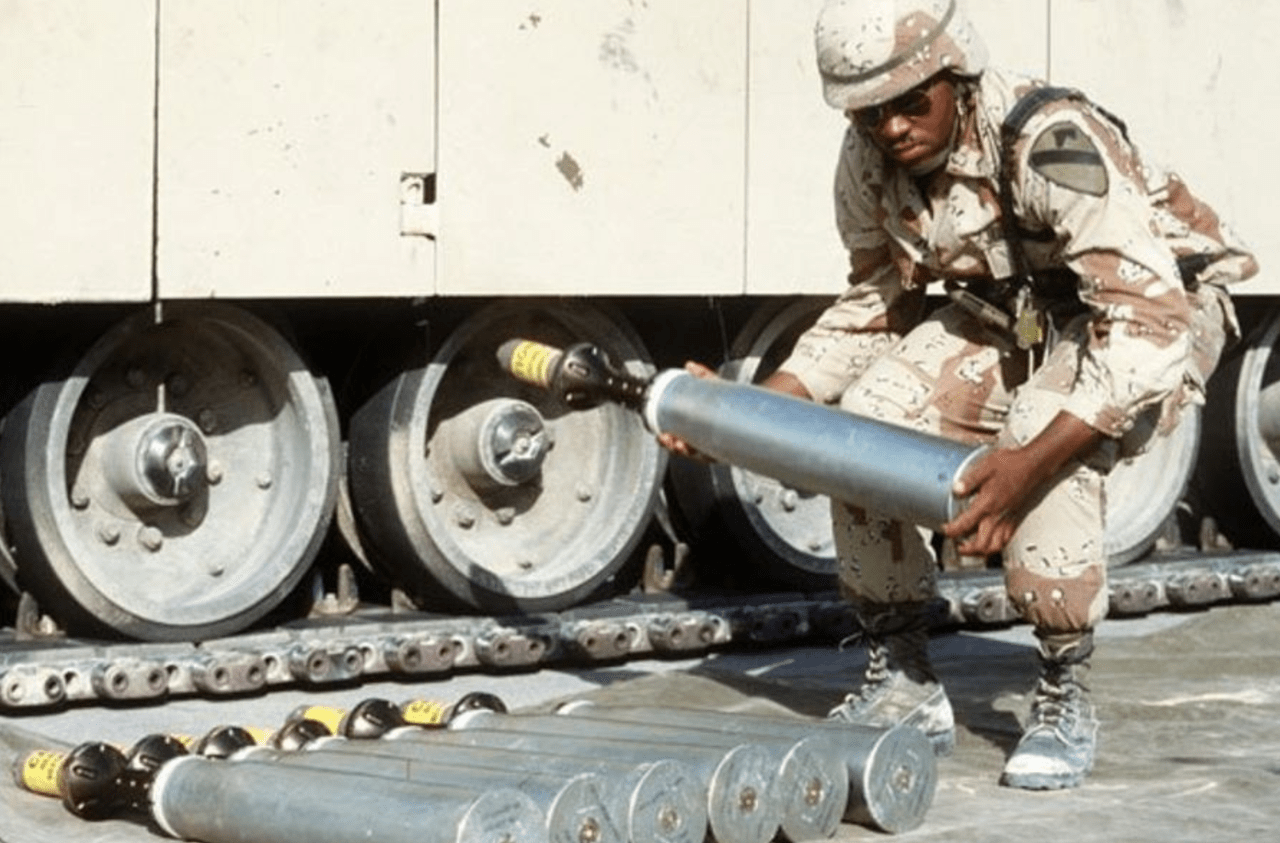
Armour-piercing sabot rounds used in the 1990-91 Gulf War, Getty Images

When asked on Wednesday if the Bradleys the US is sending to Ukraine will be equipped with depleted uranium, a senior Biden administration official said, “I’m not going to get into the technical specifics.”

The official also declined to answer if the M1 Abrams tanks the US is providing Kyiv will be equipped with a depleted uranium cage.

Konstantin Gavrilov, the head of Russia’s delegation in Vienna on arms control, has warned Moscow would view the use of depleted uranium weapons in Ukraine as the use of a “dirty bomb.” Gavrilov claimed that Germany’s Leopard 2 tanks could also be equipped with depleted uranium rounds.

“In case such munitions for NATO-made heavy weapons are supplied to Kiev, we will consider that as the use of dirty nuclear bombs against Russia with all the consequences that come with it,” he said, according to the Russian news agency TASS.

Cancer and birth defects spiked in Iraq after the Gulf War, during which the US fired an estimated one million depleted uranium rounds.

The US also used toxic ammunition in its 2003 invasion, and studies have found that birth defects are more common in areas where depleted uranium was used. Birth defects are still common today in the city of Fallujah.

Tyler Durden
Mon, 01/30/2023 – 05:00

Big Oil Set To Report Record $200 Billion Profits For 2022

0
Big Oil Set To Report Record $200 Billion Profits For 2022

Authored by Tsvetana Paraskova via OilPrice.com,

  • Oil majors’ earnings for 2023 are set to drop from the 2022 record to around $150 billion.

  • Although oil prices traded below $90 per barrel in the last weeks of 2022 and prices increased on an annual basis by only around 10% last year compared to 2021.

  • The industry, the top performer in the S&P 500 index over the past year, has boosted dividends and share buybacks in recent quarters thanks to the massive cash flows.

The five biggest oil majors in the world are expected to report record profits for 2022 in the coming days, for around $200 billion in combined yearly earnings thanks to the jump in oil and gas prices last year. 

This year, earnings at ExxonMobil, Chevron, BP, Shell, and TotalEnergies are set to be around a quarter lower than the combined profits for 2022, but they will still be a whopping $150 billion for 2023, analysts say.  

The record quarterly earnings which the majors reported for the second and third quarters of 2022 have already drawn intense criticism from the White House, which has scrambled to have gasoline prices down from the record levels seen in June. The Biden Administration has accused Big Oil of “war profiteering” and has called on companies to invest in more supply or “face higher taxes.” In Europe, the record earnings are already subject to windfall taxes, which ExxonMobil has challenged in court

The five oil and gas supermajors are expected to report at the end of January and early February combined 2022 earnings of $200 billion, according to early estimates compiled by S&P Capital IQ and cited by the Financial Times. Fourth-quarter earnings will still be well above year-ago levels, although lower than the record quarterly profits for Q2 and Q3. 

The majors’ earnings for 2023 are set to drop from the 2022 record to around $150 billion, which – despite the decline – would be the second-highest profit haul for Big Oil, per projections by S&P Capital IQ.

For 2022, the U.S. supermajors alone are set to post combined yearly profits of nearly $100 billion, analysts say.

Exxon is set to report a record of as much as $56 billion in profit for 2022, while Chevron’s earnings are projected to exceed $37 billion, also a record-high, per estimates compiled by S&P Capital IQ cited by the Financial Times

Although oil prices traded below $90 per barrel in the last weeks of 2022 and prices increased on an annual basis by only around 10% last year compared to 2021, extreme volatility and the frequent surges above $100 per barrel helped all oil firms, including the biggest American integrated companies, generate record or near-record quarterly profits and cash flows. 

The industry, the top performer in the S&P 500 index over the past year, has boosted dividends and share buybacks in recent quarters thanks to the massive cash flows. And its earnings are set to lead the 2022 earnings growth of all 11 sectors in the S&P 500.   

The energy sector is expected to report the highest annual earnings growth of all eleven sectors at 151.7%, John Butters, Vice President and Senior Earnings Analyst at FactSet, said in a report last month. 

“The Energy sector is also expected to be the largest contributor to earnings growth for the S&P 500 for CY 2022. If this sector were excluded, the index would be expected to report a decline in earnings of -1.8% rather than growth in earnings of 5.1%,” Butters noted.  

Lower oil and gas prices in the fourth quarter will impact Q4 earnings at the majors, but refining has held up, and LNG trading at the European majors is also expected to have helped Big Oil in the October-December quarter. 

Early this month, Exxon said in an SEC filing that lower oil prices could have an up to $1.7 billion negative effect on Q4 earnings, while the drop in natural gas prices could have a negative effect of up to $2.4 billion. Those negative effects will be partly offset by a positive contribution of mark-to-market derivative gains of up to $1.5 billion. 

In Europe, Shell said that trading and optimization at its integrated gas and LNG division is expected to have been significantly higher in the fourth quarter of 2022 compared to the third quarter, despite a decline in production volumes. 

Although Q4 and 2023 earnings at the majors are expected to come off the record highs seen in the previous quarters and full-year 2022, profits this year would still be huge compared to the years before 2022. Analysts expect that Big Oil will continue to seek to reward shareholders with the surplus cash, much to the resentment of the Biden Administration. 

U.S. supermajor Chevron announced this week a $75 billion share buyback program without a fixed expiration date, which immediately drew criticism from the White House.  

White House Assistant Press Secretary Abdullah Hasan said, commenting on the news, “For a company that claimed not too long ago that it was ‘working hard’ to increase oil production, handing out $75 billion to executives and wealthy shareholders sure is an odd way to show it.”  

Tyler Durden
Mon, 01/30/2023 – 04:15

Escobar: The ‘Doomsday Clock’ Is Speeding Up

0
Escobar: The ‘Doomsday Clock’ Is Speeding Up

Authored by Pepe Escobar via PressTV,

The Doomsday Clock, set by the US-based magazine Bulletin of the Atomic Scientists, has been moved to 90 seconds to midnight…

That’s the closest ever to total nuclear doom, the global catastrophe.

The Clock had been set at 100 seconds since 2020. The Bulletin’s Science and Security Board and a group of sponsors – which includes 10 Nobel laureates – have focused on “Russia’s war on Ukraine” (their terminology) as the main reason.

Yet they did not bother to explain non-stop American rhetoric (the US is the only nation that adopts “first strike” in a nuclear confrontation) and the fact that this is a US proxy war against Russia with Ukraine used as cannon fodder.

The Bulletin also attributes malignant designs to China, Iran and North Korea, while mentioning, only in passing, that “the last remaining nuclear weapons treaty between Russia and the United States, New START, stands in jeopardy”.

“Unless the two parties resume negotiations and find a basis for further reductions, the treaty will expire in February 2026.”

As it stands, the prospects of a US-Russia negotiation on New START are less than zero.

Now cue to Russian Foreign Minister Sergei Lavrov making it very clear that war against Russia is not hybrid anymore, it’s “almost” real.

“Almost” in fact means “90 seconds.”

So why is this all happening?

The Mother of All Intel Failures

Former British diplomat Alastair Crooke has concisely explained how Russian resilience – much in the spirit of Iranian resilience past four decades – completely smashed the assumptions of Anglo-American intelligence.

Talk about the Mother of All Intel Failures – in fact even more astonishing than the non-existent Iraqi WMDs (in the run-up to Shock and Awe in 2003, anyone with a brain knew Baghdad had discontinued its weapons program already in the 1990s.)

Now the collective West “committed the entire weight of its financial resources to crushing Russia (…) in every conceivable way – via financial, cultural and psychological war, and with real military war as the follow-through.”

And yet Russia held its ground. And now reality-based developments prevail over fiction. The Global South “is peeling away into a separate economic model, no longer dependent on the dollar for its trading needs.”

And the accelerated collapse of the US dollar increasingly plunges the Empire into a real existential crisis.

All that hangs over a South Vietnam scenario evolving in Ukraine after a rash government-led political and military purge. The coke comedian – whose only role is to beg non-stop for bags of cash and loads of weapons – is being progressively sidelined by the Americans (beware of traveling CIA directors).

The game in Kiev, according to Russian sources, seems to be that the Americans are taking over the Brits as handlers of the whole operation.

The coke comedian remains – for now – as a sock puppet while military control over what is left of Ukraine is entirely NATO’s.

Well, it already was – but now, formally, Ukraine is the world’s first de facto NATO member without being an actual member, enjoying less than zero national sovereignty, and complete with NATO-Nazi Storm troopers weaponized with American and German tanks in the name of “democracy”.

The meeting last week of the Ukraine Defense Contact Group – totally controlled by the US – at the US Air Force base in Ramstein solidified a sort of tawdry remix of Operation Barbarossa.

Here we go again, with German Panzers sent to Ukraine to fight Russia.

Yet the tank coalition seems to have tanked even before it starts.  Germany will send 14, Portugal 2, Belgium 0 (sorry, don’t have them). Then there’s Lithuania, whose Defense Minister observed, “Yes, we don’t have tanks, but we have an opinion about tanks.”

No one ever accused German Foreign Minister Annalena Baerbock of being brighter than a light bulb. She finally gave the game away,  at the Council of Europe in Strasbourg:

“The crucial part is that we do it together and that we do not do the blame game in Europe because we are fighting a war against Russia.”

So Baerbock agrees with Lavrov. Just don’t ask her what Doomsday Clock means. Or what happened after Operation Barbarossa failed.

The NATO-EU “garden”

The EU-NATO combo takes matters to a whole new level. The EU essentially has been reduced to the status of P.R. arm of NATO.

It’s all spelled out in their January 10 joint declaration.

The NATO-EU joint mission consists in using all economic, political and military means to make sure the “jungle” always behaves according to the “rules-based international order” and accepts to be plundered ad infinitum by the “blooming garden”.

Looking at The Big Picture, absolutely nothing changed in the US military/intel apparatus since 9/11: it’s a bipartisan thing, and it means Full Spectrum Dominance of both the US and NATO. No dissent whatsoever is allowed. And no thinking outside the box.

Plan A is subdivided into two sections.

1. Military intervention in a hollowed-out proxy state shell (see Afghanistan and Ukraine).

2. Inevitable, humiliating military defeat (see Afghanistan and soon Ukraine). Variations include building a wasteland and calling it “peace” (Libya) and extended proxy war leading to future humiliating expulsion (Syria).

There’s no Plan B.

Or is there? 90 seconds to midnight?

Obsessed by Mackinder, the Empire fought for control of the Eurasian landmass in World War I and World War II because that represented control of the world.

Later, Zbigniew “Grand Chessboard” Brzezinski had warned: “Potentially the most dangerous scenario would be a grand coalition between Russia, China and Iran.”

Jump cut to the Raging Twenties when the US forced the end of Russian natural gas exports to Germany (and the EU) via Nord Stream 1 and 2.

Once again, Mackinderian opposition to a grand alliance on the Eurasian landmass consisting of Germany, Russia and China.

The Straussian neo-con and neoliberal-con psychos in charge of US foreign policy could even absorb a strategic alliance between Russia and China – as painful as it may be. But never Russia, China and Germany.

With the collapse of the JCPOA, Iran is now being re-targeted with maximum hostility. Yet were Tehran to play hardball, the US Navy or military could never keep the Strait of Hormuz open – by the admission of the US Joint Chiefs of Staff.

Oil price in this case would rise to possibly thousands of dollars a barrel according to Goldman Sachs oil derivative experts – and that would crash the entire world economy.

This is arguably the foremost NATO Achilles Heel. Almost without firing a shot a Russia-Iran alliance could smash NATO to bits and bring down assorted EU governments as socio-economic chaos runs rampant across the collective West.

Meanwhile, to quote Dylan, darkness keeps dawning at the break of noon. Straussian neo-con and neoliberal-con psychos will keep pushing the Doomsday Clock closer and closer to midnight.

Tyler Durden
Sun, 01/29/2023 – 23:30

Mixed Oil Momentum Signals To Persist Until Impact Of War Fades

0
Mixed Oil Momentum Signals To Persist Until Impact Of War Fades

By Ryan Fitzmaurice of Marex

As many traders would agree, sometimes it’s not the data that is important but rather the price reaction to the data. We believe this is the case with oil prices recently. Looking at US inventory statistics, crude oil stocks have built by an incredible +27mb over the past two reports, yet oil prices have rallied more than 10% over the same timeframe in a classic case of sell the rumor, buy the fact. As for the sharp rise in US crude inventories, it’s not as if oil fundamentals have shifted on a dime, but rather it’s the result of the extreme cold weather that ravaged the US energy corridor in late December. The cold forced several major US refineries to shut down due to operational issues related to the freezing temperatures. Additionally, end of year tax on inventory in Texas and Louisiana caused oil imports to come onshore in early January.

So, despite what seems to be very bearish data points, the oil market appears focused on China’s abrupt reopening plans and the improving macro backdrop as opposed to backward looking inventory that was impacted by weather. In fact, the spot Brent contract is now trading in the mid to high $80s and above many moving averages. The oil rally has also coincided with a notable increase in futures open interest and managed money buying. The combined aggregate futures open interest for ICE Brent and Nymex WTI has climbed by +440mb since the start of the year while the net managed money position has increased by +68mb since last Tuesday, the latest reporting period for the CFTC positioning data. Also, about half of the net buying has come from “short”covering due to the big shift in momentum the past two weeks.

Oil prices have now turned higher on the year despite oil stocks climbing by +27mb for the first two reports of January, as the focus shifts to China’s reopening…

Mixed Signals

Last week we discussed momentum traders, and how their herd-like behavior can impact oil prices at times. Today we want to expand on that topic while discussing the impact the war in Ukraine has had on the momentum factor. To reiterate our point from last week, momentum is a very simple and straight forward trading strategy, buying commodities or assets with positive returns and selling those with negative returns over a pre-defined timeframe. For example, the one-year momentum signal tends to be a popular long-term indicator that measures the roll-adjusted return of the past year. Given we are dealing with historical prices, it is possible to look at the price development of the prior year to formulate a roadmap of how this key hurdle will change with time. It is worth noting that roll-adjustments will alter the momentum indicator somewhat, with contango increasing the signal threshold over time while backwardation decreases it.

With that in mind, we are all aware of how erratic oil prices were last year, and particularly in the early stages of the Russian invasion of Ukraine in late February. In fact, spot Brent prices spiked from below $80 at the start of 2022 to more than $135 by early March. This is important to remember because the huge spike in oil prices is going to make for an increasingly higher bar with respect to the one-year momentum signal as we approach the anniversary of the start of the war. Importantly, the forward curves shifted into a strong state of backwardation for several months after the price spike, which has worked to lower this key hurdle, but the current contango could work to offset that in the coming months should it hold. On the flip side, the weak price action more recently could make for a low bar with respect to shorter-term signals. As a result, mixed oil momentum signals are likely to persist until the impact from the war fades.

The threshold for the 1-year momentum signal will become increasingly higher over the first half of the 2023, before declining in the second half of the year…

Thinking Ahead

Oil prices are now higher on the year after a very sharp decline the first week of January and despite some sizable US inventory builds. Notably, open interest has also increased alongside prices as new money enters the fray. So far, there has been little in the way of commodity index inflows this year, however, one would assume “long-only” investor dollars are likely to be chasing oil prices given the past two years of stellar returns. This group of institutional investors should gain more influence as the war-inspired volatility begins to filter out of risk models, allowing for increased position sizes. This dynamic should become more apparent in 2H23 though.

Fundamentally, all eyes remain on the Chinese reopening and its potential demand implications for this year. As we have been highlighting recently, Chinese crude imports already climbed to more than 11mb/d in November and December, even before the abrupt pandemic policy reversal took place. This supports the notion that China will likely need record oil imports this year to meet its refining demand. In addition, we believe the US will also need to increase crude imports this year to fill the void left by the cessation of SPR releases and as the US refining system bounces back from the cold related outages.

Aggregate futures open interest for the two benchmark crude oil contracts has increased sharply to start the new year, albeit from a low base…

Tyler Durden
Sun, 01/29/2023 – 23:00

A Tale Of Two Presidents: Biden Vs Trump

0
A Tale Of Two Presidents: Biden Vs Trump

Via The Automatic Earth blog,

Highly appreciated Automatic Earth commenter TAE Summary presents another one of his series “A Tale of Two..”, and if only just for the obvious effort he put into it, let’s dig in.

How do you feel about what each president has achieved? No wrong answers.

TAE Summary:

Biden is a Great President and Trump was an Awful President

Biden

  • Appointed a diverse cabinet

  • Signed executive orders addressing systemic racism and discrimination

  • Passed the infrastructure bill to repair roads and bridges and improve internet access

  • Reduced the deficit

  • Led NATO in its support of Ukraine and opposition to Vladimir Putin

  • Lowered the child poverty rate by increasing the tax credit for children

  • Launched a program to protect earth from killer asteroids

  • Officially recognized Turkish genocide of Armenians in 1915

  • Sidelined the court-packing movement of the left

  • Stepped up US support for Taiwan

  • Announced a historic trilateral security agreement with Australia and Britain to counter Chinese hegemony

  • Accelerate Covid vaccine delivery at home an abroad

  • Improved the American economy by championing competition and reining in the power of big business which helped create millions of jobs

  • Gave Medicare the power to negotiate drug prices and made the price of things like insulin and hearing aids cheaper

  • Attacked hunger and fostered better nutrition in the US

  • Funded opioid recovery programs

  • Eliminated the statute of limitations for child sex abuse

  • Tried to reform student loans

  • Issued important cybersecurity regulations

  • Chose humanity over politics when getting Brittney Griner released

Trump

  • Colluded with the Russians to get elected in 2016

  • Appointed unqualified family members to important positions in his administration

  • Tried to ban TikTok

  • Withdrew the US from the Paris Climate Accords

  • Increased the deficit every year of his presidency

  • Approved the Keystone Pipeline through native lands

  • Disallowed transgender students from using the bathroom of their choice

  • Attacked John McCain as a loser

  • Ended curbs on auto emissions

  • Cracked down on legal immigrants

  • Impeded regulation against toxic chemicals

  • Shrank the food safety net so that over 700K Americans lost their access to food stamps

  • Suggested vaccines cause autism

  • Accused Barack Obama of spying on his campaign

  • Cut corporate taxes to the lowest level since 1939

  • Oversaw the longest government shutdown in US history

  • Acted as a racist and xenophobe when he implemented a travel ban from Muslim countries, blamed the Chinese for Covid, separated families at the US border, tried to build a wall between the US and Mexico and gave racist speeches

  • Tried to repeal the Affordable Care Act which would have left millions without healthcare

  • Inadequately responded to Covid, downplaying the dangers

  • Use his influence as president to try to get Ukraine to provide damaging narratives about his political opponent

  • Challenged the outcome of the 2020 election undermining democratic institutions and the public’s trust in elections which led to the events of January 6th and the deaths of 5 people

Trump was a Great President and Biden is an Awful President

Trump

  • Negotiated three Arab-Israeli peace accords

  • Fostered a strong economy and stock market by signing into to law the Tax Cuts and Jobs Act and other policies

  • Started the Space Force

  • Attempted the first Defense Department wide audit

  • Cracked down on unwanted robo-calls

  • Attempted to build a wall on the border with Mexico to stop illegal immigration

  • Helped American farmers with billions of dollars in aid

  • Tried to fix health technology by removing rules blocking the sharing of medical information

  • Rescinded rules for federal contractors that protected them from sexual harassment claims

  • Made it easier to prosecute financial crimes like money laundering

  • Renegotiated trade deals with Mexico, Canada and China which benefitted American workers and businesses

  • Appointed three Supreme Court justices and many other conservative judges to federal courts leading to pro-Constitutional decisions like the overturning of Roe

  • Passed the VA MISSION Act which improved healthcare access and services for veterans

  • Oversaw the defeat of the Islamic State’s territorial caliphate in Syria and Iraq

  • Kept us out of war

  • Signed executive orders and laws combating human trafficking

Biden

  • Opened the borders to illegal immigrants

  • Discharged thousands of troops for refusing the Covid vaccine

  • Opposed efforts to stop biological males from competing in women’s sports

  • Lied about border patrol agents whipping migrants

  • Claimed that January 6th rioters were a bigger threat to democracy than Confederates in the Civil War

  • Described terrorism from white supremacy as the most lethal threat to the US

  • Oversaw the disastrous withdrawal of American troops for Afghanistan

  • Mis-handled the response to Covid mandating vaccines and dividing the nation on the basis of vaccination status

  • Supported lockdowns and other pandemic polices which damaged the supply chain and the world economy

  • Supported violent protesters instead of the police during the BLM riots

  • Lied about Hunter’s laptop saying it was Russain disinformation

  • Stated that election reform is the new Jim Crow

  • Suppressed first amendment rights by influencing policies of social media outlets

  • Supported the war in Ukraine and vilified Russia as our enemy

  • Blocked American energy production

  • Illegally attempted to forgive student loans

  • Printed massive amounts of money causing massive inflation

I have one comment: I don’t think that “Joe Biden” (in Jim Kunstler language) only “supported the war in Ukraine and vilified Russia as our enemy”, “Joe Biden” did a lot more to poke the bear and instigate and fire up the war. But that’s just me. You can be the judge of that too.

Also just me: when Trump left and Biden came, we were at peace. Look at us now.

*  *  *

We try to run the Automatic Earth on donations. Since ad revenue has collapsed, you are now not just a reader, but an integral part of the process that builds this site. Thank you for your support.

Tyler Durden
Sun, 01/29/2023 – 22:30